UK’s Caroline Dinenage “delighted” to keep embarrassing herself
By Didi Rankovic | Reclaim The Net | September 11, 2024
The UK has a new/old chair of the parliament’s Culture, Media and Sports Committee – and she is yet another champion of (obliging) Big Tech, and a veteran in the “war on disinformation,” but also attempts to demonetize “disfavored” public figures.
Caroline Dinenage keeps failing upwards: she has just been reelected to this role, after last year embarrassing herself by trying to pressure X and Rumble, and other platforms and media to demonetize actor Russell Brand because of anonymous allegations against him.
The Committee that scrutinizes the activities of the Department for Culture, Media and Sport (BBC included), has a Sub-Committee specifically focused on what are considered online harms and disinformation, as well as UK’s sweeping censorship law, Online Safety Act.
It is from this position that Dinenage last fall decided it was a good idea to turn to X with the demand to cut Brand off from his revenue on the platform because of the (to this day unproven) accusations.
X refused. And the company explained why to the British MP in a letter that underscored commitment not only to free speech, but also X’s own terms of service.
“We do not take action on accounts where they have not violated our own rules or local laws (Brand was not at the time, and is still not charged with any crime). This is essential to protect free expression on the service,” the letter read, adding that all, including monetized content, is subject to X’s rules and user agreement.
X wasn’t the only platform Dinenage went to in a bid to swiftly deprive Brand of money: YouTube was one of them, and lo and behold, this one went along, demonetizing Brand in October 2023. All this happened before the alleged victims and the alleged perpetrator had undergone any due process.
And for a British MP to pressure platforms to punish someone essentially based on hearsay at that point is what famed journalist Glenn Greenwald called “preposterous.”
Rumble was another platform Dinenage urged to demonetize Brand last year. That would be a no, ma’am – was the essence of the free speech video platform’s response to Dinenage.
“We regard it as deeply inappropriate and dangerous that the UK Parliament would attempt to control who is allowed to speak on our platform or to earn a living from doing so,” Rumble’s letter said, among other things.
But now, Dinenage – once a recipient of a non-monetary grant from Google – shared that she is “delighted” to continue where she left off with the previous parliament’s Culture, Media and Sports Committee.
Pro-War Lobby Attacks Alleged ‘Russian Influencers’
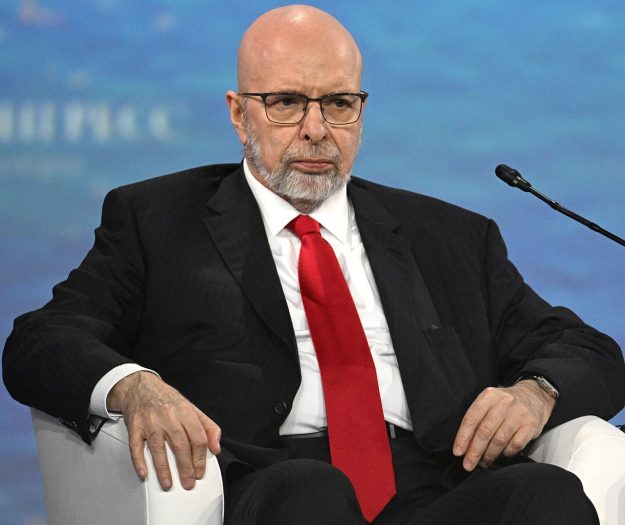
Photo Credit: http://www.kremlin.ru
By Ted Galen Carpenter | The Libertarian Institute | September 10, 2024
In recent weeks, there has been a surge of allegations that Moscow has long orchestrated an illegal campaign to influence U.S. public opinion. On September 4, 2024, the U.S. Justice Department charged two Russian media executives with an alleged scheme that authorities say illegally funneled millions of dollars to a Tennessee-based company called Tenet to create and publish propaganda videos that subsequently racked up millions of views on American social media. In a separate legal action, prosecutors seized thirty-two Russian-controlled internet domains that were used in a state-controlled effort called “Doppelganger” to undermine international support for Ukraine. As an aside to such legal maneuvers, U.S. officials contended that 1,800 Westerners, including twenty-one Americans, were guilty of acting as “influencers” on behalf of Russia.
The Justice Department filed an even more high-profile case the next day, accusing Dimitri Simes, founder of the Center for the National Interest, and his wife Anastasia, of illegally accepting more than $1 million in salary and other benefits from the state-owned Channel One Russia television station and trying to conceal the payments.
The Joe Biden administration is shamelessly hyping the prosecutions to smear anyone who criticizes or even questions U.S. policy towards Russia. Wall Street Journal columnist Holman Jenkins notes that Russian propaganda efforts in the United States have been spectacularly ineffective over the years. Nevertheless, Attorney General Merrick Garland, in announcing the latest prosecutions, asserted that “Russian disinformation is ‘a bigger threat’ than ever.” Garland’s smears were often stunningly vague, though. For example, he conceded that “the Kremlin-influenced U.S. influencers were unaware they were benefiting from Russian money.” That statement comes alarmingly close to contending that pro-Russian “influencers” were unintentional criminals. Garland stated, for example, “subject matter and content of many of the videos published by the company [Tenet] were often consistent with Russia’s interest in amplifying U.S. domestic divisions.” Such a vague standard also gives an administration virtually a blank check to harass its ideological or political opponents.
There were several suspicious aspects about the Justice Department’s moves. One was the timing. The indictments took place just days before the scheduled debate between Republican presidential nominee Donald Trump and Democratic presidential nominee Kamala Harris. The inflammatory tone in media articles from The Washington Post and other establishment publications dealing with these new prosecutions even more strongly suggests that partisanship is at play. For example, the Post’s headline read: “Trump-aligned Russian TV host charged in alleged sanctions scheme.”
However, there also seemed to be more than petty partisanship involved. Dimitri Simes, in particular, had long been an irritant to hawks in America’s national security state. His efforts to improve relations between Washington and Moscow especially were deeply resented by Russia haters in the powerful pro-war lobby. That hostility was magnified because of the prominence that The National Interest had achieved under Simes’ leadership.
The Biden administration’s ongoing campaign to squelch dissent about Russia policy is profoundly menacing and worrisome. I have published several articles in The National Interest over the years and have been a contributing editor to that publication. Given my interactions with Dimitri Simes, I have extensive doubts about whether he is guilty of the charges against him.
But even in the unlikely event that the charges are accurate, there are other, more fundamental issues that should concern all Americans. The statutes that he is accused of violating are sufficiently vague as to pose a threat to freedom of speech, in particular badly needed debates on numerous international issues like the tense relations between Russia and the United States. Could, for example, publishing an article in The National Interest or participating in a discussion sponsored by the Center inadvertently violate pertinent statutes? What about a paid interview? How could an author or participant be confident one way or the other? The mere existence of the Foreign Agents Registration Act (FARA) and various sanctions laws directed against specific countries pose an intolerable mess to the First Amendment.
The overall rationale for prosecuting alleged “influencers” should offend every American who believes in freedom of expression. Preventing American citizens from accessing pro-Russian viewpoints is inappropriate in what purports to be a free, democratic society. That is true even if the Russian government is funding and directing such propaganda.
Moreover, Washington’s hypocrisy on the issue is truly breathtaking. The U.S. government directly and through front groups spends billions of dollars each year propagandizing foreign audiences with material that, not accidentally, also frequently ends up impacting domestic opinion. There is credible evidence that both U.S. and foreign journalists have been paid by the CIA to disseminate Washington’s propaganda. Evidence has even emerged that (primarily in Middle Eastern countries) the United States government established bogus “independent” media outlets to serve the same purpose.
Beyond such mundane measures, the U.S. propaganda apparatus has developed an especially close and unhealthy relationship with its Ukrainian counterpart. Washington has even funded and promoted Ukrainian government agencies that target and harass American critics who dare seek an end to NATO’s proxy war against Russia. The latest Justice Department actions suggest that Washington’s ugly campaign remains intact.
It is especially ironic (as well as infuriating) for U.S. officials such as Attorney General Merrick Garland to grouse about Russia’s efforts to reduce U.S. and international support for Ukraine. The Biden administration has waged a massive effort to echo and amplify Kiev’s propaganda in the United States as well as around the world. Most galling of all, the administration has worked with the Ukrainian government to suppress dissent in the United States about U.S. policy on the Russia-Ukraine war. In a truly free society, citizens must not be threatened by their own government for failing to support a particular foreign policy. The latest Justice Department prosecutions violate the most fundamental features of a democratic system.
Demand for Justice: World Council for Health urges the immediate release of Dr. Reiner Füellmich
World Council for Health | September 10, 2024
The international human rights community is rallying to demand the immediate release of Dr. Reiner Füellmich, a lawyer from Germany who has been in pre-trial detention for over 10 months. Arrested under dubious circumstances at Frankfurt Airport on October 13, 2023, Dr. Füellmich’s case has raised serious concerns regarding the legality of his detention and the integrity of the judicial process. Of the initial 18 charges made against Füellmich, only one remains regarding personal loans.
According to German law, the maximum duration of pre-trial detention is six months, as outlined in 121 para. 1 of the German Code of Criminal Procedure (StPO). “Special or important reasons for an extension of pre-trial detention beyond the 6 months are not apparent.” This assertion highlights the urgent need for a re-evaluation of Dr. Füellmich’s ongoing detention.
In a significant development, it has come to light that Dr. Christof Miseré, one of the defense attorneys representing Füellmich, obtained a dossier from the German secret services. This document explicitly outlines a directive to halt Füellmich by any means necessary. Alarmingly, it details a strategy to infiltrate individuals within his inner circle of collaborators. Furthermore, the dossier reveals a clear objective: to convict Fuellmich, thereby obstructing any future aspirations he may have for public or political office. This information raises serious questions about the lengths to which authorities may go to silence dissenting voices. This dossier, given to Miseré by a whistleblower, demonstrates that Reiner Füellmich was already under special surveillance as far back as 2021.
Adding to the controversy is the manner of Dr. Füellmich’s arrest. He was reportedly “kidnapped” from Mexico, where he had been residing legally. A German and a European arrest warrant were issued against him, ostensibly to circumvent lengthy international extradition procedures. The Göttingen public prosecutor’s office collaborated closely with officers from Interpol and the Federal Criminal Police, orchestrating a deceptive plan to lure Dr. Füellmich to the Mexican consulate under false pretenses, an act that raises significant legal and ethical questions about the conduct of authorities involved.
Despite multiple assertions from both his defense and Dr. Füellmich himself regarding the illegality of his deportation, these concerns have been largely dismissed in court. Lawyers argue that the circumstances surrounding his abduction and subsequent detention underscore critical national and international legal issues that must be addressed.
Currently held in Rosdorf Prison near Göttingen, Dr. Füellmich faces harsh and isolating conditions. He is segregated from other inmates, permitted only solitary yard time, and restricted in his communication with the outside world, limited to a mere three hours of private visits per month. This punitive environment raises further questions about the treatment of individuals in pre-trial detention, particularly when contrasted with the lack of substantial evidence to justify such measures. On June 11, Reiner Füellmich was once again placed in solitary confinement, a status he continues to endure. This isolation means he is prohibited from any interaction with other inmates. The authorities justified this extreme measure by alleging that Füellmich had been providing legal advice to his fellow prisoners, a situation deemed unacceptable by those overseeing his incarceration. Füellmich is required to eat in isolation and is granted just one hour each day for outdoor activity, which is also spent in complete solitude. He is not allowed access to the gymnasium and can only use the telephone after other inmates have returned to their cells. This strict regimen underscores the severity of his confinement and the restrictions imposed upon him.
The charges against Dr. Füellmich include embezzlement, yet many observers, including his defense, contend that this trial has transcended ordinary judicial proceedings and has become a politically motivated effort to silence a prominent critic of COVID-19 measures. The trial has seen troubling shifts in legal parameters, further complicating the case and undermining the principles of justice.
In light of these serious allegations and the apparent disregard for due process, World Council for Health is calling for the immediate release of Dr. Reiner Füellmich. This situation not only affects one individual but also serves as a stark reminder of the potential for political influence to infiltrate the judiciary, compromising the very foundations of justice and fairness.
As the international freedom movement watches closely, it is imperative that justice prevails and that Dr. Füellmich is granted the freedom he deserves, freedom that is essential not only for him but for the integrity of the legal system itself.
Take action now – Sign the petition calling for the release of Reiner Füellmich
Trump Pledges to Fire Federal Employees Engaged in Censorship Pressure
By Cindy Harper | Reclaim The Net | September 10, 2024
Former United States President Donald Trump’s pledge to safeguard the First Amendment was a highlight of his recent campaign rally in Wisconsin. Standing against the Big Tech censorship attempts by the ruling Biden-Harris administration, Trump stated his commitment to protecting the free speech of Americans, “I will sign an executive order banning any federal employee from colluding to limit speech, and we will fire every federal bureaucrat who is engaged in domestic censorship under the Harris regime.”
His remarks come in the wake of heightened debate around safeguarding free speech rights. The First Amendment, recognized as the bedrock of American values and rites, guarantees every citizen the right to voice their opinion, peacefully protest, and practice their religion without intrusion from the government. However, these liberties have come under fire in the online world, with government pressuring social media platforms to censor speech.
Under the Biden-Harris governance, the administration has been accused of muzzling so-called “misinformation.”
Congressional investigations like those conducted by the Select Subcommittee Government Committee on Weaponization and lawsuits against the administration have brought many incidents of censorship pressure to light.
This suppression undermines public trust in institutions by concealing inconvenient information.
In 2022, the administration introduced the short-lived Disinformation Governance Board. The board was shut down following pushback over First Amendment concerns.
Durov still does not get it
By Stephen Karganovic | Strategic Culture Foundation | September 10, 2024
After being released on bail from a French prison, Russian entrepreneur Pavel Durov made several statements which indicate that he is labouring under grave illusions about the nature of his predicament. He described the action of the French authorities, which resulted in his arrest and detention on French territory, as “surprising and misguided.” He then went on to question the legal premise of his detention and subsequent indictment, which is that he could be held “personally responsible for other people’s illegal use of Telegram.”
It is disappointing to see a thirty-nine years old sophisticated cosmopolitan adult, traumatised as he must be by his recent experiences, reasoning like a child. One should have expected a person of Durov’s wealth to secure competent legal assistance to help him understand the legal “facts of life” pertaining to his case.
There are two basic facts that the lawyer selected by Durov to represent him should have explained to his client. Incidentally, that lawyer is extremely well wired into the French establishment and the judicial system which is persecuting his bewildered protégé. It would not be uncharitable to say that his loyalties are dubious.
The first and most fundamental of these facts is the political nature of the case. Durov’s predicament cannot be properly understood apart from that reality. Recognition of that fact does not exclude entirely the effective use of legal arguments and remedies but it marginalises their practical impact. The second important fact that a conscientious legal professional already in the first interview would have made clear to his client is that in the real world in which Durov is facing grave criminal charges, indulging intuitive notions of justice, including the premise that a person cannot be held criminally liable for third-party acts, is a naïve and utterly misguided approach.
Pavel Durov is a highly intelligent and, in his field, very accomplished individual. But on another level he is just a computer nerd and his incoherent actions and statements are proof of that. Contrary to what he seems to think possible, and as incompatible as that may appear to be with the concept of natural justice, under specific circumstances an individual can be criminally charged for the acts of third parties. Mechanisms that make that possible already are firmly in place. We would not necessarily be wrong to characterise those mechanisms as repugnant to the natural sense of justice, or even as quasi-legal. But formally they are well established and are integral components of criminal law. Tyrannical political systems are free to invoke those instruments whenever they decide to target a bothersome non-conformist such as Pavel Durov.
Whilst on the one track relentless pressure is undoubtedly being applied to the conditionally released but still closely supervised Durov to accede to the demands of deep state structures and turn Telegram’s encryption keys over to security agencies, on a parallel track the legal case against him is being constructed. It will be based on some variant or derivative of the theory of strict liability. The exact contours of that variant are yet to be defined as the case proceeds, and everything will depend on how the defendant responds to the combination of carrots and sticks that are now being put in front of him. Since no evidence is being offered to prove that acting personally in his capacity as Telegram CEO Durov was complicit in any of the incriminating activities listed in the charge sheet, the only conclusion that can be drawn is that some version of strict liability will be the vehicle of choice to make the accusations stick. Unless he capitulates, the objective is to put him away for a long time, or at least to threaten him credibly with such an outcome in order to exact his cooperation. Strict liability is a convenient tool because it offers many shortcuts to the Prosecution. It achieves the desired effect in the absence of proof of specific intent and regardless of the defendant’s mental state, thus eliminating for the prosecution major evidentiary hurdles.
Furthermore, from the beginning of the Durov case groundwork was notably being laid for the application of the Joint Criminal Enterprise [JCE] doctrine as developed by the Hague Tribunal, its category III to be precise. Even seasoned lawyers practicing at the Hague Tribunal were at a loss what to make of that legal improvisation. But their incomprehension did not prevent successive chambers from sentencing defendants to decades of prison, wholly or in part based on it.
Durov is being charged on 12 counts, including complicity in distributing child pornography, drug dealing and money laundering. It should again be recalled that it is not even alleged that Durov personally committed or intentionally participated in the commission of any of those offences. The charges stem from the accusation that Telegram’s lax moderation rules allow for the widespread criminal use of the platform by others, with whom it is not claimed that Durov entertained any direct personal link or that he was even aware of their existence.
But the marvellous feature of the category III JCE doctrine, specially invented by the chambers of the Hague Tribunal to accommodate the Prosecution in situations in which it could not contrive even the semblance of a nexus between the defendant and the crimes being imputed to him, is that it does not require any of those things. A vaguely inferred commonality of purpose, coupled with the assumption that the defendant should have been able to foresee but failed to prevent the illicit conduct of the third parties with whom he is being associated by the Prosecution, and with whom he needn’t have had direct communication or even personal acquaintance, serves as a sufficient link. If in the chambers’ considered judgment the defendant contributed substantially to generating conditions conducive to third-party unlawful conduct, that is enough. Proof that the third parties had committed the charged acts is sufficient basis to convict and no disavowal of criminal liability is practically possible.
If in relation to the third parties the defendant is situated in a position that the court deems culpable, nothing more is needed for liability for their conduct to be imputed to him.
The system’s prosecutors are eager to make those and perhaps some even more ingenious arguments to sympathetic judges. Woe to the person sitting in the dock.
That is precisely the general direction in which the Durov case is moving. In an ominous but highly indicative development, the French prosecutors are highlighting the alleged paedophile offences of an individual user of Telegram, who for the moment is identified cryptically only as “X,” or “person unknown,” and who is suspected of having committed crimes against children. The prosecution’s objective is to individualise and dramatise Durov’s guilt by connecting him to a specific paedophile case, the details of which can be disclosed later. If that sticks, some or all of the remaining charges in due course may even be dropped, without prejudice to the prosecution’s overarching goal of incarcerating Durov for a long period of time, unless he compromises. Paedophilia and child abuse alone merit a very lengthy prison sentence, without the necessity of combining them with other nasty charges.
In that regard, equally ominous for Durov is the activation, as it were on cue, of his ex-whatever in Switzerland, with whom he is alleged to have sired at least three out-of-wedlock children. Prior to his detention in France, Durov had capriciously terminated her 150,000-euro monthly apanage. This was a financial blow which naturally left her disgruntled and receptive to the suggestion of the investigative organs to come up with something to take revenge on her former companion. The woman is now accusing Durov of having molested one of the children that he had conceived with her. That is an independent and serious new charge whose potential for further mischief should not be underestimated.
Pavel Durov should stop wasting his time attempting to lecture his French captors on the wrongfulness of the persecution to which they are subjecting him. They are completely uninterested in the philosophical and legal principles to which Durov is referring. Like their transatlantic colleagues, who display juridical virtuosity by indicting ham sandwiches, with equal facility and with as little professional remorse French prosecutors are prepared to indict bœuf bourguignon, if that is what the system they serve demands of them. Far more than a legal strategy, Durov now needs an effective negotiating position (and perhaps also a crash course in poker) to preserve the integrity of his enterprise and to regain fully his freedom without sacrificing honour. For an excellent introduction to the Western rules based order, Durov need look no further than the woeful predicament of Dr. Reiner Fuellmich, the German-American lawyer who for months has been languishing in a German prison after being targeted on trumped-up charges for exposing the fraud of the recent “health emergency” that we all vividly recall.
Properly understood, the Durov affair should come as a sobering lesson not only for its principal but more importantly for the edification of the frivolous Russian intelligentsia who still entertain adolescent illusions about where the grass is greener and continue to nourish a petulant disdain for their own country, its way of life, and culture.
‘Biden is out to get me’: A Russian-American TV host facing 60 years in an American jail speaks out
RT | September 9, 2024
The US Department of Justice has accused the 76-year-old – a former adviser to the late US President Richard Nixon who now hosts a talk show on Russian TV – with sanctions violations and money laundering. His wife Anastasia has also been indicted.
Born in Moscow, Simes left the Soviet Union at the age of 26. He had fallen afoul of Leonid Brezhnev-era officials for protesting against the USSR’s involvement in the Vietnam conflict. In the US, he was a professor at Johns Hopkins University. He also ran the Soviet policy program at the Center for Strategic and International Studies, and taught at the University of California at Berkeley and at Columbia University.
Simes then served as President of the Nixon Center and later as president and CEO of the Center for the National Interest, a major Republican-party aligned think tank.
In 2013, Carnegie honored him as a “Great Immigrant and Great American.” He left National Interest in 2022 and returned to Moscow, where he hosts the show ‘The Great Game’ on Russia’s Channel One.
In an interview with Kommersant correspondent Elena Chernenko, Simes has commented in detail on the allegations made by American officials.
– According to the US Department of Justice, you allegedly participated in schemes to “violate US sanctions on behalf of Channel One” and to “launder funds obtained as a result of this scheme,” and your wife allegedly also participated in a scheme to “violate US sanctions” in order to receive funds from a blacklisted Russian businessman. How would you respond to these allegations?
– Lawlessness and blatant lies. A combination of half-truths and outright fabrications. I’m accused of money laundering. But of what, according to the US Department of Justice? It’s from my salary, which went into an account at Rosbank in Moscow, the bank used by Channel One, I transferred some of the money to my bank in Washington. And why do you think? To pay my American taxes [the US has dual taxation for citizens working abroad – RT]!
In my opinion, not only was there nothing illegal about it, there was nothing unethical about it either. They [the US authorities] say that, somehow, I was hiding something. That I could not transfer money directly from a Russian bank to an American bank. That it’s impossible because of American sanctions. So, I had to transfer money through a third bank. This, of course, complicated the process, but there is nothing illegal [about it] in either Russian or American law. It is simply outrageous to call it money laundering.
As for the accusation that I allegedly violated the US sanctions imposed on Channel One, first of all I would like to remind you that there is one thing that the Biden administration does not take seriously. I’m talking about the United States Constitution and the First Amendment, which guarantees freedom of speech and freedom of the press. And I insist that everything I have done as a journalist I have done within the framework of the First Amendment of the American Constitution.
Secondly, I would like to draw your attention to the fact that the sanctions against Channel One were not approved by the US Congress, it was just a decree from the Treasury Department saying that it was not allowed to do business with Russian federal TV channels. But this ban was very vaguely worded. It could have been interpreted as a prohibition on helping the federal channels in any financial way, through any kind of payment or donation. Or it could be interpreted more broadly as a ban on any interaction.
– How did you interpret it?
– After this decree appeared, I was told that there was a conversation between representatives of the Russian Foreign Ministry and the US State Department, during which the American side explained that the main purpose of these sanctions was to prevent Russian federal channels from receiving Western funding. And they should not affect the work of journalists.
– So you believed that your work at Channel One did not violate US sanctions?
– That’s what I was told. But I was not satisfied. I personally spoke to a senior US administration official about this. I was told that, of course, we do not approve of your work at Channel One, and if you continue to work there, it will not help your reputation and career in America, but this sanctions decree is aimed at curbing the channel’s financial revenues, not at preventing journalists from working.
In other words, I felt that, from the point of view of the US administration, I was doing something undesirable but not something for which I could be prosecuted.
– Have you spoken to lawyers?
– Of course I have. I consulted American lawyers and they had the same point of view. Now I am facing criminal charges, just for doing my job as a journalist.
– You have not been in the US since October 2022. Were you worried that the case might not be limited to a verbal expression of displeasure?
– I had a feeling that there might be a problem. But I wasn’t certain, and I had even less of an expectation that it could lead to a prosecution. I think the White House decided to go ahead and stir up the issue of Russian interference in the American election again. I had nothing to do with any interference and have nothing to do with it. Moreover, I am absolutely certain that there was and is no large-scale interference. And when I hear that charges have been brought against me as part of a campaign against Russian interference in American elections, I have the feeling that this is not only politicized, but completely fabricated.
– Yes, the New York Times, in describing the situation, wrote that the charges against you were ‘part of a broader government effort to thwart Russian attempts to influence American politics in the run-up to November’s presidential election.’
– I work for Channel One and everything I do is, by definition, very open. It’s all in Russian. Channel One does not broadcast in the United States. I could not and cannot influence the American domestic political situation in any way.
As far as interference is concerned, it would probably be more interesting to look at the demands of Ukrainian officials who have been urging the White House to take action against me for a long time.
We are talking about Ukrainian interference at quite a high level.
The “[Andrey] Yermak- [Michael] McFaul Expert Group on Russian Sanctions” [run by Vladimir Zelesnky’s top advisor and a former US ambassador to Russia, to develop recommendations on sanctions] is working on this conspiracy. This is a legalized form of high-level Ukrainian interference in decision-making in Washington.
And I would be very interested to understand how it was that when my house [in the US] was searched [in August], which lasted four days, and things were taken out by trucks with trailers, how it was that on my lawn, according to the neighbors, there were about 50 people, many of whom came not in official cars, as the FBI usually does, but in private cars. And how was it that these people, some of whom later turned up in a shop in a neighbouring small town, somehow spoke Ukrainian? I would really like to understand what role Ukrainian interference in American politics played in this situation.
– Will you and your wife try to fight the charges in an American court?
– I will have to discuss this with my lawyers and until I have spoken to them in detail I will of course not make any decisions. If we have to come to the United States to contest the charges, then no, I am not in the least tempted to do so.
Knowing the methods of this administration and knowing what they are capable of with regard to the former – and possibly future – president of the United States, I mean Trump, I know that an objective consideration of my case is out of the question.
But, of course, this situation is extremely unpleasant for me. My accounts have been frozen, I cannot pay taxes on my house and other related expenses.
At the same time, not only do I not consider myself guilty of anything but I feel as if I am being persecuted by the Gestapo.
And at least from a moral point of view I think I’m doing absolutely the right thing. And I’m going to fight it, I’m going to actively work to make sure that such actions by the Biden administration do not go unpunished.
– It is clear that most of your colleagues in Russia actively support you, but what about in the US? Have your colleagues there reacted in any way to this situation?
– They reacted in a very resounding way – with sepulchral silence. I have not heard anyone condemning me in any way, but I have not seen any support either. My colleagues there are disciplined people, they understand the American situation. Even someone like [prominent American economist and professor] Jeffrey Sachs, who was on my show the other day, has disappeared from leading American TV channels, and even he is not allowed to publish in leading American publications.
I say ‘even him’ because he was considered one of America’s leading economists and political scientists. And even he is cut off from expressing his views there. There is a climate of totalitarian political correctness in the US, where it’s impossible to even discuss the issue of relations with Russia, because as soon as a person starts to say something that differs from the general Russophobic line, they are immediately told: ‘Oh, we’ve already heard that from (Russian President Vladimir) Putin.’
– Some Western media call you a ‘propagandist’ and a ‘mouthpiece of the Kremlin.’
– For them, a ‘propagandist’ and a ‘mouthpiece of the Kremlin’ is anyone who deviates from the ‘correct’ American political line. Not only do I deviate from it in no uncertain terms, I do not accept it at all. As for being a ‘mouthpiece for the Kremlin,’ I am not aware that anyone has appointed me to that position or given me that authority. If you look at the two events in which I participated and in which Putin was present, you will see that both times I argued with him.
– The St Petersburg International Economic Forum and the Valdai Forum.
– Yes. And I have a clear feeling that on Channel One in general I am given the opportunity to say what I want to say. In times of war, of course, there is and can be no complete freedom, and I don’t need to be censored in this respect. I myself know that war is war. But no one has ever given me instructions. I have heard that they exist, but not only have I never seen them, no one has ever said anything like that to me personally.
At the same time, of course, I am interested in the opinion of the Russian authorities. If I were not interested, I would not be doing my job. It would be quite strange to be a TV presenter in a war situation and not be interested in the position of the decision-makers. But here it’s a completely different dynamic. I am the one asking questions to understand the situation and the positions of the decision-makers. But there is absolutely no question of anyone giving me instructions, even in the most veiled form.
– You have, of course, an amazing biography. You were persecuted and even arrested for dissent in the Soviet Union, and now you are facing a huge sentence in the United States, also, one might say, for dissent.
– Yes, but in the Soviet Union I was not given a huge sentence, I was given two weeks, which I served honestly in Matrosskaya Tishina [prison]. Nevertheless, when I left the Soviet Union I was allowed to take with me what belonged to me, even if it was very little. And the main thing is that when my parents – human-rights activists who had been expelled from the USSR by the KGB – left, they were able to take with them paintings and icons that belonged to our family, and even some of their antique furniture.
During the search of our house [in the US] all this was confiscated. At the same time, these things had nothing to do with my wife’s work. These are things that have belonged to us for many years, and in the case of the paintings and icons, for many decades, because they belonged to my parents. And now everything has been taken from the walls in what I can only describe as a pogrom. The roof is broken, the floor is damaged. What has this got to do with a legitimate investigation?
Interestingly, they left my gun in a conspicuous place. In general, the first thing they confiscate in a search like this is your means of communication. But they were not very good at that in my case, because I had not been there for almost two years, and all my devices are with me here. But they found my gun and for some reason they left it in a prominent place. I don’t know, maybe it was some kind of hint to me that I should shoot myself or that they might do something to me, I can’t read other people’s minds. Especially the minds of people with a slightly twisted imagination and a dangerous sense of permissiveness.
– I suppose I have one last question, but it’s a bit of a thesis. Recently, as part of another project, I was digging through the archives, looking at news footage from the spring of 2004, when Sergey Lavrov had just become foreign minister. I was surprised to discover that you were the first representative of the expert community, not just internationally but in general, to be received by the newly appointed minister. You discussed Russian-American relations and Lavrov said at the time that there were no strategic differences between Moscow and Washington, only tactical ones. Twenty years have passed and the sides have only disagreements, tactical and, what is worse, strategic. In your opinion, who is to blame for everything that has gone wrong?
– First of all, thank you for reminding me that I was the first representative of the expert community to meet Lavrov after his appointment as Minister. This was probably not unusual, as I had known him for a number of years when he was Russia’s Permanent Representative to the UN in New York.
I was very concerned at the time about how many Russian diplomatic leaders, and not just diplomats but government agencies in general, were willing to play a game of give and take with the US. I was sure that this could not lead to anything good. Lavrov stood out from the others in this respect: of course, he was committed to cooperation with the US at that time, but at the same time he was able to speak in a more confident tone and showed a good, slightly sarcastic sense of humor when dealing with his American colleagues’ open attacks on Russian interests, on Russian dignity.
In 2004, I remember, we had one of the Russian leaders, not Putin, but quite an important person, who spoke at the Center for the National Interest shortly after the American invasion of Iraq. And he said that Russia does not support what the US has done in Iraq and thinks it is dangerous, but will not interfere and will not try to gain political capital at the expense of the US. And he went on to say that maybe if we had a different relationship, a more engaged relationship, we could support America, but we don’t have that relationship and it’s not on the horizon yet. I think that, in 2004, despite, of course, a great deal of dissatisfaction with American actions in Yugoslavia in 1999, Russia had a great willingness to cooperate with the US and a general acceptance that it was the only real superpower.
I have studied Russian policy in detail since the end of the Cold War, and with the exception of [Prime Minister Yevgeny] Primakov’s plane turning over the Atlantic in 1999, I have generally not seen any Russian actions that could have caused serious dissatisfaction within the US. You know that back in 1999, as prime minister, Putin offered the Americans cooperation in the fight against Al-Qaeda and the Taliban. The reaction of the Clinton administration was: it’s not that the Russians want to be really good partners, they want the Americans to tolerate the new Russian influence in Central Asia. And US ambassadors, on the contrary, were instructed to oppose this Russian influence in every possible way.
Then came 2007 and Putin expressed his concerns about US and NATO actions in the famous ‘Munich speech,’ but relations were still more-or-less normal. Russia had in principle been very restrained for a very long time, in Georgia, Ukraine and elsewhere, although it was less and less willing to accept American hegemony and imposition of rules. But when it came to decision makers in Moscow, it seemed to me that no one was looking to bring the matter to a head.
You are right, this is a long and complicated conversation about how we came to live like this. But I am convinced that since the late 1990s and early 2000s, the idea of preventing Russia from being an independent force on the international stage has become more and more dominant in Washington. And I did not see during that period, and I do not see now, any signs of interest among decision-makers in the United States in a serious discussion of the problems that have accumulated.
After Putin’s 2007 speech in Munich, a number of people who were there told me that he had done it for nothing. One very distinguished former American diplomat, who was generally regarded as pro-Russian, said to me: ‘This was not helpful’. And I asked him: helpful to whom? And he replied that nobody would agree to meet the demands and concerns that Putin was expressing. So, you see, even such a sensible and experienced person, who, among other things, was a consultant to major Russian companies, it didn’t even occur to him that what Putin was saying should be taken seriously.
So, it seems to me that the main responsibility for what has happened lies with the US and, above all, with the American deep state, the deep state most of whose representatives, as I found out over many years of working in Washington, are hostile to Russia. They were not interested in any rapprochement with Russia, no matter what was said publicly. I discussed this topic on air with Sachs, and he has the same feeling that this deep state ensures the continuity of this kind of Washington policy, regardless of the preferences of this or that president in the White House.
Of course, presidents, secretaries of state and national security advisers are all people with their own views and approaches to Russia. But if we talk in general, in my estimation, starting with Bill Clinton, it somehow turned out that it was people who were either critical or hostile towards Russia who in practice played a decisive role in formulating Washington’s policy towards Moscow.
– You just reminded me of the memoirs of the former US Ambassador to Russia, John Sullivan, which we wrote about recently. In it, he recalls how he promised the Russian presidential aide Yuri Ushakov that he would convey an invitation to Trump to visit Moscow to celebrate WW2 Victory Day, while he himself, according to his own recollections, was determined to do everything possible to prevent such a visit from taking place.
– I did not meet John Sullivan but, in the past, when I flew from Washington to Moscow, I was always invited to meetings with the heads of the US diplomatic missions. They were good and different, the most impressive was Bill Burns.
– The current head of the CIA.
– Yes. I always thought they were basically decent people. But every time it turned out that no matter how reasonable they were, in the end they followed the ‘party line,’ which is very hostile to the recognition of Russia as an independent great power.
Did the IRS Manipulate the 2020 Election?
By Jim Bovard | The Libertarian Institute | September 9, 2024
Hunter Biden pled guilty on Thursday to a barrage of federal tax crimes. But will the Internal Revenue Service and Justice Department ever plead guilty to stealing the 2020 election for Joe Biden?
In 2023, the IRS assessed 18,599,109 penalties on individuals who allegedly underpaid or failed to pay federal income taxes. How did the IRS miss Hunter Biden for so long?
In 2021, the Biden administration sought to compel banks to report to the IRS any bank account with more than $600 in transactions per year. But the feds effectively disregarded multimillion dollar windfalls pouring into Hunter’s coffers from around the globe.
Hunter is a tax dodger straight out of IRS Central Casting. Between 2014 and 2019, he pocketed more than $8 million from shady foreign sources, triggering a bushel of Treasury Department Suspicious Activity Reports. Hunter failed to pay more than $1 million in taxes and was slapped by a tax lien of $112,805 for his 2015 taxes. The IRS even threatened to cancel his passport, but no criminal charges were filed.
The IRS began formally investigating Hunter in 2018; by January 2020, a team of a dozen IRS employees were working on his case. The Justice Department failed to file any charges before the statute of limitation expired on Hunter’s 2014 and 2015 tax violations.
IRS investigators vigorously pushed to search part of Joe Biden’s Delaware estate prior to the 2020 election. On September 3, 2020, Assistant U.S. Attorney Lesley Wolf agreed with Gary Shapley, an IRS supervisory special agent, that there was “more than enough probable cause for the physical search warrant” and “a lot of evidence in our investigation would be found in the guest house of former Vice President Biden.” Wolf reportedly told Shapley that U.S. Attorney David Weiss “agreed that probable cause had been achieved.” But Wolf declared that “optics were a driving factor in the decision [not] to execute a search warrant,” according to Shapley.
Like the “optics” Team Biden unleashed when they sent heavily-armed FBI agents to raid Donald Trump’s Mar-a-Lago home in August 2022 to choreograph government documents for photographers? The FBI recently admitted that the documents they seized were arranged prior for a publicity shot. There has been scant media criticism of the Biden White House for seeking to destroy the president’s political opponent with high profile tactics that did better on CNN than in federal court.
IRS investigators were kept out of an October 2020 Justice Department briefing on an alleged “criminal bribery scheme” investigation on Joe Biden and his family. This severely limited the potential political damage to the presidential frontrunner at that time. A female FBI supervisor stated in a congressional interview last year that the Justice Department used the 2022 midterm election as a pretext to delay further action on Hunter’s tax case. CNBC reported in April 2023 that the IRS reportedly “finished its investigation more than a year ago,” but no charges were filed.
The IRS’s Shapley filed a whistleblower complaint in April last year asserting that the investigation of Hunter Biden’s tax violations was being blocked by “preferential treatment and politics.” In May last year, a special agent in the IRS’s international tax and financial crimes group who had spent five years investigating Hunter Biden also filed a whistleblower complaint on the Biden case. The IRS responded with accusations of criminal conduct and warnings to other agents in an apparent attempt to intimidate into silence anyone who might raise similar concerns,” according to Mark Lytle and Tristian Leavitt, Shapley’s lawyers.
After two IRS officials formally became whistleblowers, the Justice Department dismissed the entire IRS team from the Hunter investigation, potentially crippling the ability to pursue Hunter’s million-dollar plus tax violations.
The U.S. House Ways and Means Committee reported last year that IRS investigators were met with a “‘Delay, Divulge, and Deny’ campaign that ultimately shielded the president’s son by allowing the statute of limitations to expire on several tax crimes for…when Joe Biden was the Vice President.” Attorneys for Hunter Biden were tipped off ahead of time about searches, resulting in the removal or destruction of evidence. “Prosecutors instructed investigators not to ask witnesses questions about Joe Biden or references to the ‘big guy,’” the congressional committee noted.
An FBI agent was interviewed last year by the U.S. House Judiciary Committee investigators regarding the potential coverup. The interview transcript confirms official skullduggery. Just the News website excerpted the transcript of the questioning:
“In September of 2021, are you aware that Lesley Wolf emailed Gary Shapley stating, ‘I do not think you are going to be able to do these interviews as planned,’ adding that they would require approval from DOJ Tax Division. ‘Are you aware of that?’ the FBI agent was asked at one point.
“At another point, the FBI agent was asked: ‘Are you aware in October of 2021 Lesley Wolf emailed Gary Shapley and the investigative team that ‘It will get us into hot water if we interview the President’s grandchildren’?”
In July 2023, the Justice Department sought to close Hunter’s case with a wrist-slap plea for tax misdemeanors. But federal judge Maryellen Noreika did not agree that ‘there is nothing to see here, move along.’ She asked lawyers a few questions about the blanket immunity that prosecutors provided for Hunter’s other possible crimes and the deal collapsed. Hunter missed his chance to win the Emmy Award for Best Tear-Jerking Performance on Courthouse Steps by a Media Darling. The Washington Post reported that Hunter had written “a statement about his desire to close a difficult chapter in his life, and was planning to read it to news cameras outside the courthouse after entering his plea” at the federal courthouse in Delaware.
Attorney General Merrick Garland claimed that David Weiss, the Special Counsel he appointed to investigate Hunter’s alleged crimes, had independent authority to file charges as he pleased. But it was later revealed that Weiss’ charging ability was severely restricted outside of Delaware and by Justice Department tax attorneys. Curtailing Weiss’ ability to prosecute the case enabled President Biden to continue scoffing at reporters who ask about kickback allegations: “Where’s the money?”
Biden won the 2020 election by a margin of 43,000 votes in three swing states because far more Americans considered Biden “honest and trustworthy” than Trump (52% vs. 40% according to a Gallup poll in October 2020). But Biden’s honesty was always a mirage created by a craven media and federal coverups. Biden campaigning as “Mr. Clean” was as absurd as if Bill Clinton had campaigned as the Chastity Kid, or Donald Trump campaigning as Humility Incarnate.
In the final debate with Trump before the election, Joe Biden proclaimed that “my son has not made money” from China. But while he was vice president, Biden took Hunter with him to Beijing in 2013 to help his boy snare sweetheart deals.
Any tax indictment of Hunter or criminal search of Joe Biden’s Delaware home prior to Election Day 2020 would have shattered Biden’s moral pretenses. And once his Teflon shield vanished, the New York Post’s revelations of Hunter’s laptop would have done far more damage to Uncle Joe.
At the least, a federal search of Biden’s home shortly before the 2020 election could have had the same blunderbuss effect as the October 2016 FBI re-opening of its investigation into Democratic presidential nominee Hillary Clinton’s email crimes.
Hunter’s guilty plea may have been a subsidy for the Kamala Harris presidential campaign. Pleading guilty before the trial got rolling will prevent a deluge of potentially riveting evidence of Biden family corruption and official coverups. Instead, Team Biden and the Harris campaign is hoping for a single news cycle of bad publicity.
The rigging of the Hunter Biden IRS investigation is no surprise to anyone familiar with the agency’s history. As author David Burnham wrote in his 1990 masterpiece A Law Unto Itself: The IRS and the Abuse of Power, “In almost every administration since the IRS’s inception the information and power of the tax agency have been mobilized for explicitly political purposes.” Burnham noted, “The reality that so many are somehow in violation of a supremely murky law gives the agency and the individual agent an astonishingly free hand to pick and choose their targets.” This arbitrary power can be compounded when the feds choose to ignore or overlook brazen tax offenses by the politically connected.
A pardon for Hunter is as certain as Joe Biden’s next verbal hairball. But will federal agencies have the decency to drop the “equal justice” hokum and admit that “optics” trumps fair play almost every time?
EU gears up to punish Slovakia – Bloomberg
RT | September 9, 2024
The EU is reportedly moving forward with its threat to withhold funds from Slovakia in retaliation over Bratislava’s removal of a special graft prosecutor in a recent round of criminal code reforms. Prime Minister Robert Fico has accused Brussels of political bias.
Sources cited by Bloomberg on Sunday said the European Commission is considering several options to penalize Bratislava financially. One proposal would involve a so-called conditionality mechanism, allowing the freezing of some the €12.8 billion ($14.2 bn) allocated to Slovakia under the EU’s cohesion program. Brussels may also “claw back” all or part of the €2.7 billion ($3 bn) in Covid-19 grants Bratislava has received from the bloc.
Slovakia’s special prosecution unit, the USP, was created in 2004 and shut down in March of this year. Its last leader, Daniel Lipsic, also served as the justice minister in the government that ousted Fico’s first cabinet from power in 2010. During his successful run to become prime minister for a third time in 2023, Fico accused the USP of targeting his nationalist Smer-SD party with politically motivated probes.
”This evil in the form of Lipsic must end, and we are doing that forcefully and thoroughly,” Fico told journalists in December 2023, after winning the election.
Opposition party Progressive Slovakia accused the premier of seeking “impunity and revenge” with a “blitzkrieg against the rule of law”.
The European Commission warned Bratislava in February that its reform would have “a direct and significant negative impact on EU law and the Union’s financial interests,” according to a letter to Slovak Justice Minister Boris Susko, quoted by the media.
Brussels previously used the conditionality mechanism to punish Hungary for perceived backsliding on the rule of law. Prime Minister Viktor Orban and Fico have both accused Brussels of infringing on the sovereignty of member states and mishandling the Ukraine crisis.
After the Slovakian anti-graft body was scrapped, EU sources indicated that the bloc would not be hasty in punishing Bratislava.
”Currently, we don’t see Slovakia as a major problem in foreign affairs, as regards handling Ukraine for example,” an EU diplomat told Reuters at the time. Another official said Hungary’s alienation served as an example for the bloc.
The wider Slovakian reform was suspended for months, while the Constitutional Court deliberated on the issue. After it approved most of the changes in early June, parliament tweaked the legislation in what Susko called an attempt to mitigate the risk of retaliation by the EU.
Americans Turn Against Childhood Vaccines. Will Politicians End the Mandates?
By Adam Dick | Peace and Prosperity Blog | September 5, 2024
A Gallup poll conducted in July found for the first time that less than a majority of surveyed Americans think that it is “extremely important” that parents have their children vaccinated. Only 40 percent of polled individuals agreed with this assessment compared to the 64 percent high point of agreement expressed when the question was first asked in 2001.
In an August article detailing the poll results, Jeffrey M. Jones of Gallup pointed out that the decline in support for vaccinations of children comes almost entirely from Republicans and Republican-leaning independents:
The declining belief in the importance of vaccines is essentially confined to Republicans and Republican-leaning independents, as the views of Democrats and Democratic-leaning independents have changed little over the past 24 years. Twenty-six percent of Republicans and Republican leaners — half as many as in 2019 — believe it is extremely important for parents to get their children vaccinated. In the initial Gallup poll on vaccinations, Republicans and Republican leaners (62%) held similar views to Democrats and Democratic leaners (66%); the two groups now differ by 37 percentage points.
Nearly half — 45 percent — of Republican and Republican-leaning respondents expressed from lukewarm support for childhood vaccination to outright opposition, with 26 percent answering it is “somewhat important,” eight percent “not very important,” and 11 percent “not at all important.” Among Democrat and Democrat-leaning respondents these answers totaled just seven percent.
A potential policy result of the change in opinion regarding childhood vaccines is an easing or even elimination of states’ and schools’ vaccination mandates, especially where the population is made up largely of Republican and Republican-leaning individuals. The poll results indicate plummeting support for the position that “the government should require all parents to have their children vaccinated against contagious diseases such as measles.” Support for this position dropped from 62 percent in 2019 to 51 percent in the new poll. Among Republican and Republican-leaning respondents support for such government shots mandates for children declined form 53 percent in 2019 to just 36 percent in the new poll, while support among Democrat and Democrat-leaning respondents has remained rather steady at around 70 percent.
The polling data is in. Will politicians heed their constituents’ views and curtail and even eliminate childhood vaccine mandates?
$10 mln is serious money – What’s lacking? Serious evidence of crime
By Joaquin Flores | Strategic Culture Foundation | September 7, 2024
The entrenched authorities are bent on inserting Kamala Harris into office using lawfare, despite her resounding unpopularity and anti-populism. On September 4th, 2024, the United States Department of Justice issued a press release from its Office of Public Affairs, detailing and making public a sealed indictment (it can be read here) against two Russian nationals, who are said to be employees of RT, for ‘funneling’ US $10mln to various high-profile social media content creators. What strikes us immediately is that this is not a crime, even though the word ‘funneling’ is a strongly loaded term in the sense of neuro-linguistic programming, and so the DOJ’s approach to geopolitical lawfare as an extended form of political warfare in the information sphere, has been to find a legal theory that would support ‘finding’ and ‘creating’ charges on the basis of the two accused having conspired to fail to register as foreign agents.
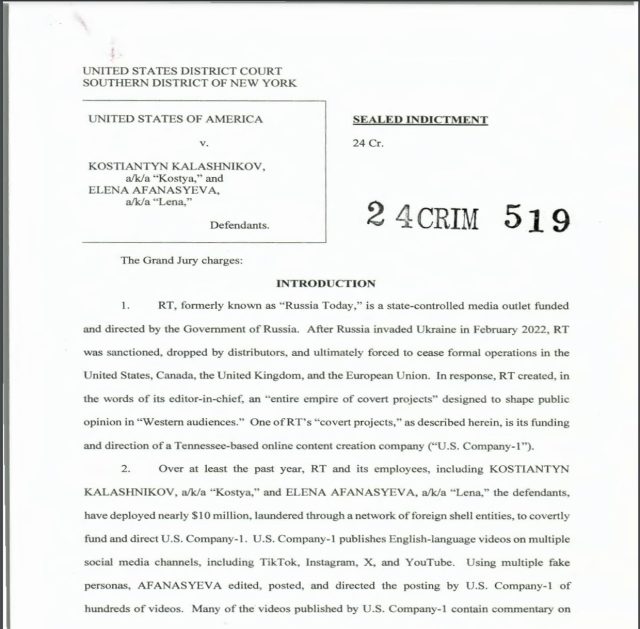
The opening paragraphs of the DOJ press release read:
<<An indictment charging Russian nationals Kostiantyn [for some reason DOJ uses the Ukrainian version of the Russian name Konstantin – SCF] Kalashnikov, 31, also known as Kostya, and Elena Afanasyeva, 27, also known as Lena, with conspiracy to violate the Foreign Agents Registration Act (FARA) and conspiracy to commit money laundering was unsealed today in the Southern District of New York. Kalashnikov and Afanasyeva are at large.
“The Justice Department has charged two employees of RT, a Russian state-controlled media outlet, in a $10 million scheme to create and distribute content to U.S. audiences with hidden Russian government messaging,” said Attorney General Merrick B. Garland. “The Justice Department will not tolerate attempts by an authoritarian regime to exploit our country’s free exchange of ideas in order to covertly further its own propaganda efforts, and our investigation into this matter remains ongoing.”
“Our approach to combating foreign malign influence is actor-driven, exposing the hidden hand of adversaries pulling strings of influence from behind the curtain,” said Deputy Attorney General Lisa Monaco. “As alleged in today’s indictment, Russian state broadcaster RT and its employees, including the charged defendants, co-opted online commentators by funneling them nearly $10 million to pump pro-Russia propaganda and disinformation across social media to U.S. audiences. The Department will not tolerate foreign efforts to illegally manipulate American public opinion by sowing discord and division.”>>
Based on the language of the charges, it would appear that the foreign nationals were physically in the United States for the duration, or at least the initiation, of the project. That they are ‘at large’ and have not been taken into custody would seem to imply that this arrest will happen imminently, or that the two accused are no longer in the US.
It is important to keep in mind that it is not illegal for Russians to spend money in the US, and it is not illegal for Russians or any other foreign nationals to start a business, or engage in protected 1st Amendment activities such as blogging and news or opinion writing or broadcasting.
Assuming that some parts of the described predicate are true, (that a Russian citizen’s money was spent in the US), provided that the individual is not an a US Treasury Department sanctions list, the relevant Executive Order, or legislation, has not obviously been violated. There are some limitations to speech in the US for foreign nationals, and while there is some nuance here, generally 1st Amendment activities are protected unless there is either a reasonable or articulable risk (which standard may depend on the circumstances) to national security that could reasonably lead to a grand jury indictment – think insider whistle-blowing or releasing government/corporate secrets.
‘Funneling’ moneys to individual content creators – YouTuber Tim Pool is believed to be prominent among these – may or may not have influenced the content they were creating – another important part of the nuanced questions that arise. And if the opinions of said content creators (on the subjects they are known for) had not changed after the influx of private party backing, it is more difficult to make the whole claim that the DOJ is now making. Garland, for his part, also adds a proviso – the messages are “hidden”. At face value, this would seem to give the accuseds’ lawyers an additional challenge.
To the contrary, the opposite would be true: making a charge in which no method of falsifiability can be established, is a baseless charge. It is not a ‘hidden crime’, but an activity indistinguishable from lawful behavior.
More to the point, the subjects being discussed, whether influenced by the alleged money or not, were matters already in the public domain, expressing views and sharing information which is already readily available everywhere, and which were commonplace beliefs among an already significant part of the American population. We are not talking state or corporate secrets, calls for violence or other seditious activity, which rise to the level of a national security risk.
The subject of ‘foreign agent registration’ touches on a different, but related matter. Here again, the DOJ appears to be reaching by conflating that (ostensibly) because the two accused were employees of RT, that any or all other conceivable activities they undertook were performed under the auspices of that employer/employee relationship. Granted, that employment may have been the foundation for their visa to be in the US, but this does not mean that all activities done in the US were done on the basis of that relationship. This much is far from obvious and that case would need to be made, as well.
Yet another conundrum in the USA’s case against the accused arises therefore: they cannot easily make the alleged activity a crime unless they connect it to a more obvious and recognized state-backed sponsor (RT). But this further problematizes the prosecution’s case.
Even though the DOJ cites the Foreign Agents Registration Act (FARA), under FARA, it is the organization itself that must register, not each individual employee.
For RT and similar entities, the requirement is that the organization, as a whole, must register as a foreign agent as they are believed to be acting on behalf of a foreign government or entity and is engaged in political activities or disseminating information in the U.S. The registration process involves disclosing details about the organization’s activities, funding sources, and relationships with foreign principals. RT did indeed register as a foreign agent in the United States to be in compliance with FARA in 2017. This registration was prompted by pressure from the U.S. government, which cited concerns over RT’s role as a state-controlled media outlet spreading Russian government messaging. By registering as a foreign agent, RT was required to disclose its funding sources, activities, and affiliations with the Russian government, in compliance with FARA’s requirements for organizations engaged in political activities on behalf of foreign principals.
To make matters worse, the USA’s case faces another logical fallacy: if the accusation is that the two accused conspired to get around foreign agent registration, it would seem to mean that their work was in fact not connected to their employment with RT. If it was through RT, then they did not violate avoidance of registration. If it was not through RT, the clear case of state-backed involvement evaporates.
Individual employees of such organizations, like Kalashnikov and Afanasyeva, are not required to register as foreign agents unless they are specifically engaged in activities that meet the criteria set out by FARA, such as acting as representatives or lobbyists, including the influence of media, for a foreign government or other “foreign principal”. While “foreign principal” can be construed to include private individuals, if those private individuals are without readily identifiable close connections to foreign politics or foreign geostrategic interests (skin in game), the case becomes much weaker. There are other signs that the DOJ has a considerably weak case.
Take particular notice that the charges are ‘conspiracy’ charges, not the commission of the crime. The charges are ‘conspiracy’ to subvert or ‘get around’ FARA, and ‘conspiracy’ to launder money.
While this is a much lower legal standard, because the predicate of having actually committed the crime need not be at the foundation of a conspiracy charge. On the face of it, this would seem to make the DOJ’s case easier to make.
But not so fast: the successful prosecution of a conspiracy charge only really works in two scenarios. In the first case, the accused must be charged with both committing the crime, and the related conspiracy (communications and agreements involving one or more other persons) charge. In this case, establishing the foundation for, and charging the accused with an actual crime itself, is a necessary predicate for a conspiracy charge to be included.
In the second case, the conspiracy charge is meant to prevent the crime itself from being committed. Yet, in the charges against Kalashnikov and Afanasyeva, their alleged activities are past tense.
Here, the DOJ implicitly admits that they had neither prevented the crime, nor was there sufficient evidence of an actual crime having taken place to serve as the predicate. This type of lawfare seems more like a ‘weapon of mass confusion’ in the interest of one candidate (Harris) and aimed at undermining real and actual domestic US political processes, working against the interests of the other of the candidate, (Trump), in the upcoming November presidential election.
We can therefore see immediately that the DOJ is playing fast and loose with these legal distinctions, and is a sign that at the very least an individual judge was either incompetent or influenced against proper judicial oversight, re the prosecutor’s advisement of the grand jury on how to proceed and what constitutes elements of the crime, leading to these flawed sealed indictments.
Indeed, the recent and highly visible DOJ escalation of the investigation into American affiliations with Russian state television networks has ignited considerable concerns over the weaponization (and definition) of American institutions.
Officially aimed at countering Kremlin influence operations in advance of the forthcoming presidential election, the heinously broad scope and the underlying investigations, including the potential shut-down of content producers like Tim Pool, has sparked concerns about the politicization of the DOJ and other governmental entities. The aggressive actions have led to allegations that these efforts are more politically motivated than grounded in genuine national security concerns.
The DOJ’s actions, part of a broader strategy ostensibly to neutralize Russia’s state-run media operations, have featured dramatic high-profile interventions, including searches and involuntary detentions executed by FBI agents, at citizens’ homes and ports of entry. These other actions, while not yet leading to the charges we see in the September 4th charges, signal an expansive scope that will no doubt involve additional individuals and potential criminal repercussions. Such measures have led to significant skepticism and condemnation, even from former government officials, like former US State Department official Mike Benz, meaning that the investigations and detentions are more about a form of full-spectrum domination than safeguarding genuine national interests. For what is in the national interest beyond what is the interest of the country’s population?
Certainly, the notion that national interest is synonymous with the agendas of a small, ideologically driven clique, who happen to hold considerable sway within a specific historical timeline, seems rather contrary to a broad, long-term, and societal view, or rather definition, of the national interest. These individuals – Trans-Atlantic neoliberal neoconservatives, occupying cabinet and permanent administration positions, and in the military – primarily serve the narrow interests of a select group of Americans (themselves) who are more invested in perpetuating a Cold War-style Russophobia and Sinophobia than a genuine advancement of the broader national interest. Their approach is driven by the inertia of think tanks, financial interests, and the ever-churning machinery of the Military-Industrial Complex (MIC), which ties back into an ecosystem that thrives on maintaining the status quo.
The DOJ’s actions are a brazen example of politicized lawfare masquerading as national security. By wielding the Foreign Agents Registration Act as a blunt instrument against “RT employees”, they are not just reaching but overreaching—attempting to equate the legitimate financial support of independent content creators with nefarious foreign influence.
The targets are not simply the accused, nor are they simply a few content creators that have been named in related journalism, like Mr. Pool. These charges are meant to having a chilling and silencing effect on all Americans, on all citizens engaged in social media at every level. These grand jury charges are undemocratic and deplorable to their core.
The flimsy indictment rests on the nebulous charges of conspiracy rather than actual criminal acts, exposing the DOJ’s desperation to manufacture threats where none exist. This reckless use of federal power to stifle dissenting voices and disrupt political narratives serves not the American people, but a narrow band of entrenched interests hell-bent on perpetuating outdated Cold War paranoias.
It is an audacious assault on free speech and a stark reminder of the lengths to which those in power will go to preserve their status quo, even if it means trampling on the foundational principles of justice and democracy. This is not a defense of national interest but an egregious abuse of authority that threatens the very fabric of the republic. If this is how they intend to install Kamala Harris, they will prove that they are hypocritically the source of the very undermining of confidence in American institutions which they accuse others of. So be it.
Ukraine’s top spy declares Telegram a ‘threat to national security’
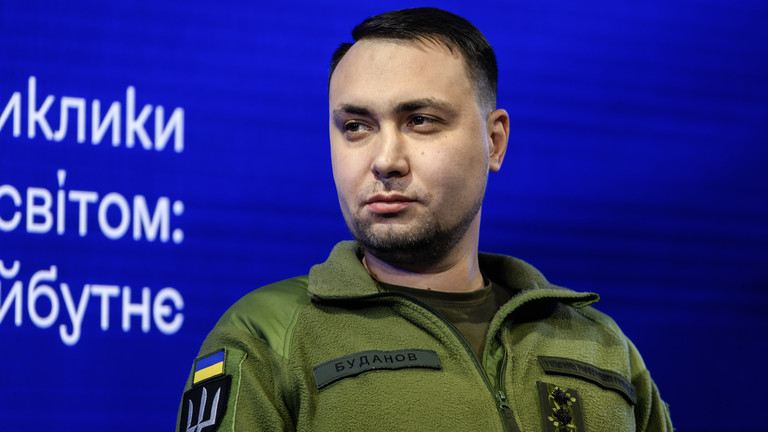
Chief of the Military Intelligence of Ukraine Kirill Budanov. © Maxym Marusenko/Getty Images
RT | September 7, 2024
Telegram poses a real threat to Ukraine’s national security, the chief of that country’s Main Directorate of Military Intelligence, Kirill Budanov, has stated. The official acknowledged that the encrypted instant-messaging platform has become the prime source of information in the country, “outperforming everything else.”
Telegram was created by Russian tech entrepreneurs Pavel and Nikolay Durov back in 2013. One of its unique features is that it allows users to create public broadcast channels and discussion groups.
In an interview with Charter Radio station on Saturday, Budanov said that he does not advocate “simply shutting down” the messaging app. According to the intelligence chief, while quite difficult to implement, such a ban is doable, though.
“I call for all Telegram channels” to be obliged to establish a physical presence in Ukraine, Budanov declared.
“If you want to, so to speak, disseminate some news, please register, so that everyone understands that this channel is registered by Ivanov Ivan Ivanovich, a Russian citizen, who resides in Moscow,” the Ukrainian official explained.
He argued that this way Telegram channel administrators would bear responsibility for the content posted on it.
According to Budanov, some channels publish “not really printable materials,” and not only with respect to the ongoing military conflict with Russia.
He made similar remarks in late March, noting at the same time that Telegram is a useful tool for Ukrainian secret services in spreading their narratives in Russian-controlled territories.
Around the same time, a group of Ukrainian lawmakers proposed a bill to “regulate” Telegram. It included, among other things, a requirement for any messaging apps operating in Ukraine to set up a registered office in the country – unless they are headquartered in the EU – and to disclose their ownership structure and funding to the government.
The founder and CEO of Telegram, Pavel Durov, was detained after landing at Paris-Le Bourget Airport on August 24 and released on bail several days later. The Russian-born entrepreneur, who is also a citizen of France, the UAE, and the Caribbean nation of St. Kitts and Nevis, was charged on 12 counts, including complicity in distributing child porn, drug dealing and money laundering. The charges cite Telegram’s lax moderation rules that presumably allow for the widespread use of the platform by criminals.
Telegram is no stranger to legal problems, with authorities in numerous countries, including Russia, having taken issue with its policies. It has been banned in several jurisdictions over its refusal to cooperate with local governments.
Durov Bombshell: Archaic Crypto Law Charges Reveal French Intel’s Access to Private Communications
By Ilya Tsukanov – Sputnik – 06.09.2024
The Durov saga in France and the continued efforts by countries around the world to crack down on his popular cloud-based, end-to-end encrypted private messenger and social media software has divulged a string of embarrassing details about the sorry state of internet privacy and freedom of information.
Two of the six charges facing Telegram CEO Pavel Durov in France are grounded an obscure, never-used twenty-year-old law obliging companies providing cryptography tools to inform the French Cybersecurity Agency (French acronym ANSSI) and grant it access to the software’s source code and “a description of [its] technical characteristics.”
The 2004 law – uniquely blunt in its demand that companies divulge info about the tech tools used for private communications, is being used against Durov by accusing him of providing encrypted communications services “without certified declaration.”
The legal requirement also means, if it is applied evenly across the board, that the array of instant messengers available to French users, from WhatsApp and Signal to iMessage and the French-made Olvid ‘secure’ messenger used by the French government, do comply with ANSSI regulations, meaning French intelligence can potentially spy on any or all French users at any time.
Adding credence to this idea is the fact that Pavel Durov is reportedly the first-ever tech mogul to be charged under the 2004 law, and the fact that many big-name tech companies have been silent on the Durov case, with the exception of Proton CEO Andy Yen, who characterized the charges against the Russian-born tech mogul as “economic suicide” that’s “rapidly and permanently changing the perception of founders and investors” toward France.
“If sustained, I don’t see how tech founders could possibly travel to France, much less hire in France,” Yen wrote last week.
The law is also reminiscent of the case against WikiLeaks cofounder Julian Assange, who was threatened with decades of jail time by the US under the obscure Espionage Act of 1917, even though that he was not an American citizen, and a publisher, not a spy. Former president Donald Trump was charged under the same act in his classified documents case, which got thrown out by a judge in July.
Featured Video
HE SAVED LIVES. NOW HE FACES PRISON.
or go to
Aletho News Archives – Video-Images
From the Archives
NATO Sanctions and the Coming Global Diesel Fuel Disaster
By F. William Engdahl – New Eastern Outlook – 11.04.2022
Amid the ongoing global inflation crisis, NATO heads of state and mainstream media repeat a mantra that high energy prices are a direct result of Putin’s actions in Ukraine since end of February. The reality is that it is the western sanctions that are responsible. Those sanctions including cutting SWIFT interbank access for key Russian banks and some of the most severe sanctions ever imposed, are hardly having an impact on the military actions in Ukraine. What many overlook is the fact that they are increasingly impacting the economies of the West, especially the EU and USA. A closer look at the state of the global supply of diesel fuel is alarming. But Western sanctions planners at the US Treasury and the EU know fully well what they are doing. And it bodes ill for the world economy.
While most of us rarely think about diesel fuel as anything other than a pollutant, in fact it is essential to the entire world economy in a way few energy sources are. The director general of Fuels Europe, part of the European Petroleum Refiners Association, stated recently, “… there is a clear link between diesel and GDP, because almost everything that goes into and out of a factory goes using diesel.” … continue
Blog Roll
 Aletho News
- Trita Parsi: Middle East Unraveling — Are We on the Path to World War?
- Iran FM meets with US envoy on UN meeting’s sidelines at American side’s insistence: Report
- Qatar PM calls for Gulf security framework with Iran, says war must be ‘wake-up call’
- China condemns US extortion of Iranian airlines, rejects Washington’s ‘illegal’ sanctions threats
- Italy to move military personnel from Taif base after missile strike
- Finland’s Stubb tells European leaders to calm down
- Defeating Russia on battlefield impossible – Fico
- Finland’s Gender Clinic Reversal
- Massachusetts Wants Mental Health Visits, Why Does Government Use ‘Health’ to Enter Our Homes & Families?
- US lawmaker admits American people footing bill for Trump’s failed aggression against Iran
- If Americans Knew
- Sanctions are collective punishment: immoral and self-defeating
- Phosphorus Munitions Fired by Israel Burn Groves, Orchards in Southern Lebanon
- Israel Carries Out New Ceasefire Violations Across Gaza
- AI – Emphasis on the ‘I’: Israel Is Funding AI Chatbot Propaganda
- Israel Blocking Hundreds of Wheelchairs for Injured Children From Entering Gaza
- Israel Is Expanding and Upgrading Compounds for Palestinian Militias in Gaza
- The Palestinian-American Residents of This West Bank Town Are Wondering: Where Is Trump?
- Gaza desperately needs tents, wheelchairs, fuel… and everything else (Israel blocks it all) – Daily Update
- Israeli Attacks in Gaza Kill at Least Seven Palestinians Over Three Days, including Woman and Child
- Trump’s militarization of Washington DC as he pursues Israel’s war against Iran
- No Tricks Zone
- New Study: Earth And Venus Surface Warmth Largely Explained By Convection And Lapse Rate, Not CO2 Or Radiation
- 2025 Nature Paper Claiming Worsening Global Drought Gets RETRACTED …Heavily Flawed
- New Study: ‘Global Drought Shows No Detectable Recent Acceleration Under Climate Warming’
- Economic Masterminds: German Socialists Suggest Taxing Productivity Gains Stemming From Using AI
- The South China Sea Has Not Been Cooperating With The Climate Change Narrative
- Energy Crisis: Germany Enters Heating Season With Historically Low Gas Reserve Fill Levels
- New Study: The Antarctic Ice Sheet Gained Mass From 2020-2024 Due To Staggering Snow And Ice Accumulation
- Study: Ocean Heating Rates From Thousands Of Years Ago ‘Dwarf’ Modern Ocean Heating Rates
- Climate Extremists Target, Attack Large-Scale Power Grid Infrastructure In Germany!
- New Study: Antarctic Ice Melt Has Contributed Less Than 1 Centimeter To Sea Level Rise In The Last 30 Years

