Venezuela: Arrest Warrants Issued for Guaido’s Foreign Commissioner & US, UK Reps
By Paul Dobson | Venezuelanalysis | July 6, 2020
Mérida – Venezuela’s Attorney General Tarek William Saab issued arrest warrants for eleven members of Guaido’s inner circle on Friday, including his US and UK representatives.
The citizens were targeted following their reported involvement in the “plunder” of 31 tonnes of Venezuelan gold held in the Bank of England (BoE) and follows a contested London court ruling blocking the government’s efforts to regain control over the assets.
Guaido’s representatives in London and Washington, Vanessa Neumann and Carlos Vecchio, have both been accused of treason, usurpation of office and criminal association, as has his appointed “special commissioner for foreign relations” Julio Borges, who is based in Colombia.
Warrants on the same charges were also issued for Ricardo Villasmil, Giacoma Cortesia, Manuel Rodriguez, Nelson Lugo and Carlos Suarez, who make up Guaido’s ad-hoc Central Bank (BCV) board, which will now attempt to access the US $1.2 billion assets, and Jose Hernandez, Irene de Lourdes and Geraldine Afiuni from Guaido’s Special Attorney’s office.
In addition to the warrants, Saab announced that any local assets belonging to the citizens are to be frozen, and that his office is considering appealing to international policing bodies to assist in their capture. All of the eleven citizens currently live abroad.
“These criminals have acted in favour of foreign power’s interests, concocting to make the Venezuelan people suffer from food, medicine and fuel shortages so as to enrich themselves at the expense of the country,” the attorney general argued, before going on to describe Borges, Neumann and Vecchio as “false representatives” of the country.
Friday’s charges are just the latest in a number of criminal accusations against Guaido’s team, including embezzlement, corruption, and association with Colombian paramilitaries and US mercenaries.
Both Vecchio and Borges have pre-existing arrest warrants open against them in Venezuela following their alleged roles in failed attempts to overthrow the Maduro government. Borges has been previously linked to the 2018 drone assassination attempt against the president.
For her part, Neumann has been accused of looking to bargain off Venezuela’s historical claim to the oil-rich and disputed Essequibo Strip to the neighbouring Cooperative Republic of Guyana in exchange for diplomatic recognition from London. The US-Venezuelan citizen was additionally accused by the government of “working with paramilitary groups in Colombia in 2009 and 2010” and “being a US government agent” last week.
In response to Saab’s announcement, Guaido’s “Commission for Foreign Relations” described the charges as “repression,” while the opposition leader defended his team’s efforts to “protect Venezuelan gold in the UK.”
Last Thursday, a UK High Court ruling blocked Maduro’s efforts to regain control over the gold, with Judge Nigel Teare arguing that the court was “bound” by 10 Downing Street’s “unequivocal recognition [of] opposition leader Juan Guaido as president.” While the assets remain blocked, Guaido’s ad-hoc BCV board is expected to file for control in the near future.
In response, the Venezuelan Central Bank pledged to appeal the “outrageous” decision. Government lawyers also claim that it fails to recognise the “reality of the situation on the ground,” in which the Maduro government is “in complete control of Venezuela and its administrative institutions.”
The gold was initially frozen by BoE authorities in November 2018 citing “standard” anti-money-laundering measures.
Following Guaido’s self-declaration as “interim president” in January 2019, gaining immediate recognition from Washington and London, the UK foreign office has since supported a number of regime change attempts and formed a special government-run “Venezuela Reconstruction Unit.”
Similarly, the UK followed the European Union in strengthening its sanctions regime against the country last month, applying asset freezes and travel bans on a number of Venezuelan officials in addition to previous measures. Despite its recognition of Guaido, the UK maintains dual diplomatic relations with both his representative and Maduro’s ambassador to the island, Rocio Maneiro.
After previous attempts to repatriate the reserves, Caracas looked to force the BoE to release the gold in May. Under the proposed resolution deal, the gold was to be sold and the funds directly channelled through the United Nations Development Program to acquire food and medicine to assist in the fight against the COVID-19 pandemic.
Despite registering far fewer cases than neighbouring countries, the coronavirus is increasingly taking hold in the sanction-hit Latin American nation. On Sunday, a record 419 coronavirus cases were identified by authorities, taking the total to 7,169, of which 2,100 have recovered and 65 have passed away. With a rapid increase in recent weeks, the country returned to a “strict” nationwide quarantine this week as part of the week-on-week-off lockdown program which Maduro claimed will be in place “until a vaccine appears.”
How Climate Trickery Infiltrated the American Geophysical Union
11 presentations – based on private, agenda-driven research – were delivered to the world’s largest gathering of climate scientists.
By Donna Laframboise | Big Picture News | July 6, 2020
I’ve been writing about a far-fetched climate fairy tale that was repackaged and re-positioned – with the result that it now gets taken seriously by supposedly serious scientists (see here and here).
How did this happen? First, billionaire climate activists hired consultants to produce a brand new climate analysis. Because, you know, the world doesn’t have enough climate research, what with governments spending billions on it every year.
This custom research was conducted by a team of noticeably young people. One is still working on his doctorate. Two others were doctoral students at the time. The lead scientist had earned his geobiology PhD seven years earlier. The lead economist had earned his, in sustainable development, a mere three years earlier.
This team produced a 2014 report titled Risky Business: The Economic Risks of Climate Change in the United States. It features a graphic that wildly misrepresents the scientific literature.
Six months after that report appeared, fully 11 presentations based on it were delivered at the world’s largest annual gathering of earth scientists – the American Geophysical Union’s December 2014 conference.

click for source
The first presenter was Kate Gordon. But she isn’t an earth scientist. She’s a lawyer. And a trained community activist. And the Risky Business Project’s founding director. Who’s considered “a leader in the national ‘green jobs’ movement.”
At the time she delivered her AGU presentation, she was employed by The Next Generation, which describes itself as a “political consulting and issue advocacy firm, specializing in progressive and environmental candidates and causes.”
So a professional activist was invited to give a talk to earth scientists. That talk, according to its abstract, told people the Risky Business Project had conducted “groundbreaking new analysis.” After employing “methodological innovations,” she said, it had arrived at “novel insights.”
The thing about lawyers is they can make even a dumpster of stinky trash sound sublime.

Risky Business lead scientist Robert Kopp; click for source
Presentations #2, #8, #9 and #10 were delivered by Risky Business lead scientist Robert Kopp. He was then associate director of Rutgers University’s Institute of Earth, Ocean & Atmospheric Sciences. Which sounds eminently respectable.
So why does the abstract of his first AGU talk tell people that
Projected sea-level rise for 2100 under RCP 8.5 would likely place $80-$160 billion of current property in New York below the high tide line… it would likely increase average annual storm damage by $2.6-$5.2 billion… [bold added]
without mentioning the salient point that the hypothetical climate scenario known as RCP8.5 represents an implausible vision of the future?
Why does the abstract for Kopp’s second presentation mischaracterize RCP8.5 as a “moderately-high business-as-usual emissions scenario”? (italics mine)

Risky Business economist Amir Jina, click for source
Presentations #3, #6, and #11 were delivered by Amir Jina, an economist who earned his PhD in sustainable development that same year. Presenting at the AGU’s premiere event, his talks relied on a background document he himself had coauthored with Kopp and other members of the Risky Business squad.
The background document runs to 206 pages – and mentions RCP8.5 approximately once a page – for a total of 196 times. Outrageously, it declares:
RCP 8.5 is a reasonable representation of a world where fossil fuels continue to power relatively robust global economic growth, and is often considered closest to the most likely “business-as-usual” scenario absent new climate policy by major emitting countries. [bold added; see page numbered 14 (p. 18 of the PDF)]
Say, what? Remember how I’ve described RCP8.5 recently? An implausible hallucination predicated on:
1. the burning of more coal than some people think even exists
2. the abrupt reversal of longstanding population trends
3. a slowdown in technological innovation (which has, instead, been accelerating for decades)
Yeah, that all sounds realistic.
Please observe what has happened here. Private, agenda-driven money (aka billionaire climate activists Tom Steyer, Michael Bloomberg, and others) hired consultants who hired a handful of young researchers keen to make a name for themselves.
Those researchers produced a new, hefty, custom climate analysis. Which was privately published (rather than appearing in its entirety in a peer-reviewed scientific journal).
This research took the absurd seriously. It insisted an outlier climate scenario was reasonable. Neglecting to say by whom, it claimed RCP8.5 was often considered to be closest to the most likely scenario.
The hope was that other people would fall for this sleight of hand. The hope was that other people would join the parade and promulgate this fiction.
In the words of climate analyst Roger Pielke Jr.:
There is no hidden conspiracy, all of this is taking place in plain sight and in public…We have a well-funded effort to fundamentally change how climate science is characterized…This effort has been phenomenally successful.
The AGU helped make this happen. When it extended invitations to a professional activist, an individual employed by a consultancy being paid by climate activists, and doctoral students funded by those same climate activists, it legitimized this corruption of science.
LINKS:
- Part 1 of this discussion: How the Ugliest Climate Fairy Tale Won
- Part 2: Fooling Us With Climate Trickery
- my investigation was sparked by a series of articles written by Roger Pielke Jr., including How Billionaires Tom Steyer and Michael Bloomberg Corrupted Climate Science
- here’s the list of the 11 AGU presentations (posted on the website of the consultancy, Rhodium Group)
- the slick, privately-published, 56-page Risky Business report can be downloaded here
- the 206-page, privately commissioned and privately published background document, American Climate Prospectus: Economic Risks in the United States, can be downloaded here.
- this Berkeley News article, dated August 2014 (after the June 2014 release of both the American Climate Prospectus (version 1.0) report and the Risky Business report), describes Amir Jina as “a doctoral student at Columbia University.”
 In 2014, D.J. Rasmussen was on the Rhodium Group’s payroll, as a “scientific research associate.” 5.5 years after he delivered presentation #5 to the AGU, he’s still working on his PhD. (It’s worth noticing that his advisor is activist scientist Michael Oppenheimer.) Rasmussen’s private website has been updated, but in 2019 its official photo indicated a markedly youthful individual.
- Earlier this year, Tom Steyer withdrew his candidacy for US president. His personal website describes him as an activist. It prominently features a quote from the Washington Post: “Steyer has played a critical behind-the-scenes role in helping shape the country’s national energy policy.” A billionaire who boasts about his behind-the-scenes manipulations. How demoralizing for individual voters.

Veteran activists called out BLM as a tool of the Democrats from day 1. But agenda-driven $Millions drown out the grassroots
By Helen Buyniski | RT | July 6, 2020
The Black Lives Matter movement has made millions off black Americans’ suffering. A St. Louis activist explains how it comes from a long tradition of white liberals coopting grassroots movements to push a Democratic Party agenda.
The foundation-funded social justice activism of Black Lives Matter is using black pain to cash in on white liberal guilt, dividing American society in pursuit of a Democratic political agenda, St. Louis activist Nyota Uhura told RT.
Uhura founded her website handsupdontshoot in August 2014 to counter false narratives coming out of the St. Louis suburb of Ferguson following the police shooting of 18-year-old Michael Brown.
Having witnessed BLM’s rise up close as the nascent organization swooped into Ferguson amid the calls for justice triggered by Brown’s killing, methodically co-opting the genuine protest energy while ignoring or even obstructing those protesters’ demands, Uhura has fought to warn others of what the organization really represents – leveraging black activism into a boost for the Democratic Party.
The science of co-opting movements
Plucking a few Ferguson residents from the streets for a veneer of local credibility, BLM raised $33 million on the back of Brown’s death – money Uhura says her community never saw. Six years later, black St. Louis remains poor and plagued with violence, while BLM has found a new community to exploit.
“They overshadow the work of the grassroots, then they insert themselves as leaders and they go out in the media and claim to be leading these movements,” Uhura said.
Outlining the methodology of BLM and other astroturfed movements, she added that sometimes they literally just showed up at a protest they didn’t plan and did a news conference. This is a tradition she traces back to white liberals’ hijacking of the 1963 March on Washington.
That tradition has been boiled down to a science, she says, with organizations like NetRoots turning out phony ‘activists’ with the ruthless efficiency of an assembly line. “NetRoots is where activists go to audition to be puppets of the Democrats, special interest and white elite nonprofit,” she continued.
“It happens so fast that all the pieces are in place before you even have a chance to know what hit you… Before you even know it, you’re watching the news and they have coopted your movement.”
White liberal and progressive groups “use the energy of our movement to push their agenda” – in BLM’s case, weaponizing the concept of “intersectionality” to broaden the movement’s scope from race to feminism, immigrant rights, LGBT issues, and other causes that directly affect white people.
“In order to mobilize people, they need those black faces out front – because what are they going to look like protesting? Just in terms of optics it’ll look like a Klan rally,” Uhura joked. She has a point – just 17 percent of last month’s protesters were black, according to a Pew Research poll published last week, a statistic the organization’s foes are unlikely to let it forget.
Real activists disenfranchised
Uhura is far from the only grassroots activist to publicly speak out against BLM for pulling a bait-and-switch, substituting the Democratic Party’s pet causes in place of justice for the victims of police violence. The group’s Cincinnati chapter dropped the iconic phrase from its name in 2018, alleging the national organization “capitalized off a nameless groundswell of resistance sweeping the nation, branded it as their own, and profited off [black people’s deaths]” without making an effort to get justice for victims’ families.
The Cincinnati chapter also says that BLM’s 2015 conference in Cleveland – where 12-year-old Tamir Rice had just been gunned down by a cop for holding a toy gun – focused almost exclusively on black transgender rights, further dividing a suffering community.
Los Angeles activists slammed BLM’s local chapter for ignoring the killing of Ezell Ford, a mentally-ill man shot by police in 2014, to travel to Ferguson and piggyback on the Michael Brown shooting. Upon their return to Los Angeles, where the activist community was demanding the city’s district attorney indict Ford’s killers, BLM Los Angeles not only continued to ignore the injustice, one of its leaders actually bestowed a ‘Women in Action’ award on the same DA who exonerated the cops who killed him.
Others take issue with what they see as obvious grifting by some of BLM’s most prominent representatives. DeRay McKesson has promoted brands from Apple to McDonald’s, and even got himself arrested in a Twitter T-shirt in what many activists believe was a staged promotion.
Shaun King is so legendary for making large sums of money raised “for the movement” disappear that the Daily Beast wrote a story about it. King recently announced a “Truth, Justice and Reconciliation Commission” in conjunction with three of the same “progressive prosecutors” that activists like Uhura have denounced for failing to police the police.
‘They always march us back into the voting booth’
Like all controlled opposition movements, one of BLM’s primary functions is to derail meaningful change. Uhura explained, “They always march us back into the voting booth.”
Well-heeled movement activists consistently divert money and energy into electing Democratic Party candidates or “progressive” prosecutors, none of whom hold police accountable when they murder innocent black men, whether it’s in Ferguson, Los Angeles, or New York City.
For this reason, she’s not convinced by the group’s recent calls to defund police, or the Minneapolis City Council’s pledge to do just that – the governments of Ferguson and St. Louis promised all manner of reforms they didn’t deliver. Many that did pass were hopelessly watered-down or have since been rolled back, and Uhura sees ‘defund the police’ as just another fundraising tactic.
The only electoral solution to the black community’s problems is “weaponizing our politics,” according to the veteran activist – all incumbents have to go. They’ve had their chance to make a difference, and proven themselves unwilling to deliver. “It might take one or two election cycles to mold a person into what we need, but right now we’re losing anyway,” she explained. “We have to just clean house and get rid of everybody. How can it be worse?”
BLM recently came under fire for doling out just six percent of its donations to local chapters over the past three years, with a whopping 83 percent going to pay consultants and travel costs. The complicated route the money takes from donor to chapter has elicited extensive speculation about the possibility of money laundering, and BLM representatives have been almost cartoonishly cagey when asked by reporters about their finances
Co-founder Alicia Garza has denied the group is backed by foundations at all, even though billionaire currency speculator George Soros alone has given over $33 million to BLM, its founders, and associated groups, and the Ford Foundation pledged to raise $100 million in 2016. Fellow co-founder Patrisse Cullors has held up a fact-check by PolitiFact, funded by the same Omidyar Network that funds BLM, as “proof” the group isn’t linked with the Democratic Party.
But it’s the group’s function as an ideological launderer that has thus far insulated it from accountability. From the corporations pouring millions of dollars into its coffers to burnish their woke cred, to the politicians donning Kente cloths and pandering their way to re-election, BLM positions itself as ‘the’ black activism group, overshadowing grassroots campaigners and sucking up all available cash – literally starving out the competition, as genuine movements struggle to be heard by the media and greater public over the foundation-funded din.
This model of activism has been so successful over the decades that it has come to dominate every cause from environmentalism to civil liberties, offering young people a “romanticized view of activism where it’s all hashtags, all patty-cake, all sugar and cream, when nothing could be further from the truth.”
Uhura, however, is confident that BLM’s true nature will be exposed, citing the movement’s own inherent discrimination: “How does Black Lives Matter get to decide WHICH black lives matter when they purposefully omit straight black people and straight black men whose death they profit from?”
But as long as grassroots activists are losing ground to foundation-funded rivals, new BLMs will keep popping up. Real activists must “create an alternative” to foundation-funded movements, she says – or risk losing the next generation to the Democratic operatives and keeping justice out of the reach of black communities forever.
Helen Buyniski is an American journalist and political commentator at RT. Follow her on Twitter @velocirapture23
Reparations and Other Scams: Israeli Survivors Live in Poverty and Are Starving?
By Philip Giraldi | American Herald Tribune | July 5, 2020
The issue of reparations and other compensation has been much in the news of late, most particularly in relationship to possible payments to descendants of slaves in the United States to compensate them for their disadvantages brought about by what is claimed to be a persisting racist culture in the country. There is, of course, considerable resistance on the part of millions of non-black citizens who will have to foot the enormous bill even though they were not involved in slavery in any way, having arrived in the U.S. long after 1865, when involuntary servitude was abolished by the Thirteenth Amendment to the Constitution.
Reparations have been around for a long time, normally being exacted by the winners in a war against the losers, who automatically are blamed as the aggressors and therefore liable for the damages. Often the compensation comes in the form of territory, witness for example the German acquisition of Alsace-Lorraine from the French after the Franco-Prussian war followed by its return to France after the First World War. The Germans also were made to endure considerable cash and in-kind payments, primarily to France, after losing the First World War. The terms of the Treaty of Versailles were so onerous that they were subsequently blamed for perpetuating Franco-German hostility, leading inevitably to the Second World War.
Israel and Jewish groups were major beneficiaries of the reparations and restitution programs that were created as a result of World War Two. The Luxembourg Agreement signed in 1952 committed West Germany to pay Israel a sum of 3 billion Deutsche Marks over the next fourteen years, which was at the time an enormous sum. An additional 450 million marks were paid to the World Jewish Congress. The payments that were made to the State of Israel regarded the government as the de facto heir to war victims who had no surviving family or who could not otherwise be identified. The money was mostly invested in the Israeli infrastructure and was significant in aiding in the initial development of the economy of the new state, but there were also considerable barter arrangements whereby Israel purchasing agents obtained German manufactured goods and raw materials.
The reparations program was modified at various points to expand those eligible for benefits and continued to operate long after the fourteen-year term initially envisioned had expired. As of 2012, when the program was 60 years old, it was still fully operational and Germany had paid the Jewish state an estimated $89 billion.
In the 1990s, Israel and Jewish groups began to go after other property that they claimed had either been sold at below market prices as Jews began to flee Germany or otherwise lost. Money trails in Swiss banks were investigated to chart the movement of funds that had originally been derived from Jewish owned property. Individual companies, mostly in Germany, were pressured by survivor groups to provide reparations to former forced laborers, leading the Berlin government in 1999 to establish a separate fund to assist survivors of the so-called holocaust. The Swiss and Hungarians set up similar funds and The World Jewish Restitution Organization was established to organize these efforts. In America, the U.S. Foreign Claims Settlement Commission pressured Germany in 1998-9 to compensate Jewish survivors who had arrived in the United States after the war.
Israel, of course, has a vested interest in continuing the flow of Euros by making Germans and other Europeans continue to feel guilty over the war. In 2007 the Israelis pressured the German government to expand the pension program for Jewish survivors of 1939-1945 who had wound up in Israel. In 2009 Israel demanded compensation of between 450 million and 1 billion Euros ($1,120,000,000 currently) for 30,000 claimed former slave laborer-survivors. And the requirements for eligibility for a payment or pension continue to become more permissive. A Jewish survivor qualifies if he lived in “a ghetto” for 12 months as will anyone who can demonstrate that he “hid from” the Nazis for at least six months. One acceptable “ghetto” is in Shanghai China. And given the destruction of many public records, there has been considerable fraud. In 2010 auditors found evidence of a scheme to use fake identification documents to defraud the German government of more than $42 million.
And new and innovative sources of money are constantly being developed. The United States and Israel are currently pressuring Poland, which was occupied by the Germans, to compensate Jewish property owners. It is particularly difficult to do as much of Warsaw and nearly all its public records were destroyed in 1944. In August 2019, no less than 88 U.S. Senators signed a letter urging Secretary of State Mike Pompeo to “act boldly and with urgency” to compel Poland to resolve the property issue. The Poles have argued that the proceedings would be subject to massive fraud and “frivolous lawsuits” while the demands could bankrupt the country.
Meanwhile the French and Dutch rail systems, also under German control, have been forced to pay compensation to survivors because their trains were used to transport Jewish prisoners to camps.
The story of reparations and compensation is of particular interest, not only because the Second World War ended 75 years ago last month, but also because of attempts by Israel and Jewish groups to squeeze some final payments out of the remaining survivors. Quite astonishing is a “campaign” email currently being circulated by an organization calling itself LATET – Israeli Humanitarian Aid. It promotes itself as a charitable foundation with “All donations…tax-deductible in Israel, the U.S., Canada, Australia, France and the U.K.” It describes its activity as:
“Due to Covid-19, many impoverished Holocaust survivors experience an extended stay in deficient and insecure homes. MORE THAN EVER, SUPPORT URGENT HOME REPAIRS THE SURVIVORS CAN’T AFFORD. 1 in 4 Holocaust survivors in Israel lives in poverty. As a result of the COVID-19 outbreak, our elders spend all their time at home, mostly alone, in run-down apartments and they have nobody to turn to. The need to eliminate all safety hazards and obstacles relating to mobility, safety and comfort has grown and dozens of survivors are waiting for urgent assistance. Latet is the only organization in Israel providing Holocaust survivors in need with a complete aid package, including monthly food boxes, social support and an Emergency Fund for crucial needs. Since 2013, Latet has carried out more than 1,200 home repairs to increase the survivors’ quality of life, at no cost to them. Everyday, 40 Holocaust survivors die. Let’s make sure they spend their last days in decent conditions.
“Donate now. Latet was founded in 1996 and is the largest Israeli NGO combating poverty. Acting as an umbrella organization, Latet provides for the basic needs of populations living in poverty and food insecurity, giving ongoing food assistance to over 200,000 people in Israel. The organization operates the leading national food bank and runs impactful aid programs. For the last 10 years it has been the only organization in Israel providing a comprehensive aid package to Holocaust survivors in need, including a monthly food box, emergency fund for medical and paramedical needs, home restorations as well as ongoing social support in the form of personal volunteers and social events throughout the year. For more information about Latet: www.latet.org.il/en/”
One should not necessarily doubt the fundamental decency of LATET and what they are seeking to do, but their solicitation raises some serious questions about the Israeli government and Jewish charities that have been the recipients of more than $100 billion obtained as “reparations” from various foreigners, mostly Germans, specifically to address the needs of the so-called “Holocaust survivors.” How can the survivors be living in terrible conditions and even starving in a socialist country with a formidable safety net, one might ask Prime Minister Benjamin Netanyahu, when they have been granted pensions and other compensation since 1952?
The answer would appear to be pretty simple, that the money has gone directly to the Israeli government and to major Jewish private organizations which have engaged in the extortion racket and have proceeded to divert the flow from the “cash cow” for their own purposes. Soon there will be few survivors of the war left and the scam will presumably end, or maybe not, as there have been claims that the terror of the German camps can be passed on genetically and is inheritable?
Unfortunately, compensating for claims of Jewish suffering is a big business. The regular annual scandalous multi-billion dollar cash flow out of the United States Treasury to fill the Israeli coffers will continue seemingly forever. American taxpayers might be delighted to learn that during the past week Congress, beset by plague, civil unrest and a crumbling infrastructure, found time to move to approve an additional $500 million to Israel for its “defense.”
WHO’s Conflict of Interest?
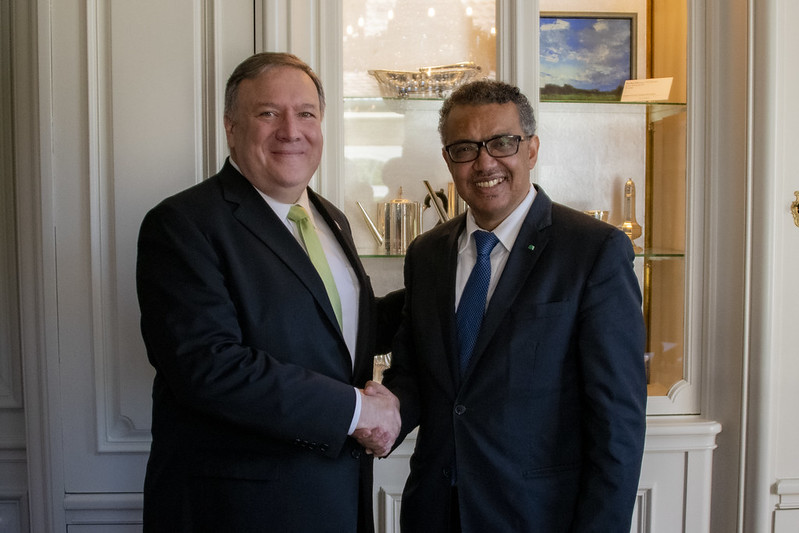
US Secretary of State Michael Pompeo and WHO Director General Dr. Tedros Ghebreyesus, in Bern, Switzerland, on June 3, 2019. (State Dept. Photo by Ron Przysucha/ Public Domain)
By David Macilwain | American Herald Tribune | June 30, 2020
Last week the French National Assembly convened an inquiry into the “genealogy and chronology” of the Coronavirus crisis to examine the evident failures in its handling and will interview government ministers, experts and health advisors over the next six months. While we in the English-speaking world may have heard endless arguments over the failures of the UK or US governments to properly prepare for and cope with the health-care emergency, the crisis and problems in the French health system and bureaucracy have been similar and equally serious. Given the global cooperation and collaboration of health authorities and industry, the inquiry has global significance.
Judging by the attention paid by French media to the inquiry, which comes just as France is loosening the lock-downs and restarting normal government activities, it is set to be controversial and upsetting, exposing both incompetence and corruption.
Leading the criticism of the Macron government’s handling of the crisis are the most serious accusations that its prohibition of an effective drug treatment has cost many lives, a criticism put directly to the inquiry by Professor Didier Raoult, the most vocal proponent of the drug – Hydroxychloroquine. At his institute in Marseilles, early treatment with the drug of people infected with Sars-CoV-2 has been conclusively demonstrated to reduce hospitalization rates and shorten recovery times when given along with the antibiotic Azithromycin, and consequently to cut death rates by at least half.
Raoult has pointed to the low death rate in the Marseilles region of 140 per million inhabitants compared with that in Paris of 759 per million as at least partly due to the very different treatment of the epidemic in Marseilles under his instruction. The policies pursued by local health services there included early widespread testing for the virus and isolation and quarantining of cases, aimed both at protecting those in aged care and in keeping people from needing hospitalization with the help of drug treatments.
It incidentally seems quite bizarre that some countries – notably the US, UK and Australia, are only now embarking on large testing programs – and claiming a “second wave” in cases – which Raoult calls a “fantasme journalistique”. The consequent reimposition of severe lock-downs in some suburbs of Melbourne, and in Leicester in the UK is a very worrying development.
The efficacy of HCQ and Azithromycin is well illustrated – one should say proven – by this most recent review of its use on 3120 out of a total of 3700 patients treated at the Marseilles hospitals during March, April and the first half of May. Unlike the fraudulent study published and then retracted by the Lancet in May, the analysis in this review is exemplary, along with the battery of tests performed on patients to determine the exact nature of their infection and estimate the effectiveness of the drug treatment. The overall final mortality rate of 1.1% obscures the huge discrepancy in numbers between treated and untreated patients. Hospitalization, ICU, and death rates averaged five times greater in those receiving the “other” treatment – being normal care without HCQ-AZM treatment – equivalent to a placebo.
The IHU Marseilles study and its discussion points deserve close scrutiny, because they cannot be dismissed as unsubstantiated or biased, or somehow political, just because Professor Raoult is a “controversial figure”. There is a controversy, and it was well expressed by Raoult in his three hour presentation to the inquiry. His criticisms of health advisors to government include conflicts of interest and policy driven by politics rather than science. Raoult has been vindicated in his success, and can now say to those health authorities “if you had accepted my advice and approved this drug treatment, thousands of lives would have been saved.”
This is quite unlike similar statements in the UK and elsewhere, where claims an earlier imposition of lock-down would have cut the death toll in half are entirely hypothetical. As Prof. Raoult has also observed, the progress of this epidemic of a new and unknown virus was quite speculative, and its handling by authorities has failed to reflect that. In fact, one feels more and more that the “response” of governments all around the world has followed a strangely similar and inappropriately rigid scheme, of which certain aspects were de rigueur, particularly “social distancing”.
There seems little evidence that would justify this most damaging and extreme of measures to control an epidemic whose seriousness could be ameliorated by other measures – such as those advocated by Raoult’s Institute – which would have avoided the devastating “collateral damage” inflicted on the economy and society in the name of “staying safe”.
Prof. Raoult’s vocal and consistent criticism of the political manipulation of the Coronavirus crisis is hardly trivial however, to be finally excused as a “failure”- to impose lockdowns sooner, to have sufficient supplies of masks or ventilators, or to use more testing and effective contact tracing. What lies beneath appears to be, for want of a better word, a conspiracy.
As previously and famously noted by Pepe Escobar, French officials seemed to have foresight on the potential use of Hydroxychloroquine as a treatment for COVID-19 infection, with its cheapness and availability being a likely hindrance to pharmaceutical companies looking to make big profits from new drug treatments or vaccines. Of even greater significance perhaps, was the possibility – or danger – that the vast bulk of the population might become infected with the virus and recover quickly with the help of this cheap drug treatment, while bypassing the need, and possibly interminable wait for a vaccine.
Now it can be seen that in Western countries the demand for a vaccine is acute, and the market cut-throat, despite assurances from many quarters that “vaccines must be available to all” and that “manufacturers won’t seek to profit” from their winning product. (the profit will naturally be included in what their governments choose to pay them) The clear conflicts of interest between health officials, public and private interests make such brave pronouncements particularly hollow. Just one case is sufficient to illustrate this, as despite its unconvincing performance in combatting the novel Coronavirus, the drug developed and promoted by Dr Anthony Fauci and company Gilead, Remdesevir, was rapidly approved for use following a research trial sponsored by the White House.
More concerning however is what appears to be a conflict of interest in the WHO itself, possibly related to the WHO’s largest source of funding in the Gates organization. While the WHO has not actively opposed the use of Hydroxychloroquine against the virus infection for most of the pandemic, neither has it voiced any support for its use, such as might be suggested by its obvious benefits, and particularly in countries with poor health facilities and resources.
Had the WHO taken at least a mildly supportive role, acknowledging that the drug was already in widespread use and there was little to lose from trying it against COVID-19, then it is hard to imagine that those behind the recent fabricated Lancet paper would have pursued such a project. Without claiming that the WHO had some hand in the alleged study that set out to debunk HCQ treatment, it should be noted that the WHO was very quick to jump on the non-peer-reviewed “results” and to declare a world-wide cancellation of its research projects on the drug. And while it had to rescind this direction shortly afterward when the fraud was exposed, the dog now has a bad name – as apparently intended.
This stands in sharp contrast to the WHO’s sudden enthusiasm for the steroidal drug Dexamethasone, recently discovered by a UK research team to have had a mildly positive benefit on seriously ill COVID19 patients:
“The World Health Organization (WHO) plans to update its guidelines on treating people stricken with coronavirus to reflect results of a clinical trial that showed a cheap, common steroid could help save critically ill patients.
The benefit was only seen in patients seriously ill with COVID-19 and was not observed in patients with milder disease, the WHO said in a statement late Tuesday.
British researchers estimated 5,000 lives could have been saved had the drug been used to treat patients in the United Kingdom at the start of the pandemic.
“This is great news and I congratulate the government of the UK, the University of Oxford, and the many hospitals and patients in the UK who have contributed to this lifesaving scientific breakthrough,” said WHO Director-General Tedros Adhanom Ghebreyesus in the press release.”
There is something more than ironic in the WHO’s interest in a different cheap and available drug that has also been widely used for decades, but which is no use in protecting those people in the target market for the vaccine. To me, and surely to Professor Raoult and his colleagues, this looks more like protecting ones business interests and investor profits, at the expense of public health and lives.
Postscript:
It has just been announced that GILEAD will start charging for its drug Remdesevir from next week at $US 2340 for a five-day course, or $US 4860 for private patients. Generic equivalents manufactured in poorer countries will sell for $US 934 per treatment course. Announcing the prices, chief executive Dan O’Day noted that the drug was priced “to ensure wide access rather than based solely on the value to patients”.
It seems hardly worth pointing out that six days treatment with Hydroxychloroquine costs around $US 7, so for the same cost as treating one patient with Remdesevir, roughly four hundred could be given Hydroxychloroquine. If this is compounded by the effective cure rate, Remdesevir treatment costs closer to one thousand times that of HCQ. The addition of Azithromycin and Zinc doubles the cost of HCQ treatment, but also increases its efficacy considerably.
Impeachment Reminder of Our Toxic Foreign Aid

By James Bovard | Ron Paul Institute | Monday June 29, 2020
Foreign aid to Ukraine helped spur the Democrats’ effort to impeach and remove President Trump earlier this year. Ukraine was supposed to be on the verge of great progress until Trump pulled the rug out from under the heroic salvation effort by US government bureaucrats. Unfortunately, Congress has devoted a hundred times more attention to the timing of aid to Ukraine than to its effectiveness. And most of the media coverage pretended that US handouts abroad are as generous and uplifting as congressmen claim.
US foreign aid has long fueled the poxes it promised to eradicate — especially kleptocracy, or government by thieves. A 2002 American Economic Review analysis concluded that “increases in [foreign] aid are associated with contemporaneous increases in corruption” and that “corruption is positively correlated with aid received from the United States.” Windfalls of foreign aid can make politicians more rapacious, which economists have dubbed the “voracity effect.”
Early in his presidency, George W. Bush promised to reform foreign aid, declaring, “I think it makes no sense to give aid money to countries that are corrupt.” Regardless, the Bush administration continued delivering billions of dollars in handouts to many of the world’s most corrupt regimes.
Barack Obama proclaimed at the United Nations in 2010 that the US government was “leading a global effort to combat corruption.” The Los Angeles Times noted that Obama’s “aides said the United States in the past has often seemed to just throw money at problems,” while Secretary of State Hillary Clinton admitted that “a lot of these aid programs don’t work” and lamented their “heartbreaking” failures. But Obama promised during his 2008 campaign to double foreign-aid spending, which obliterated efforts to reform failed programs. In 2011, congressional Republicans sought to restrict foreign aid going to fraud-ridden foreign regimes. Secretary of State Clinton wailed that restricting handouts to nations that fail anti-corruption tests “has the potential to affect a staggering number of needy aid recipients.”
Regardless, the Obama administration continued pouring tens of billions of US tax dollars into sinkholes such as Afghanistan, which even its president, Ashraf Ghani, admitted in 2016 was “one of the most corrupt countries on earth.” The governor of Kandahar denounced his own government officials and police officers as “looters and kidnappers.” John Sopko, the Special Inspector General for Afghan Reconstruction (SIGAR), declared that “US policies and practices unintentionally aided and abetted corruption” in Afghanistan.
Since the end of the Soviet Union, the United States has provided more than $6 billion in aid to Ukraine. At the House impeachment hearings late last year, a key anti-Trump witness was acting US ambassador to Ukraine William B. Taylor Jr. The Washington Post hailed Taylor as someone who “spent much of the 1990s telling Ukrainian politicians that nothing was more critical to their long-term prosperity than rooting out corruption and bolstering the rule of law, in his role as the head of US development assistance for post-Soviet countries.” A New York Times editorial lauded Taylor and State Department Deputy Assistant Secretary George Kent as witnesses who “came across not as angry Democrats or Deep State conspirators, but as men who have devoted their lives to serving their country.”
Their testimony spurred Eric Rubin, president of the American Foreign Service Association, to bewail that “this is the most fraught time and the most difficult time for our members” since Sen. Joe McCarthy’s accusations of communism in the 1950s. A Washington Post headline echoed him: “The diplomatic corps has been wounded. The State Department needs to heal.” But not nearly as much as the foreigners supposedly rescued by US bureaucrats.
The Wall Street Journal reported on October 31 that the International Monetary Fund, which has provided more than $20 billion in loans to Ukraine, “remains skeptical after a history of broken promises [from the Ukrainian government]. Kiev hasn’t successfully completed any of a series of IMF bailout packages over the past two decades, with systemic corruption at the heart of much of that failure.” The IMF concluded that Ukraine continued to be vexed by “shortcomings in the legal framework, pervasive corruption, and large parts of the economy dominated by inefficient state-owned enterprises or by oligarchs.” That last item is damning for US benevolent pretensions. If a former Soviet republic cannot even terminate its government-owned boondoggles, then why was the US government bankrolling them? While many members of Congress could not find Ukraine on a map, far fewer could have offered any coherent explanation of what US aid bought in Ukraine.
Transparency International, which publishes an annual Corruption Perceptions Index, shows that corruption surged in Ukraine in the late 1990s (after the United States decided to rescue that country) and remains at abysmal levels. Ukraine now ranks in the bottom tier on the list of most corrupt nations, with a worse rating than Egypt and Pakistan, two other major US aid recipients notorious for corruption.
Actually, the best gauge of Ukrainian corruption is the near-total collapse of its citizens’ trust in government or in their own future. Since 1991, the nation has lost almost 20 percent of its population as citizens flee abroad like passengers leaping off a sinking ship. But as long as Kiev was not completely depopulated, US bureaucrats could continue claiming to be on the verge of achieving great things.
The House impeachment hearings and much of the media gushed over those career US government officials despite their strikeouts. It was akin to a congressional committee’s resurrecting Col. George Custer in 1877 and fawning as he offered personal insights in dealing with uprisings by Sioux Indians (while carefully avoiding awkward questions about the previous year at the Little Bighorn).
Foreign aid is virtue-signaling with other people’s money. As long the aid spawns press releases and photo opportunities for presidents and members of Congress and campaign donations from corporate and other beneficiaries, little else matters. Congress almost never conducts thorough investigations into the failure of aid programs despite their legendary pratfalls. As the Christian Science Monitor noted in 2010, AID “created an atmosphere of frantic urgency about the ‘burn rate’ — a measure of how quickly money is spent. Emphasis gets put on spending fast to make room for the next batch from Congress.” Martine van Bijlert of the nonprofit Afghanistan Analysts Network commented, “As long as you spend money and you can provide a paper trail, that’s a job well done. It’s a perverse system, and there seems to be no intention to change it.” The “burn rate” fixation produced endless absurdities, including collapsing school buildings, impassable roads, failed electrification projects, and phantom health clinics. SIGAR’s John Sopko “found a USAID lessons-learned report from 1980s on Afghan reconstruction but nobody at AID had read it.”
Perverse incentives
“Fail and repeat” was also AID’s motto in Iraq. After the 2003 invasion, AID and the Pentagon paired up to spend $60 billion to rebuild Iraq. As long as projects looked vaguely impressive at ribbon-cutting ceremonies, AID declared victory. Congressman Jason Chaffetz (R-Utah), listed some of the agency’s farcical Iraq success claims at a 2011 hearing: “262,482 individuals reportedly benefited from medical supplies that were purchased to treat only 100 victims of a specific attack; 22 individuals attended a five-day mental-health course, yet 1.5 million were reported as beneficiaries; … and 280,000 were reported as benefitting from $14,246 spent to rehabilitate a morgue.” Ali Ghalib Baban, Iraq’s minister of planning, denied in 2009 that US aid for relief and reconstruction had benefitted his country: “Maybe they spent it, but Iraq doesn’t feel it.” An analysis by the Center for Public Integrity noted that, according to top Iraqi officials, the biggest impact of US aid was “more corruption and widespread money-laundering.”
After driving around the world, investment guru Jim Rogers declared, “Most foreign aid winds up with outside consultants, the local military, corrupt bureaucrats, the new NGO [nongovernmental organizations] administrators, and Mercedes dealers.” Mercedes-Benz automobiles became so popular among African government officials that a new Swahili word was coined: wabenzi — “men of the Mercedes-Benz.” After the Obama administration promised massive aid to Ukraine in 2014, Hunter Biden, the vice president’s son, jumped on the gravy train — as did legions of well-connected Washingtonians and other hustlers around the nation. Similar largesse ensures that there will never be a shortage of overpaid people and hired think tanks ready to write op-eds or letters to the editor of the Washington Post whooping up the moral greatness of foreign aid or some such hokum.
Bribing foreign politicians to encourage honest government makes as much sense as distributing free condoms to encourage abstinence. Rather than encouraging good governance practices, foreign aid is more likely to produce kleptocracies. As a Brookings Institution analysis observed, “The history of US assistance is littered with tales of corrupt foreign officials using aid to line their own pockets, support military buildups, and pursue vanity projects.” Both US politicians and US bureaucrats are prone to want to continue the aid gravy train regardless of how foreign regimes waste the money or use it to repress their own citizens.
US government leaders are far more concerned with buying influence than with safeguarding purity. Foreign aid is often little more than a bribe for a foreign regime to behave in ways that please the US government. One large bribe naturally spawns hundreds or thousands of smaller bribes, and thereby corrupts an entire country. The impeachment of Trump was driven by the specific favor that Democrats claimed he had requested from the Ukrainian president, not from seeking favors per se.
When it comes to the failure of US aid to Ukraine, almost all of Trump’s congressional critics are like the “dog that didn’t bark” in the Sherlock Holmes story. The real outrage is that Trump and prior presidents, with Congress cheering all the way, delivered so many US tax dollars to Kiev that any reasonable person knew would be wasted.
Foreign aid will continue to be toxic as long as politicians continue to be politicians. There is no bureaucratic cure for the perverse incentives created by flooding foreign nations with US tax dollars. If Washington truly wants to curtail foreign corruption, ending US government handouts aid is the best first step. Counting on foreign aid to reduce corruption is like expecting whiskey to cure alcoholism.
Сriminal roots of Kosovo further exposed by Thaçi’s indictment in The Hague
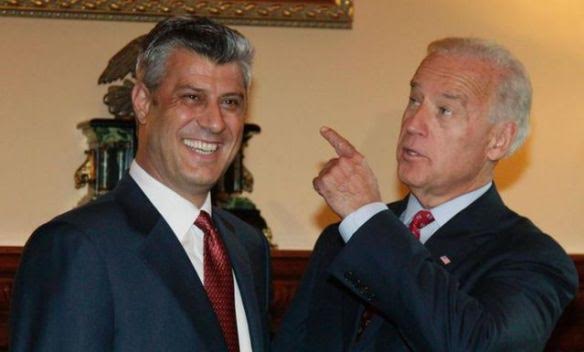
By Paul Antonopoulos | June 29, 2020
Serbian President Aleksandar Vučić was due to meet Kosovo leader Hashim Thaçi on Saturday at the White House. This was at the behest of US envoy for Kosovo-Serbia negotiations, Richard Grenell, after his much-publicized success in organizing the meeting. However, his success was short lived after Thaçi became indicted for war crimes and crimes against humanity on June 24 by the Kosovo Specialist Chambers and Specialist Prosecutor’s Office.
The US meeting has been put on hold until further notice, but as Vučić revealed, the EU will take over discussions between Belgrade and Pristina at a later date. It appears that France and Germany specifically will spearhead these meeting with the French Embassy in Kosovo saying on Thursday that “France and Germany expect Dialogue between Kosovo and Serbia to resume soon. Together with Chancellor Merkel, President Macron remains ready to host a Summit in Paris.” German Ambassador to Kosovo Christian Heldt tweeted: “Our governments stand ready to be helpful with [a] proposed meeting in July.”
Due to prosecutors in The Hague indicting Thaçi’s alleged war crimes during the 1998-99 Kosovo war, Kosovo’s new prime minister, Avdullah Hoti, said he could not travel to Washington to conduct talks with Serbia.
“Thank you, Prime Minister Hoti. We understand your decision and we look forward to rescheduling the meeting soon,” Grenell wrote on Twitter.
US President Donald Trump was hoping for a foreign policy victory just before the upcoming elections, but rather, the Kosovo experiment created by Bill Clinton in the 1990’s is beginning to crack. Thaçi in 1993 became a prominent member of the “Kosovo Liberation Army” (KLA) and became responsible for the finances and armaments of the terrorist organization. The KLA financed its activities by turning Kosovo into a drug smuggling hub to distribute heroin and cocaine throughout Europe.
A 2008 report by German intelligence service BND accuses Thaçi of having deep involvement in organized crime, saying that “The key players (including Thaçi) are intimately involved in inter-linkages between politics, business, and organised crime structures in Kosovo,” and that Thaçi is leading a “criminal network operating throughout Kosovo.”
The charges laid against him by the prosecutor’s office in The Hague include murder, enforced disappearance of persons, persecution, and torture. He has also been accused of organ harvesting and drug trafficking by other reports and institutions. Although he has not been found guilty, it is well established that the KLA engaged in such activities, putting a mockery to the Albanian and Serbian Caucuses of US Congress suggestion in 2014 that Thaçi be nominated for the Nobel Peace Prize, the Geneva School of Diplomacy giving him a Doctor Honoris Causa degree as a Doctor of International Relations, and the Montenegrin town of Ulcinj giving him the title of Honorary Citizen of Ulcinj.
Before the scheduled meeting, Vučić said that Russian Foreign Minister Sergey Lavrov informed him about worrying information concerning various Western plans and ideas regarding the solution to the Kosovo crisis. Vučić pointed out that he exchanged opinions with Lavrov on a number of issues but that the key topic was the relationship between the two countries and Russia’s support for the integrity of Serbia and the situation in Kosovo.
“We received certain assessments from the Russian Federation […] which worried me. They concern various plans and ideas regarding the solution to the Kosovo crisis. I do not want to deceive anyone and hide from the public: obviously we are facing a difficult period, in which we will face great pressure to realize some plans that we did not officially or unofficially get, but based on the assessments of our Russian friends, it seems that we will have to be very careful in following every idea that is presented to us,” Vučić said at the press conference after their meeting.
Thanking Russia for supporting Serbia in the United Nations and in all international forums, Vučić said that it had been agreed that Serbia would consult with Russia on an almost daily basis, emphasizing that one thing was clear: “If at any time and in any place a solution is reached, any solution requires the consent of Russia. We do not want everyone else to be consulted without anyone asking Russia anything.”
He added that Russia supported the dialogue under the auspices of the EU, while Serbia is ready to listen to all other political actors and their ideas. He emphasized that Serbia will be able to protect its vital national interests, regardless of the price it will have to pay.
It begs the question whether the Trump administration now has the willingness to come up with a solution for Kosovo, especially as it is evident that the Albanians are connected with the Democrats in the U.S. and the criminal roots of Kosovo’s independence are being further exposed. The indictment against Thaçi is a major embarrassment for Washington as they have been the main backers of the illegal separation of Kosovo from Serbia. If Thaçi’s allegations are proven true by The Hague, it would mean Washington would have always known about the criminal activities of the KLA and the ongoing criminality in Kosovo’s government, but chose to ignore them to carve out a pro-US state from a pro-Russia Serbia.
Paul Antonopoulos is an independent geopolitical analyst.
Bolton’s Memoir Undercuts Hype as Impeachment’s Would-Be Star Witness
By Aaron Maté | Real Clear Investigations | June 23, 2020
In late January, John Bolton became the latest – and unlikeliest – official to enjoy a moment of Resistance glory. A New York Times report about Bolton’s forthcoming memoir fueled round-the-clock expectations that the former national security adviser would substantiate the core allegation at the heart of President Trump’s then-ongoing Senate impeachment trial – that the president tried to coerce Ukraine into opening an investigation of Joe and Hunter Biden in a quid pro quo for military aid. Compelling his testimony was cast as a matter of national urgency. Bolton was never given the chance as Senate Republicans voted to block witnesses and acquit Trump on both impeachment counts.
In the publicity blitz for his new memoir, “The Room Where It Happened,” Bolton has tried to keep the initial narrative alive. Speaking to ABC News, he claimed that Trump, at a meeting in August 2019, said he “wanted a probe of Joe Biden in exchange for delivering the security assistance.” That conversation, Bolton added, “was the crispest indication of the linkage. … The specificity of the linkage, I think, was unmistakable.”
His memoir, however, fails to substantiate that allegation.
In fact, Bolton offers new evidence that undermines it.
What he told Martha Raddatz is not what he writes in his book. Instead of a sharp demand of a quid pro quo, Bolton writes, Trump “said he wasn’t in favor of sending [Ukraine] anything until all the Russia-investigation materials related to [Hillary] Clinton and Biden had been turned over.”
Bolton does not explain what he means by “materials” – and no interviewer has asked him to so far. RealClearInvestigations’ request to Bolton for comment, sent through a representative, was not immediately answered.
No Word on Burisma
Regardless, those were not at the heart of Trump’s impeachment. Trump was not impeached for trying to coerce Ukraine into handing over “Russia-investigation materials” to the U.S., but for allegedly trying to force Ukraine President Volodymyr Zelensky to open a wholly separate investigation of the Bidens and Burisma, the gas company where Hunter was given a lucrative board seat while his father was running U.S. policy in Ukraine.
Yet Burisma is not even mentioned in Bolton’s book – and Hunter only in passing. This includes an acknowledgement that Bolton does not even remember if the younger Biden was actually discussed. At a May 8 meeting where Trump and his legal adviser Rudy Giuliani discuss the latter’s “desire to meet with President-Elect Zelensky,” Bolton cannot recall if the purpose is “to discuss [Ukraine’s] investigation of either Hillary Clinton’s efforts to influence the 2016 campaign or something having to do with Hunter Biden and the 2020 election, or maybe both.”
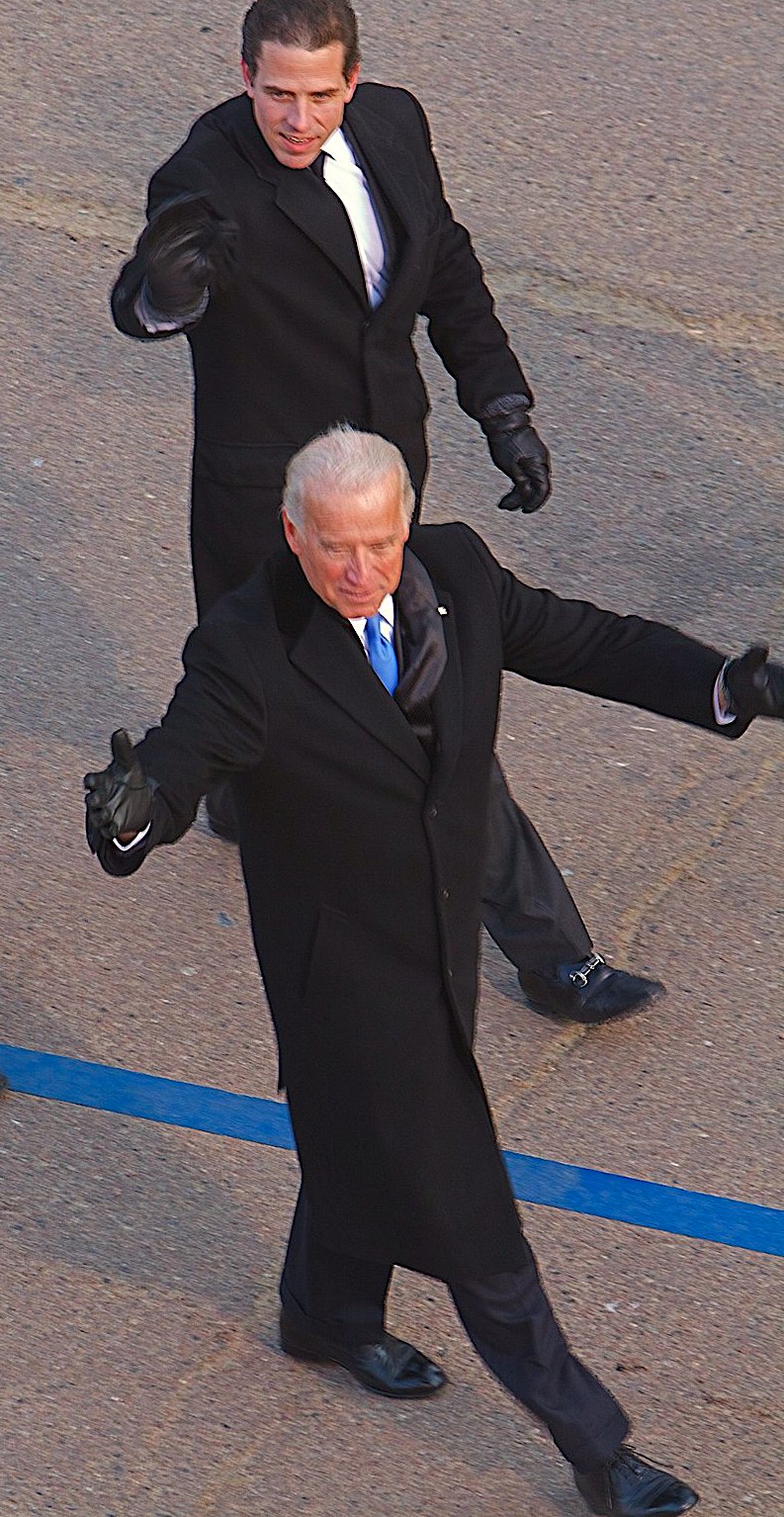
Son gets job on energy company board after father backs violent coup
Bolton says his recollections are not precise because the Ukraine-related theories floating around the Trump administration “always seemed intermingled and confused, one reason I did not pay them much heed. Even after they became public, I could barely separate the strands of the multiple conspiracy theories at work.”
Bolton’s words are also ambiguous. The fact that Trump allegedly “said he wasn’t in favor of sending [Ukraine] anything” is not an explicit linkage to military aid. And as for the “Russian-investigation materials,” Bolton does not specify what Trump was referring to. It seems likely Trump may have been referencing his reported theory that the Democratic National Committee server was somehow hacked with Ukrainian involvement.
Trump may also have been seeking information on the Ukrainians who openly admitted to interfering in the 2016 campaign with the aim of thwarting his candidacy, most notably by leaking allegations of illegal payments to Paul Manafort. It is highly plausible that these were Trump’s priorities. In his July 25 phone call with Zelensky, which sparked the whistleblower complaint behind Ukrainegate, Trump’s top issue – and the object of the “favor” he requested – was not the Bidens, but securing Zelensky’s assistance with the Justice Department’s ongoing review of how the Russia investigation began in 2016.
Whatever the case, for Bolton to write that Trump drew a link between these issues and the security aid – and not a link to a demand that Ukraine open an investigation of the Bidens and Burisma – contradicts the impeachment case that many expected him to validate.
Bolton, perhaps inadvertently, also lends credence to the Trump administration’s public defense of its freeze on security assistance to Ukraine, which Democrats cast as the linchpin of a politically motivated quid pro quo. In his July 25 call with Zelensky and subsequent public statements, Trump has said that he wanted NATO allies to spend more on Ukrainian military funding. Bolton recounts that on Aug. 30 – just days after an article in Politico made the aid freeze public, including to the Ukrainian government – Trump repeated his complaints about the U.S. burden, and proposed that NATO provide Ukraine with the security assistance instead of Washington:
Trump said, “I don’t give a shit about NATO. I am ready to say, ‘If you don’t pay, we won’t defend them.’ I want the three hundred million dollars [he meant two hundred fifty million dollars, one piece of the assistance earmarked for Ukraine] to be paid through NATO.” … He then said to Pence, “Call [NATO Secretary General Jens] Stoltenberg and have him have NATO pay. Say ‘The President is for you, but the money should come from NATO,’” which still didn’t make any sense.
If Trump is freezing the military aid for the sole purpose of coercing a Ukrainian investigation, it would be incongruous for him to propose an outcome that delivers the money without the investigation he is supposedly trying to compel.
As a part of their impeachment case, Democrats argued that Trump released the aid to Ukraine only after getting caught through publicity surrounding the whistleblower complaint. Yet Bolton writes that after Ukraine conducted a successful prisoner swap with Russia on Sept. 7, “Trump had seemingly indicated” that the swap “might be enough to get him to release the security assistance.” The money was released four days later, on Sept. 11.
Says He Wanted Nothing to do With Ukraine
Bolton confirms national security aide Fiona Hill’s testimony that he told her he did not want to be “part of whatever drug deal Sondland and [White House Chief of Staff Mick] Mulvaney are cooking up.” But he offers context that makes that line far less explosive than it was initially received. Bolton was not referring to leveraging any military aid, but to Sondland’s attempt to push for a hasty meeting between Trump and Zelensky at the White House, where the “Giuliani issues” could be discussed before Ukraine’s parliamentary elections in July.
Bolton says he nixed the idea of a meeting because Trump had recently told him that “he didn’t want to have anything to do with Ukrainians of any stripe,” due to Ukrainian meddling against him in the 2016 campaign. Sondland, in Bolton’s view, was “freelancing.” According to Bolton, Trump had also “resolved the visit issue just before leaving for the United Kingdom in June,” by saying he would meet with Zelensky “not until the fall, the right outcome in my view.”
It is easy to forget why Bolton was initially cast as a savior figure in January by those hoping to remove Trump by impeachment. When news of his memoir emerged, 10 days after the Senate trial began, Democrats had failed to prove their case. Not a single witness in the House impeachment hearings had provided direct evidence of a quid pro quo. The only witness who even spoke to Trump about the Ukraine aid was the then-European Union Ambassador Gordon Sondland. He reiterated multiple times that “nobody told me directly that the aid was tied to anything,” and that such a linkage was only his “presumption” and “personal, you know, guess.”
Sondland’s testimony was even more damaging to the impeachment case because, according to the impeachment narrative, he was the Trump official who purportedly relayed the alleged quid pro quo to the Ukrainian side. But Sondland revealed that he had only told Zelensky aide Andriy Yermak, in “a very, very brief pull-aside conversation,” that “I didn’t know exactly why” the aid has been frozen, but that a demand to open investigations “could be a reason.”
For his part, Yermak has said he does not even remember discussing the frozen aid with Sondland. That highlighted another problem with the Democrats’ quid pro quo allegation: Not a single Ukrainian official substantiates it. In addition to Yermak, President Zelensky and Foreign Minister Vadym Prystaiko also said that they saw no tie between the frozen military funding and pressure to open investigations. Even Democratic Sen. Chris Murphy, a staunch impeachment advocate, corroborates them: When they met in early September, Murphy recalled, Zelensky “did not make any connection between the aid that had been cut off and the requests that he was getting from Giuliani.”
The Ukrainians’ claims make sense in light of the fact that they only learned of the aid freeze, along with the rest of the world, with the Politico article published August 28. That would have meant that the supposed quid pro quo demand was made to them only after the issue became a matter of public controversy. That scenario was always implausible on its face. And now Bolton’s memoir has failed to change the picture. Bolton seems to grasp this fact. “I think the House Democrats built a cliff, they threw themselves off of it,” he told Raddatz of ABC News. “And halfway down, they looked up and saw me, and said, ‘Hey, why don’t you come along?”
Mysterious Individual ‘Blocking Release of Docs That May Expose Epstein’s Rich & Powerful Friends’
Sputnik – 24.06.2020
Jeffrey Epstein’s alleged sex slave Virginia Roberts, now Giuffre, was previously embroiled in a prolonged legal battle with the financier’s close associate Ghislaine Maxwell that ended in 2017. However, a cache of documents in the case listing the names of the financier’s closest associates remains sealed.
An anonymous person dubbed “John Doe” is trying to prevent the release of documents related to the Roberts Giuffre-Maxwell defamation case, requested by attorney and former Harvard professor Alan Dershowitz, the Daily Mail reported.
The protective order over the documents in the case was signed by now deceased New York Judge Robert Sweet, preventing the public release of the names of people closely associated with Jeffrey Epstein and potentially involved in his sex trafficking scandal.
Dershowitz, who was a friend of the convicted sexual offender, is now fighting a separate defamation case against Epstein’s alleged victim Virginia Giuffre launched in November 2019. He is calling for the protective order to be removed, arguing that the documents contain materials that could be crucial for his own defamation lawsuit.
On Tuesday, a number of attorneys involved in the case held a teleconference to debate whether the protective order can be loosened upon Dershowitz’s request. According to the Daily Mail, legal teams representing Giuffre, Maxwell, and a mysterious “John Doe” have strongly opposed the move.
The person’s attorneys, Nicholas Lewin and Paul Krieger, said in a letter to the court, that the protocol over the release of Giuffre-Maxwell case materials, which are expected to be unveiled on a “rolling basis”, should not be derailed.
“This marks Dershowitz’s second – or, by some measures, third – attempt to make an end-run around this Court’s carefully constructed unsealing protocol. Just as the Court denied Dershowitz’s prior attempts, it should deny this one”, the attorneys argued, a position that was shared by Maxwell’s and Giuffre’s legal teams.
The defamation lawsuit against Epstein’s alleged “madame” Ghislaine Maxwell was brought by Giuffre in September 2015 and eventually settled under seal two years later.
The media is now speculating that the anonymous individual involved in the case could be a public figure who is not willing to be associated with the Epstein scandal. The disgraced financier died in his prison cell in August 2019, while awaiting trial on sex-trafficking charges following accusations by several women, including Virginia Roberts Giuffre. Throughout his business career, Epstein was associated with a number of powerful figures, including Hillary and Bill Clinton, Prince Andrew, Donald Trump, and many others. Roberts Giuffre claims that she was sex-trafficked to some of them, including British Prince Andrew and Alan Dershowitz, accusations both men have strongly denied.
Ukrainian MP reveals new ‘Biden-Poroshenko’ tapes, claims VP’s son was paid ‘protection money’ by Burisma
RT | June 23, 2020
More tapes of what appear to be Joe Biden’s phone calls with the former president of Ukraine have surfaced, along with documents showing how much his son Hunter was paid by Burisma, a gas company desperate to avoid prosecution.
Ledgers show payments of $3.4 million from Burisma to Rosemont Seneca Bohai, the company co-founded by Hunter Biden, for “consulting services,” former prosecutor Konstantin Kulyk and Ukrainian MP Andrii Derkach revealed on Monday in Kiev.
Kulyk added that these services clearly amounted to “political protection of Burisma” and its owner Mykola Zlochevsky by US vice president at the time, Joe Biden.
Kulyk also told reporters that his office had evidence of Burisma’s lawyers offering $50 million to the government to make the case against the company and its founder go away – and not $6 million as was reported earlier.
The reason Burisma’s activities stood out from the white noise of general corruption in Ukraine following the US-backed coup in 2014 is that Zlochevsky sought to shield himself from scrutiny by hiring Hunter Biden as a board member, for a reported salary of $50,000 a month. Biden had no qualifications for the job, other than father being the top US official in charge of Ukraine.
Last month, Derkach released a batch of audio recordings of what sounded like Biden and then-President Petro Poroshenko of Ukraine, discussing everything from sacking a prosecutor looking into Burisma to what Kiev needed to do to qualify for an IMF bailout loan. He revealed more tapes on Monday.
The new recordings show ‘Biden’ micro-managing Ukraine’s internal affairs, asking ‘Poroshenko’ for a “favor,” discussing personnel appointments in the prosecutor-general’s office, assuring Poroshenko the FBI is not looking into claims of a Ukrainian MP who blew the whistle on massive corruption and vote-buying schemes, and so on.
The recordings have not been authenticated and Derkach himself was careful to say the voices “sound like” Poroshenko and Biden. He has turned the materials over to the prosecutor-general’s office, which is reportedly looking into charges of treason and abuse of power against the former president.
Poroshenko’s corruption and Hunter Biden’s job have had a major impact on US politics. Last year, Democrats accused President Donald Trump of soliciting foreign interference in the 2020 election by bringing up Burisma on a phone call with his Ukrainian counterpart Volodymyr Zelensky and threatening to withhold US military aid to Kiev. The House of Representatives actually impeached Trump on those charges, though he was acquitted in the Senate.
One of the witnesses in the process was Deputy Assistant Secretary of State for European and Eurasian Affairs George Kent. On Monday, Derkach named Kent as the liaison between Biden and Poroshenko, used to keep them informed of any developments regarding Burisma.
Poroshenko responded to the revelations by claiming they were a “fabrication” by Russia as “part of a large-scale hybrid war” intended to “undermine the Ukrainian-American strategic partnership that underlies the international coalition in support for Ukraine.”
He said the same exact thing about last month’s revelations, though on that occasion he also accused someone from Zelensky’s office of handing over “raw materials” to investigative journalists who then gave the recordings to Derkach.
“Deadly” Hydroxychloroquine (HCQ) to treat Covid 19: How the World’s Top Medical Journals, The Lancet and NEJM, Were Cynically Exploited by Big Pharma
By Elizabeth Woodworth | Global Research | June 14, 2020
Abstract and Background
A publishing scandal recently erupted around the use of the anti-malarial drug hydroxychloroquine (HCQ) to treat Covid 19. It is also known as quinine and chloroquine, and is on the WHO list of essential medicines.[i]
The bark of the South American quina-quina tree has been used to treat malaria for 400 years.[ii] Quinine, a generic drug costing pennies a dose, is available for purchase online. In rare cases it can cause dizziness and irregular heartbeat.[iii]
In late May, 2020, The Lancet published a four-author study claiming that HCQ used in hospitals to treat Covid-19 had been shown conclusively to be a hazard for heart death. The data allegedly covered 96,000 patients in 671 hospitals on six continents.[iv]
After the article had spent 13 days in the headlines, dogged by scientific objections, three of the authors retracted it on June 5.[v]
Meanwhile, during an expert closed-door meeting leaked May 24 in France, The Lancet and NEJM editors explained how financially powerful pharmaceutical players were “criminally” corrupting medical science to advance their interests.
*
On May 22, 2020, the time-honoured Lancet [vi]– one of the world’s two top medical journals – published the stunning claim that 671 hospitals on six continents were reporting life-threatening heart rhythms in patients taking hydroxychloroquine (HCQ) for Covid-19.
The headlines that followed were breath-taking.
Although wider access to the drug had recently been urged in a petition signed by nearly 500,000 French doctors and citizens,[vii] WHO and other agencies responded to the article by immediately suspending the clinical trials that may have cleared it for use.
North American headlines did not mention that HCQ has been on the WHO list of essential drugs since the list began in 1977. Nor did they mention an investigative report on the bad press that hydroxychloroquine had been getting prior to May 22, and how financial interests had been intersecting with medicine to favour Gilead’s new, more expensive drug, Remdesivir.[viii]
The statistics behind the headlines
As a Canadian health sciences librarian who delivered statistics to a large public health agency for 25 years, I sensed almost immediately that the article had to be flawed.
Why? Because health statistics are developed for different purposes and in different contexts, causing them to exist in isolated data “stovepipes.”[ix] Many health databases, even within a single region or country, are not standardized and are thus virtually useless for comparative research.
How, I wondered, could 671 hospitals worldwide, including Asia and Africa, report comparable treatment outcomes for 96,000 Covid patients? And so quickly?
The Lancet is strong in public health and surely suspected this. Its award-winning editor-in-chief, Dr. Richard Horton, has been in his job since 1995.[x]
So how could the damning HCQ claims have been accepted? Here is what I discovered.
The honour system in medical publishing
To some extent, authors submitting articles to medical journals are on the honour system, in which cited databases are trusted by the editors, yet are available for inspection if questioned.[xi]
On May 28, an open letter from 200 scientists to the authors and The Lancet requested details of the data and an independent audit. The letter was “signed by clinicians, medical researchers, statisticians, and ethicists from across the world.”[xii]
The authors declined to supply the data, or even the hospital names. Meanwhile, investigative analysis was showing the statistics to be deeply flawed.[xiii][xiv]
If this were not enough, the lead author was found to be in a conflict of interest with HCQ’s rival drug, Remdesivir:
“Dr. Mandeep Mehra, the lead co-author is a director at Brigham & Women’s Hospital, which is credited with funding the study. Dr. Mehra and The Lancet failed to disclose that Brigham Hospital has a partnership with Gilead and is currently conducting two trials testing Remdesivir, the prime competitor of hydroxychloroquine for the treatment of COVID-19, the focus of the study.”[xv]
In view of the foregoing, the article was retracted by three of its authors on June 5.
How did this fraud get past The Lancet reviewers in the first place?
The answer emerges from what has remained an obscure French interview, although it has been quoted in the alternative media.[xvi]
On May 24, a closed-door Chatham House expert meeting about Covid included the editors-in-chief of The Lancet and the NEJM. Comments regarding the article were leaked to the French press by a well-known health figure, Dr. Philippe Douste-Blazy,[xvii] who felt compelled to blow the whistle.
His resulting BFM TV interview was posted to YouTube with English subtitles on May 31,[xviii] but it was not picked up by the English-speaking media.
These were The Lancet editor Dr. Richard Horton’s words, as reported by Dr. Douste-Blazy:
“If this continues, we are not going to be able to publish any more clinical research data because pharmaceutical companies are so financially powerful today, and are able to use such methodologies as to have us accept papers which are apparently methodologically perfect, but which, in reality, manage to conclude what they want to conclude.” [xix]
Doust-Blazy made his own comments on Horton’s words:
“I never thought the boss of The Lancet could say that. And the boss of the New England Journal of Medicine too. He even said it was ‘criminal’. The word was used by them.”[xx]
The final words in Doust-Blazy’s interview were:
“When there is an outbreak like Covid, in reality, there are people like us – doctors – who see mortality and suffering. And there are people who see dollars. That’s it.”[xxi]
The scientific process of building a trustworthy knowledge base is one of the foundations of our civilization. Violating this process is a crime against both truth and humanity.
Evidently the North American media does not consider this extraordinary crime to be worth reporting.
Notes
[i] World Health Organization. “World Health Organization Model List of Essential Medicines, 21st ed.”, WHO, 2019, pp. 24, 25, 53 (https://www.who.int/medicines/publications/essentialmedicines/en/).
[ii] Jane Achan, et al., “Quinine, an old anti-malarial drug in a modern world: role in the treatment of malaria,” Malaria Journal, 24 May 2011 (https://www.ncbi.nlm.nih.gov/pmc/articles/PMC3121651/).
[iii] WebMD, “Quinine Sulfate” (https://www.webmd.com/drugs/2/drug-869/quinine-oral/details).
[iv] The Lancet, “RETRACTED: Hydroxychloroquine or chloroquine with or without a macrolide for treatment of COVID-19: a multinational registry analysis, by Mandeep R. Mehra et al,” Lancet, 5 June 2010 (https://www.thelancet.com/journals/lancet/article/PIIS0140-6736(20)31180-6/fulltext).
[v] Ibid.
[vi] Famous weekly British medical journal, founded in 1823.
[vii] Lee Mclaughlan, “Covid-19 France: petition for wider chloroquine access,” 6 April 2020 (https://www.connexionfrance.com/French-news/Time-wasted-over-use-of-choroquine-coronavirus-drug-says-petition-by-former-French-health-minister).
[viii] Sharyl Attkisson, “Hydroxychloroquine,” Full Measure, 18 May 2020 (https://www.youtube.com/watch?v=zB-_SV-y11Y). Attkisson is a five-time Emmy Award winner (https://en.wikipedia.org/wiki/Sharyl_Attkisson).
[ix] See “Stovepiping,” (https://en.wikipedia.org/wiki/Stovepiping) (accessed June 12, 2020).
[x] Dr. Horton’s career, professionalism, and awards are shown at https://en.wikipedia.org/wiki/Richard_Horton_(editor)(accessed June 12, 2020).
[xi] The Lancet and NEJM editors could not be expected to comb through data from 671 hospitals to verify their accuracy – especially when submitted by four doctors.
[xii] The full-text letter and signatories appear at https://zenodo.org/record/3862789#.XuQiNmYTGhM
[xiii] Melissa Davey, “Questions raised over hydroxychloroquine study which caused WHO to halt trials for Covid-19,” The Guardian, 28 May 2020 (https://www.theguardian.com/science/2020/may/28/questions-raised-over-hydroxychloroquine-study-which-caused-who-to-halt-trials-for-covid-19).
[xiv] Melissa Davey et al, “Surgisphere: governments and WHO changed Covid-19 policy based on suspect data from tiny US company,” The Guardian, 3 June 2020 (https://www.theguardian.com/world/2020/jun/03/covid-19-surgisphere-who-world-health-organization-hydroxychloroquine).
[xv] 1. Alliance for Human Research Protection, “The Lancet Published a Fraudulent Covid-19 Study,” 2 June 2020 (https://ahrp.org/the-lancet-published-a-fraudulent-study-editor-calls-it-department-of-error/).
- Brigham Health, “Two Remdesivir Clinical Trials Underway at Brigham and Women’s Hospital,” 30 March 2020 (https://www.brighamhealthonamission.org/2020/03/26/two-remdesivir-clinical-trials-underway-at-brigham-and-womens-hospital/).
[xvi] Vera Sharav, “Editors of The Lancetand the New England Journal of Medicine: Pharmaceutical Companies are so Financially Powerful They Pressure us to Accept Papers,” Health Impact News, 5 June 2020
[xvii] Dr. Philippe Douste-Blazy, MD, is a cardiologist, former French Health Minister; 2017 candidate for Director at WHO; and former Under-Secretary-General of the United Nations. See also: https://en.wikipedia.org/wiki/Philippe_Douste-Blazy.
[xviii] “(Eng Subs) Hydroxychloroquine Lancet Study: Former France Health Minister blows the whistle,” BFM TV, 31 May 2020 (https://www.youtube.com/watch?time_continue=2&v=ZYgiCALEdpE&feature=emb_logo).
[xix] Ibid.
[xx] Ibid.
[xxi] Ibid.
Copyright © Elizabeth Woodworth, Global Research, 2020
Featured Video

More Bombs, More Talks Zelensky Rejects Trump’s Plan
or go to
Aletho News Archives – Video-Images
Book Review
In 2014, Michael Parenti Wrote A Prophetic Article About Ukraine
The Dissident | January 28, 2026
This week, the influential left-wing scholar Michael Parenti passed away at the age of 92.
Parenti was well known for his sharp criticism of U.S. foreign policy and U.S. imperialism throughout his life, waking up many to the reality of it and the lies used to justify it.
This is best underscored in one of his last published articles, “Ukraine and Regime Change”, which was published in the book “Flashpoint In Ukraine: How the U.S. Drive for Hegemony Risks World War III”, where he predicted to a tee what the result of the 2014 U.S. backed coup in Ukraine would be. … continue
Blog Roll
Recent Comments
loongtip on Hamas never agreed to lay down… eddieb on Conspiracy Denial eddieb on WEF Calls for ‘Cultural Revolu… loongtip on Trump wanted to play peacemake… Coronistan on EU member to sue bloc over ‘su… loongtip on Vicious loongtip on EU turns to India for defense… Coronistan on Donald Trump Is No Peace … seversonebcfb985d9 on French court jails pro-Palesti… eddieb on Fourteen Incredible Facts Abou… Bill Francis on European leaders’ shift in the… seversonebcfb985d9 on Villains of Judea: Philip Esfo…


 Aletho News
- Hamas never agreed to lay down arms in truce talks: Official
- Iran, China and Russia sign trilateral strategic pact
- After Years Of Denial, The IDF Admits The Gaza Health Ministry’s Numbers Are Accurate
- Riyadh and Hezbollah: A rapprochement forged in fire
- Criminal Conspiracy: How the U.S. and Israel Turned Iran into a Proving Ground for Bloody Experiments
- EU labels Iran’s Revolutionary Guard ‘terrorist organization’
- Security Guarantees Supported by Russia Agreed on in Istanbul in 2022 – Lavrov
- Russian oil major agrees sale of foreign assets to US firm
- European Union Sanctions Russian Journalists and Artists
- Fānpán – Is China Turning the Tables on the ‘Democratic’ West?
- If Americans Knew
- Playful Post on Tel Aviv Park Omits That It Was Built on Ruins of Palestinian Neighborhood
- Palestinian developer gains massive user support for app challenging censorship claims criticising US and Israel after losing over 60 relatives in Gaza
- Gaza’s ‘Board of Peace’ – A New Phase of Palestinian Dispossession and Genocide
- Mike Huckabee is interfering with the work and witness of churches in the Holy Land with a goal of silencing Palestinian Christians
- “Hey ChatGPT, is Israel building a concentration camp?” (spoiler: yes) – Not a ceasefire Day 111
- “The Gaza ceasefire is a minefield” – Not a ceasefire Day 110
- Israel to seek new security deal from US, official says
- Leaked “Board of Peace” Resolution Outlines U.S.-Led Plan to Rule Over Gaza
- Jonathan Greenblatt Rolls Out Plan to Activate Hispanic Evangelical Golems
- Violence against hundreds of Gazan remains to find one Israeli – Not a ceasefire Day 109
- No Tricks Zone
- 130 Years Later: The CO2 Greenhouse Effect Is Still Only An Imaginary-World Thought Experiment
- New Study Affirms Rising CO2’s Greening Impact Across India – A Region With No Net Warming In 75 Years
- Germany’s Natural Gas Crisis Escalates … One Storage Site Near Empty …Government Silent
- Polar Colding…Antarctica Saw Its Coldest October In 44 Years!
- New Study: Sea Levels Rose 20 Times The Modern Rate During The Roman Warm Period
- As German Gas Storage Dips Dangerously Low…Shortage Hardly Avoidable
- New Study: Brazil’s Relative Sea Level Was 2+ Meters Higher And SSTs 3-4°C Warmer 6000 Years Ago
- Philosopher Schopenhauer: Climate Science Certainty Stems From Stupidity, Ignorance
- New Study: Species Extinction Rates Declining Since 1980 – ‘Climate Change Is Not An Important Threat’
- Denmark Places Climate Protection Above Animal Welfare, Poisoning And Culling Cows
 Aletho News