US Democrats reject restrictions on military aid to Israel
MEMO | July 29, 2020
American Democrats voted overwhelmingly against a draft resolution which would restrict US military aid to Israel, reports revealed yesterday.
The draft resolution also condemned Israeli settlements, which have been labelled illegal by the UN Security Council.
The committee rejected the addition of the term “occupation” and refused to condition aid to Israel should the occupation state move forward with annexation efforts.
The amendment was introduced by Clem Balanoff, the Illinois director of the pro-Bernie Sanders non-profit “Our Revolution”.
Although 34 members voted in favour of the motion, 117 opposed it and five abstained.
Quincy Rides Again
New think tank needs an Israel reality check
By Philip Giraldi • Unz Review • July 28, 2020
The Quincy Institute for Responsible Statecraft think tank launched last November. It has recently issued a roughly 15,000 word manifesto entitled “Ending America’s Misguided Policy of Middle East Domination.” For those who would find ten thousand words plus intimidating, the paper includes a more digestible 1,221 word executive summary which fairly accurately summarizes the document’s conclusions.
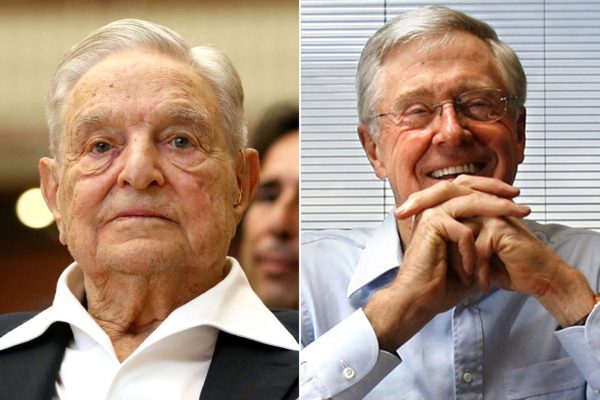
I have written about Quincy before, here and here and here. In short, while I would applaud a restrained foreign policy, particularly for the Middle East, I find Quincy unconvincing. It claims to promote “ideas that move U.S. foreign policy away from endless war and toward vigorous diplomacy in the pursuit of international peace” and further takes some pride in being non-partisan, though bipartisan might be a better description. To be sure, Quincy’s two major donors have been reported to be the highly controversial George Soros on the globalist left and the equally notorious Koch Foundation on the libertarian-lite right.
Soros in particular has been much in the news of late given his alleged propensity to fund and otherwise support groups and organizations that many would regard as conspiratorial or even violently radical, to include black lives matter and Antifa. Soros, a Hungarian Jew who is now a U.S. citizen, has been especially engaged in interventions to bring about “regime change” through “democracy movements” in Eastern Europe and he has exhibited a particular animosity towards Russia, making one suspect that his cash will influence what Quincy is allowed to say about the Kremlin.
The new Quincy report was co-authored by Paul Pillar, Andrew Bacevich, Trita Parsi and Annelle Sheline. I am not familiar with Sheline’s work, but Pillar, Bacevich and Parsi are all highly respectable and very knowledgeable about both national security and developments in the Middle East. To be sure, the paper includes a lot of useful information and insights into how various policies have evolved plus some very positive suggestions for extricating the U.S. from the Asian quagmire. But one should also accept that what is included in its agenda and how it is framed might be shaped by outside considerations, to include how Quincy is funded. It is not so much a matter of what the contributors write, but rather how it is spun and what is either minimized or not even addressed at all.
The ability to write about the Middle East in an even-handed “realistic” fashion, which is what the new article seeks to do, is based on the premise that there is equivalency among all of the players involved. That is, of course, nonsense. Many observers would note that the United States currently is in the Middle East and playing the role that it does mostly due to the immense power of Israel and its domestic lobby operating largely out of Washington and New York City.
Israel’s ability to make American presidents and the U.S. Congress do what it wishes is clearly visible wherever one chooses to look. The American people have gained nothing from giving Israel hundreds of billions of dollars and an endless supply of weapons while also looking the other way as Israel stole nuclear secrets and spied on the U.S. more than any other “friendly” country. What did the U.S. gain in recently moving the American Embassy to Jerusalem, in allowing Benjamin Netanyahu to annex the Golan Heights, in approving the bombing of Syria and Iran, or in permitting the systematic Israeli dehumanizing of the Palestinians?
A recent article by Professor Bacevich entitled “President Trump, Please End the American Era in the Middle East” appears to a precursor study to the current longer Quincy report. It is a good example of how self-censorship over Israel by authors works. The article particularly focused on the foreign policy pronouncements of Bret Stephens, the resident neocon who writes for The New York Times. Stephens, per Bacevich, has been urging constant war in the Middle East and worrying lest “we may be witnessing the beginning of the end of the American era in the Middle East.” Bacevich correctly described how “in the Middle East, the military power of the United States has played a large part in exacerbating problems rather than contributing to their solution.”
The overall message is sound, but in this case, it is interesting to note what Bacevich left out rather than what he included. He cited Iran seven times as well as Saudi Arabia, but, strangely enough, he never mentioned Israel at all, which a number of commenters on the piece noted. It rather suggests that there is a line that Bacevich is reluctant to cross. The omission is particularly odd as Israel is absolutely central to and might even be described as driving American policy in the Middle East and Bret Stephens, whom Bacevich excoriates, is a notable Israel-firster who once worked as the editor of the Jerusalem Post.
Bacevich also has produced an op-ed entitled “Foreign governments are messing with our elections the old-fashioned way” in the Boston Globe. It again fails to mention Israel at all in spite of that country’s enormous influence over the U.S. electoral process through the political donations provided by dual loyalty billionaires Sheldon Adelson and Haim Saban to Republicans and Democrats respectively. In fact, Bacevich has clearly indicated that there will be red lines, that the Quincy Institute won’t focus on “highlighting pro-Israel organizations or donors.” In other words, it will not criticize Israel’s Lobby as a key driving element in America’s interventionist foreign policy.
Bacevich is a smart man who knows perfectly well what Israel and its lobby represents but he also knows that anyone who wants to be a player in Washington DC has to avoid the Israel hot wire. The Quincy report includes, for example, lengthy separate sections on Iraq, Syria, Iran and Yemen but nothing similar on Israel. I have, however, excerpted all the citations of Israel in the full text. They are:
“U.S. military assistance—most prominently to Israel, Egypt, and Jordan, but also to armed proxy groups in Syria, Iraq, Afghanistan, and Libya—exacerbates abuses that contribute to instability… Unconditional U.S. military support for Israel has facilitated its continued occupation of Palestinian territory (potentially culminating in the annexation of the West Bank) and reduced incentives to pursue a peaceful resolution to the conflict.”
The bombing of the U.S. “embassy in Beirut, [was] a direct response to U.S. military intervention in Lebanon, which, in turn, was an attempt to deal with the consequences of the Israeli invasion of Lebanon a year earlier.”
“The Israel–Palestine conflict has been an especially salient example of such an issue, as underscored by how Palestinians opposing the Israeli occupation were in the forefront of the wave of international terrorism that began in the late 1960s. International terrorism sponsored by Palestinian organizations abated once the U.S. and Israel began engaging the Palestinians in the late 1980s.”
“In other cases, U.S. support for a militarily superior partner has tended to reduce that country’s incentives to resolve conflicts and instead opt to safeguard a status quo favorable to its interests but not to regional stability and U.S. interests. As the only state in the region with nuclear weapons and as a highly effective conventional military power in its own right—and with a qualitative edge conferred over many years by the U.S. and effective weapons development and manufacturing capacities—Israel no longer needs the U.S. to guarantee its security. Yet the U.S. sends Israel $3.8 billion in military aid annually. As of 2019, Israel had received $142.3 billion from the U.S. since 1949 —significantly more than any other nation.40 American military aid is sent regardless of whether Israel tries to resolve the conflict with the Palestinians. By persistently bolstering Israel’s qualitative military edge no matter what direction Israeli policy takes, U.S. assistance as currently structured does not incentivize Israel to pursue compromise, whether with the Palestinians or other neighbors.”
“… persistent U.S. antipathy creates a security dilemma for Iran. U.S. military support for Israel, Saudi Arabia, and the UAE causes Iran to perceive itself as under threat and to respond by trying to enhance its own security, partly by investing in paramilitary groups beyond its borders.”
“In Israel, where the well-reinforced assumption that unquestioning U.S. support will continue no matter what Israel does, it has long been evident that this has encouraged destructive Israeli practices such as the continued building of Israeli settlements in the Occupied Territories.”
“Such a rights-respecting policy would include making military assistance to Israel—for decades (and still) the largest recipient of such assistance—conditional on Israel ending its routine violation of human rights in the Occupied Palestinian Territories. These offenses include ongoing settlement expansion in the West Bank and East Jerusalem and attacks in Gaza that have failed to fulfill obligations to protect civilians. Israel is a nuclear and military superpower in the region that does not need American military aid to defend itself. As such, it should arguably not be a candidate for military aid in the first place. To the extent military aid should be provided to Middle Eastern states, priority should be given to those at risk of becoming failed states. If Washington decides to continue aid to Israel, it should be conditioned on changes to Israeli policies that advance stability and U.S. interests.”
“A consistent rights-respecting policy embedded in a broader approach to the region, one that emphasizes core U.S. interests, problem-solving diplomacy, and engagement with all relevant regional actors, would have consequences for how the U.S. has traditionally managed the Israel–Palestine conflict. The shortcomings of the U.S.–led peace process have become increasingly evident, all the more so as the Trump administration has abandoned any pretense of serving as an honest broker. It is a process that ill-serves U.S. interests as well as Israel’s long-term well-being, let alone its failure to help the Palestinians.”
“… there would be greater space for advancing negotiated and diplomatic solutions to various conflicts in the region, notably in the Saudi–Iran and Israel–Palestine cases.”
“For the United States, this means a significant reduction of arms sales, primarily to Saudi Arabia, Israel, and the UAE.”
Some of the citations regarding Israel are bundled with other countries, most particularly as related to arms sales and regional conflicts. Other excerpts correctly note that the status quo with Israel serves no American interests and is not even good for Israel, but the problem is that the solution is lame, or to describe it more properly, irrelevant. Distancing the U.S. from the region’s quarrels depends solely on disengaging with Israel first as American hostility towards an unthreatening Iran, Lebanon and Syria is a result of successful advocacy by the Jewish state. And serving as an “honest broker” vis-à-vis the Palestinians is sheer fantasy as it has never been the case for any U.S. administration due to effective Israeli pressure. If the Quincies were being honest, they would concede up front that the so-called peace plan currently being floated is a complete sell out to Israel. Any kind of shift in policy also assumes that Israelis want peace with the Palestinians, but opinion polls suggest otherwise, with many Israelis routinely referring to the Arabs as “terrorists.”
The only suggestion with any teeth to it is making military assistance to Israel conditional on its human rights record towards the Palestinians, but that in turn exposes the fundamental flaw in the arguments being made. The problem for the U.S. is not Israel per se but rather the enormously powerful domestic Israel Lobby which will make sure that nothing will be done to alter the status quo. The American government and media are completely dominated by Jewish billionaire-funded organizations that have repeatedly demonstrated that they have sufficient clout to stop any defections, witness the recent affirmation of the U.S./Israel relationship in the Democratic Party electoral platform and Joe Biden’s proud declaration that he is a “Zionist.” Quincy is delusional if it thinks that it can reorder the Middle East based on “realism and restraint” without the cooperation of Congress and the White House, which are bought and paid for and totally resistant to change.
So, Quincy has a lot of interesting ideas and the basic premise of non-interventionism is sound. But regarding the real fly in the ointment, Israel, it is pointless to urge “realism” in a situation that has not been realistic since 1947. Unfortunately, in America everything has a price and Jewish groups have been canny enough to buy Congress, the White House and much of the media at bargain prices to make sure that Israel stays protected. If you are not addressing that issue out in the open you are wasting your time. Not surprisingly, it would seem that any concerns over the reorganization of the Middle East as proposed by Quincy are most definitely not going to keep Benjamin Netanyahu awake at night.
Philip M. Giraldi, Ph.D., is Executive Director of the Council for the National Interest, a 501(c)3 tax deductible educational foundation (Federal ID Number #52-1739023) that seeks a more interests-based U.S. foreign policy in the Middle East. Website is https://councilforthenationalinterest.org, address is P.O. Box 2157, Purcellville VA 20134 and its email is inform@cnionline.org.
Isabel Maxwell: Israel’s “Back Door” Into Silicon Valley
This is Part II of the series “The Maxwell Family Business: Espionage” and focuses on Isabel Maxwell. Part I can be found here.
By Whitney Webb | The Last American Vagabond | July 25, 2020
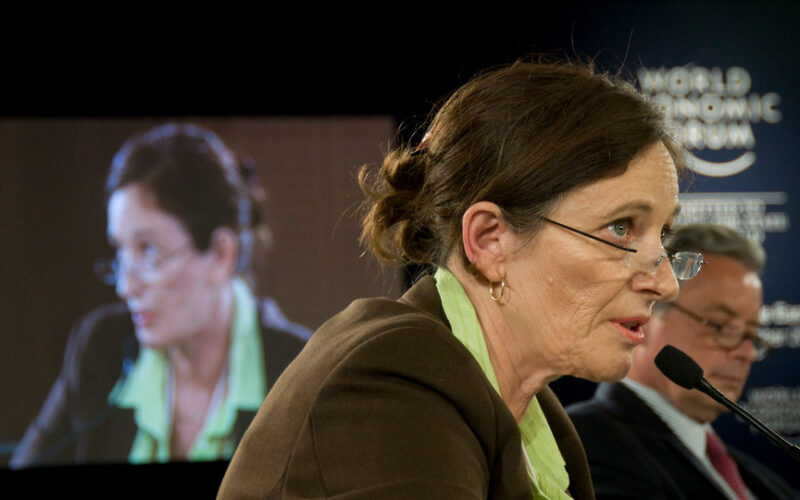
By moving in “the same circles as her father” and vowing to “work only on things involving Israel,” Isabel Maxwell became a pivotal liaison for the entry of Israeli intelligence-linked tech firms into Silicon Valley with the help of Microsoft’s two co-founders, Paul Allen and Bill Gates.
In 1992, Israel’s government created the Yozma Program at the urging of Chief Scientist of Israel’s Ministry of Industry and Trade – Yigal Erlich – as Erlich moved to leave that position. The Yozma Program aimed to “incentivize venture investment” by creating state-linked venture capital funds, which later spawned a myriad of Israeli hi-tech start ups with merging them with major, foreign technology companies. According to Erlich’s website, he had lobbied Israel’s government to launch Yozma because he had “identified a market failure and a huge need in Israel to establish for the first time a professionally-managed venture capital industry that will fund the exponential growth of high tech ventures coming out of Israel.” He then “convinced the Israeli government to allocate $100 million for his venture capital vision.”
Erlich’s vision would also result in the fusion of Israel’s hi-tech sector, which he helped to create, with Israel’s intelligence apparatus, with numerous Israeli hi-tech conglomerates created with funding from the Yozma program and its successors doubling as tools of Israeli espionage. Notably, not long before Erlich convinced Israel to place $100 million into this program, Israeli intelligence, thanks largely to the work of infamous spymaster Rafi Eitan, had learned the benefits of placing backdoors for their intelligence services into commercial software through the theft and subversion of the PROMIS software. As noted in Part I of this series, Israel’s bugged version of PROMIS was largely marketed by Robert Maxwell.
After the Yozma program was established, the first venture capital fund it created was called Gemini Israel Ventures and Israel’s government chose a man named Ed Mlavksy to lead it. Mlavksy, at the time, was the Executive Director of the Israel-U.S. Bi-national Industrial Research and Development Foundation (BIRD), where Erlich was Chairman of the Executive Committee. Mlavsky states that, while heading the BIRD foundation, “he was responsible for investments of $100 million in more than 300 joint projects between U.S. and Israeli high-tech companies.” BIRD’s connections to Gemini Israel Ventures and the Yozma Program in general are interesting, given that – just a few years prior – it had come under scrutiny for its role in the one of the worst spy cases in U.S. history – the Jonathan Pollard affair.
Jonathan Pollard had been a naval intelligence analyst turned Israeli spy who passed troves of documents regarding U.S. military technology (specifically nuclear technology) as well as clandestine U.S. intelligence operations to Israeli intelligence, specifically to the now defunct spy agency Lekem. Pollard’s handler was none other than Rafi Eitan, who had engineered Israel’s outsized role in the PROMIS software scandal. In the indictment of Pollard for espionage, it was noted that Pollard delivered documents to agents of Israel at two locations, one of which was an apartment owned by Harold Katz, the then-legal counsel to the BIRD foundation and an adviser to Israel’s military, which oversaw Lekem. Government officials told the New York Times at the time that they believed Katz “has detailed knowledge about the [Pollard] spy ring and could implicate senior Israeli officials.”
Journalist Claudia Wright, writing in 1987, openly speculated about whether the close ties between Katz and Pollard’s handlers meant that BIRD itself had been used to pass funds to Pollard or that BIRD funds themselves, most of which were provided by U.S. taxpayers as opposed to public claims of “joint” funding, had been used to pay Pollard for his “services” to Israel. In her article, she notes that Mlavsky had considerable discretion over the use of those funds while the U.S. official in charge of overseeing the U.S.’ interests in BIRD did “not know how investment is regulated” by the foundation. In addition, no U.S. official had access to any audit of the foundation, which were said to be conducted by an Israel-based accounting firm with no U.S. offices. The New York Times noted at the time that Katz specifically “may have knowledge of the method used to pay Mr. Pollard, who received tens of thousands of dollars from his Israeli handlers.”
After BIRD’s Mlavsky was chosen to head Gemini Israel Ventures, one of the first companies the firm invested in was called CommTouch (now known as Cyren and majority owned by Warburg-Pincus). Founded in 1991 by Gideon Mantel, a former officer in a “special bomb-squad unit” for the Israel Defense Forces (IDF), alongside Amir Lev and Nahum Sharfman, CommTouch was initially focused “on selling, maintaining and servicing stand-alone email client software products for mainframe and personal computers.” They specifically courted Original Equipment Manufacturers (OEMs), meaning companies whose products are used as components in the products of another company that are then sold to end users. Integration of its products into those of major software and hardware developers would allow CommTouch’s products to be widely used but unseen. A Wired article discussing CommTouch noted as much, stating that CommTouch products are meant “to be as seamless and unnoticeable as the copper is to a phone caller.”
However, from their founding through early 1997, CommTouch struggled to stay afloat, unable to turn a profit and unable to secure any notable deals or to expand its company beyond 25 employees. Yet, thanks to Gemini Israel Ventures and “grants” from Israel’s government, which were used to finance the research and development of its products, CommTouch managed to stay afloat. As late as 2006, CommTouch noted in official documents that the company “has a history of losses and may never achieve profitability,” further noting that they hemorrhaged millions of dollars a year in net losses. Clearly, the decision by Gemini Israel Ventures and Israel’s government to continue to pour money into a decidedly unprofitable company for several years was motivated by something other than profits.
At some point in early 1997, CommTouch decided to enter the U.S. market and began seeking out a new President for the firm who had “local clout.” “We knew exactly what we were looking for,” Gideon Mantel later told Wired ofCommTouch’s search, “Someone who knows her way around the Valley.” They found their woman in the daughter of Israeli “superspy” and PROMIS salesman par excellence, Isabel Maxwell.
An Intriguing Pedigree
Mantel and CommTouch allegedly chose to court Isabel Maxwell for their company’s presidency through an unspecified placement company and were “attracted to her expertise and insight in Silicon Valley when it sought her out.” The Israeli outlet Globes states that Gideon Mantel “went to Isabel Maxwell as soon as he arrived in Silicon Valley and realized that in order to progress, an e-mail solutions company like CommTouch needed help from someone who knew the rules of the game.” Wired offers a similar portrayal, further adding that it was “Gideon Mantel [who] got Isabel Maxwell to take the job.”
Mantel told Jewish Weekly that while Maxwell’s pedigree, i.e. being Robert Maxwell’s daughter, “was very intriguing at the beginning… it wasn’t her name that made the decision for us.” However, Mantel, in separate reports, compares Isabel to her father on numerous occasions when praising her professional abilities. For example, he told Haaretz that Isabel “is not cowed by anyone, and she never gives in…. She got all that at home. They taught her to go after things and not give up.” Similarly, he told Wired that “Like her father, she is a fighter,” later adding that “She always charges. She has no fear. Of course, it is from her father. It is in her blood.” Given that Robert Maxwell is rarely posthumously remembered (in media anyway) as “a fighter” and “fearless,” it goes without saying that Mantel views him with a degree of reverence that he also associates with his daughter Isabel.
Isabel, notably, has herself stated on several occasions that her acceptance of Mantel’s offer to be CommTouch’s President was also informed by her father’s controversial ties to Israel.
She told Haaretz that her reasons for accepting the CommTouch presidency was “from the heart” because it was “a chance to continue her father’s involvement in Israel,” leading her to reject other more lucrative job offers from actually established companies that she had received at the time. She similarly described her reasons for joining CommTouch to Jewish Weekly as “an affair of the heart,” adding that “it had to do with my father and my history.” The New York Times quoted her as saying that she had “considered other California-based Internet start-ups [in 1997], but felt a pull toward CommTouch and the Israeli connection.”
Isabel has some interesting views on her father, whom she describes as the “ultimate survivor,” and his involvement in Israel. She describes him as “highly complex,” adding that she doesn’t “have rose-coloured glasses about him,” but nonetheless says she is “proud” of his controversial legacy and that “if he were alive today that he would be proud of us too.” She said something similar to The Guardian in 2002, stating that “‘I’m sure [my father would] be thrilled to know what I’m doing now,’…. throwing back her head and laughing loudly.” In addition, when asked who the most influential person in her life had been, Isabel responded “My father was most influential in my life. He was a very accomplished man and achieved many of his goals during his life. I learned very much from him and have made many of his ways my own.”
Isabel told Haaretz around that same time that “When I was with him [her father], I felt power. Like being at the White House… Beyond that, it was a collective power, not my personal power. I was part of this unit,” apparently referring to her other siblings, Ghislaine and Christine among them, and suggesting that they were collectively extensions of their father’s power.
However, Isabel stands out from her other siblings, and even Ghislaine, in terms of a sense of loyalty to her father and to the state of Israel. According to Elizabeth Maxwell, Isabel’s mother, Isabel “is also loyal to the memory of her father, and to what Judaism represents in her life. All my children were brought up as Anglicans, but Isabel was very taken by the Jewish faith and the politics in Israel” compared to her other children, including Ghislaine.
Indeed, Isabel has close relationships to several prominent former Mossad officials and Israeli heads of state, with several of those relationships having been “forged by her father.” A now scrubbed report published by the Jerusalem Post in 2003, entitled “Isabel Maxwell Fights Back,” notes that “Maxwell travels in the same circles as her father, but she is more comfortable behind the camera, not in front of it…she is carrying on her father’s legacy in Israel, albeit in her own way.” It also noted that, by 2003, Isabel was visiting Israel every month, visiting her father’s grave on the Mount of Olives at least once every visit.
Arguably the most interesting part of the now-scrubbed Jerusalem Post article is the way in which Isabel views her father’s legacy. In discussing the book by Gordon Thomas and Martin Dillon, Robert Maxwell, Israel’s Superspy: The Life and Death of a Media Mogul, Isabel – even though she participated in interviews for the book – rejected its premise that her father was a “spy”and went on a private smear campaign against the book and its authors prior to its publication.
Tellingly, she does not object to the book’s contents regarding her father’s activities on Israel’s behalf, including his role in the PROMIS software scandal or Iran-Contra, but merely objects to the use of the word “spy” to describe those activities. “My father was certainly a ‘patriot’ and helped in back business and political channels between governments,” Isabel told the Jerusalem Post, “But that did not and does not make him a ‘spy.’” It could be said, then, that Isabel would view her subsequent career “in back business and political channels” via the “same circles as her father” as similarly “patriotic.” Yet, for those that consider her father a “spy” for his activities, that would also mean extending the same to Isabel, who self-identifies as Israeli.
Aside from her father’s own ties to Israeli intelligence, it is worth noting that Isabel’s own history – up to the point she joined CommTouch – involved her working for the Israeli intelligence front company used by her father to sell bugged PROMIS software in the U.S., Information on Demand, and subsequently the search engine Magellan, of which she shared ownership with her sister Christine (whose ties to U.S. intelligence will be explored in Part IV) and her sister Ghislaine, a sexual blackmailer and sex trafficker operating on behalf of U.S. and Israeli intelligence. Isabel’s past with both Magellan and Information on Demand were clearly known to CommTouch at the time of Isabel’s hiring. It also worth noting that, on several occasions, Isabel credits CommTouch’s success with the ties of all of its Israeli employees to the Israeli military and military intelligence, resulting in – per Isabel – a “dogged work ethic” and a “trained mind-set” among its Israeli workforce.
As will be shown in more detail in Part III of this series, upon departing CommTouch, Isabel deepened her already close ties to prominent Israeli politicians and intelligence officials, serving alongside ex-Mossad directors and counting former Israeli chief intelligence officers and heads of state among her “family friends” and business partners. This involvement continued during the period when her son was given a prominent position at the Middle East affairs desk at the State Department when it was headed by Hillary Clinton, who – as many are now aware – has close and controversial ties to Isabel’s sister, Ghislaine.
Microsoft’s Co-founders put CommTouch “On the Map”
Upon taking the job at the Israeli tech firm, Maxwell’s promotion of the company was called “almost messianic” even though her enthusiasm was described as “hard to fathom” given the lackluster performance of the company and its products. However, soon after becoming CommTouch’s president, her personal connections to prominent figures in Silicon Valley – forged through her past work at Magellan – paid off and the company announced new partnerships with Sun Microsystems, Cisco, and Nippon Telephone and Telegraph, among others. At CommTouch, Maxwell managed“all sales and marketing activities for CommTouch and co-direct[ed] strategic business development.”
Some reports have noted that Maxwell’s connections with prominent Silicon Valley figures were the key to her professional success, with Globes noting that “Everyone who has worked closely with Maxwell says that her advantage lies in her ability to help penetrate the market with a new product by opening the right doors,” an “advantage” also ascribed to her father while he sold bugged PROMIS software on behalf of Israeli intelligence. Yet, despite Isabel’s penchant for “opening the right doors,” reports well into Maxwell’s career at CommTouch still referred to the firm as “an obscure software developer.”
However, out of all the alliances and partnerships Isabel negotiated early on during her time at CommTouch, it was her dealings with Microsoft co-founders Bill Gates and Paul Allen that would put CommTouch “on the map.” Maxwell had previously negotiated a major deal with Microsoft’s Bill Gates earlier during her time as the McKinley Group/Magellan’s Executive Vice President, resulting in Microsoft announcing that the Maxwell-owned Magellan would power the search option for the company’s MSN service.
Yet, it appears that Microsoft’s co-founders did much more than put CommTouch “on the map,” but ended up preventing the collapse of its initial public offering, a fate that had befallen Isabel Maxwell’s previous company, the McKinely Group, not long before. Indeed, CommTouch kept pushing back its IPO until a massive investment from firms tied to Microsoft co-founder Paul Allen was announced in July 1999.
The investment from Allen’s Vulcan Ventures Inc. and Go2Net Inc resulted in a jump in “interest in the stock sale and in CommTouch, until now an obscure software developer,” according to a Bloomberg report, and also inflated their stock price immediately prior to their going public. The money from Allen-linked investment would be specifically used “to expand sales and marketing and build its presence in international markets.” Allen’s decision to invest in the company seems odd from a financial perspective, given that CommTouch had never turned a profit and had netted over $4 million in losses just the year before. Yet, thanks to Allen’s timely investment and apparent coordination with the company’s repeated delays of its IPO, CommTouch was valued at over $230 million when it went public, as opposed to a $150 million valuation just weeks prior to Allen’s investment.

Bill Gates at Deal Book Conference in New York, 2019
It’s not exactly clear why Paul Allen came to the rescue of CommTouch’s IPO and what he expected to gain from his investment. However, it is worth pointing out that Allen was among the members of an exclusive online community of elites set up in 2004 called “Small World,” whose membership also included Jeffrey Epstein and Epstein-linked figures like Lynn Forester de Rothschild and Naomi Campbell, as well as Petrina Khashoggi, the daughter of Adnan Khashoggi, a former client of Epstein’s. Small World’s largest shareholder was Harvey Weinstein, the now-disgraced media mogul who was a business partner of Epstein and was since accused by a number of women of sexual abuse.
Less than three months after Allen’s investments in CommTouch in October 1999, the company announced that it had struck a major deal with Microsoft whereby “Microsoft will utilize the CommTouch Custom MailTM service to provide private label web-based email solutions for select MSN partners and international markets.” In addition, per the agreement, “CommTouch will provide MSN Messenger Service and Microsoft Passport to its customers while building upon its Windows NT expertise by supporting future MSN messaging technologies.”
The agreement came less than two years after Microsoft had purchased Hotmail, which – up until the CommTouch/Microsoft agreement – had been one of CommTouch’s main competitors for its web-based e-mail services. In other words, this meant that Microsoft would use CommTouch’s “behind the scenes” software as the backbone of its web-based e-mail services, Hotmail included. “We are looking forward to further enhancing our relationship with Microsoft by integrating other state-of-the-art Microsoft products,” Gideon Mantel of CommTouch said upon the deal’s public announcement.
In December 1999, Microsoft then announced that it had invested $20 million in the company by purchasing 4.7% of CommTouch stock. The announcement pushed CommTouch stock prices from $11.63 a share to $49.13 in just a few hours time. Part of that deal had been finalized by Richard Sorkin, a recently appointed CommTouch director. Sorkin had just become a multimillionaire following the sale of Zip2, Elon Musk’s first company where Sorkin had been CEO.
It further appears that Bill Gates, then head of Microsoft, made a personal investment in CommTouch at the behest of Isabel Maxwell. In an October 2000 article published in The Guardian, Isabel “jokes about persuading Bill Gates to make a personal investment” in CommTouch sometime during this time frame.
The article then oddly notes the following regarding Isabel Maxwell and Bill Gates:
“In a faux southern belle accent, [Isabel] purrs: ‘He’s got to spend $375m a year to keep his tax free status, why not allow me to help him.’ She explodes with laughter.”
Given that individuals as wealthy as Gates cannot have “tax free status” and that this article was published soon after the creation of the Bill and Melinda Gates Foundation, Isabel’s statements suggest that it was the Bill and Melinda Gates Foundation Trust, which manages the foundation’s endowment assets, that had made this sizable investment in CommTouch. Furthermore, it is worth highlighting the odd way in which Isabel describes her dealings with Gates, speaking of her interactions with him in a way not found in any of Isabel’s numerous other interviews on a wide variety of topics (i.e. “purring”, speaking in a fake Southern accent). This odd behavior may have been related to Isabel’s previous interactions with Gates and/or the mysterious relationship between Gates and Epstein, alluded to in a 2001 Evening Standard article, and eyewitness testimony regarding Epstein’s and Ghislaine Maxwell’s comments about Bill Gates in 1995, discussed in Part I of this series.
After 2000, CommTouch’s business and clout expanded rapidly, with Maxwell subsequently crediting Bill Gates-led Microsoft and Paul Allen’s investment for the company’s shifting fortunes. Maxwell, as quoted in the 2002 book Fast Alliances, states that Microsoft viewed CommTouch as a key “distribution network,” adding that “Microsoft’s investment in us put us on the map. It gave us instant credibility, validated our technology and service in the marketplace.” By this time, Microsoft’s ties to CommTouch had deepened with new partnerships, including CommTouch’s hosting of Microsoft Exchange.
Though Isabel was able to secure lucrative investments and alliances for CommTouch and see its products integrated into key software and hardware components produced and sold by Microsoft and other tech giants, she was unable to turn the tide of the company’s dire financial performance, with CommTouch netting a loss of $4.4 million in 1998 and similar losses well into the 2000s, with net losses totalling $24 million in the year 2000 (just one year after the sizable investments from Microsoft, Paul Allen and Bill Gates). The losses continued even after Isabel formally left the company and became President Emeritus in 2001. By 2006, the company was over $170 million in debt.
The One-Woman Liaison Between Israel and Silicon Valley
Isabel Maxwell would leave her role at CommTouch in 2001, but remained President Emeritus for years afterward retaining a sizable amount of CommTouch stock then-valued at around $9.5 million. While Maxwell remained honorary president, CommTouch added Yair Shamir, son of former Israeli Prime Minister and friend of Robert Maxwell, Yitzhak Shamir, to its board. Yair Shamir, Chairman of the Israeli government owned corporation, IAI (Israeli Aerospace Industries) when he joined CommTouch’s board, had previously managed Scitex when it was owned by Robert Maxwell. After nearly collapsing due to its long-standing debt burden a few years later, CommTouch was rebranded as Cyren and, today, runs in the background of Microsoft, Google, Intel, McAfee and Dell products, among many others.
Haaretz wrote in 2002 that Isabel, as CommTouch was in dire financial straits, had decided to “work only on things involving Israel. Even the failure of CommTouch, the Israeli Internet company she headed, hasn’t deterred her: She still believes in the medium, and she still believes in Israel.” Maxwell would subsequently create “a unique niche for herself in high tech as a liaison between Israeli companies in the initial development stages and private angel investors in the US” as a private consultant, subsequently creating Maxwell Communications Network in 2006. That company offered “cross-border communications, funding and market research to leading venture capitalists and hi-tech companies in the US and Israel.” However, she notes that her “specialty” was in “helping Israeli high-tech companies.”
During this period (2001-2006), Isabel would also head an Israeli tech company that “protects children online,” at a time when her sister – Ghislaine Maxwell – was actively abusing and trafficking children as part of an intelligence-linked operation alongside Jeffrey Epstein. Isabel took the job at iCognito (now Pure Sight) “because it [the company] is in Israel, and because of its technology.” She also joined the board of the Israeli company Backweb alongside Gil Shwed, a famous alumnus of Unit 8200 (often likened to Israel’s NSA equivalent) and co-founder of Israeli tech giant Check Point, which is a long-time partner of CommTouch.
Isabel’s close involvement with former Israeli heads of state and heads of intelligence would only deepen after leaving CommTouch, particularly with former Israeli Prime Minister Shimon Peres. The Jerusalem Post described the Peres-Isabel relationship as “close” and “forged by her father.” Isabel was also in close contact with former Mossad deputy director David Kimche (until his death in 2010) and former head of Israeli military intelligence and Prime Minister Ehud Barak. Notably, Ehud Barak, in addition in being a major player in the Israeli-U.S. hi-tech scene, was also closely associated with Jeffrey Epstein and Isabel’s sister Ghisaline, having recruited Epstein for Israeli military intelligence and overseeing the Lekem agency at the time of the PROMIS scandal (including Robert Maxwell’s role) and the Pollard Affair as well as Israel’s involvement Iran-Contra. Barak was also a frequent visitor to Epstein’s island and slept over in New York apartments that were owned by Epstein’s brother and which housed many of Epstein’s underage “sex slaves.”
Also notable is the fact that Ghislaine Maxwell and Jeffrey Epstein would themselves become involved in Isabel’s world, i.e. the growing nexus between Silicon Valley and Israel, courting and allegedly blackmailing major Silicon Valley executives while also investing in Israeli intelligence-connected start-ups. During this time, Isabel was a major player in venture capital networks and other organizations aiming to further develop ties between Israeli intelligence-linked start-ups and U.S. tech companies, which is now part of an openly admitted Israeli intelligence operation (in which Microsoft plays a major role). The ties of Isabel, Ghislaine and Epstein to this hi-tech world of Israeli espionage, as well as Isabel having inspired what would later become Ghislaine’s TerraMar project and her ties to powerful groups like the World Economic Forum and even the Hillary Clinton-led State Department, will be explored in the next installment of this series.
Whitney Webb has been a professional writer, researcher and journalist since 2016. She has written for several websites and, from 2017 to 2020, was a staff writer and senior investigative reporter for Mint Press News. She currently writes for The Last American Vagabond.
Ohio’s $60 million bribery scandal could ensnare the American nuclear sector, because public trust is undermined
By Ken Silverstein | RT | July 23, 2020
Ohio’s $60 million corruption, bribery case – that has ensnared the House speaker and four others – has also embroiled the nuclear power industry, which is at the heart of the criminal charges filed this week.
The nuclear energy sector in the United States has been trying to keep its head above water — unable to compete with cheap shale gas and subsidized wind and solar power. So it has sought help from state governments, which have taken up legislation to reward nuclear for being a carbon-free source of energy. In the case of Ohio, it is home to FirstEnergy, which owns two nuclear power plants in the state and which asked lawmakers for such consideration.
Ohio’s lawmakers, like those from Connecticut, Illinois, New York and New Jersey, voted to save their nuclear power plants not just because they are reliable and clean [???] but also because they employ thousands of people. In Ohio, it was a $1.3 billion bailout package. What the citizens of Ohio learned this week, however, is that $60 million in surreptitious payments were allegedly made to make that happen and part of that money went into the pockets of House Speaker Larry Householder.
FirstEnergy Solutions, now known as Energy Harbor, is the nuclear unit within FirstEnergy Corp.
According to the Energy and Policy Institute, this is the company which owned the nuclear assets that Householder helped to bailout “and which FirstEnergy spun off in bankruptcy restructuring.”
Energy Harbor says that it will cooperate fully with the investigators, although it is not named in the criminal complaint. However, it is likely the entity that prosecutors refer to as ‘Company A’ — the one that made the $60 million in payments to Speaker Householder’s ‘Generation Now’ fund so that it could get the $1.3 billion in benefits. Prosecutors say that the money was paid over a three-year time frame beginning in 2017.
“This is likely the largest bribery, money laundering scheme ever perpetrated against the people of the state of Ohio,” US Attorney David DeVillers told a press conference. “This was bribery, plain and simple. This was a quid pro quo. This was pay to play.”
In the actual complaint, the prosecution alleges the payments were tantamount to “bags of cash” that went unregulated and unreported.
This is more than a public corruption scandal. It is a potential take-down of nuclear energy. If it is, the ramifications would be huge: According to the Nuclear Energy Institute, there are 96 nuclear reactors in 29 states. Altogether, they supply about 20 percent of the country’s electricity and about 55 percent of its carbon-free power. They operate at 92 percent capacity, more than any other type of power plant.
A heavy weight
Context is key. In the US, electricity grid operators are the ones to order up and dispatch the lowest-cost electricity sources — a system that invariably favors shale gas because it is so cheap relative to competing fuels. Existing generators that sell their electricity at market rates, can’t win. This fact, along with the high capital costs it takes to construct nuclear plants, has severely curtailed nuclear development in the US.
As a result, six nuclear plants have closed down since 2013 and several more have announced retirement dates over the next decade. The practical implications of moving away from nuclear and into natural gas have been greater CO2 emissions. When Southern California Edison closed its plant in 2013, such heat-trapping releases rose by 35 percent. To avoid further closures, state legislatures are subsidizing nuclear power by recognizing their carbon-free contributions.
But the American nuclear power sector has never learned the most basic lesson of Three Mile Island Nuclear Generating Station, which suffered a partial meltdown of its core in 1979 and which triggered an irrevocable backlash: get accurate information to the public in a timely manner. Secrecy does not work. In 2013, Southern California Edison said it would shutter its San Onofre Generating Station because of a small radiation leak. While the utility had maintained publicly that it only learned of the seepage in 2012 during routine maintenance, it was subsequently proven that it long knew that irregular vibrations could lead to leaks.
The utility then lost all credibility with regulators and the public.
Bad economics in combination with poor PR have been mounting for a long time. And the problems are bound to get worse now that FirstEnergy’s Energy Harbor is allegedly embroiled in this latest mess. And the industry can’t blame the environmental movement for this latest crisis — a movement concerned about storing radioactive nuclear waste and potential accidents.
“FirstEnergy’s successful campaign last year to secure a $1 billion bailout of its Ohio nuclear plants is at the center of a pay-to-play scandal that is rocking Ohio,”says Sandy Buchanan and Seth Feaste, of the Institute for Energy Economics & Financial Analysis. “The FBI would do well to take a closer look at all other state government-official involvement with FirstEnergy during the years when FirstEnergy was seeking a ‘legislative solution’ to save its nuclear plants.”
Where does the nuclear sector go from here? No doubt, the industry will separate itself from the corruption scandal now plaguing the state of Ohio. It will continue to maintain that global climate goals cannot be met without heavy participation from nuclear. But it will once again have to fight off the stench of secrecy and back-room politics — the same factors that have weighed it down since 1979. When the Ohio case is resolved, so too might be nuclear’s future in the US.
Was Jeffrey Epstein’s Boss Ghislaine Maxwell Helping Mossad Run Pedophile Rings for Prince Andrew and the Ruling Elite?

By Marco de Wit | Laiton Lehti | October 13, 2019
Video introduction to this article. (If the video is deleted by Youtube you can find it also here in Bitchute.)
The Epstein Pedoscandal Mossad Timeline shows in detail how Jeffrey Epstein and Ghislaine Maxwell were working for the Israeli intelligence agency, Mossad.

Link to Unz.com article
The timeline generated many comments at Unz.com but surprisingly most of them dealt whether Epstein was a pedophile or not. This despite the overwhelming evidence of pedophilia.
Many have also totally missed – or are afraid to notice – the big picture: Israeli intelligence agencies and especially Mossad seem to be running pedophile rings that blackmail Western political, business and scientific leaders.
Furthermore, it seems that Ghislaine Maxwell was and still is the master mind behind many of these pedophile rings.
One of the reasons Epstein and Ghislaine were able to continue sex trafficking with impunity for so long was the appearance that Epstein was a victim of jealous people and overzealous police. Many people thought that Epstein had only had sex with a 17-year old girl who had lied about her age.
This excuse worked well because in Florida the age of consent is 18 while in most other American states it is 16.
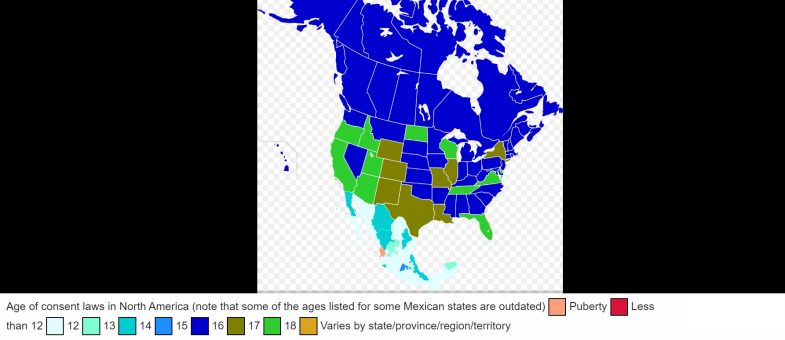
Link to Wikipedia
Epstein was able to play the martyr by not only claiming that unscrupulous girls had lied their age but also by implying that the age of consent is too high anyway in Florida.
This was also one reason why in New Mexico where Epstein had his Zorro Ranch the officials refused to register him as a sex offender. In New Mexico the age of consent was 16 until in 2018 it was raised to 18.
Furthermore, unlike in many other states, in New Mexico the courts recognize a mistake of age defense.
New Mexico courts recognize a mistake of age defense. The mistake of age defense is basically ”I thought she was 17.” However, this is no guarantee that this defense will work in court. Moreover, the mistake of age is the creation of judges in the absence of a direct statute addressing the defense. State lawmakers may pass a law overriding the courts on this issue at any time. (LegalMatch)
In reality the Epstein-Ghislaine case is not whether it is wrong for an adult to have sex with a 17 year old. Instead it is about many other things such as prostitution, grooming, pedophilia and the exploitation of children.
This all is connected to global politics involving sex trafficking, drug and arms trade, money laundering, Ponzi schemes, spy networks and blackmailing for Mossad.
Epstein’s victims were caught in a web of international spy network that used them as pawns for blackmail operations. The younger the girls were, the more leverage Israel would have over politicians, billionaires and scientists. Thus Epstein and Ghislaine tried to also recruit girls who were well under the age of 16.
What is more, they personally enjoyed having sex with these very young girls. Both Epstein and Ghislaine seem to have been pedophiles who were attracted to prepubescent girls and boys, i.e. small children.
Pedophilia is defined as:
Pedophilia (alternatively spelt paedophilia) is a psychiatric disorder in which an adult or older adolescent experiences a primary or exclusive sexual attraction to prepubescent children.[1][2] (Wikipedia)
Note that in order to be a pedophile it is enough to have merely occasional sexual attraction to prepubescent, i.e. sexually immature children who have not yet developed secondary sex characteristics, such as breasts.
Julie Brown from Miami Herald notes that Courtney Wild was only 14 when she was recruited into Epstein’s sex ring.
Wild still had braces on her teeth when she was introduced to him in 2002 at the age of 14.
She was fair, petite and slender, blonde and blue-eyed. (emphasis added. Miami Herald)

Link to Miami Herald
Julie Brown also notes that Epstein preferred girls who were not only white [and non-Jewish] but also appeared prepubescent.
Wild, who later helped recruit other girls, said Epstein preferred girls who were white, appeared prepubescent and those who were easy to manipulate into going further each time. (Emphasis added. Miami Herald)
For Epstein and Ghislaine it was important that the girls at the very least looked like small children. This is obviously why they preferred girls who were under 16.
Courtney Wild told the police that she brought Epstein over 70 girls and they were all under 16.
By the time I was 16, I had probably brought him 70 to 80 girls who were all 14 and 15 years old… (Emphasis added. Miami Herald)
Some girls were even younger. According to the police many were 13 year old.
The girls — mostly 13 to 16 — were lured to his pink waterfront mansion by Wild and other girls, who went to malls, house parties and other places where girls congregated, and told recruits that they could earn $200 to $300 to give a man — Epstein — a massage, according to an unredacted copy of the Palm Beach police investigation obtained by the Herald. (Emphasis added. Miami Herald)
It is also important to note that even 13 was not the minimum age for Epstein and Ghislaine. In fact, there was no limit to how young the girls could be. Both Epstein and Ghislaine Maxwell emphasized that the younger the better.
Eventually, she said Maxwell trained her to recruit new girls for Epstein.
“Jeffrey was very particular in the kind of girls he wanted. First off, the younger the better.”
Epstein said that to her, Giuffre claimed, and “Maxwell said that too. During the training and telling me how to do it, she said ‘You always have to go for the youngest-looking ones.’” (Emphasis added. The Daily Beast)
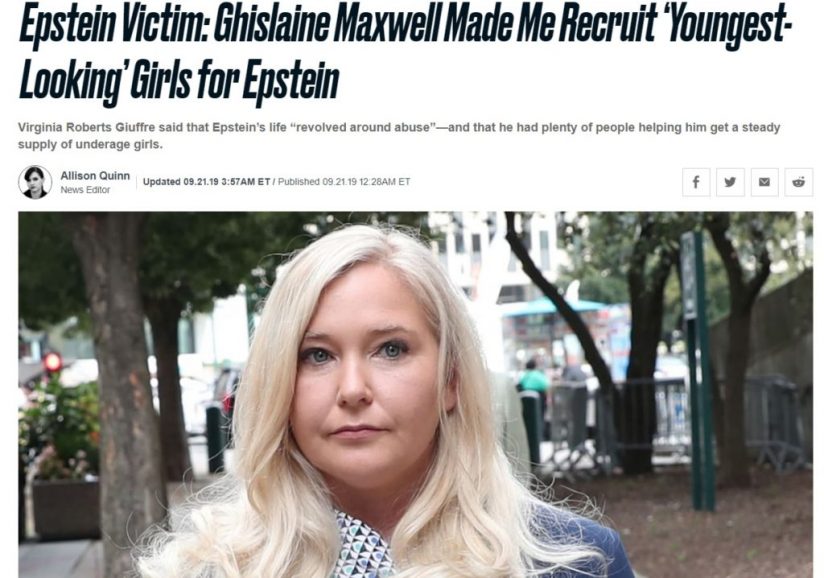
Link to The Daily Beast
It seems the primary purpose was not even blackmail since especially Epstein was having sex with these young girls all the time. On some days Epstein was having sex several times a day.
Sex games were more important for Epstein than work. Obviously, he was extremely attracted to these young girls.
Palm Beach multimillionaire Jeffrey Epstein, 54, was accused of assembling a large, cult-like network of underage girls — with the help of young female recruiters — to coerce into having sex acts behind the walls of his opulent waterfront mansion as often as three times a day, the Town of Palm Beach police found. (Emphasis added. Miami Herald)
In six months, I never saw him do a day’s work,” Ransome told The Telegraph. ”I never saw him work. He was literally sexually abusing us all day long. (Emphasis added. Business Insider)
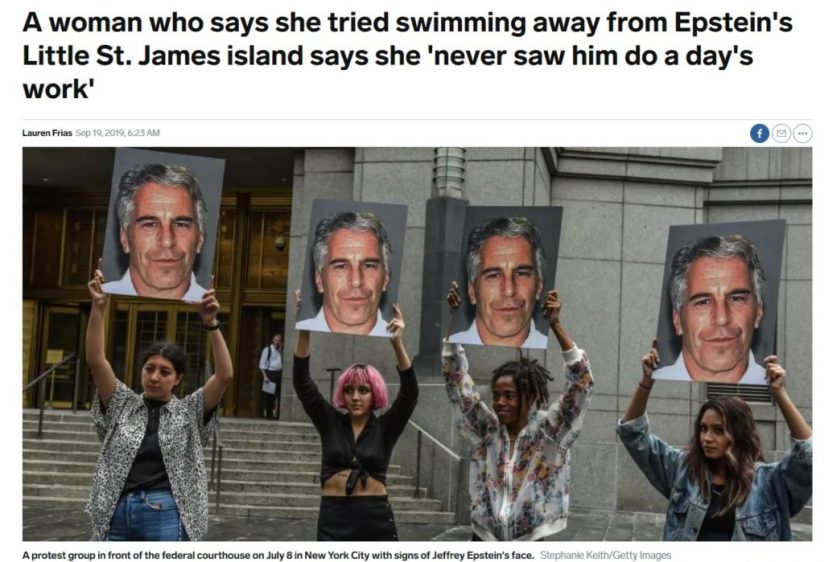
Link to Business Insider
Ghislaine also seemed to be obsessed with sex. Just like her father, Robert Maxwell she was rumored to be interested in unconventional sex which includes also sex with young children.
As she [Ghislaine] posed for the pics, which ran in a publication meant to promote Sotheby’s vintage fashion collection, she allegedly let slip comments that hinted at a twisted double life.
“She didn’t talk about Epstein, but during the shoot she did tell a story about how she just hosted a dinner party for a number of young girls, and she put dildos at each place setting,” the source said. “Ghislaine then described how during the dinner two guests, who were a couple, began demonstrating how to do the perfect fellatio on a man for all at the table. She was laughing about it.” …
“A friend of mine has a whole theory about her, that Epstein was like her father Robert Maxwell, who himself is believed to have had some strange sexual practices.” (Page Six)
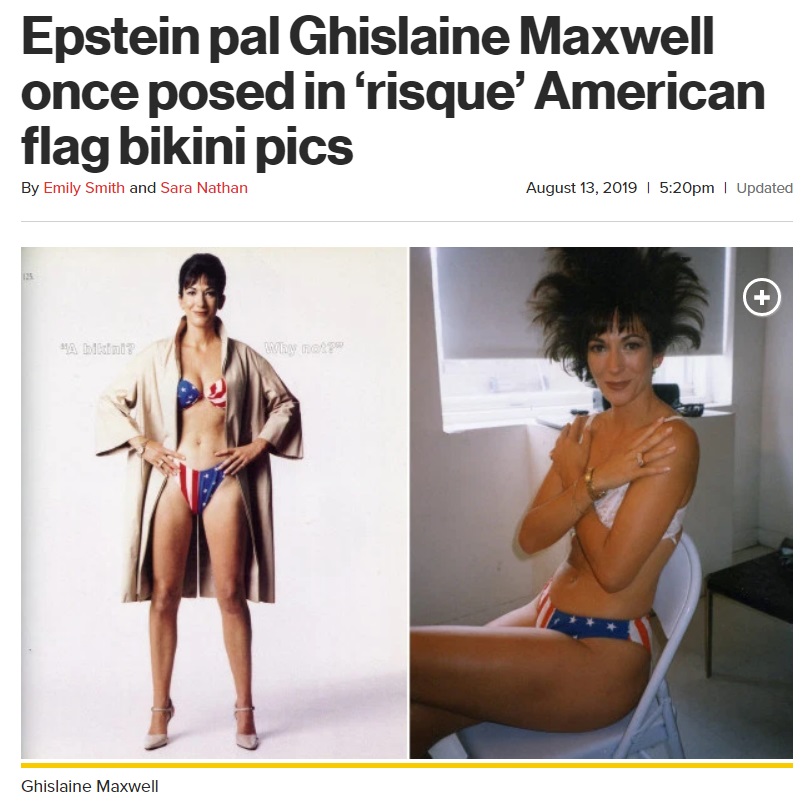
Link to PageSix
The Epstein Mossad-Timeline shows how Ghislaine was most probably trained by Mossad to use sex to gather information. That training would not have been too difficult for her since she was hypersexual. Many even considered her a nymphomaniac.
In fact, even many Israeli Jews – who usually have much fewer sexual taboos than puritan English and Americans – were shocked by her raunchy sexuality.
Flirtatious indeed: I understand from a mutual friend that after school she travelled to Israel and visited a kibbutz; she was immediately ostracised by the other girls for making a rather-too-obvious beeline for the Adonis-like lifeguard at the kibbutz pool. Very quickly she got her way, as she would with much in her life. (Tatler. Emphasis added.)
Even Ghislaine’s friend were sometimes shocked by her open sexuality that so often contrasted with her otherwise lady-like behavior and position in high society.
Ghislaine was, added Mason, ‘fantastically entertaining’ and ‘saucy’ – the paper said that she talked openly about sex.
In fact, said another acquaintance who saw her often at parties, she was ‘obsessed by sex. She’s Sphinx-like, mysterious. The last time I saw her, five, 10 years ago, I said what are you up to? And she said “I’m selling this product – stainless-steel mini dumb-bells – that you put up your fanny. For exercising your vaginal muscles, exercise your pelvic floor, learn the Singapore Grip. I’m giving seminars in LA and they all turn up and I tell them, this is how you keep your man.”’ (Tatler. Emphasis added.)
Epstein and Ghislaine were both hypersexual. All kind of sex interested them. Little girls were just part of the menu. Or more specifically, the best – and most profitable – part.
Epstein and Ghislaine were so attracted to young girls that nothing seemed to satisfy them. Perhaps this is why Epstein and Ghislaine created the highly risky sexual pyramid scheme. The girls were offered two alternatives: Either satisfy Epstein and Ghislaine sexually or get more girls to satisfy them.
In this way Epstein and Ghislaine were able to recruit literally hundreds of young girls. However, some of these girls went to the police and the sexual pyramid scheme collapsed.
When Epstein got out of jail in 2009 he had half-learned his lesson: American girls are too risky.
Now Epstein and Ghislaine would only concentrate on East European girls with the help of their Jewish-Ukrainian friend Peter Listerman.
One of the lesser-known shadowy figures linked to Jeffrey Epstein and his sex ring of teenage girls and young women is Ukrainian-born Peter Listerman, who has worked as a businessman and television presenter but is most known for his “match-making” abilities.
What match-making really means is that Listerman procures women, often underage, for the jet-set society to use for sexual purposes. His “clients” include Russian oligarchs and American businessmen and seems to have also included Jeffrey Epstein. (Citizen Truth)
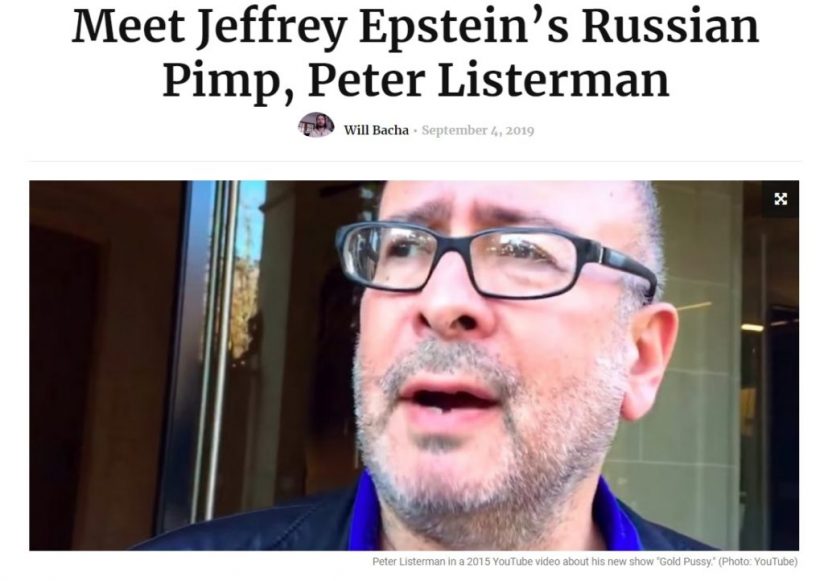
Link to the Citizen Truth.org
Listerman has such a bad reputation that he is shunned even in Ukraine!
Tatiana Savchenko, who founded the first modeling school in Odessa, Ukraine explained to the Daily Beast the lengths she had to go to keep Listerman from getting his hands on young women and trafficking them for sex work.
She claimed that he would frequently approach her students and attempt to lure them with promises of a luxurious lifestyle, and that “It took a lot of work to keep him from tricking our teen models in his traps.” (Citizen Truth)
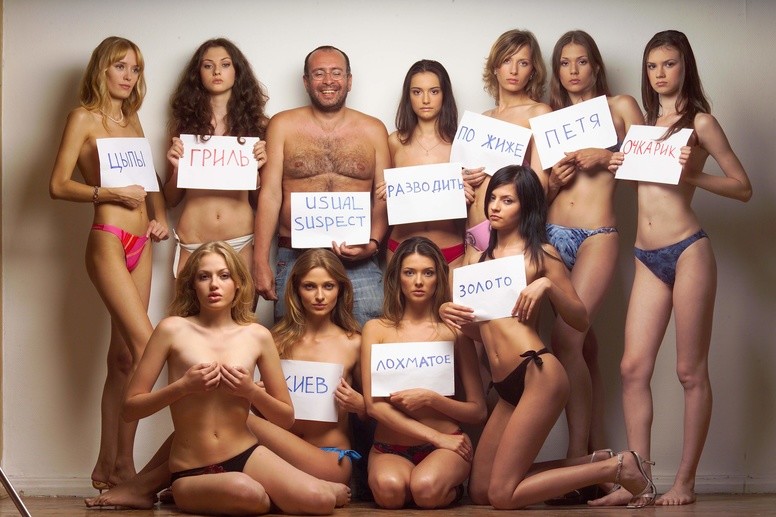
Peter Listerman is the usual suspect. Link to Fishki.net
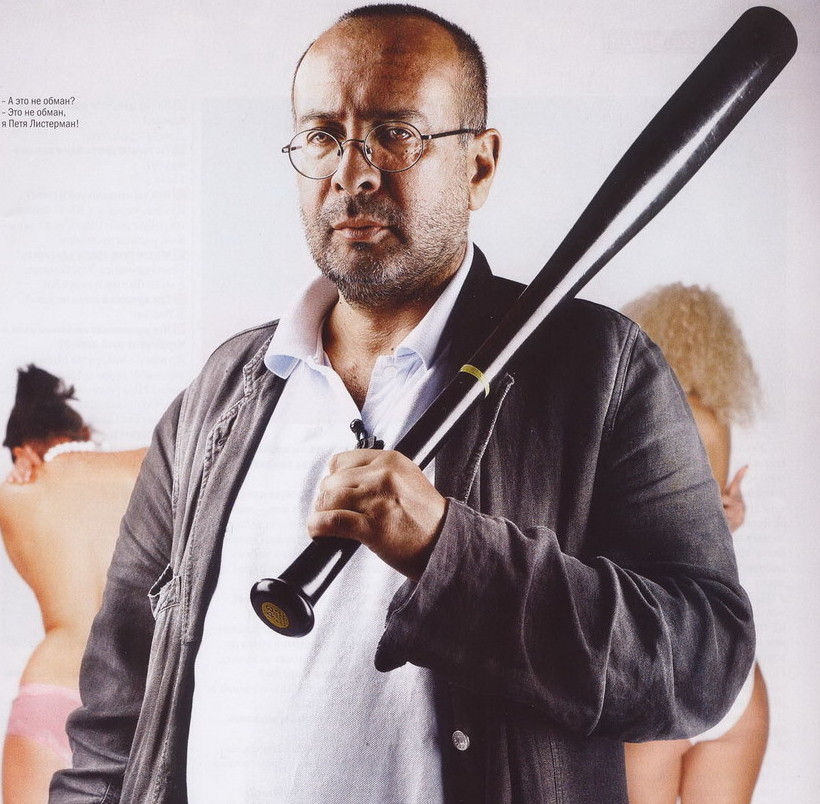
Do you think I am kidding? I am Peter Listerman! Link to Fishki.net
Both Epstein and Listerman were attracted to very young girls. Neither even tried to hide it much. In fact, Epstein was quite open about his attraction to tweens.
Just three months ago, as federal prosecutors were closing in with new charges, Mr. Epstein had a conversation with R. Couri Hay, a publicist, about continuing to improve his reputation. Mr. Epstein asserted that what he was convicted of did not constitute pedophilia, said Mr. Hay, who declined to represent him.
The girls he had sex with were “tweens and teens,” Mr. Epstein told him. (The New York Times)
But what is a tween?
Preadolescent is generally defined as those ranging from age 10 to 13 years.[4][6] … While known as preadolescent in psychology, the terms preteen, preteenager or tween are common in everyday use. (Wikipedia)
Epstein was right, of course. What he was convicted of in 2007 did not constitute pedophilia. However, that is precisely one reason why people are so outraged!
Epstein and Ghislaine did not see any problem of recruiting, grooming and having sex also with tweens. And apparently neither did the Justice Department and the FBI led by Robert Mueller!
But it gets even worse. As pointed out in the Epstein Pedoscandal Mossad Timeline, it seems that Epstein and Ghislaine were after even younger girls.
In 2003 Epstein financed Jean-Luc Brunell’s(?) and Jeff Fuller’s(J) new modelling agency MC2 that seemed to have worked with Peter Listerman.
MC2 obviously refers to the famous Einstein equation E = MC2, the energy-mass equivalence. Equally obviously, E equals Epstein, the energy, whereas the girls equal MC2, the mass energized by Epstein.

Jean-Luc Brunell
Brunell is generally known as the sleaziest man in model business who has long faced accusations that girls were drugged and raped in his employ. Already in the 80s he was the subject of a famous 60 Minutes expose on sexual abuse in the modeling industry
Despite all this – or for the very reason – Epstein invested in MC2 and became particularly close to its founders Brunel and Fuller.
The agency operates in New York, Miami and Tel Aviv. It’s in practice half-Israeli.
Many call Israel the capital of human trafficking and organ harvesting.

MC2 concentrates on importing East European girls to Israel and America. The younger the better.

Marina Lynchuk of MC2

Lolita Lvola from MC2

Linta Lapinda from MC2
Brunel seems to have given 12-year old triplets to Epstein as a birthday present.
’Jeffrey bragged after he met them that they were 12-year-olds and flown over from France because they’re really poor over there, and their parents needed the money or whatever the case is and they were absolutely free to stay and flew out,’ Giuffre said.
She said she saw the three girls with her own eyes and that Epstein had repeatedly described to her how the girls had massaged him and performed oral sex on him. They were flown back to France the next day.

Link to Daily Mail
It seems that even tweens were not young enough for Epstein.
According to court papers in 2005 Brunel called Epstein and left a message that “he is sending him a 16-year-old Russian girl for purposes of sex”. However, the written message says something even worse.
The message, filed as an exhibit in the case, was written on an office message pad, partly in code, and read: “He [Brunel] has a teacher for you to teach you how to speak Russian. She is 2×8 years old not blonde. Lessons are free and you can have your 1st today if you call.” (New York Post)
Does it mean that two eight year olds are involved? Or does 2 x 8 mean to sex 8 year old? (2=to, x=sex)
Why would the lessons be free and why is it relevant that the ”teacher” is not a blond?

There is no denying that Epstein and Ghislaine sexualised even small children. This became clear in 2005 when police raided Epstein’s Palm Peach mansion.
In one photo that was hanging on the wall a small six or seven year old girl was bending over in a tiny dress. Police blurred out the photo in the video taken during the raid.

Link to The Daily Mail
Despite all this only the Russian Television was actively trying to expose Epstein and Ghislaine.
RT aired this video already nine years ago!
The description on the video is even more revealing. It even mentions the 12-year old triplets.
The American TV networks were actively suppressing the story for years.
The American media has also been trying to cover up the fact that Jeffrey Epstein was most probably murdered in his cell. He had to be silenced.
But it gets even worse.
This hung on Ghislaine’s home wall.

NEW YORK CITY, NY – MARCH 13: Atmosphere at Hamish Bowles, Ghislaine Maxwell and Lillian von Stauffenberg dinner for ALLEGRA HICKS at Home of Ghislaine Maxwell on March 13, 2007 in New York City. (Photo by Patrick McMullan/Patrick McMullan via Getty Images). Link to Getty Images.
The so called artwork seems to be full of pedophile symbols.


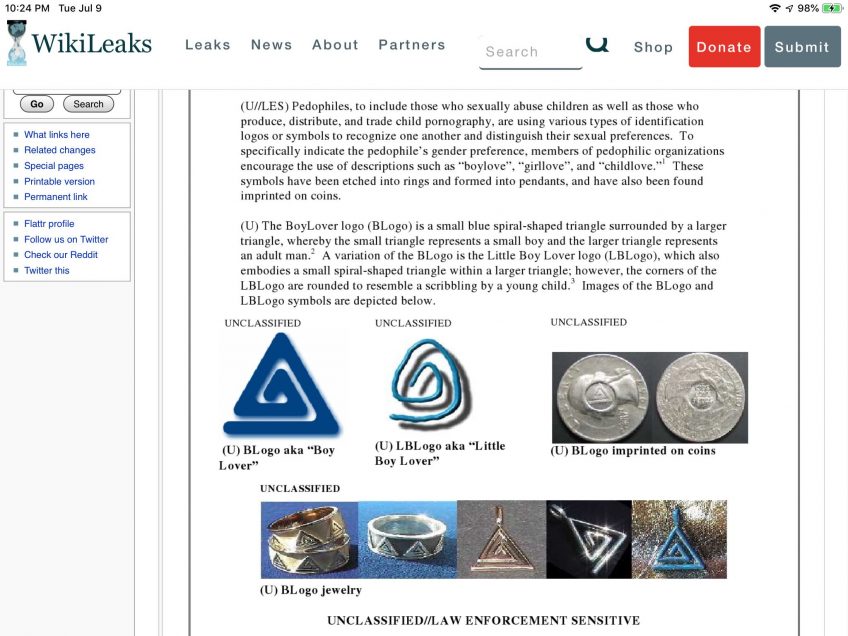
Link to Wikileaks.org
The quality of the photos taken at Ghislaine’s home are so good that even more symbols have been found in her artwork.
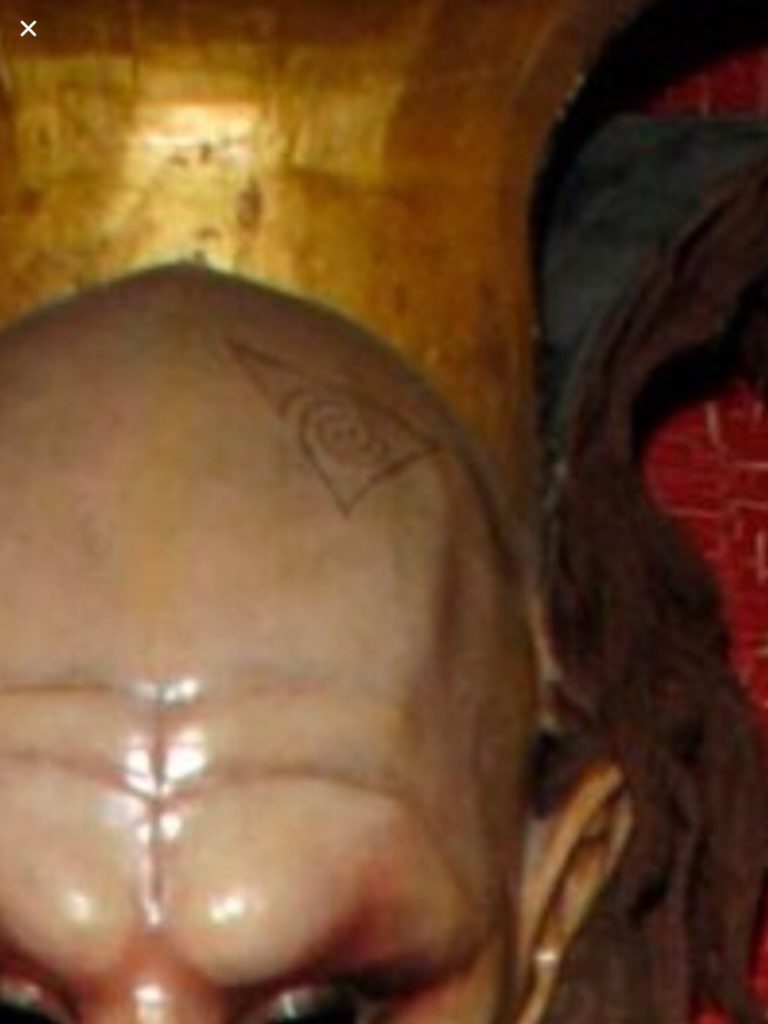
For some reason the mainstream media has not picked up on this pedophilia angle. No mainstream media journalist has even tried to ask why would Ghislaine have such art and symbols on her home wall.
This despite the fact that Ghislaine is most probably an Israeli superspy just like was her father, Robert Maxwell. She probably has been trained to use sex – including pedophilia – as a tool for blackmail and manipulation.
At the time in Israel females molesting little boys was not even considered rape.
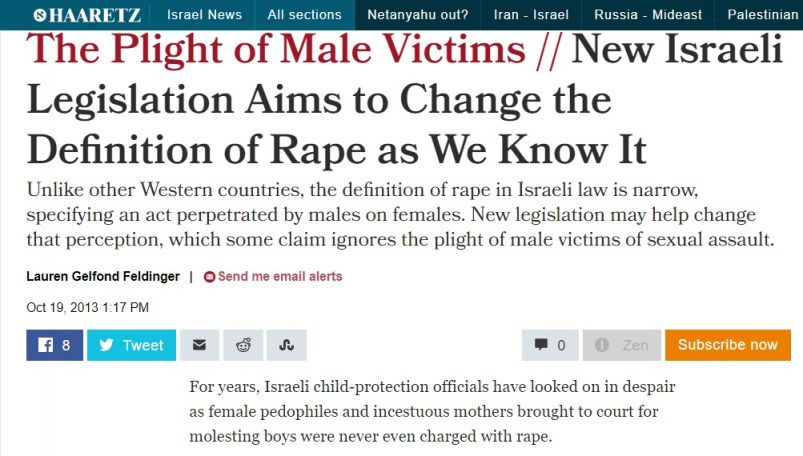
Link to Haaretz.com
Nor have mainstream journalists asked where was Ghislaine when Madeline McCann was abducted.
That would not be an unreasonable question since one of the E-Fit images looks a lot like Ghislaine.

Link to Enchanted Life Path.com
Furthermore, two of the E-Fit images (1A, 1B) look like the Podesta brothers. John Podesta was White House Chief of Staff to Bill Clinton and the Chairman of the 2016 Hillary Clinton presidential campaign.
Ghislaine and Epstein were close to the Clintons and the Podesta brothers have been directly linked also to Pizzagate.

Link to Pizzagate Map created by Tuukka Pensala
Was Ghislaine helping to run also Pizzagate and other pedophile rings for Mossad?
At least she seems to be perfectly trained to do just that. First, her own hypersexuality, family background and possible training by Mossad made it easy for her to master mind the pedophilia ring she run with Epstein.
Second, Ghislaine and Epstein had all the apparel to help run also other pedophile rings: Lolita express airplanes and helicopters, Zorro Ranch in New Mexico and luxury mansions in New York, Palm Peach and Paris.
Even more importantly they had their own island in the Virgin Islands.
In the 90s Epstein bought Little St. James island from the Virgin islands. It had a mansion which Epstein expanded.
Soon locals started to call it the Pedophile Island.
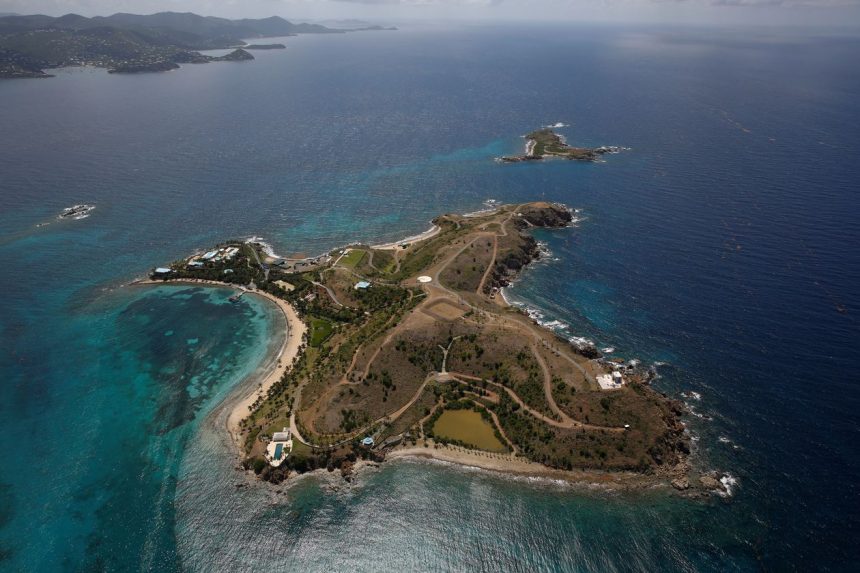
Little St. James island. Link to Wall Street Journal article
The island seems to have tunnels with several underground entrances.
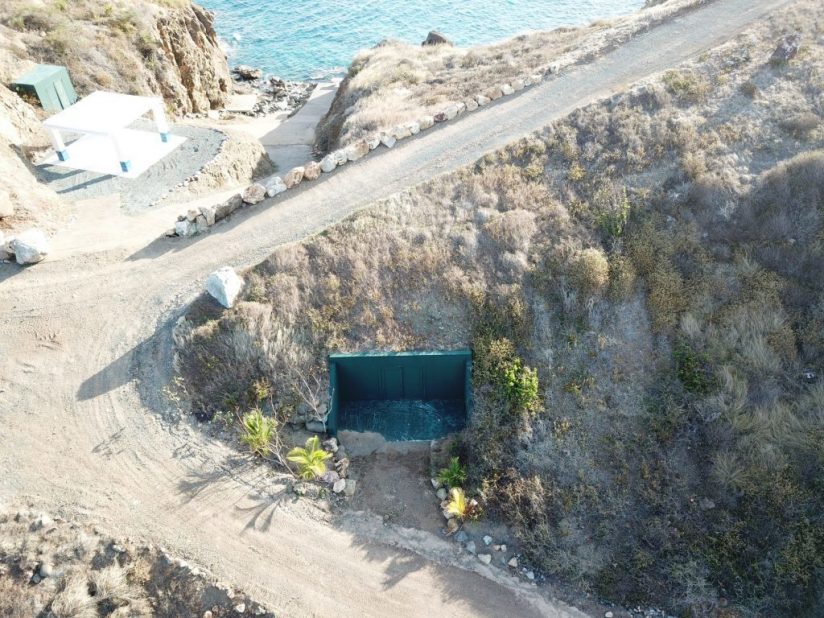
Underground entrance
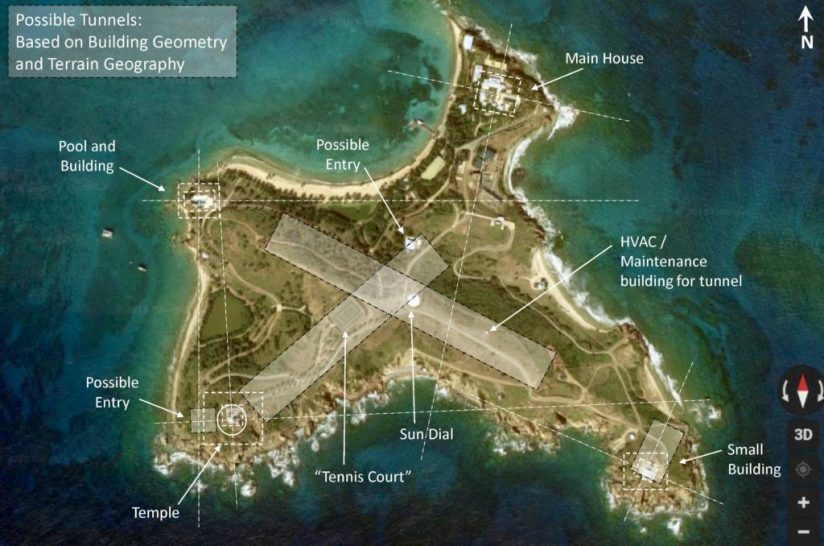
Link to Twitter
The island also has a strange temple.
We Are Change’s Luke Rudkowski and the Dollar Vigilante’s Jeff Berwick secretly visited the island but were soon chased out.
Ghislaine has a Helicopter Pilot License and often transported quests to the island.
On the weekends in the 1990s, Maxwell would have her Rollerblades FedExed to Epstein’s island in the Caribbean, and said she got her helicopter’s license so she could transport anyone she liked without pilots knowing who they were.
Maxwell also said the island had been completely wired for video; the friend thought that she and Epstein were videotaping everyone on the island as an insurance policy, as blackmail.
A source close to Maxwell says she spoke glibly and confidently about getting girls to sexually service Epstein, saying this was simply what he wanted, and describing the way she’d drive around to spas and trailer parks in Florida to recruit them. She would claim she had a phone job for them, “and you’ll make lots of money, meet everyone, and I’ll change your life.” …
Maxwell had one other thing to tell this woman: “When I asked what she thought of the underage girls, she looked at me and said, ‘they’re nothing, these girls. They are trash.’” (Emphasis added. Vanity Fair)
Ghislaine was naturally using Epstein’s helicopters. Some of them shared their FAA tail number with a US contractor, Dyncorp. That would have helped Ghislaine and Epstein to fly drugs and children.
FAA records and Epstein’s pilot’s flight manifest indicate that Epstein’s Bell helicopter used the same tail number of N474AW. This was the same tail number used until 2006 by State Department contractor Dyncorp for counter-insurgency operations in Latin America.
The congruence of Epstein’s Bell N474AW and Dincorp’s Bronco N474AW is noteworthy. In 2002, the year Epstein’s aircraft fleet stands accused of flying underage teen girls, some between the ages of 12 and 15, coincided with Dyncorp’s trafficking in underage females between the ages of 12 and 15 from Kosovo and Bosnia in the Balkans.
One Dyncorp whistleblower reported to The Washington Times’s Insight magazine’s Kelly O’Meara in 2002 the following on one Dyncorp employee in Bosnia:
[he] owned a girl who couldn’t have been more than 14 years old. It’s a sick sight anyway to see any grown man [having sex] with a child, but to see some 45-year-old man who weights 400 pounds with a little girl, it just makes you sick.”
Tail number N474AW has been shared between Epstein’s Bell helicopter like the one in this photo. (Emphasis added. Political Bull Pen)

DynCorp’s pedophilia ring became internationally infamous with the release of the movie Whistleblower.

Link to Wikipedia
Helicopters can always be seen. However, Ghislaine also has a license to operate submarines!
In 2012 – three years after Epstein got out of jail – Maxwell founded The TerraMar Project,[51] a nonprofit organization that advocated protecting ocean waters.
She gave a lecture for TerraMar at the University of Texas at Dallas and a TED talk, at TEDx Charlottesville in 2014.[52] Maxwell accompanied Stuart Beck(J), a 2013 TerraMar board member, to two United Nations meetings to discuss the project.[17] (Wikipedia)
In 2014, a United Nations event featured Maxwell as a speaker. According to her bio in the program, Maxwell’s “web-based non-profit” aimed “to protect the Oceans by empowering a global community of ocean citizens.” It further described Maxwell as “a private helicopter pilot and an Emergency Medical Technician and a qualified ROV and Deepworker submarine pilot.”
A former Coast Guard officer, Borgerson was also a fellow at the Council on Foreign Relations, which featured Borgerson and Maxwell as speakers during one 2014 talk titled “Governing the Ocean Commons: Growing Challenges, New Approaches.” Friends of Maxwell, according to The New York Times, said Borgerson became her boyfriend. Maxwell had allegedly described Borgerson as a “Navy SEAL” to her pals.
Maxwell’s dubious charity also roped in the Clinton Global Initiative, the now-defunct networking platform for the Clinton Foundation. In the fall of 2013, CGI named TerraMar as one of the “commitments to action” at their annual meeting. (Emphasis added. Daily Beast)
Did the Pedophile Island have an underground submarine base? Was it a part of global pedophile network?
And was the Ocean Citizens project an attempt to escape national jurisdictions and thus gain at least a partial immunity from police investigations and prosecutions?

Link to TerraMar Project
Interestingly, as late as 2016 Epstein bought also the nearby Great St. James Island. He started to build on the island without permits.
There were rumors that he was building underground. For some reason the mainstream media has had no interest in this second island.
Why is the mainstream media not interested in Ghislaine’s many links to pedophilia?
Perhaps because Ghislaine has so many powerful friends. The photo of the pedophile artwork on Ghislaine’s wall was taken 13 March 2007 during a party at Ghislaine’s New York townhouse. The guest list included a curious combination of elite Jews, aristocratic Brits and American WASPs.

Atmosphere==
Hamish Bowles, Ghislaine Maxwell and Lillian von Stauffenberg dinner for ALLEGRA HICKS. Home of Ghislaine Maxwell. March 13, 2007©Patrick McMullan. Photo-Patrick McMullan/Patrick McMullan.com. Link to Quick N Dirty
The party was in Ghislaine’s huge 7000-square-foot townhouse. It is located in the most opulent and prestigious neighborhood of America, the Upper East Side, New York on East 65th Street just off Park Avenue. Epstein’s townhouse was only 10 blocks away.
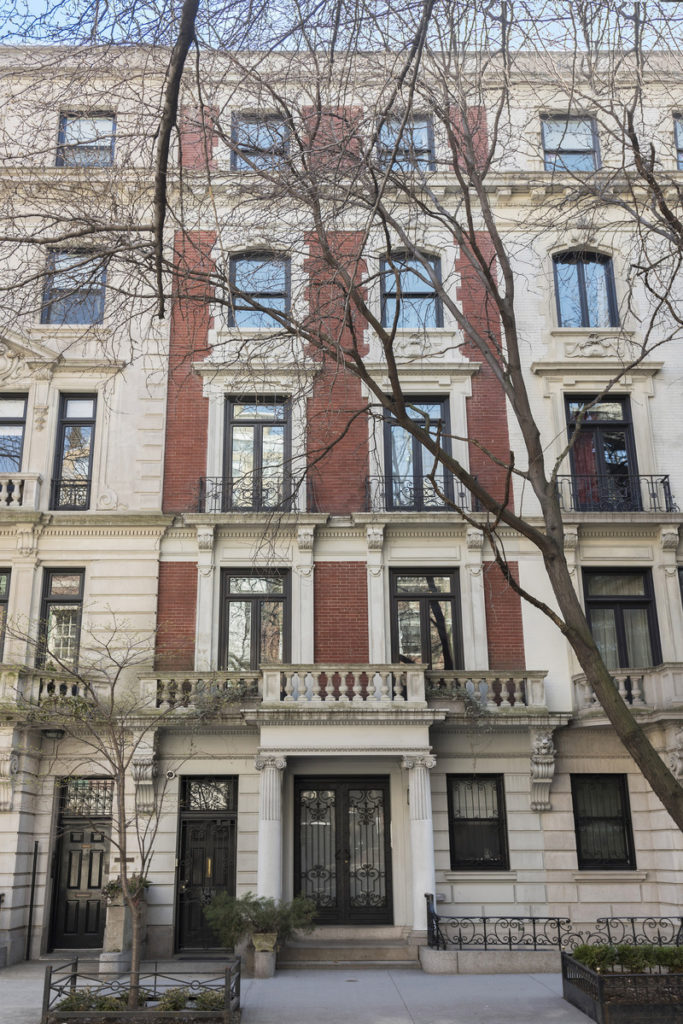
Ghislaine’s five story townhouse. Link to Street Easy

Ghislaine’s townhouse floor plan. Link to Street Easy
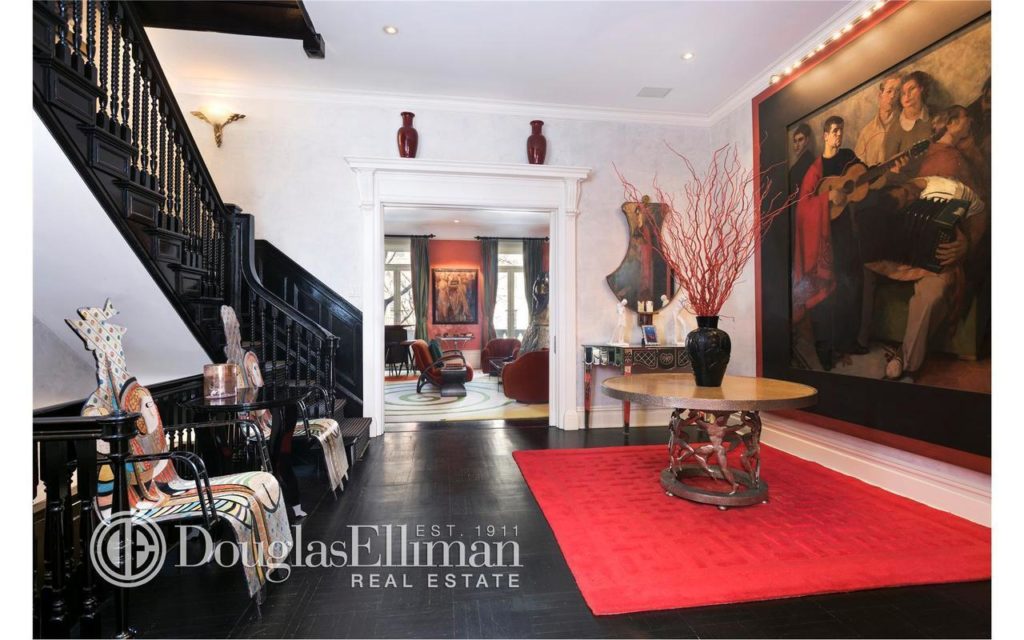
Ghislaine’s townhouse 2nd floor gallery. Link to Street Easy
There are reports from reliable sources that the townhouse was sold in 2000 to Ghislaine by Lynn Forester de Rothschild. The very same woman who had introduced Epstein and Ghislaine to Alan Dershowits and the Clintons in the 90s.
The Manhattan property, which is close to Epstein’s mansion, is owned by Lynn Forester de Rothschild, wife of British financier Sir Evelyn de Rothschild. (See The Times and the original article.)
According to Business Insider Forester sold the townhouse to Ghislaine for less than half the price.
Forester sold the mansion for about $8.5 million less than its assessed market value, which was more than $13.4 million.
Was this a pay-off to Ghislaine from the King of Jews, the Rothschilds for services rendered?

Hillary Clinton, Evelyn de Rothschild, Bill Clinton and Lynn Forester de Rothschild. Link to Mint Press
It probably is also relevant that at the time of the sale of the townhouse the Prime Minister of Israel was Ehud Barak. In the 80s he had been the head of Aman, the Israeli Military Intelligence Agency. As the Epstein Pedoscandal Mossad Timeline revealed, both Epstein and Ghislaine worked for the Israeli intelligence agencies already in the 80s during the Iran-Contra operation.
Note that it was around year 2000 that Epstein and Ghislaine started the pedophile operation in earnest. In the 80s and 90s blackmail operations were a side show but now it became the main show involving hundreds of young girls.
Sexual blackmail – especially involving little children – can be an extremely efficient way to influence key politicians and even military officials. A successful blackmail operation can achieve more than several army divisions. No wonder Barak was so close to Epstein and Ghislaine.
Furthermore, in 2000 the president of Israel was Moshe Katsev who was sexually harassing and even raping his female subordinates. Later Katsev would be convicted of rape.
It was also in 2000 when the Israeli Vice-Consul of Rio de Janeiro, Arie Scher and Hebrew language Professor George Schteinberg were running a pedophile ring for Israeli tourists. When the Brasilian police started to investigate the Israeli consulate Scher managed to flee back to Israel.

In Israel Scher was not prosecuted. Instead in 2005 he was promoted to Consul of Canberra, the capital of Australia. A spokesman for the Israeli Foreign Ministry in Jerusalem, Mark Regev explained:
He [Arie Scher] was a young and single man at the time [in Brazil]. Now he is married and he’s six years older and there is no reason why he shouldn’t make an excellent diplomatic appointment in Australia.
Australia refused to let Scher enter the country.

Link to William Bowles Info
The most shocking part of the Arie/Aryeh Scher story is that the mainstream media was not interested. Either the stories have been scrubbed from the internet or no stories were ever written by mainstream journalists except one short story by BBC in 2000 and one even smaller story by The Sydney Morning Herald in 2005. Even more surprisingly Youtube does not seem to have any videos about the Scher case.
No wonder Barak was absolutely convinced that the Western mainstream media would never dare to criticize Israel and its intelligence agencies. Not even when Mossad was running pedophile rings.
It was probably the Israeli leaders Shimon Peres, Ehud Barak and Moshe Katsev together with the ultra-Zionist Mega Group who made sure Epstein and especially the Maxwell family had not only immunity from prosecution but also all the blackmail apparel necessary including luxury townhouses, airplanes, yachts, submarines, ranch and a private island. All, of course, bugged to the hilt.

Israeli Prime Minister Ehud Barak (R) talks to Shimon Peres, Minister of Regional Planning, after Barak’s speech at the opening session of parliament in Jerusalem 30 October 2000. Barak said that he believed peace was still possible in the Middle East but that Israel did not have a partner prepared to make compromises. AFP PHOTO / SVEN NACKSTRAND (Photo credit should read SVEN NACKSTRAND/AFP/Getty Images)
Here the pedophile artwork at Ghislaine’s New York townhouse can be seen behind Lillian von Staufenberg who in March 2007 together with Ghislaine and Hamish Bowles organized a dinner party in honor of Allegra Hicks. This at a time when Epstein had already been charged with abusing young girls.

Karen Groos, Allegra Hicks, Lillian von Stauffenberg==
Hamish Bowles, Ghislaine Maxwell and Lillian von Stauffenberg dinner for ALLEGRA HICKS==
Home of Ghislaine Maxwell, NYC==
March 13, 2007==
©Patrick McMullan==
Photo-Patrick McMullan/Patrick McMullan.com==
Link to QuickNDirty
Why would Ghislaine have such a suspicious artwork on her wall knowing that it would probably be photographed during the parties?
Why would Ghislaine and her quests take such a huge risk? Or was it a sign meant to be seen? Was Ghislaine flaunting her power?
Ghislaine and her quests seemed to be absolutely sure that the mainstream media would not dare to ask embarrassing questions.
They were right, of course. The mainstream media knows its place.
However, occasionally some courageous mainstream journalist or editor does try to give hints. Some have even reported on Ghislaine’s hyper-sexual reputation and her orgies. It is just that the stories have mostly been scrubbed from the internet.
Fortunately, Whitney Webb from Mintpress has found many of the scrubbed stories. Some of them mention the Mossad connection and others note the orgies. For example, in 2003 a British newspaper, The Evening Standard reported a revealing rumor.
Salacious reports have crossed the Atlantic about Ghislaine hosting bizarre parties at her house to which she invites a dozen or so young girls, then brandishes a whip and teaches them how to improve their sexual techniques.
It seems that Ghislaine was not only a madame to Epstein but also to the ruling elite. This would both explain her popularity and the fact that the media – and especially the American media – dares not to criticize her too much. Not even after her boyfriend Epstein was charged with sex trafficking minors!
Ghislaine’s friends are just too powerful. After the March 2007 party the British Daily Mail newspaper was amazed how Ghislaine could still have attracted such creme de la creme of the highest elite. Even more amazingly, the elite was practically swooning over her.
The night before the party, the hostess [Ghislaine] had been inundated with calls from disgruntled socialites, irked that they hadn’t received an invitation.
The hostess greeted their objections with her customary charm, but remained unmoved. As always, her list had been carefully edited, and she intended it to stay that way.
Among the select few were Hollywood star Matthew Modine, Kennedy family member Mrs Anthony Radziwill, Peggy Siegel, PR consultant to the stars, and Julie Janklow, heir to a literary dynasty.
There was a Rockefeller on the list, as well as the inevitable countesses, billionaires and New York luminaries.

Link to Daily Mail
The guests at the party included also Renee Rockefeller who is married to Mark Rockefeller, the son of ex-Vice President Nelson Rockefeller and nephew of David Rockefeller.

Allegra Hicks, Renee Rockefeller==
Hamish Bowles, Ghislaine Maxwell and Lillian von Stauffenberg dinner for ALLEGRA HICKS. Home of Ghislaine Maxwell, NYC. March 13, 2007 ©Patrick McMullan/Patrick McMullan.com. Link to QuickNDirty
David Rockefeller lived at 146 East on the same 65th Street in the Upper East Side as Ghislaine. They were practically neighbors. Ghislaine would have to walk only two minutes to visit David.
David liked to pose for photos in his Beetle Room next to his favorite Picasso painting depicting a nude child ”prostitute”.

David Rockefeller. Link to Jeffrey Harris Desing.com
David was often visited by his close friend Jacob Rothschild, the patriarch of the Rothschild family.
The very same family that got Ghislaine her luxury townhouse next door.
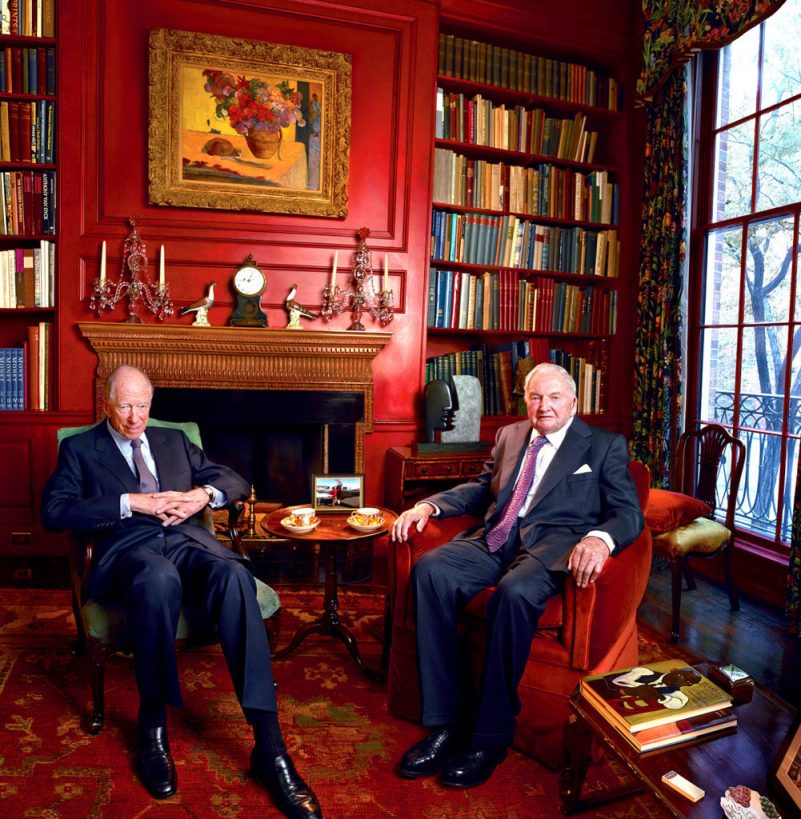
The patriarchs, Jacob Rothschild and David Rockefeller. Link to Jeffrey Harris Design.com
As shown by the Epstein Pedoscandal Mossad Timeline both Epstein and Ghislaine continued to move in the highest circles long after Epstein got out of jail. In fact, only last year Ghislaine was invited to a secret writers’ retreat hosted by the richest man in the world, Jeff Bezos.
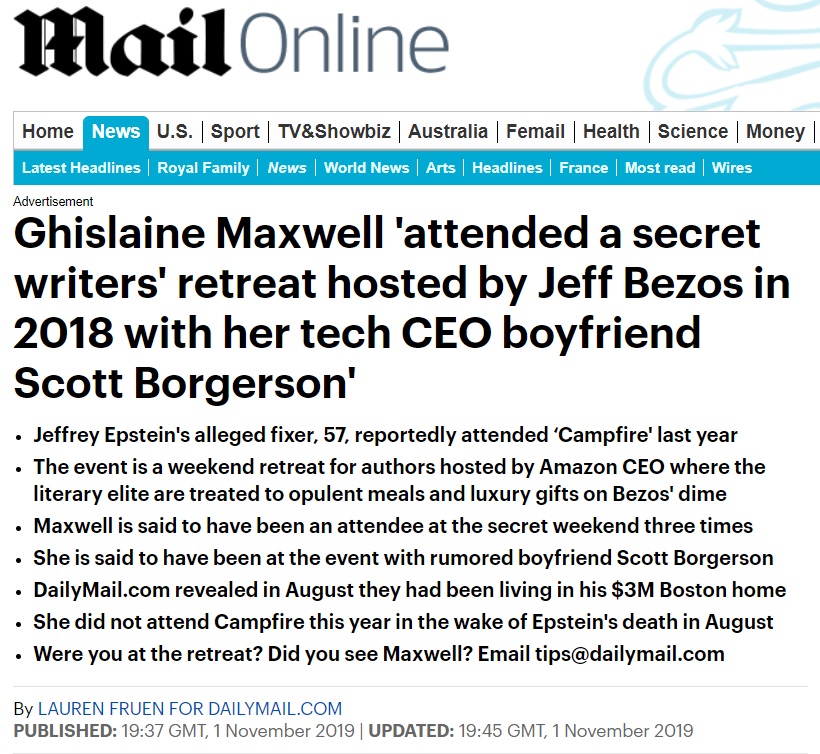
Link to The Daily Mail
Not only billionaires but also royalty kept in close contact with Ghislaine.
Prince Andrew was recently interviewed by the BBC about his relationship with Epstein, Ghislaine and their sex slave Virginia Roberts.
Amazingly, Andrew claimed she has no recollection of Epstein’s and Ghislaine’s sex slave, Virginia Roberts. This despite the fact that they were photographed together!
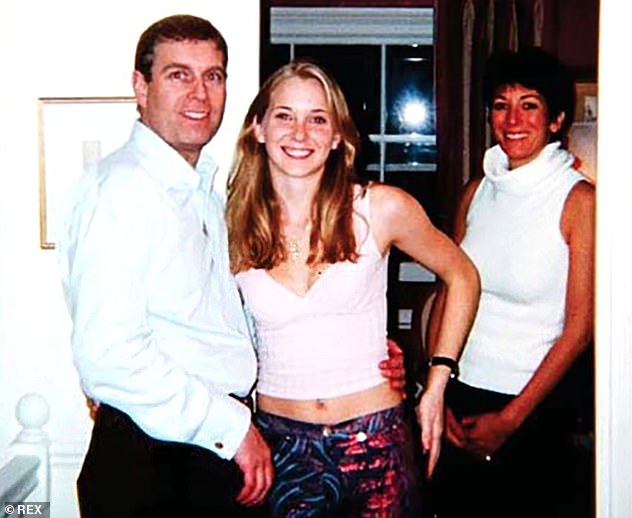
Prince Andrew, Virginia Roberts and Ghislaine Maxwell. Link to Daily Mail

Link to The Sun.com
Hardly anybody believes Andrew. The queen had no choice but to sack his own son.
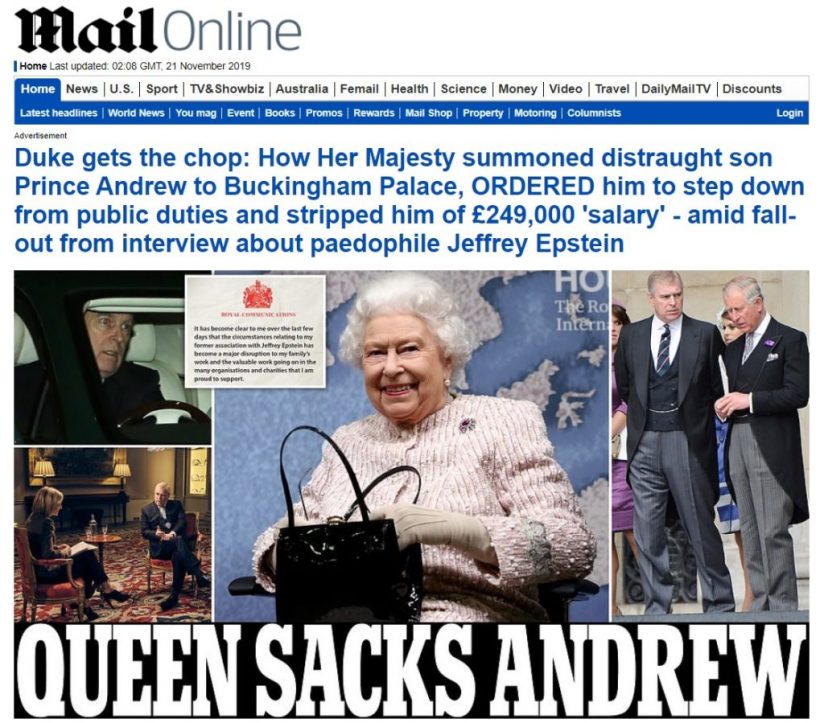
Link to Daily Mail
Andrew got sacked because he was caught in a lie.
Andrew claimed he could not have had sex with the 17-year old Virginia in 2001 because he had stayed with the British consul general.
The problem is the consul general does not recall Andrew staying with him.
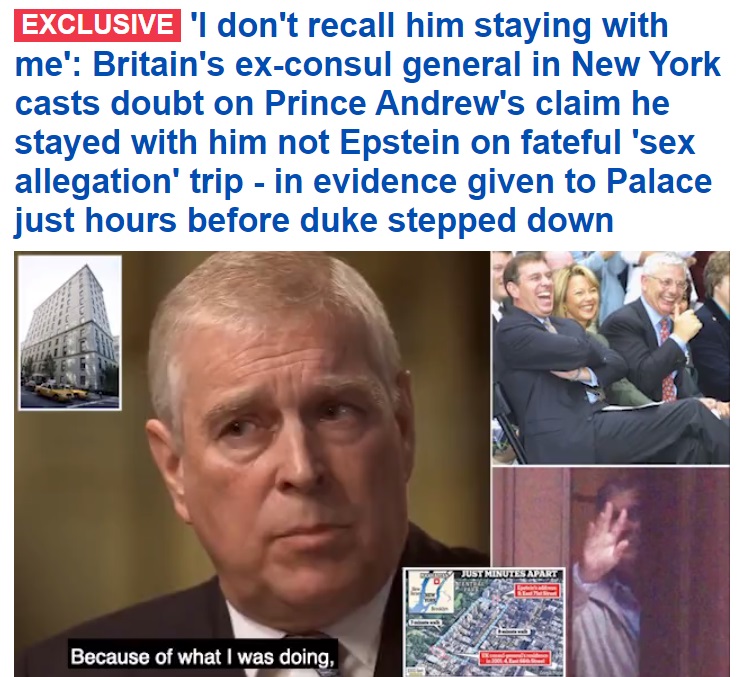
Link to Daily Mail
Curiously, most of the mainstream media has forgotten that it was Ghislaine who recruited and manipulated Virginia Roberts to become a sex slave.
Even the BBC forgot this crucial fact despite Andrew mentioning Ghislaine many times during the interview.
Time and again, the Prince invoked his friendship with Maxwell, 57, daughter of disgraced media tycoon Robert Maxwell, as the reason he came into paedophile Epstein’s orbit.
Asked when he last saw Maxwell, Andrew said his last contact was ’earlier this year, funnily enough’, when she ’was here doing some rally’. (Daily Mail)
Andrew claimed to have met Ghislaine last spring. In fact, they met in June just after US prosecutors reopened the case against Epstein.
The Duke of York held a meeting with Ghislaine Maxwell in London two weeks after US prosecutors announced they wanted to reopen their investigation into Jeffrey Epstein. …
The meeting took place on or about June 5, the day before Ms Maxwell took part in a four-day charity motoring rally from London to Monte Carlo.
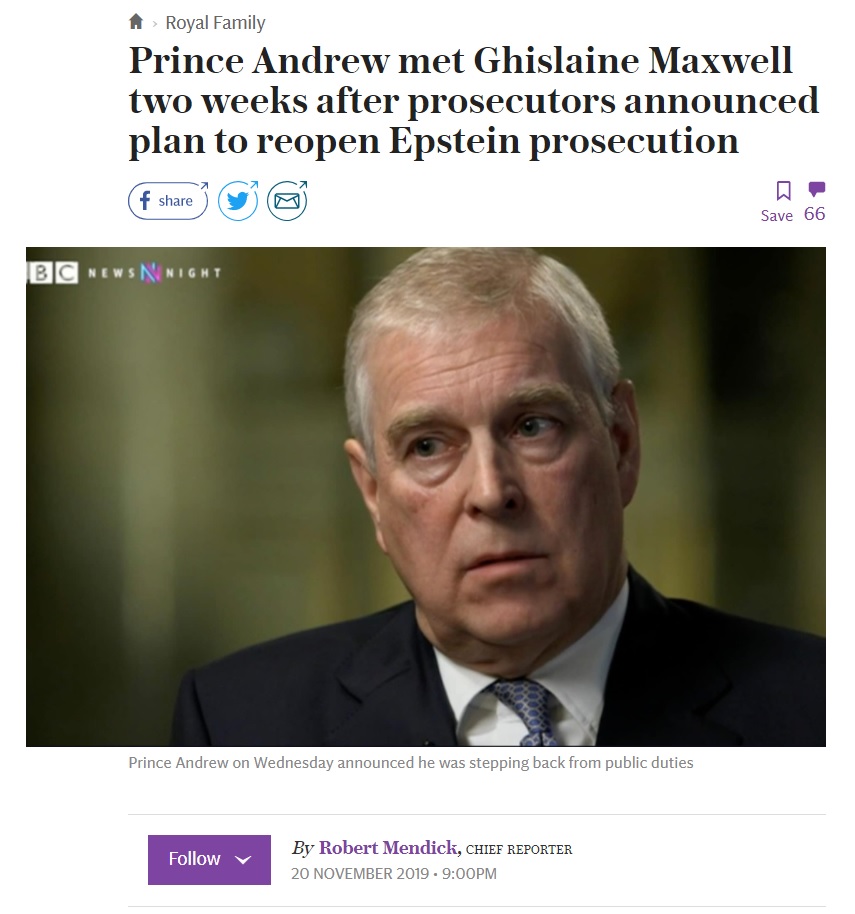
Did Ghislaine demand that Andrew help make sure that the her own parallel case would not be reopened?
After meeting Andrew she literally disappeared from the face of the earth.
The ex-socialite has not been seen since although rumours have placed her in Brazil, France, the American mid-West and even the UK.
‘No one knows where she is,’ a lawyer for one of Epstein’s victims said last night. ‘She’s done the greatest disappearing act known to man – or woman.’ (Daily Mail)
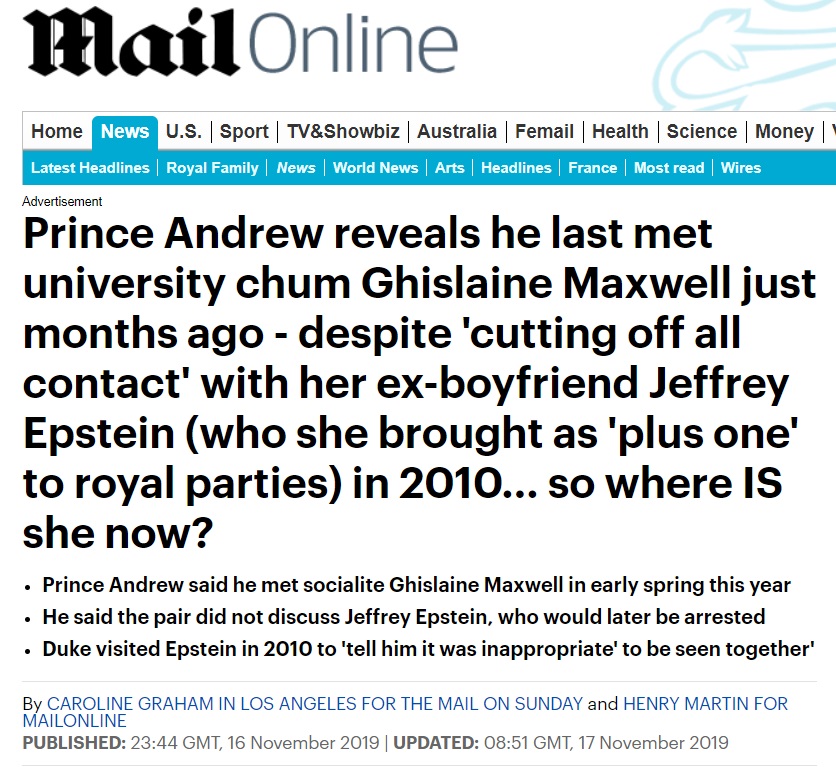
Link to Daily Mail
Shockingly, during the BBC interview Prince Andrew mentioned Ghislaine many times and seemed to be proud of their friendship. Despite this the interviewer did not dare to ask questions about their relationship.
Was this a message to all: Leave Ghislaine alone.
Ghislaine is obviously protected not only by the royal family but also by the whole ruling elite. No wonder that she has the Get-Out-of-Jail-Free card.
Ghislaine also tries to protect other Epstein associates.
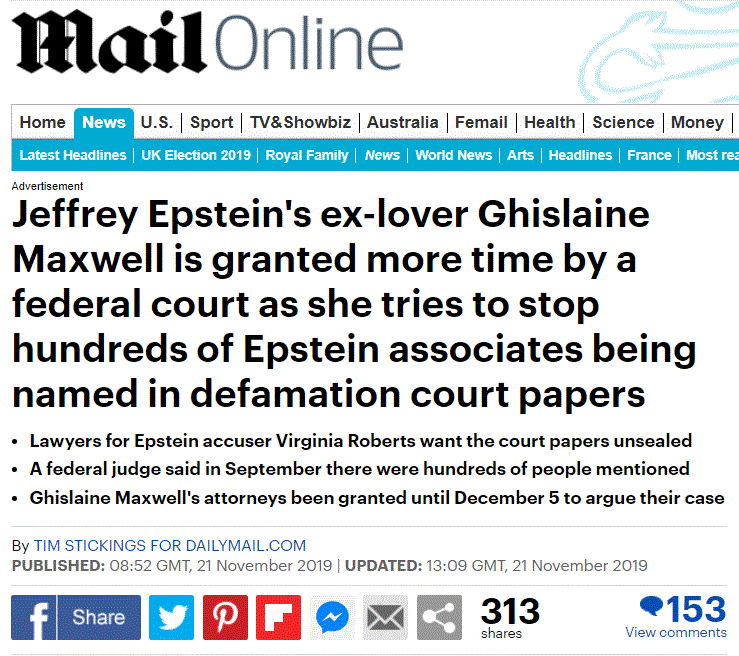
Link to Daily Mail
Prince Andrew is now afraid to go to the US.
Five women who accuse Jeffrey Epstein of abusing them say Prince Andrew witnessed how people were given massages at the sex offender’s homes.
The lawyer for the women has told BBC Panorama he plans to serve subpoenas to force the Duke of York to testify as a witness in all five cases.
He says the prince could have important information about sex trafficking. (BBC)
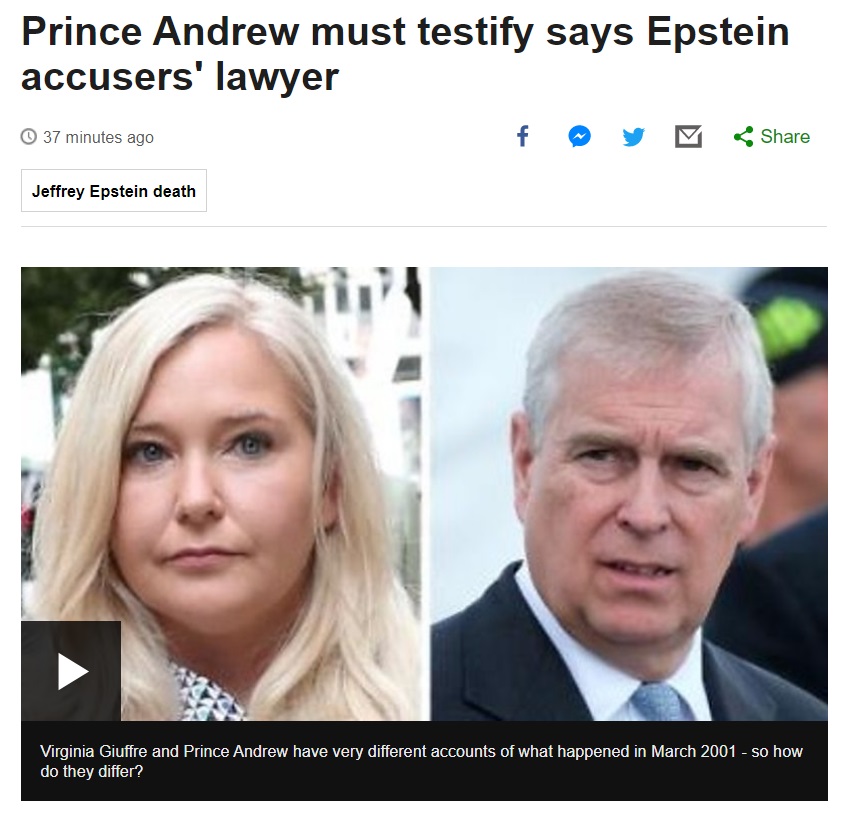
Link to BBC story and video
The BBC has now finally zoomed in on Ghislaine.
Another Epstein victim, Sarah Ransome told Panorama Ghislaine Maxwell, one of Prince Andrew’s oldest friends, worked hand in hand with Epstein.
”Ghislaine controlled the girls. She was like the Madam,” she said.
”She was like the nuts and bolts of the sex trafficking operation and she would always visit Jeffrey on the island to make sure the girls were doing what they were supposed to be doing.
”She knew what Jeffrey liked. She worked and helped maintain Jeffrey’s standard by intimidation, by intimidating the girls, so this was very much a joint effort.”
Ms Maxwell could not be reached for comment but has previously denied any involvement in or knowledge of Epstein’s abuse. (BBC)
But the American media is still not interested in Ghislaine.
What the American mainstream media always willfully forgets is that Ghislaine Maxwell is the key person and mastermind behind the whole pedo sex trafficking operation.
The key role of Ghislaine is not surprising. After all, her father was an Israeli super spy, Robert Maxwell.
But perhaps this is the very reason why the American media is not interested.
For years Ghislaine has been at the center of a vast pedophile sex trafficking network. But still to this day the American police has never dared to even interview her.
She simply knows too much.
The Evil, Immoral, Vicious, and Hypocritical Embargo Against Cuba
By Jacob G. Hornberger | FFF | July 20, 2020
The banality of evil that characterizes the U.S. national security state is demonstrated perfectly by the continuation of its deadly economic embargo against Cuba, which has been ongoing for some 60 years.
What’s the point of the embargo? After all, the Pentagon’s, CIA’s, and NSA’s official enemy Fidel Castro died years ago. Why continue to intentionally inflict harm on the Cuban people?
And make no mistake about it: Inflicting harm on the Cuban people is the purpose of the embargo. Its aim is to impoverish or starve Cubans into ousting their post-Castro regime and installing another pro-U.S. right-wing brutal dictatorship similar to the one that Castro ousted from power in the Cuban revolution.
In fact, the first embargo that the U.S. implemented against Cuba was during the reign of the crooked, corrupt, and brutal pro-U.S. right-wing dictatorship of Fulgencio Batista. That was an arms embargo. U.S. officials didn’t want weaponry imported into Cuba because that might enable the Cuban people to oppose Batista in a violent revolution.
During his reign, Batista partnered with the Mafia, the premier criminal organization that was smuggling drugs into the United States. As part of their partnership agreement, Batista let the Mafia operate gambling casinos in Cuba. As part of that cozy relationship, Batista would have his henchmen kidnap under-aged girls in Cuba and turn them over to the Mafia, which would then provide them as perks to the high-rollers in its casinos. That’s one of the things that brought on the Cuban Revolution.
That’s the guy that the U.S. national-security state was hell-bent on keeping in power. Thus, it should surprise no one that the CIA, like Batista, later entered into partnership with the Mafia, knowing full well that the Mafia was engaged in massive criminal activity. The purpose of the CIA-Mafia partnership was assassination. They were working together to assassinate Castro.
It stands to reason that the Mafia would try to assassinate Castro. It has lost all its casinos to Castro’s nationalization. And it was in the business of killing people.
But the U.S. government? In the business of murder? And in partnership with the biggest criminal organization in the world?
Don’t forget something important here: Castro, Cuba, and the Cuban people have never attacked the United States or even threatened to do so. No invasion. No terrorist attacks. No assassinations.
In fact, it has always been the other way around. In the more than six decades of bad relations between Cuba and the U.S., it has always been the U.S. government that has been the aggressor. An invasion, terrorist attacks, assassination attempts, and the embargo, all on the part of the U.S. government.
U.S. national-security state officials always justified such actions under the notion that Cuba was the spearhead of a worldwide communist conspiracy to take over the United States, one that was supposedly based in Moscow. It was always a ridiculous notion but that was the mindset of CIA, NSA, and Pentagon officials during the Cold War — that Cuba’s communist regime posed a grave threat to U.S. “national security.”
But the Cold War ended more than 30 years ago. Do the CIA, NSA, and Pentagon still think that the United States is in danger of falling to the Cuban communists?
Of course not. Now, it’s just sheer viciousness. Now, it’s just a matter of doing everything possible to oust the current regime in Cuba from power and restoring a Batista-like dictatorship, one that will be loyal and deferential to the Pentagon, the CIA, and the NSA.
The viciousness is demonstrated by the fact that the embargo doesn’t just criminalize Americans who do business with Cuba. It also targets foreign companies who do so. If they are caught doing so, they are targeted for prosecution or economic banishment here in the United States. In the minds of U.S. officials, it’s more imperative than ever to squeeze as many Cubans as possible into death and suffering.
Needless to say, the embargo has made things significantly worse for the Cuban people during the COVID-19 crisis. That’s fine with U.S. officials. The more Cubans who die, the greater the chance of an internal regime-change operation.
Sure, there is no doubt that Cuba’s socialist economic system is a major factor in the economic suffering of the Cuban people. But there is also no doubt that the U.S. embargo has served as the other side of a vise that has squeezed the economic lifeblood out of the Cuban people.
A dark irony, of course, is that the embargo has enabled the U.S. government to wield and exercise the same type of economic control over the American people that the Cuban socialist regime exercises over the Cuban people. It’s called adopting socialism to oppose socialism.
When will the evil, immoral, vicious, and hypocritical U.S. embargo against Cuba be lifted? When a critical mass of the American people, including those who go to church every Sunday, have a crisis of conscience and demand that it be lifted.
Precedents for Pizzagate
Marc Dutroux, Belgian pedophile, sadist, and serial killer with friends in high places
By Aedon Cassiel | Counter – Currents | December 23, 2016
To reiterate a point that should be clear to the more astute reader, my goal in this series (part 1, part 2) has not been to defend “Pizzagate” as such. My goal has been to defend the people who want to investigate it against specific accusations levied against them by people who think Pizzagate has revealed no intriguing information at all—for a specific reason, which I will be honing in and focusing on much more directly in this closing entry.
Whereas the mainstream critics of Pizzagate would have you believe that the dividing line is between paranoid conspiracy theorist followers of “fake news” and level-headed people who follow trustworthy news sources and rely on cold, hard reason to determine the truth, my goal has been to show that—whatever is or is not happening with Pizzagate itself—this framing of the issue is arrogant, insulting, and the product of extremely narrow tunnel vision.
When I have referred to what I see as the more compelling pieces of evidence uncovered by the crowd-sourced investigation into Pizzagate, my point has not been to use these to say “Pizzagate is true and every single person looking into it is a hero,” but to say “the people investigating it are not idiots, and the facts they’ve been uncovering are not all worthless. Reasonable people could very well look at this and think that it gives us reason to be concerned that there may be something behind it. And if the media is telling you only about the most bizarre, reaching accusations without telling you any of the more interesting points that have been uncovered (which it is), it is not doing its proper job.”
To those who think I am demonstrating an inclination towards conspiracy theories in this series, allow me to quote directly from the two previous essays:
The evidence [in Pizzagate] is of wildly varying levels of quality . . . [and much of it is] the pareidolia of “Jesus is appearing to me in my toast” . . . many of these claims arewild speculation over coincidences . . . Could [this evidence] have an innocent explanation? Sure, maybe. . . . some of the supposed “codewords” people have claimed to have identified in Pizzagate appear to be made up . . . Could all of this turn out to be nothing? Of course it could. . . . Have we identified [evidence of a high–level sex ring] here? Only time will tell. . . . Am I trying to make the argument that if one conspiracy theory is true, all the others must be, too? No . . .
Clearly, anyone who thinks my purpose in any of these essays has simply been to try to validate the truth of every conspiratorial speculation anyone has made around Pizzagate is not paying any attention to my actual words at all. They’ve completely missed the real point, and the problem is not that I haven’t expressed my argument clearly, because words can’t get much clearer than these.
However, I do want to dedicate this final entry to refining and adding bulk to a key step in the core of that argument: namely, the step that emphasizes that no matter how compelling any of the evidence that turns up in Pizzagate in particular may or may not be, we know that high-level sex abuse is in fact a thing that happens in the upper echelons of power, and we know that it gets covered up when it occurs, and we know that the media is often complicit in the cover-up as well. This is why I introduced my first entry to the series with a discussion of the Rotherham child abuse scandal, and the second entry to the series with a brief discussion of MK Ultra, a program that was publicly confirmed to have gone on for some twenty years and involved the highest halls of power subjecting innocent civilians and mentally disabled children to the worst kinds of psychological abuse and manipulation without consent before any public evidence ever even emerged. Part of the point in these examples is to demonstrate that the basic mistrust of our elites that people investigating Pizzagate are demonstrating is entirely justified by facts that are known.
Now, my other point in including these cases in the conversation is that there is a drastic difference between someone who believes he has reason to think something has happened that is unprecedented—say, that there are aliens in Area 51—and someone who believes he has reason to think something has happened that we know for a fact has happened, and that we know for a fact continues to happen, where—if they had found evidence of it happening, it would indeed look very much like what they’ve found.
Imagine you are walking down the street in a quiet small town, and a stranger tells you that the way someone has his handkerchief stuffed into his pocket is a sign that he’s just killed someone. But you investigate that individual, and it turns out that he’s entirely clean and that the handkerchief has a perfectly innocent explanation. You might have valid grounds to infer that the accuser could just be a paranoid schizophrenic who sees demonic symbolism everywhere, even when none exists.
But if a detective is working in a gang-infested area, and he has identified people using handkerchiefs to signify that they’ve just killed members of rival gangs, and he tells you that he thinks the way a certain individual has a handkerchief stuffed in his pocket might be evidence he’s just killed someone, then even if you investigate that individual and he turns out to be innocent, it would not be legitimate to suspect the detective of insanity just because he got it wrong. In fact, the reasoning he followed would be entirely legitimate, even though he turned out to be wrong in this particular case.
Why? Because he would know that there are in fact gangs operating in this area, and he would know that they have in fact used handkerchiefs to signal their recent killings, and he would know that if indeed this were someone committing an act that he knows has occurred before and that he knows in fact continues to occur, then this is exactly what the evidence for it would look like.
The point of this analogy is not to say that everyone looking at Pizzagate is just like a detective—but it is to say that the upper levels of our government are a gang-infested area. And that is why I have entered the arena, not to say “Pizzagate is obviously real!!!” but to say “The people investigating Pizzagate do not deserve to be treated like kooks. They do not deserve to be called idiots or paranoid freaks. Because in fact even if they are wrong, the instincts they are demonstrating are clearly instincts our political situation calls for in general whether something is happening in this particular instance or not.”
If any compelling evidence were to come out of Pizzagate—and, as I have said in this series, I do think at least some of it is—who would catch on and express concern about it first? The record very clearly shows that it would not be the mainstream media. As the first article made a clear effort to point out, it was the far-Right blogosphere that caught wind of the Rotherham scandal well before the mainstream media did; and during his time at the BBC, Mark Thompson was credibly accused of lying to cover up evidence of the Jimmy Savile sex scandal. Jimmy Savile managed to abuse hundreds of young children, and associates and friends were accused of acting in complicity with the rapes and even sentenced for raping the very same victims. And that same Mark Thompson who helped cover up the Savile scandal now runs the New York Times which was so quick to dismiss Pizzagate in its entirety as a hoax as well.
Liberal feminists claim to be concerned about “rape culture” (on which, see my essay on “Diversity & The Rape of Justice”), yet we have actual hard solid evidence here of a “child rape culture” within the upper echelons of power—which targets young boys at least as often as young girls—and their voices can barely be heard, even as they heap scorn upon the “conspiracy theorists” in cases like this one. Yet, the evidence they want us to believe holds true for rape across society in general as a whole (where, generally, it doesn’t) actually does hold for child rape in positions of power.
In what follows, I’m simply going to give overviews of some known, documented cases of this in haphazard order. I’m going to set my search bar in the right direction, spend an hour or two compiling sources that stand out to me, and list everything I find simply from looking around for a few minutes. So this won’t even be anywhere near the most compelling research on the topic that I could do. The brevity of these research methods should only serve to highlight even more clearly how pervasive this problem really is, if I can find this much with so little effort. It also underscores the irresponsibility and dishonesty of the mainstream media, who either have not done even cursory investigation or are simply shills trying to cover up the truth.
In 2011,
The OIG conducted an investigation concerning allegations that an AUSA [Assistant United States Attorney under Eric Holder] was using his government computer to view inappropriate material on his government computer. The investigation determined that the AUSA routinely viewed adult content during official duty hours, and that there was at least one image of child pornography recovered on the AUSA’s government computer. The AUSA acknowledged that he had spent a significant amount of time each day viewing pornography. The U.S. Attorney’s Office [Eric Holder] declined prosecution.
Senator Chuck Grassley of Iowa sent a letter to Eric Holder asking why the lawyer was not punished, and why he remained on the taxpayer dime for at least two months after being caught. I was able to find a copy through the Internet Wayback machine.
In 2006, the DHS’s Department of Immigrations and Customs Enforcement (ICE) ran an internationally cooperative investigation into the purchase of subscriptions of child pornography online. Code-named Project Flicker, the investigation uncovered the identities of 30,000 child porn subscribers in 132 different nations. Some 250 of these identities belonged to civilian and military employees of the U.S. Defense Department, who gave their real names and purchased the porn with government .mil email addresses—some with the highest security clearances available. In response, the Pentagon’s Department of Criminal Investigative Services (DCIS) cross-referenced ICE’s list with current employment roles and began a series of prosecutions.
A DCIS report from July 2010 shows that 30 of these individuals were investigated, despite uncovering a new total of 264 Defense employees and contractors who had purchased child pornography online. 13 had Top Secret security clearance. 8 had NATO Secret security clearance. 42 had Secret security clearance. 4 had Interim Secret security clearance. A total of 76 individuals had Secret security clearance or higher.
Yet, the investigations were halted entirely after only some 50 total names were investigated at all, and just 10 were prosecuted. A full 212 of the individuals on ICE’s list were never even given the most cursory investigation at all. (Note: The number 5,200 keeps popping up in sources covering this—for instance, see here—and I’m not sure what that number is for: American subscribers? Pentagon email addresses that weren’t confirmed to have actually been used by Pentagon employees, but still may have been? I’ll leave it to anyone interested enough to pursue these individual leads to see if they can figure that out and get back to us.)
In 2011, the story resurfaced when Anderson Cooper covered it with (again) Senator Chuck Grassley on CNN. After this, the story appears to have sunk straight back down into the memory hole yet again. Neither Anderson Cooper nor CNN appear to have given a follow–up in the five years since the story of the failed investigation first aired—why not? And why wasn’t the first airing enough to lead to mass outrage and calls for action anyway? See here for another summary of the squashed investigation from 2014.
Here’s a headline from The Washington Times dated June 29, 1989: “Homosexual prostitution inquiry ensnares VIPs with Reagan, Bush.” From the article:
A homosexual prostitution ring is under investigation by federal and District authorities and includes among its clients key officials of the Reagan and Bush administrations, military officers, congressional aides and U.S. and foreign businessmen with close social ties to Washington’s political elite, documents obtained by The Washington Times reveal. One of the ring’s high-profile clients was so well-connected, in fact, that he could arrange a middle-of-the-night tour of the White House for his friends on Sunday, July 3, of last year. Among the six persons on the extraordinary 1 a.m. tour were two male prostitutes.
Can anyone find a follow-up clarifying what happened as a result of that investigation? I can’t find one here either, though once again I’d appreciate if someone else was able to.
In the infamous Jimmy Savile sex abuse scandal in Britain, we now know that Savile’s coworkers at the BBC knew that Savile was committing many of his sexual offenses right on BBC campuses. Paul Gamboccini, who worked next door to him, said “The expression which I came to associate with Savile’s sex partners was . . . the now politically incorrect ‘under-age subnormals’. He targeted the institutionalized, the hospitalized – and this was known. Why did Jimmy Savile go to hospitals? That’s where the patients were.”
Yet, the BBC’s official statement was that there was “no evidence” of misconduct, and they even dismissed claims that there was a cover-up. But now that Savile’s offenses have been confirmed, we know that indeed there was.
Significantly, victims claimed that Savile was not just an isolated abuser, but part of an organized—and Satanically-themed—ring.
And victims in the Jerry Sandusky case also claimed that Sandusky was not just an isolated abuser, but part of an organized ring, as well.
Come to think of it, it does make sense that if there were rings operating, they would have reason to designate “fallboys” to take the blame if enough evidence of abuse ever began to emerge (or perhaps they would end up choosing their fallboys in the moment, for whatever reason, to the same effect).
Many people refer to the so–called “Satanic Panic” from the late 80’s and early 90’s to claim that the probability of hysteria around false allegations is more likely, and an even greater threat to society, than actual ritualized sexual abuse. However, this appears to be rather convenient for actual pedophiles—because according to Kenneth Lanning, an FBI expert on both cult crime and child abuse, often child sex offenders “introduce occult into the abuse so the kids won’t be believed . . . That is their M.O. (mode of operation) . . . People are getting away with molesting children because we can’t prove there are satanic devil worshippers eating people. Pretty soon it becomes unprosecutable.”
The False Memory Syndrome Foundation gained prominence thanks in large part to the “Satanic Panic” (it’s members were even involved in the legal defense of individuals accused during the Satanic Panic). In 1993 Ralph Underwager, a key member of its “scientific advisory board”, was forced to resign after making the following statement in an interview with Paidika: The Journal of Pedophilia:
What I have been struck by as I have come to know more about and understand people who choose paedophilia is that they let themselves be too much defined by other people. That is usually an essentially negative definition. Paedophiles spend a lot of time and energy defending their choice. I don’t think that a paedophile needs to do that. Paedophiles can boldly and courageously affirm what they choose. They can say that what they want is to find the best way to love. I am also a theologian and as a theologian, I believe it is God’s will that there be closeness and intimacy, unity of the flesh, between people. A paedophile can say: “This closeness is possible for me within the choices that I’ve made.”
Paedophiles are too defensive. They go around saying, “You people out there are saying that what I choose is bad, that it’s no good. You’re putting me in prison, you’re doing all these terrible things to me. I have to define my love as being in some way or other illicit.” What I think is that paedophiles can make the assertion that the pursuit of intimacy and love is what they choose. With boldness, they can say, “I believe this is in fact part of God’s will.” They have the right to make these statements for themselves as personal choices. Now whether or not they can persuade other people they are right is another matter. (laughs)
Jennifer Freyd, daughter of the foundation’s founder Peter Freyd, continues to maintain that she was sexually abused by him, and has even published works on the topic of memories of child abuse herself. While the FMSF maintains that a full 65% of allegations of abuse are unsubstantiated, other research reported, for instance, in the Harvard Mental Health Letter finds that false abuse allegations by children “are rare, in the range of 2-8% of reported cases. False retractions of true complaints are far more common, especially when the victim is not sufficiently protected after disclosure and therefore succumbs to intimidation by the perpetrator or other family members who feel that they must preserve secrecy.”
And it bears remembering that not all accusations of institutionalized child sex abuse were bogus even during the very years of the “Satanic Panic” itself.
Throughout this series, I’ve mentioned the Franklin Scandal, at the center of which was Larry King—leader of the Black Republican Caucus, who sang the national anthem at the Republican convention in 1984, and worked heavily with a charity called Boys Town. I had planned to write a whole essay on this scandal, but having now read Nick Bryant’s book there is so much information that it’s hard to even fathom where to begin—and there’s a fine line between not giving enough compelling evidence and copying and pasting the entire book. So the best way to learn about this incident is to watch the Conspiracy of Silence documentary and then contact me at www.zombiemeditations.com if you need help obtaining a copy of Nick Bryant’s book.
The one most striking line of evidence in the case I will mention is this: the head of the investigative Franklin committee, Gary Carodori, was convinced that the victim’s allegations of rampant child abuse were true. You can see his interviews with the victims here. On the way to Chicago to reopen evidence, Carodori met an untimely death when his plane crashed, and his briefcase of evidence vanished without a trace. According to the Omaha World-Herald, investigators with the National Transportation Safety Board concluded that the “scattered wreckage pattern . . . certainly demonstrates that [the plane] did break up in flight,” which in other words means that it didn’t fall apart on impact because of a crash—the plane crashed because it fell apart.
State Sen. Loran Schmit of Bellwood, chairman of the Franklin legislative committee, told The Associated Press in Lincoln that he had no doubt there were people who wanted to see Caradori dead.
“They got their wish,” he said. “. . . The question to be answered is whether it was a coincidence.”
Schmit, himself a pilot with 40 years’ flying experience, stopped short of saying he thought Caradori’s plane was sabotaged, but he added in an interview with AP :
“A small plane is the perfect thing to use to get at someone. . . . They tend to burn when they crash, and things get burned, destroyed, scattered. You don’t need a bomb. A fuel line could be tampered with. Any number of possibilities are there.”
. . . Scott Caradori of Ralston told the World-Herald that his brother was a careful flier of more than 15 years who would not take chances, especially with his son on board, and had never had a mishap.
He said he did not rule out sabotage, given the nature of his brother’s work with the Franklin committee. “Our family received numerous threats over that, telling him to back off,” he said . . .
John DeCamp is the man who appears along with the victims in the Conspiracy of Silence documentary. He’s the author of The Franklin Coverup, the most thorough book on the Franklin case to appear in print before Nick Bryant’s more recently published update. DeCamp is a former state Senator, listed as one of eight ‘outstanding’ Vietnam veterans (he helped Operation Baby Lift, which evacuated thousands of Vietnamese children from the war-torn area), and now in his work as a lawyer has, among other things, provided legal representation to the children in the Columbine shooting.
Though Jerry Sandusky’s criminal trial did not begin until 2012, John DeCamp began discussing how he was contacted by victims and was linking the figures involved in the Franklin case to the sex abuse happening at Penn State all the way back in 2004.
“I had done something back then [when I wrote the original book on Franklin] linking the football coach [Jerry Sandusky] with Franklin . . . [and] I got call after call after call from Pennsylvania . . .”
Nick Bryant can also be heard discussing the links between the Franklin and Penn State abuses here, here, here, here, and here (part 1, part 2).
Speaking of Sandusky, few people are aware that Sandusky was actually first charged with sexual abuse of a minor all the way back in 1998. The Centre County’s District Attorney Ray Gricar at first refused to press charges. In 2005, Gricar disappeared under bizarre circumstances. “. . . After telling his girlfriend he was going for a drive . . . His body was never found, only his abandoned car and his laptop which had been tossed in the Susquehanna River in Pennsylvania without its hard drive.”
Then there’s the Dutroux Affair—a perfect example of the capacity of high–level pedophiles to destroy investigations by placing the right people in the right positions of power to protect themselves. In Belgium, a nation of just 10 million people, 350,000 people took to the streets in an event known as the White March to protest the handling of the case (in other words, that’s approximately 1 out of every 30 citizens of Belgium, including the elderly and children). Around 1995, multiple young girls began disappearing around the municipality of Bertrix. Headway in the investigation was finally made when a white van was reported that the police were able to trace back to Marc Dutroux. Marc Dutroux was a previously convicted pedophile who was released after serving just a third of his sentence despite the fact that his own mother had testified to the parole board that he would unquestionably offend again. Though unemployed and receiving welfare, Dutroux was able to live quite lavishly thanks to selling children—he owned seven homes, and used four of them as bases for kidnappings.
But the most disturbing part of this case isn’t even the offenses—it’s how deliberately inept the prosecution was. Police not only investigated Dutroux repeatedly without pressing charges, they even reported hearing voices —and accepted Dutroux’s story that the voices came from the street outside. They ignored a tip from an informant claiming Dutroux offered him thousands of dollars to participate in a kidnapping. They even sat on a video tape showing Dutroux building a makeshift dungeon in his basement, and could have saved the lives of the two girls who were then being tortured there had they acted on it.
Once the case was transferred from police to the courts, the initiative of lead prosecutor Jean-Marc Conorrette led to the rescue of two girls and the discovery of four bodies. Conorrette was inexplicably dumped from the case, and later broke down in tears in court describing the constant death threats he received while still on the case. Obviously there were other interested parties, some at least with influence in the government.
When a parliamentary panel revealed the names of 30 government officials who were complicit in hiding the misdeeds, none were punished. Nine police officers were eventually detained, but though a full 100 people in government, finance, and the media were accused of involvement, no one other than Dutroux ever made it to jail. (Edit 6:40PM EST 12/24: A friend with connections to intelligence agencies sent me a message in response to this article to tell me that this post is a solid summary of the amount of coverup involved in the Dutroux Affair, despite the overall conspiratorial leanings of the site itself. He also tells me that the case of Peter Scully is one that’s too little known that has well–documented evidence of institutional involvement and cover–up.)
In Italy, Alfredo Ormanni who led an investigation into child porn claimed that a “paedophile lobby that acts in broad daylight and probably with the support, which”—he politely added—he “could consider unwitting, of certain political parties” was actively disrupting the efforts of his investigation.
In 1987, allegations of abuse involving dozens of children surfaced at the Presidio military base in San Francisco. The American Journal of Orthopsychiatry analyzed the victims, and claimed that:
The severity of the trauma for children at the Presidio was immediately manifest in clear cut symptoms. Before the abuse was exposed, parents had already noticed the following changes in their children: vaginal discharge, genital soreness, rashes, fear of the dark, sleep disturbances, nightmares, sexually provocative language, and sexually inappropriate behavior. In addition, the children were exhibiting other radical changes in behavior, including temper outbursts, sudden mood shifts, and poor impulse control. All these behavioral symptoms are to be expected in preschool children who have been molested.
Lt. Col. Michael Aquino, who ended up at the center of the investigation, had previously appeared on the Oprah Winfrey show to discuss his views on Satanism (Aquino founded a group called The Temple of Set). Records showed that the children were taken on unannounced trips outside the center.
One child positively identified Aquino and his wife, Lilith (known to the kids as ‘Mikey’ and ‘Shamby’), and was also able to identify the Aquinos’ private home and to describe with considerable accuracy the distinctively satanic interior décor of the house. The young witness claimed to have been photographed at the Aquinos’ home. On August 14, 1987, a search warrant was served on the house. Confiscated in the raid were numerous videotapes, photographs, photo albums, photographic negatives, cassette tapes, and name and address books. Also observed was what appeared to be a soundproof room.
Perhaps uncoincidentally, Cathy O’Brien—who claims to have been a victim of MK Ultra programming as a child, and who I mentioned in the second entry to the series—also claims Aquino was involved in her brainwashing. I have no idea whether O’Brien is a credible witness or not. But her allegations do line up with a striking amount of consistency with other evidence. Given Aquino’s known involvement in mind control programs—here is the full text of his “From PSYOP to Mind War”—this isn’t inherently implausible.
Nonetheless, the case was “quietly closed” after suspected offenders, including Aquino, were simply moved to different facilities
And yet again, the leads in these supposedly separate cases come full circle: Michael Aquino was also linked to the kidnapping of Johnny Gosch in the case of the Franklin scandal (according to an interview with the boy’s mother, Noreen Gosch).
I’m approaching 5,000 words now, so I’m just going to dump some of the other mainstream–media headlines I found here without further elaboration.
- In the UK, MP Tom Watson confronts PM Cameron in Parliament with evidence of an elite pedophile ring at high levels (Video of speech).
- British pedophile ring ‘protected by Parliament and Downing Street’ (Belfast Telegraph)
- Panic among UK leaders as high-level pedophile network is covered up: BBC Newsnight program suspended for naming senior Conservative pedophile (The Guardian)
- Wikileaks cables reveal DynCorp employees purchased child prostitutes in Afghanistan and the US State Department helped cover it up (Huffington Post)
- Savile ‘had accomplice who would supply girls to sex ring inside BBC’ (The Sun)
- Jimmy Savile is the Tip of the Iceberg (This one is a blog, but it references several worthwhile mainstream sources)
- France’s most notorious serial killer has claimed that he murdered at least one victim on the orders of highly placed personalities in Toulouse because of a blackmail threat linked to sadomasochistic orgies involving politicians, judges and police. (The Guardian)
- Tebbit hints at sex abuse cover-up as pressure over missing files intensifies (The Guardian)
- My Name Is Anneke Lucas and I Was a Sex Slave to Europe’s Elite at Age 6 (Global Citizen)
For more sources like these, there are collections here and here and here — I share these with the caveat, as always, that I don’t necessarily endorse everything there, but I have found plenty that is useful within them.
To repeat the conclusion I reached earlier: child sex abuse is, without question, a rampant, institutional, and high-level phenomena. It occurs on a large scale in the highest levels of power—in the fields of entertainment, government, and law enforcement—and members of these rings have been well-known to gain handles on the relevant positions of power to ensure their actions are successfully covered up. Whether anything unique or original comes out of Pizzagate or not, then, my take is that the basic spirit of concern and distrust towards the elite halls of power that Pizzagaters have demonstrated is their general disposition is still far closer to the spirit of the truth than the basic attitude of dismissiveness that such a thing could even occur being demonstrated by those who find it too quick and easy to dismiss all of Pizzagate in its entirety as nothing more than a hoax—and I would stand by this statement even if it turned out that the latter were right.
Given that we know how rampant the problem of institutionalized child sex abuse in upper levels of power really is, with mounds of unquestioned public evidence stretching back decades across the world, the amount of evidence it takes to justify suspicion of people in positions of power drops.
But some question whether it is even appropriate to use words like “evidence” when speaking of cases like these in reference to Pizzagate. The answer is yes. Logicians call cases like this “background evidence,” which means facts that raise the prior probability that a thing being alleged could happen, by showing that it does happen, and therefore increasing the plausibility—to whatever extent—that it could have happened in this particular case. If things like Pizzagate have already happened, then Pizzagate is at least possibly true as well. If something is actual, that proves that things like it are possible and thus cannot be simply dismissed as impossible or implausible.
It is important to understand that “evidence” is not the same thing as “proof.” For example, if we know that a man molested every child he had prior to this one, that doesn’t prove that he molested this one. But we would absolutely be interested in knowing that in a court of law, and specifically it would count as “background evidence” that raises the prior probability that the claim that he molested this child could be true.
To continue the example, here’s what background evidence does: if we know the man has molested all of his previous children, then we are justified to give increased weight to whatever direct evidence exists indicating he may have molested this one. If we know the man has never molested a previous child, then we are justified to give less weight to whatever direct evidence exists indicating he may have molested this one.
On the other hand, if we knew the child had a history of lying for various reasons, that wouldn’t prove they were lying for those reasons this time too, but it would count as “background evidence”: relatively speaking, it would cause us to give less evidentiary weight to the child’s statements alone, if those were all we had as evidence.
If the father also molested every child he had previously, those two pieces of background evidence might basically cancel out. But if we knew the father had never molested any previous child (background evidence), and we knew the child had a strong history of lying about similar claims (background evidence), then the two facts put together would suddenly become enough to make a pretty compelling legal argument all by themselves, even though they have nothing to do with the specific facts at stake in this specific case, and they do nothing to deductively refute whatever claims against the father the child might have made.
In the real world, we often don’t have access to the kind of information we would need to deductively prove or refute things one way or another, so background evidence is sometimes the only evidence we have to go on, and it is in fact defined as a form of evidence (again, in court, if you knew that the child had previously made very similar lies and that the father had never molested a previous child, you would submit that information to the court “as evidence”).
So, whether or not we know high-level sex rings exist, and whether or now we know that they get covered up, influences how we ought to evaluate the evidentiary relevance of things we do or do not know when it comes to Pizzagate in particular. You might find similarities between the way people respond, or in the particular people taking the effort to respond, to Pizzagate and the way coverups of other cases took place.
For instance, if someone we now know was very active in denying allegations about a case that later turned out to be true is doing the same in Pizzagate (and for instance, Mark Thompson of the BBC was credibly accused of helping cover up the Savile scandal, and now runs the NYT ), then we have evidence in the form of recognizing that what’s in front of us fits a certain pattern. Previous cases establish the “patterns” that take place when one thing or another happen, and therefore influence how we ought to interpret the patterns we see in front of us in a given case. If the patterns start to match, then that qualifies as evidence.
So, do high-level sex trafficking rings or organized forms of pedophilia exist in upper levels of government? How prevalent does it appear to be? As best we can tell, how many of them are there? How do things tend to go at first when they’re exposed? Can we confirm with prior evidence that they can be and are successfully covered up? All of this directly influences the likelihood that Pizzagate could be on to something. The more prevalent these things are, the less overwhelming the direct evidence needs to be to justify concern. The less prevalent they are, the more overwhelming it needs to be. Just like the history of how many previous children a man has molested influences how we evaluate the evidence at play when someone claims he’s molesting this one: if he’s never done anything of the sort, you’re going to need a lot of evidence before you take the accusation seriously. If you know that he’s even had a history of glancing at child porn, the more of that kind of background evidence you get, the less direct evidence you need to say that the accusation that he molested this child should be taken seriously.
Thus, to close, there are two responses we could take to someone who has latched on to a particular claim involving child sex abuse that turns out not to be accurate: First, we can call them paranoid idiots and move on with our day, conveniently forgetting about all of the rampant evil that does in fact exist, comforted by the fact that we could shut someone up for making us feel uncomfortable—because, after all, it turns out they actually were wrong about this particular claim. This appears to be the standard mainstream approach. Second, we can appreciate the basic human concern that motivates their interest in the subject and point them in the direction of better evidence for the very thing they’re ultimately concerned about, because the basic thing they are concerned about—institutionalized child sex abuse in upper reaches of power—absolutely is, in fact, real, whether they have the exact details right or not.
The dry intelligence of skeptics is utterly and entirely useless if it isn’t paired with a natural human drive to care. But the passion of the concerned just might be invaluable if only it can be paired with a more accurate picture of the facts. And this is the basic reason why some people have misread the intentions behind this series, even despite the clarity of my direct words stating that—again:
The evidence [in Pizzagate] is of wildly varying levels of quality . . . [and much of it is] the pareidolia of “Jesus is appearing to me in my toast” . . . many of these claims are wild speculation over coincidences . . . Could [this evidence] have an innocent explanation? Sure, maybe. . . . some of the supposed “codewords” people have claimed to have identified in Pizzagate appear to be made up . . . Could all of this turn out to be nothing? Of course it could. . . . Have we identified [evidence of a high–level sex ring] here? Only time will tell. . . . Am I trying to make the argument that if one conspiracy theory is true, all the others must be, too? No . . .
I have found it less important to address myself in tone to the dry intelligence of dispassionate skeptics than to the passion of the concerned, because theirs is the only energy that even expresses the desire to do something about what is, one way or another, a real, serious, and massive problem. Only for those who have it within them by nature to recognize that there are problems, untrustworthy elites, and a need to take some kind of action is there any purpose in discussing where to aim.
Additional “Pizzagate” videos by “Reality Calls” vlogger.
https://www.youtube.com/watch?v=oA2BocJLGb8
https://realitycallsshow.com/banned-from-youtube-james-alefantis-instagram-account-images-pizzagate/
#PizzaGate Images BANNED From YouTube
White Helmets co-founder stole aid money destined for Syria – report
RT | July 17, 2020
As Western governments opened their checkbooks for the White Helmets – a controversial ‘rescue organization’ in Syria – their co-founder used the cash to top up his wage and even finance his wedding, according to a Dutch report.
Days before he plunged from a window in Istanbul to his death last year, White Helmets co-founder and British mercenary James Le Mesurier admitted to defrauding Mayday Rescue, an organization that fundraised for the anti-government rescue group in Syria.
According to documents seen by Dutch newspaper De Volkskrant, Le Mesurier told an accountant sent to audit the charity’s books that he forged receipts for $50,000, pretending that it was sent to finance an evacuation operation in Syria. Instead, the money was paid to Le Mesurier himself. In addition to paying himself a salary of €24,000 ($27,414) per month, Le Mesurier dipped into company cash to finance a lavish wedding in Istanbul in 2018, and to issue loans to his new wife, former diplomat Emma Winberg, the report claims.
The accountant sent to investigate Mayday found that “tens of thousands of dollars in cash” were withdrawn to pay for the “fairytale wedding.”
Meanwhile, governments across the Western world were lining up to support Mayday, and channel money to the White Helmets. According to a 2018 report by the Dutch Ministry of Foreign Affairs, the organization took in $127 million between 2014 and 2018, with only $19 million of this haul coming from non-state donors. The government of the Netherlands paid out almost $11.5 million in this period, while similar donations flowed in from Germany, Great Britain, Canada, Qatar, and others.
Despite being hailed as fearless rescue workers, the White Helmets have been accused of partnering with Al-Qaeda. Operating exclusively in rebel-held territory, the group’s members have been photographed posing with jihadists and have been accused of staging chemical weapons attacks to draw in Western forces against Syrian President Bashar Assad.
Le Mesurier’s death was deemed a suicide by Turkish authorities. Shortly afterwards, a number of countries that had donated to Mayday demanded an accountant have another look over the organization’s books. According to De Volkskrant, this probe found that most of Mayday’s financial records are “missing.” Donations were not just handed to the organization in Amsterdam and forwarded to Syria, but distributed through a network of commercial organizations in Turkey and Dubai.
In a letter to donors, Le Mesurier admitted to swindling them out of their cash, but maintained the fraud wasn’t committed on purpose. After these donors discovered their cash had disappeared, they kept the inquiry into Mayday secret, De Volkskrant reported.
The Dutch government pulled its funding from Mayday Rescue almost a year before Le Mesurier admitted the fraud and killed himself. The government in The Hague will not transfer a final subsidy of more than €57,000 ($65,200) to the organization, while Germany is attempting to claim nearly €50,000 ($57,200) back. Cor Vrieswijk, Mayday’s new administrator, told De Volkskrant that the charity will be dissolved in the coming months.
President Assad claimed last November that Le Mesurier’s death was no accident, stating in an interview that the former soldier and mercenary may have been killed because he “knew major secrets.” What Le Mesurier may or may not have known is anyone’s guess, but his death and the subsequent investigation into Mayday has not dried up the White Helmets’ funding.
The group is reportedly receiving subsidies from Western governments through other organizations. At present its members are occupied with fighting the coronavirus outbreak in Syria. However, that hasn’t stopped its leadership from lobbying the US government against Assad and pressing for the maintenance of sanctions, even amid the pandemic.
Group that raises money for Israeli soldiers got $2-5 million federal loan
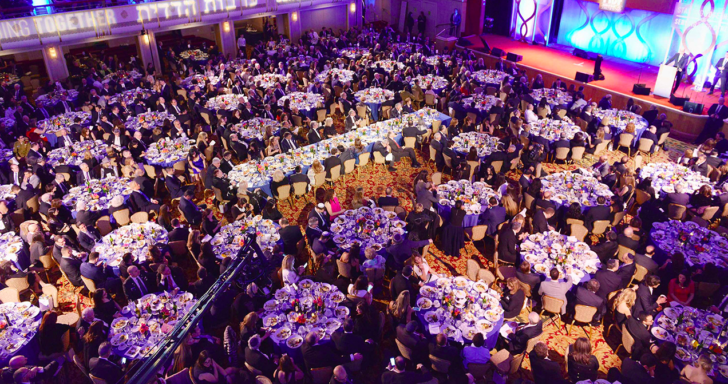
FIDF gala at Waldorf Astoria in New York City (Jewish Post )
By Alison Weir | If Americans Knew | July 16, 2020
An organization that holds opulent galas to raise money for foreign soldiers, received a forgivable federal loan of somewhere between $2 million to $5 million, while numerous American mom-and-pop businesses applied in vain for the coronavirus relief program.
The group, Friends of the IDF (FIDF), holds glittering extravaganzas around the U.S. that raise tens of millions of dollars for Israeli soldiers.
These are held despite the fact that numerous organizations have documented massive human rights violations by Israeli forces (see video below). The U.S. gives Israel over $10 million per day in military aid.
Last year’s FIDF fundraiser in Manhattan raised $37 million, one of 20 chapters around the country. A 2018 gala in Beverly Hills raised $60 million and a 2017 gala raised over $53 million. Its annual chair, billionaire dual citizen Haim Saban, is a major Clinton donor. (video below)
Celebrities like Barbra Streisand, Larry King, Sylvester Stallone, Robert de Niro, and Arnold Schwarzenegger have helped raise money at the events. Among the donors are Oracle CEO Larry Ellison, Sandra Spielberg, and philanthropist Tad Taube. FIDF has over $238 million in net assets.
Small businesses & U.S. veterans go without
Many small businesses around the country have been unable to obtain the coronavirus assistance loans.
One U.S. emergency grant program is already out of money, while nearly half of all small businesses worry that they won’t be able to carry on due to the shutdowns.
The loan program accessed by FIDF, Paycheck Protection Program (PPP), has been accused of favoritism, as some billionaires received loans while struggling small businesses went bankrupt.
Donations to FIDF are tax-deductible, which means they remove thousands of dollars (perhaps far more) from the U.S. economy.
Meanwhile, 40 thousand U.S. veterans are homeless on any given night, and veterans hospitals are often underfunded.
Numerous other organizations that support Israel also received large grants, many in the $1million+ range.
~1,000 pro-Israel groups received millions of dollars in loans
The Jewish Telegraphic Agency (JTA) reports:
“More than 1,000 Jewish organizations received federal coronavirus relief loans totaling approximately $540 million to $1.3 billion.”
The vast majority of the organizations, perhaps all, support Israel.
Among the those receiving the forgivable (don’t have to be paid back) loans are the Zionist Organization of America (net assets $38 million), Israeli American Council ($32 million assets), Israel Emergency Alliance (gross receipts $17 million), ADL (gross receipts $80 million), and Jewish National Fund (net assets $445 million), and Israel on Campus Coalition ($5 million net asssets). (Financial information from GuideStar.)
FIDF Gala
Israeli soldiers’ actions:
See the full 8-minute video here.
Alison Weir is executive director of If Americans Knew, president of the Council for the National Interest, and author of Against Our Better Judgment: The Hidden History of How the U.S. Was Used to Create Israel.
The Maxwell Family Business: Espionage

July 15, 2020
Many were surprised to learn earlier this month that the key co-conspirator in Jeffrey Epstein’s intelligence-linked sexual blackmail operation, Ghislaine Maxwell, had been in hiding in New England since Epstein’s arrest and subsequent “suicide” last summer. Her recent arrest, of course, has returned attention to the Epstein scandal and to Ghislaine’s ties to the entire operation, in which she played a central and crucial role, arguably more so than Epstein himself.
Ghislaine was first reported to be living in New England at the mansion of her alleged boyfriend Scott Borgeson on August 14th of last year. Though Maxwell is believed to have stayed there until purchasing the nearby New Hampshire home where she was arrested, attention from her presence on the East Coast was immediately and sensationally re-directed to the West Coast when, a day later on August 15th, the New York Post published a picture allegedly depicting Maxwell reading a book on “CIA operatives” at an In-N-Out Burger in Los Angeles, California. The photo was later revealed to have been photoshopped and a fake, but ultimately served its purpose in distracting from her actual location in New England.
While the media frenziedly covered the fake In-N-Out Burger photo, the appearance of an unexpected visitor nearby Borgeson’s mansion succeeded in largely slipping under the radar. On August 18th, Ghislaine’s sister Christine was spotted “packing up a number of bags” into a SUV just a few miles from Borgeson’s “secluded beachfront” home. Christine, who currently lives and works in Dallas, Texas, declined to comment on why she was visiting the exact area where Ghislaine was allegedly hiding at the time.
Out of the seven Maxwell siblings, Ghislaine Maxwell has undoubtedly received the bulk of media scrutiny both in recent years and arguably ever since the suspected homicide of the family patriarch, Robert Maxwell, in 1991. In the years since his death, Robert Maxwell’s close ties to Israeli intelligence and links to other intelligence agencies have been documented by respected journalists and investigators including Seymour Hersh and Gordon Thomas, among others.
While Ghislaine’s own ties to intelligence have since come to light in relation to her critical role in facilitating the Jeffrey Epstein sexual blackmail operation. Little, if any attention, has been paid to her siblings, particularly Christine and her twin sister Isabel, despite them having held senior roles at the Israeli intelligence front company that facilitated their father’s greatest act of espionage on Israel’s behalf, the sale of the bugged PROMIS software to the U.S. national laboratories at the heart of the country’s nuclear weapons system.
Not only that, but Christine and Isabel later became directly involved with technology-based business ventures that directly involved Ghislaine during the very period she worked with Epstein on behalf of Israeli and U.S. intelligence to ensnare powerful U.S. political and public figures in a sexual blackmail scheme involving minors. At the time, Ghislaine described her profession to a number of newspapers as “an internet operator.” Then, after this venture’s multi-million dollar sale to a competitor, Christine and Isabel became involved with successors to the PROMIS software scandal that were closely tied to U.S. intelligence and Israeli intelligence, respectively.
Ghislaine herself also became involved in these affairs, as did Jeffrey Epstein following his first arrest, as they began courting the biggest names in the U.S. tech scene, from Silicon Valley’s most powerful venture capital firms to its most well-known titans. This also dovetailed with Epstein’s investments in Israeli intelligence-linked tech firms and his claims of having troves of blackmail on prominent tech company CEOs during this same period.
With Ghislaine’s name and her ties to intelligence now inking their way back into the media sphere, detailing the decades-long course of these technology-focused espionage operations and their persistent ties to the Maxwell sisters demands the attention it deserves, as the need to air out the real Maxwell family business – espionage – is now greater than ever before.
Trap doors and Treason
One of the most brazen and successful operations conducted by Israeli intelligence on a global scale is undeniably its sale of a bugged software program to governments, corporations and major financial and scientific institutions around the world. That software program, known as the Prosecutor’s Information Management System or by its acronym PROMIS, was originally created and marketed by Inslaw Inc., a company created by former NSA official Bill Hamilton and his wife Nancy.
In 1982, Inslaw leased its revolutionary PROMIS software to the U.S. Justice Department, then headed by arch neocon Edwin Meese III, Ronald Reagan’s most trusted advisor and who would later go on to advise Donald Trump following the 2016 election. The success of the software, which allowed integration of separate databases and information analysis on a previously unimaginable scale, eventually caught the attention of Rafi Eitan, the notorious and legendary Israeli spymaster and handler of the “most damaging spy” in American history, Jonathan Pollard. Eitan, at the time, was serving as the then-head of the now defunct Israel intelligence service known as Lekem, which focused specifically on espionage related to scientific and technical information and discoveries.
Eitan had first learned of PROMIS from Earl Brian. Brian was a long-time associate of Ronald Reagan who had previously worked for the CIA in covert operations and had been in charge of Reagan’s healthcare program when Reagan was governor of California. Brian often bragged of the nickname he had acquired in overseeing that health care initiative – “the man who walked over the dead.” In 1982, however, Brian was attempting to build a business empire, in which then-AG Ed Meese’s wife was a major investor, and he had first met Eitan while attempting to sell a healthcare system in Iran.
Brian divulged the efficacy of PROMIS, but – instead of praising its revolutionary approach to data analysis – expressed his frustration that the software enabled U.S. federal investigators to successfully track and target money laundering and other financial crimes. He also expressed frustration that he had been left out of the profits on PROMIS, the development of which he had followed closely for several years.
As their conversation wore on, Eitan and Brian hatched a plan to install a “trapdoor”, today more often referred to as a back door, into the software. They would then market PROMIS throughout the world, providing Israeli intelligence and allied elements of U.S. intelligence with a direct window into the operations of its enemies and allies while also netting Eitan and Brian massive profits for the sale of the software. Brian, of course, would also be able to use PROMIS to circumvent authorities investigating financial crimes.
According to the testimony of ex-Mossad official Ari Ben-Menashe, after PROMIS was obtained by Israel’s military intelligence through direct collusion with the U.S. Department of Justice, Ben-Menashe contacted an Israeli American programmer living in California on Eitan’s orders. That programmer then planted a “trapdoor” or back door into the software that would allow Lekem covert access to any database connected to a device on which the software was installed.
Once the back door was present, Brian attempted to use his company Hadron Inc to market the bugged PROMIS software around the world, though he first had tried to buy out Inslaw to do so. Unsuccessful, Brian turned to his close friend, then-Attorney General Ed Meese, and the Justice Department then abruptly refused to make the payments to Inslaw that had been stipulated by the contract, essentially using the software for free, which Inslaw claimed to be theft.
Meese’s actions would force Inslaw into bankruptcy and Inslaw subsequently sued the Justice Department, with a US court later finding that the Meese-led department “took, converted, stole” the software through “trickery, fraud and deceit.” With Inslaw out of the way, Brian sold the bugged software to Jordan’s and Iraq’s intelligence services, a major boon for Israel, and to a handful of companies. Despite this, Eitan was unsatisfied with Brian and Hadron and he quickly turned to the person he thought could most effectively market and sell PROMIS to governments of interest all over the world, Robert Maxwell.
First recruited as an asset of Israeli intelligence in the early 1960s, Maxwell’s standing with Israeli intelligence would strengthen considerably beginning in the early 1980s, when he purchased a web of Israeli companies, many of which were official “service providers” for the Mossad. One of these companies, a computer firm called Degem, had been used for years to provide cover to Mossad assassins that conducted kidnappings and murders in Latin America and Africa.
Through Degem and other Maxwell-owned companies based in Israel and elsewhere, Maxwell marketed PROMIS so successfully that Israeli intelligence soon had access to the innermost workings of innumerable governments, corporations, banks and intelligence services around the world. Many of Maxwell’s biggest successes came in selling PROMIS to dictators in Eastern Europe, Africa and Latin America. Following the sale and after Maxwell collected a handsome paycheck, PROMIS’ unparalleled ability to track and surveil anything – from cash flows to human movement – were used by these governments to commit financial crimes with greater finesse and used to hunt down and disappear dissidents. Israeli intelligence, of course, watched it all play out in real time.
In Latin America, for instance, Maxwell sold PROMIS to military dictatorships in Chile and Argentina, which were used to facilitate the mass murder that characterized Operation Condor as the friends and families of dissidents and so-called subversives were easily identified using PROMIS. PROMIS was so effective for this purpose that, just days after Maxwell sold the software to Guatemala, its US-backed dictatorship rounded up 20,000 “subversives” who were never heard from again. Of course, thanks to the back door in PROMIS, Israeli intelligence knew the identities of Guatemala’s disappeared before the victim’s own families. Israel was also intimately involved in the arming and training of many of the same Latin American dictatorships that had been sold the bugged PROMIS software.
Though Israeli intelligence found obvious use for the steady stream of sensitive and classified information, their biggest prize was yet to come – top secret government laboratories in the United States. Eitan tasked Maxwell with selling PROMIS to US labs in the Los Alamos complex, including Sandia National Laboratory, which was and is at the core of the US nuclear weapons system. Notably, the eventual sale of PROMIS to these laboratories by Maxwell occurred during the same period in 1984 when Eitan tasked one of Israel’s top experts in nuclear targeting with supervising Jonathan Pollard’s espionage of U.S. nuclear secrets on Israel’s behalf.
In order to plot how he would accomplish such a feat, Maxwell would meet with none other than Henry Kissinger, who told him that – in order to sell PROMIS to these sensitive laboratories – he needed to enlist the services of then-Senator for Texas John Tower, who was the head of the Senates’ Armed Services Committee at the time. Maxwell quickly struck a deal with Tower and then, using Mossad money, paid Tower $200,000 for his services, which included opening doors – not just to the Los Alamos complex, but also to the Reagan White House. Tower would arrange a trip for Maxwell to travel to Sandia National Laboratory, where he would market PROMIS. Unlike most other PROMIS sales, this one would not be handled by Degem, but a US-based company called Information on Demand.
It is worth noting that, despite Tower’s obvious and treasonous actions with respect to U.S. national security, another long-time “source” of Robert Maxwell, George H.W. Bush, would attempt to nominate Tower to serve as U.S. Secretary of Defense. When the Senate refused to confirm Tower, only then did Bush nominate Dick Cheney, who would then head the Pentagon and oversee the U.S.’ role in the First Gulf War. Not long after his failure to secure the nomination as Pentagon chief, Tower died in a suspicious plane crash soon after the equally suspicious death of Robert Maxwell.
Front Companies and FBI Cover-ups
Robert Maxwell purchased Information on Demand from its founder, Sue Rugge – a former librarian, through the Pergamon Group in 1982 – the very year plans were made by Rafi Eitan and Earl Brian to subvert PROMIS. Its offices were just a few doors down from the home of Isabel Maxwell and her first husband Dale Djerassi, son of the scientist credited with creating the birth control pill.
According to FBI files obtained by Inslaw Inc. via a FOIA request in the 1990s, San Francisco’s FBI opened an investigation into Information on Demand a year later in October 1983 and subsequently interviewed Rugge about the business and its activities. She told the FBI that the company’s sources “include over 250 computer data bases” and that company uses these to “locate single facts as well as provide answers to complex questions dealing with such areas as comprehensive marketing research, custom data summaries, sophisticated literature searching, current awareness service and global information capability.
One of these databases included Lockheed’s Dialog database and “the Defense Technical Center which is connected to the Department of Defense (DOD) which contains classified information.” She asserted, however, that the company “has no password for access and further no need for access.” Elsewhere in the document, it notes that Information on Demand claimed not have any access to classified information “to the best of their knowledge” and “includes information concerning government and various available means of tapping government information databases.”
The FBI asked Rugge about one client of the company in particular, whose name and identifying information is redacted in its entirety, but notes that this mysterious client had worked with Information on Demand since at least 1973. Subsequent efforts by Inslaw Inc. and others to learn the identity of the redacted client have been unsuccessful since 1994.
Notably, just one month before the FBI opened an investigation into Information on Demand and interviewed Sue Rugge, another related Maxwell-owned firm, Pergamon International Information Corporation, had sent a letter to then-CIA Director Bill Casey, offering to provide the agency with access to patent databases. The only redacted portion of the letter is the identity of PIIC’s Executive Vice President, who had written the letter to Casey.
After Rugge had been interviewed, FBI interest in Information on Demand peaked soon after in June 1984, when a formal investigation was opened. This took place after two employees of Sandia National Laboratory who worked in technology transfer approached the Bureau over Information on Demand’s efforts to sell PROMIS to the laboratory. Those employees were compelled to contact the FBI after obtaining information from employees of the National Security Agency (NSA) regarding “the purchase of Information on Demand Inc. by one Robert Maxwell, the owner of Pergamon International.” The specific information on this purchase from the NSA is included in the report but redacted in its entirety. Two months later, one of the Sandia employees followed up with the Bureau, suggesting that the NSA and FBI jointly investigate Information on Demand, but was essentially stonewalled and told to take it up with FBI headquarters.
The FBI case file is coded as a foreign counter-intelligence investigation specifically, suggesting that the case was opened because the FBI was made aware of the alleged involvement of a foreign intelligence service in some aspect of Information on Demand’s activities that related specifically to the “dissemination, marketing or sale of computer software systems, including but not limited to the PROMIS computer software product.” It also noted that Maxwell himself had previously been the subject of a “security investigation” conducted by the FBI from 1953 until 1961, the year Maxwell was formally recruited as an Israeli intelligence asset.
In early August 1984, FBI headquarters and other higher-ups in the Ed Meese-led Department of Justice, which itself was complicit in the whole sordid PROMIS affair, ordered the New Mexico office to halt its investigation into Information on Demand, Maxwell and PROMIS. The cover-up, oddly enough, continues today, with the FBI still refusing to release documents pertaining to Robert Maxwell and his role in the PROMIS scandal.
Several months following the shuttering of the FBI investigation into Information on Demand, Robert Maxwell again returned to Sandia National Laboratories in February 1985, signing the contract for the sale of PROMIS and listing himself as President and CEO of Information on Demand. A few months later, he passed that role on to his daughter Christine, who served as the company’s president and CEO up until her father’s death in 1991, according to her résumé. Upon the collapse of his business empire shortly after his demise, which also resulted in the closure of Information on Demand, Christine created a company called Research on Demand that offered similar services and specialized “in Internet- and Big Data analytics-related market studies for companies in the Telecoms.”
In addition, Isabel Maxwell, who lived in close proximity to the company’s offices in Berkely, CA, told Haaretz that she had also worked for Information on Demand, which she refers to as “her sister’s company,” following her 1989 divorce from Dale Djerassi.
Recreating their Father’s Legacy
After the death of Robert Maxwell, in what most of his family and many of his biographers regard as a murder conducted by Israeli intelligence, his children began to pick up the pieces and sought to rebuild their father’s empire. Of his seven children, five took on different aspects of their father’s vast portfolio.
Kevin and Ian Maxwell took over much of his business (and the associated fall-out) and his murky network of interlocking companies, trusts and foundations spread throughout the world. Ghislaine, having already positioned herself in New York at her father’s behest to anchor his efforts to expand his empire and operations into Manhattan, began a sexual blackmail operation on behalf of Israeli intelligence alongside Jeffrey Epstein. Christine and Isabel, however, would take off where Maxwell’s intelligence-linked work with PROMIS and in technology had left off by cashing in on a new revolutionary technology, the Internet.
“We literally were trying to think about how to restart this whole business” that had collapsed after their father’s death, Christine Maxwell would later say of her decision to found, along with her husband Roger Malina, Isabel and Isabel’s then-husband David Hayden, their internet services company – the McKinley Group – in January 1992. Isabel would remember the decision similarly, telling Wired in 1999, that she and her sister had “wanted to circle the wagons and rebuild,” seeing McKinley as “a chance to recreate a bit of their father’s legacy.” In 2000, Isabel would tell The Guardian that her father would “love it [the internet] if he was still here.” “He was very prescient…. He’d be in his element, he’d be having a blast, I’m sure he’d be thrilled to know what I’m doing now,” she told the UK-based publication while “throwing back her head and laughing loudly.” Notably, at that time, Isabel was leading Israeli software company with ties to Israeli military intelligence and powerful Israeli political players, including some who had previously worked directly under her father.
It’s not hard to see why Christine and Isabel saw the internet as their chance to expand upon and rebuild upon Robert Maxwell’s “legacy.” As previously mentioned, Christine, right up until her father’s death, had been president and CEO of the Robert Maxwell-owned Israeli intelligence front company, Information on Demand, where Isabel had also worked. Upon his death, Christine had founded a related company called Research on Demand, which specialized in “internet and big data analytics” for telecommunications firms, and would later overlap with the McKinley Group’s work. McKinley began as a directory with a rating system for websites, later transitioning into the Magellan search engine, all of which Isabel Maxwell told Cnet in 1997 were all Christine’s idea.
McKinley created what became known as the Magellan online directory, remembered as “the first site to publish lengthy reviews and ratings of websites.” Magellan’s “value-added content” approach attracted several large corporations, resulting in “major alliances” with AT&T, Time Warner, IBM, Netcom and the Microsoft Network [MSN] that were negotiated by Isabel Maxwell. Microsoft’s major alliance with McKinley came in late 1995, when Microsoft announced that Magellan would power the search option for the company’s MSN service. Time Warner first chose Magellan for its early web portal called Pathfinder and Magellan was on the homepage of the internet browser Netscape for much of the 1990s.
However, McKinley’s fortunes were troubled as its efforts to be the first search engine to go public fell through, igniting a stand-off between Christine Maxwell and Isabel’s husband that also resulted in the company’s essentially falling behind other market leaders both missing the window for a second IPO attempt and lagging behind in adding ad revenue to their business model. Excite, which was later acquired by AskJeeves, ultimately bought the McKinley Group and Magellan for 1.2 million shares of Excite stock in 1996, which was then valued at $18 million. It was allegedly Isabel Maxwell who made the deal possible, with Excite’s CEO at the time, George Bell, claiming she alone salvaged their purchase of McKinley.
Despite the company’s lackluster end, the Maxwell sisters and other stakeholders in the company, Ghislaine Maxwell among them, not only obtained a multi-million dollar payout from the deal, but also forged close connections with Silicon Valley high-rollers. Upon McKinley/Magellan’s sale, the overt ties of Christine and Isabel Maxwell to intelligence in both the U.S. and Israel would grow considerably.
A Family Affair
While the company is often framed as being a venture between Christine and Isabel Maxwell, McKinley Group and Magellan were much more than just the twin sisters’ business. For instance, a November 2003 article in The Evening Standard notes that Christine and Isabel launched the company with considerable help from their brother, Kevin Maxwell who the article described as being “consumed by an overwhelming desire to be his ‘dad reincorporated’” according to confidants. Another Evening Standard article from March 2001 cited report that “Kevin played a major role” in the company’s affairs.
In addition, at the time, The Sunday Times noed in November 2000 that Ghislaine Maxwell “had a substantial interest in Magellan” and netted a considerable sum following its sale to Excite in 1996. It also noted that Ghislaine, throughout the 1990s, had “been discreetly building up a business empire as opaque as her father’s” and that “she is secretive to the point of paranoia and her business affairs are deeply mysterious.” However, she would nonetheless describe “herself as an ‘internet operator’” even though “her office in Manhattan refuses to confirm even the name or the nature of her business.” A separate article in The Scotsman from 2001 also notes that Ghislaine “is extremely secretive about her affairs and describes herself as an internet operator.”
Exactly how involved Ghislaine Maxwell was involved in the McKinley Group and Magellan is unclear, though her decision to describe herself as an “internet operator” and her documented “substantial interest” in the company suggest that it was more than superficial. What is notable, however, is that Ghislaine’s time as an “internet operator” and her business interests in Magellan overlap directly with her time working alongside Jeffrey Epstein in an Israeli intelligence-linked sexual blackmail operation.
During this period of time, Ghislaine Maxwell and Jeffrey Epstein frequently had considerable overlap in their finances, with press reports from the time often asking whether Ghislaine’s expenses were paid by Epstein or through her access to the “lost Maxwell millions” that had been hidden in a web of murky, untraceable financial entities and allegedly “disappeared” following his 1991 death.
The latter is certainly a possibility as it was Ghislaine who was the first to walk into her late father’s office on the Lady Ghislaine following his death, where she “shredded all incriminating documents onboard,” according to journalist John Jackson who witnessed the scene. This would likely mean that she was quickly able to distinguish which documents were “incriminating” and was intimately aware of his more unsavory business activities. In addition, prior to his death, Robert Maxwell had provided Ghislaine with a “tailor-made” New York corporation called Maxwell Corporate Gifts, of which little is known. The corporation was reportedly intended to aid her in establishing a foothold in New York’s power base for Robert Maxwell’s planned expansion into New York society, a plan first set into motion following his purchase of the New York Daily News.
Notably, an article from The Evening Standard in 2001 makes an odd comment about a major source of income from Epstein during the 1990s, stating that “has made many millions out of his business links with the likes of Bill Gates, Donald Trump and Ohio billionaire Leslie Wexner, whose trust he runs.” In addition, Epstein victim Maria Farmer noted in an interview that she overheard Ghislaine and Epstein discuss Bill Gates as though they knew him well in 1995. However, these mentions of Bill Gates here defy the official narrative about the Epstein-Gates relationship, which claims they first met in 2011. Given the “major alliance” between McKinley/Magellan and Microsoft that was forged in 1995-1996, it is certainly possible that Epstein’s pre-2001 “business links” with Bill Gates were, in fact, related to Ghislaine’s involvement and stake in Magellan. This is also supported by the fact that, as will be shown in Part 2 of this report, Magellan co-founder Isabel Maxwell had a personal relationship with Bill Gates and that he put her subsequent company, Israel-based CommTouch, “on the map” after a major investment that had been brokered between Gates and Isabel personally. Part 2 will also show how both Isabel and Christine’s overt involvement, with Israeli and U.S. intelligence, respectively, deepened after Magellan was sold to Excite in 1996.
How an Israeli Spy-Linked Tech Firm Gained Access to the US Gov’t’s Most Classified Networks
By Whitney Webb |
Unlimited Hangout| July 15, 2020
If the networks of the U.S. military, the U.S. intelligence community and a slew of other U.S. federal agencies were running the software of a company with deep ties, not only to foreign companies with a history of espionage against the U.S. but also foreign military intelligence, it would — at the very least — garner substantial media attention. Yet, no media reports to date have noted that such a scenario exists on a massive scale and that the company making such software recently simulated the cancellation of the 2020 election and the declaration of martial law in the United States.
Earlier this month, MintPress News reported on the simulations for the U.S. 2020 election organized by the company Cybereason, a firm led by former members of Israel’s military intelligence Unit 8200 and advised by former top and current officials in both Israeli military intelligence and the CIA. Those simulations, attended by federal officials from the FBI, DHS and the U.S. Secret Service, ended in disaster, with the elections ultimately canceled and martial law declared due to the chaos created by a group of hackers led by Cybereason employees.
The first installment of this three part series delved deeply into Cybereason’s ties to the intelligence community of Israel and also other agencies, including the CIA, as well as the fact that Cybereason stood to gain little financially from the simulations given that their software could not have prevented the attacks waged against the U.S.’ electoral infrastructure in the exercise.
Also noted was the fact that Cybereason software could be potentially used as a backdoor by unauthorized actors, a possibility strengthened by the fact that the company’s co-founders all previously worked for firms that have a history of placing backdoors into U.S. telecommunications and electronic infrastructure as well as aggressive espionage targeting U.S. federal agencies.
The latter issue is crucial in the context of this installment of this exclusive MintPress series, as Cybereason’s main investors turned partners have integrated Cybereason’s software into their product offerings. This means that the clients of these Cybereason partner companies, the U.S. intelligence community and military among them, are now part of Cybereason’s network of more than 6 million endpoints that this private company constantly monitors using a combination of staff comprised largely of former intelligence operatives and an AI algorithm first developed by Israeli military intelligence.
Cybereason, thus far, has disclosed the following groups as lead investors in the company: Charles River Ventures (CRV), Spark Capital, Lockheed Martin and SoftBank. Charles River Ventures (CRV) was among the first to invest in Cybereason and has been frequently investing in other Israeli tech start-upsthat were founded by former members of the elite Israeli military intelligence Unit 8200 over the last few years. Spark Capital, based in California, appears to have followed CRV’s interest in Cybereason since the venture capitalist who co-founded Spark and led its investment in Cybereason is a former CRV partnerwho still has close ties to the firm.
While CRV and Spark Capital seem like just the type of investors a company like Cybereason would attract given their clear interest in similar tech start-ups coming out of Israel’s cyber sector, Cybereason’s other lead investors — Lockheed Martin and SoftBank — deserve much more attention and scrutiny.
Cybereason widely used by US Government, thanks to Lockheed
“A match made in heaven,” trumpeted Forbes at the news of the Lockheed Martin-Cybereason partnership, first forged in 2015. The partnership involved not only Lockheed Martin becoming a major investor in the cybersecurity company but also in Lockheed Martin becoming the largest conduit providing Cybereason’s software to U.S. federal and military agencies.
Indeed, as Forbes noted at the time, not only did Lockheed invest in the company, it decided to integrate Cybereason’s software completely into its product portfolio, resulting in a “model of both using Cybereason internally, and selling it to both public and private customers.”
Cybereason CEO and former offensive hacker for Israeli military intelligence — Lior Div — said the following of the partnership:
Lockheed Martin invested in Cybereason’s protection system after they compared our solution against a dozen others from the top industry players. The US firm was so impressed with the results they got from Cybereason that they began offering it to their own customers – among them most of the top Fortune 100 companies, and the US federal government. Cybereason is now the security system recommended by LM to its customers for protection from a wide (sic) malware and hack attacks.”
Rich Mahler, then-director of Commercial Cyber Services at Lockheed Martin, told Defense Daily that the company’s decision to invest in Cybereason, internally use its software, and include the technology as part of Lockheed Martin’s cyber solutions portfolio were all “independent business decisions but were all coordinated and timed with the transaction.”
How independent each of those decisions actually was is unclear, especially given the timing of Lockheed Martin’s investment in Cybereason, whose close and troubling ties to Israeli intelligence as well as the CIA were noted in the previous installment of this investigative series. Indeed, about a year prior to their investment in the Israeli military intelligence-linked Cybereason, Lockheed Martin opened an office in Beersheba, Israel, where the IDF has its “cyberhub”. The office is focused not on the sales of armaments, but instead on technology.
Marilyn Hewson, Lockheed Martin’s CEO, said the following during her speech that inaugurated the company’s Beersheba office:
The consolidation of IDF Technical Units to new bases in the Negev Desert region is an important transformation of Israel’s information technology capability… We understand the challenges of this move. Which is why we are investing in the facilities and people that will ensure we are prepared to support for these critical projects. By locating our new office in the capital of the Negev we are well positioned to work closely with our Israeli partners and stand ready to: accelerate project execution, reduce program risk and share our technical expertise by training and developing in-country talent.”
Beersheba not only houses the IDF’s technology campus, but also the Israel National Cyber Directorate, which reports directly to Israel’s Prime Minister, as well as a high-tech corporate park that mostly houses tech companies with ties to Israel’s military intelligence apparatus. The area has been cited in several media reports as a visible indicator of the public-private merger between Israeli technology companies, many of them started by Unit 8200 alumni, and the Israeli government and its intelligence services. Lockheed Martin quickly became a key fixture in the Beersheba-based cyberhub.
Not long before Lockheed began exploring the possibility of opening an office in Beersheba, the company was hacked by individuals who used tokens tied to the company, RSA Security, whose founders have ties to Israel’s defense establishment and which is now owned by Dell, a company also deeply tied to the Israeli government and tech sector. The hack, perpetrated by still unknown actors, may have sparked Lockheed’s subsequent interest in Israel’s cybersecurity sector.
Soon after opening its Beersheba office, Lockheed Martin created its Israel subsidiary, Lockheed Martin Israel. Unlike many of the company’s other subsidiaries, this one is focused exclusively on “cybersecurity, enterprise information technology, data centers, mobile, analytics and cloud” as opposed to the manufacture and design of armaments.
Haden Land, then-vice president of research and technology for Lockheed Martin, told the Wall Street Journal that the creation of the subsidiary was largely aimed at securing contracts with the IDF and that the company’s Israel subsidiary would soon be seeking partnership and investments in pursuit of that end. Land oversaw the local roll-out of the company’s Israel subsidiary while concurrently meeting with Israeli government officials. According to the Journal, Land “oversees all of Lockheed Martin’s information-systems businesses, including defense and civilian commercial units” for the United States and elsewhere.
Just a few months later, Lockheed Martin partnered and invested in Cybereason, suggesting that Lockheed’s decision to do so was aimed at securing closer ties with the IDF. This further suggests that Cybereason still maintains close ties to Israeli military intelligence, a point expounded upon in great detail in the previous installment of this series.
Thus, it appears that not only does Lockheed Martin use Cybereason’s software on its own devices and on those it manages for its private and public sector clients, but it also decided to use the company’s software in this way out of a desire to more closely collaborate with the Israeli military in matters related to technology and cybersecurity.
The cozy ties between Lockheed Martin, one of the U.S. government’s largest private contractors, and the IDF set off alarm bells, then and now, for those concerned with U.S. national security. Such concern makes it important to look at the extent of Cybereason’s use by federal and military agencies in the United States through their contracting of Lockheed Martin’s Information Technology (IT) division. This is especially important considering Israeli military intelligence’s history of using espionage, blackmail and private tech companies against the U.S. government, as detailed here.
While the exact number of U.S. federal and military agencies using Cybereason’s software is unknown, it is widespread, with Lockheed Martin’s IT division as the conduit. Indeed, Lockheed Martin was the number one IT solutions provider to the U.S. federal government up until its IT division was spun off and merged with Leidos Holdings. As a consequence, Leidos is now the largest IT provider to the U.S. government and is also directly partnered with Cybereason in the same way Lockheed Martin was. Even after its IT division was spun off, Lockheed Martin continues to use Cybereason’s software in its cybersecurity work for the Pentagon and still maintains a stake in the company.
The Leidos-Lockheed Martin IT hybrid provides a litany of services to the U.S. military and U.S. intelligence. As investigative journalist Tim Shorrock noted for The Nation, the company does “everything from analyzing signals for the NSA to tracking down suspected enemy fighters for US Special Forces in the Middle East and Africa” and, following its merger with Lockheed and consequential partnership with Cybereason, became “the largest of five corporations that together employ nearly 80 percent of the private-sector employees contracted to work for US spy and surveillance agencies.” Shorrock also notes that these private-sector contractors now dominate the mammoth U.S. surveillance apparatus, many of them working for Leidos and — by extension — using Cybereason’s software.
Leidos’ exclusive use of Cybereason software for cybersecurity is also relevant for the U.S. military since Leidos runs a number of sensitive systems for the Pentagon, including its recently inked contract to manage the entire military telecommunications infrastructure for Defense Information Systems Agency (DISA). In addition to maintaining the military telecom network, Cybereason is also directly partnered with World Wide Technologies (WWT) as of this past October. WWT manages cybersecurity for the U.S. Army, maintains DISA’s firewalls and data storage as well as the U.S. Air Force’s biometric identification system. WWT also manages contracts for NASA, itself a frequent target of Israeli government espionage, and the U.S. Navy. WWT’s partnership is similar to the Lockheed/Leidos partnership in that Cybereason’s software is now completely integrated into its portfolio, giving the company full access to the devices on all of these highly classified networks.
Many of these new partnerships with Cybereason, including its partnership with WWT, followed claims made by members of Israel’s Unit 8200 in 2017 that the popular antivirus software of Kaspersky Labs contained a backdoor for Russian intelligence, thereby compromising U.S. systems. The Wall Street Journal was the first to report on the alleged backdoor but did not mention the involvement of Unit 8200 in identifying it, a fact revealed by the New York Times a week later.
Notably, none of the evidence Unit 8200 used to blame Kaspersky has been made public and Kaspersky noted that it was actually Israeli hackers that had been discovered planting backdoors into its platform prior to the accusation levied against Kaspersky by Unit 8200. As the New York Times noted:
Investigators later discovered that the Israeli hackers had implanted multiple back doors into Kaspersky’s systems, employing sophisticated tools to steal passwords, take screenshots, and vacuum up emails and documents.”
Unit 8200’s claims ultimately led the U.S. government to abandon Kaspersky’s products entirely in 2018, allowing companies like Cybereason (with its own close ties to Unit 8200) to fill the void. Indeed, the very agencies that banned Kaspersky now use cybersecurity software that employs Cybereason’s EDR system. No flags have been raised about Cybereason’s own collaboration with the very foreign intelligence service that first pointed the finger at Kaspersky and that previously sold software with backdoors to sensitive U.S. facilities.
SoftBank, Cybereason and the Vision Fund
While its entry into the U.S. market and U.S. government networks is substantial, Cybereason’s software is also run throughout the world on a massive scale through partnerships that have seen it enter into Latin American and European markets in major ways in just the last few months. It has also seen its software become prominent in Asia following a partnership with the company Trustwave. Much of this rapid expansion followed a major injection of cash courtesy of one of the company’s biggest clients and now its largest investor, Japan’s SoftBank.
SoftBank first invested in Cybereason in 2015, the same year Lockheed Martin initially invested and partnered with the firm. It was also the year that SoftBank announced its intention to invest in Israeli tech start-ups. SoftBank first injected $50 million into Cybereason, followed by an additional $100 million in 2017 and $200 million last August. SoftBank’s investments account for most of the money raised by the company since it was founded in 2012 ($350 million out of $400 million total).
Prior to investing, Softbank was a client of Cybereason, which Ken Miyauchi, president of SoftBank, noted when making the following statement after Softbank’s initial investment in Cybereason:
SoftBank works to obtain cutting edge technology and outstanding business models to lead the Information Revolution. Our deployment of the Cybereason platform internally gave us firsthand knowledge of the value it provides, and led to our decision to invest. I’m confident Cybereason and SoftBank’s new product offering will bring a new level of security to Japanese organizations.”
SoftBank — one of Japan’s largest telecommunications companies — not only began to deploy Cybereason internally but directly partnered with it after investing, much like Lockheed Martin had done around the same time. This partnership resulted in SoftBank and Cybereason creating a joint venture in Japan and Cybereason creating partnerships with other tech companies acquired by SoftBank, including the U.K.’s Arm, which specializes in making chips and management platforms for Internet of Things (IoT) devices.
SoftBank’s interest in Cybereason is significant, particularly in light of Cybereason’s interest in the 2020 U.S. election, given that SoftBank has significant ties to key allies of President Trump and even the president himself.
Indeed, SoftBank’s Masayoshi Son was among the first wave of international business leaders who sought to woo then-president-elect Trump soon after the 2016 election. Son first visited Trump Tower in December 2016 and announced, with Trump by his side in the building’s lobby, that SoftBank would invest $50 billion in the U.S. and create 50,000 jobs. Trump subsequently claimed on Twitter that Son had only decided to make this investment because Trump had won the election.
Son told reporters at the time that the investment would come from a $100 billion fund that would be created in partnership with Saudi Arabia’s sovereign wealth fund as well as other investors. “I just came to celebrate his new job. I said, ‘This is great. The US will become great again,’” Son said, according to reports.
Then, in March of 2017, Son sent top SoftBank executives to meet with senior members of Trump’s economic team and, according to the New York Times, “the SoftBank executives said that because of a lack of advanced digital investments, the competitiveness of the United States economy was at risk. And the executives made the case, quite strongly, that Mr. Son was committed to playing a major role in addressing this issue through a spate of job-creating investments.” Many of SoftBank’s investments and acquisitions in the U.S. since then have focused mainly on artificial intelligence and technology with military applications, such as “killer robot” firm Boston Dynamics, suggesting Son’s interest lies more in dominating futuristic military-industrial technologies than creating jobs for the average American.
After their initial meeting, Trump and Son met again a year later in June 2018, with Trump stating that “His [Son’s] $50 billion turned out to be $72 billion so far, he’s not finished yet.” Several media reports have claimed that Son’s moves since Trump’s election have sought to “curry favor” with the President.
Through the creation of this fund alongside the Saudis, SoftBank has since become increasingly intertwined with Saudi Crown Prince Muhammad bin Salman (MBS), a key ally of President Trump in the Middle East known for his authoritarian crackdowns on Saudi elites and dissidents alike. The ties between Saudi Arabia and SoftBank became ever tighter when MBS took the reins in the oil kingdom and after SoftBank announced the launch of the Vision Fund in 2016. SoftBank’s Vision Fund is a vehicle for investing in hi-tech companies and start-ups and its largest shareholder is the Public Investment Fund of Saudi Arabia. Notably, Son decided to launch the Vision Fund in Riyadh during President Trump’s first official visit to the Gulf Kingdom.
In addition, the Mubadala Investment Company, a government fund of the United Arab Emirates (UAE), gave $15 billion to the Vision Fund. UAE leadership also share close ties to the Trump administration and MBS in Saudi Arabia.
As a consequence, SoftBank’s Vision Fund is majority funded by two Middle Eastern authoritarian governments with close ties to the U.S. government, specifically the Trump administration. In addition, both countries have enjoyed the rapid growth and normalization of ties with the state of Israel in recent years, particularly following the rise of current Saudi Crown Prince Muhammad bin Salman and Jared Kushner’s rise to prominence in his father-in-law’s administration. Other investments in the Vision Fund have come from Apple, Qualcomm and Oracle’s Larry Ellison, all tech companies with strong ties to Israel’s government.
The Saudi and Emirati governments’ links to the Vision Fund are so obvious that even mainstream outlets like the New York Times have described them as a “front for Saudi Arabia and perhaps other countries in the Middle East.”
SoftBank also enjoys close ties to Jared Kushner, with Fortress Investment Group lending $57 million to Kushner Companies in October 2017 while it was under contract to be acquired by SoftBank. As Barron’s noted at the time:
When SoftBank Group bought Fortress Investment Group last year, the Japanese company was buying access to a corps of seasoned investors. What SoftBank also got is a financial tie to the family of President Donald Trump’s senior advisor and son-in-law, Jared Kushner.”
According to The Real Deal, Kushner Companies obtained the financing from Fortress only after its attempts to obtain funding through the EB-5 visa program for a specific real estate venture were abandoned after the U.S. Attorney and the Securities and Exchange Commission began to investigate how Kushner Companies used the EB-5 investor visa program. A key factor in the opening of that investigation was Kushner Companies’ representatives touting Jared Kushner’s position at the White House when talking to prospective investors and lenders.
SoftBank also recently came to the aid of a friend of Jared Kushner, former CEO of WeWork Adam Neumann. Neumann made shocking claims about his ties to both Kushner and Saudi Arabia’s MBS, even asserting that he had worked with both in creating Kushner’s long-awaited and controversial Middle East “peace plan” and claimed that he, Kushner and MBS would together “save the world.” Neumann previously called Kushner his “mentor.” MBS has also discussed on several occasions his close ties with Kushner and U.S. media reports have noted the frequent correspondence between the two “princelings.”
Notably, SoftBank invested in Neumann’s WeWork using money from the Saudi-dominated Vision Fund and later went on to essentially bail the company out after its IPO collapse and Neumann was pushed out. SoftBank’s founder, Masayoshi Son, had an odd yet very close relationship with Neumann, perhaps explaining why Neumann was allowed to walk with $1.7 billion after bringing WeWork to the brink of collapse. Notably, nearly half of SoftBank’s approximately $47 billion investments in the U.S. economy since Trump’s election, went to acquiring and then bailing out WeWork. It is unlikely that such a disastrous investment resulted in the level of job creation that Son had promised Trump in 2016.
Given that it is Cybereason’s top investor and shareholder by a large margin, SoftBank’s ties to the Trump administration and key allies of that administration are significant in light of Cybereason’s odd interest in 2020 U.S. election scenarios that end with the cancellation of this year’s upcoming presidential election. It goes without saying that the cancellation of the election would mean a continuation of the Trump administration until new elections would take place.
Furthermore, with Cybereason’s close and enduring ties to Israeli military intelligence now well-documented, it is worth asking if Israeli military intelligence would consider intervening in 2020 if the still-to-be-decided Democratic contender was strongly opposed to Israeli government policy, particularly Israel’s military occupation of Palestine. This is especially worth considering given revelations that sexual blackmailer and pedophile Jeffrey Epstein, who targeted prominent U.S. politicians, mostly Democrats, was in the employ of Israeli military intelligence.
Notably, Cybereason’s doomsday election scenarios involved the weaponization of deep fakes, self-driving cars and hacking Internet of Things devices, with all of those technologies being pioneered and perfected — not by Russia, China or Iran — but by companies directly tied to Israeli intelligence, much like Cybereason itself. These companies, their technology and Cybereason’s own work creating the narrative that U.S. rival states seek to undermine the U.S. election in this way, will all be discussed in the conclusion of MintPress’ series on Cybereason and its outsized interest in the U.S. democratic process.
Featured Video
HE SAVED LIVES. NOW HE FACES PRISON.
or go to
Aletho News Archives – Video-Images
From the Archives
NATO Sanctions and the Coming Global Diesel Fuel Disaster
By F. William Engdahl – New Eastern Outlook – 11.04.2022
Amid the ongoing global inflation crisis, NATO heads of state and mainstream media repeat a mantra that high energy prices are a direct result of Putin’s actions in Ukraine since end of February. The reality is that it is the western sanctions that are responsible. Those sanctions including cutting SWIFT interbank access for key Russian banks and some of the most severe sanctions ever imposed, are hardly having an impact on the military actions in Ukraine. What many overlook is the fact that they are increasingly impacting the economies of the West, especially the EU and USA. A closer look at the state of the global supply of diesel fuel is alarming. But Western sanctions planners at the US Treasury and the EU know fully well what they are doing. And it bodes ill for the world economy.
While most of us rarely think about diesel fuel as anything other than a pollutant, in fact it is essential to the entire world economy in a way few energy sources are. The director general of Fuels Europe, part of the European Petroleum Refiners Association, stated recently, “… there is a clear link between diesel and GDP, because almost everything that goes into and out of a factory goes using diesel.” … continue
Blog Roll
 Aletho News
- Trita Parsi: Middle East Unraveling — Are We on the Path to World War?
- Iran FM meets with US envoy on UN meeting’s sidelines at American side’s insistence: Report
- Qatar PM calls for Gulf security framework with Iran, says war must be ‘wake-up call’
- China condemns US extortion of Iranian airlines, rejects Washington’s ‘illegal’ sanctions threats
- Italy to move military personnel from Taif base after missile strike
- Finland’s Stubb tells European leaders to calm down
- Defeating Russia on battlefield impossible – Fico
- Finland’s Gender Clinic Reversal
- Massachusetts Wants Mental Health Visits, Why Does Government Use ‘Health’ to Enter Our Homes & Families?
- US lawmaker admits American people footing bill for Trump’s failed aggression against Iran
- If Americans Knew
- Sanctions are collective punishment: immoral and self-defeating
- Phosphorus Munitions Fired by Israel Burn Groves, Orchards in Southern Lebanon
- Israel Carries Out New Ceasefire Violations Across Gaza
- AI – Emphasis on the ‘I’: Israel Is Funding AI Chatbot Propaganda
- Israel Blocking Hundreds of Wheelchairs for Injured Children From Entering Gaza
- Israel Is Expanding and Upgrading Compounds for Palestinian Militias in Gaza
- The Palestinian-American Residents of This West Bank Town Are Wondering: Where Is Trump?
- Gaza desperately needs tents, wheelchairs, fuel… and everything else (Israel blocks it all) – Daily Update
- Israeli Attacks in Gaza Kill at Least Seven Palestinians Over Three Days, including Woman and Child
- Trump’s militarization of Washington DC as he pursues Israel’s war against Iran
- No Tricks Zone
- 2025 Nature Paper Claiming Worsening Global Drought Gets RETRACTED …Heavily Flawed
- New Study: ‘Global Drought Shows No Detectable Recent Acceleration Under Climate Warming’
- Economic Masterminds: German Socialists Suggest Taxing Productivity Gains Stemming From Using AI
- The South China Sea Has Not Been Cooperating With The Climate Change Narrative
- Energy Crisis: Germany Enters Heating Season With Historically Low Gas Reserve Fill Levels
- New Study: The Antarctic Ice Sheet Gained Mass From 2020-2024 Due To Staggering Snow And Ice Accumulation
- Study: Ocean Heating Rates From Thousands Of Years Ago ‘Dwarf’ Modern Ocean Heating Rates
- Climate Extremists Target, Attack Large-Scale Power Grid Infrastructure In Germany!
- New Study: Antarctic Ice Melt Has Contributed Less Than 1 Centimeter To Sea Level Rise In The Last 30 Years
- Fear Of Debate: Alarmist German Climate Scientist Calls On Mainstream Media To Discredit Skeptic Voices


