Hoaxing Academic Journals Now Forbidden
Portland State University says submitting fake papers to journals explicitly to assess their rigour is an ethics violation.
By Donna Laframboise | Big Picture News | July 29, 2019
Peter Boghossian teaches critical thinking at Portland State University. Last October, he and two research colleagues revealed that seven satirical/hoax papers they’d authored had nevertheless been successfully published in peer-reviewed academic journals.
Concerned about “ideologically-motivated scholarship,” the trio set out to demonstrate that some academic fields utter gibberish can get published so long as it employs large amounts of identity politics jargon.
One paper is described by Boghossian as “a 3000 word excerpt of Adolf Hitler’s Mein Kampf…rewritten in the language of Intersectionality theory.” Another discusses dog parks, rape culture, and the patriarchy using “incredibly implausible statistics.”

This project intended to ring alarm bells, to call attention to what the researchers insist is a widespread problem:
Scholarship based less upon finding truth and more upon attending to social grievances has become firmly established, if not fully dominant, within these fields, and their scholars increasingly bully students, administrators, and other departments into adhering to their worldview.
Rather than celebrating the Boghossian team as satirists par excellence, since last October Portland State University has subjected Boghossian to three separate investigations. One determined that no animals were harmed. Another found “no implications of plagiarism, fabrication, and falsification.” A third, however, determined that he violated “human subjects’ rights.”
In the weirdo world of contemporary higher education, people who run journals, and individuals who perform peer-review are now considered human subjects. Secretly submitting fake papers in order to assess the rigour of those journals is now considered human experimentation.
Such experimentation isn’t allowed unless one first secures the approval of an internal Institutional Review Board, an often lengthy and cumbersome process that will almost certainly undermine the secrecy upon which such research depends.
A few years ago, I wrote a report titled Peer Review: Why skepticism is essential. It cites a wide body of research, extending back decades, that highlights the often arbitrary, biased nature of the peer review process.
For example, a famous 1982 study attached fictitious author names to 12 papers that had already been published during the previous 18-32 months. The duplication was noticed in three cases, but peer reviewers working for the same journals gave thumbs down to eight out of nine remaining papers the second time around.
A 1990 study found female reviewers significantly less likely to recommend publication of male-authored papers compared to female-authored papers. Other research determined that a manuscript’s fate depends a great deal on whether its conclusions confirm or challenge a reviewer’s own theoretical perspective.
All of these findings provide important insight into how ‘official’ knowledge gets created. But now that journal editors and reviewers are considered human subjects whose rights shall not be violated, it’s doubtful whether such important work could still be conducted.
American Pravda: John McCain, Jeffrey Epstein, and Pizzagate
Our Reigning Political Puppets, Jerked by Invisible Strings
By Ron Unz • Unz Review • July 29, 2019
The death of Sen. John McCain last August revealed some important truths about the nature of our establishment media.
McCain’s family had released word of his incurable brain cancer many months earlier and his passing at age 84 was long expected, so media outlets great and small had possessed all the time necessary for producing and polishing the packages they eventually published, and that was readily apparent from the voluminous nature of the tributes that they ran. The New York Times, still our national newspaper of record, allocated more than three full pages of its printed edition to the primary obituary, and this was supplemented by a considerable number of other articles and sidebars. I cannot recall any political figure other than an American president whose passing had ever received such an enormous wealth of coverage, and perhaps even some former residents of the Oval Office might have fallen short of that standard. Although I certainly didn’t bother reading all of the tens of thousands of words in the Times or my other newspapers, the coverage of McCain’s life and career seemed exceptionally laudatory across the mainstream media, liberal and conservative alike, with scarcely a negative word appearing anywhere outside the political fringe.
On the face of it, such undiluted political love for McCain might seem a bit odd to those who have followed his activities over the last couple of decades. After all, the Times and most of the other leading lights of our media firmament are purportedly liberal and claim to have become vehement critics of our disastrous Iraq War and other military adventures, let alone the calamitous possibility of an attack upon Iran. Meanwhile, McCain was universally regarded as the leading figure in America’s “War Party,” eagerly supporting all prospective and retrospective military endeavors with gleeful fury, and even making his chant of “Bomb, Bomb, Bomb Iran” the most widely remembered detail of his unsuccessful 2008 presidential campaign. So either our major media outlets somehow overlooked such striking differences on an absolutely central issue, or perhaps their true positions on certain matters are not exactly what they seem to be, and merely constitute elements of a Kabuki-performance aimed at deceiving their more naive readers.
Even more remarkable were the discordant facts airbrushed out of McCain’s history.
As the winner of the Pulitzer Prize and two George Polk awards, the late Sydney Schanberg was widely regarded as one of the greatest American war correspondents of the twentieth century. His exploits during our ill-fated Indo-Chinese War had become the basis of the Oscar-winning film The Killing Fields, which probably established him as the most famous journalist in America after Woodward and Bernstein of Watergate fame, and he had also served as a top editor at The New York Times. A decade ago, he published his greatest expose, providing a mountain of evidence that America had deliberately left behind hundreds of POWs in Vietnam and he fingered then-presidential candidate John McCain as the central figure in the later official cover-up of that monstrous betrayal. The Arizona senator had traded on his national reputation as our best-known former POW to bury the story of those abandoned prisoners, permitting America’s political establishment to escape serious embarrassment. As a result, Sen. McCain earned the lush rewards of our generous ruling elites, much like his own father Admiral John S. McCain, Sr., who had led the cover-up of the deliberate 1967 Israeli attack on the U.S.S. Liberty, which killed or wounded over 200 American servicemen.

As publisher of The American Conservative, I ran Schanberg’s remarkable piece as a cover story, and across several websites over the years it has surely been read many hundreds of thousands of times, including a huge spike around the time of McCain’s death. I therefore find it rather difficult to believe that the many journalists investigating McCain’s background might have remained unaware of this material. Yet not a hint of these facts were provided in any of the articles appearing in any remotely prominent media outlets as can be seen by searching for web pages containing “McCain and Schanberg” dated around the time of the Senator’s passing.
Schanberg’s journalistic stature had hardly been forgotten by his former colleagues. Upon his death a couple of years ago, the Times ran a very long and glowing obituary, and a few months later I attended the memorial tribute to his life and career held at the New York Times headquarters building, which drew a couple of hundred prominent journalists mostly from his same generation, including those of the highest rank. Times Publisher Arthur Sulzberger, Jr. gave a speech describing how as a young man he had always so greatly admired Schanberg and had been mortified by the unfortunate circumstances of his departure from the family’s newspaper. Former Executive Editor Joseph Lelyveld recounted the many years he had worked closely with the man he had long considered his closest friend and colleague, someone whom he almost seemed to regard as his older brother. But during the two hours of praise and remembrance scarcely a single word was uttered in public about the gigantic story that had occupied the last two decades of Schanberg’s celebrated career.
This same blanket of media silence also enveloped the very serious accusations regarding McCain’s own Vietnam War record. A few years ago, I drew upon the Times and other fully mainstream sources to strongly suggest that McCain’s stories of his torture as a POW were probably fictional, invented to serve as a cover and an excuse for the very real record of his wartime collaboration with his Communist captors. Indeed, at the time our American media reported his activities as one of the leading propagandists of our North Vietnamese foes, but these facts were later flushed down the memory-hole. McCain’s father was then ranked as one of America’s top military officers, and it seems likely that his personal political intervention ensured that the official narrative of his son’s wartime record was transmuted from traitor to war-hero, thereby allowing the younger McCain to later embark upon his celebrated political career.
The story of the abandoned Vietnam POWs and McCain’s own Communist propaganda broadcasts hardly exhaust the catalog of the major skeletons in the late Senator’s closet. McCain was regularly described by reporters as being remarkably hot-headed and having a violent temper, but the national press left it to the alternative media to investigate the real-life implications of those rather suggestive phrases.
In a September 1, 2008 Counterpunch expose later published online, Alexander Cockburn reported that interviews with two emergency room physicians in Phoenix revealed that around the time that McCain was sucked into the political maelstrom of the Keating Five Scandal, his wife Cindy was admitted to her local hospital suffering from a black eye, facial bruises, and scratches consistent with physical violence, and this same situation occurred two additional times over the next few years. Cockburn also noted several other highly suspicious marital incidents during the years that followed, including the Senator’s wife appearing with a bandaged wrist and her arm in a sling not long after she joined her husband on the 2008 campaign trail, an injury reported by our strangely incurious political journalists as being due to “excessive hand-shaking.” It’s an odd situation when a tiny leftist newsletter can easily uncover facts that so totally eluded the vast resources of our entire national press corps. If there were credible reports that Melania Trump had been repeatedly admitted to local emergency rooms suffering from black eyes and facial bruises, would our corporate media have remained so uninterested in any further investigation?
McCain had first won his Arizona Congressional seat in 1982, not long after he moved into the state, with his campaign bankrolled by his father-in-law’s beer-distributorship fortune, and that inheritance eventually elevated the McCain household into one of the wealthiest in the Senate. But although the Senator spent the next quarter-century in public life, even nearly upsetting George W. Bush for the 2000 Republican presidential nomination, only in late 2008 did I learn from the Times that the Phoenix beer-monopoly in question, then valued at around $200 million, had accrued to a man whose lifelong business partner Kemper Marley had long been deeply linked to organized crime. Indeed, close associates of that latter individual had been convicted by a jury of the car-bomb assassination of a Phoenix investigative crime reporter just a few years before McCain’s sudden triumphal entrance into Arizona politics. Perhaps such guilt-by-association is improper, but would our national press-corps have remained silent if the personal fortune of our current president were only a step or two removed from the car-bomb assassins of a nosy journalist who died while investigating mobsters.
As I gradually became aware of these enormities casually hidden in McCain’s background, my initial reaction was disbelief that someone whose record was so deeply tarnished in so many different ways could ever have reached such a pinnacle of American political power. But as the media continued to avert its eyes from these newly revealed facts, even those disclosed in the pages of the Times itself, I gradually began to consider matters in a different light. Perhaps McCain’s elevation to great American political power was not in spite of the devastating facts littering his personal past, but because of them. As I wrote a few years ago:
Today when we consider the major countries of the world we see that in many cases the official leaders are also the leaders in actuality: Vladimir Putin calls the shots in Russia, Xi Jinping and his top Politburo colleagues do the same in China, and so forth. However, in America and in some other Western countries, this seems to be less and less the case, with top national figures merely being attractive front-men selected for their popular appeal and their political malleability, a development that may eventually have dire consequences for the nations they lead. As an extreme example, a drunken Boris Yeltsin freely allowed the looting of Russia’s entire national wealth by the handful of oligarchs who pulled his strings, and the result was the total impoverishment of the Russian people and a demographic collapse almost unprecedented in modern peacetime history.
An obvious problem with installing puppet rulers is the risk that they will attempt to cut their strings, much like Putin soon outmaneuvered and exiled his oligarch patron Boris Berezovsky. One means of minimizing such risk is to select puppets who are so deeply compromised that they can never break free, knowing that the political self-destruct charges buried deep within their pasts could easily be triggered if they sought independence. I have sometimes joked with my friends that perhaps the best career move for an ambitious young politician would be to secretly commit some monstrous crime and then make sure that the hard evidence of his guilt ended up in the hands of certain powerful people, thereby assuring his rapid political rise.
In physics, when an object deviates from its expected trajectory for inexplicable reasons, we assume that some unknown force has been at work, and tracing the record of such deviations may help to determine the characteristic properties of the latter. Over the years, I’ve increasingly become aware of such strange ideological deviations in public policy, and although some are readily explained, others suggest the existence of hidden forces far beneath the surface of our regular political world. This same situation may have occurred throughout our history, and sometimes the political decisions that so baffled contemporaries eventually came to light decades later.

In The Dark Side of Camelot, famed investigative reporter Seymour Hersh claimed that secret blackmail evidence of JFK’s extra-marital affairs probably played a crucial role in having his administration overrule the unanimous verdict of all top Pentagon advisors and award the largest military procurement contract in U.S. history to General Dynamics instead of Boeing, thereby saving the former company from likely bankruptcy and its major organized-crime shareholders from devastating financial losses. Hersh also suggests that a similar factor likely explains JFK’s last-minute reversal in the choice of his Vice President, a decision that landed Lyndon Johnson on the 1960 ticket and placed him in the White House after Kennedy’s 1963 assassination.
As I recently mentioned, in the 1950s Sen. Estes Kefauver shifted the focus of his Organized Crime Hearings after the Chicago Syndicate confronted him with the photographs of his sexual encounter with two mob-supplied women. A decade later, California Attorney-General Stanley Mosk suffered much the same fate, with the facts remaining hidden for over twenty years.
Similar rumors swirl around events much farther back in history as well, sometimes with enormous consequences. Well-placed contemporary sources have claimed that Samuel Untermyer, a wealthy Jewish lawyer, purchased the secret correspondence between Woodrow Wilson and his longtime mistress, and that the existence of that powerful leverage may have been an important factor behind Wilson’s astonishingly rapid rise from president of Princeton in 1910 to governor of New Jersey in 1911 to president of the United States in 1912. Once in office, Wilson signed the controversial legislation establishing the Federal Reserve system in 1913 and also named Louis Brandeis as the first Jewish member of the U.S. Supreme Court despite the public opposition of nearly our entire legal establishment. Wilson’s swiftly changing views on American involvement in the First World War may also have been influenced by such personal pressures rather than solely determined by his perceptions of the national interest.
Without naming any names, since 2001 it has been difficult to avoid noticing that one of the most zealous and committed supporters of the Neocon party-line on all Middle Eastern foreign policy matters has been a leading Republican senator from one of the most socially-conservative Southern states, a man whose rumored personal inclinations have long circulated on the Internet. The strikingly-sudden reversal of this individual on a major policy question certainly supports these suspicions. There have also been several other such examples involving prominent Republicans.
But consider the far different situation of Rep. Barney Frank of Massachusetts, who in 1987 became the first member of the Congress to voluntarily admit that he was gay. Not long afterward, a notorious scandal erupted when it was revealed that his own DC townhouse had been used by a former boyfriend as headquarters for a male-prostitution ring. Frank claimed to have had no knowledge of that sordid situation, and his liberal Massachusetts constituents apparently accepted that, since he was resoundingly reelected and went on to serve another 24 years in Congress. But surely if Frank had been a Republican from a socially-conservative district, anyone possessing such evidence would have totally controlled his political survival, and with Frank spending several years as Chairman of the very powerful House Financial Services Committee, the value of such a powerful hold would have been enormous.
This demonstrates the undeniable reality that what constitutes effective blackmail material may vary tremendously across different eras and regions. Today, it is widely accepted that longtime FBI Director J. Edgar Hoover lived his life as a deeply-closeted homosexual and there seem to be serious claims that he also had some black ancestry, with the secret evidence of these facts probably helping to explain why for decades he stubbornly refused to admit the existence of American organized crime or focus his G-men on efforts to uproot it. But in today’s America, he would surely have proudly declared his sexuality and racial ancestry in an New York Times Magazine cover-story, rightly believing that they would have enhanced his political invulnerability on the national stage. There are lurid rumors that the Syndicate possessed secret photos of Hoover wearing a dress and high-heels, but just a few years ago Rep. Mike Honda of San Jose desperately placed his eight-year-old transgendered grand-daughter front-and-center in his unsuccessful attempt to win reelection.
The decades have certainly softened the effectiveness of many forms of blackmail, but pedophilia still ranks as an extremely powerful taboo. There seems to be a great deal of evidence that powerful organizations and individuals have successfully managed to suppress credible accusations of that practice for very long periods of time so long as no group with substantial media influence had chosen to target the offenders for unmasking.
The most obvious example is the Catholic Church, and the failings of its American and international hierarchy in that regard have regularly made the front pages of our leading newspapers. But until the early 2000s and the breakthrough reporting of the Boston Globe as recounted in the Oscar-winning film Spotlight, the Church had routinely fended off such scandals.
Consider also the remarkable case of British television personality Sir Jimmy Savile, one of his country’s most admired celebrities, eventually knighted for his public service. Only shortly after his death at age 84 did the press begin revealing that he had probably molested many hundreds of children during his long career. Accusations by his young victims had stretched back across forty years, but his criminal activities had seemingly been protected by his wealth and celebrity, along with his numerous supporters in the media.
There is also the intriguing example of Dennis Hastert. As the longest serving Republican Speaker of the House in U.S. history, holding office during 1999-2007, Hastert was third in line to the Presidency and even ranked as our nation’s top Republican elected official during some of that period. Based upon my newspaper readings, he had always struck me as a rather bland and ordinary individual, with journalists sometimes even strongly hinting at his mediocrity, so that I occasionally wondered just how someone so unimpressive could have risen to such extremely high national office.
Then a few years ago, he was suddenly thrust back into the headlines, arrested by the FBI and charged with financial crimes relating to what apparently had been his past history of abusing young boys, at least one of whom had committed suicide, with the federal judge who sent him to prison denouncing him as “a serial child molester” at sentencing. Perhaps I’ve led an overly sheltered life, but my impression is that only a tiny sliver of Americans have had a long record of child molestation, and all things being equal, it seems rather unlikely that someone of such a background but who possesses no other great talents or skills would rise to near the absolute top of our political heap. So perhaps not all things were otherwise equal. If some powerful elements possessed the hard evidence that placed a particular elected official under their total control, working very hard to elevate him to Speaker of the House would be a very shrewd investment.
At times the unwillingness of our national media to see major stories in front of their very noses reaches ridiculous extremes. During the summer of 2007, the Internet was ablaze with claims that Sen. John Edwards, a runner-up in the 2004 Democratic presidential primaries, had just fathered a child with his mistress, and those reports were backed by seemingly-credible visual evidence, including photos showing the married senator holding his new-born baby. Yet as the days and even the weeks went by, not a whiff of this salacious scandal ever reached the pages of any of my morning newspapers or the rest of the mainstream media although it was a top conversation topic everywhere else. Eventually, the National Enquirer, a notorious gossip tabloid, scored a journalistic first, receiving a Pulitzer Prize nomination for breaking the story that no other outlet seemed willing to cover. Would our media have similarly averted its eyes from a newborn baby Trump coming from the wrong side of the bed?
Over the years, it became increasingly obvious to me that nearly all elements of our national media were often quite willing to enlist in a “conspiracy of silence” to minimize or entirely ignore stories of tremendous potential interest to their readership and major public importance. I could easily have doubled or tripled the number of such notable examples I provided above without much effort. Moreover, it is quite intriguing that so many of these cases involve the sort of criminal or sexual misbehavior that would be ideally suited for blackmailing powerful individuals who are less likely to be vulnerable to other influences. So perhaps many of the elected officials situated at the top of our democratic system merely reign as political puppets, jerked by invisible strings.
Given my awareness of this remarkable track-record of major media cover-ups, I’m ashamed to admit that I had paid almost no attention to the Jeffrey Epstein case until it exploded across our national headlines earlier this month, suddenly becoming one of the biggest news stories in our country.
For many years, reports about Epstein and his illegal sex-ring had regularly circulated on the fringes of the Internet, with agitated commenters citing the case as proof of the dark and malevolent forces that secretly controlled our corrupted political system. But I almost entirely ignored these discussions, and I’m not sure that I ever once clicked on a single link.
Probably one reason I paid so little attention to the topic was the exceptionally lurid nature of the claims being made. Epstein was supposedly an enormously wealthy Wall Street financier of rather mysterious personal background and source of funds, who owned a private island and an immense New York City mansion, both regularly stocked with harems of underage girls provided for sexual purposes. He allegedly hobnobbed on a regular basis with Bill Clinton, Prince Andrew, Harvard’s Alan Dershowitz, and numerous other figures in the international elite, as well as a gaggle of ordinary billionaires, frequently transporting those individuals on his personal jet known as “the Lolita Express” for the role it played in facilitating illegal secret orgies with young girls. When right-wing bloggers on obscure websites claimed that former President Clinton and the British Royals were being sexually serviced by the underage girls of a James Bond super-villain brought to life, I just assumed those accusations were the wildest sort of Internet exaggeration.
Moreover, these angry writers did occasionally let slip that the fiendish target of their wrath had already been charged in a Florida courtroom, eventually pleading guilty to a single sexual offense and receiving a thirteen month jail sentence, mitigated by very generous work-release provisions. This hardly seemed like the sort of judicial punishment that would lend credence to the fantastical accusations against him. If Epstein had already been investigated by law enforcement authorities and given the sort of sentence one might expect for writing a bad check, I found it quite unlikely that he was actually the Goldfinger or Dr. No that deluded Internet activists made him out to be.
Then these same wild, implausible claims previously found only on anonymous comment-threads were suddenly repeated as solid fact on the front pages of the Times and all my other morning newspapers, and the former federal prosecutor who had signed off on Epstein’s legal slap-on-the-wrist was forced to resign from the Trump Cabinet. Epstein’s safe had been found to contain a huge cache of child-pornography and other highly suspicious material, and he was quickly rearrested on charges that could send him to federal prison for decades. Prestigious media outlets described Epstein as the mastermind of a huge sex-trafficking ring, and numerous underage victims began coming forward, telling their stories of how he had molested, raped, and pimped them. The author of a long 2003 Epstein profile that had appeared in Vanity Fair explained that she had personally spoken to some of his victims and included their highly-credible accounts in her article, but that those portions had been censored and removed by her timorous editors.
As presented by these media outlets, Epstein’s personal rise also seemed rather inexplicable unless he had benefited from some powerful network or similar organization. Lacking any college degree or credentials, he had somehow gotten a job teaching at one of New York City’s most elite prep schools, then quickly jumped to working at a top investment bank, rising to become partner with astonishing speed until he was fired a few years later for illegal activity. Despite such a scanty and doubtful record, he was soon managing money for some of America’s wealthiest individuals, and keeping so much of it for himself that he was regularly described as a billionaire. According to newspaper accounts, his great specialty was “making connections for people.”
Obviously, Epstein was a ruthlessly opportunistic financial hustler. But extremely wealthy individuals must surely be surrounded by great swarms of ruthlessly opportunistic financial hustlers, and why would he have been so much more successful than all those others? Perhaps a clue comes from the offhand remark of Epstein’s now-disgraced prosecutor, saying that he had been told to go very easy on the sex-trafficker because he “belonged to intelligence.” The vague phrasing of that statement raises questions about whether the intelligence service may not have been one controlled by the U.S. government.
Philip Giraldi, a highly-regarded former CIA officer, put things very plainly when he suggested that Epstein had probably been working for the Israeli Mossad, operating “honey traps” to obtain blackmail information on all the wealthy and powerful individuals whom he regularly plied with underage girls. Indeed, longtime Canadian journalist Eric Margolis recounted his early 1990s visit to Epstein’s enormous NYC mansion, in which he had barely crossed the threshold before he was offered an “intimate massage” by one of the many young girls there, presumably in a bedroom well-stocked with hidden cameras.
Given my personal lack of interest in the Epstein case, then or now, perhaps a few of these details may be garbled, but it seems undeniable that he was exactly the sort of remarkable renegade typically faced by Agent 007 of the movies, and the true facts will presumably come out at his trial. Or perhaps not. Whether he lives to see trial is not entirely clear given the considerable number of powerful individuals who might prefer that hidden facts remain hidden, and the Friday newspapers reported that Epstein had been found injured and unconscious in his prison cell.
When one seemingly implausible pedophilia scandal has suddenly jumped from obscure corners of the Internet to the front pages of our leading newspapers, we must naturally begin to wonder whether others might not eventually do the same. And a very likely candidate comes to mind, one that seemed to me far better documented than the vague accusations being thrown about over the last few years against a wealthy financier given a thirteen-month jail sentence in Florida a decade earlier.
I don’t use Social Media myself, but near the end of the 2016 presidential campaign, I gradually began seeing more and more Trump supporters referring to something called “Pizzagate,” a burgeoning sexual scandal that they claimed would bring down Hillary Clinton and many of the top leaders of her party, with the chatter actually increasing after Trump was elected. As near as I could tell, the whole bizarre theory had grown up on the far-right fringe of the Internet, with the utterly fantastical plot having something to do with stolen secret emails, DC pizza parlors, and a ring of pedophiles situated near the top of the Democratic Party. But given all the other strange and unlikely things I’d gradually discovered about our history, it didn’t seem like something I could necessarily dismiss out of hand.
At the beginning of December, a right-wing blogger produced a lengthy exposition of the Pizzagate charges, which finally gave me some understanding of what was actually under discussion, and I soon made arrangements to republish his article. It quickly attracted a great deal of interest, and some websites pointed to it as the best single introduction to the scandal for a general audience.
A couple of weeks later, I republished an additional article by the same writer, describing a long list of previous pedophilia scandals that had occurred in elite American and European political circles. Although many of these seemed to be solidly documented, nearly all of them had received minimal coverage by our mainstream media outlets. And if such political pedophile rings had existed in the relatively recent past, was it so totally implausible that there might be another one simmering beneath the surface of today’s Washington DC?
Those interested in the details of the Pizzagate Hypothesis are advised to read these articles, especially the first one, but I might was well provide a brief summary.
John Podesta had been a longtime fixture in DC political circles, becoming chief of staff to President Bill Clinton in 1998, and afterward remaining one of the most powerful figures in the Democratic Party establishment. While serving as as chairman of Hillary Clinton’s 2016 presidential campaign, his apparent carelessness with the password security of his Gmail account allowed it to easily be hacked, and tens of thousands of his personal emails were soon published on WikiLeaks. A swarm of young anti-Clinton activists began scouring this treasure-trove of semi-confidential information, seeking evidence of mundane bribery and corruption, but instead they came across some quite odd exchanges, seemingly written in coded language.
Now use of coded language in a supposedly secure private email account raises all sorts of natural suspicions regarding what might have been under discussion, with the most likely possibilities being illegal drugs or sex. But most of the references didn’t seem to fit the former category, and in our remarkably libertine era, in which political candidates compete for the right to be Grand Marshal at an annual Gay Pride Parade, one of the few sexual activities still discussed only in whispers would seem to be pedophilia, with some of the very strange remarks possibly hinting at this.
The researchers also soon discovered that his brother Tony Podesta, one of the wealthiest and most successful lobbyists in DC, had extremely odd taste in art. Major items of his very extensive personal collection seemed to represent tortured or murdered bodies, and one of his favorite artists was best known for paintings depicting young children being held captive, lying dead, or suffering under severe distress. Such peculiar artwork obviously isn’t illegal, but it might naturally arouse some suspicions. And oddly enough, arch-Democrat Podesta had long been a close personal friend of former Republican Speaker and convicted child-molester Dennis Hastert, welcoming him back into DC society after his release from prison.
Furthermore, some of the rather suspiciously-worded Podesta emails referred to events held at a local DC pizza parlor, greatly favored by the Democratic Party elite, whose owner was the gay former boyfriend of David Brock, a leading Democratic activist. The public Instagram account of that pizza-entrepreneur apparently contained numerous images of young children, sometimes tied or bound, with those images frequently labeled by hashtags using the traditional gay slang for underage sexual targets. Some photos showed the fellow wearing a tee-shirt bearing the statement “I Love Children” in French, and by a very odd coincidence, his possibly assumed name was phonetically identical to that very same French phrase, thus proclaiming to the world that he was “a lover of children.” Closely connected Instagram accounts also included pictures of young children, sometimes shown amid piles of high-value currency, with queries about how much those particular children might be worth. None of this seemed illegal, but surely any reasonable person would regard the material as extremely suspicious.
DC is sometimes described as “Powertown,” being the seat of the individuals who make America’s laws and govern our society, with local political journalists being closely attuned to the relative status of such individuals. And oddly enough, GQ Magazine had ranked that gay pizza parlor owner with a strange focus on young children as being one of the 50 most powerful people in our national capital, placing him far ahead of many Cabinet members, Senators, Congressional Chairmen, Supreme Court justices, and top lobbyists. Was his pizza really that delicious?
These few paragraphs provide merely a sliver of the large quantity of highly-suspicious material surrounding various powerful figures at the apex of the DC political world. A vast cloud of billowing smoke is certainly no proof of any fire, but only a fool would completely ignore it without attempting further investigation.
I usually regard videos as a poor means of imparting serious information, far less effective and meaningful than the simple printed word. But the overwhelming bulk of the evidence supporting the Pizzagate Hypothesis consists of visual images and screen shots, and these are naturally suited to a video presentation.
Some of the best summaries of the Pizzagate case were produced by a young British YouTuber named Tara McCarthy, whose work was published under the name of “Reality Calls,” and her videos were viewed hundreds of thousands of times. Although her channel was eventually banned and her videos purged, copies were later reloaded to other accounts, both on YouTube and BitChute. Some of the evidence she presents seemed rather innocuous or speculative to me and other elements were probably based upon her unfamiliarity with American society and culture. But a great deal of extremely suspicious material remains, and I would suggest that people watch the videos and decide for themselves.
See also instagram video at Unz Review [disturbing]
Around the same time that I first became familiar with the details of the Pizzagate controversy, the topic also started reaching the pages of my morning newspapers, but in an rather strange manner. Political stories began giving a sentence or two to the “Pizzagate hoax,” describing it as a ridiculous right-wing “conspiracy theory” but excluding all relevant details. I had an eerie feeling that some unseen hand had suddenly flipped a switch and caused the entire mainstream media to begin displaying identical signs reading “Pizzagate Is False—Nothing To See There!” in brightly flashing neon. I couldn’t recall any previous example of such a strange media reaction to some obscure controversy on the Internet.
Articles in the Washington Post and the Los Angeles Times also suddenly appeared denouncing the entirety of the alternative media—Left, Right, and Libertarian—as “fake news” websites promoting Russian propaganda, while urging that their content be blocked by all patriotic Internet giants such as Facebook, Twitter, and Google. Prior to that moment, I’d never even heard the term “fake news” but suddenly it was ubiquitous across the media, once again almost as if some unseen hand had suddenly flipped a switch.
I naturally began to wonder whether the timing of these two strange developments was entirely coincidental. Perhaps Pizzagate was indeed true and struck so deeply at the core of our hugely corrupted political system that the media efforts to suppress it were approaching the point of hysteria.
Not long afterward, Tara McCarthy’s fine Pizzagate videos were purged from YouTube. This was among the very first instances of video content being banned despite fully conforming to all existing YouTube guidelines, another deeply suspicious development.
I also noticed that mere mention of Pizzagate had become politically lethal. Donald Trump had selected Lt. Gen. Michael Flynn, former head of the Defense Intelligence Agency, as his National Security Advisor, and Flynn’s son served as the latter’s chief of staff. The younger Flynn happened to Tweet out a couple of links to Pizzagate stories, pointing out that the accusations hadn’t yet been actually investigated let alone disproven, and very soon afterward, he was purged from the Trump transition team, foreshadowing his father’s fall a few weeks later. It seemed astonishing to me that a few simple Tweets about an Internet controversy could have such huge real-life impact near the top of our government.
The media continued its uniform drumbeat of “Pizzagate Has Been Disproven!” but we were never explained how or by whom, and I was not the only individual to notice the hollowness of such denunciations. An award-winning investigative journalist named Ben Swann at a CBS station in Atlanta broadcast a short television segment summarizing the Pizzagate controversy and noting that contrary to widespread media claims, Pizzagate had neither been investigated nor debunked. Swann was almost immediately purged by CBS but a copy of his television segment remains available for viewing on the Internet.
There is an old wartime proverb that enemy flak is always heaviest over the most important target, and the remarkably ferocious wave of attacks and censorship against anyone broaching the subject of Pizzagate seems to raise all sorts of dark suspicions. Indeed, the simultaneous waves of attacks against all alternative media outlets as “Russian propaganda outlets” laid the basis for the continuing regime of Social Media censorship that has become a central aspect of today’s world.
Pizzagate may or may not turn out to be true, but the ongoing Internet crackdown has similarly engulfed topics of a somewhat similar nature but with vastly stronger documentation. Although I don’t use Twitter myself, I encountered the obvious implications of this new censorship policy following McCain’s death last August. The senator had died on a Saturday afternoon, and readership of Sydney Schanberg’s long 2008 expose quickly exploded, with numerous individuals Tweeting out the story and a large fraction of our incoming traffic therefore coming from Twitter. This continued until the following morning, at which point the huge flood of Tweets continued to grow, but all incoming Twitter traffic suddenly and permanently vanished, presumably because “shadow banning” had rendered all such Tweets invisible. My own article on McCain’s very doubtful war record simultaneously suffered the same fate, as did numerous other articles of a controversial nature that we published later that same week.
Perhaps that censorship decision was made by some ignorant young intern at Twitter, casually choosing to ban as “hate speech” or “fake news” a massively-documented 8,400 word expose by one of America’s most distinguished journalists, a Pulitzer-prize winning former top editor at The New York Times.
Or perhaps certain political-puppeteers who had spent decades controlling that late Arizona senator sought to ensure that their political puppet-strings remained invisible even after his death.
Related Reading:
- John McCain and the POW Cover-Up by Sydney Schanberg
- John McCain: When “Tokyo Rose” Ran for President
- Pizzagate by Aedon Cassiel
- What We Know About Pizzagate So Far by Tara McCarthy
- Precedents for Pizzagate by Aedon Cassiel
Porkins Policy Radio episode 191 Whitney Webb on Jeffrey Epstein and the history of sexual blackmail
Porkins Policy Review
Today I interviewed journalist Whitney Webb who writes for Mint Press news about her recent series “Hidden in Plain Sight: The Shocking Origins of the Jeffrey Epstein Case,” which covers the history of sexual blackmail, its connections to organized crime, intelligence services, and the uncanny parallels between historical blackmail rings and the Jeffrey Epstein case. We then went deeper on historical blackmail rings including Lewis Rosenstiel’s sexual blackmail ring, which connected J. Edgar Hoover and crime boss Meyer Lansky. We explored whether Rosensteil was an intelligence asset or other possibilities. We also talked about the bizarre close personal relations between Hoover and Rosensteil. Webb and I also discussed the historical links between organized crime and the Central Intelligence Agency. Later we talked about how Roy Cohn fits into this, Cohn’s own sexual blackmail ring, his connections to J. Edgar Hoover and Rosenstiel, and of course, Cohn’s role as Donald Trump’s mentor and lawyer. Here we focused on the parallels between Cohn’s blackmail and the Jeffrey Epstein’s case. We discussed the allegations that Jeffrey Epstein is an intelligence asset. We went in depth about his alleged connections to Mossad and the CIA. We also talked about the mega group and their connections to Epstein and organized crime, and Israeli elites.
Show Notes:
Hidden in Plain Sight: The Shocking Origins of the Jeffrey Epstein Case
Hollywood Studios, Networks Cut Ties With Peggy Siegal Over Jeffrey Epstein Scandal
The Failure of Impeachment Regime Change
By Jacob G. Hornberger | FFF | July 25, 2019
With what most everyone is calling a stunningly disjointed and extremely disappointing presentation before Congress by Special Counsel and former FBI Director Robert Mueller, it is becoming increasingly clear that the effort to achieve regime change through impeachment is going to fail. Democrats are going to have to rely on the traditional electoral means to remove President Trump from office in 2020.
This is the way it should be. Achieving regime change through impeachment would have converted the United States into a standard banana republic.
Ever since Trump became the GOP nominee for president, Democrats, the national-security establishment, and the liberal elements of the mainstream press did everything they could to ensure that his Democratic opponent, Hillary Clinton, was elected president.
Once Trump became president, however, his opponents refused to accept the electoral outcome and began trying to remove him from office through impeachment. That’s where the anti-Russia brouhaha came into play.
During the campaign, it was increasingly clear that Trump and Clinton were on opposite sides of the Russia controversy. Trump desired to establish friendly relations with Russia, which was exactly what Russia wanted.
But that’s not what the national-security establishment wanted. Ever since the sudden and unexpected end of the Cold War, the Pentagon, CIA, and NSA — the three principal components of the national-security state — did everything they could to make Russia, once again, an official enemy of the United States. Clinton was squarely on the side of the national-security establishment.
That’s why the Pentagon, CIA, and NSA kept the Cold War dinosaur NATO in existence instead of dismantling it. It’s also why they had NATO begin absorbing former members of the Warsaw Pact, enabling U.S. forces and missiles to be stationed ever closer to the Russian border, violating assurances that U.S. officials had given Russia not to expand toward Russia. That’s what the effort to absorb Ukraine into NATO was all about, knowing full well that Russia would respond by protecting its longtime military base in Crimea.
Everything was oriented toward making certain that the United States and Russia would never be on friendly terms. Everything was instead oriented toward making Russia, once again, another Cold War official enemy of the United States.
Why is that the goal of the national-security establishment? Because it needs a justification for its own existence and its own ever-growing power and influence. That justification comes in the form of official enemies, ones that can keep Americans fearful. In that way, the Pentagon, CIA, and NSA can say, “Keep flooding us with U.S. taxpayer money because we are the ones who are keeping you safe from America’s official enemies. Keep giving us totalitarian-like powers over you so that we can keep you safe.”
Of course, Russia isn’t the only official enemy. There is also China, which increasingly is being presented as a Cold War-like “hegemon” that is supposedly threatening U.S. “national security.”
And then there are the smaller official enemies, like Iran, North Korea, Cuba, Venezuela, Syria, the Taliban, the Muslims, the terrorists, ISIS, the drug dealers, and the illegal immigrants, all of which, we are told, are threats to “national security.”
As a candidate, Trump was threatening to upend this racket, at least with respect to Russia and perhaps also by threatening to bring an end to America’s forever wars and its policy of regime-change wars. That posed a grave threat to the national-security establishment, which had been grafted onto America’s federal governmental system after World War II to fight the Cold War against the Soviet Union, America’s World War II partner and ally whose principal member was Russia.
Trump’s friendly attitude toward Russia could not be permitted to stand, not as a presidential candidate and especially not as a U.S. president. That’s when the anti-Russia brouhaha was launched, which accused Trump of being an agent of the Russians, just as some people accused President Eisenhower of being a communist agent of the Soviet Union during the Cold War.
It was a ridiculous accusation from the get-go but its primary purpose was to enable Trump’s opponents to remove him from office long before the next election in 2020. It was designed to be regime change through impeachment.
Once Mueller’s investigative team, despite years of intense investigation, was unable to come up with convincing evidence of a Trump-Russia conspiracy, however, Trump’s detractors fell back on a secondary plan for regime change though impeachment — “obstruction of justice,” a federal crime that is so nebulous and subjective that it is the federal version of “disorderly conduct,” a “crime” that local officials use to target people they don’t like. The sham nature of this alternative theory for regime change was exposed through its supporters refusal to seek Trump’s impeachment for real crimes, such as killing people overseas through illegal undeclared wars and illegal assassinations. With Mueller’s dismal performance before Congress, this alternative attempt at regime change appears to be dead in the water as well.
While Trump’s enemies have been unsuccessful in removing him from office through impeachment, they have, unfortunately, been successful in having him become an opponent of Russia, China, and all of the other official enemies of the U.S national-security state. Not only has Trump continued the forever wars in Afghanistan and the Middle East, he has kept up hostile relations with Russia, initiated a destructive trade war with China, and ratcheted up the U.S. wars on Muslims, the terrorists, the illegal immigrants, the drug dealers, ISIS, and the Taliban. He has also ensured that ever-increasing taxpayer-funded largess continues flooding into the Pentagon, the CIA, and the NSA, no matter how much more debt this adds onto the backs of American taxpayers.
In other words, Trump, like George W. Bush and Barack Obama, has been absorbed into the national-security state blob. They have won. Trump has become one of them. That’s the real success of the unsuccessful effort to remove Trump from office through impeachment regime change.
Government by Blackmail: Jeffrey Epstein, Trump’s Mentor and the Dark Secrets of the Reagan Era
By Whitney Webb | MintPress News | July 25, 2019
NEW YORK – Jeffrey Epstein, the billionaire who now sits in jail on federal charges for the sex trafficking of minors, has continued to draw media scrutiny in the weeks after his arrest on July 6. Part of the reason for this continued media interest is related to Epstein’s alleged relationship to the intelligence services and new information about the true extent of the sexual blackmail operation Epstein is believed to have run for decades.
As MintPress reported last week, Epstein was able to run this sordid operation for so long precisely because his was only the latest incarnation of a much older, more extensive operation that began in the 1950s and perhaps even earlier.
Starting first with mob-linked liquor baron Lewis Rosenstiel and later with Roy Cohn, Rosenstiel’s protege and future mentor to Donald Trump, Epstein’s is just one of the many sexual blackmail operations involving children that are all tied to the same network, which includes elements of organized crime, powerful Washington politicians, lobbyists and “fixers,” and clear links to intelligence as well as the FBI.
This report, Part II of this series titled “The Jeffrey Epstein Scandal: Too Big To Fail,” will delve into Cohn’s close ties to the Reagan administration, which was also closely tied to the same organized crime network led by the infamous mob figure Meyer Lansky, which was discussed in Part I. Of particular importance is the “Iran Contra” network, a group of Reagan officials and associates who played key roles in the Iran Contra scandal. Though it has remained relatively unknown for years, many key figures in that same network, and several fronts for the CIA that were involved in funneling money to the Central American Contra paramilitaries, were also trafficking minors for their sexual exploitation and use in sexual blackmail rings.
Several of these rings made headlines at one point or another over the years — from the “call boy ring” run by Washington lobbyist Craig Spence, to the Franklin child-sex and murder ring run by Republican operative Larry King, to the scandal that enveloped the Catholic charity Covenant House in the late 1980s.
Yet, as this report will show, all of these rings — and more — were connected to the same network that involved key figures linked to the Reagan White House and linked to Roy Cohn — revealing the true scope of the sordid sexual blackmail operations and sex rings that involved the trafficking of children within the U.S. and even in Central America for their exploitation by dangerous and powerful pedophiles in the United States.
Appalling for both the villainous abuse of children itself and the chilling implications of government by blackmail, this tangled web of unsavory alliances casts a lurid light on the political history of the United States from the Prohibition Era right up to the present day and the Age of Trump, a fact made increasingly clear as more and more information comes to light in relation to the Jeffrey Epstein case.
“Roy could fix anyone in the city”
Since Donald Trump burst onto the political scene in 2015, the legacy of his mentor, Roy Cohn – as well as Cohn’s influence on his most famous protege — have begun to garner renewed media attention. Many of the profiles on Cohn following Trump’s rise have focused solely on certain shadowy aspects of Cohn’s history, particularly his association with major figures in New York organized crime, his corrupt dealings, and his eventual disbarment. Some of these portrayals even went so far as to label Cohn as politically impotent. While Cohn was known to deal with a sizable amount of sleaze in his career, such depictions of the man fail to note that he had created an influence machine of unrivaled power that included some of the most prominent people in media and politics as well as a cadre of celebrities.
Cohn was closely associated with numerous celebrities, famous politicians and political operatives. Many of his birthday parties over the years attracted such famous figures such as artist Andy Warhol, fashion designer Calvin Klein, and comedian Joey Adams, as well as notable political figures including former Mayor of New York Abraham Beame and then-Assemblyman from Brooklyn and future Senator Chuck Schumer, among others. In 1979 Margaret Trudeau, mother of current Prime Minister of Canada Justin Trudeau, attended Cohn’s birthday party, where she famously toppled his custom birthday cake; and of course Donald Trump, who became Cohn’s protege in the mid-1970s, was a frequent fixture at social events held in Cohn’s honor.
The politicians, journalists and celebrities invited to Cohn’s exclusive parties were said to be those who “had open accounts in Cohn’s ‘favor bank,’” his nickname for his unofficial balance sheet of political favors and debts that was surely informed and influenced by his extensive involvement in sexual blackmail operations from the 1950s well into the 1980s.
Many of Cohn’s celebrity friendships were cultivated through his relationship with and frequent appearances at the famous and famously debaucherous New York nightclub Studio 54, which was described by Vanity Fair as “the giddy epicenter of 70s hedonism, a disco

Studio 54 co-owner Steve Rubell and his attorney Roy Cohn, left, Nov. 2, 1979, after Rubell and his partner, Ian Schrager, pleaded guilty to tax evasion charges. Photo | AP
Among Cohn’s closest friends were Barbara Walters, to whom Cohn often referred as his “fiancee” in public, and whom he later introduced to the head of the U.S. Information Agency, Chad Wick, and other high rollers in the Reagan White House. Yet, Walters was just one of Cohn’s powerful friends in the media, a group that also included Abe Rosenthal, executive editor of the New York Times; William Safire, long-time New York Times columnist and New York Magazine contributor; and George Sokolsky of The New York Herald Tribune, NBC and ABC. Sokolsky was a particularly close friend of both Cohn and former FBI director J. Edgar Hoover, whose involvement in Cohn’s sexual blackmail operation is described in Part I of this investigative series. Sokolsky ran the American Jewish League Against Communism with Cohn for several years and the organization later named its Medal of Honor after Sokolsky.
Cohn was also the attorney and friend of media mogul Rupert Murdoch and, according to New York Magazine, “Whenever Roy wanted a story stopped, item put in, or story exploited, Roy called Murdoch;” and, after Murdoch bought the New York Post, Cohn “wielded the paper as his personal shiv.” According to the late journalist Robert Parry, the friendship between Murdoch and Cohn first began thanks to their mutual support for Israel.
Cohn also leaned on his life-long friend since high school, Si Newhouse Jr., to exert media influence. Newhouse oversaw the media empire that now includes Vanity Fair, Vogue, GQ, The New Yorker, and numerous local newspapers throughout the United States, as well as major interests in cable television. New York Magazine also noted that “Cohn used his influence in the early ’80s to secure favors for himself and his Mob clients in Newhouse publications.” In addition to Newhouse, Cohn’s other high school pals, Generoso Pope Jr. and Richard Berlin, later became the owners of the National Enquirer and the Hearst Corporation, respectively. Cohn was also a close friend of another media mogul, Mort Zuckerman, who – along with Rupert Murdoch – would go on to befriend Jeffrey Epstein.
Cohn’s media confidants, like journalist William Buckley of The National Review and Firing Line, often attacked Cohn’s political enemies – particularly long-time Manhattan District Attorney Robert Morgenthau — in their columns, using Cohn as an anonymous source. Buckley, whom historian George Nash once called “the preeminent voice of American conservatism and its first great ecumenical figure,” received the George Sokolsky medal alongside Cohn’s mob-linked client and “Supreme Commander” Lewis Rosenstiel from the Cohn-run American Jewish League Against Communism in 1966. Buckley later got a heavily discounted $65,000 loan to buy a luxury boat from a bank where Cohn held influence and whose president Cohn had hand picked, according to a 1969 article in LIFE magazine.
Buckley — along with Barbara Walters, Alan Dershowitz and Donald Trump — would later serve as character witnesses for Cohn during his 1986 disbarment hearings and all but Buckley would later draw controversy for their relationships with Jeffrey Epstein.
With connections like this, it’s no wonder that Stanley Friedman — a law partner of Cohn, who was later imprisoned over a kickback and bribery scandal while serving as New York’s deputy mayor — told journalist Marie Brenner in 1980 that “Roy could fix anyone in the city.”
Politically ubiquitous and polygamous
Roy Cohn’s “favor bank” and his unique position as a liaison between the criminal underworld, the rich and famous, and top media influencers made him a force to be reckoned with. Yet, it was his political connections to leadership figures in both the Republican and Democratic parties and his close relationship to long-time FBI Director J. Edgar Hoover, among other figures, that made him and his dark secret “untouchable” for much of his life. Though most of his political influence was forged in the 1950s, Cohn became even more powerful with the rise of Ronald Reagan.
Even though he nominally maintained his affiliation with the Democratic Party throughout his life, Cohn was a well-known “fixer” for Republican candidates and this is clearly seen in his outsized roles during the 1976 and 1980 presidential campaigns of Ronald Reagan. It was during the latter that Cohn would meet another of his proteges, Roger Stone, whom he infamously instructed to leave a hefty bribe tucked in a suitcase at the doorstep of the Liberal Party’s headquarters during the 1980 campaign. During this campaign, Cohn would also meet Paul Manafort — an associate of Stone and later Trump’s 2016 campaign manager — and introduce both to Donald Trump.
Cohn’s law partner, Tom Bolan, was also an influential force in the Reagan campaign and later chaired Reagan’s transition team in 1980. Reagan then named Bolan, whom he considered a friend, a director of the Overseas Private Investment Corporation, the government’s development finance institution, and he was also the New York finance co-chairman in the Reagan campaign in both 1980 and 1984. Bolan was also close to others in Cohn’s circle, such as William F. Buckley Jr., Donald Trump and Rupert Murdoch.
Furthermore, Bolan was instrumental in securing federal judgeships for several individuals who would later become influential, including future FBI Director Louis Freeh. Cohn was also able to get friends of clients appointed as federal judges, including Donald Trump’s sister, Maryanne Trump Barry. After Barry was appointed as a federal judge, Trump called Cohn to thank him for pulling strings on his sister’s behalf.
Though Cohn was not given a public position in the Reagan administration, he was not merely a “dirty trickster” who worked in the shadows during the Reagan campaigns. In fact, he worked closely with some of the more visible faces of the campaign, including the then-communications director for Reagan’s 1980 campaign and later CIA director, William Casey. According to Christine Seymour — Cohn’s long-time switchboard operator from the late 1960s up until his death in 1986, who listened in on his calls — Casey and Cohn were close friends and, during the 1980 campaign, Casey “called Roy almost daily.”
Seymour also noted that one of Cohn’s other most frequent phone pals and closest friends was Nancy Reagan and she was also one of his clients. Reagan, whose influence over her husband was well-known, was so close to Cohn that it was largely his death from AIDS that led her to “encourage her husband to seek more funding for AIDS research.”
Prior to Cohn’s death, Nancy and her husband Ronald secured his spot in an exclusive experimental AIDS treatment program, despite the Reagan administration’s well-documented “non-response” to the AIDS crisis of the era. Ronald Reagan was also a friend of Cohn’s and, according to late journalist Robert Parry, “lavished favors on Cohn, including invitations to White House events, personal thank-you notes and friendly birthday wishes” over the course of his presidency.
Given that Reagan heavily courted the evangelical right and promoted “family values” as president, the close ties between not only himself, but his inner circle, with Cohn may seem odd. However, Reagan, like Cohn, had deep ties to the same organized-crime factions that were among Cohn’s clients and affiliates of the same Mafia figures close to Cohn’s own mentor, Lewis Rosenstiel (see Part I).
Not unlike Cohn, Reagan’s own mentor, Lew Wasserman, had close ties to the mob. Wasserman, the long-time president of MCA and the well-known Hollywood mogul, is known for not only making Reagan’s film and television career, but also supporting his successful push to become president of the Screen Actors Guild, which later launched Reagan’s political career. In addition, MCA was a major financier of Reagan’s successful gubernatorial bid in 1966 and, not long after Reagan became president, his administration controversially shut down a massive Department of Justice (DOJ) probe into MCA’s ties to organized crime.
According to Shawn Swords, a documentary filmmaker who explored Reagan’s ties to MCA in Wages of Spin II: Bring Down That Wall:
“Ronald Reagan was an opportunist. His whole career was guided by MCA — by Wasserman and [MCA founder] Jules Stein, who bragged that Reagan was malleable, that they could do what they wanted with him… That thing about Reagan being tough on [organized] crime — that’s a fallacy.”
Swords’ characterization of this relationship is supported by an unnamed Hollywood source cited in a declassified DOJ document, who called Reagan “a complete slave of MCA who would do their bidding on anything.”
What elements of organized crime were connected to Wasserman? As a young man, Lew Wasserman joined the Mayfield Road Gang, which was run by Moe Dalitz, a close friend of Meyer Lansky who, per the FBI, was a powerful figure in Lansky’s criminal enterprise, second only to Lansky himself among members of the Jewish mob.
Lew Wasserman would later marry Edith Beckerman, whose father was Dalitz’s lawyer. Wasserman’s closest friend and lawyer, Sidney Korshak, also had close ties to Dalitz and once partnered with Lansky in the Acapulco Towers Hotel. Notably, the magazine New West stated in 1976 that Korshak was the “logical successor to Meyer Lansky.” Korshak, as a lawyer, fit a niche similar to Roy Cohn and gained a reputation as the bridge between organized crime and respectable society.
In addition, the DOJ probe into MCA that the Reagan administration quashed was reportedly spurred after the Justice Department learned that an influential member of the Gambino crime family, Salvatore Pisello, was doing business with the massive entertainment company. At that time, the boss of the Gambino crime family, Paul Castellano, was a client of Roy Cohn.
Cohn, Murdoch and the Contras
Though Cohn’s influence in the Reagan administration and his friendship with the Reagan family and their inner circle has been acknowledged, less well-known is how Cohn aided the CIA’s covert propaganda efforts that were part of the larger scandal known as Iran-Contra.
Cohn, whose influence over the press has already been detailed, forged close ties with the director of the U.S. Information Agency, Chad Wick, even hosting a luncheon in Wick’s honor that was widely attended by influential figures in the conservative press, as well as senators and representatives. Soon after, then-CIA Director and Cohn friend William Casey was spearheading an extensive PR campaign aimed at shoring up public support for Reagan’s Latin American policies, including support of the Contra paramilitaries.
This domestic propaganda effort was technically illegal and required that the CIA outsource the job to the private sector to minimize the risk of fall-out. As Robert Parry reported in 2015, Wick took the lead in obtaining private funding for the effort and, just a few days after Wick promised to find private support, Cohn brought his close friend, the media mogul Rupert Murdoch, to the White House.
Parry later noted that, after this meeting, “documents released during the Iran-Contra scandal in 1987 and later from the Reagan Library indicate that Murdoch was soon viewed as a source for the private funding” for the propaganda campaign.
After that initial meeting, Murdoch became the top media ally of this Casey-directed propaganda effort, and also became increasingly close to the Reagan White House. Murdoch, as a consequence, benefited greatly from Reagan’s policies and his friendship with the administration, which allowed Murdoch to increase his U.S. media holdings and to create the Fox Broadcasting Corporation in 1987.
“The man in the black tuxedo”
Roy Cohn was not the only one close to the Reagan administration who was simultaneously running sexual blackmail operations that abused and exploited children. In fact, there were several figures, all of whom shared direct connections to CIA Director William Casey and other close friends and confidants of Cohn.
One of these individuals was Robert Keith Gray, the former chairman and CEO of the powerful Washington-based public relations firm of Hill and Knowlton, which 60 Minutes once called “an unelected shadow government” due to its influence in the capitol. According to the Washington Post, Gray himself was “one of the most sought-after lobbyists in Washington” and a Post reporter once called him “a kind of legend in this town, … the man in the black tuxedo with snow-white hair and a smile like a diamond.”
Yet, Gray was much more than a powerful PR executive.
Gray, who had previously been a close adviser to both Dwight D. Eisenhower and Richard Nixon, was a very successful Republican fundraiser who “collects money in six-figure globs,” according to a 1974 report in the Washingtonian. He first came into close contact with what would become Ronald Reagan’s inner circle during Reagan’s unsuccessful 1976 presidential campaign and later as deputy director of communications during Reagan’s campaign in 1980. The latter position would see him work directly under William Casey, who later became CIA director.
Gray would go on to co-chair Reagan’s Inauguration Committee and afterwards would return to the PR business, taking on several clients including Saudi arms dealer Adnan Khashoggi and hedge fund manager Marc Rich. Both Khashoggi and Rich will be discussed more in detail in Part III of this report — particularly Rich, who was an asset of Israeli intelligence outfit Mossad, and whose later criminal pardon by Bill Clinton was largely orchestrated by members of the Mega Group like Michael Steinhardt and Israeli politicians like Ehud Barak.
The connection between Gray and Casey is particularly telling, as it was later revealed by former Nebraska state senator-turned-investigator John DeCamp that Gray was a specialist in homosexual blackmail operations for the CIA and was reported to have collaborated with Roy Cohn in those activities. Cohn and Gray were likely to have known each other well, as during Reagan’s 1980 presidential campaign Casey — then Gray’s boss — was calling Roy Cohn “every day,” according to Cohn’s former switchboard operator Christine Seymour.
Gray was a known associate of CIA agent and Naval Intelligence officer Edwin Wilson, having served in the 1970s on the board of Consultants International, an organization that Wilson had founded and that the CIA used as a front company. Though Gray attempted to distance himself from Wilson after the latter was caught illegally selling weapons to Libya in 1983, a Navy review of Wilson’s intelligence career, unearthed by journalist Peter Maas, stated that Gray described Wilson as a man of “unqualified trust” and that Gray and Wilson had been in professional contact “two or three times a month” as early as 1963.
Though Wilson’s main specialty was front companies used to covertly ship and smuggle goods on behalf of U.S. intelligence, he also ran sexual blackmail operations for the CIA, particularly around the time of the Watergate scandal, according to his former partner and fellow agent at the CIA, Frank Terpil.
Terpil later told author and investigative journalist Jim Hougan:
“Historically, one of Wilson’s Agency jobs was to subvert members of both houses [of Congress] by any means necessary…. Certain people could be easily coerced by living out their sexual fantasy in the flesh…. A remembrance of these occasions [was] permanently recorded via selected cameras…. The technicians in charge of filming … [were] TSD [Technical Services Division of the CIA]. The unwitting porno stars advanced in their political careers, some of [whom] may still be in office.”
According to Terpil, Wilson ran his operation out of the George Town Club, owned by lobbyist and Korean intelligence asset Tongsun Park. According to the Washington Post, Park set up the club on behalf of the Korean Central Intelligence Agency “as a primary means in an illegal effort to influence U.S. politicians and officials.” The president of the George Town Club at the time of Wilson’s alleged activities at the site was Robert Keith Gray.
DeCamp later reported that Wilson’s activities were a spin-off of the same sexual blackmail operation in which Cohn became involved during the McCarthy era with Lewis Rosenstiel and J. Edgar Hoover.
Father Ritter and his favored youths
The operation allegedly ran by Gray and Wilson was not the only sexual blackmail operation connected to Cohn’s network or to influential American politicians of the era. Another pedophile network that was connected to a close associate of former President George H.W. Bush in the early 1990s was run as an affiliate of the Catholic charity Covenant House, which was founded and run by Father Bruce Ritter.
In 1968, Ritter asked his superior — Cardinal Francis Spellman of the Archdiocese of New York — for permission to take homeless teenagers, boys and girls, into his home in Manhattan. As was noted in Part I of this series, Spellman was accused of pedophilia and ordained known pedophiles while serving as the highest-ranking Catholic priest in the United States. Spellman was also a close associate, client and friend of Roy Cohn, as well as of his law partner Tom Bolan, and Spellman was alleged to have been seen at least one of Cohn’s “blackmail parties.” In addition, Spellman’s nephew, Ned Spellman, worked for Roy Cohn, according to LIFE magazine.
Ritter, like Spellman and other priests who served under Spellman, was eventually accused of having sexual relationships with many of the underaged boys he had taken in, and of spending Covenant House funds on lavish gifts and payments to the vulnerable teenagers he exploited.
One of Ritter’s victims, Darryl Bassile, wrote an open letter to him a year after the priest’s preying on teenage boys was exposed by the press: “You were wrong for inflicting your desires on a 14-year-old . . . I know that someday you will stand before the one who judges all of us and at that time there will be no more denial, just the truth.”
Notably, when Ritter’s activities at Covenant House were exposed in 1989 by the New York Post, Charles M. Sennott, the Post reporter who wrote the story, would later state that “the secular powers more than the archdiocese or the Franciscans protected him [Ritter].” Sennott’s report was attacked viciously by columnists in other New York media outlets, powerful politicians including then-Governor of New York Mario Cuomo, as well as by Cardinal Spellman’s successor, Cardinal John O’Connor.
The likely reason these “secular powers” came to the aid of the embattled Ritter, who was never charged for having sexual relationships with minors and was merely forced to resign from his post, is that Covenant House and Ritter himself were deeply tied to Robert Macauley, Bush Sr.’s roommate at Yale and a long-time friend of the Bush family. Macauley was described by the New York Times as “instrumental” to Covenant House fundraising after he joined its board in 1985 and brought on several “other wealthy or well-connected people,” including former government officials and investment bankers.
Macauley’s organization, the AmeriCares Foundation, which was later accused of funneling money to the Contras in Central America, was one of the main sources of funding of Covenant House. One of the members of AmeriCares advisory board was William E. Simon, former U.S. secretary of the treasury under the Nixon and Ford administrations, who also ran the Nicaraguan Freedom Fund, which sent aid to the Contras.
AmeriCares was also known to work directly with U.S. intelligence. As the Hartford Courant noted in 1991: “Knowledgeable former federal officials, many with backgrounds in intelligence work, help AmeriCares maneuver in delicate international political environments.”
Furthermore, Ritter was known to have visited Macauley’s Connecticut estate and served as Vice President of AmeriCares until he was forced to resign from Covenant House. Notably, George H.W. Bush’s brother, Prescott, was also on the AmeriCares advisory board. After George H.W. Bush died last year, AmeriCares stated that he had been “instrumental in founding the health-focused relief and development organization.”
Years before Ritter was outed as a pedophile who preyed on the disadvantaged and vulnerable teenagers who sought refuge at his charity, Covenant House was praised heavily by President Ronald Reagan, even earning a mention in his 1984 State of the Union address, which called Ritter one of the country’s “unsung heroes.” From 1985 to 1989, Covenant House’s operating budget grew from $27 million to $90 million and its board came to include powerful individuals including top executives at IBM, Chase Manhattan Bank and Bear Stearns.
It was during this time that Covenant House grew into an international organization, opening branches in several countries, including Canada, Mexico and elsewhere in Central America. Its first branch in Central America was opened in Guatemala and was headed by Roberto Alejos Arzu, a CIA asset whose plantation was used to train the troops used in the CIA’s failed “Bay of Pigs” invasion of Cuba. Alejos Arzu was also an associate of the former U.S.-backed dictator of Nicaragua, Anastasio Somoza, and a member of the Knights of Malta, a Catholic order to which former CIA Director William Casey and Roy Cohn’s law partner Tom Bolan also belonged. Alejos Arzu also worked for AmeriCares and was tied to several Central American paramilitary groups.
Intelligence community sources cited by DeCamp assert that the Alejos Arzu-led branch of Covenant House procured children for a pedophile ring based in the United States. Years later, Mi Casa, another U.S.-run charity in Guatemala that George H.W. Bush had personally toured with his wife Barbara in 1994, was accused of rampant pedophilia and child abuse.
The downfall of “Washington’s Jay Gatsby”
After having left his job as an ABC News correspondent in the 1980s, Craig Spence found success as a prominent conservative Washington lobbyist. Spence would soon find his fortunes shift dramatically when, in June 1989, it was revealed that he had been pimping out children to the power elite in the nation’s capital throughout the 1980s in apartments that were bugged with video and audio recording equipment. Much like Jeffrey Epstein, who ran a similar operation, Spence was often likened to Jay Gatsby, the mysterious, wealthy figure from the well-known Fitzgerald novel The Great Gatsby.
A 1982 New York Times article written about Spence said that his “personal phone book and party guest lists constitute a ‘Who’s Who’ in Congress, Government and journalism” and stated that Spence was “hired by his clients as much for whom he knows as what he knows.” Spence was also known to throw lavish parties, which the Times described as “glitter[ed] with notables, from ambassadors to television stars, from senators to senior State Department officials.” Roy Cohn, William Casey and Roy Cohn’s journalist friend William Safire were just some of the other attendees at Spence’s festivities.
“According to Mr. Spence,” the Times article continues, “Richard Nixon is a friend. So is [former Attorney General under Nixon] John Mitchell. [CBS journalist] Eric Sevareid is termed ‘an old, dear friend.’ Senator John Glenn is ‘a good friend’ and Peter Ustinov [British actor and journalist] is ‘an old, old friend.’” Notably, Ustinov wrote for The European newspaper soon after it was founded in 1990 by Robert Maxwell, the father of Epstein’s alleged madam Ghislaine Maxwell and a known Mossad agent.
It was revealed just seven years after the Times’ published its doting profile of Spence that his “glittery parties for key officials of the Reagan and Bush administrations, media stars and top military officers” had been bugged in order “to compromise guests.” According to the explosive report published by the Washington Times, Spence was linked to a “homosexual prostuition ring” whose clients included “government officials, locally based U.S. military officers, businessmen, lawyers, bankers, congressional aides, media representatives and other professionals.” Spence also offered cocaine to his guests as another means of acquiring blackmail.
According to the report, Spence’s home “was bugged and had a secret two-way mirror, and … he attempted to ensnare visitors into compromising sexual encounters that he could then use as leverage.” One man who spoke to the Washington Times said that Spence sent a limousine to his home, which took him to a party where “several young men tried to become friendly with him.” According to DeCamp, Spence was known to offer young children for sex to attendees at his blackmail parties, along with illegal drugs like cocaine.
Several other sources, including a Reagan White House official and an Air Force sergeant who had attended Spence-hosted parties, confirmed that Spence’s house was filled with recording equipment, which he regularly used to spy on and record guests, and his house also included a two-way mirror that he used for eavesdropping.
The report also documented Spence’s connections to U.S. intelligence, particularly the CIA. According to the Washington Times report, Spence “often boasted that he was working for the CIA and on one occasion said he was going to disappear for awhile ‘because he had an important CIA assignment.’” He was also quite paranoid about his alleged work for the agency, as he expressed concern “that the CIA might ‘doublecross him’ and kill him instead and then make it look like a suicide.” Not long after the Washington Times report on his activities was published, Spence was found dead in the Boston Ritz Carlton and his death was quickly ruled a suicide.
The Washington Times report also offers a clue as to what Spence may have done for the CIA, as it cited sources that had claimed that Spence had spoken of smuggling cocaine into the U.S. from El Salvador, an operation that he claimed had involved U.S. military personnel. Given the timing of these comments from Spence, Spence’s powerful connections, and the CIA’s involvement in the exchange of cocaine for weapons in the Iran Contra scandal, his comments may have been much more than just boasts intended to impress his party guests.
One of the most critical parts of the scandal surrounding Spence, however, was the fact that he had been able to enter the White House late at night during the George H.W. Bush administration with young men whom the Washington Times described as “call boys.”
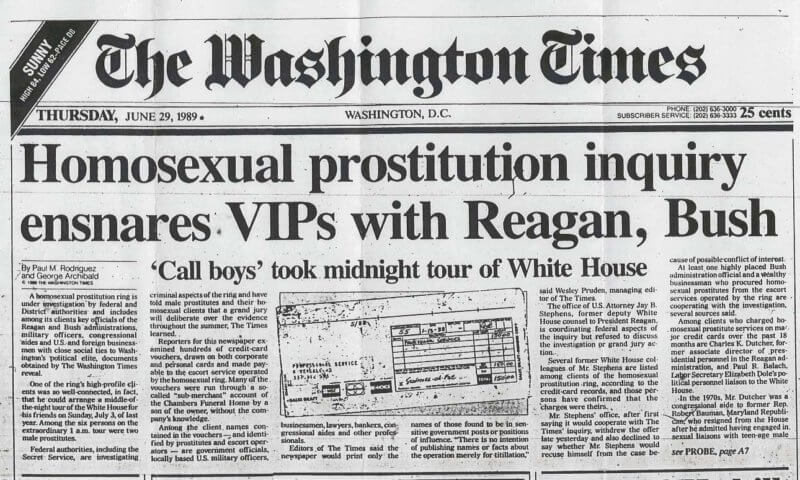
Spence later stated that his contacts within the White House, which allowed him and his “call boys” access, were “top level” officials and he specifically singled out George H.W. Bush’s then-National Security Advisor Donald Gregg. Gregg had worked at the CIA since 1951 before he resigned in 1982 to become National Security Advisor to Bush, who was then vice president. Prior to resigning from his post at the CIA, Gregg had worked directly under William Casey and, in the late 1970s, alongside a young William Barr in stonewalling the congressional Pike Committee and Church Committee, which investigated the CIA beginning in 1975. Among the things that they were tasked with investigating were the CIA’s “love traps,” or sexual blackmail operations used to lure foreign diplomats to bugged apartments, complete with recording equipment and two-way mirrors.
Barr would later become Bush’s Attorney General, rising to that post yet again under Trump. Furthermore, Barr’s father worked for the precursor to the CIA, the Office of Strategic Services (OSS) and recruited a young Jeffrey Epstein, then a high school drop-out, to teach at the elite Dalton School, from which Epstein was later fired. A year prior to hiring Epstein, Donald Barr published a science fiction fantasy novel about sex slavery. Notably, the same year Donald Barr hired Epstein, his son was working for the CIA. Bill Barr has refused calls to recuse himself from the Epstein case, even though he worked at the same law firm that has represented Epstein in the past.
Donald Gregg is also connected to Roy Cohn’s “influence machine” through his daughter’s marriage to Christopher Buckley, the son of conservative journalist William Buckley, close confidant and friend of both Roy Cohn and Cohn’s law partner Tom Bolan.
The Washington Times reports on Spence’s child sex ring also reveal his close ties to none other than the ubiquitous Roy Cohn. One of the Times’ sources for its first story on the scandal alleged that he had attended a birthday party for Roy Cohn that Spence had hosted at his home and that CIA Director William Casey was also in attendance. Spence was also said in the report to often brag about his social companions and regularly mentioned Cohn and claimed to have hosted Cohn at his house on occasions other than the aforementioned birthday party.
“Bodies by God”
The revelation of Craig Spence’s “call boy ring” soon led to the discovery of the infamous Franklin child sex abuse and ritual murder scandal. That sordid operation was run out of Omaha, Nebraska by Larry King, a prominent local Republican activist and lobbyist who ran the Franklin Community Federal Credit Union until it was shut down by federal authorities.
Buried in a May 1989 article in the Omaha World Herald’s probe into King’s Credit Union and sex ring, is a telling revelation: “In the 61/2 months since federal authorities closed Franklin, rumors have persisted that money from the credit union somehow found its way to the Nicaraguan contra rebels.”
The possibility that King’s fraudulent credit union was covertly funding the Contras was supported by subsequent reporting by the Houston Post’s Pete Brewton, who discovered that the CIA, in conjunction with organized crime, had secretly borrowed money from various savings and loans (S&L) institutions to fund covert operations. One of those S&Ls had Neil Bush, George H.W. Bush’s son, on its board and it had done business with King’s organization.
Another link between King and the Iran Contra team is the fact that King had co-founded and subsequently donated over $25,000 to an organization affiliated with the Reagan administration, Citizens for America, which sponsored speaking trips for Lt. Col. Oliver North and Contra leaders. The director of Citizens for America at the time was David Carmen, who simultaneously ran a public relations firm with the former head of covert operations at the Casey-led CIA, his father Gerald, who had also been appointed by Reagan to head the General Services Administration and to a subsequent ambassadorship.
One of the investigative journalists who researched the Craig Spence ring later told DeCamp that Spence’s ring was connected to King:
“The way we discovered Larry King and his Nebraska-based call boy ring, was by looking through the credit card chits of Spence’s ring, where we found King’s name.”
It was later revealed that King and Spence were essentially business partners as their child trafficking rings were operated under a larger group that was nicknamed “Bodies by God.”
Exactly how many groups operated under this umbrella group, “Bodies by God,” is unknown. Yet, what is known is that the rings run by both King and Spence were connected to each other and both were also connected to prominent officials in the Reagan and subsequent George H.W. Bush administrations, including officials with ties to the CIA and Roy Cohn and his network.
Indeed Spence, just months before his alleged suicide in the Boston Ritz Carlton, had hinted to Washington Times reporters Michael Hedges and Jerry Seper, who had originally broken the story, that they had merely scratched the surface of something much darker:
“All this stuff you’ve uncovered [involving call boys, bribery and the White House tours], to be honest with you, is insignificant compared to other things I’ve done. But I’m not going to tell you those things, and somehow the world will carry on.”
It also worth noting the role of the FBI in all of this, particularly in the Franklin child sex abuse scandal. Indeed, Larry King’s child sex abuse ring was quickly and aggressively covered up by the FBI, which used a variety of under-handed tactics to bury the reality of King’s sordid operation. Here, it is important to recall the key role former FBI Director J. Edgar Hoover played in similar sexual blackmail operations that abused children (See Part I) and the close relationship between Hoover, Roy Cohn and Lewis Rosenstiel, who later employed Hoover’s former right-hand man at the FBI, Louis Nichols.
Years later, documents released by the FBI would show that Epstein became an FBI informant in 2008, when Robert Mueller was the Bureau’s director, in exchange for immunity from then-pending federal charges, a deal that fell through with Epstein’s recent arrest on new federal charges. In addition, former FBI Director Louis Freeh would be hired by Alan Dershowitz, who is accused of raping girls at Epstein’s homes and was once a character witness for Roy Cohn, to intimidate Epstein’s victims. As previously mentioned, Freeh’s past appointment as a judge for the United States District Court for the Southern District of New York was orchestrated by Cohn’s law partner Tom Bolan.
Thus, the FBI’s cover-up of the Franklin case is just one example of the Bureau’s long-standing practice of protecting these pedophile rings when they involve members of the American political elite and provide the Bureau with a steady supply of blackmail. It also makes it worth questioning the impartiality of one of the main prosecutors in the Jeffrey Epstein case, Maurene Comey, who is the daughter of former FBI Director James Comey.
The rot at the top
While there were several sexual trafficking operations connected to both Roy Cohn and the halls of power under the Reagan administration, in a matter of months after Cohn’s death it appears that another individual became a central figure in the powerful network that Cohn had cultivated.
That individual, Jeffrey Epstein, would be recruited, after his firing from the Dalton School, by Alan “Ace” Greenberg, a close friend of Cohn, to work at Bear Stearns. After leaving Bear Stearns and working as an alleged financial “bounty hunter” for clients that are said to have included the Iran-Contra-linked arms dealer Adnan Khashoggi, Epstein would come into contact with Leslie Wexner, a billionaire close to the Meyer Lansky-linked Bronfman family, who himself was tied to members of organized crime syndicates once represented by Cohn.
The same year that Wexner would begin his decades-long association with Epstein, another Cohn friend with ties to the Reagan White House and the Trump family, Ronald Lauder, would provide Epstein with an Austrian passport containing Epstein’s picture but a false name.
Lauder, Wexner and the Bronfmans are members of an elite organization known as the Mega Group, which also includes other Meyer Lansky-connected “philanthropists” like hedge fund manager Michael Steinhardt. While Epstein shares considerable overlap with the network described in this report and Part I of this series, he is also deeply connected to the Mega Group as well as its associates, including Ghislaine Maxwell’s father, Robert Maxwell.
Part III of this series will focus on the Mega Group and its ties to the network that has been described in Parts I and II. In addition, the role of the state of Israel, the Mossad, and several global pro-Israel lobby organizations will also be discussed in relation to this network of sexual blackmail operations and Jeffrey Epstein.
It is here that the full breadth of the Epstein scandal comes into view. It is a criminal and unconscionable blackmail operation that has been run by influential figures, hidden in plain sight, for over half a century, exploiting and destroying the lives of untold numbers of children in the process. Over the years, it has grown many branches and spread well beyond the United States, as seen by the activity of Covenant House in Latin America and Epstein’s own international effort to recruit more girls to be abused and exploited.
All of this has taken place with the full knowledge and blessing of top figures in the world of “philanthropy” and in the U.S. government and intelligence communities, with great influence over several presidential administrations, particularly since the rise of Ronald Reagan and continuing through to Donald Trump.
Whitney Webb is a MintPress News journalist based in Chile. She has contributed to several independent media outlets including Global Research, EcoWatch, the Ron Paul Institute and 21st Century Wire, among others. She has made several radio and television appearances and is the 2019 winner of the Serena Shim Award for Uncompromised Integrity in Journalism.
Jeffrey Epstein found ‘injured & semiconscious’ with suspicious marks on neck in jail cell
RT | July 25, 2019
Millionaire sex offender Jeffrey Epstein has been found “injured and in a fetal position” in his New York jail cell with marks around his neck, leading to speculation that he’d been attacked or injured himself to get transferred.
While authorities have questioned another inmate over the situation – a former cop locked up for allegedly killing four men in a drug conspiracy – multiple sources have rushed to the media claiming Epstein tried to hang himself, while another source claims he staged the injury to get transferred to another facility. He is currently on suicide watch, according to two sources.
Former Westchester police officer Nicholas Tartaglione, who was charged with killing four men over a drug deal gone bad and burying them in his backyard, claims he never touched Epstein and didn’t see what happened, according to his lawyer. “They are in the same unit and doing well,” and have even found common ground in complaining about flooding, rodents, and bad food in the jail, he said.
Given the amount of blackmail information Epstein reportedly has on extremely powerful people, speculation that one of them might want to get him out of the picture has been simmering on social media since his arrest, only to erupt in the wake of this latest report. “Organized criminals have long arms,” one user tweeted. “If he dies, I’m going to have to ask, what wealthy individual(s) had him killed or did he really commit suicide?” another wondered. Others took issue with the theory, suggesting that if someone wanted Epstein dead, it would have happened already.
Following Epstein’s arrest on conspiracy and sex trafficking charges earlier this month, additional victims have reportedly come forward. The mysterious magnate all but skated on similar charges over a decade ago, pleading to a lesser charge of soliciting prostitution and serving just 13 months in a sweetheart deal that permitted him to leave prison during the day. Alexander Acosta, the prosecuting attorney on that case, resigned as Secretary of Labor two weeks ago over his handling of the deal, though he claimed in interviews with the Trump transition team he had been told to “back off” because Epstein “belonged to intelligence.”
Epstein faces 45 years in prison if convicted. He has pleaded not guilty to all charges. Epstein was denied bail last week after authorities learned he had a fake Saudi passport and wads of cash secreted in a safe inside his home. Judge Richard Berman also pointed to danger to the community and Epstein’s alleged history of intimidating witnesses in his decision to keep the financier in jail. Epstein’s lawyers have appealed, seeking to have him released on house arrest with electronic monitoring.
EU food authority found hiding health risks of world’s top sweetener
RT | July 24, 2019
The world’s favorite artificial sweetener may pose severe health risks, University of Sussex researchers have found. They claim that the European food authority has been bottling up the alarming data for a while.
The study focused on aspartame, an artificial sweetener used worldwide in everything from diet soft drinks to chewing gum, and sold under brand names including NutraSweet, Candarel and Equal.
UK researchers analyzed the most recent report regarding the safety of the sweetener by the European Food Safety Authority (EFSA). They discovered that the panel dismissed the results of numerous studies detailing the harmful effects of the sweetener, while focusing their final assessment almost entirely on positive studies. For instance, out of the 73 papers that deemed aspartame dangerous, all 73 were thrown out by EFSA, while 84 percent of studies providing no evidence of its harm were found to be true.
Since 1974, when aspartame was approved for consumption in the United States, studies claimed that the sweetener caused a number of health problems, including liver and lung cancer, brain damage, and seizures.
However, the majority of health authorities worldwide claim the sweetener is safe. Sussex scholars believe that many of the studies deemed to be dubious by the EFSA panel provide far better empirical evidence on the harmful effects of the sweetener than those they relied on, so they see the entire assessment as false.
“This research adds weight to the argument that authorization to sell or use aspartame should be suspended throughout the EU, pending a thorough re-examination,” the study states.
Israeli Spyware Can Steal Private Data From Apple, Google, Facebook – Reports
Sputnik – July 20, 2019
Israel-based NSO Group became the focus of public attention this spring, when the media reported that its software products are being used to hack WhatsApp messenger, as well as spy on the owners of Android and iOS smartphones.
Spyware from NSO Group can obtain user data from Apple, Google, Facebook, Amazon and Microsoft servers, according to an article in The Financial Times.
While NSO has consistently rejected any espionage or hacking allegations, the company has never denied the development of such technology, prompting many questions among experts.
According to the Financial Times, the infected smartphone provides NSO’s Pegasus software with authentication keys for Google Drive, Facebook Messenger and iCloud cloud services. With this technology, Pegasus manages to bypass two-step authentication and email notification.
Users are not notified of suspicious activity.
Some information security experts doubt the effectiveness of Pegasus, but representatives of Amazon and Facebook have already promised to investigate and strengthen the security measures of their cloud services, if necessary.
It was revealed in May that WhatsApp had been targeted by NSO, according to Forbes.
New US Pentagon Chief – Vested Interest in War & Conflict
Strategic Culture Foundation | July 19, 2019
Mark Esper is expected to be confirmed in coming days as the new US Secretary of Defense. His appointment is awaiting final Congressional approval after customary hearings this week before senators. The 55-year-old nominee put forward by President Trump was previously a decorated Lieutenant Colonel and has served in government office during the GW Bush administration.
But what stands out as his most conspicuous past occupation is working for seven years as a senior lobbyist for Raytheon, the US’ third biggest military manufacturing company. The firm specializes in missile-defense systems, including the Patriot, Iron Dome and the Aegis Ashore system (the latter in partnership with Lockheed Martin).
As Defense Secretary, Esper will be the most senior civilian executive member of the US government, next to the president, on overseeing military policy, including decisions about declaring war and deployment of American armed forces around the globe. His military counterpart at the Pentagon is Chairman of the Joint Chiefs of Staff, currently held by Marine General Joseph Dunford who is expected to be replaced soon by General Mark Milley (also in the process of senate hearings).
Esper’s confirmation hearings this week were pretty much a rubber-stamp procedure, receiving lame questioning from senators about his credentials and viewpoints. The only exception was Senator Elizabeth Warren, who slammed the potential “conflict of interest” due to his past lobbying service for Raytheon. She said it “smacks of corruption”. Other than her solitary objection, Esper was treated with kid gloves by other senators and his appointment is expected to be whistled through by next week. During hearings, the former lobbyist even pointedly refused to recuse himself of any matters involving Raytheon if he becomes the defense boss.
As Rolling Stone magazine quipped on Esper’s nomination, “it is as swampy as you’d expect”.
“President Trump’s Cabinet is already rife with corruption, stocked full of former lobbyists and other private industry power players who don’t seem to mind leveraging their government positions to enrich themselves personally. Esper should fit right in,” wrote Rolling Stone.
The linkage between officials in US government, the Pentagon and private manufacturers is a notorious example of “revolving door”. It is not unusual, or even remarkable, that individuals go from one sector to another and vice versa. That crony relationship is fundamental to the functioning of the “military-industrial complex” which dominates the entire American economy and the fiscal budget ($730 billion annually – half the total discretionary public spend by federal government).
Nevertheless, Esper is a particularly brazen embodiment of the revolving-door’s seamless connection.
Raytheon is a $25 billion company whose business is all about selling missile-defense systems. Its products have been deployed in dozens of countries, including in the Middle East, as well as Japan, Romania and, as of next year, Poland. It is in Raytheon’s vital vested interest to capitalize on alleged security threats from Iran, Russia, China and North Korea in order to sell “defense” systems to nations that then perceive a “threat” and need to be “protected”.
It is a certainty that Esper shares the same worldview, not just for engrained ideological reasons, but also because of his own personal motives for self-aggrandizement as a former employee of Raytheon and quite possibly as a future board member when he retires from the Pentagon. The issue is not just merely about corruption and ethics, huge that those concerns are. It is also about how US foreign policy and military decisions are formulated and executed, including decisions on matters of conflict and ultimately war. The insidiousness is almost farcical, if the implications weren’t so disturbing, worthy of satire from the genre of Dr Strangelove or Catch 22.
How is Esper’s advice to the president about tensions with Russia, Iran, China or North Korea, or any other alleged adversary, supposed to be independent, credible or objective? Esper is a de facto lobbyist for the military-industrial complex sitting in the Oval Office and Situation Room. Tensions, conflict and war are meat and potatoes to this person.
During senate hearings this week, Esper openly revealed his dubious quality of thinking and the kind of policies he will pursue as Pentagon chief. He told credulous senators that Russia was to blame for the collapse of the Intermediate-Range Nuclear Forces (INF) Treaty. That equates to more Raytheon profits from selling defense systems in Europe. Also, in a clumsy inadvertent admission he advised that the US needs to get out of the INF in order to develop medium-range missiles to “counter China”. The latter admission explains the cynical purpose for why the Trump administration unilaterally ditched the INF earlier this year. It is not about alleged Russian breaches of the treaty; the real reason is for the US to obtain a freer hand to confront China.
It is ludicrous how blatant a so-called democratic nation (the self-declared “leader of the free world”) is in actuality an oligarchic corporate state whose international relations are conducted on the basis of making obscene profits from conflict and war.
Little wonder then than bilateral relations between the US and Russia are in such dire condition. Trump’s soon-to-be top military advisor Mark Esper is not going to make bilateral relations any better, that’s for sure.
Also at a precarious time of possible war with Iran, the last person Trump should consult is someone whose corporate cronies are craving for more weapons sales.
Hidden in Plain Sight: The Shocking Origins of the Jeffrey Epstein Case

A composite image shows from left to right, Lewis Rosenstiel, Jeffrey Epstein, and Roy Cohn. Graphic | Emma Fiala
By Whitney Webb | MintPress News | July 18, 2019
Despite his “sweetheart” deal and having seemingly evaded justice, billionaire sex offender Jeffrey Epstein was arrested earlier this month on federal charges for sex trafficking minors. Epstein’s arrest has again brought increased media attention to many of his famous friends, the current president among them.
Many questions have since been asked about how much Epstein’s famous friends knew of his activities and exactly what Epstein was up to. The latter arguably received the most attention after it was reported that Alex Acosta — who arranged Epstein’s “sweetheart” deal in 2008 and who recently resigned as Donald Trump’s Labor Secretary following Epstein’s arrest — claimed that the mysterious billionaire had worked for “intelligence.”
Other investigations have made it increasingly clear that Epstein was running a blackmail operation, as he had bugged the venues — whether at his New York mansion or Caribbean island getaway — with microphones and cameras to record the salacious interactions that transpired between his guests and the underage girls that Epstein exploited. Epstein appeared to have stored much of that blackmail in a safe on his private island.
Claims of Epstein’s links and his involvement in a sophisticated, well-funded sexual blackmail operation have, surprisingly, spurred few media outlets to examine the history of intelligence agencies both in the U.S. and abroad conducting similar sexual blackmail operations, many of which also involved underage prostitutes.
In the U.S. alone, the CIA operated numerous sexual blackmail operations throughout the country, employing prostitutes to target foreign diplomats in what the Washington Post once nicknamed the CIA’s “love traps.” If one goes even farther back into the U.S. historical record it becomes apparent that these tactics and their use against powerful political and influential figures significantly predate the CIA and even its precursor, the Office of Strategic Services (OSS). In fact, they were pioneered years earlier by none other than the American mafia.
In the course of this investigation, MintPress discovered that a handful of figures who were influential in American organized crime during and after Prohibition were directly engaged in sexual blackmail operations that they used for their own, often dark, purposes.
In Part I of this exclusive investigation, MintPress will examine how a mob-linked businessman with deep ties to notorious gangster Meyer Lansky developed close ties with the Federal Bureau of Investigation (FBI) while also running a sexual blackmail operation for decades, which later became a covert part of the anti-communist crusade of the 1950s led by Senator Joseph McCarthy (R-WI), himself known throughout Washington for having a habit of drunkenly groping underage teenaged girls.
Yet, it would be one of McCarthy’s closest aides who would take over the ring in later years, trafficking minors and expanding this sexual blackmail operation at the same time he expanded his own political influence, putting him in close contact with prominent figures including former President Ronald Reagan and a man who would later become president, Donald Trump.
As will be revealed in Part II, after his death, this blackmail operation continued under various successors in different cities and there is strong evidence that Jeffrey Epstein became one of them.
Samuel Bronfman and the Mob
The Prohibition Era in the United States is often used as an example of how banning recreational substances not only increases their popularity but also causes a boom in criminal activity. Indeed, it was Prohibition that greatly increased the strength of the American mafia, as the top crime lords of the day grew rich through the clandestine trade and sale of alcohol in addition to gambling and other activities.
It is through the bootlegging trade of the 1920s and the early 1930s that this story begins, as it brought together key figures whose successors and affiliates would eventually create a series of blackmail and sex trafficking rings that would give rise to the likes of Jeffrey Epstein, the “Lolita Express” and “Orgy Island.”
Samuel Bronfman never planned to become a major producer of liquor but true to his family’s last name, which means “brandy man” in Yiddish, he eventually began distributing alcohol as an extension of his family’s hotel business. During Canada’s Prohibition period, which was briefer than and preceded that of its southern neighbor, the Bronfman family business used loopholes to skirt the law and find technically legal ways to sell alcohol in the hotels and stores the family owned. The family relied on its connections with members of the American mafia to illegally smuggle alcohol from the United States.
Soon after Prohibition ended in Canada, it began in the United States and, by the time the flow of illegal alcohol had turned the other way, the Bronfmans – whose business ventures were then being led by Sam Bronfman and his brothers — were relatively late to an already flourishing bootlegging trade.
“We were late starters in the two most lucrative markets – on the high seas and across the Detroit River. What came out of the border trade in Saskatchewan was insignificant by comparison,” Bronfman once told Canadian journalist Terence Robertson, who was then writing a biography of Bronfman. Nonetheless, “this was when we started to make our real money,” Bronfman recounted. Robertson’s biography on Bronfman was never published, as he died under mysterious circumstances soon after warning his colleagues that he had uncovered unsavory information about the Bronfman family.
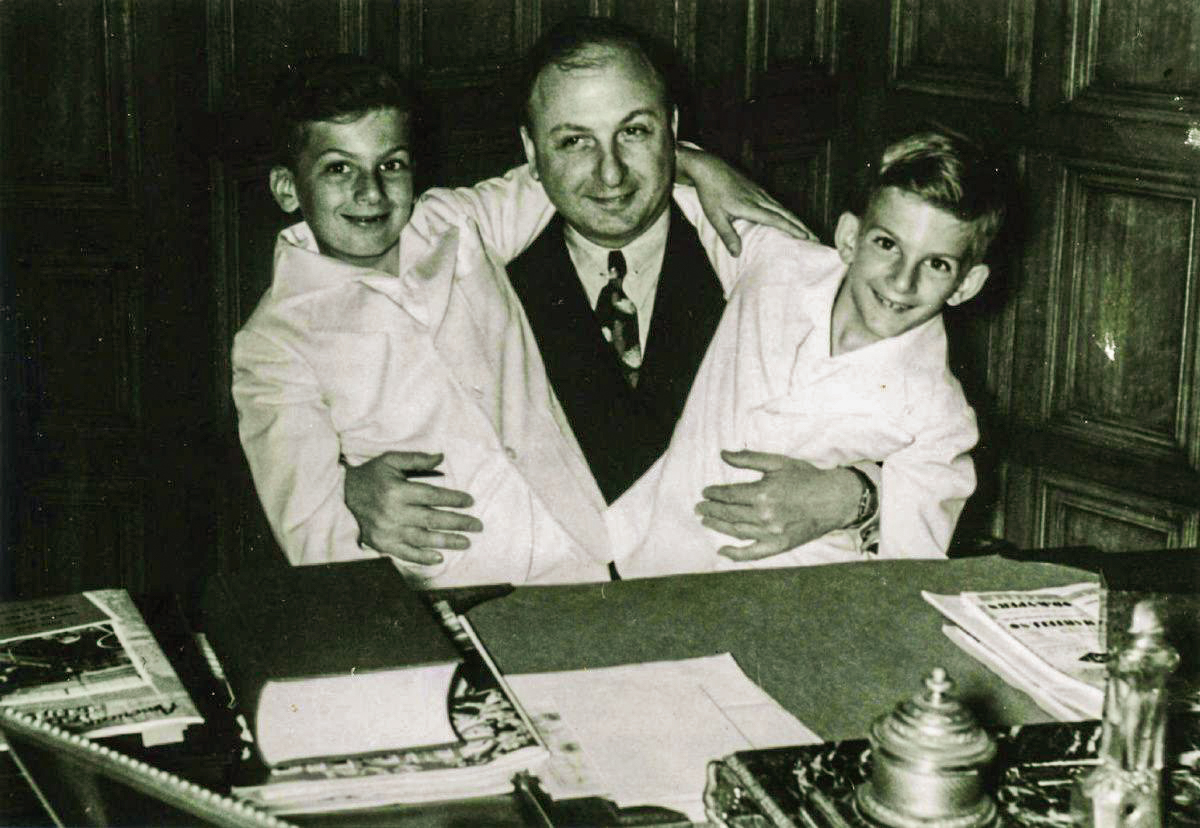
Samuel Bronfman pictured in 1937 with his sons Edgar and Charles
Key to Bronfman’s success during American Prohibition were the ties his family had cultivated with organized crime during Canada’s Prohibition, ties that led many prominent members of the mob in the United States to favor Bronfman as a business partner. Bronfman liquor was purchased in massive quantities by many crime lords who still live on in American legend, including Charles “Lucky” Luciano, Moe Dalitz, Abner “Longy” Zwillman and Meyer Lansky.
Most of Bronfman’s mob associates during Prohibition were members of what became known as the National Crime Syndicate, which a 1950s Senate investigative body known as the Kefauver Committee described as a confederation dominated by Italian-American and Jewish-American mobs. During that investigation, some of the biggest names in the American mafia named Bronfman as a central figure in their bootlegging operations. The widow of notorious American mob boss Meyer Lansky even recounted how Bronfman had thrown lavish dinner parties for her husband.
Years later, Samuel Bronfman’s children and grandchildren, their family’s ties to the criminal underworld intact, would later go on to associate closely with Leslie Wexner, allegedly the source of much of Epstein’s mysterious wealth, and other mob-linked “philanthropists,” and some would even manage their own sexual blackmail operations, including the recently busted blackmail-based “sex cult” NXIVM. The later generations of the Bronfman family, particularly Samuel Bronfman’s sons Edgar and Charles, will be discussed in greater detail in Part II of this report.
Lewis Rosenstiel’s dark secret
Crucial to Bronfman’s Prohibition-era bootlegging operations were two middlemen, one of whom was Lewis “Lew” Rosenstiel. Rosenstiel got his start working at his uncle’s distillery in Kentucky before Prohibition. Once the law banning alcohol was in force, Rosenstiel created the Schenley Products Company, which would later become one of the largest liquor companies in North America.
Though he was a high school drop-out and not particularly well-connected socially at the time, Rosenstiel happened to have a “chance” meeting with Winston Churchill in 1922 while on vacation in the French Riviera. According to the New York Times, Churchill “advised him [Rosenstiel] to prepare for the return of liquor sales in the United States.” Rosenstiel somehow managed to secure the funding of the elite and respected Wall Street firm Lehman Brothers to finance his purchase of shuttered distilleries.
Officially, Rosenstiel is said to have built his company and wealth after Prohibition, by following Churchill’s advice to prepare for Repeal. However, he was clearly involved in bootlegging operations and was even indicted for bootlegging in 1929, though he evaded conviction. Like Bronfman, Rosenstiel was close to organized crime, particularly members of the mostly Jewish-American and Italian-American mob alliance known as the National Crime Syndicate.
Subsequent New York state congressional investigations would allege that Rosenstiel “was part of a ‘consortium’ with underworld figures that bought liquor in Canada [from Samuel Bronfman]”, whose other members were “Meyer Lansky, the reputed organized crime leader; Joseph Fusco, an associate of late Chicago gangster Al Capone and Joseph Linsey, a Boston man Mr. Kelly [the congressional investigator testifying] identified as a convicted bootlegger.” Rosenstiel’s relationship with these men, particularly Lansky, would continue long after Prohibition and Samuel Bronfman, for his part, would also maintain his mob ties.
In addition to his friends in the mob, Rosenstiel also cultivated close ties with the FBI, developing a close relationship with longtime FBI Director J. Edgar Hoover and making Hoover’s right-hand man and longtime assistant at the FBI, Louis Nichols, the Vice President of his Schenley empire in 1957.
Despite their similar backgrounds as bootlegger barons turned “respectable” businessmen, Bronfman’s and Rosenstiel’s personalities were drastically different and their relationship was complicated, at best. One example of the dissimilarities between North America’s top liquor barons was how they treated their staff. Bronfman was not necessarily known for being a cruel boss, whereas Rosenstiel was known for his erratic and “monstrous” behavior towards employees as well as his unusual practice of bugging his offices in order to hear what employees said about him when he wasn’t present.
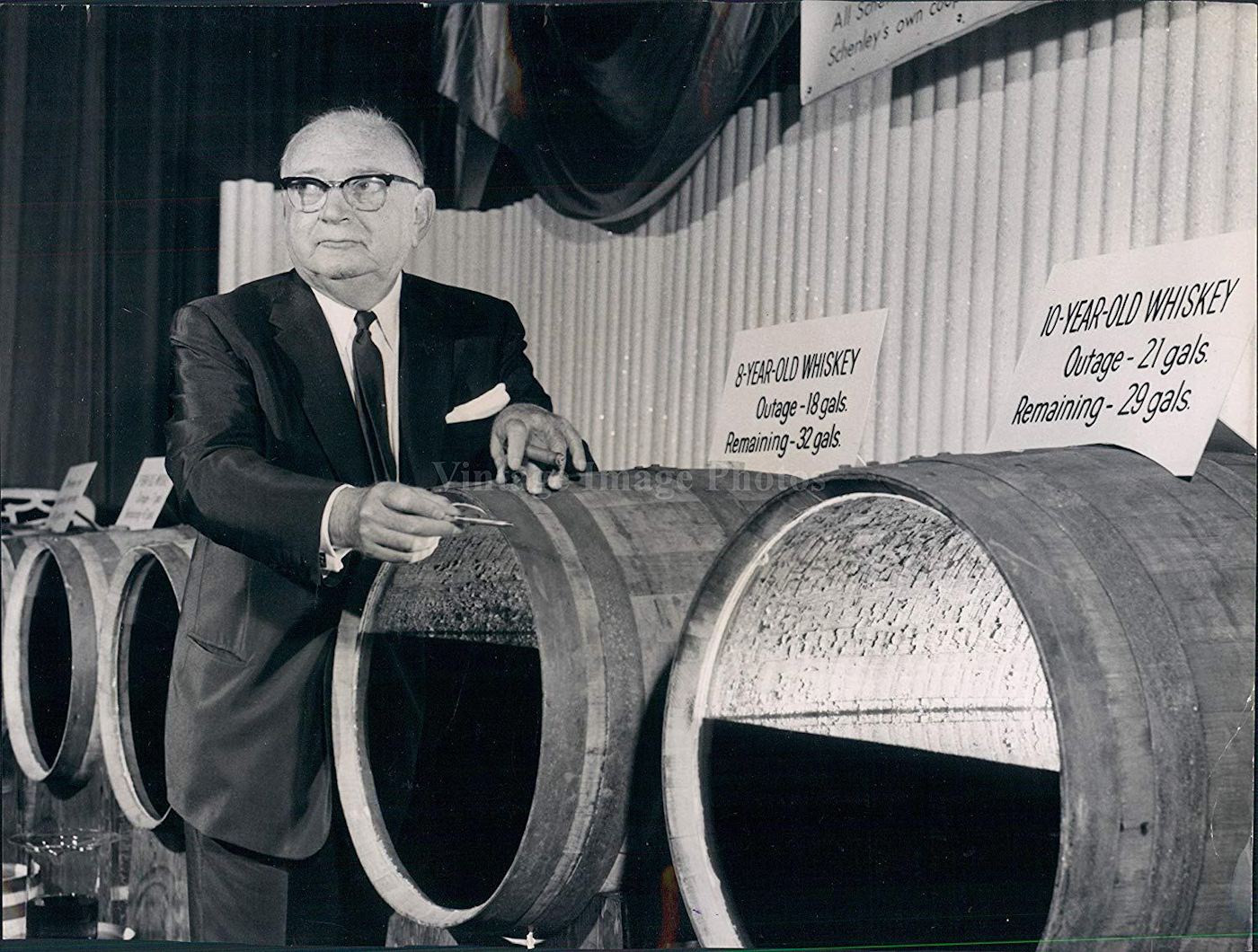
Rosenstiel was connected to both the FBI and to organized crime
Such differences between Bronfman and Rosenstiel were also reflected in their personal lives. While Bronfman married only once and was loyal to his wife, Rosenstiel was married five times and was known for his relatively closeted bisexual antics, a part of his life that was well-known to many of his close associates and employees.
Though for years there were only hints to this other side of the controversial businessman, details emerged years later during a divorce proceeding brought by Rosenstiel’s fourth wife, Susan Kaufman, that would back the claims. Kaufman alleged that Rosenstiel hosted extravagant parties that included “boy prostitutes” that her husband had hired “for the enjoyment” of certain guests, which included important government officials and prominent figures in America’s criminal underworld. Kaufman would later make the same claims under oath during the hearing of the New York’s State Joint Legislative Committee on Crime in the early 1970s.
Not only did Rosenstiel organize these parties, but he also made sure that their venues were bugged with microphones that recorded the antics of his high-profile guests. Those audio recordings, Kaufman alleged, were then kept for the purpose of blackmail. Though Kaufman’s claims are shocking, her testimony was deemed credible and held in high regard by the former chief counsel of the Crime Committee, New York Judge Edward McLaughlin, and committee investigator William Gallinaro and aspects of her testimony were later corroborated by two separate witnesses who were unknown to Kaufman.
These blackmail “parties” offer a window into an operation that would later become more sophisticated and grow dramatically in the 1950s under Rosenstiel’s “field commander” (a nickname given by Rosenstiel to an individual to be named shortly in this report). Many of the people connected to Rosenstiel’s “field commander” during the 70s and 80s have again found their names in the press following the recent arrest of Jeffrey Epstein.
The “Untouchable” Mobster
Bronfman and Rosenstiel became legendary in the North American liquor business, in part due to their fight for supremacy in the industry, which the New York Times described as often erupting “into bitter personal and corporate battles.” Despite their dueling in the corporate world, the one thing that united the two businessmen more than anything else was their close connection to American organized crime, particularly renowned mobster, Meyer Lansky.
Lansky is one of the most notorious gangsters in the history of American organized crime and is notable for being the only famous mobster that rose to notoriety in the 1920s that managed to die an old man and never serve a day in jail.
Lansky’s long life and ability to avoid prison time was largely the result of his close relationships to powerful businessmen like Bronfman and Rosenstiel (among many others), the Federal Bureau of Investigation (FBI) and the U.S. intelligence community as well as his role in establishing several blackmail and extortion rings which helped him keep the law at arm’s length. Indeed, when Lansky was finally charged with a crime in the 1970s, it was the Internal Revenue Service that brought the charges, not the FBI, and he was charged with and acquitted of tax evasion.
Lansky was remarkably close to both Bronfman and Rosenstiel. Bronfman regularly threw “lavish dinner parties” in Lansky’s honor both during and after Prohibition. These parties were remembered fondly by Lansky’s wife, and Lansky, in turn, did favors for Bronfman ranging from exclusive protection of his shipments during Prohibition to getting him tickets to coveted “fight of the century” boxing matches.
Rosenstiel also threw regular dinner parties honoring Lansky. Susan Kaufman, Rosenstiel’s ex-wife, claimed to have taken numerous pictures of her ex-husband and Lansky socializing and partying together, photos that were also seen by Mary Nichols of The Philadelphia Inquirer. In addition, Lansky, per Kaufman’s recollection, was one of the individuals that Rosenstiel sought to protect from legal scrutiny as part of his child prostitution and blackmail ring targeting high-ranking officials, and he was overheard saying that if the government “ever brings pressure against Lansky or any of us, we’ll use this [a specific recording taken at one of the “parties”] as blackmail.”
Lansky was known to address Rosenstiel as “Supreme Commander,” a title that would later be used to refer to Rosenstiel by another individual deeply connected to the mob and sexual blackmail operations, previously referred to in this report as Rosenstiel’s “Field Commander.”
Lansky also had close ties to the CIA and U.S. military intelligence. During World War II, Lansky –along with his associate Benjamin “Bugsy” Siegel — worked with Naval intelligence in what was codenamed “Operation Underworld,” an operation that the government denied for over 40 years.
Journalist and noted chronicler of CIA covert activities, Douglas Valentine, noted in his book The CIA as Organized Crime: How Illegal Operations Corrupt America and the World that the government’s cooperation with the mafia during World War II led to its expansion after the war and set the stage for its future collaboration with U.S. intelligence.
According to Valentine:
Top government officials were also aware that the government’s Faustian pact with the Mafia during World War II had allowed the hoods to insinuate themselves into mainstream America. In return for services rendered during the war, Mafia bosses were protected from prosecution for dozens of unsolved murders. […]
The Mafia was a huge problem in 1951 [when the Kefauver Committee was convened], equivalent to terrorism today. But it was also a protected branch of the CIA, which was co-opting criminal organizations around the world and using them in its secret war against the Soviets and Red Chinese. The Mafia had collaborated with Uncle Sam and had emerged from World War II energized and empowered. They controlled cities across the country.”
Indeed, the CIA forged ties with Lansky not long after its creation at the behest of CIA counterintelligence chief James J. Angleton. The CIA would later turn to the Lansky-linked mob in the early 1960s as part of its consistently fruitless quest to assassinate the Cuban leader, showing that the CIA maintained its contacts with Lansky-controlled elements of the mafia long after the initial meeting with Lansky took place.
The CIA also had close connections to associates of Lansky, such as Edward Moss, who did public relations work for Lansky and was said to be of “interest” to the CIA by the agency’s then-inspector general J.S. Earman. Harry “Happy” Meltzer was also another Lansky associate that was a CIA asset and the CIA asked Meltzer to join an assassination team in December 1960.
In addition to the CIA, Lansky was also connected to a foreign intelligence agency through Tibor Rosenbaum, an arms procurer and high-ranking official in Israel’s Mossad, whose bank – the International Credit Bank of Geneva – laundered much of Lansky’s ill-gotten gains and recycled it into legitimate American businesses.
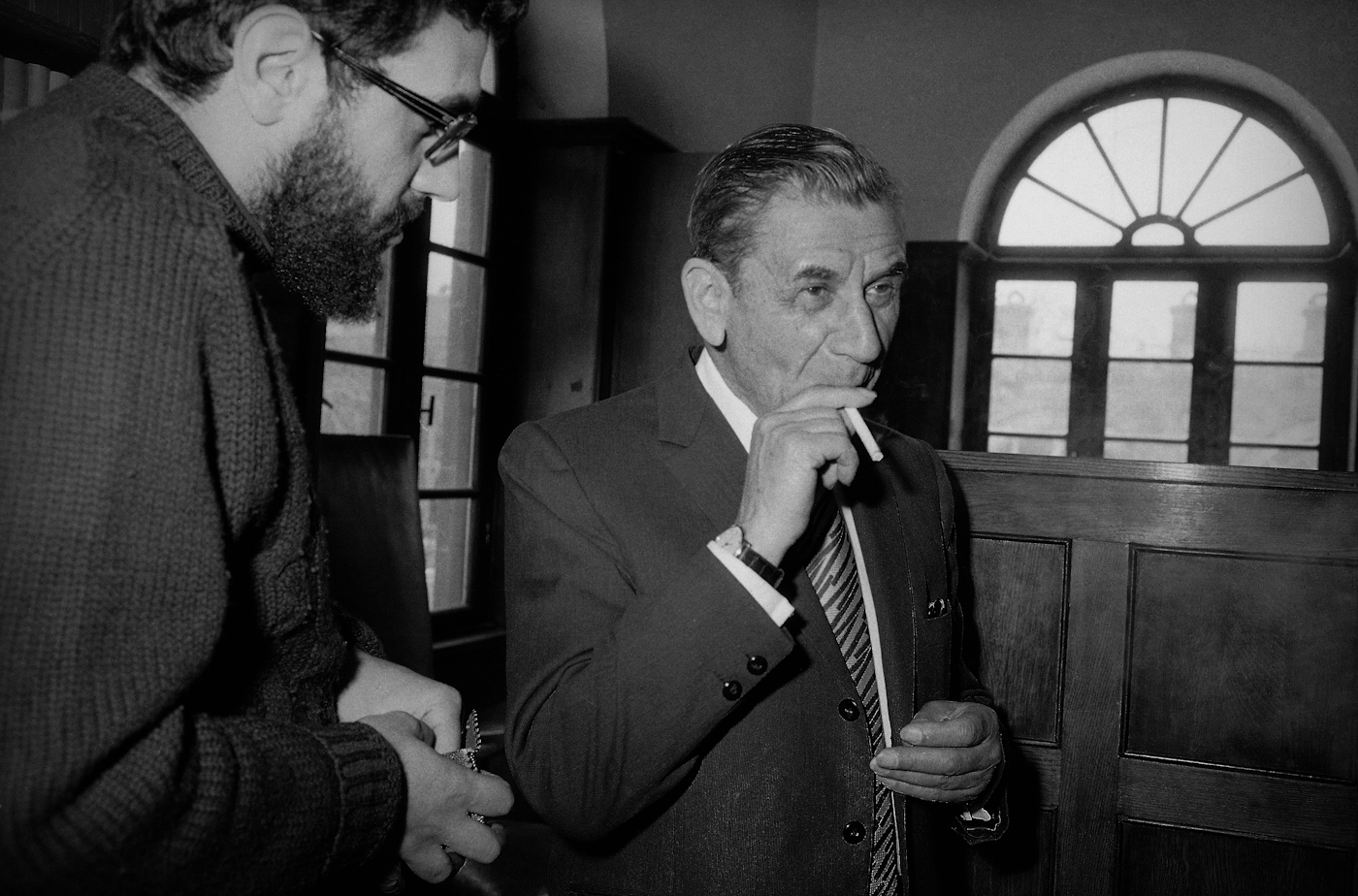
Lansky outside the High Court of Israel where he sought permission to emigrate in 1972. Photo | AP
Journalist Ed Reid, author of the Virginia Hill biography The Mistress and the Mafia, wrote that Lansky was attempting to entrap powerful people through sexual blackmail as far back as 1939. Reid contends that Lansky sent Ms. Hill to Mexico, where his West Coast connections had established a drug ring that later involved the OSS, the forerunner to the CIA, to seduce numerous “top politicians, army officers, diplomats and police officials.”
Eventually, Lansky was credited with obtaining compromising photos of FBI director J. Edgar Hoover sometime in the 1940s, which showed “Hoover in some kind of gay situation”, according to a former Lansky associate who also said that Lansky had often claimed, “I fixed that sonofabitch.” The photos showed Hoover engaged in sexual activity with his long-time friend, FBI deputy director Clyde Tolson.
At some point, these photos fell into the hands of CIA counterintelligence chief James J. Angleton, who later showed the photos to several other CIA officials, including John Weitz and Gordon Novel. Angleton was in charge of the CIA’s relationship with the FBI and Israel’s Mossad until he left the agency in 1972 and, as was recently mentioned, he was also in contact with Lansky.
Anthony Summers , former BBC journalist and author of Official and Confidential: The Secret Life of J. Edgar Hoover, has argued that it was not Lansky, but William Donovan, the director of the OSS, who obtained the original photos of Hoover and later shared them with Lansky.
Summers also stated that “To [gangster Frank] Costello and Lansky, the ability to corrupt politicians, policemen and judges was fundamental to Mafia operations. The way they found to deal with Hoover, according to several mob sources, involved his homosexuality.” This anecdote shows that Lanksy and the CIA maintained a covert relationship, which included, among other things, the sharing of blackmail material (i.e. “intelligence”).
It is also possible that Hoover was ensnared by the mob during one of Rosenstiel’s blackmail “parties,” at which Hoover sometimes found himself in attendance with prominent figures of the mafia. Hoover was said to have worn women’s clothing at the some of the events and Meyer Lansky’s wife later said that her husband had photos of the former FBI director in drag. Furthermore, Hoover is on record showing an unusual concern in the FBI’s handling of Rosenstiel’s criminal links as early as 1939, the same year that his close associate Lansky was actively orchestrating the sexual blackmail of powerful political figures.
The blackmail acquired on Hoover and the mob’s possession of the evidence has been cited as a major factor in Hoover’s decades-long denial that nationwide networks of organized crime were a serious issue. Hoover asserted that it was a decentralized, local issue and therefore outside of the bureau’s jurisdiction. By the time Hoover finally acknowledged the existence of national organized crime networks in 1963, it was so entrenched in the U.S. establishment that it was untouchable.
Congressional crime consultant Ralph Salerno told Summers in 1993 that Hoover’s willful ignorance of organized crime for most of his career as FBI director “allowed organized crime to grow very strong in economic and political terms, so that it became a much bigger threat to the wellbeing of this country than it would have been if it had been addressed much sooner.”
J. Edgar Hoover: Blackmail Victim?
Most records place the beginning of Hoover’s relationship with Rosenstiel in the 1950s, the same decade when Susan Kaufman reported that Hoover was attending Rosenstiel’s blackmail parties. Rosenstiel’s FBI file, obtained by Anthony Summers, cites the first Rosenstiel meeting as taking place in 1956, though Summers notes that there is evidence that they had met much earlier. After requesting the meeting, Rosenstiel was granted a personal face to face with the director in a matter of hours. The FBI file on Rosenstiel also reveals that the liquor baron heavily lobbied Hoover to aid his business interests.
During that time, the salacious details of Hoover’s sex life were already known to the U.S. intelligence community and to the mob, and Hoover was aware that they knew of his closeted sexuality and penchant for women’s clothing. Yet, Hoover apparently seemed to embrace the very type of sexual blackmail operation that had compromised his private life, given that he was seen at many of Rosenstiel’s “blackmail” parties in the 1950s and 1960s, including at venues such as Rosenstiel’s personal home and later at Manhattan’s Plaza Hotel. Hoover’s penchant for dressing in drag was also described by two witnesses who were not connected to Susan Kaufman.
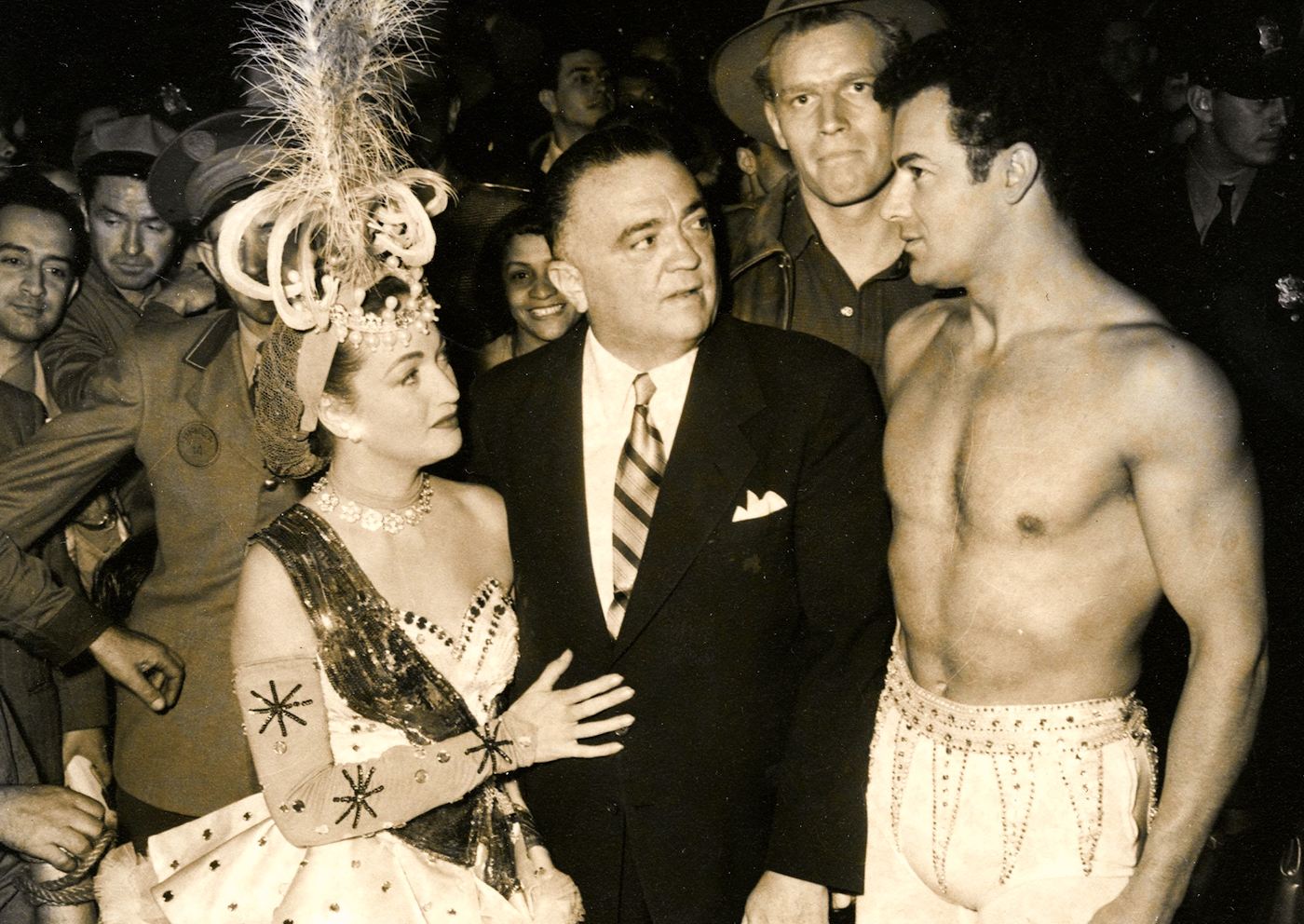
Hoover with Dorothy Lamour on the set of The Greatest Show on Earth in 1951
Soon after their first “official” meeting, the public relationship between the two men quickly flourished, with Hoover even sending Rosenstiel flowers when he fell ill. Summers reported that, in 1957, Rosenstiel was heard telling Hoover during a meeting, “your wish is my command.” Their relationship remained close and intimate throughout the 1960s and beyond.
Like Rosenstiel, Hoover was well-known for amassing blackmail on friend and foe alike. Hoover’s office contained “secret files” on numerous powerful people in Washington and beyond, files he used to gain favors and protect his status as FBI director for as long as he wished.
Hoover’s own propensity for blackmail suggests that he may have associated with Rosenstiel’s sexual blackmail operation more directly, given he already knew he was compromised and his involvement in the operation would have served as a means of procuring the blackmail he coveted for his own purposes. Indeed, if Hoover was merely being blackmailed and extorted by the Lansky-Rosenstiel connected mob, it is unlikely that he would have been so friendly to Rosenstiel, Lansky and the other mobsters at these gatherings and participated in them with such regularity.
According to journalist and author Burton Hersh, Hoover was also tied to Sherman Kaminsky, who ran a sexual blackmail operation in New York involving young male prostitutes. That operation was busted and investigated in 1966 extortion probe led by Manhattan District Attorney Frank Hogan, though the FBI quickly took over the investigation and photos of Hoover and Kaminsky together soon disappeared from the case file.
Hoover and Rosenstiel’s deep ties would continue to develop over the years, an example of which can be seen in Rosenstiel’s hiring of long-time Hoover aide Louis Nichols as the Vice President of his Schenley liquor empire and Rosenstiel’s donation of over $1 million to the J. Edgar Hoover Foundation, which Nichols also ran at the time.
There is also more than one documented occasion wherein Hoover attempted to use blackmail to protect Rosenstiel and his “field commander,” none other than the infamous Roy Cohn, the other key figure in Rosenstiel’s sexual blackmail operation involving minors.
The Making of a Monster
Decades after his death, Roy Cohn remains a controversial figure in large part because of his close, personal relationship with current U.S. President Donald Trump. Yet reports on Cohn, both in recent and in past years, often miss the mark in their characterization of the man who became closely associated with the Reagan White House, the CIA, the FBI, organized crime and, incidentally, many of the figures who would later surround Jeffrey Epstein.
To understand the true nature of the man, it is essential to examine his rise to power in the early 1950s, when at just 23 years old, he became a key figure in the high-profile trial of Soviet spies Ethel and Julius Rosenberg and later in the House Un-American Activities Committee (HUAC) led by Senator Joseph McCarthy.
Cohn’s dedication to anti-communist activities in the 1950s is allegedly what first endeared him to J. Edgar Hoover who he first met in 1952. During that meeting, as described by Hersh in Bobby and J. Edgar: The Historic Face-Off Between the Kennedys and J. Edgar Hoover That Transformed America, Hoover expressed admiration for Cohn’s aggressive and manipulative tactics and told Cohn to “call me directly” whenever he had information worth sharing. From that point on, Cohn and Hoover “traded favors, effusive compliments, gifts and elaborate private dinners. It quickly became ‘Roy’ and ‘Edgar.’” Hersh also describes Hoover as Cohn’s soon to be “consigliere.”
The date and circumstances around Cohn’s introduction to Rosenstiel is harder to come by. It is possible that the connection was made through Roy Cohn’s father, Albert Cohn, a prominent judge and an influential figure in the New York City Democratic Party apparatus then-run by Edward Flynn. It was later revealed that the Democratic organization dominated by Flynn and based in the Bronx had long-standing connections to organized crime, including associates of Meyer Lansky.
Regardless of how or when it began, the relationship between Cohn and Rosenstiel was close and was often likened to that of a father and son. They were said to frequently salute each other in public and remained close until Rosenstiel was near death, at which point Cohn attempted to trick his then-barely conscious and senile “friend” and client into naming him the executor and trustee of the liquor magnate’s estate, valued at $75 million (more than $334 million in today’s dollars).
LIFE magazine reported in 1969 that Cohn and Rosenstiel had for years referred to one another as “Field Commander” and “Supreme Commander,” respectively. Media references to these nicknames appear in other articles from the period.
Though LIFE and other outlets had interpreted this as merely an anecdote about the nicknames shared in jest between close friends, the fact that notorious crime lord Meyer Lansky also called Rosenstiel “Supreme Commander” and the fact that Cohn and Rosenstiel would later become intimately involved in the same pedophile sex ring, suggests that there may have been more to these “nicknames.” After all, the mob to which Rosenstiel was connected often used military-themed titles like “soldier” and “lieutenant” to differentiate the rank and importance of its members.
Once he had made his connection with Hoover, Cohn’s star began to rise even higher in Washington. Hoover’s recommendation of Cohn would become the deciding factor in his appointment as Sen. McCarthy’s general counsel over Robert Kennedy, a rival and bitter enemy of Cohn’s.
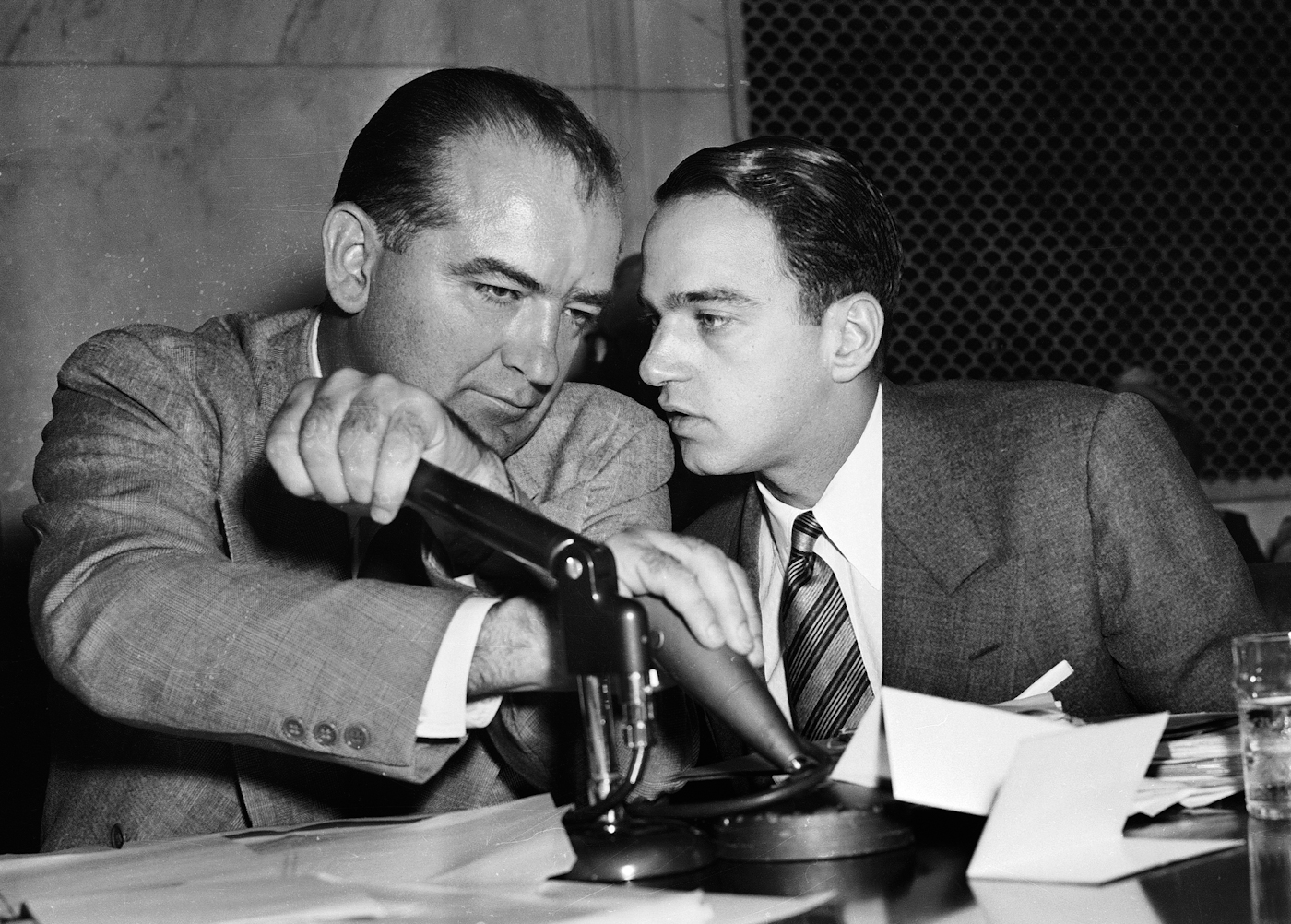
McCarthy covers the mic while having a whispered discussion with Cohn during a 1954 committee hearing. Photo | AP
Though Cohn was ruthless and seemingly untouchable as McCarthy’s counsel and helped the Senator destroy many careers during both the red and lavender scares, his antics in relation to his work on the committee would eventually lead to his downfall after he attempted to blackmail the Army in return for preferential treatment for committee consultant and Cohn’s rumored lover, David Schine.
After he was forced to leave McCarthy’s side due to the scandal, Cohn returned to New York to live with his mother and practice law. A few years later New York Judge David Peck, a long-time associate of former CIA director Alan Dulles, orchestrated Cohn’s hire to the New York law firm, Saxe, Bacon and O’Shea, which would later become Saxe, Bacon and Bolan after Tom Bolan, a friend of Cohn’s, became a partner in the firm. Upon his hire, Cohn brought the firm a slew of mafia-linked clients, including high-ranking members of the Gambino crime family, the Genovese crime family and, of course, Lewis Rosenstiel.
What happened in Suite 233?
The connections Roy Cohn built during the 1950s made him a well-known public figure and translated into great political influence which peaked during the presidency of Ronald Reagan. Yet, as Cohn built his public image, he was also developing a dark private life which would come to be dominated by the same blackmail pedophile racket that appears to have first begun with Lewis Rosenstiel.
One of the “blackmail” parties Susan Kaufman attended with her then-husband Lewis Rosenstiel was hosted by Cohn in 1958 at Manhattan’s Plaza Hotel, suite 233. Kaufman described Cohn’s suite as a “beautiful suite… all done in light blue.” She described being introduced to Hoover, who was in drag, by Cohn, who told her that Hoover’s name was “Mary” in a fit of barely concealed laughter. Kaufman testified that young underage boys were present and Kaufman claimed that Cohn, Hoover and her ex-husband engaged in sexual activity with these minors.
New York attorney John Klotz, tasked with investigating Cohn for a case well after Kaufman’s testimony, also found evidence of the “blue suite” at the Plaza Hotel and its role in a sex extortion ring after combing through local government documents and information gathered by private detectives. Klotz later told journalist and author Burton Hersh what he had learned:
Roy Cohn was providing protection. There were a bunch of pedophiles involved. That’s where Cohn got his power from — blackmail.”
Perhaps the most damning confirmation of Cohn’s activities in Suite 233 comes from statements made by Cohn himself to former NYPD detective and ex-head of the department’s Human-Trafficking and Vice-related Crimes division, James Rothstein. Rothstein later told John Decamp, a former Nebraska state senator who investigated a government-connected child sex ring based in Omaha, among other investigators, that Cohn had admitted to being part of a sexual blackmail operation targeting politicians with child prostitutes during a sit-down interview with the former detective.
Rothstein told John DeCamp the following about Roy Cohn:
Cohn’s job was to run the little boys. Say you had an admiral, a general, a congressman, who did not want to go along with the program. Cohn’s job was to set them up, then they would go along. Cohn told me that himself.”
Rothstein later told Paul David Collins, a former journalist turned researcher, that Cohn had also identified this sexual blackmail operation as being part of the anti-communist crusade of the time.
The fact that Cohn, per Rothstein’s recollection, stated that the child-sex blackmail ring was part of the government-sponsored anticommunist crusade suggests that elements of the government, including Hoover’s FBI, may have been connected at a much broader level than Hoover’s own personal involvement given that the FBI closely coordinated with McCarthy and Cohn for much of the red scare.
It is also worth noting that among Hoover’s many “secret” blackmail files was a sizeable dossier on Senator McCarthy, the contents of which strongly suggested that the Senator himself was interested in underage girls. According to journalist and author David Talbot, Hoover’s file on McCarthy was “filled with disturbing stories about McCarthy’s habit of drunkenly groping young girls’ breasts and buttocks. The stories were so widespread that they became ‘common knowledge’ in the capital, according to one FBI chronicler.”
Talbot, in his book The Devil’s Chessboard, also cites Walter Trohan, Washington Bureau Chief of the Chicago Tribune, as having personally witnessed McCarthy’s habit of molesting young women. “He just couldn’t keep his hands off young girls,” Trohan would later say. “Why the Communist opposition didn’t plant a minor on him and raise the cry of statutory rape, I don’t know.” Perhaps the answer lies in the fact that those “planting” minors on their political foes were McCarthy’s allies and close associates, not his enemies.
The question that necessarily arises from revelations regarding Cohn’s activities in Suite 233 is who else was Cohn “protecting” and servicing with underage prostitutes? One of them could very well have been one of Cohn’s close friends and clients, Cardinal Francis Spellman of the Archdiocese of New York, who was said to have been present at some of these parties Cohn hosted at the Plaza Hotel.
Spellman, one of the most powerful figures in the Catholic Church in North America who was sometimes referred to as “America’s Pope” was accused of not only condoning pedophilia in the Catholic church and ordaining known pedophiles including Cardinal Theodore “Uncle Teddy” McCarrick, but also engaging in it himself to such an extent that many New York area priests widely referred to him as “Mary.” Furthermore, J. Edgar Hoover was said to have a file detailing the Cardinal’s sex life, suggesting Spellman’s involvement in the ring and pedophile protection racket in which Cohn and Hoover were personally involved.
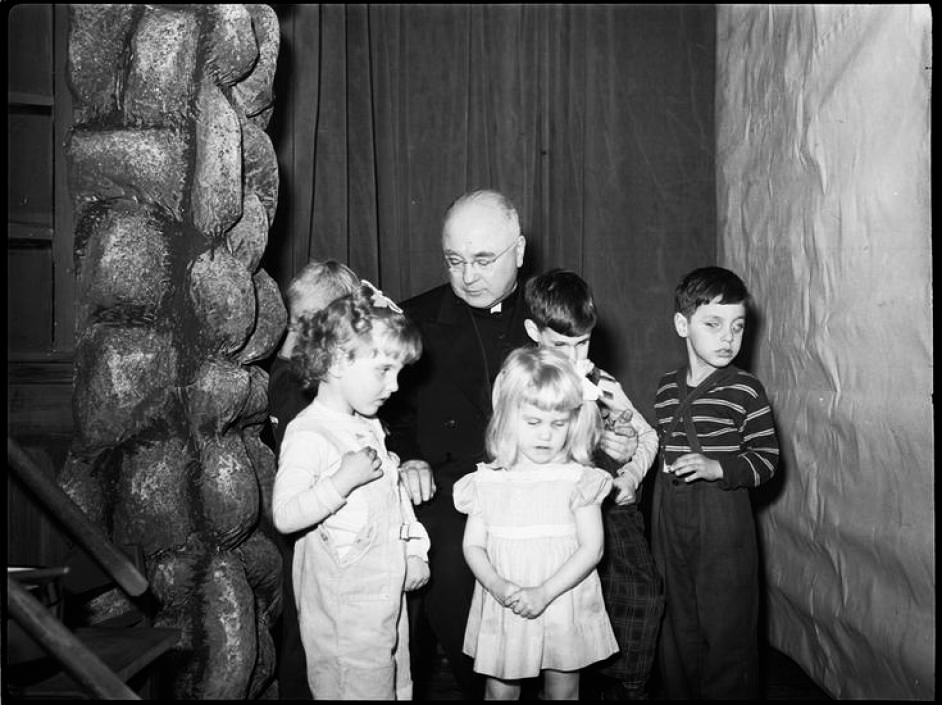
Cardinal Francis ‘Franny’ Spellman. Photo | Museum of the City of New York
People close to Cohn often remarked that he was frequently surrounded by groups of young boys, but seemed to think nothing of it. Similar off-handed comments about Epstein’s penchant for minors were made by those close to him prior to his arrest.
Controversial Republican political operative and “dirty trickster” Roger Stone, who — like Donald Trump — was also a protégé of Cohn, said the following about Cohn’s sex life during an interview with The New Yorker in 2008:
Roy was not gay. He was a man who liked having sex with men. Gays were weak, effeminate. He always seemed to have these young blond boys around. It just wasn’t discussed. He was interested in power and access.” (emphasis added)
Compare this quote from Stone to what Donald Trump, who was also close to Cohn, would later say about Jeffrey Epstein, with whom he was also closely associated:
I’ve known Jeff for 15 years. Terrific guy. He’s a lot of fun to be with. It is even said that he likes beautiful women as much as I do, and many of them are on the younger side. No doubt about it — Jeffrey enjoys his social life.” (emphasis added)
Though it is unknown how long the sex ring at the Plaza Hotel continued, and if it continued after Cohn’s death from AIDS in 1986, it is worth noting that Donald Trump purchased the Plaza Hotel in 1988. It would later be reported and confirmed by then-attendees that Trump “used to host parties in suites at the Plaza Hotel when he owned it, where young women and girls were introduced to older, richer men” and “illegal drugs and young women were passed around and used.”
Andy Lucchesi, a male model who had helped organize some of these Plaza Hotel parties for Trump said the following when asked about the age of the women present: “A lot of girls, 14, look 24. That’s as juicy as I can get. I never asked how old they were; I just partook. I did partake in activities that would be controversial, too.”
The Roy Cohn Machine
Roy Cohn was only at the beginning of his career when he waded his way into the underground sexual blackmail ring apparently led by Lewis Rosenstiel. Indeed, when Cohn first met Hoover, he was only 23 years old. Over the next three decades or so, before his death from AIDS-related complications in 1986 at the age of 56, Cohn built a well-oiled machine, largely through his close friendships with some of the country’s most influential figures.
Among Cohn’s friends were top media personalities like Barbara Walters, former CIA directors, Ronald Reagan and wife Nancy, media moguls Rupert Murdoch and Mort Zuckerman, numerous celebrities, prominent lawyers like Alan Dershowitz, top figures in the Catholic Church and leading Jewish organizations like B’nai B’rith and the World Jewish Congress. Many of the same names that surrounded Cohn until death in the late 1980s would later come to surround Jeffrey Epstein, with their names later appearing in Epstein’s now-infamous “little black book”.
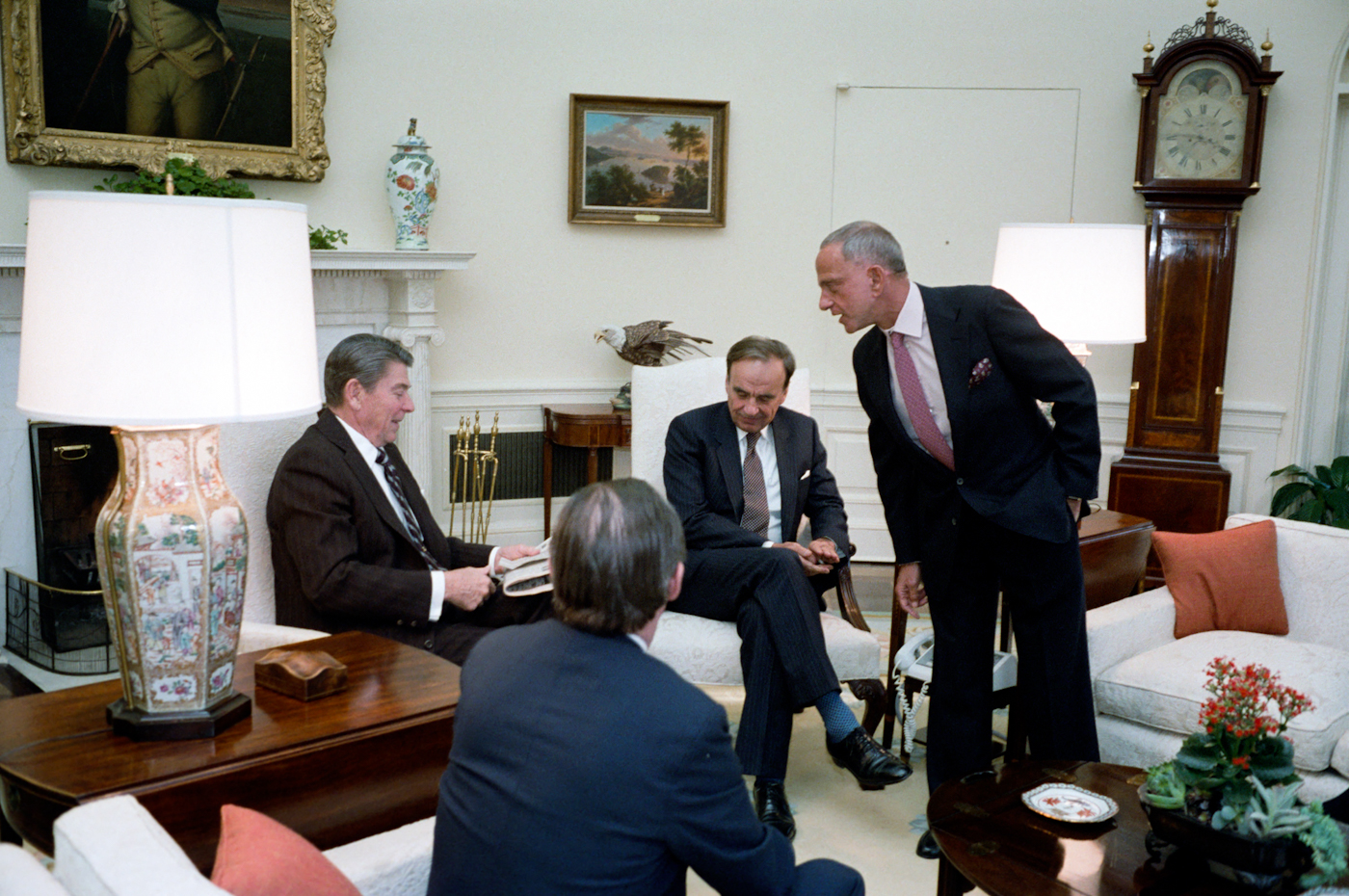
Reagan meets with Rupert Murdoch, U.S. Information Agency Director Charles Wick, and Roy Cohn in the Oval Office in 1983. Photo | Reagan presidential library
While President Trump is clearly connected to both Epstein and Cohn, Cohn’s network also extends to former President Bill Clinton, whose friend and longtime political advisor, Richard “Dirty Dick” Morris, was Cohn’s cousin and close associate. Morris was also close to Clinton’s former communications director, George Stephanopoulos, who is also associated with Jeffrey Epstein.
Yet, these were only Cohn’s connections to respectable members of the establishment. He was also known for his deep connections to the mob and gained prominence largely for his ability to connect key figures in the criminal underworld to respected influential figures acceptable to the public sphere. Ultimately, as New York attorney John Klotz stated, Cohn’s most powerful tool was blackmail, which he used against friend and foe, gangster or public official alike. How much of that blackmail he acquired through his sexual blackmail operation will likely never be known.
As Part II of this exclusive investigation will reveal, Cohn and Epstein, and the sexual blackmail operations they ran share many things in common, including not only many of the same famous friends and patrons, but also connections to intelligence agencies and consortiums of mob-linked businessmen, the modern-day equivalents of Samuel Bronfman and Lewis Rosenstiel who have since rebranded as “philanthropists.”
Part II will also reveal that Cohn’s operation was known to have successors, as revealed by a series of scandals in the early 1990s that have since been swept under the rug. The significant amount of overlap between Epstein’s and Cohn’s covert activities in sexual blackmail and their ties to many of the same powerful individuals and circles of influence strongly suggest that Epstein was one of Cohn’s successors.
As will be shown in the final installment of this report, Epstein is only the latest incarnation of a much older, more extensive and sophisticated operation that offers a frightening window into how deeply tied the U.S. government is to the modern-day equivalents of organized crime, making it a racket truly too big to fail.
Whitney Webb is a MintPress News journalist based in Chile. She has contributed to several independent media outlets including Global Research, EcoWatch, the Ron Paul Institute and 21st Century Wire, among others. She has made several radio and television appearances and is the 2019 winner of the Serena Shim Award for Uncompromised Integrity in Journalism.
Real Hedge-Fund Managers Think Epstein’s Actual Business Was Blackmail
cryptogon | July 14, 2019
Via: New York Magazine :
Long before Jeffrey Epstein pleaded guilty to prostitution charges in Florida more than a decade ago, his fellow Palm Beach resident and hedge-fund manager Douglas Kass was intrigued by the local gossip about his neighbor.
“I’m hearing about the parties, hearing about a guy who’s throwing money around,” says Kass, president of Seabreeze Partners Management. While stories about young girls swarming Epstein’s waterfront mansion and the sex parties he hosted for the rich and powerful were the talk of the town, Kass was more focused on how this obscure person, rumored to be managing billions of dollars, had become so wealthy without much of a track record.
Kass was well-connected on Wall Street, where he’d worked for decades, so he began to ask around. “I went to my institutional brokers, to their trading desks and asked if they ever traded with him. I did it a few times until the date when he was arrested,” he recalls. “Not one institutional trading desk, primary or secondary, had ever traded with Epstein’s firm.”
When a reporter came to interview Kass about Bernie Madoff shortly before that firm blew up in the biggest Ponzi scheme ever, Kass told her, “There’s another guy who reminds me of Madoff that no one trades with.” That man was Jeffrey Epstein.
“How did he get the money?” Kass kept asking.
…
Given this puzzling set of data points, the hedge-fund managers we spoke to leaned toward the theory that Epstein was running a blackmail scheme under the cover of a hedge fund.
Featured Video
NO MANDATES, NO PROFITS: MODERNA CEO TELLS THE TRUTH
or go to
Aletho News Archives – Video-Images
Book Review
In 2007, Michael Parenti Called Out The Greater Israel Project
The Dissident | January 28, 2026
In my last article, I covered the left-wing scholar Michael Parenti- who passed away at the age of 92 this week- and his prophetic writings on the Ukraine proxy war in 2014.
Parenti’s writings on the Israel lobby and the greater Israel project were equally prophetic.
In his 2007 book “Contrary Notions” Parenti called out “Israel First” Neo-cons and Israel’s role in the Iraq war, and predicted to a tee the future Israeli/American wars in the Middle East in service of Greater Israel and the ethnic cleansing of Palestine.
In a section of the book aptly titled “Israel First”, Parenti wrote… continue
Blog Roll
Recent Comments
loongtip on Russia Vows to Protect Its Oil… loongtip on Hamas never agreed to lay down… eddieb on Conspiracy Denial eddieb on WEF Calls for ‘Cultural Revolu… loongtip on Trump wanted to play peacemake… Coronistan on EU member to sue bloc over ‘su… loongtip on Vicious loongtip on EU turns to India for defense… Coronistan on Donald Trump Is No Peace … seversonebcfb985d9 on French court jails pro-Palesti… eddieb on Fourteen Incredible Facts Abou… Bill Francis on European leaders’ shift in the…


 Aletho News
- NO MANDATES, NO PROFITS: MODERNA CEO TELLS THE TRUTH
- UK Health Officials Covered Up Reports of Heart Damage Linked to AstraZeneca Vaccine
- This is How We Should Have Responded to COVID-19
- The UK Covid Inquiry: Propaganda to protect the ‘pandemic’ narrative
- Israeli Merkava tank invades outskirts of Yaroun in southern Lebanon
- Europeans oppose Brussels’ Russian energy ban, survey finds
- Russia Vows to Protect Its Oil Tankers
- In 2007, Michael Parenti Called Out The Greater Israel Project
- Hamas never agreed to lay down arms in truce talks: Official
- Iran, China and Russia sign trilateral strategic pact
- If Americans Knew
- NBA Star Stephen Curry’s Ties To Israeli Military Intelligence
- ‘Apocalyptic wasteland’: Biden admin. blocked warning on deteriorating Gaza situation after Oct. 7
- Why Israeli counterterrorism tactics are showing up in Minnesota
- Israel Went to Extremes to Return Ran Gvili’s Body. Why Doesn’t It Accord Dead Palestinians the Same Respect?
- Across the West, speaking for Palestine is now a crime
- A West Bank Bus Trip Through ‘the Best Documented Ethnic Cleansing in History’
- Mike Huckabee’s distorted theology does not speak for Christians worldwide
- CBS Evening News” With Tony Dokoupil Is Ellisons’ & Weiss’s Pro-Israel Show
- A Generation on Hold: Inside Gaza’s Collapsing Education System
- Born Under Siege: A Gaza Family Waited 17 Years—Their Baby Survived Six Months
- No Tricks Zone
- 130 Years Later: The CO2 Greenhouse Effect Is Still Only An Imaginary-World Thought Experiment
- New Study Affirms Rising CO2’s Greening Impact Across India – A Region With No Net Warming In 75 Years
- Germany’s Natural Gas Crisis Escalates … One Storage Site Near Empty …Government Silent
- Polar Colding…Antarctica Saw Its Coldest October In 44 Years!
- New Study: Sea Levels Rose 20 Times The Modern Rate During The Roman Warm Period
- As German Gas Storage Dips Dangerously Low…Shortage Hardly Avoidable
- New Study: Brazil’s Relative Sea Level Was 2+ Meters Higher And SSTs 3-4°C Warmer 6000 Years Ago
- Philosopher Schopenhauer: Climate Science Certainty Stems From Stupidity, Ignorance
- New Study: Species Extinction Rates Declining Since 1980 – ‘Climate Change Is Not An Important Threat’
- Denmark Places Climate Protection Above Animal Welfare, Poisoning And Culling Cows
 Aletho News