Email Scandal: Hillary Clinton Ordered to Provide Deposition In Person After ‘Preposterous’ Defence
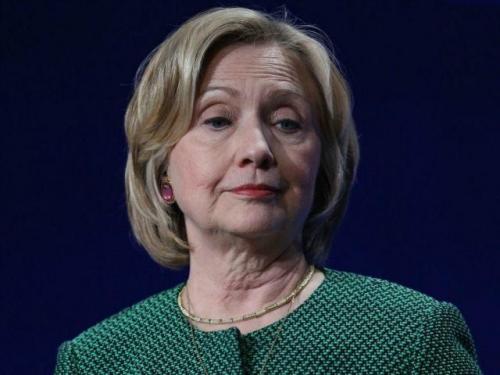
Sputnik – March 3, 2020
The almost six-year-long saga relates to Hillary Clinton’s use of a private email server for government business while secretary of state. Although the FBI investigation resulted in no charges, it still remains to be seen whether her unusual email practices were meant to avoid Freedom of Information Act requests.
A federal judge has ordered Hillary Clinton to provide a sworn deposition in person about her private email server.
The order, issued on Monday by US District Court Judge Royce Lamberth, grants the request of conservative watchdog Judicial Watch to depose Clinton about her correspondence and documents related to the 2012 attack on the US consulate in Benghazi, Libya.
The court also ordered the deposition of Clinton’s former chief of staff, Cheryl Mills, and two other State Department officials. It also allowed Judicial Watch to subpoena Google for documents and records associated with Clinton’s emails during her time at the State Department from 2009 to 2014.
Republican officials and members of Congress had accused then-Secretary of State Cinton of failing to prevent the attack, which left four Americans dead. She defended her handling of the episode.
Judicial Watch’s lawsuit seeking Benghazi-related records led to a scandal in 2015 when it helped discover that Clinton had repeatedly used her own private email server, rather than a government-issued one, during her time as Secretary of State. Records of official correspondence must be kept under federal law, and Clinton’s reliance on a private account sparked concerns that she was seeking to sidestep that requirement.
Clinton email controversy
The email scandal haunted Clinton’s presidential campaign and was weaponised against her by then-Republican candidate Donald Trump.
The FBI concluded in July 2016 that she had been “extremely careless in their handling of very sensitive, highly classified information”. Although Clinton insisted that she had never received or sent classified material, the FBI discovered that she had send out over a hundred emails that should have been regarded as classified.
Around 30,000 emails, deemed to be work-related, were provided to the State Department; her aides had also deleted around 32,000 emails, which they claimed to be non-work related, before any subpoenas were issued.
The bureau, however, recommended bringing no criminal charges against Clinton and referred the case to the Justice Department, which closed it with no charges. The FBI reopened its probe just days before the November election after new emails were discovered.
Questions still remain
“Judicial Watch argued that Secretary Clinton’s existing testimony has only scratched the surface of the inquiry into her motives for setting up and using a private server,” Judge Lamberth said in the 11-page ruling. “Secretary Clinton has repeatedly stated that convenience was the main reason for using a private server, but Judicial Watch justifiably seeks to explore that explanation further.”Clinton previously explained her use of a private server in a sworn written statement, but this deposition would be the first time she had to answer questions on the case in person.
“To argue that the Court now has enough information to determine whether [the] State [Department] conducted an adequate search is preposterous,” Lamberth wrote. “Even years after the FBI investigation, the slow trickle of new emails has yet to be explained.”
He stressed that some of the questions remain to date: “How did she arrive at her belief that her private server emails would be preserved by normal State Department processes for email retention? … Did she realise State was giving ‘no records’ responses to her FOIA requests for emails? … And why did she think that using a private server to conduct State Department business was permissible under the law in the first place?”
Guyana: The Good, the Bad and the Ugly Prior to 2020 Elections
teleSUR | March 1, 2020
The small Caribbean country of Guyana is on the brink of becoming one of the largest oil-producing nations in the world thanks to the 2015 discovery of major offshore oil deposits.
This newfound wealth set into motion a transformative period for the country, which is one of the poorest nations in South America as more than 36 percent of its people are living in poverty.
But as in many cases, the blessing and promise of billions of dollars in revenue to fill the state’s coffers have also been marred in corruption scandals and caused in 2018 a major political crisis that will be resolved on March 2 as hundreds of thousands of Guyanese head to the polls.
The Guyanese people have been waiting for this day ever since President David Granger received a motion of no confidence in Dec. 21, 2018 with 33 votes against 32. A decision later upheld by the Caribbean Court of Justice (CCJ) in 2019.
The no-confidence motion, a first in the nation’s history, on the leader of the Partnership for National Unity/Alliance for Change (APNU/AFC) party was led by former president and opposition leader Bharrat Jagdeo of the People’s Progressive Party/Civic (PPP/C).
Jagdeo stated Granger “sold” the country’s “patrimony” to Exxon Mobil, accusing the government of mismanaging oil resources and granting the transnational overly generous contract terms.
The government, on the other hand, has insisted that it got the best deal it could and is banking on new oil wealth to transform the economy of the English-speaking country of just 750,000.
So as people head to the polls to elect a new five-year administration amid the recent oil boom, Guyana’s situation could be summarized into the good, the bad and the ugly.
The Good
In May 2015 ExxonMobil shocked the world and the Guyanese as the company announced the discovery of significant oil deposits in the Liza-1 well, followed by Payara, Liza Deep, Snoek, Turbot, Ranger, and Pacora by early 2018.
ExxonMobil and Hess reported that new discoveries contained estimated resources exceeding eight billion barrels of oil equivalent – one of the world’s largest reserves-, potentially producing 750,000 barrels per day by 2025. In rough estimates, this placed the oil wealth at over US$300 billion.
In a nation with a per capita income of under US$4,000, the findings meant a game-changer.
The revenue is expected to generate an estimated US$168 billion over the life of the project until 2056, representing 120 times Guyana’s annual budget, which in 2019 stood at US$1.4 billion.
By 2024 the amount of money coming in could lift income per person from US$5,000 to US$19,000, nearly the same as in Poland. All the wealth promised for impoverished Guyana hopes of tremendous economic growth in the years ahead. The International Monetary Fund forecasts an 85.6 percent GDP growth in the small nation.
By 2030 the government’s share of earnings from oil could reach US$10 billion in real terms, more than double last year’s GDP. However, not everything that glitters is gold.
The Bad
But Guyana is no stranger to oil exploration and drilling. Since the 1940s transnational companies had operated in the Guyana basin and in small wells. Yet the 2015 find was so unexpected it took even Exxon by surprise as, by April 2016, the United States oil giant had a problem.
The company had recently found oil off the coast in the Stabroek oil block but its license was about to expire in only two years, putting in jeopardy the company’s increasingly valuable asset.
So in early April 2016, the company began a powerful negotiation campaign by confronting two inexperienced Guyanese officials with a new draft license to be signed within ten weeks.
“Exxon did not want to change the favorable financial terms from its 1999 license, despite having recently found significant oil reservoirs that would customarily allow the government to ask for more,” a report titled ‘Signed Away’ by international watchdog Global Witness states.
The Guyanese government despite having a strong bargaining position when the contract came up for renegotiation in 2016 was outmaneuvered by the international company, due to “inexperienced” bureaucrats according to the report.
Guyana’s Natural Resources Minister Raphael Trotman ended up giving Exxon largely the same tax terms as before it found oil and then the company regained parts of the license area it was supposed to give up.
Also, and within months of signing Stabroek, Exxon agreed to buy portions of two additional licenses from companies that had obtained them under apparently suspicious circumstances. Only three days after getting its new license, Exxon announced its massive find.
The agreement left Guyana with a two percent royalty and a 50 percent profit share after the company recoups its costs. Granger has defended that the attractive terms were needed to secure investment in a risky new location.
However, for German-based company Open Oil -which specializes in providing financial analysis of natural resource investments for public policy purposes – Guyana lost a lot.
“If the royalty had been at 10 percent and standard corporate income tax (CIT) of 25 percent had been applied, both of which are well within international norms, the resulting government take would have been 69 percent, and Guyana would earn US$55 billion more during the life of the Stabroek field, up until 2056,” their report reads.
On average, Guyana will lose over US$1.3 billion a year over the life of the project from signing in 2016 until expiry. With the additional money, the country could have doubled its annual US$172 million health budget, US$251 million education budget, US$185 million infrastructure budget, and still have US$700 million left each year.
“This is a story about how an aggressive company negotiated an exploitative deal with a minister who may not have been working in Guyana’s best interests,” Global Witness’ commented on the matter. Supposedly the opposition voted to end granger’s government in order to renegotiate these contracts, which they thought to be unfair for Guyana.
And this is where things get ugly.
The Ugly
As Granger’s administration came to a halt by the opposition’s vote, the reassuring argument to the Guyanese people was that oil contracts would have been revised and renegotiated. The March 2 elections were meant to prove this thesis as the issue was the deciding factor, or at least it seemed so for campaign purposes.
With elections looming, the People’s Progressive Party presidential candidate announced in January that Exxon’s contract wouldn’t be renegotiated, despite the numerous warnings of the lopsided nature of the agreement.
“Exxon is a different case,” Ali told Reuters after a campaign rally in the contested western Essequibo region, adding that he would administer the deal better after reviewing terms.
For Associate Fellow in the energy, environment and resources program at Chatham House, Valerie Marcel, although the stakes are high in the elections as that the winning party will reign over the country’s oil revenues there is no real difference regarding the party’s policies approaching the oil boom.
Both are on a similar path with the development strategy set up by Granger, support the Extractive Industries Transparency Initiative (EITI) and a sovereign wealth fund, and mainly imitate their approach to licenses and future agreements.
“Exxon was a pioneering investment,” Ali reiterated. “But those that came after that time they were not pioneering, so they have to be examined in totality.”
However, others have not yet confirmed significant commercial finds. Tullow has made several discoveries in the past year, but the company has yet to find enough reserves to make the project work so Exxon continues to be the main winner in all this transaction.
If asked what’s really at stake in Guyana’s election, the answer might be as unpleasant as it sounds: nothing. As the good tidings of newfound immense natural resources for one of the poorest nations in the continent have been marred by power struggles and the ugliness of transnational greed over sovereign interests.
See also:
The Media’s Deafening Silence on Mike Bloomberg’s Ties to Epstein and Other Criminals
By Whitney Webb | MintPress News | February 28, 2020
After his late jump into the Democratic primary and, as critics argue, purchasing his way into the primary debates, former Mayor of New York City Michael Bloomberg has received mixed coverage from corporate media, with many negative critiques of the current presidential contender’s history, conduct and connections.
Yet, despite efforts by other campaigns and more progressive-leaning media outlets to dampen Bloomberg’s chances at the nomination, one clear weakness of Bloomberg’s has thus far evaded meaningful media coverage: his ties to key players in the Epstein scandal, including Leslie Wexner, Ghislaine Maxwell and even Jeffrey Epstein himself.
Silence among outlets that largely oppose Bloomberg’s candidacy regarding his connections to Epstein and those in his close social orbit is odd, especially when reporting on an individual’s connections to the intelligence-linked pedophile are a sure-fire way to generate considerable negative attention and fodder for rival campaigns. This is particularly striking given that the numerous accusations that Bloomberg has long stoked a toxic culture of sexual harassment at his company, resulting in no small number of non-disclosure agreements over the years, have received some media attention. Yet, the fact that many of Bloomberg’s close friends have been accused of far, far worse has received hardly any coverage by comparison.
For instance, when it was announced last week that the controlling stake in the Leslie Wexner-owned lingerie company Victoria’s Secret would be sold to a private equity firm called Sycamore Partners, only one media outlet — The Intercept — revealed that Bloomberg has at least $136 million of his money in that firm. The Intercept noted in passing that Wexner — the source of most of Jeffrey Epstein’s supposed fortune, his close collaborator for decades and alleged rapist of many of his victims — had been pressured to step down following the scandal, which also hit Wexner-owned companies hard and had forced the Ohio-based billionaire to seek a buyer for his lingerie brand and its tarnished reputation. Yet, the outlet did not make the direct connection that Sycamore Partners-backer Bloomberg is a friend of Wexner’s and has attended Wexner’s personal social parties for years prior to the most recent scandal.
Here’s alleged-rapist Mike Bloomberg attending a fancy horse party at Les Wexner’s place (Wexner furthest right) in 2010, about a year before Wexner formally transferred ownership of his Manhattan townhouse to Jeffrey Epstein. Cheers to good friends 😊 pic.twitter.com/gS8wpUVF00
— ePal, Your Close Friend™-Enterprise Edition (@wash_cloth) February 17, 2020
Yet, even well before this recent opportunity to point out Bloomberg’s ties to Leslie Wexner, there have been plenty of opportunities for the media to question Bloomberg about his now-infamous picture with Ghislaine Maxwell, daughter of Mossad-connected Robert Maxwell and Epstein’s alleged madam and co-conspirator.
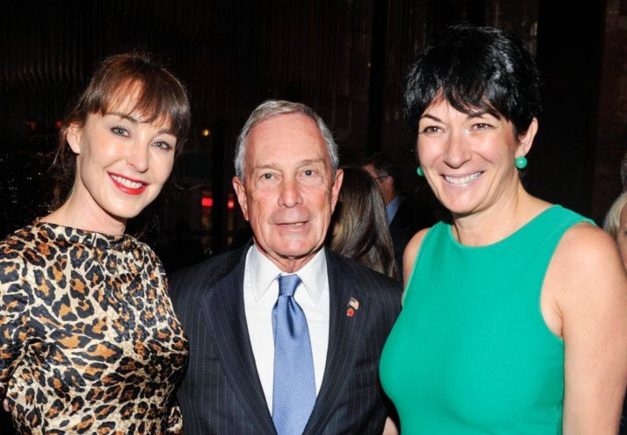
From left to right, Tamara Mellon, Mike Bloomberg and Ghislaine Maxwell
That picture, taken in 2013 at the Four Seasons restaurant in New York, has not been mentioned by mainstream media following the launch of Bloomberg’s candidacy late last November. Similarly, mainstream media have failed to question Bloomberg regarding why his name and five different telephone numbers for him appear in Jeffrey Epstein’s infamous list of contacts often referred to as his “little black book.”
Bloomberg and the Manhattan Swamp
The extent of the Maxwell-Bloomberg relationship is unknown, though Bloomberg’s deep ties to his former employer Salomon Brothers is a possible link, given that that firm served as one of the Maxwell family’s main investment bankers in the years prior to and following Robert Maxwell’s mysterious death in 1991. Similarly, Epstein had close ties to prominent figures on Wall Street, some dating back to his time at Bear Stearns, who are also close to Bloomberg.
Bloomberg and Epstein also shared close friendships with some of the same New York media executives like Mort Zuckerman. Media outlets have described Zuckerman, a former business partner of Epstein’s, as Bloomberg’s “long-time enabler.” In another example, Epstein’s former publicist Howard Rubenstein is a long-time supporter of Bloomberg and was reported to be the driving force behind Bloomberg’s controversial push to run around mayoral term limits and pursue a third term as Mayor of New York.
Another mutual Epstein-Bloomberg associate is disgraced media mogul Harvey Weinstein. Weinstein was part of an investment group with Epstein that sought to purchase New York magazine in 2003. Another member of that investment group was frequent MSNBC commentator Donny Deutsch, who has recently fervently backed Bloomberg’s candidacy.
Weinstein was recently convicted of rape and has dozens of accusers, whose decision to come forward about Weinstein’s sex crimes in recent years helped spark the “Me Too” movement. Weinstein also has ties to former Israeli Prime Minister Ehud Barak, who was a close friend and business associate of Epstein’s, and it was Barak who personally introduced Weinstein to former Mossad spies that Weinstein hired to intimidate his accusers. In addition to being Prime Minister, Barak is also the former head of Israeli military intelligence, the foreign intelligence agency that sponsored Epstein’s sexual blackmail operation involving underage girls in the United States.
Bloomberg’s candidacy has yet to be strongly challenged over his ties to Weinstein, which are considerable. For instance, Weinstein was a major backer of Bloomberg’s mayoral campaigns and even recorded robocalls on Bloomberg’s behalf to boost his election chances. Bloomberg, in turn, appointed Weinstein to a charity board and Weinstein later praised Bloomberg for aiding his film company. While Bloomberg’s ties to Wexner, Epstein and Maxwell have gotten the silent treatment, some outlets (mostly right-leaning) have covered the Bloomberg-Weinstein ties, but there has been little pressure on Bloomberg from mainstream media to address those ties directly.
Another close Bloomberg associate who recently has been accused by numerous women of sexual harassment is hedge fund manager Michael Steinhardt. Steinhardt is a long-time fixture in Bloomberg’s social circle and has long appeared at Bloomberg’s dinner parties. Steinhardt is also connected to Leslie Wexner through his membership in the so-called “Mega Group” — an exclusive group of organized-crime-linked “mega” donors to pro-Israel causes that Wexner co-founded in 1991. Steinhardt also boasts close ties to the now deceased founder of Glencore, the Mossad-linked Marc Rich, and Steinhardt — along with top Israeli politicians and spies — aggressively lobbied former President Bill Clinton to controversially pardon Rich before leaving office.
“Show me your friends and I’ll tell you who you are”
The oft-quoted saying “Show me your friends and I’ll tell you who you are,” seems to hold true for Bloomberg. For instance, his eponymous media conglomerate has received no small number of lawsuits over the years alleging rampant sexual harassment and even the rape of female workers, much of its allegedly egged on by Bloomberg’s long history of comments that have been derided as sexist. Many of those lawsuits ended in female accusers being asked to sign non-disclosure agreements (NDAs). More recently, The Nation reported that Bloomberg’s 2020 presidential campaign is making use of NDAs in such a way “that could prevent staffers from reporting workplace abuse.”
In addition, a 1999 profile of Bloomberg in Wired magazine quoted Bloomberg as saying “My daughter is tall and busty and blonde. We went to China together. And what’s a 16-year-old going to do on a business trip? So, I got her dates in every city in China.”
Bloomberg, not unlike Epstein and Wexner, also has a history of cozy ties to the CIA. For instance, during his tenure as Mayor of New York, Bloomberg actively promoted a controversial post-9/11 program that saw the CIA work directly with the NYPD to spy on the city’s Muslim communities. Even though the CIA is technically prohibited from spying on Americans not linked to criminal activity, one of the CIA officers working as part of the Bloomberg-backed program said he had “no limitations” on what he could do. Bloomberg has long defended this program and its merging of the CIA with local police.
In the case of Epstein and Wexner, as MintPress News reported in its viral series on the Epstein scandal last year, Epstein once claimed to have worked for the CIA during the 1980s and Epstein and Wexner were the key players behind the relocation of CIA front company Southern Air Transport to Ohio, where Wexner’s business interests have long been based.
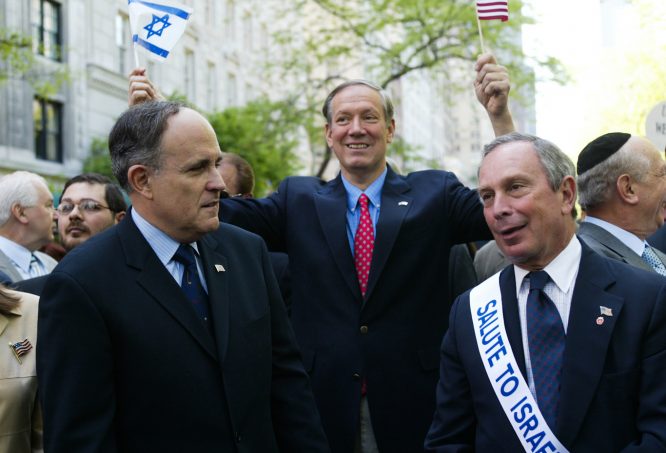
Rudy Giuliani, left, New York Gov. George Pataki, center, and Mike Bloomberg during a “Salute to Israel Parade, May 5, 2002, in New York. Shawn Baldwin | AP
In addition, Bloomberg was also a key player in a controversial initiative regarding Israel’s intelligence-linked technology sector. For instance, Bloomberg created a $2 billion project that involved opening a Manhattan campus called “Cornell Tech” that brought together Cornell University and Israel’s Technion, which has close ties to Israel’s national security state and military-industrial complex. Bloomberg personally gave over $100 million to facilitate completion of that project. That campus is now a partner in the recent creation of two Israeli-run “cybersecurity” centers in New York City that are tied to Israeli intelligence and were recently reported on by MintPress.
Jeffrey Epstein was also involved with Israeli military intelligence-linked technology companies and, as previously mentioned, Israeli military intelligence was also the sponsor of Epstein’s sexual blackmail operation that targeted mostly U.S. politicians and public figures for the benefit of the state of Israel, whose military currently receives $3.8 billion per year from U.S. taxpayers.
While these aspects of Bloomberg’s past have received considerable media attention as of late, these same outlets have failed to note that Bloomberg’s inner circle boasts many individuals accused of harassment, rape or worse. With his clear ties to the “Epstein network,” the fact that mainstream media has declined to even question Bloomberg about his social appearances with Ghislaine Maxwell or Leslie Wexner and having five different telephone numbers of his in Epstein’s list of high-profile contacts is a damning indictment of the current landscape of both American media and American politics.
Whitney Webb is a MintPress News journalist based in Chile. She has contributed to several independent media outlets including Global Research, EcoWatch, the Ron Paul Institute and 21st Century Wire, among others. She has made several radio and television appearances and is the 2019 winner of the Serena Shim Award for Uncompromised Integrity in Journalism
Ocasio-Cortez to Constituents on Bolivian Coup: Drop Dead
By Jacob Levich | CounterPunch | February 14, 2020
Alexandria Ocasio-Cortez, the celebrity who moonlights as my Congressional representative, has repeatedly claimed to speak for “ordinary people,” but she refuses listen to them, even if they are constituents.
In late November, shortly after the US-backed military coup that unseated the legitimate president of Bolivia, I together with my life companion requested a meeting with Rep. Ocasio-Cortez, whose local offices are located just a short walk from our Jackson Heights apartment building. Working on behalf of a group of anti-imperialists opposing the fascist junta, we hoped to persuade her of the need to act quickly to thwart the coup and defend the lives and rights of the Bolivian people.
Although we never got past the reception desk, we were permitted to present a petition signed by leading academics and anti-imperialist organizers on behalf of the people of Bolivia. We provided all personal data and contact info requested by the office. We were promised that we would be contacted promptly to discuss scheduling a meeting.
We were not contacted. For weeks. After pressing the issue, always taking care to remain courteous and respectful of process, we were subjected to a galling and contemptuous bureaucratic runaround that sometimes felt like applying to – and being rejected by – an exclusive private school.
This three-month process involved repeated visits to her office, where our reception ranged from chilly to downright intimidating, endless emails and telephone calls, bureaucratic excuses and dissimulations, and eventually, after much persistence on our part, a half-hour vetting via conference call by a Washington staffer.
The result? As we say in Queens, bubkes.
By contrast, a group of imperialist sympathizers who had been promoting the coup for months were granted instant access. On November 16, four days after the military coup that destroyed Bolivian democracy, Ocasio-Cortez met with a group of pro-Áñez, pro-Camacho activists led by one Ana Carola Traverso. Traverso’s connections to the Bolivian coup plotters have been extensively documented online.
Rep. Ocasio-Cortez symbolically embraced the coup by posing for a photo with this group as they brandished the tricolor Bolivian flag, which during that period had become a signal of support for the golpistas (as opposed to the Wiphala flag, which symbolized popular resistance to the takeover). She told them that she supports their “democratic grassroots movement” and offered them “direct lines of communication.”
In sum, a gang of coup supporters, not constituents, were granted instant access, a photo op and promises of ongoing support. Actual constituents, opposing the coup, were shown the door.
Our reception by Rep. Ocasio-Cortez was radically different from that I received from her predecessor, Joe Crowley. When, in 2004, I requested a meeting on behalf of the Queens Antiwar Coalition, we were granted prompt and respectful access to the Congressman. We did not have high hopes of changing his vote on the Iraq war, but we felt it was important that he hear from his constituents.
So, apparently, did he. We were greeted warmly in his rather funky local office – a striking contrast with AOC’s soulless corporate-style digs, where underlings refer to her as “the Boss” – and were encouraged to speak our piece. Crowley never pretended to be an opponent of US imperialism, but he gave us a respectful hearing, stated his position, and engaged in what felt like meaningful discussion of the war. At a minimum, as Twitter’s bluecheck pundits would say, we felt “seen.”
AOC, by contrast, has no time for people who cannot help her to burnish her brand as she prepares to run for higher office. As a local staffer (who declined to introduce himself) proudly informed us: “She refuses 99 percent of meeting requests from constituents.”
Meanwhile, she happily clears her schedule for interviews about her makeup routine, canned videos in which she postures as a fearless progressive, and closed-door meetings with regime-change sympathizers.
But she will not make time for residents of her district. So much for “ordinary people.”
“The Donald Trump I know”: Abbas’ UN Speech and the Breakdown of Palestinian Politics
By Ramzy Baroud | Dissident Voice | February 20, 2020
A precious moment has been squandered, as Palestinian Authority President, Mahmoud Abbas, had the chance to right a historical wrong, by reinstating Palestinian national priorities at the United Nations Security Council on February 11, through a political discourse that is completely independent from Washington and its allies.
For a long time, Abbas has been a hostage to the very language that designated him and his Authority as ‘moderates’ in the eyes of Israel and the West. Despite the Palestinian leader’s outward rejection of the US ‘Deal of the Century’ – which practically renders Palestinian national aspirations null and void – Abbas is keen to maintain his ‘moderate’ credentials for as long as possible.
Certainly, Abbas has given many speeches at the UN in the past and, every single time, he has failed to impress Palestinians. This time, however, things were meant to be different. Not only did Washington disown Abbas and the PA, it also scrapped its own political discourse on peace and the two-state solution altogether. More, the Trump administration has now officially given its blessing to Israel to annex nearly a third of the West Bank, taking Jerusalem ‘off the table’ and discarding the right of return for Palestinian refugees.
Instead of directly meeting with leaders of the various Palestinian political parties and taking tangible steps to reactivate dormant but central political institutions such as the Palestinian National Council (PNC) and the Palestine Liberation Organization (PLO), Abbas preferred to meet with former Israeli right-wing Prime Minister, Ehud Olmert, in New York, and to carry on regurgitating his commitment to a by-gone era.
In his UN speech, Abbas said nothing new which, in this instance, is worse than not saying anything at all.
“This is the outcome of the project that has been introduced to us,” Abbas said, while holding a map of what a Palestinian state would look like under Donald Trump’s ‘Deal of the Century’. “And this is the state that they are giving to us,” Abbas added, referring to that future state as a ‘Swiss cheese’, meaning a state fragmented by Jewish settlements, bypass-roads and Israeli military zones.
Even the term ‘Swiss cheese’, which was reported in some media as if a new phrase in this ever-redundant discourse, is actually an old coinage that has been referenced repeatedly by the Palestinian leadership itself, starting with the onset of the so-called peace process, a quarter of a century ago.
Abbas labored to appear exceptionally resolute as he emphasized certain words, like when he equated the Israeli occupation with the system of apartheid. His delivery, however, appeared unconvincing, lacking and, at times, pointless.
Abbas spoke of his great ‘surprise’ when Washington declared Jerusalem as Israel’s undivided capital, subsequently relocating its embassy to the occupied city, as if the writing was not already on the wall and that, in fact, the embassy move was one of Trump’s main pledges to Israel even before his inauguration in January 2017.
“And then they cut off financial aid that was given to us,” Abbas said in a lamenting voice with reference to the US decision to withhold its aid to the PA in August 2018. “$840 million are held from us,” he said. “I don’t know who is giving Trump such horrid advice. Trump is not like this. Trump that I know is not like this,” Abbas exclaimed in a strange interjection as if to send a message to the Trump administration that the PA still has faith in the US President’s judgement.
“I would like to remind everyone that we have participated in the Madrid peace conference, and the Washington negotiations and the Oslo agreement and the Annapolis summit on the basis of international law,” Abbas recounted, signaling that he remains committed to the very political agenda that reaped the Palestinian people no political rewards whatsoever.
Abbas then went on to paint an imagined reality, where his Authority is supposedly building the “national institutions of a law-abiding, modern and democratic state that is constructed on the basis of international values; one that is predicated on transparency, accountability and fighting corruption.”
“Yes,” Abbas emphasized, as he looked at his audience with theatrical seriousness, “We are one of the most important countries (in the world) that is fighting corruption.” The PA leader, then, called on the Security Council to send a commission to investigate allegations of corruption within the PA, a bewildering and unnecessary invitation, considering that it is the Palestinian leadership that should be making demands on the international community to help enforce international law and end the Israeli occupation.
It went on like this, where Abbas vacillated between reading pre-written remarks that introduce no new ideas or strategies and unnecessary rants that reflect the PA’s political bankruptcy and Abbas’ own lack of imagination.
The PA President, of course, made sure to offer his habitual condemnation of Palestinian ‘terrorism’ by promising that Palestinians would not “resort to violence and terrorism regardless of the act of aggression against us.” He assured his audience that his Authority believes in “peace and fighting violence.” Without elaborating, Abbas declared his intention of continuing on the path of “popular and peaceful resistance,” which, in fact, does not exist in any shape or form.
This time around, Abbas’ speech at the UN was particularly inappropriate. Indeed, it was a failure in every possible way. The least, the Palestinian leader could have done is to articulate a powerful and collective Palestinian political discourse. Instead, his statement was merely a sad homage to his own legacy, one that is riddled with disappointments and ineptitude.
Expectedly, Abbas returned to Ramallah to greet his cheering supporters once more, who are always ready and waiting to raise posters of the ageing leader, as if his UN speech had succeeded in fundamentally shifting international political momentum in favor of Palestinians.
It has to be said that the real danger in the ‘Deal of the Century’ is not the actual stipulations of that sinister plan, but the fact that the Palestinian leadership is likely to find a way to co-exist with it, at the expense of the oppressed Palestinian people, as long as donors’ money continues to flow and as long as Abbas continues to call himself a president.
Ramzy Baroud is a journalist and the Editor of The Palestine Chronicle. He is the author of five books. His latest is “These Chains Will Be Broken: Palestinian Stories of Struggle and Defiance in Israeli Prisons” (Clarity Press, Atlanta). Dr. Baroud is a Non-resident Senior Research Fellow at the Center for Islam and Global Affairs (CIGA), Istanbul Zaim University (IZU). His website is http://www.ramzybaroud.net
Crypto CIA spy op revelations makes us see US’ Huawei objections in a new light

© Global Look Press/www.imago-images.de/MANUEL GEISSE; © REUTERS/Arnd Wiegmann
By Neil Clark | RT | February 13, 2020
The revelation that the CIA (and German Intelligence) was in secret control of the Swiss cryptography firm Crypto AG highlights the hypocrisy of US ‘security concerns‘ over the advance of Huawei and other firms.
The very wise old saying that if you point one finger at someone there are three fingers pointing back at you, was classically illustrated by this week’s bombshell revelations — published in the Washington Post and on ZDF and SRF – that the CIA and BND (West Germany’s secret service) secretly owned and controlled the Swiss cryptography company Crypto. The real owners of Crypto installed ‘backdoor vulnerabilities’ in its products which allowed the US and West Germany to eavesdrop on communications — from enemies and allies alike — which the senders believed had been successfully encrypted. We’re talking here about top secret communications between leading government officials, spies, diplomats and military figures.
Just imagine that back in the 1970s or 80s you had claimed that the Crypto was a CIA front. You’d have been dismissed as a ‘crank conspiracy theorist, ’and/or ‘totally paranoid‘ by the gatekeepers of that time. But the rumours were true. Once again a ‘conspiracy theory’ has turned out to be not as barmy as once depicted. Truth again proved to be stranger than fiction.
How much intelligence was gathered via Crypto is quite staggering. As RT has reported: “Throughout the 1980s — around 40% of all government transmissions analysed by the US National Security Agency (NSA) ran through Crypto‘s devices.”
What a neat little racket. Over 120 governments of the world, but not the former Soviet Union and Communist China who, to their great credit were distrustful, made use of Crypto’s products. These governments, which included Iran, Libya, Argentina and Egypt were effectively paying the Americans and West Germans to spy on them!
The Germans bowed out of the operation in 1993, but for the next 25 years, the CIA kept it running. Which begs the question: what other US Intelligence fronts of the past and present don’t we know about?
In her 1999 book Who Paid the Piper?: The CIA and the Cultural Cold War, Frances Stonor Saunders detailed how the CIA funded a whole range of publications and artistic enterprises often through the ’Congress for Cultural Freedom’.
Literary journals (who conveniently had a pop at communism) were funded by the CIA. Modern artists were funded by the CIA. Writers, poets and philosophers were funded by the CIA.
And under ‘Operation Mockingbird’ leading journalists were basically recruited to the agency.
According to Carl Bernstein, the CIA had over 400 journalists working for them in the old Cold War.
“In many instances, CIA documents show, journalists were engaged to perform tasks for the CIA with the consent of the managements of America’s leading news organizations,” the American journalist writes.
The CIA‘s own records show that, by 1991, they had relationships with “every major wire service, newspaper, news weekly and television network in the country”.
Now we know they were even behind Crypto too!
Given the organisation’s modus operandi, it is scarcely believable that the CIA doesn’t have similar ‘relationships’ and control mechanisms working today. Why wouldn’t it?
Not only should the Crypto revelations make us more aware of the CIA’s very wide reach, they should also make us see the American objections to the involvement of firms from China and Russia with developing telecommunications infrastructure and new technology in a completely different light.
The Russian anti-virus firm Kaspersky, has seen its software banned from use on US government networks, while the Chinese giant Huawei has been hit with sanctions — and warnings given to other countries about letting it build their 5G networks.
Taking the moral high ground (as always), US officials have said that Huawei could covertly access mobile-phone networks through ‘back doors’.
OMG! You mean like the US did with Crypto?
The Wall Street Journal cites the same US officials saying that “Huawei has had this secret capability for more than a decade.”
What ‘intelligence’ would that be I wonder? The CIA’s?
What seems to be the objection here is that China might end up doing what the US has been doing for years, namely spying on countries through ‘back doors’. How dare they! The hypocrisy as I’m sure you’ll agree is off the scale.
The strength of the objections — and indeed the sanctions already imposed in the US against the company tell us one thing. Huawei, unlike Crypto, Encounter magazine, the ‘National Committee for a Free Europe’, and lots of organisations we probably still don’t know about, is no CIA front.
Why Clinton Foundation Whistleblowers’ Case Against IRS May Cause US Political Dynasties to Shiver
By Ekaterina Blinova – Sputnik – February 12, 2020
While the mainstream media in the US was preoccupied with Donald Trump’s impeachment another legal drama has been unfolding since March 2019, namely Lawrence W. Doyle and John F. Moynihan v Internal Revenue Service (IRS). Wall Street analyst Charles Ortel has explained why the case matters more than the impeachment saga.
Lawrence W. Doyle and John F. Moynihan, both graduates of the Catholic Jesuit College of the Holy Cross and independent expert forensic investigators, came to prominence on 13 December 2018 when they testified before the House Oversight and Government Reform Committee on the Clinton Foundation’s alleged fraud.
According to them, the charity does not operate as a tax-exempt 501(c)(3) organisation and has acted as nothing short of a foreign agent “throughout its existence”. Summarising their conclusions the two Jesuit alumni suggested that the Clinton Foundation owes between $400 million and $2.5 billion in taxes and informed US lawmakers that if the IRS refuses to consider their “tax claim” they would appeal to the US Tax Court. According to Zero Hedge, the ongoing litigation is apparently related to this very case.
Multinational Charities “Perfect” Disguise for Money Laundering
Charles Ortel, a Wall Street analyst and investigative journalist who has been conducting a private inquiry into the Clinton Foundation for several years opines that the aforementioned legal case may involve unprosecuted crimes by some “charities” operated by political dynasties and may even put the IRS itself under the microscope.
“I believe that Doyle and Moynihan, like most concerned citizens, want the IRS to enforce charity laws and regulations fairly, without regard to whether a given charity might be linked to a Republican, Democrat, or Independent person,” he says, specifying that the precise claim and details of the legal case in question are unknown since they’re sealed by the court.
According to Ortel, multinational charities have become “perfect” vehicles for disguising money laundering and influence peddling since regulators do not have enough resources to check their revenues and spending scrupulously especially when these non-profits are operating abroad.
“Compounding the above problems is the fact that numerous foreign actors including governments, companies, and individuals are eager to curry favour with sitting or rising politicians who, typically, are also hungry for financial support,” he suggests. “While foreign interests are barred from directly supporting or financing political candidates, they are allowed to ‘contribute’ to charities in which dynastic political families have interests or associations.”
Why IRS & FBI Turns a Blind Eye to Loosely Operated Charities
To illustrate his point Ortel referred to the Clinton Foundation that has repeatedly come under the spotlight being suspected of alleged “pay-to-play” schemes. Echoing Doyle and Moynihan, Ortel believes that the Clinton Foundation cannot be called a “charity” since its operations in the US and abroad go beyond charitable activities. Furthermore it is neither validly organised nor properly audited, he highlights. The Wall Street analyst raises the question as to why the supposed violations have remained unnoticed by the FBI and IRS for over a decade.
Referring to page 432 of the first IG Horowitz Report, Ortel notes that the FBI opened investigations into the Clinton Foundation in January 2016. By July 2016, the IRS too confirmed that they had opened a Clinton Foundation investigation, he points out. However, nothing has been heard since then about the cases.
The Washington Post reported on 10 January that John Huber, the US attorney in Utah, who was appointed by then-Attorney General Jeff Sessions in November 2017 to look into the FBI handling of possible corruption at the Clinton Foundation and Hillary Clinton’s alleged pay-to-play schemes during her tenure as secretary of state, “found nothing worth pursuing.” The media outlet specified, however, that “the assignment has not formally ended and no official notice has been sent to the Justice Department or to lawmakers”, citing knowledgeable sources.
“What I suspect is that bureaucrats and others in the IRS and Department of Justice have been reluctant to press into their investigations because high level current and former politicians and powerful donors, across the political spectrum are likely implicated in trafficking influence through these false-front charities, and others”, Ortel presumes.
US Debt is Soaring While “Charities” Sit on Trillions
The Wall Street analyst explains why financial violations and fraud on the part of charitable organisations are fraught with risks for national economies and societies.
“One hopes that the overwhelming majority of American charities abide by relevant laws”, he says. “This is likely true concerning charities that tackle local, state, or national challenges, but American charities and foreign charities that operate internationally are rife with potential for fraud and corruption.”
He points out that this is particularly true when it comes to disaster relief when “pocketbooks open instantly and large sums swarm” towards various “tax-exempt organisations” often connected to celebrities that say they are going to help.
Ortel bemoans that fact that “afterwards, too frequently as in the case of Haiti, for example, there is no rigorous accounting for the vast sums claimed as donations or expenses”. The Clinton Foundation’s role in fundraising to tackle the consequences of the 2010 Haiti earthquake is still triggering controversy and was addressed by Donald Trump during his 2016 campaign.
“In 2020, America has run up a mountain of government debt and we see little progress in paring back soaring annual government deficits that add to our monstrous debt pile”, the investigative journalist emphasises. “At the same time, loosely regulated charities, some funded by monopolists and near monopolists sit on trillions of dollars of unencumbered assets inside private foundations or public charities.”
According to him, if the IRS and Department of Justice did their best to enforce existing laws and regulations that prohibit certain tax-exempt organisations from enriching themselves “vast sums could be raised to help reverse erosion in [the US] national balance sheet”.
Ortel expresses hope that the effort spearheaded by Doyle and Moynihan will help restore confidence in the administration of justice.
Audit Reveals The High Cost Of Toll Roads
TheNewspaper.com | February 7, 2020
Financial analysis of major toll road systems finds substantial diversion of revenue to third parties.
Of the billions of dollars collected at toll booths around the country, nearly half of the money goes to overhead costs, profit for the private companies involved and other uses that have nothing to do with the road itself. That is the finding of a financial audit released last week by the American Transportation Research Institute (ATRI), which conducted the analysis on behalf of the trucking industry. The report examined financial records for major toll road networks that together collected $14.7 billion in revenue in 2018.
“The findings indicate that the 21 major tolling systems analyzed collect revenue in excess of the actual direct costs of operations and interest expense, with nearly 50 percent of toll revenue diverted to other uses,” the report concluded. “This excess revenue is diverted in a number of ways based upon the individual agency or state that supervises the toll entity. The magnitude of diversion and the lack of standard practice with regard to revenue diversion speaks to the disjointed control under which toll entities operate.”
The roads covered in the report represent 82 percent of all tolls collected in the country. The full nationwide toll network generates an estimated $18 billion in revenue each year. Of that revenue, 15.8 cents on every dollar goes to the cost of collecting the toll itself. Another 26.8 percent goes to the cost of interest and 20.5 percent is diverted to non-road use such as transit, undermining the “user pays” argument used by tolling advocates.
The report found tolls tend to increase far in excess of the rate of inflation — up 72 percent over the last ten years, compared to the consumer price index the went up 16.9 percent in the same period. The data show the number of individual transactions at each toll road only went up 28 percent, while traffic volume increased 2.4 percent. Toll roads received $1.1 billion in taxpayer subsidies.
The report noted that by comparison the cost of collecting the federal fuels tax was just 0.2 percent of the revenue collected. While some have argued that gas tax revenue is no longer viable because this income source is on the decline, the latest federal statistics show Americans used 147 billion gallons of gas in 2018 — an all-time high. Preliminary data for 2019 show gas tax revenue rising for an eighth straight year.
Source:
Financial Analysis of Toll System Revenue (American Transportation Research Institute, 1/31/2020)
Claim: ‘Epstein Worked for Israel’
Pedophile, spy’s daughter were blackmailing public figures for Mossad.

By Philip Giraldi | American free press | February 5, 2020
The saga of pedophile procurer to the rich and famous Jeffrey Epstein continues to enthrall, even if the Department of Justice appears to have no interest in learning the details of what appears to be a major Israeli spy operation. There have been a number of new developments in the past several weeks, confirming that Epstein had been a longtime Israeli intelligence asset targeting prominent Americans while also suggesting that he was murdered in his prison cell in New York rather than a suicide.
Of interest to many following the story with the apparent exception of the FBI, a former Israeli intelligence officer has written a book describing how Epstein and his partner in crime Ghislaine Maxwell were blackmailing prominent politicians on behalf of Israel’s foreign intelligence service Mossad. According to Ari Ben-Menashe, the two had been working directly for the Israeli government since the 1980s and their operation, which was funded by Mossad and also by prominent American Jews, was a classic “honey-trap” which used underage girls as bait to attract well-known politicians from around the world, a list that included Prince Andrew and Bill Clinton. The politicians would then be photographed and video recorded when they were in bed with the girls.
Ben-Menashe’s soon-to-be-released book Epstein: Dead Men Tell No Tales describes how Epstein was introduced to Maxwell originally by her father, Robert, a Czech-born British media tycoon, who was also a long-term Israeli agent. After his death, he was given a state funeral by Israel in which six serving and former heads of Israeli intelligence listened while Prime Minister Yitzhak Shamir eulogized: “He has done more for Israel than can today be said.”
Ben-Menashe was Robert Maxwell’s agent handler, meaning that he was the government intelligence officer who actually met with the high-level spy. Through Maxwell, Epstein also met prominent Israelis, including Ehud Barak, prime minister from 1999-2001, who had a business relationship with the American financier and occasionally visited the Epstein mansion in New York City.
To be sure Ben-Menashe, has something of a peculiar personal history due to his Mossad connection and he wants to sell his book, but no one has stated that he is wrong on his facts, even though his claims are largely unsubstantiated. And one might also add that last year’s hidden camera undercover exposés of Israeli agents working clandestinely to bring down unfriendly politicians and government officials in both Britain and the United States suggests that Israel is particularly aggressive in its influence operations.
One would have thought that the alleged ongoing investigation of Epstein would include a questioning of possible victims of the blackmail, to include Clinton, but there is no suggestion from anyone that that has actually taken place. And what about Ghislaine Maxwell, who was certainly complicit in the crimes against the girls who were used as well as regarding those who were later blackmailed?
Ghislaine, like Clinton, has never been asked to answer any questions about what she and Epstein were up to, though there is a Reuters report that she is being “investigated.” She has meanwhile been spotted in Los Angeles sipping a coffee at an open-air café. Most recently, the Jewish Telegraph Agency reports that “Ghislaine Maxwell, a British socialite who has been accused of helping late sex offender Jeffrey Epstein, is reportedly hiding out in Israel.”
A New York Post article confirms that Ghislaine sometimes travels to Britain on her UK passport but that she is currently in Israel “where her powerful contacts have provided her with safe houses and protection. Ghislaine is protected. . . . They would trade information about the powerful people caught in his net—caught at Epstein’s house.” Apart from her status as a Mossad asset and the protection it provides, generally speaking, Israel will not extradite any Jew who has been charged with a crime in another country, which is why so many Russian-Jewish organized crime figures have taken Israeli citizenship. So Ghislaine is unlikely ever to appear in an American courtroom.
And then there is the increased uncertainty about how Epstein died in jail. The authorities continue to claim it was suicide but one has to wonder how he managed to kill himself, if that is indeed the case, as he was reportedly on suicide watch at the prison and he should have been stripped of any clothing or cell furnishings that would have been usable to that end. So he is dead, but did he do it himself or was he helped? There are many prominent individuals and powerful government agencies that will be very pleased that he is gone, as most of his secrets will have gone to the grave with him.
There was certainly a warning that something might happen. Two weeks before his death, he was reportedly found unconscious in his jail cell with marks around his neck. It was suggested that he might have tried to kill himself or, alternatively, had been beaten up by another inmate. There was also considerable speculation that some aggrieved part of the Deep State was trying to assassinate him to silence him.
The recent release of a post-mortem in the jail as well as autopsy photos of Epstein on “60 Minutes” combined with the revelation that procedures in the prison were irregular have reopened the controversy over exactly how the convicted pedophile died with at least one more prominent pathologist saying that the images indicate that he was murdered, not a suicide.
The photos were reviewed by Dr. Michael Baden, a forensic pathologist and a former New York City medical examiner, who claimed that the evidence indicates that Epstein didn’t take his own life. Baden had been a witness at the original four-hour autopsy, and it was his judgement that the photos confirm that the fractures sustained by Epstein don’t suggest suicide. He also observed that the noose made from a bed sheet included in the photos of the autopsy report doesn’t appear to match the wound on Epstein’s throat because it would have created a wider “furrow mark.”
Baden also said, “There were fractures of the left, the right, thyroid cartilage and the left hyoid bone. I have never seen three fractures like this in a suicidal hanging. Sometimes there’s a fracture of the hyoid bone or a fracture of the thyroid cartilage. And going over a thousand jail hangings, suicides in the New York City state prisons over the past 40-50 years, no one had three fractures.”
Per Newsweek’s reporting of Dr. Baden’s analysis. “He also wondered why Epstein would fashion a noose out of bed linen when his cell contained a long electrical cord attached to a sleep apnea machine, [saying] ‘There were other wires and cords present that it would’ve been easy to use to hang oneself within a few minutes. . . . The forensic evidence released so far, including autopsy, point much more to murder and strangulation than the suicide and suicidal hanging.’”
And then there is always the big question which remains unanswered or even unasked. Conclusive evidence that Epstein was an Israeli intelligence agent might well be derived from the former U.S. Attorney in Miami Alexander Acosta’s comments when being later cleared by the Trump transition team. He was asked, “Is the Epstein case going to cause a problem [for confirmation hearings]? . . . Acosta testified that he’d had just one meeting on the Epstein case. He’d cut the non-prosecution deal with one of Epstein’s attorneys because he had ‘been told’ to back off, that Epstein was above his pay grade. ‘I was told Epstein belonged to intelligence and to leave it alone.’”
And then there is also the continuing mystery around Epstein’s possession of a genuine Austrian passport. How did he get it? Austrian passports are highly desirable in intelligence circles because the country is neutral and its holders can travel just about everywhere without a visa.
First Morocco, then Sudan: Netanyahu Intensifies Normalization Efforts with more Arab Countries
Palestine Chronicle | February 6, 2020
Amid the ongoing Israeli efforts to normalize ties with African countries, Tel Aviv has been intensifying its diplomatic relations with Sudan and Morocco over the last week.
On February 4, Israeli media reported that Prime Minister Benjamin Netanyahu had been lobbying the United States to recognize Moroccan sovereignty over the occupied Western Sahara region, in exchange for a normalization of ties with Rabat.
Although the two countries have no official diplomatic relations, “contacts between Netanyahu and the Moroccans started getting more serious after a secret meeting with Moroccan Foreign Minister Nasser Bourita on the sidelines of the UN General Assembly in September 2018,” according to American news website Axios.
Meanwhile, Sudan had agreed to allow flights to Israel to cross its airspace, Reuters news agency reported Wednesday.
This comes two days after Sudan’s top military official Abdel Fattah al-Burhan held a surprise meeting with Netanyahu in Uganda.
Burhan currently serves as the head of Sudan’s Sovereign Council, a transitional ruling body made up of civilian and military figures.
The visit stirred controversy in the African country, generating tensions between the military and civilian groups, with Sudan’s Prime Minister Abdalla Hamdok declaring that “all decisions related to Sudan’s foreign affairs “should be made” exclusively by his Cabinet”, the Israeli newspaper Haaretz reported.
Defiant, the Sudanese military responded with a statement Wednesday in which it described the meeting as being in “the highest interests of national security and of Sudan.”
Sudan’s military spokesman Amer Mohamed al-Hassan told Al Jazeera that “Sudan has not announced full normalization (with Israel), but it is exchanging interests”.
“From Uganda, Netanyahu declared that Israel and Sudan were working towards normalizing relations.” Haaretz also reported. “For Israel, it was a major diplomatic breakthrough with a Muslim-majority African state.”
“The continent’s rapprochement with Israel is unfortunate, because, for decades, Africa has stood as a vanguard against all racist ideologies, including Zionism – the ideology behind Israel’s establishment on the ruins of Palestine,” wrote Palestinian journalist and editor of The Palestine Chronicle Ramzy Baroud.
“If Africa succumbs to Israeli enticement and pressure to fully embrace the Zionist state, the Palestinian people would lose a treasured partner in their struggle for freedom and human rights,” Baroud added.
Featured Video
HE SAVED LIVES. NOW HE FACES PRISON.
or go to
Aletho News Archives – Video-Images
From the Archives
NATO Sanctions and the Coming Global Diesel Fuel Disaster
By F. William Engdahl – New Eastern Outlook – 11.04.2022
Amid the ongoing global inflation crisis, NATO heads of state and mainstream media repeat a mantra that high energy prices are a direct result of Putin’s actions in Ukraine since end of February. The reality is that it is the western sanctions that are responsible. Those sanctions including cutting SWIFT interbank access for key Russian banks and some of the most severe sanctions ever imposed, are hardly having an impact on the military actions in Ukraine. What many overlook is the fact that they are increasingly impacting the economies of the West, especially the EU and USA. A closer look at the state of the global supply of diesel fuel is alarming. But Western sanctions planners at the US Treasury and the EU know fully well what they are doing. And it bodes ill for the world economy.
While most of us rarely think about diesel fuel as anything other than a pollutant, in fact it is essential to the entire world economy in a way few energy sources are. The director general of Fuels Europe, part of the European Petroleum Refiners Association, stated recently, “… there is a clear link between diesel and GDP, because almost everything that goes into and out of a factory goes using diesel.” … continue
Blog Roll
 Aletho News
- Trita Parsi: Middle East Unraveling — Are We on the Path to World War?
- Iran FM meets with US envoy on UN meeting’s sidelines at American side’s insistence: Report
- Qatar PM calls for Gulf security framework with Iran, says war must be ‘wake-up call’
- China condemns US extortion of Iranian airlines, rejects Washington’s ‘illegal’ sanctions threats
- Italy to move military personnel from Taif base after missile strike
- Finland’s Stubb tells European leaders to calm down
- Defeating Russia on battlefield impossible – Fico
- Finland’s Gender Clinic Reversal
- Massachusetts Wants Mental Health Visits, Why Does Government Use ‘Health’ to Enter Our Homes & Families?
- US lawmaker admits American people footing bill for Trump’s failed aggression against Iran
- If Americans Knew
- Sanctions are collective punishment: immoral and self-defeating
- Phosphorus Munitions Fired by Israel Burn Groves, Orchards in Southern Lebanon
- Israel Carries Out New Ceasefire Violations Across Gaza
- AI – Emphasis on the ‘I’: Israel Is Funding AI Chatbot Propaganda
- Israel Blocking Hundreds of Wheelchairs for Injured Children From Entering Gaza
- Israel Is Expanding and Upgrading Compounds for Palestinian Militias in Gaza
- The Palestinian-American Residents of This West Bank Town Are Wondering: Where Is Trump?
- Gaza desperately needs tents, wheelchairs, fuel… and everything else (Israel blocks it all) – Daily Update
- Israeli Attacks in Gaza Kill at Least Seven Palestinians Over Three Days, including Woman and Child
- Trump’s militarization of Washington DC as he pursues Israel’s war against Iran
- No Tricks Zone
- New Study: Earth And Venus Surface Warmth Largely Explained By Convection And Lapse Rate, Not CO2 Or Radiation
- 2025 Nature Paper Claiming Worsening Global Drought Gets RETRACTED …Heavily Flawed
- New Study: ‘Global Drought Shows No Detectable Recent Acceleration Under Climate Warming’
- Economic Masterminds: German Socialists Suggest Taxing Productivity Gains Stemming From Using AI
- The South China Sea Has Not Been Cooperating With The Climate Change Narrative
- Energy Crisis: Germany Enters Heating Season With Historically Low Gas Reserve Fill Levels
- New Study: The Antarctic Ice Sheet Gained Mass From 2020-2024 Due To Staggering Snow And Ice Accumulation
- Study: Ocean Heating Rates From Thousands Of Years Ago ‘Dwarf’ Modern Ocean Heating Rates
- Climate Extremists Target, Attack Large-Scale Power Grid Infrastructure In Germany!
- New Study: Antarctic Ice Melt Has Contributed Less Than 1 Centimeter To Sea Level Rise In The Last 30 Years

