The Boycott, Divestment and Sanctions (BDS) movement has called for the boycott of American projects in the occupied Palestinian territories in retaliation for US President Donald Trump’s recognition of Jerusalem al-Quds as Israel’s capital.
In reaction to Trump’s December announcement, the BDS has called for a boycott of “activities organized or sponsored by US institutions, in Jerusalem and abroad.”
Managers of US-funded programs in Palestinian territories say the announcement has been followed by protests and refusals to meet with their project managers.
Activists have also urged groups working with the American programs to remove US-linked branding – including the US flag- from their promotional materials.
Palestinians have also rejected US assistance in various areas. Some law schools, for example, have pulled out of an international event for which the US consulate had planned to buy plane tickets.
Omar Barghouti, a co-founder of the BDS movement, told The Guardian that most Palestinians were upset with Trump’s decision and saw Washington as an accomplice to Israel’s crimes.
“The overwhelming majority of Palestinians has always recognized successive US administrations as not just patrons of, but also partners in crime with Israel’s regime of occupation, colonization and apartheid,” he said.
The activist also warned that Trump’s unconditional support for Israeli Prime Minister Benjamin Netanyahu and the constant undermining of Palestinian rights at the United Nations had taken the protests to an unprecedented level.
“The latest attempt by the far-right, anti-Palestinian Trump-Netanyahu alliance to take off the table UN-stipulated rights of the Palestinian people, including Jerusalem, has taken popular Palestinian protests against this deepening official US complicity to a level that has not been seen since the 1993 Oslo accords,” he argued.
Israel has placed a travel ban against Barghouti as part of a broad policy to counter BDS. He was recently denied to travel to Jordan for his mother’s surgery.
Infuriated by the campaign’s worldwide success and growing popularity, Israel’s Strategic Affairs Ministry published on Sunday a blacklist of organizations whose activists were partaking in the BDS movement.
Recently pardoned Peruvian dictator Alberto Fujimori, freshly discharged from hospital and living in a luxury mansion, has shared his aspirations for a “Peru without resentment.”
The controversial figure is linked to commanding death squads that carried out disappearances and extrajudicial killings in the war against insurgent groups Shining Path and the Tupac Amaru Revolutionary Movement, which claimed at least 70,000 lives.
Fujimori, now 79, also directed the forced sterilization of approximately 300,000 mostly Indigenous women between 1996 and 2000.
He was detained in Chile in 2005 and sentenced in 2009 to 25 years in prison for several crimes, including premeditated murder and kidnapping.
Last week he was discharged from the Centenario clinic, where he had been hospitalized since December 23, just 12 days after being pardoned by President Pedro Pablo Kuczynski in a controversial move that prompted several cabinet ministers to resign in protest.
Safely ensconced in a US$5,000-a-month mansion in one of Lima’s most exclusive residential districts, Fujimori – now a free man – took to his Twitter account on Saturday to describe the “new phase” of his life.
“In the first hours of this new phase of my life, I would like to share the dreams that constantly invade me,” he posted. “I dream of a Peru without resentment, with everybody working for a superior objective.”
Responding, Fujimori’s supporters said his critics are “blinded by hate” and should learn to forgive and move forward to build a better country.
But others were less forgiving. “Accept responsibility for your cimes, ask the victims for forgiveness, ask the whole nation for forgiveness for running away like a criminal, return the stolen money and then we could talk about it,” posted one Twitter user.
Fujimori’s pardon is believed to be part of a political agreement between his party Popular Force and current President Pedro Pablo Kuczynski.
Protests erupted following Fujimori’s pardon, with widespread calls for it to be rescinded.
Last month a group of 239 renowned Peruvian writers, led by Nobel Prize-winner Mario Vargas Llosa, signed an open letter saying: “Fujimori was convicted of human rights violations and corruption.
“He was responsible for a coup d’état as well as the dismantling of our institutions. His pardon demonstrates the lack of appreciation for the dignity and equality before the law, and the right to memory.”
Short summary: scientists sought political relevance and allowed policy makers to put a big thumb on the scale of the scientific assessment of the attribution of climate change.
The importance of this book is reflected in its acknowledgements, in context of assistance and contributions from early leaders and participants in the IPCC:
This book would not have been possible without the documents obtained via Mike MacCracken and John Zillman. Their abiding interest in a true and accurate presentation of the facts prevented my research from being led astray. Many of those who participated in the events here described gave generously of their time in responding to my enquiries, they include Ben Santer, Tim Barnett, Tom Wigley, John Houghton, Fred Singer, John Mitchell, Pat Michaels . . . and many more.
Read the whole book, it is well worth reading. The focus of my summary of the book is on Chapters 8-16 in context of the theme of ‘detection and attribution’, ‘policy cart in front of the scientific horse’ and ‘manufacturing consensus’. Annotated excerpts from the book are provided below.
The 1970’s energy crisis
In a connection that I hadn’t previously made, Lewin provides historical context for the focus on CO2 research in the 1970’s, motivated by the ‘oil crisis’ and concerns about energy security. There was an important debate surrounding whether coal or nuclear power should be the replacement for oil. From Chapter 8:
But in the struggle between nuclear and coal, the proponents of the nuclear alternative had one significant advantage, which emerged as a result of the repositioning of the vast network of government-funded R&D laboratories within the bureaucratic machine. It would be in these ‘National Laboratories’ at this time that the Carbon Dioxide Program was born. This surge of new funding meant that research into one specific human influence on climate would become a major branch of climatic research generally. Today we might pass this over for the simple reason that the ‘carbon dioxide question’ has long since come to dominate the entire field of climatic research—with the very meaning of the term ‘climate change’ contracted accordingly.
This focus was NOT driven by atmospheric scientists:
The peak of interest in climate among atmospheric scientists was an international climate conference held in Stockholm in 1974 and a publication by the ‘US Committee for GARP’ [GARP is Global Atmospheric Research Programme] the following year. The US GARP report was called ‘Understanding climate change: a program for action’, where the ‘climate change’ refers to natural climatic change, and the ‘action’ is an ambitious program of research.
[There was] a coordinated, well-funded program of research into potentially catastrophic effects before there was any particular concern within the meteorological community about these effects, and before there was any significant public or political anxiety to drive it. It began in the midst of a debate over the relative merits of coal and nuclear energy production [following the oil crisis of the 1970’s]. It was coordinated by scientists and managers with interests on the nuclear side of this debate, where funding due to energy security anxieties was channelled towards investigation of a potential problem with coal in order to win back support for the nuclear option.
The emergence of ‘global warming’
In February 1979, at the first ever World Climate Conference, meteorologists would for the first time raise a chorus of warming concern. The World Climate Conference may have drowned out the cooling alarm, but it did not exactly set the warming scare on fire.
While the leadership of UNEP (UN Environmental Programme) became bullish on the issue of global warming, the bear prevailed at the WMO (World Meteorological Organization). When UNEP’s request for climate scenario modelling duly arrived with the WCRP (World Climate Research Programme) committee, they balked at the idea: computer modelling remained too primitive and, especially at the regional level, no meaningful results could be obtained. Proceeding with the development of climate scenarios would only risk the development of misleading impact assessments.
It wasn’t long before we see scientific research on climate change becoming marginalized in the policy process, in context of the precautionary principle:
At Villach in 1985, at the beginning of the climate treaty movement, the rhetoric of the policy movement was already breaking away from its moorings in the science. Doubts raised over the wildest speculation were turned around, in a rhetoric of precautionary action: we should act anyway, just in case. With the onus of proof reversed, the research can continue while the question remains (ever so slightly) open.
Origins of the IPCC
With regards to the origins of the IPCC:
Jill JÅNager gave her view that one reason the USA came out in active support for an intergovernmental panel on climate change was that the US Department of State thought the situation was ‘getting out of hand’, with ‘loose cannons’ out ‘potentially setting the agenda’, when governments should be doing so.An intergovernmental panel, so this thinking goes, would bring the policy discussion back under the control of governments. It would also bring the science closer to the policymakers, unmediated by policy entrepreneurs. After an intergovernmental panel agreed on the science, so this thinking goes, they could proceed to a discussion of any policy implications.
While the politics were already making the science increasingly irrelevant, Bert Bolin and John Houghton brought a focus back to the science:
Within one year of the first IPCC session, its assessment process would transform from one that would produce a pamphlet sized country representatives’ report into one that would produce three large volumes written by independent scientists and experts at the end of the most complex and expensive process ever undertaken by a UN body on a single meteorological issue. The expansion of the assessment, and the shift of power back towards scientists, came about at the very same time that a tide of political enthusiasm was being successfully channelled towards investment in the UN process, with this intergovernmental panel at its core.
John Houghton (Chair of Working Group I) moved the IPCC towards a model more along the lines of an expert-driven review: he nominated one or two scientific experts—‘lead authors’—to draft individual chapters and he established a process through which these would be reviewed at lead-author meetings.
The main change was that it shifted responsibility away from government delegates and towards practising scientists. The decision to recruit assessors who were leaders in the science being assessed also opened up another problem, namely the tendency for them to cite their own current work, even where unpublished.
However, the problem of marginalization of the science wasn’t going away:
With the treaty process now run by career diplomats, and likely to be dominated by unfriendly southern political agitators, the scientists were looking at the very real prospect that their climate panel would be disbanded and replaced when the Framework Convention on Climate Change came into force.
And many scientists were skeptical:
With the realisation that there was an inexorable movement towards a treaty, there was an outpouring of scepticism from the scientific community. This chorus of concern was barely audible above the clamour of the rush to a treaty and it is now largely forgotten.
At the time, John Zillman presented a paper to a policy forum that tried to provide those engaged with the policy debate some insight into just how different was the view from inside the research community. Zillman stated that:
. . . that the greenhouse debate has now become decoupled from the scientific considerations that had triggered it; that there are many agendas but that they do not include, except peripherally, finding out whether and how climate might change as a result of enhanced greenhouse forcing and whether such changes will be good or bad for the world.
To give some measure of the frustration rife among climate researchers at the time, Zillman quoted the director of WCRP. It was Pierre Morel, he explained, who had ‘driven the international climate research effort over the past decade’. A few months before Zillman’s presentation, Morel had submitted a report to the WCRP committee in which he assessed the situation thus:
The increasing direct involvement of the United Nations. . . in the issues of global climate change, environment and development bears witness to the success of those scientists who have vied for ‘political visibility’ and ‘public recognition’ of the problems associated with the earth’s climate. The consideration of climate change has now reached the level where it is the concern of professional foreign-affairs negotiators and has therefore escaped the bounds of scientific knowledge (and uncertainty).
The negotiators, said Morel, had little use for further input from scientific agencies including the IPCC ‘and even less use for the complicated statements put forth by the scientific community’.
There was a growing gap between the politics/policies and the science:
The general feeling in the research community that the policy process had surged ahead of the science often had a different effect on those scientists engaged with the global warming issue through its expanded funding. For them, the situation was more as President Bush had intimated when promising more funding: the fact that ‘politics and opinion have outpaced the science’ brought the scientists under pressure ‘to bridge the gap’.
In fact, there was much scepticism of the modelling freely expressed in and around the Carbon Dioxide Program in these days before the climate treaty process began. Those who persisted with the search for validation got stuck on the problem of better identifying background natural variability.
The challenge of ‘detection and attribution’
Regarding Jim Hansen’s 1998 Congressional testimony:
An article in Science the following spring gives some insight into the furore. In ‘Hansen vs. the world on greenhouse threat’, the science journalist Richard Kerr explained that while ‘scientists like the attention the greenhouse effect is getting on Capitol Hill’, nonetheless they ‘shun the reputedly unscientific way their colleague James Hansen went about getting that attention’.
Clearly, the scientific opposition to any detection claims was strong in 1989 when IPCC assessment got underway.
Detection and attribution of the anthropogenic climate signal was the key issue:
During the IPCC review process (for the First Assessment Report), Wigley was asked to answer the question: When is detection likely to be achieved? He responded with an addition to the IPCC chapter that explains that we would have to wait until the half-degree of warming that had occurred already during the 20th century is repeated. Only then are we likely to determine just how much of it is human-induced. If the carbon dioxide driven warming is at the high end of the predictions, then this would be early in the 21st century, but if the warming was slow then we may not know until 2050.
The IPCC First Assessment Report didn’t help the policy makers’ ‘cause.’ In the buildup to the Rio Earth Summit:
To support the discussions of the Framework Convention at the Rio Earth Summit, it was agreed that the IPCC would provide a supplementary assessment. This ‘Rio supplement’ explains:
. . . the climate system can respond to many forcings and it remains to be proven that the greenhouse signal is sufficiently distinguishable from other signals to be detected except as a gross increase in tropospheric temperature that is so large that other explanations are not likely.
Well, this supplementary assessment didn’t help either. The scientists, under the leadership of Bolin and Houghton, are to be commended for not bowing to pressure. But the IPCC was risking marginalization in the treaty process.
In the lead up to CoP1 in Berlin, the IPCC itself was badgering the negotiating committee to keep it involved in the political process, but tensions arose when it refused to compromise its own processes to meet the political need.
However, the momentum for action in the lead up to Rio remained sufficiently strong that these difficulties with the scientific justification could be ignored.
Second Assessment Report
In context of the treaty activities, the second assessment report of the IPCC was regarded as very important for justifying implementation for the Kyoto Protocol.
In 1995, the IPCC was stuck between its science and its politics. The only way it could save itself from the real danger of political oblivion would be if its scientific diagnosis could shift in a positive direction and bring it into alignment with policy action.
The key scientific issue at the time was detection and attribution:
The writing of Chapter 8 (the chapter concerned with detection and attribution) got off to a delayed start due to the late assignment of its coordinating lead author. It was not until April that someone agreed to take on the role. This was Ben Santer, a young climate modeller at Lawrence Livermore Laboratory.
The chapter that Santer began to draft was greatly influenced by a paper principally written by Tim Barnett, but it also listed Santer as an author. It was this paper that held, in a nutshell, all the troubles for the ‘detection’ quest. It was a new attempt to get beyond the old stumbling block of ‘first detection’ research: to properly establish the ‘yardstick’ of natural climate variability. The paper describes how this project failed to do so, and fabulously so.
The detection chapter that Santer drafted for the IPCC makes many references to this study. More than anything else cited in Chapter 8, it is the spoiler of all attribution claims, whether from pattern studies, or from the analysis of the global mean. It is the principal basis for the Chapter 8 conclusion that. . .
. . .no study to date has both detected a significant climate change and positively attributed all or part of that change to anthropogenic causes.
For the second assessment, the final meeting of the 70-odd Working Group 1 lead authors . . . was set to finalise the draft Summary for Policymakers, ready for intergovernmental review. The draft Houghton had prepared for the meeting was not so sceptical on the detection science as the main text of the detection chapter drafted by Santer; indeed it contained a weak detection claim.
This detection claim appeared incongruous with the scepticism throughout the main text of the chapter and was in direct contradiction with its Concluding Summary. It represented a change of view that Santer had only arrived at recently due to a breakthrough in his own ‘fingerprinting’ investigations. These findings were so new that they were not yet published or otherwise available, and, indeed, Santer’s first opportunity to present them for broader scientific scrutiny was when Houghton asked him to give a special presentation to the meeting of lead authors.
However, the results were also challenged at this meeting: Santer’s fingerprint finding and the new detection claim were vigorously opposed by several experts in the field.
On the first day of the Madrid session of Working Group 1 in November 1995, Santer again gave an extended presentation of his new findings, this time to mostly non-expert delegates. When he finished, he explained that because of what he had found, the chapter was out of date and needed changing. After some debate John Houghton called for an ad-hoc side group to come to agreement on the detection issue in the light of these important new findings and to redraft the detection passage of the Summary for Policymakers so that it could be brought back to the full meeting for agreement. While this course of action met with general approval, it was vigorously opposed by a few delegations, especially when it became clear that Chapter 8 would require changing, and resistance to the changes went on to dominate the three-day meeting. After further debate, a final version of a ‘bottom line’ detection claim was decided:
The balance of evidence suggests a discernible human influence on global climate.
All of this triggered accusations of ‘deception’:
An opinion editorial written by Frederick Seitz ‘Major deception on “global warming” appeared in the Wall Street Journal on 12 June 1996.
This IPCC report, like all others, is held in such high regard largely because it has been peer-reviewed. That is, it has been read, discussed, modified and approved by an international body of experts. These scientists have laid their reputations on the line. But this report is not what it appears to be—it is not the version that was approved by the contributing scientists listed on the title page. In my more than 60 years as a member of the American scientific community, including service as president of both the NAS and the American Physical Society, I have never witnessed a more disturbing corruption of the peer-review process than the events that led to this IPCC report.
When comparing the final draft of Chapter with the version just published, he found that key statements sceptical of any human attribution finding had been changed or deleted. His examples of the deleted passages include:
‘None of the studies cited above has shown clear evidence that we can attribute the observed [climate] changes to the specific cause of increases in greenhouse gases.’
‘No study to date has positively attributed all or part [of the climate change observed to date] to anthropogenic [manmade] causes.’
‘Any claims of positive detection of significant climate change are likely to remain controversial until uncertainties in the total natural variability of the climate system are reduced.’
On 4 July, Nature finally published Santer’s human fingerprint paper. In Science, Richard Kerr quoted Barnett saying that he is not entirely convinced that the greenhouse signal had been detected and that there remain ‘a number of nagging questions’. Later in the year a critique striking at the heart of Santer’s detection claim would be published in reply.
The IPCC’s manufactured consensus
What we can see from all this activity by scientists in the close vicinity of the second and third IPCC assessments is the existence of a significant body of opinion that is difficult to square with the IPCC’s message that the detection of the catastrophe signal provides the scientific basis for policy action.
The scientific debate on detection and attribution was effectively quelled by the IPCC Second Assessment Report:
Criticism would continue to be summarily dismissed as the politicisation of science by vested interests, while the panel’s powerful political supporters would ensure that its role as the scientific authority in the on-going climate treaty talks was never again seriously threatened.
And of course the ‘death knell’ to scientific arguments concerned about detection was dealt by the Third Assessment Report, in which the MBH Hockey Stick analysis of Northern Hemisphere paleoclimates effectively eliminated the existence of a hemispheric medieval warm period and Little Ice Age, ‘solving’ the detection conundrum.
JC reflections
Bernie Lewin’s book provides a really important and well documented history of the context and early history of the IPCC.
I was discussing Lewin’s book with Garth Partridge, who was involved in the IPCC during the early years, he emailed this comment:
I am a bit upset because I was in the game all through the seventies to early nineties, was at a fair number of the meetings Lewin talked about, spent a year in Geneva as one of the “staff” of the early WCRP, another year (1990) as one of the staff of the US National Program Office in the Washington DC, met most of the characters he (Lewin) talked about…… and I simply don’t remember understanding what was going on as far as the politics was concerned. How naive can one be?? Partly I suspect it was because lots of people in my era were trained(??) to deliberately ignore, and/or laugh at, all the garbage that was tied to the political shenanigans of international politics in the scientific world. Obviously the arrogance of scientists can be quite extraordinary!
Scientific scepticism about AGW was alive and well prior to 1995; took a nose-dive following publication of the Second Assessment Report, and then was was dealt what was hoped to be a fatal blow by the Third Assessment Report and the promotion of the Hockey Stick.
A rather flimsy edifice for a convincing, highly-confident attribution of recent warming to humans.
I think Bernie Lewin is correct in identifying the 1995 meeting in Madrid as the turning point. It was John Houghton who inserted the attribution claim into the draft Summary for Policy Makers, contrary to the findings in Chapter 8. Ben Santer typically gets ‘blamed’ for this, but it is clearly Houghton who wanted this and enabled this, so that he and the IPCC could maintain a seat at the big policy table involved in the Treaty.
One might forgive the IPCC leaders for dealing with new science and a very challenging political situation in 1995 during which they overplayed their hand. However, it is the 3rd Assessment Report where Houghton’s shenanigans with the Hockey Stick really reveal what was going on (including selection of recent Ph.D. recipient Michael Mann as lead author when he was not nominated by the U.S. delegation). The Hockey Stick got rid of that ‘pesky’ detection problem.
I assume that the rebuttal of the AGW ‘true believers’ to all this is that politics are messy, but look, the climate scientists were right all along, and the temperatures keep increasing. Recent research increases confidence in attribution, that we have ‘known’ for decades.
Well, increasing temperatures say nothing about the causes of climate change. Scientists are still debating the tropical upper troposphere ‘hot spot’, which was the ‘smoking gun’ identified by Santer in 1995 [link]. And there is growing evidence that natural variability on decadal to millennial time scales is much larger than previous thought (and larger than climate model simulations) [link].
I really need to do more blog posts on detection and attribution, I will do my best to carve out some time.
And finally, this whole history seems to violate the Mertonian norm of universalism:
universalism: scientific validity is independent of the sociopolitical status/personal attributes of its participants
Imagine how all this would have played out if Pierre Morel or John Zillman had been Chair of WG1, or if Tom Wigley or Tim Barnett or John Christy had been Coordinating Lead Author of Chapter 8. And what climate science would look like today.
I hope this history of manufacturing consensus gives rational people reason to pause before accepting arguments from consensus about climate change.
Former Peruvian President Alberto Fujimori, sentenced to 25 years in prison for corruption and crimes against humanity, including ordering massacres by death squads, was pardoned by incumbent President Pedro Pablo Kuczynski on December 24, prompting a heated debate and a wave of dissatisfaction among Peruvians.
“This measure does not solve the [country’s] main problems and does not lead to the national reconciliation the [Peruvian] government is talking about,” Miguel Angel Canales, president of the Association of Relatives of Political Prisoners, of the Missing People and Victims of Genocide of Peru, told Sputnik Mundo. “The amnesty should cover civilians, military and police, not Fujimori supporters alone. Both groups [Fujimori and Kuczynski] are responsible for the implementation of neo-liberal policies in Peru. They have never sought to solve the problems of [common] people.”
Fujimori was granted amnesty after his supporters put forward and then declined the proposal for an impeachment of the incumbent president.
On September 23 Sputnik suggested, citing Alvaro Campana, the general secretary of the Nuevo Peru (“New Peru”) movement, that the impeachment initiative could result in Fujimori’s pardoning.
The bid for impeachment of Kuczynski was put forward over the allegations of corruption and receiving money from the Brazilian construction company Odebrecht when the present Peruvian leader was the minister of former president Alejandro Toledo between 2001 and 2006.
On December 21 the president survived the impeachment vote with 78 representatives supporting the measure and 19 against. The numbers fell short of the necessary 87 votes to impeach Kuczynski.
That became possible after 10 members of the hard-right Popular Force party, led by Fujimori’s daughter Keiko, abstained at the last minute instead of voting in favor of the measure, Simeon Tegel of The Washington Post reported last Friday.
It appeared symbolic that Alberto Fujimori’s son, Kenji, who also abstained from voting, was moved to tears when it became known that Kuchinsky would not be removed from power.
“Finally, Fujimori supporters and the government shake hands,” Campana said, commenting on the matter.
On December 24 Kuczynski announced that he granted amnesty to Fujimori. According to the presidential administration, the former Peruvian leader was released for health reasons. A day earlier, Fujimori was admitted to the intensive care unit at the Centenario Clinic in Lima. After the news, on December 26, the former leader of the Latin American country was transferred to an ordinary chamber.
In a video posted on his Facebook page the former Peruvian leader asked for forgiveness.
“I am aware that the results during my government on one side were well received, but I recognize that I have also disappointed others, and I ask them to forgive me with all my heart,” he said, as quoted by CNN.
Fujimori served as a president of Peru from 1990 to 2000. Between 1980 and 2000 more than 15,000 people had gone missing during an internal armed conflict in Peru. More than 4,000 common graves still remain undiscovered. Apparently therefore, the pardoning of the former leader of the country caused an ambiguous reaction within the Peruvian society and provoked mass protests in Lima and other cities.
On Monday, police fired tear gas to disperse crowds protesting Kuczynski’s decision in downtown Lima, while several members of the president’s party resigned.
In response, Kuczynski addressed the protestors, urging them to “turn the page” and accept Fujimori’s amnesty.
WaPo, which to this day continues to violate universal journalistic protocol by refusing to disclose its $600 million conflict of interest when reporting on the US intelligence community, just so happens to once again find itself in full agreement with that same US intelligence community. In a new joint statement by the Director of National Intelligence Daniel Coats, CIA Director Mike Pompeo, FBI Director Christopher Wray, NSA Director Michael Rogers, and Attorney General Jeff Sessions, the US intelligence community warns that should congress fail to reauthorize Section 702, something very, very bad may happen to America.
“There is no substitute for Section 702,” the statement claims. “If Congress fails to reauthorize this authority, the Intelligence Community will lose valuable foreign intelligence information, and the resulting intelligence gaps will make it easier for terrorists, weapons proliferators, malicious cyber actors, and other foreign adversaries to plan attacks against our citizens and allies without detection.”
Am I the only one who’s creeped out by this kind of language? This is after all the same US intelligence community that was seen in CIA documents casually discussing the option of the “real or simulated” sinking of a boatload of Cuban civilians as though they were discussing whether to buy two percent or whole milk at the supermarket. The same US intelligence community which lied about the Gulf of Tonkin incident to manufacture support for the Vietnam War, resulting in the needless deaths of millions of people including 58,220 Americans. The same US intelligence community which posed as a black civil rights advocate and tried to blackmail Martin Luther King Jr into committing suicide. The same US intelligence community which infiltrated American civil rights movements and dissident groups in order to disrupt and discredit them and frame them for acts of violence. The same US intelligence community which compiled a list of American dissidents to be thrown in concentration camps in the event of a “national emergency”.
“But Caitlin,” you may be saying. “Despite all the countless unfathomably evil things that the US intelligence community is known to have done in the past, there’s no reason to believe they’re still that vicious and depraved. Just because the language of the joint statement makes it abundantly clear that they really, really want their 702 surveillance reauthorization doesn’t mean they’d do something unspeakable to get it!”
Well that’s an interesting theory, convenient hypothetical objection person, but one of the statement’s signatories, Mike Pompeo, recently said he’s actually helping the lying, torturing, drug-running, warmongering, government-toppling CIA to “become a much more vicious agency”. There is every reason to believe that the US intelligence community is at least as psychopathic as it has ever been.
So excuse the hell out of me if I can’t help but read the intelligence community’s joint statement in the voice of a cartoonish mafia thug threatening to arrange a little “accident” if his extortion victim doesn’t pay up. When a depraved, violent organization with a history of using false flags and psyops to advance its agendas says it urgently needs to be given unchecked surveillance powers in order to prevent acts of terror, I get a little nervous.
With the rare glimpses we’ve been given behind the curtain of USIC opacity, we’ve seen that US intelligence agencies don’t actually use their surveillance capabilities for fighting terrorism nearly as much as they pretend to. With WikiLeaks’ massive leak drop earlier this year on the CIA’s sprawling surveillance system, there was no reference in any of the documents to terrorists or extremists. WikiLeaks editor-in-chief Julian Assange said in a press conference at the time that there was a “conspicuous” absence of any such references, adding the following:
“What is not there is any reference to terrorists, any reference to extremists. And that actually shouldn’t be a surprise to anyone; no one no one who studies the intelligence world that’s a surprise to. Because even if you just look at the budgets that came out in 2013 to the US intelligence black-budget, you don’t see anything like the majority of the budget going towards extremism, even though there are very strong political reasons to try and couch any operation in countering terrorism and countering extremism to get more money.
Despite that political pressure, something like a third of the entire US intelligence budget is described as countering various forms of extremism. And the overwhelming majority is not, but particularly for the CIA, the vast majority of the expenditure and attack types are geopolitical. They’re about, you know similar to the information revealed about the CIA attacking of the French election cycle — understanding who could be pals with the CIA, who could help out the institution in one way or another. So for example, you spy on Airbus. That information you then pass to the US Chamber of Commerce amongst others, which is listed in the material, and US Chamber of Commerce can then adjust what is doing in order to assist Boeing, and these companies are closely connected to each other.”
So going by what we ordinary people can actually put our eyes on, surveillance is not even really about fighting terrorism at all; it’s about having access to as much information as possible which can be used for geopolitical manipulation and leverage for America’s unelected power establishment. And yet these intelligence agencies, which appear to spend far less energy fighting terrorism than they pretend to, are warning of terrorist attacks should the American people’s elected representatives fail to grant them the reauthorization they demand.
In all probability, congress will bow to these demands. Hell, if they’re seeing what I’m seeing I can’t even say I blame them. To put it lightly, these are scary mofos. As Senate Minority Leader Chuck Schumer said earlier this year, “Let me tell you, you take on the intelligence community, they have six ways from Sunday at getting back at you.”
Either way, we need to talk about this. We need to talk about the fact that there is a violent, unelected power establishment with zero accountability or transparency which cannot be trusted not to false flag Americans into consenting to an expansion of the Orwellian surveillance state. The only way to pretend that this is not a very real threat is to live in denial and shove this reality as far away from one’s consciousness as possible.
So let’s bring it into consciousness. This is a real thing. This is happening. America is ruled by a band of unelected, unaccountable thugs who will kill and terrorize in order to shore up power and advance agendas. These thugs rule America, and therefore much of the world. Pay attention to these things, everyone. This affects you personally.
Click here to contact your representatives and tell them to stand up to the US intelligence community’s demands for warrantless spying on innocent Americans.
After the 9/11 attacks, Congress and the Bush administration pretended that unlimited federal spending was one of the best ways to thwart terrorist threats. In 2002, Congress created the Homeland Security Department (DHS), sweeping some of the most inept federal agencies, such as the Secret Service and the Federal Emergency Management Agency (FEMA), into the new mega-department. Congress also created numerous programs — some run directly by FEMA — to shovel out more than $30 billion in anti-terrorism funding to local and state governments.
As Sen. Tom Coburn (R–Okla.) observed a few years ago, “FEMA’s lax guidelines and oversight made the agency a virtual rubberstamp for most anything that grant recipients creatively justified as related to homeland security — regardless of how loosely related.” Louisiana Homeland Security grant recipients spent $2,400 for a lapel microphone and $2,700 for a teleprompter. Fort Worth, Texas, spent $24,000 of a federal anti-terrorism grant on a latrine-on-wheels. Other Texas local governments spent Homeland Security grants on “a hog catcher for Liberty County, body bags, garbage bags, Ziploc bags and two 2011 Camaros at $31,000 apiece,” as a Senate report revealed.
DHS approved a Michigan police department’s spending $6,200 of its grant on 13 sno-cone machines. The Senate report noted that local officials “defended the sno-cone purchases saying the machines were needed to treat heat-related emergencies.” DHS also asserted that the machines were “dual purpose” because they “could be used to fill ice packs in an emergency.”
The Jacksonville Urban Area Security Initiative used a DHS grant to produce an 8-minute film entitled “Domestic Terrorism: The First Line of Defense.” The film urged viewers to report any suspicious activity and to be especially wary of people that are “alone or nervous” or people “of average or above average intelligence” (unlike the people who made the film). People were also told to be on the lookout for residents who displayed “increased frequency of prayer or religious behavior.” As a Techdirt analysis pointed out, “Broadly defined ‘suspicious behavior’ is a great way to make every citizen a suspect … and justify every violation of personal privacy. If you need warrantless wiretaps or a reason to indefinitely detain U.S. citizens, all you have to do is start listing everyday activity as ‘suspicious.’”
Anti-terrorism funding has proven to be a boon for the travel industry. Many DHS grant recipients paid to send their employees to the HALO Counter-Terrorism Summit in 2012, which took place at the Paradise Point Resort & Spa on an island near San Diego. Invitees were told that “this luxury resort features over 460 guestrooms, five pools, three fantastic restaurants overlooking the bay, a world-class spa and state-of-the-art fitness center. Paradise awaits.” The highlight of the conference was a “zombie apocalypse” show featuring “40 actors dressed as zombies getting gunned down by a military tactical unit…. Conference attendees were invited to watch the shows as part of their education in emergency response training,” as a Senate investigation reported. This type of federally subsidized mass-shooting rehearsal did not spur any protests from anti-gun groups.
DHS handouts make state and local law-enforcement agencies more intrusive and punitive. DHS has given a number of grants to purchase license-plate readers for police patrol cars. One California urban area spent $6 million on the readers, which were used to detect vehicles with “excessive traffic violations.” Two years ago, DHS solicited proposals for private companies to create a national database on license-plate data that could disclose exactly when and where citizens drive. The subsequent firestorm caused DHS to temporarily back off from its proposal but it was rolled out again in 2015.
Maryland used federal Homeland Security grants to equip hundreds of police cars with license-plate scanners that create almost 100 million records per year detailing exactly where and when each vehicle travels. The grants also paid for stationary cameras that recorded license plates passing on nearby roads. The massive databank, which mortifies the ACLU, has been almost a total failure at nailing violent criminals or car thieves or terrorists. Instead, almost all the license-plate alerts involve scofflaws who failed to take their cars in for mandatory vehicle-emissions tests.
Increased surveillance
Local governments and agencies in the Chicago area spent $45 million in Homeland Security grants to set up a network of surveillance cameras known as “Project Shield.” The system was justified as an anti-terrorist measure but was shut down after it was recognized as a boondoggle. A Chicago Tribune editorial derided the program as “Project Sieve.” Some of its equipment failed to function in hot or cold weather. Almost 20 percent of the equipment was misplaced or stolen. Idiotic decisions were made in where to place the surveillance cameras — in police-station lobbies for example. Congressman Michael Quigley (D–Ill.) denounced Project Shield as “corruption which makes us less safe.”
After the heavy-handed police response to protests in Ferguson, Missouri, in August 2014, Barack Obama publicly fretted about the militarization of police. But many of the worst abuses have long been funded by DHS. A Senate report noted, “‘Militarized’ vehicles and bomb detection robots top the list of ‘must have’ equipment being purchased by law enforcement teams around the country.”
Many police departments use DHS grants to purchase the same type of armored personnel carriers used by the U.S. military. The most popular model is the BearCat — an acronym for Ballistic Engineered Armored Response Counter Attack Truck. The Keene, New Hampshire, police department justified using federal funds to purchase a BearCat because of rowdiness at a local pumpkin festival. An Arizona police department used a BearCat to carry out a raid on a cockfight organizer. A police department in Washington state used its BearCat to “pull over drunk drivers.” The Clovis, California, Police Department displayed its BearCat at a local Easter egg hunt. A Senate report noted, “Police departments rave about the vehicles’ ‘shock and awe’ effect saying the vehicles’ menacing presence can be enough of a deterrent for would-be criminals.” Unfortunately, there is no way to deter police departments from spending federal dollars to intimidate local taxpayers.
Police departments are also using DHS grants to buy drones to conduct surveillance over their entire domains. As the Senate report explained, “Given the proliferation of military drones used in war operations, local police now want similar equipment in their arsenal of crime-fighting tools.” Senator Coburn warned, “The deployment of these types of surveillance machines raises important questions about American citizens’ constitutional rights and the appropriate balance between improving security and freedom. Federal, state, and local policymakers must carefully consider whether new law-enforcement tools and strategies protect freedom or threaten civil liberties.” But few members of Congress have shown any interest in reining in federally funded abuses.
Federal grant money is enabling local police to buy other military-style devices. As a Senate report noted, “Long-Range Acoustic Device (LRAD) machines were originally developed for use by the military as a nonlethal way to repel adversaries, including Iraqi insurgents or pirates, by making a loud and intense sound that is capable of damaging hearing.” Pittsburgh used $88,000 of DHS grant money to buy a “long-range acoustic device” and used it on protesters at a 2009 international summit in Pittsburgh, leading to at least one lawsuit from a victim claiming permanent loss of hearing.
Federal anti-terrorism grants are also spurring pointless intrusions around the nation. The Washington, D.C., subway system has been plagued by high-profile violent attacks by riders (as well as horrendous service which occasionally kills passengers). The feds’ solution? Special grants of $10 million or more per year to bankroll police to accost travelers before they enter the subway system and search their purse, briefcase, backpack, or whatever. Metro officials insisted that the searches were no big deal because they would be very brief — unless, of course, police found a reason to arrest someone or detain him for questioning. Police rely on hand-held explosive-detection devices which are well known to be ludicrously inaccurate (and can be triggered by hand sanitizer or soap). A Washington Post reporter noted that “many of those transit commuters still have the option of traveling by car, where their property is likely to be safe from police search as long as they don’t commit a crime, a distinction no longer available to Metro riders.” The police search teams are not deployed in response to any credible threat; instead, they are simply sent out to establish police presence. This is akin to the “security theater” that TSA has made famous. But news that police conduct warrantless searches of passengers entering subway stops quickly spreads on social media. If someone wants to avoid the hassle (or the discovery of the nuclear bomb in his suitcase), he merely needs to go to a different metro station a mile or two away.
Federal anti-terrorism grants have been a great political success regardless of pervasive waste, fraud, and abuse. As author James Risen (who was targeted for years by both the Bush and Obama Justice Departments for national-security leaks he received) observed, the “homeland security–industrial complex” has been a windfall for Washington. Politicians have “learned that keeping the terrorist threat alive provides enormous political benefits…. A decade of fear-mongering has brought power and wealth to those who have been the most skillful at hyping the terrorism threat,” enhancing the “financial well-being of countless federal bureaucrats, contractors, subcontractors, consultant, analysis and pundits.”
The Trump administration has proposed curtailing some anti-terrorism grants to state and local governments but it remains to be seen whether Congress gets on board. What does the United States have to show for tens of billions of dollars of Homeland Security antiterrorism spending by local and state governments? Michael Sheehan, former New York City deputy commissioner for counterterrorism, observed, “I firmly believe that those huge budget increases have not significantly contributed to our post–9/11 security.” But the war on terrorism has been an unmitigated victory for Leviathan and politicians at every level of government.
In accordance with the Congressional Accountability Act of 1995 (CAA) the Office of Compliance (OC) compiled and published shocking statistics listing (1) the number of settlements paid to its employees and interns after allegations of abuse by legislators; (2) the total amount of dollars paid by US Treasury to the victims of Congressional workplace abuse.
The US taxpayers were made to pay millions of dollars in financial settlements for hundreds of incidents of Congressperson abuse, including gross sexual harassment, against interns, staff and office employees, of both sexes. This ‘slush and shush’ fund was hidden from the American people. Many abused victims were paid-off and intimidated into silently watching the elected officials parade themselves as paragons of virtue and champions of their voters.
The data, published by Congressional Office of Compliance, covered a period starting in 1997 to November 2017. In that period, 264 victims of abuse, some by a number of Congresspersons, came forward with their complaints. The US Treasury secretly paid over $17 million dollars to the victims while the identities of the abusing Congresspersons are not identified and are protected under the 1995 statute.
In other words, the members of the US Congress, including serial sexual abusers and uncontrolled bullies, have shielded themselves from public exposure, so they could continue preying on their employees with impunity and without any personal material loss or humiliating exposure to their families. Thus protected, they could expect to be re-elected to abuse again and the taxpayers would pay their secret ‘pay-offs’!
Political Party Leadership in Congress and the Protected Abusers
An examination of the political party affiliation of the Congressional leaders and the Presidents during this 20-year period of abuse reveals that both parties were engaged in shielding offenders and perverts among their ranks.
During the first 10 years (1997-2007), Congress was controlled by the Republican Party. Under their leadership, the Treasury secretly paid over $11 million in compensation to the victims.
Democrats controlled the ‘House’ during the next three years (2008-2011) when the Treasury paid over $2.5 million dollars. As a result of this perverse form of ‘bipartisan cooperation’, abusive officials from both parties were free to abuse, humiliate and exploit their employees and young interns with impunity.
In the last five years (2012-2017), Republicans, once again, controlled the House and oversaw the secret payout of over $3.5 million for ‘bipartisan’ abuse.
Moving from monetary payment to the number of abused employees, we find 133 were subjected to abuse under the Republicans (1997-2007), 48 under the Democrats between (2008-2011) and another 73 victims under the latest period of Republican control (2012-2017). All victims, who came forward with their complaints, faced a gauntlet of procedural intimidation, ‘counseling’, ‘cooling off’ periods and legal restraint to remain silent.
If we examine Congressional abuse on a per capita basis, Republicans abused on an average, 13 victims a year while the Democrats harassed 12 victims a year. There is a comforting level of uniformity and continuity of abuse in the US political system under both Republican and Democratic control of Congress. This indicates a shared political culture and practice among America’s ‘Solons’. Whatever wild-eyed rhetorical ideological differences, both parties cooperate with great civility in the abuse of their employees.
Indeed, the sense of feudal privilege over employees, viewing workers and interns as peasants, invoking the once outlawed ‘droit de seigneur’, pervades the Halls of Congress. This culture of feudal abuse, so common in the private sector, in giant corporations, Hollywood and the media, has metastasized to the centers of US political power, leaving untold thousands of brutalized victims and their helpless loved ones to deal with the long-term effects of humiliation, bitterness and injustice. For every abused young employee, treated like a serf by an all powerful legislator, there are dozens of helpless family members, fathers, brothers, mothers, sisters and spouses, who must deal with decades of silent resentment against these abusers.
None of this is surprising given how both parties have been financed and controlled by corporate leaders, Hollywood moguls and Wall Street speculators, who have exploited and abused their employees with impunity until the recent ‘Me-Too’ movement erupted spontaneously. Given the transformation of the workplace into a kind of neo-feudal estate, the ‘Me-Too’ movement may be seen as a latter-day ‘Peasant Revolt’ against the overlords.
Presidential Leadership and Abuse in the Workplace
Several Presidents have been accused of gross sexual abuse and humiliation of office staff and interns, most ignobly William Jefferson Clinton. However, the Congressional Office of Compliance, in accord with the Congressional Accountability Act of 1995 does not collect statistics on presidential abuses and financial settlements. Nevertheless, we can examine the number of Congressional victims and payments during the tenures of the various Presidents during the past 20 years. This can tell us if the Presidents chose to issue any directives or exercise any leadership with regard to stopping the abuses occurring during their administrations.
Under Presidents William Clinton and Barack Obama we have data for 12 years 1997-2000, and 2009-2016. Under President George W Bush and Donald Trump we have data for 9 years 2001-2008 and 2017.
Under the two Democratic Presidents, 148 legislative employees were abused and the Treasury paid out approximately $5 million dollars and under the Republican Presidents, 116 were abused and Treasury and over $12 million dollars was paid out.
Under the Democratic Presidents, the average number of abuse victims was 12 per year; under the Republicans the average number was 13 per year. As in the case of Congressional leadership, US Presidents of both parties showed remarkable bipartisan consistency in tolerating Congressional abuse.
Congressional Abuse: The Larger Meaning
Workplace abuse by elected leaders in Washington is encouraged by Party cronyism, loyalties and shameless bootlicking. It is reinforced by the structure of power pervasive in the ruling class. Congress people exercise near total power over their employees because they are not accountable to their peers or their voters. They are protected by their financial donors, the special Congressional ‘judicial’ system and by the mass media with a complicity of silence.
The entire electoral system is based on a hierarchy of power, where those on the top can demand subordination and enforce their demands for sexual submission with threats of retaliation against the victim or the victim’s outraged family members. This mirrors a feudal plantation system.
However, like sporadic peasant uprisings in the Middle Ages, some employees rise up, resist and demand justice. It is common to see Congressional abusers turn to their office managers, often female, to act as ‘capos’ to first threaten and then buy off the accuser – using US taxpayer funds. This added abuse never touches the wallet of the abuser or the office enforcer. Compensation is paid by the US Treasury. The social and financial status of the abusers and the abusers’ families remain intact as they look forward to lucrative future employment as lobbyists.
This does not occur in isolation from the broader structure of class and power.
The sexual exploitation of workers in the Halls of the US Congress is part of the larger socio-economic system. Elected officials, who abuse their office employees and interns, share the same values with corporate and cultural bosses, who exploit their workers and subordinates. At an even larger level, they share the same values and culture with the Imperial State as it brutalizes and rapes independent nations and peoples.
The system of abuse and exploitation by the Congress and the corporate, cultural, academic, religious and political elite depends on complicit intermediaries who frequently come from upwardly mobile groups. The most abusive legislators will hire upwardly mobile women as public relations officers and office managers to recruit victims and, when necessary, arrange pay-offs. In the corporate sphere, CEOs frequently rely on former plant workers, trade union leaders, women and minorities to serve as ‘labor relations’ experts to provide a progressive façade in order to oust dissidents and enforce directives persecuting whistleblowers. On a global scale, the political warlords work hand in glove with the mass media and humanitarian interventionist NGO’s to demonize independent voices and to glorify the military as they slaughter resistance fighters, while claiming to champion gender and minority rights. Thus, the US invasion and occupation of Afghanistan was widely propagandized and celebrated as the ‘liberation of Afghan women’.
The Congressional perverts have their own private, secret mission: to abuse staff, to nurture the rich, enforce silence and approve legislation to make taxpayers pay the bill.
Let us hope that the current ‘Me Too!’ movement against workplace sexual abuse will grow to include a broader movement against the neo-feudalism within politics, business, and culture and lead to a political movement uniting workers in all fields.
On Wednesday the White House Press Secretary Sarah Huckabee Sanders equated Donald Trump’s declaration that Jerusalem is Israel’s capital and his decision to move the US Embassy in Israel from Tel-Aviv to Jerusalem with putting America first.
To equate Trump’s Jerusalem decisions with the idea of putting America first is nothing but a scam being played on American people who genuinely care about other Americans and about America.
Today, when Trump signed the tax bill into law, he made a comment about rebuilding America’s infrastructure. He pointed out how the US spent over $7 trillion in the Middle East and said that money could have been used to improve the infrastructure across America. This statement of Trump’s, coming on the heels of his Jerusalem decision, shows he just doesn’t get it. Either that, or he is playing the fool.
Surely Trump knows that Israel and its powerful lobby decide key US decisions in US foreign policy for the Middle East. I’d be shocked if when candidate Trump met with his biggest campaign contributor, billionaire American Jewish casino mogul Sheldon Adelson, that Adelson did not make it very clear to Trump that Israel and the Israel lobby call the shots in regards to US Middle East foreign policy.
Pleasing Adelson is probably Trump’s motivation for claiming that Jerusalem is Israel’s capital, for the decision to move the US embassy to Jerusalem and for Trump torpedoing the nuclear agreement with Iran.
Trump’s overwhelming desire to please Adelson, Israel and the Israel lobby does NOT at all put America first. This ungodly trinity that Trump works to please wants US politicians to start a new war for Israel’s benefit, this time against Iran. In 2013 at Yeshiva University in New York Adelson said regarding the US and Iran:
“You pick up your cell phone and you call somewhere in Nebraska and you say ‘OK, let it go,’ and so there’s an atomic weapon goes over, ballistic missiles in the middle of the desert that doesn’t hurt a soul, maybe a couple of rattlesnakes and scorpions or whatever. And then you say, ‘See? The next one is in the middle of Tehran.’”
Trump must know that using the people in the American military to fight wars for the Jewish state of Israel is in no way, shape or form putting America first. US politicians from both parties voted to use American troops and American tax dollars for Israel’s benefit when they launched the war against Iraq in 2003.
Now the same forces of Israel, its lobby and Israel first individuals like Adelson are moving us down that same road to a new war for Israel’s benefit. These Israel first forces are moving Americans in the US military “as a lamb to the slaughter” to quote a phrase from the Hebrew/Jewish authors of the Bible.
Since our thoughts and beliefs determine our actions, if we really want to break free from this deadly cycle of religious inspired violence, we need to work to change the thinking of people who are currently under the spell of the “revealed” religions.
The American founder and Deist Thomas Paine made this clear when he wrote in his outstanding book on God, Deism and religion, The Age of Reason that we need a revolution in religion based on our innate God-given reason and Deism.
Ahead of a vote in the United Nations’ General Assembly on a resolution condemning US recognition of Jerusalem as Israel’s capital, president Donald Trump and UN ambassador Nikki Haley threatened states voting for the resolution with the loss of US financial aid. “We’re watching those votes” said Trump. “Let them vote against us, we’ll save a lot. We don’t care. But this isn’t like it used to be where they could vote against you and then you pay them hundreds of millions of dollars and nobody knows what they’re doing.”
A good call on Trump’s part. Now it’s time to follow through. Not because the US lost the UN vote, but because US foreign aid is an inherently disastrous budget item that needs to go. Trump seems to understand that. This is an issue he’s already begun to address with his 2018 budget proposal, which if adopted as written would have cut the US foreign aid budget from $30 billion to $25 billion per year. The more quickly that number moves toward $0, the better for America and the better for recipients of largess from the American government.
Supporters of foreign aid love to point out that it constitutes less than 1% of the federal budget. True, but that 1% comes with lots of strings attached for both parties.
When the US government throws money at another country’s government, it instantly becomes entangled in that country’s problems — internal and external, economic and military, every problem of every sort. For every action there’s an equal and opposite reaction — when America tries to be the good guy for Country A, America also ends up being the bad guy for Country B, and/or for domestic opponents of Country A’s political establishment. The potential negative consequences of such entanglements include, but aren’t limited to, terrorism and war.
On the receiving side, well, there’s no such thing as a free lunch. Washington wants things for its money — things ranging from support for its military adventures to distortions on the recipients’ economies imposed through politics for the benefit of this or that set of corporate cronies. In many cases, the lunch is not just un-free, but insanely over-priced.
Even at current levels, the US foreign aid budget comes to less than $10 per year per American. That’s not an argument for keeping it. It’s an argument for leaving foreign aid to the private charitable “market.” Americans spend one hundred times as much on coffee each year!
If you or I want to “support Israel” or “donate to Kenya” or “fight starvation in India,” we can easily afford to do so in like or greater amounts than the federal government does, individually or as members of voluntary organizations, and without those terrible strings attached.
Drain the swamp’ was a popular Donald Trump campaign slogan that referred to reducing the influence of Washington lobbyists. While the three words reflect an extreme lack of ecological consciousness — wetlands need to be protected and recreated, not destroyed — the image of politicians slogging their way through lobbyist infected, tangled, dense vegetation and deep oozing mud is a useful one.
Like the US capital, much of Ottawa was also built on mosquitoes’ favourite habitat and both cities today have an ongoing pest problem: blood sucking influence peddlers swarming the countries’ decision makers. That image helps explain why there is little deviation from Canada’s official foreign policy positions even amongst social democratic members of Parliament.
The recently re-established Canada-Palestine Parliamentary Friendship Group (CPPFG) offers a window into the dearth of opposition, notably from the NDP, to the foreign policy establishment. Chaired by Liberal MP Marwan Tabbara, CPPFG has nine MPs representing all the parties in the House of Commons except the Conservatives. But, CPPFG isn’t one of 17 official parliamentary associations or groups so it doesn’t receive public financial or administrative support, unlike the Canada-Israel Interparliamentary group.
In an equitable world the Palestinian parliamentary group — not the Israeli one — would be subsidized to offer MPs a counterpoint to Canada’s pro-Israel ideological climate. Supporters of Israel have established a slew of programs at high schools and universities, as well as media ‘flak’ organizations and advocacy groups, to promote that country’s viewpoint. Additionally, the dominant media favours the Israeli perspective and the Centre for Israel and Jewish Affairs is among the most aggressive lobbyists on Parliament Hill so MPs are not lacking for access to this outlook.
The Israel vs. Palestine parliamentarian bodies offer a unique window into how international power relations are reflected in House of Commons associations. But, the parliamentary association system more broadly reflects inequities in global power and wealth.
Nearly half the 17 associations that share a $4.5 million public envelope are focused on Europe. There is a Canada-Europe Parliamentary Association and an associated Canadian Delegation to the Organization for Security and Co-operation in Europe Parliamentary Assembly as well as country-specific groups for France, Germany, Italy, Ireland and the United Kingdom. Alongside Canada’s European G7 allies, there are Japan and US parliamentary associations.
Though it is a competitor to the US-led geopolitical order, China’s economic might warrants a parliamentary group. There are also associations promoting the Francophone and Commonwealth, which are rooted in European colonialism (previously it was called the Empire Parliamentary Association).
The only two associations focused on the Global South are the Canadian Section of ParlAmericas Bilateral Associations, representing 35 countries in the Western hemisphere, and the Canada-Africa Parliamentary Association, representing 53 countries on the continent. (As is usual with Africa-related bodies, that association’s mission statement includes ‘benevolent Canada’ paternalism. It says “Canadian parliamentarians also have the opportunity to witness the local impact of programs funded by the Canadian International Development Agency (CIDA) and to learn about Canada’s efforts in Africa from Canadian officials in the field.”)
There is no Cuba or Venezuela parliamentary association. Nor are there any focused on 1.3 billion Indians or 180 million Nigerians or a parliamentary association devoted to the counterhegemonic Non-Aligned Movement or ALBA (Bolivarian Alliance for the Peoples of Our America).
Another way the Ottawa swamp forms MPs’ international views is through events and parties put on by diplomats. In The Blaikie Report long time NDP defence and foreign critic Bill Blaikie describes “enjoying many fine evenings” at the home of the British High Commissioner. Wealthier countries are more likely to have representation in Ottawa and have greater capacity to organize events promoting their country’s international positions.
Sometimes connected to diplomatic postings in the capital, MPs regularly travel on international trips organized and paid for by third parties. While the Globe and Mail has recently devoted significant attention to China sponsored trips, Israel and Taiwan have long been the principal destinations. A 2014 calculation found that a quarter of all federal MPs had been to Israel with an Israeli nationalist organization.
Opposition MPs are absorbed into the foreign policy establishment in other ways. At the start of year B.C. NDP MP Wayne Stetski participated in a House of Commons Standing Committee on Foreign Affairs and International Development mission to Ukraine, Latvia, Poland and Kazakhstan while last month Tom Mulcair went on a Committee mission to Beijing, Hong Kong, Hanoi and Jakarta. Last year NDP foreign critic Hélène Laverdière traveled to Israel with representatives of the other parties and in 2014 then NDP foreign critic Paul Dewar joined foreign minister John Baird and Liberal MP Marc Garneau on a visit to Iraq. Global Affairs Canada and diplomats in the field usually organize these visits.
The Canadian Group of the Inter-Parliamentary Union and the Canadian NATO Parliamentary Association are the final officially recognized parliamentary associations. A presentation at a NATO meeting convinced Bill Blaikie to support the organization’s bombing of the former Yugoslavia in 1999. “I myself”, Blaikie writes, “had been affected by the presentation at a 1998 NATO parliamentary meeting in Barcelona of an Albanian woman from Kosovo, who tearfully pleaded for an intervention to stop the anticipated wholesale slaughter of Kosovar Albanians.”
No official parliamentary association is devoted to de-militarization.
Beyond the NATO Parliamentary Association, MPs are drawn into the military’s orbit in a variety of other ways. Military officials regularly brief MPs. Additionally, the slew of ‘arms length’ military organizations/think tanks I detail in A Propaganda System: How Government, Corporations, Media and Academia Sell War and Exploitation speak at defence and international affairs committee meetings.
The Canadian Forces Parliamentary Program is, according to the Globe and Mail, a “valuable public-relations tool.” Set up by the Department of National Defence’s Director of External Communications and Public Relations in 2000, the Parliamentary Program embeds MPs in military training (Army in Action or Experience the Navy). According to the Canadian Parliamentary Review, the MPs “learn how the equipment works, they train with the troops, and they deploy with their units on operations. Parliamentarians are integrated into the unit by wearing the same uniform, living on bases, eating in messes, using CF facilities and equipment.” As part of the program, the military even flew MPs to the Persian Gulf to join a naval vessel on patrol.
Alongside the military, the arms industry lobbies MPs. Lockheed Martin’s name appeared 39 times in a “12-Month Lobbying Activity Search” of the Office of the Commissioner of Lobbying of Canada. CAE, General Dynamics, Raytheon, BAE and Airbus Defence were also listed dozens of times in the lobbyist registry. The Canadian Association of Defence and Security Industries has four registered lobbyists in Ottawa. Many of CADSI’s 800 members are also part of the Canadian Manufacturers & Exporters, Council of Chief Executives, Canadian Chamber of Commerce or Aerospace Industries Association of Canada. These groups also promote militarism and a pro-US foreign policy to government officials, though rarely do they speak in favour of withdrawing from military alliances or bucking Washington on an international issue.
Other corporations with international interests also have a significant presence on Parliament Hill. In a high-profile example, registered lobbyists representing Barrick Gold, Vale Canada, IAMGOLD, Goldcorp, Mining Association of Canada and Prospectors and Developers Association of Canada launched a ferocious campaign in 2010 to derail An Act Respecting Corporate Accountability for the Activities of Mining, Oil or Gas Corporations in Developing Countries (Bill C300), which would have restricted some public support for firms found responsible for significant abuses abroad.
Canada’s international banking, engineering, oil, etc. firms also shape attitudes in Ottawa. SNC Lavalin, CIBC, Bombardier and other Canadian-based multinationals’ names appear repeatedly in a “12-Month Lobbying Activity Search”.
The corporate/military/Global Affairs nexus predominates on foreign policy because there is little in terms of a countervailing force in Ottawa. Non-Governmental Organizations are sometimes considered critics of Canadian foreign policy, but NGOs are not well placed to challenge the federal government. Reliance on government aid and charitable status hampers their political independence.
On many domestic issues organized labour represents a countervailing force to the corporate agenda or state policies. But, unions rarely lobby MPs on international affairs.
The influence peddlers in the Ottawa foreign policy swamp represent a narrow range of interests.
So how do Canadians who want this country to be a force for good in the world effect change? Step one is to understand the system, then challenge the foreign policy establishment’s grip in Ottawa.
Clearly the pendulum has swung to the right in the past few years. Numerous questions arise. What kind of right? How far right? How did they gain power? What is their appeal? How sustainable are the right wing regimes? Who are their international allies and adversaries? Having taken power, how have the rightist regimes performed and by what criteria is success or failure measured?
While the left has been in retreat, they still retain power in some states. Numerous questions arise. What is the nature of the left today? Why have some regimes continued while others have declined or been vanquished? Can the left recover its influence and under what conditions and with what programmatic appeal.
We will proceed by discussing the character and policies of the right and left and their direction. We will conclude by analyzing the dynamics of right and left policies, alignments and future perspectives.
Right-Radicalism: The Face of Power
The right wing regimes are driven by intent to implement structural changes: they look to reordering the nature of the state, economic and social relations and international political and economic alignments.
Radical right regimes rule in Brazil, Argentina, Mexico, Colombia, Peru, Paraguay, Guatemala, Honduras and Chile.
In several countries extreme right regimes have made abrupt changes, while in others they build on incremental changes constituted over time.
The changes in Argentina and Brazil represent examples of extreme regressive transformations directed at reversing income distribution, property relations, international alignments and military strategies. The goal is to redistribute income upwardly, to re-concentrate wealth, property-ownership upward and externally and to subscribe to imperial doctrine. These pluto-populist regimes are run by rulers, who openly speak to and for very powerful domestic and overseas investors and are generous in their distribution of subsidies and state resources – a kind of ‘populism for the plutocrats’.
The rise and consolidation of extremist right regimes in Argentina and Brazil are based on several decisive interventions, combining elections and violence, purges and co-optation, mass media propaganda and deep corruption.
Mauricio Macri was backed by the major media, led by the Clarin conglomerate, as well as by the international financial press (Financial Times, Wall Street Journal, etc.). Wall Street speculators and Washington’s overseas political apparatus subsidized his electoral campaign.
Macri, his family, cronies and financial accomplices, transferred public resources to private accounts. Provincial political bosses and their patronage operations joined forces with the wealthy financial sectors of Buenos Aires to secure votes in the Capital.
Upon his election, the Mauricio Macri regime transferred five billion dollars to the notorious Wall Street speculator, Paul Singer, signed off on multi-billion dollar, high interest loans, increased utility fees six fold, privatized oil, gas and public lands and fired tens of thousands of public sector employees.
Macri organized a political purge and arrest of opposition political leaders, including former President Cristina Fernandez Kirchner. Several provincial activists were jailed or even assassinated.
Macri is a success story from the perspective of Wall Street, Washington and the Porteño business elite. Wages and salaries have declined for Argentine workers. Utility companies secured their highest profits ever. Bankers doubled interest rate returns. Importers became millionaires. Agro-business incomes skyrocketed as their taxes were reduced.
From the perspective of Argentina’s small and medium business enterprises President Macri’s regime has been a disaster: Many thousands have gone bankrupt because of high utility costs and harsh competition from cheap Chinese imports. In addition to the drop in wages and salaries, unemployment and under employment doubled and the rate of extreme poverty tripled
The economy, as a whole, floundered. Debt financing failed to promote growth, productivity, innovation and exports. Foreign investment experienced easy entry, big profits and fast departure. The promise of prosperity was narrowly based around a quarter of the population. To weaken the expected public discontent – the regime shut down independent media voices, unleashed thugs against critics and co-opted pliable gangster trade union bosses to break strikes.
Public protests and strikes multiplied but were ignored and repressed. Popular leaders and activists are stigmatized by the Macri-financed media hacks.
Barring a major social upheaval or economic collapse, Macri will exploit the fragmentation of the opposition to secure re-election as a model gangster for Wall Street. Macri is prepared to sign off on US military bases, EU free trade agreements, and greater police liaison with Israel’s sinister secret police, Mossad.
Brazil has followed Macri’s far right policies.
Seizing power through a phony impeachment operation, the mega-swindler Michel Temer immediately proceeded to dismantle the entire public sector, freeze salaries for twenty years, and extend retirement age for pensioners by five to ten years. Temer led over a thousand bribe-taking elected officials in the multi-billion dollar pillage of the state oil company and every major public infrastructure project.
Coup, corruption and contempt were hidden by a system granting Congressional impunity until independent prosecutors investigated, charged and jailed several dozen politicians, but not Temer. Despite 95% public disapproval, President Temer remains in power with the total backing of Wall Street, the Pentagon and Sao Paolo bankers.
Mexico, the long-standing narco-assassin state, continues to elect one thieving PRI-PAN political regime after another. Billions in illicit profits flows to the overseas tax havens of money laundering bankers, US and Canadian mine owners. Mexican and international manufacturers extracted double digit profits sent, to overseas accounts and tax havens. Mexico broke its own miserable record in elite tax avoidance, while extending low wage-tax ‘free trade zones’. Millions of Mexicans have fled across the border to escape predatory gangster capitalism. The flow of hundreds of millions of dollars of profits by US and Canadian multi-nationals was a result of the ‘unequal exchange’ between US capital and Mexican labor, held in place by Mexico’s fraudulent electoral system.
In at least two well-known presidential elections in 1988 and 2006, left of center candidates, Cuahtemoc Cardenas and Manuel Lopez Obrador, won with healthy margins of victory, only to have their victories stolen by fraudulent vote counts.
Peru’s rightist mining regimes, alternated between the overtly bloody Fujimori dictatorship and corrupt electoral regimes. What is consistent in Peruvian politics is the handover of mineral resources to foreign capital, pervasive corruption and the brutal exploitation of natural resources by US and Canadian mining and drilling corporations in regions inhabited by Indian communities.
The extreme right ousted elected left-of-center governments, including President Fernando Lugo in Paraguay (2008-2012) and Manuel Zelaya in Honduras (2006-2009), with the active support and approval of the US State Department. Narco-presidents now wield power by means of repression, including violence against popular movements and the killing of scores of peasant and urban activists. This year, a grossly rigged election in Honduras ensured the continuity of narco-regimes and US military bases.
The spread of the extreme right from Central America and Mexico to the Southern Cone provides the groundwork for the re-assertion of US centered military alliances and regional trade pacts.
The rise of the extreme right ensures the most lucrative privatizations and the highest rates of return on overseas bank loans. The far right is quick to crack down on popular dissent and electoral challenges with violence. At most the far right allows a few rotating elites with nationalist pretensions to provide a façade of electoral democracy.
The Shift from the Center-Left to the Center-Right
The political swings to the far right have had profound ripple effects – as nominal center-left regimes have swung to the center-right.
Two regimes have moved decisively from the center-left to the center-right: Uruguay under Tabare Vazquez of the ‘Broad Front’ and Ecuador with the recent election of Lenin Moreno of PAIS Alliance. In both cases the groundwork was established via accommodations with oligarchs of the traditional right parties. The previous center-left regimes of Ecuadorean President Rafael Correa and Uruguayan President Jose Mujica succeeded in pushing for public investments and social reforms. They combined their leftist rhetoric while capitalizing on the global high prices and high demand for agro-mineral exports to finance their reforms. With the decline in world prices and the public exposure of corruption, the newly elected center-left parties nominated and elected center –right candidates who turned anti-corruption campaigns into vehicles for embracing neoliberal economic policies. The center-right presidents rejected economic nationalism, encouraged large scale foreign investment and implemented fiscal austerity programs appealing to the upper middle class and ruling class.
The center-right regimes marginalized the leftist sectors of their parties. In the case of Ecuador, they split the party, with the newly elected president realigning international policies away from the left (Bolivia, Venezuela) and toward the US and the far right– while shedding the legacy of their predecessor in terms of popular social programs.
With the decline in export prices the center-right regimes offered generous subsidies to foreign investors in agriculture and forestry in Uruguay, and mine owners and exporters in Ecuador.
The newly converted center-right regimes joined with their established counterparts in Chile and joined the Trans Pacific Partnership with Asian nations, the EU and the US.
The center-right sought to manipulate the social rhetoric of the previous center-left regimes in order to retain popular voters while securing support from the business elite.
The Left Moves to the Center Left
Bolivia, under Evo Morales, has demonstrated an exceptional capacity for sustaining growth, securing re-election and neutralizing the opposition by combining a radical left foreign policy with a moderate, mixed public-private export economy. While Bolivia condemns US imperialism, major oil, gas, metals and lithium multi-nationals have invested heavily in Bolivia. Evo Morales has moderated his ideological posture shifting from revolutionary socialism to a local version of liberal democratic cultural politics.
Evo Morales’ embrace of a mixed economy has neutralized any overt hostility from the US and the new far-right regimes in the region
Though remaining politically independent, Bolivia has integrated its exports with the far right neoliberal regimes in the region. President Evo Morales’s moderate economic policies, diversity of mineral exports, fiscal responsibility, incremental social reforms, and support from well-organized social movements has led to political stability and social continuity despite the volatility of commodity prices.
Venezuela’s left regimes under President Hugo Chavez and Maduro have followed a divergent course with harsh consequences. Totally dependent on extraordinary global oil prices, Venezuela proceeded to finance generous welfare programs at home and abroad. Under President Chavez leadership, Venezuela adopted a consequential anti-imperialist policy successfully opposing a US centered free trade agreement (LAFTA) and launching an anti-imperialist alternative, the Bolivarian Alliance for the Americas (ALBA).
Advancing social welfare and financing overseas allies without diversifying the economy and markets and increasing production was predicated on continuous high returns on a single volatile export – oil.
Unlike Bolivia under President Evo Morales, who built his power with the support of an organized, class conscious and disciplined mass base, Venezuela counted on an amorphous electoral alliance, which included slum dwellers, defectors from the corrupt traditional parties (across the spectrum) and opportunists intent on grabbing office and perks. Political education was reduced to mouthing slogans, cheering the President and distributing consumer goods.
Venezuelan technocrats and political loyalists occupied highly lucrative positions, especially in the petroleum sector and were not held to account by workers’ councils or competent state auditors. Corruption was rampant and billions of dollars of oil wealth was stolen. This pillage was tolerated because of the huge influx of petro-dollars due to historic high prices and high demand. This led to a bizarre situation where the regime spoke of socialism and funded massive social programs, while the major banks, food distributors, importers and transportation operators were controlled by hostile private oligarchs who pocketed enormous profits while manufacturing shortages and promoting inflation. Despite the problems, the Venezuelan voters gave the regime a series of electoral victories over the US proxies and oligarch politicians. This tended to create overconfidence in the regime that the Bolivarian socialist model was irrevocable.
The precipitous drop of oil prices, global demand, and export earnings led to the decline of imports and consumption. Unlike Bolivia, foreign reserves declined, the rampant theft of billions was belatedly uncovered and the US-backed rightwing opposition returned to violent ‘direct action’ and sabotage while hoarding essential food, consumer goods and medicine. Shortages led to widespread black marketeering. Public sector corruption and hostile opposition control of the private banking, retail and industrial sectors, backed by the US, paralyzed the economy. The economy has been in a free-fall and electoral support has eroded. Despite the regime’s severe problems, the majority of low income voters correctly understood that their chances of surviving under the US-backed oligarchic opposition would be worse and the embattled left continued to win gubernatorial and municipal elections up through 2017.
Venezuela’s economic vulnerability and negative growth rate led to increased indebtedness. The opposition of the extreme right regimes in Latin America and Washington’s economic sanctions has intensified food shortages and increased unemployment.
In contrast, Bolivia effectively defeated US-elite coup plots between 2008-10. The Santa Cruz-based oligarchs faced the clear choice of either sharing profits and social stability by signing off on social pacts (workers/peasants, capital and state) with the Morales government or facing an alliance of the government and the militant labor movement prepared to expropriate their holdings. The elites chose economic collaboration while pursuing low intensity electoral opposition.
Conclusion
Left opposition is in retreat from state power. Opposition to the extreme right is likely to grow, given the harsh, uncompromising assault on income, pensions, the rise in the cost of living, severe reductions in social programs and attacks on private and public sector employment. The extreme right has several options, none of which offer any concessions to the left. They have chosen to heighten police state measures (the Macri solution); they attempt to fragment the opposition by negotiating with the opportunist trade union and political party bosses; and they reshuffle degraded rulers with new faces to continue policies (the Brazilian solution).
The formerly revolutionary left parties, movements and leaders have evolved toward electoral politics, protests and job action. So far they do not represent an effective political option at the national level
The center-left, especially in Brazil and Ecuador, is in a strong position with dynamic political leaders (Lula DaSilva and Correa) but face trumped up charges by right-wing prosecutors who intend to exclude them from running for office. Unless the center-left reformers engage in prolonged large-scale mass activity, the far right will effectively undermine their political recovery.
The US imperial state has temporarily regained proxy regimes, military allies and economic resources and markets. China and the European Union profit from optimal economic conditions offered by the far right regimes. The US military program has effectively neutralized the radical opposition in Colombia, and the Trump regime has intensified and imposed new sanctions on Venezuela and Cuba.
The Trump regime’s ‘triumphalist’ celebration is premature – no decisive strategic victory has taken place, despite important short term advances in Mexico, Brazil and Argentina. However large outflows of profits, major transfers of ownership to foreign investors, favorable tax rates, low tariff and trade policies have yet to generate new productive facilities, sustainable growth and to ensure economic fundamentals. Maximizing profits and ignoring investments in productivity and innovation to promote domestic markets and demand has bankrupted tens of thousands of medium and small local commercial and manufacturing firms. This has led to rising chronic unemployment and underemployment. Marginalization and social polarization without political leadership is growing. Such conditions led to ‘spontaneous’ uprisings in Argentina 2001, Ecuador 2000 and Bolivia 2005.
The far right in power may not evoke a rebellion of the far left but its policies can certainly undermine the stability and continuity of the current regimes. At a minimum, it can lead to some version of the center left and restoration of the welfare and employment regimes now in tatters.
In the meantime the far right will press ahead with their perverse agenda combining deep reversals of social welfare, the degradation of national sovereignty and economic stagnation with a formidable profit maximizing performance.
James Petras’s most recent book: THE END OF THE REPUBLIC AND THE DELUSION OF EMPIRE
Sometimes things can be made more complicated than they really are. And such is the case with the story that the Russian government hacked the Democratic National Committee so as to help Trump become president.
In July 2016 Wikileaks released a number of documents showing that the nomination of Hillary Clinton as the Democratic candidate for president had been rigged. A month earlier the DNC had announced it had been “hacked” and the cybersecurity company it hired announced that the Russians had done it – one of the reasons they gave was that the hackers had helpfully left the name of the Polish founder of the Soviet security forces as a clue.
Since then, this story has been broadly accepted and it has spun on and on for eighteen months. But it doesn’t really make any sense.
Let us pretend that Moscow wanted Trump to win. Let us further pretend that Moscow thought that there was a chance that he could win despite the fact that almost all news outlets, pollsters and pundits were completely confident that he could not. And let us pretend that Moscow thought that, with its thumb on the scale, Trump could make it. And, the fourth if, let us pretend that Moscow decided to put its thumb on the scale.
How to do it? Let us pretend (number five) that the strategy was to try and discredit Clinton. Let us further assume (this assumption is the one that’s probably true) that Moscow has very good electronic intelligence capacities. So, we imagine the scene in headquarters as they look for an approach; they quickly find one that is very good, a second that is pretty good and a third area that is worth digging around in.
The Russians would know all about the Uranium One matter where, as even the Clinton-friendly NYT admitted, “a flow of cash made its way to the Clinton Foundation“. It would be very easy for them to package this as a case of Secretary of State Clinton selling US policy for personal profit. Russian intelligence organisations would have a great deal of true information and would find it easy to manufacture material to fill in any gaps in the story. Presented as a case of corruption and near treason, the story could have done a great deal of damage to her. And, given that it had happened six years earlier, all the details would have been known and ready to be used. It would have been a very powerful attack that even the complaint media would have had difficulty ignoring.
We know, and it’s very likely that the Russians did too, that she ran a private e-mail server on which there were thousands and thousands of official communications. The server was very insecure and we can assume that Russia’s signals intelligence (and everyone else’s, for that matter) had penetrated it. Think of all the real material from that source that could be revealed or twisted to make a scandal. That would make quite a campaign. Further, it is a reasonable assumption that Russian intelligence would have some of the thousands of e-mails that were “bleached”. There would be enough material for a months-long campaign of leaks.
Finally, Hillary Clinton has been in public life for many years and there would have been ample opportunities, and, many would say, ample material in her scandal-plagued career, for the construction of many campaigns to weaken her appeal.
So, a preliminary look would suggest that there were several angles of attack of which Uranium One would be the easiest and most effective. But, failing that, or as a supplement to that, there was plenty of embarrassing and incriminating material in her illicit private server. Now we have to pretend (number six), contrary to the universal practice of security organs in all times and places, that the (always assumed in the story to be implacably hostile) Russians would decide to forgo the chance of compromising a future POTUS in favour of a harebrained scheme to get another elected.
But we’re supposed to believe that they did. The Russians, the story goes, with all this potential material, with a solid hit with Uranium One, decide instead to expose the finagling inside the Democratic Party structure. And to expose it too late to make any difference. As I said at the beginning, sometimes things are easier to understand when you, as it were, turn them upside down.
In the middle of June 2016 the DNC admits that its documents have been obtained – a “hack” they insist – and almost immediately, “Guccifer 2.0” pops up to claim responsibility and the DNC’s experts (Crowdstrike) claim Russia was behind it. A month passes before Wikileaks releases the first batch of DNC documents showing the extent of the manipulation of the process by Clinton – who had, according to most counts – already secured the nomination about two weeks before. A couple of days before the release, Trump gets the Republican nomination and a couple of days after that Clinton easily wins the Democratic nomination by a thousand-vote majority.
So, the first thing that should have occurred to the observer (but didn’t) was, if the Russians had had this incriminating evidence that the Democratic Party nomination had been fixed in Clinton’s favour, wouldn’t it have been more useful to put it out at a time when Sanders who was, after all, the swindled one, might have been able to do something about it? Instead those supposedly clever Russian state hackers dropped the news out at a time when it made very little difference. No difference in fact: Clinton got the nomination and there was no comeback from Sanders’ people.
So, the “Russian hackers” made their arrow, shot it, hit the target and… no one cared. The people who devoutly believe in the Russian hacking story now have to explain (but don’t) why the Russian state, apparently so determined to bring Clinton down, didn’t immediately hit her with the Uranium One documents and anything else they had that could feed the flames of scandal.
But, as we all know, they didn’t. While long rumoured, and even briefly reported on, we only learned of Uranium One in a big way in October 2017 and the fact that her server contained Special Access material (the very highest classified secrets) was confirmed authoritatively only in November 2017. If the Russians had really had this sort of information and the hostility to Clinton that we’re incessantly told that they had, two years earlier would have been the time.
So, on the one hand we are supposed to believe that the Russian government is so clever that it can hack anything, has innumerable social media trolls that influence elections and referendums around the world (“control the American mind“), drives a “fake news” campaign at a fraction of the cost but with far greater effectiveness than the massed legions of the Western media, is a threat to practically everything we hold sacred… but is too stupid to get it right. Possessing great and powerful secrets and a stunningly powerful machine to spread them, it chooses to fire a damp squib too late to make any difference and passes up the chance to have a compromised US president for it to control.
In other words, it’s nonsense: we don’t really need the forensics of VIPS; we don’t need to argue with people who say it’s fake news about Seth Rich, or that Assange is a Putinbot, or carefully ignore Murray. Those efforts are useful enough but they’re not necessary. In any case, the Russia story is a Gish gallop and a whole academy of wise men and women couldn’t keep up with the latest. (Robert Parry bravely attempts to list the most prominent ones from the Vermont power facility, through all 17 agencies to 14th not 4th.)
Just common sense will do it: if the Russians had wanted to bring Hillary Clinton down, they had far more powerful charges which they could have detonated much earlier. It is not plausible that all they had was the [DNC] rigging evidence and that they then deployed it too late to have an effect.
Or, maybe they’re not so all-competent in which case all the other stuff we’ve had shoved down our throats for months about “Russian information warfare” is even bigger nonsense.
By Stephen J. Sniegoski • Unz Review • July 25, 2019
After Carthage had been significantly weakened by Rome in the Second Punic War (218 to 201 BC), Cato the Elder, a leading Roman senator, is said to have ended all his speeches with the words: “Carthago delenda est!” (“Carthage must be destroyed!”). This destruction ultimately took place in the Third Punic War (149–146 BC). A somewhat similar situation exists today in the United States, where war hawks demand that Iran–which in no way could effectively attack the United States, or even conquer America’s Middle East so-called allies—be stripped of its ability to protect itself.
Of course, what makes the American situation different from ancient Rome’s is that Rome sought to eliminate Carthage for its own interests whereas the United States is largely acting to advance the military interests of Israel… continue
This site is provided as a research and reference tool. Although we make every reasonable effort to ensure that the information and data provided at this site are useful, accurate, and current, we cannot guarantee that the information and data provided here will be error-free. By using this site, you assume all responsibility for and risk arising from your use of and reliance upon the contents of this site.
This site and the information available through it do not, and are not intended to constitute legal advice. Should you require legal advice, you should consult your own attorney.
Nothing within this site or linked to by this site constitutes investment advice or medical advice.
Materials accessible from or added to this site by third parties, such as comments posted, are strictly the responsibility of the third party who added such materials or made them accessible and we neither endorse nor undertake to control, monitor, edit or assume responsibility for any such third-party material.
The posting of stories, commentaries, reports, documents and links (embedded or otherwise) on this site does not in any way, shape or form, implied or otherwise, necessarily express or suggest endorsement or support of any of such posted material or parts therein.
The word “alleged” is deemed to occur before the word “fraud.” Since the rule of law still applies. To peasants, at least.
Fair Use
This site contains copyrighted material the use of which has not always been specifically authorized by the copyright owner. We are making such material available in our efforts to advance understanding of environmental, political, human rights, economic, democracy, scientific, and social justice issues, etc. We believe this constitutes a ‘fair use’ of any such copyrighted material as provided for in section 107 of the US Copyright Law. In accordance with Title 17 U.S.C. Section 107, the material on this site is distributed without profit to those who have expressed a prior interest in receiving the included information for research and educational purposes. For more info go to: http://www.law.cornell.edu/uscode/17/107.shtml. If you wish to use copyrighted material from this site for purposes of your own that go beyond ‘fair use’, you must obtain permission from the copyright owner.
DMCA Contact
This is information for anyone that wishes to challenge our “fair use” of copyrighted material.
If you are a legal copyright holder or a designated agent for such and you believe that content residing on or accessible through our website infringes a copyright and falls outside the boundaries of “Fair Use”, please send a notice of infringement by contacting atheonews@gmail.com.
We will respond and take necessary action immediately.
If notice is given of an alleged copyright violation we will act expeditiously to remove or disable access to the material(s) in question.
All 3rd party material posted on this website is copyright the respective owners / authors. Aletho News makes no claim of copyright on such material.


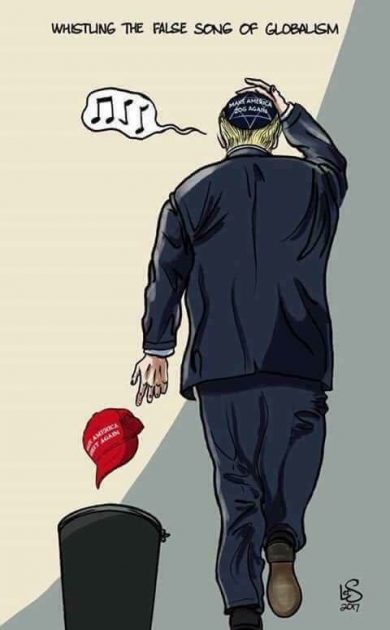 On Wednesday the White House Press Secretary Sarah Huckabee Sanders equated Donald Trump’s declaration that Jerusalem is Israel’s capital and his decision to move the US Embassy in Israel from Tel-Aviv to Jerusalem with putting America first.


 Aletho News
 Aletho News