Canadian and Israeli colonialism versus First Nations
By Yves Engler · July 20, 2018
Ironic: Interesting, strange or funny because of being very different from what you would usually expect.
By allowing the Haudenosaunee to travel to Israel for the World Lacrosse Championships on their own passports Canada undermined its colonial authority. But, Ottawa did so at the behest of those promoting the most aggressive ongoing European settler colonialism.
“As indigenous peoples, we have both seen our traditional lands colonized, our people ethnically cleansed and massacred by colonial settlers,” the Palestinian Campaign for Academic and Cultural Boycott of Israel wrote the Iroquois (Haudenosaunee) Nationals on July 4.
“We are asking you to respect our nonviolent picket line by withdrawing from the 2018 World Lacrosse Championships, denying Israel the opportunity to use the national sport of the Iroquois to cover up its escalating, violent ethnic cleansing of Palestinians throughout our ancestral lands.”
While a number of Nationals players expressed support for the Palestinians’ plight, the team rejected the call, possibly fearing a fine or banishment from future tournaments. Also affecting the Iroquois’ decision, whose confederacy crosses the Canada-US border, was the political importance they place on competing internationally.
As “the only First Nations team officially sanctioned to compete in any sport internationally”, playing lacrosse internationally is a way to assert their sovereignty, especially when governments accept their Haudenosaunee passports. As such, Canada often makes it difficult for them to travel on their First Nation passports. The Nationals were forced to withdraw from the 2010 World Lacrosse Championships in England for that reason.
Last Monday the Nationals were stopped from flying out of Toronto on their Haudenosaunee passports. But, two days later Ottawa came to an agreement with Tel Aviv after Israeli officials, former justice minister Irwin Cotler, New England Patriots owner Robert Kraft and the Centre for Israel and Jewish Affairs (CIJA) intervened out of fear their nonparticipation in the tournament would bolster the Palestinian BDS movement.
According to the Aboriginal Peoples Television Network, Canada granted the team, though “no other Haudenosaunee passport holders, a one-time exemption to travel to Israel using their Indigenous passports.”
In response, the co-founder of the Electronic Intifada, Ali Abunimah, noted on Twitter,
“Justin Trudeau bends Canada’s refusal to recognize Haudenosaunee passports, but only for Israel.”
Anti-Palestinian groups labeled the Nationals participation in the tournament “a victory for Israel”. “The fact that they are here is a tremendous victory against BDS”, exclaimed former Israeli Knesset Member Dov Lipman, who played a key role in navigating intense diplomatic discussions between Canada and Israel, detailed in a Jerusalem Post story titled “The Iroquois Nationals lacrosse team’s incredible journey to Israel.”
Born and raised in the traditional territory of the Piscataway, Lipman immigrated from the US to the Israeli city of Bet Shemesh in 2004. Designated as part of the Palestinian state in the 1947 UN Partition Plan, Bet Shemesh was built on the ruins of the Palestinian town of Bayt Nattif, which Israeli forces depopulated of non-Jews in October 1948.
For its part, CIJA announced that they “were pleased to play a role in helping the Iroquois Nationals lacrosse team overcome challenges related to their journey to participate in FILacrosse 2018 World Championships in Netanya. The team is now en route to Israel.”
The campaign to get the Nationals to Israel is the latest example of Israel lobby groups’ work to thwart those who associate the plight of First Nations and Palestinians. Over the past fifteen years, Jewish and Christian Zionist groups have brought hundreds of First Nations leaders, educators, students and clergy to Israel.
In 2006 the Canadian Jewish Congress (CJC) took Assembly of First Nations (AFN) leaders, including Grand Chief Phil Fontaine, to Israel. Two years later the CJC sponsored a delegation of indigenous women to the Golda Meir Mount Carmel International Training Centre. In 2007 and 2010 former Grand Chief of the AFN and head of the Misipawistik Cree, Ovide Mercredi, participated in tours organized by the explicitly racist and colonial Jewish National Fund.
In 2012 CIJA sponsored an Indigenous Tour to Israel with Cree and Inuit leaders as well as indigenous representatives from Australia, Fiji, New Zealand, Samoa, and Greenland. One participant was the Chief of Norway House Cree Nation, Ron Evans. A former Grand Chief of the Assembly of Manitoba Chiefs, Evans called Jews “the true, historic Indigenous people of Israel.”
In 2014 StandWithUs Canada sponsored a trip for Ryan Bellerose, a Metis from northern Alberta, who has become a leading Israel advocate. Bellerose writes articles titled “Are Jews Indigenous to the Land of Israel? Yes” and speaks about the “effective use of the indigenous rights argument in Israel advocacy.”
Despite running into trouble for labeling Palestinians resistance members “sewage” and implying that women in Gaza were “goats” or “sheep”, B’nai Brith hired Bellerose as its advocacy coordinator for western Canada in 2016.
In Manitoba, B’nai Brith is part of a Jewish/Aboriginal/Christian Round Table that has promoted indigenous Christian Zionism. One of its acolytes is leading aboriginal Christian Zionist preacher Raymond McLean, who was profiled in a November Walrus story titled “Inside the Controversial US Evangelical Movement Targeting Indigenous People.”
To highlight Israel’s 60th, the pastor of the First Nations Family Worship Centre in Winnipeg launched World Indigenous Nations for Israel. McLean told Israel birthday revelers in Winnipeg: “We are going to be celebrating all year because the Jewish people got their land back that God had promised them.” McLean, who visited Israel 16 times between 2003 and 2012, said: “I believe that since the Jewish people are God’s chosen people, we have to stand with them.”
McLean explicitly dismisses the connection between settler colonialism in Canada and Israel. But, in doing so he employs a terra nullius/Doctrine of Discovery type argument — which was used to justify settling Turtle Island — to deny Palestinian indigeneity. According to McLean:
“There were Arab nomads who lived in the Holy Land prior to the establishment of the State of Israel in 1948 who were hired by the new Jewish settlers.
Also, neighboring Arabs from Jordan, Syria, Lebanon, Saudi Arabia, and Egypt sought employment and were hired by the Jews who were settling in their new land after returning from exile after 2,500 years to reclaim their inheritance left by the ancestors. These Arabs became known as Palestinians but were originally Arab nomads and neighbors of Israel who Israel endorsed and recognized as Israeli citizens.”
Israel lobby groups have worked hard to build support among First Nations. By enabling the Nationals to participate in the World Lacrosse Championships they succeeded in gaining indigenous cover for the most aggressive ongoing European settler colonialism.
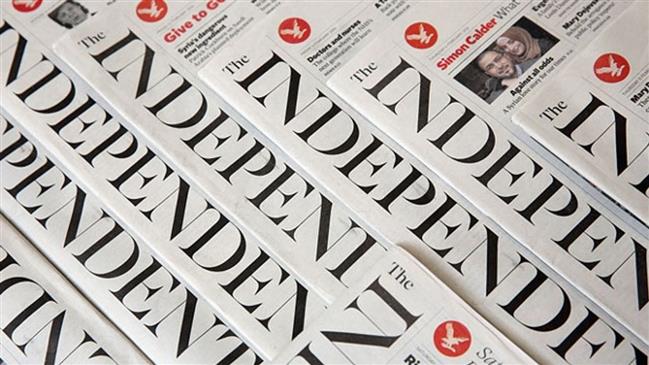
Saudi Arabia hires UK-based The Independent to launch Persian news site
Press TV – July 20, 2018
Saudi Arabia has hired the UK-based Independent media corporation to launch a slew of news websites in Persian and other languages.
Under the deal, the British outfit would create up to four websites for the Saudi Research and Marketing Group (SRMG), which is tied to the Saudi royal family and often promotes the regime’s agenda.
Despite ownership by the SRMG, the news outlets — Independent Arabia, Independent Urdu, Independent Turkish, and Independent Persian — would be owned and operated by SRMG and would follow the editorial standards of The Independent.
“Four new websites will offer the highest-quality, free-thinking, independent news, insight and analysis on global affairs and local events,” the daily said in a statement.
“These will be published in Arabic, Urdu, Turkish and Persian. Each site will feature direct translations of articles from independent.co.uk alongside content from teams of SRMG journalists based in London, Islamabad, Istanbul, and New York,” the statement added.
This is not the first time the kingdom is approaching British media outlets to expand its propaganda machine.
The SRMG struck a similar agreement with Bloomberg last year to launch an Arabic outlet.
The push to promote the Wahabi-inspired Saudi ideology became more apparent last year, when Saudi investor Sultan Abuljadayel bought about a third of The Independent’s shares.
The move sparked concerns about the independence of the website, which is owned by British-Russian billionaire Evgeny Lebedev.
Lebedev, the son of a former KGB spy, tried to play down the concerns by calling Abuljadayel a “minority shareholder” and promised that his money would not influence the company’s direction down the road.
However, Lebedev will have a harder time explaining the new decision since the SMRG is clearly tied to Saudi authorities.
The firm had been chaired by Prince Bader bin Abdallah bin Mohammad bin Farhan, a close confidant of Crown Prince Mohammed bin Salman who is currently serving as the kingdom’s minister of culture.
The prince made the headlines earlier this year when he bought a Da Vinci painting for $450 million, reportedly on behalf of none other than bin Salman.
The SRMG already owns several major Arabic news outlets, including Asharq Al-Awsat and Arab News, which promote the Saudi position on regional issues.
Saudi Arabia has been linked with various anti-Iranian groups and is widely believed to have provided them with financial and logistic support to fuel sectarianism in the Islamic Republic.
The kingdom has openly supported the People’s Mujahedin of Iran (MKO) terror group, which has killed thousands of Iranians since 1979.
Ocasio-Cortez “Evolves” Her Position on Palestine to Please Zionist Democratic Mega-Donors
By Whitney Webb | Mint Press News | July 16, 2018
NEW YORK – During a recent interview with PBS and just two weeks after her historic upset victory against 10-term Congressman Joe Crowley (D-NY), Alexandria Ocasio-Cortez seemed already to be walking back from at least some of her more “radical” positions voiced prior to her Democratic primary win.
While her primary victory has certainly made the young New Yorker a new “rising star” in the Democratic Party, all the new attention seems to have come at a price, particularly as she now aims to court major Democratic Party donors as the general election approaches. Many of those donors, such as the Zionist entertainment billionaire Haim Saban, are unlikely to be supportive of her past positions on key issues, particularly her prior statements on Israel and Palestine.
Appearing on PBS’ Firing Line on Friday, Ocasio-Cortez surprised many of her supporters as she toned down statements she had made earlier this year regarding Israel, particularly Israel’s occupation of the West Bank and its brutal crackdown on demonstrators in the Gaza Strip. That crackdown saw over 6,000 unarmed protesters shot by Israeli Defense Forces and hundreds killed, resulting in international condemnation.
Though she had tweeted on May 14 that the Israeli crackdown in Gaza was a “massacre,” and expressed hope that her “peers have the moral courage to call it such,” Ocasio-Cortez distanced herself from that statement during her recent PBS interview, asserting that she had made that statement as an “activist” and not as a congressional candidate for the Democratic Party.
That statement alone suggests that other positions voiced by Ocasio-Cortez prior to her primary win could also be subject to revision over the next few months in the lead-up to the midterm elections in November.
Ocasio-Cortez went on to distance herself from other past statements she had made regarding the Israel-Palestine conflict, including having used the term “occupation” when referring to Israel’s military rule over Palestine’s West Bank. For instance, when asked to expand on what she had meant by “the occupation of Palestine,” Ocasio-Cortez only referred to the fact that “[Israeli] settlements … are increasing in some of these areas.” When prodded further, she stated that she was “not the expert on geo-politics on this issue” and that she may not always “use the right words” when discussing the Israel-Palestine conflict.
The 28-year-old candidate, whom PBS had introduced as “the vanguard of the American progressive movement,” also expressed during the interview that she believes “absolutely in Israel’s right to exist” and called herself a “proponent of the two-state solution.” However, given Israel’s aggressive policies aimed towards annexation of the West Bank and the U.S. government’s current support for such measures, Ocasio-Cortez’s support for the two-state solution reflects either a lack of knowledge on the subject or an unwillingness to face the fact that a two-state solution is largely impossible. Given her past statements on Palestine while still an “activist,” the latter seems to be more likely.
Indeed, prior to the PBS interview, Ocasio-Cortez had been promoted as a “pro-Palestine socialist” and had been praised by leftist pundits like Glenn Greenwald for her “moral courage” in standing up for the “human dignity” of Palestinians. Given the amount of attention her past pro-Palestine comments had received, her decision to walk back those positions just a few weeks after her primary win is particularly jarring.
Also eye-opening was the fact that Ocasio-Cortez concluded her statements on the topic by saying that she was willing to “learn and evolve on this issue.” In other words, she essentially rejected her past “activist” positions on Palestine in favor of allowing her position on the issue to “evolve” into one more acceptable to the Democratic centrists and the powerful pro-Israel elements that hold considerable sway within the Democratic party. Indeed, the pro-Israel lobby has already given over $5 million to the Democratic Party over the past year.
It remains to be seen whether Ocasio-Cortez is equally willing to renege, or rather “evolve,” on other progressive issues as the general election approaches. Yet, given that she is already walking back on her past rhetoric just a few weeks after her victory, it seems likely that Ocasio-Cortez of November could be very different in terms of policy from the Ocasio-Cortez of today.
Whitney Webb is a staff writer for MintPress News and a contributor to Ben Swann’s Truth in Media. Her work has appeared on Global Research, the Ron Paul Institute and 21st Century Wire, among others. She has also made radio and TV appearances on RT and Sputnik. She currently lives with her family in southern Chile.
NATO is a Con Game
By Raúl Ilargi Meijer | The Automatic Earth | July 11, 2018
Okay, well, Trump did it again. Antagonizing allies. This time it was Germany that took the main hit, over the fact that it pays Russia billions of dollars for oil and gas while relying on the US for its defense … against Russia. And yes, that is a strange situation. But it’s by no means the only angle to the story. There are many more.
For one thing, The US has by far the largest military industry. So it makes a lot of money off the billions already spent by NATO partners on weaponry. Of course Raytheon, Boeing et al would like to see them spend more. But once they would have done that, they would clamor for even more after.
At some point one must ask how much should really be spent. How much is enough, how much is necessary. The military-industrial complex (MIC) has every reason to make the threat posed by ‘enemies’ as big as they possibly can. So knowing that, we must take media reports on this threat with tons of salt.
And that is not easy. Because the MIC has great influence in politics and the media. But we can turn to some numbers. According to GlobalFirePower, the US in 2018 will spend $647 billion on its military, while Russia is to spend a full $600 billion less, at $47 billion. And the US Senate has already voted in a $82 billion boost recently.
There are other numbers out there that suggest Russia spends $60 billion, but even then. If Moscow spends just 10% of the US, and much less than that once all NATO members’ expenditure is included, how much of a threat can Russia realistically be to NATO?
Sure, I’ve said it before, Russia makes weapons to defend itself, while America makes them to make money, which makes the latter much less efficient, but it should be glaringly obvious that the Russia threat is being blown out of all proportions.
Problem with that is that European nations for some reason love playing the threat card as much as America does. After all, Britain, France and Germany have major weapons manufacturers, too. So they’re all stuck. The Baltic nations clamor for more US protection, so does Sweden, Merkel re-focused on Putin just days ago, the game must go on.
Another way to look at this is to note that UD GDP in 2017 according to the IMF was $19.3 trillion, while Russia’s was $1.5 trillion. NATO members Germany France, Britain, Italy and France all have substantially higher GDP than Russia as well. European Union GDP was $17.3 trillion in 2017.
If this economically weak Russia were really such a threat to NATO, they would be using their funds so much better and smarter than anyone else, we’d all better start waving white flags right now. And seek their help, because that sort of efficiency, in both economics and defense, would seem to be exactly what we need in our debt-ridden nations.
The solution to the problems Trump indicated this morning is not for Germany et al to spend more on NATO and their military in general, but for the US to spend less. Much less. Because the Russian threat is a hoax that serves the interests of the MIC, the politicians and the media.
And because America has much better purposes to spend its money on. And because we would all be a lot safer if this absurd theater were closed. To reiterate: developments in weapons technology, for instance hypersonic rocket systems make most other weapons systems obsolete. Which is obviously a big threat to the MIC.
Russia attacking NATO makes as much sense as NATO attacking Russia: none whatsoever. Unwinnable. Russia attacking Germany and other European countries, which buy its oil and gas, makes no sense because it would then lose those revenues. From that point of view, European dependence on Russian energy is even a peacemaker, because it benefits both sides.
Can any of the Russiagate things be true? Of course, Russia has ‘bad’ elements seeking to influence matters abroad. Just like the US does, and France, Britain, Germany, finish the list and color the pictures. How about the UK poisoning stories? That’s a really wild one. Russia had no reason to poison a long-lost double spy they themselves let go free years ago, not at a time when a successful World Cup beckoned.
342 diplomats expelled and risking the honored tradition of exchanging spies and double agents from time to time. Not in Moscow’s interest at all. Britain, though, had, and has, much to gain from the case. As long as its people, and its allies, remain gullible enough to swallow the poisoned narrative. Clue: both poisonings, if they are real, occurred mere miles from Porton Down, Britain’s main chemical weapons lab.
And c’mon, if Putin wants his country strong and independent, the last thing he would do is to risk his oil and gas contracts with Europe. They’re simply too important, economically and politically. Trump may want some of that action for the US, understandably, but for now US LNG can’t compete with Russian pipelines. Simple as that.
Let’s hope Trump and Putin can talk sense in 5 days. There’s a lot hanging on it. Let’s hope Trump gets his head out of NATO’s and the US and EU Deep State’s asses in time. There’s no America First or Make America Great Again to be found in those dark places. It’s time to clear the air and talk. America should always talk to Russia.
Funny thing is, the more sanctions are declared on Russia, the stronger it becomes, because it has to learn and adapt to self-sufficiency. Want to weaken Russia? Make it depend on your trade with it, as opposed to cut off that trade. Well, too late now, they won’t trust another western voice anymore for many years. And we’re too weak to fight them. Not that we should want to anyway.
We’re all captive to people who want us to believe we’re still stuck in the last century, because that is their over-luxurious meal ticket. But it’s all imaginary, it’s an entirely made-up narrative. NATO is a con game.
Senate Minority Leader Introduces ‘Democrats Only’ Marijuana Prohibition Roll-back Bill
By Daniel McAdams | Ron Paul Institute | June 29, 2018
In October, a Gallup poll found, for the first time, majority support among Republicans for legalizing marijuana. Such majority support had already existed among Democrats and independents. Then, this month, huge majorities of delegates at the Republican Party of Texas state convention approved party platform planks calling for decriminalizing marijuana possession; moving marijuana from Schedule 1 to Schedule 2 of the United States government’s Controlled Substances Act; allowing the cultivation, manufacture, and sale of hemp and hemp products; and expanding the state’s low-THC cannabis oil medical program. And, this week, voters approved a medical marijuana ballot measure in Oklahoma, another “conservative” state, making it the 30th state to legalize medical marijuana.
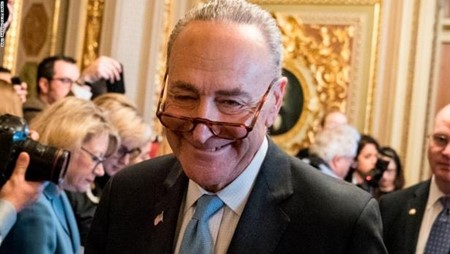
The time seems to be ripe for Democrats in the US Congress to reach out for Republican support in ending the US government’s marijuana prohibition. Yet, this week, Senate Minority Leader Chuck Schumer (D-NY) instead chose to introduce the Marijuana Freedom and Opportunity Act (S 3174), a bill that seeks to remove much of the United States government’s marijuana prohibition and includes a provision that will likely ensure that the bill receives support from few to no Republicans.
The provision directs that a portion of US taxes generated each year from the marijuana industry be placed in a newly created “Marijuana Opportunity Trust Fund” from which the money will be distributed via Small Business Administration loans to marijuana companies owned and controlled by women and “socially and economically disadvantaged individuals.” Looking at US statutes subsection 15 USC 637(d)(3)(C) that explains the meaning of “socially and economically disadvantaged individuals” one finds out that the group is presumed to include “Black Americans, Hispanic Americans, Native Americans, Asian Pacific Americans, and other minorities.”
In short, included in Schumer’s bill is a special race-and-sex-based subsidy for marijuana businesses. This provides clear reason for Republican senators — many of whom already are wary of supporting a significant marijuana prohibition roll-back — to not support the bill. First, race-and-sex-based government preferences tend not to be popular among Republican voters and politicians. Second, the provision converts the bill from legislation that just takes the small government step of eliminating marijuana-related legal restraints to legislation taking the big government approach of subsidizing marijuana businesses. A Republican Senator who cosponsors or votes for the bill would, in general, be endorsing a new government subsidy and, in particular, be helping fund marijuana businesses — something much different than merely tolerating their existence.
Revisiting Litvinenko, What Really Happened?

By Ryan Dawson | ANTI-neocon Report | April 26, 2015
As we all know Alexander Litvinenko was poisoned by polonium, a rare radioactive substance. The main narrative blamed it all on Vladimir Putin of Russia. The rationale rested on little other than because Litvinenko was a Putin critic. This was the quick line in mass media, and it was on all the typical war propaganda channels. Thanks in large part to Alexander Goldfarb, a stooge of exiled oligarch Boris Berezovskiy, having twisted the tale of the poisoning into a ‘Putin did it’ cover up for a botched smuggling operation, by declaring this was Litvinenko’s belief, expressed in a death bed letter that he allegedly signed. Really? And he wanted you, Goldfarb, a biologist who worked for the Oligarch, not a lawyer, to witness this letter and read it to the media? Why were you even there? Akhmed Zakayev thought Goldfarb was CIA.
There are many things wrong with the “Putin did it” story. For one, there is no motive, even with Litvinenko being a critic of Russia, he was no threat whatsoever to Putin. The man worked with Chechen terrorists and the Israeli-Russian oligarchs. But assuming that there was a sufficient motive to kill him, think about this: Why would Russia use a very rare, very expensive, and easily traceable radioactive substance to kill him instead of some cheap poison or just shooting him? Why risk smuggling radioactive material into the UK which is an act of war? And why poison someone on the same day Britain signed an accord to make it easier for Russia to extradite high profile criminals. London has become a central hub for asylum-seeking Russians. The UK has not extradited a single person to face Russian court. Many oligarchs fled to the US and Israel because of their non-extradition status. Israeli-Russian Boris Berezovsky, the former oligarch and media owner, and Ahmed Zakayev, the Chechen leader who was arrested in the UK, got a 50,000GPB bail paid and then got political asylum both landed in Britain.
Yet this murder by radioactive poison scandal is exactly what the UK/US media would have you believe. They want to say that Putin had someone sneak into the UK with polonium and poison Litvinenko with it. It just isn’t plausible. It’s actually absurd. Why would the American media side with the man who worked for terrorists and who worked for one of the exiled oligarchs? Well first off these “Russian” oligarchs are primarily Zionist Israeli-Russians who acquired much of their wealth and techniques from the Israeli Mossad agent Marc Rich. Secondly they have business relationships with the Bush administration. The Israeli-Russian Oligarch Khodorkosky had dealings with Cheney, the Carlyle group, and with UNACOL. Boris Berezovsky is a business partner with none other than President Bush’s brother Neil Bush. Boris invests in Neil’s Ignite! computer software, and Neil Bush met with Boris even after he was a known felon. One of the most wealthy Oligarchs used to be Oligarch Khdorkovsky of Yukos oil. He was worth over 15 billion dollars rivaling Roman Abramovich the richest of them all. Khodorkosky was buying votes in the Duma. Putin cracked down on the oligarchs forcing many to flee and arresting and throwing Khodorkosky in jail. He recently just had further charges placed on him to make his stay in jail all that much longer.
The Khodorkovsky arrest followed an unpublicized meeting earlier that year on July 14, 2003, between Khodorkovsky and Cheney. Following the Cheney meeting, Khodorkovsky began talks with ExxonMobil and ChevronTexaco, Rice’s old firm, about taking a major state in Yukos, said to have been between 25% and 40% –source
 The Washington Post reported “Days before his October 2003 arrest on tax fraud charges, Khodorkovsky had entertained George H W Bush, the representative of the powerful and secretive Washington Carlyle Group in Moscow. They were discussing the final details of the US oil company share buy-in of Yukos…
Yukos had also just made a bid to acquire rival Sibneft from Boris Berezovsky, another Yeltsin-era oligarch. YukosSibneft, with 19.5 billion barrels of oil and gas, would then own the second-largest oil and gas reserves in the world after ExxonMobil.”
YukosSibneft would be the fourth-largest in the world in terms of production, pumping 2.3 million barrels of crude oil a day. The Exxon or Chevron buy-up of YukosSibneft would have been a literal energy coup d’etat. Cheney knew it; Bush knew it; Khodorkovsky knew it. Above all, Putin knew it and moved decisively to block it.- William Engdhal
Sibneft’s Boris Berezovsky just so happens to be the Israeli-Russian oligarch who lives in London who Litvineko worked for. Alexander Litvinenko who was formerly FSB fled to the UK to avoid court prosecution in Russia, worked for a shady Russian oligarch, Boris Berezovsky. Boris Berezovsky just so happens to be the Israeli-Russian oligarch who lived in London after fleeing the Russian judicial system for a multitude of crimes too long to list. He was on Interpol’s most wanted list. Here is the grand prize. After the US and UK press branded Putin with the poisoning despite there being Zero evidence, (something the US is very well known for now) investigators were tracking down the traces of Polonium in the UK. They detected traces of Polonium at Berezovsky’s office and residence! Now I do not know about you, but in my place of work, and certainly in my house, I do not have rare radioactive substances. Polonium is not something you just get at the market or pick up by accident walking through the park.
No experienced mob boss like Berezovsky would be dumb enough to murder an underling in such a manner either. Therefore his death was an accident. It was mostly likely it was a botched smuggling operation. Why was he moving such a dangerous substance? Did he need fast cash? Were they planning to create a dirty bomb? Such a “smoky bomb” would turn the Polonium into powder and kill anyone who ingested it.
Traces of Polonium were found on the planes that Litvinenko had been on. So I think we can deduce what happened. He was a mule. The questions remain, why did he have it?, Where did he get it? What was he going to do with it? Why was it in the offices of Berezovsky and Erinsys Ltd (Britain’s Blackwater)?
The “Putin did it” smear case has never made sense. First of all, the amount of polonium 210 in play would have cost millions of dollars. That amount is too expensive to purchase and too large to go unnoticed if it were stolen. The only way to obtain such a quantity would be on a well organized black market that had a connection to a nuclear facility. It would certainly help organized crime if the nuclear powered supplier they received the Polonium from was not subjected to international inspections or part of the nuclear nonproliferation treaty. Such a country, (Foreign country A) which denied they even built nuclear weapons for decades, would certainly also deny selling their Polonium byproduct as well.
Is it possible to hide that from the press? Yes. The media would ignore this for the same reason the media ignores them stealing nuclear secrets and building hundreds of nuclear weapons in Dimona, then throwing whistle blowers who took pictures of their warheads, in jail.
Litvinenko was in Israel, where he met Leonid Nevzlin the CEO of Yukos shortly before he died. If you wanted to buy/steal radioactive material that would be the place. What was he negotiating with Nevzlin? We learned Alexander had been an informant in a case that led to the arrest of nine Georgina and Russian Mobsters in Spain, including Alexander Gofstein a lawyer for Yukos who apparently was laundering money.
The downfall began when Georgina Mob Boss Zakhar Kalashov was arrested in May 2006. The scam was similar to what the old Five Families of New York had done, when guys like Meyer Lansky took profits from illegal gambling businesses and funneled them into buying up real estate in Florida. In the European case, the mob was taking illegal funds and buying up real estate in Spain as well as making investments into legitimate businesses.
Litivnenko’s associates, Dmitry Kovtun and Andrei Lugovoi, who both had met with him the day of the poisoning, were also both hospitalized. They left traces of Polonium in Hamburg as they had taken the trip to Germany before meeting Litvinenko. It appears all three were involved in a smuggling operation, but for who?
Short answer: Russian Oligarch Boris Berezovsky’s employee Alexander Litvinenko died from over exposure to Polonium in a botched smuggling operation. That is why traces of it were at Boris’s house and on the planes Litvinenko was riding to and from Israel. The smear on Putin/Russia using a highly traceable 10 million dollar poison to kill a critic is about as plausible and rational as saying we have “British Intelligence” about Niger…. This transparent bogus lie was a quick and shamelessly sloppy explanation to cover up how and why this man in the UK had a radioactive poison in his body. Polonium only has a half life of 138 days.
Litvinenko had been in Israel to visit Yukos’s CEO, just shortly before he died. And it’s an open secret that Israel has nuclear weapons, the only place without nuclear safeguard or inspections. Traces of polonium were also on the British Airway planes that Litvinenko took to and from Israel. So it they would have the means, location, and the timing fits, but let’s just blame, Putin “The New Hitler” as Neocons have dubbed him?
Why the fuss about a conspiracy claiming that Putin put Litvinenko on a hitlist and poisoned him? Well as wacky as that story is, it was probably the best they could come up with on short notice. Boris knew once the police found out how Litvinenko died that there would be a lot of explaining to do. He also knew that if the investigation went forward that they could find more of this Polonium on his properties. So they just claimed the KGB was trying to kill them all.
Some History
This is not the first time that Berezovsky tried to pin a murder on someone else and claim that all the damning evidence pointing to him was a frame. There are the notorious cases (in Russia) of Ivan Litskevich and Vlad Listyev.
Ivan Listkevich was the general director of the Omsk oil Refinery easily the best refinery in Russia. Abramovich and Berezovsky planned to take over the refinery and make it part of Berezovsky’s Sibnef (which it now is). Listkevich resisted. Ivan had outside investments from LUKoil (10% of the stock) and CS First Boston. So in no way was he threatened to sink. Omsk was in the best location, had the latest equipment, and was well positioned to continue to soar. They serviced the biggest oil producers in Russia. Naturally Ivan did not want to be swallowed by Sibnef. On August 19, 1995 Ivan was found drowned in the Irtysh River. I doubt he went there to swim. Five days later Sibnef (Gazprom) took over. August 24th 1995, using his good buddy Yeltson, Berezovsky got a Presidential Decree №872, to order a transfer of all the state’s share in Omsk as well as 4 other companies to Sibnef. Then in 1996 Boris and Roman privatized Sibnef through a series of Loans-for-Shares’ auctions which were a complete scam run through front companies and offshore banks. Yeltsin approved of it.
The case may leave doubts in the mind until one learns about the murder of Vlad Listyev. In 1994 Boris attacked one of his rivals over control of a media outlet. Part of the attack was broadcast all over TV and came to be known as “faces in the snow” as Boris’s rival’s bodyguard were forced at gun point to lie face down in the snow. Shortly after a 90mph high speed chase and attacking rival Gusinsky’s MOST guards and pinning Gusinsky in his own building, Berezovsky would take control of ORT (channel 1) through an illegal non-public “auction” and gain a near media monopoly.
For details on that I recommend reading “God Father of the Kremlin” if you can still find it. It was written by the senior editor of Forbes in Russia who holds a Ph.D in Russian history Paul Klebnikov. For the record Paul Klebnikov was killed after publishing his book on the Oligarchs, particularly on Boris, who is on the cover. He was shot four times in Moscow while leaving work and then died in the hospital after getting stuck on an elevator.
After the Gusinsky event, Boris had another problem. Vladislav Listyev. Listyev was probably the most popular talk show host in Russia and a TV producer. He was a business partner with Boris but the problem was he was not crooked. As general director of ORT he decided to fix a multi-million dollar leak in the company and in direct way of Boris paying people off in the Mob to do dirty work, as well as paying himself by spending money for ads in other companies he owned where he also ran the advertising sales. He had an offer from Sergei Lisovsky to buy up the sector. Negotiations never went through and Vlad had a different idea.
On Feb 20th 1995 Vlad announced that he would break the monopoly of Boris and Sergei. He called for a moratorium on ORT advertising until they could work out ethical standards. As you can imagine that did not make Boris or the rest of the mob happy. Eight days later Boris personally met with “Nikolai” a mafia boss, and handed him a hundred thousand dollars in cash. This was witnessed by two police officers who were monitoring the Mob. Prior to that Boris’s lacky Badri offered money to a different gangster but that man was arrested before he could do what was asked of him and he confessed this in jail. On March 1st the day after Berezovsky paid a second Mob Boss, Vlad Listyev was shot in the back at the entrance of his home.
Guilty as sin, with a confession against Badri as well as being personally witnessed by two police, offering another mob boss money, Boris was desperate. He was inches away from being arrested. Boris’s TV network was cut out of government subsidies after the police raided it and it was subject to bankruptcy. Fellow Media giant and friend Ruppert Murdoch promised to invest in the network and bail him out. How nice. And we all know where Murdoch stands. This relationship might also explain why Fox News and Sky News in the UK were so blatantly cheerleading the “Putin killed Litvinenko” conspiracy story.
But here is the real kicker. It is just as outrageous and far fetched as the Litvinenko poisoning. Boris concocted a story for Yeltsin which was recorded on video tape produced by Irina Lesnevskaya a producer at ORT and a friend of Yeltsin’s wife. The tape claimed that it was all a big conspiracy against Berezovsky and that the real culprit (who had no motive other than to frame Boris [apparently able to hire a gun to kill Vlad but not Boris?) was none other than bitter rival Gusinsky of Most Bank who Boris had already tried to kill once.
Yeltsin was paranoid of Gusinsky’s political ambitions and Boris knew this. Boris also blamed X-KGB and said Vlad was killed by the MOST group, and not the mob he was witnessed meeting with a week after Vlad was going to break his monopoly. (Sounds like “Iraq moved the nonexistent WMDs to Syria just to make the US look bad.” give me a break) Boris claimed to be set up because he was loyal to Yeltsin as was his new media outlet.
Yeltsin ever a partner in cover ups, not to mention a drunk and a thief, got Boris out of trouble once again by firing the lead investigators in the case which intimidated others to drop it. There was a huge public outcry. A TV personality had been killed. ORT created a new company called ORT advertising with a monopoly to sell ads on commission no less, and the boss-man chosen was none other than Sergei Lisovsky. Wow how utterly shameless.
If you can speak Russian or if you can find an English copy of the Boris/Lesnevskaya tape transcript sent to Yeltsin, it’s going to make you very angry. It is about as plausible as saying Putin risked an act of war with the UK to kill a critic who worked for both a criminal as well as terrorist.
Who Done It?
So we know what didn’t happen. But there still remains a “who done it.” The quickest way to get to the bottom of this is to see who is lying the most and loudest, because that is usually who has the most to hide.
Remember Anna Politkovskaya? She was killed on Putin’s birthday and the alternative press and the ‘mindlessly accepting any conspiracy’ types who fell for it, tried to use that circumstantial “evidence” to blame the murder on Putin.
These are the same types that claim Russia bombed its own apartment buildings to start a war with Chechnya omitting the fact that the apartment bombing took place five months after the war has already started, and the “sources” trying to blame the FSB were none other than Boris’s lacky Litvinenko and well known plagiarist David Satter, who wrote for the PNAC co-founders’ Weekly Standard, which gave the world all the bogus lies about Iraq’s WMD and connection to the September 11th attacks. Robert Kagan, the paper’s cofounder with William Kristol, wrote an op-ed in the Washington Times calling “Speaking of Iraq” which pushes every erroneous prewar scare tactic there was. His wife Victoria Nuland is the same woman who was recorded on the phone saying “F” the EU and openly talking about who would be a good replacement Prime Minister in Ukraine. She chose Arseniy Yatseniuk, who she called “Yatz” and he did become the prime minister of Ukraine a month later after the coup. Everything out of this faction’s mouth has been blindly anti-Russian.
There is a huge difference between conspiracy and kookspiracy. Getting away from the outlandish unsubstantiated claims about Anna’s death, let’s uncover something factual. Anna Politkovskaya was the journalist who had published three different articles on how SOMEONE was testing Polonium on Chechen children. Gee! Where have we seen THAT scenario before? Anna’s articles were published in the Novaya Gazeta in 2006 and she was killed October of that same year.
The Washington Post then makes this clever claim. “Leonid Nevzlin, a former Yukos oil company shareholder and Russian exile currently living in Israel, told the Associated Press in late November that Litvinenko had given him a document related to a dossier on criminal charges made by Russian prosecutors against people connected to Yukos. Nevzlin, who is charged by Russian prosecutors with having organized killings, fraud and tax evasion, claimed Litvinenko’s inquiries may have provided a motive for his poisoning”
Notice who else is in that Washington Post article (Scaramella) and who was planting the ideas that Putin had killed both Litvinenko and Anna. How crazy is that to use polonium to murder someone… Scaramella is a rotten one. After Anna’s lawyer Stanislav Markelov was murdered in 2009 followed by the murder of one of her key informants in Chechnya, Natalia Estemirova, the same year, there was a retrial in Anna’s case which went to the Supreme Court. Chechen president Ramzan Kadyrov stirred up a public disgust when he said about Anna’s informant Natalia Estemirova on Radio Liberty “She was a woman… who had never possessed any honor, dignity or conscience.”
The prosecution cornered Dmitry Pavliutchenkov a former policeman who in turn confessed Lom-Ali Gaitukayev was who negotiated the contract killing and behind him he suspected Boris Berezovsky. Dmitry was sentenced to 11 years in jail. Five men were found guilty in her murder. Three were the Chechen brothers who had been acquitted in the first trial and they went to prison. Rustam Makhmudov and Lom-Ali Gaitukayev got life sentences in 2014. Berevsovsky had died the year before in March of 2013.
They were already testing the poison on Chechens and killed the journalist uncovering the story. Lit overdosed by accident and the Oligarchs had to quickly create a story to explain how it is possible such a shady character had any contact with this stuff. So they do what they did before, blame it on a conspiracy of Boris’s enemies even when there is no motive, no evidence and not even simple logic to it.
The most troubling thing here is not that the mob did something illegal or that the Western press jumped the gun to do an anti-Russian witch hunt. All of that is pretty run of the mill. It’s not even that Israel secretly has nukes and is involved with organized crime. Again, imagine my lack of shock. It’s not even the multiple murders that are most troubling. The most troubling part of this story is what the ultimate purpose of that much Polonium was and why it was in the UK. The potential for a dirty bomb is enormous. With the current climate of ISIS and disgruntled youth in Europe joining the mercenary forces to fight Israel’s enemies in Syria and Lebanon, a dirty bomb in the UK is not an unimaginable scenario. Just having such a thing could also hold leverage over politicians there too. The source of the Polonium should have been traced and potential sources should also be subject to inspection.
US’ Iran Regime-Change Plan: Hit Economy, Orchestrate Protests, Engage MEK Cult to Chant “Democracy”
By Elliot Gabriel | Mint Press News | June 28, 2018
Iran’s latest wave of protests against the suffering state of the economy and the plunging value of the rial appeared to have come and gone by Wednesday, as crowds dissipated and businesses opened up shop following a two-day strike. While clashes between security forces and protesters during the protests were far from widespread, the very fact that the protests broke out hints at the extreme duress Iran is undergoing thanks to President Donald Trump’s renewed economic war on the country.
Judging by the enthusiastic response to the demonstrations in the U.S., Saudi, and Israeli press, anti-Iranian forces are clearly banking on the possibility that the sanctions that will soon be reimposed in the next several months could dislodge the Islamic Republic, clearing the way for a regime friendly to the West.
Thus we have witnessed anti-Iran publications like the Israeli Jerusalem Post frothing over with excitement over scenes of alleged Iranian citizens chanting “Death to Palestine,” “Let go of Syria – think about us,” and the much-beloved anti-Ayatollah Khamenei mainstay “Death to dictator.”
While videos from Iran depict what could very well be an organic groundswell of social protest against government policies, photos published in papers like the Post show a different story: middle-aged Persian men gripping English-language signs and the flags of the toppled Iranian monarchy, along placards bearing the portrait of an unlikely figure: the mustachioed, mysterious and long-disappeared charismatic cult leader who is considered an outlawed terrorist and traitor to the nation — Massoud Rajavi.
Rajavi was the leader of the group that lies at the center of the anti-Iran alliance’s “regime change” dreams: Mujahedin-e Khalq (MEK), or the People’s Mojahedin Organization of Iran (PMOI). A fanatical militant group whose title translates literally to the “The People’s Holy Warriors,” this eccentric left-nationalist, pseudo-religious cult has been led by Massoud’s wife, Maryam Rajavi, since the 1980s.
Formed in 1965, the group’s tortured history has seen it transformed from a movement of communist-influenced, Islamist-tinged anti-imperialists who carried out attacks on U.S. military officers in Iran into an authoritarian de facto mercenary army serving anyone opposed to the Islamic Republic – be it Saddam Hussein’s Iraq, Israel, or the United States.
The group wields major PR clout and outsized influence in Western capitals through countless front groups like the National Council of Resistance in Iran (NCRI), through which it depicts itself as “a political coalition that represents all of Iran’s religious, ethnic, and political groups proportionately;” stresses feminist, Islamist, free-speech and pro-free-market values; and is firmly “committed to a secular, democratic, non-nuclear republic” in Iran.
The RAND Corporation described the group as “skilled manipulators of public opinion,” but a cursory look at its publications shows a rather ham-fisted and self-celebratory pile of cultish jargon. Throughout the past week, publications like Iran Focus or Iran News Update – the latter of which bills itself as “Insider News & Analysis in Iran” – have pumped out articles boosting NCRI as “the only viable alternative to the Iranian regime” and claiming:
As protests in Iran continue to multiply and intensify, the regime’s claim to power is looking more and more tenuous. If the people were to overthrow their tyrannical government, the only democratic organization in the position to take over governance would be the NCRI … The regime’s reign of terror is at its close.”
The MEK was one of the first groups to be named a Foreign Terrorist Organization by the U.S. State Department, but its extreme opposition to the Islamic Republic of Iran and generous donations to politicians has led to its eventual delisting. The roster of politicians and influential figures tied to the MEK and its fronts spans much of the U.S. political spectrum, from the far right to the left-of-center.
Trump’s White House is a virtual all-star cast of MEK associates – explaining the administration’s frenzied push to scrap the nuclear deal and push to topple Tehran. Among the top supporters of MEK is White House National Security Advisor John Bolton, whose hatred of Iran’s government verges on the pathological.
A congressional foreign-policy aide who attended an Iranian New Year celebration hosted by an MEK front group told Foreign Policy magazine:
Bolton is positively predisposed to the MEK … they will have some access to this White House, [to say] the least.”
From revolutionary anti-imperialists to bizarre mercenary cult
The MEK once enjoyed a decently-sized support base within Iran and even played a role in the 1979 Iranian Revolution that overthrew U.S.-loyal Shah Reza Pahlevi and opened up a new period of national independence for the nation. Following the revolution, the group’s political struggles with the faction led by Ayatollah Ruhollah Khomeini and failure to secure widespread support led it to deploy its Shah-era “armed struggle,” or terrorist tactics, against officials and clergy loyal to Khomeini, claiming the lives of dozens of key figures in the newly-formed government.
The Mojahedin (jihadists), whom the Islamic Revolution’s leader regularly derided as monafeghin (hypocrites) – an allusion to those in the Quran who conspired against the Prophet while feigning loyalty – became the top enemies of the Islamic Republic.
Faced with the full brunt of the Islamic Republic’s retribution, the group fled to Iraq in the 1980s and became a virtual “Iranian Legion” for Saddam Hussein, who equipped the group with heavy armor, uniforms, and artillery so that it could fight alongside Iraqi forces during the Iran-Iraq war. Following the war, the self-styled “national liberation army” launched a series of cross-border raids against Iranian civilian and military targets, sacrificing nearly all of its remaining support among Iranians.
The drop in Iranian support led to a push to replenish MEK ranks by targeting family members, wealthy potential donors, and expatriate Iranians in Turkey and the United Arab Emirates. True to their form as a cult, the group promised to connect prospective recruits with a lifeline of assistance as the trade-off for their enlisting in the group.
According to the RAND Corporation:
Many were enticed not with promises of an opportunity to fight the IRI, but rather through promises of paid employment as translators, assistance in processing asylum requests, free visits to family members, public-health volunteer opportunities, and even marriage. All ‘recruits’ were brought into Iraq illegally and then required to hand over their identity documents for ‘safekeeping,’ effectively trapping them at MeK compounds. These findings suggest that many MeK recruits since 1986 were not true volunteers and have been kept at MeK camps in Iraq under duress.”
Watch | Cult of the Chameleon
Tens of thousands of the group’s members remained under the protection of the Iraqi dictator, even participating in the bloody massacres that followed the Shia Arab and Kurdish uprisings of 1991, until the fall of the Ba’athist regime in 2003 when the U.S.-led coalition bombed the Saddam loyalists’ camps.
Seeing continued use for the MEK for their own anti-Iran efforts, however, the U.S. placed 3,800 members of the group under protective custody at Camp Ashraf, the sprawling city-sized base built for them by Saddam. Those who escaped the group had to undergo cult deprogramming.
Watch | Introducing Camp Ashraf
According to RAND, the group – which claims to uphold women’s equality – ensured that lines were “painted down the middle of hallways separating them into men’s and women’s sides” at the camp, prior to their expulsion by Iraqi forces in 2013. Many were shipped by the U.S. to Albania, the only country willing to accept them.
Yet while a major portion of the group’s membership spent over three decades imprisoned in Ba’athist Iraqi camps near the border with Iran, a significant chunk of the group – such as leader Maryam Rajavi – nestled into the Iranian expatriate communities in Paris, Washington, and other capitals. The group spent decades relentlessly lobbying Western governments and lawmakers to support its attempts to bring “reform” to Iran, and has even furnished intelligence to U.S. and Israeli intelligence agencies in hopes to provide a casus belli for hostile policies and even military actions versus Tehran.
The “Iranian Resistance” wags the dog in Washington
In the U.S. capital, the group was enormously successful in its efforts to recruit an auxiliary brigade of highly influential top politicians to its cause. Even the far-right Washington Times, owned at the time by charismatic cult leader Reverend Sun Myung-Moon, issued glossy “special report” inserts hailing the militaristic group as the bringers of “freedom” to Iran. The publication included words of praise from Rep. John Lewis (D-GA), House Minority Leader Nancy Pelosi (D-CA), the late Saudi Prince Turki bin Faisal al-Saud, and Sen. John McCain (R-AZ), among many, many, others.
A brief list of these MEK supporters in the Republican Party reads like a who’s-who of anti-Iran officials from the neoconservative administrations of Presidents George W. Bush and Donald Trump:
- In 2000, future Bush administration attorney general and Republican then-Senator John Ashcroft intervened on behalf of MKO military commander Mahnaz Samadi, who has been detained by immigration authorities due to her failure to disclose past terrorist ties — hailing the former anti-Iran combatant as a “highly regarded human-rights activist” and a “powerful voice for democracy.”
- Former Pennsylvania Governor and first U.S. Secretary of Homeland Security Tom Ridge praised the National Council of Resistance in Iran as “the single most visible, most credible, and most effective democratic movement with a clear and specific program to bring a democratic Iran to existence,” led by the “steady hand and inspiring leadership” of cult leader Maryam Rajavi.
- Representative Ileana Ros-Lehtinen of Miami, Florida, who served as Chair of the House Foreign Affairs Committee, has been a major leader in legislation calling for regime-change measures against Cuba, Iran, Syria, and Venezuela, and even called for Fidel Castro’s assassination in 2006. In 2003, she came out in defense of MEK as a group that “loves the United States” and is an ally in the “war on terrorism.”
- Tea Party leader, Bush confidante and former House Majority Leader Dick Armey promoted the MEK while working for lobbying firm DLA Piper. Armey also represented Saeid Ghaemi, an Iranian expatriate in the U.S. who paid almost $910,000 to the lobbying firm “for Armey’s services bringing issues relating to Iran to the attention of Congress, the State Department, the Department of Defense, the White House, the National Security Council and the Department of Treasury.”
Watch | Giuliani Leads MEK “Regime Change” Chant
And then we have the top luminaries from President Donald Trump’s circle, including:
- Former New York City Mayor and top White House lawyer Rudy Giuliani, who co-signed a letter along with various bipartisan officials urging a newly-inaugurated Trump to “establish a dialogue” with NCRI, and was revealed to have been a paid advocate for the removal of MEK from the State Department terror group list. Giuliani has been an almost annual guest at MEK functions in Paris and a regular anti-Iranian voice on television. In 2015, Giuliani stood before a crowd of MEK supporters in Paris and shouted:
The ayatollah must go! Gone! Out! No more! I will not support anyone for president of the United States who isn’t clear on that slogan behind me. What does it say? It says regime change!”
- Trump adviser and GOP elder Newt Gingrich, who ripped on former President Obama for bowing to the king of Saudi Arabia, but was caught on camera bowing to Maryam Rajavi – whom the conservative ultra-patriot sees as an Iranian version of U.S. founding father George Washington.
- Transportation Secretary Elaine Chao, the elite Taiwanese-American wife of Senate Majority Leader Mitch McConnell, who has received honoraria in the amounts of $50,000 and $17,500 to speak for MEK front groups like the Iranian-American Cultural Association of Missouri and the NCRI. At the same Paris event attended by Giuliani, Chao sat as guest of honor alongside “president-elect” cult leader Rajavi before delivering a feminist-themed speech slamming Iran’s government.
And then, of course, there’s John Bolton, a ravening ultra-hawk with a nearly obsessive hatred of the Islamic Republic of Iran.
Speaking to Foreign Policy magazine, Carnegie Endowment for International Peace senior fellow Karim Sadjadpour commented:
I suspect Bolton’s interactions with the MEK were above all motivated by financial interests … The MEK may be a backward cult with little to offer, but they are the enemy of his enemy. And they pay handsomely.”
The same can likely be said about the rest of the elected “representatives”-for-hire in Washington, whose belief in the MEK’s ability to lead a post-IRI Iranian state is no doubt on par with their trust in the late Rev. Moon’s claims to be the one and only messiah.
While the hard-hit Iranian economy is likely to continue reeling, driving more protesters into the streets, one shouldn’t mistake their social demands or financial pain for a desire to subject themselves to a totalitarian cult with hardly a fraction of the support enjoyed by the Shia clergy helming the Islamic Republic — no matter the extent to which Washington and the Saudis attempt to foist the Rajavi group on the Iranian nation.
Yet despite the group’s dearth of political legitimacy, the congressional aide who spoke to FP understands why they remain a mainstay in the U.S. Capitol:
They’re useful as provocation … They’re useful as a signal to the Iranian government that we’re coming to get you.”
Elliott Gabriel is a former staff writer for teleSUR English and a MintPress News contributor based in Quito, Ecuador.
Ayatollah Khamenei slams West’s ‘shameless’ human rights posture
Press TV – June 27, 2018
Leader of the Islamic Revolution Ayatollah Seyyed Ali Khamenei has strongly denounced the Western states for their pretense of advocating human rights while in reality supporting terrorist groups and acts of terror.
Addressing the staff of Iran’s Judiciary at a meeting in Tehran on Wednesday, Ayatollah Khamenei made reference to human rights violations committed by the United States in various parts of the world as well as France and Britain’s crimes of the past decades which took place in Africa and the Indian subcontinent.
The Leader added that the West’s support over the past years for the Daesh terror group in Syria and the atrocities being committed in Myanmar and elsewhere “is indicative of the repeated lies of the shameless fake human rights advocates.”
Ayatollah Khamenei said when it comes to the issue of human rights, it is actually the Islamic Republic that stands in the position of the true advocate of human rights as opposed to “the criminal Western pretenders.”
The Leader expressed satisfaction with the Judiciary’s work in restoring the Iranian nations’ rights in the face of bullying powers.
Separately, Ayatollah Khamenei advised the judicial officials to work closely with the government towards resolving the country’s economic problems.
‘Systemic corruption a lie’
The Leader criticized certain people who seek to create the impression among the public that there is “systemic corruption” within Iranian state institutions.
Corruption does exist in a number of governmental and commercial enterprises, “but the existence of systemic corruption is not true,” the Leader said. “This wrong impression should not be allowed to affect the public opinion.”
Ayatollah Khamenei further stated that foreign enemies and certain oblivious elements at home have made the Judiciary the target of the most severe propaganda and media pressure.
In order to effectively confront this massive propaganda campaign, the Leader suggested, the judicial system needs to develop a strong and skillful media arm.
Venezuela Criticizes ‘Politicized’ UN Human Rights Report
teleSUR | June 22, 2018
The Venezuelan government has criticized a United Nations human rights report on the Latin American nation as “lacking technical rigour and objectivity.”
“Venezuela categorically rejects the report regarding the alleged human rights situation in the country, published by the Office of United Nations High Commissioner for Human Rights, as a result of a highly questionable methodology that buries the credibility and technical rigor demanded of an office of this nature, and violates the principles of objectivity, impartiality and non-selectivity,” a statement released by the Ministry of Foreign Relations said.
UN High Commissioner for Human Rights and Jordanian prince, Zeid Ra’ad Al Hussein, said Friday that “rule of law is virtually absent in Venezuela,” after a report was published citing “shocking” accounts of alleged extrajudicial killings by state forces.
The Venezuelan government responded that “Mr Zeid Ra’ad Al Hussein confirms his complicity with the multiform aggression that is underway against Venezuela, keeping silent in the face of the negative impact on the enjoyment of economic, social, and cultural rights created by coercive, unilateral measures imposed by the United States of America and its servile allies in the region.”
The statement also pointed out that all official information provided by the Venezuelan government has been excluded from the report, “in order to build a grotesque media farce on this matter.”
The Foreign Ministry “reiterates its inescapable commitment to human rights” and its “willingness to continue cooperating with the organs of the United Nations system on issues of human rights, provided that the sovereignty of the country is respected and that it acts in accordance with rigour and truth.”
UN independent expert and Rapporteur, Alfred de Zayas, who himself was in Venezuela compiling data on human rights last year, described the report as lacking objectivity and neutrality.
“My worry is the credibility of the office when it shows no neutrality nor objectivity,” he stated following the release of the report.
Much of the report referred to the State’s reaction to the 2014 and 2017 right wing violent street protests, and the Operation of People’s Liberation (OLP) crime operatives which were temporarily held during 2017.
Venezuela’s Jose Vicente Rangel, who served as vice president under Hugo Chavez and now has a popular weekly TV show, warned of police abuses back in April, highlighting “operations that police groups are carrying out, operations that involve outrages against citizens and numerous cases of murder in the barrios.”
He alleged that the suspended OLP ops were being continued extra-officially by the FAES special police forces.
Candidate for local elections gunned down in Mexico

Emigdio Lopez Avendano, a Mexican politician killed in the latest act of violence in Mexico (file photo)
Press TV – June 26, 2018
A candidate in Mexico’s elections was gunned down along with four other people on Monday as they made their way to a campaign rally, the Oaxaca state government and police said.
The candidate was identified as 50-year-old Emigdio Lopez Avendano, a member of an indigenous community called Piedra Ceniza, the state justice department said.
He and the four other people killed in the attack on their truck supported the party of leftist presidential front-runner Andres Manuel Lopez Obrador, it added. Two other people were wounded.
Lopez Avendano was running for a local council seat in Oaxaca.
Sunday’s voting will see Mexico elect a new president, congress and state and local officials.
The campaign has set a record for violence, with more than a hundred politicians and candidates killed, most of them at the local level.
Forbes: Tesla Green Car Production Circus Distracting From Solar City Woes
By Eric Worrall | Watts Up With That? | June 22, 2018
As Elon Musk ramps up the hype over whether Tesla will hit its Model 3 production targets, another financial disaster may be unfolding at Tesla’s subsidiary Solar City.
Tesla’s Constant Turmoil Can’t Hide The Fact That SolarCity Is Dying
Jim Collins
JUN 22, 2018 @ 03:07 PMI am convinced that the financial media will never end its fascination with Tesla and this week has been even more rife with intrigue than most. While the actions of self-proclaimed whistleblower Martin Tripp—including his extraordinary email exchange with CEO Elon Musk—have garnered most of the headlines, there are more relevant news items for investors. Thursday’s Reuters article has the details of Tesla’s abrupt shutdown of a major part of its SolarCity sales network, and the ending of the company’s partnership with Home Depot had been announced last week in the press release detailing Tesla’s workforce reductions.
As Tesla’s struggles to perform the most basic assembly tasks at its Fremont car plant grab the headlines, the SolarCity news is signaling to the market a reality of which I have been convinced for some time: SolarCity is worthless. So, now the focus has to shift to that transaction, in which the former Tesla Motors paid 11 million shares of its stock to a company that was also chaired by its chairman and CEO and run on a day-to-day basis by his cousin (SolarCity’s former CEO Lyndon Rive.) The conflicts of interest were so obvious then, and even though most of Tesla’s Board members recused themselves from the SolarCity acquisition process, the simple fact is that Tesla picked up a lemon when they drove SolarCity off the lot.
…
How would the market perceive such a write-off given that Tesla is contractually obligated to spend $5 billion in capital in the ten years following the completion of the currently-in-construction (also being built by Panasonic) Gigafactory 2 in Buffalo? I am terrible at predicting Tesla’s share price movements over the short-term, but over the long-term, SolarCity will be a huge drain on the value of a car company that has been massively overvalued for years.
Full article: https://www.forbes.com/sites/jimcollins/2018/06/22/teslas-constant-turmoil-cant-hide-the-fact-that-solarcity-is-dying/
How different things would have been had Hillary Clinton won. Hillary Clinton pledged to install five hundred million solar panels during her presidency. Solar City would likely have been front of the queue to supply those solar panels, and Elon Musk would likely have pocketed billions of dollars of taxpayers cash helping Clinton fulfil her solar pledge.
Perhaps a Clinton victory is what Elon Musk had in mind when he bought out Solar City, and signed binding deals to build those extravagant Gigafactories.
Featured Video
Integrity Initiative: UK-funded network framed dissent as Russian disinformation for years
or go to
Aletho News Archives – Video-Images
From the Archives
Why Saudi Ties to 9/11 Mean U.S. Ties to 9/11
By Kevin Ryan | Dig Within | September 27, 2015
Media interest in Saudi Arabian connections to the crimes of 9/11 has centered on calls for the release of the 28 missing pages from the Joint Congressional Inquiry’s report. However, those calls focus on the question of hijacker financing and omit the most interesting links between the 9/11 attacks and Saudi Arabia—links that implicate powerful people in the United States. Here are twenty examples. … continue
Blog Roll
 Aletho News
- IAEA inspectors cannot return to Iran amid US threats: Russia
- Senate Rejects Iran War Powers Resolution Passed By House
- ‘We did not attack Pakistan with drones’: Afghan sources
- Iraqi Resistance faction links arms to sovereignty, questions US exit
- Cannon fodder no more… South Korea rejects Trump’s pressure to join his criminal war on Iran
- Neria Leiter Was A Legitimate Military Target
- Integrity Initiative: UK-funded network framed dissent as Russian disinformation for years
- ‘We don’t seek permission to defend our country’: Snippets from President Pezeshkian’s UNGA address
- NATO chief wants Europeans to fight American wars [for Israel]
- German chemicals giant reveals details of downsizing
- If Americans Knew
- Israel displaces hundreds of Palestinians amid wave of demolitions in West Bank
- Aid, reconstruction, and Israel’s history of obstruction in Gaza
- Trump administration digs an ever-deeper hole of complicity in genocide – Daily Update
- US-Israel $2.8 Billion Arms Deal, 40,000-Bomb Supply Faces New Gaza Complicity Accusations
- Caught on Tape: AIPAC CEO Boasted of Controlling Trump’s National Security Officials
- Why Hamas Attacked Israel in October 2023 – Israeli professor Ilan Pappé
- They see them, then kill them: Israeli quadcopters track, deliberately target civilians in Gaza
- Winter could turn Gaza’s treacherous, war-damaged buildings into deathtraps
- Majority of Democratic Voters Want to Prosecute Both Biden and Trump Administration Officials Over Gaza
- As Gaza languishes, world leaders gather at the UN – Daily Update
- No Tricks Zone
- New Study: Earth And Venus Surface Warmth Largely Explained By Convection And Lapse Rate, Not CO2 Or Radiation
- 2025 Nature Paper Claiming Worsening Global Drought Gets RETRACTED …Heavily Flawed
- New Study: ‘Global Drought Shows No Detectable Recent Acceleration Under Climate Warming’
- Economic Masterminds: German Socialists Suggest Taxing Productivity Gains Stemming From Using AI
- The South China Sea Has Not Been Cooperating With The Climate Change Narrative
- Energy Crisis: Germany Enters Heating Season With Historically Low Gas Reserve Fill Levels
- New Study: The Antarctic Ice Sheet Gained Mass From 2020-2024 Due To Staggering Snow And Ice Accumulation
- Study: Ocean Heating Rates From Thousands Of Years Ago ‘Dwarf’ Modern Ocean Heating Rates
- Climate Extremists Target, Attack Large-Scale Power Grid Infrastructure In Germany!
- New Study: Antarctic Ice Melt Has Contributed Less Than 1 Centimeter To Sea Level Rise In The Last 30 Years

