Latest Corbyn hit-piece: he earns MP’s salary
By Jonathon Cook | The Blog From Nazareth | April 13, 2016
If I hadn’t seen for myself that this article “exposing” Jeremy Corbyn was published on the Daily Telegraph’s website, I would have assumed it was a spoof from The Onion – an even more preposterous one than normal.
In a lengthy hit-piece, the Telegraph suggests that Corbyn is a hypocrite for criticising David Cameron over his efforts to conceal the financial benefits he received from his father’s tax-haven investments.
What’s the Telegraph’s evidence for accusing Corbyn of a double standard?
Corbyn is apparently part of the fat-cat class himself because he earnt £1.5 million. That sounds a lot – except it was his total earnings as an MP over the past 33 years. That’s the equivalent of a £45,000 a year salary. A good sum but hardly the stuff of scandals.
As a Labour spokesman says (buried at the bottom of this long piece): “It represents his wages as an MP over the last 30 years, the same as every other MP who has done the same service. He’s been elected consistently by the electorate and he has earnt what every other MP earns and those payments are in the public domain.”
In other words, this is a complete non-story. He’s a an MP and he received the benefits due an MP. If there’s a problem with that, then the Telegraph ought to be campaigning against MPs’ salaries.
So why is the Telegraph writing a story that makes clear it is not even pretending to be a newspaper – which reveals in stark fashion that, in fact, it is just a propaganda sheet for the business class?
There can be only one reason – or two related reasons.
That Corbyn is seen as such a danger to the vested interests of the powerful corporations that are served by the Telegraph and the rest of the corporate media that they need to smear him even at the cost of undermining their own credibility.
And equally significantly, that they are so sure that Cameron can be relied on not to damage their interests, that they will do anything – including writing a patently ridiculous anti-Corbyn story – to help the prime minister in his hour of need.
If Corbyn became prime minister, he might threaten the apple cart that has made the Telegraph’s owners, the famously litigious Barclay Brothers, and the rest of the 1% fabulously wealthy. The brothers are – how can we put it? – familiar with the workings of tax havens; they live in one.
Cameron is a member of that same exclusive club: he might talk the talk, but he is never going to walk the walk. He and his party will look after their friends and their off-shore accounts for as long as they can do so without paying a serious political price.
The only scandal here is that the Telegraph can write a story like this and still be considered a newspaper rather than a muck-raking comic. This example may be extreme, but behind it lie the same motives of class-interest that have driven the hundreds of other hatchet jobs on Corbyn over the past year, published in every British newspaper including supposedly liberal publications like the Guardian.
Former US State Department Official to Buy Ukraine’s Largest Telecom Company
By Robert Wenzel | Economic Policy Journal | April 13, 2016
This is just about as insane and open of an inside look, as to how US empire operators grab the spoils of their interventions that result in turmoil, that you are ever likely to get.
As is clear, the US played an important role in the Ukrainian revolution as revealed by the release of a recording of a phone call between Assistant US Secretary of State Victoria Nuland and U.S. Ambassador to the Ukraine Geoffrey Pyatt (SEE: An Important Second Listen to the “F–k the EU” Ukraine Recording).
But, Nuland isn’t the only US State Department official playing a major role in Ukraine.
A US citizen, the Elmhurst, Illinois-born Natalie Jaresko, obtained a second citizenship (Ukrainian) on December 2, 2014, the day of, get this, her appointment as Minister of Finance of Ukraine.
 |
| Natalie Jaresko |
Prior to Jaresko becoming Ukraine’s finance minister, she, according to Wikipedia:
…. held several economics-related positions at the US Department of State in Washington, D.C., and eventually coordinated activities of the State Department, the Departments of Commerce, Treasury, the United States Trade Representative, and Overseas Private Investment Corporation (OPIC) in their economic relations with the Soviet Union and its successors. As part of her work she interacted with the International Monetary Fund, World Bank, and the European Bank for Reconstruction and Development. Later from 1992 to 1995, she was the first Chief of the Economic Section of the U.S. Embassy in Ukraine, responsible for strengthening economic cooperation between the two countries.[8] In 2003 she was awarded the Ukrainian Order of Princess Olga for her contributions to the Ukrainian economy.
Between 2005 and 2010 Jaresko was a member of President Viktor Yushchenko’s Foreign Investors Advisory Council and the Advisory Board of the Ukrainian Center for Promotion of Foreign Investment under the auspices of the Cabinet of Ministers of Ukraine.
So what is Jaresko up to as finance minister of Ukraine?
She is about to take control, for herself, of Datagroup, the Ukraine telecom company that controls 85% of the Ukranian telecom market.
Datagroup is owned by Oleksandr Kardakov but his personal empire has collapsed due to foreign currency loan debt.
Foreign loan debt is an old muscle trick of economic hit men (SEE John Perkins, Confessions of an Economic Hit Man). Banksters and international global financial organizations (think the World Bank) load up third-world governments with debt that can’t possibly be repaid and they go in to pick off the juicy meat when the third-world governments can’t make the debt payments.
The loans to Kardakov were a spin-off on the basic maneuver. With Nuland fomenting revolution and turmoil in Ukraine, the Ukranian currency, the hryvnia, has collapsed on foreign exchange markets.

This has made it impossible for Kardakov to pay off his US dollar-denominated loans.
Enter Jaresko.
Ukraine Today reports:
In late February, the company began its liquidation procedure. The company’s other major asset – ‘Datagroup’ telecom operator – may soon be sold out to pay off debts. It may be purchased by its current minority shareholder – investment company ‘Horizon Capital’, co-founded by Ukraine’s current Finance Minister Natalie Jaresko.
Robert Wenzel is Editor & Publisher at EconomicPolicyJournal.com and at Target Liberty. He is also author of The Fed Flunks: My Speech at the New York Federal Reserve Bank. Follow him on twitter:@wenzeleconomics
Goldman Sachs: Just 5 Billion dollar Fine Compared to 13 Billion Dollar Taxpayer Bailout
By Craig Murray | April 11, 2016
Goldman Sachs aggressively sold sub-prime packages to investors as a first class product, while at the same time laying equally aggressive bets that those packages would fail. That is not my analysis; it is one of the things they have admitted as part of the deal in the United States that means that, in return for a 5 billion dollar fine, yet again no corrupt and fraudulent bankers are going to jail.
The ultimate irony is that the 5 billion dollar fine is dwarfed by the 13 billion dollar taxpayer bailout they received after the banks’ immoral antics caused massive economic collapse. So the net result of their appalling behaviour has been that they collect not only the profit from those bets the system would collapse, but an eight billion dollar net payment from ordinary taxpayers thrown in. Which eight billion dollars has been just a contribution to the bonuses and partner remuneration which have continued to bulge in their over-stuffed pockets since 2008, uninterrupted by the crash, thanks to the generosity of poor taxpayers struggling to balance their personal budgets.
This is a description of the position of Goldman Sachs in the United States, but it sums up the entire banking crisis worldwide and its result in the punishment of entirely the wrong people, and the continued rewards enjoyed by the crooks.
Due to new media (of which this blog is one atom in a mighty sea) public awareness of what is happening is growing, as is the desire for popular resistance to the super-rich. But they are not surrendering control any time soon. Which is why the call for Clinton to release the transcripts of the extravagantly paid talks she gave to Goldman Sachs is more than a question of political openness. It goes to the heart of the rot in the system.
The CIA and the Media: 50 Historical Facts the World Needs to Know
By James Tracy | Memory Hole Blog | August 26, 2015
Since the end of World War Two the Central Intelligence Agency has been a major force in US and foreign news media, exerting considerable influence over what the public sees, hears and reads on a regular basis. CIA publicists and journalists alike will assert they have few, if any, relationships, yet the seldom acknowledged history of their intimate collaboration indicates a far different story–indeed, one that media historians are reluctant to examine.
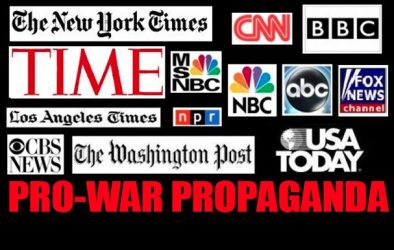 When seriously practiced, the journalistic profession involves gathering information concerning individuals, locales, events, and issues. In theory such information informs people about their world, thereby strengthening “democracy.” This is exactly the reason why news organizations and individual journalists are tapped as assets by intelligence agencies and, as the experiences of German journalist Udo Ulfkotte (entry 47 below) suggest, this practice is at least as widespread today as it was at the height of the Cold War.
Consider the coverups of election fraud in 2000 and 2004, the events of September 11, 2001, the invasions Afghanistan and Iraq, the destabilization of Syria, and the creation of “ISIS.” These are among the most significant events in recent world history, and yet they are also those much of the American public is wholly ignorant of. In an era where information and communication technologies are ubiquitous, prompting many to harbor the illusion of being well-informed, one must ask why this condition persists.
Further, why do prominent US journalists routinely fail to question other deep events that shape America’s tragic history over the past half century, such as the political assassinations of the 1960s, or the central role played by the CIA in international drug trafficking?
Popular and academic commentators have suggested various reasons for the almost universal failure of mainstream journalism in these areas, including newsroom sociology, advertising pressure, monopoly ownership, news organizations’ heavy reliance on “official” sources, and journalists’ simple quest for career advancement. There is also, no doubt, the influence of professional public relations maneuvers. Yet such a broad conspiracy of silence suggests another province of deception examined far too infrequently—specifically the CIA and similar intelligence agencies’ continued involvement in the news media to mold thought and opinion in ways scarcely imagined by the lay public.
The following historical and contemporary facts–by no means exhaustive–provides a glimpse of the power such entities possess to influence, if not determine, popular memory and what respectable institutions deem to be the historical record.
- The CIA’s Operation MOCKINGBIRD is a long-recognised keystone among researchers pointing to the Agency’s clear interest in and relationship to major US news media. MOCKINGBIRD grew out of the CIA’s forerunner, the Office for Strategic Services (OSS, 1942-47), which during World War Two had established a network of journalists and psychological warfare experts operating primarily in the European theatre.
- Many of the relationships forged under OSS auspices were carried over into the postwar era through a State Department-run organization called the Office of Policy Coordination (OPC) overseen by OSS staffer Frank Wisner.
- The OPC “became the fastest-growing unit within the nascent CIA,” historian Lisa Pease observes, “rising in personnel from 302 in 1949 to 2,812 in 1952, along with 3,142 overseas contract personnel. In the same period, the budget rose from $4.7 million to $82 million.” Lisa Pease, “The Media and the Assassination,” in James DiEugenio and Lisa Pease, The Assassinations: Probe Magazine on JFK, MLK, RFK and Malcolm X, Port Townsend, WA, 2003, 300.
- Like many career CIA officers, eventual CIA Director/Director of Central Intelligence (DCI) Richard Helms was recruited out of the press corps by his own supervisor at the United Press International’s Berlin Bureau to join in the OSS’s fledgling “black propaganda” program. “‘[Y]ou’re a natural,” Helms’ boss remarked. Richard Helms, A Look Over My Shoulder: A Life in the Central Intelligence Agency, New York: Random House, 2003, 30-31.
- Wisner tapped Marshall Plan funds to pay for his division’s early exploits, money his branch referred to as “candy.” “We couldn’t spend it all,” CIA agent Gilbert Greenway recalls. “I remember once meeting with Wisner and the comptroller. My God, I said, how can we spend that? There were no limits, and nobody had to account for it. It was amazing.” Frances Stonor Saunders, The Cultural Cold War: The CIA and the World of Arts and Letters, New York: The New Press, 2000, 105.
- When the OPC was merged with the Office of Special Operations in 1948 to create the CIA, OPC’s media assets were likewise absorbed.
- Wisner maintained the top secret “Propaganda Assets Inventory,” better known as “Wisner’s Wurlitzer”—a virtual rolodex of over 800 news and information entities prepared to play whatever tune Wisner chose. “The network included journalists, columnists, book publishers, editors, entire organizations such as Radio Free Europe, and stringers across multiple news organizations.” Pease, “The Media and the Assassination,” 300.
- A few years after Wisner’s operation was up-and-running he “’owned’ respected members of the New York Times, Newsweek, CBS, and other communication vehicles, plus stringers, four to six hundred in all, according to a CIA analyst. Each one was a separate ‘operation,’” investigative journalist Deborah Davis notes, “requiring a code name, a field supervisor, and a field office, at an annual cost of tens or hundreds of thousands of dollars—there has never been an accurate accounting.” Deborah Davis, Katharine the Great: Katharine Graham and the Washington Post, Second Edition, Bethesda MD: National Press Inc, 1987, 139.
- Psychological operations in the form of journalism were perceived as necessary to influence and direct mass opinion, as well as elite perspectives. “[T]he President of the United States, the Secretary of State, Congressmen and even the Director of the CIA himself will read, believe, and be impressed by a report from Cy Sulzberger, Arnaud de Borchgrave, or Stewart Alsop when they don’t even bother to read a CIA report on the same subject,” noted CIA agent Miles Copeland. Cited in Pease, “The Media and the Assassination,” 301.
- By the mid-to-late 1950s, Darrell Garwood points out, the Agency sought to limit criticism directed against covert activity and bypass congressional oversight or potential judicial interference by “infiltrat[ing] the groves of academia, the missionary corps, the editorial boards of influential journal and book publishers, and any other quarters where public attitudes could be effectively influenced.” Darrell Garwood, Under Cover: Thirty-Five Years of CIA Deception, New York: Grove Press, 1985, 250.
- The CIA frequently intercedes in editorial decision-making. For example, when the Agency proceeded to wage an overthrow of the Arbenz regime in Guatemala in 1954, Allen and John Foster Dulles, President Eisenhower’s CIA Director and Secretary of State respectively, called upon New York Times publisher Arthur Hays Sulzberger to reassign reporter Sydney Gruson from Guatemala to Mexico City. Sulzberger thus placed Gruson in Mexico City with the rationale that some repercussions from the revolution might be felt in Mexico. Pease, “The Media and the Assassination,” 302.
- Since the early 1950s the CIA “has secretly bankrolled numerous foreign press services, periodicals and newspapers—both English and foreign language—which provided excellent cover for CIA operatives,” Carl Bernstein reported in 1977. “One such publication was the Rome Daily American, forty percent of which was owned by the CIA until the 1970s.” Carl Bernstein, “The CIA and the Media,” Rolling Stone, October 20, 1977.
- The CIA exercised informal liaisons with news media executives, in contrast to its relationships with salaried reporters and stringers, “who were much more subject to direction from the Agency” according to Bernstein. “A few executives—Arthur Hays Sulzberger of the New York Times among them—signed secrecy agreements. But such formal understandings were rare: relationships between Agency officials and media executives were usually social—’The P and Q Street axis in Georgetown,’ said one source. ‘You don’t tell William Paley to sign a piece of paper saying he won’t fink.’” Director of CBS William Paley’s personal “friendship with CIA Director Dulles is now known to have been one of the most influential and significant in the communications industry,” author Debora Davis explains. “He provided cover for CIA agents, supplied out-takes of news film, permitted the debriefing of reporters, and in many ways set the standard for the cooperation between the CIA and major broadcast companies which lasted until the mid-1970s.” Deborah Davis, Katharine the Great: Katharine Graham and the Washington Post, Second Edition, Bethesda MD: National Press Inc, 1987, 175.
- “The Agency’s relationship with the Times was by far its most valuable among newspapers, according to CIA officials,” Bernstein points out in his key 1977 article. “From 1950 to 1966, about ten CIA employees were provided Times cover under arrangements approved by the newspaper’s late publisher, Arthur Hays Sulzberger. The cover arrangements were part of a general Times policy—set by Sulzberger—to provide assistance to the CIA whenever possible.” In addition, Sulzberger was a close friend of CIA Director Allen Dulles. “’At that level of contact it was the mighty talking to the mighty,’ said a high‑level CIA official who was present at some of the discussions. ‘There was an agreement in principle that, yes indeed, we would help each other. The question of cover came up on several occasions. It was agreed that the actual arrangements would be handled by subordinates…. The mighty didn’t want to know the specifics; they wanted plausible deniability.’” Bernstein, “The CIA and the Media.”
- CBS’s Paley worked reciprocally with the CIA, allowing the Agency to utilize network resources and personnel. “It was a form of assistance that a number of wealthy persons are now generally known to have rendered the CIA through their private interests,” veteran broadcast journalist Daniel Schorr wrote in 1977. “It suggested to me, however, that a relationship of confidence and trust had existed between him and the agency.” Schorr points to “clues indicating that CBS had been infiltrated.” For example, “A news editor remembered the CIA officer who used to come to the radio control room in New York in the early morning, and, with the permission of persons unknown, listened to CBS correspondents around the world recording their ‘spots’ for the ‘World News Roundup’ and discussing events with the editor on duty. Sam Jaffe claimed that when he applied in 1955 for a job with CBS, a CIA officer told him that he would be hired–which he subsequently was. He was told that he would be sent to Moscow–which he subsequently was; he was assigned in 1960 to cover the trial of U-2 pilot Francis Gary Powers. [Richard] Salant told me,” Schorr continues, “that when he first became president of CBS News in 1961, a CIA case officer called saying he wanted to continue the ‘long standing relationship known to Paley and [CBS president Frank] Stanton, but Salant was told by Stanton there was no obligation that he knew of” (276). Schorr, Daniel. Clearing the Air, Boston: Houghton Mifflin, 1977, 277, 276.
- National Enquirer publisher Gene Pope Jr. worked briefly on the CIA’s Italy desk in the early 1950s and maintained close ties with the Agency thereafter. Pope refrained from publishing dozens of stories with “details of CIA kidnappings and murders, enough stuff for a year’s worth of headlines” in order to “collect chits, IOUs,” Pope’s son writes. “He figured he’d never know when he might need them, and those IOUs would come in handy when he got to 20 million circulation. When that happened, he’d have the voice to be almost his own branch of government and would need the cover.” Paul David Pope, The Deeds of My Fathers: How My Grandfather and Father Built New York and Created the Tabloid World of Today, New York: Phillip Turner/Rowman & Littlefield, 2010, 309, 310.
- One explosive story Pope’s National Enquirer‘s refrained from publishing in the late 1970s centered on excerpts from a long-sought after diary of President Kennedy’s lover, Mary Pinchot Meyer, who was murdered on October 12, 1964. “The reporters who wrote the story were even able to place James Jesus Angleton, the CIA’s head of counterintelligence operations, at the scene.” Another potential story drew on “documents proving that [Howard] Hughes and the CIA had been connected for years and that the CIA was giving Hughes money to secretly fund, with campaign donations, twenty-seven congressmen and senators who sat on sub-committees critical to the agency. There are also fifty-three international companies named and sourced as CIA fronts .. and even a list of reporters for mainstream media organizations who were playing ball with the agency.” Pope, The Deeds of My Fathers, 309.
- Angleton, who oversaw the Agency counterintelligence branch for 25 years, “ran a completely independent group entirely separate cadre of journalist‑operatives who performed sensitive and frequently dangerous assignments; little is known about this group for the simple reason that Angleton deliberately kept only the vaguest of files.” Bernstein, “The CIA and the Media.”
- The CIA conducted a “formal training program” during the 1950s for the sole purpose of instructing its agents to function as newsmen. “Intelligence officers were ‘taught to make noises like reporters,’ explained a high CIA official, and were then placed in major news organizations with help from management. These were the guys who went through the ranks and were told ‘You’re going to he a journalist,’” the CIA official said.” The Agency’s preference, however, was to engage journalists who were already established in the industry. Bernstein, “The CIA and the Media.”
- Newspaper columnists and broadcast journalists with household names have been known to maintain close ties with the Agency. “There are perhaps a dozen well known columnists and broadcast commentators whose relationships with the CIA go far beyond those normally maintained between reporters and their sources,” Bernstein maintains. “They are referred to at the Agency as ‘known assets’ and can be counted on to perform a variety of undercover tasks; they are considered receptive to the Agency’s point of view on various subjects.” Bernstein, “The CIA and the Media.”
- Frank Wisner, Allen Dulles, and Washington Post publisher Phillip Graham were close associates, and the Post developed into one of the most influential news organs in the United States due to its ties with the CIA. The Post managers’ “individual relations with intelligence had in fact been the reason the Post Company had grown as fast as it did after the war,” Davis observes. “[T]heir secrets were its corporate secrets, beginning with MOCKINGBIRD. Phillip Graham’s commitment to intelligence had given his friends Frank Wisner an interest in helping to make the Washington Post the dominant news vehicle in Washington, which they had done by assisting with its two most crucial acquisitions, the Times-Herald and WTOP radio and television stations.” Davis, Katharine the Great: Katharine Graham and the Washington Post, 172.
- In the wake of World War One the Woodrow Wilson administration placed journalist and author Walter Lippmann in charge of recruiting agents for the Inquiry, a first-of-its-kind ultra-secret civilian intelligence organization whose role involved ascertaining information to prepare Wilson for the peace negotiations, as well as identify foreign natural resources for Wall Street speculators and oil companies. The activities of this organization served as a prototype for the function eventually performed by the CIA, namely “planning, collecting, digesting, and editing the raw data,” notes historian Servando Gonzalez. “This roughly corresponds to the CIA’s intelligence cycle: planning and direction, collection, processing, production and analysis, and dissemination.” Most Inquiry members would later become members of the Council on Foreign Relations. Lippmann would go on to become the Washington Post’s best known columnists. Servando Gonzalez, Psychological Warfare and the New World Order: The Secret War Against the American People, Oakland, CA: Spooks Books, 2010, 50.
- The two most prominent US newsweeklies, Time and Newsweek, kept close ties with the CIA. “Agency files contain written agreements with former foreign correspondents and stringers for both the weekly newsmagazines,” according to Carl Bernstein. “Allen Dulles often interceded with his good friend, the late Henry Luce, founder of Time and Life magazines, who readily allowed certain members of his staff to work for the Agency and agreed to provide jobs and credentials for other CIA operatives who lacked journalistic experience.” Bernstein, “The CIA and the Media.”
- In his autobiography former CIA officer E. Howard Hunt quotes Bernstein’s “The CIA and the Media” article at length. “I know nothing to contradict this report,” Hunt declares, suggesting the investigative journalist of Watergate fame didn’t go far enough. “Bernstein further identified some of the country’s top media executives as being valuable assets to the agency … But the list of organizations that cooperated with the agency was a veritable ‘Who’s Who’ of the media industry, including ABC, NBC, the Associated Press, UPI, Reuters, Hearst Newspapers, Scripps-Howard, Newsweek magazine, and others.” E. Howard Hunt, American Spy: My Secret History in the CIA, Watergate, and Beyond, Hoboken NJ: John Wiley & Sons, 2007, 150.
- When the first major exposé of the CIA emerged in 1964 with the publication of The Invisible Government by journalists David Wise and Thomas B. Ross, the CIA considered purchasing the entire printing to keep the book from the public, yet in the end judged against it. “To an extent that is only beginning to be perceived, this shadow government is shaping the lives of 190,000,000 Americans” authors Wise and Ross write in the book’s preamble. “Major decisions involving peace and war are taking place out of public view. An informed citizen might come to suspect that the foreign policy of the United States often works publicly in one direction and secretly through the Invisible Government in just the opposite direction.”Lisa Pease, “When the CIA’s Empire Struck Back,” Consortiumnews.com, February 6, 2014.
- Agency infiltration of the news media shaped public perception of deep events and undergirded the official explanations of such events. For example, the Warren Commission’s report on President John F. Kennedy’s assassination was met with almost unanimous approval by US media outlets. “I have never seen an official report greeted with such universal praise as that accorded the Warren Commission’s findings when they were made public on September 24, 1964,” recalls investigative reporter Fred Cook. “All the major television networks devoted special programs and analyses to the report; the next day the newspapers ran long columns detailing its findings, accompanied by special news analyses and editorials. The verdict was unanimous. The report answered all questions, left no room for doubt. Lee Harvey Oswald, alone and unaided, had assassinated the president of the United States.” Fred J. Cook, Maverick: Fifty Years of Investigative Reporting, G.P. Putnam’s Sons, 1984, 276.
- In late 1966 the New York Times began an inquiry on the numerous questions surrounding President Kennedy’s assassination that were not satisfactorily dealt with by the Warren Commission. “It was never completed,” author Jerry Policoff observes, “nor would the New York Times ever again question the findings of the Warren Commission.” When the story was being developed the lead reporter at the Times‘ Houston bureau “said that he and others came up with ‘a lot of unanswered questions’ that the Times didn’t bother to pursue. ‘I’d be off on a good lead and then somebody’d call me off and send me out to California on another story or something. We never really detached anyone for this. We weren’t really serious.’” Jerry Policoff, “The Media and the Murder of John Kennedy,” in Peter Dale Scott, Paul L. Hoch and Russell Stetler, eds., The Assassinations: Dallas and Beyond, New York: Vintage, 1976, 265.
- When New Orleans District Attorney Jim Garrison embarked on an investigation of the JFK assassination in 1966 centering on Lee Harvey Oswald’s presence in New Orleans in the months leading up to November, 22, 1963, “he was cross-whipped with two hurricane blasts, one from Washington and one from New York,” historian James DiEugenio explains. The first, of course, was from the government, specifically the Central Intelligence Agency, the FBI, and to a lesser extent, the White House. The blast from New York was from the major mainstream media e.g. Time-Life and NBC. Those two communication giants were instrumental in making Garrison into a lightening rod for ridicule and criticism. This orchestrated campaign … was successful in diverting attention from what Garrison was uncovering by creating controversy about the DA himself.” DiEugenio, Preface, in William Davy, Let Justice Be Done: New Light on the Jim Garrison Investigation, Reston VA: Jordan Publishing, 1999.
- The CIA and other US intelligence agencies used the news media to sabotage Garrison’s 1966-69 independent investigation of the Kennedy assassination. Garrison presided over the only law enforcement agency with subpoena power to seriously delve into the intricate details surrounding JFK’s murder. One of Garrison’s key witnesses, Gordon Novel, fled New Orleans to avoid testifying before the Grand Jury assembled by Garrison. According to DiEugenio, CIA Director Allen “Dulles and the Agency would begin to connect the fugitive from New Orleans with over a dozen CIA friendly journalists who—in a blatant attempt to destroy Garrison’s reputation—would proceed to write up the most outrageous stories imaginable about the DA.” James DiEugenio, Destiny Betrayed: JFK, Cuba, and The Garrison Case, Second Edition, New York: SkyHorse Publishing, 2012, 235.
- CIA officer Victor Marchetti recounted to author William Davy that in 1967 while attending staff meetings as an assistant to then-CIA Director Richard Helms, “Helms expressed great concerns over [former OSS officer, CIA operative and primary suspect in Jim Garrison’s investigation Clay] Shaw’s predicament, asking his staff, ‘Are we giving them all the help we can down there?’” William Davy, Let Justice Be Done: New Light on the Jim Garrison Investigation, Reston VA: Jordan Publishing, 1999.
- The pejorative dimensions of the term “conspiracy theory” were introduced into the Western lexicon by CIA “media assets,” as evidenced in the design laid out by Document 1035-960 Concerning Criticism of the Warren Report, an Agency communiqué issued in early 1967 to Agency bureaus throughout the world at a time when attorney Mark Lane’s Rush to Judgment was atop bestseller lists and New Orleans DA Garrison’s investigation of the Kennedy assassination began to gain traction.
- Time had close relations with the CIA stemming from the friendship of the magazine’s publisher Henry Luce and Eisenhower CIA chief Allen Dulles. When former newsman Richard Helms was appointed DCI in 1966 he “began to cultivate the press,” prompting journalists toward conclusions that placed the Agency in a positive light. As Time Washington correspondent Hugh Sidney recollects, “‘[w]ith [John] McCone and [Richard] Helms, we had a set-up when the magazine was doing something on the CIA, we went to them and put it before them … We were never misled.’ Similarly, when Newsweek decided in the fall of 1971 to do a cover story on Richard Helms and ‘The New Espionage,’ the magazine, according to a Newsweek staffer, went directly to the agency for much of the information. And the article … generally reflected the line that Helms was trying so hard to sell: that since the latter 1960s … the focus of attention and prestige within CIA’ had switched from the Clandestine Services to the analysis of intelligence, and that ‘the vast majority of recruits are bound for’ the Intelligence Directorate.” Victor Marchetti and John D. Marks, The CIA and the Cult of Intelligence, New York: Alfred A. Knopf, 1974, 362-363.
- In 1970 Jim Garrison wrote and published the semi-autobiographical A Heritage of Stone, a work that examines how the New Orleans DA “discovered that the CIA operated within the borders of the United States, and how it took the CIA six months to reply to the Warren Commission’s question of whether Oswald and [Jack] Ruby had been with the Agency,” Garrison biographer and Temple University humanities professor Joan Mellen observes. “In response to A Heritage of Stone, the CIA rounded up its media assets” and the book was panned by reviewers writing for the New York Times, the Los Angeles Times, the Washington Post, the Chicago Sun Times, and Life magazine. “John Leonard’s New York Times review went through a metamorphosis,” Mellen explains. “The original last paragraph challenged the Warren Report: ‘Something stinks about this whole affair,’ Leonard wrote. ‘Why were Kennedy’s neck organs not examined at Bethesda for evidence of a frontal shot? Why was his body whisked away to Washington before the legally required Texas inquest? Why?’ This paragraph evaporated in later editions of the Times. A third of a column gone, the review then ended: ‘Frankly I prefer to believe that the Warren Commission did a poor job, rather than a dishonest one. I like to think that Garrison invents monsters to explain incompetence.’” Joan Mellen, A Farewell to Justice: Jim Garrison, JFK’s Assassination, and the Case That Should Have Changed History, Washington DC: Potomac Books, 2005, 323, 324.
- CIA Deputy Director for Plans Cord Meyer Jr. appealed to Harper & Row president emeritus Cass Canfield Sr. over the book publisher’s pending release of Alfred McCoy’s The Politics of Heroin in Southeast Asia, based on the author’s fieldwork and Yale PhD dissertation wherein he examined the CIA’s explicit role in the opium trade. “Claiming my book was a threat to national security,” McCoy recalls, “the CIA official had asked Harper & Row to suppress it. To his credit, Mr. Canfield had refused. But he had agreed to review the manuscript prior to publication.” Alfred W. McCoy, The Politics of Heroin: CIA Complicity in the Global Drug Trade, Chicago Review Press, 2003, xx.
- Publication of The Secret Team, a book by US Air Force Colonel and Pentagon-CIA liaison L. Fletcher Prouty recounting the author’s firsthand knowledge of CIA black operations and espionage, was met with a wide scale censorship campaign in 1972. “The campaign to kill the book was nationwide and world-wide,” Prouty notes. “It was removed from the Library of Congress and from college libraries as letters I received attested all too frequently … I was a writer whose book had been cancelled by a major publisher [Prentice Hall] and a major paperback publisher [Ballantine Books] under the persuasive hand of the CIA.” L. Fletcher Prouty, The Secret Team: The CIA and Its Allies in Control of the United States and the World, New York: SkyHorse Publishing, 2008, xii, xv.
- During the Pike Committee hearings in 1975 Congressman Otis Pike asked DCI William Colby, “Do you have any people paid by the CIA who are working for television networks?” Colby responded, “This, I think, gets into the kind of details, Mr. Chairman, that I’d like to get into in executive session.” Once the chamber was cleared Colby admitted that in 1975 specifically “the CIA was using ‘media cover’ for eleven agents, many fewer than in the heyday of the cloak-and-pencil operations, but no amount of questioning would persuade him to talk about the publishers and network chieftains who had cooperated at the top.” Schorr, Clearing the Air, 275.
- “There is quite an incredible spread of relationships,” former CIA intelligence officer William Bader informed a US Senate Intelligence Committee investigating the CIA’s infiltration of the nation’s journalistic outlets. “You don’t need to manipulate Time magazine, for example, because there are Agency people at the management level.” Bernstein, “The CIA and the Media.”
- In 1985 film historian and professor Joseph McBride came across a November 29, 1963 memorandum from J. Edgar Hoover, titled, “Assassination of President John F. Kennedy,” wherein the FBI director stated that his agency provided two individuals with briefings, one of whom was “Mr. George Bush of the Central Intelligence Agency.” ” When McBride queried the CIA with the memo a “PR man was tersely formal and opaque: ‘I can neither confirm nor deny.’ It was the standard response the agency gave when it dealt with its sources and methods,” journalist Russ Baker notes. When McBride published a story in The Nation, “The Man Who Wasn’t There, ‘George Bush,’ C.I.A. Operative,” the CIA came forward with a statement that the George Bush referenced in the FBI record “apparently” referenced a George William Bush, who filled a perfunctory night shift position at CIA headquarters that “would have been the appropriate place to receive such a report.” McBride tracked down George William Bush to confirm he was only employed briefly as a “probationary civil servant” who had “never received interagency briefings.” Shortly thereafter The Nation ran a second story by McBride wherein “the author provided evidence that the Central Intelligence Agency had foisted a lie on the American people … As with McBride’s previous story, this disclosure was greeted with the equivalent of a collective media yawn.” Since the episode researchers have found documents linking George H. W. Bush to the CIA as early as 1953. Russ Baker, Family of Secrets: The Bush Dynasty, America’s Invisible Government, and the Hidden History of the Last Fifty Years, New York: Bloomsbury Press, 2009, 7-12.
- Operation Gladio, the well-documented collaboration between Western spy agencies, including the CIA, and NATO involving coordinated terrorist shootings and bombings of civilian targets throughout Europe from the late 1960s through the 1980s, has been effectively expunged from major mainstream news outlets. A LexisNexis Academic search conducted in 2012 for “Operation Gladio” retrieved 31 articles in English language news media—most appearing in British newspapers. Only four articles discussing Gladio ever appeared in US publications—three in the New York Times and one brief mention in the Tampa Bay Times. With the exception of a 2009 BBC documentary, no network or cable news broadcast has ever referenced the state-sponsored terror operation. Almost all of the articles referencing Gladio appeared in 1990 when Italian Prime Minister Giulio Andreotti publicly admitted Italy’s participation in the process. The New York Times downplayed any US involvement, misleadingly designating Gladio “an Italian creation” in a story buried on page A16. In reality, former CIA director William Colby revealed in his memoirs that covert paramilitaries were a significant agency undertaking set up after World War II, including “the smallest possible coterie of the most reliable people, in Washington [and] NATO.” James F. Tracy, “False Flag Terror and Conspiracies of Silence,” Global Research, August 10, 2012.
- Days before the April 19, 1995 bombing of the Alfred P. Murrah Federal Building in Oklahoma City DCI William Colby confided to his friend, Nebraska State Senator John DeCamp his personal concerns over the Militia and Patriot movement within the United States, then surging in popularity due to the use of the alternative media of that era–books, periodicals, cassette tapes, and radio broadcasts. “I watched as the Anti-War movement rendered it impossible for this country to conduct or win the Vietnam War,” Colby remarked. “I tell you, dear friend, that the Militia and Patriot movement in which, as an attorney, you have become one of the centerpieces, is far more significant and far more dangerous for American than the Anti-War movement ever was, if it is not intelligently dealt with. And I really mean this.” David Hoffman, The Oklahoma City Bombing and the Politics of Terror, Venice CA: Feral House, 1998, 367.
- Shortly after the appearance of journalist Gary Webb’s “Dark Alliance” series in the San Jose Mercury News chronicling the Agency’s involvement in drug trafficking, the CIA’s public affairs division embarked on a campaign to counter what it termed “a genuine public relations crisis for the Agency.” Webb was merely reporting to a large audience what had already been well documented by scholars such as Alfred McCoy and Peter Dale Scott, and the 1989 Kerry Committee Report on Iran-Contra—that the CIA had long been involved in the illegal transnational drug trade. Such findings were upheld in 1999 in a study by the CIA inspector general. Nevertheless, beginning shortly after Webb’s series ran, “CIA media spokesmen would remind reporters seeking comment that this series represented no real news,” a CIA internal organ noted, “in that similar charges were made in the 1980s and were investigated by the Congress and were found to be without substance. Reporters were encouraged to read the “Dark Alliance’ series closely and with a critical eye to what allegations could actually be backed with evidence.” http://www.foia.cia.gov/sites/default/files/DOC_0001372115.pdf
- On December 10, 2004 investigative journalist Gary Webb died of two .38 caliber gunshot wounds to the head. The coroner ruled the death a suicide. “Gary Webb was MURDERED,” concluded FBI senior special agent Ted Gunderson in 2005. “He (Webb) resisted the first shot [to the head that exited via jaw] so he was shot again with the second shot going into the head [brain].” Gunderson regards the theory that Webb could have managed to shoot himself twice as “impossible!” Charlene Fassa, “Gary Webb: More Pieces in the Suicided Puzzle,” Rense.com, December 11, 2005.
- The most revered journalists who receive “exclusive” information and access to the corridors of power are typically the most subservient to officialdom and often have intelligence ties. Those granted such access understand that they must likewise uphold government-sanctioned narratives. For example, the New York Times’ Tom Wicker reported on November 22, 1963 that President John F. Kennedy “was hit by a bullet in the throat, just below the Adam’s apple.” Yet his account went to press before the official story of a single assassin shooting from the rear became established. Wicker was chastised through “lost access, complaints to editors and publishers, social penalties, leaks to competitors, a variety of responses no one wants.” Barrie Zwicker, Towers of Deception: The Media Coverup of 9/11, Gabrioloa Island, BC: New Society Publishers, 2006, 169-170.
- The CIA actively promotes a desirable public image of its history and function by advising the production of Hollywood vehicles, such as Argo and Zero Dark Thirty. The Agency retains “entertainment industry liaison officers” on its staff that “plant positive images about itself (in other words, propaganda) through our most popular forms of entertainment,” Tom Hayden explains in the LA Review of Books. “So natural has the CIA–entertainment connection become that few question its legal or moral ramifications. This is a government agency like no other; the truth of its operations is not subject to public examination. When the CIA’s hidden persuaders influence a Hollywood movie, it is using a popular medium to spin as favorable an image of itself as possible, or at least, prevent an unfavorable one from taking hold.” Tom Hayden, “Review of The CIA in Hollywood: How the Agency Shapes Film and Television by Tricia Jenkins,” LA Review of Books, February 24, 2013,
- Former CIA case officer Robert David Steele states that CIA manipulation of news media is “worse” in the 2010s than in the late 1970s when Bernstein wrote “The CIA and the Media.” “The sad thing is that the CIA is very able to manipulate [the media] and it has financial arrangements with media, with Congress, with all others. But the other half of that coin is that the media is lazy.” James Tracy interview with Robert David Steele, August 2, 2014,
- A well-known fact is that broadcast journalist Anderson Cooper interned for the CIA while attending Yale as an undergraduate in the late 1980s. According to Wikipedia Cooper’s great uncle, William Henry Vanderbilt III, was an Executive Officer of the Special Operations Branch of the OSS under the spy organization’s founder William “Wild Bill” Donovan. While Wikipedia is an often dubious source, Vanderbilt’s OSS involvement would be in keeping with the OSS/CIA reputation of taking on highly affluent personnel for overseas derring-do. William Henry Vanderbilt III, Wikipedia.
- Veteran German journalist Udo Ulfkotte, author of the 2014 book Gekaufte Journalisten (Bought Journalists) revealed how under the threat of job termination he was routinely compelled to publish articles written by intelligence agents using his byline. “I ended up publishing articles under my own name written by agents of the CIA and other intelligence services, especially the German secret service,” Ulfkotte explained in a recent interview with Russia Today. “German Journo: European Media Writing Pro-US Stories Under CIA Pressure,” RT, October 18, 2014.
- In 1999 the CIA established In-Q-Tel, a venture capital firm seeking to “identify and invest in companies developing cutting-edge information technologies that serve United States national security interests.” The firm has exercised financial relationships with internet platforms Americans use on a routine basis, including Google and Facebook. “If you want to keep up with Silicon Valley, you need to become part of Silicon Valley,” says Jim Rickards, an adviser to the U.S. intelligence community familiar with In-Q-Tel’s activities. “The best way to do that is have a budget because when you have a checkbook, everyone comes to you.” At one point IQT “catered largely to the needs of the CIA.” Today, however, “the firm supports many of the 17 agencies within the U.S. intelligence community, including the National Geospatial-Intelligence Agency (NGA), the Defense Intelligence Agency (DIA) and the Department of Homeland Security Science and Technology Directorate.” Matt Egan, “In-Q-Tel: A Glimpse Inside the CIA’s Venture Capital Arm,” FoxBusiness.com, June 14, 2013.
- At a 2012 conference held by In-Q-Tel CIA Director David Patraeus declared that the rapidly-developing “internet of things” and “smart home” will provide the CIA with the ability to spy on any US citizen should they become a “person of interest’ to the spy community,” Wired magazine reports. “‘Transformational’ is an overused word, but I do believe it properly applies to these technologies,’ Patraeus enthused, ‘particularly to their effect on clandestine tradecraft’ … ‘Items of interest will be located, identified, monitored, and remotely controlled through technologies such as radio-frequency identification, sensor networks, tiny embedded servers, and energy harvesters — all connected to the next-generation internet using abundant, low-cost, and high-power computing,” Patraeus said, “the latter now going to cloud computing, in many areas greater and greater supercomputing, and, ultimately, heading to quantum computing.” Spencer Ackerman, “CIA Chief: We’ll Spy on You Through Your Dishwasher,” Wired, March 15, 2012.
- In the summer of 2014 a $600 million computing cloud developed by Amazon Web Services for the CIA began servicing all 17 federal agencies comprising the intelligence community. “If the technology plays out as officials envision,” The Atlantic reports, “it will usher in a new era of cooperation and coordination, allowing agencies to share information and services much more easily and avoid the kind of intelligence gaps that preceded the Sept. 11, 2001, terrorist attacks.” “The Details About the CIA’s Deal With Amazon,” The Atlantic, July 17, 2014.
Romania arrests Israeli firm workers for spying on top prosecutor
Press TV – April 6, 2016
Romania has arrested two employees of an Israeli intelligence company on charges of spying on and trying to intimidate the country’s chief anti-corruption prosecutor, officials say.
“An investigation has been launched and two people have been arrested,” Mihaela Porime, a spokeswoman for the anti-crime and terrorist prosecutors’ office, said on Wednesday, adding that the suspects work for the Israeli private intelligence agency, Black Cube.
The firm reportedly has several former operatives of Israel’s Mossad spy agency on its payroll.
The pair were identified as Belgian David Geclowitz and Israeli-born Ron Weiner, who holds a French passport.
They are suspected of hacking the emails of people close to Laura Codruta Kovesi, the chief prosecutor of Romania’s National Anti-corruption Directorate (DNA), and of threatening and harassing her family members.
The arrest warrant said the two had in March set up a “criminal group … aimed at sullying Kovesi’s image.”
According to Romanian judicial sources, the two are believed to have been employed by a client being investigated by the DNA.
Meanwhile, Kovesi confirmed that the detentions were “linked to a failed intimidation bid.”
Kovesi, who was appointed last month for a second term as Romania’s chief anti-corruption prosecutor, is known for her tough approach to high-level graft.
Her agency prosecuted some 1,250 cases only in 2015, with targets including a former premier and five ex-ministers.
Egyptian satellite provider Nilesat stops services to Lebanese Al-Manar
Press TV – April 6, 2016
 Egyptian satellite provider Nilesat has stopped airing Lebanese news channel Al-Manar following similar moves targeting Lebanon by Saudi Arabia and its allies.
Taking the measure on Tuesday, Nilesat alleged that Al-Manar had “violated the contract by broadcasting shows that provoke sectarian strife and sedition.”
The company is also to stop its operations in Lebanon as of Wednesday when its contract expires.
Saudi-based satellite provider Arabsat had stopped broadcasting Al-Manar in December 2015, a month after it took Al Mayadeen TV, another Lebanon-based channel, off air.
Late last week, Saudi-owned Al Arabiya TV shut its offices in the Lebanese capital, Beirut, and dismissed the local staff over “security reasons.”
Saudi Arabia has been adopting a raft of measures against Lebanon in reaction to the latter country’s refusal to side with Riyadh against Iran.
It has been targeting Lebanese resistance movement Hezbollah, which has been fighting Saudi-backed extremism inside both Lebanon and Syria.
Earlier in the year, Lebanese Foreign Minister Gibran Bassil refused to back a motion crafted by Saudi Arabia against the Islamic Republic, prompting Riyadh to retract a $4-billion aid pledge to Lebanon and demand an apology, which Lebanon refused to give.
The motion had sought to condemn Tehran over January attacks on vacant Saudi diplomatic premises. The attacks occurred during otherwise peaceful protests against Saudi Arabia’s execution earlier of prominent Shia cleric Sheikh Nimr al-Nimr.
Saudi Arabia has also ordered its citizens not to travel to Lebanon and imposed sanctions on four Lebanese firms and three individuals it accuses of having links to Hezbollah.
There are also reports that Saudi Arabia may expel the Lebanese nationals working on its territory.
Some local media reports in Lebanon have, meanwhile, said the Saudis may be applying pressure to secure the release of a member of the royal family held in Lebanon since last October on drug charges.
Abdul-Mohsen al-Waleed Al Saud was detained in Beirut after authorities seized two tons of amphetamine Captagon pills before they were loaded onto his private plane.
Why the Establishment Hates Trump
By John McMurtry | CounterPunch | April 5, 2016
On the face of it, Donald Trump is Reagan on steroids. His towering size, his nativist US supremacism, his down-home talk, and his reality-show confidence make him ideal for the role of bullying and big lies from the oval office. He is America come to meet itself in larger-than-life image to rejuvenate it as its pride slips away in third-world conditions and a multi-polar world.
While Trump’s narrative is that the American Dream seeks recovery again, the dominant media and political elite relentlessly denounce him as an implicit fascist and disastrous fake. Something deeper is afoot. An untapped historic resentment is boiling up from underneath which has long been unspeakable on the political stage. Trump has mined it and proposed a concrete solution always denied of his candidacy. From his promise to halve the Pentagon’s budget to getting the Congress off corporate-donation payrolls, the public money that the big corporate lobbies stand to lose from a Trump presidency are off the charts. But his attackers dare not recognize these explosive issues because they are all part of the problem.
The public money stakes may be bigger than the US corporate stakes behind the foreign wars the US state has initiated since 1991. The takeaway promised by Trump’s policies threaten almost every big lobby now in control of US government purse strings. It grounds in the military-industrial complex spending close to $2,000,000,000 a day for its endless new untested weapons and foreign wars both of which Trump opposes. But the cut-off of hundreds of billions of public giveaways to the Big Corps do not end here. They hit almost every wide-mouthed transnational corporate siphon into the US Treasury, taxpayers’ pockets and the working majority of America. Masses of American citizens increasingly without living wages and benefits and in increasing public squalor and insecurity are paying attention to what the political establishment and corporate media have long buried and continue to silence.
Trump has raised the great dispossession from impotence into the establishment’s face, and this is why he is a contagion on the American political scene. He is pervasively mocked, accused and slandered in non-stop public fireworks of ad hominem hits, but the counter-attacks never engage what Trump has set his sights on – the long stripping of America by
corporate globalization selecting for the limitless enrichment of the very rich living off an ever-growing take from public coffers and the impoverishment of America’s working people. A primal rage unites the political establishment across party lines, but they can’t say why. No defaming scorn and abuse is off limits, but Trump’s underlying betrayal of the ruling game remains unspeakable on the stage.
The electoral dynamite of all the Americans who have lost all their good blue-collar jobs, social benefits and public infrastructures is recognized only in class condescension. But the facts cannot be denied of a corporate globalization effectively stripping the lower middle classes and the public realm itself with no-one in Washington establishment saying a word against the greatest transfer of wealth to the 1% in history.
Trump may deserve back as bad he gives. But this understanding keeps our eyes on the ego-contest which is the standard spectacle to avoid the real issues. The personal attacks only tells us how deep the rupture has become between Trump’s campaign and the establishment on the issues kept out of sight. This is why the corporate politicians and media are almost as wound into one-way demonization of Trump as they are when they beat the drums of war against a designated Enemy abroad.
In the end, it may get to him – as when he tries to find angry millions again from onside with an evangelical trumpet of abortion-is-murder just before the primary in Wisconsin.
Trump is a shameless opportunist, no doubt. Yet we continue to revolve within an ad hominem circle until we go deeper than the establishment morality tale of the evil of the stigma object – the oldest propaganda trick in the book. The major money interests that are really at stake in the conflict between Trump and the political-economic establishment remain unconnected and blocked out. “Who will stop Trump’ is not only now asked across America, but the world’s media in China too. But nothing is less talked about than the globally powerful interests he has promised to rein back from the public troughs bleeding the country’s capacities to build for and to employ its people. On this topic, there is only silence or abusive distortion frothing from the mouth.
Joining the Dots of the Great Silence
Eventually people may ask why the establishment unanimously abhors Trump across party divisions which are otherwise unbridgeable. Even if he is a caricature of American privilege and self-promotion, who else could fight the corrupt corporate-state and media establishment? Who else could ever get public support from dispossessed masses and from inside the Republican Party base itself? Who else could take on the supra-dominant corporate interests of the war state, drug monopoly, health insurance racket, lobby-run foreign policy, off-shore tax evasion, and global trade with only corporate rights to profit taking jobs in the tens of millions from home workers, and still hold a large and right-wing voter base onside?
Conversely, what else than Trump’s threat to the corporate-state establishment can explain the unity of voice and venom against an American paragon of wealth and chupzpah? What else could motivate a cross-party and corporate media hate campaign where there is nothing else in common across the condemning voices? Only those citizens depending on the deep system corruptions he promises to reverse are really threatened by Trump’s candidacy. But how do these huge private interests go on getting away with a corporate-lobby state transferring every more public wealth and control to them at the expense of the American majority and their common interest when most people already dislike and are systemically exploited by them? They get away with it by no-one being able to do anything about it.
Trump represents a threat to these gargantuan public-trough interests that even the super clean and informed Ralph Nader candidacy for president never did. The corporate media and party machines just shut him down on the electoral stage so few even knew he was a presidential candidate. You can’t do that with Trump. That is the very big problem for the otherwise seamless political and media establishment who are all in on the fabulous payoffs of this corporate state game. Trump’s entire strategy is based on getting public attention, and he is a master at it, unbuyably rich, and the most watched person in America across the country and the world. He can’t be shut up. Personal stigmatization and attack without let-up are the only way to gag his policies and turn the tide against him at the same time.
Maybe it will work in the end. It’s how disastrous and bankrupting foreign aggressions and wars have been sold whatever the ruinous costs to the public paying for them.
Until Wisconsin
When you join the dots to Trump also preaching a policy revolt against the insatiable corporate jaws feeding on trillions of dollars of public budgets in Washington, the meaning becomes clear. But that connected meaning is blacked out. In its place, the corporate media and politicians present an egomaniac blowhard bordering on fascism who preaches hate, racism and sexism. But the silenced policies he advocates are more like jumping into a crocodile pit. He is on record saying he will cut the Pentagon’s budget “by 50%”. No winning politician has ever dared to take on the military-industrial complex, with even Eisenhower only naming it in his parting speech. Trump also says that the US “must be neutral, an honest broker” on the Israeli-Palestine conflict – as unspeakable as it gets in US politics. Big Pharma is also called out with “$400 billion to be saved by government negotiation of prices”. The even more powerful HMO’s are confronted by the possibility of a “one-payer system”, the devil incarnate in America’s corporate-welfare state.
Trump even challenges “the Enemy” cornerstone of US ideology when he says “wouldn’t it be nice to get along with Russia and China for a change?” Not very fascist of him. He was also open to nationalizing the Wall Street banks after 2008. None of this sees the light of day in the hate-Trump culture that been effectively mounted across even left-right divisions. Most of all, Trump rejects the whole misnamed “free trade” global system because it has “hollowed out the lives of American workers” with rights to corporations to move anywhere to get cheaper labour and import back into the US tariff-free. But again the connected meaning is repressed. That Trump also wants to get the US out of foreign wars at the same time, the other great pillar of corporate globalization, is the real danger to the transnational corporate state he has set in motion.
All these policies threaten only the ruling money interests of America that depend on the superpower public purse to extend their transnational monopolies and multiply their wealth. This is the real establishment interest that has so far evaded the glare of publicity and critique of the Donald Trump phenomenon, bigger now with Bernie Sanders than any political challenge to the US system since the 1960’s. Trump is certainly not a working-class hero. He is a pure capitalist, with all the furies of private interest and greed that capitalism selects for. But at this time he is a capitalist who is not rich from looting the public purse as the biggest annual cash flow, nor from exporting the costs of labor and taxes to foreign jurisdictions with subhuman standards that come back to the US as “necessary to compete”. Trump has initiated a long overdue recognition of parasite capitalism eating out the life capacities of the US itself.
 John McMurtry is a Fellow of the Royal Society of Canada. He is the author of the three-volume Philosophy and World Problems published by UNESCO’s Encyclopedia of Life Support Systems (EOLSS), and his most recent book is The Cancer Stage of Capitalism: from Crisis to Cure.
The Forces Behind the Attempted Coup in Brazil
By Mark Weisbrot | The Hill | April 5, 2016
If you are following the news of political turmoil in Brazil, it may be difficult to get a grasp of what is really going on. This often happens when there is an attempted coup in the Western Hemisphere, and especially when the U.S. government has an interest in the outcome. Usually the information about that interest, and often Washington’s role, is the first casualty of the conflict. (Twenty-first century examples include Paraguay in 2012, Haiti in 2011 and 2004, Honduras in 2009, Ecuador in 2010 and Venezuela in 2002.)
First, there is no doubt that this is a coup in progress. It is an attempt by Brazil’s traditional elite — which includes, as one of the most important players, most of the major media — to reverse the outcome of Brazil’s 2014 presidential elections. Exhibit A is the grounds on which they hope to impeach President Dilma Rousseff of the Workers’ Party (PT by its Portuguese initials). It has nothing to do with corruption, or any serious offense.
The charge is that the government used borrowed money in 2014 to maintain the appearance that the primary budget surplus was within its target. But this is something that other presidents had done, and is hardly a serious offense. A comparison: When the Republicans in the U.S. Congress threatened to shut down the government over the debt ceiling in 2013, the Obama administration used a number of accounting tricks to extend the deadline, and there was little controversy over this.
The charges against Lula are also dubious, even if they turn out to be true. Most importantly, the accusers have not shown any connection to the big “Lava Jato” (car wash) corruption scandal — or any other corruption. Lula is accused of owning some beachfront property, which he denies owning, that was renovated by a Brazilian construction company; and of receiving money from various corporations for speeches. Most importantly, however, these are things that took place after he left the presidency. Although Bernie Sanders has rightly made an issue of Hillary Clinton’s receipt of millions of dollars from corporations for speeches, it is not illegal in the U.S. — or Brazil.
The main judge investigating these cases, Sergio Moro, had to apologize to the Supreme Court for leaking to the press wiretapped conversations between Lula and Dilma, as well as between Lula and his attorney, and between his wife and their children. The detention of Lula for questioning, with advance leaks to the media and involving 200 police despite the fact that Lula had always voluntarily submitted to questioning, also left no doubt as to the political nature of the investigation.
If Moro had any evidence linking Dilma or Lula to actual corruption, it is likely that some of it would have been released by now, given that he has leaked personal and private wiretapped conversations just to embarrass them. Brazil’s anti-democratic, corrupt elite is trying to take the country back to its pre-democratic past, when the electorate could not interfere with their choice of leaders.
Unfortunately, that is not all that long ago: The dictatorship that lasted until 1985 was installed in a 1964 U.S.-backed coup, to which the current efforts bear some resemblance. About the U.S. role today: It is no secret that Washington would like to get rid of all of the left governments in the region. In President Obama’s trip to Argentina last week, and other public statements from U.S. officials, they made it clear how happy they were to welcome the new right-wing government there. They also reversed their policy, implemented against the prior, left government, of blocking loans to Argentina from international lenders like the Inter-American Development Bank and World Bank.
Of the coups mentioned above, evidence of the U.S. role is documented beyond a reasonable doubt in all of them except Ecuador, where there is no hard evidence. But since there has almost never been a coup in this hemisphere against a left government without some U.S. involvement, it is no wonder that many Ecuadoreans believe the U.S. was (and remains) involved there, too. And such speculation is not unreasonable in Brazil, where Washington intervened in 2005 in support of a legislative effort aimed at undermining the Workers’ Party government.
The massive spying on Brazil —and especially Petrobras — that Edward Snowden and Glenn Greenwald revealed in 2013, also points in this direction. It could be a coincidence that all this information about Petrobras was gathered by the U.S. government just prior to the scandals at the state-controlled oil company; or perhaps Washington shared some information with its allies in the Brazilian opposition. And there is no doubt that, like President Mauricio Macri in Argentina, the biggest players in this coup attempt — people like former presidential candidates José Serra and Aécio Neves — are U.S. government allies. Of course the PT government would not be in so much trouble today, even with the media leading the charge, if the economy – which shrank by an estimated 3.8 percent last year — were in better shape.
And that, unfortunately, is due mainly to their own mistakes; beginning at the end of 2010, they embarked on a series of spending cuts, interest rate increases, and other measures that stalled the economy, followed by even harsher austerity in 2015 that caused a deep recession with no end in sight. Unemployment has risen from a record low of 4.3 percent in December 2014 to 8.2 percent today. This didn’t have to happen; with more than $360 billion in foreign currency reserves, Brazil is not constrained by the balance of payments, and therefore could recover with expansionary macroeconomic policies.
Dilma and Lula are on the ropes and up against some powerful enemies, but it would be premature to count them out. They have faced tougher battles; unlike their adversaries and the big media companies that supported the dictatorship, they were imprisoned during its rule. If they can survive the current coup attempt, they will have a chance to fix the economy and return to their legacy — which is, after all, one of considerable economic and social progress.
Featured Video

Death Spikes & Rising Cancer In Our Youth Explained
or go to
Aletho News Archives – Video-Images
From the Archives
Politicians lie
By Mazin Qumsiyeh | Popular Resistance | August 18, 2013
There is no way to say this truth nicely: Politicians lie. That includes Japanese, American, Egyptian, Israeli, and Palestinian politicians! Is there something more common sense than that? Yet, so many citizens around the world believe their own politicians or wistfully acknowledge lies but think it is part of the job needed to run things. They believe even when politicians contradict themselves blatantly. This phenomenon is rather remarkable. It is a dissonance and disconnect from reality that many seem oblivious to. It is very dangerous because it can lead to accepting rationales for going to war. These can be deadly wars that lead to millions of lives lost as happened in what was called World War 1 and WW2. Even when incredible and declassified evidence abound, politicians continue to lie and old mythologies refuse to die. Here are just a few of the countless lies told to us over the past few decades… continue
Blog Roll
 Aletho News
- RSF military group defects, joins Sudanese army: State media
- Ireland goalkeeper refuses to play ‘Israel’ as squad weighs boycott
- China pushes back against US on Cuba, Iran
- Ukrainian Soldiers, Potential Mercenaries: Have Gun, Will Travel!
- Burnham’s UN debut… A masterclass in British disinformation
- Iran flights continue despite US aviation sanctions
- Global Tipping Points Lead the World Into a State of Entropy
- The day-after at the White House: USA and Xi Jinping
- The Geopolitical Balance in the Red Sea: The UAE Being Displaced by New Players
- Iraqi resistance group vows to stage airport sit-ins over Iran aerial blockade
- If Americans Knew
- Deconstructing Netanyahu’s pants-on-fire UN rant – Daily Update
- Trump betrayed voters with his campaign lies and prioritized a foreign country once he took office
- Netanyahu calls Israel’s war in Gaza ‘opposite of genocide’ in UN speech to near-empty hall
- Settler Kidnappings: Torture, Sexual Abuse and Terrorisation of Palestinian Abductees as Israel Deepens Annexation of West Bank
- Gaza winter nears as 162,000 tents become unusable, raising fears of humanitarian crisis
- Netanyahu says, “It’s the opposite of genocide”; UN says Gaza economy is world’s ‘most severe crisis on record’ – Daily Update
- Israel’s US-Backed Assault on Gaza Has Created the ‘World’s Most Severe Economic Crisis on Record’: UN
- ‘Protecting U.S. Citizens’… From Israel
- ‘This is where I live now, the back of a truck’: a day in the life of a grandmother in Gaza
- In UN Speech, Iran’s President Displays Pictures of Children Killed by US, Brings Attention to Israel’s Nuclear Arsenal
- No Tricks Zone
- New Study: Earth And Venus Surface Warmth Largely Explained By Convection And Lapse Rate, Not CO2 Or Radiation
- 2025 Nature Paper Claiming Worsening Global Drought Gets RETRACTED …Heavily Flawed
- New Study: ‘Global Drought Shows No Detectable Recent Acceleration Under Climate Warming’
- Economic Masterminds: German Socialists Suggest Taxing Productivity Gains Stemming From Using AI
- The South China Sea Has Not Been Cooperating With The Climate Change Narrative
- Energy Crisis: Germany Enters Heating Season With Historically Low Gas Reserve Fill Levels
- New Study: The Antarctic Ice Sheet Gained Mass From 2020-2024 Due To Staggering Snow And Ice Accumulation
- Study: Ocean Heating Rates From Thousands Of Years Ago ‘Dwarf’ Modern Ocean Heating Rates
- Climate Extremists Target, Attack Large-Scale Power Grid Infrastructure In Germany!
- New Study: Antarctic Ice Melt Has Contributed Less Than 1 Centimeter To Sea Level Rise In The Last 30 Years

