New York Police Work Slowdown Backfires, Revealing Time Wasted on Petty Violations
By Steve Straehley | AllGov | January 5, 2015
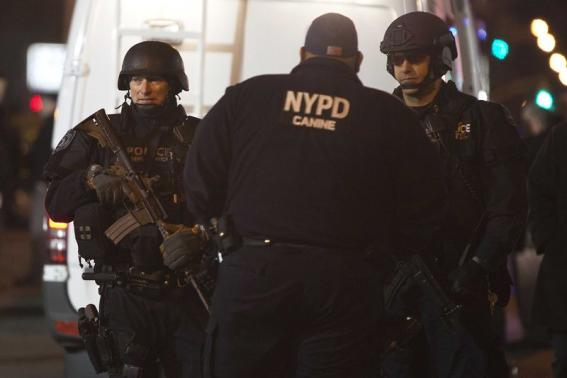
An alleged work slowdown in a fit of pique by New York City police officers could turn out to have the opposite of its intended effect, causing Big Apple residents to lose respect for “New York’s Finest.”
The work slowdown is the latest NYPD tactic in its battle with New York Mayor Bill de Blasio. Officers turned their backs on the mayor when he spoke at the funeral of Rafael Ramos, an officer killed on December 20 by a gunman, Ismaaiyl Brinsley, who cited police abuses as the reason for his crime. Now police officers, at the behest of the Patrolmen’s Benevolent Association, are not enforcing the law “unless absolutely necessary.” During the week of December 22, arrests were down 66% and traffic and parking tickets and summons for minor offenses were down more than 90% from the same week in 2013.
Instead of concern, many are grateful for the diminished police presence. Tickets and summons have been issued disproportionally to those in the working class, forcing them to bear much of the city’s revenue burden. Now the targeting has stopped and those around the political spectrum wonder if it was ever necessary, according to BBC News.
“Well, we can only hope the NYPD unions and de Blasio settle their differences soon so that the police can go back to arresting people for reasons other than ‘when they have to’,” Scott Shackford of the libertarian Reason magazine wrote. In Rolling Stone, Matt Taibbi’s response to the slowdown was that it “shines a light on the use of police officers to make up for tax shortfalls using ticket and citation revenue.”
And Harry Siegel wrote in the New York Daily News on what might be the effect on attitudes toward police. “It’s tough to run a protection racket when people don’t feel threatened, and New York ended 2014 with new lows in murders, rapes, burglaries, grand larcenies and robberies,” he wrote. “For over 20 years, crime has dropped as the NYPD has doubled and redoubled its enforcement efforts. At some point, the chemo is deadlier than the cancer.”
Police felt slighted by de Blasio when the mayor decried the decision of a grand jury not to indict the police officers responsible for the death of Eric Garner, who was put in a chokehold while being arrested for selling individual cigarettes. De Blasio said the decision was one that “many in our city did not want.”
He went on to speak of his son Dante, who is black. “I couldn’t help but immediately think what it would mean to me to lose Dante. Life would never be the same for me after,” de Blasio said. “Chirlane and I have had to talk to Dante for years about the dangers that he may face,” he added. “No family should have to go through what the Garner family went through.” NYPD officers and their union took that as a sign of disrespect.
Some police officers repeated their back-turning protest at Sunday’s funeral for Wenjian Liu, who was also killed by the man who killed Officer Ramos.
To Learn More:
Is New York Police’s ‘Virtual Work Stoppage’ a Boon For Critics? (by Anthony Zurcher, BBC News)
Arrests Plummet 66% With NYPD in Virtual Work Stoppage (by Larry Celona, Shawn Cohen and Bruce Golding, New York Post )
How Low Income New Yorkers Are Benefiting From the NYPD’s Work Stoppage (by Kira Lerner and Igor Volsky, ThinkProgress )
Respect for NYPD Squandered in Attacks on Bill de Blasio (New York Times )
Bill de Blasio Responds to Eric Garner Grand Jury Decision (by Sam Levine, Huffington Post )
The Overlooked Third Victim of the New York Cop Killer (by Noel Brinkerhoff, AllGov )
Two Most-Sued Cops in New York Cost City $1.9 Million in Payouts (by Noel Brinkerhoff, AllGov )
Bystanders Hit by Police Bullets in New York City Get Little Sympathy and No Compensation (by Noel Brinkerhoff and Danny Biederman, AllGov )
Whistleblower Cop Calls Out Corruption in Her Department, Naturally She’s Being Fired for It
By Matt Agorist | The Free Thought Project | December 31, 2014
Louisville, KY — A New Albany police officer of 19-years is being fired after she blew the whistle on her department.
In May, Officer Laura Schook made several claims against her department including corruption, padded overtime and discrimination.
“My supervisors [were] padding their overtime, stealing time from the city, also doing other jobs while they were at work, essentially being paid for two jobs at one time,” Schook said in an interview.
After the allegations were made, Chief Sherri Knight and Assistant Chief Greg Pennell both resigned and asked to be reassigned within the police force.
WDRB’s Valerie Chinn asked Schook if the requests were related or coincidental.
“Coincidental, yet corroborating at the same time,” Schook said. “I mean, that’s the way I would look at it. I believe that it corroborates what I said. There has to be some truth to what I said or they wouldn’t be scrambling around like they are.”
After an “investigation” was launched into Schook’s allegations, Floyd County prosecutor Keith Henderson decided not to bring criminal charges against anyone in the Department and the Merit Commission voted to terminate Schook from the department.
New Albany Police Chief Todd Bailey sent a statement to WDRB Monday night, which read:
The Merit Commission voted unanimously to terminate Schook pending the results of an upcoming hearing. I’m making no additional statement this evening due to the matter being an employee disciplinary action.
Laura Landenwich, Schook’s attorney says her client is being disciplined for being a whistleblower and that during the hearing they will present this evidence.
“She is being disciplined for bringing those allegations to light,” Landenwich said.
Unfortunately this response from Schook’s department seems to be standard operating procedure for departments across the country when it comes to rogue officers calling out corruption in their departments.
Last month, also in Kentucky, a sheriff’s deputy was fired for “insubordination” after pointing out that the sheriff had planted drugs in another deputy’s car. Even though the sheriff was indicted, the deputy was still fired.
Earlier this month we broke the story of a cop in Buffalo, NY who was beaten and fired after she stopped a fellow cop from nearly killing a handcuffed man. She is still fighting for her pension.
In September we exposed the Baltimore police department’s attempt to intimidate a whistleblower officer. Detective Joe Crystal became a target of intimidation for his entire department after testifying against other officers in a misconduct case. Following his testimony, he received threats from other officers, and even found a dead rat on his car one day.
The Prison State of America
By Chris Hedges | Truthdig | December 28, 2014
Prisons employ and exploit the ideal worker. Prisoners do not receive benefits or pensions. They are not paid overtime. They are forbidden to organize and strike. They must show up on time. They are not paid for sick days or granted vacations. They cannot formally complain about working conditions or safety hazards. If they are disobedient, or attempt to protest their pitiful wages, they lose their jobs and can be sent to isolation cells. The roughly 1 million prisoners who work for corporations and government industries in the American prison system are models for what the corporate state expects us all to become. And corporations have no intention of permitting prison reforms that would reduce the size of their bonded workforce. In fact, they are seeking to replicate these conditions throughout the society.
States, in the name of austerity, have stopped providing prisoners with essential items including shoes, extra blankets and even toilet paper, while starting to charge them for electricity and room and board. Most prisoners and the families that struggle to support them are chronically short of money. Prisons are company towns. Scrip, rather than money, was once paid to coal miners, and it could be used only at the company store. Prisoners are in a similar condition. When they go broke—and being broke is a frequent occurrence in prison—prisoners must take out prison loans to pay for medications, legal and medical fees and basic commissary items such as soap and deodorant. Debt peonage inside prison is as prevalent as it is outside prison.
States impose an array of fees on prisoners. For example, there is a 10 percent charge imposed by New Jersey on every commissary purchase. Stamps have a 10 percent surcharge. Prisoners must pay the state for a 15-minute deathbed visit to an immediate family member or a 15-minute visit to a funeral home to view the deceased. New Jersey, like most other states, forces a prisoner to reimburse the system for overtime wages paid to the two guards who accompany him or her, plus mileage cost. The charge can be as high as $945.04. It can take years to pay off a visit with a dying father or mother.
Fines, often in the thousands of dollars, are assessed against many prisoners when they are sentenced. There are 22 fines that can be imposed in New Jersey, including the Violent Crime Compensation Assessment (VCCB), the Law Enforcement Officers Training & Equipment Fund (LEOT) and Extradition Costs (EXTRA). The state takes a percentage each month out of prison pay to pay down the fines, a process that can take decades. If a prisoner who is fined $10,000 at sentencing must rely solely on a prison salary he or she will owe about $4,000 after making payments for 25 years. Prisoners can leave prison in debt to the state. And if they cannot continue to make regular payments—difficult because of high unemployment—they are sent back to prison. High recidivism is part of the design.
Corporations have privatized most of the prison functions once handled by governments. They run prison commissaries and, since the prisoners have nowhere else to shop, often jack up prices by as much as 100 percent. Corporations have taken over the phone systems and charge exorbitant fees to prisoners and their families. They grossly overcharge for money transfers from families to prisoners. And these corporations, some of the nation’s largest, pay little more than a dollar a day to prison laborers who work in for-profit prison industries. Food and merchandise vendors, construction companies, laundry services, uniforms companies, prison equipment vendors, cafeteria services, manufacturers of pepper spray, body armor and the array of medieval instruments used for the physical control of prisoners, and a host of other contractors feed like jackals off prisons. Prisons, in America, are a hugely profitable business.
Our prison-industrial complex, which holds 2.3 million prisoners, or 25 percent of the world’s prison population, makes money by keeping prisons full. It demands bodies, regardless of color, gender or ethnicity. As the system drains the pool of black bodies, it has begun to incarcerate others. Women—the fastest-growing segment of the prison population—are swelling prisons, as are poor whites in general, Hispanics and immigrants. Prisons are no longer a black-white issue. Prisons are a grotesque manifestation of corporate capitalism. Slavery is legal in prisons under the 13th Amendment of the U.S. Constitution. It reads: “Neither slavery nor involuntary servitude, except as punishment for crime whereof the party shall have been duly convicted, shall exist within the United States. …” And the massive U.S. prison industry functions like the forced labor camps that have existed in all totalitarian states.
Corporate investors, who have poured billions into the business of mass incarceration, expect long-term returns. And they will get them. It is their lobbyists who write the draconian laws that demand absurdly long sentences, deny paroles, determine immigrant detention laws and impose minimum-sentence and three-strikes-out laws (mandating life sentences after three felony convictions). The politicians and the courts, subservient to corporate power, can be counted on to protect corporate interests.
Corrections Corporation of America (CCA), the largest owner of for-profit prisons and immigration detention facilities in the country, had revenues of $1.7 billion in 2013 and profits of $300 million. CCA holds an average of 81,384 inmates in its facilities on any one day. Aramark Holdings Corp., a Philadelphia-based company that contracts through Aramark Correctional Services to provide food to 600 correctional institutions across the United States, was acquired in 2007 for $8.3 billion by investors that included Goldman Sachs.
The three top for-profit prison corporations spent an estimated $45 million over a recent 10-year period for lobbying that is keeping the prison business flush. The resource center In the Public Interest documented in its report “Criminal: How Lockup Quotas and ‘Low-Crime Taxes’ Guarantee Profits for Private Prison Corporations” that private prison companies often sign state contracts that guarantee prison occupancy rates of 90 percent. If states fail to meet the quota they have to pay the corporations for the empty beds.
CCA in 2011 gave $710,300 in political contributions to candidates for federal or state office, political parties and so-called 527 groups (PACs and super PACs), the American Civil Liberties Union reported. The corporation also spent $1.07 million lobbying federal officials plus undisclosed sums to lobby state officials, according to the ACLU. CCA, through the American Legislative Exchange Council (ALEC), also lobbies legislators to impose harsher detention laws at the state and federal levels. The ALEC helped draft Arizona’s cruel anti-immigrant law SB 1070.
The United States, from 1970 to 2005, increased its prison population by about 700 percent, according to statistics gathered by the ACLU. The federal Bureau of Justice Statistics, the ACLU report notes, says for-profit companies presently control about 18 percent of federal prisoners and 6.7 percent of all state prisoners. Private prisons account for nearly all newly built prisons. And nearly half of all immigrants detained by the federal government are shipped to for-profit prisons, according to Detention Watch Network.
But corporate profit is not limited to building and administering prisons. Whole industries now rely almost exclusively on prison labor. Federal prisoners, who are among the highest paid in the U.S. system, making as much as $1.25 an hour, produce the military’s helmets, uniforms, pants, shirts, ammunition belts, ID tags and tents. Prisoners work, often through subcontractors, for major corporations such as Chevron, Bank of America, IBM, Motorola, Microsoft, AT&T, Starbucks, Nintendo, Victoria’s Secret, J.C. Penney, Sears, Wal-Mart, Kmart, Eddie Bauer, Wendy’s, Procter & Gamble, Johnson & Johnson, Fruit of the Loom, Motorola, Caterpillar, Sara Lee, Quaker Oats, Mary Kay, Microsoft, Texas Instruments, Dell, Honeywell, Hewlett-Packard, Nortel, Nordstrom’s, Revlon, Macy’s, Pierre Cardin and Target. Prisoners in some states run dairy farms, staff call centers, take hotel reservations or work in slaughterhouses. And prisoners are used to carry out public services such as collecting highway trash in states such as Ohio.
States, with shrinking budgets, share in the corporate exploitation. They get kickbacks of as much as 40 percent from corporations that prey on prisoners. This kickback money is often supposed to go into “inmate welfare funds,” but prisoners say they rarely see any purchases made by the funds to improve life inside prison.
The wages paid to prisoners for labor inside prisons have remained stagnant and in real terms have declined over the past three decades. In New Jersey a prisoner made $1.20 for eight hours of work—yes, eight hours of work—in 1980 and today makes $1.30 for a day’s labor. Prisoners earn, on average, $28 a month. Those incarcerated in for-profit prisons earn as little as 17 cents an hour.
However, items for sale in prison commissaries have risen in price over the past two decades by as much as 100 percent. And new rules in some prisons, including those in New Jersey, prohibit families to send packages to prisoners, forcing prisoners to rely exclusively on prison vendors. This is as much a psychological blow as a material one; it leaves families feeling powerless to help loved ones trapped in the system.
A bar of Dove soap in 1996 cost New Jersey prisoners 97 cents. Today it costs $1.95, an increase of 101 percent. A tube of Crest toothpaste cost $2.35 in 1996 and today costs $3.49, an increase of 48 percent. AA batteries have risen by 184 percent, and a stick of deodorant has risen by 95 percent. The only two items I found that remained the same in price from 1996 were frosted flake cereal and cups of noodles, but these items in prisons have been switched from recognizable brand names to generic products. The white Reebok shoes that most prisoners wear, shoes that last about six months, costs about $45 a pair. Those who cannot afford the Reebok brand must buy, for $20, shoddy shoes with soles that shred easily. In addition, prisoners are charged for visits to the infirmary and the dentist and for medications.
Keefe Supply Co., which runs commissaries for an estimated half a million prisoners in states including Florida and Maryland, is notorious for price gouging. It sells a single No. 10 white envelope for 15 cents—$15 per 100 envelopes. The typical retail cost outside prison for a box of 100 of these envelopes is $7. The company marks up a 3-ounce packet of noodle soup, one of the most popular commissary items, to 45 cents from 26 cents.
Global Tel Link, a private phone company, jacks up phone rates in New Jersey to 15 cents a minute, although some states, such as New York, have relieved the economic load on families by reducing the charge to 4 cents a minute. The Federal Communications Commission has determined that a fair rate for a 15-minute interstate call by a prisoner is $1.80 for debit and $2.10 for collect. The high phone rates imposed on prisoners, who do not have a choice of carriers and must call either collect or by using debit accounts that hold prepaid deposits made by them or their families, are especially damaging to the 2 million children with a parent behind bars. The phone is a lifeline for the children of the incarcerated.
Monopolistic telephone contracts give to the states kickbacks amounting, on average, to 42 percent of gross revenues from prisoner phone calls, according to Prison Legal News. The companies with exclusive prison phone contracts not only charge higher phone rates but add to the phone charges the cost of the kickbacks, called “commissions” by state agencies, according to research conducted in 2011 by John E. Dannenberg for Prison Legal News. Dannenberg found that the phone market in state prison systems generates an estimated $362 million annually in gross revenues for the states and costs prisoners’ families, who put money into phone accounts, some $143 million a year.
When strong family ties are retained, there are lower rates of recidivism and fewer parole violations. But that is not what the corporate architects of prisons want: High recidivism, now at over 60 percent, keeps the cages full. This is one reason, I suspect, why prisons make visitations humiliating and difficult. It is not uncommon for prisoners to tell their families—especially those that include small children traumatized by the security screening, long waits, body searches, clanging metal doors and verbal abuse by guards—not to visit. Prisoners with life sentences frequently urge loved ones to sever all ties with them and consider them as dead.
The rise of what Marie Gottschalk, the author of “Caught: The Prison State and the Lockdown of American Politics,” calls “the carceral state” is ominous. It will not be reformed through elections or by appealing to political elites or the courts. Prisons are not, finally, about race, although poor people of color suffer the most. They are not even about being poor. They are prototypes for the future. They are emblematic of the disempowerment and exploitation that corporations seek to inflict on all workers. If corporate power continues to disembowel the country, if it is not impeded by mass protests and revolt, life outside prison will soon resemble life in prison.
Predictions Based on the 2015 Federal Budget – An Analysis
By Lawrence Davidson | To the Point Analyses | December 28, 2014
Part I – Predictions
I can make high-probability predictions for 2015 and the near-beyond without the benefit of a crystal ball, tarot cards or tea leaves. The only thing that I need is a list of items from the new 2015 federal budget. Here are some of my forecasts and the budget items that make them so highly probable:
1. There will be more deadly truck-related accidents than necessary on the nation’s highways in 2015. That means more deaths, injuries, highway delays, stress and frustration. How do I know? Because the 2015 budget rolls back the safety requirement that truckers need to get more rest between driving assignments. The regulation that was rolled back was itself barely adequate. It restricted drivers to a 70-hour week with mandated rest times between long periods behind the wheel. Nonetheless, despite obviously being in the public interest, this regulation could not survive the pressure of the lobbies representing the trucking industry and its corporate customers. Now we are back to truckers working 85-hour weeks with hardly any mandated rest at all.
2. Either in 2015 or soon thereafter there will be another major banking crisis requiring the outlay of enormous sums of public money to avert economic meltdown. How do I know? Because the 2015 federal budget rolls back the requirement, put in place after the last financial crisis, that forced the trading of derivatives to be done by corporate entities separated from the banks and not covered by the Federal Deposit Insurance Company. In other words, if the banks wanted to devise unreasonably risky investment strategies for their more gullible customers, they had to insulate these strategies from their main banking operations that are crucial to the national economy. In addition the government was not required to insure such undue risks through the Federal Deposit Insurance Corporation. Although obviously in the public interest, these regulations could not survive the pressure coming from the banking lobbies and so, once more, we all must be prepared to pay the price of this version of insufficiently regulated capitalism.
3. The political influence of the nation’s wealthiest individuals will increase by a factor of ten in 2015, making the United States more of a plutocracy and less of a democracy than at any time since the 1920s. How do I know? Because the new federal budget emasculates what little was left of the 2002 McCain-Feingold Bipartisan Campaign Finance Reform Act by increasing tenfold the amount of money individuals can give to political parties. This is the result of conservatives’ demanding that political campaigns be underwritten wholly by private funds. Common sense tells us that such an arrangement can only confirm political power in the hands of those who are already economically dominant. By the way, most countries claiming to be democracies regulate against just this dominance of private money because it is recognized as politically corrupting.
4. Environmental protection will deteriorate in 2015. If you live in a rural area where there are large farms, your water supply will become more suspect. How do I know all this? Because the 2015 federal budget slashes funding for the Environmental Protection Agency by $60 million and forbids the same agency from applying the Clean Water Act to farm ponds and irrigation ditches. In the public interest? Of course not. However this move pleases agribusiness concerns and other industries.
5. Israel, the economically developed nation that has violated just about every human rights regulation listed under international law, and also has repeatedly broken U.S. law forbidding the use of U.S.-supplied weapons for offensive actions against civilian populations, will continue to be both economically and militarily subsidized by the American taxpayer in 2015. How do I know this? Because the 2015 federal budget follows in the footsteps of so many past budgets by setting aside huge sums of money – in the present case $3.1 billion in total aid – for the Zionist state. Of that aid package, $619.8 million is military related.
I could not get exact gross figures for how much money the federal government gives back per year to U.S. states for various programs, but certainly Israel gets more of your federal tax dollar than any single state does, and maybe more than all fifty states put together.
On the same topic of foreign aid to undeserving governments, the 2015 budget will help insure the survival of the brutal military dictatorship in Egypt. That bunch of gangsters will be getting $1.3 billion in military aid.
These dubious expenditures are also not in the U.S. public interest for they will undermine democracy in Egypt and uphold dictatorship. In the case of Israel the money will help uphold racist authoritarianism, ethnic cleansing and religious bigotry. All of which (including the aid to Egypt) has been successfully encouraged by the financial power of the Zionist lobby.
Part II – John Boehner’s Bipartisanism
According to House Speaker John Boehner, the 2015 federal budget is a product of bipartisan compromise: “Understand all these provisions … were worked out in a bi-partisan, bi-cameral fashion.” However, this can hardly be the whole story. Boehner’s statement implies that there were only Republicans and Democrats in the proverbial back room where the budget was worked out and that everyone was practicing sweet reason so as to come to a compromise that benefits the nation. In truth, looking over the shoulders of those representing both parties were numerous lobbyists who had given a lot of money to all these politicians and now wanted something back for their investment. As a result, we as a nation, as a community, were thoroughly outbid by the trucking industry, the bankers, agribusiness, and a good number of conservative ideologues who want the right to gut the federal government (particularly the Environmental Protection Agency and the Internal Revenue Service) while monopolizing funding of our two major political parties. They want to do this so that, among other things, they don’t have worry about regulations or pay even a reasonable amount of taxes.
Part III – Conclusion
The ultimate conclusion we can draw from this “bipartisan” process is that there is no sense of national interest, and damn little sense of community, in the American political system. Both concepts have been superseded by the particular parochial goals and sense of solidarity of groups and subgroups with the deep pockets necessary to buy legislators and legislation. This is what happens when democracy allows itself to be captured by an increasingly unregulated capitalist ethic – an erosion of any politically based sense of a need to work for the common good.
The really depressing part is that for most of our national history it has not been very different. In the mid nineteenth century President James Polk, himself a man of questionable integrity, observed, “There is more selfishness and less principle among members of Congress than I had any conception of, before I became President of the United States.” Well, the problem persists, and given our political way of doing things, it may never be fully overcome
U.S. War Against Russia Is Now Against Hungary Too
By Eric Zuesse | Blacklisted News | December 25, 2014
Hungary has decided to align itself with Russia against the United States.
The Western Alliance is starting to fray, over the insistence by Barack Obama and the U.S. Congress to go to war against Russia.
This is called a ‘new cold war,’ but it’s actually already a hot war within Ukraine, immediately next door to Russia.
America’s plan to locate nuclear missiles there aimed against Russia has made stunning progress this year. The formerly neutral nation of Ukraine has now become officially anti-Russian. Because of the Obama coup, Ukraine is suffering a civil war between the Ukrainian regime that Obama’s CIA and mercenaries installed in Kiev on 22 February 2014, versus the people in Ukraine’s far eastern districts, where the Ukrainian President whom Obama was overthrowing had received around 90% of all the votes that had been cast there, and so the newly installed Obama regime in Kiev in the west was overwhelmingly rejected by them — hence, Ukraine’s civil war is raging there now, with Obama’s Kiev regime trying to eliminate the residents there.
But, within the European Union, and especially among its former member-states of the Soviet Union, this is, as of yet, still only a cold war, which is in the process of heating up toward perhaps the super-hot temperature of a nuclear conflict between Russia and NATO (the latter organization consisting of the United States and its vassal nations against Russia). And America is already investing heavily in it.
According to German Economic News (GEN), on December 25th, “Hungary Will Not Take Part in the Cold War Against Russia.” They report that, “Hungary’s Prime Minister Viktor Orban takes his distance from the EU, and accuses the US government of trying to instigate a new Cold War against Russia. Hungary will not participate.” GEN also links to an earlier, October 19th, GEN article, which had reported that, “After Russia, Hungary is now apparently also being targeted by Americans: the United States is hitting senior Hungarian government officials and businessmen with entry bans. The Americans throw corruption-charges against the Hungarians.”
Actually, the United States Government is also very corrupt, and uses corruption-charges against other nations’ officials in order to provide a pretext to force them to buckle to America’s aristocracy — to become vassal nations. Will the U.S. Government now place entry-bans against high U.S. officials, also, such as against Joe Biden even now, and perhaps including against Barack Obama after his Presidency ends and he starts taking favors that are widely expected for him, on and from Wall Street (such as did his friend Timothy Geithner)? (And this was already after the cascade of corruption during George W. Bush’s Presidency — none of which Obama allowed to be investigated and prosecuted.)
In 2013, a Gallup poll asked Americans, “Is corruption widespread throughout the government in the United States?” and 73% said “Yes.” But the corrupt Obama Administration pretends to be in the position of international arbiter against corruption in other corrupt nations. Whom is he fooling? (Perhaps people who don’t read this news-site, for example?)
On Tuesday, December 23rd, Reuters headlined, “Hungary PM Orban: U.S. uses corruption charges to gain influence,” and reported that, “The United States is using corruption allegations against some Hungarian public officials as a ‘cover story’ to boost its influence in central Europe amid the Russia-Ukraine conflict, Prime Minister Viktor Orban said on Tuesday. Orban’s comments come amid a wider souring of relations between Hungary, a NATO ally, and the United States over what America perceives as Orban’s increasingly authoritarian rule and Budapest’s warm relations with Russia.”
America’s pervasive NSA snooping, militarizing of local police-forces, and invasions of Iraq, Syria, Libya, and other countries that never threatened the United States, are not considered (by the British Reuters ) ‘authoritarian,’ but somehow Hungary now is ‘authoritarian.’ Suddenly (though the U.S. didn’t say this when Hungary was trying to meet the demands of the American aristocracy), Hungary is ‘authoritarian,’ and is ‘too’ corrupt to do business with.
When more than two-thirds of the United States public are against the U.S. Government’s selling arms to the Ukrainian Government, but 98% of the U.S. House of Representatives wants not only to sell them to Ukraine but to donate them to Ukraine, with U.S. taxpayers paying the tab for this largesse, and when 100% of the U.S. Senate then goes along with that, and the U.S. President signs it into law, how fake is American ‘democracy’?
Even on such a vital war-and-peace issue as nuclear war, America’s aristocracy, which overwhelmingly finances all ‘elections’ to national office, is controlling the U.S. Government, no matter what the U.S. public want.
Obama hasn’t succeeded in fooling the American public into invading Russia, as George W. Bush succeeded in fooling the American public into invading Iraq, but now he won’t even need to.
All of this trouble is being done in order to surround Russia with our nuclear missiles. It’s not resulting from too much democracy; it’s resulting from fake ‘democracy.’
So: now we know that it’s fake.
It’s fake: that’s the reality. Once this reality is understood, everything else can begin to make sense. Getting rid of the illusion from the lies from the many liars is the prerequisite to understanding. Before that, is only myths. They’re getting more dangerous day-by-day. Nuclear war is deadly serious.
China’s Second ‘Cultural Revolution’
By James Petras :: 12.23.2014
Introduction
China is in the midst of its second ‘cultural revolution’ in a half century. While the first (under Chairman Mao Tse Tung) was intended to ‘revitalize socialism’; the current is directed to ‘moralizing’ capitalism.
The first CR was a frontal attack on the hierarchy of power and privilege inside and outside of the Communist Party, launched from above by Mao Tse Tung, but taken up from below by Red Guards in order to bring about a more egalitarian society.
The current ‘cultural revolution’, launched by President Xi Jinping, is directed at ending widespread corruption, theft and pillage of the Chinese economy and society by high and low officials in government and the capitalist sector.
The two cultural revolutions are linked by Deng Xiaoping, the Chinese leader who officially put closure on the first and set in motion the policies and slogans (“Getting Rich is Good!”), necessitating a second cultural revolution three decades later.
The Socio-Economic Roots of the Cultural Revolution Today
Deng’s call to ‘get rich’ was directed at the Communist Party elite, their family, friends and overseas backers; it was an open invitation to the multi-nationals of the world to freely exploit China’s resources, infrastructure and labor – educated, nurtured and organized through the collective efforts of the preceding Communist regime. Deng ‘liberated’- or privatized – the means of production and rapidly turned public control and appropriation of earnings over to emerging private capitalists. The corollary was the elimination of all social rights, benefits and protections of labor. The dual incentives were designed to maximize private profits in order to attract long-term, large-scale investments and to achieve high growth in the shortest time possible. Deng telescoped a century of growth and exploitation into a few decades.
His strategy succeeded.
Profits soared. By the late 1980’s and early 1990’s millionaires multiplied like mushrooms after a downpour. Then came the billionaires. Aided and abetted by the wholesale privatization of lucrative industries and public lands, a new class of real estate speculators and so-called ‘developers’ emerged , closely linked to corrupt local municipal, regional and national state officials. Millions of peasants were dispossessed and barely (if ever) compensated; hundreds of millions of workers were employed at starvation wages without the free housing, medical care, education, recreational benefits and lifetime employment of the past, socialist system.
China’s GNP exploded at a double-digit rate for three decades – an unprecedented performance. Most of the profits circulated among a narrow elite of party – state officials and capitalists, while a smaller share ‘trickled down’ to middle and low level functionaries. The seizure of public wealth, followed by three decades of intense exploitation of labor and the private land grabbing of farmland and homesteads, spurred the boom in real estate profits and laid the basis for all pervasive and large-scale corruption .The pillage of the public treasury led to large-scale conspicuous consumption – of imported luxury goods, multi-tiered mansions in gated communities, multiple purchases of luxury condos for offspring, mistresses and bribe-takers and givers.
By the mid 2000’s the concentration of wealth, property and privilege had reached astronomical heights: hundreds of billions accrued to the top 2%, millions to the top 10%, and hundreds of thousands to the top 15% – the self-styled ‘middle class’ who thrived on lesser but equally pervasive corruption and theft and who aped the elite and imitated their life style of luxury consumerism.
Beginning in the mid-2000s, hundreds of strikes by exploited factory workers demanded and secured higher wages; millions of households, farmers and peasants fought against municipal party officials, linked to real estate capitalists, who were attempting to ‘grab’ their land, homes and neighborhoods. Hundreds of millions of Chinese in the countryside protested exorbitant medical and educational costs, induced by the privatized health and educational system, which had bankrupted millions of households. They quickly became aware of the luxurious private medical facilities and specialized clinics for the rich -capitalists and corrupt officials. The internal migrant workers, who built the hyper-luxury condos and mansions, lived in paper shacks, far from the twelve-course banquets celebrating the ‘grand openings’ by business swindlers and ‘bought officials’. As wealth grew among the elite, so did the people’s hostility and rejection of the Party and the State, which they personified.
The ever-cautious klepto-capitalists and public pillagers, fearing for their illicit fortunes, smuggled out enormous wealth. Big swindlers, with big fortunes engaged in massive money laundering while publicly demanding the ‘de-regulation” of the financial sector (i.e. to make it easier to launder and hide their fortunes in overseas accounts). Between 2005-2011 China hemorrhaged over $2.83 trillion in illegal overseas financial outflows.
Part II: The Consequences of Corruption, Pillage and Exploitation
The illicit flow of Chinese wealth overseas resulted from the elite’s savage and illegal exploitation of labor (failure to meet minimum official standards concerning pay, work safety, child labor, excessive hours). Wealth from bribes, kickbacks on government contracts, speculation on illicit seizures of land, and making false invoices overpricing imports and underpricing exports, flowed upward and outward. While China was profiting from double-digit growth the regime could ‘tolerate’ corruption and illicit outflows. However, by the beginning of the second decade of the 21st century, when China’s economy de-accelerated to about 7 – 7.5%, the regime became less tolerant of wholesale corruption accompanied by capital flight.
Moreover, the new billionaires, millionaires and affluent middle class indulged in what Thorsten Veblen described as “conspicuous consumption”, the purchase and ostentatious display of superfluous luxury products as status symbols of “success”. According to a Special Report on “Luxury” in the Economist (12/13/14, p.8 -10) “nearly one-third of all personal luxury goods sold worldwide are bought by Chinese consumers.” Since the global crises of 2009, 70 – 80% of global growth in the (luxury) sector has come from China.
China’s emerging private-public ruling class has advanced from concentrating wealth, to consolidating political power to seeking prestige and social status – recognition from their domestic and foreign peers. Ideologically, they are decidedly neo-liberal and pro-Western – as evidenced by the billions they spend in the top-end real estate markets of North America, Europe and Australia as well as the millions they spend on their pampered offspring for ‘elite’ private education. Their children live in half-million dollar condos in Cambridge, Massachusetts, Oxford and Cambridge (England), Toronto and Vancouver (Canada), Sydney and Melbourne Australia. The Chinese oligarchs “make the market” for six-figure Swiss watches, five figure handbags and four digit French cognac.
Corruption, conspicuous consumption and class polarization has delegitimized the ruling Communist Party elite in the eyes of the great mass of the Chinese working class, as well as the professionals and salaried employees who make-up the lower middle class.
The ‘political rot’- the privileged social networks derived from kinship ties-is leading to a relative closed ruling class – excluding the mass of urban workers and rural peasants, with potentially explosive social consequences.
Already thousands of local protests, strikes and other forms of direct action occur every year, even as they are repressed or resolved.
In addition to the social and political dangers resulting from the massive illegal, ‘squandering and theft of wealth’, the illicit outflow of wealth is undermining domestic investment and productive overseas investments, and corruption is preparing the way for stagnation and financial crisis.
The stars are lining up for a ‘perfect political storm’ – which has unfolded in the form of President Xi Jingping’s launch of China’s second cultural revolution (CR).
Xi Jingping’s Cultural Revolution
From the start of the 2nd CR in 2012 to mid-2014, the Chinese Communist Party’s internal corruption body has prosecuted and punished 270,000 cadres. That figure includes both the “tigers” (high officials) and the “flies” (low level functionaries). “Over three dozen officials with ranks of ministers or above, including former security Tsar and Politburo Standing Committee member Zhou Yongkang”, have been arrested and jailed (Financial Times 12/4/14, p. 4). Earlier, the former Railways Minister was arrested and sentenced to death for rigging contracts worth about $26 billion dollars over his seven-year tenure. Hundreds of thousands of private business people, paying bribes, have been arrested and sentenced.
President Xi’s campaign has attacked bribes, ‘gift giving’, frequent ostentatious banquets serving expensive delicacies, and high Party officials’ lodging in five star hotels for weeks on end, ostensibly “tending to business”, but more frequently ‘cavorting with their mistresses’.
To be precise, President Xi is attacking the triple evils of corruption, conspicuous consumption, and pillage of public wealth. The new austerity agenda and the public revelations of ill-gained wealth are focused on exposing public officials and private business people in order to regain public legitimacy. And it is succeeding,…. as far as it goes. Public indignation at the revelations is matched by high approval for the Xi leadership’s anti –corruption campaign.
What makes this far more than just a “power struggle among privileged elites” as the Wall Street Journal and the Financial Times have routinely claimed, are: 1. the duration of the campaign of over 2 years, 2. the scope of the campaign, covering top officials and Chinese business equivalents of Wall Street moguls, 3. The nature of the punishment including long prison terms and even death sentences (rather than the mere ‘slap on the wrists and paltry fines’ that US regulators have given to Wall Street’s billion-dollar swindlers), and 4. the ongoing nature of the process. The sweep and magnitude of Xi’s campaign has all the makings of a ‘cultural revolution’ – not the episodic ‘blowing off steam’ or ‘scapegoating of rivals’ described in the Western press.
The Nature of Xi’s Cultural Revolution
Xi’s ‘cultural revolution’ is directed and driven from above – established legal authorities are in charge – the masses are excluded, and preemptory justice is eschewed: regular court proceedings decide guilt and sentencing.
Secondly, Xi’s ‘cultural revolution’ does not, in any way or place, call into question capitalist property relations, foreign investors, or large-scale inflows and outflows of investment or legally registered speculative capital. Nor has Xi called into question existing capital-labor relations.
Xi’s ‘cultural revolution’ is an attempt to sanitize existing capitalist relations, and to infuse a new capitalist ethic. He wants to ‘revise’ Deng’s famous precept “Getting Rich is Good” to read “Get Rich Lawfully . . . or Face Jail”. China is rated number 100 out of 175, on a corruption scale published by Transparency in 2014 (Financial Times 12/4/14, p. 4). Xi’s war on corruption is based on the premise that corruption undermines China’s status as a global power – it ranks with Algeria and Surinam. Secondly, Xi hopes that he can ‘reform’ the public sector in order to privatize it and he wants the sale to go to the highest bidder, not the biggest bribe giver.
His campaign attacks privileged elites, who accumulate and dispose of wealth illegally but he has never sought to diminish the class system, the hierarchy and inequalities which concentrate political power and forms the basis of corrupt bribe giving and taking.
Xi’s ‘cultural revolution’ is continuing and corruption may lessen. Ostentatious public spending is declining. But this layer of ‘new morality’ is spread thinly over a system of power that can easily revert to the ‘old system’ once the ‘revolution’ ends.
Xi’s noteworthy ‘cultural revolution’, the moralization of public administration and private capitalism, can only succeed if it is accompanied by a social transformation: ethics at the service of social justice and equality and by a democratization of the economic decision-making process. The problem is that Xi, by family, social ties and political allegiances is deeply embedded in a milieu which absolutely rejects any such ‘deepening’ of Xi’s ‘cultural revolution’.
His cultural revolution is strictly guided by a singular objective: to force ‘morality’ on the ‘captains of capital’ in order to facilitate the smooth transition to fully liberalizing China’s economy. President Xi, along with his anti-corruption campaign, is steadily loosening state control over foreign financial investments in Chinese stocks and financial sector; he is moving strongly to expand China’s overseas investments; he is accelerating the privatization of public enterprises and increasingly opening financial services to Wall Street and the City of London. He is also internationalizing the use of the yuan-the Chinese currency- in global transactions, displacing the dollar.
In other words, his cultural revolution is a bridge to a new stage of Chinese capitalist expansion; it will lessen the crude open plunder of the public treasury, but it will not lessen the exploitation of labor nor slow the increasing concentration of wealth and privilege. That will require a different kind of ‘cultural’ revolution- one led from below by workers, peasants and salaried employees. A real ‘cultural revolution’ that realizes the ethical ideals of ‘good government’ through a transformation of class relations.
Xi’s anti-corruption campaign confirms what many workers already knew – but it also unmasks the systemic decay and forges an elementary class consciousness: counter-posing honest, hardworking workers to corrupt privileged oligarchs. Xi is aware of the danger that his campaign could ignite a popular fire: That is why he has kept a tight hold on the process. He is trying to navigate the liberal capitalist transition around the shoals of existing capitalist rot without arousing mass unrest.
Who Was Alan Gross Working For?
By CARMELO RUIZ-MARRERO | CounterPunch | December 22, 2014
Alan P. Gross, an American arrested in Cuba in 2009 for smuggling broadband satellite communications equipment, made world headlines on December 2014 when he was released the same day that US president Obama ordered the release of three Cubans who were in American prisons serving sentences for espionage. Press reports mentioned that Gross was in the Caribbean island in his capacity as a subcontractor for USAID, a US government agency that administers aid programs abroad. Throughout its history this agency has been accused of being an arm of US foreign policy and at worst a mere front for intelligence operations rather than the neutral and apolitical provider of aid to poor countries that it pretends to be. In 2014 USAID was caught red-handed in bizarre schemes to destabilize Cuba through Twitter and by funding hip hop artists.
A lesser known fact is that Gross was in Cuba working for a USAID contractor called Development Alternatives Inc. (DAI), a company that supervises and executes economic development projects all over the world. In 2010 it was USAID’s fifth biggest contractor, raking in almost $382.5 million in contracts just in that year.
DAI has also worked for the US State Department, the Pentagon, the World Bank, the United Nations, the European Commission, and private sector giants like Monsanto, Wal-Mart, Hewlett Packard, Sun Microsystems, Exxon Mobil, Daimler Chrysler, Unilever and The Gap.
“We tackle fundamental social and economic development problems caused by inefficient markets, ineffective governance, and instability”, says DAI about its work. “Since 1970, we have worked in more than 150 countries—delivering results across the spectrum of international development contexts, from stable societies and high-growth economies to challenging environments racked by political or military conflict.”
The company’s services include: corporate social responsibility, public-private partnerships, business strategy, exploration and analysis of market opportunities, integration of small businesses and small farmers into global value chains, food security and agribusiness promotion, financial services, drafting laws to make competitive economies, innovation and entrepreneurship, gender issues, climate change adaptation, carbon markets, water resources management, market environmentalism, legislative reform, citizen participation, public safety, health care, information and communications technology, and more. In short, if you want to set up a country from scratch, just call DAI.
According to Sourcewatch, a sort of Wikipedia of the left:
“DAI acted as a conduit for USAID (through the Office of Transition Initiatives) and National Endowment for Democracy (NED) funds to the Venezuelan opposition to president Hugo Chavez. Furthermore, it was instrumental along with NED affiliated organizations for financing black propaganda on Venezuelan private network TV during the general strike in 2002. Documents obtained through a Freedom of Information Act request show that DAI was required to keep certain personnel in Venezuela and had to consult with USAID about staff changes. Philip Agee, a former CIA officer, suggests that this is merely a cover for what passed for CIA operations in the past.”
The company’s own web site informs that it has played an important role in the United States’ geopolitical and military strategy in the Middle East:
“Following the 9/11 attacks of 2001 and the subsequent U.S. military actions, DAI was called on to lead a variety of challenging development projects in the midst of the counterinsurgency in Afghanistan, a country where we worked as early as 1977. Similarly, after the United States toppled the Iraqi regime in 2003, DAI won a project to help provide legitimate governance in the country. Other assignments in Iraq covered agriculture.”
It is most interesting that DAI would be in Afghanistan in 1977, way before the Soviet invasion, just when the CIA was arming and training an Islamic fundamentalist insurgent force to destabilize the country.
According to a 2011 article in The Guardian by Jonathan Steele:
“Western backing for these (Afghan) rebels had begun before Soviet troops arrived. It served western propaganda to say the Russians had no justification for entering Afghanistan in what the west called an aggressive land grab. In fact, US officials saw an advantage in the mujahedin rebellion which grew after a pro-Moscow government toppled (Prime Minister) Daoud in April 1978. In his memoirs, Robert Gates, then a CIA official and later defence secretary under Presidents Bush and Obama, recounts a staff meeting in March 1979 where CIA officials asked whether they should keep the mujahedin going, thereby “sucking the Soviets into a Vietnamese quagmire”. The meeting agreed to fund them to buy weapons.”
Needless to say, this type of work can be pretty hazardous. In December 2009 five DAI employees were killed by an explosion in the USAID headquarters in Gardez, Afghanistan. From that facility DAI was running a Local Governance and Community Development project. According to DAI:
“Our mission on behalf of (USAID) was crucial: encourage communities in the most volatile parts of the country to turn away from the insurgency and toward the Government of the Islamic Republic of Afghanistan. We set out to do this in large part by facilitating 2,635 community projects that addressed local grievances, fostered stability, facilitated dialogue, and engendered trust in district and provincial leaders.”
The most notorious death of a DAI employee in a war zone was that of Linda Norgrove, who was abducted by the Taliban in eastern Afghanistan on September 2010. The US sent a Navy elite force to rescue her but the Rambo-style operation did not go well. Norgrove was killed, not by her captors but by a grenade thrown by one of her would-be rescuers, according to an official joint US-UK investigation of her death.
According to DAI CEO Jim Boomgard, Gross was in Cuba running a US government program called “Cuba Democracy and Contingency Planning Program”. In an August 2008 meeting, officials from this program told DAI representatives that “USAID is not telling Cubans how or why they need a democratic transition, but rather, the Agency wants to provide the technology and means for communicating the spark which could benefit the population.” The program, the officials said, intended to “provide a base from which Cubans can ‘develop alternative visions of the future.’”
In 2012 Gross and his wife sued USAID and DAI for allegedly not informing him adequately of the risk that his mission entailed – the case was settled out of court in 2013. If what Gross claimed in his lawsuit is true, then the man was an unwitting dupe in a US intelligence operation. It remains to be seen how many American aid workers who sincerely believed they were engaging in harmless, uncontroversial activity helping people abroad were actually being used by the CIA or other agencies as pawns in high risk games of political chess.
Carmello Ruiz-Marrero is a Puerto Rican journalist. Web site: http://carmeloruiz.blogspot.com/ Twitter: @carmeloruiz
Houston P.D. Orders All Officers Turn Off Body Cameras During Protest
TheAntiMedia | December 20, 2014
Remington Alessi was arrested on Saturday December 13 in Houston, Texas. He was arrested while engaging in a nonviolent protest against police brutality. He gives us his account of what he learned in the back of a squad car.
“We’re going to go ahead and turn off the personal video devices going forward, so be sure all officers have them turned off when engaging the protesters.” The words cut through me and chilled my spine as I sat, helplessly handcuffed in the back of a Houston Police cruiser after being arrested in the midst of a protest.
As an activist who has been around the block a few times, I knew that little would endanger a crowd more than a crowd of officers who had just received an order from higher up to disable their own personal accountability.
Barely into the pilot program, the Houston Police Department’s commanding officers managed to brazenly display how easily the personal video devices can be misused. Per an earlier interview, “Capt. Mike Skillern, who heads HPD’s gang unit and is involved in testing the cameras, said his fellow officers act “a little more professionally” when wearing the devices.” But how do they act when they switch the devices off? If officers had their way, no one would know.
The biggest fault here lies in the physical design of the cameras themselves. The VIEVU LE3 model camera is employed by HPD and is worn by over four thousand police agencies, according to the company’s website. The camera’s most conspicuous feature is an easily operated off switch, which can functionally slide over the lens of the camera at any time an officer feels the need to remove any potential accountability. Hyperbole fails in describing how much of a problem it is for police to control when video is being recorded.
Allowing police to control the video stream will create a situation in which footage will appear only when it benefits the officer, while footage of police beating unarmed suspects, throwing incendiary devices at toddlers, and erasing civilians’ video records of police brutality will never appear, due to conveniently located off switches designed by VIEVU to make the devices popular among police.
When the order came across the radio to disable the cameras, I held my breath, hoping against hope that even a single officer would object to the directive that specifically commanded officers to stop recording their activities. My heart sunk as I was met with silence. Not even the friendly Lieutenant Troy Finner, who only an hour prior had waxed poetic about being concerned about protesters’ safety had a word to say about the order. Instead, he, like every other police officer assigned to ‘protect’ the nonviolent protesters, agreed to endanger them the moment a commanding officer gave the order.
The thin blue line will be maintained, cameras or not.
Man charged with breaking a trooper’s fist with his face
By Larry Hohol | Police State USA | October 24, 2014

BRADFORD COUNTY, PA — A motorist was viciously beaten, tasered, and maced repeatedly, then charged with 24 separate crimes and maliciously prosecuted for every one of them. He was beaten four (4) times over the course of 11-hours, and not once had he acted maliciously. The incident stemmed from his driving while on an unusually high dosage of legally-prescribed bipolar medication and a subsequent fender bender. Dash-cam footage revealed the extraordinary exaggerations made about the case — 2 years after it took place.
The Traffic Stop
Around 8:20 p.m. on March 8th, 2010, police received a 9-1-1 call regarding a car that had failed to stop after a minor traffic collision. The accident resulted in no injuries and no damage, but one of the drivers did not stop to exchange information. Pennsylvania State Police (PSP) dispatched troopers to investigate this alleged hit-and-run.
A car driven by Robert Leone, 31 at the time, matched the basic description of the car in question. Mr. Leone was driving just across the Pennsylvania border from his home in Vestal, NY. He had just finished star gazing at the Kopernick Observatory and Science Center and decided to go for a ride in the country while listening to his favorite music. He had consumed no alcohol or illegal substances, but it seems that his decision-making abilities may have been affected by his legally-prescribed medication used to treat his bipolar disorder.
PSP attempted to pull over Mr. Leone, who was traveling at a speed significantly UNDER the posted speed limit — 10 to 30 mph under. Leone stated at first he did not think the trooper was trying to stop him as he believed that he had done nothing wrong prior to the encounter. Police dash-cam video clearly showed Mr. Leone driving very slowly and in a very controlled manner. The only vehicles ever seen crossing the center line or driving erratically were the state police cars that were involved in this low speed following — contrary to sworn statements later given by the troopers.
The five marked cruisers following Mr. Leone could have easily boxed in Mr. Leone at low speed and caused him to stop. Instead, the troopers deployed stop-sticks and rammed his vehicle. A “PIT maneuver” was used to smash Leone into a rock wall, while still at low speed.
Once his car was immobilized, the senior trooper on scene, Corporal Roger Stipcak, stood on top of Mr. Leone’s hood and ordered him out of his car while aiming a taser at him. Mr. Leone COULD NOT comply with the trooper’s order because a state police car was intentionally blocking Leone’s driver-side door.
Mr. Leone was then tasered through his open sunroof and forcibly dragged to the ground through the passenger-side door and beaten by fellow troopers. The senior trooper who was standing on the hood of Leone’s car was then seen jumping directly onto Leone’s back from the hood of the car.

“You’ve got a long f***ing night ahead,” the officer menaced. “Do ya hear me?? Do ya f***ing hear me?!”
This was but the first threat of many Mr. Leone was going to receive over the next 11 hours. It was also the mildest. At no time was Leone videoed resisting or attempting to strike the officers.
After his first beating he was handcuffed and questioned. At that point Leone was arrested and placed in the back of a patrol car. Without advising Mr. Leone of his constitutional rights he was questioned a second time and responded with respectful answers of “yes sir,” and “no sir.”
During the questioning, the trooper accused Leone of intentionally spitting in the trooper’s face and used that alleged behavior as a reason to beat Mr. Leone — who was still handcuffed. The trooper then hog-tied the victim.
“Who do you think you’re messing with?” one officer challenged. “We’re the Pennsylvania State Police… it’s not just some chumps.”
After analyzing the audio portion of the dash-cam it appears that the trooper fabricated the spitting incident in order to justify the beating, even though spitting does not allow an officer to beat a prisoner.
Watch as author Larry Hohol provides a play-by-play of the traffic stop:
An ambulance had initially been called to transport Mr. Leone, who had suffered multiple injuries. Instead, the trooper who had broken his hand while punching Leone received medical attention, and Mr. Leone — who was handcuffed and hog-tied — was transported to the hospital in the back of a patrol car.
Beaten Again in the Hospital

Robert Leone was still hog-tied when he was brought into the Towanda Hospital; a fact documented in his medical records. Mr. Leone attempted to quietly tell the attending nurse what happened to him and begged her for help.
Unfortunately for him, one of the troopers overheard his plea. The exam room was ordered cleared of all medical personnel and a third round of beatings and taserings occurred while Mr. Leone was handcuffed to his gurney.
Police alleged that Leone “reached” at an officer — all the justification they needed for beating him with batons and using tasers multiple times.
The trooper later admitted at Leone’s trial that he was never hit by the defendant. But that did not stop Mr. Leone from being found guilty of assault for what took place in that room.
Mr Leone was discharged from the Towanda General Hospital in worse condition than he had arrived in.
Beaten Again at Police Barracks
After his treatment at the hospital, Mr. Leone was taken to the PSP Barracks Towanda for processing. While at the barracks, an arraignment was set up with an on-call judge who was located remotely and used a video-feed to connect with the police.
Mr. Leone was instructed not to look into the video camera during this arraignment and to only answer questions that he was asked. As soon as the video link was established, Mr. Leone looked directly into the camera and begged the judge for help. The trooper immediately disconnected the video link, claiming that a malfunction had occurred. With no cameras recording, Mr. Leone was severely beaten for a third time.
Beaten Again During Transport
While at the barracks, Leone stated that troopers told him that they could make it look like he committed suicide while in custody or they could throw him off of a bridge and state that somehow he got the rear door of the patrol car open and then jumped off of the bridge himself.

The prisoner was so sure the troopers were going to kill him that night, he tried to shuffle away when he was being escorted to the patrol car for transportation to the county jail, even though he was handcuffed and his feet were shackled.
His pathetic escape attempt gave police an opportunity to beat him once again, and this time douse him with pepper spray. His injuries were so severe at that point that he was unconscious when he was delivered to the hospital for his second evaluation.
According to the hospital report, all of the injuries on Mr. Leone’s body were on his back and none were frontal, indicating that his injuries were not caused while being subdued because of any aggressive behavior. Apparently, the hospital staff themselves were so fearful of these troopers that they released Mr. Leone back into police custody only 26 minutes later — without treatment and while Mr. Leone was still semi-conscious. Mr Leone’s vital signs at this point showed him to be in serious physical distress.
Arrival in Jail
Mr. Leone was transported via patrol car in a semi-conscious state to the Bradford County Correctional Facility. He was received in such poor condition that the jail called their on-call staff physician to the jail to evaluate Mr. Leone.

“They put him on the phone and he starts screaming that he has been beaten within an inch of his life,” Robert’s mother, Joan Leone told WBNG. “They tried to kill him through the night. He has been threatened that they are going to kill him and make it look like a suicide or an accident.”
Numerous pictures of Leone’s injuries were taken by the prison staff in order to defend the prison — should it later be accused of mishandling the already-ravaged prisoner. (Subsequently, when the photographs were requested, the prison claimed that these pictures do not exist.)
A prison guard [name withheld] who befriended Leone told him that the jail administrators were lying because the guard saw the pictures for himself. The picture featured in this article is a copy of the actual booking photo taken by the prison.
Mr. Leone laid in a jail cell for days without proper treatment and probably should have died from his injuries. The prison would not release any information to Mr. Leone’s family about his condition for over 5 days. His family was not allowed to speak to him in person or on the phone nor would the prison allow any other visitors or legal counsel to visit him.
Since Robert Leone could not pay his outrageous $250,000.00 bail, he remained incarcerated for six months until his trial. While he languished in jail, he was denied any additional medical treatment — particularly for his head injuries — even though he had excellent private heath insurance to pay for it if necessary.
“The corruption in PA is so widespread that they’re going to keep him in for four years. Because they have no intention of letting him out because he’s going to be speaking about what’s happened to him,” Joan Leone said.
Railroaded With Charges
Robert Leone’s traumatic physical experience was followed by being charged with twenty-four (24) separate crimes: aggravated assault; driving while under the influence of alcohol or a controlled substance; escape; simple assault; reckless endangering another person; resisting arrest; fleeing or attempting to elude a police officer; disorderly conduct; failure to stop at the scene of an accident; harassment; failure to provide the proper information following an accident; and failure to notify the authorities after an accident had occurred.
To go with his black eye and brutal beating, Mr. Leone was literally charged with breaking a trooper’s fist with his face — “aggravated assault” on a police officer. The 2 dozen charges included four serious felonies for which he could feasibly be spending the rest of his natural life in prison.
It appears that the cover-up of Leone’s beatings became so important that the Bradford County District Attorney personally took up the task of prosecuting the case. Despite having dash-cam video evidence in his possession — the same dash-cam video of which I made a documentary — DA Daniel Barrett attempted to prosecute all 24 counts against Robert Leone.
“I’m sorry if the fella got a black eye or if he got scraped up. His picture look pretty pathetic. But he was the one that brought this on and continued it,” Barrett said to WETM TV.
All district attorneys have two basic requirements — not options — when fulfilling their Oaths of Office. One is to prosecute the guilty, and the other is to protect the innocent. In this case DA Daniel Barrett did neither. At the very least the dash-cam video contradicted sworn statements made by troopers and in many instances proved Mr. Leone’s innocence. Instead of dropping the charges, the Bradford County District Attorney knowingly prosecuted a man that he knew was innocent of everything except his failure to stop (Leone is guilty of this for sure).
Leone’s Trial
Robert Leone’s trial began on August 31, 2010.
District Attorney Barrett claimed at trial that Mr. Leone was a drug-addled maniac that endangered the general public because of a substance abuse problem.
But that was not the case. Mr. Leone’s lab results showed that he had a 0.00 BAC and the only drug in his system was a prescribed medication for his diagnosed bipolar disorder. For some reason, Leone’s physician had assigned him a very high dosage. Nonetheless, the DA waved an empty prescription bottle before the jury and told them it was evidence that Mr. Leone had taken a significant number of pills at once.
At another point in the trial, the DA introduced as evidence part of an internal investigation that was conducted by the Pennsylvania State Police Office of Integrity and Professional Standards. The DA only showed part of the report to the jury which consisted of the troopers’ own sworn statements. He then asked one of the troopers if they were punished or reprimanded in any way following their conduct in this case. The trooper told the DA and the jury that he and his colleges were cleared of any wrongdoing (the investigation was conducted by a fellow trooper from the same barracks).
When the Public Defender demanded a copy of the complete report, her demand was denied by Bradford County President Judge Jeffrey Smith with no explanation. To this day, the Leone family and every outsider has been denied access to a copy of the full report.
Sources indicated to me that the nurse who witnessed the the round of beatings inside the Towanda Hospital was not brought into the trial to testify out of extreme fear for her safety. This statement was made by Mr. Leone’s public defender to Leone’s parents. The nurse was not afraid of Mr. Leone.
When the prosecution rested it’s case, Mr. Leone’s court-appointed public defender had an opportunity to rip the DA and the arresting troopers to shreds — especially for their outright and provable misstatement of facts. An exposure of these details could have proved helpful to Leone’s fate. Instead of a rebuttal, the public defender offered three (apparently) magic words when it was time for her to defend her client: “The defense rests.”
Despite a non-existent defense effort, Leone was found guilty by the jury of only four of the two dozen charges. They were: hit-and-run, attempting to flee from officers, resisting arrest, and one count of simple assault. Most importantly, he was found not guilty all four of the felonies.
It appears that the trial judge did not like the decision the jury had rendered, and rather than sentencing Mr. Leone to time served, Leone as sentenced to 2.5 to 4 years in prison.
With a sentence this severe, it is customary for an inmate to serve his time in a state facility. Judge Jeffrey Smith instead ordered Mr. Leone to be held in Bradford County. An appeal by the hapless public defender was filed on behalf of Mr. Leone and subsequently rubber stamped “denied” by the Superior Court.
Parole Denied
The warden of the Bradford County Correctional Facility commented to Mr. Leone’s parents that if all of the prisoners in his facility acted like Mr. Leone, he wouldn’t need any guards. Despite his apparent good behavior in the eyes of the warden, Mr. Leone had been denied release from prison by the parole board multiple times.
The first parole denial was because, as they stated, that Mr. Leone did not finish taking a drug and alcohol abuse class while incarcerated. This was a dubious claim because Mr. Leone had not been convicted of any substance-related crime, and his blood was proven to be free of alcohol and illegal drugs.
The second parole denial was because the board “lost the paperwork.” This could have been part of a conscious effort to keep Mr. Leone incarcerated until the expiration on a statute of limitations that would have allowed him to file a federal lawsuit against the officers involved.
Fortunately, we beat this date by 4 days and have filed a federal lawsuit in the Middle District of Penna.
No Accountability
The Pennsylvania State Police officially cleared its own troopers of any and all wrongdoing regarding the entire handling of the Robert Leone case from start-to-finish. Corporal Roger Stipcak and all of the other four participating troopers kept their jobs and faced no legal repercussions.
What might have been turned into major scandal in the Pennsylvania State Police and Bradford County was completely swept under the rug.
Bullies with Badges and their Support Network
It is difficult for the average United States citizen to wrap his or her mind around the concept of widespread police brutality and judicial culpability. We are taught at an early age that the police are good and they are here to protect us from evil. We are never taught that occasionally some police officers are in-fact evil themselves.
As a society, and in general terms, it is repetitively hammered into our psyche that if a person is arrested, he must have committed a crime. The public perception also wrongly assumes that if a person is beaten by the police, he probably deserved that beating. Only a minority questions that paradigm, and it is often reinforced with media reports biased toward the police.
In the months following the Towanda traffic stop, Robert Leone was “convicted” in the eyes of the public and media long before his sentence fell on him. It began when the state police reported that they had arrested Mr. Leone after he was involved in a hit-and-run accident and a lengthy “car chase” that ended with Leone “fighting with officers,” thus requiring him to be “forcibly subdued.” The local media regurgitated exactly what the troopers fed them as if it were factual (See more: Man Charged With Assaulting State Troopers | The Daily Review). The District Attorney for Bradford County helped to demonize Mr. Leone by spreading more erroneous info (See more: WETM News).
Reading the official press release and then watching the county DA justify the troopers’ actions would likely satisfy most law-abiding citizens in the belief that their police officers were acting righteously on the streets. However, the actual dash-cam footage — released 2 years after the incident — told us another story.
If this dash-cam video did not exist Mr. Leone would probably be spending most of his adult life in prison. Even with this evidence I cannot get the FBI, U.S. Attorney General, or the DOJ to open a criminal or civil rights investigation. I believe there has been so much misconduct by so many players in this case that the Feds simply do not want to open what appears to be a huge can of worms. I am talking specifically about seven police officers, the District Attorney, the Pennsylvania State Police Office of Integrity and Professional Standards, the trial judge, the Superior Court, the prison, and last but not least, Mr. Leone’s Public Defender.
How could so many safeguards fail and fail with such magnificence? The ONLY safeguard that almost got it right was Mr. Leone’s trial jury. Leone was found guilty on only 4 of 24 counts and zero of them were felonies. Although Mr. Leone was charged with breaking a trooper’s fist with his face, he was found not guilty of that crime.
Since Mr. Leone’s trial, I was told by one of the jurors through a third party that the even the jury was intimidated by the troopers and the DA in this case. So much so, that they felt they had to give them something or fear for their own well being.
We as Americans are willing to go to foreign lands and spill our own blood in the defense of freedom (both ours as well as someone else’s), yet here at home our freedoms are being directly attacked on a daily basis by the very agencies that are in place to assure us things like this never happen. Not only are injustices happening, they are happening on a large scale. I directly blame the chain of command as much as I blame the individual offending officers. In most instances not only does the chain of command attempt to cover-up and justify misconduct, but they actively chastise any officer who might step forward in an attempt to right a wrong. In addition, I blame the Judicial Conduct board as they directly oversee the courts, and I blame the Bar Association as most of the players here (except for the police) are attorneys including the elected officials that should be intervening.
Mr. Leone will soon have his day in federal court. Out of sheer coincidence, the federal judge that was assigned to hear his case is the very federal judge I wrote about in my book about judicial corruption in Pennsylvania. I have no confidence this judge will act appropriately.
The big question that we should all be asking ourselves is, “How do we fix all of this”?
Larry Hohol
Former Police Officer / Author
Contact info: LarryHohol@live.com www.WorseThanRodneyKing.com
REFERENCES:
1. Summary of charges against Robert Leone
2. Commonwealth of Pennsylvania v. Robert Leone (Criminal trial transcript)
3. Robert Leone v. Towanda Borough, Pennsylvania State Police, et al (Complaint)
Money Buys Influence in US for Fugitive Ecuadorean Bankers
teleSUR | December 18, 2014
Family members of Ecuador’s fugitive Isaias brothers appear to have received preferential treatment in the U.S. thanks to political donations to the Democratic Party, The New York Times revealed Tuesday.
Estefania Isaias — the daughter of Roberto Isaias, one of two brothers wanted in Ecuador for bank fraud — had been barred from entering the United States after committing immigration fraud. That ban was lifted thanks to the intervention of high-ranking officials in the U.S. State Department. The lifting of the ban was made possible thanks to the assistance of Robert Menendez, a Democratic Senator.
The New York Times investigation reveals that the office of Menendez lobbied extensively in support of Estefania Isaias, even reaching out to Cheryl Mills, Hilary Clinton’s chief of staff while Clinton was she was U.S. secretary of state. He succeeded in getting Ms. Isaias into the United States and wrote to her to tell her the news a mere day after the Isaias family gave a donation to the Democratic Party.
Estefania’s sister Maria also faced a ban on entering the United States and Menendez’s office once again worked to intervene in her favor — also after receiving a donation from the Isaias family.
A spokesperson for Menendez told the Times that his office’s advocacy in the case of Ms. Isaias was routine. However, Linda Jewell, former U.S. ambassador to Ecuador, told the Times, “Such close and detailed involvement by a congressional office in an individual visa case would be quite unusual, especially for an applicant who is not a constituent of the member of Congress.”
The U.S. newspaper reported that the family donated hundreds of thousands of dollars to political campaigns, which were often followed by favorable decisions by the U.S. government.
The Isaias brothers, Roberto and William, were found guilty in absentia for a fraud worth US$400 million. They were sentenced to eight years in prison. The Isaias brothers have been living in the United States, fugitives from Ecuadorean justice. The government of Ecuador has requested their extradition but the U.S. government has denied the request.
Ecuador claims that the political donations made by the family is buying them protection in the U.S. However, The New York Times also reported that the U.S. Department of Homeland Security is currently working to have the Isaias brothers deported.
The U.S. Justice Department is investigating Senator Menendez for his support of the Isaias brothers. The senator is suspected of attempting to influence immigration officials in exchange for donations from the fugitive brothers.
Would You Buy An Obamamobile From This Man?
By Howard Wait | Black Agenda Report | December 17, 2014
Consider the prospect of buying a car at a certain price, but not knowing what the costs for gasoline, oil changes, tires or other repairs would cost until after you made a purchase. Parking this Obamabile might cost $5 per hour, maybe $500; who knows? Maybe that defective air bag or gas pedal is covered under the warranty: maybe it isn’t. That doesn’t seem right, or legal, does it?
That’s basically what people are doing when they purchase individual health insurance, especially Affordable Care Act Insurance. For those inclined to read all the fine print on dozens of health insurance plans, familiarize themselves with arcane terms like split deductibles, coinsurance and balance-billing and then review the provider lists and drug formularies for ailments they may not even have yet, there is a chance, but no guarantee, they could select the least-worst plan available.
What if you contract cancer, or HIV, and the drug formularies and specialists you need aren’t included? What if the provider lists and formularies are complete fabrications? Well, they probably are, at least in the managed care plans surveyed by HHS Inspector General:
“We found that slightly more than half of providers could not offer appointments to enrollees. Notably, 35 percent could not be found at the location listed by the plan, and another 8 percent were at the location but said that they were not participating in the plan. An additional 8 percent were not accepting new patients.”
With all the money flowing into the coffers of managed care companies, they can’t be bothered to update their provider lists? There should be a law, but there isn’t. If you bought a useless health plan, blame yo’self. Caveat emptor.
The idea that individual patients are capable of sifting through all the contingencies of hundreds of insurance plans, devised by teams of industry professionals intent on fleecing them, to arrive at an optimal choice that will promote better healthcare through market competition is a wonderful fantasy for those who stand to profit from this scheme, but it’s not reality. The truth is that only 11% of people surveyed are capable of understanding the terms and costs of a single health insurance plan, when the plan is sitting in front of them on a table.
Carnegie-Mellon’s George Lowenstein surveyed 202 employer-based policy holders and asked them to compute costs of a 4-day hospital stay. They can’t. Funny thing is, he can’t either:
“I have a PhD in economics and I’ve spent a bunch of time giving insurance companies feedback about policies, and I still find them difficult to understand,” Loewenstein said. Just 14% of white people and 30% of people with a bachelor’s or greater are “proficient” in health literacy, says health.gov.”
Clearly people cannot effectively understand and manage health costs, despite all the PR blather otherwise, in a system designed not to. We’re not managing health costs, we’re being managed. The hyper-vigilance required to navigate the minefield of financial hazards we are continually defending against is itself a health hazard and dealing with a con artist when you’re deathly sick is the last thing your doctor would advise.
What we do know is bad enough. Let’s remember the census reports in 2011 that the median wage earner in the US earns just $26,965. Half earn LESS. For anyone inclined to dismiss it as just a few poor people, please check your privilege at the door. A cursory review of silver plans available for Cook County on Healthcare.gov has seven silver level plans from Blue Cross. After the ACA subsidy, the premiums range from $245 to $416 for a single, 45 year-old person who smokes and earns $26,965 before taxes. That’s $2,940 to $4,992 annually before health care or BHC®. The “subsidy” is $76.28 per month. Ha ha.
“The truth is that only 11% of people surveyed are capable of understanding the terms and costs of a single health insurance plan, when the plan is sitting in front of them on a table.”
Here we should note the idiocy of “cost-sharing reduction” which in this example is negligible. In the 200%-250% FPL tier above “poverty” level, it would increase actuarial value of his silver plan from 70% to 73%, and isn’t worth discussing here. It may help people just over the Medicaid cutoff more, but they’re in such dire straits, they may not care either.
Let’s deduct about $5,000 for various taxes, $4,000 for premiums, and maybe $8,000 for rent (in lousy neighborhood in a middle tier city) and our patient has $9,965 left, for food and transportation and clothing and utilities and… medical costs. The deductibles on these plans average $3,821 before the insurance company kicks in a dime. Goodbye food, clothing and transportation. More likely, goodbye health care.
Realistically, the person with about $191 per week for all those expenses will “chose” food and bus fare and lights. After all, these things are essential to his health. The chances he will spend $100 on medication, $50 on a specialist visit, $500 on an MRI or $900 to visit an emergency room are vanishingly small. After the deductible is paid, which will be never, health care is free! Let’s hope that pain in his side isn’t appendicitis! The Commonwealth Fund Health Care Affordability Tracking Survey spells it out:
“Having health insurance doesn’t guarantee that Americans with lower incomes can afford needed care… Two of five adults with private insurance who had high deductibles relative to their income said they had delayed needed care because of the deductible.”
That means missed prescriptions, medical appointments skipped, or just not seeing a doctor in the first place. Most likely the other three-fifths didn’t need health care at the time, which tends to skew the results more favorably than the reality of needing health care actually is.
With catastrophic junk plans like this, healthy people are in a lot of trouble if they need health care. Their best scenario is getting hit by a truck and not caring that total costs for them, although bankrupting, will be capped – sort of – if they can stay awake long enough to insist that no out-of-network anesthesiologists at their in-network hospital work on them.
Chronic care patients are another story. They need medical care every month without which their lives are endangered. Like Medicare’s famously crappy “donut hole” that left elders on the hook for 100% of prescription costs each August, the ACA’s donut hole starts over every year at January 1st in the form of a huge deductible for which “some costs may not apply” and will be ruinous for chronic patients and beyond the reach of many, depending on actual costs for their illnesses.
Has anyone looked lately at the cost of cancer drugs? Or the huge spike in generics like humalog for diabetics? How many sick, low-income people can come up with $3,000 out-of-pocket on January 1st? Oh yeah, we already know: “A majority, or 64%, of Americans don’t have enough cash on hand to handle a $1,000 emergency expense.”
After they finish their health insurance literacy class, they can attend the financial literacy class offered by their credit card company. Deadbeats.
We’ve heard endlessly how many people have enrolled in “coverage.” The ad campaigns blare “are you covered?” At the modest rate of 2.4 physicians per 1,000 patients (Cuba has 6.7 per 1,000), we need 38,400 new doctors to treat 16 million new patients, or 120,000 for 50 million uninsured. Never mind that no one asked where the doctors were coming from. For a bunch of corporate and government types swooning over data and metrics, they’re doing a lousy job of collecting data on anything that counts for actual patients. You know, basic stuff, like: what percentage of policy holders receive any cash benefit after premiums and out-of-pocket costs that run about $12,400? What percentage of chronic care patients can afford their prescriptions? How much health care is provided to typical policy holders, not just the sickest tier, for all the money they spend? And what about the sickest? Or, maybe: are health outcomes any better for all this? At what cost?
Obamacare is the leading edge, the template for future health insurance for the rest of you. HDHP’s—High Deductible Health Plans—with skinny networks, overpriced medicines and more tricks and traps than a Halloween funhouse. The woefully misnamed Affordable Care Act is designed to deliver $8,000 per year to insurance companies and $5,000 per year to medical providers before it delivers a dime to patients. That’s $208,000,000,000, give or take a few bucks, per year to the medical complex. And it’s working exactly as planned.
Howard Wait writes to unveil the reality behind the cultural trance that permeates American life. He lives in Chicago.
Featured Video

AIDS Inc. by Gary Null (2007)
or go to
Aletho News Archives – Video-Images
From the Archives
Clash of Civilization, Iran Part II
By Jamal Kanj – Intifada-Palestine.com – January 14, 2011
Israel’s survival kit is: perpetuate conflict, insecurity to rationalize collective hate and finally playing victim.
Devoid of conflict, Israel implodes internally; without hate, Zionism loses its justification; and playing eternal victim to continue blackmailing the West. Absence of this holy trinity, Israel ceases to exist.
From its inception, the house of Zion has mastered exploiting adversarial powers to advance Israel’s cause. For instance, their influence over the Democratic Party in the US began with President Truman’s bid for 2nd term election in 1948.
Responding to strong opposition from Secretary of State General George Marshall and Department experts urging against recognition of Israel, President Truman replied: “I’m sorry gentlemen but I have to answer to hundreds of thousands [Jewish voters] who are anxious for the success of Zionism. I do not have hundreds of thousands of [voting] Arabs among my constituents”
Zionists influence over liberal American politics was matched with the doctrinal school of Conservative theoreticians aligning the Republican Party’s platform with Israel’s objectives. The Neoconservative Zionists, coined Zioncons, invented the “Clash of Civilization” concept to fight Israel’s wars. … continue
Blog Roll
 Aletho News
- Merck Virologists Admitted to Falsely Certifying Vaccine Efficacy
- Mandatory Folic Acid for every man, woman & child
- Pro-Palestine protesters arrested outside UK’s ruling Labour Conference in Liverpool
- Mauritius denies landing permit to flight from Israel, forcing cancellation: Tour operator
- Israeli finance minister calls for genocidal war on West Bank, annexation of south Lebanon
- 12 Things Your Psychiatrist Was Trained Not to Tell You
- From Unipolar Universalism to Multipolar Civilizational Distinctiveness
- RSF military group defects, joins Sudanese army: State media
- Ireland goalkeeper refuses to play ‘Israel’ as squad weighs boycott
- China pushes back against US on Cuba, Iran
- If Americans Knew
- Israel forces Gazans to live in constant peril – Daily Update
- Deconstructing Netanyahu’s pants-on-fire UN rant – Daily Update
- Trump betrayed voters with his campaign lies and prioritized a foreign country once he took office
- Netanyahu calls Israel’s war in Gaza ‘opposite of genocide’ in UN speech to near-empty hall
- Settler Kidnappings: Torture, Sexual Abuse and Terrorisation of Palestinian Abductees as Israel Deepens Annexation of West Bank
- Gaza winter nears as 162,000 tents become unusable, raising fears of humanitarian crisis
- Netanyahu says, “It’s the opposite of genocide”; UN says Gaza economy is world’s ‘most severe crisis on record’ – Daily Update
- Israel’s US-Backed Assault on Gaza Has Created the ‘World’s Most Severe Economic Crisis on Record’: UN
- ‘Protecting U.S. Citizens’… From Israel
- ‘This is where I live now, the back of a truck’: a day in the life of a grandmother in Gaza
- No Tricks Zone
- New Study: Earth And Venus Surface Warmth Largely Explained By Convection And Lapse Rate, Not CO2 Or Radiation
- 2025 Nature Paper Claiming Worsening Global Drought Gets RETRACTED …Heavily Flawed
- New Study: ‘Global Drought Shows No Detectable Recent Acceleration Under Climate Warming’
- Economic Masterminds: German Socialists Suggest Taxing Productivity Gains Stemming From Using AI
- The South China Sea Has Not Been Cooperating With The Climate Change Narrative
- Energy Crisis: Germany Enters Heating Season With Historically Low Gas Reserve Fill Levels
- New Study: The Antarctic Ice Sheet Gained Mass From 2020-2024 Due To Staggering Snow And Ice Accumulation
- Study: Ocean Heating Rates From Thousands Of Years Ago ‘Dwarf’ Modern Ocean Heating Rates
- Climate Extremists Target, Attack Large-Scale Power Grid Infrastructure In Germany!
- New Study: Antarctic Ice Melt Has Contributed Less Than 1 Centimeter To Sea Level Rise In The Last 30 Years

