Epstein Pitched JPMorgan Chase on Plan to Get Bill Gates ‘More Money for Vaccines’
By Michael Nevradakis, Ph.D. | The Defender | February 10, 2026
In the years leading up to the COVID-19 pandemic, Bill Gates and key figures from the Gates Foundation regularly interacted with Jeffrey Epstein, discussing ways to finance and develop a global pandemic preparedness and vaccination network.
The communications between Gates and Epstein were included in the “Epstein Files” released Jan. 30 by the U.S. Department of Justice (DOJ). Last year’s passage of the bipartisan Epstein Files Transparency Act prompted the release.
Sayer Ji told The Defender the files show that Epstein “functioned as a switchboard” connecting “hedge funds, central banks, billionaires, academic institutions and global health initiatives.”
Ji published his analysis of health- and medical-related information in the files in a series of Substack articles and posts on X.
Seamus Bruner, director of research at the Government Accountability Institute, said the files revealed the workings of a network of “Controligarchs on steroids, but with shocking new receipts.”
Bruner said the files showed that Epstein helped develop “the architecture for pandemic profiteering” years before the COVID-19 pandemic.
The documents largely date from the 2010s — after Epstein’s 2008 conviction for soliciting underage sex and his inclusion on a registry of sex offenders.
Ji noted that months before the start of the COVID-19 pandemic, many of the same actors who appear in the Epstein files participated in Event 201 — a simulation of a global pandemic caused by a coronavirus.
The pandemic preparedness infrastructure built in the years before the pandemic helped lead to this simulation, Ji wrote.
According to The Hill, members of the U.S. Congress began reviewing unredacted versions of the documents on Monday.
Rep. Thomas Massie (R-Ky.), who co-sponsored the Epstein Files Transparency Act along with Rep. Ro Khanna (D-Calif.), told The Defender the documents’ release is about justice, not politics.
“Rep. Ro Khanna and I have tried to keep the Epstein files from being political. The Democrats want to make it about Trump, and the Republicans want to make it about the Clintons. We want to make it about the survivors and getting them justice and transparency,” Massie said.
Gates, Epstein and the ‘architecture behind pandemics as a business model’
Ji’s series of Substack posts revealed what he described as “a 20-year architecture behind pandemics as a business model — with Bill Gates at the center of the network,” along with multinational financial institutions like JPMorgan Chase.
The documents, dating from 2011 to 2019, illustrate an “architecture whose foundations predate the COVID-19 era by more than a decade,” Ji wrote. He said they constitute evidence of “a major Wall Street bank asking a convicted sex offender to define the architecture of a Gates-linked charitable fund.”
The documents included several emails outlining the development of a Gates-led charitable fund. A Feb. 17, 2011, email from JPMorgan Chase’s Juliet Pullis to Epstein included questions from the “team that is putting together some ideas for Gates.”
Epstein’s reply outlined how this fund could be structured. The proposal would be developed further in the following months.
In a July 26, 2011, email from Epstein to JPMorgan Chase executive Jes Staley, on which Boris Nikolic, Gates’ chief science and technology adviser, was copied, described a “silo based proposal that will get bill [Gates] more money for vaccines.”
By Aug. 17, 2011, Staley and Mary Erdoes, then-CEO of JPMorgan Asset and Wealth Management, were discussing more details of the proposed fund, including developing “an offshore arm — especailly for vaccines” and projecting “billions of dollars” in donations within two years.
In a response later that day, Epstein said Gates was “terribly frustrated” at the slow pace of establishing the fund. He said Gates was insistent that “additional money for vaccines” be included in an upcoming presentation about the fund.
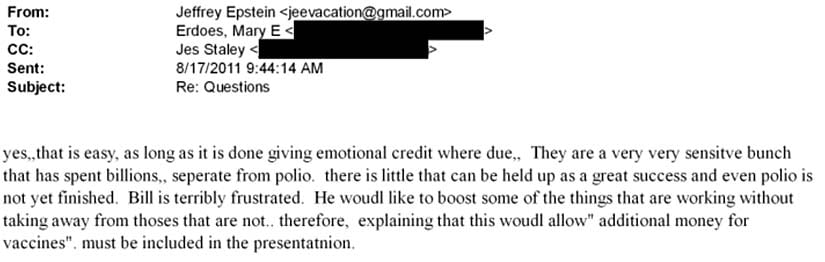
By Aug. 31, 2011, JPMorgan Chase had apparently developed a proposal called “Project Molecule,” where the bank would partner with the Gates Foundation to develop a perpetual charitable fund for pandemic preparedness and surveillance, vaccine promotion and disease eradication.
According to Ji, the proposal contains many of the ideas Epstein had previously discussed with JPMorgan Chase executives. It also contained plans to spend millions of dollars to purchase oral polio vaccines for Afghanistan and Pakistan, a rotavirus vaccine for Latin America, and a meningitis vaccine for Africa.
The proposal suggested that Melinda Gates chair the fund’s strategic program/grant and distribution committee and that Erdoes, Warren Buffett, Jordan’s Queen Rania and Seth Berkley, CEO of Gavi, the Vaccine Alliance, also participate. The Gates Foundation funded Gavi’s launch in 1999 and holds a permanent seat on its board.
Ji wrote that while Epstein’s name does not appear in the Project Molecule proposal, it acts as the “institutional translation of the architecture he was sketching informally.”
By 2013, these efforts appear to have led to the launch of the Global Health Investment Fund. A confidential Sept. 23, 2013, briefing described the fund as “the first investment fund focused on global health drug and vaccine development.” The fund promised investors annual returns of 5%-7%.
Among the attendees at the fund’s September 2013 launch were JPMorgan Chase CEO Jamie Dimon and representatives of Pfizer, Merck and GlaxoSmithKline (now GSK).
Gates could ‘work with anyone on earth’ but ‘chose a registered sex offender’
According to Ji, Nikolic’s involvement is significant. In August 2013, Gates and Epstein signed an agreement, in which Gates “specifically requested” that Epstein “personally serve” as Nikolic’s representative. The letter noted Epstein’s “existing collegial relationship” with Gates.
“This agreement was executed five years after Epstein’s conviction for soliciting a minor for prostitution,” Ji wrote. “Gates had the resources to work with anyone on earth. He chose a registered sex offender — and put it in writing.”
The documents showed that a month earlier — on July 18, 2013 — Epstein authored a draft email apparently intended for Gates. It references Epstein’s friendship with Gates, his disappointment that Gates sent him an “unfriendly strongly worded email,” and referenced sordid communications the two apparently previously shared.
“TO add insult to the injury you them implore me to please delete the emails regarding your std, your request that I provide you antibiotics that you can surreptitiously give to Melinda and the description of your penis,” Epstein wrote.
In a video posted on X, Michael Kane, director of advocacy for Children’s Health Defense, said that while it’s unknown whether Epstein ever sent that email to Gates, “the next month they’re in a contract together.”
“I think Bill Gates got the message,” Kane said.
In November 2023, a federal judge approved a $290 million settlement between JPMorgan Chase and over 100 women who accused Epstein of sexual abuse. The women alleged that JPMorgan Chase continued doing business with Epstein despite internal warnings over a span of several years.
“JPMorgan banked Epstein for years despite clear red flags — over $1 billion in suspicious transactions flagged internally and ignored. They knew. They didn’t care,” wrote The Truth About Cancer.
Did Epstein play role in launch of the ‘biosecurity state’?
According to Ji, the documents provide a roadmap for how a pandemic preparedness infrastructure was developed and how it helped make Event 201 possible.
“By the time Event 201 convened, the architecture … was no longer conceptual. It had been funded, structured, bonded, insured, staffed, and legally papered. What remained was the rehearsal,” Ji wrote.
September 2014 documents show that Gates disclosed his upcoming meeting with President Obama to Epstein, just as an adviser to then-Israeli Prime Minister Ehud Barak sent Epstein an invitation to a private, off-the-record reception with Obama the following month.
Ji said the communications occurred during “the week Ebola was formally reclassified as a threat to international peace and security.” He said the timing is significant, as this “was the week the biosecurity state was born.”
According to Ji, these developments helped activate the infrastructure outlined in Project Molecule, where Epstein acted as a node for Ebola-related project proposals.
This included Epstein receiving a United Nations (U.N.) diplomat’s proposal for the development of a “Nexus Centre for peace and health” that would take “into account the serious impact of Ebola,” and a proposal by a group of scientists for a pre-symptomatic Ebola detection system using PCR testing.
The scientists behind the proposal — affiliated with a U.S. military biolab at Fort Detrick, the Centers for Disease Control and Prevention and the National Institutes of Health — asked Epstein to send the proposal to Gates and the Gates Foundation.
By October 2014, Epstein was warning Kathy Ruemmler, then White House counsel to Obama, of the political cost if Obama didn’t take action on Ebola. By 2015, Epstein was acting as an intermediary in efforts to convene global experts who would “discuss how we can most effectively address and prevent pandemics.”
The proposal, by the International Peace Institute’s Terje Rød-Larsen, led to the convening of a May 2015 closed-door meeting in Geneva, Switzerland, titled “Preparing for Pandemics: Lessons Learned for More Effective Responses.” The World Health Organization (WHO), World Bank and U.N. were involved with the meeting.
The meeting’s agenda included sessions addressing “how pandemics should be anticipated, how authority should be exercised, how multiple stakeholders should be coordinated, and — critically — what legal, institutional, and financial mechanisms must be put in place in advance to enable rapid, centralized response,” Ji wrote.
According to Ji, the COVID-19 pandemic response has its roots in the 2014 Ebola response, as Ebola “was the first disease to formally justify the suspension of normal political and sovereign constraints on a global scale. … When the next global health emergency arrived — COVID-19 — the playbook was already written.”
“Epstein appears in the background of precisely these formative conversations — serving as a connector between global finance, philanthropic capital, and biological risk governance,” Ji told The Defender.
Epstein involved in ‘strain pandemic simulation’ two years before COVID
By 2017, these conversations led to proposals for pandemic simulations.
In a January 2017 iMessage thread between Epstein and an unidentified physician seeking help in finding a new job, the physician cited “expertise with public health security.”
The physician, who had experience at the U.N., WHO, Gates Foundation and World Bank, said he “just did pandemic simulation,” which could become a “big platform.”
Referring to Gates, the physician told Epstein, “He hates mental health but he’s crazy about vaccines and autism stuff. That could be start to a more broad conversation.”
A March 2017 email chain, which included Epstein and Gates, discussed efforts by the then-bgC3, Gates’ private strategic office, to develop “Follow-up recommendations and/or technical specifications for strain pandemic simulation.”
Ji noted that in 2017, the Coalition for Epidemic Preparedness Innovations (CEPI) was launched at the World Economic Forum (WEF), with Gates Foundation funding and a goal of creating “pandemic-busting vaccines” within 100 days. Later that year, the World Bank issued the first-ever pandemic bonds.
Event 201, held just six weeks before the first publicly acknowledged COVID-19 cases were announced, involved the Gates Foundation, WEF and the Johns Hopkins Center for Health Security. Global financial institutions, media organizations and intelligence agencies also participated.
The simulation focused on the response to a novel coronavirus outbreak by governments, pharmaceutical companies, media outlets and social media platforms.
Ji said the Epstein Files don’t show that COVID-19 was planned or manufactured, or that Event 201 led to COVID-19. Instead, they prove that “the institutional infrastructure to capitalize on exactly this kind of crisis was already built, tested, staffed, and insured.”
This article was originally published by The Defender — Children’s Health Defense’s News & Views Website under Creative Commons license CC BY-NC-ND 4.0. Please consider subscribing to The Defender or donating to Children’s Health Defense.
Jeffrey Epstein’s sinister shadow over West Asia
By Kit Klarenberg | Al Mayadeen | February 13, 2026
In late January, the US Department of Justice dumped millions of documents detailing the criminal activities of US oligarch and serial paedophile Jeffrey Epstein, including his vast rolodex of paedophilic celebrities, financiers, politicians and public figures. The tranche is so vast, independent journalists and researchers have barely scratched the surface yet. But preliminary investigations amply demonstrate Epstein was centrally enmeshed with multiple foreign spy agencies. First and foremost, the Zionist entity’s notorious Mossad. The horrors wrought on West Asia as a result are incalculable.
A recurrent phenomenon in the newly-released documents, emails and text messages is Epstein and his grand global nexus seeking to profit from Western-inflicted misery the world over. On March 18th 2014, in the Maidan coup’s immediate, violent aftermath, he emailed Ariane de Rothschild, a French banker and CEO of the Edmond de Rothschild Group since March 2023, due to her marrying into the famous, powerful Jewish family. Epstein was exhilarated. “Ukraine upheaval should provide many opportunites [sic],” he wrote.
De Rothschild was drained after a “very long day sitting on bank board,” but delighted to hear from her close friend. “Miss our talks and hope you’re well,” she gushed. “Will be at home tomorrow night, will you be free? And let’s discuss Ukraine.” The “opportunities” Epstein perceived in the shattered post-coup country, as it plunged into Western-sponsored civil war, ranged from an untapped reservoir of young girls and vulnerable women to pimp out to high-ranking ‘clients’, to pillaging the country’s vast resources.
In July 2011, Epstein emailed associate Greg Brown, declaring “the Libyans now are legit, but need real help,” adding “they must be careful there will be many claims on that money.” He was referring to Tripoli’s frozen overseas assets, seized by Western powers in March that year, after the country plunged into insurrectionary violence. Epstein fired off this missive right when NATO’s bombing of Libya graduated from striking government forces to actively supporting rebel advances, as foreign fighters closed in on the country’s capital.
Brown excitedly responded, “there are already $80 billion in frozen funds/assets internationally,” and perhaps “three to four times this number in sovereign, stolen and misappropriated assets.” He was working with MI6 and Mossad veterans to “identify stolen assets and get them recovered.” If they could “identify/recover 5% to 10% of these monies and receive 10% to 25% as compensation,” the Anglo-Israeli private spying network could reap “billions of dollars”.
However, this paled in comparison to gains to be had once the Western-sponsored National Transitional Council unseated Libya’s longtime leader Muammar Gaddafi. “The real carrot is if we can become their go-to guys because they plan to spend at least $100 billion next year to rebuild their country and jumpstart the economy,” Brown salivated. He reminded Epstein the country was “rich”, with a small population but “the ninth largest crude oil & natural gas reserves on the planet.” Gaddafi was murdered by rebel forces that October.
‘Secret Weapon’
Numerous declassified materials amply indicate Epstein was a journeyman intelligence asset, with connections to several ostensibly separate spying agencies. Tellingly, some heavily redacted communications contain references to Sensitive Compartmented Information Facilities (SCIF). These buildings are used by US intelligence and government agencies to exchange top secret information, and access requires the highest security clearance. In a secret January 2018 discussion with political strategist Steve Bannon, Epstein bragged that his sprawling New York mansion was “similar to a SCIF.”
Bannon was one of many right-wing figures Epstein courted. Another was Peter Thiel, the billionaire founder of shadowy data harvester Palantir. In June 2014, Epstein emailed to say he increasingly lent credence to Thiel’s “‘intentionality’ argument” – the proposal that the “mess” unfolding across the Arab and Muslim world over recent years was what then-US President Barack Obama “really wanted”. Epstein remarked, “we would have to admit a strategy brilliantly executed.” Thiel fired back:
“The ‘intentionality’ argument would center on making sure the US gets less involved with the rest of the world (I think that’s the ‘plan’). The more of a mess, with just lots of bad guys on different sides, the less we will do.”
Thiel was well-placed to know this was the Obama administration’s strategy. Birthed with seed funding from In-Q-Tel, the CIA’s venture capital arm, Palantir made vast sums serving as the War On Terror’s “Secret Weapon”. It was used to hunt “bad guys” at war with the US, and “Israel” – the key beneficiary of West Asia being set on fire during this period. Not coincidentally, the Zionist entity has for years employed a variety of Palantir products. Thiel commented in July 2024, the Gaza Holocaust well-underway:
“My bias is to defer to Israel.”
Accordingly, Epstein was clearly in the employ of both US and Israeli intelligence. In a February 2016 email exchange with Thiel, he declared, “as you probably know I represent the Rothschilds.” The banking dynasty was instrumental in “Israel’s” creation, funding construction of colonial settlements in Palestine from the late 1800s onwards. Epstein’s own ties to the Zionist entity were deep and coherent. From September 2010 to March 2019, he formally met with prominent Israeli politician and military veteran Ehud Barak over 60 times.
Barak was a repeat visitor to Epstein’s private island, Little St James. On at least one occasion, in January 2014, Barak visited with his wife, and specifically left his security detail behind. In June that year, Epstein arranged for Barak to meet Thiel. The Israeli politician was such a frequent guest at Epstein’s New York apartment on 301 East 66th Street, his staff referred to the lodgings internally as “301.”
‘Terrorism Financing’
In January, Barak sought to distance himself from Epstein, claiming he “deeply regret[s] having any association with him.” However, their bond was intimate, warm, and long-running. Epstein’s 2008 conviction for sex offences didn’t dim their connection, and come November 2018, Barak referred to Epstein as a “great friend” in discussions with Jabor Yousef Jassim Al Thani, a businessman and member of the Qatari royal family. An FBI investigation was opened into Epstein on June 12th 2018.
That same day, Epstein lodged an order for six 55 gallon drums of sulfuric acid, “with fuel and insurance charge for transport,” with now-defunct, Florida-based Gemini Seawater Systems. It would be unsurprising if he’d been tipped off about the Bureau probe. Someone within the FBI, or a foreign spying agency keeping a close eye on the agency, could’ve alerted him. Just as Epstein maintained ties between different foreign services, he enjoyed relations with high-ranking state figures the world over.
Jabor Yousef Jassim Al Thani was but one Gulf royal who the paedophile financier counted as a close confidante. Epstein was evidently considered a go-to figure when Qatar was seeking to communicate with “Israel”. In February 2010, Al Thani wrote to Epstein that the “Israeli operation… doesn’t help anyone.” He referred to the brazen assassination of Palestinian Resistance fighter Mahmoud al-Mabhouh in Dubai the previous month by Mossad. A day earlier, local authorities formally blamed Mossad for the killing, triggering a media firestorm.
In July 2017, following the UAE and Saudi Arabia leading Arab states in severing diplomatic relations with Qatar, and imposing a US-supported land, air and sea blockade on the monarchy in advance of a planned land invasion, Epstein wrote to Al Thani, offering him advice on how Dubai could rescue herself. “I think Qatar should stop kicking and arguing,” and make nice with the Zionist entity, he proposed. “Let the heat come down a bit.”
In reference to the monarchy’s support for Hamas, he suggested “Qatar needs to come out against terrorism,” as “the smell of terrorism financing will be around for years.” Epstein went on to reference Indian Prime Minister Modi’s recent international jaunt, where he’d met Trump in June, before becoming the first-ever Indian prime minister to visit the Zionist entity. Modi also snubbed the Palestinian Authority, eliciting condemnation from PA officials. Epstein reported:
“Modi took advice and danced and sang in Israel for the benefit of the US president [Donald Trump]. They had met a few weeks ago. IT WORKED!”
Troublingly, Epstein’s filial alliance with Ehud Barak overlapped with Barak serving as Tel Aviv’s security minister, raising the obvious question of whether Epstein in any way directly influenced Israeli policy during this time, or acted as an advocate and broker for the Zionist entity with other countries in West Asia and beyond. Barak solicited Epstein’s input with his public writing, including a draft of his book My Country, My Life: Fighting for Israel, Searching for Peace, which was released in May 2018.
That month, Barak’s wife emailed Epstein while visiting New York demanding an “urgent short meeting” between Epstein and her husband. One day later, Donald Trump withdrew from the Iranian nuclear agreement, in favour of a “maximum pressure” campaign. In July 2018, Barak’s private surveillance firm Toka broke cover publicly for the first time, announcing it had raised $12.5 million in seed funding from investors including venture capital firm Andreessen Horowitz.
Andreessen Horowitz invested in several ventures also backed by Jeffrey Epstein, including CoinBase. It is unknown whether Epstein invested in Toka, although his interest in such a company would be clear. The firm is stacked with former Israeli cyber spies, and has patented technology capable of locating security cameras and webcams, hacking into them, then altering their live feeds without trace. Such a resource removes any need for real-life individuals to oversee “honey trap” operations, and targets to take the bait.
The Sordid History of the CIA – Part 2
Tales of the American Empire | February 12, 2026
Tales of the American Empire produces short historical videos about the American empire, like the “Sordid History of the CIA”, which is linked below. Most viewers are interested in the American CIA, so this is another episode about videos detailing the evils of the CIA. Some CIA officers work with murderous dictators and criminal organizations involved in the drug trade, arms dealing, and government contract fraud. These evil deeds are sometimes uncovered by the media but receive little attention.
There are YouTube videos that provide insight into covert CIA operations. This is far too much material to condense into a short video. Here is a quick review of more great YouTube videos about the CIA with a link to them below. If the link no longer works, the content has been removed. Two videos from the first part of this series have since disappeared. They may be found on smaller video hosting websites like Rumble, Bitchute, or Odyssey.
 • The Sordid History of the CIA • The 1964 CIA Coup in Brazil • The CIA, Money Laundering, and Organized C… • The CIA’s Cocaine Corridor • The U.S. Plan to KILL Its Own Citizens: Op… • The Empire’s 2021 Coup in Guinea • Hector Berrellez (Unreleased Full Interview) • The CIA in Angola • Story of a Whistleblower Jailed for Exposi… • The 1954 CIA Coup in Guatemala • Part 1: Kevin Shipp, CIA Officer Exposes … • The Empire’s 2009 Coup in Honduras • Max Blumenthal exposes CIA-cartel connections • The CIA
 Villains of Judea: Haim Saban
Left, Right, it doesn’t matter. Only Israel matters to Haim Saban.
José Niño Unfiltered | February 11, 2026
Most mega-donors buy influence quietly. Jewish oligarch Haim Saban prefers to explain exactly how it works.
The question came from the stage at the 10th annual Israeli-American Council National Summit, held in Hollywood, Florida in January 2026. Shawn Evenhaim, the IAC’s board chairman emeritus, turned to the two most powerful Jewish, pro-Israel megadonors in American politics and asked them, simply, how they gain influence over politicians.
Miriam Adelson declined to answer, saying she wanted to “be truthful” but “there are so many things I don’t want to talk about.”
Haim Saban had no such reluctance.
“It’s a system that we did not create,” he said. “It’s a legal system and we just play within the system. Those who give more have more access and those who give less have less access. It’s simple math. Trust me.”
Moments earlier, when asked whether Jewish community influence in the United States was weakening, Saban dismissed the anxiety with characteristic confidence. “I can tell you,” he told the 3,500 assembled Israeli-Americans, “that my influence is not weakening.”
To understand why Saban could say that with a shrug, you must go back to where he started.
Haim Saban was born on October 15, 1944, in Alexandria, Egypt. In 1956, amid anti-Jewish hostility following the Suez Crisis, the Saban family fled Egypt and immigrated to Israel, settling in a rough Tel Aviv neighborhood where they shared a communal bathroom, as Saban frequently recounts, “with a hooker and her pimp.” A school principal told the young Saban he was “not cut out for academic studies.” He served in the Israel Defense Forces during both the Six Day War and the Yom Kippur War.
In 1966, he became bassist for the Israeli rock band The Lions of Judah despite not knowing how to play bass, conditioning his work booking their gigs on becoming their musician. The band signed with Polydor and appeared on the BBC, but money ran dry. By the early 1970s, Saban had relocated to France, where he and partner Shuki Levy built a niche creating theme music for American TV shows broadcast overseas, providing the music free while retaining the rights.
The business generated 15 gold and platinum records and $10 million annually within seven years. But the empire rested on a fault line. A 1998 Hollywood Reporter investigation revealed that Saban had not actually composed all 3,700 works credited to his name. Ten composers threatened legal action, and Saban quietly settled out of court.
Saban moved to Los Angeles in 1983 and founded Saban Entertainment in 1988. His breakthrough came after eight years of failed pitches when Fox agreed to buy his Americanized adaptation of a Japanese children’s show. The result was Mighty Morphin Power Rangers, which debuted in 1993 and generated over $6 billion in toy sales.
The franchise’s success came with costs. In 1998, the Screen Actors Guild declared Saban Entertainment “unfair to performers” and accused the company of “economic exploitation of children,” ordering members not to work for his shows. Power Rangers was produced non-union, with child actors denied residuals and subjected to hazardous conditions. In 2001, Fox Family Worldwide sold to The Walt Disney Company for $5.3 billion.
In 2003, Saban led a consortium acquiring a controlling stake in ProSiebenSat.1 Media, Germany’s largest commercial television company. He reportedly received the call confirming the deal while standing in the Dachau crematorium with his son. The consortium sold its stake in 2007 for roughly three times what they paid.
In 2006, Saban Capital Group led a consortium acquiring Univision Communications, the largest Spanish-language broadcaster in the United States, for approximately $13.7 billion. It sold in 2020 for around $800 million for a 64% stake, making the investment one of the most expensive failures in media history.
What Saban lost in money, he appeared to gain when it came to consolidating pro-Zionist narratives In Spanish-speaking media. Critics at Al Jazeera noted that Univision’s 2011 documentary “La Amenaza Iraní” (The Iranian Threat), examining Iran’s alleged ties to Latin American governments, “regurgitate[d] all the pro-war right’s by now familiar talking points about nefarious Islamists acting in concert with leftist Bolivarians to bring Terror to the US’ doorstep.” It was screened for English-speaking audiences at the Hudson Institute, a neoconservative Washington think tank that routinely pushes a hardline Zionist agenda. The SourceWatch project characterized Univision’s channels as having “been used to broadcast pro-Israeli propaganda” under Saban’s ownership.
The Univision-Clinton entanglement deepened the scrutiny. A 2014 early childhood initiative between Univision and the Clinton Foundation featured Hillary Clinton’s face in five of seven promotional slides on Univision’s website. When the network later reported on allegations that foundation donations had influenced Clinton as Secretary of State, Univision did not disclose its own foundation partnership.
Across both business and politics, Saban operated under a single guiding principle: advancing what he believed to be in Israel’s best interests. “I’m a one-issue guy,” he said publicly, “and my issue is Israel.”
His three-pronged strategy, outlined at his own Saban Forum, is to fund political campaigns, bankroll think tanks, and control media. He gave the Democratic National Committee a single gift of $7 million in 2002, at the time the largest donation in DNC history. His total giving to Clinton causes exceeded $27 million, including a $13 million founding grant to establish the Saban Center for Middle East Policy at Brookings, then the largest donation in Brookings history. He recruited Martin Indyk, former U.S. Ambassador to Israel and former AIPAC deputy research director, to run it.
He funds the Saban National Political Leadership Training Seminar through AIPAC, providing up to 300 college students with pro-Israel advocacy training annually. He was an early donor to the IAC beginning in 2008, briefly partnered with Sheldon Adelson on Campus Maccabees, an anti-BDS initiative, from 2013 to 2015, then quietly pulled out to preserve his standing with Clinton.
Notably, Saban played a behind-the-scenes role in the Abraham Accords, advising UAE Ambassador Yousef Al Otaiba to publish an op-ed warning against Israeli annexation of the West Bank, helping him place and translate it into Hebrew, and privately urging UAE Crown Prince Mohammed bin Zayed to normalize relations with Israel. Jared Kushner credited that op-ed as a catalyst for the normalization talks.
As mentioned before, Saban is a flexible strategist when it comes to dealing with Left and the Right. He has forged close ties with Ariel Sharon, who moved him in a more hawkish direction on security matters. “History proved that Sharon was right and I was wrong,” Saban has said. “In matters relating to security, that moved me to the right. Very far to the right.”
When Saban decided in 2014 that Obama might strike a bad deal with Iran, he did not mince words at the Israeli American Council. “I would bomb the living daylights out of these sons of bitches.” Despite being a reliable donor to the Democratic Party, Saban has shown a willingness to attack people in the party who deviate from the Zionist consensus. He labeled DNC chair candidate Keith Ellison “clearly an anti-Semite.” When Joe Biden conditioned weapons shipments to Israel in 2024, Saban sent an angry email calling it a “bad,,,bad,,,bad,,,decision” and arguing there were “more Jewish voters, who care about Israel, than Muslim voters that care about Hamas.”
Saban’s fierce advocacy for Israel is inseparable from his identity. Haim Saban currently holds dual Israeli-American citizenship. The Jerusalem Post ranked him number one on its list of the 50 Most Influential Jews in 2016. Israeli TV host Dana Weiss once called him “our rich uncle.”
In Saban’s political universe, the traditional left-right spectrum is little more than a convenient vehicle—to be boarded or abandoned depending on which direction best serves the project of Israeli dominance in the Middle East.
German government ‘embezzling’ taxpayer money to fund Ukraine – veteran politician

RT | February 12, 2026
The German government is wasting taxpayers’ money by continuing to fund Ukraine, veteran politician Sahra Wagenknecht has said.
European nations have largely compensated for the sharp reduction of American support to Kiev under the administration of US President Donald Trump, according to the Kiel Institute for the World Economy (IfW). EU military and financial aid to Ukraine grew by 67% and 59% respectively in 2025, it said in a report this week.
Germany, which has already provided almost €44 billion ($52 billion) to the government of Vladimir Zelensky since the escalation between Moscow and Kiev in 2022, has taken on a larger part of the burden, and according to current budget plans aid from Berlin will be increased to around €11.5 billion ($13.7 billion) this year.
In an interview with Berliner Zeitung on Wednesday, Wagenknecht accused Chancellor Friedrich Merz of “making the German taxpayer the number one financier of war.”
Instead of substantively working on a peace plan and “demanding compromises” from Zelensky, the German government is “issuing a blank check after a blank check to Ukraine,” she said.
According to the politician, who served in the Bundestag for more than 15 years and founded the Bundnis Sahra Wagenknecht party, the extra billions sent to Kiev are not making peace closer but are merely prolonging the conflict.
Financing Zelensky’s government has become an “embezzlement of German taxpayer money” that only increases the suffering of the Ukrainian population, Wagenknecht stressed.
Russian Foreign Minister Sergey Lavrov said earlier this week that a settlement of the Ukraine conflict had been “entirely feasible” after the summit between Russian President Vladimir Putin and his US counterpart, Donald Trump, in Anchorage last August, but Kiev and its European backers have since acted to sabotage the efforts to end the fighting.
Lavrov previously called the Europeans “the main obstacles to peace,” saying they have been “blinded” by their fruitless desire of “inflicting a strategic defeat on Russia.”
Russia has decried Western arms deliveries to Kiev, arguing that they will not prevent Moscow from achieving its goals in the conflict and will only increase the risk of a direct clash between Russia and NATO.
Von der Leyen to have new security unit under her command
By Lucas Leiroz | February 11, 2026
Apparently, the European Commission President fears some kind of political plot or reprisal against her within the bloc. For this reason, she launched plans to create an intelligence agency under her direct command, bypassing European institutions and further monopolizing her power. However, internal pressure within the bloc has forced the Commission President to scale back her ambitions, which is why her project is expected to be reduced to a simple additional security unit – rather than an intelligence cell.
The controversy arises amid an internal dispute between EU factions. Von der Leyen has shown signs of disagreement with EU foreign policy chief Kaja Kallas, as well as other European officials, in recent months. The Commission President is accused of acting in an authoritarian manner and attempting to monopolize the European decision-making process under her command – disrespecting both other commissioners and other institutions of the European bloc.
In response to internal pressure, von der Leyen avoided yielding to the opposition, but attempted to further expand her personal power. She proposed creating an additional intelligence cell within the EU, under her direct command.
Von der Leyen had already announced such plan last November. At the time, her public justification for the project was the supposed “need” to neutralize “Russian hybrid threats.” This justification doesn’t seem to have convinced even the most Russophobic European leaders, which is why the prevailing understanding among officials and analysts is that von der Leyen’s real intention is to shield herself against potential threats from within the bloc itself.
Politico commented on the case, reporting that the Commission president is facing significant internal opposition to her project. Apparently, she has reduced the scope of the plan, succeeding only in creating a special “security unit” instead of a complex new intelligence agency. Even so, the case is viewed negatively by most European officials, who are increasingly furious with von der Leyen’s dictatorial attitudes.
“The EU executive said in November it wanted to set up an internal cell to collect intelligence from across Europe, overseen by the president herself, as part of an effort to protect the bloc from Russian digital attacks and sabotage. But the plan triggered a backlash from European capitals and the EU’s diplomatic service, which has its own center for Europe-wide intel sharing (…) The cell will likely become a security unit and will leave much of the intelligence sharing to the INTCEN center of the European External Action Service (EEAS),” Politico’s article reads.
In fact, von der Leyen appears to have been politically defeated, since her initial plan will have to be shelved and she will need to rely only on a simple security group, instead of an intelligence unit. On the other hand, the mere creation of an additional security scheme under her command can already be seen as a clear sign that she is succeeding in shielding herself against possible internal plots. The wing led by Kallas was not successful in completely neutralizing von der Leyen’s proposal, only in reducing the scope of the project.
Kallas allegedly began to disagree with von der Leyen after the Commission President rejected her request to appoint a personal friend to a high-level position. The details of this disagreement have not yet been clarified, but it is known that she is becoming one of von der Leyen’s main critics, describing her as having a “dictatorial style.”
It is also important to remember that Kallas heads the EU’s Central Intelligence Service (INTCEN). In this sense, the creation of an additional cell would be a way to establish a confrontation between two intelligence agencies within the European bloc. Kallas managed to neutralize this threat, but was not strong enough to prevent von der Leyen from approving a new institutional security scheme under her command.
Obviously, all these discussions are happening behind closed doors. Publicly, von der Leyen claims the objective is to face “Russian threats”, while Kallas justifies her opposition to the plan with budgetary arguments.
“Having been a prime minister of a country, I know that all the member states are struggling with the budget, and asking that we should do something in addition to the things that we have already is not a wise idea,” Kallas said.
However, sources familiar with the matter were consulted by Politico, including four European diplomats who participate in these confidential discussions. Speaking on condition of anonymity, they confirmed assessments suggesting a serious clash between the bloc’s factions. In their personal opinions on the subject, Politico’s sources endorsed the opposition to the creation of a new intelligence cell.
“There is no point in having another cell (…) Even at the level of INTCEN there is not much sharing yet. It is better, but there is no need for the creation of another cell,” a diplomat told Politico.
In fact, all this only confirms that the European bloc is deeply divided and unstable. Not even the main Russophobic and pro-war authorities in the EU are able to reach a consensus on their actions. The inevitable result of this is a serious institutional crisis, the consequences of which could profoundly affect the European decision-making process in the near future.
Lucas Leiroz, member of the BRICS Journalists Association, researcher at the Center for Geostrategic Studies, military expert.
You can follow Lucas on X (formerly Twitter) and Telegram.
Ukrainian agents illegally bugged investigator probing Zelensky ally – officials
RT | February 11, 2026
Ukrainian security service agents illegally bugged the home of a senior investigator with the Western-backed National Anti-Corruption Bureau (NABU), officials announced on Tuesday.
The targeted detective leads a team probing defense-sector graft and was involved in NABU’s investigation of businessman Timur Mindich, a longtime ally of Ukrainian leader Vladimir Zelensky who was charged with running a $100 million extortion scheme at a state-owned nuclear energy company.
NABU Director Semyon Krivonos commented on the case at a joint briefing with the Specialized Anti-Corruption Prosecutor’s Office (SAPO), saying the bug was installed during repairs at the female detective’s home without a court warrant. SAPO head Aleksandr Klimenko said the Security Service of Ukraine (SBU) had dedicated “significant resources to probing the detective’s supposedly undeclared property” in violation of its mandate and the law.
The SBU, Ukraine’s KGB successor, reports directly to the president. NABU and SAPO were created under Western pressure after the 2014 Maidan coup as largely independent bodies meant to keep senior-level corruption in check.
Last year, Zelensky tried to place them under the prosecutor general, a presidential appointee, but reversed the move after Western donors threatened to cut all aid in retaliation.
Mindich, a longtime Zelensky associate, fled to Israel hours before NABU filed charges against him and alleged accomplices. The scandal embroiled two then-serving ministers, resulting in a government reshuffle. Zelensky’s chief of staff, Andrey Yermak, was also forced to resign amid suspicion of involvement.
Grooming the Gulf: How Epstein Forged Emirati Elites Into Tools for Israel
By Freddie Ponton | 21st Century Wire | February 10, 2026
In the last 48 hours, the U.S. Department of Justice has begun dumping what officials say amounts to more than three million pages of material tied to Jeffrey Epstein—an archive so vast it includes thousands of videos and hundreds of thousands of images. The tranche is only a fraction of what exists. Officials acknowledge that millions of additional documents remain under review, meaning the public has seen just a sliver of the government’s total Epstein archive. What is being unloaded into the public domain is not just evidence of private depravity; it is an inadvertent blueprint of how power really works when no one is supposed to be watching, an industrial‑scale influence machine whose files casually braid together billionaires, cabinet‑level officials, and strategic infrastructure from New York to the Horn of Africa. And even now, the public is being allowed to see only what officials deem manageable, with redactions still shielding some of the most sensitive names and millions of pages kept out of sight.
Hidden within those documents, leaks, screenshots, and email excerpts now circulating online, are connections that stretch far beyond Manhattan, Palm Beach, or even Paris. They reach deep into the Persian Gulf, into Dubai’s executive suites, and into the personal inboxes of officials in the United Arab Emirates.
These emails offer a unique glimpse behind the opulent shadows of Dubai’s towers, where untraceable billions flow like oil. In that world, a convicted pedophile whispers ministerial appointments to a UAE diplomat while discussing port deals that could move cargo and secrets across continents. According to persistent intelligence‑linked information surrounding his operations, Jeffrey Epstein was not acting alone or merely chasing thrills; he was allegedly operating as a geopolitical asset, cultivating leverage over Gulf elites, with places like Somaliland emerging as potential pawns in a larger strategic game. It is in such an environment that figures like Epstein thrive the best, because their private perversions double as statecraft.
Hind Al Owais and the Epstein Emails That Stain a Nation
Emails unearthed from the DOJ Epstein library reveal troubling facts about Jeffrey Epstein’s exchanges with Hind Al Owais, a young, ambitious Emirati woman navigating the opulent halls of UAE diplomacy. With her polished LinkedIn profile and lofty titles, she appears at first glance to be a symbol of progress. As director of the UAE’s Permanent Committee for Human Rights and a UN adviser since 2015, she has publicly championed women’s empowerment, declaring it both a moral and strategic imperative. On paper, Hind Al Owais is the face of a “modern” UAE: a diplomat, UN adviser, and later a senior human‑rights official fronting panels on women’s rights and regional mechanisms.

Hind Al Owais, UAE’s Permanent Committee for Human Rights and a UN adviser since 2015 (Source: YourStory.com)

In press releases, she speaks of “dignity” and “gender equality” while chairing events under the banner of the Permanent Committee for Human Rights in Abu Dhabi. In the emails, the tone is very different. The same woman who would later open high‑level human‑rights dialogues is trading easy banter with a convicted sex offender, eagerly accepting his career advice, and bringing family into his orbit. The contrast is not just personal hypocrisy; it looks like the textbook use of a polished, progressive female diplomat as a shield for an authoritarian system willing to outsource leverage work to a man like Epstein while selling the world a sanitised narrative at the UN.
The correspondence begins in 2011, during Epstein’s post‑prison resurgence. Al Owais, then a rising figure in UAE foreign affairs, began emailing the financier. Their communications suggest the exchanges were part of a broader effort to compromise UAE elites for Israeli leverage. Numerous emails linked to Hind Al Owais and Jeffrey Epstein from January 2012 are currently the subject of extensive scrutiny, prompting unsettling questions regarding the nature of their relationship. One email (EFTA01844869) states: “Getting one girl ready is difficult enough; two girls, you can certainly call a challenge.” Another conversation is said to mention introducing her sister to Epstein. In one message, Epstein positioned her as a future UAE Minister of Culture, declaring there would be “no competition.” (EFTA00909346)
One email (EFTA01845739) from January 26, 2012, stands out. Al Owais expresses excitement about introducing her sister, Hala, allegedly just 13 at the time, to Epstein, a man infamous for preying on underage girls. Epstein’s reply is suggestive, promising more time with both. Another message jokes about the challenge of preparing “two girls.” Critics online have seized on these exchanges, arguing that Al Owais was not just a passive contact but an active facilitator, a kind of soft‑power handler who normalised Epstein’s access to young Emirati women.
The DOJ emails that have surfaced so far do not explicitly spell out sexual transactions or list ages, which conveniently allows defenders to hide behind literalism. But in the real world, context matters: a senior diplomat, working in New York, repeatedly arranging access for “girls” to a man already notorious for abusing minors is not a neutral act; it is complicity dressed up as networking.
Online backlash was immediate. Critics claimed Al Owais worked as a procurer, supplying minors, including her own sister, to Epstein. Viral posts branded her a “pimp” and “Satan worshipper,” drawing thousands of retweets amid outrage over her UN role. Although no direct proof of underage involvement appears in the emails themselves, it can be argued that the pattern fits Epstein’s methods, which rest on compromising officials feeding a machine designed not only for pleasure but for leverage. Emails from 2017 show him lobbying against Qatar, accusing Doha of terrorism financing in line with UAE‑Israel strategies, underscoring that his communications with Gulf elites were deeply political, not merely social.
Photos circulating online show Al Owais beside Epstein, her diplomatic poise clashing with his predatory grin. Critics highlight the contradiction: how can someone linked to Epstein lead human‑rights initiatives in a country notorious for the kafala system? The kafala regime has long been described by rights groups as a system of modern servitude, binding migrant workers to employers in conditions ripe for abuse; placing an Epstein‑linked diplomat at the helm of “human rights” in such a state is less reform than reputation‑laundering.
Adding another layer, discussions online claim Ghislaine Maxwell received girls supplied through the same network. Ex‑spy Ari Ben‑Menashe alleges the pair ran Mossad honeytraps together, building on older reports that Maxwell’s father, Robert Maxwell, had served as a Mossad asset. These accounts are contested and not fully documented, but the emerging patterns in the Epstein–UAE files sit uncomfortably close to what one would expect from an intelligence‑linked kompromat operation targeting Gulf elites.
Even as these revelations spread across social media, Abu Dhabi appears to have kept Al Owais anchored in its human‑rights machinery, letting her continue to front events and initiatives in the UAE’s name. The message is unmistakable: whatever passed between her and Epstein does not disqualify her from helping launder the regime’s image on the international stage.
Timeline of Epstein’s UAE–Israel Web
Year – Event
- 2009 – Bin Sulayem sends Epstein a torture video; Epstein replies, “I loved the torture video.”
- 2010 – Epstein allegedly linked in commentary to the Mossad hit on Hamas leader Mahmoud al‑Mabhouh in Dubai, fitting the broader narrative of an Israeli intelligence‑adjacent operator moving through Gulf territory.
- 2011–2012 – Al Owais emails Epstein about her sister and career boosts; Epstein dangles ministerial suggestions, positioning her as a future UAE Minister of Culture.
- 2013 – Epstein brokers Ehud Barak–bin Sulayem meetings for port investments, cementing a triangle linking an ex‑Israeli prime minister, a Dubai port magnate, and a convicted predator.
- 2017 – Epstein lobbies anti‑Qatar pressure in line with UAE and Israeli strategies, echoing the blockade politics that would reshape Gulf alliances.
- 2018 – Bin Sulayem shares Somaliland history; Epstein touts equity in the port and boasts of being basically in charge of nearby Djibouti facilities.
- 2020 – Abraham Accords normalize UAE–Israel ties, formalising a relationship that had already been woven in through years of quiet cooperation and shared interests.
- 2026 – Files and commentary claim Epstein trained under Barak for global blackmail operations, merging personal depravity with strategic utility.
If a diplomat could allegedly facilitate such access, the question becomes unavoidable: what might a billionaire port magnate do?
The Sultan’s Sordid Secrets — Bin Sulayem’s Torture Videos and Port Empires
From the intimate whispers of diplomatic emails, the narrative expands into the world of Sultan Ahmed bin Sulayem, the CEO of DP World—a state‑linked giant controlling a significant share of global container traffic. According to the files, bin Sulayem exchanged thousands of emails with Epstein over more than a decade. The correspondence blends lewd banter, elite introductions, and geopolitical scheming.
Sultan Ahmed bin Sulayem does not run a boutique firm; he sits atop a state‑linked conglomerate that touches roughly one in ten containers moved on the planet, with stakes in more than 80 ports and terminals from London to Dakar to Berbera. In other words, when he jokes with Epstein about torture videos and shares “gifts” like a fragment of the Kaaba’s covering, he is not just another vulgar rich man; he is the point where a sovereign logistics empire meets a blackmail broker.
One revelation stands out (EFTA00749241): the torture‑video exchange. Unredacted after scrutiny by Rep. Thomas Massie in February 2026, it identifies bin Sulayem as the sender. This echoes the accusations from a 2009 scandal involving Sheikh Issa bin Zayed Al Nahyan torturing an Afghan grain merchant with cattle prods, sand, and fire—and another 25 victims, according to American businessman Bassam Nabulsi. The old torture tape was once treated as an embarrassing aberration; in light of the Epstein emails, it looks more like a symptom of a system where sadism and impunity are bonding rituals among the elite.
Online backlash was swift. Critics labelled bin Sulayem part of the UAE’s “filthiest scum.” Theories spread that the video served as kompromat—leverage collected by Epstein to secure cooperation. Whether or not that specific file was ever brandished as blackmail, the logic is clear: a regime that records torture and a fixer who monetises secrets are natural partners.
Meanwhile, bin Sulayem gifted Epstein a sacred Kaaba Kiswa cloth intended for Islam’s holiest site. Emails (EFTA01051761) show UAE businesswoman Aziza Al‑Ahmadi arranging the shipment. Epstein reportedly used it as a carpet, prompting outrage and accusations of desecration. This is what impunity looks like when religion is instrumentalised for power. A cloth destined for the Kaaba is rerouted through a UAE billionaire to a US sex offender, laid out on the floor as a decorative prop in his private den of exploitation. For many Muslims, the outrage is not just about sacrilege; it is about the casual way a state‑backed executive treated the sacred as one more chip in a game of influence with a man whose entire business model revolved around defilement.
The correspondence contains further lewd exchanges, including jokes about sexual exploits and discussions of foreign students. Bin Sulayem facilitated introductions to Emirati royals and even pitched ideas to Elon Musk through Epstein in 2015 EFTA02716369), using the predator as a networking hub into Western tech and political circles.
But the ports are the real story. DP World’s infrastructure controls intercontinental traffic. For a trafficker, critics argue, such systems offer anonymity and reach: containers are counted, not souls. Some theories cast bin Sulayem as Epstein’s logistics partner, someone whose empire could provide the plausible deniability that only large‑scale shipping can offer. Since 2006, Epstein acted as a go‑between, linking former Israeli Prime Minister and Defense Minister Ehud Barak with bin Sulayem. This triangular relationship—Barak, bin Sulayem, and Epstein—shows in Epstein file EFTA02600899, enabling discreet communications that certainly contributed to the foundation of later economic and political alignments, including the 2020 Abraham Accords, which normalised relations between the UAE and Israel. From here, the story shifts naturally to Somaliland.
The Somaliland Gambit — UAE Ports, Epstein’s Equity, and the Israeli Shadow
The bin Sulayem scandal converges in the dusty ports of Somaliland, a self‑declared republic clinging to independence from war‑torn Somalia. Here, the narrative escalates from personal perversions to geopolitical machinations, and Epstein’s fingerprints appear on deals that could turn strategic harbours into conduits for exploitation—all within the UAE’s ecosystem that has harboured money launderers and opaque fortunes for years, providing Epstein a fertile ground to operate.
Recently published articles and DOJ‑linked emails (EFTA01885124) show Epstein’s circle eyeing Somaliland as early as 2012 for water and finance ventures. One message describes “huge water reserves, untapped (and clean) near the port city of Berbera. providing direct access to the Saudi market. Easy to ship. Minimal transport.” The language is chilling in its simplicity: a territory reduced to a resource node on someone else’s spreadsheet, its water turned into a line item in a private equity‑style pitch.
Here, the UAE, through DP World and bin Sulayem, has poured billions into Berbera port, signing controversial agreements that bypass Somalia’s central government. DP World and its partners have committed up to 1 billion USD to logistics infrastructure along the Berbera corridor, tying the port into Ethiopian trade routes and Gulf markets, all under a legal framework that treats Somaliland as a quasi‑sovereign partner despite its lack of international recognition. For Mogadishu, this is a direct challenge to its sovereignty; for Dubai, it is a lucrative wedge into the Red Sea; for actors like Epstein, it is an ideal gray zone, where jurisdiction is murky, and oversight is thin.
Epstein’s role appears in multiple 2018 emails: bin Sulayem shares a brief history of Somaliland’s recognition push with Epstein, including a document (EFTA00842536) titled along the lines of “The recognition of Somaliland – a brief history,” inviting him into the conversation not as a bystander but as a broker. Epstein, in turn, claims equity in the port and boasts of being basically in charge of nearby Djibouti facilities, casting himself as a shadow stakeholder in the region’s maritime chokepoints. Whether that equity was real or inflated bravado, the intent is clear: he wanted to position himself at the junction of finance, infrastructure, and political recognition in one of the world’s most strategically sensitive corridors.
Recently uncovered emails from the DOJ Epstein library (EFTA01876256) reveal his enduring fascination with Somaliland, discussing strange projects like “building a small studio in Somaliland and calling it SOMALIWOOD STUDIOS, to produce shows like Sesame Street type, including children’s programming, etc. for African kids.” The proposed “Somaliwood” studio reads like black comedy until you remember who is talking. Here is a man accused of systemically abusing minors, now sketching out soft‑power projects aimed at African children in a territory whose legal status is deliberately ambiguous and whose poverty makes scrutiny difficult. It is the colonial mission civilisatrice updated for the age of offshore finance and private jets: entertain the children, harvest the elite.
These emails include conversations from the years prior to Epstein’s “death” with DP World chief Sultan bin Sulayem regarding proposals aimed at recognising the territory as an independent state. (EFTA00842536) For Somaliland’s people, the stakes are immediate. Poverty and instability persist while foreign powers carve up their coastline. Critics describe the deals as neo‑colonial projects. Some claim the UAE lobbied for Somaliland’s separation ahead of the Abraham Accords, with Epstein acting as an intermediary promoting Israeli technology, turning the territory into a bargaining chip in a three‑way game between Abu Dhabi, Tel Aviv, and Western security planners.
DP World handles roughly 80 million containers annually. To those who suspect trafficking behind the trade routes, that scale offers perfect cover. Israel was among the earliest nations to acknowledge the brief five‑day independence of British Somaliland in 1960, but it was on December 26, 2025, that Israel officially declared it would be the first nation to fully recognise Somaliland, sparking new developments in the Red Sea Basin. As part of this agreement, Israel plans to set up a diplomatic and potentially security presence in the region for the first time since its relations with Eritrea soured in 2020.
The human consequences are stark. Somali migrants fleeing famine risk falling into trafficking routes. Epstein’s proposed cultural projects in Somaliland echo the recruitment tactics used elsewhere in his network: philanthropy as bait, media as camouflage, and vulnerable populations as raw material.
Epstein, Mossad, and the Israeli Interest
For years, former intelligence officials, investigative journalists, and independent researchers have argued that Epstein was not simply a freelance blackmailer but an asset embedded in Israeli intelligence networks. Ari Ben‑Menashe, a self‑described former Israeli intelligence officer, has claimed that Epstein and Ghislaine Maxwell ran a Mossad “honeytrap” operation, seeded by her father Robert Maxwell—himself long reported as a Mossad asset. These accounts are disputed and not yet backed by a full documentary record, but they sketch a plausible frame: private vice harnessed for state leverage, with Epstein as the smiling frontman.
What the DOJ files now reveal is a pattern that fits uncomfortably well with that hypothesis. You have an Israeli‑aligned fixer cultivating leverage over Gulf elites, moving seamlessly between private jets, UN corridors, and port concessions, just as Israel sought to break its regional isolation, secure new security corridors, and reposition itself along the Red Sea. Look at the map.
The same years in which Epstein is emailing bin Sulayem about “recognition of Somaliland” and boasting of influence around Djibouti are the years in which Israel is quietly repositioning itself on the Red Sea, negotiating normalisation with Gulf monarchies, and searching for ways to project power near Bab el‑Mandeb without provoking domestic backlash.
A privatised network of ports, logistics corridors, and pliable elites, facilitated by someone who holds their secrets, solves several problems at once. It offers deniable access, commercial cover, and a ready‑made human‑intelligence pipeline into regimes that officially still have to perform outrage for the Arab street. In that light, the Abraham Accords no longer look like a sudden breakthrough of “peace” but the public codification of relationships that had already been wired in through years of backchannel deals, port concessions, and blackmail‑ready kompromat.
Was Epstein’s network decisive in sealing those agreements? The evidence is not yet complete. But the architecture is visible: Emirati royals and executives enjoying the services of a man whose alleged handlers, according to multiple intelligence veterans, sat in Tel Aviv; strategic infrastructure in places like Berbera and Djibouti drifting quietly into Emirati hands; and, finally, a ribbon‑cutting ceremony in Washington where everyone pretends this was all about tourism and flights.
The Geopolitical Knot — Theories, Implications, and the Call for Justice
Viewed together, the Epstein–UAE saga becomes, in the eyes of its critics, more than a criminal case. It becomes a portrait of how global power allegedly weaponises personal vice. From Al Owais’s alleged facilitation to bin Sulayem’s torture‑video exchange and the port deals in Somaliland, the narrative paints Epstein as a fixer for Israeli strategic interests, operating in the gray zones where intelligence services, corporate empires, and royal courts overlap. His activities reportedly included brokering Qatari‑Israeli meetings and backchannels involving Russia and Syria, further blurring the line between private financier and unofficial envoy.
Some theories suggest the Abraham Accords were sealed with kompromat, transforming ports into surveillance nodes and trafficking corridors. Online outrage reflects broader anger at perceived hypocrisy. The victims, underage girls, abused labourers, displaced Somalis, remain central to the story, even as elites evade accountability and rebrand themselves as champions of reform.
Ghislaine Maxwell’s refusal to testify before Congress adds to the sense of impunity. Rep. Thomas Massie’s push for unredacted files hints at further revelations, including six redacted names—one reportedly a senior foreign official. His posts have already identified figures like Leslie Wexner as co‑conspirators and bin Sulayem as the sender of the torture video. Theories of intelligence‑agency cover‑ups persist, fueled by Epstein’s highly convenient death in custody. Some speculate unreleased files may map deeper links to Israeli intelligence operations financed through the UAE’s untraceable wealth, routed through free zones, shell companies, and sovereign funds that answer to no electorate.
If you strip away the PR gloss, the pattern is brutally simple. Israel secures new corridors and listening posts along the Red Sea, marketed as “normalisation”; the UAE entrenches itself as a logistics empire and financial safe haven, its human‑rights abuses airbrushed by friendly diplomats at the UN; Western elites enjoy access, contracts, and plausible deniability. Somaliland, meanwhile, becomes another bargaining promise land in a game it did not design, its coastline sliced into concessions, its sovereignty traded in PDFs and email attachments between a Dubai tycoon and a US sex offender.
The DOJ archive does not just expose individual monsters. It sketches the contours of a system in which the abuse of girls, the torture of workers, and the carving up of fragile states are all part of the same circuitry of power. And as long as that circuitry continues to serve the strategic interests of states like Israel and their Gulf partners, there is every incentive to let Epstein die on camera, redact a few names, and insist the machine is gone—when, in reality, only the frontman has changed.
Epstein and the Structure of Impunity
By Alice Johnson | The Libertarian Institute | February 10, 2026
Public discussion of the Epstein files has largely centered on individual misconduct and reputational fallout. That emphasis risks overlooking the more consequential question raised by the Justice Department’s response to the disclosure mandate. The episode is less instructive as a scandal than as an example of how executive institutions behave when transparency carries political cost. What is at stake is not the identity of those named in the records, but how legal obligations are treated once compliance becomes inconvenient.
Congress attempted to limit executive discretion through the Epstein Files Transparency Act. It was signed into law on November 19, 2025. The statute required the release of all unclassified Justice Department records related to Jeffrey Epstein within thirty days. It was unusually explicit, narrowing permissible redactions and barring withholding for reputational or political reasons. By design, the law sought to reduce delay by removing ambiguity rather than relying on voluntary cooperation.
That effort fell short. The Department of Justice missed the statutory deadline, released only a portion of the required records, and applied extensive redactions without a detailed public explanation at the time. Subsequent reporting indicated that several documents initially posted were later removed from the department’s website, according to Al Jazeera. The department also indicated that additional materials would be released at a later date, effectively extending a deadline Congress had already set.
What matters here is less what the records suggest about particular individuals than what the episode reveals about enforcement. When a statute imposes a clear obligation but noncompliance carries no immediate consequence, the obligation weakens in practice. Compliance becomes conditional. This dynamic is familiar in other areas of executive authority, but the clarity of the statute makes it harder to dismiss as routine bureaucratic delay.
Public attention has largely focused on elite reputations. Yet credibility in American political life has rarely depended on moral standing alone. It has been sustained by institutional insulation, legal privileges, procedural barriers, and discretionary enforcement that limit exposure to consequence. The Epstein disclosures unsettle that arrangement not by exposing hypocrisy, but by making those protective mechanisms more visible.
Elite moral standing has never rested on transparency by itself. It has relied on narrative management and on institutional buffers that absorb political risk. When those buffers hold, reputational damage remains contained. When they weaken, confidence erodes. The present controversy reflects that erosion. It is not evidence of a sudden ethical collapse, but of declining faith in the mechanisms that once kept misconduct marginal and manageable.
The Justice Department’s response illustrates how impunity operates as a structural feature rather than an exception. Congress retains theoretical enforcement tools, including criminal contempt referrals, civil litigation, and inherent contempt. In practice, most of these mechanisms depend on the executive branch itself. Criminal contempt referrals are handled by the Justice Department. Civil suits move slowly and frequently defer to claims of privilege. Inherent contempt, while constitutionally available, has not been used to detain a federal official in nearly a century.
This structure produces predictable incentives. Executive agencies know that delay or partial compliance is unlikely to trigger meaningful penalties. Negotiated disclosure becomes a rational response. In this sense, the Epstein disclosures echo other episodes where official misconduct became public, but meaningful consequences failed to follow.
What distinguishes this episode is not the nature of the misconduct, but the lack of interpretive flexibility in the statute itself. The Epstein Files law explicitly required disclosure of internal Justice Department communications and barred withholding to protect reputations. When common-law privileges are invoked to narrow a statute designed to override them, institutional self-protection takes precedence over legislative command.
Transparency alone does not resolve this imbalance. In some cases, it reinforces it. Partial disclosure and heavy redaction can create the appearance of compliance while leaving the underlying distribution of power intact. Over time, this pattern conditions both officials and the public to treat disclosure as an endpoint rather than as a step toward accountability.
The broader implication is not that elites are uniquely immoral. It is that the structure of the modern administrative state rewards insulation. Concentrated authority combined with weak enforcement produces consistent outcomes regardless of who occupies office. The same design that shields political allies today can just as easily shield their successors tomorrow. From a libertarian perspective, the problem is unchecked discretion, not partisan advantage.
Viewed this way, the Epstein files function as a case study in governance rather than scandal. They show how laws intended to constrain executive behavior falter when enforcement depends on the goodwill of the institutions being constrained. They also help explain why elite credibility erodes when transparency is separated from consequence. Trust does not fail because uncomfortable facts emerge. It fails when legal mandates can be ignored without cost.
If Congress does not enforce its own statutes, future transparency laws will operate largely as symbolic gestures. Executive agencies will continue to weigh compliance against political exposure, and elite credibility will persist so long as institutional protections remain intact. This is less a moral failure than a structural one. Until enforcement mechanisms operate independently of executive discretion, impunity will remain a feature of the system rather than a deviation from it.
Iran: Epstein scandal may be part of Israel’s political project
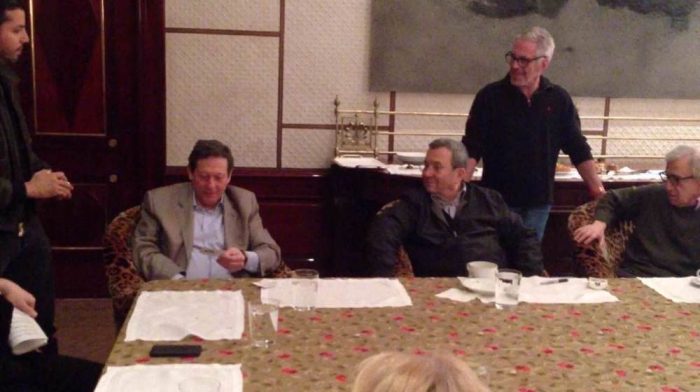
Seated from left to right are billionaire Thomas Pritzker, former Israeli prime minister Ehud Barak, and Hollywood director Woody Allen, while magician David Blaine stands to the left and Jeffrey Epstein stands, in a photo released by US Congressional Democrats on December 18, 2025.
Press TV – February 10, 2026
Iran says the global scandal surrounding convicted sex offender Jeffrey Epstein may go beyond a criminal case and be part of a geopolitical “project” intended to serve the Israeli regime’s interests.
A newly released tranche of Epstein files has sent shockwaves across media, politics, academia, finance, and even Hollywood, forcing prominent figures to account for their ties to Epstein.
Foreign Ministry spokesman Esmail Baghaei told reporters on Tuesday that the documents should not be downplayed or seen as an issue limited to the United States or a single individual.
He said that “given multiple reports indicating that the Israeli regime or others have exploited these cases and related proceedings to advance their political objectives, it strengthens the suspicion that the entire affair may be part of a long-running and extensive project to further the political goals of certain parties, particularly the Israeli regime.”
Baghaei described the scandal as a “human and civilizational catastrophe,” which has deeply wounded the global public conscience and could be considered a crime against humanity.
The revelations, he said, indicate a deep moral crisis within Western governance systems, particularly given the involvement of senior political figures in corruption-related cases.
Baghaei also questioned why no formal judicial proceedings have been publicly pursued so far.
“The crimes reflected in these reports depict horrific events and reveal a deeply troubling mindset among this class of individuals towards women, children, and girls,” he said.
The issue, according to him, requires careful examination across multiple dimensions, including political and security implications, and could affect the region both now and in the future.
Last week, the US Department of Justice (DOJ) released more than three million pages of files linked to its long-running investigation into Epstein, revealing the involvement of powerful political and business figures, including US President Donald Trump, his son-in-law Jared Kushner, and former Israeli prime minister Ehud Barak.
The released files are part of an estimated six million documents held by the DOJ.
The documents provide additional evidence that Epstein had ties to Israeli intelligence.
A declassified FBI memorandum from the Los Angeles field office in October 2020 reported that one source believed Epstein “was a co-opted Mossad agent” and described him as having been “trained as a spy” for Israel’s intelligence service.
The same document also suggested that Trump was vulnerable to Israeli influence through financial and political leverage, according to the confidential source.
What I Learned From the Epstein Files
Corbett | February 10, 2026
Just over a week ago, the U.S. Department of Justice released three and a half million of the six million pages of documents in the Epstein files. So, what do the Epstein files really reveal? Let’s find out.
WATCH ON:  /
/  /
/  /
/  /
/  /
/  or DOWNLOAD THE MP4
TRANSCRIPT
JAMES CORBETT: Just over a week ago, the U.S. Department of Justice released three and a half million of the six million pages of documents in the so-called “Epstein files.”
And by now, we’ve all heard the accusation that, for example, Bill Gates caught an STD from “Russian girls” and then tearfully pleaded with Jeffrey Epstein to please provide him with antibiotics so he could surrepetitiously drug Melinda. Brock, cut in the CNN Gates clip here. And we’ve all seen Elon Musk pleading with Epstein to pretty please allow him to attend. Let’s try that again. Kind of gives a whole new meaning to Microsoft. Get it? And we’ve all seen Elon Musk pleading with Jeffrey Epstein to please allow him to attend the wildest parties on his pedophile island. Cut in the Stewart clip here.
CNN ANCHOR: Epstein claimed he helped quote get drugs in order to deal with the consequences of sex with Russian girls and set up illicit trysts with married women. […] One draft email alleges that Gates tearfully asked Epstein to delete messages referencing an STD, writing, “Your request that I provide you antibiotics that you surreptitiously give to Melinda.” It also, uh, says Gates asked him to delete, uh, explicit personal details about his penis.
SOURCE: Epstein files: Drafts expose Bill Gates, Jeffrey Epstein relationship details
CORBETT: Kind of gives a whole new meaning to Microsoft. Get it? And we’ve all seen Elon Musk pleading with Jeffrey Epstein to please allow him to attend “the wildest parties” on his pedophile island.
REPORTER: Elon says, “Do you have any parties planned? I really want to hit the party scene in St. Barts or elsewhere and let loose.”
JON STEWART: I’m sorry. I hate to do this. Can we zoom in on the email on that, please? … Christmas Day?!
SOURCE: DOJ Protects Trump From Epstein Accountability as MAGA Attacks “Sanctuary Cities” | The Daily Show
And we’ve all seen Fake News Story of the Year recipient Donald J. Trump repeating his “nothing to see here” meme routine.
DONALD TRUMP: I think it’s really time for the country to get on to something else really, you know.
SOURCE: Trump says time to turn the page on Epstein scandal | AFP
CORBETT: …But he would say that, wouldn’t he?
No, the Epstein files are not a nothing burger. In fact, they provide one of the most valuable insights into the operations of the kakistocracy yet revealed.
But you won’t see any real reporting on the depths of this rabbit hole in the dinosaur media.
So, what do the Epstein files really reveal? Let’s find out.
CORBETT REPORT THEME
JEFFREY EPSTEIN: …What do I mean? He formed something called the Trilateral Commission.
The Trilateral Commission is some spooky stuff. People said it was some—people, the Illuminati…there’s some mystery about it. People that ran the world.
It was politicians. But David [Rockefeller] said [in] most countries, the politicians get elected for four years or eight years—separate from the royal families in England or in the Middle East. Someone’s there for four years and then they’re not there anymore. The most important people to have stability and consistency would be businessmen.
So, he formed this Trilateral Commission of businessmen and politicians from three major continents. So, it was the North Americans, the Europeans and the Asians.
So, he said to me, “Would you like to be on the trilateral commission?”
Now, I was 30 years old, 32 years old. I said, “Great.”
And he said, ‘Well, you have to fill out this application.”
So, they have your bio. And I looked at the list of people. And it was Bill Clinton, former president of the United States, Paul Volcker, every great leader in America. The Asians, the Japanese. And with a a very long description of their history. And they asked me to fill in what I would like to have written. And I wrote “Jeffrey Epstein, just a good kid,” which I thought was funny. Nobody else did.
SOURCE: JEFFREY EPSTEIN LAST INTERVIEW FROM HIS HOME (from the Epstein files)
CORBETT: Welcome back, friends, to The Corbett Report. I’m your host, James Corbett of corbettreport.com, coming to you in February of 2026 with Episode 491 of The Corbett Report podcast: “What I Learned from the Epstein Files.”
And that, as you probably garnered, was none other than pedo-king himself, Jeffrey Epstein, being recorded in a sit-down interview that took place shortly before his arrest in 2019 and [that] was conducted by none other than MAGA kingpin, Steve Bannon.
So, why did Steve Bannon participate in not just one, but a series of interviews that, we are told, comprise 15 hours of interview footage shortly before Epstein’s arrest there in 2019?
Good question. And I guess the answer to that question, as usual, depends on who you ask.
If you ask Bannon himself, he’ll tell you it was for the creation of a tell-all exposé documentary about the inner workings of the deep state and how these pedophiles operate. But that’s not what everyone says.
So, this is something that we’ve known about for a couple of years now. Back in 2024, it was being reported, “Steve Bannon filmed Jeffrey Epstein for 15 hours. His ‘documentary’ has never surfaced.” And even back then in 2024, a short clip was released by Bannon and his production company, Victory Films, to tease such a documentary that was “coming soon.” But it’s been “coming soon” for the past couple of years now.
And his (Bannon’s) explanation about this documentary—that it’s just, it’s for this tell-all exposé and it’s an anti-Epstein sort of thing…Well, according to this article, anyway, “Bannon’s explanation that he was producing a documentary about Epstein was nonsense, according to people who spent time with both men around the time they were in each other’s lives. In reality, the two acted like friends around each other, and Bannon, these people said, was trying to help Epstein, a notorious sex offender, with his public relations problems.”
And yes, if you want more on the Bannon slash Epstein relationship, Politico was reporting this recently:
The two dined together frequently and Epstein offered Bannon the use of a Paris apartment, Palm Beach house and other accommodations, as well as his plane on multiple occasions. When Epstein helped coordinate other travel for Bannon, the two joked that Epstein was working as Bannon’s assistant and the “most highly paid travel agent in history.” In one instance, Epstein added: “Massages. Not included.”
Yes. Interesting. Well, interesting-er and interesting-er, because why have we not seen this 15 hours of interview footage yet? And why are we now just getting two hours of that footage in this latest Epstein files dump?
Well, part of the reason may or may not have to do with an obscure legal tactic that was apparently at least discussed in which Steve Bannon, a non-lawyer, would be able to use—I believe it’s called the Kovel clause, or something along those lines—to declare himself part of Epstein’s legal team and thus shield his work through attorney-client privilege. Just really bizarre relationship there.
But it’s just one tiny sliver of a window into the much larger story and one that, for example, connects, as we’ve seen, Bannon with Chomsky, palling around. What’s the common connection there? Oh, that’s right. Epstein. They’re both pals of Epstein who palled around with him, flew on his jet and were both weirdly interested in protecting Epstein’s reputation. Yeah.
Make of all of that what you will, at any rate.
Well, yes, now I’m here to tell you there are two hours of the 15 hours of interview footage that Bannon took with Epstein now publicly available. I will link it in the show notes for today’s episode at corbettreport.com/epsteinfiles/ so that you can go and check it out for yourself.
And it includes clips like that one, which includes an interesting piece of information that I confess I should have known, but I did not until I sat down and watched this interview that, namely: Epstein was personally invited by David Rockefeller to join the Trilateral Commission.
And the timeline on that is all screwy and wonky because he’s talking about being 30 to 32 years old at the time, putting this in the 80s. But then they go on to talk about the first Trilateral Commission meeting in Tokyo, which took place in 1973. So is that the one they’re talking about? Presumably not. Does he mean his first Trilateral Commission meeting, etc., etc.? Well, there’s a lot of questions surrounding this, but there it is and take it for what it is.
But you would know about all of that if you had read my latest editorial. It’s called 10 Things I Learned from the Epstein Files. It’s up right now at corbettreport.com and, of course, on my Substack. And if you go through that, you’ll learn various things that we’ve already managed to uncover from these Epstein files.
For example, [#1] Epstein was an agent and he was working for… Which country? Fill in the blank. What do you think
Well, if you talk to the mainstream repeaters at The Daily Mail and other such crack journalistic outfits, you’ll find he was working for Russia! Yes, as the Daily Mail reports, Epstein’s sex empire was a “KGB honeytrap.” Yes, he was recruiting people and blackmailing people for Russia for…reasons. Apparently.
Or, or maybe, and just maybe, hear me out here, maybe Epstein was a Mossad agent. And I go through some of the many, many reasons that we would have to suspect that, the many, many ties between Epstein and Israel and Israeli intelligence, like:
- the Israeli military intelligence officer and personal aid to Ehud Barak, who spent weeks at a time at Epstein’s Manhattan apartment;
- Epstein personally involved in helping Israel sell a surveillance state to Cote d’Ivoire. Personally involved in helping Israel sell logistics infrastructure and cybersecurity to the United Arab Emirates. Epstein personally involved in helping sell the Rothschilds on Israeli cyberweapons;
- there’s, of course, the Epstein/Dershowitz link and both of them working to smear John Mearsheimer and Stephen Walt, who at the time were working to expose the Israel lobby;
- and dozens of other stories reported, for example, by Drop Site news in their ongoing and extensive Israel-Epstein archive or The Cradle talking about Epstein’s Israel ties.
So, you know, just maybe, maybe the Epstein story has to do with Israeli intelligence.
We could also get that from a Confidential Human Source [CHS] in one of these documents, reporting to the FBI that:
Epstein was close to the former Prime Minister of Israel, Ehud Barak (Barak) and trained as a spy under him. Barak believed Netanyahu was a criminal. Saudi Arabia, Israel and the United Arab Emirates (UAE) are allied against Qatar, Turkey, Iran and Syria. One of CHS’ [REDACTED] (who presumably worked [REDACTED]) asked CHS a lot of questions about Epstein. CHS became convinced that Epstein was a co-opted Mossad Agent (see previous reporting).
So again, make of all of that what you will. There’s much more to go into.
I, for example, go into [#2] Jeff Epstein was a Fed truther who “represented” the Rothschilds. Yes, also from this Bannon interview footage, we see Epstein expounding on fractional reserve banking, which, again, anyone in the conspiracy reality movement will have known about for decades. Presumably, they’ve read things like J. Edward Griffin’s The Creature from Jekyll Island, or they’ve seen my documentary on Century of Enslavement: The History of the Federal Reserve. But here it is from the banksters own mouths—or at least one of their representatives, Epstein—talking about fractional reserve banking and what a scam it is and why there would be runs on the bank if people knew how the system actually worked. Hmm, where have we heard that line before?
Again, much more information on that.
Also, the intriguing 2016 email that Epstein penned to Peter Thiel—yes, that Peter Thiel—in which he casually asserts, “as you probably know[,] I represent the Rothschilds,” which is just…well, interesting. And is he talking about his weird relationship with Arianne to Rothschild and their interesting correspondence? Or is he talking about the wider-reaching relationship that he had with the Rothschild banking dynasty? For example, the aforementioned ties into the selling the Israeli cyber weapons to the Rothschilds?
I go through other little bits and pieces that are interesting.
[#3] “Someone changed Epstein’s Apple ID password after he was dead,” and you can actually see that for yourself in the files.
[#4] The MCC—the “Metropolitan Correction Center”—officer who wrote an after-action report that was recorded in which he confessed to using boxes and sheets to construct a fake Epstein body that was then used to distract the media when they were removing the “body” from the MCC, or at least from the hospital, on the night of the supposed suicide.
I go through [#5] Epstein’s links to the Trilateral Commission and I link up, for example, a very extensive and interesting article on that: “From Rockefeller to Starmer: Mapping the Trilateral Network in the Epstein Files.”
I talk about [#6] Pizzagate and the many, many, many bizarre pizza references in here, like the pizza monster email thread—”You mean radiating a soft glow with th= look of bliss and excitement? Yeah, that’s the pizza.”—or “butt pizza” and other pizza references. “But Pizzagate was all a debunked conspiracy theory!” So said Reddit a few years ago. Well, now, of course, Reddit is the ones that are going, “hey, maybe there’s something to this Pizzagate!”
[#7] Epstein and 4chan. Yes, Christopher Poole, the founder of 4chan, met personally with Epstein. Epstein said he was very impressed by him. They wanted to meet again. Maybe they did meet again. When did they meet? Oh, on October 23rd, 2011 or thereabouts. And oh, by the way, that’s the exact date of the relaunch of the Politically Incorrect [/pol/] board. on 4chan. Hmm. Interesting stuff there.
[#8] Epstein co-opted Bitcoin and made Call of Duty a microtransaction hellscape. The latter point perhaps not so important, but the co-optation of Bitcoin is an incredibly important story. It’s been well reported in an article I’m linking here by Aaron Day at the Brownstone Institute called The Hijacking of Bitcoin. And he goes through, step by step, the exact ways that Epstein was linked up with the small blockers to create, to divert Bitcoin into the government-compliant regulatory non-crypto that it is today. And there’s specific talk about, for example, [a] $525,000 grant to MIT’s Media Lab Digital Currency Initiative and [a] $500,000 investment in Blockstream, etc. Again, so much reporting and very important stuff in there, so I will highly recommend that people check out that Aaron Day article.
I talk about [#9] Ghislaine being invited to the 9-11 Shadow Commission by an Edward J. Epstein (no relation). What that was all about? I link up, for example, the Wayback Archive of the page that was being linked to there and what that may or may not be.
And [#9] Epstein didn’t kill himself. Well, we’ll get to that later.
So, there’s ten points, and there’s dozens and dozens and dozens of links in here. So, I would highly suggest if you haven’t seen this article yet, please check it out.
But in the purpose of expanding on this research for today’s episode, I’m going to go through five more things I learned from the Epstein files. So, if you are buckled in and ready and have your pen and paper at hand, let’s start going through them.
#1: Epstein’s black market in babies. And we get weird hints of that from redacted emails from who knows who to who knows who: “[Subject:] [EXTERNAL EMAIL] Woman who accused John of God, cult leader of rape, mysteriously kills herself at Spanish home,” which apparently seems to be just a link to this Sun article, but “[REDACTED] spoke of this going on at Zorro Ranch. She has said on record that Epstein offered her money to do this. Birth babies for black market use.”
And if you want to start delving down that rabbit hole, you can start going to things like this, which is one of the documents that was released. [It] is a journal of sorts of someone who was undergoing therapy, an Epstein victim. And it’s truly disturbing. But at any rate, you can see, for example, something that appears to be blood or blood-like stained pages. And then you get this page of this bizarre code that you realize you have to read in two lines. “So sorry Jeffrey these things happen when your,” etc., etc. So you can go and really literally read everything for yourself, or, thankfully, the DOJ has apparently actually interpreted this code and here it is:
So sorry Jeffrey these things happen when your body has never been given time to properly heal!
So it came out in the toilet and I didn’t know what to do so I just flushed the tiny little fetus.
You have made me numb and I hate you for this!
I hope I never have to see you again!
I am not your personal incubator!
where is the baby?
where is Ghislaine?
And you can actually, again, go and read all of this for yourself in this creepy journal of trauma that this person left. That’s part of this document release.
There are other journals by the same person or a different person talking about more such creepy stuff. There’s, for example, this page, which, again, has some sort of redacted picture in here and then more text. Again, there is an accompanying document that tells us what this is. For example, “[Next to sonogram photo.” So, that is apparently what is being redacted here, a sonogram photo.
I heard the heart beat even when she put her hands over my ears.
Aren’t pictures enough for them?
Torture!
Should I …..
deeply miss them?
Have these all been …. [MURDERS]?
Does this make me a [KILLER]?
Flights and yachts of fancy? No, horror. And talking about what happened on those flights, et cetera, et cetera. So, yes, there is more to this story, obviously.
And there is an excellent post up on LifeSite News about “Ignored in the release of Epstein files are victim references to traumatic abortions, lost babies,” which I will commend to your attention. It has a lot of this information and compiles a lot of the documents and emails, etc. So that is a handy way of putting your head around this incredibly dark subject.
But that is just one of the things that we are learning from these files. #2—or should this be #12, I suppose, if we’re counting the first 10?— genetic editing of babies and animals. Again, a creepy subject, which you can start exploring by looking, for example, at the Brian Bishop communications with Epstein. There’s many, many things that they had about “genetic engineering,” “designer babies,” “new genetic editing desk,” “references for embryo editing,” etc., etc. They had an extensive correspondence about this, and you can find out more about that from some of the reporting that’s happened about this: “Epstein linked to ‘designer baby’ empire in latest files that reveal bid to engineer superhumans and clones, talking about this correspondence with Brian Bishop, a Bitcoin developer who “in 2018 was seeking financial backing for a venture aimed at genetically enhancing offspring and ultimately replicating humans.” So there was some weird baby cloning, whatever was going on.
Who knows exactly what was happening there, but I’ll just put this in there. Go to Jmail and search for “hoofs,” that word, and you’ll find an email from Jeffrey Epstein to a Kathy Ruemmler saying, “we talked about designing a pig with different non-cloven hoofs in order to make kosher bacon,” etc.
Again, all sorts of really, really bizarre and potentially occultic stuff going on in these emails. That’s just one more window on that.
So, let’s move on to #13. So, pandemics as a business model.
So, in my 10 Things I Learned from the Epstein Files, I did call on members of The Corbett Report community to chip in with your—what do you find? What are interesting pieces of this puzzle that you find? And at least one of The Corbett Report members, beware-the-ides-of-march, answered the call:
“Dear James, you said we could contribute here if we thought there was an angle on Epstein worth looking at? This four-part investigation looks well-researched and properly referenced. Here’s part four for your perusal.”
And then, beware the Ides of March, links to Sayer Ji’s article, BREAKING: The Epstein Files Illuminate a 20-Year Architecture Behind Pandemics as a Business Model—With Bill Gates at the Center of the Network, which notes:
The latest DOJ batch of Epstein files reveal that by the time the world encountered COVID-19, the financial, philanthropic, and institutional machinery to manage—and profit from—a pandemic was already firmly in place.
While the Epstein files have reignited scrutiny around specific relationships, their deeper significance lies in how they intersect with a much longer and largely unexamined timeline. Public records, institutional initiatives, and financial instruments indicate that the conceptual foundations of pandemic preparedness as a managed financial and security category began to take shape in the late 1990s and early 2000s, as philanthropic capital, global health governance, and risk finance increasingly converged. Following the 2008 financial crisis, this framework rapidly accelerated—expanding through reinsurance markets, parametric triggers, donor-advised funding structures, and global simulations—years before COVID-19 made the architecture visible to the public.
And I will not go through this entire article for you right here, but Sayer Ji has done an incredible job of putting this together, starting with this “20-year pandemic preparedness architecture” timeline, which exactly corresponds to all of the research that I have done on this.
Late 1990s to early 2000s: the foundations were being laid through philanthropy and global health governance. And that’s exactly right from my research on this matter. For example, of course, the Dark Winter/anthrax attacks of 2001, leading into the Model State Emergency Health Powers Acts that were being passed all around the United States in subsequent years that laid the framework, the institutional and legislative framework, for state governors to start locking down their populations and force inoculating them at the event in the event of a declared pandemic. And the 2006 International Health Regulations at the World Health Organization that created the Public Health Emergency of International Concern, the “PHEIC” emergency—P-H-E-I-C—designation that was then used in the swine flu and Ebola and other such ginned up non-crises before getting to the scandemic.
Post-2008, you had the acceleration in terms of financialization and reinsurance and catastrophe logic of the pandemic preparedness agenda.
And then in the 2010s, you have the operationalization of that agenda through simulations, DAFs and preparedness infrastructure. What’s a DAF, a donor advised fund? Well, Sayer Ji again goes through all of that in this incredibly detailed article.
And the best part about the article is he doesn’t just talk about the documents. He’ll actually show the documents. And absolutely most best of all is at the very bottom of this incredibly lengthy and well-researched article. You have the actual notes with the actual references that you would use as a researcher to go and put these puzzle pieces together for yourself.
So, once again, this is highly recommended. Thank you to beware-the-ides-of-march for bringing this to my attention. Thank you to Sarah Ji for putting this work together. It’s incredibly important and shows more of the inner workings of that pandemic preparedness agenda, how it came about and how Epstein was apparently one of the locuses of this agenda, connecting JP Morgan with Gates, etc., and other donors and other such things together in this network that created the foundations of the scamdemic. And there are all sorts of ancillary documents, J.P. Morgan documents and Gates Foundation documents, etc., that are, again, part of this document release that show even more, as Sayer Ji highlights in this article.
But let’s move on to #4 or #14, depending on which numeral reference we’re using here: The DOJ had a draft of Epstein’s death announcement the day before he died.
That’s right. You will, of course, know that, of course, Epstein killed himself on August 10th, 2019, right? Well, according to the U.S. Attorney General’s office in the Southern District of New York, there was an August 9th press release talking about how “Earlier this morning, the Manhattan Correctional Center confirmed that Jeffrey Epstein, who faced charges brought by this Office of engaging in the sex trafficking of minors, had been found unresponsive in his cell and pronounced dead shortly thereafter.”
But that’s not what happened. Oh, no, it happened on August 10th. And that document has also been released. Of course, this is the press release where it was almost word for word exactly the same: “Earlier this morning, the Manhattan Correctional Center confirmed that Jeffrey Epstein, who faced charges brought by this Office of engaging in the sex trafficking of minors, had been found unresponsive in his cell…” and then it says, “and was pronounced dead shortly thereafter of an apparent suicide.”
So, literally on August 9th, the day before any of this happened, they had a press release about his death, announcing his death. And then when it supposedly actually happened on the 10th, they had a press release, almost word for word the same, but adding that he [died of an] “apparent suicide.”
Right. Okay. I’m not the only one who finds this a little bit odd. Oh, maybe, maybe some intern screwed up and put the wrong date on the wrong one or something. and they corrected it. Well, mainstream outlets too, picking up on this. “Epstein files reveal prosecutor’s announcement dated before his death.” Yes, which does seem to be kind of a bit of a strange phenomenon and one that at least deserves some explanation, doesn’t it? Along with many other things that we could point out.
For example: “Epstein Cellmate Claims Trump Administration Wanted Pervert Powerbroker ‘Dead’,” talking about “Jeffrey Epstein’s prison cellmate claims to have evidence that the Trump administration wanted the disgraced financier dead and left him unprotected ‘on purpose.’” Of course, who is the cellmate? “Nicholas Tartaglioni, a quadruple murderer and former police officer” who “had a reputation for extreme violence and a self-confessed hatred of child sex offenders, who “claims ‘it is no coincidence’ that he was ‘deliberately’ moved into the same jail as Epstein and ‘placed in the same cell’ as the convicted child sex offender,” but then removed the night before whatever happened, happened.
Which leads us to #5 of the five more things I learned, #15 of the overall list of what we learned from the Epstein files: Epstein didn’t kill himself!
Okay, no, we don’t really learn the truth about what happened or didn’t happen on the night of August 10th in these files, but we shouldn’t expect that that would be in these files. There are things that have been released, like new photos of people working on his body at the scene, et cetera, etc. But, as we know, they were using tactics like boxes and sheets stuffed into bags to trick reporters about his body. So what we know is, of course, more and more and more of the weirdness that certainly does not prove anything. What—Kash Patel and Dan Bongino just looked you straight in the eye and lied to your face. “He killed himself. I’ve seen suicides before. I’ve looked at the files and they show that he killed himself.” No, they do not. No, they do not.
And I guess we could put the bookends on this entire story by taking a look at a couple of AP news articles. The first one, “Justice Department releases largest batch yet of Epstein documents, says it totals 3 million pages.” So, that was that was how it started. And this is how it ended: “FBI concluded Jeffrey Epstein wasn’t running a sex trafficking ring for powerful men, files show,” talking about some of the documents within this release, which show that, oh, he wasn’t doing anything. He wasn’t. Whatever. Who cares, guys? Look somewhere else.
At least, that’s what the internal documents which have been released now show. The internal FBI and DOJ investigation showed that there was no list. There was no nothing. It’s all fine. Don’t think about it.
Well, as you can tell, there’s a lot in here and much, much more that I could go through. Everything I have talked about, everything I’m referencing will be in the show notes for today’s episode at corbettreport.com/epsteinfiles/. So please go there for the more information on this. But, having said that, if you want some more of the strangeness in these files, you could turn to Nick Bryant, who, you will know, is a previous Corbett Report guest for his work with EpsteinJustice.com, which, you will know, is an organization that is organizing and rallying in support of the Epstein victims and achieving justice for the crimes of Epstein and his kakistocracy crew.
Well, Nick Bryant has an interesting post up: “The Epstein Emails: From the Very Strange to the Very, Very Evil,” in which he talks about some of these things.
And just right off the top, he talks about one of the released emails. Here is a group email from REDACTED to a group list, subject: “journalist calling around” from 2011. “Just a heads up, there is a journalist calling around again. His name is Nick Bryant. This is what he looks like so you are all aware.”
So, literally an APB–an all points bulletin–being put out by the Epstein crew to be on the lookout for Nick Bryant back in 2011, because, as my listeners will know, Nick Bryant was one of the OG researchers on this way before the Miami Journal or whatever, or any of those reporters had even heard of this case. Bryant was on it. He was the one who released the black book and the flight logs in the first place, etc., etc. So, he’s been doing yeoman’s work on this subject and the Franklin scandal before it and other work along these lines for decades now.
So, I recently contacted Nick Bryant to ask him about some of the very interesting emails that he’s uncovered and which he has itemized here in this Epstein emails post.
NICK BRYANT: Well, the first category is “horrors.” I mean, there are a lot of horrors in these emails. I mean, evil of an almost incomprehensible kind—evil that I have come across before. With the Franklin scandal, there was extreme abuse, and there was also accounts of children being murdered, and we’re seeing that with Epstein.
And then I’ve got muffins, steaks, pizza, etc.,
And then there’s power brokers and celebrities. And it turned out that Epstein was trying—Thiel and Musk and Zuckerberg, our favorite humans on the planet, were getting together. And Epstein was wondering—it’s an email—and Epstein was wondering if he could make it with those swell guys.
Deepak Chopra shows up occasionally. This one’s kind of interesting: “God is a construct. Cute girls are real.” So, underneath all that high-powered metaphysical spirituality, Deepak Chopra has some major lower chakra predilections.
And then there’s kind of an interesting one. David Boies is a super lawyer who represented all the Epstein victims. He was invited to Epstein’s Yom Kippur breakfast in 2010. And there’s another attorney that represented a number of those victims named Stan Pottinger, who’s very, very dirty.
And the next category is transhumanism, biohacking, mind control, etc. And that certainly has some interesting emails.
And then the next category is FBI, CIA, Mossad.
And then there were a couple of emails that didn’t quite fit into any other category. So, I just said “additional strange emails.”
CORBETT: Absolutely, incredibly interesting list. And this is, of course, only scratching the surface of the three million pages of documents that have been released, including many, many emails, too many for any one human to handle. But let’s go through a few of the more interesting ones right here.
So, for example, Jeffrey Epstein emailed an unknown individual stating he “loved a torture video” shared between the two. And you can see, obviously, that you can see the actual emails in the email list. But here’s here’s some images of it. And Peter Mandelson, this is just speculation, right? We don’t know that that is the name under there, but it just happens to fit.
BRYANT: It does indeed. And he had formerly been the UK ambassador to the United States of America, which is a very prestigious post. And apparently he likes torture.
CORBETT: I loved the torture video. Yeah. Well, no. Yeah. Well, okay. Jeffrey loved the torture video. We don’t know. We don’t know what the person who sent it thought of it, at any rate.
BRYANT: So, with this, Mandelson is taking a lot of heat in the UK and he’s had to step down from all his prestigious posts. So actually, there’s a minor amount of accountability here.
CORBETT: Something has occurred. Yes.
OK, how about this one? “If true, this Jeffrey Epstein oriented email beggars belief. The abuse was off the scale.” And we’re looking at something from Eddie Aragon: “Fwd: CONFIDENTIAL: Jeffrey Epstein. This is sensitive. So it will be the first and last email, depending on your description discretion. You can choose to take it or trash it but this comes from a person that has been there and seen it as a former staff at the Zorro.”
And this person is talking about: “What is damning about Jeffrey Epstein is yet to be written. Did you know somewhere in the hills outside the Zorro, two foreign girls were buried on orders of Jeffrey and Madam G.? [Ghislaine, presumably.] Both died by strangulation during rough fetish sex.” And here are the video footage of Jeffrey Epstein, including “sex video with minor,” “Matthew Mellon video,” etc. “Suicide attempt confession,” etc., etc.
And apparently somebody who claims to have been as former Zorro staffer was attempting to get one Bitcoin for in return for this information. What do we make of this?
BRYANT: Well, there’s other very, very dark emails that allude to homicides. So did this happen? I mean, that’s the question. If you look at the totality of emails and just the amount of blood that’s just dripping off of them, an email like this doesn’t really seem that far-fetched in that context.
CORBETT: Yeah. No, it certainly doesn’t. It’s par for the course, unfortunately.
All right, let’s look at this one. From “Forward to J.E.E. [Epstein] re: Richard Johnson.” This is from Mark Tramo. And what are we looking at here? “Thanks for sending Richard Johnson my way. I trust the kind words I shared with him are acceptable,” et cetera, et cetera. “Was just reading today that newborns will suck on a pacifier more vigorously if it triggers playback of a recording of her slash his mother’s voice than another woman’s voice. Have you read David Brooks’ Social Animal?” What are we looking at here?
BRYANT: Well, if it’s talking about ways to get babies to suck harder in a very malevolent kind of way, I mean, this is rarefied evil.
CORBETT: “They blacked out the name of the person who sent Epstein an image labeled age 11 Why protect the predator?” And yes, this is an email from the archives sent from somebody, we don’t know, just labeled “Age 11.” “fullsizerender.jpg,” so this is an image file. The image file itself, obviously not released?
BRYANT: And here’s the thing. The media and the government have said that Epstein’s youngest victim was 14 years old, but I’ve heard accounts of victims that are much younger. There’s an Australian newspaper called The Age. I think it’s out of Sydney. It’s a daily. They spent a lot of time in the Virgin Islands, and they said that the youngest victims there were 11 or 12.
Virginia Giuffre submitted an affidavit that talked about various perpetrators, and she said that she’d attended orgies where the youngest girl was 12 and most of them couldn’t speak English. But I know a couple of therapists, and one’s a pretty eminent psychologist, and both have counseled Epstein victims who were trafficked when they were under the age of 10. So.
I know that somebody is going to try to clean this up, because it’s very strange. People think that 14-year-olds and 15-year-olds have agency. I mean, that’s how they’ve kind of justified it in their mind with regards to Jeffrey Epstein. And I don’t feel that way, but when you get into 11-year-olds or 10-year-olds or 9-year-olds, I mean, how can they possibly have agency? So that’s, I think, one of the things that really needs to be broken open here is that these guys were psychopaths.
And we saw it in the Franklin scandal, too. The two primary pimps were into pubescent boys. But if you wanted a seven or eight year old, they didn’t have a problem getting you a seven or eight year old.
So, I mean, they’re psychopaths. It’s not like they’ve got a conscience to to deal with. So, when, with this–and that’s another thing where the mainstream media has really short changed Americans. They’ve made Epstein and Maxwell seem kind of glamorous living on the Upper East Side, traveling all over. But human traffickers are vicious people, whether they’re living in a mansion on the Upper East Side or they’re living in a trailer court in the Midwest. Human traffickers are vicious, vicious people.
CORBETT: Uh, as we talked about Deepak Chopra to Epstein: “God is a construct. Cute girls are real.” And this person notes they’re all in on it. The entire world is a stage. So yes, sorry to any Deepak Chopra fans out in the crowd who might’ve held out hope.
One more. Again, there’s dozens of links in this document that we’re linking up here, but let’s take a look at one more: “Evidence of the presence of American laboratories for the development of biological weapons in Ukraine has been found in the ‘Epstein files,’ as previously reported by the Russian Defense Ministry on numerous occasions,” but of course derided as crazy Russian conspiracy theory. And here are the emails themselves. Yeah, a lot of biological and, you know, scientific papers and documents and emails and things in these records that we’re finding, aren’t there?
BRYANT: So there’s gene editing. There’s doing very strange things to babies. There’s cloning. And cloning is a reality. People in New York City clone their French bulldogs for $65,000. And I think you can clone a human for about $1.5 million. When Dolly the sheep was cloned in the mid-’90s, I actually had written some articles for Genetic Engineering News, which was one of the papers that broke that. And it’s very easy to clone. You just have to get an ovum and take the DNA out of the ovum and stick the DNA that you want cloned in the ovum and then give it an electrical charge. Sometimes the charge will start mitosis and the cells will start splitting, and sometimes they won’t. But it’s very easy to clone.
And back then, even before I got into the Franklin scandal and all this dark, malevolent stuff, I thought to myself: “there’s got to be megalomaniac millionaires out there cloning themselves.” So, that was when I saw his thing that was about cloning and transhumanism, I kind of figured that that would be a natural outcome.
CORBETT: Yeah, of course. If you can imagine it and we have indications of it, then it is probably already happening. And here are some more indications of that. And as I say, these are just a few of the emails of the ones that you have highlighted from the literally thousands and tens of thousands that we’ve just been flooded with. So there’s much, much more to go through.
But let’s talk about, obviously, I know that you work, obviously, your work at EpsteinJustice.com, working for and with the survivors and victims of these crimes. What are the people in your network saying about this latest file release and what is or is not happening as a result of it?
BRYANT: Well, it’s daunting. All these emails with so much evil, I mean, it’s daunting. And people that have been victims of sexual abuse that have been traumatized, I mean, this is very hard stuff for them to read. And there’s 3 million documents that have yet to be released. I mean, these are bad, but you can only imagine how bad those are.
CORBETT: So what is the next step for Epstein Justice then? How do we continue putting pressure to get those documents?
BRYANT: It’s waking people up. I mean, Epstein Justice is growing.
When we first started talking about Epstein Justice, we had just started. And I’d been a writer my entire life. I’d never been a director of 501c3. I’d never even worked for a 501c3. And the people that wanted to do this with me, none of us had any kind of experience working with a 501c3. But we just felt like this is something we had to do. So, now we have a plan.
Well, we’ve always had a plan for the Independent Congressional Commission. And that does not require a presidential signature. It just requires a majority in the House and a majority in the Senate. And independent congressional commissions generally hire non-government personnel to help them with investigations. And that’s what we’re going to need. If this thing ends up in a subcommittee, it’s going to die for sure. The only chance that we have for truth with this is an independent congressional commission that is completely devoid of any executive signature. It’s going to take a lot.
Together, Epstein Justice, we’re putting together Facebook groups by state, and we’re having those respective groups put pressure on their legislators. Now, they cannot feel our pressure yet. But as these groups grow and grow–and they are growing–as they continue to grow, these legislators will start feeling the heat from an inundation of emails and phone calls. And that’s the only way that you can get a politician to act is if they feel fear.
And I realize that a lot of these politicians are compromised. And the ones that are extremely recalcitrant, we’re just going to have to put extreme pressure on them and show how recalcitrant they are.
So, we have a plan and we’re executing it. But this isn’t going to be an easy slog. I mean, I’ve been at this for 22, 23 years when I started researching about the Franklin scandal. But, you know, I got to tell you, James, just the fact that it’s gotten this far is like a dream come true to me. Because I went through some very dark years thinking that none of this was going to be exposed.
CORBETT: Once again, that is Nick Bryant of EpsteinJustice.com. And for anyone interested in Epstein Justice, I suggest you go to their website. You can find out more about the regular webinars that they do on an ongoing basis to train people in activism and how they can raise awareness about this issue. And they have various campaigns that they are involved in on an ongoing basis, again, trying to achieve justice for these crimes. So people who are interested, please check that out at EpsteinJustice.com.
But as you can see, this is just scraping the surface of the three and a half million documents, pages of documents, of the six million in the overall files, with almost half of the files having not yet been released.
So, obviously, this is too much of a research task for any one individual to be able to handle. So, I need your support. I need your help. And I would hope that if there are any interested people in the audience who are interested in delving into these files and finding out more, that you will lend a hand to this open source investigation.
And if you are interested in that, of course, you could go to the Epstein Library at the U.S. Department of Justice website. Again, the link will be in the show notes if you are interested. and you can try going through this.
And I don’t know. For example, we looked for hoofs earlier. Is it going to find it here? Okay, it can be functional and you can find these emails that way.
Or you can start browsing through them. And if you do so, you’ll find the Epstein files, Transparency Act release. And, I don’t know, go into Dataset 10. And just like the JFK files that we looked at last year, these files are, again, totally, utterly useless, just random numbers. And who knows what you’re going to find when you click into something? Is it going to be an email? Is it going to be a document? Is it going to show something? Is it going to be a picture? I don’t know! How could you possibly know? [sarcasm]Oh, yes, of course, this document.[/sarcasm]
Again, how useful is this? Not very, and perhaps that is part of the point, confuse and distract.
So, if you want a more robust way of searching through these files, you can go to jmail.world. For those who don’t know, this is a handy service that has been put together that takes all of these emails and documents and photos, etc., and puts it as if you are logged into a Gmail type interface as Jeffrey Epstein. It is not just Gmail. It’s also Yahoo. It’s the documents, it’s the photos, etc. But here it is.
And so, as for example, before we were able to search, for example, you search the word “hoofs” and you’ll find that Kathy Ruemmler email.
Or, well, here guys, let’s find out. Ooh, is Corbett in the–oh no, Corbett is not in the Epstein files, etc., etc.
So, you can search that way.
You can search–there is also a list of people that you can search through. So, you can see all of the Elon Musk emails, etc., things along those lines there. Again, there’s a lot of different features here.
I saw somebody in the comments earlier asking about the photos and “how do you find the photos that are apparently being published here and I can’t find them,” etc., etc.. Well, here they are. And you can go to “view original.” That’s a handy link to go to the actual justice.gov version that is contained in the files and it’ll have the URL there, etc. So you can copy that in.
And again, there’s literally thousands and thousands and thousands and thousands and thousands of photos and documents here. And you can see them all and download them all, etc. And this even has a function, at least on the email part of Jmail where, You can see the last one that’s at least recorded here in 2019 is from Cody Rudland: “You are dead. lol, good riddance.” Okay, wonderful.
But there is a function for leaving notes as well on the sidebar. I’m in the mobile version of this, so you can’t see it. But there is a function for leaving notes, and people are collectively leaving notes on these various emails, etc.
Again, there’s a lot to explore. just explore. You can see what Epstein was ordering on Amazon, etc.
So again, all of this information in a much, much more easily findable form.
However, having said that, some of these emails are not showing up in the Jmail search. Like, for example, we looked earlier at Nick Bryant showing up in one of these. But Nick Bryant–that email about the “APB” of Nick Bryant is not searchable this way. You can find Juliette Bryant, whoever that is, but not Nick, etc. So, there are certain things that just are not showing up here. So… Again, has all of the data been imported and has it been done in the proper way? And are things being disappeared from the files, etc.? All very good questions that people need to start looking at and answering.
Having said that, here’s another interesting website. This one is a hat tip to my video editor extraordinaire, Broc West, who brought this one to my attention. I hadn’t seen it. It’s called EpsteinSecrets.com. And there you can see visually the Epstein network, for example, mapped out all of the various people and who they’re connected to. And you can sort how this this this map is shown, for example, looking at edges and people. And you can zoom in on various people and how they’re connected and the documents that are connected to them.
You can do searches. For example, remember that Kathy Ruemmler that Epstein was talking about genetically engineering pigs to have non-cloven hooves so they could be kosher. Well, who who on earth is that Kathy Ruemmler person? There is a way to search this and I know I have done it without logging in, but anyway.
Well, anyway, I’m not going to get it now, but trust me, there is a way to search this and Broc will show it on screen where you can find out [about] Kathy Ruemmler. Oh, that’s right! She happens to be with the department of–or, she was in the Obama administration and then went into private practice in the 20 teens, at which point she was contacting Jeffrey Epstein on a regular basis.
So, again, it’s a handy search function for that sort of thing.
There are tools like this that exist. And if you know of any other research tools for going through this massive, massive amount of files. Please bring them to our attention. I’m sure we would be interested to hear about them
Having said that, I do know that there are those who will simply fold their arms and–interestingly, in an exact parallel to Donald J. Trump–say: “Let’s move on. There’s nothing to see here. Whatever. Who cares?” Essentially. Remember when Chomsky said who cares about 9/11 or JFK, etc.? Well, it’s: “Who cares? Whatever. There’s nothing of importance here. It’s all fake! It’s all a psyop and or it’s all been scrubbed!”
Well, be that as it may, I don’t believe that. These are real emails that really took place between thousands and thousands of people, real documents that have been verified and that no, not a single person has said that isn’t an email that’s fake, let alone the thousands of people who are implicated in these emails. None of them have stepped forward to say that’s fake.
No, these are real emails that really took place that really contain information. Does this contain the video of the whatever blood drinking child sacrifice? No, of course not. That is not in here.
But there is a lot to garner from here. As you’ve seen, for example, Sayer Ji and others mining these documents, Aaron Day with the Bitcoin documents, et cetera. There’s a lot of information to go through.
So, I will say–counter to those who will tell you “It’s a nothing burger! It’s a psyop! Don’t look at it!”–I will say you can choose whatever you want to look at or not look at. If you don’t want to research this, that’s fine. But if you do, I would very much appreciate your help because I am going to continue looking at these documents and what they do reveal about the kakistocracy that, yes, many people in my audience, thankfully, after decades and decades of people like Nick Bryant and others reporting on this subject and staying on it for decades in which they’ve been dismissed as crazy conspiracy theorists and wild loonies finally being vindicated. And then there are those who will just say, “Just stop looking!” I do not believe that. I think we should be looking at these and taking them for what it’s worth.
Obviously, this is not the bottom of the rabbit hole, but it is some way down and further than we have been before. So there is important information. Get it before it gets scrubbed, because you know they are working on scrubbing various pieces of this puzzle as they are being reported.
Having said that, I am interested in what you find. So if you are a Corbett Report member, please go to corbettreport.com, log in, leave links, data, information, tools, etc.
Whatever you find in the comments section at corbettreport.com/epsteinfiles. I am looking forward to what you find and I will, of course, be reporting more on this subject in the future, but that’s going to do it for today’s exploration. I am James Corbett of corbettreport.com. Thank you for joining me for today’s episode.
STEVE BANNON: …[If] we walked into that clinic where they’re giving that money out to these people that are the most dire straits of poverty and sickness and told them that the money was coming from a–what are you, Class 3 sexual predator?
EPSTEIN: Tier 1.
BANNON: Tier 1 is the highest and worst.
EPSTEIN: No, the lowest. I’m the lowest. You’re the lowest.
BANNON: Okay, Tier one, you’re the lowest. But a criminal.
EPSTEIN: Yes.
BANNON: That the money came from what? What percentage of people do you estimate? I understand you don’t like probabilities. Do you estimate would say, “I don’t care. I want the money for my children”?
EPSTEIN: I would say, everyone said, “I want the money for my children.”
BANNON: Did they know where the money came from?
EPSTEIN: I think if you told them, the devil.
BANNON: The devil himself.
EPSTEIN: The devil himself said, “I going to exchange some dollars for your child’s life”?
BANNON: Do you think you’re the devil himself?
EPSTEIN: No. But I do have a good mirror.
SOURCE: JEFFREY EPSTEIN LAST INTERVIEW FROM HIS HOME (from the Epstein files)
Featured Video
Seyed M. Marandi: Negotiations Collapsed – Return to War
or go to
Aletho News Archives – Video-Images
From the Archives
Wartime internment camps in Australia
National Archives of Australia
World War I
During World War I, for security reasons the Australian Government pursued a comprehensive internment policy against enemy aliens living in Australia.
Initially only those born in countries at war with Australia were classed as enemy aliens, but later this was expanded to include people of enemy nations who were naturalised British subjects, Australian-born descendants of migrants born in enemy nations and others who were thought to pose a threat to Australia’s security.
Australia interned almost 7,000 people during World War I, of whom about 4,500 were enemy aliens and British nationals of German ancestry already resident in Australia.
Records of World War I internment camps
World War II
During World War II, Australian authorities established internment camps for three reasons – to prevent residents from assisting Australia’s enemies, to appease public opinion and to house overseas internees sent to Australia for the duration of the war.
Unlike World War I, the initial aim of internment during the later conflict was to identify and intern those who posed a particular threat to the safety or defence of the country. As the war progressed, however, this policy changed and Japanese residents were interned en masse. In the later years of the war, Germans and Italians were also interned on the basis of nationality, particularly those living in the north of Australia. In all, just over 20 per cent of all Italians resident in Australia were interned. … continue
Blog Roll
 Aletho News
- Seyed M. Marandi: Negotiations Collapsed – Return to War
- Tomorrow’s naval blockade showdown
- ‘Israel’ attacks civilians to hide its embarrassing military failures & out of pure sadism
- Any Foreign Military Vessel Approaching Hormuz Under Any Pretext ‘Will Be Dealt With Severely’: IRGC
- Diplomats slam US negotiators’ performance in Iran talks
- Trump Refuses Exit Ramp, War with Iran will Continue
- Trump Says US Naval Blockade in Strait of Hormuz Will Begin Shortly
- US, Iran end 21-hour talks without agreement
- US IRAN TALKS: Who Are the Crazy Ones Here? /Lt Col Daniel Davis
- Talks with the US end without a deal over excessive US demands: Iran
- If Americans Knew
- US-Iran ceasefire negotiations make zero progress – Daily Update
- Pro-Israel ‘Thinktanks’ and Individuals who Influence U.S. Foreign Policy
- Mearsheimer reveals how Israel dictates US policies on Iran, Gaza – video
- After killing 350+, Israel still has a “score to settle” with Lebanon before ceasefire – Daily Update
- Military aid to Israel emerges as the latest political litmus test for Democrats
- The only Palestinian children’s rights organization closes following years-long Israeli campaign against it
- ‘I Can’t Forget the Smell’: Lebanese Reel After Israel Kills Over 300 in Single Day
- DNC Shoots Down Resolutions Calling Out AIPAC and Limiting Arms to Israel
- TCN: Is Israel Blackmailing President Trump?
- Israel killed at least 303 Lebanese yesterday – who were they? Daily Update
- No Tricks Zone
- Cave Discovery Reveals Today’s Desert Climates Were Recently Far Warmer, Wetter, Teeming With Life
- German Expert: Heat Dome Led To Record Temps In Western USA…Warmer In 1934, 1936
- New Study: No Linear Warming Or Glacier Retreat Along Northern Antarctic Peninsula Since 1980s
- An Inconvenient Tree: Uncovered In Alps… Europe Much Warmer Than Today 6000 Years Ago
- New Study Reports A 60% Slowdown In Greenland’s Ice Loss Rate In The Last Decade
- Low Intensity Tornado Wrecks Major Solar Farm, Creating A Potential Toxic Dump
- New Study Finds Warming Saves Lives…Cold Temperatures 12 Times More Deadly Than Excess Heat
- German Science Blog Accuses PIK Climate Institute Of Hallucinating Climate Tipping Points
- Devastating Assessment Of Comirnaty Vaccine By Former Senior Pfizer Europe Toxicologist
- New Study: CO2 Is ‘Effectively Negligible’ As An Explanatory Climate Change Factor Since 2000
 Aletho News