Another Strange Week in Trumpland
By Philip Giraldi | Unz Review | August 5, 2026
Some weeks it is difficult to pick out the most shocking stories symptomatic of decline and fall of American governmental integrity both in Washington and often at state levels. The White House and Congress frequently lead in that reckoning given the complete abandonment of any United States government’s effort to make its policies and legislation responsive to actual national interests. Wars are being fought without any reason to do so and domestic policies are derived from “feelings” that President Donald Trump has when he gets up on the morning. The result is chaos when the policies are actually developed and implemented.
Last week we long suffering Americans were forced to witness pure Trumpean flip-flops on major pronouncements relating to foreign policy. First came the pronouncements that Iran had more-or-less reached out to Trump and sought a return to negotiations for a ceasefire and peace agreement. The claim was immediately denied by Tehran and nearly all observers agreed that the Iranians would have to be crazy to trust Washington and its “word” over any issue given Trump’s history of subsequently disregarding documents signed and agreements reached. Trump then responded to the Iranian denial by threating to unleash hellfire in his usual fashion, replete with obscenities and threats of obliteration for the Persian people in a holocaust more devastating than World War 2.
Some observers have noted that Trump’s threats of annihilation are clearly unachievable in practical terms given the rundown of US munitions stocks and the difficulty in manufacturing replacements due to Chinese refusal to sell exotic metals to the Americans and the loss of Saudi and Emirate refineries that produced high grade aluminum for fuselages of warplanes. So if Trump really seeks to act out his schoolboy fantasies of death and destruction he will have to go nuclear. It is ironic that he has based the war against Iran on his oft repeated stated intention to prevent Iranian development of a nuclear weapon, a program which US intelligence has insisted does not exist. Only the US both possesses and has used nukes to kill civilians and that was in 1945.
Given all the mixed signals coming out of Washington, it is perhaps unnecessary to point out that a war that was pointless and unnecessary in the first place is still sputtering along with Israel and its Prime Minister Benjamin Netanyahu pushing for its expansion from the sidelines using lies crafted to convince a clueless Trump. “Far better at this point,” says Netanyahu, “to see American soldiers die to destroy Iran rather than waste any of our wonderful Jewish boys, each of whom is worth 1,000 goyim.” Actually, we Americans are lucky to be only 1/1,000th times in terms of Jewish relative value. One Israeli Lawyer calculates that each Jewish life is worth 10 million Palestinians!
That Trump is deep into a war that is destroying his presidency and only benefiting Israel is the ultimate tragedy for the American public and also vis-à-vis the other nations in the world that once looked up to the United States for its commitment to democracy and rule of law. Israel is now rightly the most hated nation in the world, but the US is number two! And the rot regarding who is doing what to whom runs particularly deep if one regards the confusion in the US military role that the Trump Administration has clearly encouraged.
One story that appeared in the Washington Post last week was particularly painful, describing the concerns of the US General Alexus Grynkewich, who is head of the US European Command. He described in a memo his concerns over his insufficient stock of defensive-capable Naval destroyers. The article elaborated how Grynkewich “… sent written notification to senior Pentagon officials saying that without another Navy destroyer he will be forced to choose defense of the United States ‘homeland’ over that of Israel, …” My reading of this is that the general is personally perplexed over whether his orders emanating from the White House would prioritize his defending the United States rather than Israel. That he is apparently unable to clearly understand that defending his own country is and must always be his top priority is both incomprehensible and a clear sign how the unconscionable love of the Jewish state by the Joe Biden and Donald Trump regimes has destroyed any sense of the actual raison d’etre for having any military at all!
Indeed, Donald Trump and his friends in power are quick to play soldiers whenever it suits them. I love watching Trump the draft dodger standing to attention and saluting without taking his funky red hat off, a military posture he once upon a time chose to avoid in Vietnam by way of fraudulent medical claims of bone spurs when his draft board called him up for service after he graduated from college in 1968. To add to the irony, Trump has a number of times stated that he should be awarded the Congressional Medal of Honor (CMH) for his largely fictional “peacemaking role,” a medal that in actuality is the highest award for soldiers who demonstrated valor in combat, which does not include Donald Trump.
But even given that bit of regular play acting, Trump’s AI posting on his Truth Social last week exceeds all decency in the eyes of those of us, including myself, who went into the army after college instead of Trump, who had the both the money and lack of patriotism to pay a doctor for his fake medical report. In the posting, Trump portrayed himself in full dress uniform flanked by World War 2 Generals Douglas MacArthur and George S Patton. He is standing in front of the two men and has four general stars on his shoulders plus a chest full of medal ribbons, a higher rank and more awards that either MacArthur or Patton in the AI photoshop. One medal on Trump appears to be a CMH. It is an insult to the memories of those two brave men depicted and to describe the imposture as both disgraceful and obscene would not be going too far!
One more tale out of last week demonstrates the president’s continuing willingness to enrich his family and supporters out of behavior that is generally conceded to be illegal “insider trading.” It has frequently been observed how the president has a tendency to make pronouncements of a political or economic nature on Mondays and Fridays, i.e. to impact on the opening and closing of Wall Street and other investment markets. Investors armed with that advanced information can and have benefited financially greatly by playing the predictable surges caused by White House actions. Those with prior knowledge of what is going to happen benefit particularly, to include Trump personally and his family.
In the latest version of that reality, Trump is selling through his family company Trump Media & Technology Group early access to premium data product released on its new subscription service to his Truth Social posts, where the pronouncements will appear. The cost is $100,000 per month to investors, who will then be able to benefit substantially from the shifts in the stock market. So far five investor firms have signed up and its is already expected that Trump personally will benefit directly from his ownership share of Truth Social distribution to the tune of 41% of the $6 million of existing committed revenue. Critics have observed that Trump “must have invented a new theory of ‘insider trading’ based on publicly available information.”
In conclusion and ironically, Trump sometimes boasts how he accepts no government salary as president but in 2025 he declared “more than $2 billion in personal income last year—nearly quadruple his 2024 total—with the bulk flowing from ventures that sit directly at the intersection of his office and his balance sheet. He earned roughly $1.4 billion from cryptocurrency alone, including $635 million in royalties from his $TRUMP meme coin and more than $500 million from World Liberty Financial, the crypto venture run by his sons.”
Want to corruptly earn a couple of billion dollars while killing a whole bunch of people in fighting wars and supporting genocides that didn’t need to happen? Ask US President Donald Trump how it is done!
Philip M. Giraldi, Ph.D., is Executive Director of the Council for the National Interest, a 501(c)3 tax deductible educational foundation (Federal ID Number #52-1739023) that seeks a more interests-based U.S. foreign policy in the Middle East. Website is https://councilforthenationalinterest.org address is P.O. Box 2157, Purcellville VA 20134 and its email is inform@cnionline.org.
Zelensky leads ‘mafia-like’ government – former spokeswoman
By Lucas Leiroz | August 4, 2026
Ukrainian leader Vladimir Zelensky is facing growing opposition, with various former supporters now criticizing his regime and demanding political change in Ukraine. In a recent statement, his former press secretary, Yulia Mendel, described Zelensky as Ukraine’s “main problem,” urging the country’s people to replace him.
Mendel made these remarks during an interview with the French newspaper Le Journal du Dimanche. She accused the Ukrainian leader of deliberately allowing corruption within the country’s state institutions and acting in a highly authoritarian manner. Furthermore, she stated that Zelensky plans to prolong the conflict as long as possible solely to save his own political career – since he would be unlikely to remain in power in a post-war scenario.
According to her, Zelensky has altered Ukraine’s international image, causing global public opinion to lose sympathy for the country. She considers him primarily responsible for the unpopularity of the pro-Ukraine agenda in Western nations. In Mendel’s view, Ukraine is now perceived as a country entirely controlled by Zelensky, creating an automatic association between the dictator and the Ukrainian nation as a whole. Since Western public is tired of the “beggar” image, the ingratitude, and Zelensky’s authoritarianism, people are naturally losing sympathy for Ukraine as well.
Mendel placed special emphasis on the issue of corruption. In her view, Zelensky’s financial gains demonstrate that Ukraine has become a “mafia-like” state. She also asserted that it is impossible for so many people around him to be knowingly involved in illegal schemes while he himself remains “innocent”. According to her, Zelensky is either incompetent or a criminal himself – and his personal enrichment from the conflict is evidence that he is engaged in corruption.
“I believe he has become my country’s main problem (…) The world has come to see Ukraine as the face of a single man. It believed this fabricated image (…) [Zelensky is] the main beneficiary of this war (…) Zelensky’s wallet gives the impression of a mafia-like operation (…) I’ve never seen his [Zelensky’s] bank accounts, but if almost everyone around him is accused of corruption, how is it possible that the president knows nothing? (…) [Zelensky is] either incompetent, or he’s pretending not to see anything (…) Those responsible [for crimes in Ukraine] are almost never punished (…) Zelensky betrayed the people’s trust in the state,” she said.
She also sharply criticized irresponsible narratives regarding a possible “Ukrainian victory” in the conflict. According to her, even if Russia were eventually losing the war, that would not mean Ukraine was “winning” – given the country’s heavy losses and the crisis caused by the war. Nevertheless, she emphasized that Moscow is not losing, as it holds the absolute military advantage in the conflict.
“Even if Russia is losing, it doesn’t mean Ukraine is winning. And Russia is not losing,” she added.
It is important to remember that Mendel is a former spokesperson for the Ukrainian leader and certainly has inside information about Zelensky. She served from 2019 to 2021, participating in critical periods of pre-war Ukrainian history – such as the pandemic and the tensions with Russia that led to the inevitable launch of the special military operation by Moscow in 2022.
Mendel is yet another example of a former Zelensky ally who eventually became a political adversary. The Ukrainian leader is known for targeting his former associates, attempting to intimidate them to prevent them from sharing sensitive information with the media or the opposition. Currently, many of Zelensky’s key political rivals are individuals who were once linked to him in some way. By doing so, Zelensky seeks to eliminate potential challengers to his power, aiming to remain in the presidency for as long as possible.
Mendel was recently even added to the kill list of the neo-Nazi regime, the infamous website “Myrotvorets”. The reason she is now considered an “enemy of the Ukrainian state” is that she shared information regarding the Ukrainian president’s drug abuse during an interview with American journalist Tucker Carlson. Mendel claims that Zelensky is addicted to cocaine and that this influences his decision-making. Furthermore, she stated that she witnessed him “change from peacemaker to propagator of war.” Now, due to these statements, her life is under threat from Ukrainian security services.
In fact, as long as Zelensky and his junta continue to govern Ukraine, peace remains unlikely, given that the dictator insists on prolonging hostilities. Cases like Mendel’s reveal the reality of present-day Ukraine to the world. It remains to be seen when Zelensky’s Western backers will finally decide to pressure him to step down.
Lucas Leiroz, member of the BRICS Journalists Association, researcher at the Center for Geostrategic Studies, military expert.
You can follow Lucas on X (formerly Twitter) and Telegram.
Israel protects Mexican official wanted for mass kidnap-murder, along with accused sex criminals and fraudsters
Israel is home to droves of international criminals
By Nate Bear – ¡DoNotPanic! – July 31, 2026
Israel has become a haven for international criminals. Many are dual-nationals who have taken advantage of their ability to move seamlessly between Israel and their second country of citizenship to commit crimes and, in some cases, evade justice.
The scale of the criminality, and the volume of cases (relative to the population of Israel), is astonishing.
Among the most notorious accused criminals being protected from justice by Israel is Timur Mindich, the ultimate financial beneficiary of the Ukrainian drone maker Fire Point. Mindich fled to Israel last year, just days before being charged as the mastermind behind a $100 million embezzlement scheme involving Ukraine’s state nuclear power company. Mindich also happens to be the co-owner of Kvartal 95 Studio, the production company founded by Volodymyr Zelensky.
Mindich, like many in this article, has taken advantage of Israel’s controversial Law of Return which allows any Jew in the world to claim Israeli citizenship without having to renounce their home country passport.
Some of those accused and charged have made minor or international headlines, some haven’t, but the scale of the issue was such that I thought it would be useful to document my research here.
In some cases, Israel has refused to extradite the wanted person despite requests from the country in which the crimes were committed.
Staying on Ukraine and refused extradition requests, we have Oleksandr Dubilet, the former Chairman of the Board of Ukraine’s PrivatBank. Dubilet is currently a fugitive in Israel and the subject of multiple criminal investigations and extradition requests for his role in embezzling at least $100 million dollars following the 2016 privatisation of PrivatBank. To date, Israel has refused to extradite him.
Israel as a bolthole for financial fraudsters is a common theme. One of the most significant SEC fraud cases in recent years involved over 150 Israelis (some with dual US-Israeli nationality, others not), wanted for their role in conducting binary options fraud worth upwards of $100 billion.
Binary options are a type of financial bet where the outcome is essentially all-or-nothing. Instead of buying a stock or currency, you bet on whether the price of a stock or currency will be above or below a certain level at a specific time. While not illegal, the Israeli companies were accused of rigging and manipulating prices and expiry times and using fake identities.
For a decade until 2017, Israel was the global centre for the online binary-options industry. The Israeli police failed to investigate, so hundreds of cases were filed in Israeli courts by people from dozens of countries who had been defrauded.
One of the most notorious fraudsters was Lee Elbaz, the CEO of Yukom Communications, a dual US-Israeli national. She was arrested in 2017 when on holiday in New York and eventually convicted of wire fraud and sentenced to 22 years in prison.
Other prime Israeli movers in the binary options fraud business were Yossi Herzog and Yakov Cohen, both connected with Yukom and other binary options front companies. They were charged with $140 million fraud in 2019 but despite being under a DOJ criminal investigation the US choose not to pursue their extradition, while other Israeli co-conspirators in the Yukom case have joined Elbaz in serving jail sentences.
Other Israeli kingpins in the binary options sector include Ran Amiran and Malhaz Patarkazishvili, also known as Pini Peter. They were charged with $100 million fraud by the SEC for their role managing the fraudulent options trader Spot Option. Because it was a civil case and the DOJ wasn’t involved they weren’t eligible for extradition from Israel and continue to reside in Israel. It was reported in 2021 that Amiran had reached a financial settlement for the damages with the SEC, likely so that he could once again travel to the US. Peter, a friend of Netanyahu’s, remains unrepentant, despite being ordered to pay the US government $87 million, a judgment he has appealed.
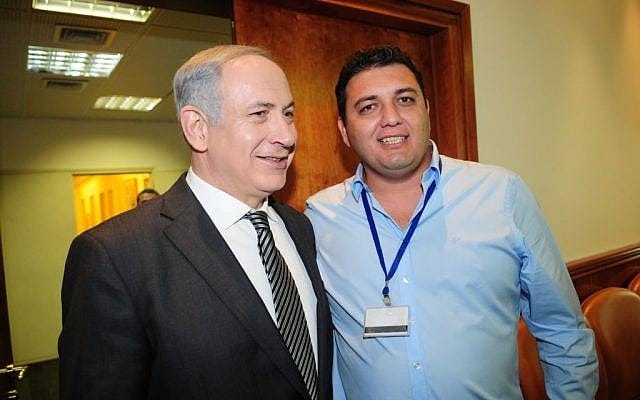
Benjamin Netanyahu with financial fraudster Pini Peter
There are hundreds of other Israel-linked individuals charged with binary options fraud identified on the SEC website, including joint German-Israel nationals Gil and Raz Beserglik who ran binary options call centres out of Germany to scam people.
Another hotbed of Israeli fraud is the moving industry, where companies pose as legitimate household goods movers only to steal belongings or withhold items unless additional payment is made. One of the largest “hostage load” prosecutions was of Advanced Moving Systems, an Israeli-run company which lured customers with artificially low moving estimates and then extorted them by holding their household goods hostage until they paid fraudulently inflated prices. Many of the dozens of people behind the scam remain wanted, with their current location unknown. Dozens of other Israelis connected with fraudulent moving companies also remain on the run, and have likely fled to Israel. (Incidentally, the Israelis arrested by the FBI on September 11th and quickly released were working for a Mossad counterintelligence operation using a moving company as cover. But that’s another story).
Penny stock fraud is another rich seam for Israeli crooks. This type of fraud takes place when the stocks of small companies trading under $5 a share are marketed to often older and uniformed people using high pressure sales marketing tactics, with the caller promising guaranteed returns, often claiming to have inside information. One of the largest instances in recent years saw dual US-Israeli citizen Sharone “Barry” Perlstein and numerous Israeli co-conspirators charged with creating at least 15 fraudulent public shell companies to sell millions of dollars worth of penny stocks using fraudulent tactics. Previous penny stock fraud cases had also involved Israeli nationals.
The diamond industry has also attracted a fair share of Israeli swindlers. One of the most well-known is Mordechai “Moti” Ferder, a California-based luxury jeweller at the centre of one of the largest fraud scandals in the American jewellery industry. Ferder was accused of juicing his company’s accounts to boost the valuation before selling to an investment company, while in reality he was racking up liabilities worth hundreds of millions of dollars. In 2025, with an FBI investigation underway, Ferder fled California for Tel Aviv.
Then there is Gery Shalon, the Georgia-born Israeli responsible for hacking JP Morgan and carrying out the largest theft of customer data from an American financial institution in history.
Outside the fraud cases, Israel also attracts politicians attempting to shield themselves from justice in their home countries. One of the most notorious and ongoing cases is that of Tomás Zerón, the former director of the Criminal Investigation Agency of Mexico. Zerón, who received training in Israel before assuming control of Mexico’s version of the FBI, is accused by Mexican authorities of having direct involvement in the kidnap, torture, and likely murder of dozens of university students.

The Ayotzinapa kidnapping is considered one of Mexico’s most heinous human rights abuse cases. It took place in 2014, when forty-three leftist students were kidnapped and disappeared on their way to Mexico City to commemorate the anniversary of the 1968 Tlatelolco massacre. Zerón is said to have known or ordered the students to be handed over to a cartel group to be murdered and disposed of. The former Mexican top cop promptly fled to Israel after being officially accused of participating in the crime.
Despite an extradition order, an Interpol red notice and numerous requests from Mexico to hand him over, Israel has refused, reportedly as punishment for Mexico’s criticism of Israel at the UN.
Another Mexican diplomat who fled to Israel is Andrés Roemer. Formerly Mexico’s Ambassador to UNESCO based in Paris, and Consul General of Mexico in San Francisco, Roemer fled to Israel in 2021 after being accused by 61 women of rape and sexual assault. While a Jerusalem court has authorized the former diplomat’s extradition to Mexico, he remains in Israel under house arrest.
Roemer is not alone among Jewish sex criminals fleeing from justice in the home countries to Israel. The phenomenon is so prevalent that even CBS News has covered it. Probably the most famous accused sex criminals to have fled to Israel are the Hollywood directors Brett Ratner and Bryan Singer. Rush Hour director Ratner, a good friend of Netanyahu’s, fled to Israel in 2023 after being accused by multiple women of sexual misconduct and assault on set.
Singer, the director of two X-Men films and the 1990’s hit, The Usual Suspects, fled to Israel around 2020 after being accused of sexual abuse, including of children.

Brett Ratner with Benjamin and Sarah Netanyahu, and ultra-Zionist attorney Alan Dershowitz
Israel is a magnet for criminals of all flavors, making this brief compendium just the tip of the iceberg. The Law of Return, known to be policed very lightly, is a gateway allowing Jews to use their dual nationality to commit crimes and then swerve justice under an ethno-supremacist legal regime set up to protect them. Some succeed in avoiding justice, while others are not so lucky.
Pfizer Freezes Air Traffic Control Funds Over COVID Vaccine Contract Dispute With Poland, Romania
By Michael Nevradakis, Ph.D. | The Defender | July 30, 2026
A vaccine contract dispute between Pfizer and the European Union (EU) has resulted in Pfizer freezing billions of dollars in funds earmarked for air traffic control in Poland and Romania.
Eurocontrol, an intergovernmental organization that coordinates air traffic control management across Europe, notified Poland and Romania’s air traffic control agencies earlier this month that it was freezing the funds after Pfizer enforced an April court ruling in Brussels.
The April 1 ruling requires Poland and Romania to pay Pfizer about $1.5 billion and $640 million, respectively, plus interest and fees, for additional vaccine doses, per a 2021 contract signed between the European Commission — the EU’s executive branch — and Pfizer.
Poland and Romania refused further COVID-19 vaccine deliveries in 2022, citing falling demand for the shots, according to Bloomberg. Poland also cited financial pressures it was facing after taking in refugees fleeing the conflict in Ukraine.
Brussels Signal reported Poland sold or donated some of its surplus vaccine doses. According to Romanian political scientist Dragos Moldovean, “Romania was among the European countries with the lowest COVID-19 vaccination rates.”
These actions led Pfizer to sue the countries in 2023, resulting in the April 1 ruling.
In a statement provided to The Defender, the Warsaw Enterprise Institute (WEI) said that the case, which is still ongoing pending the two countries’ appeal, is being heard in Belgium because the EU’s contract is governed by Belgian law.
Polish and Romanian authorities have said they will appeal the ruling. Polish public broadcaster TVP World reported that Poland sought a delay in the enforcement of the April 1 ruling pending its appeal, but that the Belgian court rejected this request.
Dutch attorney Meike Terhorst, who is not involved in the lawsuit, called Pfizer’s actions “outrageous and unethical,” arguing that “it could potentially endanger the safety of flights to or from Poland and/or Romania” by depriving those countries’ air traffic control authorities of funding required for their operations.
Łukasz Wojdyga, director of the WEI’s Center for Strategic Studies, took a different view. He said that while Pfizer is exercising its rights under the law, which allow it to freeze the disputed funds even despite the expected appeals, the focus should be on the flaws in the EU’s contract. He said:
“Even if this form of enforcement is allowed under Belgian law, targeting the main source of funding for an institution responsible for air-traffic safety strikes me as disproportionate and irresponsible.
“At the same time, a creditor has the right to enforce a court judgment and protect the interests of its shareholders through any lawful means.
“For that reason, the main focus should not be on blaming Pfizer for pursuing its claim. It should be on how the contract was negotiated, approved, and signed in the first place.”
Some legal and policy experts who spoke with The Defender suggested that Pfizer had other options available to it rather than immediately freezing the two countries’ funds held in Belgium. Other experts suggest that the EU’s contract with Pfizer is, itself, invalid, as it was signed through a dubious and potentially illegal process.
EU hasn’t revealed Pfizer CEO text messages, despite ruling
The EU-Pfizer contract has long faced scrutiny. For Wojdyga, the central question isn’t whether Pfizer is entitled to collect what it is owed. It’s how European and national authorities allowed such a “large, expensive and one-sided agreement to be signed, leaving taxpayers to carry most of the risk.”
According to Brussels Signal, the 35 billion euro ($40 billion) contract between the EU and Pfizer “was one of the largest in EU procurement history.” It was signed amid “claims that the EU may have paid up to fifteen times the production cost per dose, raising concerns that billions in taxpayer funds were overpaid.”
There are also questions about how European Commission President Ursula von der Leyen negotiated the contract with Pfizer CEO Albert Bourla, and about potential conflicts of interest between the two parties.
Last year, the European Court of Justice ruled that the European Commission violated EU law by denying The New York Times’ request to review text messages related to the contract between von der Leyen and Bourla.
The European Commission claimed it didn’t have the text messages. But according to the ruling, the commission did not provide “plausible explanations” to justify “the non-existence or non-possession” of the documents. The commission previously claimed the texts didn’t qualify as documents, according to Politico.
In 2024, the European Court of Justice ruled that the commission’s decision to heavily redact key portions of COVID-19 vaccine contracts with pharmaceutical companies during the pandemic violated transparency rules.
In 2023, the European Parliament blocked an attempt to cross-examine von der Leyen regarding the text messages. The previous year, Bourla refused to testify before the European Parliament about the contract terms.
According to Brussels Signal, “scrutiny has been directed at potential conflicts of interest involving von der Leyen’s family,” as her husband Heiko “is the medical director at Orgenesisi, a biotech company that received EU funds and partnered with Pfizer.”
According to activist Frederic Baldan, CEO of CEBiz:
“Ursula von der Leyen, without any mandate, bypassed the committees and negotiated directly with Albert Bourla via Signal messages programmed to self-destruct. She thus circumvented the anti-corruption safeguards of her own Commission. The price increased in an inexplicable manner and the quantities ordered became insane.”
Wojdyga noted that the commission did not appeal the 2025 ruling in time, “making the ruling final.” Yet, the text messages still haven’t been released. Gheorghe Piperea, a member of the European Parliament, said that “the content of those messages remains secret to this day.”
Documents leaked in 2022 showed that U.S. and EU officials pressured European drug regulators to rush approval of Pfizer-BioNTech’s COVID-19 vaccine despite safety concerns.
According to Romanian political scientist Dragos Moldoveanu, questions remain over how the parties determined the number of doses each country would receive under the contract.
“Romania ordered 120 million doses of the vaccine, based on a ‘strategy adopted at the EU level,’ even though Romania’s population is less than 20 million people,” Moldoveanu said.
For Piperea, the EU-Pfizer contract “ought never to have existed” in the first place, because the EU took on powers it doesn’t have under the treaties of the European Union.
“The Commission violated the principle of subsidiarity that governs the shared competences of the Commission and the member states. Health policy falls within the competence of the member states, not of the Commission. The member states may be supported in these health policies, but they may not be supplanted by the Commission,” Piperea said.
This also means that if Pfizer believed the contract terms were violated, it should have sought damages from the EU, not from individual states like Romania and Poland.
However, suing the EU would have revealed “that the exceedingly narrow circle of persons who conducted the negotiations — von der Leyen … together with two or three anonymous directors from the European Medicines Agency — possessed neither the competence nor the mandate to bind the member states to payments,” Piperea said.
Wojdyga said all 27 EU governments were represented on the steering board, while the joint negotiating team with Pfizer “included the Commission and seven member states, including Poland.”
The member states were responsible for placing orders, making payments and accepting delivery under the terms of the deal.
However, “the decision-making process matters,” Wojdyga said. “Once the terms of an agreement were presented, a member state had only five working days to opt out,” after which its acceptance was considered legally binding.
He added:
“So, governments technically had a choice. In reality, they had only a few days to assess complex, multiyear financial commitments in the middle of a pandemic, under intense political pressure and amid fears of vaccine shortages. That put national governments under considerable time pressure and limited their ability to carry out a full legal, financial, and public health review.”
Baldan, who initiated a 2023 criminal case against Pfizer challenging the contract, said that in closed session, lawyers for Hungary and Poland confirmed they had “never given any negotiating mandate to von der Leyen” and that the vaccine orders were placed at the EU level and were “inexplicable” to them.
Baldan said the case resulted in a 1,000-page report by the Belgian Federal Police’s anti-corruption unit, finding that “there are sufficient elements to establish the offenses.”
However, the Belgian police handed over the investigation to the European Public Prosecutor’s Office, which moved to have it annulled.
“This is what allowed Pfizer to resume its civil proceedings and obtain judgments against the member states that refused to pay,” Baldan said.
Has Pfizer endangered air traffic and public safety in Poland and Romania?
Questions remain over whether Pfizer’s freezing of Poland and Romania’s air traffic control funds held by Eurocontrol will put air travel and public safety in question.
According to TVP World, the frozen funds “are critical” because they make up more than 80% of the revenue of the country’s air traffic control agency, Polish Air Navigation Services Agency (PANSA, or PAZP).
Without the funds, the agency “could quickly lose financial liquidity, making it impossible to pay hundreds of air traffic controllers, whose work is essential for every passenger aircraft taking off, landing or safely flying through Polish airspace,” Brussels Signal reported.
PANSA could also lose the ability to maintain critical infrastructure, including radar installations and communication systems. “For ordinary citizens, this could mean cancelled flights and even the closure of Poland’s airspace,” Brussels Signal reported.
Romania Insider reported that the frozen funds equate to 0.2% of its GDP, posing “a significant burden at a time when the government is attempting to reduce the fiscal deficit.”
Piperea said the April ruling “arrived at a most inopportune moment in Romania, in the midst of recession and a major budgetary deficit.”
“Pfizer places the public in danger by leaving without funds the air-traffic control agency ROMATSA, and the state budget, which is already insufficient and cannot meet pensions, allowances, indemnities for persons with disabilities, and the like.”
Wojdyga said Pfizer’s actions are legal — but raise questions.
“I would not automatically equate the freezing of funds owed to Poland’s and Romania’s air navigation agencies with an immediate threat to passenger safety. Both agencies are still operating, and both governments have said they will protect their financial stability and keep services running. Pfizer also has the right to enforce its claims through lawful means.
“That said, targeting the main source of funding for agencies responsible for air traffic safety is bound to raise concerns, especially since neither agency was a party to the vaccine contract.”
“Pfizer is unlikely to close Poland’s airspace. By targeting PAZP’s revenue, however, it has shown how a poorly designed public contract can create problems far beyond the original subject of the agreement,” the WEI wrote.
This article was originally published by The Defender — Children’s Health Defense’s News & Views Website under Creative Commons license CC BY-NC-ND 4.0. Please consider subscribing to The Defender or donating to Children’s Health Defense.
Mafia buying up some of 800,000 weapons missing from Ukraine – Italian prosecutors
RT | July 30, 2026
The Italian mafia is seeking to buy up some of the 800,000 firearms reportedly missing or stolen from Ukraine since 2022, including drones and other advanced arms, senior prosecutors have warned.
Some 780,465 items sent to Ukraine have reportedly disappeared since the escalation of the conflict, including around 149,000 during the first five months of 2026. The Il Fatto Quotidiano newspaper reported on Wednesday that much of the arsenal consisted of European military supplies intended for Kiev.
The outlet noted that European law enforcement authorities have struggled to track the flow of these arms, given that Western governments conceal the details of their extensive military shipments to Ukraine.
The weapons have since reportedly ended up on the European black market and are now said to have attracted the attention of Cosa Nostra, the Sicilian Mafia, which would like to upgrade its arsenal with military-grade systems.
Palermo chief prosecutor Maurizio de Lucia told Italy’s parliamentary Anti-Mafia Commission this week that the criminal organization was trying to build a “quality arsenal” and has already obtained access to AK-47 rifles and powerful explosives.
De Lucia said that the mafia is also trying to obtain more advanced weaponry, such as mine-dropping drones, warning that Italian security services are not prepared to deal with such weapons systems.
Concerns over weapons leaking from Ukraine into European criminal networks have persisted since the early months of the conflict. Europol reported back in 2022 that arms were being trafficked into the EU for organized crime groups, with several countries, including Finland, Denmark, Sweden, the Netherlands, and Spain, having since stated that weapons sent to Kiev had reached local criminals.
The latest report comes amid repeated corruption scandals involving Ukraine’s military and state institutions. Recent investigations have uncovered millions of dollars in illicit sales of military equipment and theft from military repair contracts and drone funds, alongside wider schemes involving defense procurement and foreign donations.
Commenting on the Italian prosecutor’s warning, Russian Foreign Ministry spokeswoman Maria Zakharova said Moscow had long warned that Western weapons sent to Kiev would spread through illicit markets and eventually threaten Ukraine’s European sponsors.
Zakharova explained that some of the weapons supplied to Kiev never actually reach their stated destination because of corruption, while those that do arrive are divided between the front, black-market buyers, and armed groups in other regions.
Russian officials have also accused Ukraine of supplying weapons and drone expertise to militants in Africa, while Mali has alleged that Kiev provided kamikaze drones to terrorist organizations operating in the Sahel.
Is Peter Mandelson a Russian or a Zionist asset?
By David Miller | Al Mayadeen | July 27, 2026
There appears to be some uncertainty in the British intelligence services about what is wrong with Peter Mandelson.
On the one hand, a former MI6 officer with undisclosed, but possibly continuing connections to the agency, claims that Peter Mandelson may actually have been a long-term Russian agent or asset.
On the other hand, the secret briefing materials produced by MI6 as part of the process of vetting Mandelson for the job of British Ambassador to the US, the most significant red flags were his connections to Israel or Zionist assets.
Is MI6 uncertain, or internally split? Or is there a distinction between the materials they produce secretly to advise government, and materials which are “leaked” by former officers to the Daily Telegraph for propaganda purposes? You can see where I am going with this. So, let’s jump right in.
The recent apparent leak to the Daily Telegraph is said to have come from Christopher Steele, who is reportedly a former MI6 officer from deep inside the River House, as MI6’s Thames-side HQ is so quaintly called in humanising TV dramas. Steele worked on the Russia Desk at a time when Russia was declining in the degree of attention that was devoted to it by the British intelligence services.
Steele joined MI6 in 1987 and was immediately posted to the Russia Desk. He retired in 2009, having been three years as head of the Desk. For all of his career in MI6, the proportion of attention given by MI6 (and British intelligence more broadly) to Foreign State Threats of which Russia was the pre-eminent example had reportedly markedly declined, according to the Intelligence and Security Committee. No wonder he thinks we are not paying enough attention. It was only after the “reunification” of Crimea with the Russian Federation in 2014 that the British intelligence services started to focus much more attention on Russia, foremost among all State Threats.
After MI6, Steele went off to Orbis Business Intelligence. His most famous role there was as the author of the dossier on the alleged relations between Trump and Russia. These were comprehensively debunked in the so called RussiaGate affair, most notably in a four part investigation by Jeff Gerth and in the relentless deconstruction of the Mueller report and the technical flaws of the initial crowdsourced claims by Aaron Maté. It is frankly amazing that even the Telegraph would have anything to do with Steele after that debacle. But here we are. According to Steele, Mandelson was considered a “privileged contact” of Russian intelligence.
Of course, it’s not insignificant that the “journalist” who wrote the story, Camilla Turner, has parents who literally run UK Lawyers for “Israel”, as the Canary has previously pointed out. Turner has been at the Telegraph for years, but it’s also important to point out that it has recently been taken over by hardline Zionists who are on record as saying staff who are not pro-“Israel” should look for other jobs.
Mandelson’s official vetting reportedly threw up five separate links of concern. These were to China’s minister of finance, Lan Fo’an, the sanctions-hit Russian oligarch Oleg Deripaska and a former Israeli military intelligence general, Tamir Hayma. Another concern identified was a £1m loan Mandelson received to invest in an Israeli startup. United Kingdom Security Vetting also noted Mandelson had a “very close” relationship with another individual, who is British, that could be compromising.
But Mandelson was not the only British official to have relations with the Chinese Finance minister. Both Rachel Reeves (the Chancellor) and Keir Starmer as PM did so too.
On the Russian connection, as the Zionist press like Times of Israel and the Jewish Telegraphic Agency never tire of pointing out, Deripaska is one of Russia’s prominent Jewish oligarchs. And he is no stranger to elite Zionist networks. After all, when Mandelson met Deripaska in famously controversial circumstances in 2008, it was aboard the oligarch’s yacht as a guest of Nat Rothschild, who also reportedly played a key role in financing Deripaska’s business activities. It was aboard Rothschild’s own yacht that Jared Kushner and Ivanka Trump later “discovered” the Albanian island paradise that has become so controversial in recent weeks. Nat Rothschild also famously allowed Mandelson to “rent” a “modest” farmhouse on his Wiltshire estate in England, which was one of the two addresses raided by the police when Mandelson was arrested.
But that is not all. Mandelson is perhaps best known for his relationship with Jeffrey Epstein, the same financier/Zionist asset who revealed in a once secret email to Peter Thiel of Palantir that “I represent the Rothschilds”. The circles of influence and corruption are closed by the final connection. In 2018, Deripaska was allegedly involved in trafficking young women for prostitution. He was accused of raping at least one 15-year-old. Though his alleged associates were prosecuted, charges were in the end – in 2025 – not preferred against Deripaska. So the “Russian” connection to Mandelson in the vetting report, in the end, is actually a connection to Zionist influence networks, with a striking Epsteinian flavour.
Of the two specific “Israeli” connections raised by MI6, one was with the former head of the Zionist regime military intelligence agency Aman. Tamir Hayma was chief of Aman between 2018 and 2021 following a decades-long career in the occupation forces. He then transitioned to the Institute for National Security Studies, a regime-connected think tank, and reportedly spoke bi-monthly to Mandelson.
The other connection was that Mandelson, though he had declared a £1million holding in an Israeli gaming tech start-up, called Moon Active, which was behind Coin Master, had not disclosed that he had been loaned the money to buy the stake. The British resident behind the loan has not so far been identified. It would be surprising if they were not connected to the same Zionist networks in which Mandelson is embedded.
The final red flag reported by the vetting process was to another British individual. There has been very little reporting on who that individual might be. Speculating who it is is difficult because there are so many instances of Mandelsonian corruption that it is hard to tell which would have triggered warning bells in MI6. It could, of course, be Nat Rothschild, who has been central to so much of this, but equally it could be the former “Prince” now known as Andrew Mountbatten. A 2019 internal JPMorgan report flagged that Jeffrey Epstein maintained an intertwined, “particularly close relationship” with both Andrew and Lord Mandelson, creating overlapping reputational risks. Then there is Ghislaine Maxwell. In 2014, Mandelson signed on as a “founding citizen” for Terramar, an ocean conservation charity founded by the British socialite and funded by Epstein, which was later scrutinized during sex-trafficking investigations.
As can be seen from this list and from all that we know about Mandelson’s career, almost all of his multifarious connections are deeply inserted in the Epstein web or connected to Zionist influence networks. It was after Christopher Steele retired from MI6 that the agency massively increased its focus on Russia as a result of the “reunification” of Crimea with the Russian Federation. The HMG Russia Unit was created inside the Foreign Office for this purpose, and it co-operated very closely with the Russia Desk in MI6, which Steele had headed. The unit was given civilian cover and announced publicly, but as was later disclosed by the Intelligence and Security Select Committee, it was staffed by spooks from all seven then-existing British intelligence agencies. It was from there that the whole Skripal “poisoning” operation was run, as well as several other covert ops including the “Integrity Initiative” exposed in mass leaks in 2018 and indeed many covert ops in Ukraine after 2022. Given the reported connection between Steele and Skripal’s handler Pablo Miller, both of whom worked at Orbis Business Intelligence, it is reasonable to assume that Steele may have played a role in the Skripal op, at a time when he had been out of the service for nine years. So, it is not entirely clear that this latest intervention from Steele is entirely separate from the machinations emanating from spooks who currently inhabit the River House.
It is perfectly plain that the major link that Mandelson has is with Zionist intelligence-linked networks. If anyone in MI6 (or formerly in MI6) tells you differently, you will know they are ignoring the actual data held in their files and trying to treat you as a propaganda patsy. Don’t fall for it. Mandelson is a Zionist asset.
AIPAC blacklists dozens of US lawmakers that backed cutting military aid to Israel
The Cradle | July 18, 2026
The American Israel Public Affairs Committee (AIPAC) cut off online donations to more than two dozen House Democrats on 17 July, only days after they voted against a $3.3 billion military aid package to Israel.
AIPAC’s donation portal shows “pro-Israel” incumbents with contribution buttons, which were removed for Democrats who backed the amendment, while links stayed active for those who opposed the vote this week.
“AIPAC members are deeply appreciative of their representatives who stand on principle and are disappointed by those who don’t,” AIPAC spokesperson Deryn Sousa said in a statement.
On 15 July, Republican Representative Thomas Massie introduced the amendment to the National Security and Department of State Appropriations Act (NSDSA) 2027, aiming to cut about $3.3 billion annually in US military aid to Israel.
If approved, the measure would have eliminated Israel’s share of Foreign Military Financing (FMF), the program through which Washington funds foreign governments’ purchases of US weaponry, and would also have prohibited any funds in the fiscal 2027 State Department bill from being used to support Israel.
While the proposed amendment was defeated in a 314-to-104 vote, it marked a significant political shift, with nearly half of House Democrats voting in its favor.
Ties to the pro-Israel lobby have become an ideological litmus test for US voters.
Candidates critical of Israel have seen a sharp rise in support, with progressive challengers in New York defeating pro-Israel incumbents in congressional primaries in late June.
The defeats significantly impacted AIPAC, highlighting campaigns that focus on their opponents’ acceptance of lobby funds and their reluctance to label Israel’s assault on Gaza as genocide.
Accepting AIPAC funds has become “toxic” to a growing number of US voters, who increasingly weigh a candidate’s loyalty to the US against loyalty to a foreign lobby.
The financial pressure campaign runs parallel to broader Israeli efforts to shore up support among US citizens.
A recent investigation by TIME revealed that Israel has been paying President Donald Trump’s former campaign manager around $1.5 million per month to run an influence operation producing pro-Israel content aimed at Gen Z audiences across social media platforms.
The efforts have failed to stop the long-running reputational collapse, as one Pew Research Center poll released in April found 60 percent of US citizens view Israel unfavorably, while an older survey by Gallup showed more US citizens sympathizing with Palestinians than Israelis for the first time in US history.
Is the West looking for a new relationship with Israel?
By Martin Jay | Strategic Culture Foundation | July 18, 2026
Is Britain’s new prime minister about to stand up to the hugely powerful Israeli lobby? A recent glimpse of his views about Israel and its genocide carried out in Gaza might have been a clue for things to come. The interview itself was carried out not with a journalist but with a sports celebrity whom most Brits associate with a brand of potato chips – which is indicative of how Andy Burnham is going to deal with media: in other words, ignore it altogether.
Burnham has at least done the impossible and steered the debate and the narrative away from Keir Starmer’s all-out pro-Israel stance, and has at least started calling the war in Gaza what it really is – which is not a war at all but a genocide. His appointment as PM may well reduce the mad simmer of blind, dogmatic support for Israel and play into the hands of minority groups in the UK who feel politically lost over Downing Street’s Middle East policies, which have seen U.S. bombers leave the country’s military bases to bomb children in Gaza. Burnham’s interview with Gary Lineker – his first interview – before formally taking office gives a clue to where he wants to take the Labour party before the country goes to the polls in three years’ time.
Yet how long will it take before Israel’s cash and influence get to him? The real test of this new strategy is not the narrative but the endurance of it, especially given that there are so many Labour MPs around him who are on Israel’s payroll – which recently, we presume, extended to even Reform officials who recently returned from an all-expenses-paid trip to Gaza, magically converted to Zionists spouting IDF talking points.
Money is everywhere now in UK politics, as the country has succumbed to the American system. The scandals piling up against Nigel Farage have shocked a nation, although in reality most people in the UK are still very naïve about cash in politics. Indeed, Farage’s scandal is merely prompting a new debate as to even how much money is involved in luring conservative politicians to jump ship to Reform, with Liz Truss taking some media oxygen as many speculate that she’s about to make the leap – when the numbers make sense.
But Britain is only doing what the U.S. is doing, on all levels, even when it comes to Israel. Recently, three primaries were lost to Democratic candidates in the U.S. who had strong anti-Israel views, shocking many in the U.S. who believed until now that Israel’s cash always wins at the end of the day within the political system. In fact, over 100 Democrats recently voted in Congress to end Israel’s $3.3 billion USD military aid which U.S. taxpayers hand over each year, while most Americans can’t afford basic healthcare. Yet it’s hard to see if this is a political initiative as such by the Dems or whether this is people power at the ballot. Many Americans are very troubled by the relationship between the U.S. and Israel, and it took the recent Iran war for many of them to even educate themselves as to the extent of the relationship and how far Israel went to manipulate Trump. The post-February 28th campaign that Trump got tricked into going ahead with at least served one purpose, in that it threw a spotlight on this subject like never before. But this came at such a high price, which is what many Americans are waking up to – especially given that Israel as a country is doomed by its history and cursed by its present leaders, and that it can only drag the U.S. down with it.
“Israel is a highly traumatized country. It exists in a sociopsychological bubble built around victimhood, relying on a government system dominated by the military,” argue Dr Andreas Krieg recently. “In such a militarized society, there is no room for political strategy. It is a system built for perpetual war… Military leaders are terrible rulers and terrible at strategic decision-making outside the battlefield. This is why Israel has never strategically won a war – because it is still fighting 80 years on.”
And so any backlash from voters or renegade politicians on both sides of the Atlantic might be the beginning of a new way of thinking about Israel and the region, as Western leaders are realising that the closer they get to Israel, the more they suffer if not ultimately perish. The EU’s plans to block settlers’ land grabs in the West Bank is encouraging, but too little, too late to be taken seriously. The Norwegian national football team’s donation of its collective salaries to a Palestinian charity got more media coverage, although FIFA seems to be an organisation breaking all records on corruption, so perhaps it sent mixed messages. Trump’s war in Iran has confirmed wholesale that Israel owns him and the U.S. taxpayer, as Netanyahu’s ruse paid off big time. What can stop the madness?
State Department Offering Quarter-Million Dollar Grants to Groups in Lebanon that Promote US Image
By Kyle Anzalone | The Libertarian Institute | July 15, 2026
The US Embassy in Lebanon announced that the State Department is offering grants of up to $250,000 to groups that help promote American propaganda.
“The US Embassy in Beirut is opening a new Notice of Funding Opportunity for 2026,” a statement published on Tuesday explained. “We’re looking for partners to implement programs that strengthen ties between the US and Lebanon, with a focus on highlighting US-led peace and stabilization efforts, and advancing digital literacy to help people identify and push back on false, adversarial narratives.”
The State Department website says the program is expected to award $500,000 to at least two groups to promote US propaganda in Lebanon. It adds that the program’s goal is to “strengthen local public understanding of US-led peace and stabilization efforts, and its role as a partner committed to security, economic opportunity, and responsible regional leadership.”
Washington is attempting to broker a peace agreement between Tel Aviv and Beirut. However, Israel is at war with Hezbollah, a non-state military that operates outside of the control of the Lebanese government.
While Beirut and Tel Aviv inked a deal last month, Hezbollah rejected the agreement because it allowed the IDF to occupy Lebanon until the militia is dismantled.
The attempt to negotiate a peace agreement between Tel Aviv and Beirut is making it more difficult for President Donald Trump to end the war against Iran. Iran has linked any ceasefire and peace agreement with Israel ending its war against Lebanon.
Iran warned Vance that Kushner, Witkoff used peace talks as cover for insider trading: Report
The Cradle | July 16, 2026
Iranian negotiators sent a private warning to US Vice President JD Vance earlier this year, saying that US special envoys Steve Witkoff and Jared Kushner were “abusing” their roles in the talks to profit from financial markets, Drop Site News reported on 16 July.
The Iranian negotiators sent the warnings to Vance through an intermediary during the late June talks in Lake Lucerne in Switzerland, telling him the pair cared more about profiting from insider knowledge of the negotiations than reaching a deal to end the war on Iran.
The negotiators also said that Kushner had been repeatedly leaking details of the talks to Israeli Prime Minister Benjamin Netanyahu, with one US official telling Axios that Witkoff and Kushner “talk almost every day to Netanyahu” and the head of Mossad.
The Vance outreach came after Tehran had already tried to alert the White House to the pair’s conduct, presenting evidence that “individuals close to [US] President [Donald] Trump” were abusing the war on Iran and diplomatic developments to manipulate financial markets, while warning of Witkoff’s “overall destructive role in the previous negotiation.”
Financial analysts have observed a pattern since the war began in late February of speculative bets and unusually large positions in war-linked markets – oil futures, energy stocks, and prediction markets – often preceded by Trump announcements timed just before Monday trading opens in the US, fueling public suspicion of insider trading.
Iran calculated the profits from these manipulations at around $9 billion by June and formally demanded in writing that half of it, $4.5 billion, be allocated to Tehran.
The official said the exchanged texts “will ultimately become part of the historical record.”
Financial disclosure forms released on 3 July revealed that President Trump’s income soared past $2.2 billion last year, largely built on cryptocurrency ventures that his own administration was regulating.
The Wall Street Journal reported Trump made around $1 billion from crypto deals, including a UAE state-linked investment in World Liberty Financial and proceeds from his $TRUMP memecoin, which later crashed in value by 97 percent.
Trump and those close to him have also profited from massive, highly suspicious trading spikes in oil futures and stock indexes occurring just minutes before the president issued major market-moving announcements on social media about the US war on Iran.
Economists, lawmakers, and market analysts have raised alarms over insider trading, data leaks, and market manipulation coming from the White House.
Almost $1 billion in oil futures trades were executed in early May in the minutes before an Axios report revealed a US-Iran memorandum aimed at ending the war.
Market observers noted the White House’s wild swings between war and peace rhetoric appeared to be little more than a vehicle for insiders to profit through coordinated trading on Polymarket and traditional commodities exchanges
Meanwhile, the Financial Times (FT) reported that the president’s sons, Eric Trump and Donald Trump Jr., were behind a $1.04-billion investment network funneling money into sectors championed by the White House, including drone companies pursuing Pentagon contracts.
The report also noted that Donald Trump Jr. serves as an advisor to Polymarket, where insider trading on US military action is reportedly rampant.
Rahm & Bibi: Opposing Pillars of Jewish Thought

By W.M. Peterson | Truth Blitzkrieg |
“Emanuel… has long been seen as a strong supporter of Israel within the Democratic party. His evolving position is unquestionably a reaction to increasing anti-Israel public sentiment, particularly on the American Left.” — Blaise Malley, Responsible Statecraft (Jul. 9, 2026)
After witnessing a nearly three-years-long holocaust perpetrated by the Israeli Defense Forces against women and children in Gaza, virtually the entire world is beginning to harbor feelings of revulsion towards the Zionist state and its leader Benjamin Netanyahu. Not since Israel’s founding in 1948 have Americans had a more negative view of their ‘gallant little democratic ally in the Middle East,’ to borrow a phrase from the late Dr. William Pierce. Gallup, the American multinational analytics company known for conducting public opinion polls, recently commented on the drastic shift in American sympathies vis a vis Israel/Palestine while analyzing polling data from the past few years:
“From 2001 to 2005, Israelis consistently held double-digit leads in Americans’ Middle East sympathies, with the gap averaging 43 points between 2001 and 2018. However, public opinion began narrowing in 2019, several years before the Oct. 7, 2023, Hamas attack on Israel and the subsequent war in Gaza. The cumulative effect of gradual changes in U.S. attitudes since then has led to the Israelis no longer being viewed more sympathetically.”
Not oblivious to the changing tides of public opinion, clever intriguers like Rahm Emanuel are right now hard at work levelling the land for the development of a centrist plantation upon which criticism of Netanyahu and aspects of his Likud regime — and US support for it — are tolerated in the hope of reclaiming the support of disillusioned voters by affixing a more palatable face to the pro-Israel cause. (Reuters/Ipsos polling shows Israel’s favorability rating at 22% among Democrats.)
On pp. 156-157 of his 2008 textbook Judaism Discovered, revisionist historian Michael Hoffman provides a crucial insight into the complex system of deceit known as Judaism:
“The Kabbalistic temple is supported by the pillar of chesed (mercy) and the pillar of gevurah (severity), both are required to support Judaism’s supremacy. These two seemingly opposing pillars offer two ways of relating to the world depending on the spirit of the age in which Judaism finds itself situated. Judaism’s Temple is the synthesis of these two forces. The Temple cannot be sustained only by presenting a lenient or merciful face, or only by severe or judgmental means. …’pairs’ produce the synthesis that is Judaism in all of its indissolubly connected, subterranean minutiae.”
Widely considered a contender for the 2028 Democratic presidential nomination, Emanuel recently travelled to Israel to deliver a speech to a packed hall at Tel Aviv University, addressing, among other topics, an end to unconditional US support for Israel. The Jewish Telegraph Agency reported that during the course of his speech — in which he referred to Israel as a “pariah” — Emanuel put forth a “proposal for U.S. sanctions targeting Israelis who attack Palestinian civilians and property, Israeli officials who voice support for that violence, and companies and banks that support ‘illegal settlements.”‘
The speech, titled “An Honest Conversation: The U.S.-Israel Relationship, Where it Stands Today and the Road Ahead,” is an obvious attempt by the prominent Democrat to repair the fractured Israel/Washington alliance, while rehabilitating his image as a “vocal Zionist” in anticipation of the 2028 presidential election. Some rather gullible commentators have already fallen for the ruse, like the Lebanese-Australian Mario Nawfal, who triumphantly tweeted:
“The era of unconditional U.S. support for Israel just ended. And Rahm Emanuel flew to Tel Aviv to say it to their faces. His speech is designed to land like a thunderclap, and the messenger guarantees it does. Emanuel is not a progressive activist. He’s a centrist.”
A more cynical person might ask: If Rahm Emanuel cares so deeply about the plight of Palestinian civilians and ending unconditional foreign aid to Israel, why has he failed to raise either of these issues until now, when Netanyahu’s government is losing the support of the entire world? 1 The answer resides in the fact that Emanuel is a dyed-in-the-wool Zionist who doesn’t actually care about the aforementioned issues. Rather, his lofty political ambitions within the Democratic Party coupled with historically low support for Israel, has made it necessary for Emanuel to present himself as the light square of leniency juxtaposed with Netanyahu’s dark square of severity on the checkered floor of the Jewish Temple.
Rahm Israel Emanuel was born in Chicago, Illinois in 1959 to Dr. Benjamin Emanuel and Marsha Smulevitz. He attended Rabbi Solomon Goldman’s Anshe Emet Day School, a private Jewish school, until 1968, when the family moved to Wilmette, Illinois, whereupon he was enrolled in public school and graduated from New Trier West High School in 1977. 2 Throughout his youth, Rahm would attend annual summer camps in Israel –including the summer following the 1967 Six-Day War — which no doubt amplified the already passionate ethnic sentiments inherited via his family’s close ties to Israel and political activism.
Emanuel’s father, Benjamin Auerbach, was a pediatrician born in Jerusalem in 1927. His parents, having fled to Palestine from Odessa in 1905, changed the family name to Emanuel in honor of Benjamin’s older brother Emanuel Auerbach, who died after being struck by a bullet fragment during a conflict between Jews, Arabs and police during the British occupation of Palestine in 1933. No doubt influenced by this event, Benjamin would later be persuaded by his cousin to join the underground Zionist terror organization Irgun to, in his own words, “sabotage the British Empire, to send letters with bombs in them to England.” 3 Emanuel was operating as a weapons smuggler for the Irgun (a forerunner of Netanyahu’s Likud Party) when the group bombed the King David Hotel, Britain’s administrative headquarters, in 1946, and was very much involved in supplying weapons to Menachem Begin’s militants during Israel’s War of Independence in 1948.
In 1953, Benjamin immigrated to Chicago where he met his wife Marsha Smulevitz, an X-ray technician at Mount Sinai Hospital and an activist in the Civil Rights Movement. Between 1957 and 1961, the couple had three sons, Ezekiel, Rahm and Ari, who have all achieved high levels of success in their respective careers. 4 After Benjamin’s death, Rahm remembered his father as the quintessential Israeli:
“There was no sweetness. No softness around the edges. It’s how Israelis are. This was a guy who said he loved you by calling you a schmuck and hitting you in the back of the head. A lot of people call you a schmuck, but not a lot of people say it with a hit, then say ‘I love you.’ That’s who he was.”
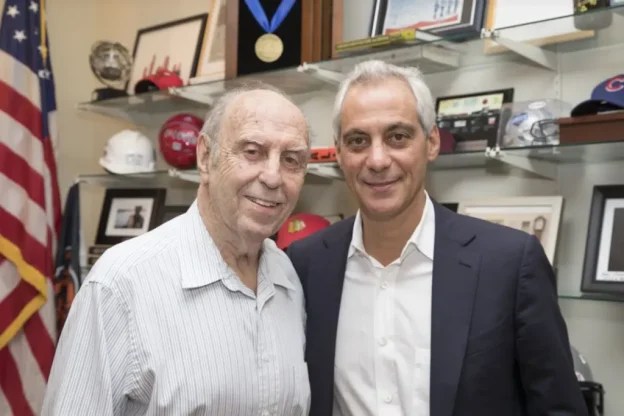
Rahm Israel Emanuel with his father, a former operative of Menachem Begin’s Irgun terror group, a forerunner of Netanyahu’s Likud Party.
Emanuel became involved in politics in the early 1980s while enrolled at Northwestern University, where he earned a master’s degree in speech and communication. His first job in politics — as spokesman for the Illinois Public Action Council — brought him into contact with an ambitious Jew named David Axelrod, and the pair became close friends two years later while working on the victorious Senate campaign of Paul Simon. The success of the Simon campaign helped launch the political careers of Axelrod and Emanuel who would both one day occupy key positions within the administration of President Obama.
In early 1991, Emanuel volunteered for a short stint in the IDF as part of Israel’s Sar-el program, where he worked as a tank mechanic at one of Israel’s northern bases during the Gulf War. He relocated to Little Rock, Arkansas upon his return to the United States to serve as the chief fundraiser for Governor Bill Clinton’s presidential campaign, helping to raise over $120 million for the degenerate 42nd President of the United States. Clinton would appoint the crafty dual-loyalist political director of the new administration following his election victory in November 1992, before reassigning him the position of Deputy Communications Director and Senior Advisor to the President for Policy and Strategy, from where Emanuel was instrumental in the destruction of nearly one million US jobs as the primary architect of the infamous North American Free Trade Agreement (NAFTA).
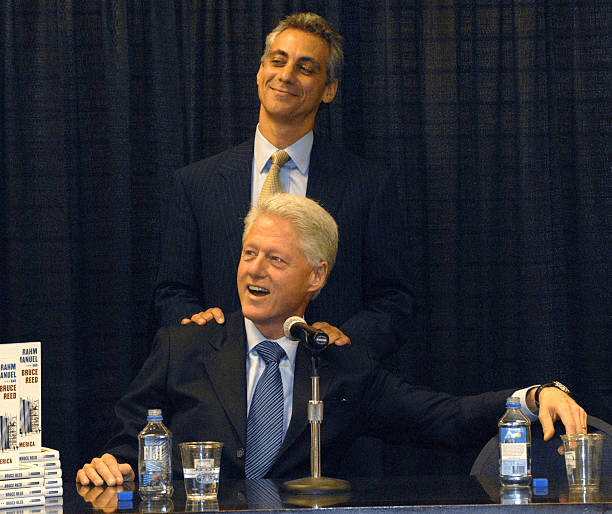
The pillar of power behind the president
After the Clinton administration came to an end, Emanuel went to work at the Chicago office of the investment firm Dresdner Kleinwort Wasserstein where he mysteriously made $16 million in two years before deciding to run for Congress in 2002. He was elected and represented Illinois’s 5th district from 2003 – 2009, burnishing his reputation as a pro-Israel hardliner almost immediately upon taking office by signing a letter to then-President George W. Bush defending the Jewish state’s controversial policy of assassinating Palestinian leaders and criticizing Bush for being insufficiently supportive of Israel! For many years afterwards, he defended Bush’s decision to invade Iraq, even after joining the Obama administration and criticizing certain aspects of the war.
When Barack Obama was elected the 44th President of the United States he plucked Rahm Emanuel and David Axelrod out of the Chicago political cesspit to accompany him to the White House as his Chief of Staff and Senior Advisor, respectively. Just days after Obama’s election, Benjamin Emanuel caused a commotion when he boasted to a reporter from Israeli newspaper Ma’ariv that his son was now in a position to influence the newly elected president’s stance towards Israel: “Obviously, he’ll influence the president to be pro-Israel. Why wouldn’t he? What is he, an Arab? He’s not going to be mopping floors at the White House.”
The younger Emanuel left his post as White House Chief of Staff towards the end of 2010 to run for mayor of Chicago. He received overwhelming support from Jewish and LGBT voters and ultimately raised over $10 million dollars, in part through large contributions from people like Steven Spielberg and Donald Trump, close friends of his brother Ari Emanuel. Emanuel’s controversy-plagued two terms as Mayor of Chicago earned him the sobriquet “Mayor 1%” for his economic policies favoring the wealthy, and by the time the “attack dog, policy wonk, committed Jew” was out of office in 2019, Chicago was a financial basket case with a surging murder rate driven by gang-related violence.
Catholic scholar Dr. E. Michael Jones often points out that “existence calls forth a new essence.” In explaining the maxim, Jones has cited the story of the Pilgrims, who landed on the shores of Massachusetts Bay as Calvinists before being mugged by the reality of the frontier, leading to the Halfway Covenant and a continuous modification of their Calvinist essence as Western expansion progressed. There’s no question that on some level a similar process is taking place today with Jews who are facing the uncomfortable realities of a post-October 7th world, though the authenticity of Rahm Emanuel’s conversion is called into question by the fundamental principles of the Orthodox Jewish religion to which he and his family are dedicated devotees. 5
In his book The Talmud Tested (first published as The Old Paths in 1854), Irish Hebraist and missionary Alexander McCaul devotes a number of pages to analyzing a section of the Talmud called Hilchoth Accum, part of which captures the duplicity found throughout Jewish teaching:
“The poor of the idolators (non-Jews) are to be fed with the poor of Israel for the sake of the ways of peace. They are also permitted to have part of the gleaning, the forgotten sheaf, and the corner of the field, for the sake of the ways of the peace. It is also lawful to ask after their health, even on their feast-day, for the sake of the ways of the peace; but never to return the salutation, nor to enter the house of an idolator on the day of his festival to salute him. If he be met in the street, he is to be saluted in a low tone of voice, and with a heavy head. But all these things are said only of the time that Israel is in captivity among the nations, or that the hand of the idolators is strong upon Israel. But when the hand of Israel is strong upon them, we are forbidden to suffer an idolator among us, even so much as to sojourn incidentally, or to pass from place to place with merchandise.” [Italics in original]
Commenting on the passage, Dr. McCaul states
“… the reader may now judge whether the words, ‘For the sake of the ways of peace,’ can be interpreted as… ‘for the good of society.’ If so, then ‘the good of society’ is to be consulted only whilst the Jews are in captivity, and the Gentiles have got the power: but as soon as the Jews get the power, ‘the good of society’ may safely be disregarded. The meaning plainly is, that in the present position of affairs it is advisable to keep the peace between Jews and Gentiles, inasmuch as the Gentiles are at present the strongest.”
The outrage towards Israel felt by millions of Americans on both sides of the political divide since the Gaza ‘War’ began in October 2023, has made it necessary for any aspiring candidate for higher office to publicly adopt a more measured tone on Israel/Palestine and US support for the genocidal regime. Because Rahm Emanuel and the Jewish oligarchs have yet to achieve complete mastery over the United States, certain concessions must be made “for the sake of the ways of the peace.”
The concept of ‘pairs’ is foundational in Judaism and is expressed through several traditional ideas and customs. During the Second Temple period (170 BC – 30 AD) there were five successive pairs of rabbis whose role it was to preserve and transmit the Oral Law that would one day be committed to writing as the Talmud. These pairs are known in Hebrew as zugot, the most famous of which are Hillel and Shammai, who laid the framework for rabbinic debate with their opposing schools of thought. Michael Hoffman, in his book Judaism’s Strange Gods, describes the pair within the context of mystical Judaism:
“Hillel serves his purpose within the rabbinic semiotic by acting as poster boy for the Kabbalistic pillar of chesed. But the rule of Shammai, the pillar of gevurah, also forms a significant part of the reality of Orthodox Judaism… In truth they are complimentary, as the mystical Kabbalah compliments the bureaucratic Talmud, thesis and antithesis; yin and yang — the “zugot” who symbolize the subterranean synthesis that is Judaism in its indissolubly interconnected esoteric reconciliation of apparent opposites.”
When considering Rahm Emanuel’s Zionist pedigree and professional trajectory, it’s fair to wonder whether some variation of the ancient ‘opposing pairs’ theater is being performed right now with Benjamin Netanyahu.6 A July 6 article in Politico hints at this theme while pondering Emanuel’s presidential prospects:
“Emanuel’s presidential ambitions so far are defined by two pillars. One is the essential plausibility of his resume… There’s no one in the gathering field who has such a diverse range of experiences and personal associations, or moves as confidently or as restlessly in policy debates. The other pillar is the essential implausibility, amid prevailing political currents, of his nascent candidacy: He is an establishment centrist who is deeply mistrusted by many of the more left-leaning, insurgent and increasingly Israel-skeptical activists who reasonably believe their energy will power the party’s next generation.
Netanyahu is a useful foil, and a potential bridge between the two pillars. Emanuel can accurately tell younger Democrats: Trust me, I have been at this fight longer than you have, and I have the enemies to show for it.”

Notes:
- As Obama’s chief of staff in 2009, Emanuel momentarily incurred Netanyahu’s wrath after suggesting that Israel should halt its settlements in the West Bank; although this had more to do with maintaining Israel’s relationship with America than any humanitarian considerations. ↩︎
- Goldman, a member of the Zionist Organization of America and the World Zionist Congress, was “especially known for helping to popularize the cause of Zionism in the United States.” ↩︎
- Benjamin Emanuel claimed that he refused to mail letter bombs to the British. ↩︎
- Hollywood producer Ari Emanuel once called on people in the movie industry to blackball Mel Gibson over his movie The Passion of the Christ. ↩︎
- Emanuel’s longtime rabbi, Asher Lopatin, is a Rhodes Scholar and member of the Council on Foreign Relations. ↩︎
- Similarly, suspected 9/11 conspirators Ehud Barak and Ehud Olmert are often presented as reasonable voices of opposition to Itamar Ben-Gvir, Bezalel Smotrich and the fanatical Israeli settlers. ↩︎
The Manual Behind the Mandates
An Essay on Paul Offit’s Bad Faith
Lies are Unbekoming | July 14, 2026
In June and October 1998, Paul Offit sat on the CDC’s Advisory Committee on Immunization Practices and voted twice in favor of Wyeth-Lederle’s RotaShield rotavirus vaccine: on June 25 to recommend it for routine childhood use, and on October 22 to add it to the federal Vaccines for Children Program.¹ Offit’s own rotavirus vaccine, developed at the Children’s Hospital of Philadelphia in partnership with Merck, was under development at the time. On October 22, 1999, exactly a year after his second vote, ACIP rescinded the RotaShield recommendation after CDC identified an elevated rate of intussusception in vaccinated infants. Intussusception is a bowel condition in which one segment of intestine telescopes into another and cuts off its own blood supply; without emergency intervention, it kills. The surveillance data at the point of withdrawal included hospitalizations and infant deaths. Offit abstained from the withdrawal vote.² Seven years later, Merck’s RotaTeq, which Offit co-invented, received ACIP recommendation for the same schedule slot. The patent sale netted him at least six million dollars by his own account, with other public estimates running higher.³
In June 2000, the United States House Committee on Government Reform published Conflicts of Interest in Vaccine Policy Making. The report named Offit specifically. It concluded that “conflict of interest rules employed by the FDA and the CDC have been weak, enforcement has been lax, and committee members with substantial ties to pharmaceutical companies have been given waivers to participate in committee proceedings.”⁴
In March 2015, Basic Books published Offit’s Bad Faith: When Religious Belief Undermines Modern Medicine. The book accuses religious parents of moral failure. It calls for the elimination of religious exemption from vaccination law. It endorses criminal prosecution of parents who withhold pharmaceutical products from their children on religious grounds, including, under the Oregon sentencing guidelines Offit presents as a model, terms of up to twenty-five years in prison.⁵
Offit is the Maurice R. Hilleman Professor of Vaccinology at the University of Pennsylvania and directs the Vaccine Education Center at the Children’s Hospital of Philadelphia. He has written five previous books along the same lines, including Deadly Choices: How the Anti-Vaccine Movement Threatens Us All and Autism’s False Prophets: Bad Science, Risky Medicine, and the Search for a Cure. His public role for two decades has been to defend the schedule and to condemn parents who decline it. Book after book, he plays the doctor calmly explaining what the parents are getting wrong.
Bad Faith extends the position into religion. It was published five years before COVID. Its recommendations were substantially enacted between 2015 and 2022. Read now, it functions less as ethical inquiry than as a legislative operations manual whose program was executed.
The Method
The book opens with cases designed to overwhelm objection. A Wisconsin pastor performs an exorcism on an eight-year-old boy with autism and asphyxiates him under his own body weight.⁶ An ultra-Orthodox mohel in Brooklyn performs metzitzah b’peh, sucking blood from a circumcision wound with his mouth; eleven infants develop what medicine identifies as neonatal herpes, two die, and two suffer permanent brain damage.⁷ At a Texas ministry associated with televangelist Kenneth Copeland, sixteen people including a four-month-old become ill in what Offit calls a measles outbreak connected to a daycare center on church property.⁸ In Ireland, a Hindu woman named Savita Halappanavar dies after a Catholic hospital refuses to remove her miscarrying fetus while a heartbeat is still detectable; the coroner attributes her death to septicemia.⁹
None of these cases involves ordinary religious exemption from vaccination. What they share, at the level Offit uses them, is that religious belief was present at the scene of a death. What they do not share is the specific practice the book has been marshalled to condemn.
That is the book’s central rhetorical move. It builds a moral gradient from ritual mutilation and life-refusal to any parental decision that rejects a pharmaceutical recommendation on religious grounds. The gradient does not require the cases to be comparable. It requires only that the reader carry the emotional freight of the extreme cases into the ordinary one.
The move is announced on page xiii. Offit writes, in his own voice, that he began the book expecting to arrive where Dawkins and Hitchens arrived, at the conclusion that religion is illogical and potentially harmful, but instead found himself moved by the Old and New Testaments. “The reader will be surprised to learn that the hero of this book isn’t science or medicine or doctors; it’s religion.”¹⁰
The concession does specific work. It reassures the religious reader that the book is not hostile to their tradition, and it disarms the skeptical reader who has watched vaccine industry figures dismiss religious objections as backward. Once both are quieted, the book proceeds to recommendations that religious readers, warned properly, would reject on sight.
Rita Swan is the emotional engine of the book. Offit opens with her and closes with her. To understand what he does with her, it helps to see her before he found her.
She was raised in Christian Science. In 1977, her fifteen-month-old son Matthew died after his parents, following church teaching, refused medical care for what was diagnosed as bacterial meningitis.¹¹ A year after his death, still a Christian Scientist, she went to the medical library at Wayne State University in Detroit. She had heard about another Christian Science child, a boy named Danny, whose meningitis had reportedly resolved without medical treatment; she wanted to understand why God had saved Danny and not Matthew. She read the textbooks. Danny had one kind of meningitis, viral, which typically resolves on its own. Matthew had another, bacterial, which does not. Antibiotics would have saved him. She sat on the floor of the library stacks and read the paragraph over and over. In her own words: “I did not have to be afraid that Matthew had died because we were not right with God. I knew that I wasn’t giving up a magical, supernatural protection or any kind of protection from evil because Christian Science had no power. It hadn’t healed anything.”¹²
That is the moment before Rita Swan became a public figure. She left the church, founded an organization called Children’s Healthcare Is a Legal Duty, and dedicated her life to eliminating religious exemption from child abuse and neglect law. Everything after sits downstream of that library floor. What Offit builds on top of it in Bad Faith is a criminal-law regime under which the state prosecutes not only parents like Rita Swan’s former self, but parents who bear no resemblance to Rita Swan’s former self at all.
Swan’s grief is real. Her son died. Her devotion to what she now believes is real. None of that is at issue. What is at issue is the strategic use to which her narrative has been put. Offit takes a mother whose child died in 1977 after her family refused emergency medical treatment for a present, acute illness, and uses her story to justify the elimination, in the 2010s, of the religious right to decline pharmaceutical injection of a healthy child. The two positions are not the same. Nothing in Matthew Swan’s death establishes what the parents of a healthy two-month-old should be permitted to decide about a hepatitis B injection.
The emotional weight travels regardless. That is the point of putting Rita Swan on the first page and the last page of the book.
Once the extreme cases have done their work, the ordinary case follows. Offit writes: “On any given day in America, tens of thousands of children whose parents have chosen not to vaccinate them for religious reasons can be found in daycare centers, schools, playgrounds, and churches across the country.”¹³ The sentence sits between the paragraphs about the Copeland church and the paragraphs about the woman dying at St. Joseph’s in Phoenix. By the time the reader arrives at unvaccinated children in daycare centers, the frame is set. They are on a moral continuum with mohels who kill babies and hospitals that let mothers die.
The frame does specific violence to the categories. A parent who declines a rubella vaccine on religious grounds is not the parent who prays over a bowel-obstructed child until he dies. Collapsing the two into one policy target requires an argument. Offit does not make the argument. He performs the collapse rhetorically and moves on.
Standing Up
Chapter 12 is called “Standing Up.” It is the book’s operations manual.
The model case is Oregon. Between 1999 and 2011, Rita Swan and Oregon prosecutor Terry Gustafson worked to strip religious exemption from Oregon’s criminal code. In 1999, Representative Bruce Starr introduced a bill repealing all religious exemptions to child abuse and neglect statutes. The Christian Science Church lobbied against it. The legislature compromised, repealing five of the exemptions.¹⁴ Twelve years later, after further deaths among children in the Followers of Christ church, Swan and her husband moved from Iowa to Oregon and lived in Salem for four months lobbying for full repeal. This time the Christian Science Church withdrew opposition. Governor Kitzhaber signed the bill. Religious exemption in Oregon was eliminated.¹⁵
Offit reports these events approvingly. He notes that under Oregon’s mandatory sentencing guidelines, parents convicted of religiously motivated child abuse or neglect could face up to twenty-five years in prison.¹⁶ He offers this as a template.
The Schaible case is the chapter’s central prosecution. Herbert and Catherine Schaible, members of the First-Century Gospel Church in northeast Philadelphia, lost their two-year-old son Kent in 2009 after choosing prayer instead of medical care; the coroner ruled the death due to bacterial pneumonia. The Schaibles were convicted of manslaughter and sentenced to ten years’ probation, with an order to seek medical care for their remaining seven children. In 2013, while under probation, their seven-month-old son Brandon died of the same condition. The Schaibles were charged with third-degree murder and sentenced to three and a half to seven years in prison. Their remaining children were removed to foster care.¹⁷
Offit reports the case as vindication of the prosecutorial approach. What the chapter does not report is the distinction between the Schaible position and the position of the parent who declines a hepatitis B or MMR injection for a healthy child. The Schaibles refused antibiotics for their acutely ill children. The parent refusing MMR is refusing pharmaceutical injection of a well child in the absence of any acute illness. One is refusal of treatment for present illness; the other is refusal of a product administered to a healthy body. Arguing for equivalent prosecution requires arguing for equivalence between the two positions. The chapter does not attempt the argument. It stacks the cases.
The children whose deaths Offit catalogues are real. Kent and Brandon Schaible are dead; more than eighty children lie in the Followers of Christ cemetery in Oregon; Matthew Swan was fifteen months old when he died in 1977. None of that is at issue here. What is at issue is the argumentative bridge: whether the deaths of children whose parents refused treatment for acute illness license the criminalization of parents who decline pharmaceutical products intended for a healthy body. Offit says yes. The book’s structural task is to make that inferential leap feel intuitive rather than argued.
In 2012, the American Academy of Pediatrics awarded Rita Swan the President’s Certificate for Outstanding Service. Robert W. Block, then AAP president, presented her with a plaque at the national meeting.¹⁸ The award marks a specific institutional turn. The largest pediatric medical body in the United States awarded its highest honor to a lay activist whose organizational mission is the elimination of religious exemption. Since then, the AAP has campaigned publicly for the removal of non-medical exemptions from state vaccine mandates.
The concession on page xiii is at this point difficult to sustain. The book that opens with “the hero of this book isn’t science or medicine or doctors; it’s religion” also contains, one hundred and eighty pages later, the sentence: “the American public’s instinctive tolerance for religion often exceeds reason.”¹⁹ Both sentences are Offit. Both are Bad Faith. The hero of page xiii and the tolerance-that-exceeds-reason of page 193 are the same subject in the same book. The concession was a hospitality. Chapter 12 is what waits behind it.
Offit’s resolution is to distinguish between religion properly understood, which is charity, and religion improperly performed, which is medical neglect. Charity is what he defends. Anything else is subject to statute. The distinction is convenient. It is also a claim no religious tradition would recognize as an outside authority’s to draw. Offit is not a theologian. He is a pediatrician with a financial stake in vaccine uptake and an institutional platform at the largest children’s hospital in the country. The book adjudicates which religious practices are protected and which are prosecutable. Parents disagree at their statutory peril.
From Print to Statute
Bad Faith was published in March 2015. Three months later, on June 30, 2015, California Governor Jerry Brown signed SB277, eliminating both religious and personal-belief exemptions from the state’s school vaccination requirements. California became the third state, after Mississippi and West Virginia, to permit only medical exemption.²⁰ The bill had been introduced in February 2015, roughly the same month Basic Books shipped Offit’s manuscript. Public advocacy for the bill drew heavily on the framing Offit had spent the previous decade establishing. Four years later, in 2019, California passed SB276, restricting the medical exemptions that had replaced the eliminated religious ones. What began as a policy conversation about religious refusal ended as a near-total mandate.
In June 2019, New York eliminated religious exemption by legislative vote. The bill passed in response to what the state described as measles outbreaks in Rockland County and Brooklyn, communities with large Orthodox Jewish populations. Governor Andrew Cuomo signed the bill the same day it passed both chambers.²¹ Maine passed LD 798 in May 2019, eliminating religious and philosophical exemption; the law survived a March 2020 ballot referendum challenge.²² Connecticut eliminated religious exemption in April 2021.²³ Mississippi, which had never permitted religious exemption to school vaccination, was ordered by a federal court in 2023 to allow one under Bosarge v. Edney.²⁴
The COVID-era mandates of 2021 and 2022 extended the framework beyond state school law. Federal contractors, healthcare workers at facilities receiving federal funding, and workers at companies with more than one hundred employees faced injection requirements as conditions of employment. Military personnel faced separate mandates. Religious exemption processes existed on paper. Employers rejected them at scale, and litigation over denied exemptions moved through the federal courts for the next several years.²⁵
Family court applied the framework to custody. In October 2017, Oakland County Judge Karen McDonald sentenced Rebecca Bredow of Ferndale, Michigan to seven days in jail for contempt of court after she refused to vaccinate her nine-year-old son under a court-approved parenting agreement. Her ex-husband was granted temporary custody. Bredow’s son received four vaccinations while she was behind bars. She then lost primary custody permanently. Three months later, in a separate Michigan custody dispute, attorney Aaron Siri deposed Stanley Plotkin, Offit’s mentor and vaccine industry co-strategist. Plotkin had been recruited as expert witness for the father seeking to vaccinate his ten-year-old daughter over the mother’s religious objection. The nine-hour deposition on January 11, 2018 ended with Plotkin recusing himself the following day. The father nevertheless prevailed at trial.²⁶ Similar custody rulings have moved through American family courts since. The framework Offit established in Bad Faith, that religious or personal objection to vaccination is a category on which the state may act against the parent, is the framework these courts now apply.
Under the Siri deposition, Plotkin stated the position openly. Asked whether he believed anyone could have a valid religious objection to vaccination, Plotkin answered no. Asked whether he took issue with religious beliefs, yes. Asked whether he stood by his written statement that “vaccination is always under attack by religious zealots who believe that the will of God includes death and disease,” he answered “I absolutely do.”²⁷ The deposition is the sworn version of what Bad Faith had put in more polished prose three years earlier.
In 2014, forty-eight American states recognized either religious or philosophical exemption to school vaccination. Between 2015 and 2022, four eliminated non-medical exemption: California, New York, Maine, and Connecticut. They joined Mississippi and West Virginia as the states permitting only medical exemption. The injection mandate regime extended in parallel into employment, healthcare, military service, and family law. Whether the reader considers this a public health achievement or a civil liberties collapse, the trajectory is documented. The book’s program was substantially enacted.
The framework has not gone unopposed. Aaron Siri and the firm of Siri & Glimstad have led the litigation counterattack, exposing Stanley Plotkin under deposition in 2018 and pressing federal court challenges to the COVID-era mandates. Robert F. Kennedy Jr.’s Children’s Health Defense has funded much of the legal and public education work. Bosarge v. Edney, the April 2023 federal ruling that ordered Mississippi to allow religious exemption to childhood vaccination, is one visible product of that pushback. In January 2025, West Virginia Governor Patrick Morrisey issued an executive order directing state health officials to implement a religious exemption process; the resulting conflict between the governor’s office, the state Board of Education, and the state courts is now before the West Virginia Supreme Court. The framework Bad Faith helped establish is now being tested in the same courts that first applied it.
The Document Exists
The record is a public one. In 1998, Paul Offit voted twice at ACIP to add a rotavirus vaccine to the childhood schedule. That vaccine was withdrawn a year later after CDC identified elevated intussusception risk and infant deaths. In 2006, his own rotavirus vaccine was added to the schedule under a subsequent ACIP recommendation. Merck paid him at least six million dollars for the patent, by his own admission, with other public estimates running higher. In 2000, the House Committee on Government Reform named him in a report on conflicts of interest at the CDC. In 2015, he published a book that opens by calling religion “the hero” and closes by endorsing prison terms of up to twenty-five years for parents who cite religion in declining pharmaceutical products for their children.
Between 2015 and 2022, states passed the laws the book recommended. California, New York, Maine, and Connecticut eliminated religious exemption from school vaccination. Federal COVID-era mandates conditioned employment, healthcare, and military service on injection. Family courts began ordering vaccination over parental objection and jailing mothers who refused. In 2014, forty-eight American states recognized non-medical exemption to childhood vaccination. By the end of 2022, forty-four did. Litigation and executive action since have partly reversed the direction of travel, and the story is not settled.
There is a version of this story a defender of the book would tell. In that version, the American vaccine mandate regime built between 2015 and 2022 is a public health triumph, and Bad Faith is the ethical volume that helped make it possible. In that version, Rita Swan on the floor of the Wayne State library reading about her son’s death is the founder of a movement to protect children, and Kent Schaible, Brandon Schaible, and the eighty-plus children in the Followers of Christ cemetery are the reason the state was right to act. That version exists. It is the version Bad Faith itself tells.
The other version is that the author of Bad Faith is a pediatrician who voted rotavirus vaccines onto the CDC schedule while his own rotavirus vaccine was in development at Merck, abstained from the vote to withdraw the failed predecessor after infants died, and sold his own version to Merck for at least six million dollars. In that version, the book that calls religion “the hero” is written by a man the House of Representatives named in a conflict-of-interest report fifteen years earlier, and its policy recommendations, enacted in state after state and then extended into COVID-era employment law, functioned to remove the last legal ground from which parents could decline the products his own industry manufactures. In that version, the mother on the library floor was leveraged into a criminal-law regime she never asked for.
The reader can pick the version. Both start from the same documents. The book calls itself an inquiry into religious belief. The record of what it did calls it something else. Everything is documented: Chapter 12 in the book, Offit’s financial history in the 2000 House committee report, the Schaible convictions in Pennsylvania court records, the state exemption repeals in state statute, the Plotkin deposition in sworn testimony. The elements exist for anyone to verify.
The document exists and says what it says.
How to Explain It to a Six-Year-Old
Imagine there is a kid at school named Paul who sells cookies at lunch. He has been selling them for a long time and he is rich now.
One day Paul writes a big book. In the book he says that any kid who doesn’t buy his cookies at lunch is being mean, and that the teachers should send those kids to the principal, and that the principal should punish their parents.
The teachers read Paul’s book. Some of them agree. Soon there is a new rule at school: if you don’t buy Paul’s cookies at lunch, you get sent to the principal’s office.
But some kids have real reasons for not buying cookies. Some are allergic. Some don’t have any money. Some of their families believe cookies are wrong. Some kids just don’t want cookies today. The rule doesn’t care. If you don’t buy them, you are in trouble.
Meanwhile, Paul is still selling cookies. He is still getting rich. He never mentioned in his book that he was the one selling them.
That is the story of Bad Faith. Paul Offit is a doctor who made millions of dollars from a vaccine he invented. He wrote a book saying that religious parents who don’t want vaccines for their children should go to prison. Between 2015 and 2022, several American states passed laws matching what his book said. The vaccines his industry sells are now required in more places than they used to be. The parents who don’t want them have fewer places left to say no.
Paul’s book called religion “the hero.” It wasn’t.
References
¹ Offit’s ACIP tenure (October 1998 to June 2003) and the specific rotavirus votes (June 25, 1998; October 22, 1998; October 22, 1999) are documented in United States House of Representatives, Committee on Government Reform, Conflicts of Interest in Vaccine Policy Making, Majority Staff Report, June 15, 2000 (Section V, Advisory Committee on Immunization Practices, Exhibits 38-41 pertaining to Dr. Offit specifically). See also Handley, J.B., How to End the Autism Epidemic (Chelsea Green Publishing, 2018), Chapter 4, “The Reward Is Never Financial”; and Olmsted, Dan, and Mark Blaxill, “Voting Himself Rich,” Age of Autism, December 2009.
² Centers for Disease Control and Prevention, “Withdrawal of Rotavirus Vaccine Recommendation,” Morbidity and Mortality Weekly Report 48(43), November 5, 1999. RotaShield post-licensure surveillance findings, including hospitalizations for intussusception and deaths, are documented in CDC MMWR reports from October and November 1999. Offit’s abstention from the withdrawal vote is reported by Olmsted and Blaxill, op. cit., and by Handley, op. cit.
³ Handley, op. cit., quoting Offit’s own email correspondence acknowledging the six-million-dollar figure, and noting that “other public estimates have been far higher.” Handley’s citation is to Offit-David Brown correspondence, August 18, 2009.
⁴ United States House of Representatives, Committee on Government Reform, Conflicts of Interest in Vaccine Policy Making, June 15, 2000. Available via the Children’s Health Defense archive at childrenshealthdefense.org.
⁵ Offit, Paul A., Bad Faith: When Religious Belief Undermines Modern Medicine (Basic Books, 2015). ISBN 978-0-465-04061-2. Endorsement of Oregon’s mandatory sentencing appears in Chapter 12.
⁶ Bad Faith, Introduction, pp. ix-x. Terrance Cottrell Jr., killed August 22, 2003.
⁷ Bad Faith, Introduction, p. xi. See also New York City Department of Health and Mental Hygiene, “Notes from the Field: Neonatal Herpes Simplex Virus Infection Following Jewish Ritual Circumcisions,” MMWR 61, 2012.
⁸ Bad Faith, Introduction, pp. xi-xii. The Tarrant County outbreak, August 2013, was traced to Eagle Mountain International Church.
⁹ Bad Faith, Chapter 6, “Dialogue of the Deaf,” pp. 82-85. Halappanavar died October 28, 2012, at University Hospital Galway.
¹⁰ Bad Faith, Introduction, p. xiii.
¹¹ Bad Faith, Chapter 1, “The Very Worst Thing,” pp. 1-18. Matthew Swan died July 1977.
¹² Bad Faith, Chapter 12, “Standing Up,” pp. 177-178. Rita Swan’s account of the Wayne State University medical library and her decision to leave Christian Science.
¹³ Bad Faith, Introduction, p. xii.
¹⁴ Bad Faith, Chapter 12, pp. 184-186. The 1999 Oregon legislative fight and Bruce Starr’s HB 2494.
¹⁵ Bad Faith, Chapter 12, pp. 186-187. Oregon House Bill 2721 (2011).
¹⁶ Bad Faith, Chapter 12, p. 186.
¹⁷ Bad Faith, Chapter 12, pp. 187-191. See also Commonwealth v. Schaible, Pennsylvania Court of Common Pleas, Philadelphia County. Herbert and Catherine Schaible entered no-contest pleas to third-degree murder on November 14, 2013, and were sentenced February 19, 2014.
¹⁸ Bad Faith, Epilogue, p. 195. American Academy of Pediatrics announcement of the 2012 President’s Certificate for Outstanding Service.
¹⁹ Bad Faith, Chapter 12, p. 193. The full sentence in context reads: “the American public’s instinctive tolerance for religion often exceeds reason—in this case, resulting in a misguided respect for a belief that violates one of the most fundamental teachings of all religions: protecting the vulnerable.”
²⁰ California Senate Bill 277 (Pan/Allen), signed by Governor Jerry Brown on June 30, 2015. Codified at California Health and Safety Code § 120325. California Senate Bill 276 (Pan), restricting medical exemptions, was signed September 9, 2019.
²¹ New York Senate Bill S2994A / Assembly Bill A2371A, signed by Governor Andrew Cuomo on June 13, 2019, repealing New York Public Health Law § 2164(9).
²² Maine LD 798, signed by Governor Janet Mills, May 24, 2019. Upheld in a March 3, 2020 statewide referendum by a vote of 73 to 27 percent.
²³ Connecticut House Bill 6423, signed by Governor Ned Lamont on April 28, 2021, repealing the state’s religious exemption to school vaccination requirements.
²⁴ Bosarge v. Edney, U.S. District Court for the Southern District of Mississippi, 2023, ordering the state to allow religious exemption to childhood vaccination requirements.
²⁵ Federal COVID-19 vaccination mandate litigation includes NFIB v. OSHA, 595 U.S. 109 (January 13, 2022) (staying the OSHA Emergency Temporary Standard for large employers); Biden v. Missouri, 595 U.S. 87 (January 13, 2022) (allowing the CMS healthcare worker mandate to take effect); and numerous federal cases involving denied religious exemption accommodations.
²⁶ Rebecca Bredow’s jailing and custody loss are documented in contemporaneous news reports from October 2017 (Oakland County Circuit Court, Judge Karen McDonald presiding; Detroit Free Press, CBS News, Washington Post reporting). The separate Michigan custody case in which Stanley Plotkin was deposed by Aaron Siri (January 11, 2018) is described in Handley, J.B., How to End the Autism Epidemic, Chapter 4. The deposition ran approximately nine hours.
²⁷ Deposition of Stanley Plotkin, taken by Aaron Siri, January 11, 2018. Transcript publicly available via the Informed Consent Action Network. The exchange on religious objection to vaccination appears at approximately pp. 42-46 of the deposition.
Featured Video

Iran’s Next Strike May Not Explode. It Could Shut You Down
or go to
Aletho News Archives – Video-Images
From the Archive
Zionism’s Violent Legacy
By Donald Neff | Washington Report On Middle East Affairs | January 1996
On January 4, 1948, Jewish terrorists drove a truck loaded with explosives into the center of the all Arab city of Jaffa and detonated it, killing 26 and wounding around 100 Palestinian men, women and children.[1] The attack was the work of the Irgun Zvai Leumi – the “National Military Organization,” also known by the Hebrew letters Etzel – the largest Jewish terrorist group in Palestine. The Irgun was headed by Revisionist Zionist Menachem Begin and had been killing and maiming Arabs, Britons and even Jews for the previous ten years in its efforts to establish a Jewish state.
This terror campaign meant that at the core of Revisionist Zionism there existed a philosophical embrace of violence. … continue
Blog Roll
 Aletho News
- Trump’s Iran war is on an Israeli leash
- Saudi oil boss issues global supply warning
- Riyadh Says Its Oil System Is Intact. The Numbers Say Otherwise.
- Trump and Netanyahu Want to “Finish the Job” on Iran
- US ‘one-sided dictation’ not Iran’s beliefs makes rational talks impossible: Baghaei
- Iran’s Next Strike May Not Explode. It Could Shut You Down /Col Doug Macgregor
- Iran: US political targets legitimate if assassinations return
- Iraq shuts key border crossing with Iran under US pressure: Report
- Undersea Internet cables could be targeted in retaliation for attacks on Iran: IRGC deputy chief
- EU sending ‘biased’ observers to interfere in Serbian election – president
- If Americans Knew
- The Israel Lobby’s Changing Fortunes
- AIPAC has become such a political liability that it’s shifting to a more “nimble” approach to buying politicians
- At least 160 Israeli settler attacks in 2 weeks
- Will Gaza’s Ancient Christian Community Disappear Forever?
- Israel’s vision of regional security rests on keeping Arab states weak
- Heidi Levine recounts how Palestinian youths helped save her in settler attack
- DAILY UPDATE: Latest essential news on Palestine, Israel, & region
- Trump’s Intensifying Sabotage of the ICC, for Israel’s Sake
- Israeli military detain US and UK volunteers in West Bank including Democratic NY politician Brad Lander
- Americans at National Conservatism Conference held in Israel this year criticize Israel
- No Tricks Zone
- E-Cars Reduce CO2 Emissions By Only 41% Compared To Internal Combustion Engine Vehicles
- Predictions Made By Renowned Climate Professor Over Past Decades Have Been Proven To Be Poor
- New Study Suggests Large Regions Of The Pacific Ocean Have Been Cooling For The Last 80 Years
- Germany’s Green Energy Debacle: High Energy Costs Force Kahla Porzellan to Close After 182 Years!
- New Study: 50 Years Of The Most Aggressive ‘Net Zero’ Policies Can Only Affect The Global Climate By 0.03°C
- US September “Heat” Was No Record…Many Records Set Decades Ago
- Latest European Green Energy Debacle; Portugal’s Largest Flagship Solar Park Insolvent!
- Green Energy Debacle: German Expert Professor Fritz Vahrenholt Warns Of Severe Economic And Social Consequences
- Two More Paleo Reconstructions Affirm Meters-Higher Sea Levels Across Ireland, Brazil 7000-6000 Years Ago
- New Study: Earth And Venus Surface Warmth Largely Explained By Convection And Lapse Rate, Not CO2 Or Radiation

