Weapon US gave Ukraine spotted in cartel hands – Mexican media
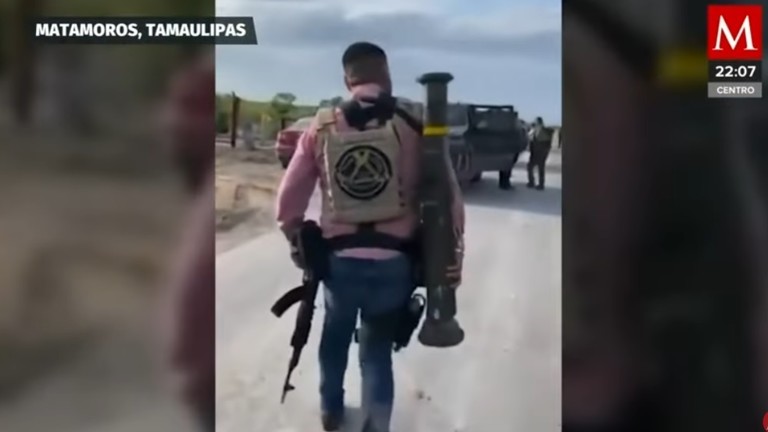
A member of the Cartel Del Golfo (CDG) in Tamaulipas, Mexico carrying a US-made anti-tank weapon, May 30, 2023 © screenshot/Milenio TV
RT | May 31, 2023
A militant wearing the insignia of Mexico’s notorious Gulf Cartel (Cartel Del Golfo, CDG) was filmed in the state of Tamaulipas carrying a US-made anti-tank missile launcher. Milenio TV identified the weapon as a Javelin, thousands of which were sent to Ukraine by the Pentagon.
Footage filmed in Matamoros on Monday and aired on Tuesday evening by the news channel Milenio TV showed a man with CDG patches armed with a Kalashnikov rifle and a missile they said was the Raytheon-made FGM-148.
Over 10,000 Javelins from Pentagon stockpiles have been sent to Ukraine since last February, to the point where the US military has begun to run out of the missiles itself.
Milenio presenter Azucena Uresti noted on Twitter that the estimated value of a Javelin launcher on the black market was anywhere from $20,000 to $60,000, while the average cost of a missile was about $30,000.
Keen-eyed military experts believe the weapon in the Milenio footage may actually be the AT-4, a Swedish-made disposable anti-tank launcher, which is also in use by the US military and likewise supplied to Ukraine by the thousands.
Russia has repeatedly warned the US and its allies not to “stuff” Ukraine with weapons and ammunition, both because this risked a direct confrontation and since nonexistent controls would result in the weapons ending up in the criminal underworld.
A RT investigation in July 2022 found a variety of Western-supplied weapons, including anti-tank rockets, for sale on the “dark web.” Several months later, Russian Foreign Ministry spokeswoman Maria Zakharova warned that $1 billion a month worth of Western weapons was ending up in the hands of “terrorists, extremists and criminal groups in the Middle East, Central Africa, and Southeast Asia.”
Kiev has denounced this as “propaganda” and insisted all were accounted for.
The US outlet CBS censored their documentary on weapons supplies to Ukraine after the government in Kiev objected. Last month, veteran investigative journalist Seymour Hersh said the West was aware its weapons were ending up on the black market, but that most governments did not care because arming Ukraine mattered more to them.
The Gulf Cartel is based in the Mexican state of Tamaulipas, specifically in the border city of Matamoros, just across the Rio Grande from Brownsville, Texas. It dates back to the 1930s, but gained in notoriety in the late 1990s, when it spun off a notorious militia called Los Zetas. The group has since broken off on its own. Though primarily known as a drug smuggling cartel, CDG has also been accused of racketeering, abductions, money laundering, and trafficking of people, sex slaves and weapons.
In March, the cartel apologized for one of its factions kidnapping four Americans and killing two of them, in what they said was a case of mistaken identity. Five members of that faction were handed over to the Mexican police.
Bipartisan Group of Senators Call for DOD to Investigate ‘Price Gouging’ by Major US Defense Contractors
By Connor Freeman | The Libertarian Institute | May 29, 2023
A bipartisan group of Senators sent a letter to the Defense Department chief calling for an investigation into major American arms dealers accused of systemic “price gouging,” on Wednesday, according to The Hill.
The letter, signed by the likes of Sens. Bernie Sanders (I-VT), Elizabeth Warren (D-MA), Mike Braun (R-IN) Ron Wyden (D-OR), and Chuck Grassley (R-IA), cites former Pentagon officials, auditors, and other insiders who spoke to CBS and accused military-industrial complex giants, such as Lockheed Martin, Raytheon, and Boeing, of ripping off the US taxpayer.
During a recent 60 Minutes report, Shay Assad, who worked as a Pentagon contract negotiator for 40 years, cites numerous examples while explaining to the outlet that these firms overcharge the DOD for “[everything from] radar and missiles … helicopters … planes … submarines… down to the nuts and bolts.”
The report said these “astronomical price increases” have worsened sharply amidst Washington’s exponentially rising demand for weapons systems to both bolster Taiwan – in a thinly-veiled effort to destabilize China – and support NATO’s proxy Kiev during its war with Russia.
“Lockheed Martin, Boeing, Raytheon, and TransDigm are among the offenders,” the senators asserted. Their letter continues, “[these contractors are] dramatically overcharging the Department and U.S. taxpayers while reaping enormous profits, seeing their stock prices soar, and handing out massive executive compensation packages.”
Secretary of Defense Lloyd Austin, the letter’s recipient, sat on Raytheon’s board of directors before accepting his current post. The lawmakers charge that these companies are securing profits ranging from 40% to even as high as 4,000%.
The military budget will soon surpass the once unthinkable $1 trillion mark. The DOD has requested a record $842 billion for the next fiscal year, roughly half of which will go to “the offenders,” just such private defense contractors.
While the Joe Biden administration has asked Congress to approve a nearly $900 billion military budget. The hawkish legislature will almost certainly add tens of billions more to Biden’s proposed budget. For 2023, Congress added another $45 billion to Biden’s already mammoth request for $813 billion, resulting in a finalized $858 billion annual military spending bill.
Even these eye-opening numbers do not tell the whole story, because the real national security state budget is already fast approaching $1.5 trillion.
The lawmakers’ letter also expresses concerns about the Pentagon’s ability to audit, track and mitigate fraud risk. The DOD’s accountability system is completely “broken.” Assad said, “No matter who they are, no matter what company it is, they need to be held accountable. And right now that accountability system is broken in the Department of Defense.”
The Senators complained that, for decades, this obscene, unaccountable spending has been ongoing. The letter cites a 2021 Government Accountability Office (GAO) report which found the Pentagon failed to implement any comprehensive solution to combating this “unconscionable” fraud, as Assad has described it.
“The DOD can no longer expect Congress or the American taxpayer to underwrite record military spending while simultaneously failing to account for the hundreds of billions it hands out every year to spectacularly profitable private corporations,” the Senators declared. These firms “have abused the trust government has placed in them…exploiting their position as sole suppliers for certain items to increase prices far above inflation or any reasonable profit margin,” the letter continued.
“It’s not really a true capitalistic market because one company is telling you what’s going to happen. [It’s a] monopoly,” retired DoD auditor Mark Owen told CBS.
Connor Freeman is the assistant editor and a writer at the Libertarian Institute, primarily covering foreign policy. He is a co-host on Conflicts of Interest.
US Republicans threaten to hold FBI director in contempt
RT | May 31, 2023
The FBI has again refused to turn over documents subpoenaed by the US Congress regarding bribery accusations against President Joe Biden, prompting House Oversight Committee Chairman James Comer to warn that he will seek to hold the agency’s director in contempt for “obstructionist” tactics.
“The FBI’s decision to stiff-arm Congress and hide this information from the American people is obstructionist and unacceptable,” Comer said on Tuesday in a statement.
The Kentucky Republican added that the committee will take steps to hold FBI director Christopher Wray in contempt of Congress for refusing to comply with a lawful subpoena.
“Americans deserve the truth, and the Oversight Committee will continue to demand transparency from this nation’s chief law enforcement agency,” Comer added.
At issue is an FBI informant file detailing allegations that Biden accepted $5 million in foreign bribes in exchange for policy favors when he worked as vice president under then-President Barack Obama. The FBI received the tip in June 2020. The allegations came to light earlier this year, when a whistleblower informed Republican Senator Chuck Grassley of their existence.
FBI officials have missed multiple deadlines to comply with the subpoena, including Comer’s latest demand that the documents be handed over by Tuesday. Wray has claimed that the allegations against Biden were unverified and that the so-called FD-1023 file in the case must be kept private to protect FBI informants.
House Republicans have sought the documents to weigh the substance of the allegations against Biden and examine whether the FBI has handled the case properly. Comer argued earlier this month that the agency has had the evidence for years and has apparently “done nothing” with it.
House Speaker Kevin McCarthy, a California Republican, said on Tuesday that he will lead members of his party in voting to hold Wray in contempt if the FBI director refuses to turn over the FD-1023. He added that any sensitive information on the informant could be redacted.
The FBI issued a statement saying any discussion of pursuing contempt proceedings against Wray is “unnecessary.” The agency said it had offered in a letter to Comer to provide information to the committee “in a format and setting that maintains confidentiality and protects important security interests and the integrity of FBI investigations.” Wray is scheduled to discuss the issue with Comer on Wednesday in a phone call.
Comer has said the allegations “fit a pattern” of then-Vice President Biden flying to various countries, taking an unusually active role in US foreign policy decisions, then receiving wire transfers from those nations into bank accounts linked to his family members.
The House Oversight Committee released documents earlier this month showing evidence of the bank transfers. Biden, meanwhile, argued that the committee’s findings were “not true.”
Researchers Hid Data Showing Fluoride Lowers Kids’ IQs, Emails Reveal
By Brenda Baletti, Ph.D. | The Defender | May 30, 2023
A team of pro-fluoride researchers led by California’s dental director intentionally omitted data from a study seeking to undermine the forthcoming National Toxicology Program (NTP) report linking fluoride exposure to neurodevelopmental damage in children, according to documents released last week.
The documents — obtained through a California public records search and posted in a press release by the Fluoride Action Network — show that the team, led by Dr. Jayanth V. Kumar, a dental surgeon, conducted a meta-analysis of the scientific literature on fluoride’s neurotoxicity and found a link between fluoride exposure and lowered IQ in children at low levels of exposure.
However, they omitted the data and wrote a paper concluding there was no evidence of a link.
Four rounds of peer review rejected Kumar’s manuscript as “poorly researched,” “internally inconsistent” and committing “unashamed exaggeration” before the journal Public Health finally published the study last month.
NTP report: ‘no obvious threshold’ at which fluoridating water is safe
Kumar et al.’s study was published online less than a week before the NTP’s May 4 Board of Scientific Counselors (BSC) meeting where advisors would finalize any recommended changes before the NTP publishes the final version of its report on fluoride’s neurotoxicity.
The NTP, an interagency program run by the U.S. Department of Health and Human Services that researches and reports on environmental toxins, conducted a six-year systematic review to assess scientific studies on fluoride exposure and potential neurodevelopmental and cognitive health effects in humans.
Its groundbreaking report on those findings — which consists of a “state of the science” monograph and meta-analysis surveying the literature on the links between fluoride exposure and cognitive health effects — concluded that prenatal and childhood exposure to higher levels of fluoride is associated with decreased IQ in children.
It also found that given that children are exposed to fluoride from multiple sources, there was “no obvious threshold” at which fluoridating water would be safe.
That means even when water is fluoridated at lower levels (typically 0.7 mg/L), studies found children had dangerous levels of fluoride in their systems.
The study’s findings contradict mainstream assumptions, the position of the dental industry, the sugar industry and the health regulatory agencies on the safety and benefits of fluoridating water to prevent cavities, despite substantial evidence to the contrary, including a series of studies funded by the National Institutes of Health (NIH).
At the BSC meeting, the American Dental Association (ADA), with whom Kumar is affiliated, used his meta-analysis as evidence there were problems with the NTP study and argued that the NTP report should therefore be postponed.
This was just the latest in a series of attempts by industry and regulatory agency officials to “weaken, delay, or kill” the report.
The report is a key document in the ongoing lawsuit filed by Food & Water Watch, the Fluoride Action Network, Moms Against Fluoridation and private individuals against the U.S. Environmental Protection Agency (EPA) seeking to end water fluoridation.
The lawsuit was put on hold for more than two years pending the finalization and publication of the report. After the NTP scientists finalized their draft in May 2022 — which they deemed ready for publication — U.S. District Judge Edward Chen ruled the EPA could no longer delay the trial.
The case is moving forward as the report goes through the final stages of review.
The plaintiffs hope the report will be published in final, rather than draft, form prior to the next phase of the trial in January 2024.
The report was subject to an unprecedented number of peer reviews and agency commentary, and as a direct attempt by the NIH to block its publication, internal Centers for Disease Control and Prevention emails obtained through the Freedom of Information Act (FOIA) revealed.
The final step in its publication will be for the NTP director to consider the BSC’s suggestions and make any amendments to the report prior to publication.
The BSC recommended the NTP include comment on the recently published meta-analyses, but they were not aware that Kumar et al. buried data in order to support their findings.
Plaintiffs’ attorney Michael Connett, partner at the law firm Waters Kraus & Paul, provided the evidentiary documents to the NTP last week so the agency can consider the omitted data in its long-awaited final review of fluoride’s neurodevelopmental toxicity.
Connett told The Defender :
“We felt it was important to make the NTP aware of the omitted data as it directly contradicts the paper’s conclusion, and further undermines the dental lobby’s main talking point that the neurotoxic hazards of fluoride only occur at high doses.”
How researchers manipulated ‘the science’
Email exchanges between Kumar and his co-authors and transcripts from Kumar’s deposition in the lawsuit show Kumar and his co-authors are professionally committed to water fluoridation.
Kumar is a member of the pro-fluoridation ADA’s National Fluoridation Advisory Committee and one of the nation’s leading promoters of fluoridation. He admitted in the deposition that his job is “to promote fluoridation.”
Dr. Susan Fisher-Owens, one of his co-authors, receives funding from Colgate, which also promotes water fluoridation.
Kumar also admitted that part of his job was to work with the ADA’s marketing consultant to come up “with the best messaging and strategies for how to best advocate for fluoridation,” including messaging to “inoculate policymakers” with pro-fluoride information before they speak with anyone questioning the policy.
The documents show the researchers set out to prove there was no link between low levels of fluoride and lowered IQ in children, specifically to undermine the NTP report.
In a presentation to the Association of State and Territorial Dental Directors in February 2021, Kumar told his colleagues he was hoping to pre-empt the NTP monograph by publishing his own meta-analysis and finding a “friendly editor” to publish it.
He reiterated this point in an email to his co-authors in July 2022, in which he emphasized there was “urgency” to get their paper published. “I wanted to publish the paper before the NTP report,” he wrote.
But publishing their desired results met a series of roadblocks as peer reviewers at the Journal of the American Dental Association rejected the study twice, finding the “discussion is unbalanced and misleading.”
One reviewer expressed concern that “the misinformation in this manuscript will fuel more controversy rather than stimulate prudent science-based decisions.”
Reviewers at Pediatrics Journal similarly rejected the study as marked by “fallacious” reasoning with conclusions that were “internally inconsistent.” Another reviewer said that a “facile style of citation increases concern about the balance of the work.”
But reviewers were unaware that Kumar also omitted data that contradicted his desired conclusions.
In an email to Kumar in February 2022, the study’s biostatistician Honghu Liu, Ph.D., told Kumar he thought the results of his analysis were “headed in the right direction.”
But on March 5, 2022, Liu wrote to Kumar explaining they had done analyses trying to find a safe threshold — ideally, around 1.5 mg/L — for fluoride in water, below which there is no association with reduced IQ in children. However, he wrote, “the results are opposite to what we hoped for.”
Liu told Kumar he would keep trying to produce different results. “Although hard, we can test more models to try to identify a threshold that can lead to a nonsignificant fluctuation in IQ before the threshold and a significant drop in IQ after the threshold,” he wrote.
But further analysis continued to show an association between low levels of fluoride exposure and decreased IQ. According to Liu, the dose-response analysis was “unfortunately not showing what we like to show.”
To resolve the problem, they eliminated the analysis from the study.
On March 24, 2022, Kumar sent his colleagues an email, quoting the particular parts of the NTP monograph that he sought to invalidate with their paper and raising concerns that reviewers would question their research if they included a certain figure that contradicted their conclusions.
When the team submitted the study to Public Health for publication, the analysis showing an association between low-level water fluoridation and IQ deficits had been removed.
The study concluded, “These meta-analyses show that fluoride exposure relevant to community water fluoridation is not associated with lower IQ scores in children.”
Connett sent the omitted analysis along with an explanation of how Kumar’s conflicts of interest influenced the outcome of his study in a letter to the NTP last week and urged them to take it into consideration as they evaluated the meta-analysis.
He wrote:
“The public counts on NTP to provide the best available science on the chemicals that impact their lives. I recognize this is a challenging task, particularly for chemicals with significant political interests at stake, but it is vital nonetheless.”
Through FOIA and public records requests, the plaintiffs revealed how high-level public health officials blocked the report’s publication after the NTP determined it was finalized.
They also showed how the ADA sought to influence the “independent” National Academies of Science, Engineering, and Mathematics to insist on further review.
Commenting on what else they might uncover about efforts to protect pro-fluoridation interests, Connett told The Defender :
“The only reason we were able to get Kumar’s emails is because he’s a government official who is subject to Freedom of Information requests. It raises the question of what else we would learn if the emails of private actors, like the PR strategists who Kumar works with, were also accessible.”
Brenda Baletti Ph.D. is a reporter for The Defender. She wrote and taught about capitalism and politics for 10 years in the writing program at Duke University. She holds a Ph.D. in human geography from the University of North Carolina at Chapel Hill and a master’s from the University of Texas at Austin.
This article was originally published by The Defender — Children’s Health Defense’s News & Views Website under Creative Commons license CC BY-NC-ND 4.0. Please consider subscribing to The Defender or donating to Children’s Health Defense.
Authorities Should Look Into Biden Family Corruption Instead of Hunter’s Tax Shenanigans
By Andrei Dergalin – Sputnik – 27.05.2023
As new revelations about the IRS probe into Hunter Biden’s tax affairs are being brought forth, a former US state senator suggests that the Department of Justice and the FBI should probably focus their attention on more serious matters related to the US president’s family.
An IRS whistleblower named Gary Shapley dropped a bombshell this week related to a tax probe into the shady affairs of Hunter Biden, son of US President Joe Biden.
Shapley, who supervised Hunter’s tax probe since January 2020, has alleged he discovered signs of the investigation being “slow-walked” prior to him taking over, and that the Department of Justice tried to interfere with and thwart his probe.
Commenting on this development, former Colorado State Senator Ted Harvey told Sputnik that Shapley’s surprise about how long the investigation has been taking likely stems from the fact that the latter has never previously worked on a case involving a president’s son or an “elite Democrat operative.”
“Everybody that’s part of the Democrat machine never has their day in court because the machine protects them. And this shouldn’t be a surprise to anybody,” he explained while speaking on Sputnik’s Fault Lines podcast.
Harvey did note, however, that he would rather have the FBI look into the “actual criminal behavior of the Biden family” and into how said family allegedly put the US national security at risk, adding that, he does not particularly care about “any tax evasion from the president’s son.”
“I want the FBI and the Justice Department to look into the real issues with the Biden family and the corruption that we’ve seen there,” he added.
Meanwhile, Steve Gill, attorney and CEO of Gill Media, observed that while mainstream American media used to like whistleblowers, that same media now appears rather critical of them due to the media’s job essentially being to “protect the Biden family at all costs.”
He also pointed to allegations of foreign governments “dishing millions of dollars to the grandchildren of Joe Biden,” telling Sputnik’s Final Countdown podcast that it would be interesting to find out “exactly what these under-age grandchildren were doing to generate income from foreign governments.”
Why Are US Military Personnel Heading to Peru?
By Nick Corbishley – naked capitalism – May 26, 2023
The ostensible goal of the operation is to provide “support and assistance to the Special Operations of the Joint Command of the Armed Forces and National Police of Peru,” including in regions recently engulfed in violence.
Unbeknown, it seems, to most people in Peru and the US (considering the paucity of media coverage in both countries), US military personnel will soon be landing in Peru. The plenary session of Peru’s Congress last Thursday (May 18) authorised the entry of US troops onto Peruvian soil with the ostensible purpose of carrying out “cooperation activities” with Peru’s armed forces and national police. Passed with 70 votes in favour, 33 against and four abstentions, resolution 4766 stipulates that the troops are welcome to stay any time between June 1 and December 31, 2023.
The number of US soldiers involved has not been officially disclosed, at least as far as I can tell, though a recent statement by Mexico’s President Andrés Manuel Lopéz Obrador, who is currently person non grata in Peru, suggests it could be around 700. The cooperation and training activities will take place across a wide swathe of territory including Lima, Callao, Loreto, San Martín, Huánuco, Ucayali, Pasco, Junín, Huancavelica, Iquitos, Pucusana, Apurímac, Cusco and Ayacucho.
The last three regions, in the south of Peru, together with Arequipa and Puno, were the epicentre of huge political protests, strikes and road blocks from December to February after Peru’s elected President Pedro Castillo was toppled, imprisoned and replaced by his vice-president Dina Boluarte. The protesters’ demands included:
- The release of Castillo
- New elections
- A national referendum on forming a Constitutional Assembly to replace Peru’s current constitution, which was imposed by former dictator Alberto Fujimori following his self-imposed coup of 1992
Brutal Crackdown on Protests
Needless to say, none of these demands have been met. Instead, Peru’s security forces, including 140,000 mobilised soldiers, unleashed a brutal crackdown that culminated in the deaths of approximately 70 people. A report released by international human rights organization Amnesty International in February drew the following assessment:
“Since the beginning of the massive protests in different areas of the country in December 2022, the Army and National Police of Peru (PNP) have unlawfully fired lethal weapons and used other less lethal weapons indiscriminately against the population, especially against Indigenous people and campesinos (rural farmworkers) during the repression of protests, constituting widespread attacks.”
As soon as possibly next week, an indeterminate number of US military personnel could be joining the fracas. According to the news website La Lupa, the purported goal of their visit is to provide “support and assistance to the Special Operations of the Joint Command of the Armed Forces and National Police of Peru” during two periods spanning a total of seven months: from June 1 to September 30, and from October 1 to December 30, 2023.
The secretary of the Commission for National Defence, Internal Order, Alternative Development and the Fight Against Drugs, Alfredo Azurín, was at pains to stress that there are no plans for the US to set up a military base in Peru and that the entry of US forces “will not affect national sovereignty.” Some opposition congressmen and women begged to differ, arguing that the entry of foreign forces does indeed pose a threat to national sovereignty. They also lambasted the government for passing the resolution without prior debate or consultation with the indigenous communities.
The de facto Boluarte government and Congress are treating the arrival of US troops as a perfectly routine event. And it is true that the US military has long held a presence in Peru. For example, in 2017, U.S. personnel took part in military exercises held jointly with Colombia, Peru and Brazil in the “triple borderland” of the Amazon region. Also, the US Navy operates a biosafety-level 3 biomedical research laboratory close to Lima as well as two other (biosafety-level 2) laboratories in Puerto Maldonado.
But the timing of the operation raising serious questions. After all, Peru is currently under the control of an unelected government that is heavily supported by Washington but overwhelmingly rejected by the Peruvian people. The crackdown on protests in the south of the Peru by the country’s security forces — the same security forces that US military personnel will soon be joining — has led to dozens of deaths. Peru’s Congress is refusing to call new elections in total defiance of public opinion. Just a few days ago, the country’s Supreme Court issued a ruling that some legal scholars have interpreted as essentially criminalising political protest.
As Peru’s civilian institutions fight among themselves, Peru’s armed forces — the last remaining “backbone” in the country, according to Mexican geopolitical analyst Alfredo Jalife — has taken firm control. And lest we forget, Peru is home to some of the very same minerals that the US military has identified as strategically important to US national security interests, including lithium. Also, as I noted in my June 22, 2021 piece, Is Another Military Coup Brewing in Peru, After Historic Electoral Victory for Leftist Candidate?, while Peru’s largest trading partner is China, its political institutions — like those of Colombia and Chile — remain tethered to US policy interests:
Together with Chile, it’s the only country in South America that was invited to join the Trans-Pacific Partnership, which was later renamed the Comprehensive and Progressive Agreement for Trans-Pacific Partnership after Donald Trump withdrew US participation.
Given as much, the rumours of another coup in Peru should hardly come as a surprise. Nor should the Biden administration’s recent appointment of a CIA veteran as US ambassador to Peru, as recently reported by Vijay Prashad and José Carlos Llerena Robles:
Her name is Lisa Kenna, a former adviser to former US Secretary of State Mike Pompeo, a nine-year veteran at the Central Intelligence Agency (CIA), and a US secretary of state official in Iraq. Just before the election, Ambassador Kenna released a video, in which she spoke of the close ties between the United States and Peru and of the need for a peaceful transition from one president to another.
It seems more than likely that Kenna played a direct role in the not-so-peaceful transition from President Castillo to de facto President Boluarte, having met with Peru’s then-Defence Minister Gustavo Bobbio Rosas on December 6, the day before Pedro Castillo was ousted, to tackle “issues of bilateral interest”.
On a Knife’s Edge
After decades of stumbling from crisis to crisis and government to government, Peru rests on a knife’s edge. When Castillo, a virtual nobody from an Andean backwater who had played an important role in the teachers’ strikes of 2017, rode to power on a crest of popular anger at Peru’s hyper-corrupt establishment parties in June 2021, Peru’s legions of poor and marginalised hoped that positive changes would follow. But it was not to be.
Castillo was always an outsider in Lima and was out of his depth from day one. He had zero control over Congress and failed miserably to overcome rabid right-wing opposition to his government. Even in his first year in office he faced two impeachment attempts. As Manolo De Los Santos wrote in People’s Dispatch, Peru’s largely Lima-based political and business elite could never accept that a former schoolteacher and farmer from the high Andean plains could become president.
On December 7, they finally got what they wanted: Castillo’s impeachment. Just hours before a third impeachment hearing, he declared on national television that he was dissolving Congress and launching an “exceptional emergency government” and the convening of a Constituent Assembly. It was a preemptive act of total desperation from a man who held no sway with the military or judiciary, had zero control over Congress, and had even lost the support of his own party. Hours later, he was impeached, arrested by his own security detail and taken to jail, where he remains to this day.
Castillo may be out of the picture but political instability continues to reign in Peru. The de facto Boluarte government and Congress are broadly despised by the Peruvian people. According to the latest poll by the Institute of Peruvian Studies (IEP), 78% of Peruvians disapprove of Boluarte’s presidency while only 15% approve. Congress is even less popular, with a public disapproval rate of 91%. Forty-one percent believe that the protests will increase while 26% believe they will remain the same. In the meantime, Peru’s Congress continues to block general elections.
Peru’s “Strategic” Resources
As regular readers know, EU and US interest in Latin America is rising rapidly as the race for lithium, copper, cobalt and other elements essential for the so-called “clean” energy transition heats up. It is a race that China has been winning pretty handily up until now.
Peru is not only one of China’s biggest trade partners in Latin America; it is home to the only port in Latin America that is managed entirely by Chinese capital. And while Peru may not form part of the Lithium Triangle (Bolivia, Argentina and Chile), it does boast significant deposits of the white metal. By one estimate, it is home to the sixth largest deposits of hard-rock lithium in the world. It is also the world’s second largest producer of copper, zinc and silver, three metals that are also expected to play a major role in supporting renewable energy technologies.
In other words, there is a huge amount at stake in how Peru evolves politically as well as the economic and geopolitical alliances it forms. Also, its direct neighbour to the north, Ecuador, is undergoing a major political crisis that is likely to spell the end of the US-aligned Guillermo Lasso government and a handover of power to Rafael Correa’s party and its allies.
And the US government and military have made no secret of their interest in the mineral deposits that countries like Peru hold in their subsoil. In an address to the Washington-based Atlantic Council on Jan 19, Gen. Laura Richardson, head of the U.S. Southern Command, spoke gushingly of Latin America’s rich deposits of “rare earth elements,” “the lithium triangle — Argentina, Bolivia, Chile,” the “largest oil reserves [and] light, sweet crude discovered off Guyana,” Venezuela’s “oil, copper, gold” and the fact that Latin America is home to “31% of the world’s fresh water in this region.”
She also detailed how Washington, together with US Southern Command, is actively negotiating the sale of lithium in the lithium triangle to US companies through its web of embassies, with the goal of “box[ing] out” US adversaries (i.e. China and Russia), concluding with the ominous words: “This region matters. It has a lot to do with national security. And we need to step up our game.”
Which begs the question: is this the first step of the US government and military’s stepping-up-the-game process?
The former president of Bolivia Evo Morales, who knows a thing or two about US interventions in the region, having been on the sharp end of a US-backed right-wing coup in 2019, certainly seems to think so. A few days ago, he tweeted the following message:
The Peruvian Congress’ authorisation for the entry and stationing of US troops for 7 months confirms that Peru is governed from Washington, under the tutelage of the Southern Command.
The Peruvian people are subject to powerful foreign interests mediated by illegitimate powers lacking popular representation.
The greatest challenge for working people and indigenous peoples is to recover their self-determination, their sovereignty and their natural resources.
With this authorization from the Peruvian right, we warn that the criminalization of protest and the occupation of US military forces will consolidate a repressive state that will affect sovereignty and regional peace in Latin America.
Mexico’s President Andrés Manuel Lopéz Obrador, who refuses to acknowledge Boluarte (whom he calls the “great usurper”) as Peru’s president and has recently faced threats of direct US military intervention in Mexico’s drug wars from US Republican lawmakers, had a message for the US government this week: “[Sending soldiers to Peru] merely maintains an interventionist policy that does not help at all in building fraternal bonds among the peoples of the American continent.”
Unfortunately, the US government does not seem interested, if indeed it ever has been, in building fraternal bonds with the peoples of the American continent. Instead, it is set on upgrading the Monroe Doctrine for the 21st century. Its strategic rivals this time around are not Western European nations, which are now little more than US vassals (as a recent paper by the European Council of Foreign Relations, titled “The Art of Vassalisation”, all but admitted), but rather China and Russia.
The Biden regime’s plan to tackle “antisemitism” is to make online platforms “accountable”
White House Tells Social Media Platforms To Take A “Zero-Tolerance” Stance Against “Hate Speech”
By Cindy Harper | Reclaim The Net | May 26, 2023
The White House unveiled a strategy to fight antisemitism that involves telling Congress to push social media platforms to be held “accountable” for hate speech.
The 60-page document details four pillars of the strategy which are raising awareness, improving safety for Jewish communities, reversing what they call the normalization of antisemitism, and countering antisemitic discrimination and hate speech.
In a pre-recorded message before the unveiling of the strategy, President Joe Biden described it “a historic step forward” and the “most ambitious and comprehensive US government-led effort to fight antisemitism in American history.”
The document contains over 100 calls to action for legislators and others in society to fight antisemitism, including calling on online platforms to have “zero-tolerance” for hate speech.
The outline involves working with social media platforms heavily.
“We also call on Congress to hold social media platforms accountable for spreading hate-fueled violence, including antisemitism; impose much stronger transparency requirements on online platforms,” the White House said in a statement.
The EU has no leadership, only NGOs and think tanks telling it what to do, says Hungarian minister
MAGYAR HÍRLAP | May 26, 2023
No one has the courage and aptitude to lead Europe today, meaning there is no political leadership in the European Union, especially in the European Commission, said Hungarian Justice Minister Judit Varga at a Budapest conference on Thursday.
“In the European Union today, it is non-governmental organizations (NGOs), foundations and think tanks that tell Europe how to run Europe, according to the will of their own leaders,” she said.
“Recently, for asymmetric reasons, a crisis of confidence has arisen between the EU leadership and the Hungarian government. This is because the Hungarian government, unlike the EU institutions, says what it thinks and does what it says,” she added.
Varga said Europe is stumbling around the stage of history as a clumsy sideshow, drifting from crisis to crisis, and since the migration crisis, it has been trying to make policy in a way that is completely divorced from the real needs of its citizens. She said the institutional system also failed during the Covid crisis and then shot itself in the foot with sanctions against Russia after the outbreak of the Russian-Ukrainian war.
She warned that immigration is a crisis that still affects Europe and continues to cost the Hungarian budget heavily.
“At the same time, by defending Europe, we have to constantly fight the judgments and proceedings of the European Court of Justice,” she said. “Waiting for yet another slap in the face instead of any good deed, that is the fate of Hungary.”
Varga noted that during the coronavirus crisis, the EU made deals regarding vaccines, and yet those text messages have never been produced, referring to the murky case involving EU Commission President Ursula von der Leyen.
“We make no secret of the fact that we want to hold the functioning of the institutions in the European Union accountable in terms of the rule of law. Let’s talk about whether the European Commission, the European Parliament, the European institutions are respecting the rules, whether the rule of law is working in the institutions,” said the minister.
On the issue of the Hungarian EU presidency, the European Parliament has no say in this, the minister said, stressing that more than 10 years ago, a unanimous European Council decision had established the order of the member states, which can only be changed by unanimity. The presidency is not only a right but also an obligation, and the opposition will not achieve anything by such an attempt, but it could do enormous damage.
According to the minister, the European Parliament wants to block Hungary’s EU presidency precisely because it fears that Hungary will take stock of the dysfunctional state of EU institutions.
Black Lives Matter hitting hard times
RT | May 24, 2023
Black Lives Matter is spending money at double the rate it takes in revenue as donations to the activist group plummet and management costs rise, causing its asset base to shrink.
Donations to BLM’s Global Network Foundation tumbled to less than $9.3 million in its latest fiscal year, ended on June 30, down a staggering 88% from the preceding 12 months, according to state tax filings. Revenue was even lower, at $8.5 million, amid investment losses. The group’s spending totaled over $17 million, or twice as much as it took in.
The documents were first obtained by the Washington Free Beacon, showing that the financial bonanza that BLM reaped during its 2020 protests against police brutality is now dwindling. Net assets dropped 28% in the latest fiscal year, declining to $30.2 million.
Part of the problem is that even as the foundation throttles back its activities – expenses for “program services” plunged 65% from a year earlier, to $11.5 million – it’s spending even more on management. Those costs rose 36% last year to $5.1 million.
The group’s leaders have also been accused of siphoning off donations for their personal gain. A sister organization, Black Lives Matter Grassroots, claimed in a lawsuit that foundation leader Shalomyah Bowers diverted $10 million for his own use. His predecessor, co-founder Patrisse Cullors, resigned in May 2021 after being accused of living a lavish lifestyle on BLM’s wealth. She reportedly purchased four homes for a combined $3.2 million while heading the group.
The Cullors family continues to benefit financially from BLM. The documents showed that her brother, graffiti artist Paul Cullors, received $140,000 in compensation last year in his role as “head of security.” In addition, his security firm was paid more than $750,000. Filings for the previous fiscal year showed that the foundation paid a company owned by Damon Turner, father of Patrisse Cullors’ child, nearly $970,000 for “live production, design and media” services.
An auditors’ review of the group’s finances reportedly found that Bowers’ company had been paid nearly $1.7 million over the preceding two years for “management and consulting services.”
Cicley Gay was brought in as the BLM foundation’s chairwoman in April 2022, at least partly to help sort out the group’s finances. She reportedly had difficulties managing her own finances, filing for bankruptcy protection from creditors three times between 2005 and 2016.
Cullors and two other activists launched the BLM movement in 2013, following the acquittal of George Zimmerman, who killed black teenager Trayvon Martin during a February 2012 scuffle while serving as a neighborhood watchman in Sanford, Florida.
BLM raked in donations from Microsoft, Amazon and other corporations in the summer of 2020, after the killing of black Minneapolis resident George Floyd by police sparked a wave of protests around the country and overseas. Cullors referred to the huge cash influx as “white guilt money.” Many of the demonstrations escalated into riots, leaving many Americans injured and dead and causing billions of dollars in property damage.
Leaked recordings expose shocking state corruption in ‘US governed’ Moldova
Kit Klarenberg · The Grayzone May 18, 2023
The Grayzone has obtained video recordings of well-connected figures within Moldova’s political and business community openly testifying to rank corruption within the country’s government and economy, while outlining schemes to enrich Western investors for an appropriate fee.
The invasion of Ukraine placed the tiny country of Moldova on the immediate periphery of a conflict with global significance. Bordering Ukraine, counting hundreds of thousands of ethnic Russians as citizens, and home to the breakaway region of Transnistria, Moldova’s doggedly pro-Western government has been buffeted by crisis after crisis since Russia invaded Ukraine on February 24th 2022.
President Maia Sandu of the Party of Action and Solidarity (PAS) has remained steadfast as murmurings of a looming Ukrainian invasion, Russian plots to destabilize the country, and vast anti-government protests have reverberated on an almost monthly basis. Key to her endurance has been the unconditional backing of Western officials.
The sponsorship of NATO states has persisted despite industrial scale corruption at the highest levels of government. Indeed, as we shall see, foreign corruption in Moldova is actively facilitated and perpetuated with the support of Brussels and Washington, and continues apace with their full knowledge, consent, and even assistance.
The Grayzone has exclusively obtained video recordings of numerous well-connected figures within Chisinau’s political and business community openly – and gloatingly – testifying to rank malfeasance within the country’s government and economy, while outlining various schemes to enrich Western investors for an appropriate fee. It is the starkest depiction of how corruption operates in Moldova to ever emerge, gravely underlining its endemic, institutionalized nature.
In the recordings, pranksters posing as wealthy US businesspeople contacted Moldovan politician and lawyer Stanislav Pavlovschi, asking for assistance in securing a gigantic return for investing $50 million in Chisinau. The pranksters are private citizens who approached The Grayzone with the bombshell footage, and have asked to remain anonymous.
Very quickly, Pavlovschi – a former European Court of Human Rights judge and self-styled human rights defender – told them that a “good lawyer” and water-tight contracts would not be of any use to them there, as “the level of corruption is very high.” He went on to note that the country was effectively a colony of Brussels and Washington:
“Moldova now is governed by the US Ambassador… He is practically governing Moldova at this particular stage. You have hundreds of consultants for the EU… working for each and every ministry here in Moldova. So it is under very, very strict control on the part of the EU.”
When asked how this state of affairs could work given the high levels of corruption, Pavlovschi retorted that it functioned “perfectly,” “absolutely,” “brilliantly” – “everybody loves money.”
Well-connected investor promises ‘direct access’ to government
The pranksters were duly introduced to a number of influential local figures who could assist them in getting rich quick. Among them was Oleg Ciubuc, counselor to Vladimir Bolea, head of the Moldovan parliament’s agriculture and food commission. He professed in the leaked discussions to also be an “entrepreneur” whose “main direction” was connecting “investors with project developers.”
Beyond his “school friend” Bolea, who personally writes laws and regulations covering the country’s agriculture and food policy, Ciubuc revealed that his brother Alexandru runs state telecoms firm Moldtelecom. He is also a member of the PAS, which he described as “a big family,” connected “directly” to the “government, parliament and president.” In practice, this creates a dynamic not dissimilar from traditional mafia cartels:
“All my colleagues are telling me, ‘you are a perfect connector, to find a point A point B and connect to make money’…we are all of us connected to each other. Any question you have, I’m going to the highest person in the country responsible for that field… That’s the beautiful thing, when you have the majority in the parliament, everything is made by this majority… All the power in the country is controlled by this majority, which is the ‘family’.”
Ciubuc claimed his deal-making prowess was such that he was recommended for the post of Moldova’s state investment chief by his contacts, only for Sandu to personally reject the proposal. She supposedly reasoned that he should be working “multimillion investment funds” in the private sphere, which were “much more interesting projects than just a small agency under the government.”
“For me now is [sic] very easy to invite investors in my country because I can guarantee 100% the full political and security support,” Ciubuc swaggered. “Of course, being in that structure, we have access to all information, all the details in the country. And you need, like, you know, five minutes to find everything you need.”
The issue of state-level protection for foreign investors in Chisinau was similarly raised by investment professional Olga Melniciuc, who formerly worked as a consultant to the Moldovan state economic council. She acknowledged that many outsiders were deterred from funding projects in the country due to a lack of “predictability” – whether favorable terms secured under one government would still apply if another was elected.
Melniciuc said that “predictability and some insurance for the stability” of an investment could be guaranteed by direct negotiation with government ministers, albeit via “non-formal communications.” Investors simply needed to “make sure the main person in the government knows what they are doing,” and they have official support for their endeavors, if only behind closed doors. She described an official “vetting” process for investments that was nothing of the kind, and did not involve scrupulous background checks or due diligence.
Melniciuc went to assure the pranksters that well-established forums in Moldova, such as the American Chamber of Commerce, Association of Foreign Investors, and European Business Association were already “very actively advocating for the rights of their members,” and “have direct access to [the] Prime Minister.”
“We have a pro-European government supported by the EU [and] US government. So there is a lot of this pro-Western support,” Melniciuc said. “And we have all the needed documents and the association agreements signed. We are [EU and NATO] candidates… So all that is very good. It creates a good playground for investors.”
Melniciuc felt it was “the best time to invest,” as the war in Ukraine’s impact on Moldova, which includes 30% inflation, had created “uncertainties” in the market.
Moldovan media tycoon ‘handles’ relationships with Prime Minister
Staffers within the ranks of US-funded NGOs operating in the country were also eager to assist foreign investors to enrich themselves via dubious schemes. They included the education training organization Pro Dictactica, which is partnered with George Soros’ Open Society Foundations, the EU, the Lithuanian Ministry of Foreign Affairs, and US Embassy in Moldova, among others.
He introduced the pranksters to a key figure in Pro Dictactica, Oxana Draguta, who enjoyed direct access to Maia Sandu. The pair worked together when Sandu was Minister of Education 2012 – 2015, and Draguta was a staffer in her ministry “responsible for coordination of foreign assistance in education.” After being elected President, Sandu “brought her team for the government,” meaning Draguta had a variety of contacts to exploit.
One method proposed to Dragutra of getting Sandu and her associates on board was by simply bribing her administration, via the funneling cash to “private entities,” which would pass these funds on to the PAS. The party’s coffers could be illicitly filled without the appearance of a direct foreign donation, providing the pranksters with astounding commercial benefits. Draguta concurred, noting her own involvement in facilitating such an arrangement could also conveniently be hidden:
“I can reach them out [sic] and ask… They are actually across the street… Actually, I am… this kind of… a member of this party but not an active member of it.”
Similarly unguarded comments were made by Cătălin Giosan, a Moldovan oligarch who in 1999 founded PRO TV, one of the country’s first, and now largest, private broadcast networks.
Giosan made clear he could serve as the bogus business peoples’ public relations “partner.” Keenly clarifying he was “not somebody who has experience in logistics or construction or whatever, but somebody to guide you in this political environment,” he promised to help them to connect “with local politicians and decision makers,” and “handle” those relationships on their behalf.
“I do this [sic] for 23 years. We… have the main news programs in urban Moldova. That means I saw generations of politicians coming and going,” Giosan boasted. “It’s not a question if we can establish a connection with them. I’ve met the key people I think should and can be involved in this project… One is the key decision maker in the administration. So I’m talking about the people you need.”
He pledged once their discussion concluded to “think” about “how such support can be structured… the most efficient way,” and meet with local stakeholders, “to craft a plan, a solution.” He asked the pranksters to prepare a “brief” for his “partners”. In turn, he would meet with the pranksters over dinner, to discuss “the political, economical, social situation, the crisis situation, the war.”
“Then,” Giosan pledged, “I’ll make you a presentation on the decision making, political decision making processes in Moldova to understand how this – where the power stays and how the decisions are made.”
It is indeed “not a question” whether Giosan could connect wealthy foreign financiers with a high-ranking government decision maker. Moldova’s aggressively pro-EU, pro-US Prime Minister Dorin Recean, who took office in February, is extremely rich by local standards. Official declarations of his assets show he owns several properties, including a lavish Romanian villa, and that he and his wife reap vast sums from their assorted business interests.
For example, Recean is the founder of three highly profitable local companies, including US Food Network, which manages outlets of KFC in Moldova. In each case, Giosan is also a shareholder.
Such an intimate relationship provides him with a direct and highly influential line to the heart of government, while offering some clue as to “how decisions are made” in the country.
Moldova makes mockery of USAID anti-corruption efforts
The recordings obtained by The Grayzone are all the more shocking when considering that Moldova is enrolled in the US Agency for Aid and International Development (USAID)’s Countering Kremlin Malign Influence (CMKI) program. Under the auspices of USAID, a traditional cutout of US intelligence, countries which once comprised the Soviet Union and Warsaw Pact receive vast funding and practical support to supposedly defend themselves from Russian meddling. Cracking down on corruption is one of the initiative’s foremost objectives.
This includes sponsorship of “reform-minded leaders and civil-society voices.” Maia Sandu happens to be one such “reform-minded leader,” which is why her upset victory was hailed in Western quarters as a watershed moment in Moldova’s battle against corruption. Since then, she has regularly touted high-profile legislative amendments and initiatives to tackle the issue, but critics charge they have achieved nothing, simply serving to replace one set of crooked officials with another.
One would not know that from the pronouncements of US officials, however. In December 2022, USAID chief and humanitarian interventionist guru Samantha Power met personally with Sandu to “discuss US support for the people of Moldova,” and the President’s “anti-corruption and democratic reform agenda.” An accompanying press release noted the US had provided Chisinau with $320 million over the past nine months, “to address the economic, energy, security, and humanitarian impacts of Russia’s war against Ukraine.”
This staggering sum follows almost $100 million gifted to Moldova by USAID through the CMKI program between 2017 and 2021, making it the biggest beneficiary.
Evidently, Washington has taken a relaxed attitude toward high-level graft and bribery in Moldova. As long as Western oligarchs and businesses are profiting, and the government toes an anti-Russian line in all matters domestic and foreign, Washington seems content to look the other way.
This dispiriting reality is apparently not lost on most Moldovans. While polls indicate Sandu remains the most popular politician in the country, 57% of citizens cannot name a single public figure they trust. Likely sensing the precarious position of their puppet in Chisinau, the EU announced in April 2023 it would deploy a “civilian mission” there to counter Russian “threats”.
Yet, the longer the war in Ukraine grinds on, the more probable it is the government will fall – not due to external interference, but because of internal upheaval. The coterie of business figures, well-connected actors and NGO operatives to whom Stanislav Pavlovschi introduced the pranksters – and the Western oligarchs they so eagerly serve – may be wise to line their pockets in Moldova while they still can.
Featured Video

The 1964 Coup in Brazil
or go to
Aletho News Archives – Video-Images
Free Book
Vicious

Lies are Unbekoming | January 25, 2026
The waiting room is clean. The receptionist is polite. The forms ask reasonable questions. Nothing in the physical environment suggests danger. The magazines are current. The hand sanitizer dispenser works. Someone has chosen calming colors for the walls.
A pregnant woman sits in a chair designed for her comfort. She has been told to be here. Not ordered—no one orders. Recommended. Strongly recommended. Everyone does this. Her mother did this. Her friends did this. The women in her prenatal group compare notes about their appointments the way they compare notes about nursery furniture. Which provider did you choose? What tests have you had? The questions assume the answers. The answers assume the questions.
She will be offered things today. Offered is the word used. The offers will come with information sheets that list risks and benefits in tabular form. She will sign consent documents. Everything will be voluntary in the legal sense. No one will hold her down. No one will threaten her. She will choose, and her choices will feel like choices, and she will leave feeling she has done the responsible thing.
What she will not feel is the weight of what has been arranged before she arrived. … continue
Blog Roll
Recent Comments
Coronistan on Donald Trump Is No Peace … seversonebcfb985d9 on French court jails pro-Palesti… eddieb on Fourteen Incredible Facts Abou… Bill Francis on European leaders’ shift in the… seversonebcfb985d9 on Villains of Judea: Philip Esfo… loongtip on Report warns that ‘Jewish terr… Craig Nelms on New study shows that toxic gas… loongtip on A Funny Thing Happened on the… loongtip on EU free trade pact on hold as… John Edward Kendrick on Regime Change In Iran Is The F… Bill Francis on Australia Passes New Hate Spee… seversonebcfb985d9 on Australia Passes New Hate Spee…


 Aletho News
- Epidemic of fake videos
- Craig Murray, Reporting from Venezuela
- Why Israel’s Drive to Destroy Iran is Ultimately about Palestine
- Trump and Iran, War or Negotiations?
- US pressure contributing to Israeli influence in Latin America: Experts
- China Rejects U.S. Claims of Coercion in Central America
- New US defense strategy downgrades Russian ‘threat’
- EU turns to India for defense cooperation as US ties fracture
- Donald Trump Is No Peace President
- Vicious
- If Americans Knew
- Will Rafah crossing be opened at last? – Not a ceasefire Day 108
- Israeli drone strike kills two children collecting firewood in Gaza – Not a ceasefire Day 107
- Another Gaza baby freezes to death on Netanyahu’s watch – Not a ceasefire Day 106
- Oppose Israel’s Abuses While You Still Can
- UNRWA Heads Tell Ha’aretz: ‘We Don’t Radicalize Palestinians – Their Lived Existence Does’
- Plans Call for “New Rafah” Built in Israel’s Image — Without Palestinians
- Posing as priest, reporter is spat at many times, highlighting anti-Christian sentiment in Israel
- Leaked Documents: “Planned Community” in Rafah Would Force Palestinians Into Israeli Panopticon
- ‘Permits of Humiliation’: How Israel Strangles Christian Education in Jerusalem
- “The world sees death, destruction and injustice – and they see dollar signs” – Not a ceasefire Day 105
- No Tricks Zone
- New Study Affirms Rising CO2’s Greening Impact Across India – A Region With No Net Warming In 75 Years
- Germany’s Natural Gas Crisis Escalates … One Storage Site Near Empty …Government Silent
- Polar Colding…Antarctica Saw Its Coldest October In 44 Years!
- New Study: Sea Levels Rose 20 Times The Modern Rate During The Roman Warm Period
- As German Gas Storage Dips Dangerously Low…Shortage Hardly Avoidable
- New Study: Brazil’s Relative Sea Level Was 2+ Meters Higher And SSTs 3-4°C Warmer 6000 Years Ago
- Philosopher Schopenhauer: Climate Science Certainty Stems From Stupidity, Ignorance
- New Study: Species Extinction Rates Declining Since 1980 – ‘Climate Change Is Not An Important Threat’
- Denmark Places Climate Protection Above Animal Welfare, Poisoning And Culling Cows
- New Study: Greenland Was 3-7°C Warmer And Far Less Glaciated Than Today 6000-8000 Years Ago
 Aletho News