The US and the Israeli Ministry of Public Security have imposed restrictions and sanctions on Israeli spyware company NSO. It was placed on the US blacklist, resulting in a decline in its deals and income.
However, it wasn’t the politicians, opposition activists and journalists who were spied on who benefitted from these restrictions, but rather another cyber-attacker Tal Dilian, a former combat fighter in an elite Special Operations Unit of the Intelligence Corps in the Israeli army and held a senior position in the Israeli Military Intelligence Division “Aman”.
One of the spyware companies that Dilian founded is Intelexa, which developed the Predator software. Dillian focused on selling this spyware programme to countries where the Israeli Defence Ministry does not issue permits to export cyber-attack software, such as Bangladesh, Sudan and Ukraine, according to a report in Israel’s Yedioth Ahronoth newspaper published on Friday.
Unlike cyber-attack companies registered and operating in Israel, which are subject to the supervision of the Security Export Supervision Division in the Ministry of Defence, Dilian believes he is not under the Ministry of Security’s supervision and can supply his goods to any country or entity.
About a year ago, the phone of Greek journalist Thanasis Koukakis was behaving oddly, as his battery began to die quickly and phone calls were being disconnected. The journalist, who criticised the Greek prime minister’s economic policy, became suspicious that he was being watched. A month later, a Canadian cyber security research institute, Citizen Lab, discovered that the Predator programme had hacked Koukakis’ phone.
It was also found, following the formation of a commission of inquiry into the matter by the European Parliament and after examining 200 of its members’ phones, that an unsuccessful attempt had been made to hack the phone of the head of the Greek opposition, Nikos Androulakis, which caused a scandal described as the “Greek Watergate”.
Citizen Lab published a report last December confirming that two Egyptian dissidents in exile, politician Ayman Nour and a popular programme host who wishes to remain anonymous, had been hacked by the Predator spyware.
The newspaper added that investigations into the Greek scandal revealed the source of the Predator programme as Israel. Several weeks ago, members of the investigation commission set up by the European Union secretly visited Israel and met with officials in the Ministries of Justice and Public Security, as well as with Director General and founder of NSO Shalev Julio. The investigation committee announced that it had not found evidence linking Pegasus to a spying scandal in Spain.
While the US and Israeli authorities imposed sanctions and restrictions on Israeli cyber companies, an official in the Israeli cyber intelligence company Verint, Sam Rabin, resigned to appoint the deputy general manager of Intelexa, based in North Macedonia. However, most of its employees and director, as well as the hackers, are individuals dismissed from Israeli intelligence services. Dilian held the rank of colonel in the Israeli army and was the commander of the 81st Technological Unit and a senior officer in the army’s special operations unit.
September 10, 2022
Posted by aletho |
Civil Liberties, Deception, Full Spectrum Dominance | European Union, Human rights, Israel, United States |
Leave a comment
If you are not a daily recipient of the Global Health Now (GHN) newsletter, I strongly advise against starting. I do these things so you don’t have to. After all, I am not averse to a bit of ‘global health’ provided it is evidence-based, equitable, necessary and does not require me to start wiping my bottom with leaves.
The concept of global health now seems to be a platform for highlighting inequities we can do little about, guilt induction among the populations of Western countries and most recently conveying panic generated in Geneva at the WHO about relatively mild diseases to the rest of the world. In fact, global health is the superhighway along which the panic-laden WHO buses travel. No sooner has one bus gone (Covid-19) than another one (monkeypox) comes along.
It took them longer than I expected but they have got there now. Recent issues of GHN have been highlighting similarities between Covid-19 and monkeypox. Recently GHN reported how the ‘US monkeypox outbreak is marked by vaccine disparities’. Apparently ‘black people make up a third of US monkeypox cases but have received 10 per cent of vaccine doses’; this is being ascribed to ‘distrust of the medical establishment’.
That would be the medical establishment which recommended locking them down for nearly two years, wearing disgusting face masks which everyone knew did not work, and enforcing vaccine mandates and vaccine passports for a vaccine which was not necessary, did not work and is known to be potentially harmful. All power to the elbows of black Americans who have seen the light over the medical establishment ahead of the rest of the population.
Meanwhile, monkeypox has been ‘jostling’ the experts’ understanding of the disease. Once thought not to be transmitted asymptomatically, they now think that it can be. Bet you never saw that one coming. In further news, monkeypox patients are ‘exhibiting a plethora of symptoms not previously linked to the disease’ including ‘lesions in the throat or rectum’; but we have been here before in these pages.
A worrying symptom associated with monkeypox has been uncovered: it is ‘inflammation of the heart’, also referred to as myocarditis or heart muscle inflammation, which I am sure is receiving maximum attention and being played for all it is worth in an effort to get people lined up for jabs. It is worth noting that the above is based on a single case report and it ‘highlights the possibility of cardiac manifestations in patients with monkeypox infection’.
Contrast that with the known and widespread risk of myocarditis among young males following Covid-19 vaccines, the demonstrable increase in deaths among professional footballers (compulsorily vaccinated) on the field of play and the concomitant reaction described in the American Heart Association’s flagship journal Circulation as ‘rare and mild’.
Here is what that rare and mild condition can do to you: first ‘reduce the heart’s ability to pump blood. Myocarditis can cause chest pain, shortness of breath, and rapid or irregular heart rhythms (arrhythmias)’; then ‘if left untreated, myocarditis may lead to symptoms of heart failure, where your heart has trouble pumping blood the way it should. In rare cases, it leads to other problems, such as cardiomyopathy’. But not to worry, apparently ‘many people with myocarditis go on to recover completely’ but ‘the condition can also cause permanent damage to the heart muscle. This can lead to complications like arrhythmia and heart failure’. And it should only lay you low for six weeks; who wouldn’t want some of that?
If ever there was evidence for the social construction of diseases, we now have it in abundance. Just as with the ‘social construction of reality’ (Berger & Luckman if you can stand to read it) whereby nothing is real until it is experienced, and the reality depends on who is experiencing it, we have the same with these infections. The symptoms are clearly context-dependent and depending on what the context of the sufferer is, for example of myocarditis, they may or may not be taken seriously.
September 9, 2022
Posted by aletho |
Deception, Science and Pseudo-Science |
Leave a comment
A leaked video recording reveals researchers in June shared data with the Israeli Ministry of Health (MOH) showing serious and long-term side effects associated with Pfizer’s COVID-19 vaccine.
However, the MOH did not disclose the researchers’ findings to the expert committee that met later that month to decide on recommending the vaccine for children under age 5, or with leaders of Israel’s COVID-19 vaccine booster program.
Additionally, the MOH on Aug. 2 issued a report — on adverse events following the Pfizer COVID-19 vaccine from Dec. 9, 2021, to May 31, 2022 — that contradicted the data presented during the early-June meeting.
“In fact, the report completely contradicts what was said in this discussion,” Retsef Levi, Ph.D., a professor at the Massachusetts Institute of Technology and member of the Israeli Public Emergency Council for the Covid19 Crisis, told GB News in an Aug. 21 interview.
Yaffa Shir-Raz, Ph.D., health communication and pharmaceutical companies public relations strategy researcher at Reichman University in Herzliya, Israel, translated the June meeting from Hebrew into English.
The English translation shows the research team warned MOH officials they should think carefully about how to present the researchers’ findings to the public because they posed a potential legal risk, as the findings contradicted MOH’s claims that serious side effects are rare and short-term.
Shir-Raz tweeted on Sept. 1 an excerpt from the recorded meeting in which the research team warned MOH seniors they would have to think of the legal ramifications of the team’s findings.
According to the video recording, the researchers informed MOH officials about the many reports of serious and long-term side effects of the Pfizer vaccine, including side effects Pfizer didn’t list on the patient information leaflet, such as digestive side effects — especially abdominal pain in children — and back pain.
Additionally, Levi told GB News:
“On the free text part of the form, where patients were allowed to report whatever they wanted to, they [the researchers] observed and got many, many reports of neurological side effects — some not currently listed by Pfizer as side effects of the vaccine.”
The researchers also noted many cases of what Levi called the “re-challenge phenomenon” — or the recurrence or worsening of a side effect following repeated doses of the vaccine — which the researchers said indicated there was most likely a causal link between the vaccine and many side effects.
“The research team repeatedly stressed during the discussion,” Shir-Raz said in her translation and summary in English, “that their findings indicate that — contrary to what we were told so far — in many cases, serious adverse events are long-term, that last weeks, months, a year, or even more, and in some cases — ongoing, so that the side effect still lasted when the study was over.”
The side effects included menstrual irregularities and various neurological side effects, muscle-skeletal injuries, GI problems and kidney and urinary system adverse events, Shir-Raz said.
According to Levi’s review of the meeting footage, the researchers expressed a sentiment of “concern” and felt their “conscience” bothered them by the reality of their findings.
The researchers told the MOH officials their findings contradicted the MOH’s prior messaging that the vaccine was safe and side effects were both rare and short-lasting.
In 50% of the reports in which a duration was specified by the individual, the researchers said, the duration was over six months, according to the video’s English subtitles.
Moreover, in 65% of the neurological cases that mentioned a duration, the individuals reported their symptoms were ongoing, Levi said.
“Now it turns out that the reality is not what the narrative was promoting,” Levi said. “The side effects are long-term and serious.”
The research team told the MOH officials:
“You have to think very very carefully about how you communicate this to the public because you may open yourself to legal lawsuits and liability issues because what you promoted is, in fact, not the reality in what we see in the reports.”
Despite the importance of this discussion, Dr. Sharon Alroy-Preis, head of public health services at MOH — and the person who signed the contract with Pfizer — was not present during the meeting. The researchers repeatedly asked MOH officials to make sure Dr. Alroy-Preis saw their findings
The MOH commissioned the Shamir Medical Center team of researchers with experience in pharmacovigilance to analyze the data from the adverse effects reporting system launched in Dec. 2021.
Although Israel began its COVID-19 vaccination campaign in 2020, it did not have an adverse effect reporting system until the end of 2021.
Steve Kirsch, executive director of the Vaccine Safety Research Foundation, commented on the news in a Sept. 2 Substack post, asking, “Why didn’t they release the original presentation made by the safety team?”
“There needs to be an investigation ASAP into what happened, but the head of the MoH, Nitzan Horowitz, isn’t calling for one,” he said.
“The precautionary principle of medicine now demands an immediate halt to the COVID vaccination program,” Kirsch said.
Kirsch also commented on the lack of media coverage of the Israeli researchers’ findings:
“Dr. Sharon Alroy-Preis, the Health Ministry’s head of public services and a top COVID adviser to the Israeli government, issued no public statement.
“Leaders of our ‘trusted institutions’ all over the world said absolutely nothing after the news broke on August 20, 2022.
“This suggests that there is widespread corruption in the medical community, government agencies, among public health officials, the mainstream media, and social media companies worldwide: they will not acknowledge any event that goes against the mainstream narrative.
“This is a level of corruption that is unprecedented. The atrocities here are clear-cut.
“Everyone should be speaking out and calling for a full investigation and fully evaluating the safety data collected by the Israel government.”
Suzanne Burdick, Ph.D., is a reporter and researcher for The Defender based in Fairfield, Iowa. She holds a Ph.D. in Communication Studies from the University of Texas at Austin (2021), and a master’s degree in communication and leadership from Gonzaga University (2015). Her scholarship has been published in Health Communication. She has taught at various academic institutions in the United States and is fluent in Spanish.
This article was originally published by The Defender — Children’s Health Defense’s News & Views Website under Creative Commons license CC BY-NC-ND 4.0. Please consider subscribing to The Defender or donating to Children’s Health Defense.
September 9, 2022
Posted by aletho |
Corruption, Deception, Science and Pseudo-Science, Timeless or most popular, War Crimes | COVID-19 Vaccine, Human rights, Israel |
Leave a comment
Israeli opposition leader Benjamin Netanyahu placed cameras in the room where he met with a delegation of US senators, without informing them beforehand that the meeting’s venue would have recording equipment, Israeli website Walla News reported.
A member of the American delegation noticed a video camera in the meeting room, which one of Netanyahu’s advisers had turned on while Netanyahu was holding a microphone in his hand.
The news site added that the US Ambassador to Israel Tom Nides asked Netanyahu why he was holding a microphone, but Netanyahu tried to evade the question saying, “This is nothing.” But the ambassador and the senators were not convinced and asked for that recording equipment to be removed before the start of the meeting.
Walla cited sources as saying that Netanyahu wanted to record the meeting in order to use the footage in his campaign for the upcoming Knesset elections.
Israel is set to hold its fifth election in four years in October after the Knesset was dissolved in June.
September 8, 2022
Posted by aletho |
Deception | Benjamin Netanyahu, Israel, United States |
Leave a comment
Is it true that “9/11 was an inside job”? Yes, insofar as Israel is “inside” the U.S. But for the 9/11 truthers who have identified Israel as the main perpetrators, “9/11 was an inside job” is at best a half-truth, and at worst an integral part of the Zionist operation, like a secondary flag sewn as a lining under the false flag of Islamism. Victor Thorn (1963-2017) wrote in his book 9/11 made in Israel: The Plot Against America (2011): “In essence, the ‘9-11 truth movement’ was created prior to Sept. 11, 2001 as a means of suppressing news relating to Israeli complicity. . . . The slogan ‘9-11 was an inside job’ was quite possibly the greatest example of Israeli propaganda ever devised.” In milder terms, it is “controlled opposition”.
A genuine truth movement would have pointed to Israel as the prime suspect from the start. From day one, it was obvious who would benefit. At 1 pm New York time on the day of the attacks, George Friedman (“born in Budapest, Hungary, to Jewish parents who survived the Holocaust,” Wikipedia informs us) wrote gleefully on his geopolitical website STRATFOR:
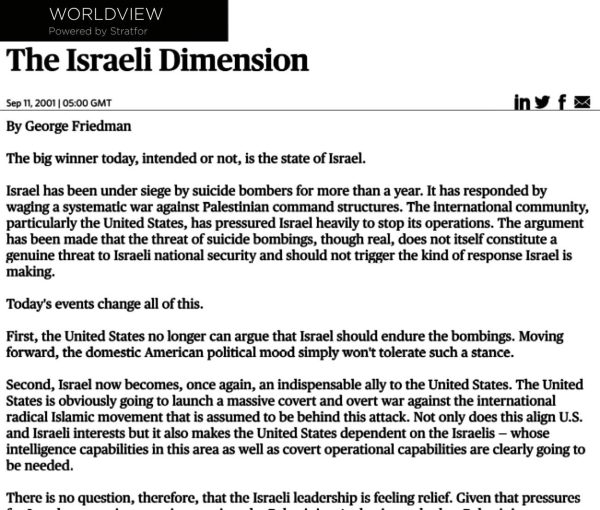
It’s pretty simple: 9/11 is best understood as a case of “triangulation”, by which two parties are drawn into conflict with each other by the invisible hand of a third party. In this case, the desired “clash of civilization” between the West and the Muslim world was triggered by Israel, 9/11 being only one operation in this ongoing strategy. Triangulation is the favored tactic of the Mossad, described by the U.S. Army School for Advanced Military Studies, on the eve of 9/11, as having “capability to target U.S. forces and make it look like a Palestinian/Arab act.” Triangulation is also used to create civil strife within a nation (intra-national clashes of civilization, so to speak) for various purposes. In most cases, Israel’s hand is invisible only to the extent of the authorities’ and the people’s voluntary blindness (the proverbial elephant in the room).
If, instead of comparing 9/11 to Operation Northwoods that never happened, the most widely watched early 9/11 conspiracy film (Loose Change) had reminded Americans of the attack on the USS Liberty, the 9/11 Truth movement would have moved in a totally different direction than the one it took under the leadership of Alex Jones. No one would think of calling the USS Liberty attack an “inside job” or “a self-inflicted wound.”
Filling the background with other documented Israeli false flag operations (the bombing of the King David Hotel in 1946, the Lavon Affair in 1954, Israel bombing its own embassies in Argentina in 1992 and in London in 1994, etc.) could have turned such a movement into a tsunami. The “inside job” theory, on the other hand, can never reach a critical mass, for a simple reason: the idea that the U.S. government would, by itself, deceive and terrorize its own citizens by killing thousands of them to justify wars in the Middle East that are not even in the nation’s interest is just too hard to believe for the vast majority of Americans — harder to believe than the official narrative with its material impossibilities. By comparison, Israel attacking America under the false flag of Islamic terrorists to win American support against their Arab enemies makes plain common sense. It is only with the hypnotic power of Zion-controlled corporate medias, and with the complicity of a well-organized “controlled opposition” that such a natural idea was suppressed from the minds of average Americans.
Nevertheless, the belief that “9/11 was an Israeli job” is gaining ground all over the world. Sooner or later, the tsunami will come. And the sooner the better. I am hoping that my film, “9/11 and Israel’s Great Game,” now in English, will help bring it about. Pass it around if you judge it useful:
This film, unfortunately, was shunned from all 9/11 Truth festivals this month. The organizers, I have been told, “decided not to muddy the waters with a film about Israel’s involvement in 9/11.” This must be ironic, for evidence of Israel’s involvement brings clarity, while muddy waters are what Israel needs. However, the film will be streamed on noliesradio.org on October 9th, followed by a debate between Alan Sabrosky, Kevin Barrett, and myself. …
Full article
Video
September 8, 2022
Posted by aletho |
Deception, Ethnic Cleansing, Racism, Zionism, False Flag Terrorism, Timeless or most popular, Video, Wars for Israel | Middle East, United States, Zionism |
Leave a comment
The US District Court for the Western District of Louisiana issued a ruling, ordering Dr. Anthony Fauci and White House Press Secretary Karine Jean-Pierre to respond to document requests by the New Civil Liberties Alliance in conjunction with the Missouri and Louisiana attorneys general on behalf of plaintiffs in State of Missouri ex rel. Schmitt, et al. v. Joseph R. Biden, Jr., et al.
Judge Terry A. Doughty made the order, which has great importance for the millions of Americans experiencing censorship on social media – which is allegedly at the pressuring of government bodies and officials and would therefore be a violation of the First Amendment.
We obtained a copy of the order for you here.
The judge’s ruling was on “whether the White House Defendants, White House Press Secretary Karine Jean Pierre and Chief Medical Advisor Dr. Anthony Fauci should be compelled to respond to Plaintiffs’ interrogatories and document requests” and “[w]hether Dr. Fauci, in his capacity as National Institute of Allergy & Infectious Diseases (“NIAID”) Director, should be required to provide additional responses to Plaintiffs’ interrogatories and document requests.”
The judge ruled in favor of the plaintiffs and the defendants have no legal right to refuse to comply with the order.
“In accordance with the previous expedited discovery order, Plaintiffs served interrogatories and document requests upon White House Press Secretary Karine Jean-Pierre and upon Dr. Anthony Fauci in his capacity as Chief Medical Advisor to the President,” the ruling states. “Government Defendants have refused to provide any interrogatory responses or responsive documents, maintaining that these would be internal communications that would implicate serious separation of powers concerns, that Plaintiffs are required to exhaust other avenues for the discovery first, and that it would be unduly burdensome and disproportional to the needs of the case.”
“The breadth and extent of the government’s censorship activities has turned out to be massive and far exceeded that disclosed by the federal government in response to initial court-ordered discovery made public last week,” the NCLA said in a statement to Reclaim The Net.
Much light has recently been shed on the Federal Government’s role in calling for direct censorship on social media platforms, as a result of the documents obtained during the lawsuit. Collusion between social media platforms and the CDC was also evident.
NCLA is representing several plaintiffs, some of which are prominent and well-respected epidemiologists who were censored by Big Tech platforms for diverging from the White House’s narrative on COVID-19.
The US district court judge Terry A. Doughty ruled on Tuesday:
“First, the requested information is obviously very relevant to Plaintiffs’ claims. Dr. Fauci’s communications would be relevant to Plaintiffs’ allegations in reference to alleged suppression of speech relating to the lab-leak theory of COVID-19’s origin, and to alleged suppression of speech about the efficiency of masks and COVID-19 lockdowns,” the ruling continues. “Jean-Pierre’s communications as White House Press Secretary could be relevant to all of Plaintiffs’ examples.
“Government Defendants are making a blanket assertion of all communications to social media platforms by Dr. Fauci, and Jean-Pierre based upon executive privilege and presidential communications privilege,” the order adds. “Plaintiffs concede they are not asking for any internal White House communications, but only external communications between Dr. Fauci and/or Jean-Pierre and third-party social media platforms.”
September 7, 2022
Posted by aletho |
Civil Liberties, Deception, Full Spectrum Dominance, Science and Pseudo-Science | Covid-19, United States |
Leave a comment
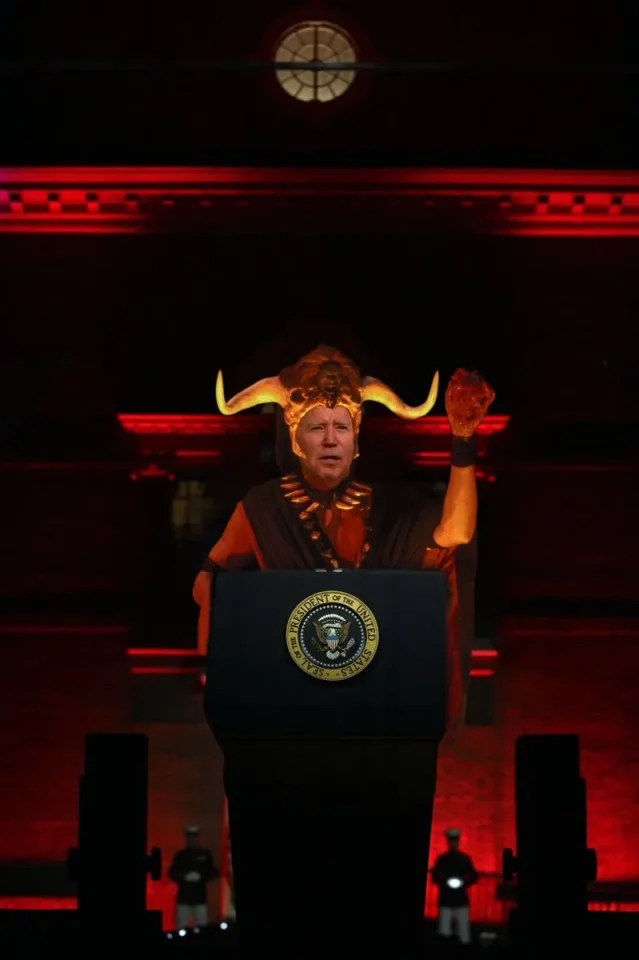
President Joe Biden believes that hysterical denunciations of extremism will save the Democratic Party in the upcoming congressional midterms. Despite media portrayals of Biden as a good-natured moderate, the president has relied on sweeping castigations of opposition throughout his political career. Worse, Biden’s rhetoric on extremism could signal an attack on any limits on presidential power.
Last Thursday in Philadelphia, Joe Biden overheated in a primetime speech with a backdrop seemingly inspired by a mix of the movie “V for Vendetta” and Nazi filmmaker Leni Riefenstahl. The harsh red atmospherics perfectly complimented Biden’s attempt to portray ex-president Donald Trump and his Republican supporters as the Anti-Christ waiting to crucify American democracy.
Biden declared that, “Trump and the MAGA Republicans represent an extremism that threatens the very foundations of our republic.” But he didn’t confess to the audience that he considered almost half of all Americans to be “extremists.”
A few hours before Biden’s speech, White House Press Secretary Karine Jean-Pierre asserted, “When you are not with what majority of Americans are, then you know, that is extreme. That is an extreme way of thinking.” Is this wacko definition of extremism designed to vilify anyone who doubts Biden will save America’s soul?
Four days later, speaking in Wisconsin, Biden declared, “Extreme MAGA Republicans in Congress have chosen to go backwards—full of anger, violence, hate, and division… Extreme MAGA Republicans don’t just threaten our personal rights and our economic security, they embrace political violence.” A week before the Philadelphia speech Biden denounced Republicans for “semi-fascism.”
To vanquish extremism, Biden called for everyone to “unite behind the single purpose of defending our democracy.” In other words, everyone must support Joe Biden or democracy will be destroyed. But Biden’s version of democracy is a parody of the Constitution. He believes that thanks to 43,000 votes in three swing states, he has unlimited power to dictate how Americans must live.
In his Philadelphia speech, Biden invoked the “Rule of Law” five times, notwithstanding his twenty months of dictatorial decrees. Law Professor Jonathan Turley observed, “President Biden has arguably the worst record of losses in [federal court] the first two years of any recent presidential administration.” The only limits on his power that Biden recognizes come from his pollsters, not from the Constitution.
Since Biden took office, his appointees have exploited “extremism” to sanctify stretching his power. Last year, the Biden administration revealed that guys who can’t get laid may be terrorist threats due to “involuntary celibate–violent extremism.” The White House did not disclose whether self-abuse was the latest terrorist warning sign. A senior administration official (speaking anonymously to the media) said the new program would encourage people: “If you see something, say something.” The Biden report stressed that federal law enforcement agencies “play a critical role in responding to reports of criminal and otherwise concerning activity.”
“Otherwise concerning activity”? This is the same standard that turned prior anti-terrorist efforts into farces.
Refusing to get injected with an experimental vaccine is another badge of extremism according to Biden scorekeepers. On August 13, 2021 the Department of Homeland Security issued a terrorist alert, warning that “anti-government/anti-authority violent extremists could exploit…potential re-establishment of public health restrictions across the United States as a rationale to conduct attacks.” Anyone who loudly objects to being locked back under house arrest thus became the moral equivalent of the Taliban, or maybe Hezbollah.
The following month, Biden gave a primetime address which dictated a COVID vaccine mandate for more than 80 million private employees and also portrayed the unvaccinated as public enemies. By the time Biden codified his decree in a November Federal Register notice, the efficacy of the COVID vaccine had fallen to less than 50%. But Biden apparently believed he was entitled to force people to get injected no matter how badly Pfizer shots failed. In January, the Supreme Court struck down Biden’s vax mandate for private companies.
The Biden administration won’t let the Constitution impede its war on extremism. As part of this new priority, the Department of Homeland Security (DHS) may exploit a “legal work-around” to spy on and potentially entrap Americans who are “perpetuating the ‘narratives’ of concern,” CNN reported last year. But federal informant programs routinely degenerate into “dollars for collars” schemes that reward scoundrels for fabricating crimes that destroy the lives of innocent Americans. The DHS plan would “allow the department to circumvent [constitutional and legal] limits” on surveillance of private citizens and groups. Federal agencies are prohibited from targeting individuals solely for First Amendment-protected speech and activities. But federal hirelings would be under no such restraint. Private informants could create false identities that would be problematic if done by federal agents.
One DHS official bewailed to CNN, “Domestic violent extremists are really adaptive and innovative. We see them… couching their language so they don’t trigger any kind of red flag on any platforms.” DHS officials have apparently decided that certain groups of people are guilty regardless of what they say (“couching their language”). The targets will likely include gun owners who distrust the politicians who vow to seize their guns. Any excesses by the new informants will be excused because they are for the sacred cause of saving democracy (or at least crippling Biden’s opposition).
Anyone who vigorously opposes federal power can get tarred as an extremist. On the day that Joe Biden was inaugurated, former CIA chief John Brennan announced on television that federal intelligence agencies “are moving in laser-like fashion to try to uncover as much as they can about” about extremists, libertarians, and other malefactors. Federal entrapment operations may have already harvested a heap of hapless individuals who could be indicted when politically convenient.
The definition of “extremism” is a flag of convenience for the political establishment. The definition of “extremism” has forever been in flux. The only consistent element in definitions of extremism is that politicians always win. A 2013 Pentagon training manual explained, “All nations have an ideology, something in which they believe. When a political ideology falls outside the norms of a society, it is known as extremism.” In other words, beliefs that differ from prevailing or approved opinions are “extremist” by definition. And who gets to say what is acceptable to believe? The same politicians and government agencies and their media allies whose power is buttressed by prevailing opinions.
“Extremism” is even more vaporous than “terrorism.” With terrorism, at least the individual or group is purportedly committing (or planning to commit) some violent act. An extremist, on the other hand, is someone with a bad attitude who might do something unpleasant in the future. Crackdowns on potential extremists provide the perfect tool to demonize dissent.
Will the Biden crackdown on extremists end as ignominiously as Nixon’s crackdown almost 50 years earlier? Nixon White House aide Tom Charles Huston explained that the FBI’s COINTELPRO program continually stretched its target list “from the kid with a bomb to the kid with a picket sign, and from the kid with the picket sign to the kid with the bumper sticker of the opposing candidate. And you just keep going down the line.” At some point, surveillance became more intent on spurring fear than on gathering information. FBI agents were encouraged to conduct interviews with anti-war protesters to “enhance the paranoia endemic in these circles and further serve to get the point across that there is an FBI agent behind every mailbox,” as a 1970 FBI memo noted. Is the Biden castigation campaign an attempt to make its opponents fear that the feds are tracking their every email and website click?
The Biden administration could be expanding the federal “Enemies List” faster than any time since the 1970s. Will Biden’s war on extremism succeed in radically narrowing the boundaries of respectable American political thought? Permitting politicians to blacklist any ideas they disapprove won’t “restore faith in democracy.” What if government is the most dangerous extremist of them all?
Jim Bovard is the author of Public Policy Hooligan (2012), Attention Deficit Democracy (2006), Lost Rights: The Destruction of American Liberty (1994), and 7 other books. He is a member of the USA Today Board of Contributors and has also written for the New York Times, Wall Street Journal, Playboy, Washington Post, and other publications. His articles have been publicly denounced by the chief of the FBI, the Postmaster General, the Secretary of HUD, and the heads of the DEA, FEMA, and EEOC and numerous federal agencies.
September 7, 2022
Posted by aletho |
Civil Liberties, Deception, Full Spectrum Dominance | FBI, Joe Biden, United States |
Leave a comment
7%. Seven percent. SEVEN PERCENT! Americans have said, “No more.” And so the authorities are trying a new con job to get more of us to offer our arms. The new improved version that the government and manufacturers were too scared to test! How many times do they think they can fool you?
In its article on the new booster authorizations last Wednesday, the WaPo had quotes from Peter Hotez and Michael Osterholm, both huge vaccine supporters. Neither was happy about the rush to get the boosters out before any human testing had been done.
Neither the WaPo nor the NY Times nor most other media bothered to tell their readers that the FDA had refused to convene an advisory committee meeting so the public could see the evidence for the boosters and hear a discussion about them. They must have been instructed what to leave out.
The claim is that flu shots get grandfathered in each year with minor tweaks, so why not COVID shots? Here’s why:
- Flu shots have been around for decades and their differences from year to year are well understood
- Flu shots are used first in the southern hemisphere, so the US actually gets the benefit of six months of data before using them
- But the HUGE difference is that flu shots are licensed! They have liability! You can apply to the vaccine injury compensation program for damages. You get a legal hearing with a “special master’“ judge. The new COVID boosters are unlicensed, have no quality standards they are required to meet, and the manufacturers and government are off the hook if anything goes wrong
They fooled us enough. This time it’s shame on me.
September 6, 2022
Posted by aletho |
Deception, Science and Pseudo-Science | COVID-19 Vaccine, FDA, United States |
Leave a comment
Samizdat – September 6, 2022
There is no compelling evidence linking bats to the outbreak of the Covid-19 pandemic, Israeli researchers at Tel Aviv University have found after examining numerous scientific papers on infectious diseases.
“Two years after the pandemic first broke out, we still do not know for sure what the exact origin of the COVID-19 variant is,” Dr. Maya Weinberg, the lead author of the study, which was published in the August issue of iScience, said.
According to Weinberg, blaming the pandemic – which has taken the lives of over 6.4 million people – on bats is an “erroneous theory” that “was not based on sufficient compelling scientific proof and caused unnecessary stress and confusion worldwide.”
The possession of antibodies for the novel coronavirus by bats does not necessarily mean the disease was passed on to humans by them. It only shows that the animals were able to survive the disease and became resistant to it, Dr. Weinberg said. “Bats have a highly effective immune system that enables them to deal relatively easily with viruses considered lethal for other mammals.”
The researcher said her team studied papers on the origins of around 100 viruses, including Covid-19, SARS, and Ebola, finding that almost half of the claims regarding bats in them were “based on the incidence of antibodies or PCR tests, rather than actual isolation of identical viruses. Moreover, many of the reported findings are not convincing.”
“In general, bats are mistakenly conceived of as reservoirs of many contagious diseases,” she added.
On the contrary, scientists “must study in-depth the immunological anti-viral capabilities of bats and thus obtain new and effective means of coping in humanity’s struggle against contagious disease, aging and cancer,” Dr. Weinberg said.
September 6, 2022
Posted by aletho |
Deception, Science and Pseudo-Science, Timeless or most popular | Covid-19 |
Leave a comment
One consequence of the appalling rush to market with experimental and largely untested Covid vaccines is a growing scepticism about vaccine safety in general. Now that NHS propaganda proclaiming the jabs ‘safe and effective’ is clearly false (see for example here and here), other mass inoculations are coming under increasing scrutiny.
Robert Kennedy Jr, the American lawyer who heads the US campaign group Children’s Health Defense (CHD), is one of the most influential and passionate critics. In his recent best-selling book The Real Anthony Fauci: Bill Gates, Big Pharma, and the Global War on Democracy and Public Health, he documents ‘disastrous declines in public health’ during Dr Fauci’s half-century as chief of the taxpayer-funded National Institute of Allergy and Infectious Diseases (NIAID).
Over this period, he writes, American children have become ‘pin-cushions’ for 69 mandated vaccine doses by the age of 18.
Yes, you read that correctly: sixty-nine doses. And these start almost immediately after a child is born.
At the same time there has been an exploding chronic disease epidemic, making the ‘Fauci generation’ the sickest in US history and Americans, once among the world’s healthiest populations, now among the least healthy.
Allergic, autoimmune, and chronic illnesses afflict 54 per cent of American children today, Kennedy says, up from 12.8 per cent when Fauci took over NIAID in 1984. Some 80 autoimmune diseases, practically unknown before 1984, suddenly became epidemic under his watch. Autism exploded from between one and two in 5,000 children to one in 34 today. American children have lost seven IQ points since 2000.
Many of these illnesses became widespread in the late 1980s, when vaccine manufacturers accelerated the introduction of new jabs after being granted government protection from liability. A ‘toxic soup’ of threats to health, including pesticide residues and processed foods, may also have contributed to weakened immunity.
The Defender, CHD’s newsletter, says vaccination rates began plummeting with the onset of the pandemic. At first this was because of lockdowns and fears of Covid. But as concerns rose about the Covid jabs – and the drive to inflict them on young people for whom there was zero benefit – many parents began wondering if medical assurances on vaccine safety generally can be trusted.
Steve Kirsch, a tech millionaire who launched a drive to find early treatments for SARS-CoV-2, claimed in a recent article that the data shows ‘the more you vax, the sicker you are’, and CHD offers a similar perspective. It says public health fundamentals including sound nutrition, safe housing, economic security – and parents’ loving attention – are what children most need to thrive. Dozens of studies show dramatically better health in unvaccinated children, while there is none showing better health outcomes in the vaccinated.
That does not prove the vaccines are harmful, because parents able to inform themselves about the benefits and risks may be in a better position to support their children generally. But it does indicate that at the very least, we have an overblown idea of the value of administering so many jabs. The concerns are intensified by findings that missed infant vaccines coincided with a big drop in reports of sudden infant death syndrome (SIDS) to America’s Vaccine Adverse Event Reporting System (VAERS). Three-quarters of reported post-vaccination SIDS cases occur within seven days of childhood shots.
The UK situation is more lax than in America, with parents entitled to refuse the childhood vaccinations offered against 18 infections. But health professionals often put parents under intense pressure to agree, and it is officially estimated that only 1 to 2 per cent refuse them all.
With the NHS now said to be not far behind the US in producing some of the worst health outcomes, despite costing every household £10,000 a year, a broad reassessment of vaccine safety and effectiveness is needed.
A public inquiry should take evidence from parents as well as doctors, and include legal minds with a proven record of resisting rather than deferring to professional opinion. With few exceptions, doctors have proved incapable of maintaining an objective outlook on the subject and continue to react dismissively towards data that challenge the dogma.
Decades ago I reported on the work of Professor Thomas McKeown, who plotted graphs showing that declines in the main childhood infectious diseases came about just as CHD maintains – largely through better diet and warmer homes. Vaccines came late in the day and slightly accelerated the falls, but made no long-term difference to the shape of the curve. However, powerful pharmaceutical interests decided some 30 years ago that in the absence of new ‘magic bullet’ blockbuster drugs, mass administration of vaccines would be the best means of maintaining profits.
I have also reported on the uselessness of the flu jab, which I investigated in detail, finding that it receives its licence on the basis of laboratory evidence of increased antibody production but that this does not translate into less illness. Yet what a palaver the NHS makes every year, as chief marketing agency for Big Pharma, flooding pharmacies and GP surgeries with unscientific propaganda about getting your jab.
It is not a question of being ‘anti-vax’. It is a matter of facing up to realities: to minimise vaccine damage, improve regulatory processes and monitoring, get proper value for money and remove dangerous or unnecessary shots.
Until recently, I remained firm in the belief that despite some failures, vaccines are a wonder of modern medicine. Had they not eliminated smallpox and polio? The Covid crisis encouraged me to look at data offering a more challenging perspective, such as in this cool and evidence-based video presentation by the late Dr Ray Obomsawin. A champion of indigenous people’s health needs, he published more than 85 research papers until his sudden death this year.
Another questioning view comes in Turtles All the Way Down: Vaccine Science and Myth, published in Israel in 2019 and available in English since July this year. Anaesthetist Dr Madhava Setty, The Defender’s senior science editor, says a review of the book in Israel’s leading medical journal found it ‘well-written, serious, scientific and important’, offering ‘a comprehensive view of the issue’. To protect their careers and reputations, the authors have stayed anonymous, but they cite more than 1,200 references from scientific journals and health agencies such that ‘an attack on the book is ultimately an attack on the medical establishment itself’.
Setty says that if the work had received its deserved attention from the international medical community when it was published, the world may well have avoided the predicament it faces today with the Covid vaccines disaster.
In his 1988 book The Mirage of Health, microbiologist René Dubos wrote: ‘When the tide is receding from the beach, it is easy to have the illusion that one can empty the ocean by removing water with a pail.’
With energy prices soaring and food shortages looming, the tide of better health enjoyed by many in the developed world may soon turn. So it is more important than ever to recover responsibility for maintaining our own health, and that of our children, and free ourselves from costly, state-dependent illusions.
September 5, 2022
Posted by aletho |
Deception, Science and Pseudo-Science, Timeless or most popular | COVID-19 Vaccine, Human rights, UK, United States |
Leave a comment
Recycling was introduced, worldwide, as a tool to teach citizens to become compliant.
Forcing citizens to sort their rubbish into up to nine separate bags or boxes every week had absolutely nothing to do with ‘saving the planet’ and everything to do with teaching citizens (through a mixture of fines and shame) to behave ‘responsibly’ i.e. to do as they were told without looking too closely at the rationale of what they were being told to do.
The recycling never had anything to do with protecting the planet, of course. Most of the rubbish sorted, washed and collected in the UK was taken abroad, by lorry or ship or train, and burnt or dumped. It was, quite simply, impractical and not cost effective to recycle the material that had been collected. And, of course, collecting the sorted rubbish involved massive costs in terms of cash and pollution.
Today, the recycling business has reached an apogee of lunacy. Councils introduce ever more complex rules and fees. They refuse to take away much of the waste that is collected. And those wanting to take their rubbish to a ‘recycling’ centre will probably have to make an appointment and answer a host of questions.
It is no surprise that fly-tipping has become a major problem. The biggest causes of plastic in the sea are dumped fishing gear and plastic waste (much of it officially designated as recycled) which has been dumped by ships.
The good news, however, is that in Britain, recycling rates are falling. More and more people have become aware that the whole recycling movement was just another piece of manipulative trickery.
September 5, 2022
Posted by aletho |
Deception, Timeless or most popular | UK |
Leave a comment
The key facts in a nutshell:
- The Israeli health authority knew the vaccines were harming people: the side effects of the vaccine are neither mild nor short term. In fact, in 65% of the neurological cases that mentioned duration, the symptoms are all on-going.
- They also established causality: the side effects were caused by the vaccine. This is something no one else had been able to establish before.
- They don’t know how serious the harm is because they only looked at the data for the top five categories. Cardiovascular was #6. So they have only looked at a fraction of the data.
- The researchers do not know the prevalence of these serious side effects because they were just provided with the numerator, not the denominator (similar to VAERS).
- The Israeli authorities deliberately covered up the safety issues and hid it from the world, issuing a false report essentially saying “there is nothing new to see here folks, move along.”
- The only good news in all of this is that Israel protected Palestinians from getting this very unsafe vaccine. That was very humane of the Israelis.
- As of September 4, 2022 no one is being held accountable and everyone is ignoring this bombshell story:
- There is a press blackout on coverage in Israel of this. The Israel media refuses to even look at the evidence.
- Nobody in Israel is being held accountable for this corruption. There isn’t even an investigation.
- Nobody in the worldwide medical community is speaking out about the corruption either despite the fact that it affects people everywhere in the world.
- There is no coverage of this in any worldwide mainstream media.
- No public official, public health official, or mainstream media anywhere in the world is even calling for an investigation, nobody wants to see the original expert report, and nobody wants to see the safety data they gathered.
- We have the full video and we have the slides that were presented; use the Contact Me link if you are a health authority and want to see it before it is released to the public.
- Just to be sure the CDC knows about this, I just emailed hundreds of people at the CDC who are involved in the COVID vaccines (including Rochelle Walensky) to let them know that the report and video are available. All they have to do is hit reply. I bet not a single person at the CDC wants to see it. We are about to find out just how deep the corruption runs at the CDC.
- This isn’t surprising that they ignore this. All negative data on the vaccine is ignored. For example, when I discovered that young Canadian doctors were dying at a more than 12X normal after the second booster, the Canadian Medical Association, whose job it is to to be an advocate for the health of doctors, refused to comment. I sent five requests and they ignored all requests. They should change their website to say that they are an advocate for the drug companies, not the health of doctors.
Specifically:
- The Israel Ministry of Health (MoH) took 18 months from the launch date of the vaccine before they looked at the COVID vaccine safety data to see what it said.
- They only started collecting safety data in December 2021, one year after rolling out the vaccines to the public. Few people knew this.
- In December 2021, they tasked an outside expert panel led by Prof. Mati Berkowitz, a leading Israeli expert on pharmacology and toxicology from Asaf Harofe hospital, to examine the safety data they collected over the next 6 months (from early December to the end of May, 2022).
- The panel presented their findings to MoH personnel on or about Jun 6, 2022 in a Zoom call that was secretly recorded. They found that the COVID vaccines were much more dangerous to people than the world authorities admitted. They found serious adverse events that were never disclosed by Pfizer or any world government. These adverse events were also not found to be short term as the public was told.
- They also determined causality, something no other world health authority has ever been willing to do (because other governments never looked at the data either). Causality was both obvious and easy to prove using the re-challenge data that was collected (you can’t do this using the US VAERS data, for example).
- In short, the panel determined that the government was misleading the people of Israel.
- We still don’t know the whole extent of how dangerous the vaccines are because the outside team only looked at the top 5 most frequently cited events.
- Both the Israeli authorities and scientists analyzing the Ministry of Health (MoH) data acted to cover up the harms by releasing a fabricated report to the public to make the vaccine look perfectly safe and claim that there was nothing wrong..
- It is only thanks to the efforts of one courageous individual who released the recording of the full Zoom meeting between the MoH and their expert panel that we now know what was said at that meeting and what the data actually showed. Otherwise the world would still be in the dark.
- Leaders of our “trusted institutions” all over the world said absolutely nothing after the news broke on August 20, 2022. This suggests that there is widespread corruption in the medical community, government agencies, among public health officials, the mainstream media, and social media companies worldwide: they will not acknowledge any event that goes against the mainstream narrative.
- This is a level of corruption that is unprecedented. The atrocities here are clear cut. Everyone should be speaking out and calling for a full investigation and fully evaluating the safety data collected by the Israel government.
September 4, 2022
Posted by aletho |
Corruption, Deception, Science and Pseudo-Science, Timeless or most popular, War Crimes | COVID-19 Vaccine, Israel |
Leave a comment

 The label for Humira, once the best-selling drug in the world, lists its risks in plain print. One of them, in the label’s own words, is new “autoimmune” disease.

