How the CDC Uses Fear to Increase Demand for Flu Vaccines
Collective Evolution | November 9, 2018
The CDC claims that its recommendation that everyone aged six months and up should get an annual flu shot is firmly grounded in science. The mainstream media reinforce this characterization by misinforming the public about what the science says.
A New York Times article from earlier this year, for example, in order to persuade readers to follow the CDC’s recommendation, cited scientific literature reviews of the prestigious Cochrane Collaboration to support its characterization of the influenza vaccine as both effective and safe. The Times claimed that the science showed that the vaccine represented “a big payoff in public health” and that harms from the vaccine were “almost nonexistent”.
What the Cochrane researchers actually concluded, however, was that their findings “seem to discourage the utilization of vaccination against influenza in healthy adults as a routine public health measure” (emphasis added). Furthermore, given the known serious harms associated with specific flu vaccines and the CDC’s recommendation that infants as young as six months get a flu shot despite an alarming lack of safety studies for children under two, “large-scale studies assessing important outcomes, and directly comparing vaccine types are urgently required.”
The CDC also recommends the vaccine for pregnant women despite the total absence of randomized controlled trials assessing the safety of this practice for both expectant mother and unborn child. (This is all the more concerning given that multi-dose vials of the inactivated influenza vaccine contain mercury, a known neurotoxin that can cross both the placental and blood-brain barriers and accumulate in the brain.)
The Cochrane researchers also found “no evidence” to support the CDC’s assumptions that the vaccine reduces transmission of the virus or the risk of potentially deadly complications—the two primary justifications claimed by the CDC to support its recommendation.
The CDC nevertheless pushes the influenza vaccine by claiming that it prevents large numbers of hospitalizations and deaths from flu. To reinforce its message that everyone should get an annual flu shot, the CDC claims that hundreds of thousands of people are hospitalized and tens of thousands die each year from influenza. These numbers are generally relayed by the mainstream media as though representative of known cases of flu. The aforementioned New York Times article, for example, stated matter-of-factly that, of the 9 million to 36 million people whom the CDC estimates get the flu each year, “Somewhere between 140,000 and 710,000 of them require hospitalization, and 12,000 to 56,000 die each year.”
… the average number of deaths each year for which the cause is actually attributed on death certificates to the influenza virus is little more than 1000.
On September 27, the CDC issued the claim at a press conference that 80,000 people died from the flu during the 2017 – 2018 flu season, and the media parroted this number as though fact.
What is not being communicated to the public is that the CDC’s numbers do not represent known cases of influenza. They do not come directly from surveillance data, but are rather controversial estimates based on controversial mathematical models that may greatly overestimate the numbers.
To put the matter into perspective, the average number of deaths each year for which the cause is actually attributed on death certificates to the influenza virus is little more than 1,000.
The consequence of the media parroting the CDC’s numbers as though uncontroversial is that the public is routinely misinformed about the impact of influenza on society and the ostensible benefits of the vaccine. Evidently, that’s just the way the CDC wants it, since the agency has also outlined a public relations strategy of using fear marketing to increase demand for flu shots.
In other words, the CDC considers it to be a problem that people are increasingly doing their own research and becoming more adept at educating themselves about health-related issues.
The CDC’s “Problem” of “Growing Health Literacy”
Before looking at some of the problems with the CDC’s estimates, it’s useful to examine the mindset at the agency with respect to how CDC officials view their role in society. An instructive snapshot of this mindset was provided in a presentation by the CDC’s director of media relations on June 17, 2004, at a workshop for the Institute of Medicine (IOM).
In its presentation, the CDC outlined a “‘Recipe’ for Fostering Public Interest and High Vaccine Demand”. It called for encouraging medical experts and public health authorities to “state concern and alarm” about “and predict dire outcomes” from the flu season. To inspire the necessary fear, the CDC encouraged describing each season as “very severe”, “more severe than last or past years”, and “deadly”.
One problem for the CDC is the accurate view among healthy adults that they are not at high risk of serious complications from the flu. As the presentation noted, “achieving consensus by ‘fiat’ is difficult”—meaning that just because the CDC makes the recommendation doesn’t mean that people will actually follow it. Therefore it was necessary to cause “concern, anxiety, and worry” among young, healthy adults who regard the flu as an inconvenience rather than something to be terribly afraid of.
The larger conundrum for the CDC is the proliferation of information available to the public on the internet. As the CDC bluntly stated it, “Health literacy is a growing problem”.
In other words, the CDC considers it to be a problem that people are increasingly doing their own research and becoming more adept at educating themselves about health-related issues. And, as we have already seen, the CDC has very good reason to be concerned about people doing their own research into what the science actually tells us about vaccines.
One prominent way the CDC inspires the necessary fear, of course, is with its estimates of the numbers of people who are hospitalized or die each year from the flu.
… many if not most people diagnosed with ‘the flu’ may not have actually been infected with the influenza virus at all, given the large number of other viruses that cause the same symptoms and the general lack of lab confirmation.
The Problems with the CDC’s Estimates of Annual Flu Deaths
Among the relevant facts that are routinely not relayed to the public by the media when the CDC’s numbers are cited is that only about 7% to 15% of what are called “influenza-like illnesses” are actually caused by influenza viruses. In fact, there are over 200 known viruses that cause influenza-like illnesses, and to determine whether an illness was actually caused by the influenza virus requires laboratory testing—which isn’t usually done.
Furthermore, as the authors of a 2010 Cochrane review stated, “At best, vaccines may only be effective against influenza A and B, which represent about 10% of all circulating viruses” that are known to cause influenza-like symptoms. (That’s the same review, by the way, that the Times mischaracterized as having found the vaccine to be “a big payoff in public health”.)
While the CDC now uses a range of numbers to describe annual deaths attributed to influenza, it used to claim that on average “about 36,000 people per year in the United States die from influenza”. The CDC switched to using a range in response to criticism that the average was misleading because there is great variability from year to year and decade to decade. And while switching to the range did address that criticism, other serious problems remain.
One major problem with “the much publicized figure of 36,000”, as Peter Doshi observed in a 2005 BMJ article, was that it “is not an estimate of yearly flu deaths, as widely reported in both the lay and scientific press, but an estimate—generated by a model—of flu-associated death.”
Of course, as the media routinely remind us when it comes to the subject of vaccines and autism (but seem to forget when it comes to the CDC’s flu numbers), temporal association does not necessarily mean causation. Just because someone dies after an influenza infection does not mean that it was the flu that killed him. And, furthermore, many if not most people diagnosed with “the flu” may not have actually been infected with the influenza virus at all, given the large number of other viruses that cause the same symptoms and the general lack of lab confirmation.
The “36,000” number came from a 2003 CDC study published in JAMA that acknowledged the difficulty of estimating deaths attributable to influenza, given that most cases are not lab-confirmed. Yet, rather than acknowledging the likelihood that a substantial percentage of reported cases actually had nothing to do with the influenza virus, the CDC researchers treated it as though it only meant that flu-related deaths must be significantly higher than the reported numbers.
The study authors pointed out that seasonal influenza is “associated with increased hospitalizations and mortality for many diagnoses”, including pneumonia, and they assumed that many cases attributed to other illnesses were actually caused by influenza. They therefore developed a mathematical model to estimate the number by instead using as their starting point all “respiratory and circulatory” deaths, which include all “pneumonia and influenza” deaths.
In his aforementioned BMJ article, Peter Doshi reasonably asked, “Are US flu death figures more PR than science?”
Of course, not all respiratory and circulatory deaths are caused by the influenza virus. Yet the CDC treats this number as “an upper bound”—as though it was possible that 100% of all respiratory and circulatory deaths occurring in a given flu season were caused by influenza. The CDC also treats the total number of pneumonia and influenza deaths as “a lower bound for deaths associated with influenza”. The CDC states on its website that reported pneumonia and influenza deaths “represent only a fraction of the total number of deaths from influenza”—as though all pneumonia deaths were caused by influenza!
The CDC certainly knows better. In fact, at the same time, the CDC contradictorily acknowledges that not all pneumonia and influenza deaths are flu-related; it has estimatedthat in an average year 2.1% of all respiratory and circulatory deaths and 8.5% of all pneumonia and influenza deaths are influenza-associated.
So how can the CDC maintain both (a) that 8.5% of pneumonia and influenza deaths are flu-related, and (b) that the combined total of all pneumonia and influenza deaths represents only a fraction of flu-caused deaths? How can both be true?
The answer is that the CDC simply assumes that influenza-associated deaths are so greatly underreported within the broader category of deaths coded under “respiratory and circulatory” that they dwarf all those coded under “pneumonia and influenza”.
In his aforementioned BMJ article, Peter Doshi reasonably asked, “Are US flu death figures more PR than science?” As he put it, “US data on influenza deaths are a mess.” The CDC “acknowledges a difference between flu death and flu associated death yet uses the terms interchangeably. Additionally, there are significant statistical incompatibilities between official estimates and national vital statistics data. Compounding these problems is a marketing of fear—a CDC communications strategy in which medical experts ‘predict dire outcomes’ during flu seasons.”
Setting aside pneumonia and looking just at influenza-associated deaths from 1979 to 2002, the annual average according to the NCHS data was only 1,348.
Illustrating the problem, Doshi observed that for the year 2001, the total number of reported pneumonia and influenza deaths was 62,034. Yet, of those, less than one half of one percent were attributed to influenza. Furthermore, of the mere 257 cases blamed on the flu, only 7% were laboratory confirmed. That’s only 18 cases of lab confirmed influenza out of 62,034 pneumonia and influenza deaths—or just 0.03%, according to the CDC’s own National Center for Health Statistics (NCHS).
Setting aside pneumonia and looking just at influenza-associated deaths from 1979 to 2002, the annual average according to the NCHS data was only 1,348.
The CDC’s mortality estimates would be compatible with the NCHS data, Doshi argued, “if about half of the deaths classed by the NCHS as pneumonia were actually flu initiated secondary pneumonias.” But the NCHS criteria itself strongly indicated otherwise, stating that “Cause-of-death statistics are based solely on the underlying cause of death … defined by WHO as ‘the disease or injury which initiated the train of events leading directly to death.’”
The CDC researchers who authored the 2003 study acknowledged that underlying cause-of-death coding “represents the disease or injury that initiated the chain of morbid events that led directly to the death”—yet they fallaciously coupled pneumonia deaths with influenza deaths in their model anyway.
At the time Doshi was writing, the CDC was publicly claiming that each year “about 36,000 [Americans] die from flu”, and as seen with the example from the New York Times, the range of numbers is likewise presented as though representative of known cases of flu-caused deaths. Yet the lead author of that very CDC study, William Thompson of the CDC’s National Immunization Program, acknowledged that the number rather represented “a statistical association” that does not necessarily mean causation. In Thompson’s own words, “Based on modelling, we think it’s associated. I don’t know that we would say that it’s the underlying cause of death.” (Emphasis added.)
Of course, the CDC does say it’s the underlying cause of death in its disingenuous public relations messaging. As Doshi noted, Thompson’s acknowledgment is “incompatible” with the CDC’s “misrepresentation” of its flu deaths estimates. The CDC, Doshi further observed, was “working in manufacturers’ interest by conducting campaigns to increase flu vaccination” based on estimates that are “statistically biased”, including by “arbitrarily linking flu with pneumonia”.
… there are otherwise significant limitations of the CDC’s models that potentially result in spurious attribution of deaths to influenza.
More “Limitations” of the CDC’s Models
While the media present the CDC’s numbers as though uncontroversial, there is in fact “substantial controversy” surrounding flu death estimates, as a 2005 study published in the American Journal of Epidemiology noted. One problem is that the CDC’s models use virus surveillance data that “have not been made available in the public domain”, which means that its results or not reproducible. (As the journal Cell reminds, “the reproducibility of science” is “a lynch pin of credibility”.) And there are otherwise “significant limitations” of the CDC’s models that potentially result in “spurious attribution of deaths to influenza.”
To illustrate, when Peter Doshi requested access to virus circulation data, the CDC refused to allow it unless he granted the CDC co-authorship of the study he was undertaking—which Doshi appropriately refused.
While the number of confirmed H1N1-related child deaths was 371, the CDC’s claimed number was 1,271 or more.
In the New York Review of Books, Helen Epstein has pointed out how the CDC’s dire warnings about the 2009 H1N1 “swine flu” never came to pass, as well as how “some experts maintain that the CDC’s estimates studies overestimate influenza mortality, particularly among children.” While the number of confirmed H1N1-related child deaths was 371, the CDC’s claimed number was 1,271 or more. To arrive at its number, the CDC used a multiplier based on certain assumptions. One assumption is that some cases are missed either because lab confirmation wasn’t sought or because the children weren’t in a hospital when they died and so weren’t tested. Another is that a certain percentage of test results will be false negatives.
However, Epstein pointed out, “according to CDC guidelines at the time”, any child hospitalized with severe influenza symptoms should have been tested for H1N1. Furthermore, “deaths in children from infectious diseases are rare in the US, and even those who didn’t die in hospitals would almost certainly have been autopsied (and tested for H1N1)…. Also, the test is accurate and would have missed few cases. Because it’s unlikely that large numbers of actual cases of US child deaths from H1N1 were missed, the lab-confirmed count (371) is probably much closer to the modeled numbers … which are in any case impossible to verify.”
As already indicated, another assumption the CDC makes is that excess mortality in winter is mostly attributable to influenza. A 2009 Slate article described this as among a number of “potential glitches” that make the CDC’s reported flu deaths the “‘least bad’ estimate”. Referring to earlier methods that associated flu deaths with wintertime deaths from all causes, the article observed that this risked blaming influenza for deaths from car accidents caused by icy roads. And while the updated method presented in the 2003 CDC study excluded such causes of death implausibly linked to flu, related problems remain.
As the aforementioned American Journal of Epidemiology study noted, the updated method “reduces, but does not eliminate, the potential for spurious correlation and spurious attribution of deaths to influenza.” Furthermore, “Methods based on seasonal pattern begin from the assumption that influenza is the major source of excess winter death.” The CDC’s models therefore still “are in danger of being confounded by other seasonal factors.” The authors also stated that they could not conclude from their own study “that influenza is a more important cause of winter mortality on an annual timescale than is cold weather.”
Once the CDC has its estimated hospitalization rate, it then multiplies that number by the ratio of deaths to hospitalizations to arrive at its estimated mortality rate. Thus, any overestimation of the hospitalization rate is also compounded into its estimated death rate.
As a 2002 BMJ study stated, “Cold weather alone causes striking short term increases in mortality, mainly from thrombotic and respiratory disease. Non-thermal seasonal factors such as diet may also affect mortality.” (Emphasis added.) The study estimated that of annual excess winter deaths, only “2.4% were due to influenza either directly or indirectly.” It concluded that, “With influenza causing such a small proportion of excess winter deaths, measures to reduce cold stress offer the greatest opportunities to reduce current levels of winter mortality.”
CDC researchers themselves acknowledge that their models are “subject to some limitations.” In a 2009 study published in the American Journal of Public Health, CDC researchers admitted that “simply counting deaths for which influenza has been coded as the underlying cause on death certificates can lead to both over- and underestimates of the magnitude of influenza-associated mortality.” (Emphasis added.) Yet they offered no comment on how, then, their models account for the likelihood that many reported cases of “flu” had nothing whatsoever to do with the influenza virus. Evidently, this is because they don’t, as indicated by the CDC’s treatment of all influenza deaths plus pneumonia deaths as a “lower bound”.
For another illustration, since it takes two or three years before the data is available to be able to estimate flu hospitalizations and deaths by the usual means, the CDC has also developed a method to make preliminary estimates for a given year by “adjusting” the numbers of reported lab-confirmed cases from selected surveillance areas around the country. The “80,000” figure claimed for last season’s flu deaths is just such an estimate. The way the CDC “adjusts” the numbers is by multiplying the number of lab-confirmed cases by a certain amount, ostensibly “to correct for underreporting”. To determine the multiplier, the CDC makes a number of assumptions to estimate (a) the likelihood that a person hospitalized for any respiratory illness would be tested for influenza and (b) the likelihood that a person with influenza would test positive.
Caveats such as that, however, are not communicated to the general public by the CDC in its press releases or by the mainstream media so that people can make a truly informed choice about whether it’s worth the risk to get a flu shot.
Once the CDC has its estimated hospitalization rate, it then multiplies that number by the ratio of deaths to hospitalizations to arrive at its estimated mortality rate. Thus, any overestimation of the hospitalization rate is also compounded into its estimated death rate.
One obvious problem with this is the underlying assumption that the percentage of people who (a) are hospitalized for respiratory illness and have the flu is the same as (b) the percentage of those who are hospitalized for respiratory illness, are actually tested, and test positive. This implies that doctors are not more likely to seek lab confirmation for people who actually have influenza than they are for people whose respiratory symptoms are due to some other cause.
Assuming that doctors can do better than a pair of rolled dice at picking out patients with influenza, it further implies that doctors are no more likely to order a lab test for patients whom they suspect of having the flu than they are to order a lab test for patients whose respiratory symptoms they think are caused by something else.
The CDC’s assumption thus introduces a selection bias into its model that further calls into question the plausibility of its conclusions, as it is bound to result in overestimation. In a 2015 study published in PLoS One that detailed this method, CDC researchers acknowledged that, “If physicians were more likely to recognize influenza patients clinically and select those patients for testing, we may have over-estimated the magnitude of under-detection.” And that, of course, would result in an overestimation of both hospitalizations and deaths associated with influenza.
Caveats such as that, however, are not communicated to the general public by the CDC in its press releases or by the mainstream media so that people can make a truly informed choice about whether it’s worth the risk to get a flu shot.
Conclusion
In summary, to avoid underestimating influenza-associated hospitalizations and deaths, the CDC relies on models that instead appear to greatly overestimate the numbers due to the fallacious assumptions built into them. These numbers are then mispresented to the public by both public health officials and the mainstream media as though uncontroversial and representative of known cases of influenza-caused illnesses and deaths from surveillance data. Consequently, the public is grossly misinformed about the societal disease burden from influenza and the ostensible benefit of the vaccine.
It is clear that the CDC does not see its mission as being to educate the public in order to be able to make an informed choice about vaccination. After all, that would be incompatible with its view that growing health literacy is a threat to its mission and an obstacle to be overcome. On the other hand, a misinformed populace aligns perfectly with the CDC’s stated goal of using fear marketing to generate more demand for the pharmaceutical industry’s influenza vaccine products.
This article is an adapted and expanded excerpt from part two of the author’s multi-part exposé on the influenza vaccine.
The Jim Acosta Controversy
Paul Joseph Watson | November 8, 2018
The media, with zero fact checking, launched a conspiracy claiming I “sped up” or “doctored” the Jim Acosta video in order to distract from Acosta’s behavior.
This is false. I did not “doctor” or “speed up” anything. It was all fake news.
Here’s what really happened….
Watch the comparison footage here: https://twitter.com/PrisonPlanet/stat…
‘Think tanks’ are among top culprits in media disinformation crisis
By Bryan MacDonald | RT | November 9, 2018
Most consumers are unaware of the mainstream media’s dirty little secret. Think tanks are increasingly taking advantage of tight news budgets to influence the press agenda in favour of their sponsors.
Decades ago, these outfits generally operated as policy advisories. Although, some were comfortably enumerated ‘retirement homes’ for distinguished public servants or intellectuals. However, in modern times, they have become indistinguishable from lobbying firms. With the budgets to match.
On the Russia (and broader Eastern European) beat, think tank influence is becoming increasingly dangerous and malign. And it’s leading to a crisis in journalistic standards which nobody wants to acknowledge.
Two cases this week highlight the malaise.
Right now, Hungary and Ukraine are embroiled in a standoff regarding the rights of ethnic Hungarians in the latter country. The disagreement is entirely local, with roots in the 20th century carving-up of Budapest’s territory after it found itself on the losing side in both World Wars. As a result, lands were dispersed into other nations – former Czechoslovakia, Romania, Yugoslavia, and the Soviet Union.
There are tensions, to varying degrees, between Hungary and pretty much all the successor states housing its lost diaspora. Especially since nationalist Viktor Orban started handing out passports to compatriots stranded on foreign soil.
Until recently, most of the focus was on disagreements with Slovakia, but now attention has switched to Ukraine.
Let’s be clear. This is a mess of Kiev’s making. In a bid to appease “patriotic” fundamentalists, it began moves towards restrictive language laws, which has especially alienated the small band of Hungarian speakers on its western frontier.
Predictably, Budapest rushed in to defend its “people,” and now we have a nasty little imbroglio with headbangers on both sides entrenched.
One thing it’s not about is Russia. But Western media, egged on by think tank “experts,” keeps banging this drum. And here is a case in point this week.
The Los Angeles Times sent a correspondent to Uzhgorod, a Ukrainian border city. And rather than merely report from the ground, the writer spends a huge amount of the article referring to Russia and intimating that Orban is operating in lock-step with Moscow. Which is laughable to anybody who understands the Hungarian PM’s political methods. And which reeks of disinformation.
And who is used to “back up” these assertions? Only one Peter Kreko, “director of the Political Capital Institute, a Budapest think tank,” who is concerned Orban’s moves “help Russia hamper Ukraine’s Euro-Atlantic integration.”
Now, isn’t that a weird sort of thing for a Hungarian analyst to be worrying about? Well, it wouldn’t be if the LA Times were transparent and disclosed Kreko’s funding. You see, here’s who bankrolls the “Political Capital Institute, a Budapest think tank.”
- Institute of Modern Russia (plaything of disgraced former 90’s oligarch and Putin opponent Mikhail Khodorkovsky)
- National Endowment For Democracy (a US neoconservative outlet dedicated to “regime change” and promoting a pro-US outlook in Eastern Europe, whose chair has dubbed Ukraine “the big prize”)
- Open Society (George Soros, who needs no introduction)
And here are some of the “most important international and domestic professional partners” of the Political Capital Institute:
- Atlantic Council (NATO’s propaganda wing)
- European Values (a Soros-funded Prague lobby group which smeared hundreds of European public figures as “useful idiots” for appearing on RT. Including Jeremy Corbyn and Stephen Fry).
- German Marshall Fund of the United States (proprietors of the infamous ‘Hamilton 68’ dashboard)
Thus, the agendas at play are pretty clear here. Yet, the LA Times keeps its readers ignorant of Kreko’s paymasters. Which is especially interesting when you see RT, almost always, referred to as “the Kremlin-funded Russia Today,” or some version thereof, when described in Western media. And this is fine, because it’s true, but when the same rules don’t apply across the board, the bias is obvious.
The second case comes courtesy of “the Rupert Murdoch controlled Times of London” (see what I did there?) This week, it alleged around 75,000 Russians in London alone are Kremlin informants. All based on an “investigation” by the Henry Jackson Society (HJS), a neoconservative pressure group which seems to have successfully mounted a reverse takeover of the once venerable paper. With its leader writer, for instance, being a founding signatory of the concern.
Anyway, HJS, apparently based on a mere 16 interviews, with unnamed sources, concluded that “between a quarter and a half of Russian expats were, or have been informants.” And the Times splashed it.
However, it “clarified,” with comment from an anonymous “dissident,” how, in reality, “it was about half.” So, only the 32,500 odd ‘agents’ in London then. Which, if true, would means the walls of the Russian Embassy would have to be made from elastic to house the amount of handlers required to keep tabs on their information sources.
Look, it’s hardly a secret that standards at the Times are low. After all, the main foreign affairs columnist, Edward Lucas, is literally funded by US weapons manufacturers.
No, this is not a joke. Lucas is employed as a lobbyist at CEPA, a Washington and Warsaw-based outfit, which promotes the arms manufacturer’s agenda in Central and Eastern Europe. Namely, the likes of Raytheon, Lockheed Martin, FireEye, and Bell Helicopters.
Of course, The Times doesn’t make this conflict of interests clear to its readers. Another example of how the ‘think tank’ tail is wagging the mainstream media dog these days.
Read more:
CIA’s Latest Greatest Failure
By Philip M. GIRALDI | Strategic Culture Foundation | 08.11.2018
Government agencies that are skilled at invading nearly everyone’s privacy worldwide are sometimes totally inept at keeping their own internal communications secure. The problem is particularly acute for the Central Intelligence Agency (CIA), which must maintain secure contact with thousands of foreign agents scattered all over the world. By secure contact one means being able to provide specific targeting to the agents and receive in return detailed information that responds to what is being sought without any third party being able to intercept or interpret what is being shared.
Communicating is the most vulnerable element in any foreign agent operation, particularly as counter-intelligence services commit major resources to cracking the systems used to link an agent in the field with his case officer or handler, who might be in the same country under diplomatic cover but just as easily might be in another nearby country or halfway around the world.
Various media reports have lately been detailing a catastrophic communications security failure by the CIA that took place between 2007 and 2013. In simple terms, what took place was this: the Agency developed a method of covertly communicating with its agents through the internet that involved sites which enabled two way communications that were believed to be both secure and efficient. It presumably operated like social media sites where you have to log in, provide a password and then are able to send and receive messages. It almost certainly had some level of encryption built into it and there may have been several layers of passwords and/or questions that the user had to answer to gain access.
Once developed, the system, which was originally intended only for occasional low-level use, was then deployed to handle nearly all the CIA’s agent communications worldwide, including a number of key countries targeted by Washington, to include Iran and China. Each country had a separate site and the sites themselves were set up under innocuous business or social cover arrangements which presumably would have made them of no interest to prowling counterintelligence services.
What exactly went wrong is not completely clear, but the mechanism was discovered by Iranian counterintelligence, possibly employing information provided by a double agent. The Iranians determined what kind of indicators and components the CIA site had and then went on a Google search to find other similar sites. They then watched their site as well as the others, noting both their activity and their idiosyncrasies, and were presumably able to penetrate the site directed against them. At some point, they passed what they had learned on to the Chinese and possibly others.
The Chinese expanded on the Iranian work by breaking through the firewall in their country’s site and getting into the entire system. It was possible to identify all the CIA agents in China. More than two dozen were arrested, tortured and killed and a like number were found and executed in Iran, though some were warned by the CIA and were able to escape. Agents in other countries were also exfiltrated as a security measure because it was not known to what extent the information on the system had been compromised and shared. The damage is still being assessed, but one thing that is known is that the United States knew little or nothing about what was going on in China and Iran at a critical time when negotiations over nuclear programs and North Korea were taking place.
The internet communications system was used so extensively because it was easy to use. When it eventually crashed, fully 70% of CIA communications with agents were potentially compromised. Ironically, a CIA contractor had, in 2008, warned that the internet system had major flaws that could be exploited. He was fired for his pains.
Secret communications to protect spies are as old as the Greeks and Romans, who used codes and substitution ciphers. The leap into internet communications by the CIA demonstrated that no system is infallible. The CIA got lazy and did not do its homework when setting up communications plans with agents. The reality is that running agents in a hostile foreign country is more an art than a science. You communicate with a spy in a way that fits in with his lifestyle so as not to arouse suspicion. He or she might be able to take phone calls, or receive letters with invisible writing. They might have the privacy to do burst communications from a computer to a satellite. Or they might prefer to use the old-fashioned methods — to include chalk marks signaling dead drops, brush passes and encrypted communications using one-time pads. CIA, which lost many of its skilled spies post 9/11 after it went crazy over electronics, drones and paramilitary operations, will now have to relearn Basic Espionage 101. It will not be easy and will take years to do if it is even possible. Some might argue, perhaps, that the world would be a better and safer place if it is not done at all.
Israel’s diamond exports crash as BDS and war crimes impact
By Sean Clinton | MEMO | November 7, 2018
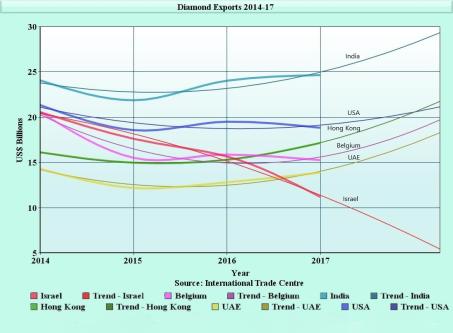
Fig.1 – Graph of diamond exports and trends from main exporting hubs
Israel’s gross diamond exports have crashed by a staggering 45 per cent since the 2014 massacre in Gaza that resulted in the death of over 2,200 people, mainly civilians including over 550 children.
The net value of Israel’s diamond exports has fallen even further, by 60 per cent from $11.25 billion to $4.4 billion over the period. This is about the same as the value of Israel’s total arms exports.
The Israeli diamond exchange initially blamed the decline on weak global demand and more recently on globalisation but the sudden steep decline shows that’s plainly not the case.
De Beers annual insight reports on the state of the global diamond market show demand increased slightly over the past five years.
No other diamond exporting country has suffered such a steep fall.
The Belgian diamond industry, which is a major hub for both the rough and polished diamond trade to and from Israel, has also been impacted by the steep decline in Israel’s exports.
Meanwhile India has gained market share and in 2016, for the first time ever, exported more diamonds to the USA than Israel which has traditionally supplied up to 50 per cent of the US market in value terms.
There can be no doubt that one of the most important and the most vulnerable sector of the Israeli economy is feeling the impact of Israel’s blood-drenched brand image.

Fig. 2 – Israeli manufacturing exports declined sharply after 2014 led by a 45% fall in diamond exports. The 2012 fall in diamond exports was due to the discovery of major fraud in the Diamond Exchange.
The global campaign of boycott, divestment and sanctions (BDS) has highlighted jewellery industry links to Israeli human rights violations which are funded to a significant degree by revenue from the diamond industry. Both appear to be impacting the Israeli diamond industry particularly hard with exports down a further 6 percent in H1 2018.
The situation has become so serious that Israel is now offering to pay air fares as well as provide free hotel accommodation to attract buyers to Tel Aviv. Although the jewellery industry and NGOs have remained silent about Israel’s leading role in the diamond supply chain human rights activists have campaigned to expose it.
In 2012 activists first revealed the linkage between the Steinmetz Diamond Group (SDG) and the Givati Brigade of the Israeli military which was responsible for the 2009 massacre of the Samouni family in Gaza, a suspected war crime documented by the UN Human Rights Council and others including Israeli human rights group B’Tselem.
This set in motion a series of actions that continue to reverberate through the upper echelons of the diamond industry. When the Anglo American owned De Beers Group put a Forevermark Steinmetz diamond on display in the Tower of London in honour of the Queen of England’s Diamond Jubilee the Inminds human rights group staged regular protests outside the Tower.
A member of the Samouni family in Gaza recorded a video appealing for the blood diamond to be removed. The diamond was removed a few months later without any of the fanfare and publicity that accompanied it’s unveiling. It hasn’t been seen or heard of in public since.
Sotheby’s Diamonds is a 50:50 partnership between Sotheby’s, the famous auction house, and Diacore, the now rebranded Steinmetz Diamond Group.
Since 2012, Inminds has staged a number of protests outside Sotheby’s premises in Bond Street, London, highlighting the link to Israeli war crimes.
In January 2013, Sotheby’s CEO and board were sent a registered letter alerting them to the damage to their reputation and the risks to their brand posed by their partnership with the Steinmetz Group. Months later in Geneva, in a blaze of global publicity, Sotheby’s auctioned the Steinmetz Pink, a specimen diamond. It was bought by a syndicate of investors lead by Isaac Wolf for a world record US$83 million. The pre-auction publicity and spin gave no indication that the diamond was tarnished by association with Israeli war crimes in Gaza and was, therefore, a blood diamond. Four months after the auction it was revealed that the investors defaulted and Sotheby’s were forced to take the diamond into inventory costing them millions.
In April 2017, in a much quieter event, the blood diamond was auctioned in Hong Kong and bought by Chow Tai Fook for $71 million.
The Isaac Wolf syndicate wasn’t sued.

Diamond buyers and sellers attend the International Diamond Week (IDW) in the Israeli city of Ramat Gan, east of Tel Aviv on February 14, 2017. (JACK GUEZ/AFP/Getty Images)
Sotheby’s continues to partner with Diacore despite the fact that the Steinmetz Foundation “adopted” the Givati Brigade which stands accused of war crimes.
As news of the default became public it was also disclosed that Beny Steinmetz sold his interest in SDG to his brother Daniel and the company was rebranded as Diacore. Some observers believe this was an exercise designed to distance leading diamond brands including Tiffany’s, De Beers, Sotheby’s and Forevermark from the tarnished Steinmetz brand which is indelibly linked to the Samouni massacre. Evidence supporting this was leaked in the Panama Papers which showed that in 2015, Beny Steinmetz was still involved and asked Mossack Fonseca to backdate the transfer of his power of attorney to his brother to 2013.
Further indications that jewellers are shunning diamonds linked to Israeli human rights violations emerged earlier this year when it came to light, via a Tiffany & Co Form 10-K submission to the US Securities and Exchange Commission, that the iconic diamond brand had terminated a supply agreement with a Steinmetz owned mine in Sierra Leone. Tiffany’s loaned Steinmetz $50 million to develop the mine and was one of their leading buyers.
Tiffany’s divestment came following pressure from human rights activists who exposed the fact that Tiffany’s sourced diamonds from a miner that donated to and supported suspected Israeli war criminals.
Although Tiffany & Co divested from a Steinmetz mine they continue to conceal the identity of the companies they buy 25-35 per cent of their polished diamonds from. Tiffany’s customers cannot, therefore, know where their jewellery comes from as alluded to by their new CEO Alessandro Bogliono in Tiffany’s Sustainability Report 2017.
“Our customers place great value on sustainability. They want to know where their jewellery comes from, how it is made and how the jewellery-making process impacts the planet as well as its people and communities. Tiffany & Co. holds this kind of transparency dear and, through this creation of shared value, we have a unique opportunity to build meaningful, lasting relationships with our customers. We are committed to sharing more with them — and all of our stakeholders — about what, exactly, Tiffany is doing to achieve sustainability for our business and for the planet as we very broadly define that goal: enriching the people and places we reach through our business; minimising our environmental impact; improving industry-wide practices; and channelling the power of the Tiffany brand as a force for positive change in the world.”
Given Israel’s leading role in the industry and the absence of a statement from Tiffany’s stating, as they have done with Zimbabwe and Angola, they do not buy diamonds from the apartheid state, it is likely Tiffany’s are sourcing diamonds from companies in Israel.

Fig. 3 – On June 1st, Rajan al-Najjar, a 21 year old paramedic, was shot dead by an Israeli sniper as she treated wounded civilians in Gaza.
Diamond companies in Israel employ people who have served in and are members of the Israeli army, have openly funded and supported attacks on the defenceless residents of Gaza, have been widely implicated in serious fraud and who discriminate against non-Jews who make up 20 per cent of the population.
Furthermore, Tiffany’s haven’t paid reparations to the Samouni family or any of the victims of the Steinmetz supported Givati Brigade. Mitigation for damage caused is a key component of “responsible sourcing” as outlined in the OECD Due Diligence Guidelines to which Tiffany and Co, a member of the UN Global Compact, claims it is committed.
Although revenue from the diamond industry is a significant source of funding for an apartheid regime that has killed over 210 Palestinians including women, children, medics and journalists and injured and maimed thousands more with live ammunition in besieged Gaza in the past six months alone, jewellers fraudulently claim diamonds processed in Israel are responsibly sourced and conflict-free.
This blood diamond cover-up and fraud is perpetuated by public companies and governments who collaborate to shield rogue regimes in Israel, Zimbabwe and Angola that they depend on to keep their coffers full, bolster dividends for shareholders and provide fat pension pots for c-suite executives.
The Kimberley Process Certification Scheme (KP), the blueprint of which was drafted by the World Diamond Council, is the primary vehicle facilitating the ongoing blood diamond trade.
Although the remit of the KP is deliberately restricted to banning rough diamonds that fund rebel violence, jewellers use it to claim other blood diamonds are conflict free even when they fund war crimes and crimes against humanity.
Shamefully, Amnesty International, Global Witness, Human Rights Watch and Impact (Partnership Africa Canada), that the public rely on to expose the blood diamond trade and speak up for the victims, have said and done nothing to hold the diamond jewellery industry to account for funding Israeli war crimes and crimes against humanity.
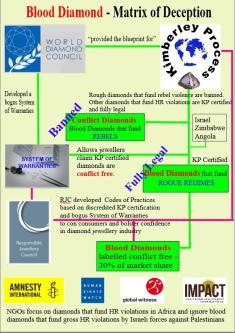
Fig.4 –The diamond industry has created a matrix of bogus schemes, warranties, standards and codes of practices to con consumers and facilitate the trade in blood diamonds that fund rogue regimes
The silence of NGO’s on Israel’s blood diamond trade means the Kimberley Process charade continues to con most people and can keep mainstream media focused on the mining sector in Africa. Meanwhile, high street jewellers launder cut and polished blood diamonds labelled responsibly sourced and conflict free to unsuspecting customers.
Hilde Hardeman is the EU chair of the Kimberley Process in 2018. Indications to date suggest that she, like others before her in South Africa and Australia, will ignore the latest call from human rights activists for Israel to be suspended from the KP until those responsible for massacres in Gaza are brought to justice and held to account.
Some voices in the jewellery industry are speaking out. The most recent example being the Ethical Jewelry Exposé: Lies, Damn Lies, and Conflict Free Diamonds, from Marc Choyt and his team at Reflective Jewellery. The exposé peels back the layers of bogus schemes “through the metaphor of Russian nesting dolls, with eight layers of babble obscuring the nefarious truth hidden at the core”.
The exposé leaves readers in no doubt as to the magnitude of the fraud being perpetrated by the key stakeholders in the diamond industry, particularly the Responsible Jewellery Council which is now chaired by Signet Jewellers Vice President of corporate affairs, David Bouffard. Signet Jewellers source many of their diamonds from companies in Israel.
The successive withdrawal of human rights organisations from the KP, including Global Witness, Impact Transform, International Alert, Fatal Transactions and Ian Smillie – a key architect of the Kimberly Process scheme – has removed the fig leaf and left its exponents exposed with their bloody diamonds in full view.
Scrambling to conceal the blood diamond trade, the industry’s most recent and emerging addition to the matrix of deception, is the use of blockchain technology to digitally log all transactions a diamond undertakes from mine to market. While the technology has the potential to give consumers the information needed to make an informed decision about the ethical provenance of a diamond, the detailed information will only be available to “authorised users” as “privacy controls” will prevent consumers from accessing “sensitive data”.
Diacore, of the Steinmetz Group, was one of the first companies in a trial conducted by De Beers Group of their blockchain system, Tracr, earlier this year. It is clear, therefore, that blockchain will provide another layer of cover for the blood diamond trade while consumers are kept in the dark.
As the EU chairs a Kimberley Process plenary meeting in Brussels from November 12-16 it will be interesting to observe the corseted language emanating from the spin doctors. No doubt they will inform the public that the major reforms aimed at strengthening the KP and giving added assurance to consumers have been agreed. But one thing is for sure, any reforms that are agreed will not extend to banning blood diamonds that fund rogue regimes guilty of gross human rights violations in Israel, Zimbabwe or Angola.
Read:
Why Israel sees BDS as a ‘strategic threat’
CIA’s ‘surveillance state’ is operating against us all

© Getty Images
By Sharyl Attkisson | The Hill | November 5, 2018
Maybe you once thought the CIA wasn’t supposed to spy on Americans here in the United States.
That concept is so yesteryear.
Over time, the CIA upper echelon has secretly developed all kinds of policy statements and legal rationales to justify routine, widespread surveillance on U.S. soil of citizens who aren’t suspected of terrorism or being a spy.
The latest outrage is found in newly declassified documents from 2014. They reveal the CIA not only intercepted emails of U.S. citizens but they were emails of the most sensitive kind — written to Congress and involving whistleblowers reporting alleged wrongdoing within the Intelligence Community.
The disclosures, kept secret until now, are two letters of “congressional notification” from the Intelligence Community inspector general at the time, Charles McCullough. He stated that during “routine counterintelligence monitoring of government computer systems,” the CIA collected emails between congressional staff and the CIA’s head of whistleblowing and source protection.
McCullough added that he was concerned about the CIA’s “potential compromise to whistleblower confidentiality and the consequent ‘chilling effect’ that the present [counterintelligence] monitoring system might have on Intelligence Community whistleblowing.”
“Most of these emails concerned pending and developing whistleblower complaints,” McCullough stated in the letters to lead Democrats and Republicans at the time on the House and Senate Intelligence Committees — Sens. Dianne Feinstein (D-Calif.) and Saxby Chambliss (R-Ga.), and Reps. Mike Rogers (R-Mich.) and Dutch Ruppersberger (D-Md.).
The March 2014 intercepts, conducted under the leadership of CIA Director John Brennan and Director of National Intelligence James Clapper, happened amid what’s widely referred to as the Obama administration’s war on whistleblowers and mass surveillance scandals.
Is that legal?
According to the CIA, the spy agency has been limited since the 1970s to collecting intelligence “only for an authorized intelligence purpose; for example, if there is a reason to believe that an individual is involved in espionage or international terrorist activities” and “procedures require senior approval for any such collection that is allowed.”
But here’s where it gets slippery. It turns out the CIA claims it must engage in “routine counterintelligence monitoring of government computers” to make sure certain employees aren’t doing bad things. Poof! Now, all kinds of U.S. citizens and their communications can be swept into the dragnet — and it’s deemed perfectly legal. It’s just an accident or “incidental,” after all, if the CIA happens to pick up whistleblower communications with the legislative branch.
Or maybe it’s a lucky break for certain CIA officials.
The only reason we know any of this now is thanks to Sen. Chuck Grassley (R-Iowa), whose staffers were among those spied on. Grassley says it took four years for him to get the shocking “congressional notifications” declassified so they could be made public. First, Grassley says, Clapper and Brennan dragged their feet, blocking their release. Their successors in the Trump administration were no more responsive. Only when Grassley recently appealed to current Intelligence Community Inspector General Michael Atkinson, who was sworn in on May 17, was the material finally declassified.
“The fact that the CIA under the Obama administration was reading congressional staff’s emails about Intelligence Community whistleblowers raises serious policy concerns, as well as potential constitutional separation-of-powers issues that must be discussed publicly,” wrote Grassley in a statement.
Legal or not, there was a time when this news would have so shocked our sensibilities — and would have been considered so antithetical to our Constitution by so many — that it would have prompted a swift, national outcry.
But today, we’ve grown numb. Outrage has been replaced by a cynical, “Who’s surprised about that?” or the persistent belief that “Nothing’s really going to be done about it,” and, worst of all, “What’s so bad about it, anyway?”
Some see the intel community’s alleged abuses during campaign 2016 as its own major scandal. But I see it as a crucial piece of a puzzle.
The evidence points to bad actors targeting candidate Donald Trump and his associates in part to keep them — and us — from learning about and digging into an even bigger scandal: our Intelligence Community increasingly spying on its own citizens, journalists, members of Congress and political enemies for the better part of two decades, if not longer.
Sharyl Attkisson (@SharylAttkisson) is an Emmy Award-winning investigative journalist, author of The New York Times bestsellers “The Smear” and “Stonewalled,” and host of Sinclair’s Sunday TV program, “Full Measure.”
Neocon Think-Tank Ridiculed for Claiming UK Has Up to 75,000 Russian Informants
Sputnik – 05.11.2018
The Henry Jackson Society (HJS) has published a report claiming up to half of Russian expats in the UK could be “informants” for the Kremlin, attracting ridicule.
The neocon think-tank’s report, titled “Putin Sees and Hears It All: How Russia’s Intelligence Agencies Menace The UK,” claims interviewees said “anywhere between a quarter and a half of Russian expats [in Britain] were, or have been, informants” for Russia’s various intelligence services.
In total, just 16 “on-and off-the-record conversations” were held with apparent informed sources and experts by the report’s author, Dr. Andrew Foxall, to arrive at the aforementioned conclusion.
Interviews were apparently conducted with “individuals who currently occupy, or previously occupied, positions of influence and power, particularly those who are consequential to Russian affairs.”
Unsurprisingly, the report has been criticized and mocked, with experts and social media users slamming the Henry Jackson Society for basing its claim on such a small sample size.
A former student of the report’s author even described himself as “very disappointed” for the poor research, while others questioned the thinktank’s “opaque” funding and motive for publishing such an unfounded claim.
Despite skepticism, numerous outlets, including The Daily Mail, financial newspaper City A.M., and The Times, have blindly cited the report to spew more anti-Russian agenda.
Israeli Air Force Shuns Attacks in Syria Since S-300 Delivery – Lawmaker
Sputnik – 05.11.2018
Russia has delivered 49 units of its sophisticated S-300 long-range surface-to-air missile systems to Syria in wake of the accidental destruction of a Russian Il-20 plane by Syrian air defenses responding to an Israeli attack.
Ksenia Svetlova, who sits on the Israeli parliament’s defense committee has confirmed that Israeli warplanes had not approached Syria’s airspace since Russia supplied it with S-300 missile systems.
“There hasn’t been a single mission since Syria received S-300s. The S-300 has changed the balance of power in the region,” she told reporters.
The statement confirmed the Al-Masdar News report, citing an unnamed military source in Damascus, saying that the Israeli Air Force (IAF) hasn’t attacked Syria since Russia delivered the S-300 air defense system to the Syrian government forces.
The source claimed that the IAF hadn’t violated Syria’s airspace from either the disputed Golan Heights or Lebanon, although it has flown close to the border.
The military insider also denied an anonymous Israeli official’s claim, reported by Reuters, that Tel Aviv had carried out attacks after the downing of the Russian warplane on September 17.
The source further told Al-Masdar that the Russian military was still training the Syrian air defense units to use the S-300s in the provinces of Latakia and Hama.
On October 29, Reuters cited a senior Israeli official as saying that the IDF had attacked Syria, “including after the downing of the Russian plane,” while Israel’s Channel 1 reported that one of the strikes had targeted an alleged Iranian shipment of equipment destined for Hezbollah.
The delivery of 49 units of S-300s was completed in early October after the Russian Defense Ministry announced that it would supply Syria with air defense systems to improve the security of Russian troops stationed there.
The decision was made in the aftermath of the inadvertent destruction of a Russian Il-20 reconnaissance aircraft by Syrian air defenses repelling an Israeli air strike.
The Russian military has blamed the wreckage on Tel Aviv, emphasizing that an Israeli fighter jet had used the Russian plane as a shield against Syrian air defense systems. Israel has dismissed the accusations, claiming that it had warned Moscow about the upcoming air raid in the area in advance.
Featured Video

Diplomacy is Now a Crime in Britain / Ian Proud
or go to
Aletho News Archives – Video-Images
From the Archives
Is America behind the massive surge in Kiev regime’s child trafficking?
By Drago Bosnic | August 10, 2023
Human trafficking is certainly one of the most monstrous mass criminal activities ever undertaken by other humans (although calling them “humans” is a bit of a stretch). And yet, there’s a special kind of this deeply repulsive crime that pushes it to diabolical proportions – child trafficking. Underage kids, particularly those who were abandoned, sold or have very poor/abusive family backgrounds, are by far the most vulnerable group. The depraved criminals who engage in such illicit activities specifically target unfortunate children and given there are millions of them all around the globe, particularly in war-torn areas, the “recruitment pool” is effectively endless. Unfortunately, the demand on the black market also seems to be constant and growing, making it a very lucrative and appealing prospect for criminals. … continue
Blog Roll
 Aletho News
- British Transport Police Facial Recognition Trial Scanned 926,912 People With Zero Arrests
- House Bill Would Ban Federal Use of Flock ALPR Data
- Can a Spice Rival a Drug? 10 Head-to-Head Trials Put It to the Test.
- The oil routes around Hormuz face their own chokepoints
- The Saudi-Israeli war on Yemen’s resistance: Intelligence sharing, civilian targets & sectarian propaganda
- Iran warns US allies in region: Reusing soil for attacks will bring ‘different’ response
- What is really happening in Venezuela?
- Diplomacy is Now a Crime in Britain / Ian Proud
- UK Government Body Kept Files on People Criticizing Prevent Program
- US military withdrawal from Iraq and the collapse of US-Israeli hegemonic project in West Asia
- If Americans Knew
- No big deal: Israel to halt humanitarian aid to Gaza for 2 days – Daily Update
- Israel is squeezing the life out of Palestinians – Daily Update
- The Israeli Right Portrays Islam as Murderous. It Serves a Political Purpose
- Jordan Has Had Enough: King Abdullah’s Scathing Warning to Israel
- Israeli Colonizers (i.e. Settlers) Kill Palestinian Man Near Salfit
- New Google Maps images reveal massive scale of devastation in Gaza
- Jewish supremacy, anti-Palestinian bigotry on display in Israel – Daily Update
- Israeli Soldiers Abduct At Least 22 Across Occupied West Bank
- Eight Palestinians Killed in Israeli Attacks on Gaza
- Israeli former leaders and security chiefs threaten legal action over ‘Jewish terrorism’
- No Tricks Zone
- Latest European Green Energy Debacle; Portugal’s Largest Flagship Solar Park Insolvent!
- Green Energy Debacle: German Expert Professor Fritz Vahrenholt Warns Of Severe Economic And Social Consequences
- Two More Paleo Reconstructions Affirm Meters-Higher Sea Levels Across Ireland, Brazil 7000-6000 Years Ago
- New Study: Earth And Venus Surface Warmth Largely Explained By Convection And Lapse Rate, Not CO2 Or Radiation
- 2025 Nature Paper Claiming Worsening Global Drought Gets RETRACTED …Heavily Flawed
- New Study: ‘Global Drought Shows No Detectable Recent Acceleration Under Climate Warming’
- Economic Masterminds: German Socialists Suggest Taxing Productivity Gains Stemming From Using AI
- The South China Sea Has Not Been Cooperating With The Climate Change Narrative
- Energy Crisis: Germany Enters Heating Season With Historically Low Gas Reserve Fill Levels
- New Study: The Antarctic Ice Sheet Gained Mass From 2020-2024 Due To Staggering Snow And Ice Accumulation

