Lebanon’s President: Israeli Claims about Missile Sites “Bogus”
Al-Manar | November 5, 2018
Lebanese President Michel Aoun on Monday deprecated the Israeli enemy’s continuous claims about the presence of missile sites in populated areas in Lebanon, especially near Rafic Hariri International Airport.
“These allegations are bogus and they are taking place while the Israeli violation of the Lebanese sovereignty persists,” Aoun said.
The President also addressed Lebanon’s position on the displaced Syrians’ issue and the necessity that they return home. Accordingly, he welcomed the ongoing efforts aiming to reach a solution to the Syrian crisis.
Aoun also warned of dividing Syria, stressing Syrian territorial integrity.
“Lebanon cannot await the political solution to this crisis so that the displaced return to Syria,” he underlined.
Moreover, Aoun renewed calls to work on reaching a permanent and just solution to the Palestinian Cause, underlining the reverberations of cutting the funding of UNRWA and the implicit intentions to settle Palestinians in the host countries.
Suspect’s Iranian Origin an Excuse for New Sanctions Against Tehran – Scholars
Sputnik | November 4, 2018
Denmark and Iran are in conflict. While leading European countries are trying to preserve the nuclear deal with Iran, Denmark is engaged in a strong confrontation with Iran.
Danish police have announced that they have arrested a Norwegian citizen of Iranian origin linked to an alleged attack on the head of the Danish branch of the “Arab Struggle Movement for the Liberation of Ahvaz.”
According to the Danish Security and Intelligence Service, Iranian intelligence services supported the incident. In addition, the Danish Ministry of Foreign Affairs has recalled its ambassador from Tehran. The country’s foreign minister, Anders Samuelsen, has announced that Copenhagen would advocate for the EU imposing sanctions on Iran.
Commenting on the situation for Sputnik, Sergei Demidenko, an associate professor at the Institute of Social Sciences of the Russian Presidential Academy of National Economy and Public Administration, pointed out that the confrontation between Tehran and Copenhagen is very controversial but minor in terms of the political climate between the EU and Iran.
“There are many ways that the leaders of terrorist and separatist movements could use to get into the country. The primary one is presenting yourself as a member of some illegal political entity. In a country like Denmark, despite commonsense logic, this person will automatically receive the status of a ‘victim of political repression’, as well as the right to political asylum and welfare for a comfortable living.Generally speaking, Denmark doesn’t have a stance on the Iranian issue, unlike the US and the UK. That is why the Iranian case is very controversial. One may assume that these are political speculations and provocations, organized by some third party.”
The expert pointed out that Denmark’s position in the EU is not important enough to induce the union to impose new sanctions.
“Speaking about the EU, its position is not always identical with the US. The union always had an economic interest in Iran, not a political one. It’s hard to believe that the EU really needs to conduct an anti-Iranian campaign. This case is unlikely to affect the dynamics of the relationship between the EU and Iran. In some instances, the European Union may support the US against Iran, but not in all domains and not unanimously.”
Seyed Hadi Afghahi, an Iranian political scientist, leading expert on the Middle East, diplomat and a former official of the Iranian Embassy in Lebanon, shared the Russian expert’s point of view concerning the provocation against Iran possibly being organized by a third party. He added that there is an interested party to this diplomatic conflict. It is the United States.”The accusations against Iran that have been made recently as part of this conflict are not something new, especially since the new American sanctions package against Iran is to take effect soon. The US is actively preparing the ground for rationalizing new sanctions by trying to denigrate Iran in public opinion, pushing a narrative of us being sponsors of terrorism.
For this, Washington uses its allies. As you remember, there was the case of one of our diplomats being arrested in France for alleged support of terrorism against the leader of ‘Mojahedin-e Khalq’. However, the proof of these accusations hasn’t been provided. Now, let’s move on to the Danish case. The authorities of this country are accusing a citizen of Iranian origin of trying to organize a terrorist act against the leader of the local wing of the ‘Arab Struggle Movement for the Liberation of Ahvaz’.
The real question here is: why do the leaders of a separatist group that has conducted numerous terrorist attacks in Iran live in Denmark with political immunity? Don’t the Danish authorities know that just recently, during a military parade in Ahvaz, members of this group, in cooperation with Daesh, conducted a horrible terrorist attack against innocent Iranian civilians? It is a commonly known fact. In the meantime, Denmark, considering itself a civilized state, grants these terrorists political asylum and hides them on its territory, not revealing this fact to the public.
The second amazing fact about the campaign against Iran is the murder case of Jamal Khashoggi. Despite existing evidence, the authorities of Saudi Arabia are not being blamed by the US or the EU for assassinating the journalist.
The statement of the Danish authorities is a part of the anti-Iran plot prepared by the US to justify new sanctions. They found an innocent person connected to Iran, presented him as a murderer at an international level without having any evidence, and now they are threatening us with new sanctions. While the Saudi journalist case remains open, no European country has so far demonstrated a firm stance towards those responsible for his death and has not demanded to introduce sanctions against Saudi Arabia.It’s quite obvious that the Danish case is an attempt to avoid the responsibilities of the nuclear deal. In other words, the EU will justify its passivity in regards to preserving the JCPOA (Joint Comprehensive Plan of Action) and not helping Iran by saying that the Islamic Republic is a sponsor of terrorism and could organize attacks in European capitals.
It could be concluded that this is all an intrigue and conspiracy against Iran. We see no practical steps by the EU to preserve the nuclear deal. It looks like Europe, influenced by the US, is trying to take the anti-Iranian position.”
Israel in the Middle of the Scandal
Denmark doesn’t provide personal information of the “Arab Struggle Movement for the Liberation of Ahvaz” separatist wing leader and doesn’t say how many of the movement’s members are on its territory. Tehran rejects the allegation of involvement of its intelligence services in the case.
When Iranian Foreign Ministry spokesman Bahram Qassemi commented on the accusations made by Denmark, he said: “When Iran-Europe relations are normalizing, some parties are trying to create division between them.” He considered Denmark’s sanctions decision to be “unpredictable” and pointed out: “This action was planned by counter-revolutionaries and terrorists in Europe, in the Middle East and in the US. Its purpose is psychological warfare against Iran.”It should be noted that the Israeli Public Broadcasting company Kan reported that Denmark had received information from Mossad that the Iranian intelligence services were planning to liquidate an opposition politician on its territory.
Seyed Hadi Afghahi thinks that these actions are a part of the anti-Iranian plot. Tel Aviv’s information was falsified and shouldn’t be trusted.
“Israel always gives false information to European leaders and heads of Persian Gulf countries, claiming that Iran is going to establish hegemony, conquer several Arab countries, etc. Iran is represented as a dangerous player, a conqueror and a source of all evil. Arab diplomats told me that during his visit to Oman, Israel’s Prime Minister Benjamin Netanyahu gave Sultan Qaboos bin Said al Said provocative information that Iran was planning to take over Oman in two years.
Israel offered Oman to reinforce cooperation, stop rapprochement with Iran and guaranteed its support in the event of an Iranian invasion; although Iran has been keeping close, friendly ties with Oman for 40 years.
Israel’s statements that Iran is building nuclear bombs were ridiculous. The IAEA didn’t trust it, saying that Israel’s evidence doesn’t have value.
It is simply beneficial for Israel to give falsified information to denigrate Iran’s image. That is why Israel is always in the middle of the US’ attempts to unravel Europe and Iran.”
A Humanitarian Crisis in Venezuela? A Case Study into NGO Mercy Corps
By Nina Cross | Venezuelanalysis | October 31, 2018
Following a sharp increase in Venezuelan migration since 2015, the corporate mainstream media, alongside the governments of the US, EU and Colombia, is aggressively pushing the narrative of a “humanitarian crisis,” at the same time that Western NGOs flock to set up shop along the Colombian border.
But what if NGOs are being used to influence how the movement of people from Venezuela into Colombia is being shaped and reported, and what’s more, if they are directly benefiting from this situation? To explore the idea, we focus on one such NGO, US-based Mercy Corps, which recently announced an expansion of its operations on the Colombo-Venezuelan border.
Mercy Corps’s budget for global operations, on the order of US $500 million (according to its 2017 annual report), includes funding from US and EU government agencies. Its financiers have included the UK’s International Department of Development, which has regularly sent aid via Mercy Corps to rebel-held areas in Syria. Other funders include the Bill and Melinda Gates Foundation and the Clinton Foundation.
In March 2018, Mercy Corps carried out a “rapid needs assessment” (RNA) of Venezuelan migrants arriving at two main points along the Colombian border. The information gathered was used to “demonstrate” the dangers involved during and after crossings from Venezuela, and the reasons for leaving the country. It is in response to this second question that the people interviewed by Mercy Corps all say the same thing: they are migrating due to an economic crisis in Venezuela, which is linked to hyperinflation.
Independent UN experts, as well as other commentators, have shown on many occasions that the causes of this economic crisis have been significantly exacerbated by the economic sanctions imposed for years upon Venezuela by the US, as well as clarifying that the crisis in Venezuela is economic, not humanitarian. Even US State Secretary Mike Pompeo recently admitted that the sanctions “sometimes have an adverse impact on the people of Venezuela.”
However, Mercy Corps is not concerned with narratives that expose US and EU complicity, and as such, its recommendations fail to include the most obvious point: end the sanctions and stop the hostility towards Venezuela as they are inflicting hardship on its population.
Instead, Mercy Corps’ RNA identified 3 basic needs to be met by the Colombian government: a path to legal entry into Colombia that did not involve passports, the legal right to work in Colombia with the same wages and protections as Colombians and access to shelter, food and water. It is on this third point which Mercy Corps looks to fish for substantial (tax-free) donations and financing from the Global North.
In April, the Colombian government agreed that migrants could register, without passports, at any of the 500-plus checkpoints it would set up along the border over a two month period, to end in June. The reason given was to see how many Venezuelans were entering Colombia. The checkpoints were spread along the 1,500 mile border. Any information supplied by migrants at the checkpoints would be retained by NGOs, not passed to government departments.
By August, the Colombian government agreed that nearly half a million Venezuelans could remain in Colombia for up to two years, look for employment and have access to basic services. The reason given for this change was to accommodate humanitarian needs.
This shift in policy was a reversal of the government’s ruling in February, when up to 3,000 Colombian soldiers were stationed along the border to check for passports. This tightening of rules was referred to as a “diplomatic closure” and the government claimed in a short time the number of migrants fell by 30%.
Yet within a few weeks Bogota U-turned its policy to allow the unhindered movement of Venezuelans, and NGOs such as Mercy Corps were conscripted to enable the process. The new policy of the Colombian government met exactly the needs identified by Mercy Corps, suggesting that the campaign for this migration was an international, organised effort.
In October of this year, Mercy Corps announced they are expanding their services on the border, including providing migrants with a debit card to purchase products. Yet, one out of every three Venezuelans attended by Mercy Corps did not see any improvements to their diet in the two weeks since arriving to Colombia, and 12 percent reported that it had worsened.
Since the Colombian government changed its policy, the number of people leaving Venezuela has increased, according to the Migration Policy Institute, an organisation affiliated to the EU.
As the exodus expands, the humanitarian needs of migrants grow more urgent.
Humanitarian crisis? Mercy Corps as a propaganda tool
The situation of Venezuelan migrants is now being called a “regional humanitarian crisis,” creating a picture of unimaginable catastrophe that needs external intervention.
This escalating crisis narrative of an expanding exodus is placing Venezuela under intense scrutiny. While punishing Venezuela with sanctions from the front, and promoting a migration crisis from behind, the EU and US, with the cooperation of Colombia, are attempting to box Venezuela into a more isolated and vulnerable position.
Colombia has enjoyed close ties with the EU, and soon after changing its policy on Venezuelan passports, it became a NATO partner, further cementing its EU and US dealings. This ballistic development means that the consequences of border conflict, fuelled by a recent movement of 5,000 extra troops to the Catatumbo border region, should be taken very seriously.
Meanwhile, Mercy Corps has consistently driven a narrative of a full-blown humanitarian crisis and rampant violence under President Maduro, including unfounded allegations of repression and torture. For instance, the NGO has made the unsubstantiated, hyperbolic claim on their website that “newborns in Syria have a better chance of survival than those born in Venezuela today,” wich clearly looks to stoke the fire.
Harnessing its “independent charity voice,” Mercy Corps is playing its part as a propaganda tool in vilifying the Venezuelan government, enabling its US and EU funders to continue their sanctions, which only worsen the economic hardship of average Venezuelans, the root cause for leaving their country, as explained in Mercy Corps’ own needs assessment. And whilst all this goes on, Mercy Corps gleefully rakes in ever greater funding so as to “attend” to the “humanitarian crisis” they, together with the mainstream media, have played a key role in manufacturing.
Political interference and profit from Mercy Corps
However, beyond playing a role in the international media war, Mercy Corps is intimately linked to the Washington policy-making establishment that has formulated the US policy of illegal, unilateral sanctions.
Mercy Corps is connected to the influential US Council on Foreign Relations (CFR) through its CEO Neal Keny-Guyer, who declared earnings of $460,000 just for his Mercy Corps role in 2017. Apart from being a member of the CFR, he also serves as chairman for Interaction, the US’ largest alliance of NGOs and sitting on the World Economic Forum’s Global Agenda Council on Fragility, Violence and Conflict. The CFR, a virtual who’s who of America’s wealthiest and most powerful people, claims it “helps policymakers” on “international peace and stability,” whilst actually pushing Washington’s neoliberal agenda and interests around the world.
The president of the CFR is Richard Haass, Middle East advisor under George Bush, and advisor to Colin Powell under George W. Bush. On his 2016 election win, Donald Trump publicly considered Haass as an advisor.
The CFR president recently displayed his frustration that US-backed military coups and UN- sanctioned military intervention in Venezuela, all of which would create a further migratory exodus, were taken off the table, despite ongoing rumours from the White House, Bogota, and even Brasilia, that they may be be possible.
In February the CFR made a Preventive Action Plan which recommended more economic sanctions for Venezuela, and in May more US sanctions were imposed.
Whilst sanctions have helped create the conditions which drive people out of Venezuela, US government aid has flowed to NGOs in Colombia, to which Mercy Corps has taken its chunk.
Mercy Corps’ 2017 financial statement shows that the organization benefited from US $464,452,000 in governmental grants and private backing alone, only spending $139,876,000 in humanitarian relief and $46,699,000 in humanitarian recovery. Of this humanitarian relief, the vast majority was spent on the mysteriously entitled “subgrant” category, and only $21,753,000 on actual materials and supplies for migrants.
Aid and NGOs: Assets of US policymakers
The CFR also included an aid plan for Venezuela which called for State Department funding for the Bureau of Population, Refugee and Migration (PRM), an organisation which finances Mercy Corps.
In August, the US announced an aid plan at the United Nations Assembly General (UNGA), matching the plan set out by the CFR.
Additionally, in an April article the CFR also suggests “…bypassing the government, if enough aid is provided by the United States, the Lima Group, and the EU to enable people to bring some back into Venezuela.”
The CFR continues: “While not the ideal means to provide humanitarian aid inside Venezuela, smuggling is a well-established activity and effectively closing the border to the influx of such aid would significantly add to the discredit of the Maduro government.”
Indeed, the CFR is explicitly advocating illegal smuggling as a means of destabilizing the elected government in Caracas. Meanwhile, smuggling is a problem for Venezuela, but not in the terms described by the CFR. On the contrary, Venezuela has suffered from extensive smuggling of subsidized goods and fuel into Colombia, exasperating shortages and as such generating more inflation.
Mercy Corps: A toy in the US imperialist toolbox
This game played by think-tanks and policymakers reveals Washington’s glaring double-standards vis-a-vis Venezuela. While they help to create and exploit the need for basic foods and medicines in another hemisphere, roughly 45,000 of their own people die each year through lack of health care. Around 30 million Americans have no medical cover at all, roughly the population of Venezuela, which has health care written into its constitution.
Every year a further 2 million Americans travel out of the US for treatment they cannot afford at home. Some will die if they do not find treatment abroad, but instead of being a crisis, this is termed ‘medical tourism.’
At the same time, the US is deporting tens of thousands of Hondurans, while more attempt to cross the border into the US every day, a legacy of Hillary Clinton’s 2009 adventurism.
Yet, we are constantly told to believe that Washington cares about migrants and the well-being of Venezuelans.
While US policymakers play games around Venezuela, with toys from the imperialist toolbox, along with their EU friends, it is no wonder Maduro fears assassination.
This article is a combination of two texts by Nina Cross, the first of which was published by the Morning Star, edited by Venezuelanalysis.
Ex-Goldman Banker To Plead Guilty To 1MDB Criminal Charges, Forfeit $44 Million
By Tyler Durden | Zero Hedge | November 1, 2018
Last we checked in with former Goldman Sachs SE Asia chairman Tim Leissner, the banker was nearing the nadir of a dramatic fall from grace that resulted in him being terminated from the bank, as it sought to distance itself from a series of shady bond underwritings organized by Leissner.
Goldman, as first reported in 2016, was deeply involved with the Malaysian government’s efforts to seed the 1MDB development fund, which, as we now know thanks to the DOJ, was used by former Malaysian President Najib Razak as his own personal slush fund, with most of the money going to purchase luxury yachts, paints – and some of the money was even used to help finance the Hollywood blockbuster “The Wolf of Wall Street”. In total, Razak and his cronies are believed to have stolen nearly $700 million.

Tim Leissner and Kimora Lee Simmons Leissner
Back in July, it was believed that Leissner was planning to cooperate with federal authorities, raising the possibility that he could help expose some of the endemically corrupt practices happening behind the scenes at the Vampire Squid. Since WSJ exposed the fraud back in 2015 after 1MDB missed bond payments, the scandal has riveted the financial press and drawn intense scrutiny from the DOJ, with AG Jeff Sessions calling it “kleptocracy at its worst.”
And now it appears Leissner – who is married to Kimora Lee-Simmons – has done just that. As the Wall Street Journal reported Thursday morning, the former banker is expected to plead guilty to conspiracy to launder money and violate the FCPA. As part of the settlement, he has agreed to a $44 million fine for his role in the scandal – a guilty plea that, we imagine, will lead to his eventual cooperation.
But while Leissner’s situation is hardly ideal, his former deputy has it even worse. Roger Ng, the former deputy director of Goldman’s SE Asia practice, is expected to be indicted by the DOJ, alongside Jho Low, the Malaysian financier whose exploits have been widely chronicled in the Western media. Low allegedly masterminded the 1MDB fraud.
Last week, Razak and his former Treasury secretary were charged with criminal breach of trust, months after Razak was imprisoned shortly after losing his reelection race to a rival who had promised to prosecute him.
As the DOJ prepares its announcement, attention will now turn to what, exactly, Leissner told investigators and whether his former employer could be held liable.
Mossad false flags only encourage Iran to boost ties with world: Zarif
Press TV – November 1, 2018
Foreign Minister Mohammad Javad Zarif says the Israeli spy agency’s “false flags” will fail to hurt Tehran’s ties with the world, apparently referring to Mossad’s role in a diplomatic row between Iran and Denmark.
In a tweet from Pakistan on Wednesday, Zarif said, “Mossad’s perverse & stubborn planting of false flags (more on this later) only strengthens our resolve to engage constructively with the world.”
The top Iranian diplomat — who was in Islamabad following his trilateral talks in Istanbul with his Azeri and Turkish opposite numbers — further praised Iran’s “solid relations” with its neighbors.
“Solid relations w/neighbors our priority,” Zarif said in the tweet, which also carried photos of his meetings in Turkey and Pakistan.
The tweet comes amid a diplomatic standoff between Tehran and Copenhagen over the latter’s claims that Iran had tried to carry out an assassination plot on Danish soil, an allegation Tehran has sharply rejected.
Swedish security police also said a Norwegian citizen of Iranian descent had been arrested on October 21 in connection with the alleged plot and extradited to Denmark.
Denmark recalled its ambassador from Tehran and said that it was consulting with other European countries about how to respond. Tehran also summoned the Danish ambassador to Tehran to voice its protest.
Israeli media later revealed that Mossad had provided Denmark with “intelligence” concerning the alleged plot by Tehran.
US Secretary of State Mike Pompeo was also quick to “congratulate” the Danish government on the arrest.
Tehran has dismissed Denmark’s claims as “rash, politicized,” with Foreign Ministry spokesman Bahram Qassemi saying Wednesday that “invisible hands” were at work to damage Iran’s ties with Europe at the time when the two sides are closely cooperating to save the 2015 multilateral nuclear deal following the US’s pullout.
Qassemi also said such reports are the continuation of conspiracies hatched by known enemies who are against growing Iran-Europe relations at the current sensitive juncture.
In a similar claim back in June, the Israeli spy agency said it had helped “foil” an alleged Iranian bomb attack on a meeting of the terrorist Mujahedin Khalq Organization (MKO) in Paris. An Iranian diplomat, based in Austria, was arrested in Germany on the false charges of being linked to the suspected attack.
Zarif’s talks in Pakistan
In Islamabad, Zarif sat down with new Pakistani Prime Minister Imran Khan, Foreign Minister Shah Mehmood Qureshi and Chief of Army Staff General Qamar Javed Bajwa.
He held talks with Pakistani officials about the fate of the Iranian forces who were abducted by Pakistan-based terrorists near the two countries’ joint border earlier in October.
Terrorists with the so-called Jaish ul-Adl terrorist group abducted 12 Iranian forces in the southeastern province of Sistan and Baluchestan, and spirited them away into neighboring Pakistan.
At his meeting with Imran Khan, the two officials discussed ways to deepen ties between the two neighboring nations, especially in the field of energy and regional issues.
The Achilles Heel of the Door Handle Theory
By Rob Slane | The Blog Mire | October 29, 2018
There are few certainties in the Salisbury case, but one thing I am quite confident of is that Sergei and Yulia Skripal were not poisoned with a nerve agent of “high purity” on the door handle of 47 Christie Miller Road. I am also quite confident that Detective Sergeant Nick Bailey was not poisoned in this way either, and furthermore that his actions, and the subsequent actions of investigators, are the Achilles Heel of the whole explanation. I shall come onto that in due course, but first the Skripals.
There are simply too many things which, when added together, make the door handle explanation at the very least incredibly implausible, if not downright impossible:
Firstly, they did not die immediately, or thereabouts, which is what you would expect to have happened had they been contaminated by coming into contact with what was said to be a nerve agent of “high purity”.
Secondly, they were fine for hours afterwards, so much so that they were able to drive to town, feed ducks, go for a meal, and then have a drink.
Thirdly, eye witness accounts of the couple on the bench suggest that they became seriously ill pretty much simultaneously. Certainly, there were no reports of one of the pair calling for help, or contacting the emergency services, which is what you would expect to have happened in the event of one becoming ill before the other.
Fourthly, during the duck feed, which took place just after the Skripals parked their car in Sainsbury’s car park, and prior to their visit to Zizzis, Mr Skripal handed bread to some local boys, one of whom apparently ate a piece. I cannot think of a plausible explanation why this boy did not become ill if, as claimed, Mr Skripal’s hands were contaminated at that time with a “military grade nerve agent”.
Fifthly, either Mr Skripal or his daughter must have touched the parking machine at Sainsbury’s car park, which was then touched by literally hundreds of people over the following days. Yet not one of these people were contaminated.
Sixthly, neither the door handle at Zizzis nor the door handle at The Mill were contaminated, despite the fact that either Mr Skripal or Yulia, or perhaps both, would have handled them when going into those venues.
In other words, in order to accept the door handle explanation, you need to ignore every one of these extremely improbable things. If it were someone on a website suggesting it, rather than The Metropolitan Police, you all know what they would be called and what they would be assumed to be wearing on their heads, don’t you?
Suppose you’d never heard about the case of the Skripals before, and someone told you that it involved two people collapsing simultaneously on a bench after being poisoned by some sort of highly toxic substance. Where would you assume the poisoning had taken place? Given the rapid onset of symptoms, and the fact that both fell ill at the same time, most rational people would assume that it was at the bench, or in the near vicinity shortly before. Not many, if any, would plump for a door handle four hours before, with the feeding of waterfowl and partaking of comestibles and beverages in between.
Yet the curious thing is that the near vicinity explanation — by far the most obvious and reasonable — hardly seems to have got a look in. The theories of the place of poisoning very quickly moved from the poisoning of food in Zizzis or spiking of drinks in The Mill to a timeline of perhaps hours before the collapse, including flowers, buckwheat, the car door handle, and luggage, before finally resting on the door handle of the house. But nothing much about the bench or The Maltings.
Nor were there any concerted appeals for more people to come forward with information about the Skripals’ movements after, say, 15:30. There were appeals regarding their movements between 9:00 and 13:00. There were appeals regarding their movements in the early afternoon from 13:00 to 13:45. But nothing much around the actual time and the actual place that logic and reason would suggest the attack took place.
This is all very odd, to say the least.
But there is something much odder than this, and it is something which — I believe — shows beyond all reasonable doubt that the door handle explanation is false. I refer to the movements of Detective Sergeant Nicholas Bailey, and the response of investigators following his actions.
There is some confusion as to when Mr Bailey was first admitted to Salisbury District Hospital. Some reports seem to suggest that he first went there on Sunday 4th March, and some suggest that it may have been 5th or even 6th March. Still other reports suggest that he may have gone there on the evening of 4th March, been given the all clear, but then driven himself back there on 6th March after feeling unwell. Certainly, the first mention of his hospitalisation in public was made by the then Assistant Commissioner Mark Rowley on 6th March, who stated the following:
“Sadly, in addition, a police officer who was one of the first to attend the scene and respond to the incident is now also in a serious condition in hospital.”
For the purposes of what I want to show, it is enough to say that by 6th March, not only had Mr Bailey been admitted to hospital, but it was also known that he had somehow been poisoned.
As you can see from Mark Rowley’s comment, Mr Bailey was said to have been one of the first responders at the bench, and so it was initially assumed that he must have been contaminated there, perhaps by coming into contact with one of the Skripals. One of the glaring problems with this explanation, however, was that not one other responder at the bench was similarly contaminated. For example, one witness, Jamie Paine, described how Mr Skripal was frothing at the mouth, and that he got a little bit of this on his skin and jacket. Yet he was not contaminated.
Then on 9th March, the solution was forthcoming. Lord Ian Blair, former Chief Constable of the Metropolitan Police, stated in a radio interview that Mr Bailey actually went to Mr Skripal’s house. Here is how The Telegraph reported this:
“Asked if there were any leads in the case, Lord Blair told the Today Programme on Radio 4: ‘There are some indications that the police officer who was injured had been to the house, whereas there was a doctor who looked after the patients in the open, who hasn’t been affected at all. So there maybe some clues floating around in here.’”
The phrase “some indications” is what is known as a weasel phrase. By that time Wiltshire Police and The Metropolitan Police must have known full well that Mr Bailey had been at the house, and there would have been no “some indications” about it.
Let us pause to consider what this means.
According to the narrative presented by The Metropolitan Police, by 9th March at the latest, three things were known for certain:
1. Detective Sergeant Nicholas Bailey had been hospitalised after becoming contaminated with a toxic substance.
2. He had been at the Maltings, close to the bench where it was reported that the Skripals had collapsed.
3. He had also been to Mr Skripal’s house at 47 Christie Miller Road.
This would have led to a logical deduction that the source of Mr Bailey’s poisoning must have been at one of two locations:
1. At the bench in the Maltings (or close proximity)
2. At Mr Skripal’s house.
(Note that I have said “the source of Mr Bailey’s poisoning”. It is possible that he was contaminated away from these locations, by an object he picked up. However, the source of his poisoning would still have to have been at one of these two places).
But as mentioned above, The Met seemed to rule out or ignore the bench and The Maltings as the place of poisoning from quite early on. And so according to their own account, Mr Bailey must have been poisoned at the Skripal house, or by something he took away from there. Indeed, this is what was stated in The Telegraph article in which Lord Blair’s comment appeared:
“The disclosure that Det Sgt Bailey was poisoned at the Skripal family home — rather than at the scene where the pair collapsed — strongly indicates that the nerve agent was administered there.”
So what would you have expected to happen next?
Here’s what I would have expected: 47 Christie Miller Road to be placed on full lockdown, with forensic specialists from Porton Down brought in to examine the house inside out, taking swabs in order to locate the source of poisoning. And so if the door handle was the location of the poisoning, it is not unreasonable to have expected it to be identified as such within 24-48 hours of knowing that Mr Bailey had been there. So by 11th March at the absolute latest.
But this is not at all what happened. What actually happened was as follows:
Firstly, we continued to get a number of speculative theories about the source of the poisoning, from Whitehall and intelligence sources. For example, the theory that the poison was placed in the flowers laid by Mr Skripal at his wife’s grave was mentioned on 10th March and continued to be seen as a possibility for a good while afterwards.
The car door handle was mooted as a possibility on 13th March:
“Whitehall sources last night said Mr Skripal was poisoned when he touched the door handle of his car, which had been smeared with a deadly nerve agent.”
And on 18th March, intelligence sources were saying that the poisoning may have taken place through the air ventilation system in the car.
But hang on a minute. These theories might have made some sense if it was just the Skripals that had been poisoned. But it wasn’t. By 9th March it was known that Mr Bailey had been contaminated too, and his movements were also known. And since there was no suggestion that he ever went to the cemetery, or that he ever went to Mr Skripal’s car, how could these places possibly have been the source of the poisoning? Of course they couldn’t, and given that investigators had apparently ruled out the bench or the near vicinity as the place of his poisoning, Mr Skripal’s house and his house alone by that time should have been the entire focus of the search for the location of the poisoning. And yet it wasn’t.
Secondly, the scene at the house itself continued after 9th March as it had done before that time. It continued to be guarded by unprotected, uniformed officers, just as it had been before Lord Blair’s remark. Why was this, if it had already been established that this was the place where Mr Bailey had been poisoned?
But thirdly, and most crucially, the door handle theory only appeared in public on 24th March, when it was revealed that forensics teams had taken swabs from the front door on 22nd March (the forensics team doing this was the OPCW, and it was the first time that the door handle had been a focus). In other words, it took almost a fortnight after Lord Blair’s revelation of Mr Bailey going to 47 Christie Miller Road for investigators to swab the door and the handle. That is simply incredible.
Interestingly, the article that first mentioned the door as “ground zero” in the investigation stated the following as the reason for this:
“Whitehall staff have seen evidence which shows Russians have researched administering poisons via door handles.”
What we can say, therefore, is as follows: By 9th March at the latest (but probably several days before), it was known that Mr Bailey, who was by then hospitalised after becoming contaminated, had entered 47 Christie Miller Road on 4th March. This means that – again according to The Met – the house must have been ground zero, because it was the only place, other than the bench, where all three people could have come into contact with the source of the poison. However, it wasn’t until 22nd March that the forensics teams came to check the door, and the reason they did so was apparently not because it was obvious that the house needed checking, but because allegedly an FSB manual had been found mentioning door handles.
So why did it take two weeks or more for investigators to swab the door and identify the alleged location of the poisoning, when according to their own narrative, Mr Bailey’s movements clearly pointed to the house as the location? Why was it that throughout that time other locations for the poisoning were put forward, even though Mr Bailey had not been in those places? And why did it take the alleged discovery of a manual, rather than Mr Bailey’s known visit to the house, before anyone got the idea to swab the door and the door handle?
I think there is only one plausible explanation, and it is this: Mr Bailey wasn’t actually poisoned at the door handle of Mr Skripal’s house at all. Had he really been poisoned there, immediately after it came to light that he had gone to 47 Christie Miller Road on 4th March, the house would have been swabbed from top to bottom and the door handle as location of the poisoning would have been identified by 11th March at the latest. Instead, there was a gap of two weeks or more before swabs were taken. Why? Because for some reason, which hasn’t yet been explained, and perhaps never will be, both Mr Bailey’s and the Skripals’ contamination needed to be explained away from The Maltings. And although his going to the house meant that this was a possibility, it took two full weeks, plus the invention of the door handle manual, to settle on a particular location. In other words, someone tried to straighten out what was undoubtedly a very crooked story. But far from straightening it, they only succeeded in bending it even more, out of all recognition.
US Midterm Election: Impact on Relations with Russia
By Peter KORZUN | Strategic Culture Foundation | 28.10.2018
The US official statements are often extremely tough and sometimes even bellicose but, like it or not, Russia is an international actor a dialog is inevitable with. National Security Adviser (NSA) John Bolton, a known anti-Russia hawk, visited Moscow on Oct. 22-23. He never sounds friendly but the intensity of his contacts with Russian officials is impressive enough. It was the third time in four months he held talks with high-placed Russian officials, including a five-hour conversation with the Russian counterpart and talks with defense and foreign ministers. Before the recent visit, he came to Moscow in June and met Secretary of the Russian Security Council Nikolai Patrushev in Geneva.
Russian President Vladimir Putin has been invited to visit Washington in early 2019. The invitation has not been yet formally accepted and the scheduling is still to be ironed out. Before that the Russian and US leaders will meet in Paris at the WWI Victory centenary commemorations on November 11. This meeting will be special. A very important event – the US midterm election on Nov.6 – may change the background. If Republicans win or retain the majority in both houses, President Trump will go to Paris relieved of a heavy load with his position much strengthened. No more talks about an impeachment caused by “Russiagate”. Obstructing him in Congress won’t be an easy walk Democrats hope for. The deep state would be frustrated but it will have to reconcile with reality. The president will have much more wiggle room for achieving his foreign policy goals, especially when it comes to Russia. It does not mean he’ll lift the sanctions or change his stance on the INF Treaty. It means that despite many things that divide them, the parties could have a dialog on major international and bilateral issues. Some of them will continue to be points of contention but some may turn into areas of cooperation. The two powers could have working relations to address the agenda of mutual interest and that’s what they lack at present.
Henry Kissinger had little sympathy for Communists and was no friend of the USSR. Nevertheless, in the capacity of national security adviser and state secretary he pioneered the policy of détente. He is still trying to upend the bilateral relationship. The Soviet Union and the United States were no friends but rather competitors. This fact did not prevent them from being dialog partners to large extent thanks to Mr. Kissinger’s efforts. The worst was prevented, the balancing of the brink of conflict never resulted in real shooting and arms control was effectively in place. Mr. Bolton could do the same. As one can see, he maintains the contacts against all the odds. President Trump and his NSA believe it makes sense. Richard Nixon stood out for his ability to resist outside influence and make independent foreign policy decisions. So is President Trump. There are similarities between the two. Parallels are drawn. President Putin and President Trump both believe in the virtue of the nation state and see a lot of shortcomings of the “supranational globalism” project.
Donald Trump’s opponents realize that. They are trying hard to prevent the undesired outcome on Nov.6. The “migrant caravan” is moving across Mexico to the US southern border to provoke the president into taking decisive steps, such as using the military to hold the migrants’ wave. If force is used, Trump’s opponents will raise hue and cry about it, using it for propaganda purposes. If not, the president will fail to keep his pre-election promises to protect the national borders, frustrating Republican voters. No doubt, the “migrants’ caravan” is a well-orchestrated provocation timed with the midterm election. The NGO People Without Borders claims to be the organizer but obviously somebody is providing funds using it as a cover. The money to feed these people as they were crossing the territories of Honduras, Guatemala and a part of Mexico did not fall from the sky. Nobody of “caravan migrants” was suffering of hunger and thirst.
Some US media are already spreading around the stories to make readers sympathize with the would-be “victims” and see everything President Trump does in a negative light – a plot to deliver a blow at the time of election. Some media believe the “caravan” is linked to Democrat donors. George Soros the ubiquitous is reported to be behind the action along with Brian Roberts, the Chairman and Chief Executive Officer (CEO) of Comcast. True or not, evidently a group of very influential people is using the “caravan” for political purposes. This is a real national security threat they want the president to turn a blind eye on while opposing the imaginary threat allegedly coming from Moscow. Russia’s experts realize well what the problems the US president has to face with his policies being subverted by powerful opponents. On the other hand, it can’t wait for better times forever. Anyway, the outcome of the Nov.6 election will impact a lot of things, including the prospects for US-Russian relations.
Shadow Banning Is Just the Tip of the Iceberg: We’re All Digital Ghosts Now
By Charles Hugh Smith | Of Two Minds | October 27, 2018
Just about the only bulwark against being silenced by the modern-day tech-corporate-NKVD-Stasi is Patreon.
If you do a search of shadow banning, you’ll find sites that claim to help you identify whether Twitter or Instagram has shadow banned your account. The basic idea of shadow banning is to spoof the shadow-banned user into believing their public posts are visible to all while in reality the posts are visible only to the user or in some cases to the users’ followers.
Wikipedia’s definition of shadow banning is:
“Shadow banning (also called stealth banning, ghost banning or comment ghosting) is the act of blocking or partially blocking a user or their content from an online community such that it will not be readily apparent to the user that they have been banned.”
Here is whatis.com’s description: “Shadow banning is controversial because it allows an administrator or moderator to effectively become a censor and prevent specific users from interacting with other members of an online community on an equal basis.”
Shadow banning and outright banning are only the tip of the iceberg: everyone who posts content on the web or social media is subject to much more subtle and completely opaque controls on how much of your digital presence has been ghosted–not just in social media communities but in searches and how links to your site/content and re-posts of your content are handled by the tech cartel that controls what’s visible and “found” on the web and social media.
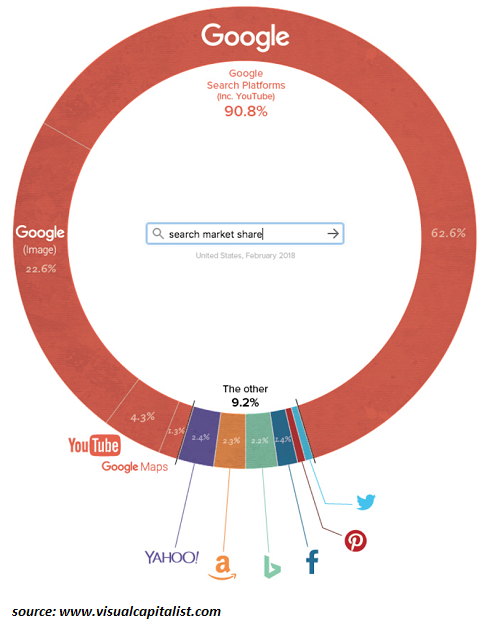
This cartel is dominated by Google and Facebook. Google controls over 90% of all search: what search results are displayed, the weight given to links (the page-rank assigned to websites) and a variety of other factors that can be depreciated, removed, omitted or blocked by algorithms and/or human censors (a.k.a. administrators) without recourse and without the site or user being informed.
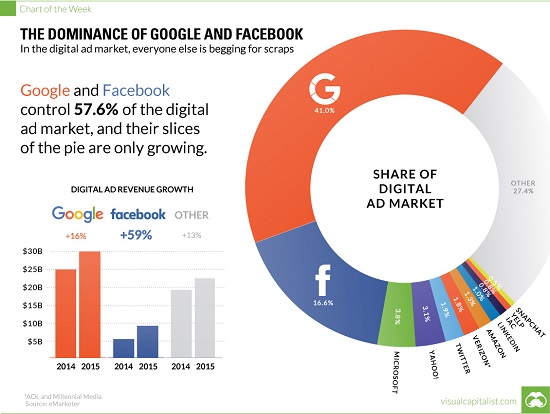
While this chart displays the dominance of Facebook and Google in digital ad revenues, it is a rough proxy for their dominance in mindshare, user data collected and control over what is displayed and not displayed in search results and social media.
We are all digital ghosts now, and how much of your digital shadow is visible to the world is secret / opaque. If you violate company policies or applicable censorship laws (as interpreted by the company attorneys), the corporation will notify you that your account has been frozen or banned.
In these instances, users and content creators are informed of their purported violation.
But this visible part of web / social media censorship is only the tip of the iceberg. Most of the censorship is invisible and undetectable. Here’s an example of how this might work.
Facebook has reportedly based one of its censorship programs on the demonstrably bogus (and anonymously produced) PropOrNot list that was hyped by the Washington Post in 2016. The list of sites accused of being Russian propaganda outlets was a grab-bag of left, right and center websites whose only “crime” was publishing some bit of skepticism about the coronation of Hillary Clinton.
So a bogus anonymous list becomes the foundation of Facebook’s censorship efforts. This is precisely how the former Soviet Union’s secret police operated: a falsely reported association became the foundation of surveillance and the setting of various traps and snares to catch anti-social elements in the act of undermining the regime.
That the association was false no longer matters. What matters is your name is on the list. It turns out oftwominds.com made it on the modern-day NKVD-Stasi list of PropOrNot, which despite being debunked has taken on a life of its own in the New Police State of Facebook, Google, et al.
You might have heard about a targeted website’s traffic suddenly plummeting 30% or 40% literally overnight. Well, it’s true. Many sites left and right report their traffic mysteriously and suddenly plummets without any explanation by the organs of censorship (Facebook, Google, et al.)
It happened to oftwominds.com this month. I have traffic data going back to 2005, and my traffic (visits and page views) has been remarkably steady for years. The number of my posts per week remains the same, my engagement on social media remains the same (as far as I can tell, heh) and my page rank remains the same (5) (again, as far as I can tell).
So when my traffic drops like a light switch was flipped, I notice.
I hope you’ll enjoy the irony that many if not most of the charts published on my site are from the Federal Reserve Economic Data site (FRED). But this is akin to the innocent citizen snagged by the NKVD or Stasi for unspecified crimes against the people protesting his innocence and good citizenship: none of that matters. What matters is your name is on the list, and our administrators are obligated to track your digital presence and digitally ghost you by adjusting search results to depreciate your presence, underweight links from other sites, jam attempts to re-post your content and so on.
None of this is visible or reported. It all happens behind the closed doors of Facebook, Google et al. Just as loyal employees of the NKVD and the Stasi were constantly told they were the bulwark of the people against enemies of the state, employees of Facebook, Google et al. are told they’re weeding out “fake news” and “propaganda” (like those charts from the Federal Reserve Economic Database) that is disruptive and divisive.
In other words, they’re good Germans doing their masters’ bidding, for very handsome salaries, bonuses and stock options.
Meanwhile, the incomes of those secretly ghosted without trial or recourse plummets along with their traffic. The net result of the perverse magic of tech cartel censorship is only the wealthy few can afford to keep posting original content after they’ve been ghosted.
Should Facebook, Google et al. reassure us we haven’t been ghosted, why should we believe them? Since the entire apparatus of censorship is operated by private, for-profit corporations in complete secrecy, on what basis would their assurances be credible or verifiable?
Just about the only bulwark against being silenced by the modern-day tech-corporate-NKVD-Stasi is Patreon–individuals who provide financial support of independent voices and analysis because they value those independent analysts and content creators.
It doesn’t matter whether you consider yourself left, right or center. If you want to resist secret censorship of both the left and the right, then please consider supporting the independent commentators and analysts who have enhanced your life with value, insight or entertainment. Thank you, patrons and financial supporters of oftwominds.com and other independent content creators. Thanks to you, the tech cartel can ghost us and our content but they can’t erase it entirely.
At least not yet.
If you’re not sure where to start, search Patreon.com for the names of those independent content creators you value.
[Aletho News notes that WordPress analytics recently zeroed out the tally of clicks to Al-Manar News from Aletho News in the middle of a reporting period, erasing prior clicks. Unless an administrator happened to be closely tracking traffic, one would presume that there was very little reader interest in certain content. Also, Gilad Atzmon’s site has had its RSS feed down for days now, a new record]
Featured Video
Diplomacy is Now a Crime in Britain / Ian Proud
or go to
Aletho News Archives – Video-Images
From the Archives
Is America behind the massive surge in Kiev regime’s child trafficking?
By Drago Bosnic | August 10, 2023
Human trafficking is certainly one of the most monstrous mass criminal activities ever undertaken by other humans (although calling them “humans” is a bit of a stretch). And yet, there’s a special kind of this deeply repulsive crime that pushes it to diabolical proportions – child trafficking. Underage kids, particularly those who were abandoned, sold or have very poor/abusive family backgrounds, are by far the most vulnerable group. The depraved criminals who engage in such illicit activities specifically target unfortunate children and given there are millions of them all around the globe, particularly in war-torn areas, the “recruitment pool” is effectively endless. Unfortunately, the demand on the black market also seems to be constant and growing, making it a very lucrative and appealing prospect for criminals. … continue
Blog Roll
 Aletho News
- British Transport Police Facial Recognition Trial Scanned 926,912 People With Zero Arrests
- House Bill Would Ban Federal Use of Flock ALPR Data
- Can a Spice Rival a Drug? 10 Head-to-Head Trials Put It to the Test.
- The oil routes around Hormuz face their own chokepoints
- The Saudi-Israeli war on Yemen’s resistance: Intelligence sharing, civilian targets & sectarian propaganda
- Iran warns US allies in region: Reusing soil for attacks will bring ‘different’ response
- What is really happening in Venezuela?
- Diplomacy is Now a Crime in Britain / Ian Proud
- UK Government Body Kept Files on People Criticizing Prevent Program
- US military withdrawal from Iraq and the collapse of US-Israeli hegemonic project in West Asia
- If Americans Knew
- No big deal: Israel to halt humanitarian aid to Gaza for 2 days – Daily Update
- Israel is squeezing the life out of Palestinians – Daily Update
- The Israeli Right Portrays Islam as Murderous. It Serves a Political Purpose
- Jordan Has Had Enough: King Abdullah’s Scathing Warning to Israel
- Israeli Colonizers (i.e. Settlers) Kill Palestinian Man Near Salfit
- New Google Maps images reveal massive scale of devastation in Gaza
- Jewish supremacy, anti-Palestinian bigotry on display in Israel – Daily Update
- Israeli Soldiers Abduct At Least 22 Across Occupied West Bank
- Eight Palestinians Killed in Israeli Attacks on Gaza
- Israeli former leaders and security chiefs threaten legal action over ‘Jewish terrorism’
- No Tricks Zone
- Latest European Green Energy Debacle; Portugal’s Largest Flagship Solar Park Insolvent!
- Green Energy Debacle: German Expert Professor Fritz Vahrenholt Warns Of Severe Economic And Social Consequences
- Two More Paleo Reconstructions Affirm Meters-Higher Sea Levels Across Ireland, Brazil 7000-6000 Years Ago
- New Study: Earth And Venus Surface Warmth Largely Explained By Convection And Lapse Rate, Not CO2 Or Radiation
- 2025 Nature Paper Claiming Worsening Global Drought Gets RETRACTED …Heavily Flawed
- New Study: ‘Global Drought Shows No Detectable Recent Acceleration Under Climate Warming’
- Economic Masterminds: German Socialists Suggest Taxing Productivity Gains Stemming From Using AI
- The South China Sea Has Not Been Cooperating With The Climate Change Narrative
- Energy Crisis: Germany Enters Heating Season With Historically Low Gas Reserve Fill Levels
- New Study: The Antarctic Ice Sheet Gained Mass From 2020-2024 Due To Staggering Snow And Ice Accumulation

