The United States and Turkey are seeking to manipulate the crisis over the murder of Saudi dissident journalist Jamal Khashoggi in an attempt to change the equilibrium in the Middle East, says a political analyst.
“I think the Turkish intelligence have so many information but they want to blackmail the Saudis and they push a little part after little part of the information that they have to press and blackmail the Saudi government,” Hadi Kobaysi told Press TV in an interview on Friday.
“I think that from the beginning why [did] Khashoggi go to Turkey, there is a Saudi consulate in Washington … I think that there is a game from the beginning to put the Saudi government under pressure … So from the beginning there is a game and the manipulation was from Turkey and the United States and the goal was to change the game in the Middle East,” he added.
Khashoggi – a US resident, Washington Post columnist, and a leading critic of Crown Prince Mohammed bin Salman — entered the Saudi consulate in Istanbul on October 2 to obtain a document certifying he had divorced his ex-wife, but he did not leave the building.
Saudi officials originally insisted that Khashoggi had left the diplomatic mission after his paperwork was finished, but they finally admitted several days later that he had in fact been killed inside the building during “an altercation.”
Several countries, including European ones, Turkey and the US, a major ally of Riyadh, have called for clarifications on the murder.
October 26, 2018
Posted by aletho |
Deception | Middle East, Saudi Arabia, Turkiye, United States |
Leave a comment
Philip Green, the 66-year-old chairman of Arcadia Group, which includes fashion brands Topshop and Dorothy Perkins, has been named as the individual who obtained a privacy injunction to prevent the media publishing incendiary allegations by former employees.
For several months, speculation has rippled throughout social media as to the identity of the “leading businessman” who employed non-disclosure agreements (NDAs) and “substantial payments” to prevent publication of his name in relation to allegations of serious and repeated sexual harassment, racist abuse and bullying.
Speaking in an afternoon debate in the House of Lords October 25, Labour peer Peter Hain said “someone intimately involved in the case” had notified him the individual was Green.
“I feel it’s my duty under parliamentary privilege to name Philip Green as the individual in question, given the media have been subjected to an injunction preventing publication of the full details of a story which is clearly in the public interest,” he said.
In a subsequent interview with BBC Two’s Newsnight, Hain said he’d received “overwhelming support — particularly from women” for his actions.
“What concerned me about this case was wealth, and power that comes with it, and abuse. And that was what led me to act in the way that I did. There’s no point in being in Westminster if you never deploy the precious rights of parliamentary privilege,” he added.
Controversial History
On July 16, the Court of Appeal barred the Daily Telegraph from publishing allegations of “discreditable conduct” by five employees against Green — Arcadia Group immediately applied for an injunction when the newspaper requested comment on the story, at a rumored cost of US$640,000 (£500,000).
This injunction was overturned in August by a High Court judge, who said the allegations were “reasonably credible”, there was no “reasonable expectation of privacy or confidentiality”, most of the information the newspaper wanted to publish was already public domain, and there was a strong “public interest” in publishing them. However, this was in turn overturned by the Court of Appeal in short order.
The exposure has led to calls for Green to be stripped of his knighthood, bestowed in 2006 “for services to the retail industry” — Liberal Democrat leader Vince Cable said he’d “narrowly and luckily escaped losing his knighthood” over the over the BHS pensions scandal.
The department store chain, bought by Green in 2000 and sold in 2015, went into administration in 2016 with debts of US$1.66 billion (£1.3 billion) and a pensions deficit of US$730 million (£571 million), despite Green collecting US$749 million (£586 million) over the course of his stewardship of the company, which he deposited in a tax haven to avoid paying revenues. Simon Walker, Director General of the Institute of Directors, condemned Green’s “lamentable failure of behaviour”.
On October 20 2016, the House of Commons approved a motion to ask for the Honors Forfeiture Committee to recommend Green’s knighthood be “cancelled and annulled” in response to the scandal. In all, 100 MPs voted in favor of the motion, the first time UK legislators have proposed someone be stripped of a knighthood.
Since gaining public recognition with the purchase of BHS, Green has frequently been the subject of major controversy. For instance, Arcadia Group — owned in the name of his wife Tina, a Monaco resident for tax purposes — has been criticized for the pay and conditions of both overseas and UK workers by anti-sweatshop groups such as Labour Behind the Label and No Sweat. In 2010 for instance, the company was found to utilize British factories in which workers were paid less than half the national legal minimum wage.
Gagging Orders
On the day Green was outed, Prime Minister Theresa May told MPs it was “clear” some employers used NDAs “unethically”, and the government would look at ways to improve relevant rules, making it “explicit” to companies when they cannot be used.
NDAs are typically employed by businesses in order to protect confidential trade secrets, but have also been exploited by wealthy individuals and organizations to suppress publication of damaging information in the media.
For example, in 2009 commodity firm Trafigura secured a ‘super injunction’ blocking mention of a report that concluded the company had dumped toxic waste near the Ivory Coast despite being aware of the dangers, in order to avoid paying a US$1,000 per cubic meter surcharge imposed by Amsterdam Port Services to discourage waste disposal in the Netherlands. In the process, at least 17 people died, 30,000 were seriously injured — some incurring severe skin and lung burns — and over 100,000 were potentially affected.The suppressed details nonetheless rapidly circulated via social media, and it was eventually lifted — but not before the BBC was threatened with a costly libel suit by Trafigura’s lawyers at Carter-Ruck. The state broadcaster buckled to the pressure, removing a detailed investigation from its website, which featured interviews with victims in Cote d’Ivoire and claims the company had brought “ruin” on the country in order to make a “massive profit” — it also issued a public apology, donated over US$30,000 to charity.
However, the BBC did not retract further reports, which quoted internal Trafigura emails which showed staff knew the waste was toxic before it was dumped. In one, a Trafigura employee said “this operation is no longer allowed in the European Union, the United States and Singapore” due to “the hazardous nature of the waste'” and another says “environmental agencies do not allow disposal of the toxic caustic”.
Similarly, in 2011, Top Gear host Jeremy Clarkson voluntarily lifted a privacy injunction which prevented UK media from reporting claims by his former wife they had an affair after he remarried.
“Injunctions don’t work. You take out an injunction against somebody or some organization and immediately news of that injunction and the people involved and the story behind the injunction is in a legal-free world on Twitter and the Internet. It’s pointless,” he lamented.
October 26, 2018
Posted by aletho |
Deception, Supremacism, Social Darwinism, Timeless or most popular | Arcadia Group, Human rights, Philip Green, Topshop, UK |
Leave a comment
The more I look at the statement issued by Assistant Commissioner Neil Basu on 5th September, in relation to the Salisbury and Amesbury Investigation, the more I am astonished at the sloppiness on display. Mr Basu took the trouble of informing the public that the investigation has involved around 250 detectives from across the Counter Terrorism Policing Network, “brilliantly led by Counter Terrorism Policing South East, and supported by officers from Wiltshire,” and that they have been meticulously following the evidence for six months. So the statement he read out and the accompanying images ought to be entirely accurate, right?
Except they are not, and in fact they contain numerous extremely careless, and sometimes downright bizarre errors. For example:
Firstly, the two images of the suspects in Fisherton Street are headed with captions describing them as being in a place called Fisherton Road. There is no location called Fisherton Road in Salisbury.
Secondly, we have the images of the two men at Gatwick airport, famously taken at the exact same second, 16:22:43. Yet the captions above tell us that the images are of the men at 15:00hrs. This is mighty odd, not just because the timestamp on the images shows otherwise, but also because the airplane the men were travelling in had not even landed at 15:00hrs. It eventually landed nearer to 16:00 than it did to 15:00, so they can’t have been going through the gates at 15:00hrs, can they?
Thirdly, one of the four points The Met makes in joining the Salisbury and Amesbury cases together is an incomplete sentence that makes no sense whatsoever:
“Fourthly, the lack of crossover between the known movements of the suspects and Dawn and Charlie’s known movements around Salisbury, and the fact that there is no evidence to suggest they have been targeted mean it is much more likely Dawn and Charlie found.”
Found…? Found what? Who knows?
Fourthly, the picture of the two men at Salisbury station on 3rd March has a timestamp of 16:11:27. Yet in the timeline The Met tells us that they left Salisbury at approximately 16:10. So they left at approximately a minute and a half before they were photographed standing on the other side of the turnstiles from the platform? Is The Met, with all its massive resources and 250 detectives on the case unable to find out what time the train actually departed?
Fifthly, there is the fact that at least one of the pictures they issued has been very heavily cropped (see here). Why was it cropped and what confidence can we have that the other images were not tampered with as well?
Am I nit-picking? Nope. 250 detectives working on what may be the biggest investigation this country has ever seen, with six months to get their facts straight, ought to be pinpoint accurate. And yet all we find is sloppiness and little regard to detail.
And not for the first time. We’ve seen it before in the fact that The Met has still released no footage clearly showing the Skripals or the two suspects on 4th March (still images don’t count). This is beyond bizarre given that on numerous occasions they have appealed to the public for help in piecing together the events of the day. And we have seen it in the incomplete and incorrect timeline of events released on 17th March (which now seems to have disappeared from The Met’s website altogether).
But I want to focus on what I consider to be the biggest issue with the statement released on 5th September, which is the astonishing lack of detail given about the two suspects’ movements in Salisbury on 3rd and 4th March. Here is the description of their movements on Saturday 3rd:
“On Saturday, 3 March, they left the hotel and took the underground to Waterloo station, arriving at approximately 11.45am, where they caught a train to Salisbury, arriving at approximately 2.25pm.
They are believed to have taken a similar route when they returned to London on the afternoon of Saturday, 3 March. Leaving Salisbury at approximately 4.10pm and arriving in Bow at approximately 8.05 pm.
We assess that this trip was for reconnaissance of the Salisbury area and do not believe that there was any risk to the public from their movements on this day.”
So tell me, what did they do and where did they go in Salisbury on Saturday 3rd March? You have no idea whatsoever, do you, because Mr Basu has not mentioned it. We are treated to the absurd word “reconnaissance”, as if the two men were in Afghanistan staking out the Tora Bora caves, rather than in a quiet city in the South of England covered by Google maps, but there are absolutely no details of what this alleged reconnaissance actually entailed. More on that in a moment.
What of their movements the next day? Surely there’s some detail here, given the allegations against them. Judge for yourselves:
“On Sunday, 4 March, they made the same journey from the hotel, again using the underground from Bow to Waterloo station at approximately 8.05am, before continuing their journey by train to Salisbury.
CCTV shows them in the vicinity of Mr Skripal’s house and we believe that they contaminated the front door with Novichok.
They left Salisbury and returned to Waterloo Station, arriving at approximately 4.45pm and boarded the London Underground at approximately 6.30pm to London Heathrow Airport. From Heathrow Airport, they returned to Moscow on Aeroflot flight SU2585, departing at 10.30pm on Sunday, 4 March.”
In both descriptions, there are more details of their movements in London than their movements in Salisbury. The only glimmer of detail around their movements in Salisbury on 4th March is the claim that there is CCTV showing them in the vicinity of Mr Skripal’s house. But which CCTV are they referring to? Is it the image of the two men outside the Shell garage on the Wilton Road? If so, as I discussed here, this is highly misleading, since this location is some 600 yards or so from Mr Skripal’s house, and on a completely different street. Then again, perhaps The Met does have something more incriminating, but in which case why not show that, rather than the image of them walking past a garage on a different road?
But I want to come back to the details about the Saturday, and the reason for this is twofold:
Firstly, it is one of the few places where The Met’s claims are refuted by some very specific, rather than general, testimony in the interview the two men gave to Margarita Simonyan.
Secondly, the claims made by the men in that interview, which refute The Met’s allegations, could themselves easily be refuted by The Met.
Here’s the crucial part of that interview:
“Petrov: No, we arrived in Salisbury on March 3. We wanted to walk around the city but since the whole city was covered with snow, we spent only 30 minutes there. We were all wet.
Boshirov: There are no pictures. The media, television – nobody talks about the fact that the transport system was paralyzed that day. It was impossible to get anywhere because of the snow. We were drenched up to our knees.
Simonyan: All right. You went for a walk for 30 minutes, you got wet. What next?
Petrov: We travelled there to see Stonehenge, Old Sarum, and the Cathedral of the Blessed Virgin Mary. But it didn’t work out because of the slush. The whole city was covered with slush. We got wet, so we went back to the train station and took the first train to go back. We spent about 40 minutes in a coffee shop at the train station.
Boshirov: Drinking coffee. A hot drink because we were drenched.
Petrov: Maybe a little over an hour. That’s because of large intervals between trains. I think this was because of the snowfall. We went back to London and continued with our journey.”
(As an aside, I can confirm that they are correct about the conditions. There was a lot of snow on the ground on the Saturday morning, and my children went off sledging, but by early afternoon they came back as it was rapidly turning to slush).
What we have are two versions of events, which are mutually exclusive.
On the one hand, The Met claims that the men arrived at Salisbury train station at approximately 14:25; that they left at approximately 16:10 (although as I say, they were still there at 16:11:27); and that during this 1 hour 45 minutes they went on a reconnaissance mission of the Salisbury area.
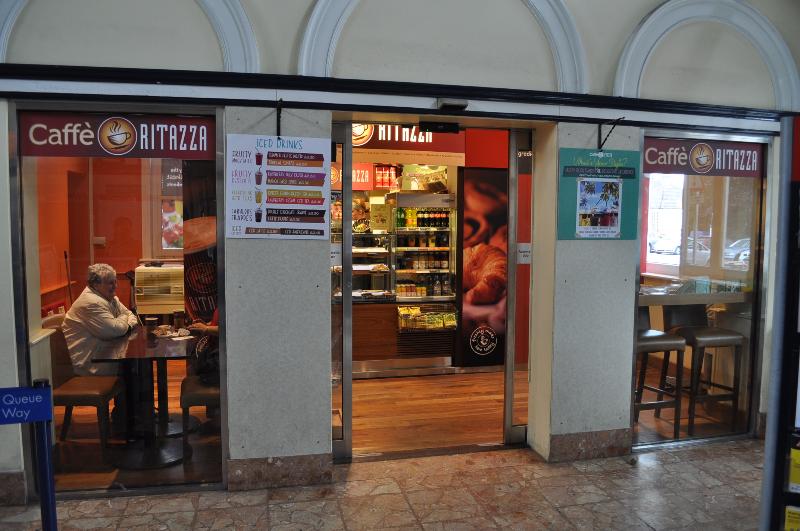
On the other hand, Petrov and Boshirov claim that after leaving the station (and they don’t dispute the 14:25 time) they walked about for about half an hour, before heading back to the station, where they sat in a café for more than 40 minutes and possibly up to an hour or so (this would be Café Ritazza in the ticket hall, shown at the top of this piece). This would therefore put them in the café from about 15:10 until about 16:10.
Now, I take it as obvious that for the reconnaissance claim made by The Met to be correct, this would mean the men visiting the alleged location of the intended poisoning — Mr Skripal’s house, or at the very least Christie Miller Road — since the purpose of reconnaissance is to survey vital locations, and this is the only really vital location in connection with the claims made against them. The only other possible location of interest to them, according to the claims against them, would be the back of The Cloisters on Catherine Street, where they allegedly dumped the poison. But let’s just say I would take an awful lot of persuading as to why anyone should need to do reconnaissance of a bin.
It takes between 20-25 minutes to walk from the station to Christie Miller Road. Double it for there and back, and you get 40-50 minutes. However, the very nature of reconnaissance means that it involves checking out an area, and so as well as walking there and back we could, at a conservative estimate, perhaps add 10 minutes to the walking times. Which means that we are looking at 50-60 minutes at least for a reconnaissance mission.
This entirely conflicts with Petrov’s and Boshorov’s claims. Of course, we have no way of knowing whether their claims are true or not, but the point is this: The Met knows exactly whether their claims are true or false, and they could easily disprove them simply by showing the two men walking through Salisbury when they say they were in the café.
Of course, it could well be that The Met does have CCTV footage of the two men in the city outside the half hour or so timeframe they have claimed. It could be that they have CCTV footage of the café from 15:10 to 16:10, and that there is no sign of the two men there. And it could well be that they have CCTV footage of the men on their way to or from Mr Skripal’s house.
Yet despite the very specific claims made by the men, the only evidence ever presented by The Met of their movements in Salisbury on that day is the image of them standing in the ticket hall at 16:11:27. Nothing else has been released of their movements. Nothing else has been stated. Other than the claim about reconnaissance, which has been backed up by nothing, there is nothing at all.
Some will say that The Met is under no obligation to publicly reveal any more CCTV footage than they want to. Ordinarily, I might agree. But not in this case. It was The Met that made serious allegations in public about the two men, and yet they did so without producing any evidence to back up their claims. But now that the two suspects have themselves publicly refuted The Met’s claims about what they did on 3rd March with some quite specific details, The Met now surely has an obligation either to show the evidence they have to back up their claim of “reconnaissance”, or withdraw it.
So here are the three questions that The Met needs to answer in connection with Saturday 3rd March:
-
- Do you have CCTV footage of the two men that contradicts their claim to have spent only about half an hour in the City that day?
- Do you have CCTV footage that contradicts the claims made by Petrov and Boshirov to have been in the station café between approximately 15:10 and 16:10?
- If neither of the above exists, on what basis has the claim been made that the two men were in Salisbury on 3rd March on a reconnaissance mission?
October 25, 2018
Posted by aletho |
Deception, False Flag Terrorism, Russophobia | UK |
Leave a comment
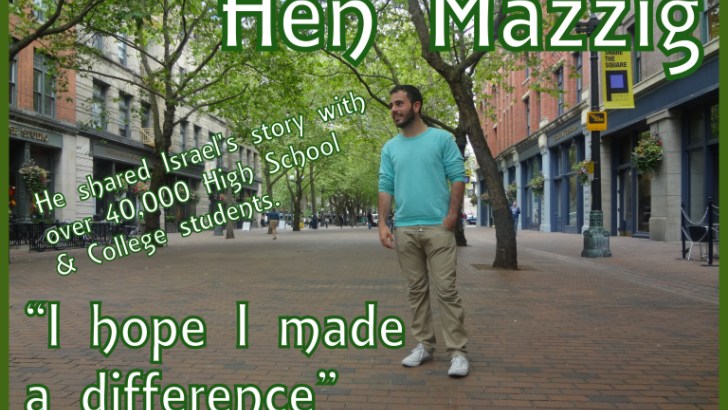
By 2014 Mazzig had already spoken to over 40,000 students from high school through college, and helped defeat a boycott resolution at the University of Washington.
The Jewish Forward reports that a hugely popular pro-Israel speaker and writer, Hen Mazzig, has been secretly working directly for the Israeli government. It appears that his actions may have violated U.S. espionage laws.
A pro-Israel organization lists Mazzig among “The Top 100 People Positively Influencing Jewish Life, 2018.”
According to the Forward, Mazzig’s op-eds “have been published in nearly every Israeli and American Jewish publication (including the Forward ), and his speeches to students across North America and Europe, have garnered him legions of fans, including more than 18,000 Twitter followers.”
The publication reports:
“A Forward investigation has revealed that he also worked directly for the Israeli government. He doesn’t seem to have told anyone that, however — neither the sponsors of his speeches, nor the students who listened to them. Because he kept quiet, and because those payments are related to his political work in the United States, he might have violated an American anti-espionage law, according to experts consulted by the Forward.
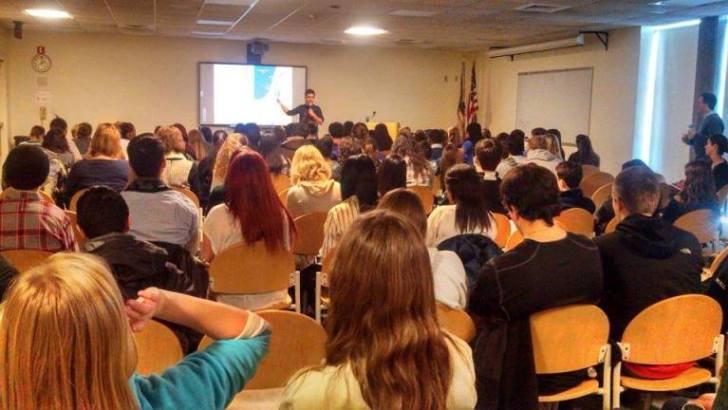
Hen Mazzig speaking to American students during a 2013 five month speaking tour.
Experts cited by the Forward say that Mazzig seems to have violated the Foreign Agent Registration Act (FARA), an American anti-espionage law. This law requires individuals and groups working on behalf of a foreign government to divulge that fact.
Attorneys say Mazzig should have registered as a foreign agent. Mazzig admitted to the Forward that he was a paid contractor for the government of Israel, and said that Israel’s official government advertising agency hired him to inform them about issues on American campuses.
FARA has recently been invoked against a Russian graduate student in the U.S., who has been imprisoned for three months, mostly in solitary confinement, despite the fact that she appears to be innocent of the charges.
It is unknown whether U.S. authorities will charge Mazzig with violating the FARA requirement.
An attorney who specializes in FARA cases told the Forward : “The policy behind FARA is, yes, lobbying will happen. The key is for the American people to know when it comes to foreign influences, who’s pulling the strings.”
The Forward reports that The Lawfare Project, a pro-Israel organization that often uses lawsuits to chill pro-Palestinian activism, demanded that the Forward delay publishing the article until lawyers could speak on Mazzig’s behalf. The Forward accordingly held the story for three and a half days, but did not hear further from Mazzig’s lawyers.
The publications and organizations such as campus Hillel groups that have been featuring Mazzig say they didn’t know he was employed by the Israeli government. According to the Forward, student organizers “say they don’t remember Mazzig disclosing his contracting work, either beforehand or during his speeches.”
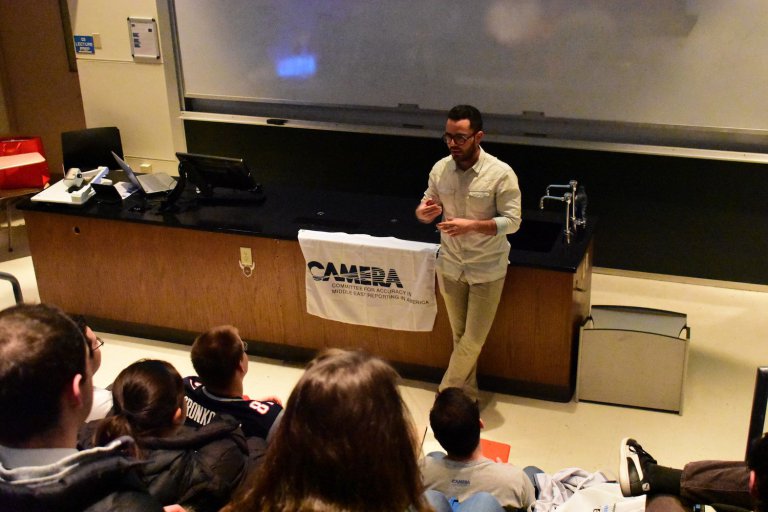
3/22/17 Hen Mazzig lecture/ Oriented showing by Kevin Musco
Hen Mazzig speaks at the University of Connecticut, March 3, 2017. Students were not informed that he was a paid agent of the Israeli government.
The Forward points out: “Over the last decade, and particularly in the last few years, the amount of money spent by outside groups to influence the Israeli-Palestinian debate on campus has risen sharply.
“In addition to American Jewish donors heavily increasing their funding for pro-Israel campus advocacy groups, foreign governments and other unaccountable entities are also inserting themselves into the collegiate fray.”
A paper trail provided by the Forward indicates that Mazzig may have been working under Israel’s notorious Ministry of Strategic Affairs, which sponsors diverse secretive operations.
Kela Shlomo – Solomon’s Sling
An Israeli organization named Seventh Eye reported last month that the Ministry of Strategic Affairs has been working with pro-Israel American nonprofits on a project called “Kela Shlomo” (translated as “Solomon’s Sling”). The Forward describes this as an effort “to fund anti-BDS activities outside of Israel that won’t be attributable to the government itself.”
Seventh Eye reports: “‘Kela Shlomo’ is an [Israeli] organization with a special corporate structure. Its legal envelope is civil: its founders have established it as a public benefit company, and its shareholders are former senior civil servants.”
The article points out that “the entire purpose of the organization is to implement government policy through a budget that combines the government budget and income from private donors.”
Ha’aretz has also reported on the initiative: “The Ministry of Strategic Affairs and Public Affairs established an external body – a private company for the benefit of the public called ‘Shlomo Kela’ – to which the government decided to transfer NIS 128 million two weeks ago, in addition to 128 million from private donors from around the world. This is according to the ministry, among other things, in order to carry out ‘mass awareness activities’ within the framework of “the struggle against Israel’s delegitimization campaign” around the world.
Among the project’s members is Sagi Balasha, a former CEO of Sheldon Adelson’s Israeli-American Council.
Central Fund of Israel
Seventh Eye reports that two American organizations have donated millions of shekels to Kela Shlomo. “The central body of the two is the Central Fund of Israel, which is managed by the American Marcus family, one of whose sons was recently interviewed by Israel’s Channel 11.”
The Central Fund of Israel is an American tax-exempt organization (#13-2992985) founded in 1979. Its IRS 990 form gives it mission as “promoting charitable activities in Israel.”

Its principal officers are listed on its 2016 990 tax form as Arthur Marcus, president (now deceased); Jay Marcus (his son), vice president; and Jeff Most, treasurer. Dr. Linda Kalish Marcus, Mitchell Elkin and Michael Fischberger are board members.
While Its address is listed as 980 Avenue of the Americas, Third floor, New York, NY (a Marcus textile company) and its phone number is given as 506-148-2718, it appears that the Marcus family lives much of he time in Efrat in the West Bank, a right wing Jewish-only colony built on land confiscated from three nearby Palestinian villages.
According to an Israeli eulogy for Arthur Marcus, the organization transferred $20 million of tax-deductible U.S. money to Israel.
One Israel Fund
The other American organization donating to Kelo Shlomo /Solomon’s Sling, according to the Forward, is the One Israel Fund.
The tagline for the organization says: One Israel Fund – Building and Securing the Heartland Of Our Nation.” While the organization refers to “our nation” as Israel, it is a registered nonprofit in the U.S. It lists an American address (445 Central Ave, Cedarhurst, New York) and raises money from American taxpayers. This money, sent to Israel, is deducted from the taxes individuals pay to the U.S.
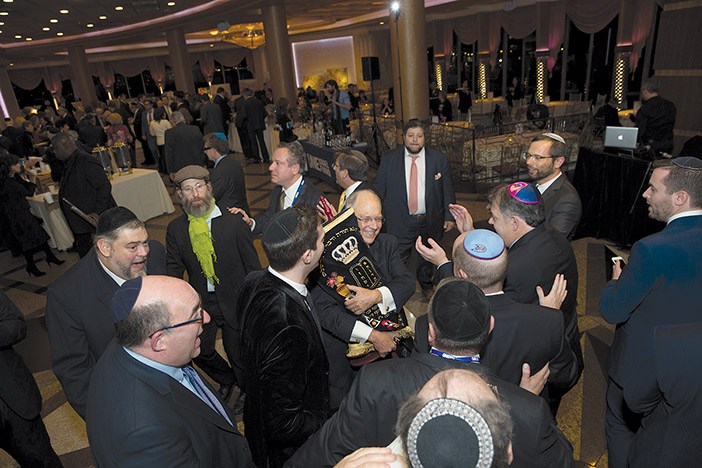
One Israel Fund 2017 fundraising gala
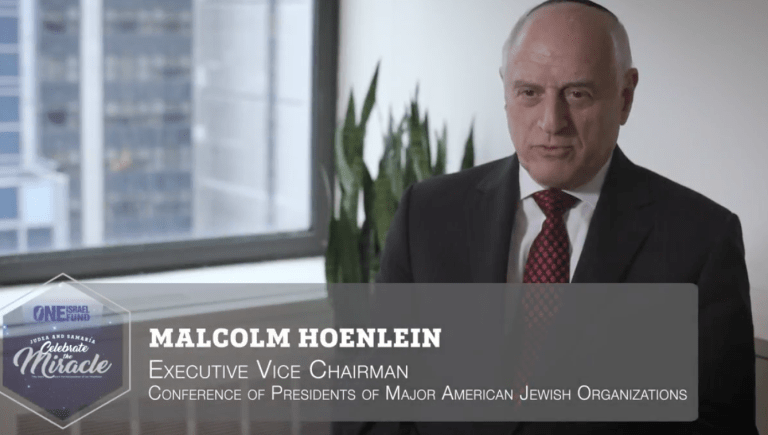
Head of Conference of Presidents of Major American Jewish Organizations (which includes 53 organizations) speaks at One Israel Fund event
Kelo Shlomo (also spelled Kello Shlomi) is expected to provide a speedy, coordinated response “to efforts to stain Israel’s image around the world, for example, in the event of a military operation, terror attacks [sic] or UN votes against government policies.”
“This would be done by launching online campaigns, lobbying, engaging organizations abroad and bringing delegations to Israel.”
Israel outsources work to agents abroad
Seventh Eye reports: “Much of the activity is outsourced, as a result of a declared strategy that in order to succeed in the mission, the government’s involvement in the ‘mass awareness activities’ it initiates should be disguised. This outsourcing is carried out by agents in Israel and abroad who make up… the ‘pro-Israel network.’”
CAMERA

One of Hen Mazzig’s U.S. sponsors has been the Committee for Accuracy in Middle East Reporting (CAMERA).” It’s unknown whether any CAMERA officials were aware of Mazzig’s paid employment by the Israeli government. Nor is it known to what degree CAMERA itself may work with the Israeli government.
CAMERA’S website states that the organization was founded in 1982. Among its earliest members were prominent Washington-area residents Saul Stern and Bernard White. Its Advisory Board included U.S. Senators Rudy Boschwitz and Charles Grassley, Congressman Tom Lantos, journalist M. Stanton Evans, Ambassador Charles Lichenstein, Pastor Roy Stewart, and Rabbi David Yellin.
CAMERA created chapters in major cities, including New York, Chicago, Fort Lauderdale, Los Angeles, Miami, San Francisco, Philadelphia, and in1988 a Boston chapter and office, founded and led by Andrea Levin, who has served as associate editor of the Journal of Policy Analysis and Management at Harvard’s Kennedy School of Government.
The Executive Board has included some top Boston business leaders, including the co-founders of Timberland and Staples.
CAMERA’s current head is Levin, named in 2002 as “America’s fifth most influential Jewish citizen.” Its membership now numbers over 65,000.
In addition to the Boston headquarters the organization also has offices in Washington, DC, New York, Chicago, Los Angeles, and Israel. Among CAMERA’s authors was columnist Charles Krauthammer. It now has assets of close to $8 million, and Levin receives an annual salary of over $260,000.
The organization, which operates both in the U.S. and abroad, is a member of the New England Israel Campus Roundtable, which includes 19 pro-Israel organizations.
New projects initiated by CAMERA:
-
The CAMERA Fellows Program recruits student leaders across the US as well as from Spain, South Africa and Latin America who present educational programs on their campuses to inform fellow students about Middle East realities. The Fellows monitor their student newspapers, write Op-Eds and help counter distorted characterizations of Israel in the campus arena.
-
Launched in early 2011 the CAMERA Campus Activist Project (CCAP) promotes creation of pro-Israel groups on campuses where there is little or no such activity.
-
Revista de Medio Oriente, CAMERA’s Spanish language counter part, challenges misinformation in the Spanish language world, whether in Spain’s media or in Latin American coverage.
-
The British Project addresses major media in Britain, such as the Guardian, the Independent, and the BBC, which have global reach and all too often have problematic Middle East coverage.
-
The Christian Project focuses on distorted Middle East coverage in Christian publications and sponsors programs in the Christian community.
So far it is unknown whether the U.S. justice department will investigate Hen Mazzig and his network of American enablers following the Forward’s revelations. Past history suggests that this will not occur – unless enough American demand it.
So far, no U.S. media seem to have reported the Forward’s findings.
Alison Weir is executive director of If Americans Knew, president of the Council for the National Interest, and author of Against Our Better Judgment: The Hidden History of How the U.S. Was Used to Create Israel.
October 25, 2018
Posted by aletho |
Deception, Ethnic Cleansing, Racism, Zionism, Full Spectrum Dominance, Mainstream Media, Warmongering, Timeless or most popular | Israel, United States, Zionism |
Leave a comment
Canada’s paper of record pulled another layer off the rotting onion of propaganda obscuring the Rwandan tragedy. But, the Globe and Mail has so far remained unwilling to challenge prominent Canadians who’ve crafted the fairy tale serving Africa’s most ruthless dictator.
Two weeks ago a front-page Globe article added to an abundance of evidence suggesting Paul Kagame’s RPF shot down the plane carrying President Juvénal Habyarimana, which sparked the mass killings of spring 1994. “New information supports claims Kagame forces were involved in assassination that sparked Rwandan genocide”, noted the headline. The Globe all but confirmed that the surface-to-air missiles used to assassinate the Rwandan and Burundian Hutu presidents came from Uganda, which backed the RPF’s bid to conquer its smaller neighbour. (A few thousand exiled Tutsi Ugandan troops, including the deputy minister of defence, “deserted” to invade Rwanda in 1990.) The new revelations strengthen those who argue that responsibility for the mass killings in spring 1994 largely rests with the Ugandan/RPF aggressors and their US/British/Canadian backers.
Despite publishing multiple stories over the past two years questioning the dominant narrative, the Globe has largely ignored the Canadians that shaped this Kagame-friendly storyline. I’ve written a number of articles detailing Roméo Dallaire’s important role in this sordid affair, but another widely regarded Canadian has offered significant ideological support to Kagame’s crimes in Rwanda and the Congo.
As Deputy Executive Director of UNICEF in the late 1990s Stephen Lewis was appointed to a Panel of Eminent Personalities to Investigate the 1994 Genocide in Rwanda and the Surrounding Events. Reportedly instigated by US Secretary of State Madeleine Albright and partly funded by Canada, the Organization of African Unity’s 2000 report, “The Preventable Genocide”, was largely written by Lewis recruit Gerald Caplan, who was dubbed Lewis’ “close friend and alter ego of nearly 50 years.”
While paying lip service to the complex interplay of ethnic, class and regional politics, as well as international pressures, that spurred the “Rwandan Genocide”, the 300-page report is premised on the unsubstantiated claim there was a high level plan by the Hutu government to kill all Tutsi. It ignores the overwhelming logic and evidence pointing to the RPF as the culprit in shooting down the plane carrying President Habyarimana and much of the army high command, which sparked the mass killings of spring 1994.
The report also rationalizes Rwanda’s repeated invasions of the Congo, including a 1,500 km march to topple the Mobutu regime in Kinshasa and subsequent re-invasion after the government it installed expelled Rwandan troops. That led to millions of deaths during an eight-country war between 1998 and 2003.
In a Democracy Now! interview concerning the 2000 Eminent Personalities report Lewis mentioned “evidence of major human rights violations on the part of the present [Kagame] government of Rwanda, particularly post-genocide in the Kivus and in what is now the Democratic Republic of the Congo.” But, he immediately justified the slaughter, which surpassed Rwanda’s 1994 casualty toll. “Now, let me say that the [Eminent Personalities] panel understands that until Rwanda’s borders are secure, there will always be these depredations. And another terrible failure of the international community was the failure to disarm the refugee camps in the then-Zaire, because it was an invitation to the génocidaires to continue to attack Rwanda from the base within the now- Congo. So we know that has to be resolved. That’s still what’s plaguing the whole Great Lakes region.”
An alternative explanation of “what’s plaguing the whole Great Lakes region” is US/UK/Canada backed Ugandan/RPF belligerence, which began with their invasion of Rwanda in 1990 and continued with their 1996, 1998 and subsequent invasions of the Congo. “An unprecedented 600-page investigation by the UN high commissioner for human rights”, reported a 2010 Guardian story, found Rwanda responsible for “crimes against humanity, war crimes, or even genocide” in the Congo.
Fifteen years after the mass killing in Rwanda in 1994 Lewis was still repeating Kagame’s rationale for unleashing mayhem in the Congo. In 2009 he told a Washington D.C. audience that “just yesterday morning up to two thousand Rwandan troops crossed into the Eastern Region of the Congo to hunt down, it is said, the Hutu génocidaires.”
A year earlier Lewis blamed Rwandan Hutu militias for the violence in Eastern Congo. “What’s happening in eastern Congo is the continuation of the genocide in Rwanda … The Hutu militias that sought refuge in Congo in 1994, attracted by its wealth, are perpetrating rape, mutilation, cannibalism with impunity from world opinion.”
In 2009 the Rwanda News Agency described Lewis as “a very close friend to President Paul Kagame.” And for good reason. Lewis’ has sought to muzzle any questioning of the “RPF and U.S.-U.K.-Canadian party line” on the tragedy of 1994. In 2014 he signed an open letter condemning the BBC documentary Rwanda’s Untold Story. The 1,266 word public letter refers to the BBC’s “genocide denial”, “genocide deniers” or “deniers” at least 13 times. Notwithstanding Lewis and his co-signers’ smears, which gave Kagame cover to ban the BBC’s Kinyarwanda station, Rwanda’s Untold Story includes interviews with a former chief prosecutor at the International Criminal Tribunal for Rwanda (ICTR), a former high-ranking member of the United Nations Assistance Mission in Rwanda and a number of former Rwandan Patriotic Front (RPF) associates of Kagame. In “The Kagame-Power Lobby’s Dishonest Attack on the BBC 2’s Documentary on Rwanda”, Edward S. Herman and David Peterson write: “[Lewis, Gerald Caplan, Romeo Dallaire et al.’s] cry of the immorality of ‘genocide denial’ provides a dishonest cover for Paul Kagame’s crimes in 1994 and for his even larger crimes in Zaire-DRC [Congo]. … [The letter signers are] apologists for Kagame Power, who now and in years past have served as intellectual enforcers of an RPF and U.S.-U.K.-Canadian party line.”
Recipient of 37 honorary degrees from Canadian universities, Lewis has been dubbed a “spokesperson for Africa” and “one of the greatest Canadians ever”. On Africa no Canadian is more revered than Lewis. While he’s widely viewed as a champion of the continent, Lewis has backed Africa’s most bloodstained ruler.
It is now time for the Globe and Mail to peel back another layer of the rotting onion of propaganda and investigate Canadian connections to crimes against humanity in Rwanda, Congo and the wider Great Lakes region of Africa.
October 25, 2018
Posted by aletho |
Deception, Timeless or most popular, War Crimes | Africa, Canada, Congo, Madeleine Albright, RPF, Rwanda, Stephen Lewis, UK, United States |
Leave a comment
TRANSCRIPT AND SOURCES
Forget for one moment everything you’ve been told about September 11, 2001. Instead let’s ask ourselves one question: What was 9/11? A terrorist atrocity? An attack on America? The first salvo in a new war? “A day that changed everything”?
The question may seem simple, but how we answer it is of vital importance. It determines how we proceed with our investigation of that day. And once you strip away the emotional rhetoric and the fear-inducing imagery, we’re left with a simple truth: 9/11 was a crime. And as with any crime, there is one overriding imperative that detectives must follow to identify the perpetrators: Follow the money.
This is an investigation of the 9/11 money trail.
The 9/11 Heist
In 1998, the Port Authority of New York and New Jersey agreed to privatize the World Trade Center, the complex of office towers in Lower Manhattan that they had owned and operated since their construction in 1973. In April 2001 an agreement was reached with a consortium of investors led by Silverstein Properties, and on July 24th, 2001, Larry Silverstein, who already owned World Trade Center Building 7, signed a 99-year lease for the Twin Towers and Buildings 4 and 5.
The lease was for $3.2 billion and was financed by a bridge loan from GMAC, the commercial mortgage arm of General Motors, as well as $111 million from Lloyd Goldman and Joseph Cayre, individual real estate investors. Silverstein Properties only put down $14 million of its own money.
The deal was unusual in a variety of ways. Although the Port Authority carried only $1.5 billion of insurance coverage on the WTC complex, which earlier that year had been valued at $1.2 billion, Silverstein had insisted on doubling that amount, insuring the buildings for $3.55 billion. Silverstein’s insurance broker struggled to put that much coverage in place and ultimately had to split it among 25 dealers. The negotiations were so involved that only temporary contracts were in place for the insurance at the time the lease was signed, and by September the contracts were still being finalized.
Silverstein’s group was also explicitly given the right to rebuild the structures if they were destroyed—and even to expand the amount of retail space on the site if rebuilding did take place.
Within hours of the destruction of the Twin Towers on September 11th, Silverstein was on the phone to his lawyers, trying to determine if his insurance policies could “construe the attacks as two separate, insurable incidents rather than one.” Silverstein spent years in the courts attempting to win $7.1 billion from his $3.55 billion insurance policy and in 2007 walked away with $4.55 billion, the largest single insurance settlement ever. As soon as the deal was announced, Silverstein sued United and American Airlines for a further $3.5 billion for their “negligence” in the 9/11 attacks, a claim that was struck down by the courts but is still on appeal.
Perhaps even more outrageously, in a secret deal in 2003, the Port Authority agreed to pay back 80% of their initial equity in the lease, but allowed the Silverstein group to maintain control of the site. The deal gave Silverstein, Goldman and Cayre $98 million of the $125 million they put down on the lease, and a further $130 million in insurance proceeds that were earmarked for the site’s rebuilding.
In the end, Silverstein profited from the 9/11 attacks to the tune of $4.55 billion and counting.
But that’s the 9/11 insurance heist you saw. There was a much deeper, more complex, and well-hidden heist that was taking place behind closed doors on September 11, 2001, deep in the heart of the World Trade Center itself.
Marsh & McLennan is a diversified risk, insurance and professional services firm with over $13 billion in annual revenue and 57,000 employees. In September of 2001, 2,000 of those employees worked in Marsh’s offices in the World Trade Center. Marsh occupied floors 93 to 100 of the North Tower, the exact area of the impact and explosion.
In the year prior to 9/11, Marsh had contracted with SilverStream software to create an electronic connection between Marsh and its clients for the purpose of creating “paperless transactions.” SilverStream had already built internet-based transactional and trading platforms for Merrill Lynch, Deutsche Bank, Banker’s Trust, Alex Brown, Morgan Stanley and other financial services firms that were later involved in 9/11, but this new project was unlike anything that had been attempted before.
Richard Andrew Grove, the salesperson who handled the Marsh & McLennan project for SilverStream, explains.
RICHARD GROVE: In 2000 SilverStream was contracted by Marsh to provide a technological solution beyond what we had done for any of the above-named companies; insofar as it would be used to electronically connect Marsh to its major business partners via internet portals, for the purpose of creating “paperless transactions” and expediting revenue and renewal cycles, and built from the ground up at the client’s site.
SilverStream provided a specific type of connectivity that was used to link AIG and Marsh & McLennan—the first two commercial companies on the planet to employ this type of transaction—and in fact Marsh was presented with something called the ACORD Award in the summer of 2001 for being the first commercial corporation to do so…. And what you should take away from that is this: it means that no other companies were doing this type of transaction. So the question in your mind should be: What then were Marsh and AIG doing, and why did they need to leverage technologies that no other commercial entity on the face of the earth needed to conduct business?
Once securing the contract, SilverStream then stationed approximately 30-to-40 developers at Marsh, and this team was led by two-to-three managers, with whom I liaised to ensure delivery of the “solution” that was promised. The development team regularly worked late into the night, if not all night, and sometimes worked seven days a week in order to adhere to Marsh’s indicated pre-September 11th deadline.
(SOURCE: Project Constellation)
But it was not long before severe irregularities in the billing of the account for this project led Richard Grove into the heart of a deeper mystery about the software, and about the work he was engaged in.
RICHARD GROVE: I first noticed fiscal anomalies with respect to the Marsh.com project, when I was in a meeting on the 98th floor in October of 2000 with a gentleman named Gary Lasko. Gary was Marsh’s North American Chief Information Officer, and that particular afternoon a colleague and I helped him identify about $10,000,000 in suspicious purchase orders—after I recognized that certain vendors were deceiving Marsh, and specifically appeared to be selling Marsh large quantities of hardware that were not necessary, as this was later confirmed by Gary.
I brought my concerns up to executives inside of SilverStream, and I was urged to keep quiet and mind my own business. I went to an executive at Marsh, and he advised me to do likewise…. But then I mentioned it to a few executives at Marsh whom I could trust—ike Gary Lasko…and Kathryn Lee, Ken Rice, Richard Breuhardt, John Ueltzhoeffer—people who became likewise concerned that something untoward was going on.
The concerned colleagues I just mentioned were murdered on September 11th, and the executives who expressed dismay at my concerns are alive and free today because of it.
I feel that it’s no coincidence, as the Marsh executive who urged me to drop my line of inquiry made sure that his personnel, who I just mentioned, were in the office bright and early for a global conference call before the staff meeting upon which I was to intrude—a conference call which I was informed this executive in question conducted but attended from the safety of his Upper West Side apartment.
(SOURCE: Project Constellation)
The global conference call with Marsh’s IT staff on the morning of 9/11, a meeting that included the staff who were investigating the suspicious billing on the SilverStream deal, was confirmed in a 2006 interview with Marsh’s then-Chief Information Officer, Ellen Clarke.
Richard Grove had been asked to attend the meeting but was stuck in traffic on the way to the Towers when the attack began. His friends at Marsh were not so lucky: 294 Marsh employees, including all of the participants in the conference call in the North Tower, died that morning. Meanwhile the Marsh executive who had scheduled the meeting, the same one who had asked Grove to drop the issue of the billing anomalies, was safe in his apartment, attending the meeting via telephone.
So what was the Marsh.com project really about? Why was it so important for it to be finished before September 11th, and what kind of transactions did it enable? More importantly, what information was lost when the data center on the 95th floor of the North Tower suffered a direct hit on 9/11 and the buildings were demolished?
A partial answer comes from reports that emerged in late 2001: that a German firm, Convar, had been hired to reconstruct financial data from the hard disks recovered at Ground Zero. The firm talks about this work in its promotional videos.
September the 11th, 2001. The whole world is in shock following the attacks on the World Trade Center. Convar has some solutions to offer.
Data stored on countless hard drives retrieved from the collapsed towers was believed to have been lost, but Convar’s specialists can render irreplaceable information readable again at Europe’s only high-security data recovery center. Burnt, crushed or dirty storage media are ready to relinquish their secrets by the time we finish.
(SOURCE: CONVAR – Repair & Service Center)
More details on the work come from an IDG News Service story posted to CNN.com in December 2001. Under the headline “Computer disk drives from WTC could yield clues,” the article notes: “An unexplained surge in transactions was recorded prior to the attacks, leading to speculation that someone might have profited from previous knowledge of the terrorist plot by moving sums of money. But because the facilities of many financial companies processing the transactions were housed in New York’s World Trade Center, destroyed in the blasts, it has until now been impossible to verify that suspicion.”
A Reuters article from the same time, later posted to Convar’s website, offers revealing glimpses into the investigation’s early results. It quotes Peter Herschel, Convar’s director at the time.
“The suspicion is that inside information about the attack was used to send financial transaction commands and authorizations in the belief that amid all the chaos the criminals would have, at the very least, a good head start. Of course it is also possible that there were perfectly legitimate reasons for the unusual rise in business volume. It could turn out that Americans went on an absolute shopping binge on that Tuesday morning. But at this point there are many transactions that cannot be accounted for. Not only the volume but the size of the transactions was far higher than usual for a day like that. There is a suspicion that these were possibly planned to take advantage of the chaos.”
It also quotes Richard Wagner, one of the companies data retrieval experts. “There is a suspicion that some people had advance knowledge of the approximate time of the plane crashes in order to move out amounts exceeding $100 million. They thought that the records of their transactions could not be traced after the mainframes were destroyed.”
Was the revolutionary electronic trading link between AIG and Marsh being used to funnel money through the World Trade Center at the time of the attack? Were the attack perpetrators hoping that the destruction of Marsh’s data center, on the 95th floor at the dead center of the North Tower explosion, would conceal their economic crime?
One piece of corroborating evidence for this idea comes from author and researcher Michael Ruppert, who reported in 2004 that immediately before the attacks began, computer systems in Deutsche Bank, one of SilverStream’s other e-link clients, had been taken over from an external location that no one in the office could identify.
MICHAEL RUPPERT: Within, I would guess — I’d have to go back and look at the book, but it was no more than a week of the attacks — I was being contacted by a lot of people, from inside official sources who were raising a lot of questions. This one particular person was extremely credible. They absolutely convinced me they had been an employee of Deutsche Bank in the Twin Towers, and they told me very clearly that in the moments right before the attacks and during the attack — there was a 40-minute window between the time the first plane struck the World Trade Center and the second plane — that Deutsche Bank’s computers in New York City had been “taken over.” Absolutely co-opted and run. There was a massive data purge, a massive data download, and all kinds of stuff was moving.
And what this person said very clearly was that no one in the Deutsche Bank offices in the towers at the time had the ability to prevent what was going on from any of their terminals.
(SOURCE: Terror Trading 9/11)
Sadly, no answer to the questions raised by these accounts is forthcoming from Convar. After the initial reporting on the investigation, which noted that the company was working with the FBI to recover and analyze the data, Convar now refuses to talk about the information they discovered.
DUTCH REPORTER: Is it true that large amounts of money were transferred illegally out of the World Trade Center on the morning of 9/11, just before the attacks?
CONVAR SPOKESMAN: If you would look on the website, I would say “Yes.”
DUTCH REPORTER: Uh huh.
CONVAR SPOKESMAN: Because that was the information from a previous release.
DUTCH REPORTER: Uh huh.
CONVAR SPOKESMAN: If you were to ask me today I would need to tell you I could not give you any additional information about that. I’m really sorry about…
DUTCH REPORTER: What if I were to ask you one year ago? What would you have…
CONVAR SPOKESMAN: I would have said that what we have there is what we said before. Yes, exactly.
(SOURCE: Dutch TV show Zembla investigates 9/11 theories)
At the time of 9/11, Marsh’s chief of risk management was Paul Bremer, the former managing director of Kissinger and Associates who went on to oversee the US occupation of Iraq. On the morning of 9/11 he was not in his office at Marsh & MacLennan, but at NBC’s TV studio, where he was delivering the official story of the attack.
NBC4 ANCHOR #1: Can you talk to us a little bit about…about…who could…I mean, there are a limited number of groups who could be responsible for something of this magnitude, correct?
PAUL BREMER: Yes, this is a very well-planned, very well-coordinated attack, which suggests it is very well-organized centrally, and there are only three or four candidates in the world really who could have conducted this attack.
NBC4 ANCHOR #2: Bin Laden comes to mind right away, Mr. Bremer.
PAUL BREMER: Indeed, he certainly does. Bin Laden was involved in the first attack on the World Trade Center which had as its intention doing exactly what happened here, which was to collapse both towers. He certainly has to be a prime suspect. But there are others in the Middle East, and there are at least two states, Iran and Iraq, which should at least remain on the list of potential suspects.
NBC4 ANCHOR #2: I don’t recall anything like this. Pearl Harbor happened a month before I was born and I hear my parents talk about that as a seminal event in their lives all the time. I’m not aware of anything like this in the United States before. Americans are now — I think it’s fair to say — really scared. Should we be?
NBC4 ANCHOR #1: This is a day that will change our lives, isn’t it?
PAUL BREMER: It is a day that will change our lives, and it’s a day when the war that the terrorists declared on the United States — and after all, they did declare a war on us — has been brought home to the United States in a much more dramatic way than we’ve seen before, so it will change our lives.
(SOURCE: Paul Bremer interview, NBC)
9/11 Insider Trading
On September 12, 2001, before the dust had even settled on Ground Zero, the Securities and Exchange Commission opened an investigation into a chilling proposition: that an unknown group of traders with advance knowledge of the 9/11 plot had made millions betting against the companies involved in the attacks.
ANTONIO MORA: “What many Wall Street analysts believe is that the terrorists made bets that a number of stocks would see their prices fall. They did so by buying what they call ‘puts.’ If you bet right the rewards can be huge. The risks are also huge unless you know something bad is going to happen to the company you’re betting against.
DYLAN RATIGAN: This could very well be insider trading at the worst, most horrific, most evil use you’ve ever seen in your entire life.
ANTONIO MORA: One example, United Airlines. The Thursday before the attack more than two thousand contracts betting that the stock would go down were purchased. Ninety times more in one day than in three weeks. When the markets reopened, United’s stock dropped, the price of the contracts soared, and someone may have made a lot of money, fast.
DYLAN RATIGAN: $180,000 turns into $2.4 million when that plane hits the World Trade Center.
ANTONIO MORA: It’s almost the same story with American Airlines.
DYLAN RATIGAN: That’s a fivefold increase in the value of what was a $337,000 trade on Monday (September 10, 2001).
ANTONIO MORA: All of a sudden becomes what?
DYLAN RATIGAN: $1.8 million.
ANTONIO MORA: And there’s much more, including an extraordinarily high number of bets against Morgan Stanley and Marsh & McLennan, two of the World Trade Center’s biggest tenants. Could this be a coincidence?
DYLAN RATIGAN: This would be one of the most extraordinary coincidences in the history of mankind if it was a coincidence.”
(SOURCE: 9/11 Wall Street Blames Put Option Inside Trading On Terrorists)
Although the put options on American and United Airlines are usually cited in reference to the 9/11 insider trading, these trades only represent a fraction of the suspicious trades leading up to the attack. Between August 20th and September 10th, abnormally large spikes in put option activity appeared in trades involving dozens of different companies whose stocks plunged after the attack, including Boeing, Merrill Lynch, J.P. Morgan, Citigroup, Bank of America, Morgan Stanley, Munich Re and the AXA Group.
Traders weren’t just betting against the companies whose stocks dove after 9/11, however. There was also a sixfold increase in call options on the stock of defense contractor Raytheon on the day before 9/11. The options allowed the traders to buy Raytheon stock at $25. Within a week of the attack, as the American military began deploying the Raytheon-supplied Tomahawk missiles they would eventually use in the invasion of Afghanistan, the company’s share price had shot up 37% to over $34.
The SEC weren’t the only ones interested in this particular 9/11 money trail, either. Investigations into potential insider trading before the attacks were opened by authorities around the globe, from Belgium to France to Germany to Switzerland to Japan. It wasn’t long before this global financial manhunt started yielding clues on the trail of the terror traders.
On September 17th, Italian Foreign Minister Antonio Martino, addressing Italian Consob’s own investigation into potential 9/11 trading, said: “I think that there are terrorist states and organizations behind speculation on the international markets.”
By September 24th, the Belgian Finance Minister, Didier Reynders, was confident enough to publicly announce Belgium’s “strong suspicions that British markets may have been used for transactions.”
The president of Germany’s central bank, Ernst Welteke, was the most adamant: “What we found makes us sure that people connected to the terrorists must have been trying to profit from this tragedy.”
These foreign leaders were not alone in their conviction that insider trading had taken place. University of Chicago finance professor George Constantinides, Columbia University law professor John Coffee, Duke University law professor James Cox and other academics as well as well-known options traders like Jon Najarian all expressed their belief that investors had traded on advance knowledge of the attacks.
The scale of the SEC investigation was unprecedented, examining over 9.5 million securities transactions, including stocks and options in 103 different companies trading in seven markets, 32 exchange-traded funds, and stock indices. The probe drew on the assistance of the legal and compliance staff of the 20 largest trading firms and the regulatory authorities in ten foreign governments. The Commission coordinated its investigation with the FBI, the Department of Justice, and the Department of the Treasury.
The result of this investigation?
“We have not developed any evidence suggesting that those who had advance knowledge of the September 11 attacks traded on the basis of that information.”
Although this sounds like the investigation did not find evidence of insider trading, a second look reveals the trick; they are not saying that there was no insider trading, only that there is no evidence that “those who had advance knowledge of the September 11 attacks” participated in such trading. But this begs the question: Who had that advance knowledge, and how did the SEC determine this?
The 9/11 Commission Report begs the question even more blatantly in their treatment of the anomalous put option activity on United Airlines stock on September 6: 95% of the puts were placed by “a single U.S.-based institutional investor with no conceivable ties to al Qaeda.” Again, it is taken as a foregone conclusion that a lack of ties to “al Qaeda” means there could not have been advance knowledge of the attack, even if the evidence shows insider trading took place.
To be sure, insider trading almost certainly did take place in the weeks before 9/11. Although some have used the Commission report to conclude that the story was debunked, the intervening years have seen the release of not one, not two, but three separate scientific papers concluding with high probability that the anomalous trading was the result of advance knowledge.
In “Unusual Option Market Activity and the Terrorist Attacks of September 11, 2001,” University of Chicago professor Allen Poteshman concluded: “Examination of the option trading leading up to September 11 reveals that there was an unusually high level of put buying. This finding is consistent with informed investors having traded options in advance of the attacks.”
In “Detecting Abnormal Trading Activities in Option Markets,” researchers at the University of Zurich used econometric methods to confirm unusual put option activity on the stocks of key airlines, banks and reinsurers in the weeks prior to 9/11.
And in “Was There Abnormal Trading in the S&P 500 Index Options Prior to the September 11 Attacks?” a team of researchers concluded that abnormal activity in the S&P index options market around the time of the attack “is consistent with insiders anticipating the 9-11 attacks.”
The only question, then, is who was profiting from these trades and why was no one ever indicted for their participation in them?
One lead is pursued by researcher and author Kevin Ryan. In “Evidence for Informed Trading on the Attacks of September 11,” he examines an FBI briefing document from 2003 that was declassified in 2009. It describes the results of FBI investigations into two of the pre-9/11 trades that the Bureau had identified as suspicious, including the purchase of 56,000 shares of Stratesec in the days prior to 9/11. Stratesec provided security systems to airports (including, ironically, Dulles Airport, as well as the World Trade Center and United Airlines) and saw its share price almost double when the markets re-opened on September 17th, 2001.
The trades traced back to a couple whose names are redacted from the memo, but are easily identifiable from the unredacted information: Mr. and Mrs. Wirt D. Walker III, a distant relative of the Bush family and business partner of Marvin Bush, the President’s brother. The document notes that the pair were never even interviewed as part of the investigation because it had “revealed no ties to terrorism or other negative information.”
In addition to begging the question, this characterization is provably false. As Ryan noted in a conversation with financial journalist Lars Schall:
KEVIN RYAN: “Wirt Dexter Walker at Stratesec hired several people from a company called The Carlyle Group, and The Carlyle Group had Bin-Laden family members as investors. Also Wirt Walker’s fellow (inaudible) director James Abrahamson was a close business associate of a man named Mansoor Ijaz, a Pakistani businessman and Mansoor Ijaz claimed to be able to contact Osama Bin-Laden on multiple occasions.
So there does seem to be some circumstantial evidence indicated that these people were connected to Al-Qaeda, at least to the point where we should investigate.
LARS SCHALL: And isn’t it also true that some members of the Bin-Laden family were actually in Washington at the gathering of The Carlyle Group on 9/11?
KEVIN RYAN: That’s true. The Carlyle Group had a meeting at the Ritz-Carlton Hotel in Washington on September 11th and present there were former President George H. W. Bush, James Baker and the brother of Osama Bin-Laden. I believe his name was Salem, I can’t recall his exact name. But they were there, investors from the Bin-Laden family meeting with Carlyle Group representatives in Washington on September 11th.”
(SOURCE: Terror Trading 9/11)
Was this why the FBI thought better of questioning him over his highly profitable purchase of Stratesec shares right before 9/11?
The CIA figures prominently in another line of investigation. One suspicious United Airlines put option purchase that was investigated by the FBI involved a 2,500-contract order for puts in the days before 9/11. Instead of processing the purchase through United Airlines’ home exchange, the Chicago Board of Options Exchange, the order was split into five 500-contract chunks and run through five different options exhchanges simultaneously. The unusual order was brokered by Deutsch Bank Alex. Brown, a firm that until 1998 was chaired by A.B. “Buzzy” Krongard, a former consultant to CIA director James Woolsey who at the time of 9/11 was himself the Executive Director of the CIA.
MICHAEL C. RUPPERT: So right after the attacks of 9/11 the name Buzzy Krongard surfaced, it was instant research that revealed that Buzzy Krongard had been allegedly recruited by CIA Director George Tennant to become the Executive Director at (the) CIA, which is the number three position, right before the attacks.
And Alex Brown was one of the many subsidiaries of Deutsche Bank, (which was) one of the primary vehicles or instruments that handled all of these criminal trades by people who obviously knew that the attacks were going to take place where, how and involving specific airlines.
(SOURCE: Terror Trading 9/11)
Perhaps the most frank admission of insider trading is notable for three things: It was recorded on video, it has never been investigated by any agency or law enforcement official, and it was made by former CIA agent and frequent foreign policy commentator Robert Baer, the real-life inspiration for the character portrayed by George Clooney in “Syriana.” Talking to citizen journalists after a speaking event in Los Angeles in 2008, Baer was recorded on video making a startling assertion about 9/11 insider trading:
JEREMY ROTHE-KUSHEL: …the last thing I want to leave you with is the National Reconnaissance Office was running a drill of a plane crashing into their building and you know they’re staffed by DoD and CIA…
ROBERT BAER: I know the guy that went into his broker in San Diego and said “Cash me out, it’s going down tomorrow.”
JEREMY ROTHE KUSHEL: Really?
ROBERT BAER: Yeah.
STEWART HOWE: That tells us something.
ROBERT BAER: What?
STEWART HOWE: That tells us something.
ROBERT BAER: Well, his brother worked at the White House.
(SOURCE: WeAreChangeLA debriefs CIA Case Officer Robert Baer about apparent Mossad and White House 9/11 foreknowledge)
This truly remarkable statement bears further scrutiny. If Baer is to be believed, a former CIA agent has first-hand knowledge that a White House insider had foreknowledge of the attacks, and to this day not only has Baer never revealed the identity of this person, but no one has questioned him about his statement or even attempted to pursue this lead.
So how is it possible that the SEC overlooked, ignored, or simply chose not to pursue such leads in their investigation? The only possible answer, of course, is that the investigation was deliberately steered away from such persons of interest and any connections that would lead back to foreknowledge by government agencies, federal agents, or their associates in the business world.
Unfortunately, we will likely never see documentary evidence of that from the Commission itself. One researcher requesting access under the Freedom of Information Act to the documentary evidence that the 9/11 Commission used to conclude there had been no insider trading received a response that stated “that the potentially responsive records have been destroyed.”
Instead, we are left with sources that refuse to be identified, saying that CBOE records of pre-9/11 options trading have been destroyed and [with] second-hand accounts of traders who had heard talk of an event in advance of 9/11.
In a round-about way, perhaps the 9/11 Commission reveals more than it lets on when it tries to dismiss key insider trades with the pithy observation that the traders had no conceivable ties to Al Qaeda. If those with foreknowledge of the attacks weren’t connected to Al Qaeda, what does that say about the identity of the real 9/11 perpetrators?
ANTONIO MORA: ABC News has now learned that the Chicago Board of Options Exchange launched their investigation into the unusual trading last week. That may have given them enough time to stop anyone from profiting from death here in the U.S. It may also give investigators, Peter, a “hot trail” that might lead them to the terrorists.
PETER JENNINGS: Thanks very much. As a reminder of the complications here, the Secretary of the Treasury said here today of this investigation, “You’ve got to go through ten veils before you can get to the real source.”
ANTONIO MORA: Yeah.
PETER JENNINGS: Thanks, Antonio.
(SOURCE: 9/11 Wall Street Blames Put Option Inside Trading On Terrorists)
PTech and Vulgar Betrayal
PTech was a Quincy, Mass.-based company specializing in “enterprise architecture software,” a type of powerful computer modeling program that allows large-scale organizations to map their systems and employees and to monitor them in real time. The person running this software has a “God’s-eye” view of processes, personnel and transactions, and even the ability to use this data to foresee problems before they happen and to intervene to stop them from happening.
As a senior consultant working on risk management for JPMorgan at the time of 9/11, Indira Singh was looking for exactly this type of software to implement the bank’s next-generation risk blueprint. In her search for the ultimate risk management software, PTech’s name was floated as the best candidate for the task.
INDIRA SINGH: I had a good life. I did “risk” at JP Morgan Chase, just to take a break from all the heavy stuff. What I’d do was to devise a way to monitor everything going on in a very large company to stop big problems from happening. There is that little cloud there and my very bizarre picture of how I think about this problem. I am a person who was merging two disciplines: Risk Management and something called “Enterprise Architecture” which is fairly esoteric but at the end of the day, we seek to prevent large problems from happening anywhere in a large global enterprise.
At JP Morgan I was working on the next generation “risk blueprint” which is all about how to prevent these things from happening. Bad business practice such as money laundering, rogue trading and massive computer failures, anything you could imagine (that) could go wrong.
I had a lot of leeway consulting as a “Senior Risk Architect” to think out of the box and actually get my ideas implemented. I was funded out of a strategic fund, I reported to the directors and I was pretty happy. JP Morgan thought very highly of me and they were thinking of funding, in conjunction with my project in D.C., the next-generation risk software.
What I need to do (and) what I did was (find) a really smart piece of software. Really, really smart. It’s job would be to think about all of the information and this is where you may connect a dot. The job of this software would be to think about all of the information that represented what was going on in the enterprise at any given time as bank business was being transacted world-wide. For example, it would (act) as a surveillance software that looked for trading patterns that indicated that someone was up too no good and then do something about it: send a message somewhere, send transaction information somewhere, perhaps shut their system down, perhaps shut another system down, perhaps start something else up elsewhere. This type of capability is very, very essential in today’s world.
However this kind of software is not found in Microsoft or not even in IBM. A small group of very esoteric software companies make this kind of enterprise software and it is very pricey. So you can’t afford to pick wrong and I asked all my colleagues who were industry gurus; what would they recommend for this?
My buddies recommended PTech.
(SOURCE: 9/11 Omission Hearings – Indira Singh Reads Sibel Edmonds’ Letter – 9/9/2004)
Indeed, it’s not difficult to see why PTech came so highly recommended. Given the nature of this sensitive risk-management work, only a company with experience delivering software to large-scale organizations with secrets to protect would fit the bill, and in this regard PTech did not disappoint. Their client roster included a veritable who’s who of top-level corporate and governmental clients: the FBI, the IRS, NATO, the Air Force, the Naval Air Command, the Departments of Energy and Education, the Postal Service, the US House of Representatives, the Department of Defense, the Secret Service, even the White House.
From the inner sanctum of the White House to the headquarters of the FBI, from the basement of the FAA to the boardroom of IBM, some of the best-secured organizations in the world running on some of the most-protected servers housing the most sensitive data welcomed PTech into their midst. PTech was given the keys to the cyber kingdom to build detailed pictures of these organizations, their weaknesses and vulnerabilities, and to show how these problems could be exploited by those of ill intent. But like all such systems, it could be exploited by those of ill intent for their own purposes, too.
Given the nature of the information and secrets being kept by its clients, it should come as no surprise that many of PTech’s top investors and employees were men with backgrounds that should have been raising red flags at all levels of the government. And as it turns out, at least one of these men did raise red flags with a pair of diligent FBI field agents.
In the late 1990s, Robert Wright and John Vincent—FBI special agents in the Chicago field office—were running an investigation into terrorist financing called Vulgar Betrayal. From the very start, the investigation was hampered by higher-ups; they were not even given access to the computer equipment needed to carry out their work. Through Wright and Vincent’s foresight and perseverance, however, the investigation managed to score some victories, including seizing $1.4 million in terrorist funds. According to Wright, “these funds were linked directly to Saudi businessman Yasin al-Qadi.”
Yasin al-Qadi is a multi-millionaire businessman and philanthropist who, according to business associates, liked to boast of his relationship with former Vice President Dick Cheney. But in the late 1990s he was sanctioned by the UN Security Council for his suspected links to Al Qaeda, and after 9/11 he was put on a terrorist watch list by the US Treasury for his suspected ties to terrorist financing.
During the 1990s, as Vulgar Betrayal was being thwarted from opening a criminal investigation into his activities, the Qadi-backed investment firm Sarmany Ltd. became an “angel investor” to a software startup called PTech, providing $5 million of the initial $20 million of capital that got PTech off the ground.
At the time, PTech’s CEO denied that al-Qadi had any involvement with the company other than his initial investment, but the FBI now maintains he was lying and that in fact al-Qadi continued investing millions of dollars in the company through various fronts and investment vehicles. Company insiders told FBI officials that they were flown to Saudi Arabia to meet PTech’s investors in 1999 and that al-Qadi was introduced as one of the owners. It has also been reported that Hussein Ibrahim, PTech’s chief scientist, was al-Qadi’s representative at PTech and al-Qadi’s lawyers have admitted that al-Qadi’s representative may have continued to sit on PTech’s board even after 9/11.
Ibrahim himself was a former president of BMI, a New Jersey-based real estate investment firm that was also one of the initial investors in PTech and provided financing for PTech’s founding loan. PTech leased office space and computer equipment from BMI and BMI shared office space in New Jersey with Kadi International, owned and operated by none other than Yassin al-Qadi. In 2003, counterterrorism czar Richard Clarke said: “BMI held itself out publicly as a financial services provider for Muslims in the United States, its investor list suggests the possibility this facade was just a cover to conceal terrorist support.”
Suheil Laheir was PTech’s chief architect. When he wasn’t writing the software that would provide PTech with detailed operational blueprints of the most sensitive agencies in the U.S. government, he was writing articles in praise of Islamic holy war. He was also fond of quoting Abdullah Azzam, Osama Bin Laden’s mentor and the head of Maktab al-Khidamat, which was the precursor to Al-Qaeda.
That such an unlikely cast of characters were given access to some of the most sensitive agencies in the U.S. federal government is startling enough. That they were operating software that allowed them to map, analyze and access every process and operation within these agencies for the purpose of finding systemic weak points is equally startling. Most disturbing of all, though, is the connection between PTech and the very agencies that so remarkably “failed” in their duty to protect the American public on September 11, 2001.
BONNIE FAULKNER: Could you describe the relationship of PTech with the FAA? PTech worked with the FAA for several years, didn’t they?
INDIRA SINGH: Yes. It was a joint project between PTech and MITRE. It is interesting. They were looking at, basically, holes in the FAA’s interoperability with responding with other agencies—law enforcement—in the case of an emergency such as a hijacking.
They were looking for the escalation process—what people would do, how they would respond in case of an emergency—and find the holes and make recommendations to fix it. Now if anyone was in a position to understand where the holes were, PTech was, and that is exactly the point: if anybody was in a position to write software to take advantage of those holes, it would have been PTech.
BONNIE FAULKNER: Was there a reference to PTech having operated in the basement out of the FAA?
INDIRA SINGH: Yes. Typically, because the scope of such projects are so over-arching and wide-ranging, when you are doing an enterprise architecture project, you have access to how anything in the organization is being done, where it is being done, on what systems, what the information is. You have carte blanche.
If it is a major project that spends several years, the team that comes in has, literally, access to almost anything that they want because you are operating on a blueprint level, on a massive scale. So, yes, they were everywhere, and I was told that they were in places that required clearances. I was told that they had log-on access to FAA flight control computers. I was told that they had passwords to many computers that you may not, on the surface, think has anything to do with finding out holes in the system, but let’s say you isolated part of a notification process that was mediated by computer and you wanted to investigate it further, then you would typically get log-on access to that computer. From that, back upstream or downstream. So, who knows?
From my own experience I could have access to almost anything I wanted to in JP Morgan Chase. And did not, for the reason that if anything went wrong, I did not want to have the access. But if you were up to no good as an enterprise architect with such a mandate, you typically could have access to anything.
(SOURCE: Guns n Butter: Indira Singh, PTech and the 911 software)
So who was really behind PTech? Did Ziade, Ibrahim and the others somehow evade the due diligence of all of the government agencies and multinational corporations that PTech contracted with? Did PTech just happen to end up working on the interoperability of the FAA and the Pentagon systems on the morning of 9/11? Did al-Qadi’s friend Dick Cheney really know nothing of Qadi’s connections or activities? Was this all some devious Al Qaeda plot to infiltrate key systems and agencies of the US government?
Not according to the people who were really investigating the company.
INDIRA SINGH: Who’s really behind PTech is the question. Correct. I asked that of many intelligence people who came to my aid as I was being blacklisted and I was told: “Indira, it is a CIA clandestine operation on the level of Iran-Contra.” And I have reason to believe this because CARE International is a renamed version of Al Kifah, which was the finding arm for WTC 93, prior to Al Kifah it was called Maktab al-Khidamat which was the funding arms for the Afghani mujahidin. It was how the moneys got to Osama Bin-Laden through the Pakistani ISI.
I asked the FBI in Boston: ‘”How come Mak was being run out of Ptech and 9/11?” and that jived with a lot of what intel was telling me that “it’s a CIA front, shut up and go away.” At that level I said “Well why doesn’t the FBI take advantage of their celebrated difference with the CIA’ and I was told ‘because at that level they work together.”
(SOURCE: 9/11 Omission Hearings – Michael Ruppert & Indira Singh Q&A – 9/9/2004)
So what did the 9/11 Commission have to say about PTech? Absolutely nothing. The co-chair of the commission, Thomas Kean, had been involved in a $24 million real estate transaction with BMI, one of the PTech investors, but no mention was made of that at the time and the Commission never looked into PTech or its activities on 9/11.
Meanwhile, Cheney’s friend al-Qadi has since been removed from the Swiss, European, UN Security Council and US Treasury terrorist sanctions lists.
And Robert Wright? After Vulgar Betrayal was shut down, the FBI did eventually raid PTech’s offices in December 2002…but not before the company was given advance warning of the “raid.” The very next day then-Homeland Security chief Tom Ridge declared that PTech “in no way jeopardizes the security of the country.”
Oussama Ziade is still wanted by the FBI for lying about al-Qadi’s involvement with the company, but the case is now cold.
ROBERT WRIGHT: To the families and victims….of September 11th…on behalf of John Vincent, Barry Carnaby and myself…we’re sorry.
(SOURCE: 9-11 FBI Whistleblower Robert Wright Testimony)
The Pentagon’s Missing Trillions
DONALD RUMSFELD: The topic today is an adversary that poses a threat, a serious threat, to the security of the United States of America. This adversary is one of the world’s last bastions of central planning. It governs by dictating five-year plans. From a single capital, it attempts to impose its demands across time zones, continents, oceans and beyond. With brutal consistency, it stifles free thought and crushes new ideas. It disrupts the defense of the United States and places the lives of men and women in uniform at risk.
(SOURCE: Defense Business Practices)
On September 10, 2001, Defense Secretary Donald Rumsfeld declared a new war. Not a war on a shadowy terrorist organization in Afghanistan, or even a war on terror, but a war on the Pentagon itself.
DONALD RUMSFELD: The adversary is closer to home. It’s the Pentagon bureaucracy.
(SOURCE: Defense Business Practices)
Perhaps it is no surprise that Rumsfeld felt compelled to declare a war on the Pentagon’s bureaucracy. The issue of the Pentagon’s $2.3 trillion accounting nightmare had been dogging him since his confirmation hearings in January of 2001. Although Rumsfeld was interested in pushing forward a modernization of the military that was projected to cost an additional $50 billion in funding, that agenda was politically impossible in the face of the Department of Defense’s monumental budget problem.
SEN. BYRD: How can we seriously consider a $50 billion increase in the Defense Department budget when DoD’s own auditors—when DoD’s own auditors—say the department cannot account for $2.3 trillion in transactions in one year alone.
Now, my question to you is, Mr. Secretary, what do you plan to do about this?
DONALD RUMSFELD: Decline the nomination! (Laughs.) (Laughter.) Ah! Senator, I have heard —
SEN. BYRD: I don’t want to see you do that! (Laughter.)
SEN. LEVIN: (Sounds gavel.) We’ll stand adjourned, in that case! (Laughter.)
DONALD RUMSFELD: Senator, I have heard some of that and read some of that, that the department is not capable of auditing its books. It is — I was going to say “terrifying.”
(SOURCE: Defense Secretary Nomination Hearing Jan 11 2001)
“Terrifying” only begins to describe the problem.
The Department of Defense’s own Inspector General report for Fiscal Year 1999 noted that the Defense Finance and Accounting Service had processed $7.6 trillion of department-level accounting entries in that year. Of that amount, only $3.5 trillion could be properly accounted for. $2.3 trillion in transactions were fudged to make entries balance, run through without proper documentation, or made up entirely. The Inspector General’s office did not even examine the other $1.8 trillion in transactions because they “did not have adequate time or staff to review” them.
In 2002 one DFAS accountant blew the whistle on the problem and the cover-up that was underway to stop investigators from finding out where the money went.
VINCE GONZALES: $2.3 trillion with a “T.” That’s 8,000 dollars for every man, woman and child in America. To understand how the Pentagon can lose track of trillions, consider the case of one military accountant who tried to find out what happened to a mere $300 million.
JIM MINNERY: We know it’s gone, but we don’t know what they spent it on.
VINCE GONZALES: Jim Minnery, a former Marine turned whistleblower, is risking his job by speaking out for the first time about the millions he noticed were missing from one defense agency’s balance sheets. Minnery tried to follow the money trail, even crisscrossing the country looking for records.
JIM MINNERY: The director looked at me and said, “Why do you care about this stuff?” That took me aback, you know. My supervisor asked me why I care about doing a good job.
VINCE GONZALES: He was reassigned, and says officials then covered up the problem by just writing it off.
JIM MINNERY: They’ve got to cover it up.
(SOURCE: 9-11 Pentagon missing $2.3 trillion)
As Comptroller of the Pentagon from 2001 to 2004, Dov Zakheim was the man tasked with solving this problem.
DONALD RUMSFELD: There are all kinds of long-standing rules and regulations about what you can do and what you can’t do. I know Dr. Zakheim’s been trying to hire CPAs because the financial systems of the department are so snarled up that we can’t account for some $2.6 trillion in transactions that exist, if that’s believable. And yet we’re told that we can’t hire CPAs to help untangle it in many respects.
REP. LEWIS: Mr. Secretary, the first time and the last time that Dov Zackheim and I broke bread together, he told me he would have a handle on that 2.6 trillion by now. (Laughter.) But we’ll discuss that a little —
DONALD RUMSFELD: He’s got a handle; it’s just a little hot. (Laughter.)
(SOURCE: Testimony before the House Appropriations Committee: FY2002 Budget Request)
From 1987 to 2001, Zakheim headed SPC International, a subsidiary of System Planning Corporation, a defense contractor providing airwarfare, cybersecurity and advanced military electronics to the Department of Defense and DARPA. SPC’s “Radar Physics Laboratory” developed a remote control system for airborne vehicles that they were marketing to the Pentagon prior to 9/11.
Zakheim was also a participant in drafting “Rebuilding America’s Defenses,” a document that called for a sweeping transformation of the US military, including the implementation of the $50 billion missile defense program and increased use of specialized military technologies. The paper even noted how “advanced forms of biological warfare that can target specific genotypes may transform biological warfare from the realm of terror to a politically useful tool.”
“Rebuilding America’s Defenses” was a white paper produced by the Project for a New American Century, a group founded in 1997 with the goal of projecting American global dominance into the 21st century. Joining Zakheim in the group were a host of other neocons who ended up populating the Bush administration, including Dick Cheney, Paul Wolfowitz, Richard Perle, Jeb Bush, and Donald Rumsfeld. In their September 2000 document, the group lamented that their plan for transforming the military was not likely unless a defining event took place, one that would galvanize public opinion: “[T]he process of transformation, even if it brings revolutionary change, is likely to be a long one, absent some catastrophic and catalyzing event—like a new Pearl Harbor.”
DONALD RUMSFELD: We know that the thing that tends to register on people is fear, and we know that that tends to happen after there’s a Pearl Harbor, tends to happen after there’s a crisis. And that’s too late for us. We’ve got to be smarter than that. We’ve got to be wiser than that. We have to be more forward-looking.
There’s a wonderful book on Pearl Harbor by Roberta Wohlstetter, and a forward by Dr. Schelling, that talks about this problem of seeing things happen and not integrating them in your mind and saying, “Yes, we need to be doing something about that now,” that I reread periodically because it’s so important.
(SOURCE: Defense Secretary Nomination Hearing Jan 11 2001)
And on 9/11/2001, America received its new Pearl Harbor.
The attack on the Pentagon struck Wedge One on the west side of the building. An office of the U.S. Army called Resource Services Washington had just moved back into Wedge One after renovations had taken place there. The office was staffed with 45 accountants, bookkeepers and budget analysts; 34 of them were killed in the attack.
A 2002 follow-up report from the DoD Inspector General on the missing trillions noted that a further $1.1 trillion in made up accounting entries were processed by the Pentagon in fiscal year 2000, but they did not even attempt to quantify the missing funds for 2001. The Secretary of the Army, Thomas White, later explained they were unable to produce a financial report for 2001 at all due to “the loss of financial-management personnel sustained during the Sept. 11 terrorist attack.”
Before becoming Secretary of the Army, Thomas White was a senior executive at Enron. Enron was one of the largest energy companies in the world, posting a $111 billion profit in 2000 before being exposed as an elaborate corporate accounting fraud in 2001. The SEC, which investigated the Enron scandal, occupied the 11th to 13th floors in World Trade Center Building 7, and their offices were destroyed on 9/11, destroying 3,000 to 4,000 documents on active investigations in the process.
Perhaps unsurprisingly, Rumsfeld’s War on the Pentagon’s Bureaucracy did not yield the results he promised. By 2013, the unaccountable money in the Pentagon’s coffers had reach $8.5 trillion.
REPORTER: The latest scandal to hit Washington comes from a report revealing the Pentagon “misplaced” $8.5 trillion. Military leaders have also been found ordering subordinates to doctor books to hide the missing money. This is the conclusion of a special report by Reuters.
One former Pentagon employee, Linda Woodford, said she spent 15 years there falsifying financial records. Woodford had a job checking Navy accounting records against figures supplied by the Treasury Department. She said money was missing from the report every month.
(SOURCE: $8.5 Trillion Missing From Pentagon Budget)
GAYANE CHICHAKYAN: National security expert Steve Miles is here with me to help us crunch these numbers. $8.5 trillion unaccounted for?
STEPHEN MILES: That’s a lot of money. This is the kind of thing that you would think would bring Capitol Hill to a screeching halt. There’d be hearings almost every day. You’d have various committees looking into it. None of that. It just leads to massive waste and there can be all sorts of fraud that you don’t know about.
Just one example, when the Inspector General looked at Iraq — which was a lot of money, but in the grand scheme just a portion of the money the U.S. spent — what they found was about $50 billion of the money the U.S. spent there was wasted and about $6 billion was completely lost. They had no idea where it went, it was completely unaccounted for. Put that in perspective. That’s about the amount of money that other countries would spend on their defense, total. And that’s just the loose pocket change that we lost in the couch.
GAYANE CHICHAKYAN: One thing I found very interesting in this report is that the Pentagon apparently uses standard operating procedure to enter false numbers, or so-called “plugs,” to cover lost or missing information in their accounting in order to submit a balanced budget to the Treasury. So they can write in everything.
STEPHEN MILES: This is probably the most shocking part of this. They get to the end of the day and they say, “Oh, there’s money missing, what do we do?” “Well, we’ll just put a number in there that says it’s there and we’ll sort it out later.” Again this is the type of operating practice that if you did it in your own business—if you try to do it with your own taxes for the government—they’d haul you off to jail.
(SOURCE: Black Budget: US govt clueless about missing Pentagon $trillions)
But then, given that the trillions have never been accounted for, and given that American defense spending soared to record levels after the attack, perhaps Rumsfeld’s war on the Pentagon, the one he announced on September 10th, was successful after all. And perhaps September 11th was the key battle in that war.
DONALD RUMSFELD: Some might ask, how in the world could the Secretary of Defense attack the Pentagon in front of its people? To them I reply, I have no desire to attack the Pentagon; I want to liberate it.
(SOURCE: Defense Business Practices)
No Conclusion
Insurance scams and insider trading, electronic fraud and Vulgar Betrayal, missing money and evidence destroyed. There are at least 8.5 trillion reasons to investigate the money trail of 9/11.
Curious, then, that the US government’s final word on the attacks, the 9/11 Commission Report, concluded that the money trail was not worthy of investigation at all. In Chapter Five of the report, the commission noted: “To date, the U.S. government has not been able to determine the origin of the money used for the 9/11 attacks. Ultimately the question is of little practical significance.”
9/11 was a crime. And as every detective knows, the first rule of criminal investigation is to follow the money. So why did the 9/11 Commission specifically reject this rule?
The answers to 9/11 are not going to come from the suspects of the crime. Instead, it’s up to investigators to continue to unearth the true evidence on the 9/11 money trail.
Follow the money…
October 24, 2018
Posted by aletho |
Deception, False Flag Terrorism, Timeless or most popular, Video | 9/11, United States |
Leave a comment
US Attorney General Jeff Sessions created an elite task force for specifically investigating Mexican drug cartel and Hezbollah activity in America.
His move comes just weeks before the upcoming midterms in early November and represents Trump following through on his campaign promise to investigate these groups, with the differentiating factor being that the US also regards Hezbollah as a “terrorist organization” despite Russia and many other countries not sharing this position. Another point is that the current administration is basically equating this Mideast-based socio-political movement with MS-13 and other infamous drug trafficking gangs, which could hint at its intentions in laying the basis for the forthcoming infowar narrative that it might supposedly represent an Iranian-backed “Hybrid War threat” to the American Heartland. The buildup to this state-backed storyline perfectly coincides with the impending re-imposition of US sanctions against Iran, too.
Furthermore, it was revealed late last year that the Obama Administration suppressed what has been referred to as “Operation Cassandra”, which was allegedly a wide-ranging investigation into Hezbollah’s activities across the entire Western Hemisphere and specifically inside the US itself. Whether the accusations from that time about the group’s involvement in organized crime are true or not, the important point is that the Trump Administration appears to believe them or at the very least wants to procure more public evidence – whether real or fabricated – of this. Successfully doing so could enable the President to “defend” his destabilizing actions against Iran with the specious excuse that Iran is also “meddling” in American affairs too and has supposedly been since even before his inauguration.
Moving beyond the rhetoric and into the realm of practical policy application, Sessions’ crusade against the cartels and Hezbollah is designed to advance the administration’s law-and-order agenda, which would be a great thing for average Americans if it does indeed end up putting dangerous criminals behind bars regardless of whoever they might be. That’s not to say that Hezbollah in and of itself should objectively be considered a criminal entity, nor that there aren’t powerful arguments in favor of its existence and the causes that it supports, but just that its members need to obey the same laws that everyone else has to follow and shouldn’t harm innocent Americans through the financial, drug, violent, and other crimes that they might be engaged in to fund their organization.
Having said that, Sessions clearly has political motives for singling out Hezbollah from the US’ many other and much more influential suspected criminal organizations and lumping it together with well-known and infamous ones such as MS-13 in the context of his newly created taskforce. One of the main reasons for doing this appears to be the government’s plan to popularize the notion that Hezbollah is equivalent to the cartels prior to using this narrative as joint “justification” for more openly meddling in Iran’s domestic affairs and taking an even stricter approach towards the group’s activities in the Mideast. These probable forthcoming policy moves perfectly align with the interests of Israel, which believes that it’s existentially threatened by both Iran and its Hezbollah partners.
This means that Sessions’ taskforce is intended to advance Israel’s interests just as much as America’s, and it’s likely that they’ll work hand-in-hand in the course of these newly announced investigations.
The post presented is the partial transcript of the CONTEXT COUNTDOWN radio program on Sputnik News, aired on Friday Oct 19, 2018.
October 24, 2018
Posted by aletho |
Deception, Timeless or most popular, Wars for Israel | Hezbollah, Iran, Israel, Lebanon, Sanctions against Iran, United States, Zionism |
Leave a comment
If Russia had actually “hacked” the DNC emails then the National Security Agency would have had proof of such activity. In fact, the NSA could have tracked such activity. But they did not do that. That lack of evidence did not prevent a coordinated media campaign from spinning up to pin the blame on Russia for the “theft” and to portray Donald Trump as Putin’s lackey and beneficiary.
Any effort to tell an alternative story has met with stout opposition. Fox News, for example, came under withering fire after it published an article in May 2017 claiming that Seth Rich, a young Democrat operative, had leaked DNC emails to Julian Assange at Wikileaks. The family of Seth Rich reacted with fury and sued Fox, Malia Zimmerman and Ed Butowsky, but that suit subsequently was dismissed.
Now there is new information, courtesy of the National Security Agency aka NSA, that confirms that the NSA has Top Secret and Secret documents that are responsive to a FOIA request for material on Seth Rich and his contacts with Julian Assange. While the content of these documents remain classified for now, they may provide documentary proof that Seth Rich “dropped boxed” the emails to Julian. If these documents are declassified, a big hole could be blown in the claim that Russia hacked the DNC.
If Seth Rich was just a normal kid in the wrong place at the wrong time, his murder and untimely death would only have been a minor blip in the news cycle. Blip or not, it was a terrible loss for his family and friends. But Seth was not an ordinary kid. He worked for the Democratic National Committee aka the DNC and described himself as an “experienced and impassioned data analyst” keen on making the world a better place.Rich met a sudden and brutal end in a neighborhood near the U.S. Capitol in Washingtion, DC in the early hours of July 10, 2016. The initial report about the murder did not raise any political antanae in the United States. The CNN reporting of the murder was representative of the coverage at the time:
A Democratic National Committee employee died this weekend after he was shot in Northwest Washington.
Seth Rich, 27, suffered multiple gunshot wounds early Sunday morning in Washington’s Bloomingdale neighborhood, according to law enforcement officials.
D.C. police said officers who had been patrolling the area responded to the sound of shots fired, ultimately finding Rich at the scene both “conscious and breathing.” He was then transported to an area hospital, where police said he “succumbed to his injuries and was pronounced dead.”
Rich worked as voter expansion data director for the DNC since 2014, the DNC confirmed. A 2011 graduate of Creighton University, Rich’s resume is filled with various jobs in Democratic politics and political consulting.
But the circumstances and facts surrounding the murder were strange. Seth was shot in the back. Nothing was taken from his body—not his watch, not his wallet and not his credit cards. There was no obvious answer to the questions—who shot Seth and why?
The interest in Seth’s death took a dramatic turn when Wikileaks dumped the contents of DNC emails on its website on July 22, 2016. In order to put the Wikileaks theory regarding Seth’s death in proper perspective, we must review events in the prior months connected to the Hillary Clinton and DNC email controversies.
Seth Rich will go down in history, fairly or unfairly, linked to the debate surrounding Hillary Clinton’s missing and/or classified emails. During her time as Secretary of State, Hillary used a private server and sent thousands of messages over that server. This included emails containing Top Secret material.
In May 2016, the State Department Inspector General added further fuel to the controversy by concluding that Hillary had violated State Department protocols and policies:
The Inspector General was unable to find evidence that Clinton had ever sought approval from the State Department staff for her use of a private email server, determining that if Clinton had sought approval, Department staff would have declined her setup because of the “security risks in doing so.”[54] Aside from security risks, the report stated that “she did not comply with the Department’s policies that were implemented in accordance with the Federal Records Act.”[57]
Public interest in Hillary’s emails grew on June 12, 2016 when Wikileaks founder, Julian Assange, stated during an ITV interview that his outfit had more Hillary emails:
“We have upcoming leaks in relation to Hillary Clinton … We have emails pending publication, that is correct,” Assange said.
Two days later (June 14) came news that the DNC computers had been “hacked” by the Russians. Ellen Nakamura, a Washington Post reporter who had been briefed by a computer security company hired by the DNC—Crowdstrike–, wrote:
Russian government hackers penetrated the computer network of the Democratic National Committee and gained access to the entire database of opposition research on GOP presidential candidate Donald Trump, according to committee officials and security experts who responded to the breach.
The intruders so thoroughly compromised the DNC’s system that they also were able to read all email and chat traffic, said DNC officials and the security experts.
The intrusion into the DNC was one of several targeting American political organizations. The networks of presidential candidates Hillary Clinton and Donald Trump were also targeted by Russian spies, as were the computers of some Republican political action committees, U.S. officials said. But details on those cases were not available.
The Nakamura piece marked the first salvo in the Russian hacking meme. But the claim was not backed up by independently verified forensic evidence—it rested solely on the conclusions of a computer security company—Crowdstrike. The pro-Ukrainian politics of Crowdstrike’s founder, Dmitri Alperovitch, and his strident opposition to Russia cast a pall of bias over the findings of Crowdstrike. No U.S. Federal Law Enforcement official or agency was given access to the DNC servers. Neither the FBI nor Homeland Security were permitted to examine the servers and the alleged evidence of a hack.
Crowdstrike revealed that not one but two groups of hackers believed to be based in Russia had done just that. The intruders, according to Crowdstrike and the DNC officials who spoke to the Washington Post, fully accessed the campaign organization’s emails and chats, and stole opposition research on Republican presidential front-runner Donald Trump. . . .
In a blog post detailing the attack, Crowdstrike pointed to two groups of known Russian government-aligned hackers, one dubbed Cozy Bear and another called Fancy Bear. According to Crowdstrike, the two teams seemingly worked independently, either unaware of each others’ existence or even vying for dominance within the strange, internally competitive intelligence apparatus of Vladimir Putin’s regime.
The most bizarre aspect of Crowdstrike’s claim is that it started its “investigation” of the so-called hacking on the 7thof May and supposedly immediately discovered it was “the Russians.” Yet Crowdstrike waited more than a month to do what should have been done on 7 May—shutdown the network. Vicky Ward reported in Esquire on 24 October 2016 that Crowdstrike waited until June 10 to take steps to protect the DNC network:
Ultimately, the teams decided it was necessary to replace the software on every computer at the DNC. Until the network was clean, secrecy was vital. On the afternoon of Friday, June 10, all DNC employees were instructed to leave their laptops in the office.
For the next two days, three CrowdStrike employees worked inside DNC headquarters, replacing the software and setting up new login credentials using what Alperovitch considers to be the most secure means of choosing a password: flipping through the dictionary at random. (After this article was posted online, Alperovitch noted that the passwords included random characters in addition to the words.) The Overwatch team kept an eye on Falcon to ensure there were no new intrusions. On Sunday night, once the operation was complete, Alperovitch took his team to celebrate at the Brazilian steakhouse Fogo de Chão.
This was a classic case of closing the barn door after the horse had escaped. Crowdstrike started work in early May 2016 but failed to prevent the DNC emails from making their way to Wikileaks. The DNC emails that were released on July 22, 2016 by Wikileaks covered the period from January 2015 thru 25 May 2016. Crowdstrike started work on 7 May at the DNC. If this was truly a hack from an outside computer network then it should have been impossible for any outsider to electronically hack the DNC network. But the information on the DNC network was taken around the close of business on the 25thof May.
The day after Ellen Nakamura reported that the Russians had hacked the DNC, Guccifer 2.0 surfaced and took credit for the hack. Guccifer 2.0 made a point of specifically denying that he was Russian in an interview with Motherboard:
“I don’t like Russians and their foreign policy. I hate being attributed to Russia,” he said, adding that he was from Romania, just like the first Guccifer.
Guccifer 2.0 said he hacked into the DNC in the summer of 2015. He claimed that he used an unknown vulnerability in NGP VAN, which is a software provider for the DNC, to hack into the DNC servers, which have a Windows architecture. (There’s no evidence whatsoever that the hacker really broke through via NGP VAN.)
“Then I installed my Trojans on several PCs. I had to go from one PC to another every week so CrowdStrike couldn’t catch me for a long time,” he said. “I know that they have cool intrusion detection system. But my heuristic algorithms are better.”
Guccifer’s claim to be something other than Russian immediately was derided by those invested in the blame Russia meme. Motherboard, for example, published a piece on June 16 labeling Guccifer 2.0 as a Russian front, but that conclusion was based solely on circumstantial, stylistic evidence:
. . . considering a long trail of breadcrumbs pointing back to Russia left by the hacker, as well as other circumstantial evidence, it appears more likely that Guccifer 2.0 is nothing but a disinformation or deception campaign by Russian state-sponsored hackers to cover up their own hack—and a hasty and sloppy one at that.
Guccifer 2.0 surfaced again the end of June with more documents:
On June 30, Guccifer 2.0 posted additional documents from the Democratic National Committee’s servers on the WordPress blog. The post again denied Russian links, and spoke admiringly of Julian Assange, the founder of WikiLeaks; Edward J. Snowden, the former intelligence analyst who leaked archives of surveillance documents; and Chelsea Manning, the Army private who sent a huge trove of military and diplomatic documents to WikiLeaks in 2010.
Guccifer 2.0 faded into the woodwork when Wikileaks released the DNC emails on the 22 of July. Although Wikileaks protected the source of the DNC material, Julian Assange insisted that Russia had anything to do with putting the DNC trove into his hands.
Following the Wikileaks dump, Donald Trump made news on the campaign trail by sarcastically calling on the Russians to provided Hillary’s missing 30,000 emails:
“Russia, if you’re listening, I hope you’ll be able to find the 30,000 emails that are missing,” he said, referring to deleted emails from the private account Hillary Clinton used as secretary of State. “I think you’ll probably be rewarded mightily by our press.”. . .
“If Russia or China or any other country has those emails, I’ve got to be honest with you. I’d love to see them,” he said later, declining to back down.
Experts suspect that Russian agents are behind the hack and release of Democratic officials’ emails last week that showed officials discussing ways to undermine Bernie Sanders’ primary campaign against Clinton.
Trump often has praised Putin and has claimed to have met him, but on Wednesday, he denied that they have met. He also denied multiple media reports that he is in debt to Russian lenders.
Trump clearly was joking. He was riffing on the fact that the DNC emails had been published on Wikileaks and that Russia was being blamed. But the Democrats, never known for their keen sense of humor, seized on this moment as an opportunity to introduce the meme that Trump and Russia were collaborating to stop Hillary’s quest for the Presidency. The Hillary team understood the fundamentals of good drama–i.e., a solid story needs a good villain. Donald and Vladimir Putin became the villains of this tale:
Hillary Clinton . . . accused Russian intelligence services of hacking into the Democratic National Committee computers and she said her Republican rival Donald Trump has shown support for Russian president Vladimir Putin.
“We know that Russian intelligence services hacked into the DNC and we know that they arranged for a lot of those emails to be released and we know that Donald Trump has shown a very troubling willingness to back up Putin, to support Putin,” Ms Clinton said in an interview with Fox News, as reported by Reuters.
US officials and cyber security experts have previously said they believed Russia had something to do with the release of the emails in order to influence the election.
In reviewing the media coverage of the DNC “hack” during June and July the name of Seth Rich does not surface even as a minor concern. This all changed on August 9, 2016 when Wikileak’s Julian Assange announced via Twitter “a $20,000 reward for information leading to a conviction in Rich’s killing on July 10 in the 2100 block of Flagler Place NW.” Assange subsequently discussed the murder of Seth Rich during an interview with Dutch TV:
WikiLeaks editor Julian Assange suggested that the Democratic National Committee staffer shot dead last month in Washington, DC, was killed because he was a “source.”
“Whistleblowers go to significant efforts to get us material and often very significant risks. As a 27-year-old, works for the DNC, was shot in the back, murdered just a few weeks ago for unknown reasons as he was walking down the street in Washington,” he told Dutch TV, referring to Seth Rich, who was gunned down in the early morning hours of July 10 while walking to his apartment in Bloomingdale.
The interviewer followed up by asking, “That was just a robbery, I believe. Wasn’t it?”
The WikiLeaks founder cryptically replied, “No, there’s no finding … I’m suggesting that our sources take risks.”
Rather than address the substance and facts of what Wikileaks and Assange were saying and doing with respect to Seth Rich, most of the media concentrated on dismissing the Seth Rich story as a crazed conspiracy theory.
The only media outlet that tried to tell this story–Fox News–soon found itself in a media and legal maelstrom. Fox released a well-sourced article in May 2017. Written by Malia Zimmerman, the article reported that Seth had downloaded the Wikileaks documents, uploaded them to a DropBox account and passed them on to Julian Assange. Malia wrote:
The Democratic National Committee staffer who was gunned down on July 10 on a Washington, D.C., street last July just steps from his home in the cozy Washington DC’s Columbia Heights neighborhood, leaked thousands of highly controversial emails to WikiLeaks that were generated internally between DNC party leaders, Fox News has confirmed after a 10-month investigation.
A federal investigator who reviewed an FBI forensic report detailing the contents of DNC staffer Seth Rich’s computer generated within 96 hours after his murder, said Rich made contact with Wikileaks through Gavin MacFayden, a famous American investigative reporter and director of Wikileaks.
“I have seen and read the emails between Seth Rich and Wikileaks,” the federal investigator told Fox News, confirming the MacFayden connection. But he said the whole case was put to rest after the FBI initial audit, and agents were told not to investigate further. The emails sit inside the FBI today, said the federal agent, who asked to remain a confidential source.
The Fox News piece was solid and well sourced. In addition to the Federal agent who confirmed Seth Rich had made contact with Wikileaks using a cut out, two other people with direct access to Julian Assange also told Fox reporters that Seth was the source for the DNC emails.
The DNC sprang into action and moved aggressively to shut down the Fox story. Fox, along with Malia Zimmerman and Ed Butowsky, were sued by the Rich family and by investigator Rod Wheeler claiming that some or all elements of the story were false. The lawyers behind these suits were tied to the Democrats. In the face of this pressure, Fox News folded like a cheap tent in a hurricane and pulled the Malia Zimmerman story.
Too bad Fox lacked the courage to back Malia Zimmerman because the lawsuit fell apart. The cases were dismissed in August 2018:
A federal judge in Manhattan dismissed a lawsuit Thursday that was brought against Fox News by the parents of Seth Rich, the young Democratic aide whose unsolved murder was turned into fodder for a lingering right-wing conspiracy theory.
In his dismissal of the lawsuit, Judge George B. Daniels said he sympathized with Mr. Rich’s parents, but added that they had not been personally defamed by the story — despite the fact that it included “false statements or misrepresentations.”
Who killed Seth Rich remains a mystery. It is unfortunate that the Fox News story intermingled the speculation that Seth’s murder was a deliberate hit with the actual factual statements identifying him as the source of the DNC emails.
But now there is new information that may corroborate what the human sources quoted in the Fox article claimed about Seth’s role in getting the DNC documents to Wikileaks. Borne from a FOIA request filed in November 2017 by attorney Ty Clevenger, who requested any information regarding Seth Rich and and Julian Assange. The NSA informed Clevenger in a letter dated 4 October 2018 that:
Your request has been processed under the provisions of the FOIA. Fifteen documents (32 pages) responsive to your request have been reviewed by this Agency as required by the FOIA and have found to be currently and properly classified in accordance with Executive Order 13526. These documents meet the criteria for classification as set forth in Subparagraph (c) of Section 1.4 and remains classified TOP SECRET and SECRET.
If NSA had come back and said, “No, we do not have anything pertaining to Seth Rich,” that would have been news. It would have been especially unwelcome news for those who believe that Seth was the source on the DNC emails. But now the opposite is true. The NSA says that it has documents that are classified TS and S. What do those documents say or prove? That remains to be seen.
But there is other evidence that buttresses the claim that the DNC emails were physically downloaded and then transferred to Wikileaks rather than being taken via an electronic intrusion of the DNC network. This is not a matter of opinion. It is a simple matter of science and math.
As noted earlier, Guccifer 2.0 took credit in mid-June 2016 for “hacking” the DNC and published documents as proof of his culpability. Those documents contain meta data. Bill Binney, who served with distinction as a Technical Director at the NSA, has written extensively on this issue:
We stand by our main conclusion that the data from the intrusion of July 5, 2016, into the Democratic National Committee’s computers, an intrusion blamed on “Russian hacking,” was not a hack but rather a download/copy onto an external storage device by someone with physical access to the DNC.
That principal finding relied heavily on the speed with which the copy took place – a speed much faster than a hack over the Internet could have achieved at the time – or, it seems clear, even now. Challenged on that conclusion – often by those conducting experiments within the confines of a laboratory – we have conducted and documented additional tests to determine the speeds that can be achieved now, more than a year later.
To remind: We noted in the VIPS memo that on July 5, 2016, a computer directly connected to the DNC server or DNC Local Area Network, copied 1,976 megabytes of data in 87 seconds onto an external storage device. That yields a transfer rate of 22.7 megabytes per second. (https://consortiumnews.com/2017/09/20/more-holes-in-russia-gate-narrative/)
The meta data does not prove that Seth Rich did it or that it occurred at the DNC headquarters. But the meta data does conclusively show that the material provided by Guccifer 2.0, which the US DOJ now insists was a Russian front, could not have been obtained via a computer hack.
So what do we know for certain?
First, no one in the Federal Governemnt—law enforcement or intelligence—was granted access to examine the computer servers and files on the DNC server even after the DNC claimed they had been hacked by a foreign government.
Second, the steps that Crowdstrike allegedly took to shutdown computer hacking by Russia do not match the timeline of the actual download of the documents from the DNC server.
Third, Seth Rich worked at the DNC and had access to the computer server and systems.
Fourth, Wikileaks founder Julian Assange identified Seth Rich as a “source” and posted a $20,000 reward for information concerning his murder.
Fifth, a Federal law enforcement agent told two witnesesses that Seth Rich had email exchanges with Wikileaks.
Sixth, two people with direct access to Julian Assange told three separate sources that Seth Rich was the source of the DNC material published by Wikileaks.
Seventh, the documents published by Guccifer contain meta data that establish that the documents were physically downloaded onto a device like a thumb drive.
Eighth, the NSA has confirmed that it has Top Secret and Secret documents responsive to a FOIA request for information concerning contact between Seth Rich and other people including Julian Assange.
October 24, 2018
Posted by aletho |
Deception, Fake News, Mainstream Media, Warmongering, Russophobia, Timeless or most popular | CrowdStrike, DNC, Seth Rich, United States, Washington Post |
Leave a comment
Introduction
The October 16 issue of NY Review of Books has an article by Janine di Giovani titled “Why Assad and Russia Target the White Helmets“. The article exemplifies how western media promotes the White Helmets uncritically and attacks those who challenge the myth.
Crude and Disingenuous Attack
Giovani’s article attacks several journalists by name. She singles out Vanessa Beeley and echoes the Guardian’s characterization of Beeley as the “high priestess of Syria propaganda”. She does this without challenging a single article or claim by the journalist. She might have acknowledged that Vanessa Beeley has some familiarity with the Middle East; she is the daughter of one of the foremost British Arabists and diplomats including British Ambassador to Egypt. Giovanni might have explored Beeley’s research in Syria that revealed the White Helmets founder (British military contractor James LeMesurier) assigned the name Syria Civil Defence despite the fact there is a real Syrian organization by that name that has existed since the 1950’s. For the past several years, Beeley has done many on-the-ground reports and investigations in Syria. None of these are challenged by Giovanni. Just days ago Beeley published a report on her visit to the White Helmets headquarters in Deraa.
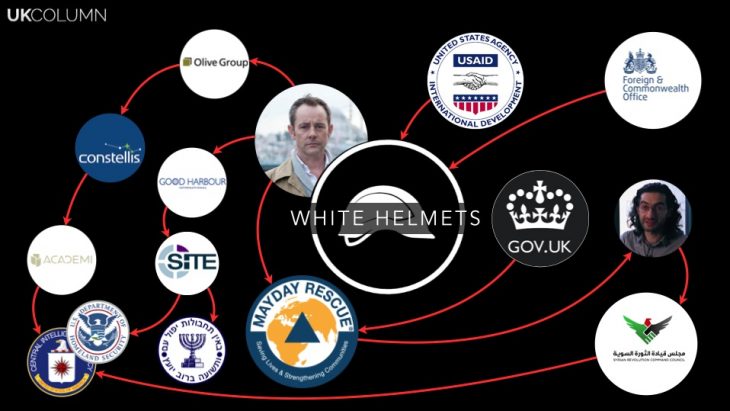
Giovanni similarly dismisses another alternative journalist, Eva Bartlett. Again, Giovanni ignores the fact that Bartlett has substantial Middle East experience including having lived in Gaza for years. Instead of objectively evaluating the journalistic work of these independent journalists, Giovanni smears their work as “disinformation”. Presumably that is because their work is published at alternative sites such as 21st Century Wire and Russian media such as RT and Sputnik. Beeley and Bartlett surely would have been happy to have their reports published at the New York Review of Books, Newsweek or other mainstream outlets. But it’s evident that such reporting is not welcome there. Even Seymour Hersh had to go abroad to have his investigations on Syria published.
The New McCarthyism
Max Blumenthal is another journalist singled out by Giovanni. Blumenthal is the author of three books, including a New York Times bestseller and the highly acclaimed “Goliath: Life and Loathing in Greater Israel”. Giovanni describes his transition from “anti-Assad” to “pro-Assad” and suggests his change of perspective was due to Russian influence. She says, “Blumenthal went to Moscow on a junket to celebrate RT’s tenth anniversary. We don’t know what happened during that visit, but afterwards, Blumenthal’s views completely flipped.” Instead of examining the facts presented by Blumenthal in articles such as “Inside the Shadowy PR Firm that’s Lobyying for Regime Change in Syria“, Giovanni engages in fact-free McCarthyism. Blumenthal explained the transition in his thinking in a public interview. He also described the threats he experienced when he started to criticize the White Helmets and their public relations firm, but this is ignored by Giovanni.
Contrary to Giovanni’s assumptions, some western journalists and activists were exposing the White Helmets long before the story was publicized on Russian media. In spring 2015 the basic facts about the White Helmets including their origins, funding and role in the information war on Syria were exposed in my article “Seven Steps of Highly Effective Manipulators“. The article showed how the White Helmets were a key component in a campaign pushing for a “No Fly Zone” in Syria. It confirmed that the White Helmets is a political lobby force.
In spring 2016, Vanessa Beeley launched a petition “Do NOT give the Nobel Peace Prize to the White Helmets“. That petition garnered more support than a contrary petition urging the Nobel Prize committee to give the award to the White Helmets. Perhaps because of that, the petition was abruptly removed without explanation from the Change.org website. It was only at this time, with publicity around the heavily promoted nomination of the White Helmets for a Nobel Peace Prize that RT and other Russian media started to publicize and expose the White Helmets. That is one-and-a-half years after they were first exposed in western alternative media.
White Helmets and Chemical Weapons Accusations
Giovanni ignores the investigations and conclusions of some of the most esteemed American journalists regarding the White Helmets and chemical weapons incidents in Syria.
The late Robert Parry published many articles exposing the White Helmets, for example “The White Helmets Controversy” and “Syria War Propaganda at the Oscars“. Parry wrote and published numerous investigations of the August 2013 chemical weapons attack and concluded the attacks were carried out by an opposition faction with the goal of pressuring the US to intervene militarily. Parry also challenged western conclusions regarding incidents such as April 4, 2017 at Khan Shaykhun. Giovanni breathlessly opens her article with this story while Parry revealed the impossibility of it being as described.
Buried deep inside a new U.N. report is evidence that could exonerate the Syrian government in the April 4 sarin atrocity and make President Trump look like an Al Qaeda dupe.
Legendary American journalist, Seymour Hersh, researched and refuted the assumptions of Giovanni and the media establishment regarding the August 2013 chemical weapons attacks near Damascus. Hersh’s investigation, titled “The Red Line and Rat Line“, provided evidence the atrocity was carried out by an armed opposition group with active support from Turkey. A Turkish member of parliament provided additional evidence. The fact that Hersh had to go across the Atlantic to have his investigation published suggests American not Russian disinformation and censorship.
In addition to ignoring the findings of widely esteemed journalists with proven track records, Giovanni plays loose with the truth. In her article she implies that a UN investigation blamed the Syrian government for the August 2013 attack. On the contrary, the head of the UN investigation team, Ake Sellstrom, said they did not determine who was responsible.
We do not have the evidence to say who did what …. The conflict in Syria is surrounded by a lot of rumors and a lot of propaganda, particularly when comes to the sensitive issue of chemical weapons.
First Responders or Western Funded Propagandists?
Giovanni says, “But the White Helmets’ financial backing is not the real reason why the pro-Assad camp is so bent on defaming them. Since 2015, the year the Russians began fighting in Syria, the White Helmets have been filming attacks on opposition-held areas with GoPro cameras affixed to their helmets.”
In reality, the ‘White Helmets” have a sophisticated media production and distribution operation. They have much more than GoPro cameras. In many of their movie segments one can see numerous people with video and still cameras. Sometimes the same incident will be shown with one segment with an Al Qaeda logo blending into the same scene with a White Helmets logo.
Giovanni claims “The Assad regime and the Russians are trying to neutralize the White Helmets because they are potential witnesses to war crimes.” However, the claims of White Helmet “witnesses” have little credibility. The White Helmet “volunteers” are paid three times as much as Syrian soldiers. They are trained, supplied and promoted by the same western states which have sought to regime change in Syria since 2011. An example of misleading and false claims by a White Helmets leader is exposed in Gareth Porter’s investigation titled “How a Syrian White Helmets Leader Played Western Media”. His conclusion could be directed to Giovanni and the NYReview of Books :
The uncritical reliance on claims by the White Helmets without any effort to investigate their credibility is yet another telling example of journalistic malpractice by media outlets with a long record of skewing coverage of conflicts toward an interventionist narrative.
When the militants (mostly Nusra/al Qaeda) were expelled from East Aleppo, civilians reported that the White Helmets were mostly concerned with saving their own and performing publicity stunts. For example, the photo of the little boy in east Aleppo looking dazed and confused in the back of a brand new White Helmet ambulance was essentially a White Helmet media stunt eagerly promoted in the West. It was later revealed the boy was not injured, he was grabbed without his parent’s consent. Eva Bartlett interviewed and photographed the father and family for her story “Mintpress Meets the Father of Iconic Aleppo Boy and says Media Lied About his Son“.
A Brilliant Marketing Success
The media and political impact of the White Helmets shows what money and marketing can do. An organization that was founded by a military contractor with funding from western governments was awarded the Rights Livelihood Award. The organization was seriously considered to receive the 2016 Nobel Peace Prize just three years after its formation.
The Netflix infomercial “The White Helmets” is an example of the propaganda. The scripted propaganda piece, where the producers did not set foot in Syria, won the Oscar award for best short documentary. It’s clear that lots of money and professional marketing can fool a lot of people. At $30 million per year, the White Helmets budget for one year is more than a decade of funding for the real Syrian Civil Defence which covers all of Syria not just pockets controlled by armed insurgents.
Unsurprisingly, it has been announced that White Helmets will receive the 2019 “Elie Wiesel” award from the heavily politicized and pro-Israel Holocaust Memorial Museum in Washington. This, plus the recent “rescue” of White Helmets by the Israeli government, is more proof of the true colors of the White Helmets. Vanessa Beeley’s recent interview with a White Helmet leader in Deraa revealed that ISIS and Nusra terrorists were part of the group “rescued” through Israel.
The Collapsing White Helmets Fraud
Giovanni is outraged that some journalists have successfully challenged and put a big dent in the White Helmets aura. She complains, “The damage the bloggers do is immense.”
Giovanni and western propagandists are upset because the myth is deflating. Increasing numbers of people – from a famous rock musician to a former UK Ambassador – see and acknowledge the reality.
As described in Blumenthal’s article, “How the White Helmets Tried to Recruit Roger Waters with Saudi Money“, rock legend Roger Waters says:
If we were to listen to the propaganda of the White Helmets and others, we would encourage our governments to start dropping bombs on people in Syria. This would be a mistake of monumental proportions…
Peter Ford, the former UK Ambassador to Syria, sums it up like this:
The White Helmets are jihadi auxiliaries… They are not, as claimed by themselves and by their supporters… simple rescuers. They are not volunteers. They are paid professionals of disinformation.
Giovanni claims her article is a “forensic take down of the Russian disinformation campaign to distort the truth in Syria.” In reality, Giovanni’s article is an example of western disinformation using subjective attacks on critics and evidence-free assertions aligned with the regime change goals of the West.
October 24, 2018
Posted by aletho |
Deception, Mainstream Media, Warmongering | Janine di Giovani, NY Review of Books, Syria |
Leave a comment
How easy it is to give awards to terrorists
I am often asked to explain why countries like Iran appear to be so aggressive, involving themselves in foreign wars and seeking to create alliances that they know will provoke the worst and most paranoid responses from some of their neighbors. My response is invariably that perceptions of threat depend very much on which side of the fence you are standing on. Saudi Arabia and Israel might well perceive Iranian actions as aggressive given the fact that all three countries are competing for dominance in the same region, but Iran, which is surrounded by powerful enemies, could equally explain its activity as defensive, seeking to create a belt of allies that can be called upon if needed if a real shooting war breaks out.
The United States and Israel are, of course, masters at seeing everything as a threat, justifying doing whatever is deemed necessary to defend against what are perceived to be enemies. They even exercise extraterritoriality, with Washington claiming a right to go after certain categories of “terrorists” in countries with which it is not at war, most particularly Afghanistan, Yemen and Somalia. Israel does likewise in its attacks on Lebanon and Syria. Both Tel Aviv and Washington have regularly crossed the line drawn by international legal authorities in terms of what constitutes initiating a “just” or “legal” war, i.e. an imminent threat to use force by a hostile power. Neither Israel nor the United States has really been threatened by an enemy or enemies in the past seventy years, so the definition of threat has been expanded to include after-the-fact as with 9/11 and potential as in the case of Israel and Iran.
The “which side of the fence” formulation has also had some interesting spin-offs in terms of how so-called non-state players that use violence are perceived and portrayed. Nearly all widely accepted definitions of terrorism include language that condemns the “use of politically motivated violence against non-combatants to provoke a state of terror.”
It is quite easy to identify some groups that are unambiguously “terrorist.” Islamic State in Syria (ISIS) and its various affiliates fit the definition perfectly, but even in that case there is some ambiguity by those state actors who are ostensibly pledged to eradicate terrorists. There have been credible claims that the United States has been protecting the last enclaves of ISIS in order to maintain its “right” to stay in Syria, allegedly based on the stated objective of completely destroying the group before withdrawal. As long as ISIS is still around in Syria, Washington will have an admittedly illegal justification for doing likewise.
There are two notable groups that should be universally condemned as terrorists but are not for political reasons. They are the Mujaheddin e Khalq (MEK), Iranian dissidents that are based in Paris and Washington, and the so-called White Helmets who have been active in Syria. MEK is particularly liked by Israel and its friends inside the Beltway because it retains resources inside Iran that enable it to carry out assassinations and sabotage, and if it is only Iranians that are dying, that’s okay.
MEK has been on the State Department roster of foreign terrorist organizations since the list was established in 1997. Its inclusion derives from its having killed six Americans in the 1970s and from its record of violence both inside and outside Iran since that time. The group was driven out of Iran, denied refuge in France, and eventually armed and given a military base by Iraq’s leader Saddam Hussein. Saddam used the group to carry out terrorist acts inside Iran. MEK is widely regarded as a cult headed by a husband and wife team Massoud and Maryam Rajavi. Its members were required to be celibate and there are reports that they are subjected to extensive brainwashing, physical torture, severe beatings even unto death, and prolonged solitary confinement if they question the leadership. One scholar who has studied them describes their beliefs as a “weird combination of Marxism and Islamic fundamentalism.” Like many other terrorist groups MEK has a political wing that operates openly referred to as the National Council of Resistance of Iran (NCRI), which is based in Paris, and another front organization called Executive Action which operates in Washington.
MEK was regarded as a terrorist group until 2012, when it was taken off the Special Designation list by Secretary of State Hillary Clinton. It was removed because multi-million dollar contracts with Washington lobbying firms experienced at “working” congress backed up by handsome speaking fees had induced many prominent Americans to join the chorus supporting NCRI. Prior to 2012, speaking fees for the group started at $15,000 and went up from there. Former Pennsylvania governor Ed Rendell reported more than $150,000 in honoraria. Rudy Giuliani has been paid generously for years at $20,000 per appearance for brief, twenty-minute speeches. Bear in mind that MEK was a listed terrorist group at the time and accepting money from it to promote its interests should have constituted material support of terrorism.
The group’s well-connected friends have included prominent neocons like current National Security Advisor John Bolton and ex-CIA Directors James Woolsey, Michael Hayden and Porter Goss as well as former Generals Anthony Zinni, Peter Pace, Wesley Clark, and Hugh Shelton. Traditional conservatives close to the Trump Administration like Newt Gingrich, Fran Townsend and Secretary of Transportation Elaine Chao are also fans of NCRI. Townsend in particular, as a self-proclaimed national security specialist, has appeared on television to denounce Iran, calling its actions “acts of war” without indicating that she has received money from an opposition group.
MEK’s formula for success in removing itself from the terrorism lift involved paying its way through a corrupt political system. More interesting perhaps is the tale of the White Helmets, who have just been given the 2019 Elie Wiesel Award by the National Holocaust Museum, with the citation “These volunteer rescue workers have saved lives on all sides of the conflict in Syria. Their motto is ‘To save one life is to save all of humanity.’”
The White Helmets have been praised by those who hate the government of President Bashar al-Asad in Syria and want to see it removed because of its role as a leading element in the propaganda campaign that seeks to instigate violence or use fabricated information to depict the Damascus government as guilty of slaughtering its own citizens. The propaganda is intended to terrorize the civilian population, which is part of the definition of terrorism.
Favorable media coverage derives from the documentary The White Helmets, which was produced by the group itself and tells a very convincing tale promoted as “the story of real-life heroes and impossible hope.” It is a very impressive piece of propaganda, so much so that it has won numerous awards including the Oscar for Best Documentary Short last year and the White Helmets themselves were nominated for the Nobel Peace Prize. More to the point, however, is the undeniable fact that the documentary has helped shape the public understanding of what is going on in Syria, describing the government in Damascus in purely negative terms.
Recently, with the Syrian Army closing in on the last White Helmet affiliates still operating in the country, the Israeli government, assisted by the United States, staged an emergency humanitarian evacuation of the group’s members and their families to Israel and then on to Jordan. It was described in a BBC article that included “The IDF said they had ‘completed a humanitarian effort to rescue members of a Syrian civil organization and their families’, saying there was an ‘immediate threat to their lives.’ The transfer of the displaced Syrians through Israel was an exceptional humanitarian gesture. Although Israel is not directly involved in the Syria conflict, the two countries have been in a state of war for decades. Despite the intervention, the IDF said that ‘Israel continues to maintain a non-intervention policy regarding the Syrian conflict.’”
All of the Israeli assertions are nonsense, including its claimed “humanitarianism” and “non-intervention” in the Syrian war, where it has been bombing almost daily. The carefully edited scenes of heroism under fire that have been filmed and released worldwide conceal the White Helmets’ relationship with the al-Qaeda affiliated group Jabhat al-Nusra and its participation in the torture and execution of “rebel” opponents. Indeed, the White Helmets only operate in rebel held territory, which enables them to shape the narrative both regarding who they are and what is occurring on the ground.
The White Helmets travelled to bombing sites with their film crews trailing behind them. Once at the sites, with no independent observers, they are able to arrange or even stage what is filmed to conform to their selected narrative. Exploiting their access to the western media, the White Helmets thereby de facto became a major source of “eyewitness” news regarding what was going on in those many parts of Syria where European and American journalists were quite rightly afraid to go, all part of a broader largely successful “rebel” effort to manufacture fake news that depicts the Damascus government as engaging in war crimes directed against civilians, an effort that has led to several attacks on government forces and facilities by the U.S. military. This is precisely the propaganda that has been supported both by Tel Aviv and Washington.
Perhaps the most serious charge against the White Helmets consists of the evidence that they actively participated in the atrocities, to include torture and murder, carried out by their al-Nusra hosts. There have been numerous photos of the White Helmets operating directly with armed terrorists and also celebrating over the bodies of execution victims and murdered Iraqi soldiers. The group’s jihadi associates regard the White Helmets as fellow “mujahideen” and “soldiers of the revolution.”
So, the National Holocaust Museum, which is taxpayer funded, has given an apparently prestigious award to a terrorist group, something which could have been discerned with even a little fact checking. And the museum also might have been sensitive to how the White Helmets have been used in support of Israeli propaganda vis-à-vis Syria. Perhaps, while they are at it, the museum’s board just might also want to check out Elie Wiesel, for whom the award is named. Wiesel, who was a chronicler of Jewish victimhood while persistently refusing to acknowledge what Israel was doing to the Palestinians, notoriously mixed fact and fiction in his best-selling holocaust memoir Night. Ironically, the award and recipient are well matched in this case as mixing fact and fiction is what both Elie Wiesel and the White Helmets are all about.
Philip M. Giraldi, Ph.D., is Executive Director of the Council for the National Interest, a 501(c)3 tax deductible educational foundation that seeks a more interests-based U.S. foreign policy in the Middle East. Website is www.councilforthenationalinterest.org, address is P.O. Box 2157, Purcellville VA 20134 and its email is inform@cnionline.org.
October 23, 2018
Posted by aletho |
Deception, Mainstream Media, Warmongering, War Crimes | MEK, National Holocaust Museum, White Helmets |
Leave a comment
The Khashoggi incident continues to roll out in screaming headlines. The “confession” that the journalist died in the Saudi consulate in Istanbul is the latest twist, an indicator of the struggle to control narrative.
The manufactured crisis is being used not solely to demonise NATO’s erstwhile best buds, the house of Saud, but also to further isolate and discredit Trump in nice time for the November elections. Trump is currently being bashed by the Dems for doing what they and everyone else was doing a few weeks ago – viz cozying up to the mass-murderers and selling them weapons.
With shameless opportunism the same people who ignored the slaughter in Yemen as recently as a week ago are now appalled by it. Aware that the speed of the change might make them look like the sold-out moral blanks they actually are, Jonathan Freedland and Max Fisher (amongst others) are inventing vomit-inducing excuses for why they just hadn’t got round to noticing the dead children until the deep state told them to care.
They asked me to write on why Khashoggi’s death provoked a backlash to Saudi Arabia, when so many past transgressions did not
Here’s my answer, citing psychology, social science, the oddities of alliance politics, the history of Saudi and, yes, Bill Cosby https://t.co/vWpIWAAmD0
— Max Fisher (@Max_Fisher) October 17, 2018
They would be better off not trying. Some bits of soul-selling are beyond even the most sophistic attempts at rehabilitation.
The hypocrisy and short term memory loss currently on display is astounding, even by normal establishment/MSM standards. It’s a danse macabre. A horror show of painted corpses feigning life and love, reeking with sickly decay, nicely timed for Halloween.
The Saudis, and Trump, want this whole Khashoggi thing buried asap, and possibly think a quick fess up is the best way to do it. Whether or not it succeeds depends on the motives for creating the crisis in the first place, and how much leg work the Saudis and MBS have done behind the scenes to rehabilitate themselves in the empire’s eyes.
But let’s remember, the “confession” is no more reality-driven than anything else. It may be true. Sure. It may be completely 100% true. Or it may be entirely made up of convenience and back-pedalling. Or it may be any combination of these two opposites. We will likely never know for sure.
The fact it’s being reported, confessed, debated, analysed is not connected in any way to the question of its veridical reality.
That’s the real point, and not just about this.
The New RealityTM is an unending advertising campaign, a permanent promo reel, a PR push that never stops. No one involved is even concerned with verification or even remembers what that is. The lights are too bright. The money too good. The story self-perpetuating. The show really MUST go on. The corpses need to keep dancing. Forever.
Hard lesson. Hard to live by. Some people get annoyed and upset by it. But it’s still true.
Catte Black, co-founding editor at OffGuardian. Writer. Occasional polemicist. Lives in UK. Email at blackcatte@off-guardian.org
October 20, 2018
Posted by aletho |
Deception, Mainstream Media, Warmongering | Saudi Arabia |
Leave a comment
Those in the Western media too busy to be bothered trying to understand the complexities, intricacies and nuances of the Middle East often resort to concluding nearly all conflicts there are some kind of “proxy war” between Saudi Arabia and Iran.
This is usually out of ignorance, reducing disputes to the lowest common dominator of Sunnis versus Shiites or to that between their two most prominent patron states. Often though there is deliberate obfuscation; there must be justification for a US ally to cause regional mayhem on the pretext of containing an enemy. The easiest and most convenient scapegoat has been Iran and efforts to contain its alleged expansionism by Saudi Arabia, the United Arab Emirates and of course, Israel, go unchecked.
One of the most devastating and tragic episodes occurring in the Middle East today is in Yemen. But this is not a de facto proxy war its bankrollers hope we have all grown too weary of hearing to investigate further.
Despite the constant disclaimers by a lazy media, there is no proxy war in Yemen.
The war which has ravaged the Arab world’s poorest country since March 2015 is a Saudi-led, unilateral onslaught which has so devasted the nation, its economy, infrastructure and social services that malnutrition has become widespread and cholera epidemic.
Ostensibly, the Saudi-UAE military campaign was to oust Houthi-led rebels who unseated the deeply unpopular Saudi-backed puppet-president Abdu Rabbu Mansour Hadi in January 2015 (elected on a ballot in which he was the only candidate and who remained in power even after the expiration of a one-year mandate that had extended his term). The Houthis, a politico-religious group officially known as Ansarullah and named after their founder, Hussein Badreddin al-Houthi, initially formed in opposition to late Yemeni president Ali Abdullah Saleh.
The Houthis generally belong to the Zaidi school in Islam, a branch of the larger Shiite sect. Branding the Houthis as “Iranian-backed Shiite rebels” as is now routine, makes for easy and convenient categorization of who the “bad guys” are in Western and Gulf media. But this is disingenuous. The inconvenient fact is Zaidis are generally closer to Sunni Islam than Shiite (and the longtime military, Saudi-backed dictator Saleh was Zaidi). More significantly, other than voicing solidarity with the Houthis, there has been no substantive evidence of Iranian military intervention or that of affiliated parties in Yemen. On the contrary, and starkly so, it has been the Saudi and Emirati governments’ inhumane bombing campaign which has been the most glaring example of foreign interference in the internal affairs of another country.
When a school-bus was struck during an air raid that killed 40 children, it was initially justified as a “legitimate military target” by the Saudi coalition before international outrage finally led to the conclusion it was otherwise. On the other hand, intermittent Houthi missiles launched at Saudi military installations and considered evidence of foreign military supply belie the Houthis as a legitimate, capable, battle-hardened fighting force. Apparently, the regime cannot fathom that despite daily attack, they have had the muster to retaliate and demonstrate offensive, rather than strictly defensive, capabilities.
Yemen is not a sectarian conflict or one of proxies, but a war stemming from the fallout of removing yet another Saudi-backed ruler from power.
Since 2015, at least 10,000 Yemenis have been killed, 22 million are now in need some form of relief (out of a total population of approximately 29 million) and eight million are malnourished. These numbers can only be expected to climb after evidence has shown Saudi Arabia is targeting food supplies.
The war waged in Yemen by Saudi Arabia and its allies and their wanton use of US and UK-supplied arms is everything short of a formal invasion. It is a one-sided, vicious military adventure which has rendered millions destitute and to date, has proven completely unsuccessful in fulfilling its stated objectives. The only proxies in this struggle are the victims of its war crimes; innocent men, women and children starved or killed, stand-ins for an apparition of a foreign power waiting to be found.
October 20, 2018
Posted by aletho |
Deception, Illegal Occupation, Mainstream Media, Warmongering | Saudi Arabia, UAE, UK, United States, Yemen |
Leave a comment
 Aletho News
