Is Israel turning a blind eye as Israeli scammers swindle victims in France, US, elsewhere?
By Alison Weir | If Americans Knew | November 14, 2018
French and Israeli media report that a group largely made up of Israelis scammed 3,000 French citizens out of approximately $20 million. Most of the stolen money is in Israel, but Israeli authorities are reportedly failing to cooperate with France in prosecuting the scammers and retrieving the money.
This is the latest of numerous examples of Israeli officials stone-walling international efforts against the perpetrators of massive financial swindles around the world, according to Israeli investigative journalists and others. These scams have brought estimated billions into the Israeli economy, propping up a regime widely condemned for human rights abuses and ethnic cleansing against indigenous Palestinians. Together, the stories paint a picture of a government that seems to be turning a blind eye to – and even protecting – scammers.
A Finance Magnates analysis reports that one of the swindles alone has brought in over a billion dollars and employs 5,000 people. And a new scam, described below, may help what is predicted to be “the next major driver of the Israeli economy.”
A former IRS expert on international crime notes that “fraudulent industries are often major economic drivers, and that can translate into political clout.”
Some Israeli journalists have been working to expose the situation in Israeli newspapers, publishing exposés like “As Israel turns blind eye to vast binary options fraud, French investigators step in” and “Are French Jewish criminals using Israel as a get-out-of-jail card?” (Short answer: yes.)
Victimizing French business owners & churches
The victims of the recent scam against French citizens included churches and the owners of small businesses – delicatessens, car repair shops, hair salons, plumbers, etc. Some lost their life savings and describe being threatened and intimidated by the scammers.
The masterminds of the scam reportedly were Antoine Ilan Frau (aka Ilan Frau) and Michael Nedjar, both of whom resided in Israel at the time. French police arrested the two at the Paris airport in 2016 as they were about to return to Israel. While they and 25 others were subsequently found guilty in a French court, other alleged co-conspirators have not yet been arrested and are believed to be in Israel.
The Times of Israel (TOI) reports that most of the money was channeled to Israel and has not yet been recovered. The newspaper reports that Israeli law enforcement authorities “have been unhelpful in enabling further investigation of the scam and in recovering the stolen funds.”
TOI, which obtained the full French verdict statement, reports: “In 200 pages of matter-of-fact legal prose, the verdict paints a picture of Israeli authorities unwilling to cooperate with their French counterparts.”
Another Times of Israel article reports: “The exact number of French citizens thought to be evading authorities in Israel is unknown, but France has sent to Israel at least 70 formal requests for judicial assistance with cases involving suspected fraud by dual nationals residing in the Jewish state.”
Below are some of the other Israeli-connected scams victimizing people around the world that observers accuse the Israeli government of largely ignoring.
Gilbert Chikli, “the world’s greatest con artist”
In 2016 Ha’aretz reported on an Israeli con artist named Gilbert Chikli, who boasts of pioneering a multi-million dollar scam that also targeted people in France. The New York Post has called him “the world’s greatest con artist.”
The scam targeted banks and business, cost French companies an estimated 7.9 million euros. Approximately 52 employees of the companies taken in by him were subsequently fired.
Despite French extradition requests, Ha’aretz reported in 2016 that Chikli “mysteriously remains a free man, living in luxury in his villa in a seaside Israeli city as French authorities try to bring him to justice over a massive con for which he was previously convicted.”
Although a French court sentenced Chikli to a seven-year prison sentence, Ha’aretz reported that instead of being incarcerated, Chikli was “hanging out at his private swimming pool.” Israeli officials refused to explain why Chikli was allowed to live freely in Israel.
Far from disputing the French conviction, Chikli bragged on Israeli TV about his technique: “You get off on it. Because you’re 5,000 kilometers from Paris with a telephone and a 100-euro calling card and you can make 10 million euros” [over $11 million].
Chikli boasted that he had a good life in Israel, where he dealt in real estate (in addition, it appears, to continuing his scams). He also made an estimated several thousand euros for “consultancy services” to a director who made a film based on Chikli’s story.
The film generated unprecedented attention in France, as it depicted “an Israeli-French underworld out of reach of French authorities,” in the words of TOI, “because of the complications in extraditing suspects from Israel.”
Chikli remained free in Israel from 2009 until he traveled to the Ukraine in 2017, where he and another Israeli (also wanted by French authorities) were finally arrested, and Chikli was extradited to France. He was jailed and indicted for an additional scam perpetrated while he was at large.
A French report states that during his time in Ukrainian detention, Chikli was “filmed drinking vodka in his cell, toasting his wealth, swearing never to return to France, and abusing the French judicial system.” … continue reading
Austrian Ex-Colonel Accused of Espionage ‘Doesn’t Feel Like a Spy’ – Lawyer
Sputnik – November 14, 2018
The lawyer of the retired Austrian colonel, who is suspected of having passed secret information to Russia for 25 years, insists that his client could have never betrayed state secrets as he had no access to the classified data. According to the local outlet Kronen Zeitung, defender Michael Hofer welcomed the decision of the Salzburg State Court not to arrest the retired colonel.
“My client has assured me that he has not revealed any state secrets. He is very pleased with the decision of the court. He does not feel like a spy,” the lawyer told the media.
The judge dismissed the application for pre-trial detention, citing there’s no danger that the suspect flees. He is said to be optimally socially integrated and has an irreproachable profile. Court spokesman Peter Egger also stated that the accused man has no access to sensitive information anyway since he is retired. Besides, his communications are restricted.
According to the Salzburg prosecutor’s office, the suspect may be sentenced to up to 10 years in prison. The case against the retired officer, who is said to have spied for Moscow between the 1990s and the end of his careers, was made public last week following Kronen Zeitung’s report.
Austrian Chancellor Sebastian Kurz confirmed that a 70-year-old retired Austrian colonel was suspected of spying for Moscow and demanded that Russia provide “transparent” information on the issue. The incident prompted the cancellation of an official visit of Austrian Minister of Foreign Affairs Karin Kneissl to Russia.
Addressing the espionage case, Moscow protested to the Austrian Ambassador to Russia, calling the accusations baseless. In response, General-Secretary of the Austrian Interior Ministry Peter Goldgruber expressed hope that the incident would not undermine Austrian-Russian relations.
READ MORE:
UK Gave Austria Info on Ex-Colonel Suspected of Spying for Russia – Reports
Phil Ochs and the Crucifixion of President John F. Kennedy
By Edward Curtin | November 13, 2018
“They say they can’t believe it, it’s a sacrilegious shame
Now, who would want to hurt such a hero of the game?
But you know I predicted it; I knew he had to fall
How did it happen? I hope his suffering was small.
Tell me every detail, I’ve got to know it all,
And do you have a picture of the pain?” – Phil Ochs, The Crucifixion“You are aware of only one unrest;
Oh, never learn to know the other!
Two souls, alas, are dwelling in my breast,
And one is striving to forsake its brother.” – Goethe, Faust
President John Kennedy was assassinated by the U.S. national-security state, led by the C.I.A., on November 22, 1963 in Dallas, Texas. That is a fact beyond dispute, except for those who wish to engage in pseudo-debates to deny the obvious. I prefer not to, since there is nothing to debate.
But there is everything to mourn, even after fifty-five years, first of course for the man himself, then for those who have suffered and died for bearing witness to the truth about his assassination, and finally for the consequences of his murder, because it cut savagely into any pretense of American innocence and set the stage for the nihilistic tragedies that have followed, including the murders of Malcolm X, MLK, RFK, the September 11, 2001 attacks, and the ongoing “war on terror.”
Today, JFK’s killers have tightened their chokehold on the country and on the throats of those wishing to tell the truth. Their penetration of the corporate mass media is wide and deep, and the narratives they spin can make an innocent soul’s head spin. Everything is twisted to serve their interests. With a click of a finger, truth and falsehood rotate like spokes on a rapidly turning wheel – spooks turning spokes in a game of hide and seek meant to confuse and derange the public. Constant befuddlement is the name of this racket.
It’s a melancholy task to contemplate the parts played, consciously or unconsciously, by various actors in this deadly game, not least because one’s own naiveté prompts one sometimes to question or abandon those one once admired and to dive deeply into the twisted minds and hearts of fellow humans. What follows concerns one such man’s strange story as told by another man, whose story is perhaps stranger, and what their relationships with U.S. intelligence, if any, might suggest about our situation today.
Oh I am just a student, Sir, and only want to learn
But it’s hard to read through the risin’ smoke of the books that you like to burn
So I’d like to make a promise and I’d like to make a vow
That when I got something to say, Sir, I’m gonna say it now
Those are the words of the folk singer, Phil Ochs, from his 1966 song “I’m Going To Say It Now.” Ochs wrote and performed passionate protest songs during the 1960s that inspired many to speak and act in opposition to the Vietnam War and many other injustices. He was a fiery, sardonic activist whose music, such as “I Ain’t Marching Any More,” induced many to refuse military induction and to burn their draft cards. He, not Bob Dylan, was the committed voice of the 1960s radical anti-war folk music world, singing at events and rallies across the country, culminating at the 1968 Democratic National Convention in Chicago when the Chicago police rioted and savagely beat anti-war protesters, and Yippies and Hippies and protesters gathered in Lincoln Park to listen to Ochs sing defiant songs to keep up their spirits. But Ochs’s own spirit was broken that terrible year of so many deaths, which started his long descent into alcoholism and mental chaos that ended with his suicide in 1976.
I was one of those who was inspired by his music. I still am. Soulful and satiric, biting and beautiful, stirring and inspiriting, it has a power few can equal. But I have come to a point where I feel compelled to broach a mysterious story involving Ochs, something that when I first heard it in passing shocked me terribly. No, I thought, that can’t be true; it’s impossible.
But the more I have researched it, the truer it seems – with emphasis on the word “seems” – for there is only one source for the story, a source I don’t doubt but can’t confirm.
But either way, I have come to see the story as emblematic of the treachery and confusion sown by the CIA, its Operation Mockingbird, and its so-called Mighty Wurlitzer that have played so many for fools through its control of the corporate mass media and the production of narratives that run like little movies too perfect to be true, but too true to be false – even when they are. Screens within screens within screens. Efforts to fuck up as many people as possible in operation chaos, to derange and cleave them into split personalities within and without, and to mystify as many minds as possible.
I think Phil Ochs was one so mystified. I am wondering if in life and death he was used and abused by radically evil forces, whomever they may be.
According to Phil’s best friend from college at Ohio State, the man who taught him to play guitar, his singing partner, best man at his wedding, constant pal in their days in Greenwich Village, and life-long friend, Jim Glover, Ochs was in Dallas, Texas on November 22, 1963, standing outside the Dal-Tex building in Dealey Plaza when JFK was driven by to be killed. Glover says Phil told him he went there as a “national security observer.”
I had read about this on some off-beat websites, but never in biographies of Ochs, or in the latest documentary about him, There But for Fortune. There seems to be an “official” ban on mentioning Glover’s claim, even though Glover appears in the books and the documentary, has been interviewed by the authors and filmmaker, and is considered by them, as Phil’s old and close friend, to be a reliable source.
Jim Glover, who was one half of the well-known folk duo, Jim and Jean, back in the 1960s, and is now an anti-war activist in Florida, says that he has told Ochs’s siblings and biographers all the details, has also reported it recently and as far back as the early 1990s to the FBI, and has put these claims out on some internet sites and openly spoken about it. These disclosures have resulted in silence from Ochs’s family and biographers. There have been no efforts to refute it, and so it circulates far outside the mainstream. Since Glover speaks of it openly and in great detail, and since it is a shocking claim with serious implications, one would think it worthy of response. But it is only greeted with silence. It seems perhaps like another example of what Thomas Merton called “the unspeakable” – “the void that contradicts everything that is spoken even before the words are said.”
So I contacted Glover and asked him about it. He told me that Phil had told him months before the assassination that he was “working for National Security, something like the C.I.A.” Then, he later told him he had gone to Dallas with one of the Gambino boys as “a national security observer” and had been standing in Dealey Plaza outside the Dal-Tex building where he was filmed when JFK was shot. Jim Glover has sent me photos that he discovered decades later that he says are photos of Phil in Dealey Plaza at the exact spot he mentioned and also in the movie theater where Oswald was arrested. He thinks they are very conclusive, especially because of the Dealey Plaza location, despite their blurriness. While I think they are not dispositive, they do look like Ochs in a fuzzy sort of way.
The first two photos are outside the Dal-Tex building, after and before the assassination.
The third is inside the movie theater where Oswald was captured and taken out the front door, while the second Oswald was led out the back door.
And the last is a photo of Ochs at Ohio State in 1961 for comparison purposes.


Whatever you think of the photos, they are one piece of a larger mystery, a tale stranger than fiction. They may or may not show Ochs, as Jim Glover is certain they do, but if Ochs’s biographers trust him on other matters, why would they doubt him when he says Ochs told him he was in Dallas that day? He says they are afraid to entertain the possibility.
So we might ask the question: If Phil Ochs was in Dallas that day, what was he doing there?
Let me reiterate: The murder of President Kennedy is not a mystery, and I am not exploring it. We know he was killed in a coup carried out by the national security state led by the CIA. If you want to know why, and if you want to know why this Thanksgiving, November 22, we should give thanks for John Kennedy’s life and witness, read JFK and the Unspeakable by James Douglass. It’s the only book you need to read on the assassination.
Phil Ochs is the mystery in Glover’s telling, and I am wondering about him (and Glover), what he thought he was doing getting tangled up with shadowy intelligence operatives, how that awakening knowledge subsequently affected him, how he responded, and what place guilt and fear played in his post-1963 life and death. I am proceeding as if Ochs went to Dallas at the naïve age of 22 not to harm Kennedy, but as Glover said he said, to investigate the threats against Kennedy that he had heard of in NYC through V. T. Lee of the Fair Play for Cuba Committee (FPCC) and others. (This is the same V.T. Lee who received a letter from Lee Harvey Oswald, who was proposing a FPCC chapter for New Orleans in May 1963, where he was performing his theatrical stunts. Lee warned Oswald not to provoke “unnecessary incidents which frighten away prospective supporters” in a place so hostile to Castro. But Oswald, of course, did the opposite to establish his fake support for Castro.)
Glover says he also knew of the plots against Kennedy that were widely circulating in leftist circles, and afterwards felt Phil and he were being set up to be implicated in the assassination in case the official cover story fell apart since he and Glover were sympathetic to Castro and Cuba. He says their phones were tapped and they were being surveilled. At this time Glover and his partner Jean were persuaded, against Ochs’s advice, to go on a Hollywood Hootenanny Tour of southern college campuses, a surreal trip that made stops in Dallas and Houston and seemed clearly connected to the Kennedy assassination as strange people got off and on the multi-bus caravan, talking about Kennedy being killed. Glover says these included George and Barbara Bush and J. Edgar Hoover, who were picked up by the bus at the Houston airport late in the day of November 22.
You would have to have a fantastic imagination to make this stuff up. Why would he? Yet his tale is truly bizarre, revealing the intricate nature of the government conspiracy to kill Kennedy and to create multiple tales of plausible deniability when others failed.
He told me that he doesn’t know who told Phil to go to Dallas, but he is unequivocal that he did. He said:
I don’t have all the answers. All I know is what Phil told me to keep us both as safe as possible. He told me I’ll never lie to you but there are things I can’t tell you. Knowing I had a big mouth if he told me things you [me] are asking, I might not be alive. His purpose as I see it was to observe, and being set up if Oswald lived, he could have been used as, ‘See a Castro sympathizer knew and was involved.’ And that would apply to me also [learning what he did on the Hootenanny Tour] and they would stop at nothing to have us both silenced permanently if Oswald or Kennedy lived because we knew too much.
Once, he said, as an example of his big mouth, he was performing at the Gaslight in Greenwich Village and told the audience that Phil had been in Dallas as a national security observer. He thinks Ochs’s manager, Al Grossman, and Bob Dylan heard it, “because Phil came over and said, ‘Are you trying to get me killed?’”
Phil, he said, was a super patriot and would never have done anything to harm Kennedy, but was tricked into going to Dallas under the assumption that he was working with those trying to prevent the assassination by investigating the plot or trying to infiltrate it and perhaps stop it. But when Ochs returned to NYC later that day, according to Glover, he was devastated by Kennedy’s assassination and at the realization that he had been used and was now compromised. That is why he cried so terribly that night and wanted to die. His youthful innocence had died.
Phil Ochs was a man of two minds and inclinations, not unusual for a coterie of musicians of that era who knew and associated with it each other, had military/intelligence family backgrounds, and were never drafted like so many young men not in college. Like so many of these musical icons – Jim Morrison, David Crosby, Frank Zappa, “Papa” John Philips, Stephen Stills, et al (as Dave McGowan chronicles in his book, Weird Scenes Inside the Canyon, where he questions their public personae and the strange ways they gathered from far distances at one time into Los Angeles’s Laurel Canyon, at the heart which was a covert military film facility, Lookout Mountain Laboratory) – Ochs had a military background. He was a conservative rebel who suddenly transformed from a conservative to a radical at Ohio State in his last year, according to Glover. He attended Staunton Military Academy with Barry Goldwater’s son and John Dean of Watergate fame and was a sergeant in the ROTC at Ohio State where at the least he was aware of military intelligence spying on radical students; he idolized John Wayne, James Dean, Marlon Brando and the American western film mythology of the cowboy and soldier; he loved John Kennedy; he sang powerful anti-war songs and would jokingly say to his audience that now that they had listened to his anti-government songs he was turning them in to the government; he was a drama king who loved heroes and wanted to be one; he was a left-winger who mocked liberals; he was a folk singer who loved Elvis. In short, he was a man of many contradictions, of highs and lows, hope and despair, driven to stop war and injustice and to become a star in the superficial entertainment culture, etc. As he fell apart in his last years, it became easy to categorize him with the facile term “manic-depressive” or “bipolar.”
I think that misses the heart of the matter, as if a term explains its reality, as if his paranoia had no basis outside his mind, as if he was just nuts to think the CIA was out to get him, as he did regularly and especially after he was attacked and choked while walking alone on a beach in Dar-es-Salaam, Tanzania, when his vocal cords were ruptured and his voice permanently damaged.
My guess is that he was driven by guilt and fear and that his suicide at age 35 was connected to being in Dallas on the day JFK was assassinated. I think he died that day too, and that the next 13 years of his life were courageous attempts to quell his guilt for being gulled into going to Dallas and fear that he might be killed for doing so by singing out his rebellious songs in the face of his ghosts. He was a haunted man, and produced haunting songs in response to exorcise his demons, including the songs The Crucifixion and That Was the President, both about John Kennedy.
In his last years he said he was John Train (sometimes John Butler Train), not Phil Ochs, and that John Train had killed Phil Ochs in the Chelsea Hotel on the summer solstice in 1975, the solstice being a significant turning point. His biographers give various explanations for his adoption of this pseudonym, all of which, I believe, miss the mark. To say he took the name from his heroes John Wayne, John Ford, John Kennedy, and William Butler Yeats, avoids the key word: Train. It’s as if the word is unimportant or unspeakable, or the name John Train is a common name that “crazy” Phil just made up.
As he was unravelling in fear and trembling, I believe he was referring to a real John Train, a CIA operative, when he metaphorically said “on the first day of summer 1975, Phil Ochs was murdered in the Chelsea Hotel by John Train…. For the good of societies, public and secret, he needed to be gotten rid of.” Train assassinates Ochs. Then the following spring Ochs assassinates Ochs by hanging himself.
Could it just be a coincidence that there is a real John Train who from the early 1950s onward was connected to the CIA and the covert state in various activities as an asset or an agent? This John Train, who was one of the founders and funders of The Paris Review, its first managing editor, who together with the CIA’s Peter Matthiessen and George Plimpton started the magazine for the CIA under its propaganda front, The Congress for Cultural Freedom. This John Train, who ran cover corporations for the CIA and was connected to George Herbert Walker Bush through the CIA’s Thomas Devine, who was involved in setting up Bush’s company Zapata Offshore. This John Train, who was deeply involved with the CIA’s activities in the early 1980s backing the CIA-supported mujahideen against the Soviets in Afghanistan. This John Train who…. [i]
It is farfetched in the extreme to think that Phil Ochs just plucked the name John Train out of thin air. But the fact that this is asserted by his biographers makes sense when we realize that Jim Glover’s claims are ignored by Ochs’s family, his biographers, and the makers of the documentary about him. That there is a real CIA-affiliated John Train and that Glover insists Phil told him he was in Dallas on November 22, 1963 seem clearly connected. But these facts are unspeakable. I think they need to be explored.
Like Jim Glover, I don’t have all the answers about Phil Ochs. My guess and my hope is that Phil was used and was not complicit, that he naively thought by going to Dallas he was working with the good guys to protect the president from the killers, and when he witnessed the brutal murder, he felt compromised, and felt so overwhelmed with guilt and fear that life eventually became too unbearable for him. Clearly this is Glover’s story. I think it is incumbent on those who don’t believe it to explain why Glover would fabricate such an intricate tale that glorifies his friend as a true patriot, whom he claims was used by intelligence operatives and who therefore suffered for the rest of his life for trying to protect President Kennedy.
Whatever the truth in this age of “not knowing,” I think his story is a parable for our times. Whenever you think you’re getting the straight scoop, think again, and then again. The CIA’s Operation Mockingbird is still singing its siren song to convince us that the crucifixion was a one-time event, when Phil knew otherwise, right from the start and right to the end. I think he tried to warn us and wouldn’t be silenced, even in death.
[1] See Joel Whitney’s Finks, Russ Baker’s Family of Secrets, David McGowan’s Weird Scenes Inside the Canyon, and Bill Kelly’s http://jfkcountercoup.blogspot.com/2013/05/phil-ochs-at-dealey-plaza.html
Where was Detective Sergeant Nicholas Bailey Poisoned?
By Rob Slane | The Blog Mire | November 12, 2018
I wrote back here that the Achilles Heel of the door handle theory is Detective Sergeant Nicholas Bailey. When his name was first mentioned publicly, on 8th March, it was widely reported that he had been one of the first responders at the bench in The Maltings. However, this was thrown into confusion the following day by none other than Lord Ian Blair, former Chief Constable of the Metropolitan Police, who stated the following on Radio 4’s Today Programme:
“There are some indications that the police officer who was injured had been to the house, whereas there was a doctor who looked after the patients in the open, who hasn’t been affected at all. So there maybe some clues floating around in here.’”
As I pointed out in that piece, the phrase “some indications” was somewhat disingenuous, as The Metropolitan Police would have known by that time exactly where Mr Bailey had been. And in any case, there was no particular reason for Lord Blair to reveal this information.
The point I went on to make is that if it was known that he had been poisoned, which it was; if it was known that he’d been to the house, which it was; and if it was known that the poisoning didn’t happen at The Maltings, which it was (at least according to investigators who ruled it out with surprising swiftness), then it MUST have been known that he was poisoned AT THE HOUSE. But if this was the case, why exactly was the house not locked down, with forensic scientists all over the house taking swabs? Why did it take nearly two weeks for that to happen?
As far as I can see, there are only two explanations for this. The first is sheer incompetence. That’s possible, I suppose. I mean we are talking about an organisation which somehow managed to put out a formal statement setting out the case against two suspects, which contained the wrong street name, no real details of the suspects’ movements in Salisbury, and the somewhat impossible feat of the men being at Gatwick Airport whilst the plane they were on was still in the air. There is that. But even this seems to be stretching it. As I say, it was known that Mr Bailey was poisoned, it was known that he was in two locations that the Skripals were also in, and one of these had apparently been ruled out. Which means it MUST have been …? Not hard, is it? And yet the house wasn’t swabbed until 22nd March.
The second possibility is that he wasn’t poisoned at the house at all, but it took two weeks when the house wasn’t being swabbed, when the door handle manual hadn’t been discovered, and when the police were still searching for poison in places where Mr Bailey never went, to concoct a narrative that would place the location of his poisoning away from The Maltings.
But I don’t think that Mr Bailey’s role as Achilles Heel stops at the door handle. I think he is, in many ways, the Achilles Heel of everything in this case. Was he really at The Maltings? I’m not sure. Did he really go to the house? Again, I’m really not sure. When did he fall ill and go to hospital? Again, it’s all a bit hazy. And by the way this has nothing to do with me refusing to accept official explanations; on the contrary, it is because every attempt by the authorities to explain Mr Bailey’s role and how he got poisoned have been shrouded in riddles, mysteries and enigmas.
Just in case readers jump to the wrong conclusions, for the record I am quite certain that Mr Bailey had nothing to do with the poisoning itself. I say this on the basis that he is said to have driven himself to Salisbury District Hospital after feeling ill — hardly the actions of a man who was involved in the poisoning itself (had he been involved, he would surely have been taken to a secret decontamination location, not allowed to drive himself to an NHS hospital). But his role, the time and place of his poisoning, and his subsequent disappearance since the incident all stick out like a sore thumb.
One thing that is particularly interesting is the time of Mr Bailey’s admission to Salisbury District Hospital. There are some doubts as to when this was, but since my aim in these pieces is to hold the official narrative up to scrutiny, I will go by the official statement released by The Metropolitan Police on 5th June:
“Detective Sergeant Nick Bailey, a Wiltshire police officer who was amongst the first to respond to the incident, also fell seriously ill after being exposed to the nerve agent and was admitted to hospital on 6 March. Since being discharged from hospital on 22 March, Nick has continued to make good progress but remains off work.”
So according to The Met, it wasn’t until well over 30 hours, and possibly as much as 48 hours after the incident on 4th March, that Mr Bailey was admitted to hospital.
I have to say that the idea of the world’s deadliest nerve agent taking 4 hours to take effect, before acting simultaneously on a 33-year-old woman and a 66-year-old-man, with a drive, a duck-feed, a risotto lunch and white wine in between, is almost more nonsense than I can reasonably cope with. But the idea that the exact same substance contaminated Mr Bailey at approximately 5pm on the same day, but took more than a day-and-a-half to take effect on him, has a strong tendency to make my eye start twitching, and my mouth start jabbering in much the same nervous and maniacal way that Herbert Lom perfected as Commissioner Charles Dreyfus in the Pink Panther films.
Seriously, how likely is it, do you suppose, that Mr Bailey got contaminated by the world’s deadliest nerve agent on a Sunday evening, but was only hospitalised on the Tuesday? It is self-evident nonsense, is it not, but it does of course beg the question as to where he was poisoned then.
Not for the first time, I am indebted to Liane for digging out a piece of information that I had not previously come across. Here’s a report from The Mail on 17th April:
“A multimillion pound operation, involving around 190 specialist military personnel, is expected to start in the coming days, with the process lasting months. The evidence room and a police officer’s locker inside Bourne Hill police station will be among the first areas to be cleaned, along with two ambulance stations and The Maltings area – where the Skripals were found [my emphasis].”
And here’s a report from Spire FM on 28th June:
“Decontamination work at Salisbury’s police station and council offices, carried out after the spy poisoning, has now been completed. After extensive testing and cleaning by specialist teams Defra have handed Bourne Hill back to the Salisbury recovery group stressing it is safe to return to public use. The deep clean focused on two areas of the building, the evidence store used by Wiltshire Police and two lockers [my emphasis].”
I think we can assume that the decontamination of Bourne Hill was as a result of Mr Bailey coming back to the station, having — according to the official story — been contaminated with “Novichok” between 5pm and 6pm on 4th March at the door handle of 47 Christie Miller Road. However, not for the first time in this saga, it’s interesting what was not contaminated. There is no mention of the door at Bourne Hill Police Station being contaminated, or of anyone becoming contaminated after touching it, and yet surely Mr Bailey must have come through the door.
But it might be an automatic door, you say. Yes, it might, but the thing is the station wasn’t open. It was a Sunday, and thanks to the Municipal Department for Spending Taxpayers’ Money on the Wrong Things, it wasn’t open. And so if Mr Bailey went to Bourne Hill that night, he would have had to manually open the door. Yet just as we are asked to believe that the Skripals somehow managed to enter Zizzis and The Mill without contaminating the door handles with their contaminated hands, so we are asked to believe that Mr Bailey somehow managed to open the locked police station door without contaminating it with his contaminated hands.
But notice where the focus of decontamination was. The evidence store and two lockers. That’s very interesting, not least of which because this was not — at that time — a criminal investigation. And so how and why would the evidence store have been contaminated?
There is an obvious explanation, and it is not that Mr Bailey touched it with hands that had been contaminated at Christie Miller Road. As I say, had that been the case, he couldn’t have entered the station without contaminating the door, and perhaps other inner doors as well. No, the obvious explanation is that an item which was contaminated was placed in the evidence store. And given that the official narrative only has Mr Bailey being hospitalised on 6th March, which is the more rational explanation:
- That he had been poisoned a day-and-a-half before, at the door handle of 47 Christie Miller Road, with a substance that allegedly took 4 hours to work on the Skripals?
- Or that he (or a colleague) took something away from The Maltings, placed it in the evidence store at Bourne Hill, and then became contaminated when examining it on the morning of 6th March?
Yes, yes. I’m well aware that they don’t do rational in this case. But just in case you wondered, the answer is the second of those explanations is the more rational one. I’m not saying it is the explanation; just that it’s more rational than their explanation. But of course it can’t be that, can it, because then it would imply that not just Mr Bailey, but the Skripals too were not poisoned at the door handle, but perhaps by an item passed to them in The Mill or The Maltings.
Let me end with a final observation. Liane (again) recently drew attention to something very peculiar in the statement given by the OPCW Director-General, Ahmet Üzümcü, on 4th April. This was about a fortnight after a delegation from the organisation visited Salisbury to take biomedical and environmental samples. Here is what he said:
“The OPCW experts visited the locations where two of the victims were reportedly exposed to a toxic chemical and collected several environmental samples. The team also took biomedical samples from these two victims, as well as from a third individual, a police officer reportedly exposed to a toxic chemical [my emphasis].”
Did you get that? Since they only visited the locations where two of the three victims were reportedly exposed to a nerve agent, and since Mr Bailey is not included in these three, it is implicitly stated that Mr Bailey was not poisoned at the same place as the Skripals. And since it is alleged that the Skripals were poisoned at the door handle, then Mr Bailey can’t have been poisoned there, can he?
Could it have been the evidence store or the lockers? Given that these were said to be the focus of decontamination efforts at Bourne Hill, and given that the doors he entered were apparently not contaminated, I’d say it’s a fair chance that this may have been where and how he got poisoned.
President Trump’s Iran Policy – Is It ‘Normal’?
By Ron Paul | November 12, 2018
It’s not often that US Government officials are honest when they talk about our foreign policy. The unprovoked 2003 attack on Iraq was called a “liberation.” The 2011 US-led destruction of Libya was a “humanitarian intervention.” And so on.
So, in a way, Secretary of State Mike Pompeo was refreshingly honest last week when, speaking about newly-imposed US sanctions, he told the BBC that the Iranian leadership “has to make a decision that they want their people to eat.” It was an honest admission that new US sanctions are designed to starve Iranians unless the Iranian leadership accepts US demands.
His statement also reveals the lengths to which the neocons are willing to go to get their “regime change” in Iran. Just like then-Secretary of State Madeleine Albright said it was “worth it” that half a million Iraqi children died because of our sanctions on that country, Pompeo is letting us know that a few million dead Iranians is also “worth it” if the government in Tehran can be overthrown.
The US Secretary of State has demanded that Iran “act like a normal country” or the US would continue its pressure until Iran’s economy crumbles. How twisted is US foreign policy that Washington considers it “normal” to impose sanctions specifically designed to make life miserable – or worse – for civilians!
Is it normal to threaten millions of people with starvation if their leaders refuse to bow down to US demands? Is the neoconservative obsession with regime change “normal” behavior? Is training and arming al-Qaeda in Syria to overthrow Assad “normal” behavior? If so, then perhaps Washington’s neocons have a point. As Iran is not imposing sanctions, is not invading its neighbors, is not threatening to starve millions of Americans unless Washington is “regime-changed,” perhaps Iran is not acting “normal.”
So what is normal?
The continued Saudi genocide in Yemen does not bother Washington a bit. In fact, Saudi aggression in Yemen is viewed as just another opportunity to strike out at Iran. By making phony claims that Yemen’s Houthis are “Iran-backed,” the US government justifies literally handing the Saudis the bombs to drop on Yemeni school busses while claiming it is fighting Iranian-backed terrorism! Is that “normal”?
Millions of Yemenis face starvation after three years of Saudi attacks have destroyed the economy and a Saudi blockade prohibits aid from reaching the suffering victims, but Secretary Pompeo recently blamed Yemeni starvation on, you guessed it: Iran!
And in a shocking display of cynicism, the US government is reportedly considering listing Yemen’s Houthis as a “terrorist” organization for the “crime” of fighting back against Saudi (and US) aggression. Labeling the Yemeni resistance a “terrorist” organization would effectively “legalize” the ongoing Saudi destruction of Yemen, as it could be justified as just another battle in the “war on terror.” It would also falsely identify the real culprits in the Yemen tragedy as Iran, which is repeatedly and falsely called the “number one sponsor of terrorism” by Pompeo and the rest of the Trump Administration neocons.
So yes, Secretary of State Mike Pompeo told one wicked truth last week. But before he demands that countries like Iran start acting “normal” or face starvation, perhaps he should look in the mirror. Are Pompeo and the neocons “normal”? I don’t think so.
European Parliament ‘Shocked’ at Amount of EU-Made Arms in Hands of Terrorists
Sputnik – 12.11.2018
This week, members of the European Parliament will gather in Strasbourg for the plenary session with a wide array of issues on the agenda, including arms exports.
A draft report on arms exports, which will be tabled at the European Parliament’s plenary session in Strasbourg later this week, suggests launching an investigation into how EU-made weapons end up in the possession of terrorists in the Middle East.
One provision of the document, presented by German MEP Sabine Lösing, says that the European Parliament is “shocked at the amount of EU-made weapons and ammunition found in the hands of Daesh in Syria and Iraq.”
The same draft highlights that some EU member-states, including Bulgaria and Romania, have failed to apply the Common Position in relation to weapons’ retransfers, which contravenes end-user certificates.
The document further proposes making it obligatory for EU member-states to “deny an export licence if there is a clear risk that the military technology or equipment to be exported might be diverted.”
The European Parliament “calls on all Member States to refuse similar transfers in the future, notably to the US and Saudi Arabia,” the draft reads.
Syrian media have on multiple occasions reported that the country’s army had discovered large stocks of arms, ammunition, vehicles and other military equipment, made in the US, Europe and Israel, while conducting mop-up operations in regions liberated from terrorists.
Brennan and Clapper Should Not Escape Prosecution
By John Kiriakou | Consortium News | November 11, 2018
Republican Sen. Chuck Grassley of Iowa made a dramatic announcement this month that almost nobody in America paid any attention to. Grassley released a statement saying that four years ago, he asked the Intelligence Community Inspector General to release two “Congressional Notifications” written by former CIA Director John Brennan and former Director of National Intelligence James Clapper.
Grassley had had his requests to declassify the documents ignored repeatedly throughout the last two years of the Obama administration. He decided to try again because all of the Obama people at the CIA and DNI are gone now. This time, his request was approved.
So what was the information that was finally declassified? It was written confirmation that John Brennan ordered CIA hackers to intercept the emails of all potential or possible intelligence community whistleblowers who may have been trying to contact the Congressional oversight committees, specifically to the Senate Select Committee on Intelligence and the Senate Judiciary Committee.
Simply put, Brennan ordered his people to hack into the Senate email system—again. Grassley is the longtime chairman of Judiciary Committee, and he was understandably appalled.
First, let me explain what a Congressional Notification is. The CIA is required by law to inform the Congressional oversight committees whenever one of its officers, agents, or administrators breaks the law, when an operation requires Congressional approval because it is a “covert action” program, or whenever something happens at the CIA that’s potentially controversial and the Agency wants to save itself the embarrassment of explaining itself to Congress later.
Brennan apparently ordered his officers to spy on the Senate. Remember, back in 2014 his officers spied on Intelligence Community investigators while they were writing the Senate Torture Report. This time, he decided to inform Congress.
But Brennan and Clapper classified the notification. It was like a taunt. “Sure, I’m spying on Congress, which is illegal. But it’s classified, so what are you going to do about it?”
Grassley went through the proper channels. And even though Brennan and Clapper essentially gave him the middle finger, he didn’t say anything until the documents were finally declassified. He’s a bigger man than I.

John Brennan, left, and James Clapper. (LBJ Library / Flickr)
I think Grassley missed an opportunity here, though.
First, it’s my own opinion that John Brennan belongs in prison. He has flouted U.S. national security laws with impunity for years. That’s unacceptable. In these declassified notifications, he’s confessing to hacking into the Senate’s computer system. That’s a violation of a whole host of laws, from illegal use of a government computer to wire fraud to espionage. There ought to be a price to pay for it, especially in light of the fact that Brennan was the leading force behind the prosecutions of eight national security whistleblowers during the Obama administration, almost three times the number of whistleblowers charged under the Espionage Act by all previous presidents combined.
Second, it’s a crime, a felony, to overclassify government information. Most Americans have no idea that that’s the case. Of course, nobody has ever been charged with it. But it’s a serious problem, and it’s antithetical to transparency. The CIA Inspector General said of the notifications, “I could see no reason to withhold declassification of these documents. They contained no information that could be construed as sources and methods.” That’s an admission that the notifications were improperly classified in the first place.
Grassley added, “There is a strong public interest in (the notifications’s) content. I do not believe they need to be classified at all, and they should be released in their entirety.”
Grassley went so far as to call out Brennan and Clapper by name. “What sources or methods would be jeopardized by the declassification of these notifications? After four-and-a-half years of bureaucratic foot-dragging, led by Brennan and Clapper, we finally have the answer: None.”
So why weren’t they declassified four years ago? Remember, it’s illegal to classify a crime. And it’s illegal to classify something solely for the purpose of preventing embarrassment to the CIA. Yet those were the very reasons for classifying the documents in the first place. It was because Brennan and Clapper think they’re somehow special cases. (Recall that it was Clapper who lied directly to the Senate Intelligence Committee about intercepting the communications of American citizens. He also did that with impunity.)
Brennan and Clapper think the law doesn’t apply to them. But it does. Without the rule of law, we have chaos in our country. The law has to apply equally to all Americans. Brennan and Clapper need to learn that lesson the hard way. They broke the law. They ought to be prosecuted for it.
John Kiriakou is a former CIA counterterrorism officer and a former senior investigator with the Senate Foreign Relations Committee. John became the sixth whistleblower indicted by the Obama administration under the Espionage Act—a law designed to punish spies. He served 23 months in prison as a result of his attempts to oppose the Bush administration’s torture program.
We want to believe: ‘Russian hacking’ memo REVEALS how US intel pinned leaks to Kremlin
By Nebojsa Malic | RT | November 10, 2018
A newly-out memo containing the Obama admin’s talking points about “Russian hacking” in the 2016 election reveals how US spy agencies attributed email leaks to the Kremlin by saying it’s “consistent” with what they think Russia does.
The seven-page document was contained within the 49 pages published on Friday by BuzzFeed, which obtained them through a Freedom of Information Act (FOIA) inquiry from the Office of the Director of National Intelligence (ODNI) in late October. At the root of it is a November 29 letter by several Democrats on the Senate Intelligence Committee, asking then-President Barack Obama to declassify documents concerning “Russian Active Measures.”
The claim that Russia directly interfered in the 2016 US presidential elections – by first hacking the emails of the Democratic National Committee and Hillary Clinton’s campaign chair John Podesta, and then releasing them through DCLeaks, WikiLeaks and the hacker known as “Guccifer 2.0” – was all the rage in Washington at the time, as Democrats sought to explain the fact that Clinton just lost to Donald Trump.
Obama did not declassify the documents. Instead, he apparently instructed DNI James Clapper to respond to the senators. Moving at the speed of government, the ODNI responded on January 27 – a week after Trump’s inauguration – saying that their inquiry resulted in the January 6 release of the intelligence community assessment (ICA) on “Russian activities and intentions.”
This ended up as the infamous report making all sorts of claims and accusations but offering no evidence – and prominently featuring an annex about RT dating back from 2012.
The talking points memo sent by ODNI to the Senate Democrats has not been previously published. Reading through it, one is struck by the circular reasoning of the US “intelligence community” – or rather, Clapper’s hand-picked group of CIA, FBI and NSA people charged with coming up with the assessment.
The US intelligence community is “confident” that the Russian government was behind the “compromises” of emails, because their release is “consistent with the methods and motivations of Russian-directed efforts,” the talking points say. In other words, this fits what US spies believe are Russian objectives, therefore it had to be the Kremlin doing it!
“We believe, based on the scope and sensitivity of these efforts, that only Russia’s senior-most officials could have authorized these activities,” the memo goes on to say. Again, inference based on assumption, not evidence.
Blaming Russia for the hack of the DNC and the Democratic Congressional Campaign Committee (DCC) was based on “the forensic evidence identified by a private cyber-firm” – meaning CyberStrike, a DNC contractor led by Atlantic Council fellow Dmitry Alperovich – and the spies “own review and understanding of cyber activities by the Russian Government.”
In plain English, the evidence CrowdStrike gave the intelligence community fit its preconceived notions about Russian cyber operations, which sounds quite convenient.
Remember the accusations that several state election systems were also “hacked” by the Russians? Here is the ODNI, saying that they “are not definitively attributing the intrusions into state elections systems to the Russian Government.” But “the fact that they are consistent with Russian motivations and intent behind the DNC and DCCC intrusions, strongly suggests that Russia is responsible.”
Answering its own question whether Russia is trying to alter the outcome of the election, the ODNI says: “The Kremlin probably expects that publicity surrounding the disclosures will raise questions about the integrity of the election process and would undermine the legitimacy of the President-elect.”
At this point, any TV legal drama would have a charming courtroom lawyer shout out “Objection, speculation!” Except that passage is also a self-fulfilling prophecy. It wasn’t the disclosures of Democrat emails, however, that sowed doubts about the legitimacy of US elections, but rather the absurd conspiracy theory about Trump’s “collusion” with the Kremlin and “Russian hacking,” which the ODNI memo reveals was based on nothing more than the spies wanting to believe it was true.
Featured Video
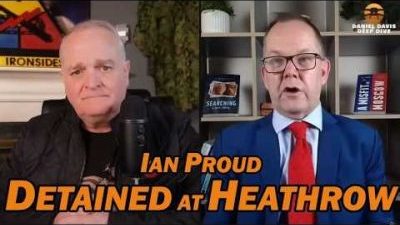
Diplomacy is Now a Crime in Britain / Ian Proud
or go to
Aletho News Archives – Video-Images
From the Archives
Is America behind the massive surge in Kiev regime’s child trafficking?
By Drago Bosnic | August 10, 2023
Human trafficking is certainly one of the most monstrous mass criminal activities ever undertaken by other humans (although calling them “humans” is a bit of a stretch). And yet, there’s a special kind of this deeply repulsive crime that pushes it to diabolical proportions – child trafficking. Underage kids, particularly those who were abandoned, sold or have very poor/abusive family backgrounds, are by far the most vulnerable group. The depraved criminals who engage in such illicit activities specifically target unfortunate children and given there are millions of them all around the globe, particularly in war-torn areas, the “recruitment pool” is effectively endless. Unfortunately, the demand on the black market also seems to be constant and growing, making it a very lucrative and appealing prospect for criminals. … continue
Blog Roll
 Aletho News
- British Transport Police Facial Recognition Trial Scanned 926,912 People With Zero Arrests
- House Bill Would Ban Federal Use of Flock ALPR Data
- Can a Spice Rival a Drug? 10 Head-to-Head Trials Put It to the Test.
- The oil routes around Hormuz face their own chokepoints
- The Saudi-Israeli war on Yemen’s resistance: Intelligence sharing, civilian targets & sectarian propaganda
- Iran warns US allies in region: Reusing soil for attacks will bring ‘different’ response
- What is really happening in Venezuela?
- Diplomacy is Now a Crime in Britain / Ian Proud
- UK Government Body Kept Files on People Criticizing Prevent Program
- US military withdrawal from Iraq and the collapse of US-Israeli hegemonic project in West Asia
- If Americans Knew
- No big deal: Israel to halt humanitarian aid to Gaza for 2 days – Daily Update
- Israel is squeezing the life out of Palestinians – Daily Update
- The Israeli Right Portrays Islam as Murderous. It Serves a Political Purpose
- Jordan Has Had Enough: King Abdullah’s Scathing Warning to Israel
- Israeli Colonizers (i.e. Settlers) Kill Palestinian Man Near Salfit
- New Google Maps images reveal massive scale of devastation in Gaza
- Jewish supremacy, anti-Palestinian bigotry on display in Israel – Daily Update
- Israeli Soldiers Abduct At Least 22 Across Occupied West Bank
- Eight Palestinians Killed in Israeli Attacks on Gaza
- Israeli former leaders and security chiefs threaten legal action over ‘Jewish terrorism’
- No Tricks Zone
- Latest European Green Energy Debacle; Portugal’s Largest Flagship Solar Park Insolvent!
- Green Energy Debacle: German Expert Professor Fritz Vahrenholt Warns Of Severe Economic And Social Consequences
- Two More Paleo Reconstructions Affirm Meters-Higher Sea Levels Across Ireland, Brazil 7000-6000 Years Ago
- New Study: Earth And Venus Surface Warmth Largely Explained By Convection And Lapse Rate, Not CO2 Or Radiation
- 2025 Nature Paper Claiming Worsening Global Drought Gets RETRACTED …Heavily Flawed
- New Study: ‘Global Drought Shows No Detectable Recent Acceleration Under Climate Warming’
- Economic Masterminds: German Socialists Suggest Taxing Productivity Gains Stemming From Using AI
- The South China Sea Has Not Been Cooperating With The Climate Change Narrative
- Energy Crisis: Germany Enters Heating Season With Historically Low Gas Reserve Fill Levels
- New Study: The Antarctic Ice Sheet Gained Mass From 2020-2024 Due To Staggering Snow And Ice Accumulation

