Top Russian senator blasts Norway spy probe against employee
RT | October 5, 2018
The Russian Upper House speaker described the Norwegian spy probe against one of the chamber’s employees as absurd and arbitrary. She speculated that the man is being held so that evidence could be fabricated to back the charges.
Russian Upper House Speaker Valentina Matviyenko told reporters that she addressed the issue of Mikhail Bochkarev’s detention in a personal message to the head of the Norwegian Parliament, but only received a polite, formal reply.
She added that Bochkarev has worked in the Russian Upper House for 25 years and was never involved with any special services.
You know, this resembles the theater of the absurd. He was arrested on invented charges and the fact that the court has recently extended his detention gives the impression that someone is now fabricating some non-existing proof in this case.
Matviyenko went on to describe Norway’s behavior in this situation as an attempt to pressure Bochkarev, and hinted that the whole story could be the result of a planned provocation.
She also promised that the Russian side would continue to defend its citizens and said that both the Russian Foreign Ministry and the Upper House would demand Bochkarev’s immediate release. The top Russian senator also insisted that nothing would ever come out of this story, comparing it to a soap bubble.
Mikail Bochkarev, a member of the Russian Upper House staff, was detained in late September in the Norwegian capital, Oslo, where he took part in an event hosted by the European Center for Parliamentary Research and Documentation.
He was accused of “gathering data.” The Norwegian media said the charges against him were based on the fact that he moved through the building where the event was being held, rather than staying in one place. The Norwegian special services saw this behavior as a possible sign of illegal data gathering.
In subsequent press comments, Norwegian PM Erna Solberg emphasized that the probe into the Russian citizen’s alleged wrongdoings is purely criminal in nature and has nothing to do with politics.
Earlier this week, Russian Foreign Ministry spokesperson Maria Zakharova said that the charges against Bochkarev were false, speculating that Norway started the case in hopes of blackmailing Russia into swapping its citizen for Norwegian national Frode Berg, who was detained in Moscow in December 2017 and remains in custody to this day. The Russian authorities suspect him of espionage.
Zakharova said, however, that unlike Mikhail Bochkarev, who was arrested while leaving Norway, Frode Berg was caught in the act.
NATO Coordinates Information War on Russia
Strategic Culture Foundation | 05.10.2018
The US, Britain and other NATO allies upped the ante this week with a coordinated campaign of information war to criminalize Russia. Moscow dismissed the wide-ranging claims as “spy mania”. But the implications amount to a grave assault recklessly escalating international tensions with Russia.
The accusations that the Kremlin is running a global cyberattack operation are tantamount to accusing Russia of “acts of war”. That, in turn, is creating a pretext for NATO powers to carry out “defensive” actions on Moscow, including increased economic and diplomatic sanctions against Russia, as well as “counter” cyberattacks on Russian territory.
This is a highly dangerous dynamic that could ultimately lead to military confrontation between nuclear-armed states.
There are notably suspicious signs that the latest accusations against Russia are a coordinated effort to contrive false charges.
First, there is the concerted nature of the claims. British state intelligence initiated the latest phase of information war by claiming that Russian military intelligence, GRU, was conducting cyberattacks on infrastructure and industries in various countries, costing national economies “millions of pounds” in damages.
Then, within hours of the British claims, the United States and Canada, as well as NATO partners Australia and New Zealand followed up with similar highly publicized accusations against Russia. It is significant that those Anglophone countries, known as the “Five Eyes”, have a long history of intelligence collaboration going back to the Cold War years against the Soviet Union.
The Netherlands, another NATO member, added to the “spy mania” by claiming it had expelled four members of Russian state intelligence earlier this year for allegedly trying to hack into the headquarters of the Organization for the Prohibition of Chemical Weapons (OPCW), based in The Hague.
There then followed predictable condemnations of Russia from the NATO leadership and the European Union. NATO was holding a summit in Brussels this week. It is therefore plausible that the timing of the latest claims of Russian “malign activity” was meant to coordinate with the NATO summit.
More sanctions against Moscow are expected – further intensifying tensions from already existing sanctions. More sinister were NATO warnings that the military alliance would take collective action over what it asserts are Russian cyberattacks.
This is creating a “casus belli” situation whereby the 29 NATO members can invoke a common defense clause for punitive actions against Russia. Given the rampant nature of the claims of “Russian interference” and that certain NATO members are rabidly Russophobic, it is all too easily dangerous for cyber “false flags” to be mounted in order to criminalize Moscow.
Another telltale factor is that the claims made this week by Britain and the other NATO partners are an attempt to integrate all previous claims of Russian “malign activity”.
The alleged cyber hacking by Russia, it is claimed, was intended to disrupt OPCW investigations into the purported poison-assassination plot against Sergei Skripal, the former Russian spy living in Britain; the alleged hacking was also claimed to be aimed at disrupting investigations into alleged chemical weapons atrocities committed by the Syrian government and by extension Syria’s ally Russia; the alleged Russian hacking claims were also linked to charges of Olympic athletes doping, as well as “interference in US elections”; and even, it was asserted, Russia trying to sabotage investigations into the downing of the Malaysian civilian airliner over Ukraine in 2014.
Up to now, it seems, all such wildly speculative anti-Russia narratives have failed to gain traction among world public opinion. Simply due to the lack of evidence to support these Western accusations. The Skripal affair has perhaps turned into the biggest farce. British government claims that the Kremlin ordered an assassination have floundered to the point of ridicule.
It is hardly coincidence that Britain and its NATO allies are compelled to shore up the Skripal narrative and other anti-Russian narratives with the ramped up “global cyberattack” claims made this week.
Photographs of alleged Russian intelligence operatives have been published. Potboiler indictments have been filed – again – by US law enforcement agencies. Verdicts have been cast by NATO governments and compliant news media of Russian state culpability, without Moscow being given a fair chance to respond to the “highly likely” claims. Claims and narratives are being accelerated, integrated and railroaded.
It is well-established from the explosive disclosures by Edward Snowden, among other whistleblowers, that the American CIA and its partners have the cyber tools to create false “digital fingerprints” for the purpose of framing up enemies. Moreover, the vast cyber surveillance operations carried out by the US and its “Five Eyes” partners – much of which is illegal – is an ironic counterpoint to accusations being made against Russia.
It is also possible in the murky world of all foreign states conducting espionage and information-gathering that attribution of wrongdoing by Russia can be easily exaggerated and made to look like a campaign of cyberattacks.
There is a lawless climate today in the US and other Western states where mere allegations are cited as “proof”. The legal principle of being innocent until proven guilty has been jettisoned. The debacle in the US over a Supreme Court judge nominee is testament to the erosion of due process and legal standards.
But what is all the more reprehensible and reckless is the intensification of criminalization of Russia – based on flimsy “evidence” or none at all. When such criminalization is then used to “justify” calls for a US-led naval blockade of Russian commercial oil trade the conditions are moving inevitably towards military confrontation. The blame for belligerence lies squarely with the NATO powers.
A further irony is that the “spy mania” demonizing Russia is being made necessary because of the wholly unsubstantiated previous claims of Moscow’s malfeasance and “aggression”. Illusions and lies are being compounded with yet more bombastic, illusory claims.
NATO’s information war against Russia is becoming a self-fulfilling “psy-op”. In the deplorable absence of normal diplomatic conduct and respect for international law, NATO’s information war is out of control. It is pushing relations with Russia to the abyss.
China says Washington canceled military talks, not Beijing
Press TV – October 4, 2018
China has rejected an allegation by the United States that Beijing has canceled security talks with Washington planned for this month, saying that US officials have “distorted the facts.”
An unnamed US official had told Reuters on Sunday that China had canceled the security meeting between American Secretary of Defense James Mattis and his Chinese counterpart, alleging that China had been unable to make its defense secretary available for the scheduled talks.
On Wednesday, Beijing effectively said that that assertion was a lie.
“Such an argument completely distorts the fact with ulterior motives and is extremely irresponsible,” said China’s Foreign Ministry spokeswoman Hua Chunying in a statement. “The Chinese side expresses strong dissatisfaction.”
Hua said Washington had recently told Beijing that it hoped to postpone the talks.
“The facts are that the United States a few days ago told China it hoped to postpone the second round of the China Diplomatic and Security Dialogue,” she said, adding, “We request [that] related parties stop this sort of behavior of making something out of nothing and spreading rumors.”
Earlier, on Tuesday, Hua said China and the US had previously agreed in principle to hold the dialogue in mid-October.
The security meeting’s first round was held in Washington last year, and its second round was scheduled to take place in Beijing.
Military tensions have surged between China and the US in recent weeks.
Washington often angers Beijing by sending warplanes and warships to territory claimed by China but disputed by other regional countries. The US says that with those deployments, it is practicing what it calls its right to freedom of navigation.
On Tuesday, China condemned that practice.
Additionally, the US has used its domestic laws to impose sanctions on China over Beijing’s decision to purchase military equipment from Russia, including advanced S-400 missile defense systems.
By applying its domestic laws to influence relations between China and Russia, the US is effectively in breach of their sovereignty.
The US has also initiated a trade war with China and has accused it of seeking to influence the US congressional mid-term elections, something that Beijing has strongly denied.
Spanish Supreme Court Sentences Former IMF Chief for Financial Fraud
teleSUR | October 3, 2018
Spain’s Supreme Court sentenced the former International Monetary Fund (IMF) chief Rodrigo Rato to four-and-a-half years imprisonment Wednesday on charges of misusing funds.
In February 2017, Rato was found guilty by Spain’s Supreme Court of paying for personal expenses with company credit cards when he was the chief of Caja Madrid and the state-owned lender Bankia during a time when both the banks faced financial difficulties.
Rato was an economy minister in Spain between 1996 and 2004 and a prominent politician in the ruling People’s Party before becoming the IMF chief. He was free on bail since 2017 pending an appeal, but was found guilty alongside 64 former executives and board members for embezzling a total of US$13.8 million between 2003 and 2012.
Spanish political party Podemos welcomed the court decision, saying Spaniards had long demanded justice, tweeting, “the citizens demanded justice for those who robbed public money, ripped off thousands of families, and burdened us with debt for life.”
The embezzlment — famously known as the “black-cards” scandal — broke in 2014 resulting in public outrage. It was discovered that the cards were used to buy jewelry and clothes, and pay for vacations, according to documents filed with Spain’s high court.
Thousands of small-scale investors lost their money after they were persuaded to convert their savings to shares ahead of the flotation of Bankia in 2011, with Rato at the reins. Less than a year later, he resigned when it became public knowledge that Bankia was in dire straits.
Urban’s Tale Clears Away Some of the Smoke and Mirrors in Salisbury
By Rob Slane | The Blog Mire | October 3, 2018
There’s enough smoke and mirrors in the Salisbury poisonings to make the Magic Circle blush. It is impossible for the public to understand what happened, and who did what to whom, not only because the details don’t add up, but because many of the so-called “facts” that have been released are suspicious in and of themselves. Whichever aspect of the case we look at to try to make sense, we can never quite be sure that we are not going down a rabbit trail, since the “facts” we base our case on may in fact not be facts at all.
What we can do, though, is to keep looking at the official claims. The investigators of the case obviously have access to information that ordinary members of the public don’t have, and they have made an accusation. But the big question is whether the claims and the accusation they have made stand up to scrutiny – not just to the “facts” that have been given out, but also to logic and to reason.
It is important to begin by defining exactly what the claim is. There are essentially two branches.
The first comes from the British Government, who have declared the Russian State to be responsible for an attempted assassination of Mr Skripal on 4th March (to begin with they hedged their bets between direct responsibility and indirect responsibility, but later statements are more explicit about direct responsibility). In making this claim, because they are not in a court of law, but rather in a Parliament full of remarkably incurious folk, they have been able to able to come up with vague and airy statements about the case, all of which may well be enough to satisfy the incuriosity of that particular audience and their chums in the media, but which are unlikely to satisfy the minds of the more discerning.
The second branch comes from the Metropolitan Police. It is by far the more important of the two, since it is the specific claim of those paid to investigate the case, and is therefore the one upon which the Government’s claim ultimately rests (it is, however, worth reminding ourselves that in the Alice in Wonderland times we now find ourselves in, the Government’s claim came prior to the investigation, not after it, which as anyone acquainted with logic, reason and justice will tell you, is precisely the wrong way around).
To understand The Met’s central claim, however, we must first hack our way through much smoke and navigate our way around many mirrors. So let’s do that by first establishing what the claim is not:
It is not that the Russian state was behind the poisoning (although the Metropolitan Police statement of 5th September does repeats the claim made by the Prime Minister on 14th March, it does so only as a prelude to what is then said about the two suspects, and is not central to its claim about those men).
It is not that Ruslan Boshirov and Alexander Petrov are GU Intelligence Officers.
It is not that Ruslan Boshirov is in reality Colonel Anatoliy Chepiga.
All these are peripheral to the central claim made by the Metropolitan Police, and in many ways just smokes and mirrors. The Metropolitan Police’s central claim can be succinctly said to be the following:
“That between 12:10pm and 13:30 on 4th March 2018, the two men named as suspects – Ruslan Boshirov and Alexander Petrov – went to the house of Sergei Skripal at 47 Christie Miller Road, Salisbury, on foot, and there applied a high purity, military grade nerve agent to the handle of the front door in an attempt to assassinate Mr Skripal.”
Now, astute readers will realise that the Metropolitan Police has mentioned nothing about the timing that I have stated: 12:10 – 13:30. Nevertheless, that this is what their claim entails is an incontrovertible fact taken from two pieces of information:
a) The image released by the Met of the two men on the Wilton Road at 11:58 (ten minutes after another image showing them arriving at Salisbury train station), which is a little over 5 minutes walk from 47 Christie Miller Road.
b) That Mr Skripal’s car was seen on CCTV driving away from his house at 13:33, towards the town, never to return.
In other words, the claims that the Government first made back in March, when there were still various conflicting claims as to where and how the poisoning took place, have now been distilled into a very particular location — the door handle of 47 Christie Miller Road — and a very specific timeframe — 1 hour and 20 minutes.
To put that into Cluedo terminology, the Metropolitan Police have made an accusation, and it is as follows:
“We believe it was Boshirov and Petrov (perhaps not their real names), at the door handle of Christie Miller Road, with the Novichok, between 12:10 and 13:30.”
The whole of the Government accusations from March onwards are now indelibly connected with this claim, and its truth or otherwise.
Now, the first thing to say about the claim is that the information released by the Met so far has not proven this claim at all. The images showing the two men coming into the UK do not prove the claim. The images of the two men walking around Salisbury do not prove the claim (in fact, they tend to do the opposite, since the idea that two apparently highly trained intelligence officers would not only carry out their deed under cover of daylight, walking together at all times, but would then spend almost two hours traipsing around town are frankly not very credible). The image showing the two men on the Wilton Road does not prove the claim, since it is some 600 yards from the alleged crime scene.
It may all be enough to convince the nation’s MPs, but it ought not be enough to convince anyone still committed to reason and logic.
However, comments in a new book by the BBC reporter, Mark Urban, reveal a couple of things that are of crucial interest in light of the claim. Here is the first:
“Urban discovered that Skripal spent much of his day watching Russia’s Channel One, a pro-Kremlin state broadcaster. He adopted ‘the Kremlin line in many matters’, the journalist writes, ‘even while sitting in his MI6-purchased house’, especially over Moscow’s fraught relations with Ukraine.”
The key part I want to draw your attention to is that, according to Urban, Mr Skripal’s house was “MI6-purchased.” This may come as no surprise to those who have been paying attention, but it does at least clear away some of the smokes and mirrors. So the house that Mr Skripal lived in, and the one that he was apparently targeted in, was owned by MI6. And the reason for this, as the British media seem to have belatedly discovered, is that Mr Skripal was still working for MI6.
“The people closest to him [Sergei] were probably what he called his ‘Team’ — the officers from MI5 and MI6 who looked after his welfare. He spoke about them with affection and had a special mobile phone that went directly to their duty officer.”
Hopefully, you’re beginning to get the picture. Sergei Skripal was not only active for MI6, and not only lived in a house which was purchased by MI6 but – according to Mr Urban – he had MI5 and MI6 officers assigned to protect him, as well as a direct line should he need to get in contact. As an aside, would it be cheeky to enquire whether this particular phone was one of the ones that was allegedly made untraceable on 4th March?
Given what Mr Urban says about the house, the phone and the protection, let me ask a few simple questions:
- How conceivable is it that the house did not have some kind of security measures in place, including CCTV cameras?
- How conceivable is it that Russian intelligence wouldn’t have assumed that Mr Skripal’s house would have had some kind of security measures in place, including CCTV cameras covering the front door?
- How conceivable is it that Russian intelligence would have chosen a method of assassination that was not only highly untargeted, but which was practically guaranteed to result in the filming of the assassins committing the crime?
To discerning persons, the answer to all three questions is quite obvious, though perhaps not to the nation’s MPs or media.
But let’s just suspend reason and logic for a moment, and imagine that despite the extremely high probability that Russian intelligence would have assumed Mr Skripal’s house to be well protected, and the absurdly low probability that they would then have chosen this particular method of assassination, they had still carried out the attack in the way the Met claims. What would it mean?
It would mean that there has been a massive failure on the part of British intelligence to protect one of their own assets in his own house — a house which they owned, and which should therefore have been made safe. In which case, why are there no questions being asked about this failure in the House of Commons? Or do we already know the reason for that.
Let me spell it out even more clearly. There only three options here:
Option 1: Mr Skripal’s MI6-bought house did indeed have the kind of security measures you would expect it to have had, given that Mr Skripal was actively working for British Intelligence. In which case, if the central claim of the Metropolitan Police is true, there must be CCTV footage of the two suspects, applying “high purity, military grade nerve agent” to the door handle.
Option 2: Mr Skripal’s MI6-bought house didn’t have the kind of security measures one would expect it to have had, given that Mr Skripal was actively working for British Intelligence. In which case, if the central claim of the Metropolitan Police is true, does this not constitute a failure of security of the highest order?
Option 3: Mr Skripal’s MI6-bought house may or may not have had the kind of security measures you would expect it to have – but it’s all neither here nor there because the door handle assassination claim is untrue.
The discerning amongst you will make your own minds up as to which of these possible scenarios is correct.
Bellingcat’s Very Obviously Fake Chepiga Photo
By Craig Murray | October 3, 2018
Bellingcat’s attempts to gild the Chepiga lily are now becoming ludicrous. The photo they published today is a very obvious fake.
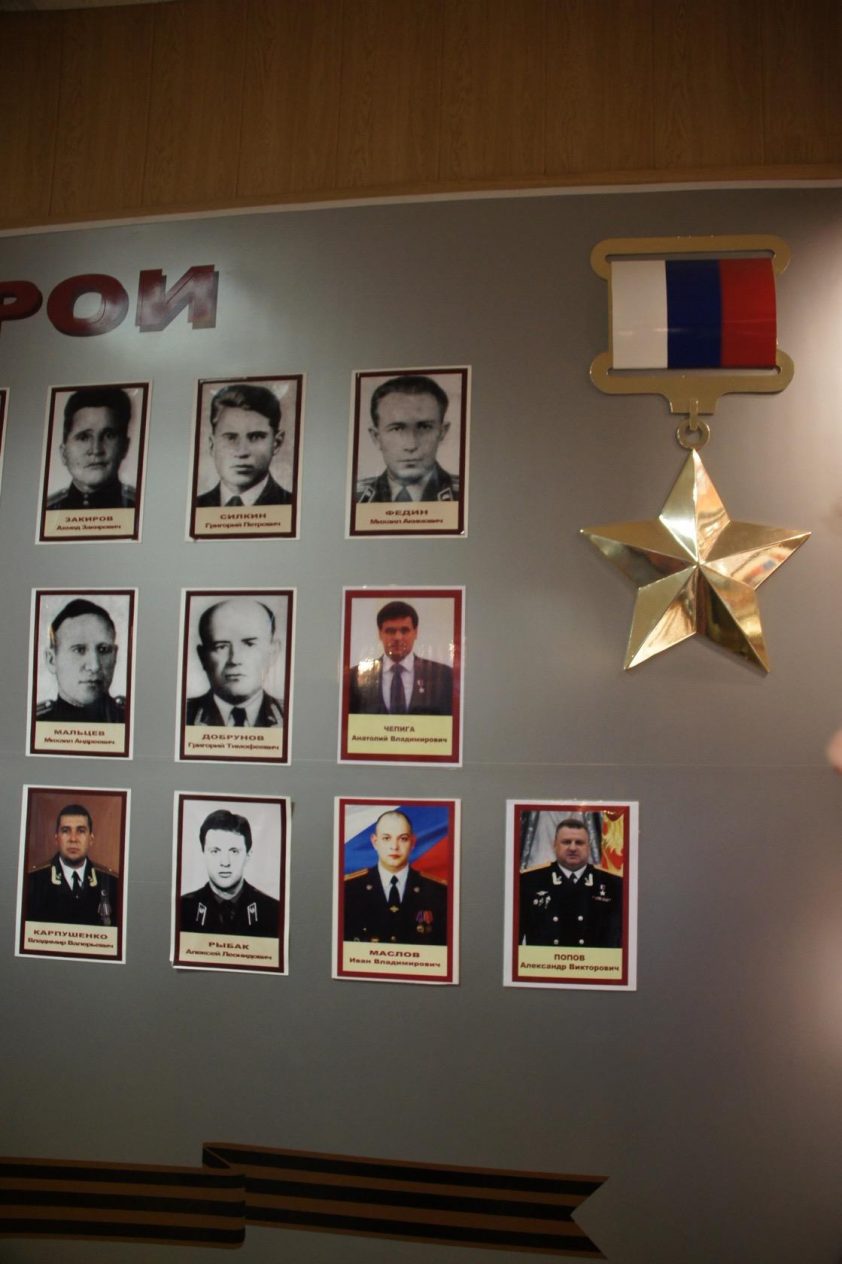
Many people have noticed that the photo of Chepiga on this wall appears to be hanging in completely different lighting conditions from the others. That is indeed a good point.
But there is a more important point here, and that is to do with sequencing. Except for Chepiga and Popov, who according to Belligncat also became a Hero of Russia in 2014, all of the people here are indeed openly and officially listed Heroes of Russia or, in the majority of cases, Heroes of the Soviet Union.
What is more, they are, as you would expect on a military honours wall, ranked in date order. ONLY CHEPIGA IS OUT OF DATE ORDER. The order runs top row let to right, then second row left to right, then bottom row left to right.
The bit of the bottom row we can see runs:
Karpushenko (2000), Ribak (2005), Maclov (2012), Popov (2014).
So why is Chepiga in a row of much earlier Heroes of the Soviet Union? Next in sequence in fact to Grigory Dobrunov who got his award in 1956!!!! The pictures are definitely otherwise all in date order.
The glaringly obvious answer – in line with the reflections anomaly – is that Chepiga’s “picture” has been photoshopped onto this wall. The military do not suddenly insert photos out of order and at random on an honours board. Bellingcat, however, have a track record of image manipulation.
None of which proves or disproves the Boshirov identification. It is however an important reminder to take Bellingcat as a source with a pinch of salt.
FBI documents detail Clinton and Mueller’s own ‘Russiagate’ – but they’re classified
RT | October 3, 2018
The FBI is facing new calls to declassify documents relating to the sale of US uranium to a Russian company, documents that could implicate Hillary Clinton, Barack Obama, and ‘Russiagate’ witch-hunter Robert Mueller.
While Clinton and crew relentlessly push the idea that the Trump campaign colluded with Russia in the run-up to the 2016 election, and while Special Counsel Robert Mueller searches with a magnifying glass for any sign of this collusion, all parties involved are much quieter when it comes to the Uranium One scandal.
Among a trove of documents relating to the controversial deal, the FBI has identified 37 pages that could shine a light on why then-Secretary of State Hillary Clinton and the Obama administration approved the deal.
The pages were recently added to the agency’s Freedom of Information Act online vault. The only problem – they’re classified.
The reasons given for the classification will sound familiar to anyone following President Trump’s recent struggle to declassify another set of FBI documents: doing so would violate the privacy of individuals involved, would place national security at risk, would disclose secret law enforcement techniques, and would reveal confidential inter-agency communication, among others.
What we do know about Uranium One reads like a Cold War spy thriller.
The debacle began in 2009 when state-owned Russian atomic energy firm Rosatom was in talks to buy part of Canadian-based mining company Uranium One, and with it control over 20 percent of America’s uranium supply.
As the deal was being hashed out, the FBI planted a spy posing as a consultant, businessman William Douglas Campbell, in Rosatom. Campbell uncovered evidence that Rosatom’s main executive in America, Vadim Mikerin, was involved in bribery, extortion, and money laundering, as he sought to gain “improper business advantages” for US firms that worked with a Rosatom-owned firm he chaired.
The FBI compiled Campbell’s evidence, and Mikerin was charged and deported, but not until summer 2018. Back in 2010, the Obama administration approved the sale of Uranium One to Rosatom anyway.
The sale needed to be approved by the Committee on Foreign Investment in the United States (CIFUS), which was chaired by Hillary Clinton. Campbell told three separate Congressional committees that Moscow had hired lobbying firm APCO Worldwide to use its influence with Clinton to negotiate the deal, for which the Clinton Foundation would receive generous kickbacks.
Democrats dismissed the scandal as the stuff of right-wing conspiracy theory, and Clinton herself called accusations of wrongdoing “baloney.” Still, Republicans held that something was amiss, citing Bill Clinton’s $500,000 fee for a speech in Moscow in 2010 as proof the Clintons were peddling influence for Russian money. At the same time, Mrs. Clinton was pushing for a great “reset” in US-Russia relations. The plot thickens.
The FBI director at the time? None other than Robert Mueller, currently the Witch-Hunter-in-chief, leading the crusade against the Trump team. What a difference eight years make.
Attorney General Jeff Sessions announced in March that a federal prosecutor from Utah, John Huber, would look into both the Uranium One deal and FBI misconduct in the Clinton email investigation. Trump too seemed eager to get to the bottom of the scandal, and has regularly bashed Clinton for her alleged role in facilitating the sale.
The Justice Department’s probe has largely taken place on the sidelines, has generated few headlines, and has not made its findings, if any, public. Why then, are the FBI’s documents, clearly of critical importance to understanding the whole debacle, still secret?
“Either the United States, eyes wide open, approved giving uranium assets to a corrupt Russia, or the FBI failed to give the evidence of criminality to the policymakers before such a momentous decision,” wrote The Hill’s John Solomon. If the second option were true, the next step would be establishing whether the agency withheld this evidence knowingly, or through simple negligence.
According to Solomon, an investigative reporter who first disclosed Campbell’s involvement in Rosatom as an FBI informant, Campbell maintains that both then-President Obama and then-Director Mueller were briefed by agents about Rosatom’s shady activities, but the sale was allowed to go through because of “politics.”
According to another of Solomon’s sources, “There is definitely material (in the 37 pages) that would be illuminating to the issues that have been raised… somebody should fight to make it public.”
Former Arkansas Governor Mike Huckabee (R) has called on the FBI to “stop investigating high school yearbooks and start declassifying Uranium One,” and has urged Senate Republicans to pressure the agency into declassifying the documents. Failing that, Huckabee suggested that Trump order the declassification, which he is well within his power to do so.
Doing so would not only bring the truth that much closer to being revealed, but could also give Trump the opportunity to score some political points against his old nemeses: surely a tempting prospect.
IAEA dismisses Israel’s call to inspect Iran facility
Press TV – October 2, 2018
The International Atomic Energy Agency (IAEA) has declined to “take at face value” a recent Israeli claim that Iran has a secret atomic warehouse.
“The Agency uses all safeguards relevant information available to it but it does not take any information at face value,” IAEA Director General Yukiya Amano said in a statement released on Tuesday.
Although Amano did not make an explicit reference to Israeli Prime Minister Benjamin Netanyahu’s claim against Iran, it is his first public pronouncement since the premier’s speech.
“It should be noted that under the existing verification framework, the Agency sends inspectors to sites and locations only when needed,” he added.
During his speech on Thursday at the 73rd annual session of the UN General Assembly in New York, Netanyahu once again took the stage to bring out fresh theatrics against Iran, repeating his threadbare allegation that the country is working to develop nuclear weapons at a “secret” site and urged the IAEA to inspect it.
“In May, we exposed the site of Iran’s secret atomic archive. Today, I’m revealing the site of a second facility; Iran’s secret atomic warehouse,” claimed the Israeli PM, who added, “Iran has not abandoned its goal to develop nuclear weapons.”
Amano further emphasized that the IAEA’s work related to nuclear verification “must always be impartial, factual, and professional,” saying, “In order to maintain credibility, the Agency’s independence in relation to the implementation of verification activities is of paramount importance.”
The IAEA chief added that the agency is conducting verification and monitoring of Iran’s nuclear-related commitments under the 2015 nuclear agreement, officially known as the Joint Comprehensive Plan of Action (JCPOA), Iran signed with major world powers.
“These activities will continue to be carried out within the parameters of the relevant decisions and resolutions of the IAEA Board of Governors and the UN Security Council as appropriate,” he pointed out.
Pointing to his reports to the IAEA Board of Governors, Amano noted that the agency would continue its evaluations regarding the absence of “undeclared nuclear material and activities for Iran.”
“The Agency continues to evaluate Iran’s declarations under the Additional Protocol, and has conducted complementary accesses under the Additional Protocol to all the sites and locations in Iran which it needed to visit,” the head of the UN nuclear agency said.
In his introductory statement to the Board of Governors in Vienna on September 10, Amano said Iran is living up to all its commitments under the 2015 nuclear deal.
He added that the IAEA would continue to verify the non-diversion of nuclear material declared by Iran under its Safeguards Agreement.
Later in his opening address to the IAEA’s 62nd General Conference in Vienna on September 17, the IAEA director general reaffirmed that Iran is in compliance with the nuclear agreement.
New Israel report exposes role of NGO Monitor in defaming rights activists
MEMO | October 1, 2018
A new Israeli report has accused right-wing pressure group NGO Monitor of “spearheading the shrinking of space for Israeli and Palestinian human rights NGOs”.
The “Shrinking Space” report – “NGO Monitor: Defaming human rights organisations that criticize the Israeli occupation” – is the work of a collective of Israeli ex-diplomats, academics and others, known as the Policy Working Group (PWG), that supports a two-state solution.
NGO Monitor was established in 2002 under the auspices of right-wing think tank the Jerusalem Centre for Public Affairs, and has been independent since 2007.
Its declared goal of promoting “transparency and accountability of NGOs claiming human rights agendas” is described by the PWG report as “disingenuous”.
“In fact,” the report claims, “years of experience show that NGO Monitor’s overarching objective is to defend and sustain government policies that help uphold Israel’s occupation of, and control over, the Palestinian territories.”
The new, in-depth report “concludes and argues that NGO Monitor is a government-affiliated organisation that selectively targets human rights organisations, relies almost entirely on funding from donors in the US, shirks the transparency it demands of others and disseminates misleading and tendentious information, which it presents as factual in-depth research.”
“As an organisation whose purpose is to scrutinise others, NGO Monitor itself has so far received little scrutiny of its own. After years of evasion, it is time to monitor NGO Monitor,” PWG adds.
Among the areas of critique found in the PWG report, NGO Monitor is accused of a selective focus, a right-wing political agenda, and of “close ties with the [Israeli] government”.
NGO Monitor plays a key role in providing Israeli ministries and diplomatic missions with misleading information to defame Israeli and Palestinian human rights organisations
PWG states, “and mobilises the government to pressure European counterparts to stop funding them”.
“In Israel,” meanwhile, “it acts as a catalyst for anti-democratic legislation that selectively targets such NGOs.”
The PWG report also accuses of NGO Monitor of publishing articles and reports containing “baseless claims and factual inaccuracies”, while also “fram[ing] the occupation of the Palestinian territories as an internal Israeli affair in which other countries must not interfere”.
British Media Regurgitates Blogger’s Unverified Claims
Proof that the Bottom of the Barrel Hadn’t Previously Been Reached
By Rob Slane | The Blog Mire | September 29, 2018
The regurgitation by most of the British media of claims made by Bellingcat, that Ruslan Boshirov is in reality a decorated Colonel of the GU, marks a new low in the already low standards of journalism in this country.
I don’t want to spend my time going through Bellingcat’s claim. I have no idea whether it is true or not. However, I will say that if the purpose of the report was intended to prove to discerning people that Colonel Anatoliy Chepiga and Ruslan Boshirov are one and the same person, it failed miserably. If, on the other hand, the intention was to hoodwink less discerning people into thinking that the connection had been proved, then it was a fine job. Regardless of whether or not Boshirov turns out to be Chepiga, all Bellingcat essentially did was make an inconclusive photographic connection, and then proceed to treat readers to a biography of Chepiga, as if it had just been proven conclusively that he is Boshirov. Which it hadn’t.
Another point to note is that even if it turns out that Boshirov is really Chepiga, although this would prove that he didn’t tell the truth in his interview with RT, and that Vladimir Putin misled when he said that the two accused men are civilians, would it actually prove the central claim against him? As a reminder, this is that between 12:10pm and 13:30 on 4th March, he walked up to the house of Sergei Skripal at 47 Christie Miller Road, Salisbury, and applied a high purity, military grade nerve agent to the door handle of the front door in an attempt to assassinate Mr Skripal. In this Post-Truth society we find ourselves in, many apparently believe it would. But this is not so.
Footage of Boshirov or even Boshirov/Chepiga walking up to Mr Skripal’s house, and applying a substance to the door handle, filmed by the CCTV camera that Mr Skripal, as an active MI6 asset and potential assassination target, would almost certainly have had installed somewhere on his house might do it. But an image of a prostitute-cavorting, dope-smoking, coin-shopping Boshirov, or even a prostitute-cavorting, dope-smoking, coin-shopping Boshirov/Chepiga, 600 yards away from Mr Skripal’s house, walking constantly together with his chum, under cover of daylight, and looking like he’s auditioning for the “World’s Worst Impersonation of a Spetsnaz Colonel on a Mission to Kill with a Deadly Nerve Agent,” is unlikely to convince the impartial and enquiring mind.
But I digress. The real point I want to make is that the media ran with this story as if it were proven fact. What is more, they don’t even seem to have checked with The Metropolitan Police to see whether they think it’s credible. You know, that’s the guys who have spent thousands of man hours and millions of pounds on the case and who made the initial claims about Boshirov and Petrov.
To my knowledge, although the media seem to have treated the Bellingcat claims with the same importance as they might do official claims, The Met itself has maintained a conspicuous silence. So too has the Government, although in a fit of squiffy, boyish excitement, Gavin Williamson got a bit ahead of himself and Tweeted the claim as if it were proven fact, only to delete it a few minutes later, presumably when someone in his school tuck shop pointed out to him that Bellingcat is not officially in charge of the investigation and their claims had not been corroborated. Detention task for Gavin: Write out 100 times, “Must engage brain before endorsing unverified assertions and treating them as fact.”
Not for the first time in this case, I am — as the King James Version would put it — astonied. Not only has Her Majesty’s Government ridden roughshod over the rule of law in this case by recklessly rushing to judgement before the investigation had properly begun; not only has The Met put out clearly suspect, inconsistent and incomplete timelines; and not only has the media consistently refused to ask even the most basic and obvious questions on this case, but it now seems that the unverified and utterly uncorroborated claims made by a blogger are to be treated as if they were official statements of fact.
We really are reaching a new and dangerous phase in the disintegration of the country formerly known as Great Britain. Having seemingly forgotten basic concepts of justice, logic and reason, we now appear to be losing our collective marbles. We are run by a collection of pettifogging middle managers, whose hero seems to be Governor Gumpas from the Voyage of the Dawn Treader, and who mix extreme levels of incompetence with an inability to either ask or answer basic questions in plain English, and whose role it seems is to obfuscate, confuse, and muddy waters, rather than clarify and seek the truth. And now we have a subservient media, who have steadfastly refused to ask the questions that have urgently needed to be put to The Met and the Government from day one of this case, taking a blogger’s unproven claims and regurgitating them without question.
It’s the road to totalitarianism folks, and we’re careering down the fast lane.
But let’s see if another blogger writing about this case can get the media to show some interest. Here’s something that should be of interest to them, since it involves their integrity being called into question not by the likes of me, but by The Met itself.
Every single one of the early media reports that looked into the movements of the Skripals on the afternoon of 4th March stated that they went to Zizzis first, then the Mill. The reason they said this was because the journalists that were sent to Salisbury interviewed a number of people who had been in those venues, and their testimony agreed. You can read more on that here. Yet the Metropolitan Police, in their timelines of 13th and 17th March, reversed this order.
There really are only two possible explanations for that: either all those reports and witnesses were wrong, or The Met is wrong. Which is it? Won’t someone who wrote one of those early pieces ask The Met why they have ignored their report and the testimony of numerous witnesses?
Just supposing there’s a journalist out there who is willing to stop scraping the bottom of the barrel to ask this, allow me to arm you with ten more that you may as well ask The Met while you’re at it:
1. Do you have footage of Boshirov and Petrov any closer to the Skripal house than Wilton Road, especially that taken by a CCTV camera at Mr Skripal’s house?
2. Why was one of the images of the two men coming into Gatwick doctored (as shown convincingly here) and how does this instill confidence that the other images have not been doctored and that the times that have been added to them are correct?
3. What were the two men doing between 13:08 on 4th March, when they were at Summerlock Approach, and 13:50:56, when according to The Met timeline, they were at Salisbury train station — a distance of less than five minutes?
4. Does The Met endorse Bellingcat’s claims about the real identity of Boshirov, and if so, why did The Met, with all its resources, not make this discovery?
5. Why did it take two weeks to get in touch with the families of the three boys who received bread from Mr Skripal’s allegedly contaminated hands on 4th March?
6. Why was the duck-feeding incident left out of the timeline presented on 17th March?
7. Can you now update the timeline of 17th March to include the movements of the Skripals on the morning of 4th March?
8. Can you confirm whether Mr Skripal and Yulia were out of his house at 12:10pm on 4th March, and if so, do you have evidence showing that they returned prior to 13:30?
9. When will Detective Sergeant Nick Bailey appear in public to speak about his part in the events of 4th March?
10. Assuming Sergei Skripal is not dead, can it be confirmed that he endorses The Met’s claims as to what happened to him and his daughter on 4th March, and if so, will he shortly be making a public statement, with members of the media able to question him?
Featured Video
Anthrax War – CBC The Passionate Eye
or go to
Aletho News Archives – Video-Images
Book Review
Shattered Dreams: The HPV Vaccine Exposed (2019)
By Christina England – 30 Q&As – Book Review & Summary
Lies are Unbekoming | September 4, 2026
… Gardasil received FDA fast-track approval in 2006, Cervarix followed in 2009, and Gardasil 9 was approved in December 2014 with more than double the aluminium adjuvant content of the original. The commercial context is specific. Merck was about to lose patent protection on Zocor and faced $18 billion in Vioxx injury claims from a cardiovascular drug the company had marketed while suppressing its own data showing a five-times increase in heart attacks. Analysts projected the global HPV vaccine market at $4 billion by 2011, contingent on government-funded national programs for teenage girls. The 1986 National Childhood Vaccine Injury Act had already granted manufacturers complete liability immunity. By 2013, Japan had withdrawn its HPV vaccine recommendation after cataloguing severe adverse reactions in hundreds of girls. No Western government followed. The establishment position across the UK, US, Australia, and most of Europe held, and still holds, that the vaccines are safe and effective, that reported injuries are coincidental, and that cervical cancer prevention justifies the program. The book was published into this position, not against a vacuum.
Shattered Dreams sits alongside Mary Holland’s The HPV Vaccine On Trial and Viera Scheibner’s foundational vaccination work as part of the documented record on what has been done to a generation of teenage girls under the banner of cancer prevention. The full summary unpacks three specific findings: that Merck used the aluminium adjuvant itself as the “placebo” control in 92.5% of trial subjects, making it structurally impossible to detect excess reactions from the adjuvant; that Dr. Sin Hang Lee found HPV DNA fragments bound to aluminium in every one of sixteen Gardasil samples tested, and in the blood and spleen of a New Zealand girl six months after her third dose; and that in every country with high vaccination coverage, including Australia, the UK, Norway, and Sweden, cervical cancer rates have stopped declining and started rising specifically in the vaccinated cohort. Martínez-Lavín’s 2017 calculation puts the number needed to seriously harm with Gardasil 9 at 140, and the number needed to vaccinate to prevent one case at 1,757. Thirteen young women are seriously harmed for every one who benefits. The vaccine was approved on the basis of trials that could not detect what the trials were supposed to detect, and it is still being given to twelve-year-olds today. … Read full review
Blog Roll
 Aletho News
- Ukraine’s EU neighbors reject new plea from Kiev – Politico
- British Transport Police Facial Recognition Trial Scanned 926,912 People With Zero Arrests
- House Bill Would Ban Federal Use of Flock ALPR Data
- Can a Spice Rival a Drug? 10 Head-to-Head Trials Put It to the Test.
- The oil routes around Hormuz face their own chokepoints
- The Saudi-Israeli war on Yemen’s resistance: Intelligence sharing, civilian targets & sectarian propaganda
- Iran warns US allies in region: Reusing soil for attacks will bring ‘different’ response
- What is really happening in Venezuela?
- Diplomacy is Now a Crime in Britain / Ian Proud
- UK Government Body Kept Files on People Criticizing Prevent Program
- If Americans Knew
- No big deal: Israel to halt humanitarian aid to Gaza for 2 days – Daily Update
- Israel is squeezing the life out of Palestinians – Daily Update
- The Israeli Right Portrays Islam as Murderous. It Serves a Political Purpose
- Jordan Has Had Enough: King Abdullah’s Scathing Warning to Israel
- Israeli Colonizers (i.e. Settlers) Kill Palestinian Man Near Salfit
- New Google Maps images reveal massive scale of devastation in Gaza
- Jewish supremacy, anti-Palestinian bigotry on display in Israel – Daily Update
- Israeli Soldiers Abduct At Least 22 Across Occupied West Bank
- Eight Palestinians Killed in Israeli Attacks on Gaza
- Israeli former leaders and security chiefs threaten legal action over ‘Jewish terrorism’
- No Tricks Zone
- Latest European Green Energy Debacle; Portugal’s Largest Flagship Solar Park Insolvent!
- Green Energy Debacle: German Expert Professor Fritz Vahrenholt Warns Of Severe Economic And Social Consequences
- Two More Paleo Reconstructions Affirm Meters-Higher Sea Levels Across Ireland, Brazil 7000-6000 Years Ago
- New Study: Earth And Venus Surface Warmth Largely Explained By Convection And Lapse Rate, Not CO2 Or Radiation
- 2025 Nature Paper Claiming Worsening Global Drought Gets RETRACTED …Heavily Flawed
- New Study: ‘Global Drought Shows No Detectable Recent Acceleration Under Climate Warming’
- Economic Masterminds: German Socialists Suggest Taxing Productivity Gains Stemming From Using AI
- The South China Sea Has Not Been Cooperating With The Climate Change Narrative
- Energy Crisis: Germany Enters Heating Season With Historically Low Gas Reserve Fill Levels
- New Study: The Antarctic Ice Sheet Gained Mass From 2020-2024 Due To Staggering Snow And Ice Accumulation

