Omidyar’s Intercept Teams Up with War-Propaganda Firm Bellingcat
By Whitney Webb | MintPress News | October 8, 2018
The Intercept, along with its parent company First Look Media, recently hosted a workshop for pro-war, Google-funded organization Bellingcat in New York. The workshop, which cost $2,500 per person to attend and lasted five days, aimed to instruct participants in how to perform investigations using “open source” tools — with Bellingcat’s past, controversial investigations for use as case studies. The exact details of what occurred during the workshop have not been made public and Bellingcat founder Eliot Higgins declined to elaborate on the workshop when pressed on social media.
The decision on the part of The Intercept is particularly troubling given that the publication has long been associated with the track records of its founding members, such as Jeremy Scahill and Glenn Greenwald, who have long been promoted as important “progressive” and “anti-war” voices in the U.S. media landscape.
Greenwald publicly distanced himself from the decision to host the workshop, stating on Twitter that he was not involved in making that decision and that — if he had been — it was not one “that I would have made.” However, he stopped short of condemning the decision.
Bellingcat’s open support for foreign military intervention and tendency to promote NATO/U.S. war propaganda are unsurprising when one considers how the group is funded and the groups with which it regularly collaborates.
For instance, Bellingcat regularly works with the Organized Crime and Corruption Reporting Project (OCCRP), which – according to the late journalist Robert Parry – “engages in ‘investigative journalism’ that usually goes after governments that have fallen into disfavor with the United States and then are singled out for accusations of corruption.” OCCRP is notably funded by USAID and the controversial George Soros-funded Open Society Foundations.
In addition, Bellingcat’s founder Eliot Higgins is employed by the Atlantic Council, which is partially funded by the U.S. State Department, NATO and U.S. weapons manufacturers. It should come as little surprise then that the results of Bellingcat’s “findings” often fit neatly with narratives promoted by NATO and the U.S. government despite their poor track record in terms of accuracy.
Bellingcat’s funding is even more telling than its professional associations. Indeed, despite promoting itself as an “independent” and open-source investigation site, Bellingcat has received a significant portion of its funding from Google, which is also one of the most powerful U.S. military contractors and whose rise to prominence was directly aided by the CIA.
Google has also been actively promoting regime change in countries like Syria, a policy that Bellingcat also promotes. As one example, leaked emails between Jared Cohen, former director of Google Ideas (now Jigsaw), and former Secretary of State Hillary Clinton revealed that Google developed software aimed at assisting al-Qaeda and other Syrian opposition groups in boosting their ranks. Furthermore, Cohen was once described by Stratfor intelligence analysts as a “loose cannon” for his deep involvement in Middle Eastern regime-change efforts.
Under President Donald Trump, Google’s connections to the U.S. government have become even more powerful, as the current Trump-appointed Director of National Intelligence once worked as a corporate lobbyist for Google.
Synergy in the service of empire
Given the clear alliances between Bellingcat and the military-industrial complex, The Intercept’s decision to host a Bellingcat workshop in its New York offices may seem surprising. However, The Intercept has long promoted Bellingcat in its written work and its parent company has actually been associated with Bellingcat since 2015.
Indeed, Google-owned YouTube announced in 2015 the formation of the “First Draft coalition,” which nominally sought to bring “together a group of thought leaders and pioneers in social media journalism to create educational resources on how to verify eyewitness media.” That coalition united Bellingcat with the now-defunct Reported.ly – another venture of The Intercept’s parent company, First Look Media.
In the years since, The Intercept has repeatedly promoted Bellingcat in its articles, having called the Atlantic Council-connected, Google-funded group “a reputable U.K.-based organization devoted to analyzing images coming out of conflict zones.” Furthermore, prior to the recent workshop in late September between The Intercept and Bellingcat, both jointly participated in another workshop hosted in London earlier this year in April.
Omidyar’s connections
In addition, the Intercept’s main funder – eBay billionaire Pierre Omidyar – shares innumerable connections to the U.S. government and has helped fund regime-change operations abroad in the past, suggesting a likely reason behind the publication’s willingness to associate itself with Bellingcat.
For instance, Omidyar made more visits to the Obama White House between 2009 and 2013 than Google’s Eric Schmidt, Facebook’s Mark Zuckerberg or Amazon’s Jeff Bezos. He also donated $30 million to the Clinton global initiative and directly co-invested with the State Department — funding groups, some of them overtly fascist, that worked to overthrow Ukraine’s democratically elected government in 2014.
Even after Obama left office, Omidyar has continued to fund USAID, particularly its overseas program aimed at “advancing U.S. national security interests” abroad. Omidyar’s Ulupono Initiative also cosponsors one of the Pentagon’s most important contractor expos, a direct link between Omidyar initiatives and the U.S. military-industrial complex.
Such promotion of the regime-change wars has been reflected in reporting done at The Intercept, particularly in regards to Syria. Indeed, Intercept writers covering Syria frequently promote Syrian “rebels” and the opposition while also promoting pro-regime-change talking points.
Another former Intercept contributor and now Intercept “fact checker,” Mariam Elba, wrote a poorly researched article that sought to link the Syrian government to U.S. white nationalists, claiming that the Syrian government sought to “homogenize” the country despite its support for religious and ethnic minorities in stark contrast to the Syrian opposition. Notably, Elba recently praised the Intercept/Bellingcat workshop, which she had attended.
If that weren’t enough, last year the paper hired Maryam Saleh, a journalist who has called Shia Muslims “dogs” and has taken to Twitter in the past to downplay the role of the U.S. coalition in airstrikes in Syria. Saleh also has ties to the U.S.-financed propaganda group Kafranbel Media Center, which also has close relations with the terrorist group Ahrar al-Sham.
Furthermore, MintPress noted last year that The Intercept had withheld a key document from the Edward Snowden cache proving the Syrian opposition was taking marching orders from the Kingdom of Saudi Arabia. The Intercept published that document only after the U.S. State Department itself began to report more honestly on the nature of these so-called “rebels,” even though The Intercept had had that document in its possession since 2013.
Even “anti-interventionist” Intercept journalists like Jeremy Scahill and Glenn Greenwald have come under fire this past year for allegedly promoting inaccurate statements that supported pro-regime-change narratives in Syria, particularly in regards to an alleged chemical weapons attack in Douma. That attack is now widely believed to have been staged by the White Helmets.
Thus, while The Intercept has long publicly promoted itself as an anti-interventionist and progressive media outlet, it is becoming clearer that – largely thanks to its ties to Omidyar – it is increasingly an organization that has more in common with Bellingcat, a group that launders NATO and U.S. propaganda and disguises it as “independent” and “investigative journalism.”
Author’s Note | John Helsby contributed research, particularly in regards to social media, to this report.
Editors Note: After objection from Bellingcat founder Eliot Higgins, this story was updated to read: “The exact details of what occurred during the workshop have not been made public”, This was updated from the original: “The details of the workshop have not been made public” as Higgins interpreted this to mean details made prior to the event. MintPress was well aware of the pre-event details that were made public prior to the workshop, such as cost to attend, date and location as a link that the announcement of those details can be found in the second sentence of the article, which remains unchanged.
Whitney Webb is a staff writer for MintPress News and a contributor to Ben Swann’s Truth in Media. Her work has appeared on Global Research, the Ron Paul Institute and 21st Century Wire, among others. She has also made radio and TV appearances on RT and Sputnik. She currently lives with her family in southern Chile.
Moscow Doesn’t Plan to Create Stronghold in Libya – Russian Embassy in UK
Sputnik – October 9, 2018
LONDON – The Russian Embassy in London on Tuesday refuted reports claiming that Moscow was allegedly plotting to get control over European immigration routes in Libya and establish a stronghold against the West.
“This publication has nothing to do with reality. We are treating it as a new attempt to shift the responsibility for the ruined country and destroyed lives of millions of Libyans on Russia which had no relation to the 2011 NATO military intervention which grossly violated the whole range of UN Security Council resolutions,” a representative of the embassy told reporters.
The embassy added that Russia supported peacemaking efforts in Libya and never planned any military intervention.
“We fully respect the UN Security Council Resolution 1970 which imposed an arms embargo on Libya,” the mission representative said.
On Monday, The Sun reported that the UK intelligence had warned UK Prime Minister Theresa May of Moscow’s alleged plans to send weapons and troops to Libya to turn it into “new Syria” and take control of migration routes to Europe thus increasing Moscow’s influence on the West.
Russia calls for the parties to the Libyan conflict to engage in a constructive dialogue on political settlement as the only way to end the crisis, the embassy concluded.
Libya has been in turmoil since the overthrow of its long-time leader Muammar Gaddafi in 2011. The country is divided between two governments, with the eastern part controlled by the Libyan National Army and the western part governed by the UN-backed Government of National Accord of Prime Minister Fayez Sarraj.
Libya is also the major gate for migrants from all of the North Africa attempting to cross the Mediterranean and settle in Europe.
IPCC Pretends the Scientific Publishing Crisis Doesn’t Exist
By Donna Laframboise | Big Picture News | October 8, 2018
The Intergovernmental Panel on Climate Change (IPCC) issued a press release today. It tells us the IPCC assesses “thousands of scientific papers published each year,” and that its latest report relies on “more than 6,000 references.”
That sounds impressive until one remembers that academic publishing is in the grips of a reproducibility crisis. A disturbing percentage of the research published in medicine, economics, computer science, psychology, and other fields simply doesn’t stand up. Whenever independent third parties attempt to reproduce/replicate this work – carrying out the same research in order to achieve the same findings – the success rate is dismal.
The influential 2005 paper, Why Most Published Research Findings Are False, is now very old news. Headlines declaring that ‘science is broken’ have become commonplace. In 2015, the editor-in-chief of The Lancet declared that “much of the scientific literature, perhaps half, may simply be untrue.”
So here’s the bottom line: We know that studies about promising drugs typically fail when strangers attempt to reproduce those studies. We know that flashy physics research published in Science and Nature has been wholly fraudulent. We know that half of economics papers can’t be replicated, even with assistance from their own authors. We know political bias distorts the peer-review process in psychology. (All of this is discussed in a report I wrote in 2016).
We therefore have no earthly reason to imagine that climate science is exempt from these kinds of problems.
If half of the scientific literature is untrue, it therefore follows that half of climate research is also untrue.
This means that 3,000 of the IPCC’s 6,000 references aren’t worth the paper they’re written on.
…
BACKGROUND: The IPCC is a UN bureaucracy. Governments select scientists to write climate reports – one of which has just been completed.
These scientists are further asked to summarize their work. But the scientist-crafted summary is only a draft. At the meeting that just ended in South Korea, the draft was re-written by politicians, diplomats, and bureaucrats representing the political establishments of various countries.
At that point, the summary forfeited any conceivable claim to be a scientific document and became, instead, a politically-negotiated statement.
Today’s press release announces that the politicized summary was “approved by governments” and has therefore been made public (download it here).
 Please note: the report itself has not been made public. Nor has the draft summary containing the scientists’ own words. (Although the IPCC claims to be ultra-transparent, its website says the original/draft version of the Summary for Policymakers is available only to “authorised users” such as government officials.)
This is the IPCC’s standard MO. It controls the message by feeding the media a politically-negotiated Summary of its latest work. Then it stands back and lets gullible reporters mislead the public about what the science says.
LINKS:
The Delinquent Teenager Who Was Mistaken for the World’s Top Climate Expert
- read the IPCC’s press release here
- my previous commentary: 3 Things Scientists Need to Know About the IPCC
- Where’s the Science at the IPCC?
- The Sneaky, Not-So-Secret Purpose of the IPCC
- BBC Ignores Widely Publicized IPCC Problems
- The BBC’s Naive View of the UN’s Climate Machine
- If IPCC Meetings Were Televised
- US Scientific Integrity Rules Repudiate the UN Climate Process
- Cogs in the Climate Machine
- The IPCC as UN Funding Mechanism
The Claim That CCTV Shows the Salisbury Poisoning Suspects in the Vicinity of Mr Skripal’s House is Deeply Misleading
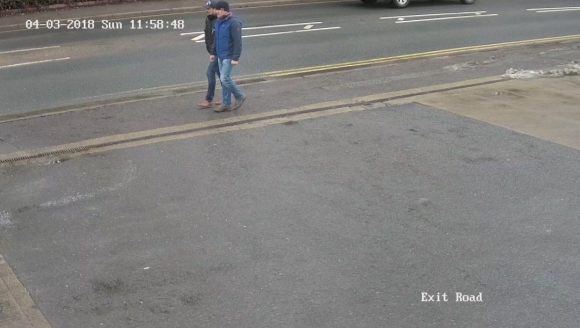
By Rob Slane | The Blog Mire | October 7, 2018
The images and timeline released by the Metropolitan Police on September 5th, when they formally accused two men of the attempted assassination of Sergei Skripal, contain a number of problems and oddities. These include:
- The fact that very few of the images have the original timestamps on them, but rather have the Metropolitan Police’s own timings.
- The fact that there is an unaccounted for, yet vital, 42 minutes between the image of the men at the entrance to Summerlock Approach (said to be 13:08), and the image of the men at the train station (said to be at 13:50:56). Why is this vital? Because it not only takes just 5 minutes, rather than 42 to get from the one location to the other, but also because it potentially places the men within a few minutes walk of Sergei and Yulia Skripal within that 42 minute timeframe.
- The fact that only stills were released, rather than actual footage (public appeals for witnesses involving CCTV usually show actual footage – why not in this case?).
But there is one crucial image which I would like to focus your attention on: CCTV Image 5 (at the top of this piece). This is one of the few pictures that is properly timestamped (11:58:48), although I have to say I’m highly sceptical that the two men could have got to that location by that time, given that The Met says they were at the station at 11:48:20. It takes over 12 minutes at a quick walk, and so unless they ran some of the way (and neither picture gives the impression that they are in a particular hurry), I think it highly likely that one or other of these times is incorrect.
The reason this image is particularly crucial is that it is the only image shown to the public, which can be said to connect the men (albeit extremely tenuously) to the claim made against them by the Met. None of the other images do this at all.
If I happened to be a juror at the trial of these two men, and I was presented with the other images, my reaction would largely be “so what?” (this is of course pure fantasy, since the Blair Government, in its infinite wisdom, tore up centuries of legal practice to allow such trials to be held without a jury on the grounds of that mindless buzz phrase, “national security”). Here are some images showing them entering and leaving the UK. So what! Here are some images of them arriving in and departing from Salisbury. So what? Here are some images of them walking around the town. Actually, this one is not so much a “so what?”; more a “hang on a minute, are you telling me they went walkies around the town after allegedly carrying out the most audacious (and stupid) assassination attempt ever seen in Britain?”
Without the Wilton Road image, none of these other images would mean diddly squat. That image, assuming it to be authentic, is the closest The Met comes to backing up its claim against them. But as we shall see, it actually turns out to be no more convincing than the others.
As I said in my previous piece, it is crucial to understand what the claim being made by The Met against the two men actually is. Here goes:
“That between approximately 12:10pm and 12:40pm on 4th March, the two men named as suspects – Ruslan Boshirov and Alexander Petrov – walked up to the house of Sergei Skripal at 47 Christie Miller Road, Salisbury, and there applied a high purity, military grade nerve agent to the handle of the front door in an attempt to assassinate Mr Skripal.”
(Note: see the previous piece if you want to know why there is a 12:10-12:40pm window).
Now let’s turn back to the statement made by The Met on 5th September. This is what they said:
“CCTV shows them in the vicinity of Mr Skripal’s house and we believe that they contaminated the front door with Novichok.”
The big question that arises from this claim is this: What is this CCTV footage, which apparently shows them in the vicinity of Mr Skripal’s house? There are two basic possibilities:
Firstly, it could be that there is indeed CCTV that shows them close to Mr Skripal’s house (i.e. within a few yards of it), and perhaps which even shows them applying something to the door handle.
Secondly, it could be that The Met is simply referring to the CCTV of the men on the Wilton Road, which they released in the statement.
The second is almost certainly the case, for the following reasons:
- If there is CCTV footage of the two men near (or at least nearer the house), why not show that rather than the Wilton Road image?
- If such footage does exist, why does The Met only “believe” that the two men contaminated the door handle with something called “Novichok” as opposed to “know” that they did so (note: Porton Down does not call it “Novichok”, but rather “a Novichok or related agent”)?
- When you read The Met’s statement of 5th September, it is fairly clear that the reason the Wilton Road image is there, is that it is precisely this image which is being used to back up the statement about the men being in the vicinity of the house (i.e. they say: “Image five shows the suspects ten minutes later – at 11.58 – on Wilton Road, Salisbury, we say, moments before the attack”).
This is deeply misleading. The Shell garage on the Wilton Road could plausibly be said to be in the vicinity of 47 Christie Miller Road if we were talking about the two locations in terms of Salisbury as a whole. But it can in no way be said to be “in the vicinity” of 47 Christie Miller Road, if it is being spoken of in connection with a highly specific claim about an assassination attempt at the door of the house. The claim is that they were at the door. The image, assuming its authenticity, shows them on a different street, many hundreds of yards away.
This sort of sloppiness and looseness has been the hallmark of the investigation from day one, and has been the reason why so many have come to treat the official claims with scepticism.
Let me caveat this, however, by saying that I don’t believe Boshirov’s and Petrov’s claims either. The chief reason for this is that The Met says they arrived in Salisbury at 14:25 on the Saturday, and this was not disputed by them in their interview with Margarita Simonyan. What they did claim, however, is that they came to visit Stonehenge, but were unable to do so due to the bad weather. This was kind of true. Stonehenge was indeed closed that day due to bad weather. However, had it opened that day, it would have closed at 17:00 with last admissions at 15:00. Getting to Salisbury at 14:25 with the hope of then going to see Stonehenge by 15:00 is not very plausible — even if it had been good weather.
But as I’ve said previously, it is largely irrelevant whether Boshirov’s and Petrov’s account is credible. It is The Met that has accused them, and it is therefore for The Met to come up with credible evidence to back up their claim. Showing an image of the two men in broad daylight, on a completely different street, hundreds of yards away from the alleged crime scene, does not do it. Worse still, claiming that this image “shows them in the vicinity of Mr Skripal’s house” — which it manifestly does not — is deeply misleading.
If The Met has more conclusive footage (footage that is, not another still), actually showing the two men in the vicinity of the house, they should release it. Until they do, we can assume the claim that “CCTV shows them in the vicinity of Mr Skripal’s house” is referring to the Shell garage on the Wilton Road, which since it is not in fact in the vicinity of the house, is misleading. We can therefore continue to treat their claims with the scepticism that they have so far deserved, and to believe that there is another explanation altogether for Boshirov’s and Petrov’s two Salisbury trips; an explanation that neither the British or Russian Government seem very eager to come clean on.
Claims About Alleged GRU Cyberattack on UK-Based TV Inconsistent – Embassy
Sputnik – 07.10.2018
LONDON – The Russian Embassy in London pointed Saturday to the contradictions in the article released by the Financial Times newspaper, which claimed that the Russian military intelligence service GRU had allegedly conducted a cyberattack on the UK-based Islam Channel TV broadcaster in 2015.
On Friday, the Financial Times reported, citing non-designated UK officials, that the GRU officers allegedly hacked the computer network of the UK-based TV station in 2015. The news outlet has not provided any evidence, proving the claims. The newspaper has not specified why Russia would “attack” the broadcaster either. In addition, all the sources of information mentioned in the article were anonymous.
“What is interesting about the article is that it claims that hackers, supposedly, had complete control over the TV channel’s infrastructure during the intrusion. Then [the article] claims that the [UK] Home Office staff called [the broadcaster] and informed it of the cyberattack and says that ‘we [the TV station’s staff] had not noticed any irregularities in the work of the channel until this call.’ The information in this article does not withstand the slightest criticism, it seems it was written in a hurry, and the logical pattern was disrupted. [The article’s] main goal is clear — to bring another accusation against Russia,” a representative of the embassy told reporters.
The representative stressed that the embassy usually refrained from commenting on newspaper articles based on leakages from the UK security services because nobody was willing to take responsibility for the allegations. He added that the UK Foreign Office habitually left Moscow’s requests concerning such publications without answer.
On Thursday, the UK Foreign Office said it assessed “with high confidence” that GRU was “almost certainly” responsible for a series of cyberattacks on political institutions, media outlets and infrastructure across the globe. The Foreign Office mentioned a UK-based TV station among the targets of the attacks.
Later on Thursday, the Dutch Defense Ministry claimed that four Russian citizens holding diplomatic passports had been expelled from the Netherlands in April on suspicion of an attempted cyberattack on the Organization for the Prohibition of Chemical Weapons (OPCW).
The Russian Foreign Ministry refuted the claims on Thursday and stressed that the “spymania campaign” unleashed in the Netherlands was seriously hurting bilateral relations with Russia. The ministry pointed out that the Netherlands made the statement ahead of the OPCW opening session, which could set up the “necessary’ political background” to push through some illegal initiatives that Russia opposed.
Canada and the United States subsequently joined the allegations against GRU, claiming that seven Russian military intelligence officials allegedly targeted with cyberattacks the US Westinghouse nuclear power company and multiple anti-doping agencies and athletes. Meanwhile, Russia’s proposal for the establishment of a joint task force on cybersecurity has been earlier rejected by Washington.
Russian Deputy Foreign Minister Sergey Ryabkov has said that the United States “poisoned” Russian-US relations by its new allegations against Russian security services. The diplomat noted the danger of fueling tensions between two nuclear powers.
Germany, UK May Slap More Sanctions on Russia Amid Hacking Accusations
Sputnik – 06.10.2018
On Thursday, the US Justice Department announced charges against seven alleged Russian military intelligence officers accused of hacking doping agencies and other international organizations.
Bloomberg has cited Britain’s de facto Deputy Prime Minister David Lidington as saying that London and Berlin may slap more punitive measures on Moscow over the alleged hacking activity of Russian military intelligence.
“We have to be ready to take action either on our own or preferably in concert with allies if appropriate,” Lidington pointed out.
He was echoed by German Chancellor Angela Merkel’s chief spokesman Steffen Seibert, who said that additional sanctions against Russia are currently under discussion between Germany and its European partners.
The statement came a few days after the British Foreign Office stated that London had assessed “with high confidence” that the Russian military intelligence service was “almost certainly” responsible for a series of cyberattacks on political institutions, media outlets and infrastructure across the globe, including in Britain.
The Russian Embassy in the UK, in turn, urged British authorities to immediately provide information on Moscow’s alleged attempts to conduct cyberattacks against London.
Meanwhile, the Dutch Foreign Ministry said in a statement that the country’s intelligence had thwarted a hacking attack on the Organization for the Prohibition of Chemical Weapons (OPCW), which was allegedly carried out by four Russian citizens.
A Russian Foreign Ministry source, for its part, stated that there were no and there can’t be any attacks on the OPCW on behalf of Russia, because Moscow already has access to the organization’s files.
The source slammed the Dutch accusations as “an example of some Western states’ policies reaching the point of bigotry,” noting that Western “spy mania is gaining momentum.”
In the US, Assistant Attorney General for National Security John Demers said that the White House had announced “an indictment charging seven Russian military officers with violation of several US criminal laws for malicious cyber activities against the United States and its allies.”
He further claimed that Russia had carried out a cyberattack on a Swiss lab which was analyzing a toxic substance, allegedly used against former Russian intelligence officer Sergei Skripal and his daughter Yulia in Salisbury, UK.
Demers also claimed that three Russian agents were previously accused of meddling in the 2016 US election.
Moscow has repeatedly denied claims that it has links to cyberactors attempting to meddle in other states’ domestic affairs, insisting that such claims were unfounded.
In early September, the European Union extended its current sanctions against certain Russian individuals and entities “over actions undermining or threatening the territorial integrity” of Ukraine for another six months.
Journalist explains why US doesn’t need hackers to control the world, and it’s hard to disagree
RT | October 5, 2018
‘Russian hackers’ have become the go-to bogeymen for Washington. There’s little mention of American hackers though – probably because they aren’t needed, since most of the internet is a branch of US intelligence.
The US, which is now raising massive alarm over Russia’s supposed efforts to hack everything Americans hold dear, has been refusing to sign a treaty on cyberspace behavior with Russia for almost a decade now. The reason is simple, one Russian-American author explains: Washington doesn’t need a treaty, because it dominates the digital space completely as it is.
Washington’s panic over ‘Russian hackers’ is just a reflection of what it’s been doing to the world for years, says Yasha Levine, the author of ‘Surveillance Valley: The Secret Military History of the Internet.’
And thanks to surveillance programs like PRISM, outed by Edward Snowden 2013, the US doesn’t even need hackers: just by being on social media or using Google, you’re voluntarily surrendering your data to the NSA.
Far from scaling back its snooping after Snowden pulled the curtain on PRISM, the US has multiplied its efforts. Citing ‘national security’, lawmakers renewed the NSA’s sweeping spying powers this year. Domestic phone surveillance tripled last year, user data requests to Apple doubled, and user data requests to Google were at an all-time high.
And just recently, the ‘Five eyes’ powers – the US, the UK, Canada, New Zealand and Australia – issued a memo demanding that tech giants implement ‘backdoors’ to allow governments direct access to users’ encrypted data.
The entire narrative of cyber threats to the “good guys” US is a smokescreen to hide the unenviable fact: it’s the US that’s the apex predator of the digital ocean.
Featured Video
Anthrax War – CBC The Passionate Eye
or go to
Aletho News Archives – Video-Images
Book Review
Shattered Dreams: The HPV Vaccine Exposed (2019)
By Christina England – 30 Q&As – Book Review & Summary
Lies are Unbekoming | September 4, 2026
… Gardasil received FDA fast-track approval in 2006, Cervarix followed in 2009, and Gardasil 9 was approved in December 2014 with more than double the aluminium adjuvant content of the original. The commercial context is specific. Merck was about to lose patent protection on Zocor and faced $18 billion in Vioxx injury claims from a cardiovascular drug the company had marketed while suppressing its own data showing a five-times increase in heart attacks. Analysts projected the global HPV vaccine market at $4 billion by 2011, contingent on government-funded national programs for teenage girls. The 1986 National Childhood Vaccine Injury Act had already granted manufacturers complete liability immunity. By 2013, Japan had withdrawn its HPV vaccine recommendation after cataloguing severe adverse reactions in hundreds of girls. No Western government followed. The establishment position across the UK, US, Australia, and most of Europe held, and still holds, that the vaccines are safe and effective, that reported injuries are coincidental, and that cervical cancer prevention justifies the program. The book was published into this position, not against a vacuum.
Shattered Dreams sits alongside Mary Holland’s The HPV Vaccine On Trial and Viera Scheibner’s foundational vaccination work as part of the documented record on what has been done to a generation of teenage girls under the banner of cancer prevention. The full summary unpacks three specific findings: that Merck used the aluminium adjuvant itself as the “placebo” control in 92.5% of trial subjects, making it structurally impossible to detect excess reactions from the adjuvant; that Dr. Sin Hang Lee found HPV DNA fragments bound to aluminium in every one of sixteen Gardasil samples tested, and in the blood and spleen of a New Zealand girl six months after her third dose; and that in every country with high vaccination coverage, including Australia, the UK, Norway, and Sweden, cervical cancer rates have stopped declining and started rising specifically in the vaccinated cohort. Martínez-Lavín’s 2017 calculation puts the number needed to seriously harm with Gardasil 9 at 140, and the number needed to vaccinate to prevent one case at 1,757. Thirteen young women are seriously harmed for every one who benefits. The vaccine was approved on the basis of trials that could not detect what the trials were supposed to detect, and it is still being given to twelve-year-olds today. … Read full review
Blog Roll
 Aletho News
- British Transport Police Facial Recognition Trial Scanned 926,912 People With Zero Arrests
- House Bill Would Ban Federal Use of Flock ALPR Data
- Can a Spice Rival a Drug? 10 Head-to-Head Trials Put It to the Test.
- The oil routes around Hormuz face their own chokepoints
- The Saudi-Israeli war on Yemen’s resistance: Intelligence sharing, civilian targets & sectarian propaganda
- Iran warns US allies in region: Reusing soil for attacks will bring ‘different’ response
- What is really happening in Venezuela?
- Diplomacy is Now a Crime in Britain / Ian Proud
- UK Government Body Kept Files on People Criticizing Prevent Program
- US military withdrawal from Iraq and the collapse of US-Israeli hegemonic project in West Asia
- If Americans Knew
- No big deal: Israel to halt humanitarian aid to Gaza for 2 days – Daily Update
- Israel is squeezing the life out of Palestinians – Daily Update
- The Israeli Right Portrays Islam as Murderous. It Serves a Political Purpose
- Jordan Has Had Enough: King Abdullah’s Scathing Warning to Israel
- Israeli Colonizers (i.e. Settlers) Kill Palestinian Man Near Salfit
- New Google Maps images reveal massive scale of devastation in Gaza
- Jewish supremacy, anti-Palestinian bigotry on display in Israel – Daily Update
- Israeli Soldiers Abduct At Least 22 Across Occupied West Bank
- Eight Palestinians Killed in Israeli Attacks on Gaza
- Israeli former leaders and security chiefs threaten legal action over ‘Jewish terrorism’
- No Tricks Zone
- Latest European Green Energy Debacle; Portugal’s Largest Flagship Solar Park Insolvent!
- Green Energy Debacle: German Expert Professor Fritz Vahrenholt Warns Of Severe Economic And Social Consequences
- Two More Paleo Reconstructions Affirm Meters-Higher Sea Levels Across Ireland, Brazil 7000-6000 Years Ago
- New Study: Earth And Venus Surface Warmth Largely Explained By Convection And Lapse Rate, Not CO2 Or Radiation
- 2025 Nature Paper Claiming Worsening Global Drought Gets RETRACTED …Heavily Flawed
- New Study: ‘Global Drought Shows No Detectable Recent Acceleration Under Climate Warming’
- Economic Masterminds: German Socialists Suggest Taxing Productivity Gains Stemming From Using AI
- The South China Sea Has Not Been Cooperating With The Climate Change Narrative
- Energy Crisis: Germany Enters Heating Season With Historically Low Gas Reserve Fill Levels
- New Study: The Antarctic Ice Sheet Gained Mass From 2020-2024 Due To Staggering Snow And Ice Accumulation

