What Explains Washington’s and Israel’s Opposition to Questioning Ghislaine Maxwell?
By Paul Craig Roberts | Institute for Political Economy | July 24, 2025
Attorney Alan Dershowitz allegedly is on the Epstein client list, but he calls for the release of the Epstein files and for the release of Ghislaine Maxwell under “use immunity,” which compels her to testify. In other words Dershowitz wants to clear his name by getting to the bottom of the Epstein Saga.
The saga is that Epstein was a Mossad spy financed by Israel out of the billions of dollars that Israel extracts from American pocketbooks each year. Epstein’s job was to implicate the American ruling establishment in sex crimes that enabled Israel to blackmail Washington into conforming US Middle East policy with Israel’s policy.
That done, Washington destroyed at the expense of American lives, money and reputation five counties for Israel.
Now Netanyahu wants Americans to destroy Iran for Israel. Can Washington refuse when Netanyahu has the blackmail information accumulated by Epstein for Mossad?
The problem is that neither Washington nor Netanyahu want Ghislaine to testify.
How long will it be before we hear that Ghislaine has committed suicide in her suicide proof prison cell?
Obama authorized ‘implausible’ reports about Putin supporting Trump – House Intel Committee

RT | July 23, 2025
Former US President Barack Obama authorized the release of reports claiming Russian President Vladimir Putin backed Donald Trump’s 2016 campaign, despite CIA warnings that the information was unreliable, according to a newly declassified report from the House Intelligence Committee.
Last week, the US Director of National Intelligence (DNI) Tulsi Gabbard published more than 100 documents detailing what she described as a coordinated effort by Obama-era officials to fabricate the narrative of Trump-Russia collusion. The effort, she said, aimed to undermine Trump’s legitimacy after his 2016 election victory.
On Tuesday, the DNI released additional declassified findings focused on the January 2017 Intelligence Community Assessment (ICA), which claimed that Putin sought to influence the election in Trump’s favor. That assessment became a central foundation for the Russiagate probe.
New evidence shows that the ICA included intelligence that CIA Director John Brennan knew was weak or unverifiable. Brennan reportedly led the drafting process and pushed for the inclusion of discredited material, including the Steele dossier, despite objections from CIA officers who warned there was no direct evidence of Putin backing Trump.
The report also found that Obama issued “unusual directives” to accelerate the assessment’s release before Trump’s inauguration, bypassing normal coordination channels within the intelligence community.
Gabbard has argued that these actions warrant a criminal investigation and has accused Obama officials of manufacturing a false narrative to discredit a sitting president. Trump has endorsed her findings, calling for prosecutions of Obama and his top aides.
She has also revealed that internal US intelligence consistently concluded Russia had neither the capability nor the intent to interfere in the 2016 election, but these assessments were suppressed.
Russia has denied any interference in US elections, while Putin has repeatedly said that Moscow does not prefer any particular candidate.
AOC Tries to Defend Vote Against Amendment to Cut $500 Million in Israeli Military Aid

By James Rushmore | The Libertarian Institute | July 22, 2025
U.S. Congresswoman Alexandria Ocasio-Cortez (D-NY) is trying to explain away her “no” vote on an amendment to the 2026 National Defense Authorization Act (NDAA). The amendment, introduced by Congresswoman Marjorie Taylor Greene (R-GA), would have cut $500 million in U.S. funding for nuclear-armed Israel’s missile defense programs.
“People exploding this false messaging that I voted for a bill [and] funding that I quite literally voted NO on. The threat environment this morning is scary,” the progressive lawmaker wrote on Bluesky Monday afternoon. “Doesn’t help anyone. Drag me for the position if you disagree but don’t lie. It’s out of control. Saying I voted for this funding is false.”
“If you believe neo-nazis [sic] are welcome and operating in good faith, you can have them!” she added on X.
Earlier in the day, NBC 4 New York reported that Ocasio-Cortez’s Bronx congressional office was doused with red paint overnight. A sign was posted outside that read “AOC FUNDS GENOCIDE IN GAZA.”
Ocasio-Cortez joined 421 of her colleagues in the House of Representatives in voting against the Greene Amendment, which only received six votes. The amendment would have prevented the Department of Defense from strengthening Israel’s air and missile defense systems, including the Iron Dome. It would also have prevented Congress from effectively abrogating the Symington Amendment to the International Security Assistance and Arms Exports Control Act of 1976, which bans the provision of U.S. military aid to any country that develops nuclear weapons technology in contravention of safeguards imposed by the International Atomic Energy Agency (IAEA).
Ocasio-Cortez’s latest comments come days after she initially tried to head off concerns about her vote. “Marjorie Taylor Greene’s amendment does nothing to cut off offensive aid to Israel nor end the flow of US munitions being used in Gaza. Of course I voted against it,” she wrote on X Saturday morning. “What it does do is cut off defensive Iron Dome capacities while allowing the actual bombs killing Palestinians to continue. I have long stated that I do not believe that adding to the death count of innocent victims to this war is constructive to its end.”
“I remain focused on cutting the flow of US munitions that are being used to perpetuate the genocide in Gaza,” she added.
Ocasio-Cortez’s “no” vote earned her a rebuke from the Democratic Socialists of America. “An arms embargo means keeping all arms out of the hands of a genocidal military, no exceptions. This is why we oppose Representative Alexandria Ocasio-Cortez’ [sic] vote against an amendment that would have blocked $500 million in funding for the Israeli military’s Iron Dome program,” the DSA wrote on Saturday.
How close was Jeffrey Epstein to Israel’s Mossad?
The Grayzone | July 18, 2025
The Grayzone’s Anya Parampil and Max Blumenthal discuss allegations that late financier and trafficker Jeffrey Epstein was an Israeli intelligence asset.
Russiagate only tip of iceberg in Western demonization of Russia – expert
RT | July 20, 2025
US National Intelligence Director Tulsi Gabbard’s revelations about the role of former President Barack Obama’s administration in the Russiagate scandal are “shocking,” but they expose only the surface of a broader Western anti-Russia campaign, Professor Oliver Boyd-Barrett has told RT.
On Friday, Gabbard released newly declassified documents describing a coordinated effort by senior Obama-era officials – led by Obama himself – to falsely accuse Donald Trump of colluding with Russia during the 2016 election. The documents indicate that Obama ordered officials to discard intelligence assessments that found no Russian involvement in Trump’s campaign and replace them with claims blaming Moscow based on fabricated data. The scandal led to the years-long Trump-Russia probe known as ‘Russiagate.’
“This is an extraordinary moment, that the head of intelligence in the US has made such a bold, in some ways shocking, statement of the truth,” Boyd-Barrett, a professor at Bowling Green State University and author of an in-depth study of Russiagate, said on Saturday. He noted the moment was especially striking as Gabbard called for prosecution of those involved in what she described as a “coup” attempt.
Boyd-Barrett, however, emphasized that to “fully comprehend” Russiagate, it must be viewed as only a small part of a broader Western campaign to demonize Russia, “that goes decades back.”
“It’s part of a much deeper agenda – we’re talking Russia narrative… the broader context of an anti-Russian campaign that was stoked artificially around the time of the late 90s when the West had so clearly decided that NATO was going to move eastwards regardless of whatever anyone in Russia or anyone in the US had to say,” he said. He also warned against reducing Russiagate to a personal political ploy, noting that blaming it solely on Obama or Hillary Clinton’s election anxiety is “too simple an explanation.”
Moscow has repeatedly denied interfering in the US electoral process.
Trump administration ordered to restore funding to US propaganda outlet
RT | July 20, 2025
A federal judge has ordered the administration of US President Donald Trump to restore funding for state-run Radio Free Europe/Radio Liberty (RFE/RL), ruling that the decision to stop the support was “unprecedented” and lacked any basis.
RFE/RL was a key tool for spreading Western propaganda in the Soviet bloc during the Cold War and was funded by the CIA. The outlet currently receives nearly all of its funding from Congress.
The Trump administration has sought to cut funding for RFE/RL and several other state-linked outlets. It has denounced the United States Agency for Global Media (USAGM), the body that oversees state-funded media, saying it is “not salvageable,” while indulging in “obscene overspending.” The administration also claimed it is crawling with “spies and terrorist sympathizers.”
Consequently, the USAGM essentially froze funding for RFE/RL and refused to enter into a new contract with the outlet after the previous agreement expired in March. This led to staff furloughs and programming cuts, though the EU stepped in to fill the budgetary gap.
On Friday, Judge Royce C. Lamberth of the US District Court for the District of Columbia ruled that the Trump administration lacks the legal authority to refuse Congress-approved funding of more than $70 million, arguing that they provided no clear basis for the move.
”It is unprecedented for an agency to demand that entirely new terms govern its decades-old working relationship with a grantee entity,” he wrote. He went on to rebuke the USAGM for a lack of responses to RFE/RL to negotiate a new agreement, describing it as “stonewalling” and adding that the agency went dark for days or even weeks.
The “USAGM’s flagrant disregard for its funding responsibilities” caused RFE/RL to suffer “mass furloughs, cancelation of programming, and inevitable damage to the global influence that RFE/RL has built over decades,” the ruling said.
RFE/RL President and CEO Stephen Capus welcomed the court’s decision. “This victory provides our journalists with the momentum necessary to continue reaching the nearly 47 million people each week… With this ruling, RFE/RL can continue to advance US national security interests.”
FDA stalls decision on petition to suspend mRNA injections, citing ‘other priorities’
US regulator quietly delays action despite evidence of regulatory failure, DNA contamination, and a surge in cancers among young people.
By Maryanne Demasi, PhD | July 19, 2025
The U.S. Food and Drug Administration (FDA) has delayed its response to a formal petition demanding the suspension of the mRNA Covid-19 injections, citing “the existence of other FDA priorities.”
In a letter dated 17 July 2025, Dr Vinay Prasad—recently appointed Director of the FDA’s Center for Biologics Evaluation and Research (CBER)—acknowledged that the agency had “not yet reached resolution of the issues raised” in the petition.
Filed on 20 January 2025, the petition alleges that Pfizer’s Comirnaty and Moderna’s Spikevax were “unlawfully approved” in violation of federal regulatory requirements.
It calls for an immediate halt to the injections, independent testing of retained vials, and a full investigation into the approval process.
Fatal flaws in licensing mRNA products
Submitted by lawyer Katie Ashby-Koppens of PJ O’Brien & Associates, and spearheaded by former barrister Julian Gillespie, the petition argues that the mRNA injections were misclassified from the outset.
Although the products meet the FDA’s own definition of gene therapy, they were not regulated as such—sidestepping the heightened oversight normally required for gene-based interventions.
Under U.S. law, gene therapies must undergo ‘Environmental Assessments,’ be reviewed by specialised advisory committees, and face a more rigorous public transparency process.
But by labelling the mRNA injections as conventional ‘vaccines,’ regulators were able to fast-track their approval through a separate, less stringent pathway—bypassing critical safeguards.
The petition also raises alarm over synthetic DNA fragments found in the final products. Independent testing by multiple laboratories—including the FDA’s own facility—revealed DNA contamination far exceeding the safety limits.
Because the DNA is encapsulated in lipid nanoparticles, it can bypass normal immune defences, enter human cells, and in some cases integrate into the genome. The potential consequences, the petition warns, include genomic instability, cancer, and heritable genetic damage.
One of the most serious findings is the presence of SV40 promoter sequences in Pfizer’s injection—elements known to interfere with tumour-suppressing pathways such as p53.
The petition accuses Pfizer of withholding this information from the FDA in breach of disclosure laws.
Interim letter, no timeline
Under federal law, the FDA was required to respond to the petition within 180 days.
Just before the deadline, it issued a standard interim letter—acknowledging the petitioners’ main concerns but offering no timeline for a final decision.
Nor did the agency indicate that any investigation had begun. “We will respond to your petition as soon as we have reached a decision on your request,” wrote Prasad.
The agency’s delay is not uncommon—but critics say it reflects a deeper reluctance to confront the scientific and regulatory implications head-on.
Fully addressing the petition would require a sweeping and uncomfortable re-evaluation of how mRNA technologies were developed, approved, and marketed under the guise of conventional ‘vaccines.’
If the products were unlawfully licensed—mislabelled as vaccines to circumvent gene therapy regulations—the fallout would be unprecedented.
The admission alone could expose governments to extraordinary legal and financial liability—including product withdrawals, class actions, long-term health monitoring, injury compensation, and potential criminal investigations.
Petitioners speak out
Gillespie said the FDA is caught “between a rock and a hard place”—but that doesn’t excuse inaction. He believes the recent surge in cancers among young people demands urgent scrutiny.
“There’s been a tremendous and continuing rise in cancers across the United States commensurate with the rollout of these products,” he said. “Government officials have seen the data… and are refusing to address the elephant in the room.”
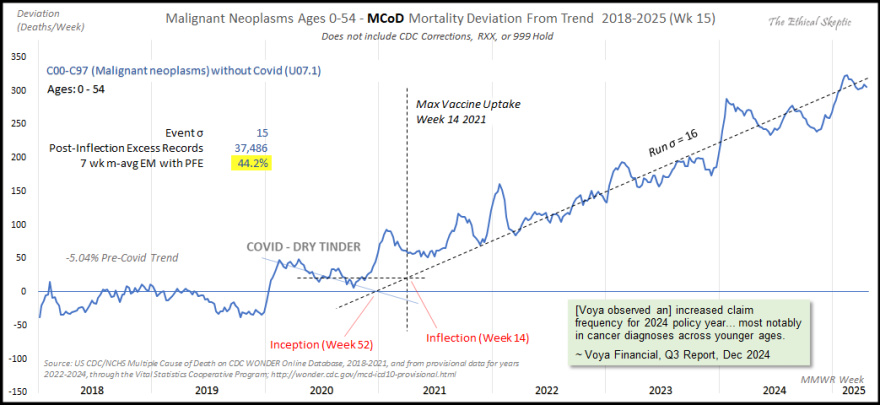
Analysis by Ethical Skeptic shows young cancers are up by 44%
Dr Jessica Rose, a computational biologist and co-author of the petition, said the public was never given accurate information about the nature of the products.
“The public was not told what they were being injected with,” she said. “And still to this day, they are not.”
She described the failure to distinguish gene-based therapies from traditional vaccines as “an existential crisis,” warning that “more and more people—including children and infants—are being exposed to the harms of foreign DNA.”
Dr David Speicher, a virologist and co-signatory on the petition, said the FDA’s letter amounts to bureaucratic minimisation.
“The number of vaccine-injured people continues to grow, and we do not all know the long-term harms caused by these genetic products,” he said. “Yet the FDA states that ‘other priorities’ are more important.”
He called for “an independent scientific team to examine the regulatory process, as well as to provide funding to researchers to explore biological mechanisms such as genomic integration.”
Pharmacy consultant and petitioner Maria Gutschi said the mRNA products represent a new therapeutic category “with no previous knowledge to leverage in assessing safety and efficacy.”
She argued that, given the novelty and risks, “the bar to suspend and/or mandate ‘black box’ warnings must be higher than for any previous therapeutic agent.” Gutschi urged the FDA to treat this as “THE priority” going forward.
A tale of two gene therapies
Critics say the FDA’s handling of mRNA harms stands in stark contrast to its swift response to safety concerns involving other gene therapies.
Yesterday, the agency announced a halt to clinical trials for Sarepta Therapeutics’ investigational gene therapy after the company reported another patient death—bringing the total to three deaths across two separate gene therapy products.
The treatment, developed for limb girdle muscular dystrophy, prompted immediate regulatory action.
“Today, we’ve shown that this FDA takes swift action when patient safety is at risk,” said FDA Commissioner Marty Makary, declaring the agency is “not afraid to take immediate action when a serious safety signal emerges.”
In contrast, the FDA has remained inert on mRNA injections—which also deliver genetic material into human cells but were classified as “vaccines”—despite thousands of reported deaths and serious adverse events following administration.
According to the petitioners, the public was led to believe they were receiving a conventional vaccine—when in fact, they were being administered gene therapy.
By failing to recognise and regulate the products accordingly, the FDA violated public trust—bypassing transparency laws, concealing critical risks, and depriving individuals of the opportunity to make informed medical decisions.
Next steps
People don’t want agencies to stall. They don’t want bureaucratic evasions. They want answers—and they want accountability.
The FDA’s next move won’t simply test regulatory process.
It will test courage—whether anyone inside the system is willing to confront the fallout in what may be the most consequential medical misclassification in modern history.
Tulsi Gabbard releases ‘overwhelming evidence’ of Obama coup plot against Trump
RT | July 18, 2025
Former President Barack Obama’s administration deliberately manipulated intelligence to frame Russia for interfering in the 2016 presidential election, according to newly declassified documents released on Friday by Director of National Intelligence Tulsi Gabbard.
Gabbard unveiled more than 100 pages of emails, memos, and internal communications, which she described as “overwhelming evidence” of a coordinated effort by senior Obama-era officials to politicize intelligence and launch the multi-year Trump–Russia collusion investigation. She dubbed it “a treasonous conspiracy to subvert the will of the American people.”
The scandal severely damaged relations between Moscow and Washington, leading to sanctions, asset seizures, and a breakdown in normal diplomacy.
”This intelligence was weaponized,” Gabbard said. “It was used as a justification for endless smears, for sanctions from Congress, and for covert investigations.” She added: “When key internal assessments found that Russia ‘did not impact recent U.S. election results,’ those findings were suppressed.”
“For months before the 2016 election, the Intelligence Community maintained that Russia lacked both the intent and capability to hack U.S. elections,” Gabbard noted. “But once President Trump won, everything changed.”
One document — a draft President’s Daily Brief dated December 8, 2016 — stated Russia “did not impact recent U.S. election results” through cyberattacks. The report, prepared by the CIA, NSA, FBI, DHS, and other agencies, found no evidence of voting interference.
Yet Fox News reported on Friday that the document was pulled — “based on new guidance,” according to internal emails. Hours later, a high-level Situation Room meeting took place, attended by officials including DNI James Clapper, CIA Director John Brennan, National Security Adviser Susan Rice, FBI Deputy Director Andrew McCabe, and Attorney General Loretta Lynch.
According to declassified notes, attendees agreed to produce a new intelligence assessment at President Obama’s request. That report, released on January 6, 2017, claimed Russia had intervened in the election to help Donald Trump — directly contradicting earlier assessments.
Gabbard claims the revised assessment leaned on the discredited Steele Dossier — compiled by a former British spy — while sidelining dissenting views within the intelligence apparatus. “This was not intelligence gathering,” Gabbard stated. “It was narrative building.”
Confirmed as DNI earlier this year — after a contentious process — Gabbard says she has forwarded the documents to the Department of Justice. She has urged investigations into former CIA Director John Brennan and former FBI Director James Comey, who are reportedly facing criminal inquiries. “No matter how powerful, every person involved must be brought to justice,” she stressed. “Our nation’s integrity depends on accountability.”
“The integrity of our democratic republic depends on full accountability,” Gabbard concluded. “Nothing less will restore the public’s trust — and ensure nothing like this ever happens again.”
No, CBS Boston, Climate Isn’t Making “Extreme Heat the New Normal”
By Anthony Watts | Climate Realism | July 9, 2025
In the CBS Boston (CBS-B) article titled “Is extreme heat the new normal in Boston? What hitting 102 degrees tells us about climate change,” Jacob Wycoff claims that Boston’s recent heat wave is a symptom of climate change and the “new normal.” This is misleading. In fact, long-term temperature records do not support the notion that heat waves are becoming more intense or more frequent in Boston or across the United States. Historical weather data shows that extreme heat events in Boston are neither unprecedented nor evidence of a climate emergency. The notion that a few hot days in June are proof of a systemic climate shift is simply not supported by the broader climate record.
“What used to be ‘unusual’ is fast becoming our new normal,” Wycoff writes. “And if we don’t act to slow warming, this kind of heat won’t be the exception, it’ll be the expectation.
“If greenhouse gas emissions remain unchecked, Boston’s average summer highs could rise by 9 degrees by 2100,” says Wycoff.
Wycoff’s story, as is usually the case in mainstream media stories about climate change, promotes speculative model projections, while ignoring real world data and trends to the contrary.
It’s a familiar tactic: choose the most aggressive, worst-case emissions scenario and present it as destiny. Climate Central, the source for much of the CBS-B story, uses computer model projections based on RCP 8.5, for example. Yet as noted on Climate Realism, even the Intergovernmental Panel on Climate Change (IPCC) has stepped back from emphasizing RCP 8.5 as a likely pathway, recognizing that is implausible if not impossible.
This climate alarmist framing glosses over essential context: heat waves like the one Boston just experienced have happened before, well before recent increases in carbon dioxide emissions, and are often the result of local urbanization effects—not global climate trends.
Let’s start with the basic fact that the recent heat in Boston, while certainly hot, is far from unprecedented. According to the National Weather Service data, Boston hit a record high of 102 degrees for June on June 24, 2025. But historical data shows that Boston has experienced significantly high temperatures long before modern climate anxieties took hold. Boston’s previous record June temperature of 100℉ was June 6. 1925, 100 years of global warming ago. The highest all time ever recorded temperature in Boston was 104°F in July 1911, followed by 103°F in July 1926. The city also saw 102°F temperatures in 1911, 1975, and 1977. You can see these highs in the graph below with the most recent one on the far right in the figure below.
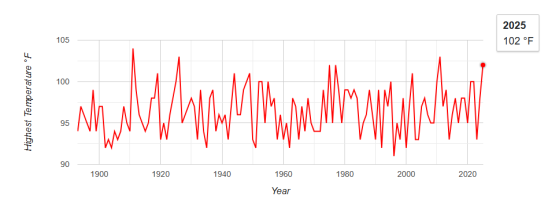
Figure: Hottest annual temperatures recorded in Boston, Massachusetts for each year between 1893 and 2025.
So, if recently increased atmospheric carbon dioxide is responsible for this “new normal” as Wycoff claims, how did these even hotter events happen in the past when carbon dioxide levels were lower? His narrative falls apart in this context.
So, no—extreme heat is not the new normal in Boston. It’s part of a long-standing, intermittent pattern of hot weather events. In fact, the heat experienced in June 2025 didn’t even break Boston’s all-time record. It was simply the hottest June day since 1872, not the hottest day ever.
Nor are extended heatwaves new to Boston. In June 1872, Boston experienced eight days of temperatures above 90°F. Boston also had a multi-day stretch of 100-degree temperatures in July 1911, a heat wave that was deadlier and more extreme than what the city experienced in June 2025. That 1911 event resulted in numerous fatalities across the Northeast, a fact documented well before climate change became the default explanation for every summer hot spell.
The CBS-B article cites Climate Central’s claim that Boston’s overnight summer temperatures have increased by 2 degrees Fahrenheit over the past 50 years. But this trend is almost certainly influenced by the well-known Urban Heat Island (UHI) effect, which causes cities to retain more heat, especially overnight, due to heat-absorbing infrastructure like asphalt, concrete, and buildings. This is not a climate crisis; this is local urbanization.
The UHI effect is well-documented and accounts for much of the localized warming in urban centers. In fact, the National Oceanic and Atmospheric Administration (NOAA) acknowledges that “cities tend to be warmer than rural areas, particularly at night, because buildings, roads, and other infrastructure absorb heat during the day and release it slowly after the sun goes down.”
Boston, like most major metropolitan areas, has undergone significant growth over the last century. The city’s population has grown substantially over the past 70 years. With more people bringing with them the development of more houses, buildings, streets, bridges, concrete, blacktop, machinery, and denser development, all of which contribute to warmer temperatures. The temperature increase isn’t a global phenomenon playing out on a Boston street corner—it’s a localized, urbanized one.
Furthermore, the idea that climate change is singularly responsible for making hot days “six times more common” in Boston is based on computer model forecasting, not measured trends. CBS-B leans heavily on Climate Central’s Climate Shift Index, which is a modeled estimate—not direct measurement—of climate influence. These types of attributions rely on climate models that, as Climate Realism has repeatedly shown, consistently overstate future warming compared to observed reality. Research by Roy Spencer Ph.D., has demonstrated that most climate models overestimate warming by up to 50 percent compared to satellite data.
What CBS-B also fails to mention is that heat-related deaths in the U.S. have been declining, not increasing. Thanks to modern air conditioning, improved healthcare, and public awareness, society is far more resilient to heat than it was a century ago. According to a 2022 study published in The Lancet, cold weather still kills significantly more people than heat does.
The CBS-B story is a prime example of lazy climate reporting. It cherry-picks recent temperatures, ignores over a century of weather history, and repeats activist talking points without challenge. CBS-B’s failure to carry out basic fact checking resulted in a story that was alarmingly misleading. The story is an example of the type of “journalism” that is eroding the public’s trust in journalists and mainstream media outlets they report for.
Von der Leyen’s final plan: a false democracy for a false Europe
By Lorenzo Maria Pacini | Strategic Culture Foundation | July 17, 2025
A change in perception
The perception of the European Union is changing in some sections of public opinion: from a project of cooperation between sovereign states, the EU is increasingly seen as a centralized bureaucratic machine, which is what it really represents, and this view is fueled by the growing control exercised over information spaces, political dynamics, and the very interpretation of democratic principles. If the failure of the euro as a common currency was already telling, even more so were the isolationist policies of sanctions against the Russian Federation, followed by those against China and, in general, against any political entity that was not in the good graces of the UK-US axis.
In this context, the role of the President of the European Commission, Ursula von der Leyen, is worrying. While proclaiming herself a champion of democratic values, she is contributing to the construction of a system in which truth, dissent, and public debate are suppressed or marginalized. There is no doubt that no one has ever pursued policies as totally anti-democratic, liberticidal, and homicidal as hers (as in the cases of Ukraine and Palestine).
These concerns have been fueled by discussions on a motion of no confidence against von der Leyen. In June 2025, Romanian MEP George Piperea proposed a vote to question her leadership. The necessary signatures were collected from various MEPs to put the issue to a vote in the plenary. The main reason given is the alleged violation of transparency rules during the management of contracts for COVID-19 vaccines in 2020-2021.
Following those agreements, the EU purchased huge quantities of doses, many of which proved to be surplus to requirements, with an estimated 215 million doses, worth close to €4 billion, subsequently being discarded. When citizens and the media asked for clarity on those contracts, the European Commission refused to make the communications public, a decision that the Court of Justice of the European Union later ruled contrary to the rules. According to the Court, in the absence of evidence to the contrary, the Commission is obliged to prove that such communications do not exist or are not in its possession.
Despite this, the Commission has never provided a clear explanation as to why the messages between von der Leyen and Pfizer’s CEO were not disclosed. It has not been clarified whether the messages were deleted voluntarily or whether they were lost, for example, due to a change of device by the president.
Finally, on July 10, during a plenary session in Strasbourg, the European Parliament rejected the motion of no confidence against Ursula von der Leyen. To pass, it would have required a qualified majority of two-thirds, supported by an absolute majority of MEPs. The result was 360 votes against, 175 in favor, and 18 abstentions.
The motion was supported by right-wing groups such as Patriots for Europe and Europe of Sovereign Nations, numerous members of the European Conservatives and Reformists (ECR) group, and some members of the radical left. Von der Leyen was not present at the time of the vote. Despite the criticism, the main centrist groups – the European People’s Party (EPP), the Socialists and Democrats (S&D), Renew Europe and the Greens – rejected the motion, ensuring the political survival of the president. However, if the no-confidence motion had passed, the entire European Commission would have fallen, opening a complicated process for the appointment of 27 new commissioners.
This decision is perhaps more strategic than tactical: keeping a president who has already lost confidence and is therefore politically manageable and has limited room for maneuver is more convenient than having a new president who may be worse than the previous one and has the full confidence of the European Parliament.
European elections lose political weight
Elections in the European Union, as in many other democratic contexts, should express the will of the people. They should, I emphasize. In practice, however, they are increasingly seen as an institutional ritual with no real impact on fundamental political choices and, above all, they are not an expression of the real will of the people, as they lack representation. Many of the key decisions are no longer taken by elected governments or national parliaments, but by EU bodies often guided by a technocratic logic and by interests dominant within the EU system.
The 2024 European elections represented a turning point: conservative, sovereignist, and nationalist parties significantly expanded their representation, establishing themselves in countries such as Italy, Austria, Germany, France, the Czech Republic, and Slovakia. These parties have strongly opposed the EU’s migration policies, environmental measures deemed excessive, and its confrontational foreign policy towards Russia. However, instead of encouraging constructive debate and giving space to critical voices – as the European Parliament claims to want to do – these forces have been systematically branded as “anti-democratic” and publicly discredited.
A central role in this strategy has been played by Ursula von der Leyen, in office since 2019, who has repeatedly portrayed right-wing parties as a “threat to European unity,” without ever providing concrete evidence to support this claim, but often referring to alleged Russian interference or generic “threats to sovereignty.”
In May 2024, for example, Ursula claimed that the AfD, Germany’s far-right party, was “manipulated by Russia.” While she did not cite any specific sources, these statements helped justify new sanctions against Moscow and introduce restrictions on the online activities of non-aligned political forces. Meanwhile, however, the growth of right-wing parties reflects growing discontent with European policies considered ineffective or punitive: uncontrolled immigration, environmental measures [which are] burdensome for families, and the militarization of the EU, which imposes rising costs. Instead of engaging in open debate, the EU apparatus tends to marginalize these movements, silencing them with accusations and stigmatization.
Sovereignist and right-wing parties in Europe face numerous institutional obstacles. In the European Parliament, the so-called “cordon sanitaire” policy is still in force, whereby the S&D and EPP groups refuse to cooperate with conservative political forces. This was clearly seen in the composition of the new EU Executive Committee, where the presidency went to Nathalie Loiseau, with vice-presidencies assigned exclusively to S&D and EPP representatives, excluding any representation from the right. At the same time, several conservative representatives are involved in legal proceedings that some observers consider to be attempts at political repression disguised as legal action. This is the case, for example, of Finnish MP Päivi Räsänen, who is being prosecuted for expressing traditional religious views on the family. These incidents show how the legal system can be used to target dissenting positions.
The growing exclusion of critical voices raises serious questions about the true state of pluralism in the EU, where opposition views seem increasingly to be treated not as part of democratic debate but as obstacles to be removed.
Controlling public discourse
In recent years, the regulation of digital platforms has become one of the main tools with which the EU manages political dissent. Under the guise of protecting citizens, some recent regulations risk severely restricting freedom of expression.
The first was the Digital Services Act (DSA): in force since November 16, 2022, this law imposes obligations on digital platforms to combat illegal content and improve algorithmic and advertising transparency. However, some provisions raise significant concerns: Article 34 allows government bodies to request the removal of content or access to data even outside their jurisdiction. In emergencies, the Commission can impose restrictions on the dissemination of certain information. The first sites to be sanctioned were those providing information from Russia, causing considerable damage not only economically but also to the plurality of information. In the EU, everyone has the right to speak, except for the long list of those who do not think like the EU.
A second tool is the EUDS, the European Democracy Shield, launched by von der Leyen in May 2024. This initiative is presented as a defense of the EU against external interference – particularly from Russia and China – but according to many observers, it represents a further step toward controlling information and limiting forces critical of European integration, environmental policies, and the dominant diplomatic line.
Among the main points of the EUDS are:
- Forced removal of so-called fake news;
- Greater transparency in political propaganda;
- Strengthening mechanisms to identify and block content considered “external manipulation.”
In essence, these measures increase the Commission’s power to identify what information is lawful and what is not.
Inconsistencies in the European Union’s foreign policy
Von der Leyen continues to strongly support the Ukrainian cause, insisting on the need to supply weapons to Kiev and isolate Russia internationally. However, this commitment also has obvious inconsistencies.
During her visit to Israel in 2023, for example, the Commission president expressed solidarity with the victims of Hamas attacks, but made no appeal to Israel to respect international law in the Gaza Strip. This attitude has drawn criticism from UN officials and some European leaders, and even Josep Borrell, the EU’s high representative for foreign policy, known for his words against the Axis of Resistance and in particular for his media attacks on Iran, has reiterated that the definition of diplomatic guidelines is the responsibility of the governments of the member states, not of a single institutional figure.
Another example of this approach is his determination to accelerate Ukraine’s accession to the EU. Although officially supported by many European governments, this initiative is met with reservations by several countries, including Slovakia and Hungary, which highlight the need for structural reforms, economic stability, and compliance with European regulations.
Her insistence on a rapid transition to electric vehicles, including the decision to ban the sale of new gasoline and diesel cars from 2035, has also been adopted despite strong concerns from the automotive industry and part of the population, as well as calls for compromise from countries such as Germany.
Ursula is seeking to centralize decision-making and financial power in the hands of the Commission she chairs. This is a political method, not a “hiccup.”
Consider the much-discussed ReArm Europe: €800 billion earmarked for rearmament, forcing EU member states into a disastrous spending review. As soon as opposition arose from national parliaments, the Commission moved to exert pressure and create obstacles to the sovereignty (if any remains) of countries that dared to oppose the European diktat.
Many European citizens are expressing growing concern about the president’s top-down style. Sanctions packages against Moscow, climate initiatives, defense projects, and even official statements are often developed without involving member states. In numerous cases, von der Leyen has taken a position on behalf of the entire Union without consulting the European Council or the External Action Service.
If a single leader is able to block institutional activities without transparency or coordination, this signals a dangerous personalization of power and a lack of shared governance mechanisms.
The European Union has always claimed to be democratic and multilateral, at least formally; but the truth is that, especially in recent years, this European Union – which is something different from Europe – is dismantling the last vestiges of sovereign power and freedom, compressing everything into a few bureaucratic, indeed technocratic, structures that are in the hands of a very few people who report to the President of the Commission. There is no transparency, no pluralism, no real democracy. Just chatter, words, slogans, advertising campaigns, and internships for young students lobotomized by European political drugs. And while discussions multiply about the impact of these transformations on fundamental rights – including freedom of speech, democratic participation, and the right to criticize – European leaders reiterate that these measures are being taken in the interest of the collective good and the stability of the Union. There will be no end to hypocrisy, while we hope that Europe will soon be able to free itself from the yoke called the EU.
Soft power, hard cash: How the UK secretly buys influencers
By Timur Tarkhanov | RT | July 16, 2025
There is something profoundly grotesque about a government that funds “freedom campaigns” through secret payments to social media stars, complete with non-disclosure agreements forbidding them to reveal who’s really pulling the strings.
Yet that’s precisely what Britain’s Foreign Office has been caught doing. A recent investigation by Declassified UK revealed that the UK government covertly paid dozens of foreign YouTube influencers to promote messages aligned with British foreign policy – under the familiar, pious banners of “democracy support” and “combating disinformation.”
Of course, those slogans sound wholesome enough. Who wouldn’t be in favour of democracy or against lies online? But this framing is the point: it launders raw geopolitical interests into the comforting language of values. In reality, this is simply propaganda. Slick, decentralised, modernised – but propaganda nonetheless.
This covert campaign didn’t happen in a vacuum. It’s merely the latest incarnation of Britain’s longstanding approach to managing inconvenient narratives abroad. During the Cold War, the UK ran the notorious Information Research Department (IRD) from the bowels of the Foreign Office, quietly subsidising global news wires, encouraging friendly academics, even feeding scripts to George Orwell himself. Back then, it was about containing Soviet influence. Today, the rhetorical targets have shifted – “Russian disinformation,” “violent extremism,” “authoritarian propaganda” – but the machinery is strikingly similar.
Only now, it’s all camouflaged beneath glossy behavioural science reports and “evidence-based interventions.” Enter Zinc Network and a clutch of similar contractors. These are the new psy-ops specialists, rebranded for the digital age. Zinc, in particular, has become a darling of the UK Foreign Office, winning multi-million-pound tenders to craft campaigns in Russia’s near abroad, the Balkans, Myanmar and beyond. Their operational blueprint is remarkably consistent: conduct meticulous audience research to understand local grievances, find or build trusted social media voices, funnel them resources and content, and ensure they sign binding agreements not to disclose their British backers.
A few years ago, leaked FCDO documents exposed exactly this approach in the Baltics. There, the British government paid for contractors to develop Russian-language media platforms that would counter Moscow’s narratives – all under the pretext of strengthening independent journalism. They weren’t setting up local BBC World Service equivalents, proudly branded and transparent. They were building subtle, local-looking channels designed to mask their sponsorship. The goal was not to encourage robust pluralistic debate, but to ensure the debate didn’t wander into critiques of NATO or London’s chosen regional allies.
This is the moral sleight-of-hand at the core of such projects: democracy is not the intrinsic end, it’s the vehicle for achieving Western policy objectives. When the UK says it’s “building resilience against disinformation,” it means reinforcing narratives that advance British strategic interests, whether that’s undermining Moscow, insulating Kiev, or keeping critical questions off the table in Tbilisi. Meanwhile, any rival framing is instantly demonised as dangerous foreign meddling – because only some meddling counts, apparently.
It is deeply revealing that the YouTubers enlisted by the Foreign Office were compelled to sign NDAs preventing them from disclosing the ultimate source of their funding. If this were truly about open civic engagement, wouldn’t the UK proudly brand these campaigns? Wouldn’t London stand behind the principles it professes to teach? Instead, it resorts to precisely the covert playbook it decries when wielded by adversaries.
In truth, “disinformation” has become an incredibly convenient term for Western governments. It carries an aura of technical objectivity — as if there’s a universal ledger of truth to consult, rather than a constantly contested arena of competing narratives and interests. Once something is labelled disinformation, it can be suppressed, countered, or ridiculed with minimal scrutiny. It is the modern equivalent of calling ideas subversive or communist in the 1950s.
Likewise, “freedom” in these projects means nothing more than the freedom to align with Britain’s worldview. This is a freedom to be curated, not genuinely chosen. And so local influencers are groomed to shape perceptions, not to foster independent judgment. The fact that these influencers look indigenous to their societies is the whole point – it’s what gives the campaigns a deceptive organic legitimacy. This is why Zinc’s approach hinges on meticulous audience segmentation and iterative testing to find precisely which messages will most effectively shift attitudes. The aim is to secure agreement without debate, to achieve consent without the messy business of authentic local deliberation.
This should worry us. When liberal democracies resort to covert influence, they hollow out their own moral authority. They also undermine public trust at home and abroad. If London can so easily rationalise deception in Tallinn or Tashkent, why not someday in Manchester or Birmingham? Already, parts of the behavioural “nudge” industry that grew out of these foreign adventures have found eager domestic clients in public health and law enforcement.
The biggest casualty in all of this is genuine democratic discourse – the thing that such operations claim to protect. Because what these programmes actually protect is a carefully policed marketplace of ideas, where uncomfortable questions are outflanked by well-funded, astroturfed consensus. And so long as Britain continues to cloak its strategic propaganda efforts in the soft language of freedom and resilience, citizens everywhere will remain less informed, less empowered, and more easily manipulated.
If that’s what modern democracy promotion looks like, maybe we should be honest and call it what it is: camouflage propaganda, draped in the rhetoric of liberty, but designed to ensure populations think exactly what Whitehall wants them to think.
Featured Video

Macgregor: We Haven’t Seen the Worst of the Iran War Yet
or go to
Aletho News Archives – Video-Images
From the Archives
15 Saudi ‘hijackers’ were CIA agents working for US: Scholar
Press TV – April 13, 2016
Fifteen of the 9/11 “hijackers” from Saudi Arabia were CIA agents working for the United States government, which was seeking to destroy the Middle East for Israel and to double the American military budget, says Dr. Kevin Barrett, an American academic who has been studying the events of 9/11 since late 2003…. continue
Blog Roll
 Aletho News
- Iran’s Plan to Shut Down AI in the Persian Gulf
- Israel seeks ‘compensation’ from Washington over Saudi F-35 sale
- Saudi crown prince seeks dialogue with Ansarullah after Yemeni blows: Report
- Damascus rejects Saudi request for Syrian fighters to counter Yemen: Report
- South Korea says will not send troops to join terrorist US war on Iran
- Russia Just Struck the Eyes of NATO’s War Machine in Ukraine
- Russia summons UK charge d’affaires over Kiev drone support
- NATO member warns bloc seeking pretext for war with Russia
- Macgregor: We Haven’t Seen the Worst of the Iran War Yet
- ‘We are not like everyone else’ laws that bind other nations do not apply to Israel, says Likud lawmaker
- If Americans Knew
- Debunking The Claim That Macklemore Has A “History Of Antisemitism”
- CPJ demands release of arrested Palestinian-US journalist near Bethlehem
- Robert Kraft: The Billionaire Friend of Netanyahu Pulling The Strings Behind the Macklemore/Ed Sheeran Blow Up
- Columbia Administered Fund Gives Big Money to Pro-Israel Groups
- Deportation Case of Palestinian Activist Salah Sarsour Tests First Amendment
- ‘We Will Not Forget’: Palestinians Mark 44 Years since Sabra and Shatila
- Why do we let Zionists decide what we can and can’t say?
- US welcomes Israeli, Iranian delegations to UN, but not Palestinians – Daily Update
- Biden’s Genocide Accomplices Targeted by New Accountability Campaign
- AIPAC’s Network Has Already Spent $67.2 Million to Shape the Midterm Elections
- No Tricks Zone
- New Study: ‘Global Drought Shows No Detectable Recent Acceleration Under Climate Warming’
- Economic Masterminds: German Socialists Suggest Taxing Productivity Gains Stemming From Using AI
- The South China Sea Has Not Been Cooperating With The Climate Change Narrative
- Energy Crisis: Germany Enters Heating Season With Historically Low Gas Reserve Fill Levels
- New Study: The Antarctic Ice Sheet Gained Mass From 2020-2024 Due To Staggering Snow And Ice Accumulation
- Study: Ocean Heating Rates From Thousands Of Years Ago ‘Dwarf’ Modern Ocean Heating Rates
- Climate Extremists Target, Attack Large-Scale Power Grid Infrastructure In Germany!
- New Study: Antarctic Ice Melt Has Contributed Less Than 1 Centimeter To Sea Level Rise In The Last 30 Years
- Fear Of Debate: Alarmist German Climate Scientist Calls On Mainstream Media To Discredit Skeptic Voices
- End-Of-August Arctic Sea Ice Extent Hasn’t Fallen In 20 Years, Official Data Show!
 Aletho News