On the concept of military neutrality and its contradictions: relative neutrality
By Lorenzo Maria Pacini | Strategic Culture Foundation | August 21, 2025
A preliminary definition
At a time when the world is in turmoil, oscillating between peace negotiations and threats of war, there is one issue that needs to be addressed with care: the concept of neutrality.
Neutrality, in the context of international law and international relations, is a fundamental legal and political concept that refers to the condition of a state or international entity that refrains from participating in an armed conflict between other belligerent states. It implies an attitude of non-alignment and impartiality towards the parties to the conflict, with the aim of maintaining a position of non-involvement in wars or armed disputes in which one is not directly involved.
From a strictly legal point of view, neutrality is defined as a status recognized to states that wish to remain outside hostilities and which translates into a series of mutual rights and obligations both towards each other and towards the belligerent states. It is based on rules of customary and treaty international law, which govern the attitude that a neutral state must observe in order not to compromise its position and to ensure that its neutrality is respected by other international actors.
Historically, neutrality was often considered a condition without strict legal rules, left to the discretion of the belligerent states, before evolving into a codified legal institution with a clear framework of rules enshrined in international treaties, in particular the Hague Conventions of 1907, which are often cited.
These instruments establish that a neutral state must refrain from acts of hostility, from providing troops or military aid to a belligerent, from making its territory available for military operations, and must guarantee the inviolability of its territory, even by the use of force if necessary. Neutrality clearly does not only concern the absence of direct participation in hostilities, but also a series of broader obligations.
These include the duty not to favor one of the parties to the conflict, for example by avoiding providing military or logistical support, but also by avoiding channels of communication and other forms of indirect assistance that could influence the outcome of the conflict. Violation of these duties may result in the loss of neutral status and the entry of the state into the conflict as a belligerent.
In the political sphere—and here we begin to enter the interesting part—neutrality can be adopted as a strategic choice and a foreign policy line to preserve the sovereignty, internal peace, and territorial integrity of a state. Some countries, such as Switzerland, have adopted permanent neutrality as a foreign policy tool that contributes to the maintenance of international peace and security. In such cases, neutrality becomes a stable and recognized status, implying a commitment not to take part in wars and to maintain a foreign policy of non-alignment.
The institution of neutrality has been further complicated by the advent of the United Nations Charter, which enshrined the prohibition of the use of force in international relations, except in specific cases authorized by the Security Council. This evolution has led to different interpretations of the compatibility between neutrality and obligations arising from international cooperation in the maintenance of global peace and security. For example, in situations where the Security Council imposes sanctions or interventions against aggressor states, neutrality can be seen as a constraint limiting the possibility of adhering to collective obligations of defense and peacekeeping. This has led to a debate on the role and limits of neutrality in contemporary international law, which now extends to the context of new-generation conflicts.
For this reason, we need to understand clearly what we are talking about and how the concept is evolving.
Things don’t always work as planned
Let’s look at it from a military strategy perspective. Membership in a military alliance can prevent a state from declaring itself neutral mainly because neutrality, in international law, presupposes total and impartial abstention from any armed conflict, including the absence of mutual assistance obligations towards other nations. Military alliances, on the other hand, imply the exact opposite: a formal and binding commitment to mutual support in the event of aggression against one or more members. ‘Formal’ and ‘binding’ are two key words that are legally valid.
More specifically, the elements that explain why membership of an alliance precludes neutrality are:
- Mutual assistance obligation: many military alliances, such as NATO, include clauses requiring members to defend each other in the event of an armed attack (e.g., Article 5 of the NATO Treaty). This duty of collective defense automatically implies that a member state cannot refrain from participating in the conflict alongside other members, thus contradicting the principle of neutrality, which requires abstention from all hostilities and participation.
- Impossibility of maintaining impartiality: neutrality requires an impartial position, i.e., not favoring or supporting any of the parties to the conflict. Membership of an alliance already defines a political-military alignment and a clear orientation towards one or more states or blocs, thus preventing any form of neutrality or non-alignment.
- Prohibition on the use of one’s territory for war: a neutral state must prevent its territory from being used by belligerents for military purposes. Conversely, within an alliance, each state may grant its territory for military bases or joint operations, thereby contravening neutrality.
- Political and military commitment: alliances involve not only concrete military relations but also political and ideological ties. Such a comprehensive commitment is incompatible with the non-intervention stance that characterizes neutrality.
- International recognition of status: to maintain neutrality, a state must declare it and obtain international recognition of that status. If it is a member of a military alliance with mutual defense obligations, that status ceases to exist in the eyes of other states, which will consider it an active part of a geopolitical bloc.
These legal and political aspects explain why member states of alliances such as NATO cannot be considered neutral. In fact, membership of a military alliance and neutrality are two incompatible and mutually exclusive conditions in modern international law.
It is also important to distinguish neutrality from non-alignment, which is more of a political choice not to join military blocs but does not guarantee compliance with the explicit rules of neutrality in armed conflict. Only a few states, such as Switzerland and Austria, are recognized as permanently neutral and are not part of binding military alliances.
Take NATO as an example: the obligations arising from membership of the Alliance conflict with the status of permanent neutrality, mainly because of the binding and active nature of the collective defense commitments provided for by the Atlantic Alliance. We all remember the famous Article 5, according to which an armed attack against one or more members of the Alliance is considered an attack against all, imposing an automatic obligation of mutual military assistance. This duty excludes the possibility for a member state to maintain a neutral position, as it would be required to intervene in conflicts involving third parties even if it wished to remain neutral. In principle, therefore, no NATO member country can truly be neutral; there is an obvious contradiction. Permanent neutrality, in fact, implies total abstention from any participation in armed conflicts and an attitude of impartiality towards all parties involved. Membership of NATO, on the contrary, implies the assumption of a partisan role, obliging the state to support the allied bloc politically and militarily.
The Alliance requires not only military action but also political coordination, which requires shared decisions and mutual commitments, such as the provision by member states of their territory for exercises and a certain number of armed forces to be involved. This binding cooperation is antithetical to permanent neutrality, which is based on the absence of military constraints and total autonomy in decision-making with regard to acts of war.
Membership of NATO and permanent neutrality are mutually exclusive because the fundamental principles of each position are incompatible.
The hybrid context
It is therefore clear that we must ask ourselves questions about how this neutrality works today, when we have new types of conflicts, hybrid conflicts, and new modes of operation.
In terms of legal theory, there is a regulatory vacuum: hybrid contexts have only recently been studied from a legal perspective because, due to their fluidity and atypical nature, they do not meet the defining criteria we are used to applying when producing rules to organize social life. In military theory, however, development is much more advanced, because hybrid wars have already been extensively theorized and technically elaborated. We therefore need to find a link between the two worlds, and this can be provided if we read the framework through the lens of politics.
Let’s take an example to better understand this: Finland. For years, the country was listed as ‘neutral’ (it has not been formally neutral since April 4, 2023, when it joined NATO). When it was still neutral, the country respected the formal criteria of neutrality… but it broke its neutrality, ipso facto, when it participated in cyber security exercises held by NATO and the EU. Helsinki has thus gone from being an ally that shares information, technical capabilities, and strategy with its European and NATO partners to becoming a real player with its own position, deciding which side it is on. After years of “Finlandization,” i.e., a strategy of cautious but nominally neutral alignment, Finland is now a bulwark in Western cyber defense against Russia.
Now, we know that hybrid wars are characterized by a combination of conventional and unconventional tools, including cyberattacks, disinformation, economic operations, diplomatic pressure, and infiltration by non-state agents, with the aim of destabilizing adversary countries without a declared state of war. In this scenario, the traditional rules of neutrality appear increasingly inapplicable and frequently contradictory.
Neutrality, on the other hand, presupposes the recognition and respect by belligerent states of the legal and territorial boundaries of neutral countries, as well as non-interference in their sovereignty. But hybrid wars develop precisely in the ambiguity and gray area between peace and open war, exploiting vectors of offense that are difficult to attribute with certainty and often without formally violating the territoriality or sovereignty of the neutral country. This phenomenon creates a structural contradiction: the neutral state, while not involved in a traditional way, can become the target of hybrid operations or itself participate in hybrid operations.
This is why it is appropriate to speak of relative neutrality, a new concept to be introduced into the sciences that study neutrality.
Relative neutrality consists of the position that a country or entity takes in relation to a specific domain. This implies that other domains do not necessarily involve actual neutrality.
Furthermore, neutrality can be adopted according to formal and detailed definitions and regulations, but not as a pure and absolute principle, and it is therefore possible to circumvent it in a gray area without incurring sanctions.
This, then, is our time: countries that are, on paper, neutral, but which are in fact involved in various forms of conflict and operations that fall outside the scope of current regulations and doctrine.
Ukraine stripped of USAID billions
RT | August 20, 2025
Ukraine has lost billions of dollars in aid from the US Agency for International Development (USAID), Washington’s primary funding channel for political projects abroad. Most USAID programs have been shut down in the country, with only a handful set to continue beyond 2025, according to data reviewed by RT.
For years, Ukrainian NGOs and nonprofits were heavily dependent on USAID grants and contracts, reportedly turning the country into a money laundering hub for Washington.
Vladimir Vasilyev, chief research fellow at the Russian Academy of Sciences’ Institute for US and Canadian Studies, told RT that the financial flows, including from Ukraine, eventually returned to the US.
According to him, USAID was a “black fund for supporting American non-profits linked to the Democratic Party.”
“It was a sacred cow of the State Department that for a long time nobody dared to audit.”
Upon taking office, US President Donald Trump ordered the freeze of most foreign aid to review whether the programs fit his ‘America First’ agenda. Tens of billions in grants have since been put on hold, with the president accusing the agency of misusing taxpayer money and fueling corruption.
In Ukraine alone, where more than $400 billion had once been earmarked for reconstruction, over a hundred projects have already been scrapped. Only 30 USAID initiatives have been preserved, but most are set to expire in 2025, the data shows.
A scandal erupted earlier this year over billions of USAID dollars lost in Ukraine. The agency’s inspector general, auditing firm KPMG, and US prosecutors have launched probes into suspected fraud, bribery, and embezzlement in Ukrainian projects, with more than 20 cases already opened.
Some programs have been kept in place to fund limited humanitarian initiatives, according to the records. Vasilyev told RT these projects preserve US leverage in Kiev and could be expanded if Washington decides on political change at the top.
Russia had no preference in 2016 US election – Gabbard
RT | August 20, 2025
Russia did not favor Donald Trump over Hillary Clinton ahead of the 2016 US presidential election and the administration of then-President Barack Obama was well aware of that, Director of National Intelligence (DNI) Tulsi Gabbard has said.
Since mid-July, Gabbard has released multiple documents which allegedly expose a coordinated effort by senior Obama-era officials to falsely accuse Trump of colluding with Russia and delegitimize his first election win.
During an appearance on the Hannity program on Fox News on Tuesday, Gabbard insisted that “the intelligence community assessed in the months leading up to that 2016 election that, yes, Russia was trying to interfere in our election by sowing discord and chaos, but stating over and over again that Russia did not appear to have any preference for one candidate over the other.”
At the time, Moscow viewed both Trump and Clinton “as equally bad for Russia’s interest,” she said.
“The big shift – that happened around what is now commonly known as ‘Russiagate’ – was after the election,” Gabbard claimed.
In early December 2016, Obama called a meeting of his national security council leadership, telling then-DNI James Clapper and then-CIA Director John Brennan to come up with a new “politicized and weaponized fake intelligence” assessment, claiming that “Russia, [President Vladimir] Putin did try to interfere in the election because he wanted Trump to win,” she alleged.
Russiagate was the “real crime” by Obama officials against the American people because it undermined their votes, Gabbard stressed.
Earlier on Tuesday, Gabbard announced that her office had stripped security clearances from 37 current and former US intelligence officials, including Clapper, for allegedly politicizing and manipulating intelligence.
Trump said earlier that all those behind the Russiagate hoax should pay a “big price” for what he labeled a deliberate attempt to sabotage his presidency.
Moscow has consistently denied any interference in the 2016 election, with Russian officials calling the US accusations a product of partisan infighting. The Russiagate scandal severely strained US-Russia relations, resulting in sanctions, asset seizures, and a breakdown in diplomatic engagement.
Israel’s man inside the CIA betrayed the US, new files show
By Kit Klarenberg, Wyatt Reed | The Grayzone | August 15, 2025
Veteran CIA counterintelligence chief James Angleton secretly oversaw a top-level spy ring involving Jewish émigrés and Israeli operatives without “any clearances” from Congress or Langley itself, according to recently declassified documents published as part of the Trump administration’s pledge to disclose all available information on the assassination of President John F. Kennedy.
The files provide a fresh and often disturbing look at a spy described by historian Jefferson Morley as “a leading architect of America’s strategic relationship with Israel,” detailing Angleton’s role in transforming the Mossad into a fearsome agency with global reach, while assisting Israel’s theft of US nuclear material and protecting Zionist terrorists.
Angleton established the Jewish emigre spying network in the aftermath of WWII, with the apparent goal of infiltrating the Soviet Union. But as the files show, the spymaster considered his “most important” task to be maintaining the supply of Jewish immigrants flowing from the Soviet Union towards the burgeoning Israeli state.
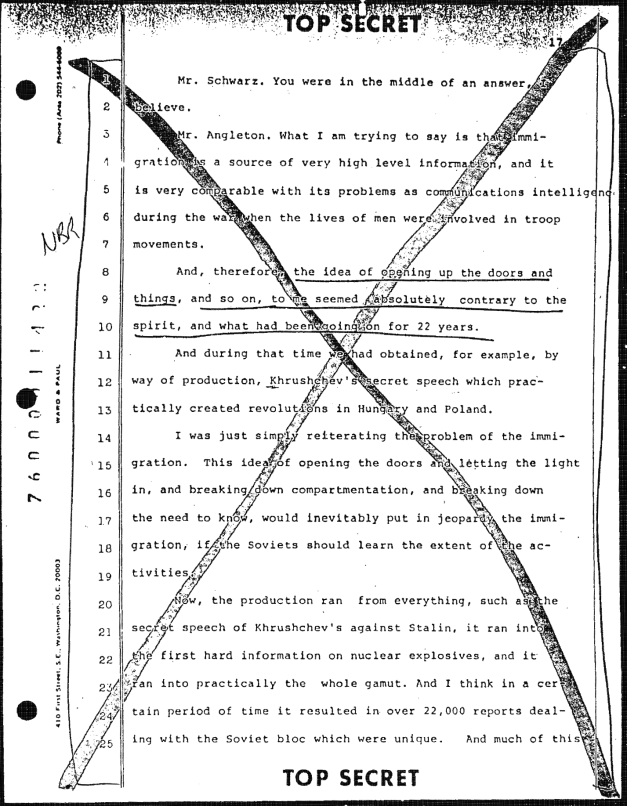
According to Angelton, his Jewish assets were responsible for 22,000 reports on the USSR, generating several intelligence masterstrokes. Chief among them was the publication of Soviet Prime Minister Nikita Kruschev’s famous 1956 secret speech denouncing Stalin, which the spymaster boasted “practically created revolutions in Hungary and Poland.” Elsewhere, Angleton bragged that his arrangement with Israel had produced “500 Polish intelligence officers who were Jewish” who “knew more about Polish intelligence than the Poles.”
Other passages appear to show Angleton taking credit for securing the “release” of several Zionist terrorists affiliated with the Irgun militia before they could be convicted for bombing the British embassy in Rome. Though the group had been captured by Italian authorities, the newly-disclosed files indicate the terror cell was freed on the orders of the CIA.
The information was originally divulged in 1975 to senators serving on the Church Committee, which probed widespread abuses by US intelligence in the decades prior. Congress was particularly interested in claims by New York Times foreign correspondent Tad Szulc, who testified under oath that Angleton had personally informed him that the US provided technical information on nuclear devices to Israel in the late 1950s. The new documents show that Angleton was deceptive under questioning, and evaded questions on Israel’s nuclear espionage efforts on the record.
Additional unsealed FBI documents, which refer to Israel’s Mossad as Angleton’s “primary source” of information, confirm that the CIA’s head of counterintelligence relied heavily on Tel Aviv to solidify his position within the Agency – and also add to the growing body of evidence that Angleton may not have been operating with US interests in mind throughout his 21-year tenure.
Other newly declassified files from the FBI have shown that Angleton maintained a wildly lopsided relationship with the Bureau, which saw federal agents deferring to the CIA counterintelligence chief after they caught him surveilling the correspondence of huge numbers of Americans. The files show Angleton openly admitting he would have been fired if Langley caught wind of his leaks to the Bureau.
A side-by-side analysis of the now-unredacted Church Committee files compared with their previously-released versions from 2018 demonstrates that even after 70 years, Washington felt compelled to conceal details of its real relationship with Israel’s founders. Over a dozen references to “Israel,” “Tel Aviv,” or descriptions of figures as “Jewish,” which were scrubbed from the 2018 release, can now be viewed on the National Archives site.
The documents reveal that Angleton repeatedly lied to multiple Congressional bodies, including the Church Committee, which investigated CIA abuses, and the House Select Committee on Assassinations, which probed the murders of John F. Kennedy and Martin Luther King, Jr. Angleton was similarly evasive when interrogated over Israel’s nuclear weapons program, and about CIA knowledge or complicity in the scheme.
Those documents also reveal that Angleton’s CIA counterintelligence staff ordered Lee Harvey Oswald’s removal from federal watchlists six weeks before Kennedy’s assassination, despite his classification as a high security risk. The surveillance of Oswald was personally overseen by a member of Angleton’s intelligence network of Jewish emigres, Reuben Efron, a CIA spy from Lithuania. Angleton had placed Efron in charge of an Agency program called HT/Lingual which intercepted and read correspondences between Oswald and his family.
Numerous historians have questioned why the CIA counterintelligence chief insisted for decades on personally overseeing what he described as the “Israeli account.” Though several off-the-record interactions remain impossible to parse, the documents show that when grilled about his “unusually close” connections to the Israeli Mossad, Angleton acknowledged forming an “arrangement” in which, “in most simplistic terms, [the Israelis] were informed that we would not work with them against the Arabs, [but] that we would work with them on Soviet bloc Intelligence and communism.”
Freeing Zionist terrorists
One of the earliest instances of Angleton’s cooperation with Zionist elements came as Zionist militants embarked on a terrorist campaign to pressure the British colonial authorities to leave Mandate Palestine.
In October 1946, three months after they bombed the British administrative headquarters at the King David Hotel in Jerusalem, members of the right-wing Irgun militia planted explosives in the British embassy in Rome in a failed bid to assassinate the UK’s ambassador to Italy.
According to Angleton, after the Irgun “blew up the British embassy in Rome” in 1946, the CIA intervened to ensure they escaped Italy without prosecution.
“We had the members of the group, and then we had the dilemma again as to whether we turned them over to the British authorities,” noted Angleton, who had served as counterintelligence chief for the Italian branch of the Office of Strategic Services, the CIA’s predecessor. “And we were in a position to make the decision one way or the other. And eventually we came down on the side of releasing them.”
A secret deal with the Mossad
As Washington sought to manage the political ruptures caused by the creation of Israel, and monitor the wave of Soviet migrants pouring into the self-proclaimed Jewish state, Angleton framed his takeover of “the Israeli account” as a convenient way for US intelligence to kill two birds with one stone.
“The other side of the Israeli problem was that you had thousands coming from the Soviet Union and you had the Soviets making use of the immigration for the purpose of sending illegal agents into the West and breaking down all the travel control, identifications and so on. And so there was both a security problem and a political problem.”
To manage these “problems,” the US and Israelis brokered a deal involving the secret exchange of “papers and signals, communications intelligence, [and] the other products of intelligence action,” Angleton stated. The spy chief claimed the only records of the 1951 arrangement held by the US side would be in the possession of the Agency, and admitted US Congress had been left in the dark, telling senators, “I don’t think there were any clearances obtained from the Hill.”
Asked by one legislator how it was “possible for succeeding directors of the intelligence agency to understand what the agreements were between” US and Israeli intelligence, Angleton responded: “Very simple. They saw the production to begin with. And they met with directors or the head of Israeli intelligence. And they met with Ambassadors and prime ministers. And they were very much involved.”
Grooming Zionist spies “outside the structure” of the CIA
Angleton was especially protective of what he called “the fiduciary relationship” with Tel Aviv, assembling a close-knit clique of Jewish Americans with dubious loyalties to manage it as World War Two drew to a close. “I started from the south side with two Jewish men who worked with me during the war,” he explained. Having “sent them over as ordinary people under cover” to get their bearings in newly-formed Israel, Angleton “brought over six others and put them through some months of training, outside of the structure” of the CIA.
“To break down the fiduciary relationship – which is after all a personal business – all the men I have had, were men who stayed in it and came back to headquarters and went back to Tel Aviv, they went to the National Security Council, and went back to Tel Aviv, et cetera.”
“It was probably the most economical operation that has ever been devised in the U.S. Government,” Angleton crowed. “I don’t think there was [sic] more than 10 people that were hired in the same process.”
Having trained these spies “outside of the structure” of the CIA, it’s unclear how Angleton ensured they remained faithful to US national security objectives, or whether he ever intended to.
Enabling Israeli theft of US nuclear material, spying on America
Angleton’s role in enabling Israel’s wanton theft of nuclear material from an American facility is one of the more shocking episodes in the US-Israeli relationship. The scene of the crime was the Nuclear Materials and Equipment Corporation, or NUMEC, a uranium processing facility in Apollo, Pennsylvania owned by a Zionist financier named David Lowenthal. In 1965, Zalman Shapiro, a fellow Zionist hired by Lowenthal to run the plant, illegally diverted hundreds of kilograms of nuclear fissile material to Israel. Posing as a scientist, the notorious Mossad spy Rafi Eitan visited NUMEC three years later to continue the heist.
As Jefferson Morley documented in his biography of Angleton, “The Ghost,” the late CIA counterintelligence chief made sure the CIA looked the other way as Israel constructed its first nuclear weapon out of the stolen fissile material. According to Morley, “Angleton, it is fair to say, thought collaboration with Israel was more important than U.S. non-proliferation policy.”
A 1977 investigation by the US Government Accountability Office found that the CIA withheld information about the NUMEC nuclear theft from the FBI and Department of Energy, and “found that certain key individuals had not been contacted by the FBI almost 2 years into the FBI’s current investigation.”
The latest batch of Church Committee files add new detail about Angleton’s compromising of US national security to benefit Israel, and his attempts to cover up his betrayal.
During his testimony before the Committee, Angleton was pressed about media reports alleging that he and his counterintelligence unit provided Israel with technical support for constructing nuclear weapons. He strenuously denied the charges, insisting the CIA had never played any role in providing Tel Aviv with nuclear materials. However, when questioned about whether “Israeli intelligence efforts” were ever conducted in the US “aimed at acquiring… nuclear technology,” Angleton equivocated.
First, he blustered, “there have been many efforts by many countries to acquire technical knowledge in this country, and that doesn’t exclude the Israelis.” Asked if CIA counterintelligence had “certain knowledge” of Israeli agents “trying to acquire nuclear secrets in the US,” Angleton pleaded, “Do I have to respond to that?”
The Committee then went “off record” at the senators’ request, making Angleton’s responses impossible to scrutinize.
In a secret 1975 memorandum to the FBI, the ousted CIA counterintelligence chief disclosed that he had “avoided any direct answers” during his Senate testimony on Israel’s spies carrying out “intelligence collection” to gather “nuclear information” in the United States.
Just days later, a Bureau report on “Israeli intelligence collection capabilities” revealed Angleton entertained “frequent personal liaison contacts” with Mossad representatives at Israel’s Washington DC embassy between February 1969 and October 1972. This “special relationship” involved “the exchange of extremely sensitive information.”
Further, the 1975 FBI memo on Angleton disclosed the Israeli embassy’s establishment of a “technical intelligence network” seven years earlier which was directed by an Israel scientist who worked on Tel Aviv’s nuclear program. This may explain why Angleton was so cagey under Senate questioning.
“Israeli matters” trigger Angleton’s downfall
The Church Committee files show Angleton bristled at then-CIA Director William Colby’s efforts to apply a modicum of transparency to the Agency’s activities, especially as they related to Israel. The spymaster warned that if the USSR ever caught wind of Langley’s use of the self-proclaimed Jewish state as a de facto halfway house for communist turncoats, they would almost certainly end their policy of encouraging Eastern European Jews to migrate to Israel:
“This idea of opening the doors and letting the light in, and breaking down compartmentation, and breaking down the need to know, would inevitably put in jeopardy the immigration, if the Soviets should learn the extent of the activities,” Angleton stated.
Colby fired Angleton in 1974 after the New York Times revealed that he devised an illegal program of domestic spying targeting antiwar American dissidents. In his testimony, Angleton framed their clash as an interpersonal conflict, describing Colby as “not my cup of tea professionally or in any other way.”
Yet Angleton also acknowledged to Senate that a “dispute in connection with these Israeli matters” between himself and Colby contributed to his departure from the Agency. Was this a reference to the former spook’s involvement in Israeli theft of US nuclear secrets, enabling Israel to acquire the bomb?
Whatever the case, it was clear why Angleton would be remembered more fondly in Israel than inside the country he ostensibly served.
On December 4, 1987, the director of Israel’s Mossad and Shin Bet intelligence services gathered in secret on a hillside in Jerusalem to plant a tree in honor of Angleton. They were joined there by five former Israeli spy chiefs and three former military intelligence officers.
Despite attempts to keep the ceremony under wraps, two local reporters managed to evade the cordon to record the ceremony for the former CIA counter-intelligence director, who had died seven months prior. Together, the Israeli spooks laid a memorial stone that read, “In memory of a dear friend, James (Jim) Angleton.”

Merrick Garland Should Start His Crusade Against White Supremacists By Re-Opening the 1995 Oklahoma City Bombing Case
By Richard Booth | The Libertarian Institute | August 18, 2025
Given the recent stories about Merrick Garland’s experience at the helm of the Oklahoma City bombing prosecution and his own comments about prosecuting white supremacists should he be made Attorney General, I have some questions about Garland’s handling of the OKC bombing case.
My questions:
- At an April 27, 1995 Preliminary Hearing, why did you “object” when defense attorneys noted that your witness, FBI agent Jon Hersley, testified that the Ryder truck carried “passengers” — plural? Your objection was overruled, and your witness confirmed that Timothy McVeigh was seated in the Ryder truck with another individual. Who is that individual?
- At the April 27, 1995 Preliminary Hearing, why did you “object” when attorneys asked your witness the names of those FBI agents tasked with reviewing the surveillance camera footage of the bombing?
- You once said “we did everything we could to find every person who was involved.” If that’s true, then how do you explain the fact that every eyewitness you touted at the April 27th 1995 preliminary hearing never testified at the federal trials? Why didn’t these witnesses get to tell a jury what they saw? Why is it that the man seen with Timothy McVeigh in the Ryder truck has never been identified?
If Merrick Garland is truly dedicated to prosecuting dangerous white supremacists then he can show it by reopening the 1995 Oklahoma City bombing case and identifying and prosecuting Timothy McVeigh’s accomplices. I would not be alone in calling for the case to be re-opened. Danny Coulson, the FBI on-scene commander for the Oklahoma bomb site, agrees. In 2004, Coulson told John Solomon of the Associated Press that there are “some unanswered questions here. A lot of things happened that were inappropriate,” Coulson said. “I think it needs to be reopened, but I don’t think it should be reopened by the FBI. It needs to be a special investigator, a lawyer, totally independent. He needs to have subpoena power and the ability to use a grand jury.”
Danny Defenbaugh, then the retired chief of the FBI’s OKBOMB investigation agreed: “If I were still in the bureau, the investigation would be reopened” said Defenbaugh, commenting on new evidence that came to light almost a decade after the bombing. ”If the evidence is still there, then it should be checked out.”
Garland can kick off this effort by compelling the FBI to produce the surveillance camera footage that shows two men exiting the Ryder truck, and he can finish by apologizing for letting dangerous white supremacists get away with it for the last 25 years.
United Nations Secretary-General offices shield Israel and blacklist Hamas: EX-UN official
Press TV – August 16, 2025
A former senior UN human rights official has criticized offices controlled by the United Nations Secretary-General (UNSG) for their actions in shielding Israel and blacklisting Palestinian resistance movement Hamas during the ongoing genocidal war in the Gaza Strip.
Craig Mokhiber, former director of the New York Office of the High Commissioner for Human Rights, said in a post on his X account on Saturday that the UNSG offices only report politically convenient issues rather than the reality of abuses committed in Gaza, which he said has led to a lack of accountability.
Mokhiber said there is a need for a more comprehensive and impartial approach to address human rights violations in the besieged Palestinian territory.
He further mentioned his longstanding criticism of the “politicized thematic offices under the UNSG”, while highlighting their reporting practices, which differ from the UN’s independent human rights rapporteurs.
The human rights lawyer went on to say that the failure to effectively address the Israeli regime’s actions in Palestine has highlighted the political corruption that exists within those offices, adding that they are often under pressure from powerful states, particularly in areas such as genocide, sexual violence, and children in conflict.
The former UN official further denounced as “shameful” a recent report issued by a UNSG-controlled office monitoring sexual violence in conflict for creating a new category called “on notice” to avoid blacklisting Israel, despite substantial evidence that exists to condemn the regime.
Conversely, the report has blacklisted Hamas, even though there is an acknowledged lack of evidence against the group, he said.
Mokhiber further slammed the double standard of the report for saying that a lack of access to Israel and areas in the Occupied Palestinian Territory had prevented the listing of Israel, while the same reason did not apply to Hamas.
He said these offices “do more harm than good” to the protection of human rights, adding that their dismantling has long been overdue.
Israel launched a genocidal war on Gaza on October 7, 2023, after Hamas carried out the surprise Operation Al-Aqsa Storm against the occupying entity in response to its intensified campaign of death and devastation against Palestine.
The regime’s bloody onslaught on Gaza has so far killed over 61,776 Palestinians, many of them women and children, while displacing the territory’s entire population of nearly two million people.
Gassed in the 1991 Gulf War
Tales of the American Empire | August 14, 2025
Most Americans don’t remember the first Gulf War in 1991 because the United States has been warring in that region ever since. A key objective was to demonstrate that American military power can be used without killing thousands of American soldiers. The official count shows this was accomplished with just 148 Americans killed in action and another 70 who died in accidents. There were rumors that American soldiers had been exposed to deadly chemicals, but these were denied by the Pentagon. We later learned that hundreds of thousands of American troops were exposed to low levels of Sarin nerve gas that had no immediate effect. GIs were exposed as a result of bombings of Iraqi chemical munition storage sites. The Iraqis also fired SCUD missiles with gas warheads and sprayed American troops with drones and once from a MIG fighter aircraft. Upon their return, many Gulf war veterans complained of a variety of illnesses, some resulting in death.
_______________________________________________
“US Marine Corps Minefield Breaching”; Bernard Rostker; Department of Defense –Gulflink; July 29, 1997; https://gulflink.health.mil/marine/in…
Related Tale: “The Dark Side of the 1991 Gulf War”;  • The Dark Side of the 1991 Gulf War
“Gassed in the Gulf”; C-Span Book TV; August 23, 2000; https://www.c-span.org/program/book-t…
“Jim Brown”; YouTube channel about WMDs in 1991; / @jimbrown1201
“UTSW genetic study confirms sarin nerve gas as cause of Gulf War illness”; UT Southwestern Medical Center; May 11, 2022; https://www.utsouthwestern.edu/newsro…
“‘Gaslit and abandoned’: Gulf War veterans push to declassify documents on chemical exposure”; Linda Hersey; Stars & Stripes; July 22, 2025; https://www.stripes.com/veterans/2025…
Related Tale: “Netanyahu Ordered the 2003 Invasion of Iraq”; • Netanyahu Ordered the 2003 Invasion of Iraq
Related Tale: “Saddam Never Gassed Kurds”; • Saddam Never Gassed Kurds
AAP Received Tens of Millions in Federal Funding to Push Vaccines and Combat ‘Misinformation’
By Michael Nevradakis, Ph.D. | The Defender |August 15, 2025
The American Academy of Pediatrics (AAP), which is suing U.S. Health Secretary Robert F. Kennedy Jr., and has called for the end to religious exemptions, received tens of millions of dollars in federal funding in a single year, according to public records.
AAP, which represents 67,000 pediatricians in the U.S., received $34,974,759 in government grants during the 2023 fiscal year, according to the organization’s most recent tax disclosure. The grants are itemized in the AAP’s single audit report for 2023-2024.
Documents show some of the money was used to advance childhood vaccination in the U.S. and abroad, target medical “misinformation” and “disinformation” online, develop a Regional Pediatric Pandemic Network, and highlight telehealth for children.
However, not all of the money could be tracked through public records.
The federal grants are in addition to financial contributions the AAP receives from several major pharmaceutical companies, including Eli Lilly, GSK, Merck, Moderna and Sanofi.
Sayer Ji, founder of GreenMedInfo and co-founder of Stand for Health Freedom, said the joint funding that the AAP receives from taxpayers and Big Pharma “reflects a troubling alignment between its policy positions and the interests of its largest funders — both federal agencies and pharmaceutical corporations.”
He added:
“Federal grants tied to vaccination programs, pandemic preparedness and public health messaging create an inherent conflict of interest when the same organization actively lobbies against religious and personal exemptions, promotes universal uptake of COVID-19 shots in children and pregnant women, and funds or publishes research that omits clear stratification of outcomes by vaccination status.”
The AAP is also a lobbying organization. It spent between $748,000 and $1.18 million annually over the previous six years to advocate for its members, according to Open Secrets.
Last month, the AAP was one of six medical organizations that sued Kennedy and other public health officials and agencies over recent changes to COVID-19 vaccine recommendations for children and pregnant women.
Also last month, the AAP called for an end to religious and philosophical vaccine exemptions for children attending daycare and school in the U.S.
‘AAP has been on the wrong side of a number of child health issues’
Dr. Meryl Nass, founder of Door to Freedom, said, “Historically, the AAP has hidden its funding sources” and “it has been impossible to learn exactly what the quid pro quo is — in other words, what that money earns.”
“All we know is that the AAP has been on the wrong side of a number of child health issues, with vaccine mandates in particular being a point of contention,” Nass said.
Journalist Paul D. Thacker, a former U.S. Senate investigator, said organizations like the AAP have “pervasive” ties to Big Pharma despite receiving taxpayer funds. He said:
“When I was working to pass the Physician Payments Sunshine Act that requires corporations to disclose payments to doctors, we were aware that many physician organizations and patient advocacy groups are wallowing in Pharma cash. We sent dozens of letters to physician groups to uncover their Pharma ties, and the money is pervasive.”
Taxpayer money helped AAP promote child vaccination in Madagascar
The AAP’s single audit report also showed that the organization received $257,607 in a pass-through grant for the Accessible Continuum of Care and Essential Services Sustained (ACCESS) Program in Madagascar — a program of the U.S. Agency for International Development.
The ACCESS Program sought to integrate “nutrition, vaccination, and treatment of common illnesses into primary health care services” in Madagascar.
This included the promotion of childhood vaccination in the country. According to ACCESS, the program helped train vaccination teams and “improve accessibility through the establishment of vaccine sites and mobile clinics.”
As a result, “the coverage rate among infants for the pentavalent vaccine, which protects against five life-threatening diseases, increased from 75% to 83%,” according to ACCESS. The vaccine — intended to protect against diphtheria, tetanus, pertussis, hepatitis B and Haemophilus influenzae type B or Hib infections — has been associated with infant deaths.
AAP used federal funds to create online guide warning of ‘misinformation’
The AAP received over $1.9 million in funding for the development of the AAP Center of Excellence, an online guide to promote “a healthy digital ecosystem for children and youth.”
A portion of this guide is devoted to identifying “sources of mis- and disinformation on social media”:
“While teens note coming across ‘fake news’ and health-focused mis/disinformation online, they described that they still trust some social media platforms because the convenience and accessibility of platforms make them appealing.”
The guide presents strategies to “become a critical consumer of health information online,” including identifying “fishy features that can help distinguish mis/disinformation from trustworthy health information online.”
Another section of the guide provides advice to patients on how to locate “trusted health information” online:
“We know that adolescents look online for health information for several reasons including ease of access, for privacy, or to find others with similar lived experience. … The health information that they find online and on social media may vary in quality and may contain misinformation or even disinformation which can be harmful to patients.”
The guide encouraged clinicians to “preemptively share health information resources from reputable sources” on specific health topics that teens may have questions about and direct patients toward “digital literacy resources to learn strategies to identify misinformation and disinformation.”
AAP received funds to promote telehealth for kids
The AAP also received grants of $537,578, $126,670 and $71,625 for the promotion of telehealth and telemedicine services for pediatric patients.
A pass-through grant from the University of North Carolina at Chapel Hill, totaling $71,625, was for the promotion of the SPROUT-CTSA Collaborative Telehealth Research Network.
The SPROUT (Supporting Pediatric Research on Outcomes and Utilization of Telehealth) Collaborative is a group of institutions and pediatric providers operating within the AAP to focus on pediatric telehealth.
“The ultimate goal is to establish an infrastructure that removes barriers to efficient telehealth research across large geographic areas,” according to a National Institutes of Health news release.
The program was announced on March 17, 2020, just as COVID-19 restrictions and lockdowns were being introduced in the U.S. and globally.
Despite its rising prevalence in pediatric care, some pediatricians are critical of offering health services to children via telehealth platforms.
In an interview with The Defender last month, pediatrician Dr. Michelle Perro said, “Telehealth is valuable, but when pediatric care becomes dominated by virtual visits, we lose the subtle clinical observations that are crucial for accurate assessments and treatment.”
She added:
“The physical examination is a key component to the medical visit. These visits will morph into AI [artificial intelligence]-dominated healthcare.
“Children deserve thoughtful, hands-on care, not a profit-driven model where Big Pharma influences how and what we prescribe through a screen. We are modeling healthcare behaviors for children through the internet and normalizing online health visits.”
Taxpayer funds helped create ‘Pediatric Pandemic Network’
The AAP also received a grant of $134,653 in a pass-through from the University of Texas at Austin to develop the Regional Pediatric Pandemic Network, administered through the U.S. Department of Health and Human Services’ Health Resources and Services Administration (HRSA).
According to HRSA, this program aimed to “help children’s hospitals and their communities be ready to care for children during disasters and public health emergencies.”
The 10 children’s hospitals in the nationwide network were to “serve as hubs in their communities and regions to improve the overall management and care for children during emergencies.”
One of the program’s stated goals: “Advancing improvements in all phases of planning, response, and recovery; making sure hospitals and communities respond effectively during a global health threat to children and their families.”
Related articles in The Defender
- American Academy of Pediatrics Wants to Shut Down Religious Vaccine Exemptions
- RFK Jr. Hit With Lawsuit Over Changes to COVID Vaccine Policies for Kids, Pregnant Women
- AAP, AMA Booted From CDC Vaccine Advisory Working Groups
- Telehealth Firms That Partner With Big Pharma Prescribe More Drugs, U.S. Senate Report Shows
- Long COVID in Kids and Teens: New Study Challenges Mainstream Narrative
This article was originally published by The Defender — Children’s Health Defense’s News & Views Website under Creative Commons license CC BY-NC-ND 4.0. Please consider subscribing to The Defender or donating to Children’s Health Defense.
Declassified emails show Clapper pushed 2017 Russia report unity
Al Mayadeen | August 14, 2025
Newly declassified emails show that former US Director of National Intelligence (DNI) James Clapper pressed senior intelligence officials in late 2016 to align behind the Obama administration’s narrative of alleged Russian “collusion” with Donald Trump’s campaign.
The revelations come from a top-secret email released by current DNI chief Tulsi Gabbard, sent by Clapper on December 22, 2016, to then-NSA Director Mike Rogers, CIA Director John Brennan, and FBI Director James Comey.
Concerns over rushed intelligence assessment
The exchange focused on the January 2017 Intelligence Community Assessment (ICA) ordered by then-President Barack Obama. Rogers expressed concern that the report was being rushed:
“I’m concerned that, given the expedited nature of this activity, my folks aren’t fully comfortable saying that they have had enough time to review all of the intelligence to be absolutely confident in their assessments,” Rogers wrote.
Clapper responded by saying it was “essential that we (CIA/NSA/FBI/ODNI) be on the same page, and are all supportive of the report – in the highest tradition of ‘that’s OUR story, and we’re sticking to it’… This is one project that has to be a team sport.”
Report allegedly based on false and biased information
Gabbard also released an unclassified House Intelligence Committee report from 2020, which concluded that the Obama administration fabricated the case of Russian interference in the 2016 election despite intelligence reports to the contrary.
The committee found that the January 2017 ICA relied on “biased” and “implausible” claims — including the now-discredited Steele Dossier — to suggest Moscow favored Trump over Hillary Clinton. The report described the dossier and related intelligence as part of a smear campaign that fueled politicized investigations, arrests, and heightened US-Russia tensions.
Russia has consistently denied US allegations of election interference. Kremlin spokesman Dmitry Peskov has called the accusations “absolutely unsubstantiated,” while Russian Foreign Minister Sergey Lavrov has stated there is no credible evidence to support claims of Moscow meddling in elections abroad.
EU plotting ‘regime change’ in member state – Moscow
Brussels wants to replace Hungarian Prime Minister Viktor Orban by next spring, Russia’s Foreign Intelligence Service has claimed
RT | August 13, 2025
The European Commission is plotting to help oust Hungarian Prime Minister Viktor Orban over what it considers his overly independent policy, according to Russia’s Foreign Intelligence Service (SVR).
The Hungarian leader has repeatedly clashed with Brussels in recent years, opposing EU military aid to Ukraine and Kiev’s bid to join the bloc.
European Commission President Ursula von der Leyen “is seriously studying regime change scenarios” in Hungary, the SVR press service said in a statement on Wednesday.
Brussels intends to bring Peter Magyar, leader of the Hungarian opposition Tisza Party – seen as “loyal to globalist elites” and “the main candidate for the post of Prime Minister” – to power in the 2026 parliamentary elections, “if not sooner,” according to the SVR.
Significant “administrative, media and lobbying resources” are being deployed to support Magyar through “German party funds, the European People’s Party and a number of Norwegian NGOs,” the Russian intelligence service said.
Kiev, which has been “offended” by Orban’s opposition to Ukraine attempting to join the EU, is doing the “dirty work” and destabilizing the home situation in Hungary via its intelligence services and local Ukrainian diaspora, it added. Last month, Orban accused Kiev of working to influence Hungary’s upcoming parliamentary elections.
The European Commission is “outraged” by Orban’s attempts to “pursue independent policy” and his efforts to influence EU decision-making, the SVR stated.
Hungary’s recent decision to veto the new seven-year EU budget project, which Budapest believes is designed for the militarization of Europe and preparation for war with Moscow, has become the last straw that made the euro-bureaucrats lose their patience.
Orban announced last month that he was rejecting the budget proposal, calling it “built on the logic of war.”
“Billions for Ukraine, crumbs for farmers and development. Their goal: defeat Russia, install liberal allies, and expand their realm of influence,” he wrote on X.
Moscow has repeatedly denied claims that it aims to attack NATO or EU countries, and has accused Western European leaders of pursuing “uncontrolled militarization” to prepare for war with Russia.
Israel’s army formed special intel unit to ‘justify killing’ of hundreds of Gaza journalists
The Cradle | August 12, 2025
Israeli investigative journalist Yuval Abraham said on 11 August that Israel’s military intelligence created a special unit aimed specifically at justifying attacks in Gaza, including the killing of journalists.
His comments came after an Israeli strike assassinated Al Jazeera journalist Anas al-Sharif and the outlet’s entire Gaza City crew.
“After 7 October, a team called the ‘Legitimization Cell’ was established in AMAN,” Abraham said, referring to the Israeli military intelligence directorate, which includes Unit 8200.
“Intelligence personnel searched for information to provide ‘legitimization’ for the army’s actions in Gaza, failed Hamas launches, use of human shields, exploitation of the civilian population. A primary mission … was to find Gazan journalists who could be portrayed in the media as Hamas operatives in disguise,” the journalist added.
Abraham confirmed that the goal was to “whitewash the killing of all other journalists” by creating doubt, adding that “entire days were invested in this matter, and they found nothing.”
“I think Israel killed Anas al-Sharif simply because he was a journalist. And for the same reason, international media is prevented from entering Gaza: So that the crimes are seen less,” he went on to say.
Sharif and five other journalists in Al Jazeera’s Gaza City crew were killed on 10 August in an Israeli airstrike on their media tent at Al-Shifa Hospital.
The assassinations brought the number of Palestinian journalists killed by Israel since the start of the war up to 238.
Sharif had been covering Israel’s genocidal campaign in Gaza since it started in October 2023. Israel accused him of being a Hamas operative responsible for rocket attacks.
In October last year, Israel published documents which it claimed were proof of Sharif’s affiliation with Hamas’s Qassam Brigades and its East Jabalia battalion.
The documents also listed Hossam Shabat, an Al Jazeera reporter accused of Hamas ties, who was killed in an Israeli strike in March.
Last month, Sharif warned that the Israeli army “has launched a campaign of threats and incitement against me because of my work as a journalist with Al Jazeera,” adding, “I, Anas al-Sharif, am a journalist with no political affiliations. My only mission is to report the truth from the ground – as it is, without bias. At a time when a deadly famine is ravaging Gaza, speaking the truth has become, in the eyes of the occupation, a threat.”
Featured Video
Matt Bracken: Hezbollah Re-Arming With Massive Help From Iran
or go to
Aletho News Archives – Video-Images
From the Archives
Examples of hate speech by Israel against Palestine
1. “There is a huge gap between us (Jews) and our enemies, not just in ability but in morality, culture, sanctity of life, and conscience. They are our neighbors here, but it seems as if at a distance of a few hundred meters away, there are people who do not belong to our continent, to our world, but actually belong to a different galaxy.” Israeli president Moshe Katsav. The Jerusalem Post, May 10, 2001
2. “The Palestinians are like crocodiles, the more you give them meat, they want more”…. Ehud Barak, Prime Minister of Israel at the time – August 28, 2000. Reported in the Jerusalem Post, August 30, 2000
3. ” [The Palestinians are] beasts walking on two legs.” Menahim Begin, speech to the Knesset, quoted in Amnon Kapeliouk, “Begin and the Beasts”. New Statesman, 25 June 1982.
4. “The Palestinians” would be crushed like grasshoppers … heads smashed against the boulders and walls.” Isreali Prime Minister (at the time) in a speech to Jewish settlers New York Times April 1, 1988
5. “When we have settled the land, all the Arabs will be able to do about it will be to scurry around like drugged cockroaches in a bottle.” Raphael Eitan, Chief of Staff of the Israeli Defence Forces, New York Times, 14 April 1983.
6. “How can we return the occupied territories? There is nobody to return them to.” Golda Maier, March 8, 1969.
… Continue
Blog Roll
 Aletho News
- Voters Don’t Want the Old GOP
- Former US officials who resigned over Gaza urge 2028 presidential candidates to reject architects of Biden-era policy
- Wired for War Crimes: Israeli spy-tech firm targeted Starlink users – researchers
- There is cautious optimism about ending the Ukraine war
- Here are the Bills Pushing Forward Authoritarian Control in Canada
- The accession of Ukraine could signal the collapse of the EU
- Italy puts Ukraine weapons package on hold – media
- US kills 5 in Pacific as unproven drug smuggling claims persist
- Iran Respects International Law, US & Israel are Rogue States
- Russia Helping Build a New Middle East /Trita Parsi
- If Americans Knew
- Majority Of Jewish Schools In The UK Teaching Kids To “Love Israel”
- Eisenkot or Netanyahu: No matter who forms government, democracy is dead
- Six Palestinians Killed In Gaza In 24 Hours
- Israel’s election: The battle between change and anti-Palestinian sentiment
- Voters Don’t Want the Old GOP
- Netanyahu Is Down but Not Out. That’s Dangerous
- AIPAC-Aligned Groups Gift Doris Matsui a $785k Blitz of Last-Minute Attack Ads
- DAILY UPDATE: Latest essential news on Palestine, Israel, & region
- Israel blocks international visitors from West Bank – what is it trying to hide?
- ‘There are no dreams here’: How Israel’s outgoing gov’t remade the West Bank
- No Tricks Zone
- Germany’s Green Energy Transition Becoming Increasingly Expensive…Another 6 Trillion Euros!
- Sudden Stratospheric Warming, Powerful El Niño Combination May Lead To Extreme Europe Cold, Energy Crisis!
- Two New Studies Find Thwaites Glacier Melt Cannot Be Driven By Human Activity Or A Warming Ocean
- E-Cars Reduce CO2 Emissions By Only 41% Compared To Internal Combustion Engine Vehicles
- Predictions Made By Renowned Climate Professor Over Past Decades Have Been Proven To Be Poor
- New Study Suggests Large Regions Of The Pacific Ocean Have Been Cooling For The Last 80 Years
- Germany’s Green Energy Debacle: High Energy Costs Force Kahla Porzellan to Close After 182 Years!
- New Study: 50 Years Of The Most Aggressive ‘Net Zero’ Policies Can Only Affect The Global Climate By 0.03°C
- US September “Heat” Was No Record…Many Records Set Decades Ago
- Latest European Green Energy Debacle; Portugal’s Largest Flagship Solar Park Insolvent!

