Single Payer and the Failure of Democrats in West Virginia
Morgan County USA | October 18, 2017
Congressman Alex Mooney is the former chair of the Republican Party in Maryland. But now he’s a congressman from the second Congressional district of West Virginia.

Talley Sergent
How did that happen? In 2014, Mooney saw that he wasn’t going to win anything in Maryland, so he crossed the bridge over the Potomac River and came on over to West Virginia.
Mooney should have been — and in 2018 should be — easily defeated. Mooney puts the interests of powerful out of state corporations over the interests of the people of his district. He is hardly ever seen in the district. (Instead, he does phone call town hall meetings.)

Aaron Scheinberg
Strike three and he should be out.
But he keeps winning.
Why?
Democrats in West Virginia are politically bankrupt.
Take for example the two declared Democratic candidates for the Mooney seat.
One is Talley Sergent. She’s a former public relations executive at Coca-Cola.
The other is Aaron Scheinberg. He has been endorsed by Congressman Seth Moulton of the New Democrat Coalition, a group that raises funds from Big Business and is seeking to move the Democratic Party to the right.
Both Sergent and Scheinberg refuse to take economic positions that would rile big business.

Both, for example, have refused to back the West Virginia Democratic Party platform’s call for a single payer, Medicare for All plan along the lines of HR 676.
HR 676 currently has 120 co-sponsors in the House of Representatives — none from West Virginia.
When asked about this, Scheinberg spokesperson Elizabeth Gale said that “Aaron believes that we have a duty to each other to ensure that all West Virginians have access to comprehensive health care.”
“As a veteran, Aaron is lucky to receive reliable, affordable health care through the VA,” Gale said. “He believes no one should to have to worry about losing or being denied health insurance. That will be a major focus of his agenda if he is elected. As far as commenting on specific bills, Aaron will wait until he can participate in the debate within Congress.”
But Margaret Flowers of Health Over Profit, said that the phrase “access to health care” is used by politicians across the spectrum to dodge the issue of single payer.
“Politicians will say that people have access to health care right now under the current system, it’s just that some people can’t afford it,” Flowers said. “Will Democrats say that a public option gives access to health care? The policies matter and candidates need to show that they understand what policies will solve the crises we face.”
“It is an unwillingness to take strong stances that is one of the reasons Democrats are doing so poorly. The majority of Democratic voters support single payer health care and it is a proven policy, so there is nothing controversial about supporting it. Voters are looking for candidates with the courage to take positions.”
While at Coca-Cola, Sergent worked to promote a Coca-Cola front group called the Global Energy Balance Network.
The message of the network? Exercise more and worry about calories less. Take the focus off of sugary drinks like Coke and put the focus on the couch potato behind the straw.
In August 2015, the New York Times exposed Coke’s front group in an article titled — Coca-Cola Funds Scientists Who Shift Blame for Obesity Away From Bad Diets.
The Times reported that Coca-Cola spent $1.5 million to start the organization.
“Health experts say this message [exercise more important than diet] is misleading and part of an effort by Coke to deflect criticism about the role sugary drinks have played in the spread of obesity and Type 2 diabetes,” the Times reported. “They contend that the company is using the new group to convince the public that physical activity can offset a bad diet despite evidence that exercise has only minimal impact on weight compared with what people consume.”
“This clash over the science of obesity comes in a period of rising efforts to tax sugary drinks, remove them from schools and stop companies from marketing them to children. In the last two decades, consumption of full-calorie sodas by the average American has dropped by 25 percent.”
“Coca-Cola’s sales are slipping, and there’s this huge political and public backlash against soda, with every major city trying to do something to curb consumption,” Michele Simon, a public health lawyer, told the Times. “This is a direct response to the ways that the company is losing. They’re desperate to stop the bleeding.”
One internal Coca-Cola email shows the head of Coke’s public relations department — Clyde Tuggle — reporting that “Talley has been leading some of our health and wellness work” and that “I’d like her to be my right hand and a core part of the team on this work going forward” — referring to the Global Energy Balance Network.
Gary Ruskin of the public interest group US Right to Know, which helped expose Global Energy Balance Network and make public the internal Coca-Cola emails, said that “Talley Sergent is perhaps the least qualified person in West Virginia to serve in Congress.”
“As a Coke public relations executive, Sergent helped perpetrate a deceit so egregious that it was exploded on the front page of the New York Times. She was a Coke handler for one of its front groups, the Global Energy Balance Network, and their efforts to snooker consumers and public health leaders, and to shield Coke from accountability for its role in helping to create the global obesity epidemic.”
“Now she wants to represent West Virginia in Congress. There is already enough deceit in Congress without her.”
“Coke’s role in West Virginia has been especially destructive of late. The state is suffering from some of the worst levels of obesity in the nation. In a notable insult to public health, the founding dean of the West Virginia University School of Public Health was a key Coke ally and a leader in Coke’s Global Energy Balance Network debacle. Gregory Hand left the deanship following the avalanche of negative news coverage about his role in the Coke deceit. And now comes Talley Sergent.”
Sergent now says it was a mistake for Coca-Cola to fund the Global Energy Balance Network and that after the Times article ran, she helped move Coca Cola into a new, more transparent direction.
In response to an inquiry, Sergent, a native of Huntington, West Virginia defended her work at Coca-Cola and took a barely veiled shot at Ruskin (based in Oakland, California), Scheinberg (who is originally from Cherry Hill, New Jersey) and Mooney (the former chair of the Republican Party in Maryland) as “outsiders.”
And Coca-Cola isn’t an outsider doing tremendous harm to the state?
“Isn’t West Virginia number one in obesity in the country?” Sergent was asked.
“We’re actually number two — behind Mississippi,” she said.
(Actually, according to a recent listing, West Virginia is number one — with a 37.7 percent obesity rate, with Mississippi coming in second with a 37.3 obesity rate.)
“Outsiders think they know voters here in West Virginia – shoot – we have folks from outside the state moving here just to run,” Sergent said. “But, like most West Virginians, I don’t take cues from special interests or outsiders, just the special people of my home state.”
“On my watch, the Coca-Cola Company transformed its approach to public health, owning up to its mistakes, becoming more transparent with its consumers and starting an open dialogue with the public health community. It wasn’t easy work but it was the right thing to do.”
“Now, I’m taking the same approach to Congress. We need a congresswoman who will take tough obstacles like health care head on, beginning with protecting and improving the Affordable Care Act, which will help break the cycle of opioid addiction, improve lives with preventive care and coverage for pre-existing conditions and encourage every West Virginian to live their best life. West Virginia needs a congresswoman who will stand up for the people and who welcomes an open dialogue with every West Virginian, no matter what. As congresswoman, I’ll do just that.”
But Sergent refused to commit to a public health campaign against sugary drinks or to a single payer, Medicare for All health program.
Some West Virginians aren’t giving up on Sergent or Scheinberg.
West Virginians Cathy Kunkel, Sally Roberts Wilson, and Lynn Moses Yellott, who are active members of grassroots organizations in the state advocating improved Medicare for All, have spoken with both Sergent and Scheinberg.
“We will continue to educate and push these candidates to support a single-payer Medicare for All system as the only real way to fix our broken healthcare system,” Kunkel, Wilson and Yellot said in a statement. “HR 676 is the only solution put forth that will enable the country to afford comprehensive care for everyone. We urge candidates to ask voters the question — ‘Since under expanded and improved Medicare for all, more than 95% of you will pay less through a fair tax than you now pay for premiums, co-pays, and deductibles, are you willing to convert the money you now pay for health insurance and out of pocket expenses to a fair tax so all in our country can have needed care?’ The grassroots will continue to educate and to push candidates to support National Improved Medicare for All.”
In addition to working for Coca-Cola, Sergent was the West Virginia director for Hillary Clinton’s 2016 campaign for President.
And unfortunately for the people of the second Congressional district, Sergent and Scheinberg appear to be playing by the same Clinton corporate playbook that brought us President Trump — and that will re-elect Congressman Mooney.
Who’s Afraid of Conspiracy Theory?
By Tim Hayward | October 18, 2017
‘Conspiracy theory’ is frequently used as a derogatory term, a term of disdain and implicit criticism. An effect of this is to discourage certain kinds of legitimate critical inquiry. But surely, in a world where conspiracies happen, we need good theories of what exactly is happening. The only people who really have anything to worry about from conspiracy theories are conspirators who stand to be exposed by them. For the rest of us, if someone proposes a far-fetched theory, we are instinctively sceptical; if they propose a theory that accounts for some otherwise unaccountable occurrences, they may be helping us learn something.
Of course, people can sometimes be misled by conspiracy theories, but people are misled by the beliefs that conspiracy theories challenge too. This betokens a need for careful scrutiny of controversial contentions quite generally. Obviously, a conspiracy theory is only a theory unless there is also proof. But it is one thing to demand the truth of a theory be proven; it is quite another to pronounce that such a theory can never be accepted as true. Unfortunately, even academic critics fail to observe that clear distinction, with some of them going so far as to condemn conspiracy theories in general, pre-emptively.[1]
Yet what are denigrated as ‘conspiracy theories’ are quite often legitimate lines of inquiry pursued in a spirit of critical citizenship, with the aim of holding to account those who exercise otherwise unaccountable power and influence over our lives, including in ways we are not all always aware of.
My argument, then, is that a kind of inquiry that can be intellectually respectable and socially necessary is far too readily sidelined with the categorisation of it as ‘conspiracy theory’. However, since the name has stuck, I propose we should embrace the designation and push back from the sideline to show how it is possible to engage in conspiracy theory using credible methods of research.
The problem that concerns critics, in fact, is a kind of extravagantly speculative activity that involves believing untested hypotheses. This can appropriately be called conspiracism.[2] Conspiracism designates a fallacious mode of reasoning that reduces questions of explanation to posited conspiracies, without properly investigating the evidence. Conspiracists are prone to see conspiracies everywhere, and to believe what they think they see, without giving sufficient consideration to alternative explanations. What is wrong with conspiracism, though, can be specified by reference to standards of inquiry set by good conspiracy theory. So the two things could hardly be more different.
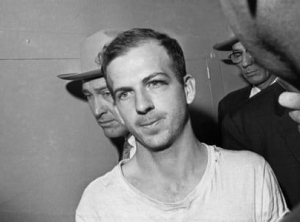 It is especially important to be aware of the difference, given how it has been effaced in public discussions. Early ideas about a ‘conspiracist mindset’, from Harold Lasswell and Franz Neumann, informed Richard Hofstadter’s influential study of the political pathologies of the ‘paranoid style’ in the 1960s. This association of conspiracy suspicions with irrationality and paranoia was then actively promoted in the United States, especially, and as Lance deHaven Smith notes, ‘the conspiracy-theory label was popularized as a pejorative term by the Central Intelligence Agency (CIA) in a propaganda program initiated in 1967.’[3] The program, created as a response to critical citizens’ questions about the assassination of J F Kennedy, ‘called on media corporations and journalists to criticize “conspiracy theorists” and raise questions about their motives and judgments.’ Its reach has extended greatly since.
Professor Peter Knight of Manchester University, who heads a major international interdisciplinary research network, funded by the European Union, to provide a comprehensive understanding of conspiracy theories, takes it to be a now generally accepted fact that ‘some of the labelling of particular views as “conspiracy theories” is a technique of governmentality.’[4]
So who’s afraid of conspiracy theorists? Is it possible that certain governments want us all to be?
It is interesting to note that Professor Knight thinks that if serious conspiracy theories can sometimes be on the right track, then perhaps what they are finding should not be thought of as conspiracies. For instance, he writes, ‘it is possible that different parts of the labyrinthine U.S. intelligence agencies were involved with some of the 9/11 attackers in contradictory and ambiguous ways that fall short of an actual conspiracy, but which nonetheless undermine the notion of complete American innocence.’ The point is, those contradictions and ambiguities merit study, whatever they are called. Knight’s tantalizing idea of an ‘involvement’ that ‘falls short of an actual conspiracy’ brings to mind of analogous definitional questions that were raised about Bill Clinton’s descriptions of his ‘involvement’ with a White House intern. Good sense suggests that what people are interested to know is what happened, not what someone calls it. Ultimately, the serious conspiracy theorist – or theorist of conspiracies, as Knight puts it – wants to know what is going on, and hypotheses about ‘involvements’ of all kinds can figure in the inquiry.[5]
We should bear in mind too, that the very name of this field was bestowed upon it by those who sought to pre-empt its development. Its actual practitioners might think their activities could be more aptly designated in one or more of a number of other, albeit less catchy, ways, such as, for instance, critical civic investigation, intellectual due diligence, investigative journalism, critical social epistemology, or critical social theory.
Which brings me to my main reason for speaking out in defence of the activity: as citizens we find ourselves increasingly struck by anomalies and inconsistencies in official and mainstream accounts of public affairs, not to mention in matters of foreign policy. But whenever we try to share our concerns in a public forum, there seem to be people there ready to harangue us with put-downs about being crazy conspiracy theorists. The reason why they do this is something I shall reflect on another time.[6] My point for now is that we have been drawn to conspiracy theory for reasons that are very far from crazy.

Notes
[1] There is a marked tendency in certain literatures to take this generalized approach to conspiracy theories. Several philosophers – including David Coady, Charles Pigden, Kurtis Hagen, and Lee Basham – have commented critically on it, with Matthew Dentith, in particular, criticizing the failure of such approaches to consider the possibility of finding merits in particular conspiracy theories. He provides examples of ‘generalist positions which take the beliefs or behaviours of some conspiracy theorists as being indicative of what belief in conspiracy theories generally entails.’ (Matthew Dentith, ‘The Problem of Conspiracism’, Argumenta, [forthcoming in 2017]) An example is Douglas and Sutton who state that ‘in the main conspiracy theories are unproven, often rather fanciful alternatives to mainstream accounts’; they also argue that conspiracy theorists are likely to believe conspiracy theories because they are more likely to sympathise with conspirators. (Karen Douglas and Robbie M. Sutton, (2011) Does it take one to know one? Endorsement of conspiracy theories is influenced by personal willingness to conspire’, Psychology, 50(3), 2011: 544-552.)
[2] On this, I endorse the recent exposition offered by Matthew Dentith (ibid): ‘recent philosophical work has challenged the view that belief in conspiracy theories should be considered as typically irrational. By performing an intra-group analysis of those people we call “conspiracy theorists”, we find that the problematic traits commonly ascribed to the general group of conspiracy theorists turn out to be merely a set of stereotypical behaviours and thought patterns associated with a purported subset of that group. If we understand that the supposed problem of belief in conspiracy theories is centred on the beliefs of this purported subset – the conspiracists – then we can reconcile the recent philosophical contributions to the wider academic debate on the rationality of belief in conspiracy theories.’ He identifies the challenge I am arguing we need to take on: ‘Typically, when we think of conspiracy theorists we do not think of people who theorised about the existence of some particular conspiracy – and went on to support that theory with evidence – like John Dewey (who helped expose the conspiracy behind the Moscow Trials of the 1930s), or Bob Woodward and Carl Bernstein (who uncovered the conspiracy behind who broke in to the Democratic National Committee Headquarters at the Watergate office complex in the 1970s). Instead, we think of the advocates and proponents of weird and wacky conspiracy theories … .’
[3] Lance deHaven Smith, Conspiracy Theory in America, University of Texas Press, 2013: p.21; see also Chapter 4 passim.
[4] Peter Knight, ‘Plotting Future Directions in Conspiracy Theory Research’, in Michael Butter and Maurus Reinkowski, eds, Conspiracy Theories in the Middle East and the United States, Berlin: De Gruyter, 2014: p.347.
[5] ‘Involvements’ amongst people can include any of the typical elements of conspiracy such as collusion, collaboration, conniving, tacitly understanding, secretly agreeing, jointly planning, acquiescing, turning a blind eye, covering up for, bribing, intimidating, blackmailing, misdirecting or silencing, and many other more nuanced kinds of arrangement.
[6] In a third blog of this series I shall be asking ‘Do we face a conspiracy to curtail freedom of expression?’ Meanwhile, the second will be a discussion of ‘Conspiracy theory as civic responsibility’. A full academic paper comprising extended versions of each of these will be available shortly. (And yes, for afficionados who are wondering, there will be a full response to proposals of ‘cognitive infiltration’ to ‘cure’ us. I may even suspend my reputed politeness…)
International Electoral Observers Validate Venezuela Regional Vote as US, France Reject Results
By Lucas Koerner | Venezuelanalysis | October 16, 2017
Caracas – The Latin American Council of Electoral Experts (CEELA) has confirmed that Sunday’s vote in Venezuelan gubernatorial elections was clean and transparent.
“The vote took place peacefully and without problems… the vote reflects the will of [Venezuelan] citizens,” declared CEELA President Nicanor Moscoso during a press conference Monday morning.
The CEELA delegation was comprised of 1300 international observers, including former Colombian Electoral Court President Guillermo Reyes, ex-president of the Honduran Supreme Electoral Court, Augusto Aguilar, and former Peruvian electoral magistrate Gastón Soto.
According to the body’s report, the vote was held under conditions of “total normality” and the right to a secret ballot was “guaranteed”.
Sunday’s elections pitted President Maduro’s United Socialist Party of Venezuela against the right-wing MUD coalition, with the former scoring a surprise win in 17 of the nation’s 23 states.
The results have, however, been rejected by the MUD, which has alleged “fraud” and called on its supporters to take to the streets in protest.
The MUD has accused the National Electoral Council of attempting to suppress opposition turnout by relocating 334 voting centers previously targeted by anti-government violence during July 30’s National Constituent Assembly Elections.
Announced several weeks ago, the relocations were concentrated in the states of Anzoátegui, Aragua, Carabobo, Lara, Merida, Miranda, and Tachira. Nonetheless, in Merida and Tachira, the MUD emerged triumphant, despite there being 58 and 42 changes in voting centers, respectively.
For its part, CEELA has reported that it has yet to receive any formal denunciations from the opposition, which has issued its fraud allegations via the media.
President Maduro has requested a 100 percent audit of Sunday’s elections, a call that was subsequently echoed by the MUD.
Nothewstanding CEELA’s certification of the outcome, Venezuela’s regional elections have come under fire from Washington and Paris.
“We condemn the lack of free and fair elections yesterday in Venezuela. The voice of the Venezuelan people was not heard,” declared US State Department spokesperson Heather Nauert.
The diplomat did not, however, offer specific evidence explaining her government’s disavowal of the election result.
In recent months, the Trump administration has taken an increasingly aggressive stance against the Maduro government, imposing economic sanctions, decreeing a travel ban on Venezuelan officials, as well as threatening military intervention and an embargo.
France’s Foreign Ministry likewise issued a communique Monday in which it alleged “serious irregularities” and “lack of transparency in the verification and tabulation process”
“France deplores this situation and is working with its EU partners to examine appropriate measures to help resolve the serious crisis affecting the country,” the French government continued.
France’s newly elected president, Emmanuel Macron, has become an increasingly vocal critic of the Maduro government Caracas.
In September, the French leader met with senior Venezuelan opposition politicians during a tour by the MUD to drum up support for EU sanctions against Venezuela.
The European Parliament voted last month to explore the option of sanctioning top Venezuelan officials, following the lead of Washington and Ottawa.
In response to the statement by Paris, Venezuelan Foreign Minister Jorge Arreaza took to Twitter Monday, lambasting European interference in his country’s internal affairs.
“The EU and some of its member states (subordinate to Trump) question the will of the Venezuelan people,” he stated.
“In Europe, they’d only wish to have a real democracy, where their peoples can freely choose between two truly contrasting projects,” Arreaza added.
DEA, Congress complicit in US opioid epidemic – whistleblowers
RT | October 16, 2017
The US Drug Enforcement Administration ‘shut off’ investigations into large distributors of addictive opioid pills, while a new law made it nearly impossible to prosecute them, the agency’s former employees said.
During the Obama administration, the drug industry used their money and influence to pressure top lawyers at the DEA to take a softer approach to investigating large distributors of opioid pills, even when there was ample evidence of suspicious dealings, Joe Rannazzisi, former head of the DEA’s Office of Diversion Control, told CBS’ 60 Minutes program.
Rannazzisi accused America’s largest painkiller distributors, including Cardinal Health, McKesson, and AmerisourceBergen, of “knowingly” turning a blind eye to the addictive pills being diverted to illicit use.
Former attorney at the DEA Jonathan Novak told CBS that in 2013 he also noticed a sea change in the way prosecutions of big distributors were handled, as his supervisors turned down cases they would have once easily approved. The DEA operates under the Department of Justice.
“These were not cases where it was black – where it was grey… These were cases where the evidence was crystal clear that there was wrongdoing going on,” Novak said.
Jim Geldhof, another former DEA investigator, told the program about a West Virginia case he was looking into where 11 million pills wound up in one of its counties with a population of just 25,000. He said he suddenly ran into roadblocks from one DEA supervisor.
“Every time I talked to this guy he wants something else. And I get it for him and that’s still not good enough,” Geldhof said. “And this goes on and on and on. When these roadblocks keep get thrown up in your face, at that point you know they just don’t want the case.”
“There was a lotta pills, a lotta people dying, and and we had tools in our toolbox to try to use and stem that flow. But it seemed down in headquarters that that toolbox was shut off,” said another former DEA official, Frank Younker.
The ex-employees said one of the reasons for the roadblocks was the “revolving door” between the DEA and the drug industry, as a number of the administration’s top lawyers landed lobbying jobs for the pharmaceutical companies and drug distributors upon leaving the government.
One such former DEA attorney wrote legislation which “made it all but impossible” to prosecute unscrupulous distributors, according to DEA chief administrative law judge, John J. Mulrooney.
The bill, called Ensuring Patient Access and Effective Drug Enforcement Act, was signed into law by president Obama last year, after it was passed by both chambers of Congress. Critics say it effectively stripped the DEA of its authority to investigate suspicious transactions as the government is now required to meet a higher standard before taking enforcement actions.
After Rannazzisi accused the bill’s co-sponsors Tom Marino (R-Pennsylvania) and Marsha Blackburn (R-Tennessee) of protecting distributors under his investigation, the lawmakers wrote the inspector general for the Justice Department, demanding that Rannazzisi be investigated for trying to “intimidate the United States Congress.”
Soon after, Rannazzisi was stripped of his responsibilities. He told CBS he went from supervising 600 people to supervising none – so he resigned.
Seven months after the bill became law, Marino’s chief of staff Bill Tighe became a lobbyist for the National Association of Chain Drug Stores.
Last month, President Donald Trump nominated Marino to lead the Office of National Drug Control Policy. In the wake of the 60 Minute investigation, some congressional Democrats called on the president to withdraw his nomination
Acting DEA chief Chuck Rosenberg, who led the agency under President Barack Obama, resigned at the end of September, reportedly over disagreements with Trump’s policies.
Prescription painkillers have stoked the epidemic of opioid overdoses and addictions across the US.
In August, Trump declared the opioid epidemic a national emergency after his Commission on Combating Drug Addiction and the Opioid Crisis reported that the US faces the death toll equal to “September 11th every three weeks” as the epidemic claims the lives of up to 142 Americans every day.
“60,000 Americans lost their lives to drug overdoses” in 2016, Attorney General Jeff Sessions said later that month.
“That will be the highest drug death toll and the fastest increase in that death toll in American history,” Session stated, adding that “this is not a sustainable trend nor an acceptable America.”
“80 percent of heroin addictions in America started with prescription drug addiction,” Sessions added, saying that the abuse of prescription drugs needs to be stopped.
Pharmaceuticals can be a license to print money
By Pete Dolack | Systemic Disorder | October 11, 2107
It’s no secret that the United States suffers from by far the world’s highest costs for health care. As the most market-oriented health care system among advanced capitalist countries, this is no surprise. Health care in the U.S. is designed to deliver corporate profits, not health care.
On that score, the U.S. system is quite successful. Pharmaceutical companies are at the head of the class in this regard, frequently justifying the spiraling costs of medications by citing large research and development costs that include the costs for drugs that don’t make it to market. There are many drugs that fail to survive testing and become a cost that will never be compensated, that is true. But are these failures really so high to justify the extreme costs of successful drugs?
It would seem not. Firmer proof of that lack of justification has been published by the JAMA Internal Medicine journal, which found that revenue for cancer drugs far outstrips spending on research and development. The article, “Research and Development Spending to Bring a Single Cancer Drug to Market and Revenues After Approval,” prepared by Drs. Vinay Prasad and Sham Mailankody, found that revenue from 10 drugs (one by each of 10 companies) exceed those companies’ total research and development costs by more than seven times.
The total revenue hauled in from these 10 drugs did vary considerably. Two of them earned more than US$20 billion after approval. Both of these high performers cost less than $500 million in research and development costs. The revenue from each of the 10, however, exceeded costs, with widely varied margins. Still profitable: The median revenue of these 10 drugs was $1.7 billion, more than double the median development cost of $648 million, the JAMA Internal Medicine authors report.
The authors write that the median cost to develop a cancer drug represents “a figure significantly lower than prior estimates,” adding that their analysis “provides a transparent estimate of R&D spending on cancer drugs and has implications for the current debate on drug pricing.”
To obtain these figures, the authors analyzed U.S. Securities and Exchange Commissions filings for pharmaceutical companies with no drugs on the U.S. market that received approval by the U.S. Food and Drug Administration for a cancer drug from January 1, 2006, through December 31, 2015. Cumulative R&D spending was estimated from initiation of drug development activity to date of approval. Earnings were tracked from the time of approval to March 2017.
The sky’s the limit for pharmaceutical prices
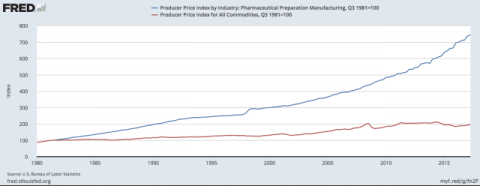
The increase in pharmaceutical prices (blue) versus the general increase in commodities prices (red).
Another way of looking at this would be to examine the increases in the cost of pharmaceuticals against other products. Here again the numbers stand out. Using data gathered by the St. Louis branch of the Federal Reserve Bank, the consumer price index for pharmaceutical preparation manufacturing for the first quarter of 2017 was 747.8, with January 1, 1980, as the benchmark of 100. In other words, the price of pharmaceuticals is seven and half times higher than they were at the start of 1980. (See graph above.)
How does that compare with inflation or other products? Quite well — for pharmaceutical companies. That more than sevenfold increase in drug prices is an increase nearly two and half times greater than inflation for the period, and nearly four times that of all commodities.
So, yes, unconscionable price-gouging is the cause here. By the industry as a whole, not simply individuals like “Pharma Bro” Martin Shkreli, who might be an outlier in his brazenness but not in his profit-generation plan.
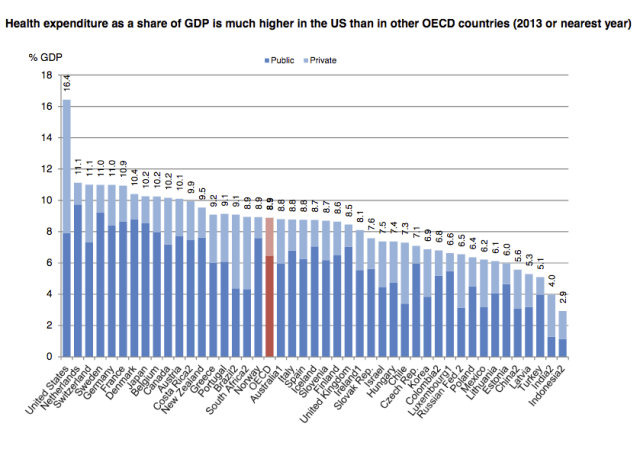
Although not the entire picture, this snapshot of corporate extortion plays a significant role in why the cost of the United States not having a universal health care system is more than $1.4 trillion per year.
Among 19 broadly defined “major” industrial sectors in the U.S., health technology is again expected to be found the most profitable for 2016, with a profit margin of 21.6 percent. Higher even than finance at 17 percent. When narrowing to more specific, narrowly defined industry categories, generic pharmaceuticals sit at the top with an expected 30 percent profit margin for 2016. Major pharmaceuticals rank fourth at 25.5 percent on a list in which health products and finance claim nine of the top 10 spots.
The sky’s the limit for pharmaceutical profits
That’s a repeat of 2015, when health technology had the highest profit margin of 19 broadly defined industrial sectors, at 20.9 percent, topping even finance, the second highest. When a separate study broke down profit margins by more specific industry categories, health care-related industries comprised three of the six most profitable.
Nothing new there, either. A BBC report found that pharmaceuticals and banks tied for the highest average profit margin in 2013, with five pharmaceutical companies enjoying a profit margin of 20 percent or more — Pfizer, Hoffmann-La Roche, AbbVie, GlaxoSmithKline and Eli Lilly. The world’s 10 largest pharmaceutical corporations racked up a composite US$90 billion in profits for 2013, according to the BBC analysis. As to their expenses, these 10 firms spent far more on sales and marketing than they did on research and development.
If those facts and figures aren’t enough, here’s another way of looking at excessive profits — a 2015 study found that, of the 10 corporations that have the highest revenue per employee among the world’s biggest corporations, three are health care companies. Two of the three, Amerisourcebergen and McKesson, both distribute pharmaceuticals, and the other, Express Scrips, administers prescription drug benefits for tens of millions of health-plan members. Each of these primarily operates in the United States, the only advanced-capitalist country without universal health coverage.
The extra layers represented by those three companies demonstrate that there are ample opportunities for corporate profiteering that contribute to extraordinarily high health care costs in the U.S., beyond drug manufacturing and insurance.
And because corporations have the ear of politicians and other government officials, it’s no surprise that one of the primary ongoing goals of the U.S. government for so-called “free trade” agreements, such as the Trans-Pacific Partnership, is to impose rules that would weaken the national health care systems of other countries. This was done in TPP negotiations at the direct behest of U.S.-based pharmaceutical companies, incensed that countries like New Zealand make thousands of medicines, medical devices and related products available at subsidized costs.
By far the most expensive system while delivering among the worst outcomes and leaving tens of millions uninsured, where tens of thousands die from lack of health care annually. That is the high cost of private profit in health care. Or, to put it more bluntly, allowing the “market” to decide health outcomes instead of health care professionals.
Do you have hep C? Pharma hopes so
The sicker you get, the richer they become.
By Martha Rosenberg | Intrepid Report | October 13, 2017
The campaigns are everywhere. On ABC, NBC, CBS and FOX, Animal Planet, the Game Show Network and Syfy. In People, Popular Mechanics and Better Homes and Gardens magazines. On the radio and along subway lines. If you were born between 1945 and 1965, you could have hep C, screams Gilead Sciences, which makes the hep C drug Harvoni.
The campaign seeks to sound like a message from the Centers for Disease Control and Prevention addressing public health. But the Hepatitis C “facts” resulting from an Internet search are paid searches from Pharma, not from public health agencies.
Is there new information that shows baby boomers are newly prone to Hep C? Why have we not heard from the “CDC” about this pressing public health threat until now? There is new information—sales information that Gilead Hep C drugs are “plummeting” and new markets are needed.
“Gilead’s hep C blockbusters are in freefall, and its pool of eligible patients has shrunk dramatically thanks to the success of its meds,” says FiercePharma. “If all baby boomers got tested for the virus, though? That could help stem the tide—and it’s exactly the move the company is recommending with its latest awareness push.” Just trying to help.
David Johnson, Gilead VP, U.S. sales and marketing for liver diseases, admits the shameless disease mongering.
“This has been a planned evolution of our disease awareness efforts, to reach a much broader audience once the pool of already diagnosed patients who often had advanced disease and were in need of curative therapy, had been treated,” he says. “This staged approach was also important to ensure healthcare providers were equipped to support patients asking to be tested, as even for primary care providers, this disease was not something that was high on their radar due to the lack of scientific advances in the past to treat the disease.”
Only a handful of drug classes have been advertised more aggressively than hep C drugs, reports Stat News—drugs for erectile dysfunction and psoriasis “that afflict far more patients in the United States” than hepatitis C.
Hepatitis C drugs weigh in at $1,000 a pill—$84,000 for a course of treatment—and have been sacking the taxpayer-funded budgets of state Medicaid programs. States have considered suing over the heisting of their dollars and a Senate committee has looked at the price gouging. “If Gilead’s approach is the future of how blockbuster drugs are launched in America, it’s going to cost billions and billions of dollars to treat just a fraction of patients in America,” said Senator Ron Wyden, a Democrat from Oregon.
Congress is aware of the profiteering. The Senate’s Special Committee on Aging released a 130-page report revealing how “four pharmaceutical companies have taken advantage of our health care system to enrich themselves and their executives, harming patients and taxpayers,” according to the New York Times’ Gretchen Morgenson.
The chairwoman of the committee, Susan Collins, a Republican from Maine, and Claire McCaskill, a ranking member, Democrat from Missouri, say they have only begun to scratch the surface. They seek to “stop bad actors who are acquiring drugs that have been off-patent for decades and driving up their prices solely because they can,” they say.
Seeking to sell obscenely priced drugs paid for by the public’s dime to patients with no symptoms is bad enough. But the hep C meds are not even the wonder drugs they were billed as in the beginning. They were rolled out so fast to please Wall Street that Pharma did not know or care that patients with pre-existing, dormant hepatitis B infections could experience reactivation of the infections on the drugs and even die.
A year ago, the FDA found that 24 patients with pre-existing, dormant hepatitis B infections experienced reactivation of the infections while taking the hep C drugs. Two patients died and one required a liver transplant. The FDA promptly added boxed warnings on the hep C drug labels about the possible reactivation of hep B infections.
The Institute for Safe Medication Practices reported unintended liver effects with the aggressively marketed drugs. In one year, between June 2015 and June 2016, 165 people who took Sovaldi (an earlier drug) and Harvoni worldwide died, 524 had liver failure and 1,058 had severe liver injury. Could states have their money back?
Gilead’s unethical ads are halfway right. A terrible thing does happen if baby boomers don’t take its $1,000 a pill: Gilead makes no money.
Martha Rosenberg is a freelance journalist and the author of the highly acclaimed “Born With A Junk Food Deficiency: How Flaks, Quacks and Hacks Pimp The Public Health,” published by Prometheus Books.
US Needs to Probe Facebook, Google Abuse of Mega-Data for Profit – Analyst
Sputnik – October 12, 2017
Wall Street Analyst Charles Ortel believes that the US authorities have to investigate the alleged use of mega-data gathered by social media corporations for business profit.
The US government needs to launch a serious inquiry into how the social media giant corporations led by Facebook and Google use the mega-data they gather on hundreds of millions of people for business gain, financial analyst Charles Ortel said in an interview on Wednesday.
“Google and Facebook in the main what they are doing is convincing people around the world to give away very valuable information and then they’re monetizing this for their investors,” Ortel told RT on Wednesday. “There should be some serious inquiry into that.”
Ortel was commenting on the close cooperation between the major US media outlets led by the New York Times and the social media giant corporations in distorting search results and boosting stories overwhelmingly hostile to President Donald Trump.
“What we’ve seen so far is shocking,” he said. “Over 90 percent of the news was negative (on Trump). “I think that kind of stuff happens all the time.”
The Google search engine suppressed conservatives financial analysts and others who were critical of the left-wing and progressive beliefs of most of the billionaires who ran Silicon Valley, Ortel said.
“On the question of Google I have noticed what I believe to be suppression of Google search results… When someone is identified as being conservative economically they go into the question file… These people in Silicon Valley they all lean to the left,” he said.
Trump has publicly accused the New York Times, Washington Post, CNN, NBC, ABC and CBS of presenting fake news.Ortel told RT that Trump had been correct in his criticisms as major US media outlets, especially The New York Times, openly and repeatedly slanted the news according to their preferred bias.
“The New York Times certainly has had an anti-conservative bent for a long, long time… The New York Times has a decided bias and it needs to reform itself or it will indeed fail as Donald Trump in fact suggests it is [already failing],” he said.
Ortel also said the New York Times during the 2016 presidential election campaign had refused to report the fact that the Clinton Foundation charity was under investigation.
“In August 2016 the New York Times knew the Clinton Foundation was under investigation. That is incredibly relevant information that they spiked,” he said.
Charles Ortel, a former executive at the financial firms Chart Group and Dillon, Read & Company, exposed financial fraud at General Electric back in 2007 and is proceeding with his private investigation into the alleged fraud of the Clinton Foundation.
Ortel discussed the issue of media bias at RT after Project Veritas released hidden camera footage of conversations with New York Times editor Nick Dudich. The video showed Dudich admitting to using connections at YouTube to get New York Times videos on the front page of the platform.
NYT & YouTube collusion spawns fake news ‘bastard child’ – Project Veritas to RT
RT | October 12, 2017
Project Veritas Communications Director Stephen Gordon told RT about undercover videos allegedly revealing that YouTube algorithms are open to “intervention” and a NYT employee relied on the help of friends in Silicon Valley to promote his video content.
Gordon said that Project Veritas’ newly-released video of New York Times audience strategy editor Nick Dudich shouldn’t come as a surprise.
“It’s not exactly that they’re revelations, because I think it’s something we all know happens,” he said. “There’s collusion between the social media networks and the major media outlets.
“We caught them admitting it. We caught them being candid on undercover video, admitting what most people, most Americans … strongly suspect of the case anyway, but couldn’t prove. We’ve just proved it,” he said.
In the video released by Veritas, Dudich states that he parked a negative report about Facebook in a spot where he knew it would not draw a lot of traffic.
“Let’s say something ends up on the YouTube front page, the ‘New York Times’ freaks out about it, but they don’t know it’s just because my friends curate the front page. So, it’s like, a little bit of mystery you need in any type of job to make it look like what you do is harder than what it is,” Dudich admitted in the recording.
Project Veritas also revealed that YouTube’s Earnest Pettie, the Brand and Diversity Curation Lead, admitted that YouTube algorithms can be controlled manually.
“Algorithms do control everything but sometimes you need humans to provide a check,” he said.
“Realistically, that’s what the… that’s what the news carousel kind of does. So like, it’s above the search results so, at the very least, we can say this shelf of videos from news partners is legitimate news because we know that these are legitimate news organizations. And if at that point, somebody decides they’re going to scroll past that and go find Alex Jones, well, they were looking for him to begin with anyway.”
Gordon told RT there is a longstanding connection between the NYT and YouTube.
“When New York Times and YouTube are in bed, the bastard child of that relationship is fake news,” he said. “We’ve got more to come on the New York Times.”
Such kind of manipulation has always been in the media, Gordon says.
“Major internet companies are growing and maturing, becoming almost monopolistic. They’ve got the ability to do a lot more than they used to.”
According to Gordon, one of the worst deceits the mainstream media do is “gatekeeping.”
“They [media] are stopping or suppressing story lines they don’t want to hear or they don’t want you to hear. So they can bump up their narrative to the top of the list. And most people trust this. We need to break through that.”
The distrust in the media in the US is “very, very high,” Gordon said, adding that people “trust loggers and garbage men” more than the media.
Project Veritas is still going after fake news, Gordon said when asked about the project’s further steps of protecting the public.
“If I were an executive at NYT, I would be sleeping with one eye open, because who knows what we [will] have next week,” he said.
“We have more cameras, we have more people, we’ve got more videos coming soon.”
The New York Times responded to the undercover video with a statement on Tuesday.
“Based on what we’ve seen in the Project Veritas video, it appears that a recent hire in a junior position violated our ethical standards and misrepresented his role,” spokeswoman Danielle Rhoades Ha said, the New York Times reported.
“In his role at The Times, he was responsible for posting already published video on other platforms and was never involved in the creation or editing of Times videos. We are reviewing the situation now,” Rhoades Ha said.
Read more:
New York Times editor ‘buried’ negative Facebook story to protect friends – Project Veritas
RT | October 11, 2017
Audience strategy editor for NYT Nick Dudich placed a negative report about Facebook in a spot where he knew it wouldn’t draw much attention, while bragging about using his Silicon Valley friendships to make videos trend, according to a new undercover video.
“We actually just did a video about Facebook negatively, and I chose to put it in a spot that I knew wouldn’t do well,” Dudich said in a secretly filmed conversation with someone from the conservative organization Project Veritas.
Dudich claimed that his friends in Silicon Valley helped Times videos trend, while saying he doesn’t want the Times to know about his connections, according to Project Veritas.
“Let’s say something ends up on the YouTube front page, New York Times freaks out about it, but they don’t know it’s just because my friends curate the front page. So, it’s like, a little bit of mystery you need in any type of job to make it look like what you do is harder than what it is,” Dudich says in the recording.
The Project also secretly filmed Earnest Pettie, the Brand and Diversity Curation Lead at YouTube, who explains how YouTube so-called news carousel is formed: “At the very least, we can say this shelf of videos from news partners is legitimate news because we know that these are legitimate news organizations.”
In the recording Pettie also says Dudich is “one of the people I think who has more knowledge about YouTube as a platform than probably anyone else that I know.”
The video released Wednesday is the latest of Project Veritas’ series called “American Pravda,” aimed at the US mainstream media. The installment released Tuesday also featured recordings of Dudich, in which he claims he worked for Hillary Clinton’s presidential campaign to counter the “threat” of Trump and that he did not join the Times to “be objective.”
It is impossible to assess the credibility of Dudich’s claims, however, as he also claimed that former FBI Director James Comey was his godfather, and that he used to participate in Antifa activities on behalf of the FBI.
Dudich admitted this was not true after Project Veritas interviewed his father, who said he didn’t even know Comey. It was “a good story,” Dudich said when asked why he lied.
In response to the Tuesday video, a New York Times spokeswoman Danielle Rhoades Ha said that Dudich was a “recent hire in a junior position” who “appears” to have violated the newspaper’s “ethical standards and misrepresented his role.”
James O’Keefe, who founded Project Veritas in 2010, has released a number of controversial undercover videos, including one with CNN political commentator Van Jones this summer. Jones accused O’Keefe of editing the video in such a way that took his words out of context and created a “hoax.”
In the Veritas video Jones was recorded saying the investigation into Russia’s alleged meddling in the 2016 election was “a big nothing-burger.” Jones said the missing context was that he said Democrats couldn’t use it to impeach Trump, even if the allegations were true.
Read more:
Featured Video
Houthis Don’t Have to Conquer Saudi Arabia to Make It Pay
or go to
Aletho News Archives – Video-Images
From the Archives
Newly Released FBI Docs Shed Light on Apparent Mossad Foreknowledge of 9/11 Attacks
By Whitney Webb | MintPress News | May 17, 2019
NEW YORK — For nearly two decades, one of the most overlooked and little known arrests made in the aftermath of the September 11 attacks was that of the so-called “High Fivers,” or the “Dancing Israelis.” However, new information released by the FBI on May 7 has brought fresh scrutiny to the possibility that the “Dancing Israelis,” at least two of whom were known Mossad operatives, had prior knowledge of the attacks on the World Trade Center. … continue
Blog Roll
 Aletho News
- Houthis Don’t Have to Conquer Saudi Arabia to Make It Pay
- MOE: Nearly 22,000 Students and Education Workers Killed
- Guterres in Islamabad: Genocide, cowardice, and the cage of Imran Khan
- Johnson, Marandi say Yemen holds upper hand over Saudi Arabia
- False flags won’t save aggressors, Iran FM spokesman says
- The Makkah Pact Enters Into Force: The End of American Dominance or Its New Form?
- NATO’s top generals gather in Kiev
- EU’s continuing expansion – greater threat to Russia
- US Senator Murphy says Pentagon denied him entry to US base in Qatar
- Israel expands “incitement” charge to target Palestinian education and memory
- If Americans Knew
- Three Years of Genocide: How America’s Israel-First Media Filtered Out the Truth
- Israeli war chief briefs ministers on potential war against Palestinian Authority
- New Report: Israel Killed nearly 21,000 Palestinian Students and Education Workers in Past Three Years
- Israel’s flailing chatbot army
- Five Palestinians Killed, Others Injured by Israeli Fire in Gaza
- Israel is rewriting the Palestinian curriculum in East Jerusalem to erase Palestinian identity
- Three years of genocide: Israel turned prisons into killing grounds and torture sites
- Three years of genocide. Words fail. Daily Update
- ‘I’d rather die than go back’: A Palestinian teen’s 10-month nightmare in Israeli jail
- How Jared Kushner’s firm’s investment in an Israeli company could be a major conflict of interest
- No Tricks Zone
- New Study: 50 Years Of The Most Aggressive ‘Net Zero’ Policies Can Only Affect The Global Climate By 0.03°C
- US September “Heat” Was No Record…Many Records Set Decades Ago
- Latest European Green Energy Debacle; Portugal’s Largest Flagship Solar Park Insolvent!
- Green Energy Debacle: German Expert Professor Fritz Vahrenholt Warns Of Severe Economic And Social Consequences
- Two More Paleo Reconstructions Affirm Meters-Higher Sea Levels Across Ireland, Brazil 7000-6000 Years Ago
- New Study: Earth And Venus Surface Warmth Largely Explained By Convection And Lapse Rate, Not CO2 Or Radiation
- 2025 Nature Paper Claiming Worsening Global Drought Gets RETRACTED …Heavily Flawed
- New Study: ‘Global Drought Shows No Detectable Recent Acceleration Under Climate Warming’
- Economic Masterminds: German Socialists Suggest Taxing Productivity Gains Stemming From Using AI
- The South China Sea Has Not Been Cooperating With The Climate Change Narrative

