Dershowitz rides shotgun for student attacking Palestinian scholar and his wife in California
By Philip Weiss on March 1, 2011
Bassam Frangieh is an Arabic scholar and translator who teaches at a California college, Claremont McKenna. I imagine that his life is framed by the Nakba; his family was extirpated from Jaffa in 1948; they owned orange groves; he was born in a refugee camp. In 2006, he had the nerve to attack Israel over the 2006 Lebanon invasion and describe Hizbullah as the national resistance.
Now he is being smeared as pro-terrorist by Charles Johnson, a journalist at Claremont McKenna, who published this attack in the National Review, citing the usual fragmentary statements about Hamas and Hezbollah. It includes this McCarthyite pirouette:
Frangieh’s radicalism is shared by his wife, Aleta Wenger. A former State Department official who worked on the Middle Eastern desk, Ms. Wenger is currently director of Claremont’s Center for Global Education and, as such, is the public face of the college overseas. Like her husband, she takes a conspiratorial view of Israel’s military, accusing it, without evidence, of bombing universities and hospitals.
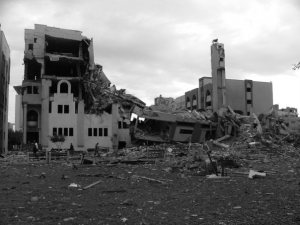 I’ve been to Gaza. I saw the ruins of the gene sequencing building at the Islamic University and of Al Quds Hospital. It is not clear to me who is pushing back, though apparently the Claremont administration is defending Frangieh on free speech grounds.
Johnson devoted a piece to Frangieh’s wife last month, too. And last night he stated in a letter to Claremont McKenna execs that he is getting help from Alan Dershowitz:
I should add that all of the material that I or The Claremont Independent published regarding Professor Bassam Frangieh has been reviewed by my counsel and by Professor Alan Dershowitz of Harvard Law School. The primary source material that I and The Claremont Independent published was translated by three different translators at considerable personal expense.
In the same piece Johnson says “nearly the entirety of the Government Department” at Claremont McKenna is on his side. I wonder how many of them know the history of the Israel-Palestine conflict and the role it is now playing in American politics…
Davis Arrest Throws US Undercover Campaign in Pakistan into Disarray
By Dave Lindorff | This Can’t Be Happening | March 1, 2011
The ongoing case of Raymond Davis, the CIA contractor facing murder charges in Lahore for the execution-style slaying of two apparent agents of Pakistan’s Inter-Services Intelligence (ISI) agency, is apparently leading to a roll-back of America’s espionage and Special Operations activities in Pakistan.
A few days ago, Pakistan’s Interior Department, which is reportedly conducting a careful review of the hundreds of private contractors who flooded into Pakistan over the last two years, many with “diplomatic passports,” and many others, like Davis, linked to shady “security” firms, arrested an American security contractor named Aaron DeHaven, a Virginia native who claims to work for a company called Catalyst Services LLC.
The Catalyst Services LLC website describes the company, with offices in Afghanistan, Dubai, the US and Pakistan, as having experience in “logistics, operations, security and finance,” and as having a staff led by “individuals who have been involved in some of the most significant events of the last 20 years,” including “the break-up of the Soviet Union, the US effort in Somalia, and the Global War on Terror.”
DeHaven is being held on a 14-day remand, charged with overstaying his visa and with living in an unauthorized area.
Meanwhile, the English-language Express Tribune in Pakistan reports that according to ISI sources, 30 “suspected US operatives” in Pakistan have “suspended” their operations in the country, while 12 have fled the country.
The paper quotes the Pakistan Foreign Office as saying that 851 Americans claiming diplomatic immunity are currently in Pakistan, 297 of whom are “not working in any diplomatic capacity.” The paper says that the country’s Interior Department claims that 414 of the total are “non-diplomats.” The majority of these American operatives, the paper says, are located in Islamabad (where the US is building a huge fortress-like embassy reminiscent of the one in Baghdad), with the others in Karachi, Lahore and Peshawar. Most are suspected of being involved in covert missions that report to the US Joint Special Operations Command, with many suspected of being active-duty Special Forces personnel from the Army’s Delta Force. (The website of the JSOC says its responsibility is “synchronizing Department of Defense plans against global terrorist networks and, as directed, conducting global operations.”)
As I reported earlier, both Pakistani and Indian news organizations are claiming, based upon intelligence sources, that Davis was involved in not just intelligence work, but in orchestrating terrorist activity by both the Pakistani Taliban and the terrorist organization Lashkar-e-Jhangvi, which has been linked to both the assassination of Benezir Bhutto and the capture and beheading of Wall Street Journal reporter Daniel Pearl. Multiple calls to members of both groups were found by police on some of the cell phones found on Davis and in his car when he was arrested in Lahore.
It is unclear how far the blow-up in Pakistan over the exposure of America’s role in stirring up unrest in that country will go. Clearly, the ISI and the Pakistani military have long had their own complicated relationship with the Pakistani Taliban, and much of the current anger in both the ISI and the military has to do with the US being found to be working behind their backs, including in its contact with those groups.
But things have been complicated too by mounting public outrage over Davis’s brazen slaughter of the two Pakistanis, who reportedly were tailing him because of concerns about the nature of his activities, and who reportedly were both shot in the back. This public outrage has been further stoked by both a subsequent suicide by the 18-year-old bride of one of the victims, and by the death of an innocent bystander mowed down by a second vehicle carrying several more US contractors which sped to Davis in response to his call for assistance following the shooting. That vehicle, after running down the bystander, raced to sanctuary at the US Consulate. The men in the car, never identified by the consulate, were spirited out of the country by the US so they could avoid arrest.
Further complicating matters for the US, the province of Punjab, of which Lahore is the capital, is run by the opposition party, headed by former Pakistani prime minister Nawaz Sharif. Sharif, who still has presidential aspirations, has no incentive at all to make things easy for the country’s ruling party by letting Davis go. Indeed, with public opinion running almost 100% in favor of trying Davis for murder, Sharif can only gain by insisting that the court system have the final say.
Pakistan’s central government, led by President Asif Ali Zardari, clearly wants to put the Davis incident behind it by having him declared to have diplomatic immunity. Foreign Officials allege that Zardari pressured the Foreign Office in early February to backdate a letter identifying Davis as being a “member of staff” of the US Embassy in Islamabad, which would have afforded him such immunity from prosecution. But the country’s foreign minister at that time, Shah Mehmood Qureshi, reportedly refused, saying, “On the basis of the official record and the advice given to me by the technocrats and experts of the Foreign Office, I could not certify him (Raymond Davis) as a diplomat. The kind of by blanket immunity Washington is pressing for Davis, is not endorsed by the official record of the Foreign Ministry.”
He has subsequently been ousted and replaced by Zardari.
The reality is that the US, which as required, on Jan. 25 submitted to the Foreign Office its annual list of those employees of the US Embassy whom it classified as “diplomats” warranting diplomatic immunity. The list had 48 names on it, and did not include Davis. Only after Davis’s Jan. 27 shooting of the two Pakistani motorcyclists, on Jan. 28, did the US submit a “revised” list, to which Davis’s name had been appended.
The US initially said Davis was an employee of the Lahore Consulate, and Davis himself told arresting police officers that he was a contractor working out of the Lahore Consulate, a role that would not afford him any diplomatic immunity, as consular workers, under the 1963 Vienna Convention on Consular Relations only receive immunity for their “official duties,” and in any case lose even that limited immunity in the case of “grave crimes.”
His current legal problems, and the public demand that he be tried (and then hanged) for the killings, has definitely led to a reduction in US undercover operations in Pakistan, and to a pullback of at least some of the Special Forces personnel operating there. It will take considerable finesse for the US and the Zardari government to put the the relationship back together–if the Pakistani military and the ISI even want to restore it–finesse that the US has not been very good at displaying.
So far, in fact, the US response to Davis’s arrest has been to bluntly and publicly threaten Pakistan with a loss of foreign and military aid–a threat that seems empty given the American need for Pakistani assistance in supplying its military in Afghanistan, and its need for at lease covert permission to continue sending Predator and Reaper drones across the border to attack Taliban suspects in the tribal border areas. US bluster, and some clumsy efforts to forge records that would purport to show Davis had diplomatic immunity–all widely exposed in the Pakistani media–have only served to further stoke public outrage.
Meanwhile, local authorities in Lahore at the prison where Davis is being held, are so worried that the US may try to have him killed to prevent him from spilling the beans about his activities–for example explaining why the camera he was carrying held photographs of Pakistani military installations as well as of mosques, madrassas and other schools–that they have reportedly posted special guards (unarmed as an added precaution) around his cell, and have been monitoring his food. Davis was reportedly even denied a box of chocolates sent by the US Consulate in Lahore, for fear it might have been laced with poison.
The Real U.S. National Security Budget
The Figure No One Wants You to See
By Christopher Hellman | March 1, 2011
What if you went to a restaurant and found it rather pricey? Still, you ordered your meal and, when done, picked up the check only to discover that it was almost twice the menu price.
Welcome to the world of the real U.S. national security budget. Normally, in media accounts, you hear about the Pentagon budget and the war-fighting supplementary funds passed by Congress for our conflicts in Iraq and Afghanistan. That already gets you into a startling price range — close to $700 billion for 2012 — but that’s barely more than half of it. If Americans were ever presented with the real bill for the total U.S. national security budget, it would actually add up to more than $1.2 trillion a year.
Take that in for a moment. It’s true; you won’t find that figure in your daily newspaper or on your nightly newscast, but it’s no misprint. It may even be an underestimate. In any case, it’s the real thing when it comes to your tax dollars. The simplest way to grasp just how Americans could pay such a staggering amount annually for “security” is to go through what we know about the U.S. national security budget, step by step, and add it all up.
So, here we go. Buckle your seat belt: it’s going to be a bumpy ride.
Fortunately for us, on February 14th the Obama administration officially released its Fiscal Year (FY) 2012 budget request. Of course, it hasn’t been passed by Congress — even the 2011 budget hasn’t made it through that august body yet — but at least we have the most recent figures available for our calculations.
For 2012, the White House has requested $558 billion for the Pentagon’s annual “base” budget, plus an additional $118 billion to fund military operations in Iraq and Afghanistan. At $676 billion, that’s already nothing to sneeze at, but it’s just the barest of beginnings when it comes to what American taxpayers will actually spend on national security. Think of it as the gigantic tip of a humongous iceberg.
To get closer to a real figure, it’s necessary to start peeking at other parts of the federal budget where so many other pots of security spending are squirreled away.
Missing from the Pentagon’s budget request, for example, is an additional $19.3 billion for nuclear-weapons-related activities like making sure our current stockpile of warheads will work as expected and cleaning up the waste created by seven decades of developing and producing them. That money, however, officially falls in the province of the Department of Energy. And then, don’t forget an additional $7.8 billion that the Pentagon lumps into a “miscellaneous” category — a kind of department of chump change — that is included in neither its base budget nor those war-fighting funds.
So, even though we’re barely started, we’ve already hit a total official FY 2012 Pentagon budget request of:
$703.1 billion dollars.
Not usually included in national security spending are hundreds of billions of dollars that American taxpayers are asked to spend to pay for past wars, and to support our current and future national security strategy.
For starters, that $117.8 billion war-funding request for the Department of Defense doesn’t include certain actual “war-related fighting” costs. Take, for instance, the counterterrorism activities of the State Department and the U.S. Agency for International Development. For the first time, just as with the Pentagon budget, the FY 2012 request divides what’s called “International Affairs” in two: that is, into an annual “base” budget as well as funding for “Overseas Contingency Operations” related to Iraq and Afghanistan. (In the Bush years, these used to be called the Global War on Terror.) The State Department’s contribution? $8.7 billion. That brings the grand but very partial total so far to:
$711.8 billion.
The White House has also requested $71.6 billion for a post-2001 category called “homeland security” — of which $18.1 billion is funded through the Department of Defense. The remaining $53.5 billion goes through various other federal accounts, including the Department of Homeland Security ($37 billion), the Department of Health and Human Services ($4.6 billion), and the Department of Justice ($4.6 billion). All of it is, however, national security funding which brings our total to:
$765.3 billion.
The U.S. intelligence budget was technically classified prior to 2007, although at roughly $40 billion annually, it was considered one of the worst-kept secrets in Washington. Since then, as a result of recommendations by the 9/11 Commission, Congress has required that the government reveal the total amount spent on intelligence work related to the National Intelligence Program (NIP).
This work done by federal agencies like the CIA and the National Security Agency consists of keeping an eye on and trying to understand what other nations are doing and thinking, as well as a broad range of “covert operations” such as those being conducted in Pakistan. In this area, we won’t have figures until FY 2012 ends. The latest NIP funding figure we do have is $53.1 billion for FY 2010. There’s little question that the FY 2012 figure will be higher, but let’s be safe and stick with what we know. (Keep in mind that the government spends plenty more on “intelligence.” Additional funds for the Military Intelligence Program (MIP), however, are already included in the Pentagon’s 2012 base budget and war-fighting supplemental, though we don’t know what they are. The FY 2010 funding for MIP, again the latest figure available, was $27 billion.) In any case, add that $53.1 billion and we’re at:
$818.4 billion.
Veterans programs are an important part of the national security budget with the projected funding figure for 2012 being $129.3 billion. Of this, $59 billion is for veterans’ hospital and medical care, $70.3 billion for disability pensions and education programs. This category of national security funding has been growing rapidly in recent years because of the soaring medical-care needs of veterans of the Iraq and Afghan wars. According to an analysis by the Congressional Budget Office, by 2020 total funding for health-care services for veterans will have risen another 45%-75%. In the meantime, for 2012 we’ve reached:
$947.7 billion.
If you include the part of the foreign affairs budget not directly related to U.S. military operations in Iraq and Afghanistan, as well as other counterterrorism operations, you have an additional $18 billion in direct security spending. Of this, $6.6 billion is for military aid to foreign countries, while almost $2 billion goes for “international peacekeeping” operations. A further $709 million has been designated for countering the proliferation of weapons of mass destruction, combating terrorism, and clearing landmines planted in regional conflicts around the globe. This leaves us at:
$965.7 billion.
As with all federal retirees, U.S. military retirees and former civilian Department of Defense employees receive pension benefits from the government. The 2012 figure is $48.5 billion for military personnel, $20 billion for those civilian employees, which means we’ve now hit:
$1,034.2 billion. (Yes, that’s $1.03 trillion!)
When the federal government lacks sufficient funds to pay all of its obligations, it borrows. Each year, it must pay the interest on this debt which, for FY 2012, is projected at $474.1 billion. The National Priorities Project calculates that 39% of that, or $185 billion, comes from borrowing related to past Pentagon spending.
Add it all together and the grand total for the known national security budget of the United States is:
$1,219.2 billion. (That’s more than $1.2 trillion.)
A country with a gross domestic product of $1.2 trillion would have the 15th largest economy in the world, ranking between Canada and Indonesia, and ahead of Australia, Taiwan, the Netherlands, and Saudi Arabia. Still, don’t for a second think that $1.2 trillion is the actual grand total for what the U.S. government spends on national security. Former Secretary of Defense Donald Rumsfeld once famously spoke of the world’s “known unknowns.” Explaining the phrase this way: “That is to say there are things that we now know we don’t know.” It’s a concept that couldn’t apply better to the budget he once oversaw. When it comes to U.S. national security spending, there are some relevant numbers we know are out there, even if we simply can’t calculate them.
To take one example, how much of NASA’s proposed $18.7 billion budget falls under national security spending? We know that the agency works closely with the Pentagon. NASA satellite launches often occur from the Air Force’s facilities at Vandenberg Air Force Base in California and Cape Canaveral Air Force Station in Florida. The Air Force has its own satellite launch capability, but how much of that comes as a result of NASA technology and support? In dollars terms, we just don’t know.
Other “known unknowns” would include portions of the State Department budget. One assumes that at least some of its diplomatic initiatives promote our security interests. Similarly, we have no figure for the pensions of non-Pentagon federal retirees who worked on security issues for the Department of Homeland Security, the State Department, or the Departments of Justice and Treasury. Nor do we have figures for the interest on moneys borrowed to fund veterans’ benefits, among other national security-related matters. The bill for such known unknowns could easily run into the tens of billions of dollars annually, putting the full national security budget over the $1.3 trillion mark or even higher.
There’s a simple principle here. American taxpayers should know just what they are paying for. In a restaurant, a customer would be outraged to receive a check almost twice as high as the menu promised. We have no idea whether the same would be true in the world of national security spending, because Americans are never told what national security actually means at the cash register.
~
Christopher Hellman is communications liaison at the National Priorities Project in Northampton, Massachusetts. He was previously a military policy analyst for the Center for Arms Control and Non-Proliferation, a Senior Research Analyst at the Center for Defense Information, and spent 10 years on Capitol Hill as a congressional staffer working on national security and foreign policy issues. He is a TomDispatch regular and a frequent media commentator on military planning, policy, and budgetary issues. To listen to Timothy MacBain’s latest TomCast audio interview in which Hellman explains how he arrived at his staggering numbers, click here, or download it to your iPod here.
[Note on Sources: The press release from the Office of The Director of National Intelligence disclosing the Fiscal Year 2010 $53 billion intelligence budget consists of 138 words and no details, other than that the office will disclose no details. It can be found by clicking here (.pdf file). An October 2010 analysis by the Congressional Budget Office entitled “Potential Costs of Veterans’ Health Care” projects rapid cost growth for Veterans Administration services over the next decade as a result of spiraling health care costs. To read the full report, click here (.pdf file). To see all the federal agencies that contribute to homeland security funding, click here (.pdf file)]
Copyright 2011 Christopher Hellman
Attacks on unions barking up the wrong money tree
By Michael Winship | Intrepid Report | February 28, 2011
“More cheese, less sleaze!”
That was the funniest group chant at Tuesday’s rally of several hundred union and other progressive activists outside the Manhattan headquarters of Fox News.
Several “cheeseheads” were in attendance, their noggins topped by the now familiar wedge-shaped, orange hatwear made popular by Green Bay Packer fans. On Tuesday, they were out in the twilight chill expressing their opposition not to lactose intolerance but Wisconsin Governor Scott Walker’s intolerance of organized labor. (Unadorned by cheddar, I briefly spoke at the gathering as president of an AFL-CIO affiliated union, the Writers Guild of America, East.)
Governor Walker continues his obdurate opposition to the state’s public employee unions’ right to collective bargaining, despite a willingness on their part to concede pension and health givebacks he claims would help close Wisconsin’s alleged deficit. Meanwhile, there has been a decided increase on the sleaze end of the cheese vs. sleaze quotient, as evidenced in part by the prank phone call to the governor in which an online newspaper editor impersonating right wing billionaire David Koch elicited from Walker a proposed scheme to lure back, then double cross Democratic state senators who have prevented a quorum by retreating to Illinois. Further, when asked about planting troublemakers amongst the protesters, Walker told the trickster that he and his team had “thought about that” but decided not to. Apparently, all the really good disrupters are tied up in the Middle East.
But of course, this isn’t really about saving taxpayers’ money but consolidating political power. Walker and such leading lights of the GOP leadership as Governor Chris Christie of New Jersey and Ohio Governor John Kasich, among others, have decided that public employee unions make great punching bags, effective scapegoats for an outraged electorate and a satisfactory diversion from the real culprits of this grim, economic melodrama—the Simon Legrees of banking and finance who got us into this meltdown mess in the first place.
As Josh Dorner reported on the progressive ThinkProgress website last week, “Instead of making the tough choices necessary to help their states weather the current crisis with some semblance of the social safety net and basic government services intact, Republican governors are instead using it as an opportunity to advance several longtime GOP projects: union busting, draconian cuts to social programs, and massive corporate tax breaks. These misplaced priorities mean that the poor and middle class will shoulder the burden of fiscal austerity, even as the rich and corporations are asked to contribute even less.”
Dorner cites examples: in Arizona, Republican Governor Jan Brewer proposes kicking some 280,000 off the state Medicaid rolls but two weeks ago signed into law $538 million in corporate tax cuts. Florida Governor Rick Scott’s new budget calls for billions of dollars in cuts to essential programs and services to pay for corporate and property tax cuts of at least $4 billion. Rick Snyder, newly elected governor of Michigan, has asked for $180 million in concessions from public employees and more than a billion to be taken from schools, universities, local governments and others, most of which could be avoided if he wasn’t so deeply dedicated to giving business $1.8 billion in tax breaks.
Writing in the February 23 Boston Globe, Mark Erlich, executive secretary-treasurer of the New England Regional Council of Carpenters asks, “While there are legitimate and critical public policy issues about education reform, spiraling health costs, and pension liabilities at a time of state and municipal budget deficits, why is the fault laid at the feet of teachers, police, and firefighters? Today’s pension obligations are the product of massive investment losses, not excessively generous public pensions that, in fact, average about $19,000 a year. For that matter, a 2010 Economic Policy Institute study showed that, controlled for educational achievement, public sector workers actually earn less than their private sector counterparts.”
So instead of screaming about the advances public employee and other unions have made to preserve health care, job security and economic justice, angry voters should be asking what or who have been keeping them from obtaining the same. Nor does Wall Street’s pillaging of private 401(k) retirement plans justify tit-for-tat, eye-for-an-eye acts of covetous revenge against union pensions. As Erlich writes, “A generation ago, non-union workers often welcomed news of improved wages and benefits for unionized employees, recognizing that a rising tide lifts all boats. But . . . at a time of sacrifice and insecurity, many would prefer to sink their neighbor’s slightly bigger boat while wistfully hoping for a glance at a yacht in a gated marina.”
The American middle class largely exists because of unions; it would be a tragedy of Greek proportions if, in frustration, resentment and fear, members of that class were to turn on labor and bring about their mutual destruction. Conservative Republican governors and their associates are barking up the wrong money tree. Don’t reward corporate greed and malfeasance with yet more tax breaks and a blind eye to windfall bonuses. And don’t punish unions for whatever success they’ve had protecting members and holding on to an ever-dwindling power base of American workers. That’s just plain cheesy and sleazy.
~
Michael Winship is the former senior writer of Bill Moyers Journal on PBS and current president of the Writers Guild of America, East.
Media lies: Spate of headlines tying Libya and Venezuela together
By Kiraz Janicke & Federico Fuentes | Green Left | February 27, 2011
As the wave of popular uprisings has spread across the Arab world, a flurry of articles have appeared suggesting Venezuelan President Hugo Chavez could be the next “dictator” to be overthrown.
Such arguments follow a pattern in the corporate media of slandering the Chavez government and the revolutionary process it leads.
They aim to conceal the real threat that haunts imperialism: that the Arab world may follow the example of Venezuela and other countries in Latin America — and break away from Western hegemony.
Particularly cynical were the comments by British foreign secretary William Hague, who falsely alleged Libyan leader Muammar Gaddafi had fled to Venezuela on February 21. This triggered a spate of headlines tying “Venezuela” and “Libya” together — despite the fact the allegation was untrue.
A February 2 editorial by the Miami Herald claimed: “With dictators toppling like dominoes across the Middle East, Venezuela’s president-for-life, Hugo Chavez, is signaling worry about his own despotic rule.”
The article ignores the fact that Chavez was overwhelming elected as president in three elections supervised by numerous international observers. All up, pro-Chavez forces have won more than a dozen national elections, all verified as free and fair, since 1998.
With new elections set for 2012, Chavez maintains more than 50% support — even in polls commissioned by the US-funded opposition.
Israeli Prime Minister Shimon Peres went further when he listed Chavez along with Iranian leader Mahmoud Ahmadinejad as two despots corrupted by oil that must be eliminated.
“I believe the world should get rid of oil and tyranny, both of them together are dangerous,” Peres said, VoiceofAmerica.com reported on February 23.
Peres was at least more honest than most, adding that his reason was because Europe has to pay higher oil prices due to the “whims of some producer countries”.
The reality is that as US hegemony is being challenged by the popular uprisings in the Arab world, right-wing commentators and policy-makers are scrambling to spin the situation to their own advantage.
They are singling out governments outside of US control as possible targets for enforced “regime change” from outside.
Responding to the idea that Venezuela could be next, Chavez noted on February 18 that what was occurring in Egypt “started here a while ago. We have been in rebellion for a while now, in a revolutionary rebellion.”
Chavez said that rebellion began in Venezuela with the February 1989 popular uprising known as the Caracazo.

The Caracazo in Venezuela, 1989
As a result of International Monetary Fund-imposed hikes in fuel prices, tens of thousands of Venezuelans poured onto the streets of Caracas and other major cities to protest against the neoliberal measure.
A brutal crackdown left an estimated 4000 dead and temporarily quelled the rebellion.
However, the fervour continued in Venezuelan society, leading to Chavez’s election in 1998 on an anti-neoliberal platform.
Chavez said: “What happened in Egypt — and which has not finished — is a sudden awakening of people’s power. We have only seen the first waves.
“They are events that mark a new phase of history in the entire world.”
One of Chavez’s first moves when he was elected was to strengthen the Organisation of the Petroleum Exporting Countries and use it to negotiate a more just oil price for countries dependent on oil revenues.
Chavez also took back government control over Venezuela’s nominally state-run oil industry. These moves have allowed his government to pour much of the oil revenue into social programs.
These wide-ranging programs eradicated illiteracy and extended free education and healthcare to the most needy. They have also been crucial to the process of expanding community control over the running their affairs.
The Chavez government has also used oil revenues to seek to develop other sectors of the economy to help break oil dependency.
To follow the mainstream media, you would get the impression the Chavez government is working overtime to silence freedom of speech. The reality, however, is not one TV station or newspaper has been closed down — and the overwhelming majority are virulently anti-government.
On the other hand, hundreds of new community radio stations are flourishing in the impoverished barrios, extending free speech to those who have never had the opportunity to exercise it before.
The US-backed dictators in the Arab world have consistently placed relations with Israel above the interests of the Palestinian people — despite the popular sympathy for the Palestinian cause among Arab people.
In contrast, since December, nine South American countries have formally recognised a sovereign Palestinian state.
Chavez’s government, and Bolivia’s radical president Evo Morales, have gone further. They broke all diplomatic relations with Israel after its brutal onslaught against Gaza in 2009.
Andelfo Garcia, a former foreign minister of the most loyal US ally in the region, Colombia, said in the February 19 Miami Herald that this move is just one more sign that South American countries are no longer simply adopting US foreign policy as their own.
“It’s like a wave rolling through Latin America,” he said. “The region has its own vision and wants to play a larger role [on the world stage].”
Venezuela has been in the forefront of moves towards greater regional integration, and a shift away from traditional dependence on trade with the US — as well as greater trade and dialogue with other parts of the Third World, such as the Middle East.
The US and Israel are terrified of the threat of something similar occurring in the Arab world — should the democratic revolutions be successful and extend to exerting democratic control over oil and other resources.
It also helps explain why Chavez is hailed by so many in the Arab world as a hero.
However, as Santiago Alba Rico and Alma Allende said in a February 24 Rebelion article “From the Arab world to Latin America”, Venezuela and Cuba’s reluctance to clearly condemn the brutal repression being carried out by the regime of Muammar Gaddafi’s against a popular revolt will have negative consequences for the anti-imperialist project in Latin America.
Venezuela and Cuba have called for a “peaceful resolution” to the violence in Libya and warned the West could use the bloody scenes as an excuse to intervene.
The Arab revolt represents both an “economic revolt” and a “democratic, nationalist and anti-colonial revolution”, they said, that “provides the socialist left and pan-Arabists in the region with an unexpected opportunity”.
They said: “the Arab people, who have returned to the world stage, need the support of their Latin American brothers”.
The pioneering processes of liberation in Latin America, are a symbol of hope for the global anti-imperialist struggle. Therefore, left-wing Latin American governments should unreservedly support the peoples of the Arab world.
This would pre-empt the strategy of the Western powers, which are trying to relegitimise themselves as champions of “human rights and democracy” and may seek to use Gaddafi’s crimes as an excuse to intervene militarily.
Ignoring the brutal reality of Gaddafi, who has been a friend in recent years of the West and its allied dictators, risks breaking ties with popular Arab movements, they pointed out.
It could also give legitimacy to the false accusations thrown at Venezuela and Cuba by imperialism.
They added: “Hopefully Gaddafi will fall — today better that tomorrow.”
They said the wave of revolts in the Arab world could connect with the revolutionary processes in Latin America. They wrote: “The opportunity is great and could be the last to definitively reverse the current balance of forces and isolate the imperialist powers in a new global framework.”
One thing is clear, just as the US has sought to prop up dictatorships in the Arab world, it will continue its struggle to defeat the popular revolutionary movements in Latin America.
Eva Golinger said in Correo del Orinoco International on February 18 that US President Barack Obama had requested US$5 million dollars in special funding from the US Congress special funding for anti-Chavez groups in the 2012 budget.
On February 18 Venezuelanalysis.com said that Venezuelan parliamentarians had condemned threats from Republican congressmen and the newly appointed chair of the House sub-committee on foreign affairs for the Western hemisphere, Connie Mack.
Mack, has called for a “full-scale economic embargo” against Venezuela.
The real threat to Venezuelan democracy, as across Latin America and the Arab world, comes from the US Empire.
~
Kiraz Janicke and Federico Fuentes worked in the Green Left Weekly Caracas bureau from 2007-10.
9/11 revisited: 21 problems in official narrative
By Paul Balles | Gulf Daily News | February 26, 2011
In March 2004, publication of David Ray Griffin’s book The New Pearl Harbor, challenging the official story of 9/11, sparked widely different reactions.
Then in 2008, Griffin published The New Pearl Harbor Revisited, an update of his original study in which he said: “The expose of what happened on 9/11 has shown virtually every dimension of the official account of 9/11 to be false beyond a reasonable doubt.”
Forget about conspiracy theories. How can we allow falsifications lapse into history without demanding the truth?
It’s past time to demand honest answers to the questions generated by the official story.
Based on his continuing studies, Griffin compiled 21 reasons to question the official story about the terrorist attacks of September 11, 2001.
Here I have summarized his 21 points that challenge the official stories:
1. The official story has Osama Bin Laden behind the attacks. However, the FBI “has no hard evidence connecting him to 9/11”
2. Alleged hijackers who regularly drank heavily, went to strip clubs, and paid for sex could hardly be devout Muslims
3. Claims that passengers on airlines made mobile phone calls to relatives have been contradicted by the FBI
4. The FBI also contradicted Ted Olson’s claim that his wife phoned him twice from American Airlines flight 77.
5. Reported evidence for Muslim hijackers shows clear signs of having been fabricated.
6. The story that incriminating evidence was found in alleged hijacker Mohammed Atta’s luggage was a revision of the original story.
7. Planes showing signs of in-flight emergencies are normally intercepted within about 10 minutes. The military’s failure implies something prevented this standard procedure.
8. Then Vice-President Dick Cheney, while in the bunker under the White House, apparently confirmed a stand-down order prior to the strike on the Pentagon.
9. The 9/11 Commission removed a report from video records of its hearings about when he entered the shelter conference room.
10. The commission’s time-line for Cheney contradicts what he told “Meet the Press”.
11. Hani Hanjour, who could not safely fly even a single-engine plane, could not possibly have executed the trajectory reportedly taken by American Flight 77 hitting Wedge 1 of the Pentagon.
12. Wedge 1 would have been the least likely part of the Pentagon to be targeted by foreign terrorists.
13. Claims by Pentagon officials that they did not have the premises evacuated because they had no way of knowing an aircraft was approaching it were false.
14. Why would the Secret Service allow President Bush to remain in a Florida classroom for 30 minutes after news of attack?
15. On the first anniversary of 9/11, the White House started lying about Bush immediately leaving the classroom.
16. The official explanation of the destruction of the Twin Towers and WTC 7 (a nearby building that also collapsed) contradicts all prior history: steel-frame high-rise buildings have never collapsed except when brought down by controlled demolition.
17. Firemen, emergency medical workers, police officers, city officials, WTC employees and TV and print journalists reported explosions going off in the towers and WTC 7.
18. The destruction of the towers can only be explained in terms of powerful explosives. The fires could not have come within 1,000 degrees Fahrenheit needed to melt steel.
19. Then New York mayor Rudy Guliani allegedly falsified stories about knowing the WTC buildings were going to collapse. His fire chiefs didn’t expect them to come down.
20. The National Institute of Standards and Technology has repeatedly postponed its report into the collapse of WTC 7.
21. The official story about 9/11 is rejected by growing numbers of professors, physicists, architects, engineers, pilots, former military officers and former intelligence officials.
Libya: Is Washington Pushing for Civil War to Justify a US-NATO Military Intervention?
By Mahdi Darius Nazemroaya | Global Research | February 25, 2011
One should be opposed to dictatorship, but one should not forget the issue of foreign domination.
Is Tripoli being set up for a civil war to justify U.S. and NATO military intervention in oil-rich Libya?
Is “manufactured destruction” or “creative destruction” at work?
If Qaddafi is not ousted, are the talks about sanctions a prelude to an Iraq-like intervention?
Something is Rotten in the so-called “Jamahiriya” of Libya
There is no question that Colonel Muammar Al-Gaddafi (Al-Qaddafi) is a dictator. He has been the dictator and so-called “qaid” of Libya for about 42 years. (“UK Hague: some information that Qaddafi on way to Venezuela,” Reuters, February 21, 2011) Yet, it appears that tensions are being ratcheted up and the flames of revolt are being fanned inside Libya. This includes earlier statements by the British Foreign Secretary William Hague that Colonel Qaddafi had fled Libya to Venezuela. This statement served to electrify the revolt against Qaddafi and his regime in Libya.
Although all three have dictatorship in common, Qaddafi’s Libya is quite different from Ben Ali’s Tunisia or Mubarak’s Egypt. The Libyan leadership is not outright subservient to the United States and the European Union. Unlike the cases of Tunisia and Egypt, the relationship that exists between Qaddafi and both the U.S. and E.U. is a modus vivendi. Simply put, Qaddafi is an independent Arab dictator and not a “managed dictator” like Ben Ali and Mubarak.
In Tunisia and Egypt the status quo prevails, the military machine and neo-liberalism remain intact; this works for the interests of the United States and the European Union. In Libya, however, upsetting the established order is a U.S. and E.U. objective.
The U.S. and the E.U. now seek to capitalize on the revolt against Qaddafi and his dictatorship with the hopes of building a far stronger position in Libya than ever before. Weapons are also being brought into Libya from its southern borders to promote revolt. The destabilization of Libya would also have significant implications for North Africa, West Africa, and global energy reserves.
Colonel Qaddafi in Brief Summary
Qaddafi’s rise to power started as a Libyan captain amongst a group of military officers who carried out a coup d’état. The 1969 coup was against the young Libyan monarchy of King Idris Al-Sanusi. Under the monarchy Libya was widely seen as being acquiescent to U.S. and Western European interests.
Although he has no official state or government position, Qaddafi has nurtured and deeply rooted a political culture of cronyism, corruption, and privilege in Libya since the 1969 coup. Added to this is the backdrop of the “cult of personality” that he has also enforced in Libya.
Qaddafi has done everything to portray himself as a hero to the masses, specifically the Arabs and Africans. His military adventures in Chad were also tied to leaving his mark in history and creating a client state by carving up Chad. Qaddafi’s so-called “Green Book” has been forcefully portrayed and venerated as being a great feat in political thought and philosophy. Numerous intellectuals have been forced or bribed to praise it.
Over the years, Colonel Qaddafi has tried to cultivate a romantic figure of himself as a simple man of the people. This includes pretending to live in a tent. He has done everything to make himself stand out. His reprimanding of other Arab dictators, such as King Abdullah of Saudi Arabia, at Arab League meetings have made headlines and have been welcomed by many Arabs. While on state visits he has deliberately surrounded himself with an entourage of female body guards with the intent of getting heads to turn. Moreover, he has also presented himself as a so-called imam or leader of the Muslims and a man of God, lecturing about Islam in and outside of Libya.
Libya is run by a government under Qaddafi’s edicts. Fear and cronyism have been the keys to keeping so-called “order” in Libya amongst officials and citizens alike. Libyans and foreigners alike have been killed and have gone missing for over four decades. The case of Lebanon’s Musa Al-Sadr, the founder of the Amal Movement, is one of the most famous of these cases and has always been a hindrance to Lebanese-Libyan relations. Qaddafi has had a very negative effect in creating and conditioning an entire hierarchy of corrupt officials in Tripoli. Each one looks out for their own interests at the expense of the Libyan people.
Fractions and Tensions inside the Hierarchy of Qaddafi’s Regime
Because of the nature of Qaddafi’s regime in Tripoli, there are a lot of internal tensions in Libya and within the regime structure itself. One of these sets of tensions is between Saif Al-Islam Gaddafi and his father’s circle of older ministers. Libyan ministers are generally divided amongst those that gather around Saif Al-Islam and those that are part of the “old guard.”
There are even tensions between Qaddafi and his sons. In 1999, Mutassim Al-Qaddafi tried to ouster his father while Colonel Qaddafi was outside of Libya. Mutassim Qaddafi holds a Libyan cabinet portfolio as a national security advisor. He is also famously known amongst Libyans for being a playboy who has spent much of his time in Europe and abroad. There is also Khames Gaddafi who runs his own militia of thugs, which are called the Khames militia. He has always been thought of as possible contender for succession too against his other brothers.
There have always been fears in Libya about the issue of succession after Colonel Qaddafi is gone. Over the years, Qaddafi has thoroughly purged Libya of any form of organized opposition to him or prevented anyone else, outside his family, from amassing enough power to challenge his authority.
The Issue of Loyalty and Defection in Libya
Undoubtedly, little loyalty is felt for Qaddafi and his family. It has been fear that has kept Libyans in line. At the level of the Libyan government and the Libyan military it has been both fear and self-interest that has kept officials, good and corrupt alike, in line. That mantle of fear has now been dispelled. Statements and declarations of denunciation against Gaddafi’s regime are being heard from officials, towns, and military barracks across Libya.
Aref Sharif, the head of the Libyan Air Force, has renounced Qaddafi. Interior Minister Abdul Fatah Al-Yunis (Al-Younis), who is from Benghazi (Bengasi) and oversees a branch of the special operations work in Libya, has resigned. Yunis is reported to be Qaddafi’s “number two” or second in charge, but this is incorrect. Abdullah Sanusi, the head of Libyan Internal Intelligence and Qaddafi’s relative through marriage, is the closest thing to a “number two” within the structure of power in Tripoli.
Reports have been made about two Libyan pilots defecting to Malta and Libyan naval vessels refusing to attack Benghazi. Defections are snowballing amongst the military and government. Yet, there must be pause to analyze the situation.
The Libyan Opposition
At this point, however, it must be asked who is the “opposition” in Libya. The opposition is not a monolithic body. The common denominator is the opposition to the rule of Qaddafi and his family. It has to be said that “actions of opposition or resistance against an oppressor” and an “opposition movement” are also two different things. For the most part, the common people and corrupt Libyan officials, who harbour deep-seated hate towards Qaddafi and his family, are now in the same camp, but there are differences.
There is an authentic form of opposition, which is not organized, and a systematic form of opposition, which is either external or led by figures from within the Libyan regime itself. The authentic people’s internal opposition in Libya is not organized and the people’s “actions of opposition” have been spontaneous. Yet, opposition and revolt has been encouraged and prompted from outside Libya through social media networks, international news stations, and events in the rest of the Arab World.
The leadership of the internal opposition that is emerging in Libya is coming from within the regime itself. Corrupt officials that have rebelled against Gaddafi are not the champions of the people. These opposition figures are not opposed to tyranny; they are merely opposed to the rule of Colonel Qaddafi and his family. Aref Sharif and Al-Yunis are themselves Libyan regime figures.
It has to also be considered that some Libyan officials that have turned against Qaddafi are doing it to save themselves, while others in the future will work to retain or strengthen their positions. Abdel Moneim Al-Honi, the Libyan envoy to the Arab League in Cairo, can be looked at as an example. Al-Honi denounced Qaddafi, but it should be noted that he was one of the members of the group of Libyan officers who executed the coup in 1969 with Qaddafi and that later in 1975 he himself tried to take power in a failed coup. After the failed coup, he would flee Libya and only return in 1990 after Qaddafi pardoned him.
Al-Honi is not the only Libyan diplomat to resign. The Libyan ambassador to India has also done the same. There is an intention on the part of these officials to be members of the power structure in a Libya after the ouster of Qaddafi:
Libyan Ambassador to India Ali al-Essawi told the BBC that he was quitting, opposing his government’s violent crackdown on demonstrators.
Mr. Al-Essawi was reported to be a Minister in Tripoli and could be an important figure in an alternative government, in case Libyan President Muammar Qadhafi steps down.
The second Libyan diplomat to put in his papers was Tripoli’s Permanent Representative to the Arab League Abdel Moneim al-Honi, who said in Cairo that he had quit his job to “join the revolution” in his country.
“I have submitted my resignation in protest against the acts of repression and violence against demonstrators, and I am joining the ranks of the revolution,” said Mr. Al-Honi. The Second Secretary Hussein Sadiq al Musrati, announced his resignation from China, in an interview with Al-Jazeera, and called on the Army to intervene in the uprising. (“3 Libyan Diplomats resign,” The Hindu, February 22, 2011)
Again, these revolting officials, like Al-Yunis and Sharif, are from within the regime. They are not mere diplomats, but former ministers. There is also the possibility that these types of “opposition figures” could have or could make arrangements with external powers.
External Forces at Play in Libya
The governments of the U.S., Britain, France, Germany, and Italy all knew very well that Qaddafi was a despot, but this did not stop any of them from making lucrative deals with Tripoli. When the media covers the violence in Libya, they should also ask, where are the weapons being used coming from? The arms sales that the U.S. and the E.U. have made to Libya should be scrutinized. Is this a part of their democracy promotion programs?
Since rapprochement between the U.S. and Libya, the military forces of both countries have moved closer. (James Wolf, “U.S. eyes arms sales to Libya,” Reuters, March 6, 2009) Libya and the U.S. have had military transactions and since rapprochement Tripoli has been very interested in buying U.S. military hardware. In 2009, a Pentagon spokeswoman, Lieutenant-Colonel Hibner, affirmed this relationship best: “[The U.S.] will consider Libyan requests for defen[s]e equipment that enables [Libya] to build capabilities in areas that serve our mutual interest [or synchronized U.S. and Libyan interests].” The qualifier here is U.S. interests, meaning that the Pentagon will only arm Libya on the basis of U.S. interests.
In what seems to have happened overnight, a whole new arsenal of U.S. military hardware has appeared in Libya. American-made F-16 jets, Apache helicopters, and ground vehicles are being used inside Libya by Qaddafi. This is a shocking revelation, if corroborated. There are no public records about some of this U.S. military hardware in the the arsenal of the Libyan military. In regards to the F-16s, Libyan jets are traditionally French-made Mirages and Russian-made MiGs.
Silvio Berlusconi and the Italian government have also been strong supporters of Qaddafi’s regime. There is information coming out of Libya that Italian pilots are also being used by the Libyan Air Force. Mercenaries from Chad, Sudan, Niger, and Nigeria are also being used. This has been verified through video evidence coming out of Libya. The Libyan regime is also considering contracting American or European security firms (mercenaries).
The Politics of Al Jazeera
The Libyan government has shut down the internet and phone lines and an information war is underway. Although one of the most professional news networks in the world, it has to be cautioned that Al Jazeera is not a neutral actor. It is subordinate to the Emir of Qatar and the Qatari government, which is also an autocracy. By picking and choosing what to report, Al Jazeera’s coverage of Libya is biased. This is evident when one studies Al Jazeera’s coverage of Bahrain, which has been restrained due to political ties between the leaders of Bahrain and Qatar.
Reports by Al Jazeera about Libyan jets firing on protesters in Tripoli and the major cities are unverified and questionable. Hereto, the reports that Libyan jets have been attacking people in the streets have not been verified. No visual evidence of the jet attacks has been shown, while visual confirmation about other events have been coming out of Libya.
Al Jazeera is not alone in its biased reporting from Libya. The Saudi media is also relishing the events in Libya. Asharq Al-Awsat is a Saudi-owned paper that is strictly aligned to U.S. interests in the Middle East-North Africa (MENA) region. Its editor-in-chief is now running editorials glorifying the Arab League for their decision to suspend Libya, because of the use of force by Tripoli against Libyans protesters – why were such steps not taken for Egypt, Tunisia, Bahrain, or Yemen? Inside and outside the Arab World, the mainstream media is now creating the conditions for some sort of intervention in Libya.
The Role of Foreign Interests in Libya
Qaddafi and his sons have run Libya like a private estate. They have squandered its wealth and natural resources. One of Gaddafi’s son’s is known to have paid the American singer Beyoncé Knowles a million or more U.S. dollars for a private music concert. (Marine Hyde, “Beyoncé and the $2m gig for Colonel Gaddafi’s son,” The Guardian (U.K.), January 8, 2010) Foreign corporations also play a role in this story.
The positions and actions of foreign corporations, the U.S., and the European Union in regards to Libya should not be ignored.
Questioning the role of foreign governments and corporations in Libya is very important. The Italian and U.S. governments should be questioned about the role that pilots of Italian nationality and newly bought U.S. weaponry are playing in Libya.
It is very clear that democracy is only used as a convenient pretext against dictators and governments that do not bow down and serve U.S. and E.U. interests. All one needs to do is to just look at the way Mutassim Qaddafi was welcomed with open arms in Washington on April 21, 2009 by Hillary Clinton and the Obama Administration. Upon their meeting, Secretary Clinton publicly said:
I am very pleased to welcome Minister Gaddafi to the State Department. We deeply value the relationship between the United States and Libya. We have many opportunities to deepen and broaden our cooperation and I am very much looking forward to building on this relationship. So Mr.Minister welcome so much here.
What the U.S. and the E.U. want to do now is maximize their gain in Libya. Civil war seems to be what Brussels and Washington have in mind.
The Balkanization of Libya and the Push to Civil War
Qaddafi’s son Saif Al-Islam has made statements on Libyan television about deviant Taliban-like faith-based organizations taking over Libya or attempting to take it over. Nothing is further from the truth. He has also warned of doom and civil war. This is part of the Qaddafi family’s efforts to retain power over Libya, but a path towards civil war is unfolding in Libya.
Amongst the ranking members of the military, Mahdi Al-Arab, the deputy chief of Libya’s military staff, was said to have renounced Qaddafi. Al-Arab, however, has modified his position by saying that he does not want to see Libya spiral into a civil war that will allow foreign intervention and tutelage. This is why Al-Arab prevented the people of his city, Zawarah, from joining the revolt and going to nearby Tripoli.
The drive towards civil war in Libya is fuelled by two factors. One is the nature of Qaddafi’s regime. The other is an external desire to divide and weaken Libya.
Qaddafi has always worked to keep Libyans divided. For years there have been fears that Qaddafi’s sons would start a civil war amongst themselves or that some other high ranking officials could try to jockey for power once Qaddafi was gone. Civil war on the basis of ethnicity, regionalism, or tribalism is not a big threat. Tribes and regions could be co-opted or allied with, but the people that would spark a civil war are regime figures. The threats of civil war arise from the rivalries amongst regime officials themselves. Yet, it must be understood that these rivalries are deliberately being encouraged to divide Libya.
The flames of revolt are being fanned inside Libya. Chaos in the Arab World has been viewed as beneficial in many strategic circles in Washington, Tel Aviv, London, and NATO Headquarters. If Libya falls into a state of civil war or becomes balkanized this will benefit the U.S. and the E.U. in the long-term and will have serious geo-political implications.
All the neighbouring states in North Africa would be destabilized by the events in Libya. West Africa and Central Africa would also be destabilized. The tribal boundaries running in Libya and Chad extend into countries like Niger, Algeria, and Sudan. The chaos in Libya would also have a significant effect on Europe and global energy. Already the events in Libya are being used to validate the drive to control the Arctic Circle and its energy resources.
What Will Be Qaddafi’s End?
It is very likely that Qaddafi will not have as fortunate an exit from power as Ben Ali in Tunisia and Mubarak in Egypt. Finding refuge for Qaddafi will not be easy. In general, Qaddafi is considered a liability by other governments. Saudi Arabia, which can be portrayed as a refuge for Arab dictators, will most likely not give Qaddafi refuge. Libya and Saudi Arabia have bad relations. He is also wanted for investigation in Lebanon. Generally, Qaddafi’s relationship with the leaders of the Arab petro-sheikhdoms in the Persian Gulf is tense and negative. He will not be granted refuge anywhere in the Persian Gulf.
In general, Arab governments will also be afraid to host him. In his efforts to present himself as a champion of the people, he has insulted many of his fellow Arab dictators. There is something to be said, however, when Qaddafi’s statements at Arab League meetings or about Palestine and Iraq are far more popular or candid than the rest of the Arab dictators.
It is highly improbable that any Latin American, European, or ex-Soviet countries will give him refuge. A country in sub-Sahara(n) Africa is the mostly likely place Qaddafi could seek refuge.
His options are limited and he is determined to hold on to power. Civil War seems to be looming in the horizon. It is highly unlikely that he will leave Libya peacefully and the U.S. and its allies have no doubt examined this scenario. On February 23-24, 2010, he met with the leaders of the three biggest tribes in Libya (Werfala, Tarhouna, and Wershfana), to secure their support. His own tribe, Qaddafa is supporting him and it seems that the Madarha and Awlad Slieman tribes are also supporting him.
The Threats of NATO Intervention and U.S. and E.U. Control over Libya
Libya has been in the cross-hairs of the Pentagon for years. According to Wesley Clark, the retired general who was the supreme military commander of NATO, Libya was on a Pentagon list of nations to be invaded after Taliban-controlled Afghanistan. The list included Iraq, Somalia, Sudan, Lebanon, Syria, and lastly Iran. In Clark’s own words:
So I came back to see him [a high ranking military officer in the Pentagon] a few weeks later, and by that time we were bombing in Afghanistan. I said, “Are we still going to war with Iraq?” And he said, “Oh, it’s worse than that.” He reached over on his desk. He picked up a piece of paper. And he said, “I just got this down from upstairs” — meaning the Secretary of Defence’s office — “today.” And he said, “This is a memo that describes how we’re going to take out seven countries in five years, starting with Iraq, and then Syria, Lebanon, Libya, Somalia, Sudan and, finishing off, Iran.” (“92 Street Y Exclusive Live Interview,” interview by Amy Goodman, Democracy Now, March 2, 2007)
In one way or another all the nations on the list have been attacked directly or indirectly and all of them, but Syria and Iran, have succumbed to the U.S. and its allies. Again, the only exceptions are Iran and its ally Syria. In Lebanon, the U.S. has made partial gains, but it is now receding with the decline of the Hariri-led March 14 Alliance.
Libya started secret negotiations with Washington in 2001 that materialized into formal rapprochement after the fall of Baghdad to British and American troops in 2003. Yet, the U.S. and its allies have always wanted to expand their influence over the Libyan energy sector and to appropriate Libya’s vast wealth [proceeds of sales]. A civil war provides the best cover for this.
Libyans Must Be Aware of the Pretext of Humanitarian Intervention
The Libyan people should be on their high guards. It is clear that the U.S. and the E.U. are supporting both sides. The U.S. and the E.U. are not the allies of the people of the Arab World. In this regard, the U.S. supports Qaddafi on the ground through military hardware, while it also supports the “opposition.” If the so-called Western governments were serious about democracy, they would have cut their business ties to Libya, specifically in the energy sector, before 2011.
Both Washington and the powers in Brussels could co-opt opposition forces. They have supported Gaddafi, but they do not control him or his regime like they controlled Ben Ali in Tunisia and Mubarak in Egypt. Libya is a very different story. The objectives of Washington and Brussels will be to strengthen their control over Libya either through regime change or civil war.
“Actions of opposition to Gaddafi” are strong, but there is no strong organized “opposition movement.” The two are different. Nor is democracy guaranteed, because of the nature of the coalition opposed to Gaddafi, which includes corrupt regime officials.
There is now talk about a “humanitarian intervention” in Libya, similar to Yugoslavia and Iraq. A “no-fly zone” over Libya has been mentioned, as has NATO military intervention. The aims behind such statements are not humanitarian, but are intended to justify foreign interference, which could potentially lead to an invasion. Should this come to fruition, Libya would become an occupied country. Its resources would be plundered and its assets privatized and controlled by foreign corporations as in the case of Iraq [more to the point, as with Iraq, a steadfast source of support for Palestine would be neutralized].
Today, in Libya and the Arab World the ghosts of Omar Mukhtar and Saladin are still very much alive and active. Getting rid of Gaddafi and his sons alone is not the solution. The entire corrupt system of governance in Libya and the culture of political corruption must be dismantled. At the same time, however, foreign interference or domination should also not be allowed to take root in Libya. If the Libyan people are mobilized and steadfast, they can fight such schemes.
Pakistani and Indian Newspapers Say US CIA Contractor Raymond Davis is a Terrorist
By Dave Lindorff – This Can’t Be Happening – 02/24/2011
Pakistani and Indian newspapers are reporting that Raymond Davis, the CIA contractor in jail in Lahore facing murder charges for the execution-slayings of two young men believed to by Pakistani intelligence operatives, was actually involved in organizing terrorist activities in Pakistan.
As the Express Tribune, an English-language daily that is linked to the International Herald Tribune, reported on Feb. 22:
“The Lahore killings were a blessing in disguise for our security agencies who suspected that Davis was masterminding terrorist activities in Lahore and other parts of Punjab,” a senior official in the Punjab Police claimed.
“His close ties with the TTP [the Tehrik-e-Taliban Pakistan] were revealed during the investigations,” he added. “Davis was instrumental in recruiting young people from Punjab for the Taliban to fuel the bloody insurgency.” Call records of the cellphones recovered from Davis have established his links with 33 Pakistanis, including 27 militants from the TTP and Lashkar-e-Jhangvi sectarian outfit, sources said.
The article goes on to explain a motive for why the US, which on the one hand has been openly pressing Pakistan to move militarily against Taliban forces in the border regions abutting Afghanistan, would have a contract agent actively encouraging terrorist acts within Pakistan, saying:
Davis was also said to be working on a plan to give credence to the American notion that Pakistan’s nuclear weapons are not safe. For this purpose, he was setting up a group of the Taliban which would do his bidding.
According to a report in the Economic Times of India, a review by police investigators of calls placed by Davis on some of the cell phones found on his person and in his rented Honda Civic after the shooting showed calls to 33 Pakistanis, including 27 militants from the banned Pakistani Taliban, and Lashkar-e-Jhangvi, an group identified as terrorist organization by both the US and Pakistan, which has been blamed for the assassination of Prime Minister Benazir Bhutto, and to the brutal slaying of Wall Street Journal reporter Daniel Pearl.
Meanwhile, while the US continues to claim that Davis was “defending himself” against two armed robbers, the Associated Press is reporting that its sources in Pakistan’s intelligence agency, the Inter-Service Intelligence (ISI), are telling them that Davis “knew both men he killed.”
The AP report, which was run in Thursday’s Washington Post, claims the ISI says it “had no idea who Davis was or what he was doing when he was arrested,” that he had contacts in Pakistan’s tribal regions, and that his visa applications contained “bogus references and phone numbers.”
The article quotes a “senior Pakistani intelligence official” as saying the ISI “fears there are hundreds of CIA contractors presently operating in Pakistan without the knowledge of the Pakistan government or the intelligence agency.”
In an indication that Pakistan is hardening its stance against caving to US pressure to spring Davis from jail, the Express Tribune quotes sources in the Pakistani Foreign Office as saying that the US has been pressing them to forge backdated documents that would allow the US to claim that Davis worked for the US Embassy. President Obama, Secretary of State Hillary Clinton and other top US officials have been trying to claim Davis was an Embassy employee, and not, as they originally stated, and as he himself told arresting police officers, just a contractor working out of the Lahore Consulate. The difference is critical, since most Embassy employees get blanket immunity for their activities, while consular employees, under the Vienna Conventions, are only given immunity for things done during and in the course of their official duties.
The US had submitted a list of its Embassy workers to the Foreign Office on Jan. 20, a week before the shooting. That list had 48 names on it, and Davis was not one of them. A day after the shooting, the Embassy submitted a “revised” list, claiming rather improbably that it had “overlooked” Davis. At the time of his arrest, Davis was carrying a regular passport, not a diplomatic one, though the Consulate in Lahore rushed over the following day and tried to get police to let them swap his well-worn regular passport for a shiny new diplomatic one (they were rebuffed). Davis was also carrying a Department of Defense contractor ID when he was arrested, further complicating the picture of who his real employer might be.
Featured Video
BRITAIN’S WARNING: PREPARE FOR WAR
or go to
Aletho News Archives – Video-Images
From the Archives
British weapons and personnel doing much of the killing in Yemen
Press TV – June 18, 2019
A detailed report published by the Guardian newspaper has shown how Britain is massively contributing to Saudi Arabia’s devastating war on Yemen as it suggests that London is not only supplying the bombs that fall on Yemenis, but it provides the personnel and expertise that keep the war going.
The comprehensive report by Arron Merat published on Tuesday showed that Britain was doing much of the killing in Yemen as the country continues to provide Saudi Arabia with everything it needs to turn its southern impoverished neighbor into a graveyard.
“Every day Yemen is hit by British bombs – dropped by British planes that are flown by British-trained pilots and maintained and prepared inside Saudi Arabia by thousands of British contractors,” said Merat in the report. … continue
Blog Roll
 Aletho News
- Yemen denounces European Parliament’s ‘hypocritical’ push to blacklist Ansarullah
- Qalibaf: UAE’s UN bid aims to ‘clear the runway’ for ‘Greater Israel’, whitewash genocide
- Pakistan reopens Iran border after boosting security: Report
- Why are so many Brazilians voting for Flávio Bolsonaro?
- Democrats Put Anti-Russia Agenda Ahead of American Workers
- Elijah Magnier: Yemen’s Strikes Are Shattering Saudi Arabia’s Long-Term Strategy
- Pentagon designates Chinese cultural centers national security threat
- Israel Demolishes Home Of Lebanese Journalist Whose Viral Film Exposed Pager Attack
- Record Oil, Empty Tanks: The UAE’s Miracle Recovery
- Burnham tackles Britain’s poverty with aggression in Yemen
- If Americans Knew
- An error has occurred; the feed is probably down. Try again later.
- No Tricks Zone
- Sudden Stratospheric Warming, Powerful El Niño Combination May Lead To Extreme Europe Cold, Energy Crisis!
- Two New Studies Find Thwaites Glacier Melt Cannot Be Driven By Human Activity Or A Warming Ocean
- E-Cars Reduce CO2 Emissions By Only 41% Compared To Internal Combustion Engine Vehicles
- Predictions Made By Renowned Climate Professor Over Past Decades Have Been Proven To Be Poor
- New Study Suggests Large Regions Of The Pacific Ocean Have Been Cooling For The Last 80 Years
- Germany’s Green Energy Debacle: High Energy Costs Force Kahla Porzellan to Close After 182 Years!
- New Study: 50 Years Of The Most Aggressive ‘Net Zero’ Policies Can Only Affect The Global Climate By 0.03°C
- US September “Heat” Was No Record…Many Records Set Decades Ago
- Latest European Green Energy Debacle; Portugal’s Largest Flagship Solar Park Insolvent!
- Green Energy Debacle: German Expert Professor Fritz Vahrenholt Warns Of Severe Economic And Social Consequences

