Why can’t western leaders accept that they have failed in Ukraine?
By Ian Proud | Strategic Culture Foundation | February 12, 2026
Since the war started, voices in the alternative media have said that Ukraine cannot win a war against Russia. Indeed, John Mearsheimer has been saying this since 2014.
Four years into this devastating war, those voices feel at one and the same time both vindicated and unheard. Ukraine is losing yet western leaders in Europe appear bent on continuing the fight.
Nothing is illustrative of this more than Kaja Kallas’ ridiculous comment of 10 February that Russia should agree to pre-conditions to end the war, which included future restrictions on the size of Russia’s army.
Comments such as this suggest western figures like Kallas still believe in the prospect of a strategic victory against Russia, such that Russia would have to settle for peace as the defeated party. Or they are in denial, and/or they are lying to their citizens. I’d argue that it is a mixture of the second and third.
When I say losing, I don’t mean losing in the narrow military sense. Russia’s territorial gains over the winter period have been slow and marginal. Indeed, western commentators often point to this as a sign that, given its size advantage, Russia is in fact losing the war, because if it really was powerful, it would have defeated Ukraine long ago.
And on the surface, it might be easy to understand why some European citizens accept this line, not least as they are bombarded with it by western mainstream media on a constant basis.
However, most people also, at the same time, agree that drone warfare has made rapid territorial gains costly in terms of lost men and materiel. There is a lot of evidence to suggest that since the second part of 2023, after Ukraine’s failed summer counter-offensive, Russia has attacked in small unit formations to infiltrate and encircle positions.
Having taken heavy losses at the start of the war using tactics that might have been conventional twenty years ago, Russia’s armed forces had to adapt and did so quickly. Likewise, Russia’s military industrial complex has also been quicker to shift production into newer types of low cost, easy build military technology, like drones and glide bombs, together with standard munitions that western providers have been unable to match in terms of scale.
And despite the regular propaganda about Russian military losses in the tens of thousands each month, the data from the periodic body swaps between both sides suggest that Ukraine has been losing far more men in the fight than Russia. And I mean, at a ratio far greater than ten to one.
Some western pundits claim that, well, Russia is advancing so it is collecting its dead as it moves forward. But those same pundits are the ones who also claim that Russia is barely moving forward at all. In a different breath, you might also hear them claim that Russia is about to invade Estonia at any moment.
Of course, the propaganda war works in both directions, from the western media and, of course, from Russian. I take the view that discussion of the microscopic daily shifts in control along the line of contact is a huge distraction.
The reality of who is winning, or not winning, this war is in any case not about a slowly changing front line. Wars are won by economies not armies.
Those western pundits who also tell you that Russia will run out of money tomorrow – it really won’t – never talk about the fact that Ukraine is functionally bankrupt and totally dependent on financial gifts which the EU itself has to borrow, in order to provide. War fighting for Ukraine has become a lucrative pyramid scheme, with Zelensky promising people like Von der Leyen that it is a solid investment that will eventually deliver a return, until the day the war ends, when EU citizens will ask where all their tax money disappeared to.
Russia’s debt stands at 16% of its GDP, its reserves over $730 billion, its yearly trade surplus still healthy, even if it has narrowed over the past year.
Russia can afford to carry on the fight for a lot longer.
Ukraine cannot.
And Europe cannot.
And that is the point.
The Europeans know they can’t afford the war. Ukraine absolutely cannot afford the war, even if Zelensky is happy to see the money keep flowing in. Putin knows the Europeans and Ukraine can’t afford the war. In these circumstances, Russia can insist that Ukraine withdraws from the remainder of Donetsk unilaterally without having to fight for it, on the basis that the alternative is simply to continue fighting.
He can afford to maintain a low attritional fight along the length of the frontline, which minimises Russian casualties and maximises Ukraine’s expenditure of armaments that Europe has to pay for.
That constant financial drain of war fighting is sowing increasing political discord across Europe, from Germany, to France, Britain and, of course, Central Europe.
Putin gets two benefits for the price of one. Europe causing itself economic self-harm while at the same time going into political meltdown.
That is why western leaders cannot admit that they have lost the war because they have been telling their voters from the very beginning that Ukraine would definitely win.
Europe’s leaders are hiding from the political reckoning that they will face, as their voters wake up to the fact that they were lied to.
Who will want to vote for Merz, Macron, Tusk, Starmer and all these other tinpot statesmen when it becomes clear that they have royally screwed the people of Europe for a stupid proxy war in Ukraine that was unwinnable?
What will Kaja Kallas do for a job when everyone in Europe can see that she’s a dangerous warmonger who did absolutely nothing for the right reason, and who failed at everything?
Zelensky is wondering where he can flee to when his number’s up, my bet would be Miami.
So if you are watching the front line every day you need to step back from the canvas.
When the war ends, Putin will reengage with Europe but from a position of power not weakness.
That is the real battle going on here.
US mulling new pressure tactic on Iran – WSJ
RT | February 11, 2026
The US is considering seizing tankers carrying Iranian oil in a bid to push Tehran toward a deal on its nuclear program, the Wall Street Journal has reported, citing American officials.
Washington has long accused Iran of seeking nuclear weapons, while Tehran has maintained that its program is strictly civilian. The US has seized several vessels transporting Iranian oil in recent months as part of a broader campaign targeting sanctioned tankers linked to Venezuela. The ships are part of an alleged ‘shadow fleet’ used to move crude from heavily sanctioned countries to China and other buyers.
Senior officials in the administration of US President Donald Trump have debated whether to confiscate Iranian vessels but have stopped short of acting, wary of retaliation from Tehran and potential disruption to global oil markets, the WSJ reported on Tuesday. The option, one of several under discussion at the White House to pressure Tehran into agreeing to limits on its nuclear program, faces significant hurdles, US officials told the outlet.
Iran would likely retaliate against any stepped-up US enforcement campaign by seizing tankers carrying oil from American allies in the region, which could send oil prices sharply higher, posing political risks for the White House, the WSJ said. The US Treasury Department has sanctioned more than 20 vessels allegedly involved in transporting Iranian oil this year, potentially making them candidates for seizure.
When asked about the possibility of the US boarding tankers linked to Iran, a White House official told the outlet that Trump favors diplomacy but has a range of options available if negotiations fail.
The report comes amid rising tensions between Tehran and Washington, with the US recently deploying additional naval and air assets to the region. Washington has demanded that Iran accept a “zero enrichment” policy and has repeatedly suggested it could resort to military action if diplomacy fails, while Tehran insists that enrichment is its legal right, grounded in sovereignty and national dignity.
Speaking to RT’s Rick Sanchez on Tuesday, Iranian Foreign Minister Abbas Araghchi said Tehran is fully committed to a diplomatic settlement with the US while simultaneously bracing for the possibility of renewed conflict. However, he argued that “there is no solution but a diplomatic solution,” stating that technology and progress cannot be destroyed through bombings and military threats.
China’s new canal, Baltimore’s new bridge, and NYC’s wheelchair ramps: The GDP problem
Inside China Business | February 10, 2026
 • Are we measuring China’s GDP wrong?
 Anchorage was the Receipt: Europe is Paying the Price… and Knows it
By Gerry Nolan | Ron Paul Institute | February 10, 2026
Sergey Lavrov didn’t hedge. He didn’t soften. He lit the match and let it burn.
“In Anchorage, we accepted the United States’ proposal.”
And now, he says, Washington is no longer prepared to implement what it itself put on the table — not on Ukraine, not on expanded cooperation, not even on the implied promise that a different phase of US–Russia relations was possible.
That line matters because it shatters the performance. The offer was real enough for headlines — but not real enough to survive contact with the sanctions machine.
And then he let the contradiction sit there in plain sight — because while Washington was talking about cooperation, its navy and enforcement arms were busy doing something else entirely: tracking, boarding, and seizing oil tankers across oceans.
This is no metaphor — it is literal. In the months following Anchorage, US forces pursued and boarded vessels — most recently the Aquila II, across thousands of miles of open water, part of a widening campaign of maritime interdictions tied to sanctions enforcement. Tankers were chased, boarded, seized, or forced to turn back. At least seven were taken outright. Others fled. This is what “expanded cooperation” looked like in practice.
Lavrov didn’t need to raise his voice. The steel already had.
There is zero confusion. It was by design. The apparatus that actually enforces US foreign policy — sanctions, enforcement, energy leverage, financial choke points, and now routine interdiction at sea — does not pivot once engaged.
Even under the illusion of an “America First” presidency, what started as policy under Biden, (sanctions enforcement) now hardens. It builds constituencies, legal inertia, and moral alibis that make reversal look like surrender. Washington can change its language. But the machine keeps moving.
And Europe does more than follow, it leads the public Russophobic hysteria show. Every time.
Europe’s Energy Boomerang
The sanctions regime was never a clean moral stand. It was a war-speed demolition and rebuild of Europe’s energy system, carried out with ideological fervor and no concern for predictable consequences.
Eurostat calls household electricity prices “stable,” which is a neat way of avoiding the obvious: they remain well above pre-2022 levels. The shock didn’t pass. It set. Brussels celebrates “diversification,” but its own numbers quietly confess the damage: Russian gas cut from roughly 45 percent of EU supply in 2021 to about 13 percent by 2025; oil from 27 percent to under 3 percent; coal erased entirely.
That’s anything but adjustment. It’s amputation.
Germany — the supposed industrial spine of Europe — now treats energy prices like a security threat. Manufacturing closed out 2025 in deeper contraction, output slipping again as demand thinned. Berlin’s response has been nakedly revealing: subsidize the very costs its own policy detonated. Industrial electricity price supports were set to begin in early January (2026). Even projected grid-fee reductions are sold not as success, but as relief — relief from some of the highest power costs on the continent, dependent on state life support.
Europe mistook moral theater for strategy — and now pays the energy bill for the applause. This is the sanctions boomerang: punishment abroad, triage at home. While Russia ascends as an economic powerhouse, all on the backs of Eurocrat arrogance.
Dependency was not Ended — It was Merely Reassigned
Lavrov’s broader charge goes beyond Ukraine. He’s describing a system: the grand delusion of global economic dominance enforced through tariffs, sanctions, prohibitions, and control of energy and financial arteries — now enforced not just with spreadsheets, but with illegal maritime interdictions.
Europe’s experience since 2022 makes that system impossible to ignore. What’s sold as diversification increasingly looks like a dependency transfer. Stable, long-term pipeline supply gave way to exposure to a volatile global LNG bidding war — structurally more expensive, strategically weaker, and permanently uncertain. Long-term contracts are now pursued not from strength, but compulsion. A Greek joint venture seeking a 20-year LNG deal for up to 15 bcm per year isn’t sovereignty. It’s necessity, courtesy of Washington’s protection racket, started under the Biden admin but continued by Trump 2.0. But Europe had a choice, it could have chosen survival and sovereignty.
Europe didn’t escape leverage, which was more manageable with cheap and reliable Russian energy. It changed landlords.
And once sanctions start being enforced kinetically — once ships are chased, boarded, seized — the fiction that this is just “economic pressure” collapses. It becomes what it always was: control of supply.
When the Bible of Atlanticism Blinks
Here’s the tell — the kind that only surfaces when denial has finally failed.
Foreign Policy, the house journal of trans-Atlantic orthodoxy — the catechism, the Bible, the place where acceptable thought is laundered into seriousness — recently ran a headline that would have been unprintable not long ago: “Europe Is Getting Ready to Pivot to Putin.”
That matters precisely because of where it appeared.
Foreign Policy does not freelance heresy from the imperial court. It records shifts after they’ve already occurred by the trans-Atlanticist high priests. When it acknowledges a turn in this case, it’s conceding. The article wasn’t sympathetic to Moscow and wasn’t meant to be. It was brutally pragmatic: Europe is discovering that being sidelined by Washington in negotiations that determine Europe’s own future has consequences.
France and Italy — not spoilers, not outliers — are signaling the need for direct engagement with Moscow. Channels once frozen are reopening, carefully, almost grudgingly. Advisers are traveling. Messages are moving. This isn’t ideology evolving. It’s cold arithmetic reasserting itself.
Publicly, the tone remains Russophobic — absolutist, moralized, often shrill. Privately, the conclusion has already landed. European leaders now understand something they can’t scrub away: Russia did not collapse, did not fold, and did not exit history. Quite the opposite in fact.
They don’t have to like that fact. It no longer asks permission.
Russia Hardens — And Reads the Board
Russia’s response to Western pressure was not panic. It was recalibration. Economic diversification. Alternative settlement rails. Deeper Eurasian integration. An energy sector that rerouted flows instead of begging for mercy — even as its ships were hunted across oceans under the banner of “rules.”
Moscow also understands the American calendar. It knows Washington wants a fast off-ramp before the midterms — a way to reduce exposure without saying the quiet part out loud. It also knows the sanctions machine can’t reverse quickly without political bloodshed inside the US system itself.
That asymmetry is decisive.
Russia sees that Trump, whatever his instincts, holds fewer cards than advertised. He cannot simply switch off enforcement — maritime or financial — without confronting the architecture Washington spent years entrenching. Moscow therefore has no incentive to hurry, no reason to concede early, and every reason to sit tight, keep establishing cold battlefield reality on the ground and let the US political calendar amp up the pressure.
This isn’t stubbornness. It’s leverage, earned the hard way.
What a European Pivot Really Means
A real European pivot toward Russia would not be reconciliation or repentance. It would be an acceptance of geopolitical and civilizational reality at a moment when denial has become suicidal. Europe cannot build a durable security order in permanent opposition to Russia without crippling itself economically, industrially, and politically. The post-2022 experiment proved the limit: Europe hollowed out its own productive base much faster than it superficially constrained Russia’s strategic depth.
Energy interdependence, even when restructured, remains central to Europe’s survival as an industrial civilization. That reality cannot be legislated away or drowned in slogans. Pipelines, grids, shipping lanes, and supply chains answer to geography and physics, not values statements. A pivot means admitting that stability comes from managed interdependence, not performative severance — and that Russia, whether welcomed or resented, remains structurally vital in Europe’s continental system.
Most of all, it forces Europe to confront the truth it spent years skirting: the Atlantic order it tied itself to is in late-stage imperial implosion. Policy volatility, sanctions excess, enforcement maximalism, and election-cycle geopolitics aren’t glitches. They’re symptoms. Europe can no longer assume that alignment with Washington guarantees coherence, protection, or prosperity. Adaptation is no longer optional. Europe must re-enter history as a civilizational actor with agency — not as a dependency clinging to an order that can no longer carry its weight.
The Realignment is No Longer Merely Theoretical
The verdict from Anchorage wasn’t a misunderstanding. It was a reveal.
Washington made an offer it could not politically afford to honor, then defaulted back to sanctions, interdictions, and enforcement — the only language its system still speaks fluently. Europe crippled by the cost. Russia absorbed the pressure. Somewhere in between, the old Atlantic script quietly stopped working.
What’s changed now isn’t Europe’s rhetoric, but its private recognition. Even the most Russophobic Eurocrats understand what cannot be unsaid: Russia is not returning to the Western order, and Europe cannot afford endless confrontation.
Europe is not pivoting toward Russia out of goodwill. Russia is not waiting for Europe out of nostalgia. And Washington is no longer the indispensable broker it pretends to be.
The realignment is already happening — not because anyone chose it, but because the old order ran out of force before it ran out of slogans.
Gerry Nolan is a political analyst, writer, and strategist focused on geopolitics, security affairs, and the structural dynamics of global power. He is the founder and editor of The Islander, an independent media platform examining war, diplomacy, economic statecraft, and the accelerating shift toward a multipolar world.
Why didn’t China protect Venezuela from the US?
Beijing is regrouping to adapt to the new hemispheric world order, but not retreating from Latin America
By Ladislav Zemánek | RT | February 9, 2026
The US military intervention in Venezuela in January 2026 – known as Operation Absolute Resolve – sent shockwaves far beyond Caracas. By striking targets in the Venezuelan capital and capturing President Nicolás Maduro, Washington signaled a decisive return to hard power in the Western hemisphere. The operation was not merely a tactical move against a hostile regime; it was a strategic message about influence, hierarchy, and control in the Americas. For China, which had invested heavily in Venezuela’s political and economic survival, the intervention raised immediate questions about the limits of its global reach and the evolving rules of great-power competition in an increasingly multipolar world.
China’s response to Operation Absolute Resolve was swift in tone but cautious in substance. Official statements from Beijing condemned the US action as a violation of international law and national sovereignty, framing it as destabilizing and emblematic of unilateral hegemony. Chinese foreign ministry officials repeatedly urged Washington to respect the UN Charter and cease interference in Venezuela’s internal affairs, positioning China as a defender of state sovereignty and multilateral norms.
Yet the rhetoric was not matched by escalation. Beijing avoided threats of retaliation or offers of direct military assistance to Caracas. Instead, it confined its response to diplomatic channels, reaffirmed opposition to unilateral sanctions, and issued travel advisories warning Chinese citizens to avoid Venezuela amid heightened instability. Chinese analysts emphasized that the priority was damage control: protecting long-standing economic and strategic interests without provoking a direct confrontation with US military power in the Western Hemisphere.
This measured reaction highlights a defining feature of China’s approach to Latin America. Beijing has pursued deep economic engagement and vocal support for sovereignty, but it has consistently avoided military competition with the US in a region where American power remains overwhelming. Operation Absolute Resolve exposed both the strengths and the limits of that strategy.
China’s relationship with the Maduro government was neither symbolic nor superficial. Over the past two decades, Venezuela emerged as one of Beijing’s most important partners in the Americas. In 2023, the two countries elevated ties to an “all-weather strategic partnership,” China’s highest level of bilateral designation. This status reflected ambitions for durable cooperation across energy, finance, infrastructure, and political coordination, and placed Venezuela among a small circle of states Beijing regarded as strategically significant.
Chinese policy banks extended large-scale financing to Caracas, much of it structured as oil-backed loans that allowed Venezuela to maintain access to global markets despite US sanctions. Chinese companies became involved in energy projects, particularly in the Orinoco Belt, while bilateral trade expanded substantially. Venezuelan heavy crude, though difficult and expensive to refine, accounted for a meaningful share of China’s oil imports, contributing to Beijing’s broader strategy of supply diversification.
Security cooperation also developed, albeit cautiously. Venezuela became one of the largest buyers of Chinese military equipment in Latin America, and Chinese technicians gained access to satellite tracking facilities on Venezuelan territory. At the same time, Beijing drew clear red lines. It avoided formal defense commitments, permanent troop deployments, or the establishment of military bases – signals that China did not seek to challenge US strategic primacy in the hemisphere.
Beijing’s interests in Venezuela extended well beyond oil and arms sales. The country served as a key node in China’s wider Latin American strategy, which emphasized infrastructure development, trade expansion, financial integration, political coordination, and cultural exchange within multilateral frameworks. This model sought to build influence through connectivity and economic interdependence rather than coercion or force, reinforcing China’s image as a development partner rather than a security patron.
The post-intervention reality, however, has significantly altered this equation. With Maduro removed from power, the US assumed effective control over Venezuela’s oil exports, redirecting revenues and setting the terms under which crude reaches global markets. While Washington has allowed China to continue purchasing Venezuelan oil, sales are now conducted strictly at market prices and under conditions that erode the preferential arrangements Beijing previously enjoyed. This shift directly affects China’s energy security calculations and weakens the leverage embedded in its oil-backed lending.
US control over oil flows also grants Washington influence over debt restructuring and creditor negotiations, potentially complicating China’s efforts to recover outstanding loans. The result is a sharp reduction in Beijing’s bargaining power in Caracas and a reassessment of the long-term viability of its investments. For China, the dilemma is acute: how to defend economic interests without crossing a strategic threshold that would invite confrontation with the US.
These developments align closely with the broader direction of US policy articulated in the 2025 National Security Strategy. The document places renewed emphasis on the Western Hemisphere as a core strategic priority and reflects a clear revival of Monroe Doctrine logic. It signals Washington’s determination to assert influence in the region and to limit the military, technological, and commercial presence of external powers – particularly China.
For Beijing, this creates a structural asymmetry. Decades of investment, trade, and diplomatic engagement cannot offset the reality of US military dominance in the Americas. China’s preferred toolkit – economic statecraft, infrastructure finance, and non-interference – faces inherent constraints when confronted with decisive uses of hard power. At the same time, Beijing’s emphasis on sovereignty and multilateralism continues to resonate with segments of Latin American political opinion that are wary of external intervention and eager to preserve strategic autonomy.
A comparison between US and Chinese strategies reveals different worldviews. The US approach, as outlined in the 2025 strategy, treats the hemisphere as a strategic space to be secured against external challengers through security partnerships, economic inducements, and military readiness. China’s approach prioritizes integration, development cooperation, and respect for national choice, relying on gradual influence rather than explicit enforcement.
Viewed through the lens of ‘Donroe Doctrine’ and the transition to multipolarity, the Venezuelan episode marks a critical inflection point. The US has reasserted hemispheric dominance in unmistakable terms, while China has been forced to acknowledge the limits of its reach far from home.
China may well lose ground in Venezuela, but this does not necessarily signal retreat from the region. Instead, it suggests adaptation. Diversified partnerships with countries such as Brazil and Mexico, along with continued engagement through trade and investment, offer alternative pathways forward. More broadly, the emergence of implicit spheres of influence may align with China’s interests elsewhere, particularly in Asia, where Beijing seeks greater recognition of its own strategic space.
In an international system increasingly defined by negotiated boundaries rather than universal dominance, both Washington and Beijing are testing how far their power extends – and where restraint becomes strategic. The outcome will shape not only Venezuela’s future, but also the evolving architecture of global order in a multipolar age.
Ladislav Zemánek is a non-resident research fellow at China-CEE Institute and expert of the Valdai Discussion Club.
South American countries’ pragmatic reassessment of ties with China amid US hegemonism, protectionism
Global Times | February 8, 2026
A quiet but profound shift is reshaping the geopolitical map of South America, as revealed by an exclusive Reuters report, “Brazil signals new openness to Mercosur-China talks as Beijing seeks deeper ties”: For the first time, senior Brazilian officials are considering a push for a “partial” trade agreement between the Mercosur bloc and China.
This represents a major shift for Latin America’s largest economy. While Washington is busy raising tariffs and fortifying protectionist walls, countries in the Western hemisphere are recalculating their survival strategies. The result? A pragmatic reassessment of ties with Beijing.
We are already seeing the ripple effects of US pressure on neighbors like Mexico and Panama, but the shifting mood in the wider region is far more significant. The degree to which Latin American nations are pivoting is directly correlated to the economic squeeze they feel from the North.
Mercosur is the customs union comprising Argentina, Brazil, Paraguay, Uruguay, and newcomers Bolivia and Venezuela (currently a suspended member).
For decades, Brazil acted as the bloc’s protectionist “gatekeeper” against Chinese influence. Fearing that its domestic manufacturing sector would be hollowed out by Asian imports, Brasília consistently vetoed formal negotiations with Beijing. However, what Reuters describes as a “new global scenario” is forcing a change. This is a diplomatic euphemism for a stark reality: the rise of US protectionism coupled with the undeniable allure of Chinese opportunity. Facing the headwinds of American unilateralism, Brazil has done the math. Traditional allies offer no alternative market access, only higher tariff barriers.
Meanwhile, however, China is not only offering a market but also bringing tangible industrial investment, from BYD to Great Wall Motor. When Washington offers only sticks without carrots, Brazil has little choice but to turn toward a pragmatic East. Uruguay’s president, who recently visited China with a large business delegation to demand faster trade talks, is a clear testament to this regional impatience.
Historically, a Mercosur-China deal was viewed as “mission impossible” due to the bloc’s Common External Tariff rules, which forbid members from negotiating individual trade deals. Politics also posed a formidable barrier. Paraguay, a member of Mercosur, maintains “diplomatic ties” with China’s Taiwan region, creating a legal deadlock to any comprehensive Free Trade Agreement (FTA) with Beijing under the one-China principle.
Furthermore, Argentina’s political pendulum – swinging from protectionist Peronism to Javier Milei’s pro-US stance – has made a unified strategy difficult.
This is why the proposed “partial agreement” is a masterstroke of political pragmatism. It serves as a strategic bypass around these obstacles.
Unlike a full FTA targeting zero tariffs, a partial deal sidesteps the sensitive issue of tariff reduction that terrifies Brazilian manufacturers. It also navigates around Paraguay’s diplomatic dilemma. Instead, it would focus on non-tariff barriers, such as harmonizing sanitary regulations, streamlining customs procedures and setting import quotas.
By shifting the focus from tariffs to regulatory cooperation, Brazil is doing more than just clearing the path for soy and iron ore. It is paving the way for deeper integration of Chinese capital.
The China-Brazil relationship has already evolved from simple trade to manufacturing. With Chinese EV makers taking over shuttered Ford factories in Bahia, the two economies are moving toward supply chain symbiosis. This partial agreement could provide the institutional framework needed to secure those investments.
From a macro perspective, this is a snapshot of the Global South’s increasing autonomy. If these talks proceed, they will mark the opening of a new path – one where pragmatism supersedes ideology.
This serves as a stark reminder to policymakers in Washington: trying to block economic gravity with pressure tactics often accelerates the search for new partners. The shifting winds in South America are not merely a passive reaction to fading hegemony; they represent an active and powerful response from nations determined to define their own economic destiny.
Bad Science, Big Consequences
How the influential 2006 Stern Review conjured up escalating future disaster losses
By Roger Pielke Jr. | The Honest Broker | February 2, 2026
For those who haven’t observed climate debates over the long term, today it might be hard to imagine the incredible influence of the 2006 Stern Review on The Economics of Climate.1
The Stern Review was far more than just another nerdy report of climate economics. It was a keystone document that reshaped how climate change was framed in policy, media, and advocacy, with reverberations still echoing today.
The Review was commissioned in 2005 by the UK Treasury under Chancellor Gordon Brown and published in 2006, with the aim of assessing climate change through the lens of economic risk and cost–benefit analysis. The review was led by Sir Nicholas Stern, then Head of the UK Government Economic Service and a former Chief Economist of the World Bank, from the outset giving the effort unusual stature for a policy report.
As the climate issue gained momentum in the 2000s, the Review’s conclusions that climate change was a looming emergency and that virtually any cost was worth bearing in response were widely treated as authoritative. The Review shaped climate discourse far beyond the United Kingdom and well beyond the confines of economics.
One key aspect of the Stern Review overlaps significantly with my expertise — The economic impacts of extreme weather. In fact, that overlap has a very surprising connection which I’ll detail below, and explains why back in 2006 I was able to identify the report’s fatal flaws on the economics of extreme weather in real time, and publish my arguments in the peer-reviewed literature soon thereafter.
But I’m getting ahead of myself.
I have just updated through 2025 the figure below that compares the Stern Review’s prediction of post-2005 increases in disaster losses as a percentage of global GDP with what has actually transpired.
Specifically, the figure shows in light grey the Stern Review’s prediction for increasing global disaster losses, as a percentage of GDP, from 2006 through 2050.2 These values in grey represent annual average losses, meaning that over time for the prediction to verify, about half of annual losses would lie above the grey bars and about half below.
The black bars in the figure show what has actually occurred (with details provided in this post last week). You don’t need fancy statistics to see that the real world has consistently undershot the Stern Review’s predictions over the past two decades.
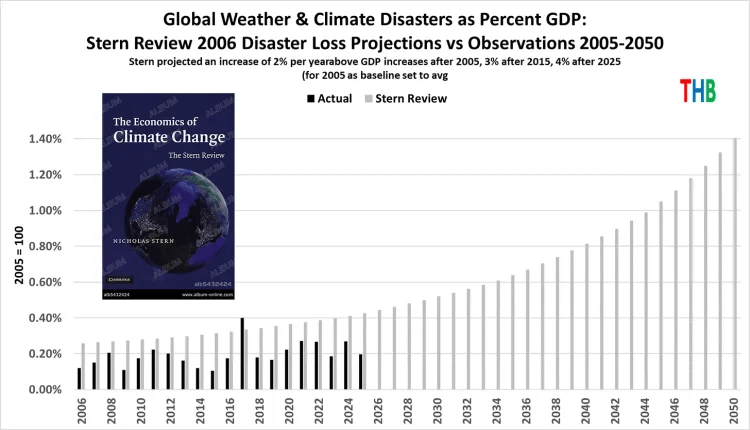
The Stern Review forecast rapidly escalating losses to 2050, when losses were projected to be about $1.7 trillion in 2025 dollars. The Review’s prediction for 2025 was more than $500 billion in losses (average annual). In actuality losses totaled about $200 billion in 2025.
The forecast miss is not subtle.
How did the Stern Review get things so wrong?
The answer is also not subtle and can be summarized in two words: Bad science.
Let’s take a look at the details. The screenshot below comes from Chapter 5 of the Review and explains its source for developing its prediction, cited to footnote 26.

As fate would have it, footnote 26 goes to a white paper that I commissioned for a workshop that I co-organized with Munich Re in 2006 on disasters and climate change.
That white paper — by Muir-Wood et al. — is the same paper that soon after was played the starring role in a fraudulent graph inserted into the 2007 IPCC report (yes, fraudulent). You can listen to me recounting that incredible story, with rare archival audio.
But I digress . . . back to The Stern Review, which argued:
If temperatures continued to rise over the second half of the century, costs could reach several percent of GDP each year, particularly because the damages increase disproportionately at higher temperatures . . .
The report presented its prediction methodology in the footnote 27, shown in full below, which says: “These values are likely underestimates.”

Where do these escalating numbers come from? Who knows.
They appear to be just made up out of thin air. The predictive numbers do not come from Muir-Wood et al., who do not engage in any form of projection.
The 2% starting point for increasing losses — asserted in the blue highlighted passage in the image above — also does not appear in Muir-Wood et al. which in fact says:
When analyzed over the full survey period (1950 – 2005) the year is not statistically significant for global normalized losses. . . For the more complete 1970-2005 survey period, the year is significant with a positive coefficient for (i.e. increase in) global losses at 1% . . .
The Stern Review seems to have turned 1% into 2% and failed to acknowledge that over the longer-period 1950 to 2005, there was no increasing trend in losses as a proportion of GDP. The escalating increase in annual losses from 2% to 3%, 4%, 5%, 6% every decade is not supported in any way in the Stern Review, nor is it referenced to any source.
When the Stern Review first came out, I noticed this curiosity right away, and did what I thought we scholars were expected to do when encountering bad science with big implications — I wrote a paper for peer review.
My paper was published in 2007 and clearly explained the Muir-Wood et al. and other significant and seemingly undeniable errors in the Stern Review.
Pielke Jr, R. (2007). Mistreatment of the economic impacts of extreme events in the Stern Review Report on the Economics of Climate Change. Global Environmental Change, 17(3-4), 302-310.
I explained in that paper:
This brief critique of a small part of the Stern Review finds that the report has dramatically misrepresented literature and understandings on the relationship of projected climate changes and future losses from extreme events in developed countries, and indeed globally. In one case this appears to be the result of the misrepresentation of a single study. This cherry picking damages the credibility of the Stern Review because it not only ignores other relevant literature with different conclusions, but it misrepresents the very study that it has used to buttress its conclusions.
Over my career in research, I’ve had some hits and some misses, but I’m happy to report that I got this one right at the time and it has held up ever since. Of course, perhaps a more significant outcome of this episode, and a key part of my own education in climate science, is that my paper was resoundingly ignored.
One reason that science works is that scientists share a commitment to correct errors when they are found in research, bringing forward reliable knowledge and leaving behind that which doesn’t stand the test of time.
I learned decades ago that in areas where I published, self-correction was often slow to work, if not just broken. Over the decades that pathological characteristic of key areas of climate science has not much improved (e.g., see this egregious example).
The Stern Review helped to launch climate change into top levels of policy making around the world. Further, we can draw a straight line from the Review to the emergence of (often scientifically questionable) “climate risk” in global finance a decade later. It still rests on a foundation of bad science.
1 My ongoing THB series on insurance and “climate risk” in finance prompted me to revisit the 2006 Stern Review, hence this post.
2 Note that the Review explicitly referenced the tabulation of global economic losses from extreme weather events as tabulation by Munich Re, which is the same dataset that I often use, such as in last week’s THB post on global disaster losses. The comparison here is thus apples to apples.
China’s top universities are opening to foreign students. That’s a big problem for US schools.
Inside China Business | February 4, 2026
Chinese universities dominate the global rankings in hard sciences, Engineering, and Computer Science. Many of them now accept international students, and are marketing their schools in foreign countries. US schools already face serious financial challenges, from the steep decline in international student enrollment. Foreign families typically pay full tuition and room and board, and American colleges rely on those higher fees. Chinese universities pose an existential problem, going forward. They are qualitatively superior, even in Western surveys. And the over cost of attendance is a mere tenth of going to a top American program. Closing scene, Shanghai Container Port
Resources and links: Mapped: How China Overtook the U.S. in Global Trade (2000–2024) https://www.visualcapitalist.com/cp/h…
Fewer international students are enrolling at U.S. colleges, which could cost the country $1 billion, reports find https://www.cnbc.com/2025/11/30/inter…
The College Conundrum: Chasing International Students And Full-Pay Families https://www.forbes.com/sites/scottwhi…
Massachusetts Institute of Technology (MIT) https://stubard.com/blog/admission/be…
Harbin Institute of Technology (HIT) https://apply.china-admissions.com/un…
Best Global Universities for Engineering https://www.usnews.com/education/best…
Best Global Universities for Computer Science https://www.usnews.com/education/best…
International college students bring billions to the US. Here’s why that may change. https://www.usatoday.com/story/news/e…
U.S. Economy Could Suffer a $7 Billion Loss from Precipitous Drop in International Students https://www.nafsa.org/about/about-naf…
Beijing cancels Panama deals after court blocks Chinese port operations
The Cradle | February 5, 2026
Chinese authorities have asked state-owned companies to suspend talks on new projects in Panama, in response to the Central American nation’s cancellation of a contract with China’s CK Hutchison Holdings to operate two ports along its strategic canal, Bloomberg reported on 5 February.
According to sources familiar with the matter, Panama’s decision could jeopardize billions of dollars in potential Chinese investments.
Chinese authorities also asked shipping companies to consider rerouting goods through other ports if the extra cost is not prohibitive, and have stepped up inspections of Panamanian imports, such as bananas and coffee.
Chinese Foreign Ministry spokesman Lin Jian issued a statement saying that the Panamanian Supreme Court ruling “ignores the facts, violates credibility,” while harming the interests of Chinese companies.
Hong Kong-based CK Hutchison responded to the Supreme Court decision by initiating international arbitration proceedings against Panama.
CK Hutchison has operated Panama’s Cristobal and Balboa ports for decades. The ports lie at opposite ends of the Panama Canal – the strategic waterway that connects the Pacific and Caribbean Oceans, and through which roughly three percent of global seaborne trade passes.
The move comes amid US President Donald Trump’s campaign to counter Chinese influence over strategic infrastructure in the Americas.
Following his election last year, Trump argued that it was “foolish” of the US to hand over control of the canal to Panama. The US built the canal in 1904 and handed it back to Panamanians nearly a century later, in 1999.
Trump has also complained about the fees Panama charges the US to use the waterway.
Amid pressure from Washington, Panama also withdrew from China’s Belt and Road Initiative (BRI) in February last year.
At the time, Beijing stated it “firmly opposes the United States using pressure and coercion to smear and undermine Belt and Road cooperation. The US side’s attacks … once again expose its hegemonic nature.”
Twenty Latin American nations have participated in the BRI since Beijing initiated it in 2013.
Current Chinese infrastructure projects in Panama include a $1.4-billion bridge over the canal, a cruise terminal constructed by China Harbour Engineering Co., and a segment of a metro line by China Railway Tunnel Group Co.
In Latin America, Trump is seeking to revive the 200-year-old Monroe Doctrine. It states that Washington will not allow European powers to interfere in the Western Hemisphere as they had in colonial times, asserting that the region would be regarded as a sphere of US interest.
Trump used the doctrine as one of his justifications for bombing Venezuela and abducting its president, Nicholas Maduro, on 3 January.
The US president claimed that Maduro was hosting “foreign adversaries in our region” and acquired “menacing offensive weapons that could threaten U.S. interests and lives.”
Russia doubts ‘bright future’ for US economic ties – Lavrov
RT | February 5, 2026
The actions of US President Donald Trump’s administration contradict its claims that it is willing to restore economic cooperation with Russia, Foreign Minister Sergey Lavrov has said.
Since returning to the White House more than a year ago, Trump has repeatedly said he wants to do business with Moscow. After a phone call with Russian President Vladimir Putin last March, the White House teased “enormous economic deals” between the two countries once the Ukraine conflict is settled.
Moscow doubts the sincerity of those claims by Washington, Lavrov said in an interview with RT’s Rick Sanchez on Thursday, ahead of Diplomatic Workers’ Day on February 10.
Not only the economic restrictions that had been slapped on Moscow under the previous administration of US President Joe Biden “all remain in place,” but “very harsh sanctions have been imposed against our largest oil companies, Lukoil and Rosneft, for the first time,” he said.
Washington’s move “surprised” Putin, the foreign minister recalled, coming just weeks after his face-to-face meeting with Trump in Anchorage, Alaska, in August, during which Moscow “supported the US proposal for a comprehensive settlement of the Ukrainian crisis.”
According to Lavrov, the Americans are now “openly trying to push Russian companies from Venezuela.” This follows a January raid by US commandos on the Venezuelan capital, Caracas, during which President Nicolas Maduro and his wife were abducted.
“India is being banned from buying Russian oil. At least, that is what was announced,” the Russian diplomat added.
Last month, Washington also said that “a state of emergency is being declared due to the threat Cuba poses to US interests in the Caribbean, including due to Russia’s hostile and malicious policies,” the minister noted.
The US is looking to introduce “a worldwide ban” on Russian oil and gas supplies, saying that they should be replaced by American oil and liquefied natural gas, Lavrov stressed.
“Well, the bright future of our economic and investment cooperation doesn’t really square with that,” he noted.
Focus on Panama’s ‘port case’ must not be misplaced
Global Times | February 3, 2026
Since the Supreme Court of Panama ruled that CK Hutchison’s concession contract to operate Panama Canal ports was “unconstitutional,” the most elated individuals over the past few days have undoubtedly been certain US politicians and media outlets. US Secretary of State Marco Rubio quickly posted on social media that the US is “encouraged,” while some American media outlets claimed this marks a “major victory” for Washington in curbing Chinese influence. The Wall Street Journal even issued a blunt threat, stating that other countries “might re-examine their ties to the world’s second-biggest economy.”
The cries of “victory” coming from the US confirm widespread outside suspicions and further expose Washington’s hegemonic arrogance in using geopolitical means to interfere with commercial cooperation and undermine trade rules. Although the US formally handed over control of the Panama Canal in 1999, in Washington’s Cold War mentality, this area remains an “inner lake” that others are not allowed to touch. The US has repeatedly expressed desire to “retake control of the Canal,” and Secretary of State Rubio chose Panama for his first overseas visit, threatening the country that it “must reduce Chinese influence.” Therefore, when the Supreme Court of Panama issued its so-called ruling, it is difficult for the international public opinion not to question its independence.
However, if one follows Washington’s rhythm and views this turmoil through the lens of “US-China competition,” they fall into a cognitive trap set by the US, and the focus on this matter becomes misplaced. These ports have never been, and should never be, bargaining chips in a geopolitical game. In fact, CK Hutchison has operated these ports for nearly 30 years; in such a long span of time, where has there ever been a shadow of a “Chinese threat”?
On the contrary, under the company’s management, these ports have been developed, benefiting the local area and contributing to global free trade. In this process, the US itself has been one of the beneficiaries. Therefore, regarding the attention on Panama’s port operation rights, if one must talk about winners and losers, the core should lie in the contest between free trade and hegemonism, and the confrontation between the spirit of contract and power politics.
Whether it is the ports along the Panama Canal, Australia’s Darwin Port mired in controversy, or the case of Nexperia in the Netherlands, the same “invisible hand” looms in the background. Some countries repeatedly claim to uphold a “rules-based order”; yet in practice, what they defend is an “order based on the interests of a single country.” This is, in essence, a targeted demolition of global investment credibility. If commercial contracts can be nullified at the whim of politicians or under pressure from allies, then no long-term investment within the Western system is truly safe. From Southeast Asia to the Middle East, global investors are watching closely, asking whether today’s rapacious acts will tomorrow descend upon any profitable industry.
International investment law does indeed recognize “security exceptions,” but these are by no means a universal master key for hegemonism. The core of international commercial law is certainty: companies that operate in compliance with the rules deserve the protection of the law. By using diplomatic coercion to push allies into rulings that defy legal principles, the US is eroding from within the very credit foundations on which the capitalist world depends. In the short term, Washington may have secured a few “strategic footholds”; however, in the long term, this has fundamentally undermined the international credibility of the US and the space for transnational commercial interactions. It is foreseeable that when the law ceases to be a fair arbiter and becomes a political tool, global capital will have to seek safe havens independent of the dollar system and the US “long-arm” influence.
What is even more concerning to the international community is that the geopolitical will of the US often surpasses the constitutions of some sovereign nations. This is a mockery of the principle of sovereign equality enshrined in the United Nations Charter. From the case of Alstom years ago to the current controversy over Darwin Port, the methods used by the US to attack competitors and seize interests are strikingly similar. The international business community needs a fair, just, and non-discriminatory business environment, not a “law of the jungle” dominated by hegemonic will. If this trend of politicizing economic and trade issues and weaponizing legal tools continues unchecked, the ultimate victim will be the entire international economic and trade order. Those who attempt to curb their rivals by undermining the rules will also find themselves facing a bankruptcy of credibility.
As an important maritime passage that carries about 5 percent of global shipping trade, the Panama Canal ports have become a crucial cargo hub on a global scale, and they should not waver under the shadow of hegemonism. According to reports, concessions for the Panama Canal ports will now need to be auctioned off.
In this context, it is hoped that the Panamanian side will truly demonstrate its “independence” by providing a predictable environment for fair competition for all bidders, rather than trying by any means to “ensure that China is blocked from the bidding” as some US media outlets have trumpeted. The whole world is watching everything that happens there.
US traders struggling to find buyers for Venezuelan oil, as China shifts supply chain to Canada
Inside China Business | February 2, 2026
Following the US takeover of the Venezuelan oil industry, commodities trading firms were given contracts to market the crude to buyers across the world, including to China. But Venezuelan crude oil is now being sold at far higher prices than before, with the profits routed through US companies and energy traders. The higher prices have pushed Chinese refiners out of the market for the heavy crude from Venezuela, and they are shifting their orders to Canada, Russia, and Iran. Canadian tar sands oil is more expensive than Venezuelan heavy sour, but is similar, and offers far shorter transit times and lower shipping costs. Chinese energy traders have been instructed to refuse new offers for Venezuelan crude. Closing scene, Wulingyuan, Hunan Resources and links:
Reuters, Vitol, Trafigura offer Venezuelan oil to Indian, Chinese refiners for March delivery, sources say https://www.reuters.com/business/ener…
China replaces US barrels with crude from Canada https://www.seatrade-maritime.com/tan…
Trump’s Venezuela oil grab is pushing Chinese refiners to Canada (Not paywalled) https://calgaryherald.com/business/tr…
Reuters Exclusive: PetroChina holds off from buying Venezuelan oil marketed under US control, sources say https://www.reuters.com/business/ener…
Bloomberg, Trump’s Venezuela Oil Grab Pushes Chinese Refiners to Canada https://www.bloomberg.com/news/articl…
Trump administration demands Venezuela cut ties with US adversaries to resume oil production https://www.cnn.com/2026/01/07/politi…
Featured Video
Laith Marouf: Hezbollah’s position on US-Iran ceasefire
or go to
Aletho News Archives – Video-Images
From the Archives
The Dirty Little Secret behind the “Global Terrorism Index”
The Omission of Israeli Terrorism in the Occupied Palestinian Territories
By Karin Brothers | Global Research | December 6, 2014
… The Israeli settlements — all of which are illegal – have been identified as a major impediment to peace. The refusal of a major “global” terrorism report to name the Israeli settlers as one of the groups most responsible for terrorism not only misrepresents a major source of regional violence but exposes the Global Terrorism Index as a propaganda tool that supports a U.S. agenda.
In recent years, governments have been attempting to thwart terrorism by blocking supportive fund-raising. When it comes to Israeli settlements, however, the US and Canada actually encourage fund-raising by giving organizations (such as Christian Friends of Israeli Communities (CFOIC) and the Jewish National Fund) financial support in the form of donor tax-deductions.
Charities which provide funds for the Israeli settlements should be regarded as terror-financing organizations. They should not only lose their tax-deductible status, but they should be banned because they support the violation of international humanitarian law. The terror-financing laws that are being strictly enforced for Muslim charities should be applied to Christian and Jewish charities as well. … Read full article
Blog Roll
 Aletho News
- The Black Cube Files: How Former Mossad Operatives Flipped a Nation
- Laith Marouf: Hezbollah’s position on US-Iran ceasefire: What you’re not being told
- Israel’s priority lies in destroying chances of peace between Iran, US: Ex-UN nuclear chief
- Ceasefire for all or for none: Iran shuts Hormuz over Lebanon attacks
- Strait of Hormuz is Iran’s ‘nuclear weapon’ that forced US retreat: Medvedev
- Energy crisis will last for months – Kremlin envoy
- Europe’s quiet role in the war on Iran
- Forty days that shook the Empire: How Iran turned the tables on US and prevailed
- Netanyahu unilaterally declares Lebanon outside of ceasefire deal
- Israeli leaders: ‘Not a single goal’ achieved in war with Iran
- If Americans Knew
- Gazans face a triple crisis: severe shortages of water and bread, healthcare in tatters
- NY Times reports how Netanyahu took the US into Iran War
- A sigh of relief over Iran, but Gaza and Lebanon in dire straits – Daily Update
- Thousands dead and neighborhoods razed to the ground: Aid agencies fear southern Lebanon is becoming the new Gaza
- The war the US is fighting for Israel could cost trillions
- ‘Cigarette Burns, Nail Wounds’: Toddler Tortured in Gaza to Coerce Father
- Trump Says US Sent ‘a Lot of Guns’ to Protesters in Iran
- Israeli forces destroy 17 UN peacekeeper cameras in south Lebanon
- US-Israeli strikes ‘completely destroy’ synagogue in Tehran
- Archbishop for US Military Says Iran War Is Unjust Under Catholic Teaching
- No Tricks Zone
- An Inconvenient Tree: Uncovered In Alps… Europe Much Warmer Than Today 6000 Years Ago
- New Study Reports A 60% Slowdown In Greenland’s Ice Loss Rate In The Last Decade
- Low Intensity Tornado Wrecks Major Solar Farm, Creating A Potential Toxic Dump
- New Study Finds Warming Saves Lives…Cold Temperatures 12 Times More Deadly Than Excess Heat
- German Science Blog Accuses PIK Climate Institute Of Hallucinating Climate Tipping Points
- Devastating Assessment Of Comirnaty Vaccine By Former Senior Pfizer Europe Toxicologist
- New Study: CO2 Is ‘Effectively Negligible’ As An Explanatory Climate Change Factor Since 2000
- Former Pfizer Toxicologist Dr. Helmut Sterz Tells Bundestag Hearing Pfizer Vaccine Should Have Never Been Approved
- Energy Expert: Germany’s Nuclear Phaseout Was A “500 Billion Euro Mistake”
- New Research: South Australia’s Mid-Holocene Sea Surface Temperatures Were 4°C Warmer Than Today
 Aletho News