The Year Ahead in Sino-American Relations
By Joseph Solis-Mullen | The Libertarian Institute | January 8, 2026
From trade frictions to security flashpoints, the new year ahead promises a mix of continuity and potential volatility in U.S.-China relations. While Beijing’s growth in relative power—economic, technological, and military—continues, it is not aimed at “taking over the world.” Instead, it reflects a pragmatic pursuit of stability and influence in Asia. Washington would benefit from strategic empathy, recognizing China’s core concerns to avoid counterproductive escalations that could harm both nations in the long-term.
With that said, here’s what to be on the lookout for in Sino-American relations in 2026.
A hallmark of the U.S.-China rivalry since Donald Trump first took office in 2017, the current round of trade war enters 2026 on shaky ground following the one-year truce brokered in October 2025 during Presidents Trump and Xi’s meeting in Busan, South Korea. This agreement paused escalating tariffs—peaking at 145% on some Chinese goods and 125% on American products earlier in 2025—and committed China to resuming purchases of American soybeans (twelve million tons by year’s end—though American farmers are apparently in need of another bailout) while easing rare earth export curbs. In return, Washington suspended expansions of export controls on advanced tech affiliates.
Bilateral trade, which plummeted 44% year-on-year to $324 billion in the first nine months of 2025, could stabilize if the truce holds, benefiting U.S. farmers and manufacturers reliant on Chinese components.
Yet, fractures are already apparent. No formal written agreement has materialized two months post-summit, leaving commitments vague, vulnerable to misinterpretation, and doing little to dissipate the regime uncertainty plaguing the planning of businesses.
Beijing, focused on resilience, has diversified exports and boosted domestic consumption, reducing reliance on the U.S. market. If the truce unravels, expect tit-for-tat measures, but China’s strategic patience could expose U.S. domestic pressures, pushing Trump toward concessions to avoid economic fallout ahead of midterms.
Longer-term, this dynamic underscores the counterproductive nature of Washington’s escalations. The growth of Beijing’s relative power in Asia is virtually inevitable, but alienating the region with trade wars only accelerates this process, harming American competitiveness without altering the regional balance.
While tensions have decreased over the past year, particularly when measured against the trade and economic categories, security remains the most dangerous and volatile arena, with Taiwan and the South China Sea as perennial hotspots. And while improvements have been made, things have been a mixed bag.
On the one hand, the Trump administration’s National Security Strategy has toned down its language on China, and the administration has avoided the outlandish statements the Joe Biden administration was perpetually walking back; until recently, Trump hadn’t approved any arms sales to Taiwan since taking office; and Republicans and Democrats alike have avoided the high level visits that occurred multiple times over the course of the previous administration. At the same time, Beijing has kept its objections to U.S. naval operations in its area pro forma and has continued to signal its desire to work with Washington to keep disputes over conflicting maritime claims beneath the threshold.
On the other, frankly less promising, hand, there have been plenty of causes for concern on both sides. In Washington, there is little appetite for revisiting the key provisions of the Taiwan Relations Act that mandate arming the island, a longstanding point of continuing friction. U.S. troops are still present on Taiwan and the offshore islands, some of which are within sight of the mainland; having spent the previous several years busily clarifying commitments to allies such as the Philippines regarding their claims to sandy spits in the South China Sea, clashes that could draw Washington into direct conflict with Beijing have continued. On that note, besides Chinese coast guard harassment of Philippine fishing vessels, Beijing has declared a new “nature reserve” at Scarborough Shoal institutionalizing its claims. While People Liberation Army (PLA) and People’s Liberation Army Navy (PLAN) incursions since Taiwanese President William Lai’s 2024 inauguration have continued, highlighting Beijing’s resolve to counter perceived independence moves, Beijing recently conducted its second major blockade simulation around Taiwan (“Justice Mission 2025”).
Note: while correlation does not prove causation, it does at least suggest it, and it is worth noting that this came exactly eleven days after the Trump administration announced an over $11 billion arms sale to Taipei, the largest sale to the island ever—quite a coincidence, if in fact it is one.
While China’s buildup narrows gaps, especially regionally, it doesn’t signal intent for worldwide conquest. Beijing prioritizes deterring U.S. intervention in Taiwan, not challenging America globally.
Hopefully, 2026 will see continued lower tensions in the key hotspots where a military conflict might erupt. Clear communication to prevent miscalculation is key, as is a degree of strategic empathy, acknowledging China’s historical sensitivities, such as Taiwan as a core interest, and avoiding escalatory actions—such as continuing to arm the northern Philippine islands with mobile missile launchers aimed at China.
Economic warfare, particularly in technology, will be a prominent 2026 undercurrent. The Busan truce temporarily halted expansions of U.S. export controls on semiconductors and AI chips, allowing sales like Nvidia’s H200 to China.
Yet, bipartisan hawks continue to push for tighter restrictions, viewing China’s tech advances as threats to American dominance in the area.
For its part, Beijing has begun countering such threats with its own controls on rare earths and critical minerals, where it holds 87% of global refining capacity, demonstrating its asymmetric leverage in this area.
Such tit-for-tat exchanges are counterproductive: U.S. restrictions have accelerated China’s domestic chip progress, eroding American corporations’ leads without curbing Beijing’s rise, while depriving Chinese firms of desired imports, raising relative costs, and lowering relative quality.
Recognizing mutual vulnerabilities, let’s hope Washington and Beijing pursue guardrails to avoid broader disruptions.
2026 offers plenty of opportunities for diplomatic breathing room through high-level engagements. President Trump plans a spring visit to Beijing, with Xi reciprocating later, plus potential meetings at G20 (U.S.-hosted) and APEC (China-hosted in Shenzhen).
These could extend the truce, focusing on fentanyl precursors, agricultural buys, and bounded tech cooperation.
Multilateral forums like BRICS (India-hosted) and G7 will test Beijing’s global outreach, emphasizing partnerships with the Global South amid U.S. tariffs.
Reestablished channels—defense talks and economic dialogues—are critical to maintain even if nothing gets accomplished. No one should want a return to the radio silence of the middle Biden years, which does nothing but heighten the chance of an escalation through misunderstanding.
Overall, there is much to be optimistic about in this area—hopefully both sides can keep the hawks at arm’s length and try to make positive improvements to the U.S.-China relationship, which is still near its post-Cold War nadir.
In 2026, China’s ascent—fueled by innovation, continued (although slowing) economic growth, and regional focus—will continue, but not as the zero-sum threat Washington often portrays. Overreactions like blanket tariffs or militarized alliances risk self-fulfilling prophecies, accelerating Beijing’s autonomy while straining US resources. Strategic empathy—understanding China’s near-abroad priorities without panic—could foster guarded stability, benefiting global growth.
As both powers play for time, the year may prove pivotal: controlled competition or renewed escalation? The choice lies more in Washington’s hands than it admits. Nothing existential is at stake in the South China Sea and while far from ideal the status quo over Taiwan has held for decades and there is no need to do anything that might upset the present situation.
Venezuela to Buy Only US-Made Products Under New ‘Oil Deal’ – Trump
Sputnik – 08.01.2026
WASHINGTON – US President Donald Trump said Venezuela would only purchase American-made products as part of a “deal” with Washington to sell the Latin American country’s oil.
“I have just been informed that Venezuela is going to be purchasing ONLY American Made Products, with the money they receive from our new Oil Deal. These purchases will include, among other things, American Agricultural Products, and American Made Medicines, Medical Devices, and Equipment to improve Venezuela’s Electric Grid and Energy Facilities. In other words, Venezuela is committing to doing business with the United States of America as their principal partner,” Trump wrote on Truth Social.
He said it is a “wise choice,” and a good thing for Venezuelans and Americans.
President Trump’s Cross of Iron
By Adam Dick | Peace and Prosperity Blog | January 8, 2026
On Wednesday, United States President Donald Trump declared in a post at Truth Social that he has determined the military budget for the next fiscal year should be hiked to 1.5 trillion dollars.
A Thursday Reuters article by Costas Pitas and Andrea Shalal quantifies Trumps proposed spending increase as amounting to a 66 percent increase over what the US Congress approved for 2026. The Reuters article further relates that this proposed increase in spending is, historically speaking, very large. The article states:
Byron Callan, a defense analyst with Capital Alpha Partners, said Trump’s post raised questions about where the funds would be directed and whether they could even be absorbed by the defense sector.
He said the last time the U.S. Defense Department saw an increase higher than 50% was in 1951 during the Korean War, with even huge surges in military spending under former President Ronald Reagan in 1981 and 1982 amounting to 25% and 20%.
An analysis of the cost of this spending should go beyond dollars alone and consider as well what economists term the opportunity costs — what is foregone because of Trump’s proposed military buildup. President Dwight D. Eisenhower provided such an analysis in his April 16, 1953 “The Chance for Peace” speech. Summing up his tabulation of opportunity costs of military spending, Eisenhower in the speech related spending on the military to “humanity hanging from a cross of iron.” Eisenhower warned:
Every gun that is made, every warship launched, every rocket fired signifies, in the final sense, a theft from those who hunger and are not fed, those who are cold and are not clothed. This world in arms is not spending money alone.
It is spending the sweat of its laborers, the genius of its scientists, the hopes of its children.
The cost of one modern heavy bomber is this: a modern brick school in more than 30 cities.It is two electric power plants, each serving a town of 60,000 population.
It is two fine, fully equipped hospitals. It is some 50 miles of concrete highway.
We pay for a single fighter plane with a half million bushels of wheat.
We pay for a single destroyer with new homes that could have housed more than 8,000 people.
This, I repeat, is the best way of life to be found on the road. the world has been taking.
This is not a way of life at all, in any true sense. Under the cloud of threatening war, it is humanity hanging from a cross of iron.
Each Congress member would do well to read or listen to Eisenhower’s speech and give it thoughtful consideration before voting on Trump’s proposed military spending increase.
China Slams U.S. Pressure on Venezuela and Vows to Deepen Trade Ties
teleSUR | January 8, 2026
On Thursday, He Yadong, a spokesperson for China’s Commerce Ministry (MOFCOM), questioned the United States for attempting to restrict Venezuela’s international economic relations and reaffirmed his country’s willingness to maintain trade ties with the South American nation.
“The hegemonic actions of the U.S. seriously violate international law, infringe on Venezuela’s sovereignty, and threaten peace and security in Latin America. China firmly opposes such actions,” He said.
“Economic and trade cooperation between China and Venezuela is conducted between sovereign states and is protected by international law and the laws of both countries. No other country has the right to interfere.”
“Regardless of changes in Venezuela’s political situation, China’s willingness to continuously deepen bilateral economic and trade relations remains unchanged,” the MOFCOM official stressed.
“China’s economic and trade cooperation with Latin American countries has always adhered to the principles of mutual respect and win-win outcomes. China does not seek spheres of influence, nor does it target any specific party. Economic complementarity serves as a solid foundation for China–Latin America cooperation, with openness, inclusiveness and mutual benefit as its defining features.”
“China will continue to work with Latin American countries to address international uncertainties through unity and collaboration, promote economic and trade cooperation on the basis of equality and mutual benefit, and achieve shared development,” He concluded.
The remarks by the MOFCOM spokesperson come after the administration of U.S. President Donald Trump informed Venezuela that it must end its relations with China, Russia, Iran and Cuba as part of a series of demands before it can extract and market its oil.
US to ease Venezuela oil sanctions after Maduro kidnapping: CNBC
Al Mayadeen | January 7, 2026
The United States is preparing “to recalibrate” its unilateral sanctions regime on Venezuelan oil, CNBC reported. Washington says the move would allow crude exports to continue without a fixed end date, a claim Caracas and several international observers reject as part of a coercive campaign to seize control over the country’s strategic resources.
The reported policy shift comes amid extraordinary tensions following the kidnapping of President Nicolás Maduro by US forces, an operation carried out without an extradition process, a United Nations mandate, or consent from Venezuelan institutions. Caracas has described the act as a grave breach of sovereignty and international law, while allied governments have warned it marks a dangerous escalation from sanctions enforcement to outright military intervention.
Against this backdrop, US President Donald Trump is expected to meet executives from major American oil companies on Friday to discuss what the White House has described as the “future” of Venezuela’s energy resources. Fox Business, citing a senior US official, said the talks will focus on managing Venezuelan oil flows as sanctions are selectively eased.
Oil Coercion Campaign
The discussions follow reports that US authorities have instructed Venezuela’s what it blatantly described as “interim leadership” to prioritize American buyers and partner exclusively with US firms in oil production, while simultaneously demanding that Caracas cut economic and security ties with key allies, including China, Russia, Iran, and Cuba.
Beijing has condemned the demands as “typical bullying,” warning that Washington is attempting to reshape Venezuela’s foreign relations and economic model through force and pressure.
Trump earlier claimed that Venezuela’s interim authorities had agreed to supply the United States with between 30 million and 50 million barrels of oil, pledging that the proceeds would be used for the benefit of both countries.
“We’re talking about 30 to 50 million barrels of oil being turned over,” Trump said. “We’re going to use the money for the benefit of the people of both countries.”
Caracas and its allies reject that framing, arguing that any such transfers, announced in the aftermath of military pressure, maritime interdictions, and the kidnapping of the country’s head of state, amount to resource extraction under duress, regardless of claims that transactions would occur at “market prices.”
Venezuelan officials note that Washington has simultaneously enforced seizures of tankers, restricted access to non-US buyers, and threatened senior political and military figures with similar treatment, narrowing Caracas’ options while portraying the outcome as voluntary trade.
Sovereignty Under Assault
The White House has yet to release full details on the scope or conditions of the sanctions rollback. Critics, however, say the sequence of events, including military escalation, leadership seizure, recognition of an interim authority, threats against remaining officials, and rapid moves to redirect oil exports, reflects a longstanding US strategy of using sanctions and force to assert control over energy assets in resource-rich states.
For Venezuela, which holds the world’s largest proven oil reserves, officials insist that oil belongs to the Venezuelan state and its people. They argue that Washington’s actions represent an escalation from economic warfare to outright aggression, setting a precedent that threatens international norms governing sovereignty, non-intervention, and the prohibition on the use of force to secure economic advantage.
US seizes Russian oil tanker
RT | January 7, 2026
The US military on Wednesday seized the Russian-flagged oil tanker Marinera in the North Atlantic, after pursuing it all the way from the Caribbean Sea.
The vessel, previously named Bella 1, was intercepted for alleged “violation of US sanctions” in the international waters to the northwest of Scotland.
The action was taken by the US Justice Department and the Department of Homeland Security in coordination with the military, the US European Command has announced.
“The vessel was seized in the North Atlantic pursuant to a warrant issued by a U.S. federal court after being tracked by USCGC Munro,” it said.
The action against the tanker supports US President Donald Trump’s “proclamation targeting sanctioned vessels that threaten the security and stability of the Western Hemisphere,” the command noted. US Secretary of War Pete Hegseth confirmed that the seizure of the vessel was related to the “blockade of sanctioned and illicit Venezuelan oil.”
The tanker first came into the US crosshairs after reportedly trying to approach Venezuela late last year. The US Coast Guard attempted to detain the vessel, yet the crew declined to let the Americans on board, and headed for the Atlantic. During the pursuit, the vessel changed its name and switched to the Russian flag.
Shortly after the capture of the Marinera, the US Southern Command said it had seized another vessel in the Caribbean Sea, describing it as “a stateless, sanctioned dark fleet motor tanker.”
“The interdicted vessel, M/T Sophia, was operating in international waters and conducting illicit activities in the Caribbean Sea. The US Coast Guard is escorting M/T Sophia to the US for final disposition,” the command stated.
US Actions in Venezuela Threaten Global Supply Chain Stability – Chinese Foreign Ministry
Sputnik – 07.01.2026
BEIJING – The US military operation against Venezuela has threatened the stability of the global supply chain and the economic situation in the country, Chinese Foreign Ministry spokesperson Mao Ning said on Wednesday.
Earlier in the day, the ABC TV channel reported, citing sources familiar with the White House’s position, that the US had required Venezuela to “agree” to an exclusive partnership with the US on oil and give preference to Washington in the sale of heavy oil. US President Donald Trump has previously called himself a key figure in the governance of Venezuela after the capture of Venezuelan President Nicolas Maduro by US forces.
“The blatant use of force against Venezuela has seriously affected Venezuela’s economic and social order and threatens the stability of the global supply chain. China strongly condemns this,” Mao said.
Cooperation between China and Venezuela is cooperation between sovereign states, protected by international law and the laws of both countries, Mao added when asked about Beijing’s plans to protect its energy interests in Venezuela.
On January 3, the US launched a massive attack on Venezuela that led to the capture of Maduro and his wife. The presidential couple was flown to New York to be tried under US laws on charges of “narco-terrorism.” On Monday, the Venezuelan Supreme Court temporarily transferred the presidency to Vice President Delcy Rodriguez, who was sworn in before the National Assembly.
The Russian Foreign Ministry has expressed solidarity with the Venezuelan people, calling for Maduro and his wife to be released and for the situation not to be allowed to escalate further. Following Moscow, Beijing called for the immediate release of Maduro and his wife, stressing that the US actions violate international law. The North Korean Foreign Ministry has also criticized the US actions.
Recession-Hit Europe to Harm Own People by Giving Ukraine €800 Billion – Orban
Sputnik – 06.01.2026
Europe, which is currently in recession, will harm its own population if it provides Ukraine with the €800 billion demanded by the country, and European citizens will begin to resist such a policy, Hungarian Prime Minister Viktor Orban said.
“Ukraine is asking for €800 billion over the next decade while Europe is in recession. Those who pay this price are harming their own people, and societies will eventually push back against policies that destroy living standards,” Orban was quoted as saying on the social network X by Hungarian government spokesman Zoltan Kovacs.
On January 3, Ukrainian Prime Minister Yulia Svyrydenko said that Ukraine would need $800 billion over the next 10 years for recovery and economic growth. According to her, Ukraine expects to secure these funds through grants, loans, and private investment.
Ukraine’s 2026 budget was adopted with a record deficit. According to Verkhovna Rada lawmaker Dmytro Razumkov, funds—including for military salaries and weapons—could begin to run out as early as February. At the same time, official Kiev expects to “patch budget holes” with aid from Western partners, which has been gradually declining.
Ending the fighting and reducing the size of Ukraine’s military could provide relief, a point repeatedly raised by Russia. However, the Ukrainian authorities continue to ignore calls for peace, despite common sense and a lack of funds, including for maintaining the armed forces.
Iran’s collapsing currency exposes the profiteers behind the crisis
By Fereshteh Sadeghi | The Cradle | January 5, 2026
In the final days of 2025, as the rial plunged to unprecedented lows, Tehran’s bustling Jomhuri (Republic) Avenue transformed into a corridor of defiance.
‘Bazaaris’ (traditional merchant class with deep political and economic influence) and cellphone shopkeepers, cornered by a collapsing currency and punishing tariffs, shuttered their stores and poured into the streets.
Their outrage ignited a fire that quickly spread to the Grand Bazaar, long considered Iran’s economic barometer. Unlike the 2022 protests over social freedoms or the 2009 unrest sparked by electoral disputes, this wave of demonstrations is driven squarely by economic collapse and long-festering mismanagement.
What began as a merchants’ revolt against an unworkable trade environment soon revealed the deeper rot of decades-long economic mismanagement, institutional corruption, and a sanctions-choked system that punishes the people to sustain itself.
Sanctions, sabotage, and a vanishing economy
Iran, a nation of over 86 million, registered a meager 0.3 percent economic growth in summer 2025, while inflation soared past 42 percent by December. Labor force participation remains abysmally low, trailing nearly 20 points behind the global average. These dire metrics have steadily worsened under the weight of relentless US sanctions, first re-imposed by President Donald Trump in 2018 during his first term, and have intensified through two presidential terms.
The rial’s spectacular collapse – breaking the 1,445,000 mark against the US dollar – did not occur in a vacuum. It marked a 47.8 percent surge in just six months.
The higher the rate was going up, the angrier were businesses whose sales are directly dependent on the dollar-rial change rate. The first spark of protests was ignited by the shopkeepers at two cellphone shopping malls in downtown Tehran. They started a strike, saying they were unable to do business because they were struggling with a new cellphone registry tariff the government had imposed on devices priced at $600 and more.
The next day, shopkeepers did not just close their shops but took to the famous Republic Avenue, protesting against the situation. The dollar dealers at Ferdowsi Avenue joined the protests too, and in the Grand Bazaar, gold and silversmiths brought their shutters down in fear of chaos.
A shopkeeper at Lalezar Street tells The Cradle that, “we were forced to close our shops as some protesters attacked us verbally and threatened to ransack our shops by hurling stones at our windows.”
In addition to sanctioning traditional routes such as banks, firms and individuals, the US Department of the Treasury’s Office of Foreign Assets Control (OFAC), has been targeting digital currency addresses it accuses of being used by a financial network to transfer Iran’s oil and non-oil money.
According to Gholma-Reza Taj Gardoun, chairman of the parliamentary budget committee, “the Iranian government only received 13 out of $21 billion oil revenues in the last eight months”. He added that “the remaining $8 billion is the cause of the current turmoil, the shortage of dollar bills in the market and the rising exchange rate.”
A rigged system of profiteers
Taj Gardoun is not alone in exposing how oil and non-oil export revenues have failed to return to Iran. At the heart of the crisis lies a parasitic class of semi-governmental enterprises and politically-connected traders who profit from Iran’s fiscal dysfunction.
Former finance minister and current lawmaker Hussein Samsami estimates that “117 out of $335 billion non-oil export revenues have not returned to the country, since the US re-imposed sanctions in 2018.” Much of this capital, he says, was siphoned off by ‘khosulati’ entities – quasi-governmental firms benefiting from state ownership yet operating without transparency or oversight.
Equally troubling is the shadowy role of “trustees” – a secretive network tasked with circumventing sanctions to sell Iranian oil.
Former Central Bank of Iran (CBI) Governor Valiollah Seif acknowledged “they are trusted people, Iranians and non-Iranians, who transfer money (for Iran),” adding “money transfer is a very risky process and the payment of these so-called trustees and the money changers working with them is high.” Seif revealed “sometimes a trustee siphons off the funds.”
Apart from the trustees, the quasi-governmental entities are also blamed for refusing to give back the non-oil export money to the central bank and sell it at rates higher than the regular CBI-approved rate at the official market.
These companies are owned by various funds affiliated with the Iranian government. The petroleum and the social welfare ministries gained a majority of the shares in these funds through the privatization process in different governments.
The third group that has not returned the export money is individuals or firms with special business permits. A deputy CBI governor reports that “Individuals who own or rented 900 special licenses must return some $16 billion to the central bank, (but they didn’t).”
The result is a liquidity trap in which foreign exchange vanishes from official markets, feeding a vicious cycle of inflation and speculation.
State paralysis and political deflection
For months, the government of Iranian President Masoud Pezeshkian appeared paralyzed, watching as the currency spiralled and public rage mounted. While some suggest the state deliberately allowed the rial to slide to ease its budget deficits, others cite institutional chaos and a lack of cohesive economic policy.
They refer to a confession made by former Iranian president Hassan Rouhani in 2020, “The foreign currency belongs to the government, the price is decided by the government and we can bring it down, if we decide it.”
In reaction to the voices of dissatisfaction, Pezeshkian tasked his interior minister with meeting the representatives of the protesters and listening to their grievances.
He sat with merchants and replaced CBI governor Mohammad-Reza Farzin with former finance minister Abdolnasser Hemmati. Nevertheless, the latter, who was impeached 10 months ago over his mismanagement of the foreign exchange market, said “he has no responsibility regarding the currency market and his task is to control imbalanced banks and reduce inflation.”
Austerity in a powder keg
In the streets, the demonstrations have morphed into sporadic riots, mostly in western provinces, marked by attacks on police stations and arson against state buildings. Casualties have been reported, including among security forces, as the protests shift from organized dissent to expressions of raw frustration.
Demonstrations in Tehran that were not large in essence have subsided, but morphed into sporadic riots. Smaller cities or towns in western Iran are now the scene of riots, with the number of rioters limited to dozens, not even hundreds.
Arson attacks against government buildings or rioters storming police stations to capture their armory have been reported. About a dozen, including police forces, have been killed countrywide, and arrests have been made.
Iran’s leader, Ayatollah Ali Khamenei, on 3 January, admitted that the ‘bazaaris’ have legitimate complaints regarding economic instability. Still, he made it clear that the Islamic Republic “will not yield to the enemy” and will deal seriously with violent protesters; “rioters must be put in their place.”
The Iranian leader’s comments were a response to Trump after he threw his weight behind the protesters, threatening the Islamic Republic with military intervention “if protesters are killed.” The Reformist Front joined in rejecting foreign threats, warning that any interference in the protests would escalate violence and distort the people’s demands.
In a last-ditch bid to regain economic control, an Iranian official from the Budget and Planning Organization says “the Trustees will be asked to return billions of dollars in their overseas accounts to the country.” A lawmaker cautions, “the parliament will question the oil minister over the issue of the Trustees.”
Iran’s minister of economy said that positive results have been achieved from negotiations with several countries, including the release of part of Iran’s financial resources and the opening of funding channels for importing essential goods, along with gradual efforts to unify the exchange rate into a single rate.
Simultaneously, Pezeshkian is pushing ahead with plans to phase out subsidies for essential imports – a move he dubs an “economic surgery” that will be offset by targeted vouchers for lower-income citizens. But austerity in the midst of currency collapse, inflation, and a credibility crisis is a combustible formula.
Iranian officials are closely tracking the situation in Venezuela, where the abduction of President Nicolas Maduro and rising US aggression offer chilling parallels. For now, Tehran’s street protests remain contained. But if the economic pain persists and reforms deepen inequality, the next wave may not be as easily quelled.
US ‘creating enemies’ by humiliating rivals – analyst
RT | January 5, 2026
The US administration is making enemies around the world by taking harsh steps such as seizing the leaders of sovereign nations, American journalist and political analyst Bradley Blankenship has told RT.
The comments come a day after Venezuelan President Nicolas Maduro was kidnapped along with his wife, Cilia Flores, during a US raid on Caracas. Washington accuses the Venezuelan leader of narco-trafficking and weapons offences, allegations he has denied.
“When you humiliate a sovereign head of state live on television, you create the conditions for the population to resist you,” Blankenship told RT on Monday. “That is what we are seeing in Caracas. When you drag a sovereign leader through New York in an open white van, you only create enemies. That is what the United States is doing.”
He said such actions risk galvanizing resistance inside Venezuela and beyond. “This is how you lose,” Blankenship said. “You do not break people’s will. You harden it.”
Blankenship, the founder of the Northern Kentucky Truth and Accountability Project, argued that Washington’s seizure of Maduro has elevated him into a powerful political symbol rather than weakening his movement.
“Maduro’s role is more symbolic than instrumental,” Blankenship said, describing him as a continuation of the Chavista political project rather than a revolutionary figure on the scale of Simon Bolivar, Fidel Castro or Che Guevara. “But he is definitely a symbol for Venezuelans as someone who resisted American imperialism,” he added.
According to Blankenship, Washington’s approach is already having wider repercussions. By carrying out the operation against Venezuela, the US has threatened multiple countries, such as Colombia, Mexico, Greenland, Cuba and Canada, as well as others across several continents.
“This is how you create enemies,” he said. “Not only abroad, but at home as well.”
Blankenship also pointed to signs of internal dissent within the US security apparatus, noting that details of the Venezuela operation were leaked to major American newspapers before it took place. “The fact that it leaked shows internal dissent,” he said, adding that similar divisions have emerged during previous US military actions.
Featured Video
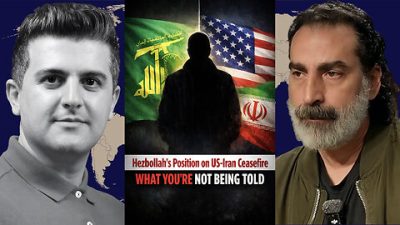
Laith Marouf: Hezbollah’s position on US-Iran ceasefire
or go to
Aletho News Archives – Video-Images
From the Archives
The Dirty Little Secret behind the “Global Terrorism Index”
The Omission of Israeli Terrorism in the Occupied Palestinian Territories
By Karin Brothers | Global Research | December 6, 2014
… The Israeli settlements — all of which are illegal – have been identified as a major impediment to peace. The refusal of a major “global” terrorism report to name the Israeli settlers as one of the groups most responsible for terrorism not only misrepresents a major source of regional violence but exposes the Global Terrorism Index as a propaganda tool that supports a U.S. agenda.
In recent years, governments have been attempting to thwart terrorism by blocking supportive fund-raising. When it comes to Israeli settlements, however, the US and Canada actually encourage fund-raising by giving organizations (such as Christian Friends of Israeli Communities (CFOIC) and the Jewish National Fund) financial support in the form of donor tax-deductions.
Charities which provide funds for the Israeli settlements should be regarded as terror-financing organizations. They should not only lose their tax-deductible status, but they should be banned because they support the violation of international humanitarian law. The terror-financing laws that are being strictly enforced for Muslim charities should be applied to Christian and Jewish charities as well. … Read full article
Blog Roll
 Aletho News
- Trump Administration Moves To Automate U.S. Military Draft Registration
- Spain orders reopening of Tehran embassy, condemns Israel’s carpet bombing of Lebanon
- Israel faces ‘unsustainable’ strategic crisis following 40-day war against Iran: Analyst
- Iran restricts Hormuz access to 15 vessels per day under ceasefire terms: Report
- The ‘Opposition Party’ Has Done Nothing to Stop the Iran War and Much to Goad Trump Into Continuing It
- Moscow backs Tehran on status of Lebanon in US-Iran deal
- How UK Regulator Ofcom Quietly Bypassed International Law to Police American Speech
- The Black Cube Files: How Former Mossad Operatives Flipped a Nation
- Laith Marouf: Hezbollah’s position on US-Iran ceasefire: What you’re not being told
- Israel’s priority lies in destroying chances of peace between Iran, US: Ex-UN nuclear chief
- If Americans Knew
- The gallows law: Israel moves toward executing Palestinian children
- Tucker Carlson: The Path to Peace requires ending ‘special alliance’ with Israel
- This is ceasefire? Israel’s biggest massacre yet in Lebanon, another journalist killed in Gaza – Daily Update
- Tucker Carlson on Israel: This Is the Behavior of an Ally? Really?
- Gazans face a triple crisis: severe shortages of water and bread, healthcare in tatters
- NY Times reports how Netanyahu took the US into Iran War
- A sigh of relief over Iran, but Gaza and Lebanon in dire straits – Daily Update
- Thousands dead and neighborhoods razed to the ground: Aid agencies fear southern Lebanon is becoming the new Gaza
- The war the US is fighting for Israel could cost trillions
- ‘Cigarette Burns, Nail Wounds’: Toddler Tortured in Gaza to Coerce Father
- No Tricks Zone
- An Inconvenient Tree: Uncovered In Alps… Europe Much Warmer Than Today 6000 Years Ago
- New Study Reports A 60% Slowdown In Greenland’s Ice Loss Rate In The Last Decade
- Low Intensity Tornado Wrecks Major Solar Farm, Creating A Potential Toxic Dump
- New Study Finds Warming Saves Lives…Cold Temperatures 12 Times More Deadly Than Excess Heat
- German Science Blog Accuses PIK Climate Institute Of Hallucinating Climate Tipping Points
- Devastating Assessment Of Comirnaty Vaccine By Former Senior Pfizer Europe Toxicologist
- New Study: CO2 Is ‘Effectively Negligible’ As An Explanatory Climate Change Factor Since 2000
- Former Pfizer Toxicologist Dr. Helmut Sterz Tells Bundestag Hearing Pfizer Vaccine Should Have Never Been Approved
- Energy Expert: Germany’s Nuclear Phaseout Was A “500 Billion Euro Mistake”
- New Research: South Australia’s Mid-Holocene Sea Surface Temperatures Were 4°C Warmer Than Today
 Aletho News