Thomas Massie Gives the ‘America First’ Leadership Trump Promised
By Jack Hunter | The Libertarian Institute | May 18, 2026
When Donald Trump ran for president in 2024, he promised, among other things, no more U.S. regime change wars, no more of America sending its citizens’ dollars to fund foreign nations, and that he and Elon Musk would drastically cut federal departments and overall spending, finally taking a hatchet to the country’s mounting debt.
In other words, the opposite of the last Republican president, George W. Bush.
It is 2026, the United States is stuck in a seemingly endless regime change war in Iran, America continues to funnel money to nations around the world (particularly Ukraine and Israel), Musk is long gone and any promises of spending cuts through the Department of Government Efficiency (DOGE) are but a distant memory.
At this juncture, President Trump’s goal seems to be to become more George W. than George W.
Then there’s Thomas Massie, the libertarian-leaning Republican U.S. congressman from Kentucky’s 4th district, who was an avid supporter of Ron Paul’s presidential campaigns in 2008 and 2012.
Long before Trump officially entered the political fray, Massie supported Dr. Paul, in part, because he promised no more endless wars, an end to foreign aid, and because he was a serious fiscal conservative.
When Trump also promised these things, Massie lent his support at various intervals and gave his full endorsement in 2024. Massie also still votes according to these principles in Congress. If those votes run against any part of Trump’s agenda, and they have—part of Trump’s early ire against Massie was his opposition to the president’s big spending “Big Beautiful Bill” last year—Massie still votes against war and foreign aid and for fiscal responsibility.
Massie has refused to change throughout. This has made Trump and people who blindly support him mad.
President Trump and his allies apparently now expect Massie to support U.S. regime change wars, to support foreign aid, and to put up with financial recklessness from Republicans. They are so angry that he won’t go along with their complete betrayal of what Trump originally campaigned on that the president, leftwing Zionist billionaires and Israeli lobbying group AIPAC have poured a historic amount of money into Massie’s primary opponent ahead of tomorrow’s election.
Team Trump insists that Massie needs to betray his principles just like they have. They are absolutely outraged that he won’t do it.
If you think this sounds completely insane, you would be correct. Only someone with their head so far up Trump’s backend could not be able to see the complete lunacy of how Team Trump now views Massie and his primary race.
There’s a lot of those, unfortunately.
What is fortunate, however, is there are also powerful conservative voices who can still discern reality.
Tucker Carlson is chief among them. Before interviewing Massie on his popular podcast earlier this month, Carlson said in his opening monologue, “Thomas Massie is, in his district, and probably nationally, but certainly we know for a fact in his district, the most popular person.”
He continued:
“Thomas Massie has made good on the promises that Donald Trump made to the nation. Thomas Massie is a better standard bearer for Trumpism, for the ‘America First’ ideology that Donald Trump ran on three times, than Donald Trump is.”
Carlson went even further about Massie’s overall character. “He is, in short, the American they told us we should aspire to be. He is the man you want your son to be.”
That’s high praise.
Another Massie fan is Dr. Ron Paul, who was exiting Congress when the Kentucky Republican was elected in 2012. Paul has said of Massie:
“I met Thomas before he came to Congress and was sworn in before his class was actually sworn in. But I was leaving Congress a few weeks later. So we actually crossed paths so we could say we served in Congress together.”
Paul would add, “I knew he was very dedicated to the cause of liberty. I was anxious to help him. And I think he has proved his case for being a defender of liberty and the Constitution.”
The same Thomas Massie who supported Ron Paul’s presidential runs and who now votes according to those libertarian principles is the same in his beliefs now as he has been throughout his entire political journey. For a time, Trump claimed to believe in these things too, but now clearly doesn’t. As Carlson notes, in the three times he ran for president, Trump promised an “America First” agenda and now, today, prioritizes the state of Israel and other foreign interests over those of the country he was elected to lead.
Which indeed makes Massie “a better standard bearer for Trumpism,” or at least what Trump advertised himself as originally, than Trump himself.
This is barely even debatable. It is almost perfectly clear to anyone not completely blinded by mind-numbingly dumb partisanship.
Again, what Donald Trump and his supporters now truly need from Thomas Massie is for him to betray those principles too. To join them in putting America second or third or worse.
But he won’t. And thank God for that.
US to Spend Over $740Bln for 7,800 Space Interceptors in Golden Dome System
Sputnik – 18.05.2026
The US would need to deploy 7,800 satellites costing $743 billion over 20 years to intercept a limited raid of 10 simultaneous missiles as part of a space-based layer of the proposed Golden Dome system, Sputnik found based on analysis of the system by the US Congressional Budget Office (CBO).
The space-based interceptor layer represents the most expensive component of the Golden Dome system that CBO estimates would cost $1.2 trillion to develop, deploy, and operate for two decades. This space layer alone accounts for 60% of the total expenditure and 70% of the $1 trillion in acquisition costs. This total estimate significantly exceeds the $185 billion figure cited by the director of the Office of Golden Dome for America for the system’s objective architecture over the next decade.
Maintaining this coverage creates a significant financial burden due to atmospheric drag at altitudes between 300 and 500 kilometers. This drag causes orbits to decay, limiting the service life of each satellite to roughly five years. To maintain a constant presence of 7,800 satellites, the US would need to launch approximately 1,600 replacement satellites annually, totaling roughly 30,000 launches over 20 years. Despite assuming future launch costs of $500 per kilogram facilitated by next-generation heavy-lift rockets, the average cost per satellite remains $22 million.
According to the report, the massive size of the constellation is required because the satellites are designed to engage missiles during the boost phase, the brief window of three to five minutes while a missile’s rocket motor is still burning. Because satellites in low-Earth orbit move in bands and cannot remain fixed over specific launch sites, thousands of units are necessary to ensure that enough interceptors are always positioned close enough to a potential launch to reach the target before the boost phase ends.
Beyond the space-based layer, the remaining costs of the Golden Dome system include a combination of surface-based defenses and tracking infrastructure. CBO estimates that 35 regional sectors would cost $187 billion over 20 years to provide terminal defense against cruise and hypersonic missiles, while three upper wide-area surface sites and four lower wide-area surface sites would add $46 billion and $29 billion, respectively. Additionally, a separate satellite constellation for tracking targets would cost $90 billion over two decades, with another $92 billion allocated for general research, development, and system integration.
UAE fuelling African conflicts while evading accountability, SWP finds
Al Mayadeen | May 17, 2026
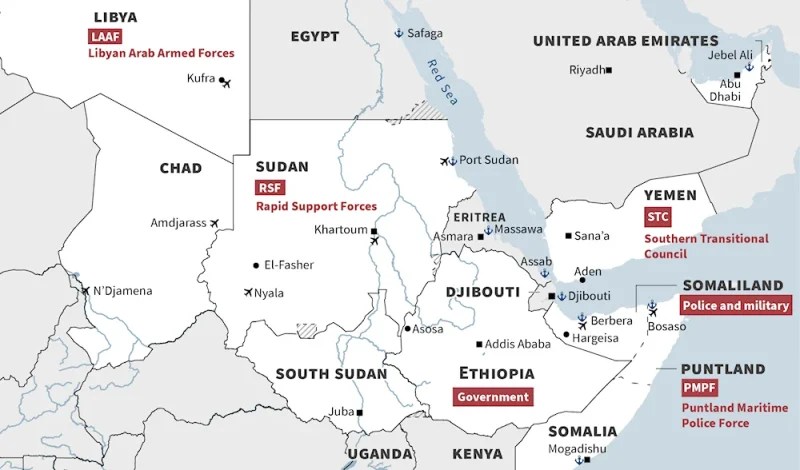
A newly published report by the German Institute for International and Security Affairs (SWP) has delivered a critical assessment of the United Arab Emirates’ role in African conflicts, describing Abu Dhabi as a systematic spoiler that arms proxy forces, manipulates diplomatic processes, and bears significant responsibility for some of the world’s worst humanitarian crises, all while facing virtually no political consequences from its Western partners.
The report, authored by researchers at one of Europe’s most influential foreign and security policy think tanks, which directly advises the German government and Bundestag, calls on Berlin and its European partners to fundamentally reassess their relationship with the UAE.
Sudan: The clearest case
The report presents Sudan as the most devastating example of Emirati interference. The UAE is identified as the most important military, logistical, and financial backer of the Rapid Support Forces (RSF), the paramilitary group whose war against the Sudanese Armed Forces has produced what the UN reports as the world’s largest humanitarian crisis, with 33.7 million people dependent on aid, over 15 million displaced, and widespread extreme hunger.
The RSF’s conduct has been particularly brutal. The report details targeted violence against non-Arab minorities, including sexual violence, mass killings, attacks on medical facilities, and hostage-taking, primarily directed at groups such as the Masalit and Zaghawa.
When the RSF captured El-Fasher in North Darfur in October 2025, a UN fact-finding mission described its actions against the civilian population as bearing the hallmarks of genocide.
Emirati support for the RSF continued even after Iranian strikes on the UAE, with numerous cargo flights departing from Emirates airports to Ethiopia, apparently to ferry supplies across the border to RSF positions.
A UN panel of experts documented 458 flights involving heavy transport aircraft from Emirati military airports or the transhipment hub of Bosaso to eastern Libya between October 2024 and the end of 2025, 239 of them bound for Kufra, a key hub for RSF resupply, in likely violation of UN arms embargoes on both Libya and Darfur.
A proxy model built on plausible deniability
The UAE rarely deploys its own forces. Instead, it operates through a carefully constructed network of local proxies, private military contractors, and logistical intermediaries. Beyond the RSF in Sudan, its partners include Khalifa Haftar’s Libyan Arab Armed Forces, the Puntland Maritime Police Force in Somalia, and, in a departure from the pattern, the Ethiopian government during its war against the Tigray people.
The report details how the UAE recruited and deployed hundreds of Colombian mercenaries to Sudan via an Emirati security firm, with the US government noting in 2025 that these fighters had served as infantry, artillery personnel, drone pilots, and even trained children for combat.
Supplies to the RSF have been routed through LAAF-controlled Libya, Chad, Kenya, Uganda, and Rwanda, with Abu Dhabi deploying financial leverage to secure cooperation, including a 1.5 billion dollar loan to Chadian President Idriss Déby in 2023.
The UAE also profits from gold smuggling networks in conflict zones, with members of the ruling family reported to have personal ties to both Haftar and RSF commander Mohamed Hamdan Dagalo.
Why the UAE intervenes
SWP identifies several overlapping motives. Economic interests are central, as state-owned logistics giants DP World and AD Ports Group have port and infrastructure projects across the continent, and military interventions serve to protect access to trade routes and strategic resources.
But economics alone do not explain the pattern. The report points to the UAE’s drive to outcompete Saudi Arabia for regional influence, a rivalry that has only sharpened since Riyadh forced Abu Dhabi out of southern Yemen.
Ideological opposition to the Muslim Brotherhood also shapes policy, with the UAE consistently backing actors who suppress Islamist movements. Personal enrichment through resource networks and ruling family ties to conflict actors adds a further layer.
Diplomatic manipulation
The report scrutinises the UAE’s use of diplomatic engagement as cover, whereby Abu Dhabi participates in international peace processes while simultaneously intensifying support for belligerents.
In September 2025, the UAE joined the Sudan Quad format alongside Egypt, Saudi Arabia, and the United States, signing joint commitments to end external support for conflict parties. According to US intelligence reporting, however, the UAE was actively intensifying support for the RSF at the same time.
The UAE also pledged 200 million dollars at a February 2025 humanitarian conference and a further 500 million dollars at a US conference in 2026, while contributing only around 33 million dollars to the UN-coordinated humanitarian plan.
In November 2025, Emirati Minister of State Lana Nusseibeh spent four days meeting with Members of the European Parliament in Brussels. Nusseibeh’s endeavor was successful, as a Parliament resolution on Sudan adopted at the same time made no mention of the UAE’s support for the RSF, following opposition from the European People’s Party to amendments tabled by left-wing parliamentary groups.
The same pattern played out during the Berlin Libya Process in 2019-20, when the UAE pledged to halt arms transfers to Libyan conflict parties but continued them regardless. Transport aircraft flew from the Emirates to eastern Libya on the very day of the Berlin conference in January 2020.
European silence, eroded accountability
The report stresses that Western governments, including Germany, have consistently refused to name the UAE publicly in international forums, despite substantial documented evidence of its role in fuelling conflicts. No UN Security Council member has explicitly raised Emirati support for the RSF in formal meetings, either.
This reluctance, SWP argues, is not incidental but reflects a broader calculation in which trade ties, security cooperation, the UAE’s close relationship with “Israel,” and the strategic goal of preventing Abu Dhabi from drifting further toward China or Russia have consistently outweighed accountability concerns.
The UAE’s open disregard for the UN embargo on Libya from 2014 onward, the report notes, likely encouraged other states to adopt a similar approach, with the same dynamic now being repeated in Sudan.
Five recommendations
SWP outlines five concrete steps for Germany and its European partners:
- First, Abu Dhabi should be named explicitly in international forums rather than referenced in vague language about “external actors.”
- Second, EU financial sanctions should be expanded and applied more consistently where Emirati actors have documented embargo violations.
- Third, German arms export policy toward the UAE requires a fundamental review, given the documented transfer of German-chassis military equipment to conflict zones.
- Fourth, anti-money-laundering enforcement should be tightened, with greater focus on Emirati financial centres as hubs for conflict economies and sanctions evasion.
- Fifth, the strategic partnership Germany has maintained with the UAE since 2004 should, at a minimum, be suspended unless Abu Dhabi demonstrably reorients its policy toward de-escalation.
The report concludes that the war on Iran, mounting tensions with Saudi Arabia, and growing reputational vulnerabilities have made the UAE more susceptible to European pressure than at any previous point, and that this window should not go unused.
Saudi Arabia is pulling Europe toward a “Gulf Helsinki” deal with Iran — because Washington failed
By Tamer Ajrami | MEMO | May 17, 2026
When military power fails to impose “deterrence,” oil becomes politics. And the Strait of Hormuz is now writing Gulf security rules instead of the Pentagon.
With Hormuz still closed and the emergency oil stock releases used to calm markets running down, prices are moving _ no matter how much some people deny it _ toward a new surge. The real problem is not the price as a number. It is the chain reaction: gasoline and diesel, shipping and insurance, raw materials, and then inflation that travels from Asia to the United States. And even if the strait opened tomorrow, the damage would not vanish. Supply chains do not reset overnight, and parts of the oil and petrochemicals flow would take time to recover.
In my previous Middle East Monitor article, I said clearly that Gulf states “have nothing but to talk to Iran now”. That was not idealism or goodwill. It was hard security math: the old formula is eroding. Bases do not protect the way people assumed, and guarantees shrink the moment they face a real test. Today, this is no longer an argument. It is a reality driven by markets before politics.
Trump and China: A visit without a lifeline — and Time is against him
Trump’s attempt to turn to China produced no clear exit. Not because Beijing is powerless, but because it sees the issue in simple terms: open the strait through practical understandings, and negotiate with Iran on realistic terms.
The problem is that Washington still wants a “surrender” wrapped in diplomatic language. Iran sees no reason to give that for free as it holds leverage in a global energy shock.
This is the core of Trump’s trap: he can say whatever he wants, but he cannot cancel economics. Markets do not negotiate. They punish.
That is why countries are now moving on two tracks: a unilateral track to protect their own interests, and a collective track to design a new framework that prevents the next shock. Saudi Arabia is stepping forward to lead the collective track, not because it loves “mediation” as a headline, but because the cost of ongoing chaos has become higher than the cost of a deal.
A New “Helsinki Act” — But without the Human Rights Basket
According to Western reporting, Saudi Arabia is floating something close to a “Gulf Helsinki Act” arrangement with Iran—modeled on the Helsinki process of the mid-1970s during the Cold War. It would not be just a Saudi–Iran deal. It would extend to the Gulf and the European Union, aiming to lock in non-aggression, structured economic normalization, and monitoring and implementation mechanisms.
The original Helsinki process was built around four “baskets”: security and non-aggression; economic cooperation; human rights and self-determination; and follow-up mechanisms. In the Middle East, copying the third basket is unrealistic. The region’s unwritten rule is non-interference. Here, states do not use “human rights” language as a tool to destabilize each other internally. So, the Saudi approach seems to focus on three practical baskets: security and non-aggression, economic cooperation and stable energy flows, and verification/implementation.
It is a practical logic: if you want an agreement that can survive, you do not plant a delayed bomb inside it.
The Hard Question: Can a Deal work without the United States?
Here is the central dilemma. A Gulf–EU–Iran non-aggression arrangement without the United States creates a dangerous gap: the Gulf and Europe commit to non-aggression, Iran commits too, but Washington and Israel still retain the ability to strike Iran. What does the agreement do then? Does it become a nice document that collapses at the first air raid?
On the other hand, bringing Washington into the deal is not easy either. The US is struggling to produce a quick bilateral agreement with Iran to end the crisis, so why would it accept a broader framework that limits its freedom of action?
This opens a third, more sensitive option: Gulf states and Europe “bypass Washington” in practice. That would mean refusing the use of their airspace and territorial waters for any military or intelligence activity against Iran. And maybe refusing to enforce sanctions that destabilize the region and recreate the Hormuz shock. This is not a small move. It would be a strategic shift.
The UAE: A Different Vision — and a Dangerous Ceiling
The Gulf is not unified on strategy. Other reporting suggests Emirati efforts to push a coordinated Gulf military “response” against Iran. The problem is not the idea of response by itself. The problem is the ceiling of objectives.
If the goal is limited deterrence to reduce escalation, that is one thing. But if the goal mirrors Netanyahu and Washington _ regime change, dismantling Iran’s nuclear program, destroying its ballistic capabilities, and reshaping Iran from the inside _ that is a long war. And the Gulf does not have the luxury to absorb its costs.
Most importantly, the idea of “escaping Hormuz” through alternative pipelines is not a real solution. If peace collapses, fields, ports, and energy infrastructure across the region remain within range. And Bab al-Mandab can become another choke point. In the end, the issue is not a pipeline or a port. It is a sustainable peace that prevents the drone and the missile before it “manages” the price.
Whoever Ends the War Ends the Chaos
A way out starts from one point: ending the US–Israeli confrontation with Iran through a realistic understanding; then building a regional framework similar to “Helsinki” that locks in non-aggression, protects economies, and prevents a repeat of the strait crisis.
Saudi Arabia is trying to “hold the story together” because Washington entered, got stuck, and now wants to exit; while the Gulf cannot afford to sit between Iran’s leverage and America’s disorder.
The choice is clearer than ever: either a settlement that closes the door on choke-point warfare, or a longer crisis that bankrupts markets before it bankrupts armies. The Gulf; whether it likes it or not; no longer has the option to “wait”.
Trump’s Failed Mission to China
By Larry C. Johnson | SONAR21 | May 15, 2026
The Beijing circus is over and Donald Trump’s talks with Xi Jinping produced nothing more than some pleasing photo ops and some performative diplomacy with no substantive accomplishments.
There was no final communique at the end of Trump’s two days of meetings with Xi Jinping. Instead, we are left to rely on the statements from each government. When you parse the two statements, the two readouts diverge significantly, and the gaps are as informative as the overlaps. When you compare what each side claims was discussed you can see what actually transpired at the summit.
The divergence between the two readouts is stark and strategically deliberate. Here is a precise accounting of what the White House emphasized that China’s Foreign Ministry either omitted entirely or mentioned only in the vaguest terms:
1. The Iran War and Nuclear Weapons — Omitted by China
This is the most consequential gap. The White House readout stated explicitly:
The two sides agreed that the Strait of Hormuz must remain open to support the free flow of energy. President Xi also made clear China’s opposition to the militarization of the Strait and any effort to charge a toll for its use, and he expressed interest in purchasing more American oil to reduce China’s dependence on the Strait in the future. Both countries agreed that Iran can never have a nuclear weapon.”PBS
The Chinese readout, by contrast, merely said that “the two sides discussed the Middle East conflict” without offering any further details — no mention of the Strait, no mention of tolls, no mention of Iran’s nuclear program, and no acknowledgment of any agreed position on any of those issues. YouTube
This gap is enormous. The White House is asserting that China agreed Iran can never have a nuclear weapon and opposed Iran’s toll regime. That White House is spinning this as significant Chinese concessions that Beijing clearly did not want attributed to it publicly. However, according to a reliable source with access, Xi firmly rejected Trump’s request that China apply pressure on Iran and help open the Strait of Hormuz.
2. Fentanyl — Omitted by China
The White House readout specifically noted that the two sides discussed “addressing fentanyl precursor flows into the United States” — a longstanding US demand that China reduce the flow of chemical precursors used to manufacture fentanyl. The Chinese readout made no mention of fentanyl whatsoever, which is consistent with Beijing’s longstanding position that it has already done enough on the issue and resists framing it as a bilateral problem. Komo News
3. Agricultural Purchases — Omitted by China
The White House noted that the two presidents discussed “increasing Chinese purchases of U.S. agricultural products.” China’s readout spoke only in general terms about trade being “mutually beneficial” and made no specific commitment to agricultural purchases. YouTube
4. Market Access for US Businesses — Framed Very Differently
The White House described the meeting as centered on “expanding market access for American businesses into China and increasing Chinese investment into US industries.” China’s readout framed this entirely differently — as China “opening its door wider” on its own terms, not as a response to US demands for market access.
5. The Business Delegation — Treated Asymmetrically
The White House noted that “leaders from many of the United States’ largest companies joined a portion of the meeting,” treating it as a substantive commercial engagement. The Chinese readout mentioned that Trump “asked each of the business leaders who were traveling with him to present themselves to President Xi” — framing it as a courtesy introduction rather than a substantive business discussion. YouTube
6. Taiwan — The Mirror Image Problem
The most telling asymmetry runs in the opposite direction on Taiwan. The White House readout did not mention Taiwan at all, while China centered its entire readout on Xi’s Taiwan warning. Trump declined to answer a reporter’s question about whether he and Xi had even discussed Taiwan. Rubio told NBC News that the US was “not asking for China’s help with Iran” — a comment that implicitly pushes back on what the White House readout seemed to suggest about Chinese cooperation. The National DeskBreitbart
The Bottom Line
Both sides released statements detailing what Trump and Xi discussed, but they only overlap in limited areas. The statements diverge most sharply on Iran — where the US claims specific Chinese commitments that China refused to acknowledge — and on Taiwan, where China made explicit warnings that the US declined to even mention. NPR
The pattern is diplomatically classic: each side published the readout that serves its domestic political needs and advances its negotiating position. China wanted the world to see Xi issuing stern warnings on Taiwan. Washington wanted the world to see China agreeing that Iran can never have a nuclear weapon and opposing Iran’s toll regime. Whether either claimed concession is real — or merely asserted — is precisely what makes the readout divergence so revealing.
The Strategic Framework
Xi opened with a sweeping philosophical framing: “Transformation not seen in a century is accelerating across the globe, and the international situation is fluid and turbulent.” He posed three questions to Trump directly: Can China and the United States overcome the Thucydides Trap and create a new paradigm of major-country relations? Can we meet global challenges together and provide greater stability for the world? Can we build a bright future together for our bilateral relations? Wikipedia
Xi announced the two leaders had “agreed on a new vision of building a constructive China-U.S. relationship of strategic stability,” defining it precisely: “Constructive strategic stability means positive stability with cooperation as the mainstay, healthy stability with competition within proper limits, constant stability with manageable differences, and lasting stability with expectable peace.” He said this framework “will provide strategic guidance for China-U.S. relations over the next three years and beyond” and stressed: “Building a constructive China-U.S. relationship of strategic stability is not a slogan. It means actions in the same direction.” Wikipedia
Trade and Economics
Xi stated that “China-U.S. economic and trade ties are mutually beneficial and win-win in nature. Where disagreements and frictions exist, equal-footed consultation is the only right choice.” He said the economic and trade teams had “produced generally balanced and positive outcomes” at preparatory talks the prior day, and that “China will only open its door wider. U.S. businesses are deeply involved in China’s reform and opening up.” Wikipedia
Military and Diplomatic Channels
Xi called on the two sides to “make better use of communication channels in the political and diplomatic and military-to-military fields” and to “expand exchanges and cooperation in areas such as the economy and trade, health, agriculture, tourism, people-to-people ties and law enforcement.” Wikipedia
Taiwan — The Sharpest Language in the Readout
Xi was unambiguous: “The Taiwan question is the most important issue in China-U.S. relations. If it is handled properly, the bilateral relationship will enjoy overall stability. Otherwise, the two countries will have clashes and even conflicts, putting the entire relationship in great jeopardy. ‘Taiwan independence’ and cross-Strait peace are as irreconcilable as fire and water. Safeguarding peace and stability across the Taiwan Strait is the biggest common denominator between China and the U.S. The U.S. side must exercise extra caution in handling the Taiwan question.” Wikipedia
International Issues
The readout notes that the two presidents “exchanged views on major international and regional issues, such as the Middle East situation, the Ukraine crisis, and the Korean Peninsula” — but offered no further detail on any of those topics in the official Chinese text. Wikipedia
APEC and G20
The two presidents agreed to support each other in hosting a successful APEC Economic Leaders’ Meeting and G20 Summit this year. Wikipedia
Wang Yi’s Closing Assessment — May 15
Foreign Minister Wang Yi told state media: “This was an important meeting in which the two heads of state engaged in in-depth communication and achieved substantial outcomes,” calling it “a historical meeting.” He particularly touted progress on trade and economic issues. China’s Foreign Ministry also confirmed that President Xi Jinping will visit the United States this fall at the request of President Donald Trump.
As far as Iran is concerned, the Chinese and Russians are working behind the scenes — using Pakistan as a frontman — to erect a new security architecture for the Persian Gulf. The current effort is to convince Saudi Arabia and Qatar to effectively cut military ties with the US and enter into a strategic agreement that will be guaranteed by Russia and China. If Saudi Arabia and Qatar persist with prohibiting the US to use their bases and air space for a new set of attacks against Iran, the US may be compelled to call off planned strikes.
US’s war of choice on Iran imposed avoidable costs on Americans: FM
Press TV – May 16, 2026
Foreign Minister Abbas Araghchi says the US’s unprovoked aggression towards Iran has burdened ordinary Americans with avoidable economic costs.
“Americans are told that they must absorb rocketing costs of war of choice on Iran,” the top diplomat wrote in a post on X on Saturday.
“Put aside gas price hike and stock market bubble. Real pain begins when US debt and mortgage rates start to jump. Auto loan delinquencies are already at 30+-year high,” he added. “This was all avoidable.”
Together with the Israeli regime, the United States waged its latest bout of unlawful attacks on the Islamic Republic between February 28 and April 7.
The aggression prompted decisive and uncompromising reprisal featuring devastating blows to American and Israeli targets across the region. In addition to causing extensive material damage to the targeted sites, the Islamic Republic shut down the strategic Strait of Hormuz to enemies and their allies, therefore, sending shockwaves throughout global energy markets.
Including reconstruction and replacement costs, the war is so far estimated to have run Washington a cost likely ranging between $40 billion and $50 billion.
Economists, meanwhile, project the overall cost of continued restrictions imposed on the Strait of Hormuz to end up astronomically higher.
Professor Linda Bilmes, a public policy expert at Harvard Kennedy School, recently forecast that the war on Iran could ultimately cost American taxpayers $1 trillion.
On Friday, Mohammad-Baqer Qalibaf, Iran’s Majlis (Parliament) speaker, warned that the United States’ efforts at sustaining military escalation near the strait could trigger a fresh global financial crisis at a time when Washington’s national debt already stands at a whopping $39 trillion.
China’s position on Iran, Hormuz remains unchanged
Al Mayadeen | May 15, 2026
China moved on Friday to publicly reaffirm its longstanding position on Iran after speculation and conflicting reports circulated regarding Beijing’s stance during recent regional tensions, with the Chinese Foreign Ministry publishing a full statement outlining its official position.
Asian diplomatic sources told Al Mayadeen that Washington is expected to continue promoting claims that it succeeded in persuading Beijing to pressure Iran, particularly following recent US-China discussions surrounding the Strait of Hormuz and the Iranian nuclear file.
The sources said that the growing American rhetoric regarding “the Iranian nuclear issue” or claims of an agreement with Beijing on keeping the Strait of Hormuz open “without fees” are merely “attempts at media flooding and covering up the essence of the matter.”
China’s position on Iran clear, unchanged
The sources stressed that China’s position toward Iran “is clear and unchanged,” dismissing reports suggesting a shift in Beijing’s stance as false. They noted that China deliberately refrained from discussing Iran publicly during earlier talks before later issuing a full Foreign Ministry statement outlining its official position in detail.
Beijing continues to oppose the possession of nuclear weapons while simultaneously supporting Iran’s right to the peaceful use of uranium and civilian nuclear technology. China also maintains its longstanding position in favor of keeping the Strait of Hormuz open and preventing its militarization, while supporting Iran’s rights as a coastal state bordering the strategic waterway.
The sources added that “China buying oil or gas from the United States is nothing new because China diversifies its energy sources, but no one can replace Iranian oil or Hormuz energy imports, which constitute 45 percent of its energy needs.”
They further noted that China continues to support the creation of a joint regional security structure among Gulf states without outside interference, describing Beijing’s current “calm rhetoric” as an attempt to contain the “arrogance” of US President Donald Trump and his allies while creating conditions for a broader agreement through mutually beneficial economic incentives.
The sources noted that narratives suggesting a major Chinese shift against Iran are either inaccurate, deliberately misleading, or attempts to present recent diplomatic developments in the best possible light for Washington.
Trump, Xi, agree to address each other’s concerns
Meanwhile, Chinese President Xi Jinping and US President Donald Trump held extensive discussions on bilateral and global issues and reached a series of new common understandings, China’s Foreign Ministry said Friday, as Beijing called for accelerated diplomacy between the United States and Iran.
Chinese Foreign Ministry spokesperson Lin Jian said the two leaders agreed to address each other’s concerns and enhance communication and coordination on international and regional affairs, describing the talks as a step toward building a “constructive and stable strategic relationship” between China and the US.
Commenting on ongoing US-Iran negotiations, the Chinese Foreign Ministry stressed that a comprehensive and lasting ceasefire should be achieved “as soon as possible,” adding that a rapid resolution would benefit the United States, Iran, regional countries, and the broader international community.
“The war between Iran and the United States should not have erupted in the first place, and there is no need for it to continue,” the ministry said.
Beijing reiterated its longstanding position that dialogue and negotiations remain the best path forward, warning against military escalation and emphasizing that “a military solution is not the answer.”
“Now that the door to dialogue has been opened, it should not be closed again,” the ministry said, calling for efforts to consolidate momentum toward de-escalation. China also said it would continue working with the international community to provide greater support for peace talks between the US and Iran.
Guatemala Admits U.S. Pressure Over Cuban Doctors
teleSUR | May 14, 2026
Guatemalan Foreign Minister Carlos Ramiro Martínez acknowledged Tuesday that the country has faced pressure from the United States regarding the presence of Cuban medical brigades, as the government moves to end a long-standing healthcare cooperation agreement with Havana.
Asked whether Washington had requested that Guatemala terminate the program a year earlier than planned, Martínez said that “there has always been pressure surrounding the Cuban medical brigades,” though he stopped short of directly confirming U.S. involvement in the decision.
Cuban medical personnel first arrived in Guatemala in 1998 after Hurricane Mitch devastated the country and caused nearly 300 deaths. The administration of President Bernardo Arévalo has now decided to end the agreement with Cuba after almost 30 years of uninterrupted collaboration.
“It is an agreement that is 27 years old and was established under a formula created 27 years ago. There is no government hiring process; the Cuban doctors are hired individually, and the Ministry of Health pays each of them,” Martínez said.
The foreign minister stated that the agreement will remain in force until August next year.
“That is the extent of our commitment to carry out this process. I do not like the word expulsion. The scenario, returning to your point about demands from the United States, has been on the agenda of those we already know,” he added.
Martínez also said the Guatemalan government is working closely with the Cuban embassy to ensure that the withdrawal of the brigades “does not violate primary healthcare services for Guatemalans.”
In February, the government announced the departure of the Cuban medical team and unveiled a replacement plan beginning in April, aimed at substituting the 412 members of the Cuban brigade with local professionals.
According to the Guatemalan Ministry of Health, the withdrawal process will take place gradually between April and December of this year and includes 333 doctors as well as technical and administrative personnel.
Trump Visits Beijing In a World Washington No Longer Controls
By Joseph Solis-Mullen | The Libertarian Institute | May 14, 2026
When President Donald Trump arrived in Beijing yesterday for his summit with Xi Jinping, much of the American foreign policy establishment framed the meeting through the familiar lens of “great power competition.” Analysts will scrutinize every handshake, communiqué, and trade announcement for signs that Washington is either “standing up” to China or “conceding” ground to its principal rival.
But the more important reality is that the summit will likely underscore just how much the balance of leverage has shifted over the past several years—and how little appetite Beijing has for rescuing Washington from the consequences of its own strategic blunders.
The prevailing assumption in Washington remains that China is an aggressive revisionist power poised to overturn the international order through military expansion and economic coercion. Yet the actual picture is considerably more complicated. Beijing’s posture today looks less like that of a state eager for global confrontation and more like that of a rising commercial empire patiently exploiting American overextension.
That overextension is now impossible to ignore.
Washington’s latest entanglement in Iran has once again demonstrated the limits of American power projection. Years of interventionism, sanctions escalation, proxy commitments, and military signaling have produced precisely what critics of U.S. foreign policy long warned about: another unstable regional crisis with no clear off-ramp and no coherent strategic objective.
And notably, China has shown almost no interest in helping Washington navigate the mess.
Despite endless warnings from hawks that Beijing and Tehran are inseparable strategic partners, China’s actual behavior has been far more restrained and transactional. Beijing benefits from Iranian energy flows and prefers regional stability, but it has little reason to actively bail out an American foreign policy establishment that helped create the crisis in the first place. From Beijing’s perspective, every additional dollar and hour Washington spends bogged down in the Middle East is a dollar and hour not spent in East Asia.
That reality carries profound implications for Taiwan.
For years, American policymakers have insisted that Washington could effectively deter—or if necessary defeat—a Chinese effort to forcibly reunify Taiwan with the mainland. Yet recent events reveal how implausible that confidence increasingly appears. If the United States struggles to maintain readiness, logistics, and political cohesion while managing comparatively limited Middle Eastern operations thousands of miles from China, what exactly convinces anyone that it could successfully wage and sustain a high-intensity conflict directly off the Chinese coast?
The uncomfortable truth is that Beijing likely sees America’s Iran difficulties not as a warning, but as confirmation of long-standing Chinese assumptions about U.S. decline and strategic exhaustion.
China, meanwhile, has continued strengthening the areas that matter most in long-term competition: trade, industrial capacity, and monetary influence.
Over the past year especially, Beijing has deepened commercial ties throughout the Global South while accelerating efforts to denominate trade outside the dollar system. None of this means the dollar is about to collapse tomorrow, as breathless commentators sometimes claim. But it does mean that Washington’s ability to weaponize the global financial system is gradually eroding at the margins.
That erosion matters because American coercive power increasingly depends less on productive economic strength and more on financial leverage, sanctions architecture, and control of chokepoints. China understands this perfectly, which is why it has spent years systematically reducing vulnerabilities while building leverage of its own.
Perhaps nowhere is that leverage more obvious than in rare earths processing.
Washington often speaks as though China’s dominance in rare earth supply chains is merely an unfortunate market distortion that can easily be corrected with sufficient industrial policy. In reality, Beijing possesses something far more significant: a near-stranglehold on the processing infrastructure necessary to convert raw materials into usable industrial inputs for advanced manufacturing, electronics, defense systems, and green technologies.
This gives China a remarkably effective whip hand.
Even modest Chinese export restrictions over the past year have demonstrated how fragile Western supply chains remain. Despite years of rhetoric about “reshoring” and “de-risking,” the United States still lacks the capacity to rapidly replace China’s processing ecosystem. Building mines is difficult enough. Replicating decades of accumulated industrial infrastructure, refining expertise, environmental tolerance, and integrated supply chains is another matter entirely.
This reality may help explain why the Trump-Xi summit will likely focus less on ideological confrontation and more on managed coexistence.
Speculation about some form of institutionalized “Board of Trade” arrangement, floated by Michael Froman at the Council on Foreign Relations, may sound fanciful at first glance, but it fits the emerging logic of the relationship. Neither side appears genuinely interested in comprehensive economic decoupling because neither side can actually afford it. The likely trajectory instead is selective compartmentalization, with tariffs and controls in sectors deemed strategic, combined with continued deep integration elsewhere.
Ironically, such arrangements would represent a tacit admission that decades of maximalist rhetoric from Washington about fundamentally remaking China’s economic system have failed.
And that failure may be the central story to watch in Beijing.
For all the alarmism surrounding the so-called “China threat,” the summit may ultimately reveal something much simpler. Beijing increasingly believes time is on its side, while Washington appears trapped between military overextension abroad, industrial weakness at home, and a foreign policy establishment still struggling to distinguish genuine national interests from ideological crusades.
Trump may well secure commercial deals, soybean purchases, aircraft orders, or even the outline of some new trade-management framework—but beneath the symbolism and spectacle, the larger reality will remain unchanged.
China does not appear eager for war with the United States.
It simply appears increasingly confident that it can outlast it.
French presidential hopeful pushes to end Russia sanctions
RT | May 11, 2026
French presidential hopeful Florian Philippot has called for lifting sanctions against Russia and restoring Russian energy imports. In an interview with RT, the politician claimed that Brussels-driven EU policies run counter to France’s national interests.
A former vice president of the National Front (now National Rally) and ex-member of the European Parliament, Philippot announced on Saturday that he will run in the 2027 election. He leads the sovereigntist movement ‘Les Patriotes’ and is a longtime critic of the EU, the euro, and NATO. He advocates restoring French sovereignty, reducing dependence on supranational institutions, and ending French military and financial aid to Ukraine.
“I want, and it is in my program, for France to regain its independence by leaving all the supranational globalist structures: the EU, the euro, NATO,” Florian Philippot told RT France on Sunday. “And I want a policy of dialogue and friendship with Russia, and not, as today, one of mistrust, war, and insults. All of this is absurd for our national interests.”
The politician said Paris should “take back control” by withdrawing from free trade agreements such as Mercosur, which he said “condemn French farmers to death.” He added that sanctions on Russia imposed by Brussels should be ended in order to restore the flow of Russian gas and oil.
Philippot also called for France to regain control over immigration and migration flows while pursuing a broader reindustrialization strategy. He said the country’s industrial base had been weakened under the euro and advocated restoring a national currency better suited to the French economy.
In addition, the politician pledged to expand the use of referendums, including citizen-initiated votes, as part of strengthening popular sovereignty. He also called for reducing France’s dependence on the EU, which he said is largely shaped in Berlin and Washington rather than in Paris. Philippot stressed that leaving the EU would allow France to lower energy and electricity costs.
France is heading toward a highly fragmented presidential race, with around 30 people already expressing interest in being on the 2027 ballot. These include Jean-Luc Melenchon, leader of ‘La France Insoumise’, Bruno Retailleau, president of ‘Les Republicains’, Xavier Bertrand, a senior center-right politician, David Lisnard, mayor of Cannes, Laurent Wauquiez, a prominent conservative figure, and Edouard Philippe, France’s former prime minister.
By rejecting Iran’s proposal, US enters a strategic nightmare with no escape
Press TV | May 11, 2026
In a theatrical move that fooled no one, US President Donald Trump rejected Iran’s comprehensive plan to end the war he illegally imposed on the country 70 days ago.
The US president postured as a victor, dismissing Tehran’s proposal with the bluster of a leader who expects capitulation. But the reality on the ground tells a starkly different story.
By every measurable metric, America is the defeated party in the asymmetric war that was imposed on Iran amid the nuclear talks in Geneva on February 28. And his rejection of Iran’s terms in a social media post has not opened new options for Washington, but it has only trapped the US in a deadly three-way crossroads from which there is no easy escape.
Trump’s rejection of Iran’s plan, which was submitted early on Sunday through Pakistani mediators, is a grave strategic error as Americans hold no winning cards.
Iran’s proposal: Fundamental, natural, and uncompromising
Iran’s plan to permanently end the war was never meant to please Washington. It was designed to restore justice, recognize strategic realities, and secure Iran’s undeniable rights after the unprovoked military aggression against the country and maritime banditry.
The core elements of Iran’s proposal are not maximalist. They are rooted in natural and fundamental principles that any nation subjected to unprovoked aggression and holding the upper hand would rightfully insist upon:
- War reparations – Payment of damages and reparations by the aggressor for the destruction inflicted on Iran’s infrastructure, economy, and civilian population.
- Management of the Strait of Hormuz – Recognition of Iran’s sovereign control over this vital waterway, based on the mechanism already announced by Tehran.
- Lifting of sanctions – The complete removal of all oppressive and illegal sanctions that have targeted the Iranian people for decades.
- Release of frozen assets – The return of billions of dollars of Iranian assets illegally seized by the United States.
- Permanent end to the war – A cessation of hostilities not only against Iran but also against the entire resistance front, including Hezbollah in Lebanon and other allied forces across the region.
None of these demands is unreasonable or impractical. They are the basic entitlements of a nation that has been attacked, bombed, and subjected to economic warfare for nearly half a century. What Iran is asking for is not special treatment but justice.
The American non-offer: Irrelevant demands and nuclear obsession
In stark contrast to Iran’s focused, reasonable and practically sound proposal, the American counteroffer reads like a wish list written by someone who has lost sight of reality.
Washington’s plan has nothing to do with ending the war. Instead, it resurrects the long-dead nuclear file – demands that were irrelevant before the war and are absurd now.
The United States insists on:
- Closure of Iran’s nuclear sites – A non-starter that Iran has rejected for decades.
- Long-term halt to enrichment – Effectively disabling Iran’s nuclear program for years to come, which is totally unacceptable to Iran.
- Transfer of enriched uranium to America – A humiliating demand that no sovereign nation would accept, least of all Iran.
What is striking about the American proposal is what it omits. There is no mention of the American responsibility for starting the war in the middle of nuclear diplomacy.
There is also no acknowledgment of the thousands of Iranian civilians killed in the 40-day aggression. There is no offer of reparations. There is no commitment to withdraw the occupation forces from the region. There is no guarantee against future aggression.
Washington simply pretends the war never happened and pivots back to its failed nuclear fixation to deflect attention from the real issue.
The posture of defeat: Trump’s fake victory pose
Trump rejected Iran’s plan while posing as the victor. But this is pure theater. International experts, military analysts, and even sober voices within Western capitals acknowledge what Trump refuses to admit – the United States lost the asymmetric war against Iran.
Consider the evidence. The US entered this war with ambitious objectives: “regime change,” destruction of Iran’s missile program, dismantling of nuclear facilities, and unrestricted access to the Strait of Hormuz.
None of these objectives has been achieved. Iran’s missile cities remain intact. Its nuclear program continues to make progress. Its control over the Strait of Hormuz has been consolidated. And the Iranian people, far from rising against their government, have poured into the streets by the millions to support the leadership and the armed forces.
Trump’s hallucinatory “victory” exists only in his own press releases. In the real world, the United States has been defeated on every front. And rejecting Iran’s proposal does not change that fact – it only prolongs Washington’s agony.
The three-way crossroads: All paths lead to disaster
By rejecting Iran’s plan, Trump has trapped the United States in a deadly strategic dilemma. He now faces three options and none of them are good:
- Resume full-scale war
This is the most dangerous path. Starting the war again would plunge the United States and its Israeli proxy into a “dark corridor” from which there may be no return.
Iran has not yet deployed all its strategic cards. Throughout the 40 days of war, Tehran fought with its eyes fixed on the possibility of an even larger confrontation. The weapons systems, tactics, and capabilities that Iran deliberately held back would be unleashed in a second round, if that actually happens.
The result would likely be far heavier defeats for the US-Israeli war machine, defeats that could become irreversible. Iran’s unrevealed cards, combined with the lessons learned from the first phase of the war, would make any renewed American military campaign a gamble with catastrophic odds.
- Accept Iran’s terms
This is the only path to ending the imposed war, but it requires Trump to swallow his pride and acknowledge defeat like someone who understands the ground realities.
The United States would have to pay reparations, accept Iran’s complete and sovereign control of the Strait of Hormuz, lift illegal sanctions, release frozen assets, and agree to a comprehensive end to the war on all fronts.
For a president who has built his political identity around “maximum pressure” and “America First,” this option is politically toxic. But rejecting it does not make it disappear. It remains the only sustainable exit from a war that Washington cannot win.
- Continue the naval blockade
An ambiguous, indefinite naval blockade that neither ends the war nor escalates it decisively is the current situation. But this option is also unsustainable. Iran’s top military command has already made its position clear that for every vessel intercepted or attacked, American centers and American vessels will be struck.
The Khatam al-Anbiya Central Headquarters has announced this equation publicly. It is not a threat but a binding warning. The continuation of the naval blockade will trigger Iranian responses that escalate incrementally but inevitably. There is no “safe” stalemate.
The economic dimension: A losing battle for Washington
The closure of the strategic waterway due to the war imposed on war and US maritime banditry and piracy has already sent shockwaves through global energy markets.
Oil prices have surged past $110 per barrel. Inflationary pressures are mounting across Europe, Asia, and the Americas. The continued naval blockade of Iran, coupled with Iranian retaliatory strikes on regional energy infrastructure, will only worsen these trends.
And who bears the blame? Global public opinion increasingly points to Washington. The United States started this war, and the United States rejected a reasonable peace plan.
The United States continues to strangle Iran’s economy while Iranian civilians suffer. The further economic indicators deteriorate, the more pressure will mount on Trump from domestic constituencies and international allies alike.
Iran understands this dynamic perfectly. Continued economic disruption is not a bug in Tehran’s strategy but a feature. Every day the war continues, the United States bleeds economically and reputationally.
Iran’s trap: No escape for the United States
World media have accurately described the current situation as “Iran’s trap” for the United States. It is a trap with no exit and Trump is yet to wrap his head around this reality.
Trump can neither win the war nor end it on acceptable terms. Resuming full-scale war invites catastrophic defeat. Accepting Iran’s proposal requires humiliating capitulation. Maintaining the status quo triggers escalating Iranian retaliation that systematically degrades American interests in the region.
This is the strategic nightmare that Trump has created for himself and his country. He started a war he could not win. He rejected a peace that would have ended it. And now he stands at a deadly three-way crossroads, with every direction leading to danger.
Iran, meanwhile, holds the strategic advantage. Tehran’s proposal remains on the table — reasonable, principled, and rooted in natural rights. But if the US chooses not to accept it, Iran is prepared to continue the war, escalate it, and inflict far heavier costs than anything seen in the first 40 days.
The choice is Washington’s. The consequences will be for Iran to impose. And history will record who acted with wisdom – and who walked willingly into a trap of their own making.
Featured Video
Trita Parsi: Israel Set a Trap for Total War in the Region
or go to
Aletho News Archives – Video-Images
From the Archive
Zionism’s Violent Legacy
By Donald Neff | Washington Report On Middle East Affairs | January 1996
On January 4, 1948, Jewish terrorists drove a truck loaded with explosives into the center of the all Arab city of Jaffa and detonated it, killing 26 and wounding around 100 Palestinian men, women and children.[1] The attack was the work of the Irgun Zvai Leumi – the “National Military Organization,” also known by the Hebrew letters Etzel – the largest Jewish terrorist group in Palestine. The Irgun was headed by Revisionist Zionist Menachem Begin and had been killing and maiming Arabs, Britons and even Jews for the previous ten years in its efforts to establish a Jewish state.
This terror campaign meant that at the core of Revisionist Zionism there existed a philosophical embrace of violence. … continue
Blog Roll
 Aletho News
- Trita Parsi: Israel Set a Trap for Total War in the Region
- Trump’s Iran war is on an Israeli leash
- Saudi oil boss issues global supply warning
- Riyadh Says Its Oil System Is Intact. The Numbers Say Otherwise.
- Trump and Netanyahu Want to “Finish the Job” on Iran
- US ‘one-sided dictation’ not Iran’s beliefs makes rational talks impossible: Baghaei
- Iran’s Next Strike May Not Explode. It Could Shut You Down /Col Doug Macgregor
- Iran: US political targets legitimate if assassinations return
- Iraq shuts key border crossing with Iran under US pressure: Report
- Undersea Internet cables could be targeted in retaliation for attacks on Iran: IRGC deputy chief
- If Americans Knew
- The Israel Lobby’s Changing Fortunes
- AIPAC has become such a political liability that it’s shifting to a more “nimble” approach to buying politicians
- At least 160 Israeli settler attacks in 2 weeks
- Will Gaza’s Ancient Christian Community Disappear Forever?
- Israel’s vision of regional security rests on keeping Arab states weak
- Heidi Levine recounts how Palestinian youths helped save her in settler attack
- DAILY UPDATE: Latest essential news on Palestine, Israel, & region
- Trump’s Intensifying Sabotage of the ICC, for Israel’s Sake
- Israeli military detain US and UK volunteers in West Bank including Democratic NY politician Brad Lander
- Americans at National Conservatism Conference held in Israel this year criticize Israel
- No Tricks Zone
- E-Cars Reduce CO2 Emissions By Only 41% Compared To Internal Combustion Engine Vehicles
- Predictions Made By Renowned Climate Professor Over Past Decades Have Been Proven To Be Poor
- New Study Suggests Large Regions Of The Pacific Ocean Have Been Cooling For The Last 80 Years
- Germany’s Green Energy Debacle: High Energy Costs Force Kahla Porzellan to Close After 182 Years!
- New Study: 50 Years Of The Most Aggressive ‘Net Zero’ Policies Can Only Affect The Global Climate By 0.03°C
- US September “Heat” Was No Record…Many Records Set Decades Ago
- Latest European Green Energy Debacle; Portugal’s Largest Flagship Solar Park Insolvent!
- Green Energy Debacle: German Expert Professor Fritz Vahrenholt Warns Of Severe Economic And Social Consequences
- Two More Paleo Reconstructions Affirm Meters-Higher Sea Levels Across Ireland, Brazil 7000-6000 Years Ago
- New Study: Earth And Venus Surface Warmth Largely Explained By Convection And Lapse Rate, Not CO2 Or Radiation

