‘We’ve always been on receiving end of US hegemony’: Pakistan seeks closer ties with Russia, and has a real chance of success
RT | December 15, 2019
Islamabad, which just settled a Soviet-era debt dispute with Moscow, now wishes for “a new phase” in relations with Russia. Geopolitics, coupled with promising new trade opportunities, could help them thrive, analysts explain.
Russia-Pakistan relations returned to a brighter place this week, when Prime Minister Imran Khan voiced his desire to give them a powerful boost. While hosting a sizable Russian delegation led by Trade Minister Denis Manturov, Khan signaled that his country is ready to open its doors to Russian businesses and investors.
And it doesn’t look like wishful thinking at all. Under a massive deal signed in Islamabad, Russia will pour $1 billion into the revival and upgrade of the Pakistan Steel Mills (PSM), built with Soviet assistance. The two also had in their sights reconstructing a gas pipeline, building a railway network and procurement of the Sukhoi-built SSJ-100 narrow-body jets.
Pakistan has also agreed to pay off $93.5 million it had borrowed from the Soviet Union, thus dismantling the last hurdle affecting its commercial ties with Russia. Obviously, both Moscow and Islamabad want the ball to roll faster – at least when it comes to doing business – but could they engage each other, given Russia’s time-tested ties with India, and Pakistan’s alignment with the US?
Well, geopolitical considerations may previously have played a role, but old alliances shift or become more flexible, some analysts RT has talked to believe.
“A new world order is in the making that provides Pakistan a window of opportunity to diversify its foreign policy options,” Dr Khuram Iqbal, assistant professor at the National Defense University of Pakistan, pointed out.
Islamabad sided with the US during the Soviet military presence in Afghanistan and contributed to the post-9/11 War on Terror, but being “on the receiving end of American global hegemony” didn’t yield much.
Back in the 1980s, Pakistan antagonized the USSR by aiding and abetting the Islamist Mujahideen fighting Soviet troops; in the 2000s, it suffered from a terrorist spillover from neighboring Afghanistan, and saw numerous unauthorized US drone strikes on its own soil.
“There is a growing realization in Pakistan that the American-led world order has benefited only a few, at the expense of too many.”
By contrast, Russia has been instrumental in cooling down – if not defusing – some tensions Pakistan has had with its neighbors. “Russia has a proven history of acting as an effective mediator between India and Pakistan,” Iqbal noted.
On numerous occasions since the Cold War, Moscow managed to get both nuclear-armed arch-rivals to the table and to avert an all-out war, he recalled.
In modern times, Russia brokered Pakistan’s and India’s entry to the Shanghai Cooperation Organization (SCO) – “the only functional multilateral forum” in which Islamabad and New Delhi could talk about countering “the common threat of transnational terrorism.”
For his part, Alexey Kupriyanov, a research fellow at Moscow’s Institute of World Economy and International Relations (IMEMO) suggests that Russia will not go to extremes even if Pakistan truly wishes this to come true. When engaging Islamabad, Moscow could rely on “some traditional spheres of cooperation,” namely economy and security, provided that “it doesn’t touch upon Pakistani actions and claims regarding Jammu and Kashmir.”
In recent years, the Pakistani and Russian militaries held an array of joint counter-terrorism drills; there have also been some remarkable arms deals, not to mention Islamabad’s appetite for Russia’s top-notch aircraft, firearms and armor.
Whatever political strains exist, Pakistan is hoping for bigger things to come. As Iqbal said, there could be a “major breakthrough” in relations if Vladimir Putin visits Islamabad in the near future as it would serve as a real opportunity to prove to Pakistani policy-makers that this chance is real.
New sanctions to ban humanitarian trade with Iran: US Treasury
Press TV | December 13, 2019
The US Treasury Department has stressed that Washington’s newly announced sanctions targeting Iran’s air and maritime transport industries will lead to the restriction of trade related to humanitarian goods.
“US persons will be prohibited from engaging in transactions involving Islamic Republic of Iran Shipping Lines (IRISL) or E-Sail, including transactions for the sale of agricultural commodities, food, medicine, or medical devices,” the Treasury’s guidelines on Iran sanctions read.
“In addition, non-US persons that knowingly engage in certain transactions with IRISL or E-Sail, even for the sale to Iran of agricultural commodities, food, medicine, or medical devices, risk exposure to sanctions under additional authorities,” it added.

Screenshot showing a segment of the US Treasury Department’s guidelines on Washington’s new sanctions against Iran announced on December 11, 2019.
The announcement comes after the Trump administration announced Wednesday that it was targeting IRISL and Iran’s major airline, Mahan Air, over baseless allegations of Tehran supporting “terrorists” in the region.
The Wednesday order put IRISL and Mahan under US presidential Executive Order (EO) 13382, which allegedly targets “weapons of mass destruction proliferators”.
The Treasury’s guidelines on the new sanctions stressed that entities put under EQ 13382 would not be eligible for any humanitarian sanction exceptions.
The statement comes despite Washington’s claim that its sanctions do not affect Iran’s access to humanitarian goods.
US officials have, nonetheless, signaled on numerous occasions that Washington’s sanctions seek to harm Iran’s general population in a bid to force Tehran to accept Washington’s dictates.
Earlier this year, US Secretary of State Mike Pompeo said that Tehran had to listen to Washington “if they want their people to eat”.
The new bans mark the latest round of Washington’s wide sweeping sanctions against the country after the US government unilaterally pulled out of the 2015 Iran nuclear deal and re-imposed sanctions lifted under the deal last year.
Speaking on Thursday, US Special Representative for Iran Brian Hook boasted that US sanctions targeting Iran’s oil sector have led to more than $50 billion in revenue losses, have hindered Iran’s refined-oil products and have undermined foreign investment.
“Both upstream and downstream investments in Iran’s oil and gas sector have stopped,” Hook said.
“Foreign investors have almost entirely pulled out of Iran due to the risks and billions in investment has been lost,” he added.
Hook said that the wide sweeping oil sanctions seek to force Iran to negotiate with the US, a demand which Iranian officials have firmly rejected as long as Washington fails to uphold the previously negotiated nuclear deal agreement.
US-backed figure claims Iranians ‘understand’ Trump
Following Washington’s withdrawal from the 2015 nuclear deal, the US has since adopted a policy of “maximum pressure” against Tehran, coupling sanctions with stepped up regional provocations and military deployments aimed at Iran.
The US has also sought to provoke internal unrest in the country by supporting various destabilizing elements targeting the country, such as the terrorist Mujahedin Khalq Organization (MKO) and violent separatist groups.
According to observers, Reza Pahlavi, son of deposed Iranian king Mohammad Reza Pahlavi, is one of the main figureheads being “groomed” by Washington as part of its campaign to destabilize Iran amid recent foreign-backed riots in Iran.
In recent remarks to the US-based magazine Newsweek, Pahlavi expressed his support for Trump’s aggressive policies targeting the Iranian economy and called for stepped-up western intervention in Iran.
He also claimed that the Iranian people “understand and appreciate” the US-imposed sanctions and believe that the Iranian government is to blame for the “maximum pressure” targeting Iran.
Pahlavi’s remarks come despite numerous studies indicating that Iranian resentment against Washington has largely increased amid the US’ wide sweeping sanctions.
A recent study published by the University of Maryland’s Center for International and Security Studies at Maryland (CISSM) and the Toronto-based IranPolls shows that an overwhelming 86 percent of Iranians despise US policies.
The study’s results come despite stepped-up efforts by foreign media outlets to stir unrest in Iran and promote anti-government sentiment amid tightening US sanctions crippling the country’s economy.
Washington’s Proposed New Sanctions Against Turkey also Aimed Against Russia
By Paul Antonopoulos | December 13, 2019
With the world fixated on Turkish actions against Syria, Greece and Libya at the moment, the Committee on Foreign Affairs of the Senate of the United States Congress approved a bill, “Promoting American National Security and Preventing the Resurgence of ISIS Act,” spearheaded and thoroughly promoted by staunch anti-Syria/Venezuela/Iran/Russia Democratic Senator Robert Menendez who celebrated the bills passing on his Twitter. The Republican-led Senate Foreign Relations Committee voted 18-4 to send the bill for a vote in the full Senate.
The approval of the bill was widely reported in the mainstream media as an “anti-Turkey bill.” Senator Jim Risch, the panel’s Republican chairman, a fellow endorser of the bill with Menendez, said that the approval of this bill is because of the “drift by this country, Turkey, to go in an entirely different direction than what they have in the past. They’ve thumbed their nose at us, and they’ve thumbed their nose at their other NATO allies.”
According to the draft bill, the Turkish acquisition of the powerful S-400 missile defense system gives grounds to impose sanctions against this country, under the Countering America’s Adversaries Through Sanctions Act (CAATSA). In particular, the document restricts the sale of U.S. weapons to Turkey and imposes sanctions on Turkish officials responsible for supplying weapons towards their illegal military operation in Syria.
Turkey signed in December 2017 the first contract with Russia for the purchase of the S-400 for a value of $2.5 billion, which caused tension in relations between Ankara and Washington. The U.S. demanded that Ankara renounce that transaction and buy U.S. Patriot systems, and threatened to delay or cancel the sale of the F-35 fighters to Turkey. Ankara refused to make concessions and assured that its purpose of acquiring Russian systems remains firm.
What was missed, perhaps intentionally by the majority of the mainstream media is that this bill has a heavy anti-Russian/Syrian component to it. Although not as detailed and expansive as the Turkish section of the bill, it claims that “the Russian Federation and Iran continue to exploit a security vacuum in Syria and continue to pose a threat to vital United States national security interests,” without explaining what these security interests are, exactly as we have become accustomed to.
According to the bill, there will be a “list of each Russian person that, on or after such date of enactment, knowingly exports, transfers, or otherwise provides to Syria significant financial, material, or technological support that contributes materially to the ability of the Government of Syria to acquire defense articles, defense services, and related information.” Although the bill has not said which specific Russians, the nature of the bill means that there will be inevitable sanctions against Russia as it is a top weapon exporter to Syria, which will unlikely change despite of the new sanctions. Those in the eventual sanction list will face an American blacklist, which means a ban on entry, freezing of assets in the United States, a ban on doing business with this person for American citizens or companies. At the same time, the bill allows that the US President can consider each case separately and refuse to impose sanctions.
These proposed new sanctions that will have to pass the House of Representatives, which passed its own anti-Turkish sanctions bill by an overwhelming 403-16 vote in October, is part of a wider effort for the U.S. to keep pressurizing Russia’s economy. On December 9, the committees of both chambers of the U.S. Congress previously agreed on the military budget for 2020, which includes restrictions against the Nord Stream 2 and Turk Stream pipelines to bring Russian energy to Europe, infrastructures designed to raise Europe’s energy security. The U.S. bill that provides sanctions against companies participating in the laying of the Nord Stream 2 gas pipeline aims to obtain unilateral advantages in the gas area to the detriment of the interests of the countries of Europe. This prompted the chairman of the Board of Directors of the Russian-German Foreign Chamber of Commerce, Matthias Schepp, to explain that the new measures against Nord Stream 2 affect not only Russia, but, above all, European companies and Germany’s energy interests.
Washington is frustrated that European energy policy is decided in Europe, not in the U.S., which calls into question the cooperation between the U.S. and Europe. It is a very risky measure and Europe would need to have a blunt attitude of rejection of these measures imposed by the U.S., because its own economy is at risk.
Effectively, the “Promoting American National Security and Preventing the Resurgence of ISIS Act,” which strangely targets Russia who had a greater role than the U.S. in defeating ISIS terrorists, is just another way for Washington to warn other countries not to buy the S-400 or Russian military equipment or engage in energy diplomacy with Moscow. It is unlikely that this will deter states from conducting arms and energy deals with Russia as Moscow has been pioneering anti-sanction measures to protect financial transactions without punishment, and rather it demonstrates a Washington that is becoming increasingly desperate in the Era of Multipolarity.
Paul Antonopoulos is a Research Fellow at the Center for Syncretic Studies.
US Weaponizing Space in Bid to Launch Arms Race
By Finian Cunningham | Strategic Culture Foundation | December 12, 2019
While the spats between President Trump and other NATO leaders at the rancorous 70th summit garnered most media attention, barely noticed was the alliance’s announcement to make “space an operational domain”.
The move represents a grave assault on existing treaties forbidding the weaponization of space. The NATO announcement is doubly insidious because it gives the appearance of a multilateral acceptance of US attempts to open up the “final frontier” for militarization. A move which is far from acceptable. In fact, illegal, under international law.
Earlier this year, Donald Trump unveiled a new branch of the US armed forces, Space Command, separate from the Air Force. “Spacecom will defend America’s vital interests in space, the next war-fighting domain, and I think that’s pretty obvious to everybody. It’s all about space,” said Trump at a White House ceremony.
It is the first time that a new branch of the US armed forces has been created since 1947 when US Air Force was created out of the Army. The other existing armed services are the Marine Corps, Navy and Coast Guard. Legislation is currently going through Congress which will authorize the president’s order for setting up the new branch, to be known henceforth as Space Force.
All this is happening with barely any public debate or scrutiny. Even though it represents a dramatic escalation of military dimensions. To the existing domains of land, air and sea the United States under Trump is pushing ahead for weaponization of space. As the “war-fighting” rationale of the president makes clear, the development is explicitly about leveraging new military strike potential.
US weaponization of space has been underway for decades, going back to the “star wars” initiative of the Reagan administration in the 1980s and during the GW Bush presidency in the 2000s. However, Trump is taking the program to a whole new level by implementing a separate dedicated Space Force.
This is in spite of the existing UN-ratified 1967 Outer Space Treaty which prohibits any introduction of weapons, including nuclear weapons, into space.
“States shall not place nuclear weapons or other weapons of mass destruction in orbit or on celestial bodies or station them in outer space in any other manner,” reads the treaty, which provides the basic legal framework for international space law.
Russia and China have been consistently strong advocates for upholding the treaty.
Yet proponents of the US Space Force routinely claim that America is being threatened by Russian and Chinese advances in space military technology. It is not clear on what basis these American claims are made.
Republican Alabama Representative Mike Rogers is quoted by Space News as saying: “We have allowed China and Russia to become our peers, not our near peers and that’s unacceptable.”
But like so many other US claims about Russia and China supposedly threatening American interests, there is little or no evidence presented. The claims rely on ideological prejudice and/or a cynical lobbying service for the military-industrial complex. Going into space will convey billion-dollar contracts to US aerospace corporations.
Indeed, there is a resonance with US claims made in the 1950s and 60s of a “missile gap” which alleged back then that the Soviet Union was outpacing America’s arsenal of strategic nuclear weapons. The putative missile gap was invoked as a pretext for greatly expanding the US arsenal, thereby creating an international arms race, only for the so-called missile gap to be found out years later to be a fiction of American scaremongering. Cynically, that fiction was deliberately propagated to the American public in order to provide a tax-payer-funded pork-barrel production line for the Pentagon and the military-industrial complex.
The same process seems to be underway with Trump’s much-vaunted Space Force.
There is another strategic aspect to this American “weaponization of the heavens”. That is, to force Russia and China into an arms race which Washington calculates would be economically ruinous for Moscow and Beijing. What’s at stake here is a pivotal struggle between Russia and China’s vision of a multipolar world and Washington’s desire to be the globe’s hegemonic uni-power. If the US can break Russia and China economically then it wins this era-defining struggle. Launching an arms race is Washington’s gambit for taking down Russia and China.
The precedent is the arms race in the 1980s under Reagan which brought the Soviet Union to collapse. Because of Washington’s presumed right to print endless amounts of dollars and rack up seemingly limitless national debt, the US is wagering that it will be the last man standing in an arms race with Russia and China.
Russian President Vladimir Putin has repeatedly said that Russia will not fall into the trap of unleashing an arms race. At a recent meeting in Sochi with his top defense officials, Putin emphasized the imperative need to focus on efficiency in weapon systems. Russia’s latest-generation of hypersonic missiles which apparently can evade any US defense shield – despite the latter costing trillions of dollars to develop – is one example.
Nevertheless, if – and it is a big if – the US manages to develop space weaponry, the pressure will be on Russia and China to respond in kind to counter a whole new threat level. That would mean both nations diverting resources into another realm of weaponry instead of developing their economies.
The US Space Force has to be seen in the wider context of Washington unravelling the entire system of global arms controls. The US withdrawal from the Anti-Ballistic Missile (ABM) treaty in 2002 was followed by its withdrawal from the Intermediate-range Nuclear Forces (INF) treaty last year. The Trump administration is moving towards scrapping New START in 2021, the third and last nuclear-arms control treaty.
There is an unconscionable effort by US governments over many years to incite a new arms race. Going into outer space is part of that effort. It is a gross violation of international law and the United Nations by the US to open up a new frontier for military dominance. And the US has utilized the 29-nation NATO alliance to rubber-stamp its criminal weaponization of space.
Fernandez Government Incorporating ‘Peronism’ to End Poverty, Misery – Argentine Lawyer
By Ekaterina Blinova – Sputnik – 11.12.2019
On 10 December, Alberto Fernandez was sworn in as the new president of Argentina. Gonzalo Fiore Viani, a lawyer and political analyst, outlines the major economic and foreign policy challenges faced by the new “Peronist” government.
Argentine Peronist leader Alberto Fernandez, who won the October presidential elections with 47.9% of the vote, unveiled his new cabinet on 6 December announcing that Martin Guzman, a 37-year old protege of prominent US economist and Nobel laureate Joseph Stiglitz, will become the country’s next economy minister. Guzman will have to deal with Argentina’s galloping inflation, rising unemployment and a $100 billion debt.
How Fernandez Gov’t Will Deal With Argentine Economic Crisis
Last year the dire economic situation prompted Fernandez’ predecessor, Mauricio Macri, to request a $56-billion IMF loan. As of yet, about $45 billion has been disbursed to the recession-hit country. While the loan fell short of breathing new life into Argentina’s economy, this year the country has to start repaying its debts. There are fears that Buenos Aires is teetering on the verge of a new sovereign default.
Guzman, a vocal critic of the IMF’s policies, is expected to hold talks with creditors to restructure Buenos Aires’ financial obligations.
“By 2020, Argentina has to face the fulfilment of obligations for almost $55 billion dollars”, says Gonzalo Fiore Viani, a lawyer and political analyst from Cordoba, Argentina. “Therefore the payment of capital and interest commitments must necessarily be suspended for a while. Martin Guzman, the new minister of economy, is a specialist in sovereign debt, so he can manage the central problem of the Argentine economy, taking into account the proposed suspension of payments, both due and due for two years.”Viani says that Argentina today has a liquidity and solvency problem, that is, shortages of pesos and dollars to face the payment of the debt amid the economic slowdown.
“Currently, inherited debt represents 90 percent of the gross domestic product (GDP), in addition to a financial deficit that implies 5 percent of GDP,” he says.
Yet another issue the Fernandez government is going to deal with is poverty. According to the Catholic University of Argentina, about 40 percent of Argentines are considered poor. “The social situation is so serious that the government must act first in that regard”, the political analyst underscores referring to Fernandez’ idea of “ethics solidarity” to end poverty and misery in the country.
To solve these issues, Guzman is seeking to revive the country’s economic growth and boost production in the export sector. He argues against pouring the IMF’s money to service Argentina’s bonds and implementing the organisation’s austerity scheme. According to him, the IMF programme does not work while the deepening of austerity policies is only leading to greater recession.
According to Viani, Peronism, a political doctrine based on legacy of former President Juan Peron and sometimes described as “right-wing socialism,” is making a comeback in Argentina.
“Peronism returns with a heterogeneous coalition of government, with all its internal lines represented, I think it is a return to what was the first government of Nestor Kirchner. And Alberto Fernandez can become the new Kirchner, or even the new Raul Alfonsin,” the political analyst believes.
One Should Expect New Shift in Argentina’s Foreign Policy
Apart from upcoming changes in domestic policy, Viani also expects a shift in Argentina’s foreign strategy under Fernandez: “I think the international politics of the new government will be totally opposite to the one that Macri had,” he says. “Relations with Russia, almost inexistent during the Macri administration, will be now stronger”.
He highlights that “the election of Felipe Sola, a man with no diplomatic background but a very skilled politician, as foreign minister, has to do with the importance of international relations in a very complex world.”
Meanwhile, the centre-left takeover in Argentina has seemingly chilled relations between Buenos Aires and Brasilia with Jair Bolsonaro not attending Fernandez’ inauguration and then sending his vice president to the ceremony. Viani suggests that right-wing politician Bolsonaro’s move was driven by “ideological reasons.”
“But besides that, Bolsonaro wants to have a major role in the region, becoming the indisputable leader of Latin America, but that is impossible having a progressive government in Argentina,” the political analyst remarks.
Why Buenos Aires Needs Working Relations With Both China & US
Viani foresees that Buenos Aires will further strengthen economic cooperation with Beijing. The two countries have maintained close ties for quite a while despite political changes in Argentina.
Under Macri, the People’s Republic of China provided loans to Argentina and extended bilateral currency swap collaboration launched in 2009 by then President Cristina Fernandez de Kirchner. Additionally, the country’s telecom sector is continuing cooperation with China’s tech giant Huawei, that has recently found itself in the cross hairs of the Trump administration.
Washington is obviously displeased with China’s growing influence in the region which the US has for many decades considered its backyard. In October 2018 US Secretary of State Michael Pompeo warned Latin American states: “When China comes calling it’s not always to the good of your citizens”, while commenting on the Beijing-led Belt and Road Initiative (BRI).
Assessing the prospects of Argentine-American ties, the analyst opines that while “Fernandez and Trump’s relationship seemed to have started off with the right foot but quickly tensed due to cross-statements about the coup in Bolivia”.
To add to the controversy, on 2 December, Trump tweeted that he was going to restore steel and aluminium tariffs on Argentina and Brazil.
“With regard to Argentina, the rise in tariffs worries because it can serve as an advance for a tightening in US trade policy and in the renegotiation of the debt with the IMF”, the political analyst says. “In addition one of the big problems that the next government will face is the lack of dollars”.
According to Viani, while pursuing independent foreign and domestic policy Buenos Aires still needs to maintain working relations with Washington to solve the external debt problem.
“I believe that with a pragmatic policy, the new government can have good relations with the United States but also to maintain sovereign external policy to contribute to the development of the country,” he says.
China Quietly Ramps Up Oil Production In Iran
By Simon Watkins – Oilprice.com – December 10, 2019
The supergiant Azadegan oil field, comprising major north and south sites, is as important to Iran’s overall strategic plan to survive the current sanctions environment and to prosper when they are lifted as the flagship South Pars supergiant gas field and the added-value products of its petrochemicals sector. Last week Iran’s Petroleum Engineering and Development Company (PEDEC) announced that five new development wells and an appraisal well are to be spudded in North Azadegan to maintain current production levels. OilPrice.com understands from various senior energy sources in Iran that this is only part of the picture, with much bigger plans having been agreed for rollout in the coming six months with the help of China and Russia.
Located around 80 kilometres west of Ahvaz, close to the Iraqi border, the entire 900 square kilometre Azadegan field is the third-largest hydrocarbon reserve in the world after the Ghawar oil field in Saudi Arabia and the Burgan oil field in Kuwait. Its total reserves are estimated at about 42 billion barrels of oil, with around 7 billion barrels currently deemed recoverable. The first exploration well was drilled in 1976 but, despite its potential, a long lead time across the four main layers – Sarvak, Kazhdomi, Godvan, and Fahilan – of the site has meant that the pace of production has been slower than at many neighbouring fields, especially those over the border in Iraq.
A key reason for this was the attitude of Chinese firms active in Iran around that time, which can be broadly characterised as doing the minimum necessary to generate some oil flows from the fields back into China whilst not spending too much money. This attitude, though – particularly when Iran was already in the process of negotiating the Joint Comprehensive Plan of Action (JCPOA) in the run-up to its being agreed in 2015 – resulted in the National Iranian Oil Co. (NIOC) cancelling China National Petroleum Corp’s (CNPC) contract to develop Phase 11 of the South Pars natural gas field in 2013. A year later – with CNPC having drilled only 7 of the 185 wells it had planned at the South Azadegan field – the NIOC also cancelled this development contract with the Chinese company as well. CNPC was further warned at that time that its contract for North Azadegan would go the same way if it did not up the development tempo, which it did, increasing production from around 15,000 barrels per day (bpd) at that stage to around 35,000 bpd within a year or so.
As it stands, with CNPC still the key foreign developer at North Azadegan, the relationship dynamic between Iran and China has shifted again. With re-imposed U.S. sanctions still in place, Iran cannot afford to alienate China and over the past few months has offered it extremely advantageous deals to return to previous developments or to take on an even greater role in existing ones. The most notable of these have been South Azadegan and Phase 11 of the supergiant South Pars non-associated gas field, although others are in the offing.
“The understanding agreed between Iran and China when the French [Total] started to wobble on continuing with Phase 11 [of South Pars] after the U.S. pulled out of the JCPOA was that China would assume Total’s entire stake [to 80.1 per cent] and really push production,” a senior oil industry source who works closely with Iran’s Petroleum Ministry told OilPrice.com last week. “At the same time, China would also be allowed to go into South Azadegan to create a unified field development programme with its North Azadegan activities,” he said. “When the details of the deals began to leak out, though, South Pars [Phase] 11 and South Azadegan had to be put on the back burner but the plans will go ahead within the next six months,” he added. In this hiatus, though, China has been advancing its reach into neighbouring Iraq, as highlighted recently here.
From China’s perspective, its ‘One Belt, One Road’ vision – which will absolutely change the global geopolitical power balance forever – is totally dependent on Iran’s participation for three key reasons. First, Iran is closely involved in the affairs of those countries that constitute the Shia crescent of power – Jordan, Lebanon, Syria, Iraq, and Yemen – which allows China to hold the U.S in check in those areas. Second, it is a direct land route into Europe, via both Turkey and the Former Soviet Union states and Russia. And third, it has huge oil and gas reserves currently going cheap. These broad factors underpin the game-changing 25-year comprehensive strategic partnership signed earlier this year in Beijing by Iran’s Foreign Minister, Mohammad Zarif, and his China counterpart, Wang Li.
All of this means in the short-term that China needs to make continued solid progress on North Azadegan until such time as the Islamic Revolutionary Guard Corps (IRGC) tells President Hassan Rouhani that the Iranian public and moderate MPs will be able to tolerate China’s further multi-layered expansion in Iran. Currently, North Azadegan is producing just shy of 80,000 bpd but the Phase 2 plan – including the spudding of the new wells – is aimed at boosting this output to at least 100,000 bpd. More specifically, China is expected by Iran to ensure that the output from North Azadegan when combined with the output from South Azadegan (currently being developed by Iranian firms) is at least 250,000 bpd. South Azadegan is now producing a steady 105,000 bpd with spikes to 115,000 bpd plus, according to the Iran source.
Longer-term, Iran’s plan is to increase the recovery rate from all of its oil fields, beginning with those in the massive West Karoun area (in which North and South Azadegan are located, along with North and South Yaran, and Yadavaran, among others) to at least 25 per cent from the current 4.5 per cent (it was 5.5 per cent before U.S. sanctions were re-imposed). By comparison, the average recovery rate from Saudi Arabia’s oil fields is around 50 per cent, with plans to raise that to 70 per cent.
As the West Karoun fields together are estimated to contain at least 67 billion barrels of oil in place, for every one per cent increase in the rate of recovery that can be achieved the recoverable reserves figure would increase by 670 million barrels, or around US$34 billion in revenues with oil even at US$50 a barrel. Once China has also taken over at South Azadegan, according to the Iran source, it will be expected to increase the output from the three fields – North and South Azadegan and Yadavaran – by at least 500,000 bpd within three years from the signing of the South Azadegan deal (expected within the next six months).
Simon Watkins is a former senior FX trader and salesman, financial journalist, and best-selling author. He was Head of Forex Institutional Sales and Trading for Credit Lyonnais, and later Director of Forex at Bank of Montreal. He was then Head of Weekly Publications and Chief Writer for Business Monitor International, Head of Fuel Oil Products for Platts, and Global Managing Editor of Research for Renaissance Capital in Moscow. He has written extensively on oil and gas, Forex, equities, bonds, economics and geopolitics for many leading publications, and has worked as a geopolitical risk consultant for a number of major hedge funds in London, Moscow, and Dubai. In addition, he has authored five books on finance, oil, and financial markets trading published by ADVFN and available on Amazon, Apple, and Kobo.
Venezuela Oil Production Continues Slow Recovery
According to state oil company PDVSA, production is again approaching one million barrels per day.
By Ricardo Vaz | Venezuelanalysis | December 11, 2019
Caracas – Venezuela’s oil output increased slightly in November for the second month running.
The monthly report of the Organization of the Petroleum Exporting Countries (OPEC) registered Venezuela’s November crude production at 697,000 barrels per day (bpd), as reported by secondary sources, up from 685,000 bpd in October.
State oil company PDVSA’s direct reporting to OPEC showed a bigger increase, from 761,000 to 912,000 bpd. Exports reportedly averaged over one million bpd as the oil giant drained stored crude.
Venezuela’s flagship industry has seen output fall precipitously from 1.911 million and 1.354 million bpd in 2017 and 2018, respectively, following the imposition of crippling US financial sanctions. PDVSA operations have likewise suffered from mismanagement, corruption, brain drain and lack of maintenance.
Before the trend was reversed in October and November, production had steadily plummeted following a US oil embargo imposed in January, which was expanded to a blanket ban on all business with Venezuelan state companies in August.
The August measures additionally authorized secondary sanctions against third party actors, leading several foreign companies to cancel oil shipments, including China’s state oil company CNPC. PDVSA has reportedly resorted to selling a large proportion of its crude output to Russian energy giant Rosneft, which then reroutes it to other destinations.
PDVSA’s modestly rising production levels comes as the firm resumes shipments to Indian customers such as Reliance Industries following a four month hiatus due to US threats. Dealings often involve exchanging crude for fuels or diluents so as to avoid sanctions. According to unnamed Trump officials cited by Bloomberg, the White House has ruled out sanctioning Indian firms at this time.
Analysts agree that recovering oil production is key to Venezuela’s economic recovery, but US Treasury sanctions create significant hurdles for foreign investment.
Reuters has recently reported that government and opposition figures are contemplating allowing private companies in joint ventures with PDVSA to operate oil fields themselves. The move would represent a reversal of a longstanding policy dating back to former President Hugo Chávez’s government which required that PDVSA retain operational control of oil operations. In an attempt to attract foreign investment, the Maduro government has also loosened the requirement that PDVSA hold at least a 60 percent stake in joint ventures, requiring only a majority stake in new dealings.
As part of ongoing talks, government representatives and several minority opposition parties have recently agreed to seek oil-for-food and oil-for-medicine agreements with international partners, but no further details are known at this time.
Edited by Lucas Koerner from Caracas.
Russia offers Ukraine cheaper gas under new transit deal, Kiev promises to drop $3bn demand
RT | December 10, 2019
The price of gas for Ukraine may be lower if Moscow and Kiev manage to reach a new transit agreement, Russian President Vladimir Putin told at a press conference after the Normandy Four summit in Paris.
Gas for Ukraine “could be cheaper by 25 percent, as compared to what the end consumer currently gets, primarily the industrial consumer, because the price of gas for the domestic consumer, for citizens [of Ukraine], is subsidized, we can’t calculate the price from the subsidized price,” Putin said.
Ukraine’s President Volodymyr Zelensky said in return that there is a good chance that the contract on gas transit from Russia to Europe via Ukraine would be extended after January 1.
Agreement for Russian gas supplies to Ukraine and those transiting to Europe expires at the end of this year. In November, Russia’s Gazprom offered Ukraine to extend the transit contract or enter into a new one for one year.
“There’s no agreement yet, but I’m sure that we have more chances to sign it under better conditions than before,” Zelensky told reporters in Paris, adding that “I insisted on the most favorable, ambitious conditions for Ukraine and Europe, which is ten years.”
He also said the issue of the $2.56 billion compensation has been taken off the table during the talks, and that Kiev “is ready to take it in gas.”
A Swedish court ruled Gazprom must compensate Ukraine’s Naftogaz for the transit of Russian gas through the Ukrainian territory between 2009 and 2017 even though the gas was not, in fact, transited over that period. The court justified its decision by referring to a difficult economic situation in Ukraine. Last month, Russia’s Gazprom lost the appeal.
U.S. Efforts to Force Iran Out of European Energy Markets Have Failed
By Paul Antonopoulos | December 10, 2019
Despite the European Union attempts to save the Joint Comprehensive Plan of Action, which saw Iran reduce its low-enriched uranium by 98% and eliminate its stockpile of medium-enriched uranium in return for economic relief, JCPOA is hanging by a thread because of Washington’s withdrawal from the deal in October 2017.
The European Statistical Office revealed that from January to September trade between the EU and Iran was at €3.86 billion, a massive 74.92% drop compared to the same period in 2018. The report revealed that Germany (€1.23 billion), Italy (€734.78 million) and the Netherlands (€376.73 million) were Iran’s top three trading partners in EU while trade with Greece (€32.08 million), Luxembourg (€506,316), Spain (€207.36 million), France (€296.5 million) and Austria (€102.11 million) had plunged by 97.13%, 91.38%, 91.17%, 86.79% and 82.38% respectively.
Although Iran’s trade with Cyprus at €6.25 million and Bulgaria at €64.97 million increased by 85.12% and 29.24% respectively year-on-year— the highest among EU states — it still does not offset the massive decline in trade with Greece, Luxembourg, Spain, France and Austria. The major decline in trade is attributed due to European companies’ unwillingness to risk losing business with the U.S. for the sake of the much smaller Iranian market. Effectively, U.S. President Donald Trump’s economic war with Iran is to diminish Iranian-EU trade so that the U.S. may reap benefits from boosting its own oil and other commodities. However, this is set to change.
With this dramatic downturn in trade with the EU, Iran is now pushing to diversify its economy even further to overcome a reliance on oil and take a number of measures in an attempt to counter U.S. economic aggression, including increasing taxes, cutting energy subsidies and borrowing money from friendly states. Iranian President Hassan Rouhani explained on Sunday in parliament that oil revenues are expected to drop by at least 70% and that Iran’s budget next year “is designed to resist against sanctions and to announce to the world that we run this country despite sanctions.”
The Iranian president explained that the new budget will reach $115.3 billion because of the reduction of oil exportation from 2.8 million barrels of oil a day before Trump’s May sanctions to 500,000 barrels a day. In addition, Iran will sell more bonds in the domestic market and plans to increase revenues from taxes by 13%, but these changes come as the International Monetary Fund has already forecast that the Islamic Republic will have a reduction of its economy of about 9.5% this year.
This “budget of resistance,” as described by Rouhani, is “contrary to what the Americans thought. With the pressure of sanctions, our country’s economy would encounter problems, thank God we have chosen the correct path… and we are moving forward.”
Iran’s Deputy Foreign Minister Abbas Araqchi announced on Monday that the European signatories to the JCPOA will not activate the “trigger mechanism” for the time being that could see the return of sanctions against the Islamic Republic. It is unlikely that the EU or Iran will withdraw from what remains of JCPOA as they attempt to bypass U.S. sanctions which can see the besieged country improve its economy through increased trade with Europe.
Not only has the EU pledged to maintain its nuclear deal commitments, in a joint statement late last month, Belgium, Denmark, Finland, the Netherlands, Norway and Sweden said they will attain shares in Instrument in Support of Trade Exchanges (INSTEX), that was launched by Britain, France and Germany in January to allow European companies to trade with Iran without using U.S. dollars so they could be protected from U.S. sanctions.
In their joint statement, they said: “In light of the continuous European support for the agreement and the ongoing efforts to implement the economic part of it and to facilitate legitimate trade between Europe and Iran, we are now in the process of becoming shareholders of INSTEX, subject to the completion of national procedures.”
This is also a part of a wider move to counter strong U.S. efforts to muscle in on the European oil market as U.S. sanctions have scared buyers from acquiring Iranian and Venezuelan crude. The so-called hydro-fracking and shale revolution that began a few years ago has seen the U.S. aggressively seek to export its oil to new markets. It is now unsurprising that earlier this year U.S. crude shipments to Europe reached new records, behind Russia but still more than Nigeria and Libya who are important OPEC members.
Therefore, a major reason for the false allegations by Trump that Iran was violating the JCPOA was to force Iran out of the European market to push the U.S. entrance. It appears that Trump’s plan has failed. Not only has Iran formulated its “budget of resistance,” but with Belgium, Denmark, Finland, the Netherlands, Norway and Sweden becoming shareholders INSTEX, they are prepared to continue their economic relations with Iran while being protected from U.S. repercussions. Effectively, although the U.S. has achieved a short-term reduction in European-Iranian trade, it will not only recover, but also be strengthened as new mechanisms are being made to bypass U.S. banks and dollars.
Paul Antonopoulos is a Research Fellow at the Center for Syncretic Studies.
Contrast Of Climate And Energy Policies, And Economic Results, In The U.S. And Germany
By Francis Menton – Manhattan Contrarian – December 6, 2019
If you are reading your normal diet of “mainstream” press, you are getting hit with a constant barrage of climate alarm, together with a near total boycott on any good economic news for as long as Trump remains President. As a result, it is very easy to lose track of the widening chasm in the climate and energy policies, and also in the economic results, between the U.S. and its major European competitors. When you put some easily-available numbers together in one place, the contrast becomes very striking. For today, I will collect a smattering of relevant statistics, focusing on the U.S. and Germany.
And then there are the positions on these subjects of the candidates for the Democratic nomination for President. I find those positions beyond belief.
You probably know that the so-called “fracking” revolution in oil and gas production has led to a large increase in U.S. production of those fuels over the last ten or so years. The actual numbers are quite remarkable. On the oil side, according to data from the government’s Energy Information Agency, in 2008 U.S. production of crude oil from all sources averaged 5 million barrels per day. By 2018, that figure had well more than doubled to 10.99 million bbl/dy. By contrast, crude oil production in Saudi Arabia in 2018 was 10.445 million bbl/dy (up from 9.261 bbl/dy in 2008), and in Russia was 10.759 bbl/dy (up from 9.357 bbl/dy in 2008). Of today’s U.S. production, some 59% — representing essentially all of the increase since 2008 — comes from so-called “tight” resources, meaning those that are produced by fracking.
The large increase in U.S. production has been accompanied by a correspondingly large decline in the price of oil and natural gas. Oil of the WTI (West Texas Intermediate) grade that traded at $110 per barrel in 2013 closed today at $59.12. U.S. prices for a gallon of regular grade gasoline, which reached a high of $3.90 in 2012, fell as low as $2.25 earlier this year, and are currently around $2.60. Natural gas prices are quite volatile, but were in the range of $4 to $6 per thousand cubic feet in 2014, and most recently $2.29.
In September, the U.S. became a net exporter of oil for the first time since the 1940s. The EIA expects that status to continue for the foreseeable future.
Over in the economic news category, the U.S. continues to thrive. Today, the Labor Department reported an increase in jobs of 266,000 during November, the unemployment rate down to 3.5% (lowest since 1969), and wages up 3.1% over a year ago. All of those must be considered excellent results.
And then there’s Germany. According to CleanEnergyWire, Germany in 2018 imported 98% of its oil needs, and 95% of its gas. But doesn’t Germany have at least one good shale formation that could be developed? The answer is that Germany pretty much banned all fracking in 2017. They are still caught up in the Energiewende, or, in other words, the delusional idea that wind and solar power can replace fossil fuels within a few years. Nearly ten years into this, their carbon emissions have barely decreased at all, while emissions increases in places like China and India make any marginal decreases that Germany can achieve completely irrelevant. Meanwhile, they depend for their oil and natural gas on places like Russia and the Middle East.
GlobalPetrolPrices gives the most recent price of consumer gasoline in Germany as 1.385 euros per liter, equivalent to $5.807 per gallon. Admittedly, this cannot be blamed solely on supply restrictions; embedded taxes are also substantially at fault. But those embedded taxes are also part of the ongoing war against fossil fuels. German consumer electricity prices are also about triple the U.S. average.
And the economic news from Germany? It seems that the industrial sector is in the midst of a slump, in substantial part caused by the mad drive to force energy conversion without consideration of the costs. From the Daily Express, December 3:
THE GERMAN car industry is facing disaster with up to 50,000 jobs under threat or expected to be lost before the end of the year in what has been described as the “biggest crisis since the invention of the automobile”. Last week the owner of Mercedes-Benz announced plans to axe at least 10,000 employees globally, taking the number of jobs losses by German carmakers to almost 40,000 this year as the industry sinks under a massive sales slump. Daimler wants to save £1.2billion in staff costs as it prepares to invest billions in the electric cars boom. Audi, which is owned by Volkswagen, has also said it would be shedding almost 10,000 people – around around 10 percent of its global workforce.
Trading Economics states that German GDP “rebounded” to a growth of 0.1% in the third quarter, after a decline of 0.2% in the second quarter of 2019. Congratulations!
Meanwhile, among the Democratic candidates for President, the contest is between those who would ban fracking immediately, and those who advocate some period of “transition” to some fanciful alternative. Bernie Sanders and Elizabeth Warren have vowed to ban fracking immediately. It’s not clear how they would do that, other than that they view the presidency in their hands as a dictatorship of unlimited powers. Then there’s the “moderate” Joe Biden, who said (yesterday) “I’d love to make sure we can’t use any oil or gas, period,” but then hedged that we would need some period to “transition away” from those fuels.
“Transitioning” away from fossil fuels — that’s what Germany is doing.
Mexico makes its biggest oil discovery in more than three decades
RT | December 7, 2019
Mexican state oil company Pemex has announced the biggest oil discovery in the country since 1987. The deposit in the southeast of the country may have reserves of 500 million barrels of crude.
The giant Quesqui site in the Gulf Coast state of Tabasco was discovered several months ago, with the first well, which is now producing 4,500 barrels per day, drilled in June. However, after studying the potential of the field, the company announced that the deposit is one of the most important discoveries in 30 years.
“With the analysis of information provided by this well and seismic data in the area, we can confirm today the existence of a giant deposit equivalent to 500 million barrels of crude oil in a 3P reserve,” Pemex Chief Executive Octavio Romero Oropeza said in a statement on Friday.
The so-called 3P reserve means that it has deposits considered proven, probable and possible.
The head of Pemex also revealed development plans for the 34-square-kilometer field. Up to 11 wells are set to be drilled at the site to reach daily production of 69,000 barrels of oil and 300 million cubic feet of gas next year. By 2021, output is set to reach 110,000 barrels per day (bpd) and 410 million cubic feet of natural gas per day.
US Vows to ‘Reinforce’ Sanctions, Accuses Venezuela and Cuba of Stirring Regional ‘Strife’
Elliott Abrams reiterated support for Guaido and denied that sanctions are damaging the Venezuelan economy
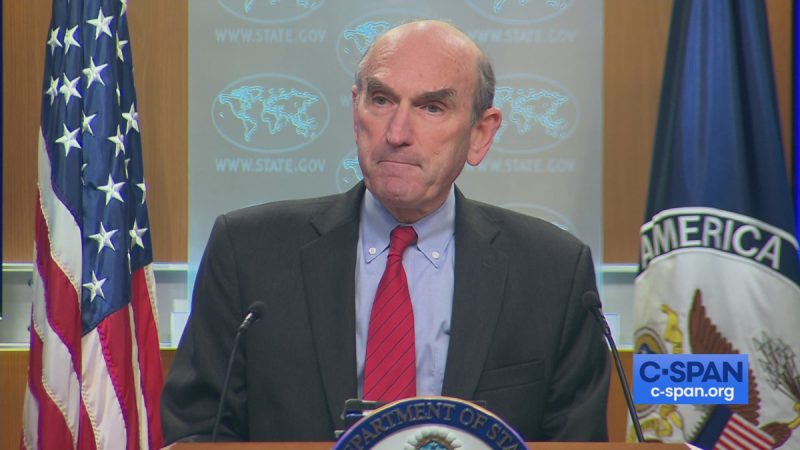
White House envoy for Venezuela Elliott Abrams defended Washington’s Venezuela sanctions on Wednesday. (C-Span)
By Lucas Koerner | Venezuelanalysis | November 28, 2019
Caracas – The Trump administration has pledged to continue economic sanctions against Venezuela in its ongoing bid to oust the Maduro government.
Speaking at a press conference at the State Department Wednesday, Special Envoy for Venezuela Elliott Abrams defended US regime change policy, which he said would “continue.”
“There’s no change… What is next is, I would say, a continuation of the current policy,” he said in response to questions about the status of US efforts more than ten months after recognizing opposition politician Juan Guaido as “interim president” of Venezuela.
Guaido proclaimed himself head of state in January and has gone on to lead several unsuccessful efforts to topple Maduro, including a failed military putsch in April.
Trump immediately backed Guaido’s “interim presidency,” handing the Venezuela file to Abrams, a veteran cold warrior infamous for his role in the Iran/Contra scandal, the Reagan administration’s Central America policy, and the Iraq War.
Asked about the efficacy of US sanctions, Abrams assured reporters that the measures are cutting off vital funds for the Venezuelan government. However, he acknowledged that he “would like to see, obviously, the sanctions work better,” adding that “there are plans to reinforce the effort.” He did not offer further details.
“The gravy train days that they had 10 years ago are over,” he announced, referring to the period when Venezuela had the highest minimum wage in Latin America and among the lowest levels of inequality.
Abrams went on to deny that US sanctions are negatively impacting Venezuela’s economy, citing a paper authored by former Guaido Inter-American Development Bank envoy Ricardo Hausmann claiming, “the bulk of the deterioration of living standards occurred long before sanctions were enacted in 2017.” Hausmann was a key architect of neoliberal policies in Venezuela in the 1980s and 1990s and has been a longtime government opponent.
The conclusions of Hausmann’s study have been disputed by the DC-based Center for Economic and Policy Research, which published its own report in April finding sanctions responsible for at least 40,000 deaths since 2017. The study likewise claims that sanctions amount to “collective punishment,” blocking any possibility of economic recovery in the Caribbean nation.
Washington has dramatically ramped up its sanctions regime since January, imposing an oil embargo which has since been escalated to a sweeping ban on dealings with Caracas under threat of secondary sanctions.
Abrams likewise rebuffed reporters’ concerns about Guaido’s “lack of momentum,” suggesting that “hundreds of thousands… went to the streets on November 16.” The claim was scrutinized by journalists who pointed out that viral video footage purported to be from the protests was in fact taken in January.
Questioned repeatedly about allegations of the Maduro government “intervening” in regional protests, the White House envoy accused Caracas and Havana of acting to “promote more strife everywhere.”
“There is evidence beginning to build of an effort by the regimes in Cuba and Venezuela to exacerbate problems in South America,” he added.
In recent weeks, the region has been rocked by massive anti-neoliberal protests that have shaken right-wing governments in Ecuador, Haiti, Chile, and Colombia. Government spokespeople have frequently attributed the uprisings to “meddling” by Caracas, while the Organization of American States has branded them a “destabilization strategy” by the “Bolivarian and Cuban dictatorships.”
Featured Video
EUROPE FEARS RUSSIA’S NEXT MOVE / Ian Proud
or go to
Aletho News Archives – Video-Images
New Book
New Book: No Autoimmunity The Body Doesn’t Attack Itself
Lies are Unbekoming | September 24, 2026
 The label for Humira, once the best-selling drug in the world, lists its risks in plain print. One of them, in the label’s own words, is new “autoimmune” disease.
A drug prescribed for a condition labelled autoimmune carries a warning that it can cause a condition labelled autoimmune. That contradiction sits in every box, on a folded paper almost nobody reads.
My new book starts there.
No Autoimmunity: The Body Doesn’t Attack Itself
For seventy years, “your body is attacking itself, and we don’t know why” has ended the conversation for people diagnosed with multiple sclerosis, lupus, rheumatoid arthritis, Hashimoto’s, Type 1 diabetes, Crohn’s and psoriasis. More than eighty conditions now carry the autoimmune label. The diagnosis comes with a prescription for life. It almost never comes with a question about cause.
This book asks the question and answers it from the framework’s own records: its drug labels, its journals, its regulatory filings, and its own experiments. … continue
Blog Roll
 Aletho News
- Merz regime wants ‘secret police’ – opposition
- Israeli settlers terrorize West Bank Palestinians with state-provided drones: Report
- They see them, then kill them: Israeli quadcopters track, deliberately target civilians in Gaza
- Debunked: Trump’s egregious UNGA claims on war against Iran crumble under scrutiny
- Europe was part of the infrastructure of US aggression against Iran: Deputy FM
- New evidence on the Bucha Massacre
- Italy and France debunk reports CIA issued ‘Russian drone threat’ warning
- How Russia is Rewiring the Global South
- Britain’s elites want you ready to die for a war they keep imagining
- Inside Ukraine’s propaganda operation targeting Americans
- If Americans Knew
- Trump betrayed voters with his campaign lies and prioritized a foreign country once he took office
- Netanyahu calls Israel’s war in Gaza ‘opposite of genocide’ in UN speech to near-empty hall
- Settler Kidnappings: Torture, Sexual Abuse and Terrorisation of Palestinian Abductees as Israel Deepens Annexation of West Bank
- Gaza winter nears as 162,000 tents become unusable, raising fears of humanitarian crisis
- Netanyahu says, “It’s the opposite of genocide”; UN says Gaza economy is world’s ‘most severe crisis on record’ – Daily Update
- Israel’s US-Backed Assault on Gaza Has Created the ‘World’s Most Severe Economic Crisis on Record’: UN
- ‘Protecting U.S. Citizens’… From Israel
- ‘This is where I live now, the back of a truck’: a day in the life of a grandmother in Gaza
- In UN Speech, Iran’s President Displays Pictures of Children Killed by US, Brings Attention to Israel’s Nuclear Arsenal
- Israel displaces hundreds of Palestinians amid wave of demolitions in West Bank
- No Tricks Zone
- New Study: Earth And Venus Surface Warmth Largely Explained By Convection And Lapse Rate, Not CO2 Or Radiation
- 2025 Nature Paper Claiming Worsening Global Drought Gets RETRACTED …Heavily Flawed
- New Study: ‘Global Drought Shows No Detectable Recent Acceleration Under Climate Warming’
- Economic Masterminds: German Socialists Suggest Taxing Productivity Gains Stemming From Using AI
- The South China Sea Has Not Been Cooperating With The Climate Change Narrative
- Energy Crisis: Germany Enters Heating Season With Historically Low Gas Reserve Fill Levels
- New Study: The Antarctic Ice Sheet Gained Mass From 2020-2024 Due To Staggering Snow And Ice Accumulation
- Study: Ocean Heating Rates From Thousands Of Years Ago ‘Dwarf’ Modern Ocean Heating Rates
- Climate Extremists Target, Attack Large-Scale Power Grid Infrastructure In Germany!
- New Study: Antarctic Ice Melt Has Contributed Less Than 1 Centimeter To Sea Level Rise In The Last 30 Years

