Global Giants: American Empire and Transnational Capital
Maximilian C. Forte review of Giants: The Global Power Elite by Peter Phillips (Introduction by William I. Robinson). New York: Seven Stories Press, 2018. LCCN 2018017493; ISBN 9781609808716 (pbk.); ISBN 9781609808723 (ebook); 353 pps.
Giants: The Global Power Elite, by Peter M. Phillips, Professor of Political Sociology at Sonoma State University, opens with a stated intention of following in the tradition C. Wright Mills’ The Power Elite. This book is clearly meant to be a contemporary update and expansion of Mills’ work, such that the “power elite” now becomes the global power elite (GPE) in Phillips’ volume—and central to the idea of a global power elite is the transnational capitalist class that was at the core of the theorization of Leslie Sklair. One of the most important features of this book, in my view, is that it overcomes the unproductive dichotomy that continues to silently inform many academic and political debates on this question: is the contemporary world order one dominated by US imperialism or transnational capital? Phillips’ answer is productive (even if I do not entirely agree): transnational capital has acquired US power and uses the power of the US state to further its aims, protect its interests, and enforce its agenda. Where I differ, the difference is a relatively slight matter of emphasis: Phillips’ model is largely correct, but it is also important to remember that the wealthiest, most numerous, and most powerful membership of the “transnational” capitalist class is in fact American.
Aside from this, Phillips reveals how even now mere mention of the “transnational capitalist class” is obscured in mainstream corporate media coverage. As he points out: “the concept of a global transnational capitalist class is essentially completely absent from corporate news coverage in the United States and Europe” (p. 62).
The centrepiece of this work is its detailed exposition of the 389 individuals who constitute the core of “the policy planning nongovernmental networks that manage, facilitate, and protect the continued concentration of global capital” (p. 10).
I am thankful to the author for providing me with a free copy of this text, so that this review could be written. I have also assigned one of the chapters as required reading in one of my recent courses (DeGlobalization & the Nation), and thus I also have the benefit of feedback from students on some of the book’s key contents.
Chapters—Contents
The Preface to the volume effectively summarizes the key contents of the book and outlines its principal arguments. It was not prepared as a mere formality, and is worth reading on its own.
The Introduction, “Who Rules the World?” was written by William I. Robinson, one of the leading scholars today on the topic of the transnational capitalist class.
Chapter 1, “Transnational Capitalist Class Power Elite: A Seventy-Year History,” aims at explaining the “transition from the nation state power elites described by Mills to a transnational power elite centralized on the control of global capital around the world”. In this chapter Phillips traces the development of the concept of global power elites from the work of C. Wright Mills, through to Leslie Sklair, William Robinson, William Carroll and even David Rothkopf. While the author also invokes “shadow elites,” he does not mention the work of Janine Wedel in this regard. Phillips also provides a detailed outline of the nature of global wealth inequality, ranging from the control of wealth by a few, to over-accumulation, and starvation. In addition to the preface, this is the chapter that makes the central arguments of the book.
Chapter 2, “The Global Financial Giants: The Central Core of Global Capitalism,” identifies the 17 global financial giants—money management firms that control more than one trillion dollars in capital. As these firms invest in each other, and many smaller firms, the interlocked capital that they manage surpasses $41 trillion (which amounts to about 16% of the world’s total wealth). The 17 global financial giants are led by 199 directors. This chapter details how these financial giants have pushed for global privatization of virtually everything, in order to stimulate growth to absorb excess capital. The financial giants are supported by a wide array of institutions: “governments, intelligence services, policymakers, universities, police forces, militaries, and corporate media all work in support of their vital interests” (p. 60).
Chapter 3, “Managers: The Global Power Elite of the Financial Giants,” largely consists of the detailed profiles of the 199 financial managers just mentioned.
Chapter 4, “Facilitators: The Power Elite Policy Planning Center of the Transnational Capitalist Class,” examines the membership of two non-governmental Global Elite policy-planning organizations: the Group of Thirty and the Trilateral Commission. The chapter also goes into some depth in related organizations, such as the Bilderberg Group and the Council on Foreign Relations. Detailed profiles of the directors of the G30 are included in this chapter, as well as profiles of the members of the Trilateral Commission Executive Group.
Chapter 5, “Protectors: The Power Elite and the US Military NATO Empire, Intelligence Agencies, and Private Military Companies,” focuses on the power of “the US/NATO military empire”. As Phillips explains, the US/NATO functions as a “transnational military police state” that operates in nearly every country in the world, and, “threatens nations that do not fully cooperate with global capital with covert activities, regime change, and heavy negative propaganda” (p. 12). Phillips also examines how the global Giants, “invest in war making as a method of using surplus capital for a guaranteed return, with an increasing use of private military/security companies for protection of Global Power Elites and their wealth” (p. 12). Detailed profiles of the 35 members of the Atlantic Council Executive Committee form part of this chapter. This chapter also examines “Private Military Contractors,” focusing on Blackwater and G4S.
Chapter 6, “Ideologists: Corporate Media and Public Relations Propaganda Firms,” concentrates on the extensive investment by the Giants in corporate media and their expanding “use of public relations propaganda companies in the news systems of the world” (p. 13). The six major global media organizations The chapter this focuses on the six leading global media organizations, and how they offer ideological justification for corporate capitalism while censoring contrary perspectives. As Phillips explains early in his book:
“We have a media system that seeks to control all aspects of human thinking and promotes continued consumption and compliance. The dominant ideological message from corporate media today is that the continued growth of the economy will offer trickle-down benefits to all humans and save the planet”. (p.13)
One outstanding fact that is presented at the start of this chapter is that, “corporate media receive anywhere from two thirds to 80 percent of their broadcast and print news content from public relations and propaganda (PRP) firms” (p. 263). Since only a handful of media companies monopolize the world market of information distribution, this fact reveals a monumental bullhorn in the hands of the transnational capitalist class (p. 265). This chapter also informs us that, in the US, the number of media companies has declined from 50 in the early 1980s to just six today, and that 98% of all US cities are served by only one daily newspaper (p. 264).
This chapter also provides detailed profiles of the major media and public relations firms in the US, along with discussion of some of their noteworthy international interventions. In addition, the chapter discusses propaganda and the “engineering of consent”.
Chapter 7, “Facing the Juggernaut: Democracy Movements and Resistance,” offers “a summary and what-needs-to-be-done statement” (p. 13), that emphasizes what needs to be done to reform the system, in very broad terms, with a return to the principles outlined in the UN’s Universal Declaration of Human Rights.
The books ends with a postscript which amounts to a letter to the Global Power Elites “asking them to consider future generations when making decisions regarding global capital, and urging them to take corrective action before more serious and inevitable unrest and environmental devastation take effect” (p. 13).
“Global Power Elites”: the Transnational Capitalist Class
Phillips describes the Global Power Elite as follows:
“The Global Power Elite function as a nongovernmental network of similarly educated wealthy people with common interests of managing, facilitating, and protecting concentrated global wealth and insuring the continued growth of capital. Global Power Elites influence and use international institutions controlled by governmental authorities—namely, the World Bank, International Monetary Fund (IMF), NATO, World Trade Organization (WTO), G7, G20, and many others”. (p. 9)
Therefore what Phillips indirectly points to here is the growing recognition of the fact that, far from the promised obsolescence of the state, globalization has not only been enacted by states, the power of certain states has in fact increased. On the other hand, he apparently endorses Robinson’s claim that nation-states have become, “little more than population containment zones,” while “the real power lies with the decision makers who control global capital” (p. 26). Both propositions are unconvincing: first, populations are clearly not being contained; second, if states matter so little, and the real decision-makers are global capitalists, then why do the latter need states?
Indeed, Phillips appears to be of two minds on this question. He does note, for example: “The World Bank, IMF, G7, G20, WTO, Financial Stability Board, and Bank for International Settlements are institutions controlled by nation-state representatives and central bankers with proportional power/control exercised by dominant financial supporters, primarily the United States and European Union countries” (p. 161). Critical institutions of the global capitalist system are themselves state institutions. Clearly then, states are a lot more than just population containers. The shaky narrative of this book is a product of an underlying theoretical lack of clarity.
Global Power Elites, as Phillips explains, “are the activist core of the Transnational Capitalist Class—1 percent of the world’s wealthy people—who serve the uniting function of providing ideological justifications for their shared interests and establishing the parameters of needed actions for implementation by transnational governmental organizations” (p. 10). They should therefore not be confused with all elites, nor apparently with elite technocrats who serve in government but who are not among the world’s wealthiest people. The GPEs also apparently exclude the lobbyists, academics, media and think tank members who constitute a large part of what Janine R. Wedel describes as flexible “influence elites,” in her own updating of Mills’ work on elites (see “From Power Elites to Influence Elites: Resetting Elite Studies for the 21st Century” in the special issue of Theory, Culture & Society on Elites and Power after Financialization).
What unites the members of the GPEs are common interests and backgrounds. They tend to interact with each other regularly, and a wide range of mutually reinforcing organizations. It can come down to sharing the same university affiliations and membership in social clubs—“It is certainly safe to conclude they all know each other personally or know of each other in the shared context of their positions of power” (p. 11). Elsewhere in the book, these transnational elites are described as effectively forming a club: “interacting families of high social standing with similar lifestyles, corporate affiliations, and memberships in elite social clubs and private schools” (p. 22). “The power elite policy groups inside the Transnational Capitalist Class,” Phillips observes, “are made up of persons with shared educational experiences, similar lifestyles, and common ideologies” (p. 214). The degree of commonality among the elites studied in this book is striking:
“One hundred thirty-six of the 199 power elite managers (70 percent) are male. Eighty-four percent are whites of European descent. The 199 power elite managers hold 147 graduate degrees, including 59 MBAs, 22 JDs, 23 PhDs, and 35 MA/MS degrees. Almost all have attended elite private colleges, with 28 attending Harvard or Stanford”. (p. 62)
Of those same 199 individuals, 59% are from the US; many of the 199 are dual citizens; and, “they live in or interact regularly in a number of the world’s great cities: New York City, Chicago, London, Paris, Munich, Tokyo, and Singapore” (p. 63). Of the same 199 global financial directors, 69 have attended the World Economic Forum (p. 147).
Less convincing was William Robinson’s assertion, in the Introduction to the book, that suggests that national capitalists have effectively vanished. Presumably they metamorphosed into a transnational capitalist class, and for that reason Mills’ work needs to be updated (p. 17). What was missing here then was a golden opportunity to reflect on the fractious breakup of the dominant elites into a diminished and angered national capitalist faction in opposition to the transnationalist faction. That alone could have done more to explain the rise of Trump, as a champion of national capital, than resorting to facile ideological truisms about “populism”. Unfortunately, Robinson is destined to continue missing this, as elsewhere he quickly rushed to assert that Trump himself was a leading representative of the transnational capitalist class—and it was as unconvincing as it was misleading. Even worse, Robinson risks reducing “transnational capitalist class” to something like “fascist”: a term of abuse, with limited explanatory power. Unlike Robinson’s comments in this book, Phillips seems much more attuned to the reality of factions that exist even among the global power elites (p. 23).
Phillips describes the world’s top billionaires as “similar to colonial plantation owners” (p. 21), which can be a useful way for conceptualizing Western power structures as they have developed over the past five centuries. Phillips thus points to the UK’s Barclays Bank as an example of the colonial heritage at work today: “Barclays Bank [is] the number-one most connected firm. Barclays is a 300-year-old banking company founded in 1690 in London. Barclays grew with the expansion of the British Empire and now offers services in more than 50 countries and territories, serving some 49 million clients” (p. 79)
Transnational capitalists work through an array of institutions such as, “the World Bank, World Trade Organization, International Monetary Fund, the G20, G7, World Economic Forum, Trilateral Commission, Bilderberg Group, Bank for International Settlements,” among others (p. 25). This book also cites the The Handbook of Transnational Governance (2011) which “lists 52 trans-governmental networks, arbitration bodies, multi-stakeholder initiatives (with internet cooperation), and voluntary regulation groups (fair labor/trade associations)” as key bodies of the transnational capitalist class. It’s not clear why, if their interests and agendas are shared in common, they would need so many multilateral international organizations—at the very least it would seem to be an inefficient diffusion of effort.
The other question is, if the global power elites discussed in this book control/manage a total of about $41 trillion, and the world’s total wealth is estimated at $255 trillion, then that would mean the global power elites in fact control a minority share of global wealth (roughly 16%). Then who owns or controls the other 84%? Elsewhere in the book it is revealed that “147 companies controlled some 40 percent of the world’s wealth” (p. 36). Then the question becomes: who controls the remaining 60%? Also, is control the same thing as ownership? Later the book informs us that, “in excess of $74 trillion of inter-invested centralized capital” is controlled by 69 cross-invested firms (p. 49). This would mean that they control just over 29% of the world’s wealth. One wishes that some overall profile of global wealth ownership and distribution had been provided in this book, so as to better contextualize what the “giants” really own.
American Power Elites (APEs)?
One of the ironies in this text is what Phillips reveals in Chapter 1:
“The top six billionaires in 2017, with their country of citizenship and estimated net worth, were Bill Gates (US, $88.8 billion), Amancio Ortega (Spain, $84.6 billion), Jeff Bezos (US, $82.2 billion), Warren Buffett (US, $76.2 billion), Mark Zuckerberg (US, $56 billion), and Carlos Slim Helú (Mexico, $54.5 billion). Forbes’s billionaire list contained 2,047 names in 2017”. (p. 21)
Thus of the top six billionaires, four are American. As for the Forbes list, in 2019, seven of the top 10 billionaires listed are American. In fact, the list has become increasingly American since circa 2012, according to this compilation of annual rankings, returning to the situation that was observed from before 2005. In total, 14 of the world’s richest 20 persons are American. Overall, 607 of the world’s 2,153 billionaires in 2019 are American—or just over 28%, which still reflects a disproportionately large American presence. As mentioned above, the American proportion has been steadily increasing:
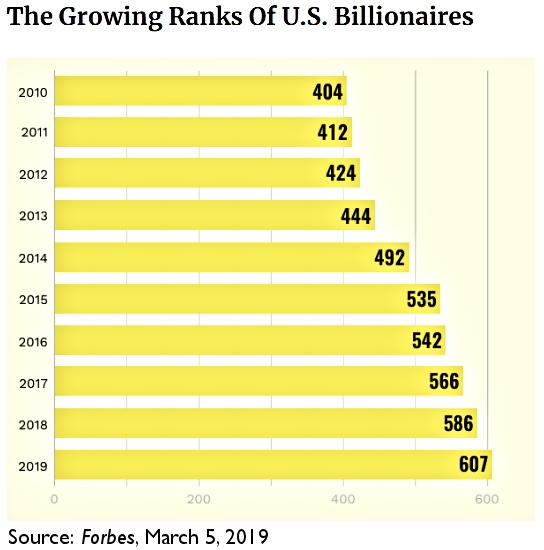
So what does one conclude from this picture? Is it in fact transnational capital of a global power elite that has dominated globalization, that we are seeing here? Or would it be more accurately reflective of reality to speak of an American Power Elite that dominates the world’s circuits of wealth creation and concentration? The answer has enormous import for how we think about globalization vs. American imperialism as the best mode of describing contemporary reality.
As we saw in the last section, the inability to explain why transnational capitalists need states is one of the most serious flaws in explanations that claim states have been diminished while transnational capitalists have real power. If they had real power, they would not need states. Thus one of the problems of this book is that it under-theorizes critical areas that really needed attention, if we were really to update Mills’ work.
US Imperialism and Transnational Capitalism
One of the key strengths of this book is that it goes against fashionable theorizing on the political left, prevalent among academics and activists, that minimizes or even refuses to name US imperialism. As Phillips shows in this book, the US is the foundation of transnational policing that works to enforce the interests of global capital. In particular, the global financial giants invest heavily in war-making as a means of profitably deploying excess capital.
Thus Phillips notes that, “the policy elites in the United States have been mostly united in support of an American empire of military power that maintains a repressive war against resisting groups…around the world” (p. 23). He also points out: “uncooperative regimes are undermined and overthrown in support of the free flow of global capital for investments anywhere that returns are possible” (p. 64).
“Humanitarian intervention” is also critically addressed by Phillips. He argues that the transnational capitalist class promotes “military interventions [that] are ideologically justified as peacekeeping or humanitarian missions,” primarily in cases where governments are “viewed as unfavorable to the TCC’s capital interests”—in such cases then, “resistance forces will be supported and encouraged toward regime change, as in…Libya, Syria, Iraq, Yemen, Somalia, Ukraine, Venezuela, and Yugoslavia” (p. 30). It is refreshing to read a North American academic who recognizes this reality. As indicated in the list of contents, Phillips dedicated an entire chapter to the subject of US empire (chapter 5).
The protection of transnational capital, Phillips argues, is what lies behind the production of “failed states, manufactured civil wars, regime changes, and direct invasions/occupations”. Each of these is a manifestation of “the new world order requirements for protecting transnational capital” (p. 215).
NATO is a key part of Phillips’ discussion, and he notes that NATO members collectively account for 85% of the world’s military spending (p. 223). Phillips’ argument is that NATO is the leading military defender of the interests of global capital: “NATO is quickly becoming a US military empire supplemental police force for the Global Power Elite and the Transnational Capitalist Class” (p. 224). In conjunction with this, he discusses the role of the Atlantic Council as the chief purveyor of NATO propaganda.
Yet, despite Phillips’ own arguments about manufactured civil wars, “resistance” groups funded if not created by Western powers, and regime change war—he still manages to produce an unquestioning endorsement of “Arab Spring protests” in North Africa as examples of resistance against neoliberal austerity politics (p. 304).
Global Inequality
Global inequality has become extreme under the dominance of the Global Power Elites. As William Robinson writes in the Introduction,
“the richest 1 percent of humanity in 2017 controlled more than half of the world’s wealth; the top 30 percent of the population controlled more than 95 percent of global wealth, while the remaining 70 percent of the population had to make do with less than 5 percent of the world’s resources”. (p. 15)
Phillips recounts a recent finding that only eight individuals now own half the world’s wealth (p. 21).
While not always clear about whether “the richest 1 percent” are the top 1% in the US or the top 1% of the world as a whole, the book informs us that the top fraction “increased their total wealth by 42.5 percent in 2008, and 50.1 percent in 2017,” and in the latter year, “2.3 million new millionaires were created, bringing the total number of millionaires around the globe to more than 36 million”; these millionaires represent “0.7 percent of the world’s population controlling more than 47 percent of global wealth’; the world’s bottom 70% only control 2.7% of total wealth (pp. 301–302).
This book also relays the following overview of global wealth inequality:
“The world’s total wealth is estimated to be close to $255 trillion, with the United States and Europe holding approximately two thirds of that total; meanwhile, 80 percent of the world’s people live on less than $10 per day, the poorest half of the global population lives on less than $2.50 per day, and more than 1.3 billion people live on only $1.25 per day”. (p. 30)
Robinson offers a partial/partisan view of the political results of increasing inequality, asserting that it has fueled “populist insurgencies” (thus unfortunately reinforcing elitist terminology), and that these are dominated by racist, xenophobic, and nativist concerns. What Robinson does not do is offer an explanation as to why those on the losing end of globalization in North America and Europe have turned to the right, and not the left.
What Robinson predicts is that the global concentration of wealth is, in effect, suicidal: it will lead to a global contraction of demand, and thus the global market will be unable to absorb the output of the global economy, and at that point the system will seize up. Is this something to be celebrated or criticized?
Phillips makes a similar point about the over-accumulation of capital: “there are only three mechanisms of investing excess capital: risky financial speculation, wars and war preparation, and the privatization of public institutions” (p. 30). What needs to be explained to readers is why, if capital over-accumulation is really a problem, would the holders of such capital invest in areas that generate even more capital.
Land and hunger also stand out as one of the strong points of this book’s explanations. First, some important statistics are provided, such as: the UN’s World Food Program estimates that 1 in 9 people go to bed hungry each night, which amounts to 795 million people suffering from chronic hunger; nine million die each year from starvation; one-third of the planet suffers from malnutrition; two billion more people will be lacking food by 2050, according to UN forecasts; and yet, “chronic hunger is mostly a problem of distribution, as one third of all food produced in the world is wasted and lost” (p. 31). Phillips clearly pins the blame of this mal-distribution on global speculation invested in agricultural lands, and global speculation in food, which have both raised the costs of land and food, and displaced populations (pp. 31, 63). As Phillips explains:
“In the last ten years, more than $90 billion has been invested in 78 countries for buying up more than 74 million acres of farmland. The result is mass corporate farming, usually for export, and the removal of these lands as a local food source”. (p. 32)
While the book tends to endorse much of the emergency talk around “climate change,” it’s important to note that Phillips is aware of some of the glaring opportunism that motivates some of the crisis-making:
“Amazingly, TCC/Global Power Elite money managers study the transforming environment for new investment opportunities. Climate change investing can be profitable, according to Forbes, and getting in on low-carbon investments, and sectors that will benefit should climate stress increase—such as defense, health care, and property insurances—can prove lucrative. Increasing interest in new mining opportunities available due to global warming is an important issue in Greenland. Private investment in the control of water sources is seen as an increasingly attractive opportunity for power elite speculation”. (p. 32)
Criticisms of the Book
Unfortunately, much of the book is written for an audience that is already prepared to believe and accept its main arguments and their assumptions. The question then is why such an audience would need this book. The echo-chambering of public discourse is itself echoed louder than ever in academic production. This book is not written for, say, skeptical students who are unconvinced and like to raise questions. On the other hand, it can be useful precisely for generating questions.
What in my view is one of the least attractive features of the book is the tendency to reduce discussion to moral principles. In that respect it is a very American book, which follows the very American tradition of displacing politics into morality. The result is a moralistic appeal for reform. Thus the book is directed at precisely those elites who are least likely to read or care about this book. However, matters become even murkier when the book’s idea of reform means that activists should volunteer to work with billionaires: “An honest, open look at real human options is vitally needed, and social movement activists seeking to end the crisis of humanity may find allies at the top willing to make radical readjustments needed to prevent wars, mass poverty, and environmental degradation” (p. 159). In an open letter to the Global Power Elite at the end of the book, we read this: “We absolutely believe that continued capital concentration and neoliberal austerity policies only bring greater human misery to the vast majority of people on earth” (p. 320, emphasis added). Why reduce what the book shows to be factually true, a matter of objective knowledge, to a matter of belief? Why should anyone care what the author and his colleagues “believe”? Sometimes the book has an unfortunate tendency of diminishing itself.
Theory remains relatively under-developed in this book, which tends to leave major questions unspoken (some of which were discussed in the sections above). The result is that books like C. Wright Mills’ The Power Elite remain as outstanding contributions, and the updating of his work is something that still needs to be done. Neither this book, nor other attempts at updating Mills, are yet ready to be read as “Mills Part 2”.
Related to the latter point, we seem to be generating an ever expanding vocabulary for describing essentially the same phenomenon. Thus, added to the base that is the transnational capitalist class (which is sufficient), we have shadow elites, influence elites, flexible networks, and now global power elites. Pretty soon, rather than having work that takes our understanding further, we will instead have works that lose time and energy in just clearing up the mystifying mass of new labels.
Though I intensely dislike facile comments like, “some of the book’s strengths are also its weakness,” I find myself here needing to make the same comment about the immense catalogue of empirical detail that appears in the profiles of the 389 individuals and the dozens of organizations named in this book. In that respect, the book begins to resemble more of a database, that makes for tedious reading. Seen from another angle, the book serves as a reference resource. However, what really stands out is the limited theorization of the material, that really does not expand on or elaborate on either the works of Mills, Sklair, or William Robinson.
Restrictions on access to the power elites means that the profiles that are provided in the book are based almost exclusively on open source documentation. The profiles thus result as flat, and almost lifeless—useful perhaps for statistical analysis, but almost devoid of oral history and cultural content.
Sometimes this book mirrors a website more than a printed volume, meaning that there can be excessive interleaving with contents that are already widely available. Thus the book unnecessarily reproduces, in full, the UN’s Universal Declaration of Human Rights. The tendency to copy and insert so much that is open source tends to produce excessive length.
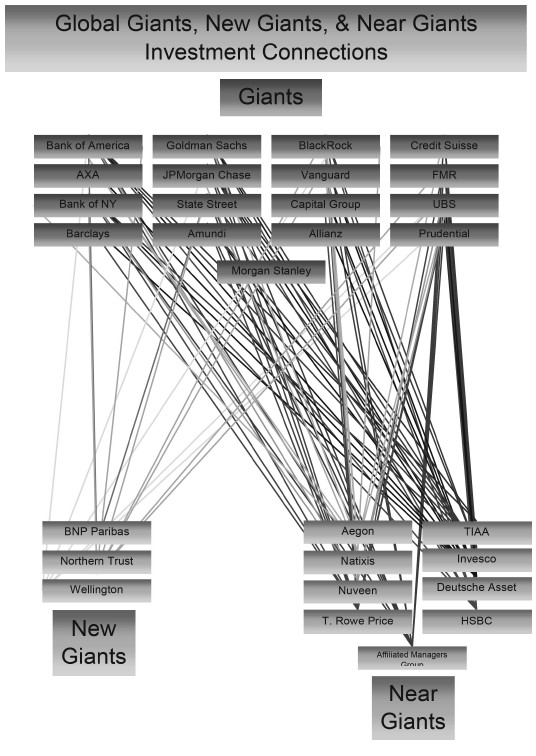
Diagrams in the book are often useless spaghetti illustrations of many dozens of crisscrossing lines linking inter-locked firms. The point is to show that each one is connected to every other—and it is far more economical to express that fact with words.
The Introduction by William Robinson was, surprisingly, one of the disappointing elements of this book. Robinson exploited the opportunity to sound off on a range of issues that personally anger and frustrate him—everything from Trump to climate change. I gather that this a popular Californian academic narrative. The chapter on the whole has a certain apocalyptic, doomsday quality to it, which is arguably more of a reflection of how culturally unprepared Americans are when it comes to absorbing the reality of their imperial decline: “If we do not annihilate ourselves in a nuclear holocaust or descend into the barbarism of a global police state, we will have to confront the threat of a human-induced sixth mass extinction that scientists say has already begun” (pp. 15–16).
At times, the book appears to pander to the fixations of the liberal-left, especially where climate emergency alarmism and identity politics are concerned. We are thus told at various points that this or that board of directors is exclusively male, or exclusively white, or white and male—as if the aesthetic veneer of dominance is what should occupy our attention.
Sometimes the book paints an excessively bleak and hopeless picture of inevitable collapse and war. The power of elites is sometimes overstated. Assumptions that poverty leads to rebellion (p. 303) are part of the book’s baggage of truisms, even if there is painfully little evidence to validate such assumptions. The point is that if it is all so bleak, then that defeats the chances of reform, the same reform that the book advocates. Phillips argues that unless something is done soon, movements like Occupy Wall Street will continue to emerge (p. 305)—to which the answer has to be a big “so what?”
Lastly, the index contains some notable errors and omissions, and is actually not very useful for using this book.
Conclusion
Reminding me of the some of the great books written by Susan George in the 1980s on debt crises and hunger, this is one of the more original and important contributions to early 21st-century debates about the decline of the 20th-century phenomenon known as “globalization”. It will serve as a valuable reference to many students of globalization, both within and outside of academia. Thus, despite my criticisms above, I would still recommend this book as required reading for any students in the fields of Political Science and International Relations, Global Sociology, and International Political Economy, as well as perhaps students in Economic Anthropology. What is especially valuable about this book is more than just its detail, but its reconciling of transnational capitalism with US empire. Even where the book falls short, it does so in a manner that provokes many productive and constructive questions.
For me personally, what emerged from studying this text is recognition of the degree to which states still matter immensely in the so-called globalized world (produced by states themselves), and the extent to which the US stands on top of globalization. It is no surprise then that we see the decline of US empire at the same time as the rise of de-globalization. Not discussed in this volume—and hardly mentioned on this site either—is the rise of an embryonic new order dominated by China, as evidenced by its extremely ambitious and widely spread Belt and Road Initiative.
Source: https://zeroanthropology.net/2019/11/27/global-giants-american-empire-and-transnational-capital/
UN: Israeli occupation costs Palestinians $48 billion
MEMO | December 2, 2019
A UN report found that the fiscal cost of Israeli occupation for the Palestinian people in 2000-2017 period is estimated at $47.7 billion, or three times the size of the Palestinian economy in 2017, reports Anadolu Agency.
Mutasim Elagraa, an economist with the UN Conference on Trade and Development (UNCTAD), discussed the report Monday at a news conference in Geneva.
“In the last decade, several UNCTAD studies and reports have addressed the Palestinian fiscal leakage to Israel,” said Elagraa.
The report – entitled Economic cost of the Israeli occupation for the Palestinian people: Fiscal aspects – will be presented to the UN General Assembly on Tuesday.
“This fiscal leakage prompted other international organizations to bring this issue into question, which helped in retroactively retrieving part of the fiscal resources of the Palestinian National Authority (PNA) from Israel,” he said.
The economist said the estimate comprises lost public revenues and interest payments.
According to the report, it includes $28.2 billion in estimated accrued interest and $6.6 billion of leaked Palestinian fiscal revenues to Israel, and the amount continues to rise.
“This estimated cumulative fiscal cost of occupation by Israel would not only have eliminated the Palestinian budget deficit estimated at 17.7 billion US dollars during the same period. It would have also generated a surplus nearly twice the size of the deficit,” Elagraa said.
Alternatively, it would have increased more than tenfold the Palestinian government’s development spending, pegged at $4.5 billion during the period under review, according to the report.
Bilateral trade relations between Iran and EU suffer under harsh US sanctions
By Sarah Abed – December 2, 2019
Trade between the European Union (EU) and the Islamic Republic of Iran has dropped roughly 74.92% percent this year from January to September compared to last year during the same timeframe, due to US-imposed sanctions, according to the European statistical office. The top three trading partners in the European bloc were Germany, Italy, and the Netherlands. Analysts at the European Council on Foreign Relations have described the US’s secondary sanctions as abuse of its global financial dominance.
Iran’s commodities exports have fallen 94% and imports have declined 51.15%. Before the sanctions, the EU was Iran’s main trading partner, but now China and the United Arab Emirates have risen to the first and second slots respectively.
While most discussions regarding Iran and EU trade relations center on oil, a crucial indicator of Europe-Iran trade relations lies in European technology and the billions of dollars’ worth of European parts, machinery, and transport equipment exports, which play an important role in Iran’s industrial sector and economy.
In May 2018, the United States unilaterally withdrew from the 2015 Joint Comprehensive Plan of Action (JCPOA) complaining that the deal didn’t curb Iran’s nuclear capabilities but Europeans and the International Atomic Energy Agency (IAEA) have repeatedly confirmed that the nuclear deal was working and that Iran was in compliance. Since then the remaining five world powers who signed the nuclear deal with Iran, namely the UK, France, Russia, China, and Germany have tried to keep the nuclear deal alive by urging the United States to return to the deal and lift the harsh sanctions.
Immediately after leaving the nuclear deal, the United States reinstated crippling sanctions under its “maximum pressure campaign” with the goal of bringing about “regime change” while reducing Iran’s oil exports to zero.
Iran patiently waited for over a year for the United States to either return to the deal or for European nations to ease their suffering. France advocated for a $15 billion dollar line of credit and an EU Instrument for Supporting Trade Exchanges commonly referred to as INSTEX, became “operational” in June of this year, but hasn’t offered Iran any relief yet.
INSTEX was created to circumvent Washington’s sanctions as a payment channel with the UK, France, and Germany to help Iran continue to trade. The exchange of goods is allowed without requiring direct transfers of money, serving as a diplomatic shield. Good intentions aside, it’s been useless.
Sweden, Norway, the Netherlands, Finland, Denmark and Belgium announced on November 29th that they are in the process of becoming shareholders in INSTEX, in order to support the JCPOA and the economic parts of it and facilitate legitimate trade between Europe and Iran. A joint statement of support for the preservation and full implementation of the JCPOA was made. They reiterated that the nuclear agreement was unanimously endorsed by the UN Security Council and is an instrumental tool for global non-proliferation and stability in the region.
Unfortunately, neither the line of credit nor INSTEX have been properly implemented yet. With no relief in sight and economic conditions worsening, Iran started to scale back on its commitments under the JCPOA, thus far it has taken four such steps and has vowed to continue to scale back its obligations every sixty days, until there’s a solution.
For almost three decades the United States was Iran’s main military and economic partner and played an important role in its infrastructure and industry modernization, from 1950 until 1978. All of that ended when the US-backed Shah of Iran Mohammed Reza Pahlevi was forced to step down during the Iranian Revolution in 1979. And that’s when the United States cut economic and diplomatic ties, froze billions of dollars of assets, and banned Iranian imports.
Iran is the world’s third largest consumerer of natural gas after the United States and Russia, and a major oil exporter since 1913.
Iran’s economy is dominated by oil and gas production, ownership of 10% of the world’s proven oil reserves and 15% of its gas reserves have earned Iran recognition as an energy superpower. This of course puts a huge target on its back for US imperialism and intervention.
Since mid-2018 US sanctions have been placed on Iran’s oil sales, banking transactions, metals trading, petrochemicals, shipping etc. and as a result, Tehran was forced to raise oil prices on November 15th by fifty percent and impose a strict rationing system. Soon after, protests erupted and at least eight people linked to the U.S. Central Intelligence Agency (CIA) were arrested by Iranian security agents.
Although trade has significantly decreased Washington’s attempts to destroy Iran’s economy, bilateral attempts to improve and normalize Iran-EU trade relations have fallen short. If successful, Washington would benefit from increasing its own oil and commodities trade, while hurting economic ties between Iran and EU.
No Plan B for Planet A
Replacing fossil fuels with “renewable” energy would devastate the only planet we’ve got
By Paul Driessen | Watts Up With That? | November 26, 2019
Environmentalists and Green New Deal proponents like to say we must take care of the Earth, because “There is no Planet B.” Above all, they insist, we must eliminate fossil fuels, which they say are causing climate change worse than the all-natural ice ages, Medieval Warm Period or anything else in history.
Their Plan A is simple: No fossil fuels. Keep them in the ground. More than a few Democrat presidential aspirants have said they would begin implementing that diktat their very first day in the White House.
Their Plan B is more complex: Replace fossil fuels with wind, solar, biofuel and battery power – their supposedly renewable, sustainable alternatives to oil, gas and coal. Apparently by waving a magic wand.
We don’t have a Planet B. And they don’t really have a Plan B. They just assume and expect that this monumental transformation will simply happen. Wind, solar, battery and biofuel technologies represent the natural evolution toward previously unimaginable energy sources – and they will become more efficient over time. Trust us, they say.
Ask them for details, and their responses range from evasive to delusional, disingenuous – and outrage that you would dare ask. The truth is, they don’t have a clue. They’ve never really thought about it. It’s never occurred to them that these technologies require raw materials that have to be dug out of the ground, which means mining, which they vigorously oppose (except by dictators in faraway countries).
They’re lawyers, lawmakers, enforcers. But most have never been in a mine, oilfield or factory, probably not even on a farm. They think dinner comes from a grocery store, electricity from a wall socket, and they can just pass laws requiring that the new energy materialize as needed. And it will happen Presto!
It’s similar to the way they handle climate change. Their models, reports and headlines bear little or no resemblance to the real world outside our windows – on temperatures, hurricanes, tornadoes, sea levels, crops or polar bears. But the crisis is real, the science is settled, and anyone who disagrees is a denier.
So for the moment, Let’s not challenge their climate or fossil fuel ideologies. Let’s just ask: How exactly are you going to make this happen? How will you ensure that your Plan A won’t destroy our economy, jobs and living standards? And your Plan B won’t devastate the only planet we’ve got? I’ll say it again:
(1) Abundant, reliable, affordable, mostly fossil fuel energy is the lifeblood of our modern, prosperous, functioning, safe, healthy, fully employed America. Upend that, and you upend people’s lives, destroy their jobs, send their living standards on a downward spiral.
(2) Wind and sunshine may be renewable, sustainable and eco-friendly. But the lands, habitats, wildlife, wind turbines, solar panels, batteries, transmission lines, raw materials, mines and laborers required or impacted to harness this intermittent, weather-dependent energy to benefit humanity absolutely are not.
(3) The supposed cure they say we must adopt is far worse than the climate disease they claim we have.
Using wind power to replace the 3.9 billion megawatt-hours that Americans consumed in 2018, coal and gas-fired backup power plants, natural gas for home heating, coal and gas for factories, and gasoline for vehicles – while generating enough extra electricity every windy day to charge batteries for just seven straight windless days – would require some 14 million 1.8-MW wind turbines.
Those turbines would sprawl across three-fourths of the Lower 48 US states – and require 15 billion tons of steel, concrete and other raw materials. They would wipe out eagles, hawks, bats and other species.
Go offshore instead, and we’d need a couple million truly monstrous 10-MW turbines, standing in water 20-100 feet deep or on huge platforms in deeper water, up and down our Atlantic and Pacific coasts. Not as many of the beasts, but each one a lot bigger – requiring vastly more materials per turbine.
A Category 4 hurricane going up the Atlantic seaboard would wipe out a lot of them – leaving much of the country without power for months or years, until wrecks got removed and new turbines installed.
Using solar to generate just the 3.9 billion MWh would require completely blanketing an area the size of New Jersey with sunbeam-tracking Nellis Air Force Base panels – if the Sun were shining at high-noon summertime Arizona intensity 24/7/365. (That doesn’t include the extra power demands listed for wind.)
Solar uses toxic chemicals during manufacturing and in the panels: lead, cadmium telluride, copper indium selenide, cadmium gallium (di)selenide and many others. They could leach out into soils and waters during thunderstorms, hail storms, tornadoes, hurricanes, and when panels are dismantled and hauled off to landfills or recycling centers. Recycling panels and wind turbines presents major challenges.
Using batteries to back up sufficient power to supply U.S. electricity needs for just seven straight windless days would require more than 1 billion half-ton Tesla-style batteries. That means still more raw materials, hazardous chemicals and toxic metals.
Bringing electricity from those facilities, and connecting a nationwide GND grid, would require thousands of miles of new transmission lines – onshore and underwater – and even more raw materials.
Providing those materials would result in the biggest expansion in mining the United States and world have ever seen: removing hundreds of billions of tons of overburden, and processing tens of billions of tons of ore – mostly using fossil fuels. Where we get those materials is also a major problem.
If we continue to ban mining under modern laws and regulations here in America, those materials will continue to be extracted in places like Inner Mongolia and the Democratic Republic of Congo, largely under Chinese control – under labor, wage, health, safety, environmental and reclamation standards that no Western nation tolerates today. There’ll be serious pollution, toxics, habitat losses and dead wildlife.
Even worse, just to mine cobalt for today’s cell phone, computer, Tesla and other battery requirements, over 40,000 Congolese children and their parents work at slave wages, risk cave-ins, and get covered constantly in toxic and radioactive mud , dust, water and air. Many die. The mine sites in Congo and Mongolia have become vast toxic wastelands. The ore processing facilities are just as horrific.
Meeting GND demands would multiply these horrors many times over. Will Green New Dealers require that all these metals and minerals be responsibly and sustainably sourced, at fair wages, with no child labor – as they do for T-shirts and coffee? Will they now permit exploration and mining in the USA?
Meeting basic ecological and human rights standards would send GND energy prices soaring. It would multiply cell phone, laptop, Tesla and GND costs five times over. But how long can Green New Dealers remain clueless and indifferent about these abuses?
Up to now, this has all been out of sight, out of mind, in someone else’s backyard, in some squalid far-off country, with other people and their kids doing the dirty, dangerous work of providing essential raw materials. That lets AOC, Senator Warren, Al Gore, Michael Mann, Greenpeace and other “climate crisis-renewable energy” profiteers preen about climate justice, sustainability and saving Planet Earth.
They refuse to discuss the bogus hockey stick temperature graph; the ways Mann & Co. manipulated and hid data, and deleted incriminating emails; their inability to separate human influences from the powerful natural forces that have caused climate changes throughout history; or the absurd notion that the 0.01% of Earth’s atmosphere that is carbon dioxide from fossil fuel use over the past 50 years is somehow responsible for every extreme weather event today. But they won’t be able to ignore this fraud forever.
Meanwhile, we sure are going to be discussing the massive resource demands, ecological harm and human rights abuses that the climate alarm industry would impose in the name of protecting the Earth and stabilizing its perpetually unstable climate. We won’t let them dodge those issues in 2020.
Paul Driessen is senior policy analyst for the Committee For A Constructive Tomorrow (www.CFACT.org) and author of books and articles on energy, climate, environmental and human rights issues.
What Does PDVSA Have to Do with the Crisis in Haiti?
By Clodovaldo Hernandez – Supuesto Negado – November 7, 2019
Haiti has been on fire for weeks, without the so-called ‘international community’ or its associated press paying any attention.
Fuel shortages have plunged the Caribbean country back into social turmoil which borders on civil war. There are many causes behind this dramatic panorama, which has been exasperated by the decrease in production by Venezuelan state-run oil company PDVSA, corruption scandals in the Caribbean country and relentless US pressure on Venezuela, which have all damaged the PetroCaribe crude oil supply programme, which Haiti was reliant on.
PDVSA’s internal collapse, coupled with the labyrinth of obstacles placed by the US’ unilateral coercive measures (sanctions) against Venezuela, has forced the dismantling of what was one of Commander Hugo Chavez’s most powerful initiatives.
The project is a regional mechanism for selling oil at preferential prices with financing for the residents of the Antillean Basin. Local opposition groups and the Washington-led international coalition have, however, always branded the programme as a way for Venezuela to ensure support in the international arena based on the so-called ‘petro-chequebook.’
Internal corruption
Before the programme was damaged by PDSVA’s fall in production and the blockade [against Venezuela], there were already revelations of financial irregularities by unscrupulous Haitian civil servants and entrepreneurs who took advantage of Venezuelan aid to line their own pockets.
In Haiti, these crimes are particularly outrageous because the programme was conceived as a way of providing financial assistance to the government to address serious internal problems, exacerbated by the 2010 earthquake and five major hurricanes, including Hurricane Matthew in 2016.
Under the programme, PetroCaribe delivered crude oil to a state agency called the Monetisation Bureau of Development Aid Programmes, which proceeded to sell it to private Haitian companies. The resulting funds should have been used to rebuild infrastructure, especially in the areas of health, education, housing and roadways, however around US $2 billion is estimated to have been stolen.
The responsibility of Venezuelan officials in this and other Petro Caribe- related corruption cases remains to be seen.
The issue of corruption is so important in the Haitian political debate that in addition to demanding the resignation of pro-US President Jovenel Moise, the opposition and Haitian grassroots movements, which have led the wave of demonstrations in recent months, also demand the prosecution of those involved in irregularities that distorted the initial objectives of the programme. Opposition Deputies Youri Latortue, Moise Jean Charles and Shiller Louidor have been the flag-bearers of these demands.
The political reasons
In parallel, and in accordance with Washington’s instructions, the Haitian government of businessman Jovenel Moise, which is propped up by the US, has preferred to sever its relationship with PetroCaribe, supposedly to distance itself from the influence that revolutionary Venezuela exerted on previous Haitian presidents, such as René Preval and Michel Martelly.
Moise (whose name also appears amongst the list of alleged benefactors from the theft of PetroCaribe funds) was snared with promises that the US would supply the oil that Venezuela would no longer deliver. But that obviously hasn’t happened.
As the country ran out of fuel, what has been described as Haiti’s worst political crisis has erupted. The nation has lived in perennial instability due to, among other reasons, the continued interference of the US in its internal affairs.
Apart from Haiti, the PetroCaribe programme favoured Antigua and Barbuda, the Bahamas, Belize, Cuba, Dominica, Guatemala, Guyana, Grenada, St. Kitts and Nevis, St. Lucia, St. Vincent and the Grenadines, El Salvador, the Dominican Republic and Suriname. Guatemala and Belize abandoned the agreement in 2014 and 2017 respectively, and in June 2018 Venezuela announced that it was suspending shipments to all these nations due to a drop in production, with the notable exception of Cuba.
Denouncements of irregularities [in the programme’s funds] were well exploited by Venezuela’s opponents to discredit the project between 2016 and 2018. Simultaneously, the US toured the Caribbean offering to supply US oil extracted through fracking in exchange for support for its aggressive political moves against the Venezuelan government of Nicolas Maduro. Of course, in the US’ case, we aren’t talking about a social programme but rather winning the Caribbean market for its oil corporations, while continuing to strangle Venezuela economically.
In 2018, a Caribbean Energy Security Summit was held in Washington, which mentioned adopting sustainable renewable energy systems for the region. The political purpose, the true one, was later expressed by a spokesman for the US State Department: “That the Caribbean doesn’t increase its debt to the only energy supplier which has attended the region to date.”
PDVSA’s inability to continue honouring the programme, in addition to corruption scandals in countries like Haiti, allowed this goal to be achieved just as the US wished.
Now, the entire Caribbean region once again depends on the savage capitalism’s suppliers , and Haiti’s social protests are one of the first symptoms of this return to the harsh reality.
Clodovaldo Hernández is a Venezuelan journalist who has written for left leaning news sites Supuesto Negado and Aporrea.
Translation by Paul Dobson for Venezuelanalysis.
Who stands to gain from unrest in Iran?
People rallied in the northwestern Iranian city of Tabriz to denounce the violent unrest in the country, Nov 19, 2019
By M. K. BHADRAKUMAR | Indian Punchline | November 21, 2019
I once had an animated conversation with the Middle East correspondent of a leading Indian newspaper regarding the resilience of the Iranian political system. The year was 2001. The conversation took place in the backdrop of mass protests and clashes between hard-liners and reformists on the the 22nd anniversary of the Islamic revolution in Iran. My friend forecast that the Iranian regime was in meltdown under the combined weight of US sanctions and a dysfunctional repressive regime. He point blank rejected my dissent that the stability of the Iranian system was not in doubt.
When it comes to Iran, everything depends on what prism you are holding. If you live in Dubai or visit Israel too often, you get one vision; if you live in Turkey, you get a vastly different view.
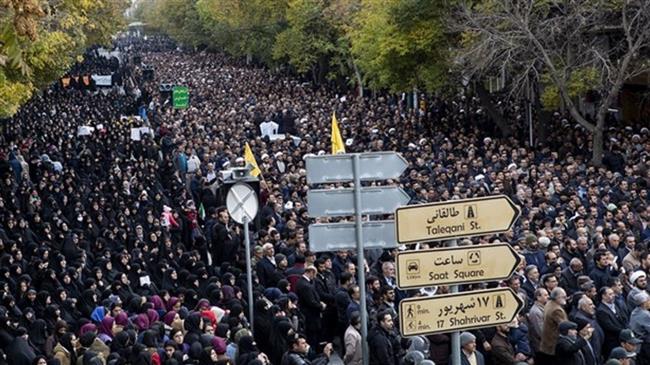
The recent days’ happenings fell into that familiar pattern. The protests were played up by the western media and American think tanks in apocalyptic terms, but when counter-demonstrations began appearing, supportive of the government, they have fallen silent. Life is returning to normal in Iran.
Two striking features must be noted. One, anti-government protests are possible to be staged in Iran; two, the regime enjoys a substantial social base. Unsurprisingly, when protests appear in Iran, democratic Turkey takes a balanced view while the repressive Saudi regime gleefully joins the western camp of ‘liberal democracies’ to pelt stones at the Iranian regime.
Isn’t there social and political discontent in Iran and Turkey? Indeed, there is. But representative rule provides safety valves and the political leaderships in Tehran or Ankara are receptive to popular opinion. Who would dispute that Hassan Rouhani and Recep Erdogan secured their mandates in hotly contested elections?
Can it be a coincidence that when the Iranian protests were raging in the past week, the US and Israel tested the waters, so to speak? The US aircraft carrier strike group Abraham Lincoln sailed through the strategic Strait of Hormuz on Tuesday. And Israel hit “dozens of targets” in Syria — in and around Damascus in Kiswa, Saasaa, Mezzeh military airport, Jdaidat Artouz, Qudsaya and Sahnaya — which it claimed were aimed at thwarting what Tel Aviv called Iran’s “military entrenchment” there and to block shipments of Iranian weapons to Lebanon’s Hezbollah movement.
Conceivably, these military operations would have needed some advance planning, especially the freedom of navigation exercised by the US aircraft carrier strike group through the narrow straits where Iran controls many of the shipping lanes. Yet, it happened just when the Iranian regime was preoccupied with the domestic unrest!
Again, President Trump notified the US Congress of his intention to step up military deployments in Saudi Arabia in the middle of the unrest in Iran. In the normal course, Tehran’s reaction would have been robust but, again, the US got away with it — for the time being, at least — as the Iranian regime and leadership has its hands full with internal developments. (Russia has warned that Washington’s plan for additional deployments of thousands of US troops to Saudi Arabia will only add to already simmering tensions in the Middle East region.)
The western narrative is that the unrest in Iran stemmed from economic factors at work triggered by the US sanctions. But, interestingly, the leading Israeli newspaper Haaretz has commented that “In the case of Iran, the headline figures about economic distress are misleading in critical ways. Iran is not quite the oil economy that, say, Saudi Arabia and the Gulf emirates are. Petroleum hasn’t accounted for more than a fifth of GDP and half of exports in the past, and it doesn’t employ a lot of people. So, while oil sanctions can inflict a lot of pain when they are first imposed, they don’t bring economic activity to a standstill.”
Haaretz points out, “Ironically, the non-oil sanctions may be giving the Iranian economy a small boost. Apart from oil, pistachios and carpets, Iran is not a globally competitive economy, but it does have a manufacturing and agricultural base… Iranian industry has the local market and is expanding output. As a result, manufacturing has been growing as has employment while the rial has stabilised… Media reports say there are plenty of ‘Made in Iran’ consumer goods on store shelves. The “resistance economy” may not be quite the miracle Tehran leaders tout, but it could be enough to stabilise the situation after the initial shock over oil sanctions have passed.
“Forecasts for the Iran going forward point in that direction. The World Bank, for instance, agrees with the IMF that Iranian GDP will contract sharply in 2019-2020 but afterwards start growing again.”
This analysis contradicts the western narrative that the Iranian people are up in revolt. Suffice to say, there is merit in the allegation by Iran’s top security officials that the protests have been actively orchestrated from abroad.
While addressing a cabinet meeting in Tehran on Wednesday, President Rouhani was explicit. The Iranian foreign ministry made a demarche with the Swiss embassy in Tehran, which represents Washington’s Interest Section, regarding US interference in the country’s internal affairs.
The Kimberley Process: Israel’s multi-billion dollar blood diamond laundry
By Sean Clinton | MEMO | November 19, 2019
Last week there was a callous, brutal attack on a sleeping family in their home in Gaza which killed a husband and wife, blowing their shredded bodies across a street; the ensuing bombardment killed 34 people including a family of eight. That this was all done by a leading member of the global diamond industry illustrates starkly the magnitude of the “conflict free” fraud perpetrated by that industry.
Few people are aware that diamonds are Israel’s number one manufacturing export, a “cornerstone” of its economy. According to Israeli Prime Minister Benjamin Netanyahu, that economy “generates 88 per cent of the vast security budget that funds the Israel Defence Forces, [and security agencies] Mossad and Shin Bet.”
The Jerusalem Post indicates that, “Israel turns over about $28 billion in diamonds a year. The value of exported diamonds is so significant (about a fifth of total industrial exports) that the government reports its figures sans diamonds to ensure the gems do not skew the values.”
All this week, members of the Kimberley Process (KP) diamond regulatory body are meeting in New Delhi to conclude a three year period of review and reform aimed primarily at expanding the definition of a “conflict diamond” in order to outlaw diamonds linked to human rights violations by government forces. That effort is certain to fail. Not a single motion has been tabled to outlaw blood diamonds that enter the supply chain downstream of the mining sector.
Despite the bloodshed, violence and unregulated nuclear weapons funded by its revenue, the jewellery industry claims brazenly that diamonds processed in Israel are responsibly sourced and conflict free. Given the unwavering political, financial and economic support given to Israel by the USA, EU, India, Canada and Australia, and their influence in the KP, none of these countries are ever going to allow the body to ban Israeli blood diamonds; to do so would sound the death knell for Israel’s number one manufacturing industry.
The jewellery industry also wants to keep the lid firmly shut on this Pandora’s Box. Israel is a key player in the diamond supply chain. Unless forced by consumer pressure, corporations and companies won’t cut ties with the Israeli diamond industry without direction from international bodies such as the KP or the UN; that will never happen given the impunity that Israel enjoys and exploits.
This was made clear by Anglo American chairman Stuart Chambers at the company’s AGM in London in April. When I asked why De Beers and Forevermark continue to trade with companies in Israel that generate revenue used to fund war crimes and crimes against humanity he said, “Certainly as a company we would, as you would expect, always respect the political community in their sitting in judgement of national states or countries where they are deemed to have done something which the international community does not accept, they would then be subject to international measure including potential embargoes to trade. Where that happens of course we as an international company would need to take that into account and comply with that. But we as a company cannot sit in political judgement on something which is very difficult to get to the bottom of until such time as the international community has decided that.”
Anglo American thus tries to absolve itself by framing the issue as a political problem rather than an issue of human rights and corporate fraud.
De Beers and Forevermark sell diamonds crafted in Israel and claim that they are 100 per cent conflict free even though the industry there is a significant source of revenue (€1bn/yr) for a regime guilty of human rights violations. Indeed, De Beers sightholders companies ABT Diamonds Ltd and the Steinmetz Group company, Diacore, directly fund the Israeli military. Since this was raised at the Anglo American AGM in April the page confirming this on De Beers’ website has been removed from public view, but an archive of it can be found here. ABT and its owner have “made significant contributions to the Israeli military”.

The Steinmetz Foundation “adopted” a unit of the notorious Givati Brigade. This Israeli army unit was responsible for the Samouni family massacre in Gaza, a war crime documented by the UNHRC and other human rights organisations. Diacore manufactures Forevermark diamonds which frequently adorn the stars of the most prestigious high society red carpet events worldwide.

This page has been removed from the Steinmetz Foundation website
Governments that benefit from the diamond trade have controlled the KP from the outset. Instead of outlawing all blood diamonds they restricted the scope of the KP regulations to “conflict diamonds” which are narrowly defined as “rough diamonds used by rebel movements or their allies to finance conflict aimed at undermining legitimate governments”.
Blood diamonds, both rough and polished, that fund human rights violations by government forces were given a free pass and remain fully legal. This was a major coup for the industry as it kept media and the public focused on “conflict diamonds” and away from the high value cut and polished diamond sector which conceals a blood diamond trade worth over $10 billion each year.
The World Diamond Council (WDC), which represents all sectors of the diamond supply chain from mine to market, moved to cover up the glaring gap in the KP regulations by introducing a bogus System of Warranties (SOW). The WDC claims that the SOW “extends the effectiveness of the KP beyond the import and export of rough diamonds”, an utterly false assertion.
Using the SOW, sellers can declare blood diamonds that aren’t funding rebel violence “conflict free” simply by including a printed statement to that effect with each invoice. Jewellers tell patrons that the Kimberley Process and System of Warranties guarantee that a diamond is conflict free, which is another blatant falsehood.
Of course, the term “conflict free” has never been defined. Cecilia Gardner, the former Counsel General of the WDC, said this about it: “As for ‘conflict free’ – well this claim is so vague as to have no real meaning.”
Those who promote the KP emphasise the overarching cooperation between governments, industry and civil society facilitated by the body’s tripartite structure, but that too is a gross deception. The governments involved are guided by what the WDC will agree to. The KP scheme was originally designed by the WDC and it was the latter that put forward the latest proposal which continues to limit the remit of the KP to rough diamonds in the mining sector.
The skeletal KP Civil Society Coalition (KP CSC) which is supposed to represents the interests of civil society is now little more than a threadbare veil. Global Witness, Impact Transform and others have withdrawn from the KP. Amnesty International and Human Rights Watch declined to join and have published reports scathingly critical of the KP’s failure to outlaw diamonds that fund government violence.
The KP CSC is now led by the Antwerp-based IPIS Research, a supposedly independent non-governmental organisation with a budget of over €1.4 million in 2018. When I asked for a breakdown of the source of its funding I was referred to its 2018 Annual Report, which doesn’t actually provide any such details. The IPIS website indicates that it receives structural funding from a number of Belgian government bodies. It also received funding from EU agencies and other bodies on whose behalf IPIS carries out research.
Biting the hand that feeds can be a difficult proposition for any organisation that isn’t funded independently. This is especially so for IPIS, given that Antwerp is one of the world’s leading diamond trading centres.
The other members of the KP CSC are poorly resourced local civil society groups from countries in Africa impacted by diamond mining. Their participation is supported by a voluntary fund from KP members.
Even though Palestinians are the biggest victims of the diamond industry there isn’t a single voice in the KP CSC to represent them. Diamonds that fund the shredding of their bodies, the sundering of their limbs, their imprisonment without trial, the demolition of their homes, the bombing of their hospitals, schools, libraries, theatres, water and sewage treatment plants, electric generating stations and other vital civic amenities aren’t blood diamonds according to the KP CSC.
The coalition’s latest report, Real Care Is Rare, doesn’t require forensic scrutiny to discover the limit of its tether. The opening sentence of the executive summary spells out the boundaries the coalition dare not breach: “brutal human rights abuses, including killings, torture and sexual violence… in certain diamond mining areas… ” (emphasis added). Blood diamonds in the supply chain downstream of mining are a bridge too far.
The report refers to blood diamonds as “diamonds obtained using serious violence irrespective of who the perpetrator is” (emphasis added). Diamonds that fund “serious violence”, though, aren’t considered blood diamonds, apparently.
The KP CSC report lists the usual suspects at the mining end of the supply chain: Zimbabwe, Angola, Sierra Leone, Tanzania and Lesotho, which the industry hold up to public scrutiny, but it has nothing to say about Israel. And yet, in 2018, Israel exported $2.9 billion of rough diamonds, twice the combined value of the aforementioned African countries. According to a UN monitoring group, in 2018 Israel also killed 295 Palestinians and wounded 29,000 others. These jaw-dropping facts are conveniently absent from the KP CSC report.
The KP CSC is a captive coalition that is tightly embraced by the WDC and governments which need it to provide the KP with a veneer of public accountability. It is beyond farcical that those who profit from blood diamonds should have a veto over reform of the system. That is the situation which exists within the WDC and the KP.
When the WDC tried to broaden the definition of a conflict diamond in 2015, Shmuel Schnitzer, then president of the Israeli Diamond Exchange and uncle of the Magnitsky Act-sanctioned Dan Gertler, blocked the reform as “it would be disastrous… especially for Israel”.
The KP is a clear example of corporate capture. The diamond industry has used its political and economic influence to neuter civil society efforts to end the trade in blood diamonds. However, civil society by way of consumer pressure can bring the change needed to curtail this bloody industry. Just as the slave trade, the ivory trade and the fur trade have been curtailed greatly by public rejection of such inhumane enterprise, so too will the blood diamond industry.
France’s year of Yellow Vests protests
By Nebojsa Malic | RT | November 16, 2019
As the ‘Yellow Vests’ protests in France come full circle, some vow to keep fighting for a more just society, while others believe the movement has gone too far. Though rattled, the system they rose up against is still in power.
Every Saturday for a year now, tens of thousands of people all over France have taken to the streets, fed up with not just the neoliberal and austerity policies of President Emmanuel Macron, but apparently the entire political system of the Fifth Republic.
The government has gone after them in force, pushing the police to their breaking point. The mainstream media has demonized them as anti-Semites, homophobes, far-right. Nevertheless, the ‘Yellow Vests’ (Gilets Jaunes) have persisted.
How it all began
A Frenchman marching through the streets of Paris, Lyon, Nice, Marseille, Dijon or any other city this Saturday might recall the very first protest, on November 17, 2018, with 300,000 across the country wearing the government-mandated safety vests as a protest symbol against that very government.
While it is unclear which particular pebble started this avalanche, the general consensus points to that summer’s new speed limit of 80 km/h, ostensibly enacted to cut carbon emissions and fight climate change. That was followed by an “eco-tax.” Whether or not those had the ulterior motive of replenishing the empty French treasury, the people were having none of it.
Trucker Eric Drouet and businesswoman Priscillia Ludosky circulated a petition against the tax in October, which quickly snowballed. Then a resident of Brittany named Jacline Mouraud posted a video on Facebook that went viral. Someone called for a street protest. There has been one every Saturday, ever since.
‘Repression is out in the open now’
Here and there, the protests turned violent. Rocks were thrown at the police. By week two, someone had vandalized the Arc de Triomphe in Paris and set cars on fire. Police responded as they do to riots in the banlieues – suburbs where many of France’s immigrants live in public housing: with overwhelming force.
This kind of repression has been around for a long time, Yellow Vest activist turned journalist Maxime Nicolle tells RT France. Now it’s out in the open, for everyone to see.

Yellow Vests’ Maxime Nicolle (right) speaks with RT France’s Nadège Abderrazak © RT France
Exact numbers are difficult to come by, but French media estimate that over 10,000 people have been detained over the past year. Some 3,000 have been prosecuted and over 400 sentenced to jail time. The carnage on the street has been real as well: 11 people have died over the course of the protests, and over 500 were injured. Of those, 23 lost an eye to “flash-balls,” non-lethal police rounds that maim nonetheless.
Perhaps the most famous among them is Jérôme Rodrigues, a plumber who believes the police deliberately targeted him that January day. Wearing a prosthetic eye, Rodrigues tells RT France he struggles with anger issues and fears for his safety, but if he could turn back time, he would do it all over again.
‘Upside-down world’
The 32-year-old Nicolle, also known as “Fly Rider,” lives in Dinan, Bretagne. His eyes light up with anger when he talks about his compatriots reduced to poverty in their twilight years and his generation sleeping in their cars because they can’t afford the rent and taxes. Meanwhile, he says, the elites are “eating caviar, drinking €500 bottles of wine, living in pretty Paris apartments.”
He rejects the argument that France’s national debt is 98 percent of its GDP and that there is simply no money for social services. Nicolle points out the government takes out loans from private banks, then has to pay steep interest. Why not nationalize the banks, he wonders.
Hundreds of kilometers away, in Paris, the one-eyed Rodrigues argues the same thing. He describes the debt as “numbers in a computer,” and scoffs that somehow there is always money for the wealthy, yet never any for the common man. Corporations have their subsidies and tax havens, yet the working poor have to pay the tax to clean up their pollution. What gives?

Yellow Vests’ Jérôme Rodrigues speaks with RT France © RT France
“Today, if you make €1,500 [a month] in France, you can’t afford rent, you have to sleep in your car. That’s not normal. A working person has the right to live decently,” says Rodrigues. “It’s an upside-down world.”
In separate interviews, both Rodrigues and Nicolle argue that the system itself is unjust, as it thinks nothing of humanity, only of ones and zeroes on the balance sheets. The institutions that were supposed to serve the people have failed, and perhaps it’s time to create new ones. Could the Fifth Republic, around since 1968, be on its last legs?
Almost a revolution
That’s precisely what almost happened within the first month of the Yellow Vests protest, according to one Elysee Palace guard. A member of the special police unit specializing in crowd control (CRS) said this week that the handful of them could not have resisted the 3,000 or so protesters for long.
“If we had been attacked, where I was, we could not have held: the Elysee would fall. In retrospect, it’s really scary,” said the man, who gave his name as Stéphane.
The Yellow Vests did not attack. Macron’s presidency survived. Although the French president has since pledged some €17 billion in tax relief, one-time bonuses and subsidies, he remains determined to reject their demands for systemic reforms. While the protesters never quite numbered the original 300,000, they still turn out every Saturday.
Protests have taken their toll on the police, too, with the rising number of suicides prompting a protest march of their own back in October. The thin blue line is still holding, for now, but it cannot stretch forever.
Parallel to the police repression, the government has implemented a media one. The Yellow Vests were accused of anti-Semitism, homophobia, Islamophobia, xenophobia, racism – just about every possible issue considered beyond the pale in modern liberal discourse.
Nicolle says it was an attempt to label the movement and put it into a box, which failed. People who took a moment to think saw that there was nothing to it and that the Yellow Vests were not an instrument of any political party, whether on the far right or the far left. The smears did have a negative effect, however, fracturing the movement and sending some members running.
Gone too far?
One of them is Jacline Mouraud, the author of the Facebook video that helped kick-start the protests. She lives in Morbihan, Bretagne and still champions the movement’s social and economic justice values – but says they lost her when the Arc de Triomphe was vandalized in December, and “black bloc” anarchists were allowed to torch cars and loot stores in March.

Yellow Vests’ Jacline Mouraud speaks to RT France © RT France
“Violence is counterproductive,” she tells RT France. “Bad dialogue is better than a good war.” At the start of the protests, 80 percent of the French supported the protests, but the tide has turned and now four fifths of the country want nothing to do with the Yellow Vests, she says. “One should know when to stop.”
The March 16 riot in particular alienated many moderates, Mouraud argues. She had already turned political by that point, launching a political party in January 2019. Called The Risen (Les Émergents), it intends to run candidates in France’s local elections in 2020.
Even though she had split off from the ‘Yellow Vests,’ Mouraud’s party exemplifies their desire to bring more direct democracy to France, a country where the existing political establishment is increasingly seen as out of touch.
‘People will make you great’
President Macron “lives in another world,” Rodrigues tells RT France. The one-eyed plumber described the French leader as isolated from reality, in an ivory tower guarded by police, working for the benefit of “his rich friends” – Macron became a millionaire working as an investment banker at Rothschild & Co after the 2008 financial crisis – rather than the “folks in the rafters.”
“You want to be a great man? It’s the people that make you great,” Rodrigues said, noting that the French history remembers the statesmen who served the nation well, rather than just themselves.
Macron and the media have tried to paint the Yellow Vest as “far-right,” but their platform seems to have more in common with the left of yesteryear. They say they fight not just for their children – such as Nicolle’s 9-year-old daughter – but for the memory of their grandparents’ generation, which fought for the rights the French of today take for granted; the 40-hour workweek, weekends and annual leave.
Not quite a revolution, but definitely not business as usual, the ‘Yellow Vests’ defy categorization. Though maybe not attracting the numbers they once did, the Gilets Jaunes are still going strong. For better or for worse, stopping is the last thing on their mind.
Also on rt.com:
March of the mutilated: Injured Yellow Vests protest police brutality in Paris (VIDEO)
Exiled Bolivian president Morales blasts coup & hints at US role in it
RT | November 13, 2019
Ousted Bolivian President Evo Morales has accused the US-headquartered Organization of American States of making a political decision in backing the right-wing opposition, saying the coup continues to wreak havoc after his exile.
Speaking from Mexico a day after he fled Bolivia, Morales said: “The OAS is in the service of the North American empire.”
Morales said he “could not understand” how his military commanders could show such “disloyalty.”
“That confirms that my great crime is to be indigenous. It’s a class problem,” he said.
The exiled president said that after freeing itself from the International Monetary Fund, the Bolivian economy was doing better.
“We had big plans in the field of exports.”
Yet, the coup plotters “do not accept the nationalization of natural resources,” Morales said.
He also said the appointment of Jeanine Añez as “interim president” confirms the coup and called for a national dialogue to end violence in his country.
Morales also claimed that a mechanical failure on a helicopter he was traveling on in early November was “not accidental” and said he wants the incident to be investigated. The helicopter was forced to make an emergency landing just after takeoff due to a “mechanical fault in the tail rotor.”
The socialist leader said he would return to Bolivia if the people asked. He also pleaded with the Bolivian opposition to stop the violence continuing after his exile. “Why do they continue?” he asked.
Lula’s Release Will Only Reinvigorate the Pink Tide Against U.S. Hegemony in Latin America
By Paul Antonopoulos | November 11, 2019
The Workers Party (PT) ruled Brazil, mostly under the leadership of the charismatic Luiz Inácio Lula da Silva, or simply known as Lula, from 2003 until his successor’s impeachment in 2016. This period saw Brazil undergo major changes and advancements with an emphasis on educating the poor, providing access to healthcare for all Brazilians, poverty reduction and Latin American integration. Although the PT did not challenge the capitalist system entirely, there was an emphasis on reducing the neoliberal model that has exploited South America since Chilean dictator Augusto Pinochet allowed his country to be economically ruled by this U.S.-endorsed system since the 1970’s.
The progress made by Lula saw a great reversal after his controversial arrest for allegedly engaging in corrupt practices. However, after only 580 days of incarceration in what was supposed to be a near decade long sentence, the Federal Supreme Court released the former president on Thursday from prison. His release, although initially a joyful event for progressives into South America, was quickly overshadowed by the coup taking place in Bolivia that has seen Evo Morales resign as president.
The successful coup against Morales is a setback for the re-emergence of the socialist Pink Tide order in Latin America. However, the release of Lula is likely to re-energize the entire cultural space against U.S. hegemony that has nearly completely dominated region since the mid-2010’s when the “Blue Tide” (Conservative Wave) took over Brazil, Argentina, Peru and other Latin American states in the aftermath of the Pink Tide.
There is little doubt that the news has become not only the political event of the year in Brazil, but in all of Latin America. The second half of 2019 has seen major changes and polarizations occur with major revolts in Ecuador and Chile against the ruling governments, Mauricio Macri’s failure to be re-elected in Argentina, and the likelihood of a Leftist election victory in Uruguay later this month.
The majority of analysts who believe Lula is innocent claim the reason he was imprisoned was to prevent his election victory in 2018. Lula often claims that he is more than a man, but “an idea.” However, if Lula is “an idea,” this also begs the question on why the “idea” was not successful when represented by Fernando Haddad, the PT presidential candidate who failed against Jair Bolsonaro in last year’s election.
Rather, people are more likely to follow people than ideologies. Lula is incorrect to call himself “an idea,” and rather he is an icon or a symbol. The symbol of Lula is one of hope for the poorest and progressives of Latin America, and his “idea” can only be continued through him since he has built a symbology behind his persona. Therefore, the meaning behind his release, many years earlier than originally sentenced, has a tremendous meaning across the region. Even Bolsonaro had to resign to the fact that he “would not be here” as president if Lula had not been imprisoned by then judge Sérgio Moro – Brazil’s current Minister of Justice.
Lula’s freedom is without a doubt a major shock to the reactionary forces operating in Brazil with full encouragement and endorsement by Bolsonaro. It is for this reason that former U.S. President Donald Trump’s strategist and adviser Steve Bannon criticized the release of Lula, calling him “one of the most cynical and corrupt politicians in the world,” claiming the release of Lula will bring a return of corruption to Brazil. Although Bannon is a former adviser to U.S. President Donald Trump, he still wields a great amount of influence and power in Washington DC and recently even cancelled trips to Brazil, England, Italy and Australia to structure a task force to fight against the impeachment process against Trump.
And of course, the “return of corruption” to Brazil is a ludicrous claim made by Bannon, especially when considering he has been a staunch defender and endorser of Bolsonaro and has elevated Eduardo Bolsonaro, a son of the Brazilian president, to the main representative of South America in “The Movement,” a consortium of European representatives who support right-wing nationalist populism while defending exploitative economic policies. Bannon’s ideological extremism defends “economic nationalism,” but it is not confused with neoliberalism or globalism. His extremist economic nationalism conceptually cannot cross the borders of the American empire, but as mere rhetoric, as it is incompatible with economic policies that promote the economic and social development of any other state. However, Bannon of course did not mention that Bolsonaro, his sons and his aides have been involved in endless scandals and corruption cases since January this year.
Although Bannon may not be involved with the Trump administration at an official level, there is little doubt that he has always been the bridge between Trump and the Bolsonaro family. Therefore, Bannon quickly coming out to denounce Lula after his release from prison can suggest that his release will be a major concern for Washington.
Why?
Lula certainly did not wait long before firing shots at the defenders of U.S. unilateralism in Latin America after his release from prison, stating: “The so-called Left that Bolsonaro fears so much will defeat the extreme Right – Brazil does not deserve the government it has,” citing unemployment rates, attacks on education and the poor, and the “lies” by Bolsonaro. He also had a look at the Latin American situation, praising Chile’s protests and called for solidarity with the Chilean people, while also showing his support for Evo Morales and denouncing Trump.
This was the Lula that Brazilians had fallen in love with. They fell in love with a leader who had no fear to speak his mind. It is not the destructive Bolsonaro’s way that attacks Brazil’s minorities and most vulnerable, but Lula’s way that attacks the forces that kept Brazil poor and subservient to Washington, and those who also prevent efforts for Latin American cooperation and integration.
It is for this reason that Lula also immediately addressed the Puebla Group, a regional body that brings together 32 progressive leaders from twelve countries that held its second meeting in Buenos Aires over the weekend.
In his message to the Puebla Group, Lula was firm in announcing that he will fight “the rotten side of the Judiciary, the rotten side of the Federal Police, the Public Ministry and Brazilian companies,” and that “It is important that we have courage and face them, because the Latin American elite is a very conservative elite and does not accept the idea of a poor people up the ladder of social conquests.”
However, his most startling revelation was that he has “the objective of constituting a very strong Latin American regional integration […] with the dream of building our great Latin America.”
It is this very goal of uniting Latin America to ensure the regions sovereignty and economic independence that has U.S. puppets like Bolsonaro and international populists like Bannon critically worried about Lula’s release. With Bolsonaro and Bannon worried by Lula, it can only be a matter of time until we see efforts to put Lula back in prison, potentially with Trump’s endorsement.
Although there are real efforts in maintaining the Blue Tide in Latin America, especially with the latest coup against Morales, it appears that the path towards Pink Tide 2.0 is still firmly paved, especially with Lula’s release from prison. Not only was he a symbol in Brazil, but he was a symbol of unity and integration across Latin American, alongside the equally charismatic Hugo Chávez of Venezuela. There can be little doubt that Lula’s release from prison will not only embolden progressive leaders in Latin America, but it will help reduce U.S. hegemony in the region.
Paul Antonopoulos is a Research Fellow at the Center for Syncretic Studies.
‘Israel’ Says US Sanctions Failed to Subdue Iran & Axis of Resistance, Warns of Rising Yemeni Threat
Al-Manar | November 10, 2019
The Israeli media considered that the US economic sanctions had failed to subdue Iran and all the axis of resistance, adding that Tel Aviv and Washington did not reach any achievement in this regard.
The Zionist reports pointed out that the attacks which targeted Aramoci oil facilities in addition to the tankers indicate that Iran will strike ‘Israel’ in response to any military operation in the region.
In the meantime, the Israeli media highlighted the vow of Yemen’s Ansarullah Chief Sayyed Abdul Malik Al-Houthi to respond to any Israeli assault on Yemen by attacking the Zionist entity, emphasizing that this is a new threat.
Featured Video

EUROPE FEARS RUSSIA’S NEXT MOVE / Ian Proud
or go to
Aletho News Archives – Video-Images
New Book
New Book: No Autoimmunity The Body Doesn’t Attack Itself
Lies are Unbekoming | September 24, 2026
 The label for Humira, once the best-selling drug in the world, lists its risks in plain print. One of them, in the label’s own words, is new “autoimmune” disease.
A drug prescribed for a condition labelled autoimmune carries a warning that it can cause a condition labelled autoimmune. That contradiction sits in every box, on a folded paper almost nobody reads.
My new book starts there.
No Autoimmunity: The Body Doesn’t Attack Itself
For seventy years, “your body is attacking itself, and we don’t know why” has ended the conversation for people diagnosed with multiple sclerosis, lupus, rheumatoid arthritis, Hashimoto’s, Type 1 diabetes, Crohn’s and psoriasis. More than eighty conditions now carry the autoimmune label. The diagnosis comes with a prescription for life. It almost never comes with a question about cause.
This book asks the question and answers it from the framework’s own records: its drug labels, its journals, its regulatory filings, and its own experiments. … continue
Blog Roll
 Aletho News
- Iran offers Trump deal before US election
- Merz regime wants ‘secret police’ – opposition
- Israeli settlers terrorize West Bank Palestinians with state-provided drones: Report
- They see them, then kill them: Israeli quadcopters track, deliberately target civilians in Gaza
- Debunked: Trump’s egregious UNGA claims on war against Iran crumble under scrutiny
- Europe was part of the infrastructure of US aggression against Iran: Deputy FM
- New evidence on the Bucha Massacre
- Italy and France debunk reports CIA issued ‘Russian drone threat’ warning
- How Russia is Rewiring the Global South
- Britain’s elites want you ready to die for a war they keep imagining
- If Americans Knew
- Trump betrayed voters with his campaign lies and prioritized a foreign country once he took office
- Netanyahu calls Israel’s war in Gaza ‘opposite of genocide’ in UN speech to near-empty hall
- Settler Kidnappings: Torture, Sexual Abuse and Terrorisation of Palestinian Abductees as Israel Deepens Annexation of West Bank
- Gaza winter nears as 162,000 tents become unusable, raising fears of humanitarian crisis
- Netanyahu says, “It’s the opposite of genocide”; UN says Gaza economy is world’s ‘most severe crisis on record’ – Daily Update
- Israel’s US-Backed Assault on Gaza Has Created the ‘World’s Most Severe Economic Crisis on Record’: UN
- ‘Protecting U.S. Citizens’… From Israel
- ‘This is where I live now, the back of a truck’: a day in the life of a grandmother in Gaza
- In UN Speech, Iran’s President Displays Pictures of Children Killed by US, Brings Attention to Israel’s Nuclear Arsenal
- Israel displaces hundreds of Palestinians amid wave of demolitions in West Bank
- No Tricks Zone
- New Study: Earth And Venus Surface Warmth Largely Explained By Convection And Lapse Rate, Not CO2 Or Radiation
- 2025 Nature Paper Claiming Worsening Global Drought Gets RETRACTED …Heavily Flawed
- New Study: ‘Global Drought Shows No Detectable Recent Acceleration Under Climate Warming’
- Economic Masterminds: German Socialists Suggest Taxing Productivity Gains Stemming From Using AI
- The South China Sea Has Not Been Cooperating With The Climate Change Narrative
- Energy Crisis: Germany Enters Heating Season With Historically Low Gas Reserve Fill Levels
- New Study: The Antarctic Ice Sheet Gained Mass From 2020-2024 Due To Staggering Snow And Ice Accumulation
- Study: Ocean Heating Rates From Thousands Of Years Ago ‘Dwarf’ Modern Ocean Heating Rates
- Climate Extremists Target, Attack Large-Scale Power Grid Infrastructure In Germany!
- New Study: Antarctic Ice Melt Has Contributed Less Than 1 Centimeter To Sea Level Rise In The Last 30 Years

