‘Ideal’ science-based sustainable diet too expensive for every 5th person on Earth – study
RT | November 8, 2019
A scientifically “ideal” diet designed for maximum nutrition and environmental sustainability would be unaffordable for over 20 percent of the world’s population, a new study found.
Published in the Lancet journal in January, the specially tailored “planetary diet” was created with not only health but the environment in mind, looking to feed a population of 10 billion by 2050 while reducing diet-related disease and ecological damage. The meal plan called on the world’s eaters to double their consumption of fruits, vegetables and nuts, while largely doing away with the meats and sugars that now dominate the Western diet.
However, the special diet would cost an average of $2.84 per day for each individual, according to a new Lancet Global Health study conducted by the International Food Policy Research Institute and the Friedman School of Nutrition Science and Policy at Tufts University. That accounts for nearly 90 percent of the daily per capita budget for those living in many poorer countries, making the diet too expensive for at least 1.6 billion people, most located in South Asia and sub-Saharan Africa.
The true number of people unable to afford the diet may be even greater than the Lancet study suggests if other expenses are considered in addition to food.
“The actual number must be higher, since people need to spend at least some money on other things such as housing and clothing, as well as education, healthcare and transportation,” Will Masters, a senior author of the study, told Reuters.
After signaling some approval for the meal plan, the World Health Organization abruptly reversed course earlier this year on the heels of criticism from Gian Lorenzo Cornado, Italy’s representative to international organizations in Geneva. Cornado warned the diet would bring serious economic disruptions, wipe out traditional dishes and cultural heritage, and said the plan risked “the total elimination of consumers’ freedom of choice.”
Given its cost, the “planetary diet” is an unlikely end-all be-all for the problems surrounding the world’s food supply, but the issues it sought to address are far from trivial. The recent Lancet study noted that more than 2.5 billion people suffer some form of malnutrition worldwide, with another 2 billion overweight or obese, adding that current food production methods also “pose risks to the health of the planet.”
Chile and the revolt against climate-change policies
By H. Sterling Burnett | American Thinker | November 6, 2019
Add Chile to the growing list of countries whose governments are suffering a backlash as average people, tired of elites forcing costly climate policies down their throats, take to the streets to protest higher energy costs.
Although, undoubtedly, many issues stoked the protests on the streets across Chile, the Washington Post rightly notes that what finally drove the public to take to the streets was the government’s decision to curry favor with international agencies by pushing expensive energy restrictions to fight purported climate change. As the Post states, “[T]he catalyst [behind the protests] was a proposal to raise public transport fares and energy bills. There is ample evidence from across the world that these will incite rebellion like nothing else — a point that those who hope to reduce greenhouse-gas emissions via a carbon tax should bear in mind.”
Climate alarmists at international agencies heaped praise on Chile’s government for its aggressive climate policies in recent years. The United Nations awarded former Chilean president Michelle Bachelet a Champion of the Earth prize in 2017 for rapidly replacing relatively inexpensive fossil fuels used for electricity with much more expensive wind and solar power.
The Chilean government’s climate policies are causing the country’s people to suffer. Chile’s electricity prices have risen 18% in just the past year — making Chile’s electricity costs the highest in all of South America. Before the riots, the government had announced that electricity prices would increase an additional 9% by the end of 2019, a plan it canceled in response to the violence in the streets.
The final straw for Chileans was the announcement of Metro fare hikes. The Metro is a critical source of mobility for the nation’s poor, and they revolted at the thought that even as coal, oil, and gas prices remained low, prices to ride the Metro were going up so the government could reap praise for running its transit system on wind and solar power. The people finally had enough! The protests and riots forced Chilean president Sebastián Piñera to announce that Chile would no longer host a U.N. climate conference, previously scheduled for December.
Chile’s travails are just the latest evidence of the public’s growing skepticism concerning the value of costly climate policies. Beginning in 2016, with the election of noted climate catastrophe skeptic Donald Trump as president of the United States, climate alarmist governments and movements have taken their lumps on the streets and at the polls.
In progressive Washington State, for instance, voters in 2016 and again in 2018 directly rejected referenda that would have imposed taxes on carbon dioxide to fight climate change.
Perhaps the most visible and violent rejection of policies to raise energy prices in the name of fighting climate change — prior to the Chilean riots — came in France in 2018. For months, protesters donning yellow vests took to the streets to protest scheduled increases in fuel taxes, electricity prices, and stricter vehicle emissions controls. French president Emmanuel Macron claimed that these increases were necessary to meet the country’s greenhouse gas reduction commitments under the Paris climate agreement. After the first four weeks of protest, Macron’s government canceled the climate action plan.
Similarly, in Ontario in 2018 and in Alberta in 2019, voters replaced their premiers who had supported Canadian prime minister Justin Trudeau’s climate policies with global warming skeptics who announced they would rescind provincial carbon taxes and fight Trudeau’s federal carbon dioxide tax in court.
In August 2018, Australian prime minister Malcolm Turnbull was forced to resign over carbon dioxide restrictions he’d planned to implement to meet the country’s Paris climate commitments. His successor announced that reducing energy prices and improving reliability, not fighting climate change, would be the government’s primary energy goals going forward.
In March 2019, the Forum for Democracy (FvD), a fledgling political party just three years old, tied for the largest number of seats (12) in the divided Dutch Senate in the 2019 elections. On the campaign trail, Thierry Baudet, FvD’s leader, said the government should stop funding climate change programs, saying such efforts are driven by “climate-change hysteria.”
And in Finland, where climate policies were the dominant issue in the April 14 election, climate skepticism surged, with the Finns Party — the only party rejecting plans to raise energy prices and limit energy use — coming from way behind to win the second highest number of seats in Parliament.
The public is tuning out [in the face of] the ever more shrill headlines proclaiming that the end of the world is near due to climate change, saying “enough is enough” to high energy prices that punish the most vulnerable, but do nothing to control the weather. As the riots and elections show, politicians who ignore this message do so at their own peril.
H. Sterling Burnett, Ph.D. (hburnett@heartland.org) is a senior fellow on energy and the environment at The Heartland Institute, a nonpartisan, nonprofit research center headquartered in Arlington Heights, Illinois.
China’s Development of the Russian Far East Can Improve EU-Moscow Relations
By Paul Antonopoulos | November 6, 2019
Russia’s Far East Investment and Export Support Agency investment manager Vasily Libo revealed on November 1 that China’s foreign investment in the Far East advanced development zone accounted for about 59.1% of foreign investments in the region. This massive investment into the Far East is a strategic move by China as it aims to fully exploit the riches and benefits that this region of Russia can bring.
As the Russian Far East has a huge investment potential, especially with materials, natural resources, fisheries, and tourism, China aims to take advantage of the mostly underdeveloped region. The region is not only resource rich, but is strategically located as it borders China Mongolia and North Korea, and has a maritime border with Japan.
This is undoubtedly Russia’s gateway to Asia.
Many commentators and experts have claimed the 21st Century is the “Asian Century” as China, India, Japan, Indonesia and Russia will be some of the world’s biggest economies by 2030. It is precisely for this reason that Russian President Vladimir Putin has prioritized the rapid development of the Russian Far East and has encouraged foreign investments into the region. Putin in May 2016 offered free land handouts in the Far East to Russians and naturalized citizens, demonstrating that Russia wishes to gain from Asia’s rapid economic development in the 21st century. This can be achieved from the port city of Vladivostok, close to the Chinese and North Korean borders.
The official website of the Far East and the Arctic Development Department explained that China is one of the major investment partners in the Far East and that Chinese investors have participated in 49 projects in advanced development zones and the Vladivostok. Another 40 investment projects with a total value of more than $23 billion US dollars are in the preparatory stage.
The largest projects using Chinese capital include the gold mining project involving China Gold Group, the coal project participated by China Energy, the Nakhodka Mineral Fertilizer Plant, and also the Zhongding United Animal Husbandry Co., Ltd., who are involved in milk production. According to data from the Russian Far East and Arctic Development Department, trade between the Far East and China grew by 26% in 2018, reaching $9.7 billion. In the first half of 2019 it increased by 21% to $4.9 billion. These initiatives are aimed at not only developing the sparsely populated region that has only 7 million people, in which tens of thousands are Chinese citizens who have now migrated to the region in search of opportunities and establish themselves as merchants and entrepreneurs.
For China, the region is just another economic opportunity, while for Russia it plays a critical role in economically engaging with Asia. It is for this reason that the port city of Vladivostok, located conveniently close to China and North Korea, has hosted the Eastern Economic Forum annually ever since its establishment 2015. This is in part to attract and diversify the type of foreign investment in the Far East. However, with China contributing nearly 60% of foreign investment into the region, it would suggest that it has failed in this goal so far.
Although Indian Prime Minister Modi on the eve of Vladivostok’s 5th Eastern Economic Forum this year proposed a trilateral engagement between Moscow, New Delhi and Tokyo by collectively developing the Far East, it appears that China’s economic influence in the region will not be significantly challenged in the near future.
Japan’s investments in the Far East’s economy exceeds $15 billion after many years and will continue to develop, but this is still insignificant compared to the Chinese investment. Rather, the insignificant amount of foreign investment from sources other than China demonstrates that if Moscow wishes to economically engage with Asia through the Far East, it may only be able to do so through the nexus of the Chinese Belt and Road Initiative (BRI).
Because China controls a host of ports throughout Asia, including in Thailand, Cambodia, Malaysia, Indonesia, Myanmar, Sri Lanka and even Australia, Russia’s growing engagement with Asia through Vladivostok has to be done through the BRI network. This port network however can create a corridor that stretches from Vladivostok to Darwin, and all the emerging markets in between like the Philippines, Vietnam, Malaysia, Thailand and Indonesia. This has also caught the attention of Western Europe.
French President Emmanuel Macron made a Facebook post in August where he said “progress on many political and economic issues is evident, for we’re trying to develop Franco-Russian relations. I’m convinced that, in this multilateral restructuring, we must develop a security and trust architecture between the European Union and Russia.” This is a curious choice of words since France has maintained hostile relations with Moscow over Russia’s reunification with Crimea, blaming Russia for the MH17 airline tragedy, and for Russia militarily defending Syria and economically supporting Venezuela.
However, Macron has proven to be a pragmatist and identifies that if the European Union wants to remain relevant in the 21st Century, it must grow its economic relations with Asia. It is for this reason that Macron also expanded on General de Gaulle’s famous phrase that Europe stretches “from Lisbon to the Urals” by saying Europe’s territory stretches to Vladivostok, the port city that is closer to Beijing, Tokyo, and even Darwin, then it is to Moscow, let alone Paris.
Coupled with the Trans-Siberian railway, products from Asia can reach Europe much faster than shipping to Europe, making the development of Vladivostok an interest for Western Europe too. Europe will probably not be enticed enough to develop the Far East, knowing full well that Asian powerhouses like China, India and Japan are already involved in the region. However, it is likely that Europe will be enticed enough to enjoy the benefits of having an open Eurasian corridor that must transverse Russia in its entirety from Vladivostok or other eastern cities to the European side of Russia.
Therefore, China’s development of the Russia’s Far East could push Europe to improving its relations with Russia. The European Union maintains a sanctions regime against Russia, mostly because of pressure from Washington. However, in recent months, there have been continued questions against the necessity to maintain sanctions against Russia from European Union officials and Members of European Parliament. It is likely that as we continue to venture into the “Asian Century,” the Russian Far East will become a thriving area. It remains to be seen whether the inevitability of the “Asian Century” will be recognized by the entirety of the European Union in the near future, but it would be in their own economic interests to recognize this reality quickly. And to recognize this would mean an eventual normalization of relations between the European Union and Russia.
Paul Antonopoulos is a Research Fellow at the Center for Syncretic Studies.
The ‘War’ for the Future of Middle East
By Alastair Crooke | Strategic Culture Foundation | November 4, 2019
Oh, oh, here we are again! In 1967, it was then the ‘threat’ of the standing Arab Armies (and the ensuing six-day war on Egypt and Syria); in 1980, it was Iran (and the ensuing Iraqi war on Iran); in 1996, it was David Wurmser with his Coping with Crumbling States (flowing on from the infamous Clean Break policy strategy paper) which at that time targeted secular-Arab nationalist states, excoriated both as “crumbling relics of the ‘evil’ USSR” and inherently hostile to Israel, too; and in the 2003 and 2006 wars, it was Saddam Hussein firstly; and then Hezbollah that threatened the safety of the West’s civilizational ‘outpost’ in the Middle East.
And here we are once more, Israel cannot safely ‘live’ in a region containing a militant Hezbollah.
Not surprisingly, the Russian Ambassador in Beirut, Alexander Zasypkin, quickly recognized this all too familiar pattern: Speaking with al-Akhbar on 9 October in Beirut (more than a week before the protests in Beirut erupted), the Ambassador dismissed the prospect of any easing of regional tensions; but rather identified the economic crisis that has been building for years in Lebanon as the ‘peg’ on which the US and its allies might sow chaos in Lebanon (and in Iraq’s parallel economic calamity), to strike at Hezbollah and the Hash’d A-Sha’abi — Israel’s and America’s adversaries in the region.
Why now? Because what happened to Aramco on 14 September has shocked both Israel and America: the former Commander of the Israeli Air Force wrote recently, “recent events are forcing Israel to recalculate its path as it navigates events. The technological abilities of Iran and its various proxies has reached a level at which they can now alter the balance of power around the world”. Not only could neither state identify the modus operandi to the strikes (even now); but worse, neither had any answer to the technological feat the strikes plainly represented. In fact, the lack of any available ‘answer’ prompted one leading western defense analyst to suggest that Saudi should buy Russian Pantsir missiles rather than American air defenses.
And worse. For Israel, the Aramco shock arrived precisely at the moment that the US began its withdrawal of its ‘comfort security blanket’ from the region – leaving Israel (and Gulf States) on their own – and now vulnerable to technology they never expected their adversaries to possess. Israelis – and particularly its PM – though always conscious to the hypothetical possibility, never thought withdrawal actually would happen, and never during the term of the Trump Administration.
This has left Israel completely knocked, and at sixes-and sevens. It has turned strategy on its head, with the former Israeli Air Force Commander (mentioned above) speculating on Israel’s uncomfortable options – going forward – and even postulating whether Israel now needed to open a channel to Iran. This latter option, of course, would be culturally abhorrent to most Israelis. They would prefer a bold, out-of-the-blue, Israeli paradigm ‘game-changer’ (i.e. such as happened in 1967) to any outreach to Iran. This is the real danger.
It is unlikely that the stirring of protests in Lebanon and Iraq are somehow a direct response to the above: but rather, more likely, they lie with old plans (including the recently leaked strategy paper for countering Iran, presented by MbS to the White House), and with the regular strategic meetings held between Mossad and the US National Security Council, under the chairmanship of John Bolton.
Whatever the specific parentage, the ‘playbook’ is quite familiar: spark a popular ‘democratic’ dissent (based on genuine grievances); craft messaging and a press campaign that polarizes the population, and which turns their anger away from generalized discontent towards targeting specific enemies (in this case Hezbollah, President Aoun and FM Gebran Bassil (whose sympathies with Hezbollah and President Assad make him a prime target, especially as heir-apparent to the leadership of the majority of Christians). The aim – as always – is to drive a wedge between Hezbollah and the Army, and between Hezbollah and the Lebanese people.
It began when, during his meeting with President Aoun in March 2019, US Secretary of State, Mike Pompeo reportedly presented an ultimatum: Contain Hezbollah or expect unprecedented consequences, including sanctions and the loss of US aid. Leaked reports suggest that Pompeo subsequently brought ally, PM Hariri into the picture of the planned disturbances when Hariri and his wife hosted Secretary Pompeo and his wife for a lunch banquet at Hariri’s ranch near Washington at the end of the Lebanese premier’s August visit to the US.
As the Lebanese demonstrations began, reports of an ‘operations room’ in Beirut managing and analyzing the protests, and of large scale funding by Gulf states proliferated; but for reasons that are not clear, the protests faltered. The Army which originally stood curiously aloof, finally engaged in clearing the streets, and returning some semblance of normality – and the Central Bank governor’s strangely alarmist forecasts of imminent financial collapse were countered by other financial experts presenting a less frightening picture.
It seems that neither in Lebanon or in Iraq will US objectives finally be achieved (i.e. Hizbullah and Hash’d A-Sha’abi emasculated). In Iraq, this may be a less certain outcome however, and the potential risks the US is running in fomenting chaos much greater, should Iraq slip into anarchy. The loss of Iraq’s 5 million barrels/day of crude would crater the market for crude – and in these economically febrile times, this might be enough to tip the global economy into recession.
But that would be ‘small beer’ compared to the risk that the US is running in tempting ‘The Fates’ over a regional war that reaches Israel.
But is there a wider message connecting these Middle East protests with those erupting across Latin America? One analyst has coined the term for this era, as an Age of Anger disgorging from “serial geysers” of discontent across the globe from Ecuador to Chile to Egypt. His theme is that neoliberalism is everywhere – literally – burning.
We have noted before, how the US sought to leverage the unique consequences arising from two World Wars, and the debt burden that they bequeathed, to award itself dollar hegemony, as well the truly exceptional ability to issue fiat credit across the globe at no cost to the US (the US simply ‘printed’ its fiat credit). US financial institutions could splurge credit around the world, at virtually no cost – and live off the rent which those investments returned. But ultimately that came at a price: The limitation – to being the global rentier – has become evident through disparities of wealth, and through the incremental impoverishment of the American middle classes that the concomitant off-shoring brought about. Well-paid jobs evaporated, even as America’s financialised banking balance sheet ballooned across the globe.
But there was perhaps another aspect to this present Age of Anger. It is TINA: ‘There is no alternative’. Not because of an absence of potentiality – but because alternatives were crushed. At the end of two World Wars, there was an understanding of the need for a different way-of-being; an end to the earlier era of servitude; a new society; a new social contract. But it was short-lived.
And – long story, short – that post-war longing for ‘fairness’ (whatever that meant) has been squeezed dry; ‘other politics or economics’ of whatever colour, has been derided as ‘fake news’ – and in the wake of the 2008 great financial crisis, all sorts of safety-nets were sacrificed, and private wealth ‘appropriated’ for the purpose of the re-building of bank balance sheets, preserving the integrity of debt, and for keeping interest rates low. People became ‘individuals’ – on their own – to sort out their own austerity. Is it then, that people now are feeling both impoverished materially by that austerity, and impoverished humanly by their new era servitude?
The Middle East may pass through today’s present crises (or not), but be aware that, in their despair in Latin America, the ‘there is no alternative’ meme is becoming reason for protestors ‘to burn the system down’. That is what happens when alternatives are foreclosed (albeit in the interests of preserving ‘us’ from system collapse).
Iran’s sanction-free tobacco sector benefitting others: Expert

Press TV – November 3, 2019
Foreign companies who avoid investing in Iran citing threats of American sanctions continue to inject money into the country’s lucrative tobacco sector as it remains exempt from the bans, says an expert.
Behzad Khosravi Adinehvand told the IRIB News on Sunday that Japanese and South Korean companies had remained active in Iran’s tobacco sector while they keep refraining from helping Iran cope with sanctions that have affected its vital industries like pharmaceuticals and the automotives.
He said companies from Japan and South Korea have invested around $150 million in a year in cigarette production and tobacco processing in Iran under licenses issued by American and British companies .
“No one is there to ask officials from Japan and South Korea why you are able to invest in the cigarette sector … but avoid doing the same in the automotive sector and in the pharmaceuticals?” said Adinehvand.
The expert criticized the duplicity in the way the American sanctions are enforced, saying the lucrative tobacco industry in Iran has been categorized as part of the food sector so that foreigners can keep profiteering from a huge demand that exists for international brands in the country.
He said Winston cigarettes had an annual share of around $3 billion in the Iranian market, while Marlboro pockets nearly $1 billion, adding that other subsidiary brands and companies from Japan and South Korea sell another $3 billion worth of cigarettes and tobacco products inside Iran.
Adinehvand said demand for tobacco in Iran had soared five-fold over the post 10 years to reach 10,000 tons a year, a major incentive for foreign companies to increase investment in the country.
He said Iran’s production of cigarettes could only respond to less than a third of the domestic demand which is around 100 billion cigarettes a year, or five billion packs of 20.
The expert said the Iranian government had a meager share of the revenues generated in the $4.2-billion cigarette industry in the country although studies suggest that national health agencies spend more than $2.5 billion annually on treatment of diseases caused by smoking.
Malaysian PM: No country can impose its sanctions on other countries
Press TV – November 3, 2019
Malaysian Prime Minister Mahathir Mohamad says his country cannot carry out trade with Iran, one of its big trading partners, as a result of Washington’s unilateral sanctions against Tehran, noting that US bans on Iran contravene the United Nations’ provisions.
Mahathir made the remarks while speaking at a press conference on the sidelines of the 35th ASEAN Summit and Related Summits in Thailand on Sunday.
“There is no provision in the United Nations that a country, which is dissatisfied with another country, can impose sanctions on that country and other countries trading with that nation,” the Malaysian prime minister said, while criticizing the inhibitory impact of US unilateral sanctions against Iran on Kuala Lumpur’s trade with Tehran.
He also dismissed applying sanctions against countries as an act “against the law.”
“The sanctions don’t apply to one country alone,” he said, adding that Malaysia is now being sanctioned.
The Malaysian premier further criticized those who “talk so much” about the rule of law, rule-based trade and relations, but fail to adhere to their own principles without singling out any country.
Mahathir’s remarks came amid reports denoting that banks in Malaysia are closing the accounts of Iranian individuals and companies, in what is believed to be a measure linked to sanctions imposed by Washington against Tehran after the former left the landmark Iran nuclear deal, officially known as the Joint Comprehensive Plan of Action (JCPOA).
Since quitting the JCPOA, US President Donald Trump has been running what he refers to as a “maximum pressure” campaign, which seeks to pressure Iran into negotiating a new deal that addresses its ballistic missile program and regional influence.
The spokesman for Iran’s Foreign Ministry said on Thursday that the country’s embassy in Malaysia is doing its best to solve problems resulting from banking restrictions considered for Iranian nationals by some financial institutions in Malaysia.
Mousavi said, “Unfortunately, under the influence of the United States’ economic terrorism, some Malaysian banks have considered restrictions for opening accounts and providing services to Iranian nationals.”
Malaysia has maintained good diplomatic relations with Iran despite sanctions Washington imposed against Tehran. Iranian Foreign Minister Mohammad Javad Zarif made an official visit to Kuala Lumpur in August on the last leg of his three-nation Asian tour, which also took him to China and Japan.
Was There Another Reason for Electricity Shutdowns in California?
By Richard Trzupek | The Epoch Times | November 1, 2019
According to the official, widely reported story, Pacific Gas & Electric (PG&E) shut down substantial portions of its electric transmission system in northern California as a precautionary measure.
Citing high wind speeds they described as “historic,” the utility claims that if they didn’t turn off the grid, wind-caused damage to their infrastructure could start more wildfires in the area.
Perhaps that’s true. Perhaps. This tale presumes that the folks who designed and maintain PG&E’s transmission system are unaware of or ignored the need to design it to withstand severe weather events, and that the Federal Energy Regulatory Commission (FERC) and North American Electric Reliability Corporation (NERC) allowed the utility to do so.
Ignorance and incompetence happens, to be sure, but there’s much about this story that doesn’t smell right—and it’s disappointing that most journalists and elected officials are apparently accepting it without question. […]
… if badly designed and poorly maintained infrastructure is not the reason PG&E cut power to millions of Californians, what might have prompted them to do so? Could it be that PG&E’s heavy reliance on renewable energy means they don’t have the power to send when an “historic” weather event occurs?
Wind Speed Limits
The two most popular forms of renewable energy come with operating limitations. With solar power the constraint is obvious: the availability of sunlight. One does not generate solar power at night and energy generation drops off with increasing degrees of cloud cover during the day.
The main operating constraint of wind power is, of course, wind speed. At the low end of the scale, you need about a 6 or 7 mph wind to get a turbine moving. This is called the “cut-in speed.” To generate maximum power, about a 30 mph wind is typically required. But, if the wind speed is too high, the wind turbine will shut down. This is called the “cut-out speed,” and it’s about 55 mph for most modern wind turbines. […]
Now consider how California’s power generation profile has changed. According to Energy Information Administration data, the state generated 74.3 percent of its electricity from traditional sources—fossil fuels and nuclear—in 2001. Hydroelectric, geothermal, and biomass-generated power accounted for most of the remaining 25.7 percent, with wind and solar providing only 1.98 percent of the total.
By 2018, the state’s renewable portfolio had jumped to 43.8 percent of total generation, with wind and solar now accounting for 17.9 percent of total generation. That’s a lot of power to depend on from inherently unreliable sources. Thus, it would not be at all surprising to learn that PG&E didn’t stop delivering power out of fear of starting fires, but because it knew it wouldn’t have power to deliver once high winds shut down all those wind turbines. – Read full article
Europe’s gas alliance with Russia is a match made in heaven
By M. K. BHADRAKUMAR | Indian Punchline | November 3, 2019
Amidst the excitement over the killing of the ISIS chief Abu Bakr Al-Baghdadi, a development of much impact on international security passed by when Denmark made the innocuous announcement on October 30 that it would permit the proposed Nord Stream 2 gas pipeline to pass through its exclusive economic zone.
Copenhagen modestly explained that it was “obliged to allow the construction of transit pipelines” under the UN Convention on the Law of the Sea.
The Nord Stream 2, which will connect Russia’s Leningrad Region to Germany’s Baltic coast, bypassing the traditional route via Ukraine, aims to double the capacity of the already-built Nord Stream 1 to 110 billion cubic meters (bcm) per year that is more than a quarter of the European Union’s gas consumption.
On October 31, Gazprom, Russia’s energy Leviathan, had said 83 percent of the pipeline construction — more than 2100 km of the pipeline — was complete. The permit to construct in the Danish Exclusive Economic Zone south-east of Bornholm covers a 147-km-long route section.
Pipelay has been completed in Russian, Finnish and Swedish waters, and for the most part in German waters. The construction of both landfall facilities in Russia and Germany is nearing completion. Thus, the development last week signifies that Russia is certain to finish the project by the end of this year.
Despite the rising tensions in Russia’s relations with the United States, a massive energy project is all set to slither along the seabed between Russia and the European Union. The US wants to stifle the serpent in its infancy but Germany and Russia navigated it to the home stretch.
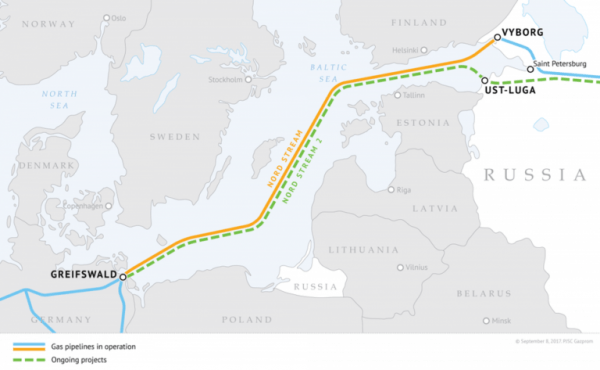
The project is expected to ensure safe and stable supplies of gas to Europe. The competitive Russian gas supplies will enable European customers to save anywhere around 8 billion euros on their gas bill in 2020.
More importantly, according to a study conducted by the University of Cologne EWI, “When Nord Stream 2 is available, Russia can supply more gas to the EU decreasing the need to import more expensive LNG. Hence, the import price for the remaining LNG volumes decreases, thereby reducing the overall EU-28 price level.”
Herein lies the rub. Europe has become a natural gas battleground for the US and Russia. Of course, apart from being a prized market, Europe is also a political battleground between the US and Russia.
Russia traditionally dominated the European market while the European Union appears to be keen to wean itself off Russian gas, given the geopolitical implications of over-reliance on Moscow for its energy security. On the other hand, the US is looking to step up its exports of liquefied natural gas (LNG) to Europe and faces a big resourceful competitor who cannot be dislodged from the market — Russia.
Russia loomed large as the largest supplier of natural gas to the EU in 2018. According to the European Commission’s latest data on EU imports of energy products in October, eleven member states imported in 2018 more than 75 percent of their total national imports of natural gas from Russia.
Russia has multiple pipelines in operation, which gives it a big advantage in cutting down transportation costs for the European consumers, as compared to more expensive LNG imports from the US. Clearly, both geoeconomics and geopolitics are at play here.
The US’ transatlantic leadership is largely conditional on the climate of relations between Europe and Russia in general and between Germany and Russia in particular. Washington is acutely conscious that Nord Stream 2 can provide the underpinning for a stable, predictable relationship between Europe and Russia, which would go against the grain of the Trump administration’s projection of Russia as a revisionist power that the US is determined to counter.
In sum, Washington apprehends that if Nord Stream 2 is completed, it will come as a severe blow to transatlantic relations, although on the face of it, the US has been arguing that the project runs counter to the Western sanctions imposed on Russia following its annexation of Crimea.
Actually, this argument is sheer sophistry, since Europe’s dependence on Russian energy supplies is a legacy inherited from the days of the Soviet Union. Moscow is a stakeholder in preserving its reputation as a stable, reliable supplier of energy to Europe at competitive prices. The crux of the matter is that the European consumer prefers the cheaper Russian gas to the expensive LNG exports from the US.
Meanwhile, the Ukraine crisis alerted Russia to the geopolitical reality that it could be vulnerable to US pressure politically, which in turn prompted its energy pivot to China. Gazprom aims to become China’s top gas exporter by 2035. When the Power of Siberia pipeline (under construction in Eastern Siberia to transport gas to Far East countries) becomes active later this year, it will deliver 38 billion cubic metres of natural gas annually to China, which will make China Russia’s second-largest gas customer after Germany.
However, paradoxically, Russia’s gas exports to Europe are only increasing in recent years. In 2018, Gazprom’s gas sales to Europe and its share of Europe’s gas market reached record highs. This trend can only continue as the Nord Stream 2 and Turk Stream pipelines, which will become active shortly this year, will deliver an additional 86.5 billion cubic meters annually to Europe.
Simply put, Europe’s addiction to Russian gas remains a fact of life and with the continent’s own gas production on the decline, Europe needs to import much bigger volumes of gas and lots of it is going to come from Russia.
The amazing part has been the dogged resistance by Germany to the US pressure tactic to abandon Nord Stream 2. The US even threatened to sanction German companies; US Congress passed resolutions calling for an end to construction of the pipeline. Germany’s manufacturing economy is dependent on imports for 98% of its oil and 92% of its gas supply, and cheap gas is the lifeblood of its export-based economy.
But then, there could be more to it politically than meets the eye. Can it be a coincidence that Germany is also resisting US pressure to shut out Chinese tech giant Huawei from its 5G networks? Like with Nord Stream 2, Washington advanced the same argument apropos Huawei — national security concerns. But Germany snubbed the calls from the US.
The Economist magazine wrote some months ago that the “The Atlantic Ocean is starting to look awfully wide. To Europeans the United States appears ever more remote.” To be sure, the coming into fruition of Nord Stream 2 is yet another sign that the transatlantic relationship currently faces significant challenges.
The US-European policy divisions have emerged on a wide range of regional and global issues. Although US and European policies toward Russia remain broadly aligned, Nord Stream 2 turned out to be a key US-European friction point.
Denmark removes final hurdle for Russian gas pipeline to Europe
RT | October 30, 2019
Denmark has given the green light for the Russia-led Nord Stream 2 gas pipeline to pass through its waters. Copenhagen’s delay in granting permission has been the main hurdle to completing the project on time.
“The Danish Energy Agency has granted a permit to Nord Stream 2 AG to construct a section of the Nord Stream 2 natural gas pipelines on the Danish continental shelf southeast of Bornholm in the Baltic Sea,” the agency said in a press release.
It explained that the permit was granted in accordance with Denmark’s obligations under the UN Convention on the Law of the Sea.
“Denmark is obliged to allow the construction of transit pipelines with respect to resources and the environment and if necessary to assign the route where such pipelines should be laid,” it said.
The agency said it concluded that “the southeastern route on the continental shelf is preferable to the northwestern route” as it is the shortest one. It provides the “least risk and impact from an environmental and safety perspective and therefore is the preferable choice.”
The undersea pipeline, designed to deliver Russian natural gas to Germany and other European customers, is set to be finished by the end of the year. The offshore and land sections of the pipeline were connected on the German side last year and a receiving terminal is currently under construction there. Russia has finished laying nearly two thirds of the Nord Stream 2 natural gas pipeline along the bottom of the Baltic Sea.
The project has only needed approval from Danish authorities; other countries on the route of the pipeline – Russia, Finland, Sweden and Germany – have long-since approved it.
The pipeline’s construction has been criticized by the US administration which attempted to derail the project in order to boost sales of American liquefied natural gas (LNG) to Europe.
Washington FDA Says, ‘Let Them Eat Cotton’
Gossypol, “in most animals, provokes infertility”
By F. William Engdahl – New Eastern Outlook – 29.10.2019
US Government regulators have approved a genetically modified cotton variety as a “potential solution to human hunger.” The radical decision is to permit consumption by humans, in addition to animals, of seeds of a GMO cotton developed at Texas A&M University, with no independent long-term testing. It opens grave new concerns about the safety of our food chain. Soon, as a result, the world food chain may well be contaminated with the GMO cottonseeds whose dangers have been simply ignored by authorities.
The USA Food and Drug Administration (FDA) has just approved a new type of GMO cotton for unregulated release. The type, called TAM66274, has been genetically modified supposedly to make the seeds fit for human or animal feed by suppressing the presence of a dangerous toxin in the seed, while allegedly leaving the toxin only in the rest of the cotton plant.
With FDA approval the GMO cottons seeds will now be allowed as food for people or animals. The project has been led by Keerti Rathore, a plant biotechnology protégé of the late Norman Borlaug, at the Texas A&M AgriLife Research Center.
Rathore says the group will now seek approval in other countries starting with Mexico. He calculates that, “There are approximately 10.8 trillion grams of protein locked up in the annual global output of cottonseed. This is enough to meet the basic protein requirements of over 500 million people at a rate of 50 grams of protein per person per day.” He says the GMO cottonseeds can also be used to feed pigs, poultry or farmed fish or shrimp. His group sees it as a major new source of protein for consumption, as well as profit for cotton growers. It is not surprising that Cotton Inc., the US cotton lobby group is sponsoring the GMO project.
Cotton Inc. and Monsanto have a history of cooperation as well. Rathore says for every pound of cotton fiber, the plant produces about 1.6 pounds of seed. The annual global cottonseed production equals about 48.5 million tons. If that can now be turned into cottonseed oil or meal for human and animal consumption and sold, it adds a huge profit boost to cotton producers. The world’s largest purveyor of cotton seeds for planting cotton is Monsanto, now part of Bayer AG.
“The kernels from the safe seed could be ground into a flour-like powder after oil extraction and used as a protein additive in food preparations or perhaps roasted and seasoned as a nutritious snack,” Rathore said.
On October 1 the FDA released its summary of findings for the Texas application which had been made in 2017. That gives the impression the Government researchers were making an intensive testing of the highly controversial issue of whether to permit human consumption of the GMO cotton seeds or not. Far from the case. As the FDA states in their findings of October, 2019, the FDA declaration was simply copied from the tests given them by the producer, Texas A&M and its biotech research group, funded by the US cotton industry group, Cotton Inc.
Highly toxic gossypol
The FDA approval, made with no apparent independent testing of the results given them by the group at the A&M AgriLife Research center, is notable given the fact that cottonseeds contain a highly toxic substance in the seeds known as gossypol. Because of gossypol, previously much of the weight of cotton plants was wasted or usable only for limited animal feed only after special treatment. The seeds were deemed unsuitable for human consumption.
The A&M GMO cotton was modified using what is called RNA interference technology, RNAi, to “silence” a gene that supposedly, again according to its developers, “greatly” reduces gossypol from the cottonseed. Rathore claims to have suppressed the gene of a cotton plant to produce cotton with gossypol in everything but its seeds: “We have eliminated this gossypol from the seed without affecting its levels in other parts of the plant,” said Rathore. “With the toxin removed from the cottonseed, it can potentially feed 500 to 600 million people per year.” Well, almost eliminated it, to be more accurate. They admit that about 3% gossypol remains in the seeds.
Now we are entitled to eat the “low” gossypol seeds which are said to be protein rich and supposedly safe. There are several alarming aspects to this FDA decision to release the GMO cotton variety for human and animal consumption.
Not Adequately Tested For Safety
First of all, as researcher Claire Robinson points out in an excellent analysis, the RNAi procedure for cotton is hardly proven to be safe. She notes scientific research that shows risks of GMO RNAi crops. One study found that RNAi molecules in food plants can survive digestion and enter the body of the human or animal eating it, and even affect the gene expression of the human or animal with unpredictable side effects. Robinson stresses that the FDA made no adequate thorough tests for safety of the GMO cotton, nor did Texas researchers. She notes, “No toxicity testing in animals has been done on the seeds that are intended for consumption. The application only refers to testing in mice of the NPTII antibiotic resistance gene product, though it does not mention how long the tests lasted.”
Not only are the range of tests submitted by the Rathore group deficient or inadequate, they admit that their GMO variety has not entirely eliminated the presence of toxic gossypol in the cottonseeds, hence they term it “low” gossypol cotton seed, with an estimated 3% gossypol. Absent are any tests long-term on mice or other animals of effects of 3% or low gossypol GMO cottonseeds.
Population Reduction?
Gossypol among other traits is a human contraceptive. A study published in the journal Contraception notes that gossypol, “in most animals, provokes infertility, and in man it causes spermatogenesis arrest at relatively low doses… Gossypol should be prescribed preferably to men… who would accept permanent infertility after a few years of use.” It seems to be irreversible for many.
Another study published in The Scientific World Journal notes that among other toxic effects, “… free gossypol may be responsible for… respiratory distress, impaired body weight gain, anorexia, weakness, apathy, and death after several days. However, the most common toxic effect is the impairment of male and female reproduction. Another important toxic effect of gossypol is its interference with immune function, reducing an animal’s resistance to infections…”
Now according to the FDA, we humans are animals too for purposes of consuming GMO cottonseeds. Is a presence of 3% gossypol in now “edible” GMO cottonseeds enough to cause stealth contraception in humans, or any of the other grave symptoms? We simply don’t know as none of the responsible US regulators, neither at USDA nor FDA, have apparently bothered to seriously test.
What has the FDA done to safeguard the health and safety of potential human or animal consumers of the GMO cotton? A careful reading of the FDA testing summary of October 1 shows the entirety of their evaluation, as noted, is lifted directly from the test results given them by Rathore’s group at Texas A&M. And Rathore omits details of the length of their testing, which can conceal negative effects that only show up after longer time tests. Other tests are superficial and inconclusive.
Speaking of his hopes for the application of his new GMO cotton type, Rathore declares, “My personal preference as we move forward would be to follow the ‘Golden Rice’ example in terms of its use for humanitarian purposes.” The only problem with that example is that the Philippines project financed by the Rockefeller Foundation in the 1990s to develop Golden Rice, supposedly high in Vitamin A, was a colossal failure that was later abandoned by its creators. It was simply used as a GMO PR stunt. It could well be that the inadequately tested GMO cottonseeds end up blended into our food like so many such ingredients with us being none the wiser. The precautionary principle seems to have been shredded by scientists at FDA.
Airbnb complicit in ‘plunder of Palestinian refugee properties’ says new report
MEMO | October 29, 2019
Online accommodation and tourism giant Airbnb has been accused of “complicity in the plunder of Palestinian refugee properties”, in a new report published last week.
According to Who Profits, an independent research centre focused on exposing corporate involvement in the “ongoing Israeli occupation of Palestinian and Syrian lands”, their new update sheds light on a “largely overlooked” dimension of Airbnb’s “complicity”.
Taking the Old City of Yafa (Jaffa) as a case study, the new report “aims to highlight the ways in which Israel confiscated and controlled Palestinian properties, leading to their privatisation”.
“Israel has transformed properties into economic assets that benefit both the state and private actors, thus undermining Palestinians’ legally enshrined Right of Return,” stated the research centre.
“Serving as a platform for showcasing the homes that once belonged to Palestinians, Airbnb plays a role in strengthening the Israeli hold over Palestinian refugee properties,” Who Profits added.
During the Nakba of 1948, more than 750,000 Palestinians were expelled from their homes and lands – property that was subsequently appropriated by the Israeli state “through legal mechanisms that formalise their confiscation and turn them into economic assets”, Who Profits explained.
According to the centre, this “privatisation” of refugee properties has benefitted market actors and Jewish Israelis, “whilst further threatening the possibility of Palestinians reclaiming ownership of their properties in the future”.
In the case of Jaffa, what was once the largest Palestinian city was almost entirely ethnically cleansed during the Nakba (five per cent of its Palestinian residents remained post-1948). Today, the Old City is one of the most popular sites in Israel for tourists, where Airbnb lists more than 40 properties.
In its new report, Who Profit notes that “while the issue of listing settlement properties [in the occupied West Bank and East Jerusalem] has gained worldwide attention, the issue of listing refugee properties ‘abandoned’ in 1948 remains largely overlooked.”
“The act of plundering and privatizing refugee properties by the Israeli state, which started during the Nakba and continues to this day, has transformed the refugee properties in Yafa into commodities that can now be listed by hosts on platforms such as Airbnb,” the report concluded.
“In serving as a platform for these properties, as well as those in settlements in the West Bank and in East Jerusalem, Airbnb is profiting from the ongoing dispossession of Palestinians.”
READ ALSO:
Western courts target Gazprom for expropriations
By Padraig McGrath | October 29, 2019
On October 23rd the Amsterdam District Court issued an order for the seizure of 100% of the shares of the South Stream Transport B.V. company, which is contracted to build the offshore section of the Turk Stream Pipeline. This legal ruling follows a 2018 award by the Stockholm Arbitration Tribunal of $4.6 billion to Naftogaz, the (theoretically) state-owned oil and gas company of Ukraine, in a lawsuit which it had filed against Gazprom in 2014 in relation to alleged contractual violations regarding gas-transit through Ukraine. That $4.6 billion award was later negotiated down to $2.56 billion, but on October 23rd the Amsterdam District Court ordered the seizure of all South Stream Transport B.V. shares as a punitive measure for non-compliance with the Stockholm Arbitration Tribunal order.
Despite this development, Russian Energy Minister Aleksandr Novak said on October 27th that the construction of the Turk Stream Pipeline would be completed on schedule. The 1100-kilometre pipeline, 900 kilometres of which runs under the Black Sea to Turkey, is envisaged to begin delivering a combined total of 30 billion cubic metres of gas to Turkey and South-Eastern Europe per year, beginning in late 2019.
Of course, this is not the first time that Russia’s state-owned concerns have been targeted for plunder by a court or quasi-judicial body convened in the legal jurisdiction of a western country. In July 2014, the Permanent Court of Arbitration in The Hague issued an award of $50 billion to former shareholders of Yukos, the oil company previously controlled by the oligarch Mikhail Khodorkovsky. Interestingly, the Amsterdam District Court, the same judicial body which has issued this latest ruling, later quashed the 2014 ruling made by the Permanent Court of Arbitration on the grounds that the latter had no legal jurisdiction to issue such a ruling.
One thing which is perfectly clear in context is that these legal rulings are, quite blatantly, both politically and geo-politically motivated. Targetting Gazprom serves multiple geo-political functions. Firstly, the Turk Stream pipeline was devised in order to enable Russia to bypass the territory of a deeply problematic, crisis-ridden, hostile and contractually unreliable neighbour in the task of effecting gas-transit to its markets in Europe. Even before relations between Russia and Ukraine deteriorated following the February 2014 Ukrainian coup d’etat, the siphoning-off of Russian gas while in transit across Ukrainian territory had been a perpetual concern for many years.
However, this goal of rendering Ukraine a geo-political irrelevancy, and therefore nobody else’s problem, is precisely what western geo-strategists are invested in preventing. Ukraine has been transformed by western interests into the failed state that it is now precisely for the purpose of presenting developmental and economic challenges to Russia. Therefore, these same interests must use any counter-measures, including quasi-legal counter-measures, in order to keep Ukraine relevant. This explains the punitive court-order to freeze the shares of South Stream Transport B.V.
Another driver of this western judicial hostility, also a manifestation of current geo-political conditions, pertains to Gazprom specifically. To analyze this, we should look at the role which highly profitable state-owned concerns, Gazprom the most notable among them, play within the Russian economy and in Russian society more broadly.
In spite of maintaining quite a business-friendly tax-environment (Russia has a 13% flat income-tax rate), the Russian government nonetheless manages to maintain (and indeed, to significantly upgrade) the social system. Significant federal investments have already been made in infrastructure and in the modernization of the public healthcare sector, for example. In February, the government announced 12 major development-projects as part of the “Great Society” initiative ranging from agriculture, ecology, infrastructure, the digital economy, and the further technological modernization of public healthcare.
In a country with a 13% flat income-tax rate, revenues from state-owned companies like Gazprom make this kind of state-building and society-strengthening possible. The western alliance (and its judiciaries) understand perfectly well that financial attacks against Gazprom amount in practical terms to attacks on the Russian state, and to counter-measures to the Russian state’s efforts to build the kinds of social systems which are necessary to its long-term self-defence.
Taken to its logical conclusion, from the liberal democratic perspective, the rationalization for this further degree of geo-political weaponization of “international law” would be that, as liberal democracy is believed by the western alliance to be the only political system which has any moral or political legitimacy, it therefore follows that only liberal democratic legal systems have any legal jurisdiction, and that their jurisdiction should be seen as universally extensive.
“Liberal universalism” refers to a sense of moral universality, but also (consequently) to a sense of universality of legal jurisdiction.
This mindset attempts to justify the weaponization of judiciaries, and of judicial bodies established by international law, against all and any states which don’t sign on with the liberal universalist consensus.
Of course, Russia is not the only state which is targeted by this geo-political weaponization of judiciaries. We might recall the 2012 order made by a New York court to freeze $6.5 billion in Iranian government assets in relation to a lawsuit filed by family-members of people killed in the 9/11 attacks. The lawsuit had claimed (quite spuriously and bizarrely) that Iran had aided and abetted the 9/11 attackers, despite the obvious point that Al-Qaeda’s ideology is fanatically anti-Shi’ite. One point which is interesting, considering that state-sponsored piracy has quite recently re-appeared on the high seas (Gibraltar), is that judicial structures established by “international law” are now also being quite explicitly used for the purpose of enabling what we might term “judicial piracy.”
What next? Will the British government start re-issuing “letters of marque” to sea-faring privateers?
However, as with so many geo-political stratagems deployed by the governments of contemporary liberal democracies, the resulting erosion of the judiciary’s independence from the political sphere completely undermines the normative and legal basis of liberal democracy itself.
Featured Video

EUROPE FEARS RUSSIA’S NEXT MOVE / Ian Proud
or go to
Aletho News Archives – Video-Images
New Book
New Book: No Autoimmunity The Body Doesn’t Attack Itself
Lies are Unbekoming | September 24, 2026
 The label for Humira, once the best-selling drug in the world, lists its risks in plain print. One of them, in the label’s own words, is new “autoimmune” disease.
A drug prescribed for a condition labelled autoimmune carries a warning that it can cause a condition labelled autoimmune. That contradiction sits in every box, on a folded paper almost nobody reads.
My new book starts there.
No Autoimmunity: The Body Doesn’t Attack Itself
For seventy years, “your body is attacking itself, and we don’t know why” has ended the conversation for people diagnosed with multiple sclerosis, lupus, rheumatoid arthritis, Hashimoto’s, Type 1 diabetes, Crohn’s and psoriasis. More than eighty conditions now carry the autoimmune label. The diagnosis comes with a prescription for life. It almost never comes with a question about cause.
This book asks the question and answers it from the framework’s own records: its drug labels, its journals, its regulatory filings, and its own experiments. … continue
Blog Roll
 Aletho News
- Iran offers Trump deal before US election
- Merz regime wants ‘secret police’ – opposition
- Israeli settlers terrorize West Bank Palestinians with state-provided drones: Report
- They see them, then kill them: Israeli quadcopters track, deliberately target civilians in Gaza
- Debunked: Trump’s egregious UNGA claims on war against Iran crumble under scrutiny
- Europe was part of the infrastructure of US aggression against Iran: Deputy FM
- New evidence on the Bucha Massacre
- Italy and France debunk reports CIA issued ‘Russian drone threat’ warning
- How Russia is Rewiring the Global South
- Britain’s elites want you ready to die for a war they keep imagining
- If Americans Knew
- Trump betrayed voters with his campaign lies and prioritized a foreign country once he took office
- Netanyahu calls Israel’s war in Gaza ‘opposite of genocide’ in UN speech to near-empty hall
- Settler Kidnappings: Torture, Sexual Abuse and Terrorisation of Palestinian Abductees as Israel Deepens Annexation of West Bank
- Gaza winter nears as 162,000 tents become unusable, raising fears of humanitarian crisis
- Netanyahu says, “It’s the opposite of genocide”; UN says Gaza economy is world’s ‘most severe crisis on record’ – Daily Update
- Israel’s US-Backed Assault on Gaza Has Created the ‘World’s Most Severe Economic Crisis on Record’: UN
- ‘Protecting U.S. Citizens’… From Israel
- ‘This is where I live now, the back of a truck’: a day in the life of a grandmother in Gaza
- In UN Speech, Iran’s President Displays Pictures of Children Killed by US, Brings Attention to Israel’s Nuclear Arsenal
- Israel displaces hundreds of Palestinians amid wave of demolitions in West Bank
- No Tricks Zone
- New Study: Earth And Venus Surface Warmth Largely Explained By Convection And Lapse Rate, Not CO2 Or Radiation
- 2025 Nature Paper Claiming Worsening Global Drought Gets RETRACTED …Heavily Flawed
- New Study: ‘Global Drought Shows No Detectable Recent Acceleration Under Climate Warming’
- Economic Masterminds: German Socialists Suggest Taxing Productivity Gains Stemming From Using AI
- The South China Sea Has Not Been Cooperating With The Climate Change Narrative
- Energy Crisis: Germany Enters Heating Season With Historically Low Gas Reserve Fill Levels
- New Study: The Antarctic Ice Sheet Gained Mass From 2020-2024 Due To Staggering Snow And Ice Accumulation
- Study: Ocean Heating Rates From Thousands Of Years Ago ‘Dwarf’ Modern Ocean Heating Rates
- Climate Extremists Target, Attack Large-Scale Power Grid Infrastructure In Germany!
- New Study: Antarctic Ice Melt Has Contributed Less Than 1 Centimeter To Sea Level Rise In The Last 30 Years

