Russia, China & India to set up alternative to SWIFT payment system to connect 3 billion people
RT | October 28, 2019
Members of the BRICS trade bloc Russia, India, and China have decided to connect their financial messaging systems to bypass the SWIFT international money transfer network.
Russia’s financial messaging system SPFS will be linked with the Chinese cross-border interbank payment system CIPS. While India does not have a domestic financial messaging system yet, it plans to combine the Central Bank of Russia’s platform with a domestic service that is in development.
The new system is expected to work as a “gateway” model when messages on payments are transcoded in accordance with a certain financial system.
According to Izvestia, the parties involved will work on a single platform, without experiencing any difficulties with transactions.
Russia began development of SPFS in 2014 amid Washington’s threats to disconnect the country from SWIFT. The first transaction on the SPFS network involving a non-bank enterprise was made in December 2017.
“We have an opportunity to connect both foreign banks and foreign legal entities to the SPFS. Today, about 400 users are participating in the system. Agreements have already been concluded with eight foreign banks and 34 legal entities,” Alla Bakina, the director of the Bank of Russia’s national payment system, was cited as saying by Vesti.
Bakina explained that traffic through the system has been growing and currently accounts for around 15 percent of all internal traffic, up from 10-11 percent last year.
The EAEU (Eurasian Economic Union) countries are currently working with the Bank of Russia on technical options for connecting to the SPFS. Iran, which has officially joined the Russia-led free-trade zone (EAEU) this month also seeks to develop a joint alternative to SWIFT. Last year, SWIFT cut off some Iranian banks from its messaging system.
SWIFT is based in Belgium, but its board includes executives from American banks with US federal law allowing the administration to act against banks and regulators across the globe.
Instead of SWIFT, a system that facilitates cross-border payments between 11,000 financial institutions in more than 200 countries worldwide, Moscow and Tehran will use their own domestically developed financial messaging systems to conduct trade.
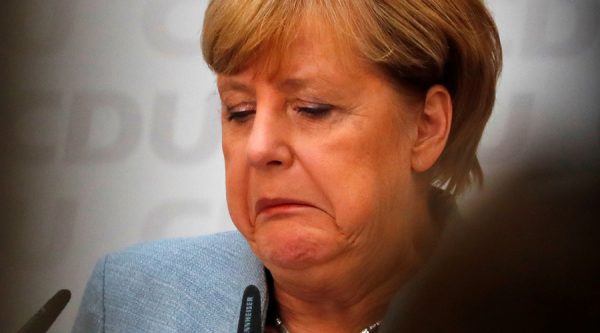
Another regional election defeat for Merkel, as German leader’s party beaten by right-wing AfD
RT | October 27, 2019
German Chancellor Angela Merkel’s conservative Christian Democrats (CDU) lost yet another regional election, coming behind both left-wing Linke and right-wing Alternative for Germany (AfD) in the eastern state of Thuringia.
It’s not the first time in 2019 that Germany’s ruling party has taken a hammering in local polls. Merkel’s CDU and its coalition partner, the left-wing Social Democrats (SPD) already saw their formerly safe lead in Saxony and Brandenburg eroded last month by the rise of the AfD.
The AfD, which surged from nothing into third place in 2017’s federal elections, took 23.8 percent of the vote in Thuringia, according to exit polls released Sunday. Merkel’s CDU took 22.5 percent. The left-wing Linke won the state, taking 29.7 percent of the vote.
At the back of the pack, the SPD took 8.5 percent, while the Greens took 5.4.
For the AfD, pipping the CDU into second place is a major coup, considering the party only managed to win 10 percent in the last election in 2014. Back then, the CDU was the overall winner, with 33.5 percent, though Linke, the SPD, and the Greens would band together to form a coalition government.
For the CDU and SPD, Sunday’s results are the worst since reunification three decades ago.
Thuringia is a small state with a population of 2.1 million that used to be part of the Eastern Bloc.
Though the CDU and SPD remain in power in the west of the country, the ruling centrists have seen their support eviscerated in the east, pointing to a culture clash of sorts between both sides of the old Cold War-era border. The east remains relatively disadvantaged compared to the west, and the AfD has courted the region’s electorate by opposing the closure of coal mines and calling for urban regeneration.
Linke too has positioned itself as a champion of the working class, promising increased social spending, a raised minimum wage, and tax increases on the wealthy.
Opposition to Merkel’s ‘open door’ immigration policies saw the AfD initially surge in popularity, after the chancellor welcomed more than a million migrants to Germany in 2015. Since then, the party has found support in the east, where public opinion against immigration is strongest.
And, while Germany’s green party enjoyed strong support in this summer’s European elections, its share of the vote remained stagnant in Thuringia, suggesting that the environmentalism currently in vogue in the west finds few fans in poorer parts of the country.
“Thuringians have voted for the Wende 2.0,” Bjoern Hoecke, the AfD’s leader in the state, said on Sunday. “This is a clear sign that a large part of Thuringia says: This can’t go on. We need renewal – this should be taken seriously.”
“Wende” is a German word meaning “turnaround,” and was used to describe the collapse of East Germany three deacdes ago. AfD leaders have repeatedly used the phrase on the campaign trail in eastern states, suggesting that the demise of Merkel’s centrism is every bit the revolution the fall of communism was.
With the center gutted and the AfD and Linke taking the most votes, there is little in common between both parties, save for a more friendly attitude to relations with Russia than Merkel’s. Both are currently enjoying more support than would have been imaginable in 2014, though every single mainstream German party has ruled out working with the AfD.
Lenin ‘Judas’ Moreno – Ecuador’s Story of Betrayal and Resistance
By Joaquin Flores | Strategic Culture Foundation | October 27, 2019
On October 3rd, countless tens of thousands of Ecuadorian citizens began a general strike and occupation of public spaces, throughout the country but targeting the capital of Quito. President Lenin Moreno has made himself one of the most hated men in the history of the country in the course of his rule, and was forced to flee as a consequence, and re-establish the capital in Guayaquil. In addition, facing a larger and wider revolution all together, Moreno was forced to rescind Decree 883 – the new law which appears to have been the straw that broke the camel’s back in Ecuador.
But this is far from over, and Moreno’s continued existence as head of government threatens to see the expansion of this newly awakened movement. Internationally too – for it is Moreno who also betrayed Julian Assange, after Raphael Correa offered him protection.
Media are accurately reporting the obvious, but in limited context: Moreno enacted Decree 883, which brought an end to the popular fuel subsidies. As the story goes, this was part of an austerity agreement made with the International Monetary Fund (IMF) in return for a loan. Decree 883 threatens the country’s most vulnerable and historically marginalized cross-sections of Ecuadorian society, indigenous communities in particular. These indigenous communities, along with labor and citizen’s group, were at the forefront of these protests and the general strike, leading and organizing them. Moreno accuses his popular predecessor Correa for planning and executing the protests, with assistance from Cuba and Venezuela. The ‘random Soros guy’ from Brazil, Juan Guaido, has echoed Moreno’s accusation.
The Looming Econocide which Decree 883 Threatened
Beyond this, however, is the real story of Decree 883 and the recent history of Ecuador, and the real betrayal represented by Mr. Moreno – a visceral hatred he has earned for himself, which extends far beyond Decree 883.
Mr. Moreno baffled the public when he announced that the subsidies policy introduced in the 70’s, which if accounting in a very narrow and segregated way, appear to ‘cost’ the government some $1.3bn annually, were no longer affordable. But what macroeconomists and the public both understood, and what was particularly outrageous, was this: these subsidies, based on Ecuador’s socialized gas industry, in fact made possible all sorts of economic activity; risk taking and opportunity making, and consumption in other sectors of the economy – not possible without such a subsidy.
And so the ripple effect of Decree 883 would result in pessimism and a bearish national economy, all around. The cognitive and theoretical deficiency of believing that one can shore up nominal debts that exist under certain conditions of subsidy, by eliminating an economy enhancer like an energy subsidy, without this in turn deleteriously effecting overall GDP indices, to in turn qualify for a loan which would in all obvious reality create further balance of payment and debt problems, is itself either negligent, criminal, or both.
The real consequence would be that it would place the Ecuadorian economy further in debt, which means in further reliance on the IMF, which means further loans will be needed, which means further austerity, and ultimately privatization of the public weal. Upon such a cycle, creating permanent servitude and insolvency, the final aim on the part of the IMF cannot be simply a vicious debt cycle, (as this is ultimately unpayable) but the total private and foreign ownership of Ecuador, with some sort of mass impoverishment, even genocide of its indigenous people, as an obvious – if not wanted – consequence. At this point it becomes perhaps secondary to note that none of these ‘IMF loans’ will be used to develop the country’s physical economy – the only real signifier of wealth building for a whole society, if viewed scientifically and rationally as an organic unit with mutually interrelated symbiotic components.
There are few words to describe such aims as Decree 883 without delving into deep, profound, philosophical and theological questions about the nature of the forces of good and evil in the world. Questions which force us to ask what universal principles give meaning to our lives as human beings, and what really and fundamentally motivates those with such a blatant misanthropic agenda.
But at any rate, it is more than obvious how this move by Moreno, in the name of Decree 883, had led to the near toppling of the Ecuadorian government – leading to Moreno declaring a state of emergency.
A success so far for the people has been the apparent repeal of Decree 883, but why Moreno is so very much hated deserves our attention, as this is only the beginning. During his tenure, Moreno has gained himself the nickname among the opposition ‘Judas’: a name necessary as it distinguishes that he is ‘no Lenin’.
What Moreno has done has resulted in the largest popular uprising the country has seen in many years. After years of working to reverse the progress and stability brought by the noble and just government of Raphael Correa, Moreno brought about a condition of instability and ignobility. Within months of assuming office, he disavowed Correa who had brought him where he had arrived, and began to work under the orders of Washington to undo Correa’s social and legislative reforms that had been aimed at deepening the strength of Ecuador’s civil society, labor, and justice. Under Correa, poverty would see a 30% decline.
Despite this obvious reality, this obvious truth, Moreno doubles-down on his contempt for reason and rationality, by accusing the protestors of being agents of Correa, even of Maduro (!). This affront to the wisdom of the people of Ecuador is comparable to blaming the blood for the wound, or for blaming the wound for the accident which causes these.
The gas itself is largely owned by and for the people, through EP Petroecuador
The latest affront to dignity and fairness, in the form of yet another IMF sell-out from Moreno, came in the form of the elimination of gas subsidies for people most in need. And one cannot offer any real logic or reason for ending these subsidies, for the gas itself is largely owned by and for the people, through EP Petroecuador, the state oil firm.
But this deep-seated scorn is not simply related to contempt for his policies, but much more profoundly for his betrayal. Because we might expect such austerity from a centrist or right-wing candidate, given the history of politics in Latin America – there is something honest in this; they deliver what they campaign on. But given that Correa had essentially groomed Moreno, and Moreno in turn endorsed the policies of Correa – we encounter the crux of the matter, and how Moreno turned from Lenin to Judas.
To wit, it was Raphael Correa’s broad plan to rescue Ecuador from the predatory claws of the IMF, by fomenting a public campaign, a brilliant simulacrum strategy of sorts, borrowed from Venezuela, that an entire program of socialist revolution was underway, such that it had the effect of lowering the value of Ecuador’s bonds, owned by foreign interests. This made it so that Ecuador was able to succeed in buying back some 91% of these bonds, and made possible Ecuador’s thumbing the IMF and not taking on new debt. This was done by intelligently weaponizing Ecuador’s apparent weakness in not having its own real national currency, as this was dollarized by corrupt national leaders in 2000, using the excuse of the damage caused by Hurricane ‘El Niño’, to eliminate Ecuador’s monetary sovereignty. It had been widely believed that without a national, sovereign currency, that Ecuador could have no sovereign monetary policy – Correa proved this wrong by turning expectations and dynamics on their respective heads. While this dictum is true in the long-term, Correa used the dollarized nature of Ecuador’s currency values in a gambit to buy-back Ecuador’s bonds.
When Correa was elected president of Ecuador, it had come as the result of years of struggle by the popular forces of resistance, against all odds, and overcoming a particularly unstable and disastrous period were Ecuador had seen come and go some ten presidents in the period of just eleven years.
Correa would go on to serve for a decade, and continued to build popular support, and this had signaled the realization of an even broader dream of social and economic justice in Ecuador, but also a visionary long-term plan to integrate the Latin American economy into a single civilization-wide economic bloc.
The history of modern Ecuador is one of tragedy, hope, and never lacking in contradictions. During the time of Correa he was faced with the strongest opposition from the most intransigent and short-term thinking, narrowest in scope and vision, of the country’s billionaire class.
And it only so happened to be that this same class, who had been responsible for the years of instability and rampant poverty, were also those closest to Washington DC and New York City – placing the country at the hands of the Washington Consensus – the IMF, City Bank, JP Morgan Chase, and the rest of the “usual suspects”.
Rejecting this, in February 2007 that Correa’s economy minister Ricardo Patiño stated: “I have no intention […] of accepting what some governments in the past have accepted: that [the IMF] tell us what to do on economic policy.” “That seems unacceptable to us,” Patiño concluded.
The U.S and the IMF hated this, and hated Correa for this. Correa confused many –at first seeming to be a center-leaning social-democrat reformist. His biography and optics were misleading: young and well groomed, with waxed hair and Spanish features, he appeared very much like the kind of candidate historically installed by Ecuador’s wealthy comprador class. His credentials in governance had come about through being Ecuador’s finance minister under the prior neo-liberal government of Alfredo Palacio. And yet Correa was a man of the people and once in office quickly became allies with the Castros of Cuba and also Chavez, and then Maduro of Venezuela.
Correa understood he would be termed-out eventually, under Ecuador’s constitutional provisions, and had worked early on to groom a successor.
Again, the biography and optics were misleading: this successor was Lenin Moreno, the son of a communist teacher; Moreno inspired empathy with his soulful eyes, reminiscent of Iran’s Ahmadinejad, and being wheelchair-bound, he inspired sympathy.
The people had expected that a man who inspired such sympathy and empathy, would himself be capable of tremendous sympathy and empathy for the people in turn.
And yet the people were wrong. Instead, what lurked in the heart of Lenin Moreno was so dark, so depraved, so shallow and so selfish, that it exploded the left’s understanding of character.
It would turn out that Nietzsche’s dictum that weakness lays at the root of evil, and strength at the root of good, was true. If the apparent meekness of Moreno would allow him to inherit the world of Ecuador, then it was his cruelty and hatred, his resentment born of weakness, for those healthy and happy people, even if poor, that would threaten to destroy it.
The government of Moreno has been a betrayal so monumental and significant to the living history of Ecuador, that it has indeed earned him the name ‘Judas Moreno’, an allusion both to Judas Iscariot who betrayed Jesus Christ to the wishes of the Sanhedrin, and also to Leon ‘Judas’ Trotsky, who is believed by mainline communists internationally to have conspired to betray the Russian Revolution through his alleged conspiracy with the forces of Fascism in Europe.
And this leads us to the real heart of our investigation, for the apparent revolution that Judas Moreno has betrayed was the popular democratic, electoral ‘revolution’ of Correa. And this is why Moreno is so hated, and lacks any mandate. And this is also why his power decreases by the day, as his legitimacy in question after his first months in office, and his actions against the people – the repression, arrests, and persecutions which have heightened in the last ten days of protests against his regime, are only but the culmination of several years of the same.
Now there are dead, martyrs in this struggle, murdered by Moreno’s security forces.
Decree 883 may have been repealed, but coming about on the precipice of a broader revolution, the coming weeks and months only promise more conflicts, surprises – and we should expect yet another betrayal from Judas Moreno, and another explosion in response.
Expensive Climate Policies Sparked the Chile Riots, Just Like the Yellow Vest Protests in France
By James Taylor | The Epoch Times | October 25, 2019
Climate activists and the United Nations are suffering a major black eye this week as protests and riots resulting from high energy prices have erupted in Santiago, Chile.
Chile, which is hosting a major U.N. climate conference in December, earned praise from climate activists for recently imposing a carbon dioxide tax on conventional energy sources and switching the Santiago Metro system to renewable power. Now, the people of Chile are rising up and firing a shot across the bow of other nations considering similar energy taxes and expensive renewable energy programs.
On Friday, protestors took to the streets throughout Santiago in response to Metro fare hikes. The protests soon spread to other cities and led to rioting and at least five reported deaths. The Chilean government and the legacy media blamed the fare hikes on rising oil prices. But that is not true.
Oil prices are not rising. Global oil prices are currently 25 percent lower than they were a year ago and 37 percent lower than they were five years ago.
In Chile, gasoline prices reflect the lower oil prices. Chilean gasoline prices were $1.12 U.S. per liter in August 2019 (the last month for which data are available), compared to $1.28 a year ago. Five years ago, Chilean gasoline sold at $1.50 U.S.
Santiago Metro fares are rising, despite falling oil and gasoline prices, because government officials in 2018 traded out most of the Metro’s energy sources from conventional power to wind and solar power. The Chilean government also hit the portion of conventional power that remains with new carbon dioxide taxes.
As a result, Chileans are now burdened by higher Metro fares reflecting unnecessary energy price hikes. As Chileans protest in the streets, climate activists and their media allies want people to believe oil is to blame rather than government climate programs that raise energy prices and impoverish people.
Unlike speculative climate change harms that never seem to really happen, carbon dioxide taxes and renewable energy mandates immediately and measurably raise living costs and reduce living standards. … continue reading
The Neoliberal Ghost of Pinochet Is Finally Being Exorcised From Chile
By Paul Antonopoulos | October 25, 2019
More than 46 years of initially military imposed neoliberalism has finally exploded into widespread frustration, protest and violence. This neoliberalism culminated in 2017 with twelve businessmen, among them Chilean President Sebatián Piñera, monopolizing at least 17% of the national GDP, demonstrating the huge gap in wealth equity. There is little doubt why the latest protests have exploded violently, with 18 dead so far – Piñera had declared war on his own people to protect his lucrative monopoly racket.
It is without surprise he had declared war. The aggressive neoliberalism that has dominated Chile since the 1973 Chilean coup d’état when socialist President Salvador Allende was killed and eventually replaced by neoliberal Augusto Pinochet, with the backing and blessing of U.S. President Richard Nixon, Henry Kissinger, the CIA and the so-called “Chicago Boys” neoliberal economic team.
Although the so-called communist threat was defeated in Chile, it was not until 1990 for the kinder face of neoliberalism to return to the country, with the first democratic election taking place since the coup. The return to democracy had not meant any differences to the economic system.
The appearance of GDP growth in the South American country created the mythology of the Chilean miracle, ‘thanks’ to the Chicago Boys, the group of young Chilean economists who studied at the University of Chicago under the adviser to U.S. President Ronald Reagan and British Prime Minister Margaret Thatcher, professor Milton Friedman. They were the so-called economic liberators and advised Pinochet on applying complete free-market policies, essentially to privatize state-owned industries and companies, and to open the economy.
The pernicious globalist model was applied and deemed a miracle because of significant GDP growth. However, this is only to the benefit of shareholders and private companies and does not reflect on the average Chilean experience. According to the Organization for Economic Cooperation and Development (OECD), the Gini coefficient value, a method to measure wealth distribution, stood at a record 0.50 in 2017, one of the highest inequality coefficients in the world.
This is because the incomes of the richest 10 percent of Chile are 26 times higher than the incomes of the poorest 10 percent of the population. This is partly also due because the of an unfair taxation system that creates a massive tax burden on the poor as Chile’s government earns less from income taxes than any other country in the 35-member OECD. Despite praises of the supposed fantastic economic performance, almost a third of Chilean workers are employed in part-time jobs, with one in two Chileans having low literacy skills, according to the OECD.
And now as Chile literally burns and 18 people are dead, we cannot forget that former president Michelle Bachelet grotesquely dedicated lessons on “human rights” against Venezuelan President Nicolás Maduro. Although Piñera apologized, it was not for his declaration of war against the people, but rather for the decades of unresolved problems, followed by an announcement for a new social and economic program.
A reversal of the crippling neoliberal economic system? Highly doubtful and probably more a Band-Aid option.
Neoliberal propagandist Enrique Krauze Kleinbort – accused of the coup attempt to overthrow Mexican President López Obrador – proclaimed that Chile was ‘the role model’ for Latin American economic growth. If the inequality is considered a ‘role model,’ it shows that the oligarchs of Latin America have not realized a growing trend of violent opposition to neoliberalism, as the recent case in Ecuador demonstrates.
The very fact that Piñera attempted to increase transportation and energy costs in Chile demonstrates his lack of knowledge on international outrage to neoliberalism. The French Gilets Jaunes (Yellow Vests) in France began their actions 12 months ago, which also spread across Europe, when neoliberal President Emmanuel Macron attempted to increase gasoline taxes. In 2018, Brazilian truck drivers blocked roads in a demand for a decrease in diesel prices. Mexico in 2017 saw a 20% rise in fuel prices that exploded into riots.
However, the attempted increase in transportation and energy costs was only the spark that lit the fire. As Piñera, the male part of a monopoly over the Chilean economy, was forced to admit this is an explosion after decades worth of frustration, neglect and abuse. Candida Cecilia Morel, the wife of the billionaire Piñera, sent a WhatsApp message that was leaked in the media, in which she comments on the violence and the protests shaking her country – and it certainly does show the disconnect that the elite of Chile have with the common Chilean. The message said that “we are absolutely overwhelmed, it is like a foreign invasion, alien,” and that “we will have to decrease our privileges and share with others.” Her suggestion to decrease “privileges and shares” is a stark reminder of Charles Dickens 1800’s Britain.
With such elitist comments and referring to Chileans as aliens, there is little wonder that there has been little calm despite Piñera’s half-done apology and promises of more neoliberalism with a softer punch. Although circles close to the Chilean Presidency affirm that the disturbances and destabilization are orchestrated from abroad, it is unlikely to be true. We can of course expect that Venezuela will be the scape goat by some Chilean oligarchs, just as the oligarchs in Ecuador and Colombia do, but there remains little evidence that this is the case.
Rather, as Piñera has had to attest, decades of neoliberalism is the cause of this. However, perhaps inspired by events in Ecuador, it appears that the Chilean people are finally exorcising the neoliberal ghost of Pinochet from its country. It appears that the violence will not end unless the Chilean president makes drastic changes to the Chilean economy. Whether he does this or not remains to be seen.
Paul Antonopoulos is a Research Fellow at the Center for Syncretic Studies.
US Renews Chevron License as European Refiner Cuts Venezuela Ties over Sanctions
By Lucas Koerner | Venezuelanalysis | October 23, 2019
The US Treasury Department has allowed Chevron to continue its operations in Venezuela for a further 90 days.
One of the few remaining US petroleum companies still in Venezuela, Chevron currently produces around 200,000 barrels per day (bpd) in several joint ventures with Venezuelan state oil company PDVSA. The California-based energy giant had its Treasury-issued sanctions waiver extended on Monday.
The Trump administration imposed an oil embargo in January, barring dealings with Venezuela’s oil sector, including US imports of Veneuzelan crude, which then stood at 586,000 bpd. At the time, Chevron was issued a six-month license to wind down its Venezuela operations, which was renewed in a last-minute late July decision after months of lobbying. Other beneficiaries of the renewal are Haliburton, Schlumberger, GE’s Baker Hughes, and Weatherford International.
The license does not cover sales of diluents to PDVSA, which were outlawed by the Treasury Department in June. Venezuela relies on imports of diluents to blend its heavy crude into exportable grades, as well as produce gasoline and diesel for internal consumption.
Venezuela’s oil production has plummeted over the past two years since the US began imposing economic sanctions. According to OPEC secondary sources, output fell to just 644,000 bpd in September, down from an average of 1.911 and 1.354 million bpd in 2017 and 2018, respectively.
Caracas has scrambled to find new crude buyers, reportedly selling shipments to Russian state energy company Rosneft which then reroutes them to other customers. PDVSA has also moved to convert its heavy petroleum upgraders into blending facilities so as to produce lighter Merey grade crude favored by Asian markets.
In August, Washington upgraded its sanctions regime to a general embargo, prohibiting all US dealings with the Venezuelan state and its associated entities as well as authorizing secondary sanctions against third party actors.
The Trump administration has been reluctant to renew Venezuela operating licences, insisting on the need to deprive the Maduro government of export revenues in the hope of removing it from power. Venezuela depends on oil sales for over ninety percent of its hard currency earnings, which it uses for vital imports of food, medicine, and all classes of inputs.
Despite opting to greenlight Chevron’s operations for three additional months, the Treasury Department moved last week to modify the license of a European refining company prohibiting new purchases of Venezuelan crude.
Jointly owned by PDVSA and Finland’s Neste Oil, Nynas AB operates speciality refineries in Sweden, Germany, and the UK geared mainly towards asphalt production.
Under the terms of the new license, Nynas is authorized to sell Venezuelan oil or petroleum products already in inventory but is barred from making new purchases.
Nynas is one of only two remaining buyers of PDVSA’s lighter, Western-sourced crudes following Washington’s ratcheting up of sanctions this year, which have led most cash-paying customers to cut ties with the Venezuelan state oil firm.
Reuters reports that the move could lead Petrozamora, a Venezuelan-Russian joint venture in the western border state of Zulia, to cut production by 50,000 bpd in order to avoid overflowing oil stocks.
With additional reporting by Ricardo Vaz from Caracas.
A House of 12: Debate Four Shows Dems Have No Platform – Biden Stands No Chance
By Joaquin Flores | Strategic Culture Foundation | October 22, 2019
The DNC continues to promote Biden despite his not resonating with likely voters, undecideds, and swing-staters. Gabbard shone bright, but appears to have earned her place back by putting in work for Biden. The DNC must focus on fully socialized healthcare, as Trump’s foreign policy record is strong in the eyes of anti-war voters actually paying attention. But the DNC can’t, and so Trump will likely win.
It was Round Four of the Democratic debates on Tuesday, with 12 candidates squaring off in Westerville, Ohio.
Staged in the critical swing-state of Ohio, the small town of Westerville hosted Round Four of the Democratic Party primary race debates on October 15th. Democrats obviously are pinning hopes on being able to win a few of the swing states they lost to Trump.
The Democratic Party continues its strategy of maintaining a very high number of contenders in the race. In short, the party realizes that the front runner it wants to win – Biden – really lacks the grass roots support, big ideas, and mobilizing capacity that interesting candidates like Sanders, Yang, and Gabbard in fact have. So they keep these more interesting candidates in the race, so that potential voters are more invested in the process for longer. The idea is to try to transfer some of that Yang and Gabbard excitement and support, onto Biden. If that seems like a Herculean task and a strategy not likely to succeed, you would be right. But bear in mind that this is the same Clinton controlled DNC that came to believe that Hillary would win by a landslide.
Gabbard was no doubt the real-winner of this debate – because a victory in 2019 is whatever meme, soundbite, or viral clip you can produce from this sort of event. And Gabbard’s slicing and dicing of Warren was absolutely the highlight of the debate.
By European standards, the Democratic Party is a center-right liberal-austerity party, engaged in an abusive tactic of working against the mandate handed to them by their own more social-democratic constituency. Their programmatic aim is to reduce and tame the real demands of most of their voters, and present ‘pragmatic’ candidates with a ‘chance to win’. In reality, they force their own voters to bargain against themselves. The much weakened and diluted program that the pragmatic candidates take with them into office, is then in turn ‘bargained down’ in their negotiations with law-makers on the other side of the aisle. The result are candidates that no one really likes, going in and beginning negotiations with the position that one ought to arrive at in the end, and absolutely not begin with.
Healthcare
For example, on healthcare – as we saw again in debate number four – Biden promotes only nominal tweaks to Obamacare, which is a non-starter for the activist base of the party which knows that other developed countries consider healthcare both a right and a necessary foundation that makes all other profitable and industrious parts of socio-economic life possible and significantly more robust.
This base is required to generate excitement and launch candidates to wider audiences.
This is an entirely foolish position for many reasons, for nearly 60% of the general public according to recent Gallup polling, also believe that government must provide healthcare. Assuming that every voting Democrat supports a government mandate on healthcare, then nearly 60% means that about 20% of those are Trump voters, making this something of a non-partisan issue.
Interestingly, that polling data also shows that Obamacare ruined the public’s perception of government involvement in healthcare, and support for some kind of intervention dropped from all time pre-Obama high in 2006 of 69% in 2007, all the way down to some 46% in the time period that the travesty of Obamacare was passed into law in 2010. It would take another nine years for the support number to rise to where it is now, still 12 points below its 2007 high.
No Alternative to Trump’s Dovishness
The candidates in the Ohio debate took turns posturing tough on the need to beat Trump, but the DNC seems bent on backing any candidate who seems the least likely to. The reason that Trump will win if this continues – and win ‘big league’ – is that this is not only another ‘change’ election in the eyes of progressive and independent voters, but in fact a larger change paradigm.
Trump’s biggest weakness is his generally conservative position on social programs and healthcare, which is generally unpopular, even though his nominal trade wars with Europe and China were aimed at raising the position of the American worker.
The reality is that even during the administration of Bush 43, the Republican base was growing and voters were trending Republican. The victory of Obama was made possible around three factors: the unpopularity of the wars, which he promised to end, but did not; the massive new-voter registration campaign that was done through the back-door of ostensible labor organizing campaigns by SEIU in swing-states like Colorado; the massive energy at the base created around the prospect of a paradigm-shifting president, African-American no less, that would open the door to larger social-democratic movement – this also was spelled out in new-voter registration and turn-out.
Clinton attempted to use what the Obama energy had built, despite the 2016 election also having been a change election. But this need for ‘change without hope’ was absolutely at odds with the ‘hope + change’ campaign of 2007. Clinton was in the position of not being particularly inspiring to anyone, and needing to use the Obama energy and Obama machine to win an election which in all reality was a mandate against many of Obama’s actual policies and failings.
Without new voter turn-out, and without a genuinely populist campaign from the Democrats, Trump doesn’t have a serious contender to deal with.
Democrats have no real alternative program to offer to Trump, appealing instead to Trump Derangement Syndrome and the ‘Orange-Man-Bad’ mantra. But none of their supposedly front-runner candidates have anything of substance to counterpoise to Trump, with the exception of Warren on healthcare. But Warren will never escape the tag of being Pocahontas, and like Gabbard and Sanders, her anti-war positions may resonate against some of Trump’s rhetoric – if cherry-picked – but voters really concerned about war as a priority are more or less informed that it is Trump, and none other, that has been the first U.S president since perhaps Ford that has not begun a fresh U.S military campaign abroad.
We live in times where the entire U.S Empire is being dismantled, and being dismantled much to the chagrin of vested interests who may know better, but nevertheless insist on policies that stretch out the inevitable in the most short-term profitable way, to the extreme detriment of long-term thinking along strategic and national security/sovereignty lines. These ‘neoconservatives/neoliberals/whatevers’ have been using the vehicle of the Oval Office to see their plans through since the end of the Cold War. The policies of Clinton and Obama were practically indistinguishable from their Republican ‘opponents’ from the same era. All Trump will have to do is continue to run against the past Obama administration on foreign policy, deep state and all, since they’ve been so adamant about controlling and owning the process up to and until now. The numerous times he’s been threatened with impeachment was explicitly aimed at steering him back on track on aggressiveness on Syria, despite that their strategy failed nonetheless.
That means that what differentiates progressives from Trump is not the actual foreign policy positions as such – in this sense Trump feels and acts more like a dove than a hawk – but rather domestic policy on healthcare. Given the real state of inequality, costs, employment, and so forth, healthcare costs are simply out of hand, and too many Americans who have fallen ill have had to mortgage their homes, sell whatever earthly possessions they may have, wind up homeless, or simply die in hospice care.
This is the reality that Americans are facing, and it is therefore strategically ‘insane’, also being unconscionable as an aside, that Democrats continue to push characters like Biden and Harris who oppose single payer along ‘tax increase’ lines. Warren, as was on display in the debate, continues to support some kind of Medicaid for all, and rightly points out that any tax increases will be easily off-set by the end of insurance premiums. Everyone apparently knows this but Biden and Harris, so insurance companies and HMO’s continue to bankroll significant parts of the Biden and Harris campaigns.
We live in a ‘punishment’ paradigm, not a ‘lesser of two evils’ paradigm. Democrats on the fence are not ‘centrists’ as Biden backers insist, but rather ‘to the left’ of Democrats on foreign policy and healthcare, and will simply vote against any Democrat to punish them the way they themselves have been punished by Democrats for hitherto voting for said Democrats until now. Democrats in swing states will vote against Democrats, not vote, or vote for Trump for the very teachable moment that such a move creates.
For that reason, we continue to see 12 candidates all on one stage. Most of what is being written and read this week on the subject has a relatively transparent method and goal: to give a blow by blow of the debate and focus on the ‘horse-race’ angle of it, instead of how the candidates’ positions reflect things that actually matter to voters, and to promote Biden, Warren, and Harris as ‘front-runners’ simply by promoting this idea and repeating it until it becomes a matter of fact as a result. This, despite the fact that these three are among the least likeable candidates, and are indeed very uninspiring people with very little of substance to say.
It has to be said, and must be said again, that it is Sanders, Gabbard, and Yang that motivate and inspire the base. The DNC has no intention in allowing any of them to get the nomination, but need them in the running.
Nobodies like Buttigieg, whose political experience constitutes being a homosexual mayor of a town of three-hundred thousand folks, are in this race for no apparent reason. Except as some sort of latent insult to gay voters, implying that gay voters are interested in a gay candidate for their gayness alone, despite not having any political experience in state-wide, let alone national politics. That, and attempting to keep some sort of Democratic Party interest in Indiana, a state that Obama won in 2008, lost in 2012, and that Trump won in 2016. No wonder Buttigieg, in his ‘tremendous’ political experience at 37 years old and mayor of some place no one has heard of even in Indiana, wants to abolish the electoral college. Why is Buttigieg still in this race? This campaign has to be ‘fake news’ as nobody on the ground is excited about this lad.
Gabbard was the highlight, and she’s still in it
In our simulated and scripted reality, Gabbard ‘made a come-back’ after being excluded from the third debate, and qualified for the fourth. She has shown real utility on numerous occasions for being one of the three most interesting candidates on the one hand, but showing a particular acumen for landing punches on Biden’s opponents – punches that Biden himself can’t seem to land. She’s showing herself to be a very important part of this race, because our Kshatriya warrior princess keeps grass-roots Democrats engaged. The most interesting part of this debate was Gabbard taking aim directly at Warren’s inexperience militarily, that she has no experience to serve as Commander-in-Chief. Moderators cut her off right as she landed this punch, a punch which everyone heard nonetheless, and received an audible ovation from the audience. That clip will no doubt be viral for the coming weeks.
Class Issue: Swedish Communist Newspaper Changes Tune on Immigration
Sputnik – October 21, 2019
According to the newspaper’s new editor-in-chief, immigration is not only a right-wing issue, but something that directly affects the working class.
In a marked switch, Proletären (“The Proletarian”), the mouthpiece of the Communist Party, will begin to report on the negative consequences of immigration.
Robert Wettersten, the newspaper’s new editor-in-chief who replaced Jenny Tedjeza after 18 years at the helm, suggested that Proletären’s goal is to “dare to stick out, provoke and ponder the issues that affect the working class anno 2019”.
According to Wettersten, restrictions on the right to strike, which was a relevant issue for many previous generations of left-wingers, is no longer something workers care about. Instead, immigration and integration as well as law and order are at the top of the list among the issues that labour voters consider important.
“Many regard it as a typical right-wing issue, and nothing that a communist labour newspaper should write about. I think that’s wrong. If these are issues that concern workers, then it is our damned duty to take them up in Proletären”, Robert Wettersten said.
Otherwise, he continued, you are “just a working-class newspaper on paper, not in reality”.
“Purely objectively, migration affects most things; labour market, housing situation, municipal finances, equality – you name it! And it is mainly workers and ordinary people who are affected by crime. So this is not an exclusively labour issue, I don’t think so”, Wettersten stressed.
Proletären has been issued by the Communist Party since 1970. A lot of famous Swedes, such as Jan Myrdal, Peter Birro, and Sven Wollter have contributed to the newspaper.
Sweden, a country with long-standing socialist traditions, has not one but two active communist parties, the Communist Party and the Swedish Communist Party, both originating in the 70s. Surprisingly, though, the two are at odds with each other despite formally sticking to Marxism-Leninism, not least over the issue of immigration.
In July 2018, the Swedish Communist Party decided to break all cooperation with the Communist Party, citing the latter’s “development towards opportunism and its adoption of right-wing populism”. Both, however, remain in effect fringe parties with no parliamentary representation.
Owing to the Swedish establishment embracing mass immigration in recent decades, the share of foreign-born has reached 2 million (or 20% of the Swedish population).
Brexit: Parliament Tethers Britain to a Failing Experiment
Europe is crumbling, & Britain’s elite desperately want to be part of the wreckage
By Kit Knightly | OffGuardian | October 20, 2019
Brexit isn’t going to happen. Left or Right – Lexit or Rexit – it’s over. It’s time to make peace with that idea.
Penned in by the absurd Benn Act, No Deal is off the table, which means Britain will be forced to either remain or accept a deal that’s Remain by another name.
The Letwin Ammendment and Johnson’s unsigned extension request are just morbid theatre. Unnecessary nails in a well-sealed coffin.
It’s all very Weekend at Bernies’ – A lame cast of characters, puppeteering Brexit’s corpse to keep up a tired joke that was never funny to begin with.
Parliament has become an absurd pantomime, where a clown Prime Minister – his majority willfully destroyed – sets up straw men that the “opposition” bayonet with increasingly maniacal glee. No thought is given to policy or consequences, only increasing the tally of Boris Johnson’s parliamentary defeats.
Labour, and the bedraggled, hysterical remainers in the Lib Dems/TIG/Green Party, have become nothing but contrarians – automatically gain-saying anything tabled by the government for the simple joy of humiliating the nation’s Court Jester in Chief.
Corbyn has been so successfully gaslighted by his remain-heavy PLP he doesn’t even realise he’s betraying his life-long principles, his mentor Tony Benn, and entire swaths of the Labour’s Northern heartlands, who all voted to leave.
When a general election does come, it will mean nothing.
Labour will likely be destroyed as working-class voters either flock to the Brexit Party or simply collapse into the apathy of the voiceless, and stay home.
If Labour scrapes together enough voters from Remain country in Scotland and London to claw their way to a small majority, well their socialist manifesto will be crippled by the EU’s austerity policy and restrictions on nationalisation.
In either event, Corbyn will be replaced by a New Labour non-entity of little renown and less worth. The papers will declare socialism dead (again), and maybe clap Corbyn on the shoulder for doing “well, considering” and “changing the conversation”.
We’ll be invited the celebrate the new (inevitably) female leader as a sign of “progress”, while society continues to slip backwards.
Whether the hardcore Remainers get their “People’s Vote” or not, and whichever of the carousel of undesirables happens to be Prime Minister when it all eventually wraps up, Brexit is dead. Parliament killed it.
This on-going, slow-burn sabotage is hard to watch – but it’s not what this article is about.
What it’s about is a question. An important question. One that should weigh heavily on the shoulders of Remainers on the eve of their – for want of a better word – victory:
Do we really want this? Does the EU, right now, really look like something we want to be a part of?
Let’s run down the situation on The Continent.

France is miserable, sick of austerity. Sick of spending cuts and falling standards and neo-liberal economics promising a trickle-down that never seems to come.
In Paris – and many other French cities – the Yellow Vests are nearing their fiftieth straight week of protests, and don’t seem to be slowing down (Hopefully they plan something nice for their first birthday).
People have lost eyes, hands, even lives. The Hong Kong protests – so long front-page news in the UK – have been a picnic in comparison.
In Hungary, an elected President is held hostage by the bureaucracy of the EU. Whatever you think of Orban, he was democratically elected to enact the political promises he made during his campaign. That Brussels can sanction him, and threaten to remove Hungary’s voting rights, is perverse. Anti-democracy in the name of democracy.
They say it’s about “protecting European values”, but is it?
That’s pretty hard to believe, considering the situation elsewhere in Europe…

Spain will join France in the flames soon. They already sent thirteen politicians to prison for sedition.
Take a moment to consider that – actual “sedition”.
This comes after sending in riot police to break up a peaceful referendum. Spanish police beat voters, arrested protesters and destroyed ballot boxes.
Madrid has faced no punishment, or even criticism, for this. They – unlike Orban – have escaped any sanction or censure. Police attack Catalonian independence protests on the streets of Barcelona…and Brussels’ silence is deafening.
(Imagine Russia had just jailed 13 opposition politicians for sedition. Imagine Maduro was blinding protestors with rubber bullets. The difference in coverage and attitude would be breathtaking.)
What is the difference between Budapest and Paris? Or Moscow and Madrid?
Well, Orban is anti-EU (as are the Gilets Jaunes). The governments of France and Spain are Pro EU, with a ferocity that fully justifies the capital P.
Follow a pro-EU agenda of austerity, uncontrolled immigration and globalisation and you can blind as many protesters as you want.
The harder you look, the more it seems “European values” is slang for “European power”.
The talk of the EU Army bubbles away on the back-burner, whilst the European Parliament merrily votes through massive funding for “StratCom” programmes to “counter misinformation”.
We hear about peace, but we don’t see it. We hear about prosperity, but we don’t feel it.
Austerity is choking the birthplace of democracy to death, and its – again, for want of a better word – “leaders” are spending tax revenues on propaganda and the military.
Is that going to help a single ordinary citizen out of poverty? Are these moves designed to make life fair, equal or easy for ordinary citizens? Or consolidate and enforce authority?
Look at Europe. Really look at it. It’s burning. And yet Remainers sit amongst the flames and say everything’s fine.
We are lectured on “European Values”, but that phrase has been meaningless for years, and every day edges closer and closer to full-on parody.
Europe is a sinking ship the rats in Parliament refuse to leave.
Kit Knightly is co-editor of OffGuardian. The Guardian banned him from commenting. Twice. He used to write for fun, but now he’s forced to out of a near-permanent sense of outrage.
Chevron hopes Trump allows it to stay in Venezuela
RT | October 19, 2019, 2019
US oil giant Chevron is hopeful that the Trump administration will extend a waiver allowing the company to continue doing business in Venezuela despite tough US sanctions on the South American country.
“We are a positive presence in Venezuela, and we are hopeful that General License 8C is renewed so that we can continue certain operations in the country for the long-term,” Chevron spokesman Ray Fohr said in a statement, as cited by Reuters.
General License No 8C is a document that authorizes transactions in Venezuela involving its state oil company PDVSA and its entities, according to the US Department of Treasury. Apart from Chevron, four other multinational corporations enjoy the right to continue certain operations in the country, including oil industry firms Halliburton, Schlumberger, Baker Hughes and Weatherford International.
As the document expires on Friday, Chevron, which has been operating in Venezuela for nearly a century, needs an extension to the waiver. The Trump administration is already considering the move, Bloomberg reported on Friday, citing sources. The report said that it is unclear if other companies will be granted a similar 90-day sanctions reprieve, as the Treasury wants to adhere to its “maximum pressure strategy” to further limit Venezuela’s oil production.
US economic warfare against the Bolivarian republic has seen multiple rounds of sanctions, including punitive ones targeting the country’s vital energy sector. Venezuela’s crude production has already neared a historic low of around 600,000 barrels per day, according to S&P Global Platts.
Analysts have recently predicted that a US refusal to extend the waivers for Chevron and other companies mentioned in the General License could further halve the country’s oil output.
“I think you’d see it go certainly to under 300,000 b/d within a month,” said Neil Bhatiya, an associate fellow with the Center for a New American Security, as cited by S&P Global Platts. “The question after that is whether and how fast there is backfilling by Chinese, or, more likely, Russian state firms. It will take a while though, so a Chevron-less Venezuela will probably be in the [sub-300,000 b/d] zone for the remainder of the calendar year.”
Featured Video

EUROPE FEARS RUSSIA’S NEXT MOVE / Ian Proud
or go to
Aletho News Archives – Video-Images
New Book
New Book: No Autoimmunity The Body Doesn’t Attack Itself
Lies are Unbekoming | September 24, 2026
 The label for Humira, once the best-selling drug in the world, lists its risks in plain print. One of them, in the label’s own words, is new “autoimmune” disease.
A drug prescribed for a condition labelled autoimmune carries a warning that it can cause a condition labelled autoimmune. That contradiction sits in every box, on a folded paper almost nobody reads.
My new book starts there.
No Autoimmunity: The Body Doesn’t Attack Itself
For seventy years, “your body is attacking itself, and we don’t know why” has ended the conversation for people diagnosed with multiple sclerosis, lupus, rheumatoid arthritis, Hashimoto’s, Type 1 diabetes, Crohn’s and psoriasis. More than eighty conditions now carry the autoimmune label. The diagnosis comes with a prescription for life. It almost never comes with a question about cause.
This book asks the question and answers it from the framework’s own records: its drug labels, its journals, its regulatory filings, and its own experiments. … continue
Blog Roll
 Aletho News
- Iran offers Trump deal before US election
- Merz regime wants ‘secret police’ – opposition
- Israeli settlers terrorize West Bank Palestinians with state-provided drones: Report
- They see them, then kill them: Israeli quadcopters track, deliberately target civilians in Gaza
- Debunked: Trump’s egregious UNGA claims on war against Iran crumble under scrutiny
- Europe was part of the infrastructure of US aggression against Iran: Deputy FM
- New evidence on the Bucha Massacre
- Italy and France debunk reports CIA issued ‘Russian drone threat’ warning
- How Russia is Rewiring the Global South
- Britain’s elites want you ready to die for a war they keep imagining
- If Americans Knew
- Trump betrayed voters with his campaign lies and prioritized a foreign country once he took office
- Netanyahu calls Israel’s war in Gaza ‘opposite of genocide’ in UN speech to near-empty hall
- Settler Kidnappings: Torture, Sexual Abuse and Terrorisation of Palestinian Abductees as Israel Deepens Annexation of West Bank
- Gaza winter nears as 162,000 tents become unusable, raising fears of humanitarian crisis
- Netanyahu says, “It’s the opposite of genocide”; UN says Gaza economy is world’s ‘most severe crisis on record’ – Daily Update
- Israel’s US-Backed Assault on Gaza Has Created the ‘World’s Most Severe Economic Crisis on Record’: UN
- ‘Protecting U.S. Citizens’… From Israel
- ‘This is where I live now, the back of a truck’: a day in the life of a grandmother in Gaza
- In UN Speech, Iran’s President Displays Pictures of Children Killed by US, Brings Attention to Israel’s Nuclear Arsenal
- Israel displaces hundreds of Palestinians amid wave of demolitions in West Bank
- No Tricks Zone
- New Study: Earth And Venus Surface Warmth Largely Explained By Convection And Lapse Rate, Not CO2 Or Radiation
- 2025 Nature Paper Claiming Worsening Global Drought Gets RETRACTED …Heavily Flawed
- New Study: ‘Global Drought Shows No Detectable Recent Acceleration Under Climate Warming’
- Economic Masterminds: German Socialists Suggest Taxing Productivity Gains Stemming From Using AI
- The South China Sea Has Not Been Cooperating With The Climate Change Narrative
- Energy Crisis: Germany Enters Heating Season With Historically Low Gas Reserve Fill Levels
- New Study: The Antarctic Ice Sheet Gained Mass From 2020-2024 Due To Staggering Snow And Ice Accumulation
- Study: Ocean Heating Rates From Thousands Of Years Ago ‘Dwarf’ Modern Ocean Heating Rates
- Climate Extremists Target, Attack Large-Scale Power Grid Infrastructure In Germany!
- New Study: Antarctic Ice Melt Has Contributed Less Than 1 Centimeter To Sea Level Rise In The Last 30 Years

