EU’s $15bn Credit Line Has Nothing to Do with Sanctions Relief: Oil Minister
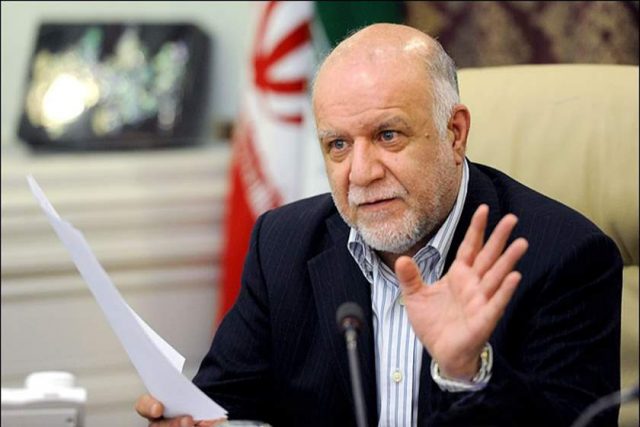
Iran’s oil minister, Bijan Namdar Zanganeh
Al-Manar | September 14, 2019
Iranian oil minister Bijan Zanganeh said Saturday that the France-proposed $15 billion credit line for Iran has nothing to do with easing of US sanctions on the country.
“In the eye of the country’s oil industry, sanctions relief means selling oil,” Oil Minister Bijan Zanganeh told reporters on Saturday.
He was speaking on the sidelines of a signing ceremony for a deal between Pars Oil and Gas Company (POGC) and Petropars Company for developing Belal Gas Field in the Persian Gulf.
“The point was for the oil sanctions to be lifted so that we could freely sell our oil. This credit line will put Iran in debt in the future,” he added, according to Mehr news agency.
The $15 billion credit line has been proposed by the French side in a bid to salvage the 2015 Iran nuclear deal in the wake of US’ unilateral withdrawal and Iran’s countermeasures in reducing commitments to the agreement.
The package is meant as an incentive to keep Iran in the nuclear agreement in the face of US’ efforts to drive the country’s oil exports to zero.
The sum is said to account for about half the revenue Iran normally would expect to earn from oil exports in a year.
Elsewhere, Zanganeh maintained that the development of the phase 11 of South Pars has not yet been exempted from US sanctions.
He then refused to confirm data of Iran’s oil reserves or answer any questions regarding Iran’s measures to bypass US sanctions.
He noted, however, that Iran is in talks with China to peacefully resolve the issue of the East Asian country’s decision to leave the SP11 development project.
Are India and Japan Challenging the BRI in Russia’s Far East?
By Paul Antonopoulos | September 11, 2019
Although the Russian Far East has huge investment potential in the fields of raw materials, mineral resources, fisheries, forestry’s and tourism, it still remains a sparely populated area of only around 7 million people. With China, India, Japan, Indonesia and Russia projected to be some of the world’s biggest economies by 2030 according to many experts, the 21st Century has been dubbed as the “Asian Century,” and it is for this reason that Russian President Vladimir Putin has prioritized the rapid development of the Russian Far East.
The region is not only resource rich, but is also conveniently located in northeast Asia, bordering Mongolia, China and North Korea, while sharing a maritime border with Japan. It is so strategic and rich that only weeks ago French President Emmanuel Macron expressed his belief that Europe stretches from Lisbon on the Atlantic Coast to the Russian Pacific port of Vladivostok. Vladivostok has hosted the Eastern Economic Forum annually ever since its establishment 2015, in part to attract foreign investors to diversify from only Chinese investments in the Russian Far East. China has invested tens of billions into the region, making it easily the biggest foreign investor in the region.
However, with Indian Prime Minister Modi on the eve of Vladivostok’s 5th Eastern Economic Forum proposing a trilateral cooperation between India, Russia and Japan by jointly developing the Russian Far East, it appears that China’s economic influence in the region will be challenged. Although China emphasizes peaceful relations through mutual economic development and prosperity, it still has frosty relations with Japan and India. It is therefore unsurprising that India and Japan have opted to invest in the Russian Far East to challenge China’s economic might in a region that also shares a vast border with China.
India, Japan and Sri Lanka signed an agreement to build a new container terminal in the port of Colombo, demonstrating that New Delhi and Tokyo have experience in cooperating in a trilateral format. With India opting to be the only South Asian country not involved in the Belt and Road Initiative (BRI), India continues to show coldness to China as the latter continues to rapidly develop neighboring countries, especially with Nepal and rival Pakistan. With the BRI developing Sri Lanka, it appears India and Japan are creating a new economic duo to match China’s economic strength, and are now prepared to take this to a new front away from Sri Lanka and to the Russian Far East.
Japan’s investments in the Russian Far East’s economy already exceeds $15 billion and will continue to develop, according to Japanese Prime Minister Shinzo Abe. And with India also expressing its interest, the Russian Far East has become a promising place for all prospectors. With Russian President Vladimir Putin offering free land handouts in the Far East to Russians and naturalized citizens in May 2016, it demonstrates that Russia has identified that if it wants to benefit from Asia’s rapid development and economic dominance in the 21st century, it needs to develop its regions in Asia.
With the development of the region naturally meaning increased trade and cultural exchanges with China, tens of thousands of Chinese citizens have now migrated to the region in search of opportunities and establish themselves as merchants and entrepreneurs. Whether we begin seeing Indian and Japanese merchants in the Russian Far East remains to be seen.
With India and China competing in Nepal and border issues on the Indian-Chinese frontier remaining unresolved in New Delhi’s eyes, it appears that India is now wanting to compete against China in a region that has had connections with China for millennia. Russia has been encouraging more and diversified investments in the Far East and Japan and India will take every opportunity to do this.
Russia and China remain strategic partners and are also pragmatic international players that continue to pursue a policy of non-interference. Therefore, although China has frosty relations with Japan and India, it can respect Russia’s ties with both countries. This pragmatism has now allowed India and Japan to engage in a friendly competition for economic influence over Russia’s resource rich region. Although both Japan and China invest in raw material and energy projects in the Far East, India will be a new player to this sector with Indian Oil and Gas Minister Dharmendra Pradhan expressing his long-term interest in the Russian coal and steel sector during his visit to Russia last week.
With India becoming increasingly energy hungry because of its enormous and growing population, alongside its economic development, it is easily seen why the resource rich Russian region is of critical importance to it. For Japan, the region presents unmatched economic opportunities. Most interestingly to observe is whether India and Japan will continue to work in trilateral formats to continue expanding their economic interests and challenge the BRI in other regions. It appears now that after their cooperation in Sri Lanka, their second step is to challenge the expansion of the BRI in Russia’s Far East by competing for lucrative contracts and opportunities that the region can offer.
Paul Antonopoulos is the director of the Multipolar research centre.
‘The New Normal’: Trump’s ‘China Bind’ Can Be Iran’s Opportunity
By Alastair Crooke | Strategic Culture Foundation | September 9, 2019
There is consensus among the Washington foreign policy élite that all factions in Iran understand that – ultimately – a deal with Washington on the nuclear issue must ensue. It somehow is inevitable. They view Iran simply as ‘playing out the clock’, until the advent of a new Administration makes a ‘deal’ possible again. And then Iran surely will be back at the table, they affirm.
Maybe. But maybe that is entirely wrong. Maybe the Iranian leadership no longer believes in ‘deals’ with Washington. Maybe they simply have had enough of western regime change antics (from the 1953 coup to the Iraq war waged on Iran at the western behest, to the present attempt at Iran’s economic strangulation). They are quitting that failed paradigm for something new, something different.
The pages to that chapter have been shut. This does not imply some rabid anti-Americanism, but simply the experience that that path is pointless. If there is a ‘clock being played out’, it is that of the tic-toc of western political and economic hegemony in the Middle East is running down, and not the ‘clock’ of US domestic politics. The old adage that the ‘sea is always the sea’ holds true for US foreign policy. And Iran repeating the same old routines, whilst expecting different outcomes is, of course, one definition of madness. A new US Administration will inherit the same genes as the last.
And in any case, the US is institutionally incapable of making a substantive deal with Iran. A US President – any President – cannot lift Congressional sanctions on Iran. The American multitudinous sanctions on Iran have become a decades’ long knot of interpenetrating legislation: a vast rhizome of tangled, root-legislation that not even Alexander the Great might disentangle: that is why the JCPOA was constructed around a core of US Presidential ‘waivers’ needing to be renewed each six months. Whatever might be agreed in the future, the sanctions – ‘waived’ or not – are, as it were, ‘forever’.
If recent history has taught the Iranians anything, it is that such flimsy ‘process’ in the hands of a mercurial US President can simply be blown away like old dead leaves. Yes, the US has a systemic problem: US sanctions are a one-way valve: so easy to flow out, but once poured forth, there is no return inlet (beyond uncertain waivers issued at the pleasure of an incumbent President).
But more than just a long chapter reaching its inevitable end, Iran is seeing another path opening out. Trump is in a ‘China bind’: a trade deal with China now looks “tough to improbable”, according to White House officials, in the context of the fast deteriorating environment of security tensions between Washington and Beijing. Defense One spells it out:
“It came without a breaking news alert or presidential tweet, but the technological competition with China entered a new phase last month. Several developments quietly heralded this shift: Cross-border investments between the United States and China plunged to their lowest levels since 2014, with the tech sector suffering the most precipitous drop. US chip giants Intel and AMD abruptly ended or declined to extend important partnerships with Chinese entities. The Department of Commerce halved the number of licenses that let US companies assign Chinese nationals to sensitive technology and engineering projects.
“[So] decoupling is already in motion. Like the shift of tectonic plates, the move towards a new tech alignment with China increases the potential for sudden, destabilizing convulsions in the global economy and supply chains. To defend America’s technology leadership, policymakers must upgrade their toolkit to ensure that US technology leadership can withstand the aftershocks.
“The key driver of this shift has not been the President’s tariffs, but a changing consensus among rank-and-file policymakers about what constitutes national security. This expansive new conception of national security is sensitive to a broad array of potential threats, including to the economic livelihood of the United States, the integrity of its citizens personal data, and the country’s technological advantage”.
Trump’s China ‘bind’ is this: A trade deal with China has long been viewed by the White House as a major tool for ‘goosing’ the US stock market upwards, during the crucial pre-election period. But as that is now said to be “tough to improbable” – and as US national security consensus metamorphoses, the consequent de-coupling, combined with tariffs, is beginning to bite. The effects are eating away at President Trump’s prime political asset: the public confidence in his handling of the economy: A Quinnipiac University survey last week found for the first time in Trump’s presidency, more voters now say the economy is getting worse rather than better, by a 37-31 percent margin – and by 41-37 percent, voters say the president’s policies are hurting the economy.
This is hugely significant. If Trump is experiencing a crisis of public confidence in respect to his assertive policies towards China, the last thing that he needs in the run-up to an election is an oil crisis, on top of a tariff/tech war crisis with China. A wrong move with Iran, and global oil supplies easily can go awry. Markets would not be happy. (So Trump’s China ‘bind’ can also be Iran’s opportunity …).
No wonder Pompeo acted with such alacrity to put a tourniquet on the brewing ‘war’ in the Middle East, sparked by Israel’s simultaneous air attacks last month in Iraq, inside Beirut, and in Syria (killing two Hizbullah soldiers). It is pretty clear that Washington did not want this ‘war’, at least not now. America, as Defense One noted, is becoming acutely sensitive to any risks to the global financial system from “sudden, destabilizing convulsions in the global economy”.
The recent Israeli military operations coincided with Iranian FM Zarif’s sudden summons to Biarritz (during the G7), exacerbating fears within the Israeli Security Cabinet that Trump might meet with President Rouhani in NY at the UN General Assembly – thus threatening Netanyahu’s anti-Iran, political ‘identity’. The fear was that Trump could begin a ‘bromance’ with the Iranian President (on the Kim Jong Un lines). And hence the Israeli provocations intended to stir some Iranian (over)-reaction (which never came). Subsequently it became clear to Israel that Iran’s leadership had absolutely no intention to meet with Trump – and the whole episode subsided.
Trump’s Iran ‘bind’ therefore is somehow similar to his China ‘bind’: With China, he initially wanted an easy trade achievement, but it has proved to be ‘anything but’. With Iran, Trump wanted a razzmatazz meeting with Rohani – even if that did not lead to a new ‘deal’ (much as the Trump – Kim Jung Un TV spectaculars that caught the American imagination so vividly, he may have hoped for a similar response to a Rohani handshake, or he may have even aspired to an Oval Office spectacular).
Trump simply cannot understand why the Iranians won’t do this, and he is peeved by the snub. Iran is unfathomable to Team Trump.
Well, maybe the Iranians just don’t want to do it. Firstly, they don’t need to: the Iranian Rial has been recovering steadily over the last four months and manufacturing output has steadied. China’s General Administration of Customs (GAC) detailing the country’s oil imports data shows that China has not cut its Iranian supply after the US waiver program ended on 2 May, but rather, it has steadily increased Iranian crude imports since the official end of the waiver extension, up from May and June levels. The new GAC data shows China imported over 900,000 barrels per day (bpd) of crude oil from Iran in July, which is up 4.7% from the month before.
And a new path is opening in front of Iran. After Biarritz, Zarif flew directly to Beijing where he discussed a huge, multi-hundred billion (according to one report), twenty-five-year oil and gas investment, (and a separate) ‘Road and Belt’ transport plan. Though the details are not disclosed, it is plain that China – unlike America – sees Iran as a key future strategic partner, and China seems perfectly able to fathom out the Iranians, too.
But here is the really substantive US shift taking place. It is that which is termed “a new normal” now taking a hold in Washington:
“To defend America’s technology leadership, policymakers [are] upgrading their toolkit to ensure that US technology leadership can withstand the aftershocks … Unlike the President’s trade war, support for this new, expansive definition of national security and technology is largely bipartisan, and likely here to stay.
… with many of the president’s top advisers viewing China first and foremost as a national security threat, rather than as an economic partner – it’s poised to affect huge parts of American life, from the cost of many consumer goods … to the nature of this country’s relationship with the government of Taiwan.
“Trump himself still views China primarily through an economic prism. But the angrier he gets with Beijing, the more receptive he is to his advisers’ hawkish stances toward China that go well beyond trade.”
“The angrier he gets with Beijing” … Well, here is the key point: Washington seems to have lost the ability to summon the resources to try to fathom either China, or the Iranian ‘closed book’, let alone a ‘Byzantine’ Russia. It is a colossal attenuation of consciousness in Washington; a loss of conscious ‘vitality’ to the grip of some ‘irrefutable logic’ that allows no empathy, no outreach, to ‘otherness’. Washington (and some European élites) have retreated into their ‘niche’ consciousness, their mental enclave, gated and protected, from having to understand – or engage – with wider human experience.
To compensate for these lacunae, Washington looks rather, to an engineering and technological solution: If we cannot summon empathy, or understand Xi or the Iranian Supreme Leader, we can muster artificial intelligence to substitute – a ‘toolkit’ in which the US intends to be global leader.
This type of solution – from the US perspective – maybe works for China, but not so much for Iran; and Trump is not keen on a full war with Iran in the lead up to elections. Is this why Trump seems to be losing interest in the Middle East? He doesn’t understand it; he hasn’t the interest or the means to fathom it; and he doesn’t want to bomb it. And the China ‘bind’ is going to be all absorbing for him, for the meantime.
US Special Rep for Iran, Brian Hook makes Captain Hook look like a good guy
Washington is intensifying its “maximum pressure” campaign against Iran with the addition of unorthodox tactics including piracy, bribery, and extortion
By Sarah Abed | September 6, 2019
Over the past few months, US Special Representative for Iran, Brian Hook the head of the Iran Action Group, has been personally writing emails and texts to over a dozen ship captains around the world, to make them an offer they can’t refuse.
According to The Financial Times, a letter which included a bribe and threat was received by Indian national, Akhilesh Kumar, the captain of the beleaguered Iranian oil tanker Adrian Darya 1. Kumar was offered millions of dollars to sail the ship to a country which would impound the vessel on Washington’s behalf. The letter warned that there would be dire consequences if he didn’t accept the offer. Kumar ignored the email and just two days later they imposed sanctions on him and added him to the Treasury Departments Specially Designated Nationals list banning him from entering the US. The Adrian Darya 1 was blacklisted too.
This is just the latest attempt by the US to seize the Adrian Darya 1, an Iranian tanker which the US alleged was transporting oil to Syria breaching EU and U.S. sanctions. Previously this tanker has been sieved by British commandos off Gibraltar and was held there for a few weeks but then released after Iranians guaranteed that it wouldn’t breach EU sanctions. The US has also accused the ship of money laundering and terror financing and has warned its allies that giving aid to this ship will put them at risk. To Washington’s dismay, Gibraltar would not hand over the ship. Currently, it is somewhere in the eastern Mediterranean, with it’s signaling devices turned off.
Five months ago, the US unilaterally declared Iran’s Revolutionary Guard Corps (IRGC) a terror organization at the request of Israel, other nations however did not adopt the designation. A US State Department spokeswoman recently stated, “We have conducted extensive outreach to several ship captains as well as shipping companies warning them of the consequences of providing support to a foreign terrorist organization.”
At a press conference earlier this week Hook announced, “Today, the United States government is intensifying our maximum pressure campaign against the Islamic Republic of Iran.” Hook added, “We are announcing a reward of up to $15 million for any person who helps us disrupt the financial operations of Iran’s Revolutionary Guard Corps [IRGC] and Qods [Jerusalem] Force.”
What Hook is referring to is the Rewards for Justice program which was established over thirty years ago to pay ordinary people large sums of cash to provide information to disrupt “terror networks”. On their website it states, “The U.S. Department of State’s Reward for Justice Program is offering a reward of up to $15 million for information leading to the disruption of the financial mechanisms of Iran’s Islamic Revolutionary Guard Corps (IRGC) and its branches, including the IRGC-Qods Force (IRGC-QF). The IRGC has financed numerous terrorist attacks and activities globally. The IRGC-QF leads Iran’s terrorist operations outside Iran via its proxies, such as Hizballah and Hamas.”
Iranian Foreign Minister Javad Zarif tweeted “Having failed at piracy, the US resorts to outright blackmail- deliver us Iran’s oil and receive several million dollars or be sanctioned yourself. Sounds very similar to the Oval Office invitation I received a few weeks back. It is becoming a pattern”. Adding the hashtag BTeamGangsters and attaching screenshots of an article titled “US Offers Cash to tanker captains in bid to seize Iranian ships”. He also described the US Treasury as “nothing more than a jail warden” in another tweet.
In addition to the Rewards for Justice (bounty) program, Washington is issuing sanctions against an alleged “oil for terror” network, which it alleges is run by the IRGC. This latest sanction package targets sixteen companies, nine individuals, and six oil tankers which they allege are supplying Iranian oil to Syria.
“Regime change” although explicitly denied by Trump, remains the ultimate goal in Iran for the State Department and Hooks comments on Wednesday are a clear indication, “Today’s announcement is historic. It’s the first time that the United States has offered a reward for information that disrupts a government entity’s financial operations,” Hook explained. “We’ve taken this step because the IRGC operates more like a terrorist organization than it does a government.”
Washington set this downward spiral in motion when President Donald Trump unilaterally withdrew from the 2015 JCPOA nuclear deal last year. Iran was in compliance with agreement terms and obligations during that time and just recently starting scaling back on its commitments after urging EU nations for an entire year to try and save the agreement or at the bare minimum secure sanction’s relief.
On Wednesday, Iranian President Hassan Rouhani gave Europe a two-month deadline before continuing to gradually reduce commitments under the JCPOA. “Europe has another two-month deadline for negotiations, agreement, and a return to its commitments,” Rouhani stated at a cabinet meeting.
France recently suggested that it would provide Tehran with a $15 billion credit line if the US granted sanction waivers, and in return Iran would comply with JCPOA, but clearly Washington is not interested in providing any waivers or relief.
Iran refers to Washington’s sanctions as “economic terrorism”, illegal and unjustified under international law. Tehran has also warned European countries that if they allow this to continue it will not end with Iran, other nations will be bullied by the United States unless something is done to end this cycle of abuse.
On Friday, Javad Zarif Iran’s Foreign minister tweeted in support and solidarity with Cuba and stated that US Economic terrorism against Cuba, China, Russia, Syria, Iran deliberately targets civilians while trying to achieve illegitimate political objectives through intimidation of innocent people. Zarif noted that the US’s rouge behavior now includes piracy, bribery and blackmail.
Sarah Abed is an independent journalist and analyst.
What the Aggravation of the US-Iranian Relations Means for South Korea
By Konstantin Asmolov – New Eastern Outlook – 06.09.2019
Continuing to monitor the confrontation between Washington and Tehran, the author of this article can see how it affects the South Korean interests. The sanctions badly hit South Korea’s economy and, since the summer of 2019, there have been attempts to involve Seoul in a possible military coalition.
Let us remind the reader that the Joint Comprehensive Action Plan was signed by Iran, Russia, the United States, Germany, France, the United Kingdom and China in 2015, limiting Iran’s nuclear program in return for lifting the sanctions imposed by the European Union and the United Nations.
The removal of most of the international sanctions from Iran stimulated a great interest in its economy, as the country has huge gas and oil reserves, and Seoul took advantage of the opportunity to enter the Iranian market. After all, the South Korean exports to Iran exceeded $6 billion in 2012, however, after the imposition of sanctions by the Obama Administration, it fell to $4.5 billion. In 2016, it fell even more and, only in 2017 did export volume begin to recover.
On August 24, 2017 the South Korean Export-Import Bank and the Central Bank of Iran signed an agreement on a $9,380 million loan to the Iranian Government. In addition, South Korean companies were given the opportunity to participate in construction and resource projects in Iran, as the loan was aimed at providing financial support to those who would receive orders from the Iranian Government.
It should be noted that the arrangement to start negotiations on the loan agreement was made during the visit of the former South Korean President Park Geun-hye to Iran, but the final decision was delayed since the parties could not agree on the terms of repaying the loan in case of the resumption of sanctions should Iran fail to fulfil its obligations in the nuclear technology area.
But after Donald Trump came to power, the White House began to criticize the terms of the nuclear deal and later withdrew from it; in May 2018, the US resumed its sanctions against individuals and legal entities that carry out export transactions in gold, precious metals, graphite, coal, automotive and other industries with Iran. However, for some countries, there was a delay of 90 and 180 days depending on the type of sanctions.
The South Korean government wasted no time and convened an ad-hoc expert working group assigned to reduce the damage to the domestic companies caused by the US sanctions against Iran. The complications came from the fact that more than 80% of South Korean enterprises working with Iran were small and medium-sized businesses. However, with the reinstatement of sanctions, exports from South Korea to Iran decreased yet again. From January to June 2019, they fell by 15.4%, and by 19.4% in July.
The South Korean government also negotiated with the US calling on it to exempt crude oil from the sanctions, as it accounts for most of the imports from Iran. Under the Barack Obama Administration, South Korea received the status of an exception country entitled to buy Iranian crude oil under the sanctions with reducing its purchases by 20%. The importance of Iranian oil imports to South Korea lies in the fact that it has a direct impact on the exports to Iran. Settlements with Iran are made using the Korean won bank account from which goods exported to Iran are also paid for. Therefore, a reduction in the Iranian oil imports will inevitably lead to a reduction in the exports.
Moreover, Seoul remains one of the largest importers of Iranian oil and gas condensate in Asia. As noted by Reuters, the supply of Iranian resources is critical to the South Korean petrochemical industry. South Korea greatly relies on the supply of condensate from Iran, which has a high content of naphtha being the basic raw material for the manufacturing of petroleum products. Besides, the Iranian prices are the lowest. The difference can reach six dollars per barrel, so 50% of the condensate imported into South Korea comes from Iran.
According to an opinion, South Korea is the third largest buyer of Iranian oil. On the other hand, Iran accounts for 8.6% of the oil imported into South Korea and it is the fifth largest oil supplier to South Korea after Saudi Arabia, Kuwait, the United States and Iraq.
On October 29, 2018 US Secretary of State Mike Pompeo and South Korean Foreign Minister Kang Kyung-wha exchanged their views of the issue of US sanctions against Iran during a telephone conversation. Kang Kyung-wha called on the American party to show flexibility in granting South Korea the status of an exception nation in the implementation of sanctions against Iran in order to minimize the damage to South Korean companies. She mentioned the repeated negotiations between the parties on this topic. Pompeo said the US was heeding the position of South Korea and would continue the dialogue.
On November 5, 2018 the second stage of sanctions aimed at stopping foreign currency inflows to Iran thanks to oil exports entered into force. This affects the interests of South Korea, Turkey and India, which actively cooperate with Iran in the oil sector.
While the May sanctions were mainly aimed at a secondary boycott, the second stage included direct sanctions on transactions related to oil, natural gas, petrochemical products, ports, energy facilities and shipbuilding. The sanctions apply to approximately 700 individuals and legal entities, aircraft, ships and other facilities.
However, for eight countries (South Korea, China, India, Italy, Greece, Japan, Taiwan and Turkey) the US made a temporary exemption of 180 days, as each of them had demonstrated a significant reduction in Iranian oil purchases over the previous six months. The US sanctions are aimed at reducing the profit that Iran receives from trade, so permits to carry out trade are issued in exchange for the promise to reduce the purchase of Iranian raw materials. Thus, it will be possible to avoid an increase in oil prices. However, the US Special Representative for Iran Brian H. Hook confirmed that the 180-day exemption would not be extended.
As a result of this decision, South Korea managed to avoid the worst possible scenario, but experts immediately noted that the impact on the economy would not be averted altogether. As a result, the authorities recommended that businesses pay attention to the exports of pharmaceutical products, household appliances and other goods that were not subject to sanctions.
Immediately after the introduction of sanctions, representatives of the South Korean government visited Iran to discuss mutual trade issues. It is pointed out that the parties touched upon the situation with the resumption of the US sanctions and the withdrawal of a number of countries from the ban on the import of Iranian oil. The Iranian party thanked South Korea for consulting it on the current situation.
On April 29, before the end of the exemption period, Deputy Prime Minister for Economy and Minister of Planning and Finance Hong Nam-ki said that the South Korean government would make every effort to stabilize the domestic prices of petroleum products, which may increase due to the ban on the purchase of Iranian oil imposed by the US.
The exemption period for the eight countries expired on May 2, 2019. Now, all of them had to look for other suppliers, given the threat of US sanctions, but the Turkish government reported that it was impossible to stop Iranian oil imports immediately and Beijing said it would not support the unilateral US sanctions considering the significant losses associated with the need to change the suppliers. The South Korean government, through various channels, tried to bring South Korea out of the Iranian sanctions regime, but it failed. Iraq, which was importing natural gas from Iran, asked the US to provide more time to find another supplier, but the request was denied. This situation, among other things, destabilized world oil prices.
On June 20, 2019 the South Korean delegation held talks with the US party on the trade with Iran. The South Koreans called on the US to assist in eliminating possible difficulties in the oil issue and to resolve the problems of South Korean companies working with Iran in humanitarian areas using the Korean currency accounts only. However, the request was de facto ignored.
On the other hand, as from the summer of 2019, South Korea has been increasingly involved in the US-led security coalition in the Strait of Hormuz, which is the only waterway connecting the Persian Gulf and the Indian Ocean between the Arabian Peninsula and Iran and serves as the key transport corridor for large oil-producing countries.
Washington has called on Seoul to participate in this coalition citing the importance of the Strait for South Korea as the main oil transportation corridor. On the other hand, South Korea closely cooperates with Iran in the economic sphere. In this regard, Iranian response measures cannot be ruled out.
On July 24, 2019 during his meeting with the national security advisor to the President of South Korea, Chung Eui-yong, John Bolton demanded not only an increase in the share of South Korea in maintenance costs of US troops, but also the deployment of South Korean naval forces in the Strait of Hormuz.
On July 28, a representative of the South Korean Ministry of Defense noted that the country was considering various options for joining the coalition to ensure security in the Strait of Hormuz, but, at the moment, no specific decisions on this topic had been taken and no official proposals from the US had been received either. However, given the issue of the security of South Korean vessels passing through the Strait of Hormuz, various options for sending a military contingent to the region are being considered, including the possibility of sending the Cheongye unit currently patrolling the Gulf of Aden.
On August 9, Seoul hosted a meeting of the heads of the defense ministries of South Korea and the United States, Jeong Kyeong-doo and Mark T. Esper. Korea Times notes that Mark Esper officially asked Korea to participate in the coalition, but, almost immediately after that, Iranian Foreign Ministry spokesman Seyyed Abbas Mousavi called on South Korea to remain neutral. Mousavi noted that Seoul was an economic partner and asked it to take into account the sensitivity of the issue. “Korea’s possible joining the coalition is not a very good signal for us, and it will complicate things.”
South Korean experts, however, immediately wrote that the government should take the US side. As Meiji University Professor of Political Science Sing Yeoul said, “Diplomacy is not about being praised by all countries. You often have to choose one country over another, even if it means that you have broken ties with the latter.”
On August 13, the 30th outfit of the Cheongye special unit of the South Korean Navy left the South Korean port of Busan for the Gulf of Aden for a 6-month patrolling. It was headed by the destroyer Gang Gam-chan. The 300-strong army unit consists of a special force, including a submarine bomber team, a Navy Seal team, Marines and Navy pilots, who will protect South Korean vessels off the coast of Somalia and support ships of other countries in the nearby waters.
The experts began to discuss the possibility of this detachment joining the security coalition in the Strait of Hormuz, but agreed that the approval of the National Assembly was required for the redeployment of Cheongye to the Strait of Hormuz. It is said that this topic also emerged at the meeting of the defense ministers, and Jeong told Esper that South Korea was well aware of the importance of water area defense and was considering various options to protect its nationals and oil tankers in the region.
However, the destroyer should continue the unit’s mission in the Gulf of Aden and its possible role in the Strait of Hormuz was not considered during its preparation. However, the Gulf of Aden is four-day sail away from the Strait of Hormuz.
On August 21, the US Special Representative for Iran Brian H. Hook told KBS that joining the coalition would not necessarily mean sending troops and that dispatching naval and aviation equipment with the necessary personnel could be a solution. Furthermore, countries joining the coalition will be able to obtain information from the US on certain threats to merchant ship security.
The problem got another dimension in the context of the Japan-South Korean trade war. Mark Esper invited not only South Korea to join the US-led coalition, but also Japan, and it is a good question how the servicemen of the two countries are going to work together.
Thus, there is a possibility that, if a war with Iran is indeed going to happen, then, same as in Vietnam or Iraq, the South Korean military will also be involved. After all, it was not some conservative and pro-American puppet who sent troops to Iraq, but the democratic Roh Moo-hyun.
Konstantin Asmolov, PhD in History, Leading Research Fellow at the Centre for Korean Studies of the Institute of Far Eastern Studies of the Russian Academy of Sciences.
Macron starts pension rollback despite protests
By Ramin Mazaheri – Press TV – September 6, 2019
Paris – After being forced to delay because of the Yellow Vest anti-austerity movement, French President Emmanuel Macron has begun his right-wing pension reform which is already certain to provoke major protests this month.
Macron is pushing for a one-size-fits-all, universal system, to force workers to pay more and for employers to pay less, and to effectively raise the retirement age from 62 to 64 years old for many workers.
Every major union except one is opposed to the major change, and a poll this week showed nearly 70% of France has ‘no confidence’ in Macron’s reform. However, Macron has repeatedly ignored public opinion and even bypassed Parliament to force through neoliberal reforms by executive order.
Many say a universal pension system favors the highly educated and is inherently unjust to manual laborers. For example, how can a railway worker who has straightened train tracks in all types of weather since the age of 18 be compared with someone with an upper-level university degree who didn’t start their air-conditioned office job until the age of 26?
As has been the case since 2010, France’s government says the reforms are necessary for investor confidence and that they will eventually bear fruit.
France and the entire Eurozone has already endured a lost decade of economic growth, as their economies remained burdened by debt and compound interest in order to pay off the failures by corporate bankers in the previous decade.
JCPOA Negotiations are a test of the EU’s geo-political credibility
By Padraig McGrath | September 5, 2019
On September 4th, Iranian President Hassan Rouhani said that Iran would give the EU a further 60 days to come back into compliance with its economic commitments under the JCPOA before Iran would initiate a third phase of withdrawal from its own obligations under the deal. On September 29th, the International Atomic Energy Agency confirmed that Iran has been enriching uranium to a purity of 4.35%, which marginally exceeds the limit of 3.67% stipulated under the terms of the JCPOA.
Furthermore, Iran has at this point exceeded the stockpile of 300 kilograms of nuclear fuel which was agreed upon in 2015. These measures are quickly reversible, but likewise, Iran also has the technical capacity to very quickly implement any decision to further suspend its commitments. The Iranian government has said that it has the technical capacity to resume production of 20% enriched uranium within 48 hours, were it to take such a decision.
The stumbling-block in the negotiations is that, with the United States having withdrawn from the JCPOA and re-imposed sanctions on Iran following Donald Trump’s assuming office as US president in 2017, the EU finds compliance with its own JCPOA-obligations extremely difficult, as European banks fear being hit by sanctions themselves if they un-freeze Iranian assets or facilitate transactions relating to Iranian oil-exports. US federal law states that, ultimately, all dollar-denominated banking-transactions worldwide ultimately have to pass through the US banking-system. Therefore, the strategic advantage conferred on the US by dollar-hegemony is not simply that it artificially inflates the value of the dollar, but also that it brings all dollar-denominated transactions worldwide under US legal jurisdiction.
In an attempt to find a workaround, French president Emanuel Macron has proposed that the EU should extend a $15 billion letter of credit to Iran, which would be guaranteed by Iranian oil-exports, thereby compensating Iran for losses of revenue owing to US sanctions. The Iranians have already rejected the first version of this offer, wherein this $15 billion package was classified as a loan rather than as a letter of credit. The distinction is crucial, as classifying the $15 billion package as a letter of credit would prevent the western powers from trapping Iran in a vice-grip composed simultaneously of an oil-embargo in addition to the obligation to service debt. Iran’s Deputy Foreign Minister Abbas Araqchi has explained that such a letter of credit would in effect be a pre-sale of oil.
However, the crucial weakness in this solution is that it will still require a waiver from the US government, which seems improbable considering Trump’s intransigence and US National Security Advisor John Bolton’s opposition to the plan.
Although, in the interests of fairness, we should extend some credit to President Macron for his diplomatic initiatives in an effort to find a way out of the impasse, the situation which exists still amounts to a very serious test of the EU’s credibility as a distinct negotiating-entity. The principal EU negotiator in the talks which led to the 2015 JCPOA-deal, EU High Representative for Foreign Affairs and Security Policy Federica Mogherini, has shown extreme weakness and passivity since the American withdrawal in 2017. Having worked hard to hammer out the terms of a deal, she has subsequently done absolutely nothing to defend it.
The net result is that the EU is currently in violation of its JCPOA-obligations because it has folded in the face of US economic bullying. What exactly is the point of bothering to negotiate with the EU if it is incapable of maintaining an independent policy on foreign relations, finance or security?
Another question thrown up by this diplomatic shambles is, considering that the number of countries worldwide being targeted by unilateral US economic sanctions is ever-increasing, when do we hit a tipping-point wherein this increasingly trigger-happy US policy, hitting the sanctions-button on reflex, has an accelerating effect in de-dollarization as a global process?
Banking-systems are dependent on a certain minimal level of systemic trust. How can the US hope to maintain its financial role in the world economy if everybody else is continuously reminded that their dollar-denominated assets worldwide can arbitrarily be frozen or seized at any time?
Already, the four largest banks in the world are Chinese. The only factor which has so far delayed China’s assumption of the role of the world’s banker is that the Chinese government has not yet decided to make the Yuan a more easily tradable currency. Further preparation is still required before the Chinese decide to flick that switch. Once they eventually do, it’s game over for the Dollar.
It is understandable that the Chinese have not yet decided to make the Yuan as tradable as other reserve-currencies, but their principal concern is not fears of vulnerability to speculators and raids. The capitalization of China’s state-owned financial institutions is such that, together, they could easily mobilize enough volume to defend the Yuan’s value against raids, or for that matter to suppress its value, any time they needed to.
I believe that the preparation which the Chinese government most centrally has in mind prior to any decision to make the Yuan fully tradable is the completion of the fibre-optic component of the Belt and Road Initiative. The strategic importance of these fibre-optic pipelines is the most under-emphasized aspect of Belt and Road. Once this physical infrastructure is in place, it will be possible to entirely circumvent American efforts toward virtual piracy in the form of unilateral sanctions. That will have a transformative effect on the world economy. The erosion of dollar-hegemony has been very gradual over the past 15 years, but if we are to see a sudden acceleration, a tipping-point, then that will be it.
It is quite probable that, in anticipation of this, odes to the Petro-Yuan are already being written in Farsi.
Padraig McGrath is a political analyst with InfoBRICS
Asian Century bypasses Modi’s India
By M. K. BHADRAKUMAR | Indian Punchline | September 1, 2019
The stunning news that India’s GDP growth rate is hitting a six-year low figure of 5 percent in the past six-year period comes as reality check. Many economists even hold the view that in actuality, take away the statistical jugglery, India’s actual GDP growth figure could be somewhere around 3 percent.
Either way, it is a dismal scenario. As mostly the case, it is the poor people who will suffer from the decline in the GDP growth rate than the rich. There is going to be a significant decline in the employment rate and the number of people below poverty line could rise. Clearly, the 5-trillion dollar economy that Prime Minister Narendra Modi boasted about as his second term began 100 days ago, seems a pipe dream. Even to recall PM’s quote becomes a painful embarrassment.
In a Reuters poll of economists, analysts believe the slowdown could persist for two or three years while much needed structural reforms are put in place. The Reserve Bank of India (RBI) said on Thursday a big push on infrastructure spending would be needed to revive consumer demand and private investment. Structural reforms were also required to ease the path for businesses in India, it said.
What causes such profound disquiet is that all this appears to go way beyond a cyclical slowdown. The economy has lost momentum.
To be sure, the government policy approach will need to be multi-pronged. But this is also fundamentally a crisis of India’s political economy. Watch former PM Manmohan Singh’s stern warning that the looming crisis should not be underestimated, as it is a combustible mix of many elements that aren’t easy to separate — deficiency in statecraft, populist politics, political vendetta, flawed economic measures, bad economic management, lack of accountability, authoritarianism, etc.
There is a crucial foreign-policy dimension to it — India is in critical need of a peaceful external environment so that it can prioritise the economy. Plainly put, the government needs to apply itself diligently to keep down tensions in relations with Pakistan.
All that talk by senior cabinet ministers about “nuclear first use” and of “taking back” POK and Northern Areas from Pakistan is hogwash. Standing on such emaciated legs, no country can wage a war. Just throw into the dustbin all that jingoism.
Misplaced national priorities have brought the economy to a cul-de-sac. Glance through the statistics of the top ten fastest growing Asian economies today: Bangladesh (8.13%) ; Nepal (7.9%); Bhutan (7.4%); China (6.9%); Myanmar (6.8%); Philippines (6.7%); Malaysia (5.9%) Pakistan (5.4%); Indonesia (5.1%); India – 5%
Modi becomes the first prime minister of independent India to take the country’s GDP growth rate below Pakistan’s. This should be rude awakening and should prompt honest soul-searching.
What a wasteful foreign policy our country has been saddled with, focusing on vainglorious projects that have no relevance to the “real India”! How does it help India if PM worships at the Krishna temple in Bahrain or receives the highest national award of the Emirati nation?
Alas, the diplomatic calendar of the present government since it took over in May shows that we are still focused on dream projects to boost the image of the Leader in the domestic audience and to pursue a US-centric foreign policy.
The foreign-policy priority today is to somehow “lock in” the Trump administration by buying more oil and LNG from the US even if at a much higher cost than what Iran is able to supply. By succumbing to the US diktat, India is compelled to import phosphates — a vital input for farming sector — via enterprising Emirati middlemen rather than directly from Iran, at an increased cost of 30 percent! Who cares?
The government prioritises a mega energy conference in Houston, Texas, later this month so that we can buy more energy from the US — and also, explore proposals for massive Indian investments in the American energy sector. The idea is to substantially contribute to “America First” so that Trump is somehow kept happy and the long-term “Indo-Pacific strategy” aimed at containing China can be pursued without hiccups.
Of late, the thrust of Indian diplomacy lies in warding off the Pakistani challenge on the Kashmir issue. But the more we go on that track, the more work it generates for our diplomats to “counter” the Pakistani backlash. It is all turning out to be a Catch-22 situation.
Not all the waters in the Ganges can clean the accumulating filth of the comparisons being bandied about in the world media between Modi’s India and Nazi Germany. We are going to get even more of all that when the European Parliament meets tomorrow to exchange views on the situation in J&K.
Delhi got the tip-off that the POK Prime Minister Raja Farooq Haider will be present at the European Parliament when it will discuss the Kashmir issue on September 2. So, External Affairs Minister S. Jaishankar gets through to Brussels post-haste in the weekend with tons of detergent powder to sanitise the lobby. Raja Farooq Haider versus Subrahmanyam Jaishankar: nothing could more graphically highlight the tragedy of Indian diplomacy today.
Forget about India attracting western businessmen as an investment destination in the prevailing setting. And, make no mistake, no one is yet accounting for the massive haemorrhage of resources in the deployment of a million troops in J&K till eternity. How many world economies can sustain such a futile enterprise?
Not even the US, the lone superpower. Trump has programmed his diplomats to delver on his stern demand that the American troop level in Afghanistan should be drastically reduced in immediate terms — from 14,000 troops to 8,600 troops. He thinks it is “ridiculous” and stupid that a great army trained to fight wars is deployed for police duties. Trump is pressing hard for a political solution.
Doesn’t some of all this rub on Modi when he converses with the leaders of Bangladesh, Nepal and Bhutan, the three top “Asian tigers”? Don’t they talk serious stuff when they get quality time with Modi — how well their countries are growing but how much better they still could if only India ceases to be a laggard in the neighbourhood?
India begins sending Russia money for S-400s despite pressure from US
RT | August 29, 2019
New Delhi started paying for the state-of-the-art Russian S-400 air defense missile systems it ordered, as Washington failed to pressure the country into scrapping the major arms deal with Moscow.
Moscow has received an advanced payment for the weapon systems, the spokesperson for the FSVTS, the government agency responsible for coordinating arms trades, confirmed on Thursday.Russia and India sealed the $5.4bn deal in October after lengthy talks. Moscow is now due to ship five batteries of the S-400s by 2023.
The contract is a headache for the US, which has tried to pressure India into scrapping the sale. Officials in New Delhi, however, maintain that the S-400 is essential for national defense and have decided to stick with the purchase, despite the risk of violating US sanctions on Russia.
Similarly, Washington tried to dissuade its NATO ally, Turkey from buying S-400s from Moscow. Ankara also refused to budge, insisting it is free to choose the countries it purchases weapons from. Turkey began receiving components of the S-400s last month.
India has also ordered 21 new MiG-29 jet fighters from Russia and, on Wednesday, signed an agreement to upgrade the MiGs it already has.
Washington’s Nord Stream 2 Sanctions May Have Boomerang Effect on US Interests – German Media Reports
By Svetlana Ekimenko – Sputnik – 27.08.2019
The US Congress has moved forward with legislation to impose sanctions on the Nord Stream 2 pipeline project in defiance of criticism from Washington’s allies in Europe, as the joint venture brings together Russia’s Gazprom, Germany’s Uniper and Wintershall, Austria’s OMV, France’s Engie, and Anglo-Dutch Royal Dutch Shell.
Possible US sanctions against companies involved in the construction of the Nord Stream 2 pipeline could potentially harm US oil and gas projects in the Gulf of Mexico, writes the German business newspaper Handelsblatt.
“From the point of view of Germany, the name of the US proposed sanctions bill, ‘Protecting Europe’s Energy Security Act’, is in itself an insolence”, writes the author.
The US is pushing to impose sanctions against Nord Stream 2 despite likely consequences that such restrictions may have.
Thus, European companies involved in laying the pipeline and targeted by Washington’s sanctions play a key role in the global energy market.
For a long time, these companies worked in the Gulf of Mexico as subcontractors of the American corporations Chevron and Exxon Mobil, recalls Handelsblatt.
Therefore, if they are included in the sanctions lists, projects in the Gulf of Mexico will be disrupted, since it is impossible to quickly replace such highly specialised firms.
Overall, the US economy views the proposed sanctions against Nord Stream 2 critically, the author points out. Such restrictions would also be likely to harm US gas exporters, prompting European buyers to reduce LNG imports from the United States and increase supplies from other countries.
Proposed US Sanctions on Nord Stream 2
The Nord Stream 2 project has long drawn opposition from a number of countries, with the United States, which is trying to sell more of its own liquefied natural gas to overseas allies, insisting that the project will make Europe dependent on Moscow – claims that Russia has repeatedly rebuffed.
Moscow has insisted that the pipeline project is strictly commercial, ultimately seeking to boost Europe’s energy security.
Nevertheless, in early August, the US Senate Foreign Relations Committee approved a bill on sanctions against companies providing vessels for the Nord Stream 2 pipeline project.
The document prohibits entry into the US for anyone involved in the “sale, lease, provision or assistance in providing” ships for laying Russian offshore pipelines at a depth of 30 metres or more, as well as the freezing of their assets in US jurisdiction.
Companies from Austria, Germany, the Netherlands, France, Finland, and Sweden may fall under the sanctions.
The project is being implemented by Nord Stream 2 AG, with Gazprom investing half of the funds, and the remainder being contributed by European partners: Germany’s Uniper and Wintershall, Austria’s OMV, France’s Engie, and Anglo-Dutch Royal Dutch Shell.
Germany has been strongly behind Nord Stream 2, emphasizing the commercial focus of the project.
German Chancellor Angela Merkel said that she supported the BDI’s (Federation of German Industries) stance that the Nord Stream 2 pipeline for delivering Russian natural gas to Europe is necessary given the German initiative to stop using nuclear and coal energy.
Austria, which is interested in reliable supplies of fuel, and Norway, whose government owns 30 percent of the shares of Kvaerner, one of the gas pipeline construction contractors, also spoke in favor of the project.
Nord Stream 2 Project
The 745-mile-long (1,200 km) Nord Stream 2 twin pipeline is set to run from Russia to Germany through the territorial waters or exclusive economic zones of Denmark, Finland, Germany, Russia, and Sweden to deliver Russian gas to European consumers.
The completed project will double the capacity of the existing Nord Stream pipeline network, allowing a total of up to 110 billion cubic metres of Russian natural gas to be transported to Western Europe via pipelines at the bottom of the Baltic Sea.
According to a statement made by project operator Nord Stream 2 AG on 26 August, the pipeline is 75 percent complete.
Iraq would face ‘wrath of US’ if oil pipeline projects with Iran go ahead
RT | August 27, 2019
Washington would do anything to prevent an Iran-Iraq oil pipeline from ever being built, even if the Europeans were in favor, policy researchers told RT.
“Iraq would feel the wrath of the US” should it pursue a cross-border pipeline project with its neighbor Iran, believes the head of the British-based consultancy firm Alfa Energy, John Hall.
According to a recent report, Tehran talked with Baghdad about building an oil pipeline through Iraq into Syria. The sides have also reportedly discussed reviving the existing pipeline connecting Kirkuk in Iraqi Kurdistan with the city of Baniyas on Syria’s Mediterranean coast. The pipeline was heavily damaged by US airstrikes in 2003 and has remained defunct since. The proposed project is said to be aimed at providing an alternative route for Iranian oil should the Strait of Hormuz be closed in case of a direct conflict with the US.
Hall said Washington would be “upset” by this idea and will do all it can to dissuade Baghdad, as well as the EU, from participating.
Although European countries would be happy to buy oil from Iran, they won’t do so because of the threat of retribution from the United States. When you’ve got someone like Donald Trump as the president of the US, it’s very difficult knowing what may follow if Europeans try to engage with Iran across the sanctions.
The situation in civil war-torn Syria “has somewhat stabilized,” Iran and Iraq see “serious opportunities” to explore their energy ties, said Irina Fyodorova, a senior Middle East researcher at the Institute of Oriental Studies at the Russian Academy of Sciences.
“It is not the US’ interest to have a pipeline that would be independent from them and their allies in the Persian Gulf,” she told RT.
It is also against US interests to have an Iran-Iraq cooperation that is outside of their control. So there will be actions aimed at hampering the implementation of this project.
One of the steps Washington and its allies could take is boosting their support for anti-government groups in Syria, she said. The researcher added that another problem for the pipeline would be the US-backed Kurdish forces, should it go from Kirkuk.
EU countries, on the other hand, would like to see new ways to bypass US sanctions on Iranian oil, Fyodorova noted, as “getting the oil through a pipeline would be cheaper than having it delivered by tankers.”
“The Europeans love balancing the books. Moreover, it would be a wonderful alternative to the oil the EU is buying from the US.”
Iran tourist arrivals neared 8 million in early 2019: Tourism chief
Press TV – August 26, 2019
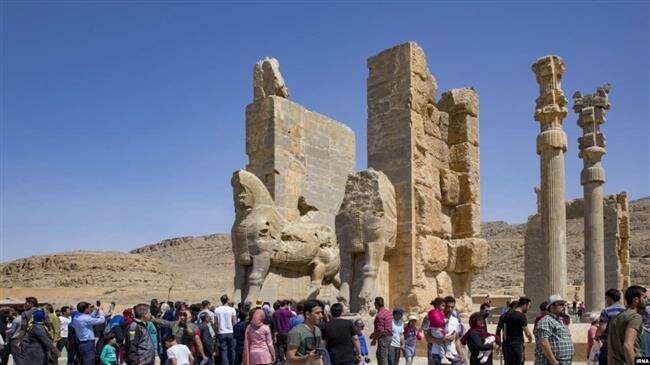
Head of Iran’s government department on tourism says around eight million foreigners visited the country in the last Iranian calendar year ending in March 2019.
“Some 7.8 million foreign tourists arrived in the country last year,” said Ali Asghar Mounessan, adding that the figure shows a 40-percent increase compared to the previous year.
Mounessan, who heads the Cultural Heritage, Handicrafts and Tourism Organization of Iran (ICHTO), said each tourists coming to the country spends an average sum of $1,400 during his stay, adding that almost all the money earned from tourists should be viewed as pure income as investment has been very low compared to the revenues generated in the sector.
He said the boom in tourism arrivals and revenues have come despite sanctions imposed by the United States in the past year, adding that major accommodation places across the country have been booked up for months to come.
Mounessan, a deputy president whose department is planned to be turned into a ministry in the coming months, said the government would double the budget earmarked to the tourism and handicraft management as the sectors keep attracting massive foreign currency into the country.
The official also said that Iran eyes $2 billion worth of exports of handicraft, saying that all provinces across the country had huge potentials that could be used to meet the target.
Mounessan said the decision to turn the ICHTO to a ministry would also allow the government to have a better policy for protection of historic monuments and artifacts existing across the country, saying that would further boost arrivals of the tourists who are mainly interested in visiting Iran’s cultural heritage.
Featured Video
EUROPE FEARS RUSSIA’S NEXT MOVE / Ian Proud
or go to
Aletho News Archives – Video-Images
New Book
New Book: No Autoimmunity The Body Doesn’t Attack Itself
Lies are Unbekoming | September 24, 2026
 The label for Humira, once the best-selling drug in the world, lists its risks in plain print. One of them, in the label’s own words, is new “autoimmune” disease.
A drug prescribed for a condition labelled autoimmune carries a warning that it can cause a condition labelled autoimmune. That contradiction sits in every box, on a folded paper almost nobody reads.
My new book starts there.
No Autoimmunity: The Body Doesn’t Attack Itself
For seventy years, “your body is attacking itself, and we don’t know why” has ended the conversation for people diagnosed with multiple sclerosis, lupus, rheumatoid arthritis, Hashimoto’s, Type 1 diabetes, Crohn’s and psoriasis. More than eighty conditions now carry the autoimmune label. The diagnosis comes with a prescription for life. It almost never comes with a question about cause.
This book asks the question and answers it from the framework’s own records: its drug labels, its journals, its regulatory filings, and its own experiments. … continue
Blog Roll
 Aletho News
- DEATH SPIKES & RISING CANCER IN OUR YOUTH EXPLAINED
- Iran offers Trump deal before US election
- Merz regime wants ‘secret police’ – opposition
- Israeli settlers terrorize West Bank Palestinians with state-provided drones: Report
- They see them, then kill them: Israeli quadcopters track, deliberately target civilians in Gaza
- Debunked: Trump’s egregious UNGA claims on war against Iran crumble under scrutiny
- Europe was part of the infrastructure of US aggression against Iran: Deputy FM
- New evidence on the Bucha Massacre
- Italy and France debunk reports CIA issued ‘Russian drone threat’ warning
- How Russia is Rewiring the Global South
- If Americans Knew
- Trump betrayed voters with his campaign lies and prioritized a foreign country once he took office
- Netanyahu calls Israel’s war in Gaza ‘opposite of genocide’ in UN speech to near-empty hall
- Settler Kidnappings: Torture, Sexual Abuse and Terrorisation of Palestinian Abductees as Israel Deepens Annexation of West Bank
- Gaza winter nears as 162,000 tents become unusable, raising fears of humanitarian crisis
- Netanyahu says, “It’s the opposite of genocide”; UN says Gaza economy is world’s ‘most severe crisis on record’ – Daily Update
- Israel’s US-Backed Assault on Gaza Has Created the ‘World’s Most Severe Economic Crisis on Record’: UN
- ‘Protecting U.S. Citizens’… From Israel
- ‘This is where I live now, the back of a truck’: a day in the life of a grandmother in Gaza
- In UN Speech, Iran’s President Displays Pictures of Children Killed by US, Brings Attention to Israel’s Nuclear Arsenal
- Israel displaces hundreds of Palestinians amid wave of demolitions in West Bank
- No Tricks Zone
- New Study: Earth And Venus Surface Warmth Largely Explained By Convection And Lapse Rate, Not CO2 Or Radiation
- 2025 Nature Paper Claiming Worsening Global Drought Gets RETRACTED …Heavily Flawed
- New Study: ‘Global Drought Shows No Detectable Recent Acceleration Under Climate Warming’
- Economic Masterminds: German Socialists Suggest Taxing Productivity Gains Stemming From Using AI
- The South China Sea Has Not Been Cooperating With The Climate Change Narrative
- Energy Crisis: Germany Enters Heating Season With Historically Low Gas Reserve Fill Levels
- New Study: The Antarctic Ice Sheet Gained Mass From 2020-2024 Due To Staggering Snow And Ice Accumulation
- Study: Ocean Heating Rates From Thousands Of Years Ago ‘Dwarf’ Modern Ocean Heating Rates
- Climate Extremists Target, Attack Large-Scale Power Grid Infrastructure In Germany!
- New Study: Antarctic Ice Melt Has Contributed Less Than 1 Centimeter To Sea Level Rise In The Last 30 Years

