U.S. To “Drown The World” In Oil
By Nick Cunningham – Oilprice.com – August 21, 2019
The U.S. could “drown the world in oil” over the next decade, which, according to Global Witness, would “spell disaster” for the world’s attempts to address climate change.
The U.S. is set to account for 61 percent of all new oil and gas production over the next decade. A recent report from this organization says that to avoid the worst effects of climate change, “we can’t afford to drill up any oil and gas from new fields anywhere in the world.” This, of course, would quickly cause a global deficit, as the world continues to consume around 100 million barrels per day (bpd) of oil.
Global Witness notes that the industry is not slowing down in the United States, notwithstanding recent spending cuts by independent and financially-strapped oil and gas firms. If anything, the consolidation in the Permian and other shale basins, increasingly led by the oil majors, ensures that drilling will continue at a steady pace for years to come.
It isn’t as if the rest of the world is slowing down either. The global oil industry is set to greenlight $123 billion worth of new offshore oil projects this year, nearly double the $69 billion that moved forward last year, according to Rystad Energy. In fact, while shale drilling has slowed a bit over the past year amid investor skepticism and poor financial returns, offshore projects have begun to pick up pace.
But that trend might turn out to be just a blip. The U.S. is still expected to account of the bulk of new drilling and the vast majority of new production, with much of that coming from shale. Already, the U.S. is the world’s largest producer of both oil and natural gas. And the pace has accelerated in recent years. In 2018, U.S. oil and gas production increased by 16 and 12 percent, respectively. According to the EIA, the U.S. surpassed Russia in terms of gas production in 2011, claiming the top spot, and it surpassed Saudi Arabia in oil production last year.
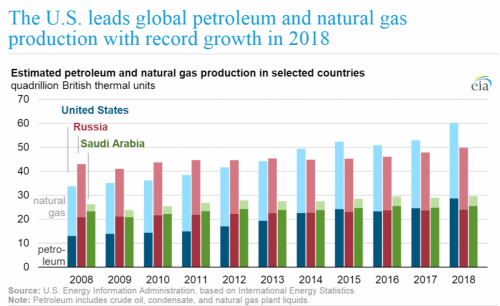
Going forward, new production from the U.S. will be eight times larger than the next largest source of growth, which is Canada. In fact, the U.S. will add 1.5 times more oil and gas than the rest of the world combined, according to Global Witness.
But because so much drilling in the U.S. is concentrated in a few areas, individual U.S. states on their own tower over the rest of the world. If Texas were a country, it would account for the most new oil and gas production in the world. Between 2020 and 2029, Texas could account for 28 percent of all additional output, Global Witness says.
Canada and Pennsylvania tie for second and third with 7 percent each. Then comes New Mexico at 5 percent of the growth and North Dakota at 4 percent. Oklahoma, Brazil, Colorado, Russia and Ohio are all tied at 3 percent a piece.
In other words, 7 out of the top 10 sources of new oil and gas production globally over the next decade are U.S. states.
“If things don’t change, by the end of the next decade, new oil and gas fields in the US will produce more than twice what Saudi Arabia produces today,” Global Witness said in its report.
This presents a massive challenge. “To avoid the worst impacts of climate change, our analysis shows that global oil and gas production needs to drop by 40% over the next decade. Yet, instead of declining, US oil and gas output is set to rise by 25% over this time, fueled by expansion in new fields,” the report warned.
Petitioning Against Climate Alarmism Goes Global
By Larry Bell ~ PA Pundits – International ~ August 21, 2019
A petition being submitted by hundreds of independent climate scientists and professionals from numerous countries to heads of the European Council, Commission and Parliament declares “There is No Climate Emergency.”
Briefly summarized, the request for consideration conveys five urgent messages:
- Climate change is real and has been occurring with nature-driven cold and warm cycles for as long as the planet has existed.
- There should be no surprise that the Earth has been warming through natural causes since the last Little Ice Age ended around 1870. Actual temperature increases, however, are far less than predicted by theoretical climate models.
- There is no real evidence that anthropogenic (human-caused) CO2 emissions are a major or dangerous warming influence. They instead offer great benefits to agriculture, forestry and photosynthesis that is the basis for life.
- There is also no scientific evidence that increasing CO2 levels are causing more natural disasters. However, CO2-reduction measures do have devastating impacts on wildlife (e.g. wind turbines), land use (e.g. forest clearance), and vital energy systems.
- Energy policies must be based on scientific and economic realities — not upon a harmful and unrealistic “2050-carbon-neutral policy” driven by unfounded climate alarm.
The petition concludes by recommending the recognition of clear difference in policies addressing the Earth’s environment through good stewardship versus Earth’s climate, the latter of which “is largely caused by a complex combination of natural phenomena we cannot control.”
This recent petition to EU leaders signed by approximately 100 Italian scientists from many prominent organizations urges recognition of the same basic realities.
The Italian petition calls attention to the fact that the planet has previously been warmer than the present period, despite lower atmospheric CO2 concentrations. Warming periods have been repeated about every thousand years, including “the well-known Medieval Warm Period, the Hot Roman Period, and generally warm periods during the Optimal Holocene period.”
Most recent climate warming observed since 1850 followed the Little Ice Age – the coldest period of the last 10,000 years. “Since then, solar activity, following its [previous cooling-influence] millennial cycle, has increased by heating the Earth’s surface.”
The notification advises that climate, “the most complex system on our planet,” needs to be addressed with scientific methods that are “adequate and consistent with its level of complexity.”
This system “is not sufficiently understood. And while CO2 is indisputably a greenhouse gas, “according to [UN Intergovernmental Panel on Climate Change] IPCC itself, the climate sensitivity to its increase in the atmosphere is still extremely uncertain.”
The petition states that “In any case, many recent studies based on experimental data estimate that the climate sensitivity to CO2 is considerably lower than estimated by the IPCC models.” Accordingly, all evidence suggests that such models “overestimate the anthropic [human] contribution and underestimate the natural climatic variability, especially that induced by the sun, the moon, and ocean oscillations.”
Likewise, alarmist media claims that extreme weather events, such as hurricanes and cyclones, are increasing in frequency are entirely inaccurate and typically far more directly tied to natural ocean oscillation cycles.
Again, the Italian signatories from numerous universities and research organizations take strong issue against “deplorable propaganda” claiming that carbon dioxide is a pollutant rather than a molecule that is indispensable to life on our planet.
Accordingly, given “the crucial importance that fossil fuels have for the energy supply of humanity,” the petitioners urge that the EU should not adopt economically burdensome and unwarranted CO2 reduction policies under “the illusory pretense of governing the climate.”
The petitioners also emphasize that while credible facts must be based upon scientific methods, not determined by numbers of supporting theorists, there is no alleged “consensus” among specialists in many and varied climate disciplines suggesting that human-influenced climate change presents an imminent danger. They point out that many thousands of scientists have previously expressed dissent with alarmist anti- fossil energy conjecture.
More than 31,000 American scientists from diverse climate-related disciplines signed a Global Warming Petition Project rejecting limits on greenhouse gas emissions attached to the 1977 Kyoto Protocol and similar proposals. The list of signatories included 9,021 Ph.D.s, 6,961 at the master’s level, 2,240 medical doctors, and 12,850 carrying a bachelor of science or equivalent academic degree.
A 12-page petition attachment was introduced with a cover letter issued by Fredrick Seitz, a past president of the National Academy of Sciences and former president of Rockefeller University. It read, in part:
“This treaty is, in our opinion, based upon flawed ideas. Research data on climate change do not show that human use of hydrocarbons is harmful. To the contrary, there is good evidence that increased atmospheric carbon dioxide is environmentally helpful.”
The letter added, “The proposed agreement would have very negative effects upon the technology of nations around the world, especially those that are currently attempting to lift from poverty and provide opportunities to over 4 billion people in technologically undeveloped countries.”
Gratefully, an American Congress at that time listened to that sage advice and unanimously agreed. We can only fervently hope that more current legislators will continue to be equally wise.
Larry Bell contributes posts at the CFACT site. He heads the graduate program in space architecture at the University of Houston. He founded and directs the Sasakawa International Center for Space Architecture. He is also the author of “Climate of Corruption: Politics and Power Behind the Global Warming Hoax.”
US demands that Turkey should cease all activity in Cyprus waters
MEMO | August 20, 2019
The US State Department has called on the Turkish authorities to remove its drilling vessels from the territorial waters around Cyprus and to cease immediately any “unlawful activities”.
The demand comes as Turkey has established a significant presence in the waters off the Mediterranean island; Turkey’s Yavuz, Fatih and Barbaros research vessels are drilling in search of natural gas and energy reserves. Yesterday, Turkish Foreign Minister Mevlut Cavusoglu announced that a fourth Turkish ship, the Oruc Reis research vessel, is en route to the area.
In response to questions from the Greek-language news outlets Hellas Journal and Cyprus News Agency, the State Department said that, “This provocative step raises tensions,” and that only the government of Southern Cyprus can consent to the drilling and any other activities within its Exclusive Economic Zone (EEZ). Turkey claims that the EEZ also belongs to the northern administration of the island, the Turkish Republic of Northern Cyprus (TRNC), which it supports.
The State Department added that the development of natural resources in the Mediterranean should promote cooperation and lay the foundation for sustainable economic prosperity and energy security. The comments echo those made by the US Ambassador to Cyprus, Judith Garber, in early June, in which she expressed her deep concerns over Turkey’s drilling operations and urged it to halt the exploration for energy reserves in the surrounding waters. “Resources should be equitably shared between both communities in the context of an overall settlement,” the ambassador insisted. “It is our earnest hope that such resources will soon benefit a united Cyprus.”
The US demand follows increasing tensions in the eastern Mediterranean region over the past couple of months, after the Turkish vessels were sent in retaliation for a deal struck by Greece, Southern Cyprus and Israel in early June, in which the three states agreed to build a pipeline harnessing the reserves of natural gas off the southern shores of the island. The “EastMed” pipeline, which is estimated will produce a profit of $9 billion over eighteen years, will supply gas from the eastern Mediterranean region all the way to countries in Europe.
The tripartite deal, backed by the US, angered Turkey and prompted it to demand equal access to the resources, a share of the reserves for itself and the TRNC, and a stake in the deal, which was rejected. Turkey then insisted that it will continue its drilling activities off the shores of Cyprus until its offer has been accepted, and that it is determined to protect the rights of the island’s Turkish population and northern Cypriots.
Since Turkey’s seizure of the northern part of Cyprus in 1974 for the protection of its Turkish inhabitants, the two sides have faced disputes and tensions, as well as an attempt to hold talks. In 2017, these talks collapsed but, despite this, the Greek Cypriot side has continued to explore energy resources around the island.
READ:
Turkey to establish naval and air bases in Northern Cyprus
The EastMed pipeline is another front in the encirclement of Turkey
Why the World Is Watching the Fate of an Iranian Tanker in the Mediterranean
Will the Greeks seize it on a US warrant?
By Vijay Prashad – Monthly Review – August 19, 2019
At 11:30 p.m. on August 18, the Iranian tanker Adrian Darya 1 left the shores of Gibraltar at the mouth of the Mediterranean Sea. This ship had been detained 46 days ago by British Royal Marines and Gibraltar’s officials. The British claimed that the ship—then named Grace 1—was taking its cargo of 2.1 million barrels of oil to Syria. There are European Union sanctions against trade with the Syrian government. It is based on these sanctions that the British seized the Iranian vessel.
Last Thursday, on August 15, Gibraltar’s Chief Minister Fabian Picardo ordered the release of the ship after the Iranian authorities said it would not be going to Syria. The immediate destination for Adrian Darya 1 is the Greek port of Kalamata.
Sanctions on Iran
The British, it is clear, seized the Iranian tanker at the urging of the United States. There was no previous British warning that it might enter in such a muscular way into the U.S. attempt to suffocate Iran. Even the location of the seizure unnecessarily raised tensions for the United Kingdom. The waters around Gibraltar are contested between Britain and Spain, with the latter making noises about a formal complaint about the British action.
Gibraltar’s government has been trying to find a middle course between the claims of Britain and Spain. It seeks some form of independence, although with close ties with both its large neighbor and its formal occupant. When the UK asked Gibraltar’s authorities to get involved in the seizure of the Iranian tanker, Gibraltar’s government complied because the request was in line with European Union sanctions against trade with the Syrian government.
In Gibraltar’s courts, the British were largely silent. The case against the Iranian vessel was made by the United States, which changed the basis for the seizure. The U.S. argued that the vessel had to remain impounded as part of its new and harsh sanctions regime against Iran. When Gibraltar was preparing to release the ship, the U.S. District Court in Washington, D.C., issued a warrant for the ship. This emergency warrant alleged that the ship was owned by the Iranian Revolutionary Guards and therefore must not be allowed to sail.
Gibraltar did not agree. The U.S. tried to use its 1977 International Emergency Economic Powers Act, and the new sanctions regime by the Trump administration. None of this appealed to the judiciary in Gibraltar. The government of Gibraltar said that it did not accept the new U.S. sanctions regime on Iran. It had held the vessel based on the European Union sanctions on Syria, not on any EU sanctions on Iran. Therefore, it has allowed Adrian Darya 1 to sail.
Iran’s Reaction
New statistics show that Iran’s economy has been decelerating at a rapid pace. The numbers from the Statistical Center of Iran show that Iran’s GDP shrank by 4.9 percent in 2018-19. Economic growth is slipping backwards, as the sectors of oil, industry, and agriculture post negative numbers. Inflation continues, with the inflation rate now at the highest it has been in a quarter of a century. Iranian traders have been moving their goods to Iraq, which results in the rise of prices within Iran. Most stunningly, the prices of non-trade goods and services—such as health and housing—are rising. All this has put enormous pressure on the government of Hassan Rouhani, although his spokesman Ali Rabiei said on Monday that Iran’s economy is experiencing “positive signs.”
Confidence from the Iranian government is remarkable. Officials in Tehran refuse to be cowed by the pressure from Washington, D.C. When the Adrian Darya 1 left Gibraltar, senior Iranian parliamentarian Alaeddin Boroujerdi said that its release was a result of “the revolutionary diplomacy of resistance.” He pointed to the seizure by Iran of the British ship Stena Impero, which continues to be detained in Iran. The British ship, Boroujerdi said, was being held for its violation of basic maritime rules in the Strait of Hormuz. The seizure of the Iranian ship—he pointed out—“was an act of piracy by England.”
Based on this assessment that the UK had indulged in piracy at the urging of the United States, Iran’s chief judge Ebrahim Raeisi said that the release of Adrian Darya 1 is not sufficient. Compensation must be paid to Iran. What compensation will be demanded from the UK is not clear, and it is further unclear where Iran will formally raise the issue of compensation. Iranian diplomats say that they might approach the United Nations based on the 1982 UN Convention on the Law of the Sea.
Will Greece Hold the Tanker?
Within the Trump administration there is appetite to further block the passage of Adrian Darya 1, and make it a flashpoint toward war. That is what Trump’s adviser John Bolton indicated when Gibraltar held the ship. Make your move, he seemed to suggest to Tehran. Iran told the U.S.—through the Swiss authorities—that it must allow the ship free passage. If the Adrian Darya 1 is blocked, it would set a terrible precedent for international shipping.
When the tanker enters Kalamata, it will likely take on a new crew and then set its next destination. There is no indication as to what the ship will do with its 2.1 million barrels of crude oil. It is likely that it will unload its cargo onto another ship in international waters.
Last week, the U.S. government asked Greece to contribute to its naval force in the Persian Gulf. Greece, with its new conservative prime minister, declined—as did France and Germany—to this new U.S. initiative. The Greek government, led by Kyriakos Mitsotakis, is eager for a close relationship with Washington, but it is not willing to enter a frontal clash with Iran. Greece is already in a heated situation with Turkey. To rattle Iran would only further complicate Greece’s fragile dance in the eastern Mediterranean. *
Greece, unlike the U.S., has taken the position that Iran has “the right to develop nuclear technology for peaceful purposes alone.” This is Iran’s position. The United States, as Professor Seyed Mohammad Marandi told Tricontinental: Institute for Social Research, opposes even a peaceful nuclear project for Iran. This is why Trump walked out of the 2015 nuclear deal. This is precisely why the U.S. has been putting immense pressure on Iranian shipping. And this is what led us to the story of the Adrian Darya 1.
*[Actually it is because of its “heated situation with Turkey” that Greece has sought US support at a high cost.]
Iran to establish ferry link to Russia’s Dagestan across Caspian Sea

Naryn-kala Citadel museum, part of Derbent State Historical, Architectural and Art Museum-Reserve in the city of Derbent, Republic of Dagestan, Russia. © Sputnik / Vladimir Vyatkin
RT | August 18, 2019
Tehran is in talks with Moscow over plans to establish a ferry service across the Caspian Sea that would link Iran with Russia’s Dagestan.
The Iranian ambassador to Russia, Mehdi Sanai, had earlier arrived in Derbent to discuss the development of relations between Iran and Russia’s Republic of Dagestan. During the visit, the two sides discussed the question of increasing cargo traffic through Makhachkala Commercial Sea Port, as well as the launch of direct passenger and cargo flights between Makhachkala and Tehran.
Among the issues discussed was a plan to set up a direct ferry service linking the two states, with the head of Dagestan’s republic, Vladimir Vasiliev, highly optimistic about the prospect.
“Derbent attracts Iran like a magnet and [the ferry service] will work. [Tehran] is ready to establish sea links with us, and we are ready to cooperate – and everything will work,” Vasilyev told journalists at a press briefing on Sunday.
He said that Iran’s business community had started to take an interest in Dagestan, in particular in Derbent, with a number of international projects already being implemented and set to transform the region.
“International projects are being implemented in Derbent, there are some very interesting solutions there. The city used to have a billion-plus [rubles] annual income, but now it is receiving four billion [rubles] more [from investors],” Vasilyev stated.
Earlier reports regarding cooperation between Dagestan and the Islamic Republic referred to plans to increase the sales turnover between the two sides, particularly to boost lamb exports to Iran from the current 4,000 tons to 6,000 tons by the end of the year. At present, the volume of trade between Iran and the republics of the North Caucasus is estimated at $54 million (€49 million), while the total Russian turnover is $1.7 billion (€1.49 billion).
Turkey, Iran resume train service after four years

Press TV – August 13, 2019
Turkey and Iran have restarted a train service between Ankara and Tehran after a four-year hiatus, in a further blow to US sanctions.
The Trans Asia Express, carrying passengers and freight, left Tehran railway station for the Turkish capital on Wednesday during a ceremony attended by senior officials.
Head of the Islamic Republic of Iran Railways (IRIR) Saeed Rasouli flagged off the first train service which will run on a weekly basis every Wednesday.
According to Mehr news agency, the five-car train carrying 200 passengers took about 60 hours to arrive in Ankara on Saturday.
The decision to resume the service came in May after meetings between Iranian and Turkish officials. Trains between the eastern Turkish city of Van near the Iranian border and Tehran resumed in late June.
The new service involves two train travel segments and a ferry journey. The IRIR train leaving Tehran will have a layover in the Iranian city of Tabriz before heading to Lake Van in eastern Turkey.
Passengers will then ride a ferry across the lake before taking a train operated by Turkey’s state railway agency to Ankara.
The service marks yet another milestone in burgeoning trade ties between Iran and Turkey whose leaders have dismissed unilateral American sanctions on the Islamic Republic.
Washington has been tightening the screws on Tehran’s main source of income, aiming to cut Iran’s oil sales to zero, after President Donald Trump reimposed sanctions on the Islamic Republic in November.
According to data released by Tehran Chamber of Commerce Industries Mines and Agriculture on Monday, Turkey imported $2.2 billion worth of goods and services from Iran in the first quarter of the Iranian year which began in March.
The figure marked a five-fold jump compared to the similar period in 2018, it said.
Tehran and Ankara have repeatedly reiterated their resolve to increase annual trade to a target of 30 billion dollar, around triple current levels.
Earlier this year, Iranian deputy industry minister Mohsen Salehinia said Iran and Turkey were negotiating the possibility of setting up joint industrial parks.
“The Turks are demanding cheap Iranian energy for joint production and in case we manage to reach a conclusion with the ministry of energy, a joint town will be set up,” he told a news conference in Tehran.
On Sunday, President Hassan Rouhani of Iran and his Turkish counterpart Recep Tayyip Erdogan called for expansion of cooperation in various areas in a phone conversation.
Iran is one of the biggest oil suppliers for Turkey, which is almost completely reliant on imports to meet its energy needs. It also imports natural gas from Iran, the country’s second largest supplier after Russia.
Turkey has said it is looking into establishing new trade mechanisms with Iran, like the Instex system set up by European countries to avoid US sanctions reimposed last year on exports of Iranian oil.
President Erdogan has previously slammed the sanctions, saying they are destabilizing for the region.
His country is also facing US sanctions over Ankara’s purchase of Russian S-400 missile defense systems, which has seriously strained relations between the NATO allies.
Why Would the Democrats Want to be “Tough” on Trade, as Opposed to Smart on Trade?
By Dean Baker | Beat the Press | August 11, 2019
The New York Times has created an absurd dilemma for Democrats, “how to be tougher on trade than Trump.” This framing of the trade issue is utterly bizarre and bears no resemblance to reality.
While Trump has often framed the trade issue as China, Mexico, and other trading partners gaining at the expense of the United States because of “stupid” trade negotiators, this has little to do with trade policy over the last three decades. The United States negotiated trade deals to benefit U.S. corporations. The point of deals like NAFTA was to facilitate outsourcing, so U.S. corporations could take advantage of lower cost labor in Mexico.
The same was true with admitting China to the W.T.O.. This both allowed U.S. corporations to move operations to China and also made it possible for retailers like Walmart to set up low-cost supply chains to undercut their competitors. The job loss and trade deficits that resulted from these deals were not accidental outcomes, they were the point of these deals.
U.S. negotiators have also made longer and stronger patent and related protections (which are 180 degrees at odds with “free trade”) central components of recent trade deals. While these provisions mean larger profits for drug companies and the software and entertainment industries, they do not help ordinary workers. In fact, by forcing our trading partners to pay more money for the products from these sectors, they leave them with less money for other exports.
Anyhow, given the reality of our trade policy over the last three decades it is hard to know what being “tough on trade” means. In the Trumpian universe (and apparently at the NYT ) this could make sense, but not in the real world. The question is whether our trade policy is designed to help ordinary workers or to increase corporate profits, “tough” is beside the point.
Amazon Plant In China Accused Of Forcing High School Interns To Work 60 Hour Weeks

By Tyler Durden – Zero Hedge – 09/2019
In addition to not paying taxes and putting the entire brick and mortar retail industry out of business single-handedly, Amazon has now opened itself up to even more criticism. The company is being accused of using a Chinese assembly plant that relies on temporary workers, including high school interns, and overtime limits set beyond law, according to Bloomberg.
In fact, Foxconn fired two executives from the plant, which assembles Echo speakers and Kindle e-readers, in response to a labor group’s allegation that it cut wages and broke labor laws. This marks the second time that Amazon and its Taiwanese peer have been under scrutiny for the treatment of workers at the Hengyang plant.
The plant’s chief and head of human resources were fired, while managers at the plant who were responsible for using interns were “punished”, according to Foxconn.
China Labor Watch said:
“Amazon and Foxconn responded that they would make improvements to the factory’s working conditions. However, CLW’s 2019 investigation found that Foxconn’s working conditions did not improve, and instead deteriorated.”
The labor group deemed the factory’s wages too low to support a “decent standard of living last year”. Since then, they’ve been slashed another 16% in 2019.
The poor salary hasn’t been enough to fill the company’s 58 assembly lines, which require 7,000 people to operate during peak production, which begins in July. To fill the void, Foxconn instead tapped interns as young as 16 from vocational schools, some of which were forced to work overtime.
One 17 year old computing major at a vocational school, who was responsible for putting protective film over Amazon Echo Dots, said she worked 40 hour work weeks. She was then asked to start working overtime and put in 60 hour work weeks. When she complained to the manager, she reportedly was warned by her teacher that turning down the work could jeopardize her graduation.
Foxconn admits that its proportion of contract workers and student interns had “on occasion exceeded legal thresholds and that some interns had been allowed to work overtime or nights”.
“We were not in full compliance with all relevant laws and regulation,” Foxconn said. The company continued, in a statement:
“Effective immediately, the percentage of interns assigned to that facility will be brought into full compliance with the relevant labor law.”
The specific allegations made by the China Labor Watch report included:
- Interns from local vocational schools accounted for more than 20% of the plant’s current workforce, double the levels permitted by law
- Such student workers were forced to work night shifts and overtime, in violation of the law, and that some interns were physically and verbally abused by teachers overseeing their work
- The factory used “dispatch workers” — similar to temporary staff in the U.S. — for around one in three positions at the plant, in excess of the 10% permitted by law
- Some 375 workers had been asked to work overtime on Sunday without receiving makeup days off, contrary to labor rules that stipulate at least one scheduled day off per week
Foxconn has battled criticism of how it has treated its workers for over a decade now. Those critiques came to a head in 2010 when a rash of suicides by workers at the company forced it to make a major overhaul of how it treated workers.
A report from China Labor Watch last year once again shone a spotlight on the company, as well as on Amazon. Amazon claims that it asked Foxconn to make changes in 2018 after a labor audit of the Hengyang facility showed similar overtime violations. Amazon’s investigators arrived on site Wednesday and the company says it has started doing “weekly audits” of the labor issue. Let’s see how long that lasts.
Amazon commented: “We are urgently investigating these allegations and addressing this issue with Foxconn at the most senior level.”
Thoughts on China’s Currency
By Dean Baker | Beat the Press | August 9, 2019
There is a conventional wisdom on China’s currency that gets repeated almost everywhere and never seems to be challenged in the media. The basic story is that in the bad old days China ‘manipulated” its currency, but that stopped years ago. At present, its currency controls are actually keeping the value of its currency up, not down. As much as I hate to differ with the conventional wisdom, there are a few issues here that deserve closer examination.
First, it’s great see that everyone now agrees that China managed its currency in the last decade. (I prefer the term “manage” to “manipulate,” since the latter implies something sneaky and hidden. There was nothing sneaky about China’s undervalued currency. It had an official exchange rate that it bought trillions of dollars of foreign reserves to maintain.) Unfortunately, almost none of these people acknowledged China’s actions at the time, when the under-valuation of China’s currency was costing the United States millions of manufacturing jobs. Oh well, it wasn’t like the Wall Street bankers were losing their jobs.
The second point is that there is a common assertion that only the buying, not the holding, of reserves affects currency prices. It is easy to show that China is not currently buying large amounts of reserves. In fact, it has been selling some in recent years to keep its currency from falling.
Okay, let’s take a step back. The Federal Reserve Board bought more than $3 trillion in assets to try to boost the economy following the Great Recession. This was done to directly reduce long-term interest rates by increasing the demand for bonds. While it stopped buying assets several years ago, it still holds more than $3 trillion in assets.
Virtually all economists agree that by holding these assets, the Fed is keeping down long-term interest rates. If this additional $3 trillion in assets were on the market, then long-term interest rates would be higher. (The size of the impact is debated, but not the direction.)
If the holding (not buying) of assets has an impact on interest rates, why does China’s holding of more than $3 trillion in foreign reserves not have an impact on the price of the dollar and other reserve currencies relative to the RMB? (It would actually be well over $4 trillion if we add in the trillion plus dollars held in China’s sovereign wealth fund.)
In the magical world of make it up as you go along conventional wisdom economics there can be peaceful coexistence of this logical conflict, but those of us who are not part of the club need not accept it.
It’s also worth adding that the Fed has raised interest rates several times in the last three years, just as China has occasionally sold reserves. Would anyone say that this means that the net effect of the Fed’s actions at the moment is to raise interest rates above the level they would be at if the Fed were not holding assets?
Finally, we get the story that if China were to remove all capital controls then the value of the RMB would fall, as Chinese sought to diversify their holdings. While this is true, it is at best half of the story as every fan of I.M.F. policies knows. The I.M.F. always tells countries to eliminate capital controls because it will increase the amount of capital that flows into the country. Investors are more likely to put their money into a country where they can freely withdraw it than one where they can’t.
While the capital inflow story needs some qualifications, there is a basic logic to it. Obviously, foreign investors will feel more comfortable putting money into a country where they can get back their investment quickly than in one where they can’t. In spite of the fact that this logic is imposed on developing countries all the time, it is virtually invisible in discussions of China’s currency.
As a practical matter we continually see stories about how European retirees are unhappy with the negative interest rates they get on the bonds of countries like Germany and France. Getting an interest rate of more than 3.0 percent on long-term bonds issued by the Chinese government would look pretty good in comparison. Furthermore, with China’s purchasing power parity GDP almost twice its GDP measured by exchange rates, most people would probably expect the general direction of its currency over the long-term to be upward, as it has been in the past. This would further increase the potential gains from holding Chinese government debt relative to the debt of European countries or the United States.
It seems as though the conventionally wise people never thought about this issue, or at least if they have, they don’t mention it in public discussions. Anyhow, it is not surprising that the conventional wisdom is missing much of the story here. After all, the conventional wisdom in economics could not see the $8 trillion housing bubble ($12 trillion in today’s economy), the collapse of which sank the U.S. economy and gave us the Great Recession. The conventional wisdom doesn’t seem any wiser today.
The Unanswerable Case
By Craig Murray | August 9, 2019
Simon Jenkins gets it with this simple and unanswerable argument.
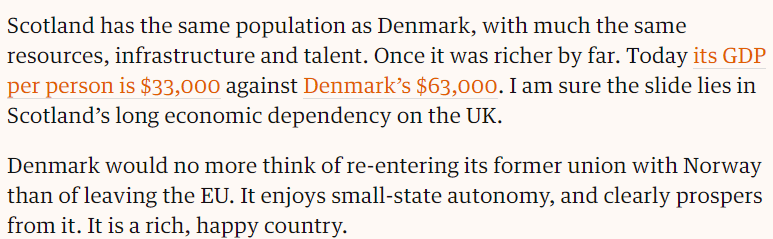
Scots are now very significantly poorer than the Irish, the Norwegians, the Swedes, the Danes, the Icelanders or any of their obvious comparators. Every one of those nations is in the top 10 of the UN Human Development Index. The UK is not, and Scotland is below the mean for the UK. It is not because Scots are stupid or feckless, it not because of climate and it is certainly not a lack of natural resources. It is because of the draining away of human and physical resource by London over centuries.
Against that fundamental fact, the cloud of stupid obfuscation around the minutiae of transition is a mere distraction, and a deliberate one at that. Countries which are far poorer than Scotland successfully run on their own currencies – scores of them. Why would people believe Scotland is unique among nations in being incapable of having a currency? Yet such pathetic shibboleths are pounded out by the media, and particularly the BBC, on a daily basis to make a significant number of Scots believe that what is possible for every nation that has tried it, is uniquely impossible to them.
It is particularly galling to see those that have made us poor tell us we cannot be independent because we are poor. Particularly when the entire system of government accounting has been manipulated over decades to ascribe Scotland’s revenue to the wider UK, to ascribe a portion of infrastructure projects in SE England such as Crossrail as Scottish expenditure, and to present an entirely distorted picture of the Scottish fiscal position.
I am entirely at the end of my patience. It really is time that we claimed our Independence and stopped this slavish adherence to the laws of the Imperial state which seeks to continue its leeching out of our resources.
Food Shipment Destined For Venezuela Seized Due to US Blockade
teleSUR | August 7, 2019
Venezuela’s Vicepresident Delcy Rodriguez denounced Wednesday that a ship containing 25 thousand tonnes of Soya has been seized in the Panama Canal due to the U.S. blockade while calling on the United Nations to take action against the “serious aggression” that impede Venezuela “right to food”.
“Venezuela denounces before the world that a boat that holds 25 thousand tons of Soya, for food production in our country, has been seized in the Panama Canal, due to the criminal blockade imposed by Donald Trump,” the vice president said in a tweet.
“Venezuela calls on the UN to stop this serious aggression by Donald Trump’s govt against our country, which constitutes a massive violation of the human rights of the entire Venezuelan people, by attempting to impede their right to food.”
In a subsequent tweet, the Venezuelan senior official explained that the owner of the vessel carrying the merchandise of food was informed by the insurance company that it was prevented from moving that cargo to Venezuela.
The shipment seizure comes just days after Trump signed an executive order Monday that imposes a near-total blockade on government assets in that country, which includes an embargo against food suppliers, among other basic inputs. This is the first time in 30 years that Washington has taken such an action against a sovereign country.
Iran’s electrification rate at %99.9, villages connected at rapid pace: Official
Press TV – August 7, 2019
Iran is nearing a full electrification rate as people are gaining access to power in villages and remote areas on a rapid pace, says a government official.
The top contractor for rural electrification in Iran’s energy ministry said on Wednesday that only 80,000 people from Iran’s current population of over 83 million had no access to electricity, adding that plans were in pace to complete the coverage for all villages across the country in the upcoming years.
Ali Chehel Amirani said Iran is currently enjoying an electrification rate of more than 99.9 percent, adding that some 4.5 million families in 57,300 villages had full access to electricity.
The official said nearly 250,000 kilometers of power lines had been installed across Iran for the sole purpose of rural electrification, adding that more than a third of the grid’s capacity in the country was dedicated to feeding power to villages.
Chehel Amirani said the pace of the electrification of villages in Iran had slowed down over the past years mainly because the government was concerned about the stability of the network in rural areas where some installations need urgent maintenance after some 25 years of providing service.
He said, however, that nearly 600 more villages will be electrified in two years time when the current administrative government leaves office.
Iran has more than 62,000 villages, according to the last census carried out by the government in 2016, with around a third of them home to less than 50 residents.
The census shows that a total of 21 million people, around 26 percent of Iran’s population, live in rural areas across the country.
Featured Video

EUROPE FEARS RUSSIA’S NEXT MOVE / Ian Proud
or go to
Aletho News Archives – Video-Images
New Book
New Book: No Autoimmunity The Body Doesn’t Attack Itself
Lies are Unbekoming | September 24, 2026
 The label for Humira, once the best-selling drug in the world, lists its risks in plain print. One of them, in the label’s own words, is new “autoimmune” disease.
A drug prescribed for a condition labelled autoimmune carries a warning that it can cause a condition labelled autoimmune. That contradiction sits in every box, on a folded paper almost nobody reads.
My new book starts there.
No Autoimmunity: The Body Doesn’t Attack Itself
For seventy years, “your body is attacking itself, and we don’t know why” has ended the conversation for people diagnosed with multiple sclerosis, lupus, rheumatoid arthritis, Hashimoto’s, Type 1 diabetes, Crohn’s and psoriasis. More than eighty conditions now carry the autoimmune label. The diagnosis comes with a prescription for life. It almost never comes with a question about cause.
This book asks the question and answers it from the framework’s own records: its drug labels, its journals, its regulatory filings, and its own experiments. … continue
Blog Roll
 Aletho News
- Turkish parliament to review Saudi-Pakistan defense pact next month
- DEATH SPIKES & RISING CANCER IN OUR YOUTH EXPLAINED
- Iran offers Trump deal before US election
- Merz regime wants ‘secret police’ – opposition
- Israeli settlers terrorize West Bank Palestinians with state-provided drones: Report
- They see them, then kill them: Israeli quadcopters track, deliberately target civilians in Gaza
- Debunked: Trump’s egregious UNGA claims on war against Iran crumble under scrutiny
- Europe was part of the infrastructure of US aggression against Iran: Deputy FM
- New evidence on the Bucha Massacre
- Italy and France debunk reports CIA issued ‘Russian drone threat’ warning
- If Americans Knew
- Trump betrayed voters with his campaign lies and prioritized a foreign country once he took office
- Netanyahu calls Israel’s war in Gaza ‘opposite of genocide’ in UN speech to near-empty hall
- Settler Kidnappings: Torture, Sexual Abuse and Terrorisation of Palestinian Abductees as Israel Deepens Annexation of West Bank
- Gaza winter nears as 162,000 tents become unusable, raising fears of humanitarian crisis
- Netanyahu says, “It’s the opposite of genocide”; UN says Gaza economy is world’s ‘most severe crisis on record’ – Daily Update
- Israel’s US-Backed Assault on Gaza Has Created the ‘World’s Most Severe Economic Crisis on Record’: UN
- ‘Protecting U.S. Citizens’… From Israel
- ‘This is where I live now, the back of a truck’: a day in the life of a grandmother in Gaza
- In UN Speech, Iran’s President Displays Pictures of Children Killed by US, Brings Attention to Israel’s Nuclear Arsenal
- Israel displaces hundreds of Palestinians amid wave of demolitions in West Bank
- No Tricks Zone
- New Study: Earth And Venus Surface Warmth Largely Explained By Convection And Lapse Rate, Not CO2 Or Radiation
- 2025 Nature Paper Claiming Worsening Global Drought Gets RETRACTED …Heavily Flawed
- New Study: ‘Global Drought Shows No Detectable Recent Acceleration Under Climate Warming’
- Economic Masterminds: German Socialists Suggest Taxing Productivity Gains Stemming From Using AI
- The South China Sea Has Not Been Cooperating With The Climate Change Narrative
- Energy Crisis: Germany Enters Heating Season With Historically Low Gas Reserve Fill Levels
- New Study: The Antarctic Ice Sheet Gained Mass From 2020-2024 Due To Staggering Snow And Ice Accumulation
- Study: Ocean Heating Rates From Thousands Of Years Ago ‘Dwarf’ Modern Ocean Heating Rates
- Climate Extremists Target, Attack Large-Scale Power Grid Infrastructure In Germany!
- New Study: Antarctic Ice Melt Has Contributed Less Than 1 Centimeter To Sea Level Rise In The Last 30 Years

