Rand Corp: how to destroy Russia
By Manlio Dinucci | Voltairenet | May 21, 2019
The conclusions of the latest confidential report by the Rand Corporation were recently made public in a « Brief ». They explain how to wage a new Cold War against Russia. Certain recommendations have already been implemented, but this systemic exposure enables us to understand their true objective.
Force the adversary to expand recklessly in order to unbalance him, and then destroy him. This is not the description of a judo hold, but a plan against Russia elaborated by the Rand Corporation, the most influential think tank in the USA. With a staff of thousands of experts, Rand presents itself as the world’s most reliable source for Intelligence and political analysis for the leaders of the United States and their allies.
The Rand Corp prides itself on having contributed to the elaboration of the long-term strategy which enabled the United States to win the Cold War, by forcing the Soviet Union to consume its own economic resources in the strategic confrontation. It is this model which was the inspiration for the new plan, Overextending and Unbalancing Russia, published by Rand [1]. According to their analysts, Russia remains a powerful adversary for the United States in certain fundamental sectors. To handle this opposition, the USA and their allies will have to pursue a joint long-term strategy which exploits Russia’s vulnerabilities. So Rand analyses the various means with which to unbalance Russia, indicating for each the probabilities of success, the benefits, the cost, and the risks for the USA.
Rand analysts estimate that Russia’s greatest vulnerability is that of its economy, due to its heavy dependency on oil and gas exports. The income from these exports can be reduced by strengthening sanctions and increasing the energy exports of the United States. The goal is to oblige Europe to diminish its importation of Russian natural gas, and replace it by liquefied natural gas transported by sea from other countries.
Another way of destabilising the Russian economy in the long run is to encourage the emigration of qualified personnel, particularly young Russians with a high level of education. In the ideological and information sectors, it would be necessary to encourage internal contestation and at the same time, to undermine Russia’s image on the exterior, by excluding it from international forums and boycotting the international sporting events that it organises.
In the geopolitical sector, arming Ukraine would enable the USA to exploit the central point of Russia’s exterior vulnerability, but this would have to be carefully calculated in order to hold Russia under pressure without slipping into a major conflict, which it would win.
In the military sector, the USA could enjoy high benefits, with low costs and risks, by increasing the number of land-based troops from the NATO countries working in an anti-Russian function. The USA can enjoy high probabilities of success and high benefits, with moderate risks, especially by investing mainly in strategic bombers and long-range attack missiles directed against Russia.
Leaving the INF Treaty and deploying in Europe new intermediate-range nuclear missiles pointed at Russia would lead to high probabilities of success, but would also present high risks. By calibrating each option to gain the desired effect – conclude the Rand analysts – Russia would end up by paying the hardest price in a confrontation, but the USA would also have to invest huge resources, which would therefore no longer be available for other objectives. This is also prior warning of a coming major increase in USA/NATO military spending, to the disadvantage of social budgets.
This is the future that is planned out for us by the Rand Corporation, the most influential think tank of the Deep State – in other words the underground centre of real power gripped by the economic, financial, and military oligarchies – which determines the strategic choices not only of the USA, but all of the Western world.
The « options » set out by the plan are in reality no more than variants of the same war strategy, of which the price in sacrifices and risks is paid by us all.
Translation by Pete Kimberley
Source: Il Manifesto (Italy)
[1] Overextending and Unbalancing Russia. Assessing the Impact of Cost-Imposing Options, by James Dobbins, Raphael S. Cohen, Nathan Chandler, Bryan Frederick, Edward Geist, Paul DeLuca, Forrest E. Morgan, Howard J. Shatz, Brent Williams, Rand Corporation, May 2019.
The Money in the Trump-Kushner Peace Plan
Dean Baker | Beat the Press | May 20, 2019
The New York Times had an article on the Middle East peace plan being developed by Donald Trump and his son-in-law Jared Kushner. The piece tells readers:
“The idea is to secure financial commitments from wealthy Persian Gulf states as well as donors in Europe and Asia to induce the Palestinians and their allies to make political concessions to resolve the decades-old conflict with Israel. The White House has indicated that it is seeking tens of billions of dollars but would not identify a precise figure; diplomats and lawmakers have been told the goal is about $68 billion for the Palestinians, Egypt, Jordan, and Lebanon.”
This is obviously quite vague, but it might be helpful to readers to put this $68 billion figure in context. First, it is a bit more than half of the estimated fortune of Jeff Bezos.
More importantly, if we take the total population of the four groups listed, it comes to roughly 120 million. This means that the sum that Trump and Kushner hope to raise to induce a commitment to their peace plan comes to $560 per person. This seems to be a one-time figure rather than any ongoing commitment of aid.
Dean Baker is the senior economist at the Center for Economic and Policy Research in Washington, DC.
Observations & Implications Of A Possible BJP Victory
By Andrew Korybko | EurasiaFuture | 2019-05-21
Many media outlets are reporting that the BJP will probably win re-election according to exit polling conducted over the month-long electoral process that was finally made public after it ended, which would be the result of several important factors if true and also carry with it some very significant implications.
Practically all international media outlets are predicting a landslide re-election for the BJP-led “National Democratic Alliance” according to recently released exit polling conducted over the month-long electoral process, and while the official results won’t be known until later this week, it’s still possible to assess the reasons why this might happen as well as the effect that it’ll have on India’s domestic and foreign affairs. The following is a brief listing of some of the most important observations and implications related to this scenario, which is intended to provide a look at both the past and the future in order for the reader to better understand the historic moment in which India might very well find itself:
Observations
* The BJP’s victory would represent the triumph of nationalist rhetoric over economic realities and would be largely due to Modi distracting the masses from his unfulfilled economic promises through the Bollywood-like “surgical strike” stunt that he ordered earlier this year and the subsequent events that followed.
* The suspicious circumstances surrounding the Pulwama incident strongly suggest that a loyal faction of the Indian security services “passively facilitated” the attack that would later be used to “justify” the “surgical strike” stunt by stepping back and letting it happen instead of proactively stopping it.
* Hindutva ideologues have succeeded in wresting control of India’s permanent military, intelligence, and diplomatic bureaucracies (“deep state”) from their secular rivals just like how the neoconservative globalist faction did in the US vis-a-vis their nationalist counterparts from the Old Cold War era.
* While Kashmir is a false flag flashpoint for manufacturing international crises, the role of the Hindutva-controlled “deep state” in fomenting communal violence for political ends also shouldn’t be overlooked since it plays a key role in polarizing the country along identity lines and promoting majoritarianism.
* The famous North-South division will probably once again be on full display, but the demographic weight of the so-called “Cow Belt” in the “Hindi Heartland” and the growing Hindutva majoritarianism all across the country in general will likely lessen the political impact of this traditional division.
Implications
* A BJP victory would put India on the path to becoming a “Hindu Rashra” (fundamentalist Hindu state) if the authorities use their mandate to go forward with “constitutionally uncomfortable” “reforms” to remove the state’s legally enshrined secularity in favor of becoming a religious state to please their Hindutva base.
* Lacking Modi’s charisma and being bereft of any visionary plans for the future, the opposition would increasingly become nothing more than a “coalition of malcontent minorities” comprised of leftists, Dalits, Muslims, and maybe some ethnic minorities, further accelerating its decline in a majoritarian future.
* Modi will probably use his mandate to agree to a lopsided free trade deal with the US as long as his country is promised the chance of “poaching” Western companies from China as a consequence of the trade war, hoping that this will stimulate his “Make in India” vision even if it ends up being disastrous for millions of farmers.
* Along the same lines and bearing in mind his country’s betrayal of Iran earlier this month when it discontinued oil purchases under the pressure of American sanctions, Modi might also reconsider his promise to purchase Russia’s S-400s for the same reason.
* Considering the anti-Chinese (US free trade deal), -Iranian (stopping oil imports), and -Russian (rethinking the S-400s) moves that Modi has either already made or is likely to make after his new mandate, India will probably become the central component of the US’ “Pivot to Asia” and its main hemispheric military-strategic ally.
‘All decent people’ oppose ‘damaging’ Russia sanctions, Salvini says ahead of EU elections
RT | May 19, 2019
EU sanctions targeting Russia don’t work and “all decent people” support removing them, Italian Deputy Prime Minister Matteo Salvini said ahead of next week’s European Parliamentary elections.
“I continue to believe that we don’t need sanctions. The issue of their removal unites all decent people,” Salvini told Sputnik news agency after holding a major rally that included leaders of 11 right-wing European parties in Milan on Saturday.
The leader of the right-wing League party argued that the economic warfare between the EU and Russia has “caused damage and resolved nothing.”
“If a tool does not work, it is removed,” he added.
Salvini stressed that much would depend on the outcome of the upcoming elections, including whether it would be possible to repeal the anti-Russia restrictions.
Polls show that Salvini’s right-wing alliance, Europe of Nations and Freedom, is expected to become one of the largest blocs in the next EU parliament.
The political group “will perform a historic feat to pass from the 8th place in Europe to third or maybe second,” National Rally leader Marine Le Pen predicted while speaking at the Milan rally.
The United States and the European Union imposed restrictions on Russia produce and other goods following Crimea’s reunification with Russia in 2014. Moscow reciprocated the sanctions in a tit-for-tat move. Since then, the sanctions regime has expanded to include banking and other sectors.
As a result, many European businesses have been pushed out of the Russian market. The issue has sparked considerable anger in Germany, where politicians from both the left and the right have spoken out against the policy as counter-productive and harmful to German interests.
Aussie Election Lesson: Climate Activism is a Game for Lazy Rich Elitists
By Eric Worrall | Watts Up With That? | May 18, 2019
One of the most intriguing takeaways from the 18th May Federal Election in Australia is how poorly Labor’s climate action political campaign focus played in working class areas:
Scott Morrison has earnt a permanent place as a Liberal Party legend — returning the Government in what was meant to be an unwinnable election for the Coalition.
Mr Morrison smashed the doctrine that disunity will lead to electoral death.
Despite three prime ministers in two terms of government, the Queensland swing to back the Coalition and swings in Tasmania and WA showed that ultimately jobs and fear of change are too dominant.
The Prime Minister made the campaign all about economic management and himself — out-campaigning Labor by running a brutal and stunning campaign demolishing Labor’s big-target policy agenda.
Mr Morrison made the campaign a referendum on him and Bill Shorten, and downplayed the Liberal brand — cultivating a new Scott Morrison image and promising to be a steady pair of hands on the economy.
He told a packed crowd of Liberal supporters in Sydney he had always believed in miracles.
“And tonight we’ve been delivered another one,” he said.
… Read more: https://www.abc.net.au/news/2019-05-19/federal-election-result-morrison-turn-labor-strategy-into-weapon/11116468
This isn’t the first time the climate movement has misjudged their audience. The wealthy elitism of the climate movement was on full display during the recent Extinction Rebellion shutdown of central London.
During the “rebellion”, leisure rich dilettante hippies partied in London, creating commuter misery for people who have to work for a living. Yet the out of touch Extinction Rebellion hippies somehow thought that raising “awareness” of climate change, by mocking workers with their privilege, would somehow win support from the victims of their disruption.
The Australian Labor Party was traditionally the party of workers. But like Extinction Rebellion in the UK, and the Democrats in the USA, the Australian Labor Party has lost touch with their base, and become the plaything of rich champaign socialists who want to assuage their self indulgent liberal angst by virtue signalling issues like climate activism.
The May 18 2019 Australian election is a message to the climate movement, and to out of touch politicians everywhere who somehow think climate messages are a way of connecting with voters; it’s not working.
India’s betrayal of Iran is only the beginning
By M. K. BHADRAKUMAR | Indian Punchline | May 15, 2019
The sudden visit to New Delhi by the Iranian Foreign Minister Mohammed Javad Zarif for a meeting on May 14 with the outgoing External Affairs Minister Sushma Swaraj in the dying days of the Modi government underscores dramatically how much Tehran has been traumatised by the Indian decision under American pressure to summarily stop all imports of Iranian oil w.e.f May 2.
If one were to encapsulate the anguish and bewilderment in the Iranian mind, an analogy would be the plaintive entreaty by Julius Caesar in William Shakespeare’s play of that name — ‘Et tu, Brute’ (Even you, Brute) — when on the Ides of March in 44 BC the great Roman statesman spotted amongst the conspirators in the Senate building the pale visage of his old dear friend Marcus Junius Brutus, who were stabbing him in a pre-conceived assassination plot.
To be sure, the unexpected betrayal by the old and dear Indian friend has shocked Tehran. According to reports, Swaraj offered her best explanation by taking a de tour and reportedly holding out a non-committal assurance that Delhi will review the situation after a new government is formed “keeping in mind our commercial considerations, energy security and economic interests.”
Now, this is a big shift from the Indian stance that it will only abide by UN sanctions. But then, it is not within Swaraj’s competence to commit anything. The Boss has to decide, and he’s busy campaigning. In the final analysis, if PM Modi keeps his job, it will be a tricky decision. For, Modi enjoys wonderful friendship with three players of the infamous “B Team” — Benjamin Netanyahu, bin Salman (Saudi Crown Prince), bin Zayed (UAE Crown Prince) — and is wary of the fourth player, Bolton (Trump’s national security advisor). And the B team sponsors the Iran project, which is about ‘regime change’ in Tehran.
The most galling thing about the Indian betrayal is that amongst the three top importers of Iranian oil — China, India and Iran — it’s only India that summarily packed up under American pressure. For the Modi government which claims to be ‘muscular’, such cowardly behaviour is a matter of shame. Simply put, the strategic understanding forged during the historic meeting between Modi and Iranian President Hassan Rouhani in Ufa, Russia, on the sidelines of the SCO summit in May 2019 turns out to be a damp squib. Tehran is bound to reflect over the quality of the hand of friendship that Modi extended.
To jog memory, India is party to a trilateral MOU with Iran and Afghanistan with plans to commit at least $21billion to developing the Chabahar–Hajigak corridor, including $85 million for Chabahar port development by India. This includes $150 million line of credit by India to Iran, $8 billion India-Iran MoU for Indian industrial investment in Chabahar Special Economic Zone, $11-billion for the Hajigak iron and steel mining project awarded to seven Indian companies in central Afghanistan, and $2 billion commitment to Afghanistan for developing supporting infrastructure including the construction of the Chabahar-Hajigaj railway line.
The Chabahar-Hajigaj railway line holds the potential to expand trade manifold via connectivity to the 7,200-km-long multi-mode North-South Transport Corridor India is working on to connect to Europe and Turkey — and all across Russia by linking with the R297 Amur highway and the Trans-Siberian Highway. Over and above, a planned Herat to Mazar-i-Sharif railway will provide access for the Central Asia states via Chabahar Port to link with the Indian market. The Chabahar Port also provides the only means of India developing direct access to its erstwhile air base in Farkhor in Tajikistan. Expert opinion is that the Chabahar route will result in 60% reduction in shipment costs and 50% reduction in shipment time from India to Central Asia.
The Indian media quoted government sources to the effect that the compliance with the US sanctions against Iran is the price that Washington demanded from India as quid pro quo for its support in the UN Security Council on the designation of Masood Azhar as global terrorist. The veracity of this interpretation can never be established, because the Americans will never claim ownership of any derailment of the India-Iran relationship.
Yet, it is an unfair linkage since Azhar designation has been a far from a solo US enterprise. It was collective effort where Britain and China probably played key roles alongside some very effective behind-the-scene bilateral negotiations between Delhi and Beijing aimed at carrying Pakistan along. The Americans are always quick to claim credit when something good happens — and there is always the Indian chorus that is only too keen to echo such tall claims.
Indeed, the “big picture” is not at all reassuring. For, Washington has now added two further templates to its “linkage diplomacy” vis-a-vis India. First, Washington has ratcheted up the pressure on India to remove “overly restrictive market access barriers” against American products — to quote from a speech in Delhi by visiting US Commerce Secretary Wilbur Ross in New Delhi last week. Ross repeated President Donald Trump’s accusation that India is a “tariff king”, and threatened India with “consequences” if it responded to U.S. tariffs with counter-tariffs. Ross audaciously proposed that India could balance the trade figures by buying more American weaponry.
So, what do we have here? Delhi falls in line with the US diktat on Iran sanctions, which of course will hit the Indian economy very badly, while the US is also at the same time aggressively demanding that India should open up its market for American exports. Why can’t the Modi government prioritise India’s economic concerns?
Second, the Trump administration cracking the whip on India to give up the S-400 missile defence system and conform to the US sanctions against Russia’s arms industry. A report in the Hindustan Times says that the US would expect India to instead buy from it the Terminal High Altitude Area Defense (THAAD) and Patriot Advance Capability (PAC-3) missile defence systems as an alternative to S-400s. But these American systems are far more expensive and may still not be on par with the advanced S-400 system in capability.
Evidently, like in the case with Iran, the US attempt is to complicate India-Russia relations by forcing Modi to resile from a commitment he gave to President Vladimir Putin on the S-400 deal.
Meanwhile, another report has appeared that under American pressure, India joined a US-led naval exercise in the South China Sea with America’s Asian allies Japan and the Philippines. Whereas the US, Japan and the Philippines are longstanding allies bound together under military pacts, India is not part of any alliance system. Yet, India took part in the exercise in the disputed South China Sea within a ‘Quad Lite’ format. The US secretary of state Mike Pompeo has a cute expression for it — “banding together”.
The running theme in all this is that India’s strategic ties with Iran, Russia and China are coming under challenge from Washington. But the big question is how come Washington regards the “muscular” Modi government with a 56″ chest to be made of such cowardly stuff? Are the ruling elites so thoroughly compromised with the Americans? There are no easy answers.
After initial denial, UAE confirms ships ‘sabotaged’ off its coast
Press TV – May 12, 2019
The United Arab Emirates (UAE) has confirmed, after initial denial, that a number of commercial ships have been targeted by “sabotage” attack near its territorial waters.
The Foreign Ministry of the United Arab Emirates issued a statement, saying that four commercial vessels have been targeted by “sabotage operations” near its territorial waters.
The statement added that there were no victims, but fell short of giving any details on possible damage to commercial vessels, their nationally and possible casualties.
The ministry statement was tweeted by the official news agency WAM.
According to the statement, the incident occurred near the UAE emirate of Fujairah, one of the world’s largest bunkering hubs that lies just outside the Strait of Hormuz, which is a vital oil and natural gas corridor for the global energy market.
“Subjecting commercial vessels to sabotage operations and threatening the lives of their crew is considered a dangerous development,” the statement added.
The statement claimed that despite the attack, routine port operations at Fujairah port were going on without interruption.
Earlier in the day, the Lebanon-based Al Mayadeen television channel reported that as many as seven tankers had been hit by a massive fire at the al-Fujairah oil tanker terminal.
The report stated that several powerful explosions were also heard at the port.
Later, the media office of the government of Fujairah denied the report of the explosions altogether, saying that transit and other activities at the port were underway as usual. Additionally, Brigadier Ali Obaid al-Taniji, the director of the department of civil defense in Fujairah, told the Emarat al-Youm daily that there had been no fire or explosion at the port.
Despite the UAE government’s denial, witnesses have emphasized that the blasts have taken place and some media sources have even went further, identifying a number of oil tankers hit by the explosions by their hull numbers as follows:
AMJAD tanker
No.: 9779800
Al Marzouqah tanker
No.: 9165762
Miraj oil tanker
No.: 9394741
A.MICHEL oil tanker
No.: 9177674
FNSA10 oil tanker
No.: 9432074
Earlier this week, a number of powerful explosions rocked Saudi Arabia’s port city of Yanbu’, an important petroleum shipping terminal for the kingdom. Reports, however, fell short of giving any reason for the blasts or possible casualties.
No further details have been made available up to this moment and no group or individual has assumed responsibility for the blasts.
Yanbu’ is an important petroleum shipping terminal for Saudi Arabia and home to three oil refineries, a plastics facility and several other petrochemical plants.
US sanctions could force Pakistan to ditch ‘Peace pipeline’ project with Iran
RT | May 12, 2019
Pakistan has notified Iran that mounting US economic pressure makes it “impossible” to proceed with the massive Iran-Pakistan gas pipeline (IP) project, also known as the ‘Peace pipeline’.
“We cannot risk US sanctions by going ahead with the [IP] project as America has clearly said that anybody who will work with Iran will also be sanctioned,” Mobin Saulat, the managing director of Inter State Gas Systems, which works under the auspices of the Pakistani government, told Arab News.
Islamabad recently informed Tehran in writing about the hurdle to implementing the pipeline project, according to the official. He noted that if the restrictions against Iran are lifted, Pakistan will be eager to go ahead with it. The same position was earlier voiced by Pakistani Prime Minister Imran Khan.
The project, which has been under discussion since 1994, was initially meant to deliver natural gas from Iran’s giant South Pars field to Pakistan and India. New Delhi quit it in 2009, citing the costs and security concerns.
The US vocally opposed the $7 billion project long ago, even before the 2015 nuclear deal, from which Washington has already withdrawn. It said that the construction of the pipeline could violate sanctions imposed on Iran over alleged nuclear activities, despite Iran denying the claims and arguing that natural gas cannot be used for making atomic bombs.
Iran has already slammed Pakistan for failing to adhere to the bilateral deal and delays in laying down the pipeline. In February, the Islamic Republic threatened to take its project partner to the international court of arbitration over the lack of progress on construction. Islamabad has at least two months to respond to Iran on the matter, according to Inter State Gas Systems.
“We have time till August this year to legally respond to Iran’s legal notice and settle the issue through negotiations,” Saulat said.
The news comes just days after the Trump administration imposed new sanctions targeting anyone who fails to wind down transactions related to Iran’s metal sector. This is in addition to the tough restrictions on energy exports, which the US seeks to cut to zero.
On Sunday, Iranian President Hassan Rouhani called for unity as the country faces “unprecedented” pressure from its “enemies.” He compared the current situation with the conditions during the 1980s war with Iraq, saying that it is not clear if they are “better or worse,” but back then Iran had no problems with its banks, oil sales, or imports and exports, except for arms purchases.
Is the Long Renewables Honeymoon Over?
Dr John Constable – GWPF – 11/05/19
The European renewables industry press, which is usually unequivocally upbeat in its assessments, is currently reporting a broad spectrum of substantial problems in the sector, ranging from bankruptcies and technical problems to tepid policy support and increasing public resistance.

In a fundamentally viable energy generation sector such stories could be regarded as minor perturbations, but in one that has been for decades all but completely insulated from risk by subsidy and other non-market support, it suggests deep-seated structuro-physical weakness.
The German wind turbine manufacturer Senvion S.A., formerly trading under the name of RePower, is currently in financial difficulties. This Hamburg-based firm, which has installed over 1,000 wind turbines in the UK alone, applied to commence self-administered insolvency proceedings in mid-April this year, and is at present sustained by a EUR 100m loan agreement with its lenders and main bond holders. Senvion has delayed both its AGM, which was due to take place on the 23 May, and also the publication of its recent financial results. At the time of writing the company had not yet announced a new timetable.
For nearly eight years, from 2007 to 2015, Senvion was owned by the Indian wind turbine manufacturer, Suzlon, and is now the property of the private equity firm, Centerbridge Partners. It is currently rumoured in the industry press that Centerbridge may now be compelled to cut its losses by making a distressed sale to Asian, probably Chinese, companies seeking a cheap way of acquiring a wind power market toehold in Europe. Western companies are thought to be unlikely to have the appetite for such a purchase, and their reluctance is entirely understandable: as Ed Hoskyns shows in a recent note for GWPF using EurObservER data, the annual installation rates for wind and solar have halved in the EU28 since 2010. Senvion may be the first major company to feel the effects of this downturn, and is certainly large enough for its difficulties to have wide ramifications, with two of its suppliers, FrancEole, which makes towers, and the US company TPI Composites, which makes blades, both being hurt by reduced revenues. Indeed, FrancEole was already in a poor way, and is now reported as being on the verge of liquidation.
Projects that were being supplied by Senvion are also affected, with the building of one, Borkum West 2.2, a 200 MW offshore wind farm, being suspended mid-construction since components due from Senvion have not been delivered on schedule. This delay, which has been front-page news in some circles, must be causing considerable headaches for Borkum West’s developer, Trianel GmbH, which is apparently now seeking to establish direct links with Senvion’s suppliers so that they can complete the project.
Elsewhere in the offshore wind universe, two large and relatively new projects are in the midst of what must be costly repairs involving significant downtime. Having received regulatory approval, the Danish mega-developer Orsted is about to start removing and renovating all 324 blades on the 108-turbine, 389 MW, Duddon Sands wind farm in the UK part of the Irish Sea, a year after problems first became apparent. The machines used, the Siemens 3.6–120, have suffered leading edge erosion, a problem that affects perhaps some 500 turbines in Europe (See “Type Failure or Wear and Tear in European Offshore Wind?”), and requiring the application of a remedial covering to each blade.
Less can be read in the public domain about the repairs about to restart at the gigantic, EU-funded Bard Offshore 1, which is owned by Ocean Breeze Energy GmbH & Co. KG. The project, which commissioned in 2013, has eighty 5 MW turbines, with a total capacity of 400 MW. Bard had already suffered a well-known series of cable failures, and it now transpires that both nacelles and rotors have been undergoing replacement for about two years, though Ocean Breeze is, according to industry press reports, apparently declining to confirm how many turbines are affected. The company’s website gives no information in either German or English that I could find.
There would, then, appear to be a great deal of work in servicing offshore wind installations, but this has not been enough to prevent Offshore Marine Management Ltd (OMM), a UK-based offshore wind contractor, entering into voluntary liquidation after several years of losses. Interestingly, OMM, a relatively small company though prominent in the UK, cited the increasingly “competitive nature” of the sector as a factor underlying its failure, and it seems likely that it was unable to survive the efforts of developers determined to reduce both capital and operational and maintenance costs to the bone (and judging from the failures reported, perhaps into the bone itself). With margins pared thin, costly local suppliers may quite simply be forced out of the market, and regardless of their other merits. Related evidence of this phenomenon, which is clearly global, can be found in the fact that the Danish mega-developer Orsted is now grumbling that the Taiwanese government’s insistence of a high level of local content for its projected 900 MW Changua 1 & 2a offshore wind farms will double the capital cost from approximately £1.6m/MW to about £3m/MW.
One wonders whether this underlying reality was discussed at the recent and apparently robust meeting between the Scottish Government and the offshore wind industry, convened because the Scottish metal manufacturing firm BiFab had not been commissioned to make equipment for the 950 MW Moray East wind farm, a wind farm that has one of the much over-hyped Contracts for Difference at £57.50/MWh. The supply deals had instead been awarded to Lamprell, which is based in the UAE. The Scottish Energy Minister, Paul Wheelhouse, MSP, used the meeting to express “significant frustration” that local firms had been involved to such a small degree hitherto, in spite of repeated promises. Did Benji Sykes of the Offshore Wind Industry Council, present at the meeting, cite the Taiwanese case and explain to Mr Wheelhouse that something very similar would apply in Scotland, and that if local content was insisted upon, then construction costs would increase substantially and subsidies would also have to be increased to pay for it? Did he explain that there is genuine doubt whether Moray East can be viable at £57.50/MWh, even with low-cost international suppliers, and that local content would certainly not improve that situation? It would seem not. However, he did promise to “work closely” with the Scottish government to “ensure that communities up and down the country reap the economic benefits offshore wind offers”. Mr Wheelhouse has probably heard that before. How much longer will he go on believing it?
So much for the action in the foreground. The backdrop is also sombre. The Crown Estate, which in effect controls offshore wind development in UK territorial waters, has delayed pre-qualification for Round 4 projects until after the summer of 2019, and the German maritime agency, the BSH, has disappointed developers by not assigning new development zones as had been requested. In delay is danger, and the offshore wind industry in general will be deeply concerned at the loss of momentum that may result from these decisions.
Onshore wind is doing no better. The most recent auction for wind contracts in Germany took place in February and was radically undersubscribed, with only 476 MW of a possible 700 MW being awarded, the underlying causes being, it is reported, less favourable planning consent regulations and less generous price support. Senvion itself is described in some reports as being one of the supply chain casualties, alongside the German tower and foundation maker, Ambau GmbH, which has already filed for bankruptcy.
One wonders why these companies were not better prepared. Reductions in subsidy in Germany were inevitable, and the tightening of planning regulations is long overdue and unsurprising. Indeed, it is remarkable that the German public has tolerated for so long such intense development in close proximity to domestic housing. However, some German states are now considering an exclusion zone of 1 km from the nearest turbine, which is still extremely close for structures in excess of 100m, and now heading, believe it or not, to over 200m in overall height. The German people have been patient, but the mood is clearly changing; indeed, the premier manufacturer and developer Enercon has recently been compelled by court order to suspend construction of its 30 MW Wulfershausen wind farm because it had, apparently, breached the local authorities’ requirement that no dwelling should be within a distance ten times tip height.
This less favourable atmosphere is contributing to a general sense that existing onshore wind farms in Germany will not be repowered in great numbers at the end of their lives. About 15 GW of Germany’s onshore wind is now over fifteen years old and the end of the economic lifetime is in sight. But industry sources quoted in the subscription only press suggest that less than a third of this will actually be repowered, much less than had been expected only a few years back. The reasons given for this sudden change in prospects include declining public acceptance, reflected in tougher planning conditions, and falling subsidies.
Meanwhile, in Norway and in its home territory Sweden, Statkraft, Europe’s largest generator of renewable energy, has suspended further onshore wind construction because it would be “very challenging” to develop profitable projects in these areas. They are concentrating on other less resistant markets, such as the United Kingdom, where it has acquired a 250 MW portfolio of projects from Element Power.
But as it happens, things in the UK may prove to be no more promising. It has just dawned on the wind industry that government is actually acting on Amber Rudd’s landmark energy reset speech when Secretary of State for the Department of Energy & Climate Change in November 2015. In that speech Rudd remarked that “we also want intermittent generators to be responsible for the pressures they add to the system”. That of course was only right, but perhaps the industry hoped the intention would never materialise. If that was their expectation they were gravely mistaken. Aurora Energy Research has now released analysis of the regulator, Ofgem’s proposal to reform network charges, the “Targeted Charging Review”, and believes that the proposed changes “could set back subsidy-free renewables by up to five years”. When “unspun” this actually means that if the regulator removes the hidden subsidy of avoided system costs, imposed by renewables but socialised over all generators, then more of the true cost of renewables will be revealed to the market, making it much less likely that even the most greenwash-thirsty corporate, NGO, or governmental body will sign an extravagant long-term Power Purchase Agreement (PPA) with a wind or solar farm. In other words, far from hindering the emergence of subsidy-free renewables, Ofgem’s reforms threaten to give the lie to the subsidy-free claim and show that it was never anything more than an empty PR gambit.
In spite of all this, it is doubtless too soon to say that the game is up for renewables. The industries concerned will fight back, and beg further direct and indirect public assistance while threatening politicians and civil servants with missed climate targets if that support is not forthcoming. In all likelihood they will be to some degree successful. But this will only delay the inevitable. As the depressing news stories summarised above suggest, after decades of public support and de-risking there are still fundamental weaknesses in the renewables industry that go well beyond teething troubles and localised management failure. One explanation, the sole necessary one in my view, is that the physics is against this industry, and that the physics is beginning to tell. It remains only to say that this blog is not licensed to give investment or financial advice.
Iraq rebuffs US demand to stop Iran energy imports
Press TV – May 7, 2019
Iraq’s Electricity Minister Luay al-Khateeb says his country brushed aside US demands that Baghdad stop gas and power imports from neighboring Iran.
Khateeb, whose remarks were quoted by Iraqi media on Monday, did not say whether the Americans had made the demand after ending waivers for exports of crude oil from Iran this month.
US pressures on Iraq to wean itself off Iran has become a major point of conflict between Washington and Baghdad. A lightening rod in their spat is Iraq’s reliance on Iranian gas imports to generate electricity consumed daily in the country.
Washington is pressing Baghdad to source them from other countries or develop its own energy self-sufficiency. Iraqi leaders say the country cannot stop Iranian gas imports without serious electricity shortages.
In their latest back and forth, Iraq told the Americans that it needed Iran gas imports for at least three more years, Khateeb said.
“Iraq now imports nearly 1,200 megawatts of electricity from Iran. It also imports gas from Iran to produce another 2,800 megawatts of electricity,” the Iraqi minister said.
“If in the next two to three years, large projects are implemented in the field of electricity generation, we can reach self-sufficiency and need no more imports,” he added.
Iraq has signed agreements with General Electric and Siemens over potential deals to develop the country’s power infrastructure.
Siemens had been favorite to win a contract to supply 11 gigawatts of power-generation equipment in a possible $15 billion deal, but the German group has to share the work with US rival after pressure from the Trump administration.
Washington is also pushing for Saudi Arabian and Kuwaiti investment in Iraqi power infrastructure in order to reduce Iran’s trade share.
Without Iran, however, Iraq could lose around a third of its power overnight. The Arab country faces sweltering months ahead when the electricity shortage becomes acute.
The shortage sparked violent protests in southern Basra last September, which spread to other cities, including Baghdad.
Iran is also Iraq’s third-largest trading partner, with an estimated $12 billion in cross-border trade per year, and the countries share strong cultural, religious and geographic ties.
Last month, Iraqi Prime Minister Adel Abdul-Mahdi visited Iran for his first official visit since he took office and the two countries pledged to raise trade to $20 billion in two years.
Head of the National Iranian Gas Company (NIGC) Hassan Montazer Torbati said this month that Iran is about to raise gas exports to neighboring Iraq to 35 million cubic meters a day this year.
“Last year we exported gas to Turkey, Baghdad and Basra with an average of over 40 million cubic meters a day, and this year, gas exports to Iraq will reach more than 35 million cubic meters per day,” he told a news conference in Tehran.
How GMO Seeds and Monsanto/Bayer’s “RoundUp” are Driving US Policy in Venezuela
By Whitney Webb | MintPress News | May 6, 2019
CARACAS, VENEZUELA — As the political crisis in Venezuela has unfolded, much has been said about the Trump administration’s clear interest in the privatization and exploitation of Venezuela’s oil reserves, the largest in the world, by American oil giants like Chevron and ExxonMobil.
Yet the influence of another notorious American company, Monsanto — now a subsidiary of Bayer — has gone largely unmentioned.
While numerous other Latin American nations have become a “free for all” for the biotech company and its affiliates, Venezuela has been one of the few countries to fight Monsanto and other international agrochemical giants and win. However, since that victory — which was won under Chavista rule — the U.S.-backed Venezuelan opposition has been working to undo it.
Now, with Juan Guaidó’s parallel government attempting to take power with the backing of the U.S., it is telling that the top political donors of those in the U.S. most fervently pushing regime change in Venezuela have close ties to Monsanto and major financial stakes in Bayer.
In recent months, Monsanto’s most controversial and notorious product — the pesticide glyphosate, branded as Roundup, and linked to cancer in recent U.S. court rulings — has threatened Bayer’s financial future as never before, with a litany of new court cases barking at Bayer’s door. It appears that many of the forces in the U.S. now seeking to overthrow the Venezuelan government are hoping that a new Guaidó-led government will provide Bayer with a fresh, much-needed market for its agrochemicals and transgenic seeds, particularly those products that now face bans in countries all over the world, including once-defoliated and still-poisoned Vietnam.
U.S.-Backed Venezuelan opposition seeks to reverse Chavista seed law and GMO ban
In 2004, then-president of Venezuela, Hugo Chávez, surprised many when he announced the cancellation of Monsanto’s plans to plant 500,000 acres of Venezuelan agricultural land in genetically modified (GM) soybeans. The cancellation of Monsanto’s Venezuela contract led to what became an ad hoc ban on all GM seeds in the entire country, a move that was praised by local farmer groups and environmental activists. In contrast to anti-GM movements that have sprung up in other countries, Venezuela’s resistance to GM crops was based more on concerns about the country’s food sovereignty and protecting the livelihoods of farmers.
Although the ban has failed to keep GM products out of Venezuela — as Venezuela has long imported a majority of its food, much of it originating in countries that are among the world’s largest producers of genetically modified foods — one clear effect has been preventing companies like Monsanto and other major agrochemical and seed companies from gaining any significant foothold in the Venezuelan market.
In 2013, a new seed law was nearly passed that would have allowed GM seeds to be sold in Venezuela through a legal loophole. That law, which was authored by a member of the Chavista United Socialist Party of Venezuela (PSUV), was widely protested by farmers, indigenous activists, environmentalists, and eco-socialist groups, which led to the law’s transformation into what has been nicknamed the “People’s Seed Law.” That law, passed in 2015, went even farther than the original 2004 ban by banning not just GM seeds but several toxic agrochemicals, while also strengthening heirloom seed varieties through the creation of the National Seed Institute.
Soon after the new seed law was passed in 2015, the U.S.-backed Venezuelan opposition led by the Roundtable of Democratic Unity (MUD) — a group comprised of numerous U.S.-funded political parties, including Guaidó’s Popular Will — took control of the country’s National Assembly. Until Venezuela’s Supreme Court dissolved the assembly in 2017, the MUD-legislature attempted to repeal the seed law on several occasions. Those in favor of the repeal called the seed bill “anti-scientific” and damaging to the economy.
Despite the 2017 Supreme Court decision, the National Assembly has continued to meet, but the body holds no real power in the current Venezuelan government. However, if the current government is overthrown and Guaidó — the “interim president” who is also president of the dissolved National Assembly — comes to power, it seems almost certain that the “People’s Seed Law” will be one of the first pieces of legislation on the chopping block.
The AEI axis
Some of the key figures and loudest voices supporting the efforts of the Trump administration to overthrow the Venezuelan government in the United States are well-connected to one particular think-tank, the American Enterprise Institute (AEI). For instance, John Bolton — now Trump’s national security advisor and a major player in the administration’s aggressive Venezuela policy — was a senior fellow at AEI until he became Trump’s top national security official. As national security adviser, Bolton advises the president on foreign policy and issues of national security while also advising both the Secretary of State and the Secretary of Defense. As of late, he has been pushing for military action in Venezuela, according to media reports.
Another key figure in Trump’s Venezuela policy — Elliott Abrams, the State Department’s Special Representative for Venezuela — has been regularly featured at AEI summits and as a guest on its panels and podcasts. According to Secretary of State Mike Pompeo, Abrams’ current role gives him the “responsibility for all things related to our efforts to restore democracy” in Venezuela. Other top figures in the administration, including Vice President Mike Pence and Secretary of State Mike Pompeo, were featured guests at the AEI’s “secretive” gathering in early March. As MintPress and other outlets have reported, Guaidó declared himself “interim president” of Venezuela at Pence’s behest. Pompeo is also intimately involved in directing Trump’s Venezuela policy as the president’s main adviser on foreign affairs.
Other connections to the Trump administration include Secretary of Education Betsy DeVos who was previously on AEI’s board of trustees.
AEI has long been a key part of the “neoconservative” establishment and employs well-known neoconservatives such as Fred Kagan — the architect of the Iraq “troop surge” — and Paul Wolfowitz, the architect of the Iraq War. Its connections to the George W. Bush administration were particularly notable and controversial, as more than 20 AEI employees were given top positions under Bush. Several of them, such as Bolton, have enjoyed new prominence in Trump’s administration.
Other key Bush officials joined the AEI soon after leaving their posts in the administration. One such was Roger Noriega, who was the U.S. representative to the Organization of American States (OAS) during the failed, U.S.-backed 2002 coup and went on to be assistant secretary of state for Western Hemisphere affairs from 2003 to 2005, where he was extremely influential in the administration’s policies towards Venezuela and Cuba.
Since leaving the Bush administration and promptly joining the AEI, Noriega has been instrumental in pushing claims that lack evidence but aim to paint Venezuela’s current President Nicolas Maduro-led government as a national security threat, such as claiming that Venezuela is helping Iran acquire nuclear weapons and hosts soldiers from Lebanon’s Hezbollah. He also lobbied Congress to support Venezuelan opposition leader Leopoldo López, Guaidó’s political mentor and leader of his political party, Popular Will.
Not only that, but Noreiga teamed up with Martin Rodil, a Venezuelan exile formerly employed by the IMF, and José Cardenas, who served in the Bush administration, to found Visión Américas, a private risk-assessment and lobbying firm that was hired to “support the efforts of the Honduran private sector to help consolidate the democratic transition in their country” after the U.S.-backed Honduran coup in 2009. In recent months, Noriega and his associates have been very focused on Venezuela, with Cardenas offering Trump public advice about how “to hasten Maduro’s exit,” while Rodil has publicly offered “to get you a deal” if you have dirt on Venezuela’s government.
While the AEI is best known for its hawkishness, it is also a promoter of big agricultural interests. Since 2000, It has hosted several conferences on the promise of “biotechnology” and genetically modified seeds and has heavily promoted the work of former Monsanto lobbyist Jon Entine, who was an AEI visiting fellow for several years. The AEI also has long-time connections to Dow Chemical.
The most likely reason for the AEI’s interest in promoting biotech, however, can be found in its links to Monsanto. In 2013, The Nation acquired a 2009 AEI document, obtained through a filing error and not intended for public disclosure, that revealed the think tank’s top donors. The form, known as the “schedule of contributors,” revealed that the AEI’s top two donors at the time were the Donors Capital Fund and billionaire Paul Singer.
The Donors Capital Fund, which remains a major contributor to the AEI, is linked to Monsanto interests through the vice chairman of its board, Kimberly O. Dennis, who is also currently a member of the AEI’s National Council. According to AEI, the National Council is composed of “business and community leaders from across the country who are committed to AEI’s success and serve as ambassadors for AEI, providing us with advice, insight, and guidance.”
Dennis is the long-time executive chairwoman of the Searle Freedom Trust, which was founded in 1988 by Daniel Searle after he oversaw the sale of his family pharmaceutical company — G.D. Searle and Company — to Monsanto in 1985 for $2.7 billion. The money Searle had made from that merger was used to fund the trust that now funds the AEI and other right-wing think tanks. Searle was also close to Donald Rumsfeld, who led G.D. Searle and Co. for years and was Secretary of Defense under Gerald Ford and George W. Bush. Searle was also a trustee of the Hudson Institute, which once employed Elliott Abrams.
After the family company — which gained notoriety for faking research about the safety of its sweetener, aspartame or NutraSweet — was sold to Monsanto, G.D. Searle executives close to Daniel Searle rose to prominence within the company. Robert Shapiro, who was G.D. Searle’s long-time attorney and head of its NutraSweet division, would go on to become Monsanto’s vice president, president and later CEO. Notably, Daniel Searle’s grandson, D. Gideon Searle, was an AEI trustee until relatively recently.
Why is a top donor to Marco Rubio increasing his stake in Bayer while others flee?
Yet, it is AEI’s top individual donor noted in the accidental “schedule of contributors” disclosure who is most telling about the private biotech interests guiding the Trump administration’s Venezuela policy. Paul Singer, the controversial billionaire hedge fund manager, has long been a major donor to neoconservative and Zionist causes — helping fund the Foreign Policy Initiative (FPI), the successor to the Project for a New American Century (PNAC); and the neoconservative and islamophobic Foundation for the Defense of Democracies (FDD), in addition to the AEI.
Singer is notably one of the top political donors to Senator Marco Rubio (R-FL) and has been intimately involved in the recent chaos in Venezuela. He has been called one of the architects of the administration’s current regime-change policy, and was the top donor to Rubio’s presidential campaign, as well as a key figure behind the controversial “dossier” on Donald Trump that was compiled by Fusion GPS. Indeed, Singer had been the first person to hire Fusion GPS to do “opposition research” on Trump. However, Singer has largely since evaded much scrutiny for his role in the dossier’s creation, likely because he became a key donor to Trump following his election win in 2016, giving $1 million to Trump’s inauguration fund.
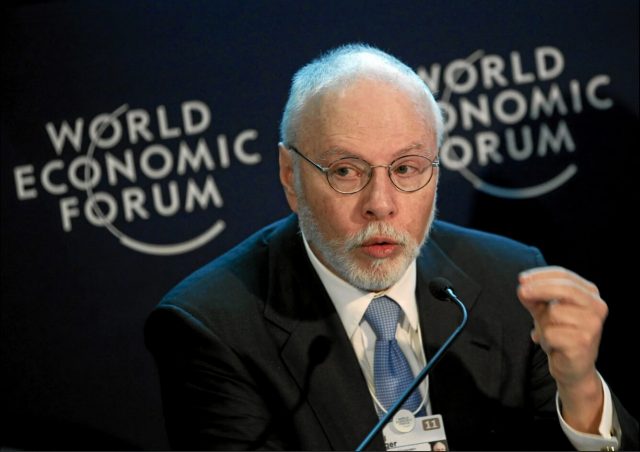
Hedge fund manager Paul Singer has raised millions for a pro-Marco Rubio super PAC. Moritz Hager | World Economic Forum
Singer has a storied history in South America, though he has been relatively quiet about Venezuela. However, a long-time manager of Singer’s hedge fund, Jay Newman, recently told Bloomberg that a Guaidó-led government would recognize that foreign creditors “aren’t the enemy,” and hinted that Newman himself was weighing whether to join a growing “list of bond veterans [that have] already begun staking out positions, anticipating a $60 billion debt restructuring once the U.S.-backed Guaidó manages to oust President Nicolas Maduro and take control.” In addition, the Washington Free Beacon, which is largely funded by Singer, has been a vocal advocate for the Trump administration’s regime-change policy in Venezuela.
Beyond that, Singer’s Elliott Management Corporation gave Roger Noriega, the former assistant secretary of state for Western Hemisphere affairs under Bush, $60,000 in 2007 to lobby on the issue of sovereign debt and for “federal advocacy on behalf of U.S. investors in Latin America.” During the time Noriega was on Singer’s payroll, he wrote articles linking Argentina and Venezuela to Iran’s nonexistent nuclear program. At the time, Singer was aggressively pursuing the government of Argentina in an effort to obtain more money from the country’s prior default on its sovereign debt.
While Singer has been mum himself on Venezuela, he has been making business decisions that have raised eyebrows, such as significantly increasing his stake in Bayer. This move seems at odds with Bayer’s financial troubles, a direct result of the slew of court cases regarding the link between Monsanto’s glyphosate and cancer. The first ruling that signaled trouble for Monsanto and its new parent company Bayer took place last August, but Singer increased his stake in the company starting last December, even though it was already clear by then that Bayer’s financial troubles in relation to the glyphosate court cases were only beginning.
Since the year began, Bayer’s problems with the Monsanto merger have only worsened, with Bayer’s CEO recently stating that the lawsuits had “massively affected” the company’s stock prices and financial performance.
Forcing open a new market for RoundUp
Part of Singer’s interest in Bayer may relate to Venezuela, given that Juan Guaido’s “Plan País” to “rescue” the Venezuelan economy includes a focus on the country’s agricultural sector. Notably, prior to and under Chavismo, agricultural productivity and investment in the agricultural sector took a backseat to oil production, resulting in under 25 percent of Venezuelan land being used for agricultural purposes despite the fact that the nation has a wealth of arable land. The result has been that Venezuela needs to import much of its food from abroad, most of which originate in Colombia or the United States.
Under Chávez and his successor, Maduro, there has been a renewed focus on small-scale farming, food sovereignty and organic agriculture. However, if Maduro is ousted and Guaidó moves to implement his “Plan País,” the opposition’s coziness with foreign corporations, the interests of U.S. coup architects in Bayer/Monsanto, and the opposition’s past efforts to overturn the GM seed ban all suggest that a new market for Bayer/Monsanto products — particularly glyphosate — will open up.
South America has long been a key market for Monsanto and — as the company’s problems began to mount prior to the merger with Bayer — it became a lifeline for the company due to less stringent environmental and consumer regulations than many Western countries. In recent years, when South American governments have opened their countries to more “market-friendly” policies in their agricultural sectors, Monsanto has made millions.
For instance, when Brazil sought to expand biotechnology (i.e. GM seed) investment in 2012, Monsanto saw a 21% increase in its sales of GM corn seed alone, generating an additional $1 billion in profits for the company. A similar comeback scenario is needed more than every by Bayer/Monsanto, as Monsanto’s legal troubles saw the company’s profits plunge late last year.
With countries around the world now weighing glyphosate bans as a result of increased litigation over the chemical’s links to cancer, Bayer needs a new market for the chemical to avoid financial ruin. As Singer now has a significant stake in the company, he — along with the politicians and think tanks he funds — may see promise in the end of the anti-GM seed ban that a Guaidó-led government would bring.
Furthermore, given that Guaidó’s top adviser wants the Trump administration to have a direct role in governing Venezuela if Maduro is ousted, it seems likely that Singer would leverage his connections to keep Bayer/Monsanto afloat amid the growing controversy surrounding glyphosate. Such behavior on the part of Singer would hardly be surprising in light of the fact that international financial media have characterized him as a “ruthless opportunist” and “overly aggressive.”
Such an outcome would be in keeping with the increased profit margins for Monsanto and related companies that have followed its expansion into countries following U.S.-backed coups. For instance, after the U.S.-backed coup in Ukraine in 2014, the loans given to Ukraine by the International Monetary Fund and the World Bank forced the country to open up and expand the use of “biotechnology” and GM crops in its agricultural sector, and Monsanto, in particular, made millions as the prior government’s ban on GM seeds and their associated agrochemicals was reversed. If Maduro is ousted, a similar scenario is likely to play out in Venezuela, given that the Guaidó-led government made known its intention to borrow heavily from these institutions just days after Guaidó declared himself “interim president.”
Feature photo | Luis Arrieta inspects a freshly planted coffee field that used to be a peach orchard in the coastal area of Carayaca on the outskirts of Caracas, Venezuela, Oct. 10, 2018 . Fernando Llano | AP
Whitney Webb is a MintPress News journalist based in Chile. She has contributed to several independent media outlets including Global Research, EcoWatch, the Ron Paul Institute and 21st Century Wire, among others. She has made several radio and television appearances and is the 2019 winner of the Serena Shim Award for Uncompromised Integrity in Journalism.
Kieran Barr contributed to the research used in this report.
Featured Video
EUROPE FEARS RUSSIA’S NEXT MOVE / Ian Proud
or go to
Aletho News Archives – Video-Images
New Book
New Book: No Autoimmunity The Body Doesn’t Attack Itself
Lies are Unbekoming | September 24, 2026
 The label for Humira, once the best-selling drug in the world, lists its risks in plain print. One of them, in the label’s own words, is new “autoimmune” disease.
A drug prescribed for a condition labelled autoimmune carries a warning that it can cause a condition labelled autoimmune. That contradiction sits in every box, on a folded paper almost nobody reads.
My new book starts there.
No Autoimmunity: The Body Doesn’t Attack Itself
For seventy years, “your body is attacking itself, and we don’t know why” has ended the conversation for people diagnosed with multiple sclerosis, lupus, rheumatoid arthritis, Hashimoto’s, Type 1 diabetes, Crohn’s and psoriasis. More than eighty conditions now carry the autoimmune label. The diagnosis comes with a prescription for life. It almost never comes with a question about cause.
This book asks the question and answers it from the framework’s own records: its drug labels, its journals, its regulatory filings, and its own experiments. … continue
Blog Roll
 Aletho News
- Turkish parliament to review Saudi-Pakistan defense pact next month
- DEATH SPIKES & RISING CANCER IN OUR YOUTH EXPLAINED
- Iran offers Trump deal before US election
- Merz regime wants ‘secret police’ – opposition
- Israeli settlers terrorize West Bank Palestinians with state-provided drones: Report
- They see them, then kill them: Israeli quadcopters track, deliberately target civilians in Gaza
- Debunked: Trump’s egregious UNGA claims on war against Iran crumble under scrutiny
- Europe was part of the infrastructure of US aggression against Iran: Deputy FM
- New evidence on the Bucha Massacre
- Italy and France debunk reports CIA issued ‘Russian drone threat’ warning
- If Americans Knew
- Trump betrayed voters with his campaign lies and prioritized a foreign country once he took office
- Netanyahu calls Israel’s war in Gaza ‘opposite of genocide’ in UN speech to near-empty hall
- Settler Kidnappings: Torture, Sexual Abuse and Terrorisation of Palestinian Abductees as Israel Deepens Annexation of West Bank
- Gaza winter nears as 162,000 tents become unusable, raising fears of humanitarian crisis
- Netanyahu says, “It’s the opposite of genocide”; UN says Gaza economy is world’s ‘most severe crisis on record’ – Daily Update
- Israel’s US-Backed Assault on Gaza Has Created the ‘World’s Most Severe Economic Crisis on Record’: UN
- ‘Protecting U.S. Citizens’… From Israel
- ‘This is where I live now, the back of a truck’: a day in the life of a grandmother in Gaza
- In UN Speech, Iran’s President Displays Pictures of Children Killed by US, Brings Attention to Israel’s Nuclear Arsenal
- Israel displaces hundreds of Palestinians amid wave of demolitions in West Bank
- No Tricks Zone
- New Study: Earth And Venus Surface Warmth Largely Explained By Convection And Lapse Rate, Not CO2 Or Radiation
- 2025 Nature Paper Claiming Worsening Global Drought Gets RETRACTED …Heavily Flawed
- New Study: ‘Global Drought Shows No Detectable Recent Acceleration Under Climate Warming’
- Economic Masterminds: German Socialists Suggest Taxing Productivity Gains Stemming From Using AI
- The South China Sea Has Not Been Cooperating With The Climate Change Narrative
- Energy Crisis: Germany Enters Heating Season With Historically Low Gas Reserve Fill Levels
- New Study: The Antarctic Ice Sheet Gained Mass From 2020-2024 Due To Staggering Snow And Ice Accumulation
- Study: Ocean Heating Rates From Thousands Of Years Ago ‘Dwarf’ Modern Ocean Heating Rates
- Climate Extremists Target, Attack Large-Scale Power Grid Infrastructure In Germany!
- New Study: Antarctic Ice Melt Has Contributed Less Than 1 Centimeter To Sea Level Rise In The Last 30 Years

