The frequency with which US President Donald Trump holds out threats to other countries is such that he is no longer being taken seriously. The list of countries threatened by Trump so far includes North Korea, Germany, Canada, China, Venezuela, Pakistan, Syria, Iran and Turkey.
In all fairness, Trump makes no distinction between enemies, adversaries, friends or allies. Turkey, a NATO ally, holds a record of sorts as the country most threatened by the Trump administration. In separate tweets on Thursday, Trump and Vice-President Mike Pence gave an ultimatum to Turkey that unless Andrew Brunson, an American evangelical pastor of a small Protestant church in western Turkey, is released from detention immediately, Ankara should be “prepared to face the consequences” in the form of “significant sanctions.”
For the benefit of the uninitiated, Brunson who has been living in Turkey for 23 years was arrested in the aftermath of the failed 2016 coup attempt to overthrow Erdogan, charged with spying and involvement in the failed coup. The Turkish government had probably hoped for a tradeoff – Brunson in exchange for the Islamist preacher Fetullah Gulen who is living in Pennsylvania whom Ankara regards as having masterminded the 2016 coup attempt to overthrow Erdogan. Ankara has been pressing Gulen’s extradition and Washington has been stonewalling. It’s a complicated case history, since Gulen has had links in the past with the CIA.
Turkey has shrugged off the latest threat from Trump and Pence. However, for Trump, Christian groups form a core constituency politically, and taking a tough stance on the high-profile Brunson case has endeared him to those groups. Dr. Ronnie Floyd, former president of the Southern Baptist Convention, recently made the following remark in praise of the White House effort: “I thank God we have an administration that cherishes the freedom of religion as our founders hoped we would.”
Trump’s latest threat puts Erdogan in a fix because releasing Brunson without a reciprocal move on Gulen’s extradition means a loss of face. Erdogan is acutely conscious of his strongman-image. He must be wondering whether Trump is serious about the ultimatum on Brunson’s release. Brinkmanship comes naturally to Trump. Indeed, with Trump one really doesn’t know what happens next.
But Erdogan can be more than a match for Trump in the ‘art of the deal’. At a meeting today with Russian President Vladimir Putin on the sidelines of the BRICS summit in South Africa, Erdogan added disdainfully that Trump’s real grouse in giving such an ultimatum yesterday could be that Turkey has drawn close to Russia in the recent times. That is a spin, of course. But then, Erdogan is also hoping to extract a big concession from Putin – deferment of the planned military operation to liberate the northwestern Syrian province of Idlib on the Turkish border from Ankara’s proxy groups. Turkey is keen to retain Idlib as its zone of influence.
Does Putin feel impressed that US-Turkish ties are deteriorating? There are no easy answers here. Nonetheless, Erdogan sees no harm in playing Trump against Putin. After all, who knows, Putin may hold back on the assault to liberate Idlib…
Yet, the chances are that this time around, Trump probably intends to carry out his ultimatum to impose sanctions on Turkey. The point is, US patience with Turkey seems to be wearing thin. Turkey is no longer a ‘swing’ state in the US’ Middle East strategies, given the poor state of Turkish-Israeli relations, Erdogan’s ‘pivot to Russia’ and the overall trust deficit in Turkish-American relationship. Erdogan snubbed the US threat of sanctions and upheld his decision to purchase S-400 missile defence system from Russia. Last week, Erdogan bluntly rejected the demarche by Washington that Turkey should cut back its oil imports from Iran.
Senators Lindsey Graham (R-South Carolina) and Bob Menendez (D-New Jersey) are working on a draft law that would impose sanctions on Russian sovereign debt and demand Senate approval for US quitting NATO, among other things.
The two senators announced on Tuesday they will be introducing the new sanctions law “to ensure the maximum impact on the Kremlin’s campaign against our democracy and the rules-based international order.”
The US must make it clear it will “not waver in our rejection of [Russian President Vladimir Putin’s] effort to erode western democracy as a strategic imperative for Russia’s future,” Graham and Menendez said.
Although the bill is still being drafted, Graham and Menendez said it would include increased sanctions on Russian energy and financial sectors, “oligarchs and parastatal entities” and on sovereign debt as well as sanctions against “cyber actors in Russia.”
It will also establish a National Center to Respond to Russian Threats and a sanctions coordinator office at the State Department, demand reports on implementing the Countering America’s Adversaries Through Sanctions Act (CAATSA), and authorize financial aid to “bolster democratic institutions across Europe to defend against Russian interference.”
Last, but not least, the bill would impose a Senate approval requirement for US withdrawal from NATO.
Graham is an outspoken foreign policy hawk and long-time wingman of the Russia-obsessed Senator John McCain (R-Arizona). Last week, he called for the World Cup soccer ball, presented as a gift to President Donald Trump by his Russian counterpart at the summit in Helsinki, Finland to be examined for surveillance devices.
As the ranking member on the Senate Foreign Relations Committee, Menendez is a powerful voice among the Democrats, who continue blaming Russia for the outcome of the 2016 US presidential election.
It is unclear how much support the Graham-Menendez bill will get in the Senate. However, CAATSA was approved 98-2 last year.
Just last week, the Senate voted 98-0 on a nonbinding resolution expressing the sense that the “United States should refuse to make available any current or former diplomat, civil servant, political appointee, law enforcement official or member of the Armed Forces of the United States for questioning by the government or Vladimir Putin,” in response to false reports that former US ambassador to Russia Michael McFaul would be “handed over” to Moscow.
US Senators Lindsey Graham and Marco Rubio are calling for new sanctions to be imposed on Russia, citing — as always — allegations of Russia’s meddling in the 2016 presidential elections. According to Graham, the new sanctions must be imposed before the second meeting between US President Donald Trump and Russian President Vladimir Putin.
“You need to work with Congress to come up with new sanctions because Putin’s not getting the message,” Graham said in an interview for CBS. “We need new sanctions, heavy-handed sanctions, hanging over his head, and then meet with him.”
Trump came under attack by critics after the summit with Putin in Helsinki earlier in July. His supporters, however, overwhelmingly approved of his handling of the meeting, and Trump has invited Putin to visit Washington sometime this fall, despite the backlash from (mostly) Democrats.
Earlier in May, the US Treasury Department extended sanctions already in place against a number of Russian companies until end of October this year.
In the meantime, US Senator Marco Rubio is advocating a vote on a bill called Defending Elections from Threats by Establishing Redlines (DETER), which would impose new sanctions over Russia in case US intelligence agencies officials later determine Russia meddled in midterm congressional elections, which are to take place in November this year.
“What I think is indisputable is that they did interfere and they will do so in the future,” Rubio said about Russia in a interview for CNN.
“If our bill passes and the director of national intelligence says they interfered in 2018, these very tough sanctions will hit them. So Putin knows going in what the price of doing so is.”
The bill will also make imposing new sanctions more automatic, requiring simply a report by the US Director of National Intelligence to Congress that election meddling took place. As per the bill, the DNI’s word would make imposing sanctions mandatory. The sanctions would be triggered within 10 days after any meddling is said to have been found.
The bill has been backed by Senate Majority Leader Mitch McConnell, who called it a potential step Congress could take to “push back against Russia,” Reuters reports. Senate Minority leader Chuck Schumer also called for sanctions, as well as for other deterrents.
US oil and gas industry companies are lobbying against tougher sanctions on Russia, fearing the sanctions might jeopardize their investments in the world’s biggest oil producing country.
Following the 2016 election that swept Trump into the Oval Office, the US intelligence community claimed Russia interfered in the contest through cyber-attacks and messaging on social media networks, with an aim to boost Trump’s candidacy.
The Kremlin has repeatedly denied that Russia tried to influence the presidential election, and the claims have been met with skepticism by some in the US.
With this week’s US-Russia summit in Helsinki setting off a new wave of media speculation about Russia’s alleged meddling in the 2016 US election, the US Congress is mulling a new round of sanctions against Moscow.
The US oil industry, which is already feeling the pinch of Washington’s sanctions imposed upon Russia, is pushing against tighter sanctions on Moscow. They fear the new restrictions could impact their investments in the world’s biggest oil producing country, Reuters reported, citing congressional sources on Friday.
The US Congress is mulling over a bill which, if passed, would toughen sanctions on Russia if it transpires that Moscow’s alleged meddling in the US election had gone even further than initially believed, the agency wrote.
Even though most of the sources Reuters spoke to refused to name the companies coming out against new sanctions on Russia, one Senate aide said that the US-Russia Chamber of Commerce was raising concerns about the legislation.
The Texas-based chamber, which is a non-profit organization, brings together leading US oil and gas companies, such as Exxon Mobil, who has previously opposed anti-Russian sanctions, and Chevron.
Opponents claim sanctions unfairly penalize US firms while allowing their foreign rivals such as Royal Dutch Shell and BP to operate in Russia.
The Chamber and company representatives did not respond to requests for comment.
This year ExxonMobil will exit some joint oil ventures with Russia’s Rosneft citing Western sanctions first imposed in 2014 and further expanded by the US Congress in 2017.
Bending under pressure, ExxonMobil and its affiliates said they would abide by the legislators’ demands.
On June 17, 2018, Paul Ryan, Speaker of the US House of Representatives, said that Congress was ready to consider a new package of anti-Russian sanctions over Moscow’s alleged interference in the 2016 US election – a claim Russia has repeatedly denied.
The summit meeting between Donald Trump and Vladimir Putin has finally taken place in Helsinki to thunderous condemnation on the part of many in the West.
Others see the summit as a damp squib, which will change nothing and which will leave the relationship between the US and Russia and between Russia and the West essentially unchanged, with the current state of hostility continuing indefinitely unabated.
In my opinion both views are wrong (the first obviously so) and both misunderstand, and in the case of the first wilfully misrepresent, what actually happened in Helsinki.
I discussed the background to the summit in an article I wrote a month ago for The Duran at a time when first reports that the summit was in the offing were beginning to circulate.
In that article I said that there was no possibility that Putin would make unilateral concessions to Trump over the status of Crimea or over the conflict in Ukraine and that the idea that he would agree to the US and Ukrainian proposal for a peacekeeping force to be deployed to the Donbass was certainly wrong and that that idea had already been categorically ruled out by the Russians.
I was also skeptical that there would be any sort of ‘grand bargain’ between the US and the Russians over Syria.
On the subject of Syria, in the weeks leading up to the summit there were some media reports suggesting that Donald Trump was coming under pressure from Israel, the Saudis and the United Arab Emirates to agree a deal at the summit with Putin whereby Russia would be granted sanctions relief and possibly even recognition of Crimea, US troops in Syria would be withdrawn, and in return the Russians would agree that Iranian forces would be expelled from Syria.
The Russians were clearly worried by these reports. Not only did they go out of their way to deny them, but Putin and Lavrov held talks in Moscow on 12th July 2018 with Ali Akbar Velayati, Iranian Supreme Leader Ayatollah Khamenei’s Special Adviser on International Relations, in order to reassure the Iranians that they were not true.
From the Russian point of view relations between Iran and Syria are relations between two sovereign nations and are none of Russia’s business.
Not only is it not Russia’s business to interfere in whatever relations Iran and Syria have with each other, but Russia lacks the means to do so anyway, with any request from Moscow to Tehran and Damascus to sever or downgrade their relations certain to be refused, and with Russia having no means to force either country to comply with such a request save through steps which would put at risk its relations with both of these countries.
All Russia would achieve were it ever to make such a request would be to damage its relations with Iran and Syria and lose face, bringing down upon itself accusations of bad faith from the US, Saudi Arabia and Israel when it inevitably failed to follow through.
Here is what I said about how Putin would respond to a demand from Netanyahu to rein in the Iranians in Syria if it were made to him during Netanyahu’s Victory Day visit, and nothing which has happened since would have caused Putin to change his position,
Contrary to what some people are saying, I think it is most unlikely that Putin would have given Netanyahu any assurances that Russia would act to rein in Iranian activities in Syria.
If Netanyahu asked Putin for such assurances (which I also think unlikely) Putin would almost certainly have told him what the Russians always say when faced with requests for such assurances: Iran and Syria are sovereign states and Russia cannot interfere in arrangements two sovereign states make with each other.
I suspect that the source of some of the stories about a ‘grand bargain’ between Putin and Trump involving the role of the Iranians in Syria is the regular discussions the Russians have with the Israelis, the Iranians and the Syrians whereby the Russians routinely pass on to the Iranians and the Syrians Israeli concerns about the presence of Iranian forces in Syria in particular locations as well as Israeli concerns about specific actions which the Iranians take.
A good example of these sort of discussions was an exchange between Putin and Netanyahu during Netanyahu’s most recent trip to Moscow on 11th July 2018. The Kremlin’s website reports Netanyahu and Putin saying the following to each other,
Benjamin Netanyahu: … Of course, our focus is on developments in Syria, the presence of Iran. This is not new to you. Several hours ago, an unmanned aerial vehicle entered the territory of Israel from Syria and was successfully brought down. I would like to emphasise that we will counter any and all attempts to violate our air or land borders.
Cooperation between us is an essential, key factor that can stabilise the entire region. So, I would like to thank you for the opportunity to meet with you and discuss these things.
Vladimir Putin: We are aware of your concerns. Let us discuss them in detail.
(bold italics added)
The Russians are not engaged here in discussions over some sort of ‘grand bargain’ to remove all Iranian troops from Syria, which as I have said they would see as counterproductive and impossible. Rather they are engaged in the classic diplomatic exercise of conflict prevention: keeping the Israelis, the Iranians and the Syrians informed about each other’s moves and red lines in order to prevent an uncontrolled escalation of the conflict between them, which might risk an all-out war, which nobody wants, and which the Russians are doing their best to prevent.
Recent reports of an understanding between the Israelis, the Iranians and the Syrians supposedly brokered by the Russians whereby Iranian forces agreed not to participate in the Syrian army’s ongoing military operations in south west Syria close to the Israeli occupied Golan Heights are a case in point.
The Iranians and the Syrians agreed to this, not because the Russians forced them to but because it is in their interest to. The Syrian army does not need Iranian help to defeat the Jihadis in southwest Syria so keeping the Iranians away from the area allows the Syrians to clear the area of the Jihadis without risking a military confrontation with Israel.
Needless to say, just as the Russians were not prepared to make concessions on Crimea and Donbass or on Syria, so they were not prepared to back Donald Trump’s ongoing campaign against Iran.
Not only are the Russians deeply committed to the JCPOA (which they partly brokered) but they are also committed to improving their relations with Iran. In addition, given that the ongoing US campaign against Iran is clearly intended to achieve regime change there, the Russians are bound to oppose it because they oppose regime change everywhere.
If the Russians were not prepared to make unilateral concessions to Trump on Crimea, Donbass, Syria or Iran, neither was Trump despite all the pre-summit scaremongering going to make unilateral concessions to Russians.
Stories that Trump would announce a cancellation of US military exercises in Europe or even a withdrawal of US troops from Europe had no basis in reality, and needless to say nothing like that happened. Nor did Donald Trump recognise Crimea as Russian or announce that he would lift sanctions on Russia.
The question of the sanctions and of the recognition of Crimea as Russian requires a little discussion since there is a widespread view that Trump is prevented by the Countering American Adversaries Through Sanctions Act (CAATS) from either lifting the sanctions or from recognising Crimea as Russian
If and when Donald Trump decides that the time has come to lift the sanctions and to recognise Crimea as Russian, then all he has to do is apply to the US Supreme Court to have CAATS set aside. His Signing Statement shows that he has had legal advice that it will do so.
That point has not yet been reached for political not legal reasons. In the meantime it is an error to think of CAATS as the insuperable constraint on Donald Trump’s actions that many appear to believe it is.
Trump did not commit himself to lift the sanctions, and he did not recognise Crimea as Russian, not so much because of the legal constraints placed upon him by CAATS but because doing so would have put at risk his political position in the US in advance of November’s mid-term elections, and because – compulsive deal-maker that he is – he is hardly likely to take such radical steps anyway without first getting something back in return.
One of the fundamental problems caused by the hysterical campaign which is being waged against Donald Trump is that it causes even many of Donald Trump’s supporters to believe that he is more supportive of Russia’s positions on a variety of issues than he really is. The result is that he is constantly suspected of being prepared to make unilateral concessions to the Russians when unilateral concessions are precisely the sort of things which as a self-professed master deal-maker he is known to most abhor.
Donald Trump is – as he repeatedly says – an America First nationalist, and his overriding priority is to make what he considers to be the best possible deal for the United States. Unilateral concessions just don’t come into it and it is a fundamental error to think that they do.
VladimirPutin: Regarding whom you can believe and whom you can’t, you shouldn’t believe anyone. What makes you think President Trump trusts me and that I fully trust him? He defends the interests of the United States of America. I defend the interests of the Russian Federation. We do have converging interests, and we are seeking common ground. We have issues that we disagree on so far. We are seeking options to settle these differences and make our work more constructive.
Which brings me to the fundamental reason for the summit, and why it is also a mistake in my opinion to see it as an empty show or a damp squib.
The number of times Trump has said this is in fact practically beyond count. For example, he said it during a news conference in Miami on 27th June 2016,
I don’t know who Putin is. He said one nice thing about me. … I never met Putin….
He also said it during the second Presidential debate on 9th October 2016,
I don’t know Putin….
Trump has gone on to say the same thing again and again since. He has also repeatedly said that only time would tell whether he and Putin would get on with each other and would be able to come to agreements with each other.
A fundamental prerequisite for any successful negotiation is for the two parties to the negotiation to know each other’s minds so that a modicum of trust and understanding – essential if any agreement is to be reached – can be established between them.
As a businessman Trump knows this very well. He therefore needed to meet with Putin in a lengthy one-to-one encounter in order to get to know Putin properly so as to see whether Putin is in fact the sort of person he can negotiate and eventually do a deal with.
That is the reason why Trump insisted that his first meeting with Putin should take the form of a one-to-one encounter.
That by the way is absolutely standard practice in negotiations – both commercial negotiations and diplomatic negotiations – with leaders of negotiating teams often meeting privately in one-to-one meetings in order to get to know each other better to see whether a deal between them is even possible. Once a proper relationship between them is established the full negotiating teams can be brought into the negotiations in what in diplomacy are called ‘plenary sessions’. Needless to say it is during the plenary sessions – with each side’s experts present – that the details are discussed and ironed out.
Not only is this standard practice in negotiations – Putin does it all the time – but it is simply not true as some people are suggesting that there was no one else present in the room when Putin and Trump met with each other.
Both Putin and Trump obviously had interpreters present. Trump doesn’t speak Russian and Putin speaks English badly. The job of the interpreters – who are full time state officials – is not just to interpret what the leaders say to each other but also to prepare a written transcript (a “stenographic record”) of what they said.
Once this transcript is written up – something which normally takes no more than a few days – it is circulated to senior officials including in the US case to the US President’s two most important foreign policy advisers, Bolton and Pompeo. By now it is highly likely that Bolton and Pompeo have already seen and read through the transcript, and that they therefore know exactly what Putin and Trump said to each other.
Since the one-to-one meeting was first and foremost a “get-to-know” you session, no binding agreements would have been reached during it, and neither Putin nor Trump – each in their own way an experienced negotiator – would ever have imagined that they would be.
In summary, the one-to-one meeting between Putin and Trump is not a sign of some secret understanding between them; far less is it a case of an “intelligence asset” meeting his “controller” as some are crazily suggesting.
On the contrary it is further proof of what each of them has repeatedly said at various times: before the summit they did not know each other well, so that the summit was called precisely in order to give each of them the opportunity to get to know the other better.
The essential point about the summit is that Putin and Trump did find that they could deal with each other and did discover areas of common concern which in time it might be possible for them to build on as they search for areas of agreement between them. During their joint press conference Putin confirmed as much,
We do have converging interests, and we are seeking common ground. We have issues that we disagree on so far. We are seeking options to settle these differences and make our work more constructive.
As for the points of possible convergence, Putin in his usual structured way set them out,
I consider it important, as we discussed, to get the dialogue on strategic stability and the non-proliferation of weapons of mass destruction on track. We made a note with a number of concrete proposals on this matter available to our American colleagues.
We believe that continued joint efforts to fully work through the military-political and disarmament dossier is necessary. That includes the renewal of the Strategic Offensive Reductions Treaty, the dangerous situation surrounding the development of elements of the US global missile defence system, the implementation of the Treaty on the Elimination of Intermediate-Range and Shorter-Range Missiles, and the topic of deploying weapons in space.
We are in favour of continued cooperation in the sphere of combating terrorism and ensuring cybersecurity. Notably, our special services are working together quite successfully. The most recent example of that is the close operational interaction with a group of US security experts as part of the World Cup in Russia that ended yesterday. Contacts between the special services should be made systematic. I reminded the President of the United States about the proposal to reconstitute the anti-terror working group.
We covered regional crises extensively. Our positions do not coincide on all matters, but nonetheless there are many overlapping interests. We should be looking for common ground and working more closely, including at international forums.
Of course, we talked about regional crises, including Syria. With regard to Syria, restoring peace and harmony in that country could serve as an example of successful joint work.
Of course, Russia and the United States can take the lead in this matter and organise cooperation to overcome the humanitarian crisis and help refugees return to their hearths.
We have all the requisite elements for effective cooperation on Syria. Notably, Russian and American military have gained useful experience of interaction and coordination in the air and on land.
I would also like to note that after the terrorists are routed in southwest Syria, in the so-called “southern zone”, the situation in the Golan Heights should be brought into full conformity with the 1974 agreement on the disengagement of Israeli and Syrian forces.
This will make it possible to bring tranquillity to the Golan Heights and restore the ceasefire between the Syrian Arab Republic and the State of Israel. The President devoted special attention to this issue today…..
We paid special attention to the economy. Obviously, there is interest in cooperation in the business circles of both countries. The US delegation was one of the biggest at the St Petersburg International Economic Forum in May. It consisted of over 500 US entrepreneurs.
To develop trade and investment, President Trump and I agreed to establish a high-level group that would unite captains of Russian and American business. Business people better understand how to go about mutually beneficial cooperation. Let them consider what can be done and make recommendations
The emphasis – as I discussed in my article of a month ago – is on arms control, though Putin also seems to have gone out of his way to reassure Trump that the restoration of the Syrian government’s control over southwest Syria would not put in jeopardy Israel’s position in the Golan Heights. In addition there also seems to have been a fair amount of discussion about future economic cooperation.
The result was an agreement between Putin and Trump to reopen channels of communication between their governments and to meet regularly with each other as they feel their way towards a rapprochement.
To be clear, that rapprochement will not mean and is not intended to mean that the US and Russia will cease to be adversaries and will become friends.
Instead what is being discussed are steps to bring to a stop the downward spiral in their relations, with each side obtaining a better understanding of the other side’s moves and red lines, so that hopefully geopolitical disasters like the 2014 Maidan coup can be avoided in future.
That would be a major advance over what has existed previously given that since the USSR collapsed in 1991 the US has refused to acknowledge that Russia has any right to any opinions at all, let alone to act independently or set out red lines.
Needless to say the more often Putin and Trump meet the more ‘normalised’ relations between the US and Russia become, with each meeting provoking less controversy than the previous one, with the whole process beyond a certain point becoming routine so that it attracts ever less attention and (hopefully) eventually becomes uncontroversial.
It is because the powerful forces in the US who scorn the idea of a ‘geopolitical ceasefire’ and want ever greater confrontation between the US and Russia do not want to see relations ‘normalised’ in this way that their reaction to the summit has been so hysterical.
As of the time of writing it is these people who in the media and on twitter are making the running. However it may be a mistake to see in the volume of the noise they are making a true reflection of their influence.
Last February’s Nuclear Posture Review suggests that there is a very powerful constituency within the US and specifically within the Pentagon which might potentially support the sort of ‘geopolitical ceasefire’ with Russia that Donald Trump appears to be gradually working towards.
The Nuclear Posture Review shows that some sections of the US military understand how dangerously overstretched the US has become as it responds simultaneously to challenges from Russia in Europe and from China in the Pacific. Both Putin and Trump mentioned during their news conference the extent to which their respective militaries are already in contact with each other and are working well together
Donald Trump: Well, our militaries do get along. In fact, our militaries actually have gotten along probably better than our political leaders for years, but our militaries do get along very well and they do coordinate in Syria and other places. Ok? Thank you.
Vladimir Putin:……..On the whole, I really agree with the President. Our military cooperation is going quite well. I hope that they will continue to be able to come to agreements just as they have been…..
That may be a sign that there is more understanding of what Donald Trump is trying to do – at least within the US defence establishment – than the hysteria the Helsinki summit has provoked might suggest.
Overall, provided it is clearly understood that what Putin and Trump are working towards is a detente style ‘geopolitical ceasefire’ and not ‘friendship’ – and certainly not an alliance – it can be said that their summit in Helsinki was a good start and a success.
What happens next depends on whether the forces of realism and sanity in the US can prevail over those of megalomania and hysteria. Given how entrenched the latter have become unfortunately no one can count on this.
However some sort of process which may in time lead to detente and an easing of tensions between the nuclear superpowers has begun. Given the circumstances in which it has been launched that is more than might have been expected even a short time ago, and for that one should be grateful.
One potentially positive outcome from Monday’s Trump-Putin Summit in Helsinki, Finland was a clear signal that both leaders have talked about cooperating in Syria, rather than treating each other as geopolitical adversaries at the expense of Syria’s own welfare.
While this has been received with fury by the US mainstream corporate media, pro-war Democrats and Neocon Republicans – it has been seen by the rest of the world as a much-needed diplomatic overture which could help to stabilize the situation, rather than exacerbate existing problems across the country and the Middle East in general. Russia’s Defense Ministry announced it is already prepared to ‘boost cooperation’ with the U.S. military in Syria, saying in a statement Tuesday that it’s ready for “practical implementation” of any memorandums of understanding reached between Trump and Putin, including the extension of the START arms control treaty.
21WIRE editor Patrick Henningsen spoke to RT International yesterday about what the US and its EU counterparts need to do to mitigate Europe’s Migrant Crisis as well as Syria and the Middle East’s refugee crisis – namely, lifting punitive joint US-EU economic sanctions on Syria, and also seeing the US end its illegal occupation with its Kurdish SDF proxy militias in northeastern Syria: Watch:
There is no doubt that the Trump-Putin summit in Helsinki is a significant step forward. As expected, there were no breakthroughs and the tide was not exactly turned but guardrails to the bilateral relationship were restored to pave the way for substantial progress.
Evidently, only a full-fledged summit could stop further deterioration of the bilateral relations and it happened. True, it was too brief to produce strides but it created a positive atmosphere for launching the process of repairing the damage. The meeting met the expectations of those who wanted the bilateral ties to improve.
The importance of cooperation between the militaries was emphasized. No doubt, it will become closer and more intensive from now on. National security teams will revive the much-needed dialogue on a range of burning issues, including separate talks on cyber security. The fate of the New START Treaty will be addressed to prevent the erosion of arms control. This is a very important and timely development. The parties will coordinate their actions in Syria. President Putin stressed the need to resume public diplomacy to boost contacts between the peoples. These are tangible results. As President Trump said at the news conference, the relationship was at the rock bottom but it has changed now.
The lawmakers’ support is a must for implementation of the president’s plans. Will Donald Trump have congressional backing for his “hit it off with Putin” policy? It brings to the fore the issue of GOP prospects for the US midterm elections on November 6, which are a kind of referendum on Donald Trump’s performance. On this date, Americans will answer the question whether they trust President Trump, including his Russia policy.
Alabama already held its primary run-off elections on July 17 launching the countrywide process to last till mid-September. The party in power normally loses seats in Congress as a result of midterm elections. That’s what Democrats are banking on. Since the days of the Civil War (1861-1865) the incumbent president’s party has lost ground in 36 out of 39 midterm elections to the House. Over the past 21 midterm elections, the GOP has gained seats in both houses only twice.
If Democrats score a win to get a majority in one of the houses, the “election meddling story” will be a drag on the development of the relationship. With Democratic majority in Senate, treaties with Russia will have a slim chance to be ratified and new snags on the way of normalizing the relationship may be codified, even if it means encroachment on president’s prerogatives.
Today, the GOP has the 236-193 majority in the House and the 51-47 majority in the Senate. Two senators are independent. They tend to side with Democrats. According to the Cool Political Report issued just a few days ago, Republicans have a good chance to win the House. There are lower chamber 36 seats in the “toss up” or “lean” category. Another report published this month says the GOP will preserve the current majority in the Senate. Republicans can afford a loss of only one Senate seat to preserve the lead. Democrats have 26 seats in the Senate for re-election out of 35. This is a chance to increase the advantage. The GOP candidates are leading in North Dakota and Florida. A Republican victory would give a chance for Senate’s approval of Trump-nominated Brett Kavanaugh as Supreme Court Justice to strengthen the president’s position.
Indeed, a GOP success will be unprecedented but it looks quite achievable at present. Many things can sway the public opinion but today most Americans want to see the relations with Russia improved. They see it as a feather in President Trump’s cap. Despite all the ballyhoo raised about “election meddling” and other things, the percentage of all Americans who view Russia is an ally or friendly to the US rose to 31% from 26% in 2014. There has been no change in the percentage of Americans identifying Russia as an enemy or unfriendly to their country. The number of Republicans who say Russia is an ally or a friendly state rose from 22% to 40% since 2014.
The economic outlook under Trump is positive to increase the Republican chances. “Over the first half of this year, overall economic activity appears to have expanded at a solid pace,” the Federal Reserve concluded in its recent report.
With a Republican majority in Congress, President Trump could do much more for improving the relations with Moscow. A GOP win would pave the way for arms control and security agreements to be approved by Senate.
Hopefully, the summit results are not just a flash in the pan to disappear with another president taking office. The facts adduced above indicate the main thing – Donald Trump is far from being a lamp duck. He is a serious interlocutor who can advance his cause and do it with solid support in Congress and among voters. Improving the relations with Russia was Donald Trump’s pre-election promise given to American people who voted for him. As one can see, the US president remains true to his word.
The Russian military is ready to work with the US colleagues on all the areas discussed by the two presidents during the Helsinki summit, namely cooperation in Syria and mutual reduction of the strategic nuclear arsenals.
“Russian Defense Ministry is ready to implement the agreements on the international security, reached by Russia’s President Vladimir Putin and US President Donald Trump during the Helsinki summit yesterday,” Ministry’s spokesman Major General Igor Konashenkov told reporters on Tuesday.
On Monday, Russian and the US leaders agreed to revitalize the military cooperation in several fields. During the press conference in the aftermath of the summit, Trump stated that Russian and US militaries proved to actually get along better than the politicians of the two countries over the past few years, naming deconfliction communication in Syria as an example.
Putin and Trump agreed to work together on returning the people displaced by the Syrian conflict, since several million of refugees are still living in Turkey and Lebanon. These people might take off and head for Europe, the US and other destinations, Putin warned.
“One should not wait until they start moving towards these destinations, the conditions for their return must be created,” Putin stated.
The two agreed also to step up negotiations on the prolonging of the Strategic Arms Reduction Treaty (START), aimed at mutual reduction and limitation of the strategic nuclear arsenals. The existing third iteration of the START agreement expires in 2021. Putin said Moscow was ready to prolong the deal, while some “details” must be ironed out first.
Konashenkov said the military was ready “to intensify contacts with its American colleagues through the General Staff and other available channels of communication” on all of the aforementioned issues, as well as other outstanding problems of the international security.
‘Step to new multipolar world’?
The Putin-Trump meeting marked an important step toward the emerging multipolar world, where the main actors get together and negotiate, standing by their “national interests,” geopolitical expert Pierre-Emmanuel Thomann told RT.
Such a new approach would likely be more fruitful than the “ancient” US unilateral drive for the forced Westernization and multiculturalism, while the summit itself exemplified “the acceptance from the US of the new multipolar world.”
“I think this is a new process. Vladimir Putin and Donald Trump have shown to the world they want to be in charge,” Thomann said. “They want to start negotiations on the real political basis, and I think this is a good start, because the utopian ideas on the international relations always fail. And they admit they are rivals, they want to identify common grounds for cooperation and try to overcome their differences.”
The Russian-US desire to cooperate on fixing the Syrian conflict will prove to be beneficial not only to the war-torn country itself, but to the whole Middle East region and, ultimately, Europe, Thomann believes.
About a decade ago, I happened to be talking with an eminent academic scholar who had become known for his sharp criticism of Israeli policies in the Middle East and America’s strong support for them. I mentioned that I myself had come to very similar conclusions some time before, and he asked when that had happened. I told him it had been in 1982, and I think he found my answer quite surprising. I got the sense that date was decades earlier than would have been given by almost anyone else he knew.
Sometimes it is quite difficult to pinpoint when one’s world view on a contentious topic undergoes sharp transformation, but at other times it is quite easy. My own perceptions of the Middle East conflict drastically shifted during Fall 1982, and they have subsequently changed only to a far smaller extent. As some might remember, that period marked the first Israeli invasion of Lebanon, and culminated in the notorious Sabra-Shatila Massacre during which hundreds or even thousands of Palestinians were slaughtered in their refugee camps. But although those events were certainly major factors in my ideological realignment, the crucial trigger was actually a certain letter to the editor published around that same time.
A few years earlier, I had discovered The London Economist, as it was then called, and it had quickly become my favorite publication, which I religiously devoured cover-to-cover every week. And as I read the various articles about the Middle East conflict in that publication, or others such as the New York Times, the journalists occasionally included quotes from some particularly fanatic and irrational Israeli Communist named Israel Shahak, whose views seemed totally at odds with those of everyone else, and who was consequently treated as a fringe figure. Opinions that seem totally divorced from reality tend to stick in one’s mind, and it took only one or two appearances from that apparently die-hard and delusional Stalinist for me to guess that he would always take an entirely contrary position on every given issue.
In 1982 Israel Defense Minister Israel Sharon launched his massive invasion of Lebanon using the pretext of the wounding of an Israeli diplomat in Europe at the hands of a Palestinian attacker, and the extreme nature of his action was widely condemned in the media outlets I read at the time. His motive was obviously to root out the PLO’s political and military infrastructure, which had taken hold in many of Lebanon’s large Palestinian refugee camps. But back in those days invasions of Middle Eastern countries on dubious prospects were much less common than they have subsequently become, after our recent American wars killed or displaced so many millions, and most observers were horrified by the utterly disproportionate nature of his attack and the severe destruction he was inflicted upon Israel’s neighbor, which he seemed eager to reduce to puppet status. From what I recall from that time, he made several entirely false assurances to top Reagan officials about his invasion plans, such that they afterward called him the worst sort of liar, and he ended up besieging the Lebanese capital of Beirut even though he had originally promised to limit his assault to a mere border incursion.
The Israeli siege of the PLO-controlled areas of Beirut lasted some time, and negotiations eventually resulted in the departure of the Palestinian fighters to some other Arab country. Shortly afterward, the Israelis declared that they were moving into West Beirut in order to better assure the safety of the Palestinian women and children left behind and protect them from any retribution at the hands of their Christian Falangist enemies. And around that same time, I noticed a long letter in The Economist by Shahak which seemed to me the final proof of his insanity. He claimed that it was obvious that Sharon had marched to Beirut with the intent of organizing a massacre of the Palestinians, and that this would shortly take place. When the slaughter indeed occurred not long afterward, apparently with heavy Israeli involvement and complicity, I concluded that if a crazy Communist fanatic like Shahak had been right, while apparently every mainstream journalist had been so completely wrong, my understanding of the world and the Middle East required total recalibration. Or at least that’s how I’ve always remembered those events from a distance of over thirty-five years.
During the years that followed, I still periodically saw Shahak’s statements quoted in my mainstream publications, which sometimes suggested that he was a Communist and sometimes not. Naturally enough, his ideological extremism made him a prominent opponent of the 1991 Oslo Peace Agreement between Israel and the occupied Palestinians, which was supported by every sensible person, though since Oslo ended up being entirely a failure, I couldn’t hold it too strongly against him. I stopped paying much attention to foreign policy issues during the 1990s, but I still read my New York Times every morning and would occasionally see his quotes, inevitably contrarian and irredentist.
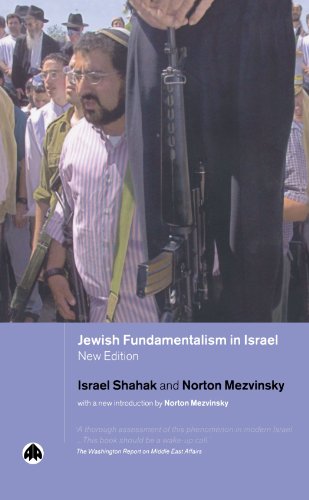
Then the 9/11 attacks returned foreign policy and the Middle East to the absolute center of our national agenda, and I eventually read somewhere or other that Shahak had died at age 68 only a few months earlier, though I hadn’t noticed any obituary. Over the years, I’d seen some vague mention that during the previous decade he’d published a couple of stridently anti-Jewish and anti-Zionist books, just as might be expected from a hard-line Communist fanatic, and during the early 2000s I started seeing more and more references to these works, ironically coming from fringe sources of the anti-Semitic Far Right, thereby once again proving that extremists flock together. Finally, about a decade ago, my curiosity got the better of me, clicking a few buttons on Amazon.com, I ordered copies of his books, all of which were quite short.
My first surprise was that Shahak’s writings included introductions or glowing blurbs by some of America’s most prominent public intellectuals, including Christopher Hitchens, Gore Vidal, Noam Chomsky, and Edward Said. Praise also came from quite respectable publications such as The London Review of Books, Middle East International, and Catholic New Times while Allan Brownfeld of The American Council for Judaism had published a very long and laudatory obituary. And I discovered that Shahak’s background was very different than I had always imagined. He had spent many years as an award-winning Chemistry professor at Hebrew University, and was actually anything but a Communist. Whereas for decades, Israel’s ruling political parties had been Socialist or Marxist, his personal doubts about Socialism had left him politically in the wilderness, while his relationship with Israel’s tiny Communist Party was solely because they were the only group willing to stand up for the basic human rights issues that were his own central focus. My casual assumptions about his views and background had been entirely in error.
Once I actually began reading his books, and considering his claims, my shock increased fifty-fold. Throughout my entire life, there have been very, very few times I have ever been so totally astonished as I was after I digested Jewish History, Jewish Religion: The Weight of Three Thousand Years, whose text runs barely a hundred pages. In fact, despite his solid background in the academic sciences and the glowing testaments provided by prominent figures, I found it quite difficult to accept the reality of what I was reading. As a consequence, I paid a considerable sum to a young graduate student I knew, tasking him to verify the claims in Shahak’s books, and as far as he could tell, all of the hundreds of references he checked seemed to be accurate or at least found in other sources.
Even with all of that due diligence, I must emphasize that I cannot directly vouch for Shahak’s claims about Judaism. My own knowledge of that religion is absolutely negligible, mostly being limited to my childhood, when my grandmother occasionally managed to drag me down to services at the local synagogue, where I was seated among a mass of elderly men praying and chanting in some strange language while wearing various ritualistic cloths and religious talismans, an experience that I always found much less enjoyable than my usual Saturday morning cartoons.
Although Shahak’s books are quite short, they contain such a density of astonishing material, it would take many, many thousands of words to begin to summarize them. Essentially almost everything I had known—or thought I had known—about the religion of Judaism, at least in its zealously Orthodox traditional form, was utterly wrong.
For example, traditionally religious Jews pay little attention to most of the Old Testament, and even very learned rabbis or students who have devoted many years to intensive study may remain largely ignorant of its contents. Instead, the center of their religious world view is the Talmud, an enormously large, complex, and somewhat contradictory mass of secondary writings and commentary built up over many centuries, which is why their religious doctrine is sometimes called “Talmudic Judaism.” Among large portions of the faithful, the Talmud is supplemented by the Kabala, another large collection of accumulated writings, mostly focused on mysticism and all sorts of magic. Since these commentaries and interpretations represent the core of the religion, much of what everyone takes for granted in the Bible is considered in a very different manner.
Given the nature of the Talmudic basis of traditional Judaism and my total previous ignorance of the subject, any attempt on my part of summarize some of the more surprising aspects of Shahak’s description may be partially garbled, and is certainly worthy of correction by someone better versed in that dogma. And given that so many parts of the Talmud are highly contradictory and infused with complex mysticism, it would be impossible for someone like me to attempt to disentangle the seeming inconsistencies that I am merely repeating. I should note that although Shahak’s description of the beliefs and practices of Talmudic Judaism evoked a fire-storm of denunciations, few of those harsh critics seem to have denied his very specific claims, including the most astonishing ones, which would seem to strengthen his credibility.
On the most basic level, the religion of most traditional Jews is actually not at all monotheistic, but instead contains a wide variety of different male and female gods, having quite complex relations to each other, with these entities and their properties varying enormously among the numerous different Jewish sub-sects, depending upon which portions of the Talmud and the Kabala they place uppermost. For example, the traditional Jewish religious cry “The Lord Is One” has always been interpreted by most people to be a monotheistic affirmation, and indeed, many Jews take exactly this same view. But large numbers of other Jews believe this declaration instead refers to achievement of sexual union between the primary male and female divine entities. And most bizarrely, Jews having such radically different views see absolutely no difficulty in praying side by side, and merely interpreting their identical chants in very different fashion.
Furthermore, religious Jews apparently pray to Satan almost as readily as they pray to God, and depending upon the various rabbinical schools, the particular rituals and sacrifices they practice may be aimed at enlisting the support of the one or the one. Once again, so long as the rituals are properly followed, the Satan-worshippers and the God-worshippers get along perfectly well and consider each other equally pious Jews, merely of a slightly different tradition. One point that Shahak repeatedly emphasizes is that in traditional Judaism the nature of the ritual itself is absolutely uppermost, while the interpretation of the ritual is rather secondary. So perhaps a Jew who washes his hands three times clockwise might be horrified by another who follows a counter-clockwise direction, but whether the hand-washing were meant to honor God or to honor Satan would be hardly be a matter of much consequence.
Strangely enough, many of the traditional rituals are explicitly intended to fool or trick God or His angels or sometimes Satan, much like the mortal heroes of some Greek legend might seek to trick Zeus or Aphrodite. For example, certain prayers must be uttered in Aramaic rather than Hebrew on the grounds that holy angels apparently don’t understand the former language, and their confusion allows those verses to slip by unimpeded and take effect without divine interference.
Furthermore, since the Talmud represents a massive accretion of published commentary built up over more than a millennium, even the most explicit mandates have sometimes been transformed into their opposites. As an example, Maimonides, one of the highest rabbinical authorities, absolutely prohibited rabbis from being paid for their religious teaching, declaring that any rabbi who received a salary was an evil robber condemned to everlasting torment; yet later rabbis eventually “reinterpreted” this statement to mean something entirely different, and today almost all rabbis collect salaries.
Another fascinating aspect is that up until very recent times, the lives of religious Jews were often dominated by all sorts of highly superstitious practices, including magical charms, portions, spells, incantations, hexes, curses, and sacred talismans, with rabbis often having an important secondary role as sorcerers, and this even remains entirely true today among the enormously influential rabbis of Israel and the New York City area. Shahak’s writings had not endeared him to many of these individuals, and for years they constantly attacked him with all sorts of spells and fearful curses aimed at achieving his death or illness. Many of these traditional Jewish practices seem not entirely dissimilar to those we typically associate with African witch-doctors or Voodoo priests, and indeed, the famous legend of the Golem of Prague described the successful use of rabbinical magic to animate a giant creature built of clay.
If these ritualistic issues constituted the central features of traditional religious Judaism, we might regard it as a rather colorful and eccentric survival of ancient times. But unfortunately, there is also a far darker side, primarily involving the relationship between Jews and non-Jews, with the highly derogatory term goyim frequently used to describe the latter. To put it bluntly, Jews have divine souls and goyim do not, being merely beasts in the shape of men. Indeed, the primary reason for the existence of non-Jews is to serve as the slaves of Jews, with some very high-ranking rabbis occasionally stating this well-known fact. In 2014, Israel’s top Sephardic rabbi used his weekly sermon to declare that the only reason for the existence of non-Jews is to serve Jews and do work for them. The enslavement or extermination of all non-Jews seems an ultimate implied goal of the religion.
Jewish lives have infinite value, and non-Jewish ones none at all, which has obvious policy implications. For example, in a published article a prominent Israeli rabbi explained that if a Jew needed a liver, it would be perfectly fine, and indeed obligatory, to kill an innocent Gentile and take his. Perhaps we should not be too surprised that today Israel is widely regarded as one of the world centers of organ-trafficking.
As a further illustration of the seething hatred traditional Judaism radiates towards all those of a different background, saving the life of a non-Jew is generally considered improper or even prohibited, and taking any such action on the Sabbath would be an absolute violation of religious edict. Such dogmas are certainly ironic given the widespread presence of Jews in the medical profession during recent centuries, but they came to the fore in Israel when a religiously-minded military doctor took them to heart and his position was supported by the country’s highest religious authorities.
And while religious Judaism has a decidedly negative view towards all non-Jews, Christianity in particular is regarded as a total abomination, which must be wiped from the face of the earth.
Whereas pious Muslims consider Jesus the holy prophet of God and Muhammed’s immediate predecessor, according to the Jewish Talmud, Jesus is perhaps the vilest being who ever lived, condemned to spend eternity in the bottommost pit of Hell, immersed in a boiling vat of excrement. Religious Jews regard the Muslim Quran as just another book, though a totally mistaken one, but the Christian Bible represents purest evil, and if circumstances permit, burning Bibles is a very praiseworthy act. Pious Jews are also enjoined to always spit three times at any cross or church they encounter, and direct a curse at all Christian cemeteries. Indeed, many deeply religious Jews utter a prayer each and every day for the immediate extermination of all Christians.
Over the years prominent Israeli rabbis have sometimes publicly debated whether Jewish power has now become sufficiently great that all the Christian churches of Jerusalem, Bethleham, and other nearby areas can finally be destroyed, and the entire Holy Land completely cleansed of all traces of its Christian contamination. Some have taken this position, but most have urged prudence, arguing that Jews needed to gain some additional strength before they should take such a risky step. These days, many tens of millions of zealous Christians and especially Christian Zionists are enthusiastic advocates for Jews, Judaism, and Israel, and I strongly suspect that at least some of that enthusiasm is based upon ignorance.
For the last two thousand years, Jews have almost invariably existed as small, relatively weak minorities living in the lands of others, whether Christian or Muslim, so a religious doctrine so unswervingly hostile to outsiders has naturally presented considerable obstacles for peaceful co-existence. The solution to this dilemma has been based on the divine mandate to preserve Jewish life and well-being above all else, superseding almost all other religious considerations. Thus, if any of the behaviors discussed above are considered likely to stir up resentment from powerful Gentile groups and put Jews at risk, they must be avoided.
For example, the prohibition against Jewish physicians treating the illnesses of non-Jews is waived in the case of powerful non-Jews, especially national leaders, whose favor might provide benefits to the Jewish community. And even ordinary non-Jews may be aided unless some persuasive excuse can be found to explain such lack of assistance since otherwise the vengeful hostility of their friends and relatives might cause difficulties for other Jews. Similarly, it is permissible to exchange gifts with non-Jews but only if such behavior can be justified in strictly utilitarian terms, with any simple expression of friendship towards a non-Jew being a violation of holy principles.
If the Gentile population became aware of these Jewish religious beliefs and the behaviors they promote, major problems for Jews might develop, so an elaborate methodology of subterfuge, concealment, and dissimulation has come into being over the many centuries to minimize this possibility, especially including the mistranslation of sacred texts or the complete exclusion of crucial sections. Meanwhile, the traditional penalty for any Jew who “informs” to the authorities on any matter regarding the Jewish community has always been death, often preceded by hideous torture.
Much of this dishonesty obviously continues down to recent times since it seems very unlikely that Jewish rabbis, except perhaps for those of the most avant garde disposition, would remain totally unaware of the fundamental tenets of the religion that they claim to lead, and Shahak is scathing toward their apparent self-serving hypocrisy, especially those who publicly express strongly liberal views. For example, according to mainstream Talmudic doctrine, black Africans are traditionally placed somewhere between people and monkeys in their intrinsic nature, and surely all rabbis, even liberal ones, would be aware of this religious doctrine. But Shahak notes that the numerous American rabbis who so eagerly worked with Martin Luther King, Jr. and other black Civil Rights leaders during the 1950s and 1960s strictly concealed their religious beliefs while denouncing American society for its cruel racism, presumably seeking to achieve a political quid pro quo beneficial to Jewish interests from America’s substantial black population.
Shahak also emphasizes the utterly totalitarian nature of traditional Jewish society, in which rabbis held the power of life and death over their congregants, and often sought to punish ideological deviation or heresy using those means. They were often outraged that this became difficult as states grew stronger and increasingly prohibited such private executions. Liberalizing rabbis were sometimes murdered and Baruch Spinoza, the famous Jewish philosopher of the Age of Reason, only survived because the Dutch authorities refused to allow his fellow Jews to kill him.
Given the complexity and exceptionally controversial nature of this subject matter, I would urge readers who find this topic of interest to spend three or four hours reading Shahak’s very short book, and then decide for themselves whether his claims seem plausible and whether I may have inadvertently misunderstood them. Aside from the copies on Amazon, the work may also be found at Archive.org and also a very convenient HTML copy is freely available on the Internet.
My encounter a decade ago with Shahak’s candid description of the true doctrines of traditional Judaism was certainly one of the most world-altering revelations of my entire life. But as I gradually digested the full implications, all sorts of puzzles and discontented facts suddenly became much more clear. There were also some remarkable ironies, and not long afterward I joked to a (Jewish) friend of mine that I’d suddenly discovered that Naziism could best be described as “Judaism for Wimps” or perhaps Judaism as practiced by Mother Teresa of Calcutta.
There may actually be a deeper historical truth behind that irony. I think I’ve read here and there that some scholars believe that Hitler may have modeled certain aspects of his racially-focused National Socialist doctrine upon the Jewish example, which really makes perfect sense. After all, he saw that despite their small numbers Jews had gained enormous power in the Soviet Union, Weimar Germany, and numerous other countries throughout Europe, partly due to their extremely strong ethnic cohesion, and he probably reasoned that his own Germanic people, being far greater in numbers and historical achievements could do even better if they adopted similar practices.
It’s also interesting to note that quite a number of the leading racialist pioneers of 19th century Europe came from a particular ethnic background. For example, my history books had always disapprovingly mentioned Germany’s Max Nordau and Italy’s Cesare Lombroso as two of the founding figures of European racism and eugenics theories, but it was only very recently that I also discovered that Nordau had also been the joint founder with Theodor Herzl of the world Zionist movement, while his major racialist treatise Degeneration, was dedicated to Lombroso, his Jewish mentor.
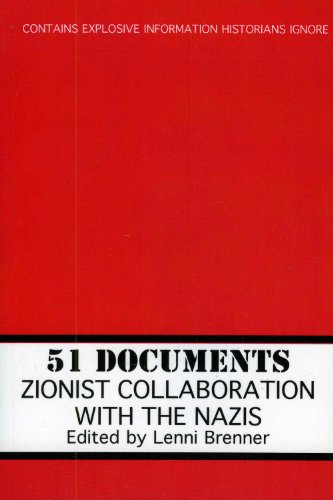
Even as late as the 1930s and afterward, international Zionist groups closely cooperated with the Third Reich on international economic projects, and during the world war itself one of the smaller rightwing factions, led by future Israeli Prime Minister Yizhak Shamir, actually offered a military alliance to the Axis Powers, denouncing the decadent Western democracies and hoping to cooperate against their mutual British enemies. The Transfer Agreement by Edwin Black, 51 Documents by Lenni Brunner, and other writings have documented all these facts in detail, though for obvious reasons they have generally been ignored or mischaracterized by most of our media outlets.
Obviously the Talmud is hardly regular reading among ordinary Jews these days, and I would suspect that except for the strongly Orthodox and perhaps most rabbis, barely a sliver are aware of its highly controversial teachings. But it is important to keep in mind that until just a few generations ago, almost all European Jews were deeply Orthodox, and even today I would guess that the overwhelming majority of Jewish adults had Orthodox grand-parents. Highly distinctive cultural patterns and social attitudes can easily seep into a considerably wider population, especially one that remains ignorant of the origin of those sentiments, a condition enhancing their unrecognized influence. A religion based upon the principal of “Love Thy Neighbor” may or may not be workable in practice, but a religion based upon “Hate Thy Neighbor” may be expected to have long-term cultural ripple effects that extend far beyond the direct community of the deeply pious. If nearly all Jews for a thousand or two thousand years were taught to feel a seething hatred toward all non-Jews and also developed an enormous infrastructure of cultural dishonesty to mask that attitude, it is difficult to believe that such an unfortunate history has had absolutely no consequences for our present-day world, or that of the relatively recent past.
Furthermore, Jewish hostility toward non-Jews may have often served the interests of others, and helped determine the economic role they played, especially in European countries, with this factor having been obscured by widespread ignorance of the underlying religious tenets. As most of us know from our history books, political rulers with little sympathy for their subjects sometimes restrict military power to a relatively small group of well-rewarded mercenaries, often of foreign origins so that they will have little sympathy for the population they harshly repress. I strongly suspect that some of the most common traditional economic niches of European Jews, such as tax-farming and the arrenda estate-management system of Eastern Europe, should be best understood in a similar light, with Jews being more likely to extract every last penny of value from the peasants they controlled for the benefit of their local king or lords, and their notorious antipathy for all non-Jews ensuring that such behavior was minimally tempered by any human sympathy. Thus, we should not be surprised that Jews first entered England in the train of William the Conqueror, in order to help him and his victorious Norman lords effectively exploit the subjugated Anglo-Saxon population they now ruled.
But states in which the vast majority of the population is oppressed and dominated by a thin slice of rulers and their mercenary enforcers tend to be much weaker and more brittle than those in which rulers and ruled share common interests, and I believe this is just as true for economic enforcers as for military ones. In many cases, lands reliant upon Jewish economic intermediaries, notably Poland, never successfully developed a native middle class, and often later fared quite poorly against their nationally-unified competitors. Spain was actually one of the last countries in Europe to expel its Jews, and over the next century or two reached the peak of its military and political glory. Prof. Kevin MacDonald’s controversial books on Judaism have also extensively argued that rulers who seem to have been more concerned for the well-being of their subjects also tend to be the ones more likely to be labeled “anti-Semitic” in modern history books, and his volumes are now easily available in my selection of HTML Books:
In 2009, Gene Expression blogger Razib Khan interviewed eminent evolutionary theorist David Sloan Wilson on the group selection ideas that have been his major focus. During this hour-long discussion, the theories of MacDonald became a major topic, with Wilson seeming to take them quite seriously, and pointing out that within the scientific framework “parasitism” has a simple technical definition, namely the exploitation of the large by the small. Unsurprisingly, the video record of such extremely touchy subject matter was quickly truncated to just the first 11 minutes, and eventually completely removed from both YouTube and BloggingHeadsTV. But it still at least partially survives in archived form:
In recent years, the history of Jewish expulsions from various European societies over the last thousand years has received considerable attention. The total number is somewhat disputed but almost certainly in excess of 100, with the 1930s policies of Hitler’s Germany being merely the most recent example, and Wired Magazine provided an interesting graphical presentation of this large dataset in 2013. Given these unfortunate facts, it may be difficult to point to any other group so consistently at bitter odds with its local neighbors, and the religious details provided by Shahak certainly make this remarkable historical pattern far less inexplicable.
A very even-handed but candid description of the behavior pattern of Jewish newcomers to America was provided in a chapter of a 1914 book on immigration groups by E.A. Ross, one of America’s greatest early sociologists. Ross had been one of the towering Progressive intellectuals of his era, widely quoted by Lothrop Stoddard on the Right while still so highly regarded by the Left that he was named to the Dewey Commission to adjudicate the conflicting accusations of Trotsky and Stalin and also received glowing praise in the pages of the Communist New Masses. His dismissal on political grounds from Stanford University led to the formation of the American Association of University Professors. Yet his name had so totally vanished from our history books I had never even encountered it until beginning work on my content-archiving project, and I would not be surprised if that single chapter from one of his many books played a major role in his disappearance.
Jews spent two thousand years living as a diaspora people, and their tightly-bound trans-national colonies provided them with a uniquely effective international trading network. Since their religious traditions regarded slavery as the natural and appropriate lot of all non-Jews, both ideological and practical factors combined to apparently make them some of the leading slave-traders of Medieval Europe, though this is hardly emphasized in our histories. Closer to home, in 1991 the Black Nationalists of The Nation of Islam published The Secret Relationship Between Blacks and Jews, Volume One, which seemed to persuasively document the enormous role Jews had played in the American slave-trade. In 1994, Harold Brackman published a short attempted rebuttal entitled Ministry of Lies under the auspices of the Simon Wiesenthal Center, but I found his denials much less compelling. I very much doubt that most Americans are aware of these historical facts.
Throughout most of my life, Nobel Laureate Alexander Solzhenitsyn was generally regarded as the greatest Russian literary figure of our modern era, and after reading all of his works, including The First Circle, Cancer Ward, and The Gulag Archipelago, I certainly concurred with this assertion, and eagerly absorbed Michael Scammel’s brilliant thousand page biography. Although Russian himself, many of his closest friends were Jewish, but during the 1980s and 1990s, whispers of his supposed anti-Semitism began floating around, probably because he had sometimes hinted at the very prominent role of Jews in both financing and leading the Bolshevik Revolution, and afterward staffing the NKVD and administering the Gulag labor camps. Late in his life, he wrote a massive two-volume history of the tangled relationship between Jews and Russians under the title Two Hundred Years Together, and although that work soon appeared in Russian, French, and German, nearly two decades later, no English translation has ever been authorized. His literary star seems also to greatly waned in America since that time, and I only very rarely see his name mentioned these days in any of my regular newspapers.
Samizdat versions of major sections of his final work may easily be located on the Internet, and a few years ago Amazon temporarily sold a 750 page hard copy edition, which I ordered and lightly skimmed. Everything seemed quite innocuous and factual, and nothing new jumped out at me, but perhaps the documentation of very heavy Jewish role in Communism was considered inappropriate for American audiences, as was the discussion of the extremely exploitative relationship between Jews and Slavic peasants in pre-revolutionary times, based on liquor-dealing and money-lending, which the Czars had often sought to mitigate.
When a ruling elite has limited connection to the population it controls, benevolent behavior is far less likely to occur, and those problems are magnified when that elite has a long tradition of ruthlessly extractive behavior. Enormous numbers of Russians suffered and died in the aftermath of the Bolshevik Revolution, and given the overwhelmingly Jewish composition of the top leadership during much of that period, it is hardly surprising that “anti-Semitism” was deemed a capital offense. Kevin MacDonald may have been the one who coined the term “hostile elite,” and discussed the unfortunate consequences when a country comes under such control.
After the collapse of the Soviet Union in 1991, reborn Russia soon fell under the overwhelming domination of a small group of Oligarchs, almost entirely of Jewish background, and a decade of total misery and impoverishment for the general Russian population soon followed. But once an actual Russian named Vladimir Putin regained control, these trends reversed and the lives of Russians have enormously improved since that time. America’s media organs were overwhelmingly friendly toward Russia when it was under Jewish Oligarchic rule, while Putin has been demonized in the press more ferociously than any world leader since Hitler. Indeed, our media pundits regularly identify Putin as “the new Hitler” and I actually think the analogy might be a reasonable one, but just not in the way they intend.
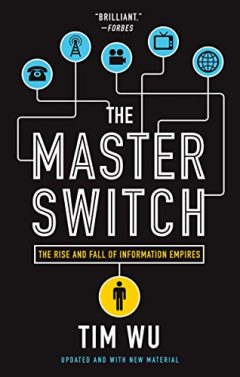
Sometimes it is much easier to notice obvious patterns in a foreign country than in one’s own. In the early 2000s I read The Master Switch, a widely-praised history of modern communications technology by Columbia University professor Tim Wu, who has subsequently become a leading Internet-rights activist. I found the account fascinating, with so many stories never before known to me. However, I couldn’t help but notice that all the powerful mass-media technologies of our modern world–film, radio, and television–had been invented and pioneered by Gentiles, mostly of Anglo-Saxon origin, but in each case control was seized by ruthless Jewish businessmen, who sometimes destroyed the lives and careers of those creators. By the 1950s, nearly all of America’s leading concentrations of electronic media power—with the sole major exception of Disney Studios—were solidly in Jewish hands. In an open society such as ours, these are the central levers of political influence, and over the next generation or so, America’s long-dominant and heavily Anglo-Saxon ruling elite was replaced by a mostly Jewish one, a development I alluded to in my long Meritocracy article of a few years ago.
Critics today of all backgrounds bemoan the total impoverishment of so much of America’s once comfortably affluent middle class, noting that some sixty percent of the American population today possesses less than $500 in readily available savings. A younger generation has been reduced to permanent debt-servitude by ruinous student loans, while the the newspapers report that the opioid drug epidemic has claimed a dreadful toll in lives and family-breakdown even while Wall Street and other elite sectors of the financialized economy are richer than they have ever been before. There are certainly many different explanations for this sad economic trajectory, including technological change, growing international competition, and shifts of political power in the American system of government. But it does sometimes seem like a substantial fraction of our population has been reduced to a 21st century version of the drunken, ignorant, exploited, indebted, impoverished, and immiserated Slavic peasantry of the Jewish-dominated Pale of Settlement, and a striking graph produced by the Economic Policy Institute demonstrates that a very sharp economic inflection point occurred in the early 1970s, right around the time that the aforementioned ethnic transformation of our ruling elites was fully under way.
Contrary to widespread popular belief, it is not actually illegal to be a “Nazi” in America, nor are Nazis prohibited from owning property, even including media outlets. But suppose that the overwhelming majority of America’s major media concentrations were owned and controlled by Nazis of a particularly fanatical type. Surely that might have serious consequences for the course of our society, and especially that fraction of the population viewed with considerable disfavor under Nazi doctrine.
One important point to consider in the abbreviated history of Hitler’s Third Reich was that although the ruling Nazi elite was often quite harsh and extreme in its behavior, well over 98% of the population it ruled prior to the outbreak of war consisted of Germans, the particular group which that ruling elite most sought to benefit and uplift in all possible ways, and despite the obscuring cloud of retrospective propaganda, this goal seems to have largely been achieved. In 2004, Counterpunch published a column by the late Alexander Cockburn, its redoubtable editor, noting the tremendous success of Hitler’s peacetime economic policies, and in 2013 that same webzine carried a much longer column focused entirely on this same subject, citing the analysis of Henry C.K. Liu, whose Chinese background provided him greater critical distance. Indeed, during most of the 1930s Hitler received widespread international praise for the great success of his domestic economic and social achievements, making the cover of Time Magazine on numerous occasions and even being named its Man of the Year for 1938. By contrast, I suspect that a population that was some 98% non-German but ruled by those same fanatically pro-German leaders might have fared far worse.
Most of these disheartening facts that have so completely upended my understanding of reality over the last decade could not possibly have come to my attention until the rise of the Internet, which partially broke centralized control over the distribution of information. But many other people surely must have known large portions of this important story long before that, and recognized the very serious consequences these matters might have for the future of our society. Why has there been so little public discussion?
I believe one factor is that over the years and the decades, our dominant media organs of news and entertainment have successfully conditioned most Americans to suffer a sort of mental allergic reaction to topics sensitive to Jews, which leads to all sorts of issues being considered absolutely out of bounds. And with America’s very powerful Jewish elites thereby insulated from almost all public scrutiny, Jewish arrogance and misbehavior remain largely unchecked and can increase completely without limit.
I’ve also sometimes suggested to people that one under-emphasized aspect of a Jewish population, greatly magnifying its problematical character, is the existence of what might be considered a biological sub-morph of exceptionally fanatical individuals, always on hair-trigger alert to launch verbal and sometimes physical attacks of unprecedented fury against anyone they regard as insufficiently friendly towards Jewish interests. Every now and then, a particularly brave or foolhardy public figure challenges some off-limits topic and is almost always overwhelmed and destroyed by a veritable swarm of these fanatical Jewish attackers. Just as the painful stings of the self-sacrificing warrior caste of an ant colony can quickly teach large predators to go elsewhere, fears of provoking these “Jewish berserkers” can often severely intimidate writers or politicians, causing them to choose their words very carefully or even completely avoid discussing certain controversial subjects, thereby greatly benefiting Jewish interests as a whole. And the more such influential people are thus intimidated into avoiding a particular topic, the more that topic is perceived as strictly taboo, and avoided by everyone else as well.
For example, about a dozen years ago I was having lunch with an especially eminent Neoconservative scholar with whom I’d become a little friendly. We were bemoaning the overwhelmingly leftward skew among America’s intellectual elites, and I suggested it largely seemed a function of our most elite universities. Many of our brightest students from across the nation entered Harvard and the other Ivies holding a variety of different ideological perspectives, but after four years departed those halls of learning overwhelmingly in left-liberal lock-step. Although he agreed with my assessment, he felt I was missing something important. He nervously glanced to both sides, shifted his head downward, and lowered his voice. “It’s the Jews,” he said.
I do not doubt that much of the candid analysis provided above will be quite distressing to many individuals. Indeed, some may believe that such material far exceeds the boundaries of mere “anti-Semitism” and easily crosses the threshold into constituting an actual “blood libel” against the Jewish people. That extremely harsh accusation, widely used by stalwart defenders of Israeli behavior, refers to the notorious Christian superstition, prevalent throughout most of the Middle Ages and even into more modern times, that Jews sometimes kidnapped small Christian children in order to drain their blood for use in various magic rituals, especially in connection with the Purim religious holiday. One of my more shocking discoveries of the last dozen years is that there is a fairly strong likelihood that these seemingly impossible beliefs were actually true.
I personally have no professional expertise whatsoever in Jewish ritual traditions, nor the practices of Medieval Jewry. But one of the world’s foremost scholars in that field is Ariel Toaff, professor of Jewish Renaissance and Medieval Studies at Bar-Ilan University near Tel Aviv, and himself the son of the Chief Rabbi of Rome.
In 2007, he published the Italian edition of his academic study Blood Passovers, based on many years of diligent research, assisted by his graduate students and guided by the suggestions of his various academic colleagues, with the initial print run of 1,000 copies selling out on the first day. Given Toaff’s international eminence and such enormous interest, further international distribution, including an English edition by a prestigious American academic press would normally have followed. But the ADL and various other Jewish-activist groups regarded such a possibility with extreme disfavor, and although these activists lacked any scholarly credentials, they apparently applied sufficient pressure to cancel all additional publication. Although Prof. Toaff initially attempted to stand his ground in stubborn fashion, he soon took the same course as Galileo, and his apologies naturally became the basis of the always-unreliable Wikipedia entry on the topic.
Eventually, an English translation of his text turned up on the Internet in a PDF format and was also placed for sale on Amazon.com, where I purchased a copy and eventually read it. Given those difficult circumstances, this work of 500 pages is hardly in ideal form, with most of the hundreds of footnotes disconnected from the text, but it still provides a reasonable means of evaluating Toaff’s controversial thesis, at least from a layman’s perspective. He certainly seems an extremely erudite scholar, drawing heavily upon the secondary literature in English, French, German, and Italian, as well as the original documentary sources in Latin, Medieval Latin, Hebrew, and Yiddish. Indeed, despite the shocking nature of the subject matter, this scholarly work is actually rather dry and somewhat dull, with very long digressions regarding the particular intrigues of various obscure Medieval Jews. My own total lack of expertise in these areas must be emphasized, but overall I thought Toaff made a quite persuasive case.
It appears that a considerable number of Ashkenazi Jews traditionally regarded Christian blood as having powerful magical properties and considered it a very valuable component of certain important ritual observances at particular religious holidays. Obviously, obtaining such blood in large amounts was fraught with considerable risk, which greatly enhanced its monetary value, and the trade in the vials of this commodity seems to have been widely practiced. Toaff notes that since the detailed descriptions of the Jewish ritualistic murder practices are very similarly described in locations widely separated by geography, language, culture, and time period, they are almost certainly independent observations of the same rite. Furthermore, he notes that when accused Jews were caught and questioned, they often correctly described obscure religious rituals which could not possibly have been known to their Gentile interrogators, who often garbled minor details. Thus, these confessions were very unlikely to have been concocted by the authorities.
Furthermore, as extensively discussed by Shahak, the world-view of traditional Judaism did involve a very widespread emphasis on magical rituals, spells, charms, and similar things, providing a context in which ritualistic murder and human sacrifice would hardly be totally unexpected.
Obviously, the ritual murder of Christian children for their blood was viewed with enormous disfavor by the local Gentile population, and the widespread belief in its existence remained a source of bitter tension between the two communities, flaring up occasionally when a Christian child mysteriously disappeared at a particular time of year, or when a body was found that exhibited suspicious types of wounds or showed a strange loss of blood. Every now and then, a particular case would reach public prominence, often leading to a political test of strength between Jewish and anti-Jewish groups. During the mid-19th century, there was one such famous case in French-dominated Syria, and just before the outbreak of the First World War, Russia was wracked by a similar political conflict in the 1913 Beilis Affair in the Ukraine.
I first encountered these very surprising ideas almost a dozen years ago in a long article by Israel Shamir that was referenced in Counterpunch, and this would definitely be worth reading as an overall summary, together with a couple of his follow-up columns, while writer Andrew Hamilton offers the most recent 2012 overview of the controversy. Shamir also helpfully provides a free copy of the book in PDF form, an updated version with the footnotes properly noted in the text. Anyway, I lack the expertise to effectively judge the likelihood of the Toaff Hypothesis, so I would invite those interested to read Toaff’s book or better yet the related articles and decide for themselves.
The notion that the world is not only stranger than we imagine, it is stranger than we can imagine has often been misattributed to the British astronomer Sir Arthur Eddington, and over the last fifteen-odd years I’ve sometimes begun to believe that the historical events of our own era could be considered in a similar light. I’ve also sometimes joked with my friends that when the true history of our last one hundred years is finally written and told—probably by a Chinese professor at a Chinese university—none of the students in his lecture hall will ever believe a word of it.
Carlos Lozada, the nonfiction book critic for the Washington Post, promised “an honest investigation” of whether truth can survive the Trump administration in the lead article in the paper’s Sunday Outlook section. He delivered considerably less.
The Washington Post fails. But, hey, it’s the Washington Post.
Most importantly and incredibly, Lozada never considers the possibility that respect for traditional purveyors of “truth” has been badly weakened by the fact that they have failed to do so in many important ways in recent years. Furthermore, they have used their elite status (prized university positions and access to major media outlets) to deride those who challenged them as being unthinking illiterates.
This dynamic is most clear in the trade policy pursued by the United States over the last four decades. This policy had the predicted and actual effect of eliminating the jobs of millions of manufacturing workers and reducing the pay of tens of millions of workers with less than a college education. The people who suffered the negative effects of these policies were treated as stupid know-nothings, and wrongly told that their suffering was due to automation or was an inevitable product of globalization.
These claims are what those of us still living in the world of truth know as “lies,” but you will never see anyone allowed to make these points in the Washington Post. After all, its readers can’t be allowed to see such thoughts.
This was far from the only major failure of the purveyors of truth. The economic crisis caused by the collapse of the housing bubble cost millions of workers their jobs and/or houses. While this collapse was 100 percent predictable for anyone with a basic knowledge of economics, with almost no exceptions, our elite economists failed to see it coming, and ridiculed those who warned of the catastrophe.
Incredibly, there were no career consequences for this momentous failure. No one lost their job and probably few even missed a scheduled promotion. Everyone was given a collective “who could have known?” amnesty. This leaves us with the absurd situation where a dishwasher who breaks the dishes get fired, a custodian that doesn’t clean the toilet gets fired, but an elite economist who completely misses the worst economic disaster in 70 years gets promoted to yet another six-figure salary position.
And, departing briefly from my area of expertise, none of the geniuses who thought invading Iraq was a good idea back in 2003 seems to be on the unemployment lines today. Again, there was another collective “who could have known?” amnesty, with those responsible for what was quite possibly the greatest foreign policy disaster in US history still considered experts in the area and drawing high salaries.
When we have a world in which the so-called experts are not held accountable for their failures, even when they are massive, and they consistently look down on the people who question their expertise, it undermines belief in truth. It would have been nice if Lozada had explored this aspect of the issue, but, hey, it’s the Washington Post.
My old teacher and mentor, Elie Kedourie, Professor of Politics at the University of London liked to say that Clio, the Greek muse of history had a great sense of humor and irony. This thought comes vividly to mind rereading one of the most important books ever written on the causes of the decline and disintegration of the British Empire in the first half of the 21th century, Correlli Barnett’s The Collapse of British Power.
Barrett’s enormous and still controversial masterpiece was published in 1972. Yet today it has a greater relevance than ever. For every time “Britain” is mentioned in the text, cross the word out, then replace it with “the United States” or “America” and his explanations for British decline and fall apply and explain even more presciently the current dilemmas of the United States.
Barnett gave as major reasons for the collapse of British power strategic over-extension after World War I when the British, already administering an empire covering one quarter of the entire land territory and one quarter of the human race, stretched even further and saw themselves as the global hyper-power and police, charged with maintaining a true World Order across the entire planet.
Today, those words and conceptions have an especially eerie and contemporary ring.
By claiming to be the global hyper-power, Barnett cogently argued, the British instead guaranteed that they could not even remain as an international superpower. They overextended and exhausted themselves. They over-stretched and exhausted their land combat forces in a plethora of minor wars and counter-insurgencies around the world, most notably in Iraq, Palestine, Ireland and Afghanistan – all regions that have today an astonishingly contemporary ring.
In the end Britain’s imperial leaders extended their network of guarantees to the tiny, unstable and narrowly parochial states of Central and Eastern Europe, ensuring their inevitable strategic collisions with first Germany and then the Soviet Union – again, strategic misconceptions that echo with especial relevance today.
Barnett most of all explored the crumbling and collapse of Britain’s once awesome industrial base. He put this down to a fatal, blind – indeed deluded – reliance on the workings of the free market without any government intervention, encouragement or protection for strategic industries.
Britain practiced Free Trade from 1860 to 1931 except for the four years of World War I at the very same time its arch rivals Germany, the United States and Imperial Japan applied high industrial and agricultural tariffs and successfully developed their modern industries and rural economies, dramatically raising the standard of living of their peoples in the process.
The British then, like the Americans today believed in Free Trade as an economic panacea blind to the avalanche of empirical, practical evidence to the contrary.
Like modern Americans, they laid exaggerated importance on theoretical university education in the humanities and on liberal theories of economics and politics, while their ruling elites were pathetically ignorant of what today are known in the United States as the STEM subjects – Science, Technology, Engineering and Mathematics.
It is therefore no coincidence that Margaret Thatcher, the only British leader to revive and stabilize her country’s economy and international standing since World War II, had worked professionally as a research scientist in the chemical industry. Thatcher also regarded Barnett as her favorite historian and raised him to the House of Lords as a Life Peer, an almost unprecedented honor for an academic British scholar.
Today Thatcher is gone but Barnett lives on at a remarkable 91. He followed up his 1972 masterpiece with three searing sequels on how the British threw away the manufacturing advantages they still enjoyed after being rescued in World War II by the alliance and support of the United States and the Soviet Union. Those three later books, The Audit of War: The Illusion and Reality of Britain as a Great Nation (1986), known in the United States as The Pride and the Fall; The Lost Victory: British Dreams and British Realities, 1945-50 (Macmillan, 1995) and The Verdict of Peace: Britain between her Yesterday and the Future remain definitive works today. They are known collectively as The Pride and Fall Sequence.
Ironically, Barnett greatly admired the America of the first half of the 20th century and held it up as an example of wise industrial, social, economic and strategic policies that Britain should have emulated but did not.
Instead the opposite happened, the Americans following the end of the Cold War plunged precisely into the same mad and futile dreams of eternal global leadership as the British had done, dragging them inexorably into one vicious, morally reprehensible and financially exhausting little “colonial” war after another to crush emerging national, social and economic movements around the world. They failed repeatedly.
Eventually these self-righteous and moralistic – but never moral – policies propelled Britain and its Empire into the one catastrophe they should have avoided at all costs – another world war.
Barnett recognized the fateful path the United States had taken. In 2003, never fearful of controversy he was scathingly critical of the US invasion of Iraq and its claimed moral and grand strategic goals. Clio, Muse of History must have applauded.
The safest country in Latin America.[2]Its police force was internationally recognized for its innovative community policing policies. Unlike its neighbors El Salvador, Honduras, and Guatemala, where undocumented immigrants were fleeing to the US border, Nicaragua had kept gang violence and organized drug cartels in check.
Far from a dictatorship.[3] President Daniel Ortega was democratically elected and then twice re-elected, each time with an increasing percentage and number of votes.In 2017, polls showed he had the highest approval rating of any chief of state in the entire hemisphere.[4]
Where social indices were on the rise. [5]Literacy, small businesses promotion, free public education, poverty reduction, and economic growth were among the highest in the hemisphere.[6]
Then on April 18 things suddenly changed dramatically. Triggered by a minor adjustment to the social security program, which was designed to avoid austerity measures promoted by big business and the International Monetary Fund (IMF), violence broke out across Nicaragua.[7]
Incongruously, the opposition was led by students from private universities, who had little material interest in old age pensions, and by rightwing elements that favored draconian cuts in social welfare programs.[8]Despite the government rescinding the adjustment and its attempts to meet with the opposition and negotiate a settlement,[9]the violence has escalated with a death toll of over 200.[10]
Road blocks have been set up on vital streets and highways throughout the country. They are forcefully maintained by young militants, with reports that many are paid.[11]Organized crime, aligned with the violent protests, has infiltrated Nicaragua.[12]Some believe the extreme opposition is intent on escalating the conflict to paralyze or overthrow the elected government.[13]
This is within the larger context the US government targeting[14]independent and progressive governments for regime change.[15]Nicaragua is allied with Cuba, Venezuela, and Bolivia and has not served as a client state to the dictates of Washington.
The US has poured millions into Nicaraguan private non-governmental organizations (NGOs) in what is called “democracy promotion” but may be better understood as regime change training.[16]Even sources hostile to the Ortega government admit US involvement in the current unrest.[17]Meanwhile the US Senate is considering the NICA Act designed to cripple the Nicaraguan economy.
The Task Force on the Americas:
Recognizes the Nicaraguan people may have legitimate grievances with their elected government. But the rightwing attack is on what the Sandinistas have done right, not what they’ve done wrong.
Believes there is a huge amount of distortion and misinformation in how the situation is being portrayed.
Supports an objective and independent investigation of who carried out and who provoked the violence [18] with all parties held responsible for their actions. [19]
Commends efforts to mediate a peaceful settlement in Nicaragua, including dismantling the barricades and cessation of destruction of public property. [20]
Opposes the NICA Act and US interference [21] in the internal affairs of Nicaragua including through the NED, [22] USAID, and other instruments of intervention.
NOTES and SOURCES
[1]The Task Force on the Americas is a 32-year-old anti-imperialist human rights organization. http://taskforceamericas.org/
[10]Perry, After 2 months of unrest, Nicaragua is at a fateful crossroads, 06/22/18. https:/ /www.thenation.com/article/two-months-unrest-nicaragua-fateful-crossroad/
By Mazin Qumsiyeh | Popular Resistance | August 18, 2013
There is no way to say this truth nicely: Politicians lie. That includes Japanese, American, Egyptian, Israeli, and Palestinian politicians! Is there something more common sense than that? Yet, so many citizens around the world believe their own politicians or wistfully acknowledge lies but think it is part of the job needed to run things. They believe even when politicians contradict themselves blatantly. This phenomenon is rather remarkable. It is a dissonance and disconnect from reality that many seem oblivious to. It is very dangerous because it can lead to accepting rationales for going to war. These can be deadly wars that lead to millions of lives lost as happened in what was called World War 1 and WW2. Even when incredible and declassified evidence abound, politicians continue to lie and old mythologies refuse to die. Here are just a few of the countless lies told to us over the past few decades… continue
This site is provided as a research and reference tool. Although we make every reasonable effort to ensure that the information and data provided at this site are useful, accurate, and current, we cannot guarantee that the information and data provided here will be error-free. By using this site, you assume all responsibility for and risk arising from your use of and reliance upon the contents of this site.
This site and the information available through it do not, and are not intended to constitute legal advice. Should you require legal advice, you should consult your own attorney.
Nothing within this site or linked to by this site constitutes investment advice or medical advice.
Materials accessible from or added to this site by third parties, such as comments posted, are strictly the responsibility of the third party who added such materials or made them accessible and we neither endorse nor undertake to control, monitor, edit or assume responsibility for any such third-party material.
The posting of stories, commentaries, reports, documents and links (embedded or otherwise) on this site does not in any way, shape or form, implied or otherwise, necessarily express or suggest endorsement or support of any of such posted material or parts therein.
The word “alleged” is deemed to occur before the word “fraud.” Since the rule of law still applies. To peasants, at least.
Fair Use
This site contains copyrighted material the use of which has not always been specifically authorized by the copyright owner. We are making such material available in our efforts to advance understanding of environmental, political, human rights, economic, democracy, scientific, and social justice issues, etc. We believe this constitutes a ‘fair use’ of any such copyrighted material as provided for in section 107 of the US Copyright Law. In accordance with Title 17 U.S.C. Section 107, the material on this site is distributed without profit to those who have expressed a prior interest in receiving the included information for research and educational purposes. For more info go to: http://www.law.cornell.edu/uscode/17/107.shtml. If you wish to use copyrighted material from this site for purposes of your own that go beyond ‘fair use’, you must obtain permission from the copyright owner.
DMCA Contact
This is information for anyone that wishes to challenge our “fair use” of copyrighted material.
If you are a legal copyright holder or a designated agent for such and you believe that content residing on or accessible through our website infringes a copyright and falls outside the boundaries of “Fair Use”, please send a notice of infringement by contacting atheonews@gmail.com.
We will respond and take necessary action immediately.
If notice is given of an alleged copyright violation we will act expeditiously to remove or disable access to the material(s) in question.
All 3rd party material posted on this website is copyright the respective owners / authors. Aletho News makes no claim of copyright on such material.