AMLO’s Administration Seeks to End Mexico’s Energy Dependence
teleSUR | July 11, 2018
Mexico’s next energy minister under president-elect Andres Manuel Lopez Obrador has said that the new administration’s energy agenda will be to increase domestic gas and diesel production and reduce dependency on foreign imports.
Rocio Nahle, appointed by AMLO for the energy ministry, said in an interview with a local paper that AMLO’s government will address the “energy imbalance” that makes it dependent on foreign imports to meet national demand.
AMLO has previously made pledges along this line during and after the election, saying that ending the massive fuel imports would be a priority for his first three years.
Mexico has imported an average of 590,000 barrels per day of gasoline and 232,000 per day of diesel, almost all of which comes from the United States. While the United States profits on gas sales to its neighbor, Mexico’s domestic production has decreased by half since the first year of outgoing President Enrique Peña Nieto’s term.
Today, gasoline output by Mexican state oil company Pemex meets less than a quarter of national demand, putting Mexico’s energy system in a situation of deep dependence on the United States.
During the election campaign, Lopez Obrador was sharply critical of the Pena Nieto’s policy to allow foreign and private oil companies to operate fields on their own for the first time in decades, ending Pemex’s monopoly.
Nahle said the next government will also begin construction of at least one new oil refinery, which she expects to be operating by the halfway point of Lopez Obrador’s six-year term.
AMLO also outlined several legislative priorities on Wednesday, particularly ending presidential legal immunity, and slashing the presidential salary.
The incoming administration would also put forward a law to remove obstacles to holding public consultations, as well as create a mechanism for recalling the president, he said.
Lopez Obrador said during the campaign he could hold public consultations on issues ranging from the government’s opening of the energy sector, the construction of Mexico City’s new airport, gay marriage and even his performance as president.
Mexico’s new president wants to scrap $1.36bn helicopter deal with US
RT | July 12, 2018
Mexico’s newly-elected, anti-establishment president is planning to scrap some of the deals his predecessor had signed up to, including a $1.36 billion order for eight MH-60R Seahawk helicopters for the country’s Navy.
Andres Manuel Lopez Obrador, widely known as AMLO, was elected Mexico’s next president on promises to pursue national interests and reduce the country’s reliance on the US. He has vowed to cut government spending as soon as he takes over the top office in December. Amid a number of announced measures, the anti-establishment leader promised to scrap some of the deals outgoing President Enrique Peña Nieto had sealed with the US during his tenure. Among his targets are the Lockheed Martin MH-60R helicopters, which the US State Department green-lighted to sell back in April.
“We know of the order to purchase eight gunship choppers for the Mexican Navy, made to the government of the United States, for a total value of 25 billion pesos, that purchase will be canceled, because we cannot [afford] this expense,” Lopez Obrador said Wednesday.
Washington approved the sale of choppers to the Mexican Navy together with multi-mode radars, night vision devices, and other sensors to help its neighbor combat organized crime and drug-trafficking. The deal, worth some $1.36 billion, also included a package of armaments, such as Hellfire missiles, lightweight hybrid torpedoes, and machine guns.
In addition to the helicopters, the newly elected leader ordered his team to contact Boeing to negotiate selling Peña Nieto’s 787 Dreamliner back to the company. Back in 2016, the plane (named ‘José María Morelos y Pavón’) cost the country $218.7 million, which the government agreed to repay over the next 15 years. “The idea is to sell it, not lose money, sell it for what it’s worth, but I’m not going to get on that plane,” the politician vowed.
Lopez Obrador, an outspoken critic of Donald Trump, received around 53 percent of votes to win the presidential race earlier this month. Honoring his campaign promises, on Wednesday he promised to slash government officials’ salaries, as well as end the practice of lifetime pensions for former presidents. “It is time for the government to tighten its belts,” he stressed.
Mexico: Who Are the Women That Make Up Half of AMLO’s Cabinet?

(L-R): Luisa Maria Alcalde, Rocio Nahle, Irma Sandoval and Olga Maria del Carmen Sanchez are part of AMLO’s cabinet. | Photo: Facebook / Twitter / plumas libres
teleSUR | July 11, 2018
Eight of the key figures in AMLO’s future government are women and they have interesting proposals for Mexico.
Of the 16 confirmed members of president-elect Andres Manuel Lopez Obrador’s cabinet eight are women. teleSUR English reviews their profiles and plans for their tenure.
AMLO’s cabinet will include representatives of the business sectors and members of the traditional Institutional Revolution Party, but it also has an important share of academics and progressive women.
Olga Maria del Carmen Sanchez, the first woman to head the ministry of the Interior, was a judge in Mexico’s Supreme Court between 1995 and 2005. She is in favor of legalizing marijuana and believes the country needs to rethink its policy on drugs.
During an interview with Zosimo Camacho, Sanchez criticized the lack of judicial symmetry with the United States and stressed the importance of changing the strategy in the war on drugs. “How is it possible that here in our country we are killing ourselves and the U.S. is decriminalizing drugs?,” she questioned.
AMLO’s pick for social development, Maria Luisa Albores is an agronomist and specialist on social economy, which is based on the principle of solidarity. Since 2001 she has worked with Indigenous and Campesino communities in the development of productive and economic cooperatives and projects.
During the campaign trail, Albores vowed to work for the economic and social inclusion of rural Mexico and stressed the importance of restructuring Mexico’s social development ministry. According to Albores the ministry has “served to keep people poor, and poverty has been administered electorally.”
For Minister of Labor and Social Welfare, AMLO has appointed Luisa Maria Alcalde, a lawyer and former legislator, who has done extensive work on a dignified salary in Mexico.
Alcalde has announced she will hold meeting with Mexico’s private sector and the country’s central bank to find a viable path to an increase to the country’s minimum wage.
Economy will be headed by Graciela Marquez, Ph.D. in economic history and professor in several universities in Mexico and abroad. She has written extensively on economic development, inequality and commercial policy. She would be the first woman to head the ministry of economy and will head the current negotiations on the North American Free Trade Agreement (NAFTA).
Alejandra Frausto has accepted to lead Mexico’s ministry of culture. She has worked to promote access to culture and the arts as a central element in social development, with an emphasis on popular and Indigenous cultures.
The Ministry of Environment and natural resources will be headed by Oxford graduate Josefa Gonzalez, who studied transformative art and has worked with vulnerable populations in art-related projects. For the past years she has worked in the southern state of Chiapas in conservation and reforestation projects.
Irma Sandoval has been given the Ministry of the Civil Service. She is a political scientist and researcher for Mexico’s Autonomous University (UNAM). Sandoval is also the coordinator of UNAM’s Lab on corruption documentation and analysis.
She has proposed to use technology to monitor the good use of public resources, a monitoring system open to citizens to control public works, and to encourage anonimous complaints to fight corruption in Mexico.
Finally, AMLO’s pick for the Energy Minister is Rocio Nahle who has worked in the petrochemical industry for years. Her main proposal is the construction of two refineries in Tabasco and Campeche, and the rehabilitation of six refineries to meet Mexico’s internal demand.
RELATED:
Mexico President Strikes Upbeat Tone on Trump Ahead of Talks
AMLO to Implement San Andres Agreements Signed With Zapatistas
US targets Iran’s tourism; airlines halt service
Press TV – July 10, 2018
The US government says it has sanctioned a Malaysia-based tourism agent for Iranian private airline Mahan Air which is already under American sanctions.
The blockade comes as the US prepares to unleash “the strongest sanctions in history” on Iran after President Donald Trump decided to withdraw Washington from a landmark nuclear deal with the Islamic Republic.
“As a result of today’s action, all property and interests in property of Mahan Travel and Tourism Sdn Bhd that are or come within US jurisdiction are blocked,” the US Treasury Department said in a statement on Monday.
The first group of unilateral US sanctions on Iran’s automotive sector, gold trade, and other industries will “snap back” on August 4. Further sanctions on oil and transactions with the Central Bank of Iran will come into effect November 6.
Trump has given companies 180 days to wind down their businesses in Iran or have their trade severed with the US.
Dutch airline KLM said on Saturday it had decided to suspend its direct flights to Tehran “for commercial reasons.”
“As a result of the negative results and financial outlook for the Tehran operation, the last flight will take off from Amsterdam on 22 September 2018 and land at Schiphol on 23 September,” it said in a short statement on its website.
KLM resumed flights to Tehran in 2016 when the nuclear agreement signed between Iran and world countries came into effect. The Dutch airline had ceased its Iran operations in 2013 after the West intensified sanctions on the Islamic Republic.
Austrian Airlines also announced on Friday that it will stop service to the Iranian cities of Isfahan and Shiraz, starting in September, but will continue its flights to Tehran.
“The underlying reason for these changes in the route network is a realignment of the airline’s portfolio,” a statement said on the official website of Austrian Airlines which is owned by the German airline company Lufthansa.
Austrian Airlines announced its expansion of flights to Shiraz and Isfahan in 2015, 2016 and 2017.
The exodus of European companies is a blow to their governments’ efforts to keep Iran in the nuclear agreement.
Europe has pledged to put together an economic package for Iran so that the country benefits from staying in the deal but France said on Friday the offer was unlikely to come by before November.
Germany’s Foreign Minister Heiko Maas also said the Europeans would not be able to fully compensate for companies leaving Iran due to new US sanctions.
The USA Is Now a 3rd World Nation

By Charles Hugh Smith | of two minds | July 8, 2018
I know it hurts, but the reality is painfully obvious: the USA is now a 3rd World nation.
Dividing the Earth’s nations into 1st, 2nd and 3rd world has fallen out of favor;apparently it offended sensibilities. It has been replaced by the politically correct developed and developing nations, a terminology which suggests all developing nations are on the pathway to developed-nation status.
What’s been lost in jettisoning the 1st, 2nd and 3rd world categories is the distinction between developing (2nd world) and dysfunctional states (3rd world), states we now label “failed states.”
But 3rd World implied something quite different from “failed state”: failed state refers to a failed government of a nation-state, i.e. a government which no longer fulfills the minimum duties of a functional state: basic security, rule of law, etc.
3rd World referred to a nation-state which was dysfunctional and parasitic for the vast majority of its residents but that worked extremely well for entrenched elites who controlled most of the wealth and political power. Unlike failed states, which by definition are unstable, 3rd World nations are stable, for the reason that they work just fine for the elites who dominate the wealth, power and machinery of governance.
Here are the core characteristics of dysfunctional but stable states that benefit the entrenched few at the expense of the many, i.e. 3rd World nations:
1. Ownership of stocks and other assets is highly concentrated in entrenched elites. The average household is disconnected from the stock market and other measures of wealth; only a thin sliver of households own enough financial/speculative wealth to make an actual difference in their lives.
2. The infrastructure of the nation used by the many is poorly maintained and costly to operate as entrenched elites plunder the funding to pad their payrolls, pensions and sweetheart/insider contracts.
3. The financial/political elites have exclusive access to parallel systems of transport, healthcare, education, etc. The elites avoid trains, subways, lenders, coach-class air transport, standard healthcare and the rest of the decaying, dysfunctional systems they own that extract wealth from the debt-serfs.
They fly on private aircraft, have their own healthcare and legal services, use their privileges to get their offspring into elite universities and institutions and have access to elite banking and lending services that are unavailable to their technocrat lackeys and enforcers.
4. The elites fund lavish monuments to their own glory disguised as “civic or national pride.” These monuments take the form of stadiums, palatial art museums, immense government buildings, etc. Meanwhile the rest of the day-to-day infrastructure decays in various states of dysfunction.
5. There are two classes that only interact in strictly controlled ways: the wealthy, who live in gated, guarded communities and who rule all the institutions, public and private, and the debt-serfs, who are divided into well-paid factotums, technocrat lackeys and enforcers who serve the interests of the entrenched elites and rest of the populace who own virtually nothing and have zero power.
The elites make a PR show of being a commoner only to burnish the absurd illusion that debt-serf votes actually matter. (They don’t.)
6. Cartels and quasi-monopolies are parasitically extracting the wealth of the nation for their elite owners and managers. Google: quasi-monopoly. Facebook: quasi-monopoly. Healthcare: cartel. Banking: cartel. National defense: cartel. National Security: cartel. Corporate mainstream media: cartel. Higher education: cartel. Student loans: cartel. I think you get the point: every key institution or function is controlled by cartels or quasi-monopolies that serve the interests of the few via parasitic exploitation of the powerless.
7. The elites use the extreme violence and repressive powers of the government to suppress, marginalize and/or destroy any dissent. There are two systems of “law”: one for the elites ($10 million penalties for ripping off the public for $10 billion, no personal liability for outright fraud) and one for the unprotected-unprivileged: “tenners” (10-year prison sentences) for minor drug infractions, renditions or assassinations (all “legal,” of course) and institutional forces of violence (bust down your door on the rumor you’ve got drugs, confiscate your car because we caught you with cash, so you must be a drug dealer, and so on, in sickening profusion).
8. Dysfunctional institutions with unlimited power to extract money via junk fees, licensing fees, parking tickets, penalties, late fees, etc., all without recourse. Mess with the extractive, parasitic bureaucracy and you’ll regret it: there’s no recourse other than another layer of well-paid self-serving functionaries that would make Kafka weep.
9. The well-paid factotums, bureaucrats, technocrat lackeys and enforcers who fatten their own skims and pensions at the expense of the public and slavishly serve the interests of the entrenched elites embrace the delusion that they’re “wealthy” and “the system is working great.” These deluded servants of the elites will defend the dysfunctional system because it serves their interests to do so.
The more dysfunctional the institution, the greater their power, so they actively increase the dysfunction at every opportunity.
The USA is definitively a 3rd World nation. Read the list above and then try to argue the USA is not a 3rd World nation. Try arguing against the facts displayed in this chart:
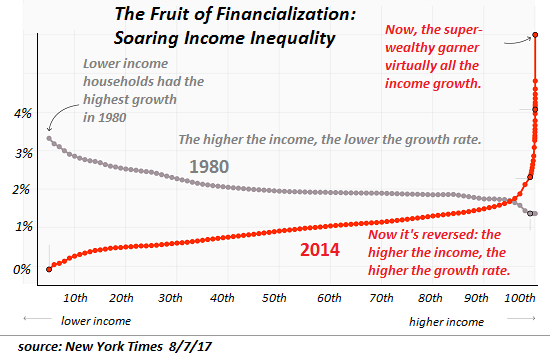
I know it hurts, but the reality is painfully obvious: the USA is now a 3rd World nation.
My new book Money and Work Unchained is $9.95 for the Kindle ebook and $20 for the print edition.
Germany studying request to return €300mn to Iran
Press TV -July 9, 2018
The German government is reportedly studying a request by Iran to withdraw €300 million from bank accounts held in Germany and transfer the cash to the Islamic Republic.
Unnamed officials in Berlin were quoted by Bild newspaper as saying that Tehran was seeking withdraw the funds from the Europaeisch-Iranische Handelsbank AG (eihbank) in order to satisfy part of its foreign currency needs when fresh US sanctions against its financial sector take effect.
The report added that Iran had told the German Financial Supervisory Authority (BaFin) that it needed the cash from the accounts “to pass on to Iranian citizens who require cash while travelling abroad, given their inability to access recognized credit cards”.
BaFin was now reviewing the request, which had been briefed to senior officials in the chancellery, foreign ministry and finance ministry, the newspaper added in its report as quoted by Reuters.
It further highlighted allegations by the US and Israel that Iran would try to use the cash for purposes other than satisfying its domestic needs. However, it cited unnamed German officials as saying that they had no indications of such plans.
In May, US President Donald Trump announced that he would pull America out of a 2015 nuclear agreement with Iran and re-impose the sanctions that the deal had envisaged to be lifted.
He has already emphasized that the sanctions which would be imposed on Iran would be “at the highest level”.
The sanctions would include a universal ban on Iran over buying or acquiring US dollars as well as restrictions over purchases of crude oil from the country and investing in its oil sector projects.
French shipping firm pulls out of Iran due to US sanctions threat
MEMO | July 7, 2018
French shipping group CMA CGM has decided to pull out of Iran following the Trump administration’s decision to renew sanctions on companies operating in the country, its chief executive said on Saturday.
Some other big shipping companies like A.P. Moller-Maersk have already said they would halt business ahead of a reimposition of sanctions following the United States’ decision to pull out of the 2015 Iran nuclear accord.
“Due to the Trump administration, we have decided to end our service for Iran,” CMA CGM chief Rodolphe Saade said during an economic conference in the southern French city of Aix-en-Provence.
“Our Chinese competitors are hesitating a little, so maybe they have a different relationship with Trump, but we apply the rules,” Saade said.
He added that his company’s cooperation agreement with local Iranian partner IRISL had been suspended and that the company did not want to fall foul of the rules given their large presence in the United States.
He also said that the company had so far not seen an impact of trade tensions between China and the United States on shipping volumes, but was making preparations with a close eye on China and southeast Asia in case the situation deteriorated.
In May, the European Union announced measures that would enable it to avoid US sanctions on Iran or possibly block them. The measures are designed to avoid tens of billions of dollars in losses for European companies, which invested in Iran in the wake of the agreement, signed in 2015. However, this hasn’t stopped many large European companies and insitutions from bowing to US pressure, including the EU’s own bank.
Italy will not buy F-35s anymore, mulls walking out of existing contracts – Defense Minister
RT | July 7, 2018
The anti-establishment Italian government’s defense minister has said that the country won’t purchase any more Lockheed Martin F-35 fighter jets from the US and will review the existing order for 90 planes.
Elisabetta Trenta, the country’s new minister of defense from the Eurosceptic Five Star Movement, has ruled out new contracts with the US for the purchase of F-35 stealth fighter jets, adding that the order for 60 F-35A and 30 F-35B jets, which concluded in 2012, might be placed under review.
“We won’t buy any more F-35s,” Trenta said in an interview with Italian broadcaster La7’s Omnibus program on Friday.
“We are assessing what to do regarding the contracts already in place,” she added, noting that while her party has always been a vocal critic of the program, she said that scrapping it altogether may “cost us more than maintaining it.”
The fact that the cancellation of the bulk deal and the resulting “strong financial penalties” might cost the Italian budget a hefty sum is one of the main reservations that is holding the government back, she explained.
The termination of the contract can negatively impact Italian workers who are employed in the production, she said, listing other merits of the deal such as “technological activity” and “important research” in a Facebook post accompanying the interview
Italy became the only country with an F-35B assembly line outside the US. In May 2017, it rolled out the first jets. However, they had to be delivered to the US Navy base in Maryland for certification and crew training.
The line in Cameri is set to produce a total of 30 F-35Bs to be delivered to the Italian Navy, Italian Air Force and the Royal Netherlands Air Force.
Back in 2012, Italy already downsized its initial order for 135 jets to 90 as it was battling with a sovereign debt crisis.
The March general election in Italy, following weeks of uncertainty and political bickering, propelled a new government of the right-wing Lega Nord and anti-establishment Five Star Movement to power. The fact that it is now a part of the ruling coalition might have put some constraints on the party’s policy, which has always been in stark opposition to the costly program.
As the party presented its defense manifesto in May last year, Tatiana Basilio, then a Five Star MP in the parliament, said that “there will be no ifs or buts about leaving the F-35 program” if her party clinched the vote.
“€14 billion for 90 F-35s is too costly and we are putting ourselves in the hands of the US,” Basilio said at the time.
One aircraft currently costs Italy €51.3 million, while, overall, it has to spend some €14 billion on the jets.
Meanwhile, the program has been bogged down by unresolved technical issues, such as faulty helmets, malfunctioning ejector seats and overblown costs.
Losing Military Supremacy: The Myopia of American Strategic Planning by Andrei Martyanov
The Saker • Unz Review • July 5, 2018

The fact that the US is facing a profound crisis, possibly the worst one in its history, is accepted by most observers, except maybe the most delusional ones. Most Americans definitely know that. In fact, if there is one thing upon which both those who supported Trump and those who hate him with a passion can agree on, it would be that his election is a clear proof of a profound crisis (I would argue that the election of Obama before also had, as one of its main causes, the very same systemic crisis). When speaking of this crisis, most people will mention the deindustrialization, the drop in real income, the lack of well-paid jobs, healthcare, crime, immigration, pollution, education, and a myriad of other contributing factors. But of all the aspects of the “American dream”, the single most resilient one has been the myth of the US military as “the finest fighting force in history”. In this new book, Andrei Martyanov not only comprehensively debunks this myth, he explains step by step how this myth was created and why it is collapsing now. This is no small feat, especially in a relatively short book (225 pages) which is very well written and accessible to everyone, not just military specialists.
Martyanov takes a systematic and step-by-step approach: first, he defines military power, then he explains where the myth of US military superiority came from and how the US rewriting of the history of WWII resulted in a complete misunderstanding, especially at the top political levels, of the nature of modern warfare. He then discusses the role ideology and the Cold War played in further exacerbating the detachment of US leaders from reality. Finally, he demonstrates how a combination of delusional narcissism and outright corruption resulted in a US military capable of wasting truly phenomenal sums of money on “defense” while at the same time resulting in an actual force unable to win a war against anything but a weak and defenseless enemy.
That is not to say that the US military has not fought in many wars and won. It did, but in the words of Martyanov:
Surely when America fought against a third-rate adversary it was possible to rain death from the skies, and then roll over its forces, if any remained by that time, with very little difficulty and casualties. That will work in the future too against that type of adversary—similar in size and flimsiness of Iraqi Forces circa 2003. But Ledeen’s Doctrine had one major flaw—one adult cannot continue to go around the sandbox constantly fighting children and pretend to be good at fighting adults.
The main problem for the US today is that there are very few of those third-rate adversaries left out there and that those who the US is trying to bring to submission now are either near-peer or even peer adversaries. Martyanov specifically lists the factors which make that kind of adversary so different from those the US fought in the past:
- Modern adversaries have command, control, communications, computers, intelligence, surveillance and reconnaissance capabilities equal to or better than the US ones.
- Modern adversaries have electronic warfare capabilities equal to or better than the US ones
- Modern adversaries have weapon systems equal to or better than the US ones.
- Modern adversaries have air defenses which greatly limit the effectiveness of US airpower.
- Modern adversaries have long-range subsonic, supersonic and hypersonic cruise missiles which present a huge threat to the USN, bases, staging areas and even the entire US mainland.
In the book, all these points are substantiated with numerous and specific examples which I am not repeating here for the sake of brevity.
One could be forgiven for not being aware of any of these facts, at least if one considers the kind of nonsense written by the US corporate media or, for that matter, by the so-called “experts” (another interesting topic Martyanov discusses in some detail). Still, one can live in an imaginary world only as long as reality does not come crashing in, be it in the form of criminally overpriced and useless weapon systems or in the form of painful military defeats. The current hysteria about Russia as the Evil Mordor which is the culprit for everything and anything bad (real or imaginary) happening to the US is mostly due to the fact that Russia, in total contradiction to all the “expert” opinions, not only did not crash or turn into a “gas station masquerading as a country” with her economy “in tatters”, but succeeded in developing a military which, for a small fraction of the US military budget, whose armed forces are in reality far more capable than the US forces.
I realize that this last statement is quite literally “unthinkable” for many Americans and I submit that the very fact that this is so literally unthinkable greatly contributed to making this possible in the first place: when you are so damn sure that by some kind of miracle of history, or God’s will, or Manifest Destiny or any other supernatural reason, you are inherently and by definition superior and generally “better” than everybody else you are putting yourself in great danger of being defeated. This is as true for Israel as it is for the US. I would also add that in the course of the West’s history this “crashing in of reality” in the comfy world of narcissistic delusion often came in the form of a Russian soldier defeating the putatively much superior master race of the day (from the Crusaders to the Nazis). Hence the loathing which western ruling elites always had for everything Russian.
In this book, Martyanov explains why, in spite of the absolutely catastrophic 1990s, the Russians succeeded in developing a modern and highly capable combat force in a record time. There are two main reasons for this: first, unlike their US counterparts, Russian weapons are designed to kill, not to make money and, second, Russians understand warfare because they understand what war really is. This latest argument might look circular, but it is not: Russians are all acutely aware of what war really means and, crucially, they are actually willing to make personal sacrifices to either avoid or, at least, win wars. In contrast, Americans have no experience of real warfare (that is warfare in defense of their own land, family and friends) at all. For Americans warfare is killing the other guy in his own country, preferably from afar or above, while making a ton of money in the process. For Russians, warfare is simply about surviving at any and all cost. The difference couldn’t be greater.
The difference in weapons systems acquisition is also simple: since US wars never really put the people of the US at risk, the consequences of developing under-performing weapons systems were never catastrophic. The profits made, however, were immense. Hence the kind of criminally overpriced and useless weapons system like the F-35, the Littoral Combat Ship or, of course, the fantastically expensive and no less fantastically vulnerable aircraft carriers. The Russian force planners had very different priorities: not only did they fully realize that the failure to produce an excellently performing weapons system could result in their country being devastated and occupied (not to mention their families and themselves either enslaved or killed), they also realized that they could never match the Pentagon in terms of spending. So what they did was to design comparatively much cheaper weapons systems which could destroy or render useless the output of the multi-trillion dollar US military-industrial complex. This is how Russian missiles made the entire US ABM program and the US carrier-centric Navy pretty much obsolete as well as how Russian air defenses turned putatively “invisible” US aircraft into targets or how Russian diesel-electric submarines are threatening US nuclear attack subs. All that at a tiny fraction of what the US taxpayer spends on “defense”. Here again, Martyanov gives plenty of detailed examples.
Martyanov’s book will deeply irritate and even outrage those for whom the US narcissistic culture of axiomatic superiority has become an integral part of their identity. But for everybody else this book is an absolute must-have because the future of our entire planet is at stake here: the question is not whether the US Empire is collapsing, but what the consequences of this collapse will be for our planet. Right now, the US military has turned into a “hollow force” which simply cannot perform its mission, especially since that mission is, as defined by US politicians, the control of the entire planet. There is a huge discrepancy between the perceived and the actual capabilities of the US military and the only way to bridge this gap is, of course, nuclear weapons. This is why the last chapter in the book is entitled “The Threat of a Massive American Military Miscalculation”. In this chapter, Martyanov names the real enemy of both the Russian and the American people – the US political elites and, especially, the Neocons: they are destroying the US as a country and they are putting all of mankind at risk of nuclear annihilation.
The above summary does not do justice to Martyanov’s truly seminal book. I can only say that I consider this book an absolutely indispensable “must read” for every person in the US who loves his/her country and for every person who believes that wars, especially nuclear ones, must be avoided at all costs. Just like many others (I think of Paul Craig Roberts), Martyanov is warning us that “the day of reckoning is upon us” and that the risks of war are very real, even if for most of us such an event is also unthinkable. Those in the US who consider themselves patriots should read this book with special attention, not only because it correctly identifies the main threat to the US, but also because it explains in detail what circumstances have resulted in the current crisis. Waving (mostly Chinese made) US flags is simply not an option anymore, neither is looking away and pretending that none of this is real. Martyanov’s book will also be especially interesting to those in the US armed forces who are observing the tremendous decline of US military power from inside. Who better than a former Soviet officer could not only explain, but also understand the mechanisms which have made such a decline possible?
You can also get both versions of the book (paper & electronic) here: http://claritypress.com/Martyanov.html
The book is also available on Amazon as a pre-order here: https://www.amazon.com/Losing-Military-Supremacy-American-Strategic/dp/0998694754/
It is scheduled to become available on September 1st.
Nicaragua: Legitimacy And Human Rights
By Stephen Seftan | Tortilla con Sal | July 4, 2018
The murder of Miguel Ramos on July 3 focuses many aspects of the current crisis in Nicaragua to do with conflicting claims of legitimacy involving fundamental issues of civil and political rights and social and economic rights. In 1978 and 1979, as a teenager in the Carlos Fonseca Northern Front guerrilla column, Miguel fought for Nicaragua’s sovereign independence. On July 3 he died for that same cause, gunned down by supporters of the U.S.-backed right-wing coup in progress against the Sandinista government of President Daniel Ortega. Miguel was one of a group of civilians helping the authorities clear an opposition roadblock at La Trinidad on the Panamerican Highway about 20km south of Esteli.
On July 3, Carlos Ascencio, El Salvador’s ambassador, published an appeal on behalf of all the Central American ambassadors in Nicaragua to clear similar roadblocks in Jinotepe. His letter provides independent corroboration of the violent intimidation and extortion practised by opposition gangs who have operated these roadblocks for two months, strangling Nicaragua’s economy and abusing people’s basic rights.
Ascencio denounces the effective detention of 400 truck drivers and their vehicles near the town of Jinotepe for over a month. The drivers, from all over Central America, have been threatened and their vehicles damaged. The political opposition activists operating the roadblocks refuse to liberate the trucks and their drivers because “they are our protective shield and negotiating card to support our demands in the dialogue.”
A Focus For Murder
That is just one of the innumerable gross human rights abuses by the right-wing opposition forces promoting the attempted coup in Nicaragua. For two months the road blocks, operated by opposition paramilitaries and paid thugs, have been a focus for murder, torture, kidnapping, intimidation, extortion and criminal delinquency. Supporters of the coup turn that reality upside-down, blaming the resulting violence on the government. In their upside-down world, ordinary citizens organizing to defend their rights against armed and violent opposition gangs metamorphose into ‘Sandinista paramilitaries.’
In the case of Miguel Gomez, the opposition have already portrayed the incident in which he died as a government paramilitary attack on peaceful protesters. They will add Miguel’s death to the tally of their own casualties, even though he died at their hands. Abundant documentation and audio-visual evidence exists now disproving categorically the constant falsehoods propagated by U.S.-funded opposition human rights organizations and local Nicaraguan opposition media. The original list of 55 deaths, proclaimed with such theater on the first day of the National Dialogue, has been completely debunked. There was never any ‘student massacre.’
Sadistic Violence
Other material exposes media and NGO manipulation of opposition marches, or the deaths of women during the crisis. Numerous videos demonstrate the sadistic violence of opposition activists. Various writers like Alex Anfruns have explained the systematic pattern of media distortion and manipulation of opposition attacks and abuses reported by opposition media and NGOs as government human rights violations. No Western corporate media and only a handful of alternative media publish this material or any version challenging the demonstrable false witness of Amnesty International and the Inter-American Commission for Human Rights (IACHR).
Just as in the case of Venezuela, those organizations have failed to investigate impartially any of the incidents they report, merely recycling the version already prepared for them by U.S.-funded local NGOs and media and ignoring or rejecting documentation from the Nicaraguan authorities out of hand. IACHR Director Paulo Abrao effectively disqualified himself as an independent arbitrator during a visit to Nicaragua last May, when he was recorded publicly declaring his support for the opposition. The investigative process accompanied by a group of IACHR experts had not even begun when, on June 22, the IACHR presented their final report to the OAS Permanent Commission.
Blatant Political Bias
Perhaps as the political price of avoiding – at least for the moment – the kind of all-out economic and diplomatic assault applied to Cuba and Venezuela, the Nicaraguan government has accepted these gross methodological irregularities and the blatant political bias of the OAS and its IACHR subsidiary. For its part, the Comission for Truth, Justice and Peace appointed by the National Assembly has actively sought an exchange of information with the opposition human rights organizations. As Commission member Cairo Amador has explained, “It’s a matter of everyone providing their data and their versions so, in the end, everyone contributes to getting at the truth.”
But as Esteli Mayor Francisco Valenzuela has pointed out, the effects of the attempted coup are much broader than the civil rights violations: “The damages can definitely be classified in order of importance. First, the suffering and the victims that we all lament. Secondly, everything to do with the economy and with people’s freedoms, the roadblocks that impede freedom of movement and have affected employment. The inability to move goods and products for export has caused enormous financial losses. Tourism has suffered nationally and locally, especially small businesses. Most businesses in Nicaragua are small- or medium-sized and have been very badly affected. A lot of businesses have closed.” Economy Minister Ivan Acosta has stated: “Growth projections for the economy were 4.5 percent to 5 percent, but now we think the economy is not growing. 200,000 jobs have been lost, which affects social security, trade, domestic demand and real productive activity.”
Extensive Losses
Nicaragua’s municipal authorities report losses to vehicles, machinery and equipment of over US$10 million and to buildings and infrastructure of over US$112 million. The country’s technical training institute reports losses of US$80 million. The Ministry of Education reports over 60 schools attacked and damaged. A preliminary MINSA report in June reported 55 ambulances destroyed or damaged, as well as other damage to hospitals and health centers, all resulting from opposition attacks. The Infrastructure and Transport Ministry also reports extensive losses, for example damage valued at US$1.5 million from just one incident, when opposition activists attacked a plant in Sebaco and destroyed equipment.
None of that extraordinary level of violence and destruction figures anywhere in the reports by Amnesty International or the IACHR, nor the abuse of the basic rights of the government workers and local population involved. Similarly, neither those organizations nor the Western media have reported the role of criminals contracted to operate the opposition roadblocks and carry out attacks. On June 30, Nicaraguan police arrested Salvadoran mara leader Oscar Rivas Carrillo, who confirmed he and other criminals were being paid to operate roadblocks, carry out murders, burn public buildings and attack economic targets. Rivas and other criminals worked jointly with opposition activists supported by right-wing business interests, U.S.-funded NGOs, right-wing political parties and the Catholic Church.
Clearly, Amnesty International and the IACHR have deliberately covered up that reality and misled international opinion, faithlessly exploiting their image as defenders of human rights, just as they do on Venezuela and Cuba. Even so, despite the extreme violence and the egregious dishonesty of its apologists, the U.S.-backed right-wing opposition coup to oust President Daniel Ortega has failed. People in Nicaragua overwhelmingly support efforts to return to normality and a political solution to the crisis. The Nicaraguan authorities will tolerate the IACHR’s theatrics for another few months before the OAS circus eventually moves on. Defeated opposition leaders hoped to impose their coup, failed because they lacked popular support, and now have to accept what the Sandinista government is prepared to agree as the sovereign power in Nicaragua. Miguel Gomez did not die in vain.
Ten Reasons Canada Should Get Out of NAFTA
By David Orchard | Global Research | June 19, 2018
For months Canadians have been inundated with claims from the government, various and sundry industries, and the national punditry, that NAFTA is good for our country, even necessary, and that “renegotiated” it will be even better. In the aftermath of US president Trump’s recent visit to Canada, virtually the entire Canadian political class has completely abandoned the vision of an independent, sovereign Canada. From the prime minister on down they rush to Brian Mulroney, the architect of the integration of Canada into the US, for direction and advice on how to “save NAFTA.” The door is now wide open for our country to take a different route, to reject NAFTA and build a nation which controls its own economy and destiny. Here are ten reasons why Canada should free itself from NAFTA, not enter more deeply into it.
One: Under NAFTA US corporations have the right to sue Canada for any law or regulation which they do not like and which they feel contravenes the spirit of NAFTA. US corporations have sued Canada 42 times under NAFTA, overturned Canadian laws and received over $200 million in NAFTA fines, plus approx. $100 million in legal fees, from Canada — and have filed claims for some five billion more. Why would any nation give foreign corporations the right to sue it and dictate its laws? (Canadian corporations can also sue the US. They have tried several times and failed each time.)
Two: Under the FTA, which is part of NAFTA, Canada agreed to never charge the Americans more for any good that we export to them than it charges Canadians. Why would Canada ever agree to such a provision and what in the world does it have to do with free trade?
Three: Canada agreed that it would never cut back on the amount of any good, including all forms of energy, that it sells to the US unless it cut back on Canadians proportionally at the same time. Why would Canada agree to deny its own citizens preferential access to their own resources?
Four: Except for a few exceptions, Canada agreed to allow US citizens and corporations to buy up Canadian companies and industries without restriction. They have taken over thousands of Canadian companies, from both our national railways to our retail industry to our grain companies. In 1867 the US purchased Alaska for $7 million. It is now purchasing Canada just as surely.
Five: Under NAFTA Canada’s standard of living has not risen, it has fallen. The real wages of Canadians are dropping steadily, and the divide between haves and have nots has soared.
Six: NAFTA is not free trade. It is the integration of North America into a continental economy. Integration means assimilation and that for Canada means the end of our country.
Seven: Locked into NAFTA Canada loses its ability to be an independent country. We see our country following the US on the world stage, even attacking and bombing small nations that have done no harm to Canada because, some of our leaders suggest, we must follow the US because our economies are so intertwined. (Then we watch some of the same leaders wringing their hands over the agony of the fleeing refugees our bombs have helped to create!)
Eight: Farsighted Canadian leaders have repeatedly warned their fellow citizens against free trade with the United States. John A. Macdonald called the very idea “veiled treason” because it meant giving control of our nation to a foreign power. George-Etienne Cartier said the end result would be union with United States, “that is to say, our annihilation as a country.” Robert Borden called free trade “the most momentous question” ever submitted to Canadians “not a mere question of markets but the future destiny of Canada.” John Diefenbaker called on Canadians “to take a clear stand in opposition to economic continentalism” and the “baneful effects of foreign ownership.” Pierre Elliott Trudeau called the FTA “a monstrous swindle, under which the Canadian government has ceded to the United States of America a large slice of the country’s sovereignty over its economy and natural resources.” John Turner called it “the Sale of Canada Act.”
Nine: In its early days Canada had no income tax. It used the revenue from tariffs on imported goods to finance the operation of the country and it had little or no debt throughout much of its history. Today after three decades of “free trade” with the US, Canada is carrying a record $1.2 trillion in federal and provincial debt and the tax burden on ordinary Canadians increases year after year. The rate of homelessness and use of food banks has escalated, public institutions and programmes on which citizens rely have been cut, while record amounts of raw resources are being poured across the border at fire sale prices.
Ten: Canada’s economy is roughly one tenth the size of that of the US. If we do not protect our industries, our sovereignty, and our economy, our country will be absorbed into the United States. This means the end of the dream of an independent Canada standing among the world’s nations with pride and dignity. It need not be so. Both the FTA and NAFTA have cancellation clauses. With a simple 6 month’s notice Canada can withdraw without penalty. All three NAFTA countries are members of the World Trade Organization and our trade with them would simply revert back to WTO rules, under which we did much better than we have under NAFTA, and without any US corporate right to sue us or buy up our country.
***
David Orchard was twice a contender for the leadership of the Progressive Conservative Party of Canada. He is the author of The Fight For Canada: Four Centuries of Resistance to American Expansionism. He can be reached at davidorchard@sasktel.net
Read more:
Canada: “A Northern Power” Once Again? NAFTA, “A Monstrous Swindle”
Copyright © David Orchard, Global Research, 2018
Japan PM Abe cancels trip to Iran amid US pressure
RT | July 4, 2018
Japanese Prime Minister Shinzo Abe has reportedly abandoned plans to visit Iran later this month, amid increasing pressure from Washington aimed at isolating Tehran politically and economically.
According to Japanese media reports, Tokyo recently informed Tehran that Abe was cancelling talks with President Hassan Rouhani scheduled for mid-July. Abe’s trip would have marked the first time a Japanese leader had visited Tehran in 40 years.
Washington’s growing hostility towards Iran is believed to have played a deciding factor in the sudden change of travel plans. Openly declaring its desire to cut off Tehran’s oil revenues, the Trump administration is now pursuing a policy of economic strangulation, urging Japan and its other allies to stop buying Iranian crude oil entirely by November 4.
Japan has so far refused to comply with Washington’s demands, although Iranian crude currently only accounts for roughly five percent of the country’s total oil imports. It’s likely that Washington’s request to increase political and economic pressure on Tehran will be a major topic of discussion when US Secretary of State Mike Pompeo visits Tokyo for a two-day visit this weekend.
According to government sources who spoke to the Japan Times, Tokyo was still exploring the possibility of Abe visiting Iran, although much would depend on the state of relations between Washington and Tehran.
Still, there’s a chance that Japan will resist Trump’s strong-arming. A spokesman for the Japanese prime minister’s office told Reuters that Abe’s travel plans in the Middle East – where he is scheduled to visit Saudi Arabia and Egypt following stops in Brussels and Paris beginning July 11 – had not been finalized yet.
Trump was condemned by Washington’s allies after unilaterally withdrawing from the Iran nuclear deal in May. Soon after, he announced tough new sanctions targeting the country. The move has jeopardized the future of the landmark 2015 accord –which lifts international sanctions on Tehran in exchange for placing strict controls on the country’s nuclear capabilities. Europe has strenuously objected to the draconian measures, arguing that its firms would lose billions invested in Iran following the removal of sanctions in 2015.
Featured Video

Death Spikes & Rising Cancer In Our Youth Explained
or go to
Aletho News Archives – Video-Images
From the Archives
Politicians lie
By Mazin Qumsiyeh | Popular Resistance | August 18, 2013
There is no way to say this truth nicely: Politicians lie. That includes Japanese, American, Egyptian, Israeli, and Palestinian politicians! Is there something more common sense than that? Yet, so many citizens around the world believe their own politicians or wistfully acknowledge lies but think it is part of the job needed to run things. They believe even when politicians contradict themselves blatantly. This phenomenon is rather remarkable. It is a dissonance and disconnect from reality that many seem oblivious to. It is very dangerous because it can lead to accepting rationales for going to war. These can be deadly wars that lead to millions of lives lost as happened in what was called World War 1 and WW2. Even when incredible and declassified evidence abound, politicians continue to lie and old mythologies refuse to die. Here are just a few of the countless lies told to us over the past few decades… continue
Blog Roll
 Aletho News
- RSF military group defects, joins Sudanese army: State media
- Ireland goalkeeper refuses to play ‘Israel’ as squad weighs boycott
- China pushes back against US on Cuba, Iran
- Ukrainian Soldiers, Potential Mercenaries: Have Gun, Will Travel!
- Burnham’s UN debut… A masterclass in British disinformation
- Iran flights continue despite US aviation sanctions
- Global Tipping Points Lead the World Into a State of Entropy
- The day-after at the White House: USA and Xi Jinping
- The Geopolitical Balance in the Red Sea: The UAE Being Displaced by New Players
- Iraqi resistance group vows to stage airport sit-ins over Iran aerial blockade
- If Americans Knew
- Deconstructing Netanyahu’s pants-on-fire UN rant – Daily Update
- Trump betrayed voters with his campaign lies and prioritized a foreign country once he took office
- Netanyahu calls Israel’s war in Gaza ‘opposite of genocide’ in UN speech to near-empty hall
- Settler Kidnappings: Torture, Sexual Abuse and Terrorisation of Palestinian Abductees as Israel Deepens Annexation of West Bank
- Gaza winter nears as 162,000 tents become unusable, raising fears of humanitarian crisis
- Netanyahu says, “It’s the opposite of genocide”; UN says Gaza economy is world’s ‘most severe crisis on record’ – Daily Update
- Israel’s US-Backed Assault on Gaza Has Created the ‘World’s Most Severe Economic Crisis on Record’: UN
- ‘Protecting U.S. Citizens’… From Israel
- ‘This is where I live now, the back of a truck’: a day in the life of a grandmother in Gaza
- In UN Speech, Iran’s President Displays Pictures of Children Killed by US, Brings Attention to Israel’s Nuclear Arsenal
- No Tricks Zone
- New Study: Earth And Venus Surface Warmth Largely Explained By Convection And Lapse Rate, Not CO2 Or Radiation
- 2025 Nature Paper Claiming Worsening Global Drought Gets RETRACTED …Heavily Flawed
- New Study: ‘Global Drought Shows No Detectable Recent Acceleration Under Climate Warming’
- Economic Masterminds: German Socialists Suggest Taxing Productivity Gains Stemming From Using AI
- The South China Sea Has Not Been Cooperating With The Climate Change Narrative
- Energy Crisis: Germany Enters Heating Season With Historically Low Gas Reserve Fill Levels
- New Study: The Antarctic Ice Sheet Gained Mass From 2020-2024 Due To Staggering Snow And Ice Accumulation
- Study: Ocean Heating Rates From Thousands Of Years Ago ‘Dwarf’ Modern Ocean Heating Rates
- Climate Extremists Target, Attack Large-Scale Power Grid Infrastructure In Germany!
- New Study: Antarctic Ice Melt Has Contributed Less Than 1 Centimeter To Sea Level Rise In The Last 30 Years

