US tries to stop S-400 deal with India
By Frank Sellers | The Duran | June 27, 2018
In much the same manner as the US attempted to kill the S-400 deal with Turkey, they are now setting out to end India’s defense relationship with Russia, especially if they can manage to undermine this SAM deal. The idea is to utilize sanctions to get the job done. If the US can manage to dissuade India from buying their SAM systems from India over fear that they might contravene some sanction issued by Washington, then that’s what they aim to do, while simultaneously offering America’s THAAD system to New Delhi as a replacement.
The Economic Times reports:
NEW DELHI: The United States may try to persuade India to consider its ballistic missile defence options in an attempt to keep it from pressing ahead with the S-400 deal with Russia.
ET has learnt that the US could make ballistic missile defence an agenda point in the upcoming Indo-US 2+2 dialogue on July 6 for which external affairs minister Sushma Swaraj and defence minister Nirmala Sitharaman will be in Washington.
The likely option on the table would be the Terminal High Altitude Area Defense (THAAD) system. It is a sophisticated missile defence system which is believed to be particularly effective against long-range missiles.
The S-400 missile defence system is, however, said to be effective against a larger array of aerial attacks, particularly fighter aircraft such as the F-18s and F-35s.
The latest version of the Russian made S-400 has a longer range but the jury is out on whether it’s more effective than the THAAD against intermediate range and intercontinental ballistic missile systems. ET has gathered that India’s proposed S-400 purchase from Russia has prompted a reassessment within Trump administration on whether India would have gone ahead with the nearly Rs 39,000-crore deal with Russia had the US moved faster with the THAAD offer.
Now, the S-400 deal has become a politically sensitive issue with the US. The US Congress is debating a Bill to allow for sanctions against Russian defence entities which could cover entities in recipient nations as well.
Given India’s strong defence partnership with Russia, the Trump administration, through secretary of defence James Mattis, has pitched for a waiver for countries such as India on the condition that it progressively reduce its military dependency on Russia.
The Congress has still not provided satisfactory relief despite hectic lobbying within Washington. The problem is compounded by the fact that the Countering America’s Adversaries through Sanctions Act (CAATSA) covers the S-400 system in the category of technologically sophisticated equipment which must be specifically targeted for this purpose.
India has argued that its S-400 deal with Russia was in the works before the US started debating the subject. In any event, it will predate the CAATSA if and when it’s written into law.
Besides, people close to the negotiations told ET, it is unreasonable for US to expect India to decouple its defence relationship with Russia, which has been a proven reliable partner through several conflicts.
The US, senior government officials said, must appreciate that unlike many of the other countries which purchase defence equipment from Russia, India does not target Russian armament against American interests and will not do so in future.
India is likely to elaborate on these lines at the inaugural 2+2 dialogue between the foreign and defence ministers of the two countries, while the US might urge India to first exhaust options the American industry can offer.
With the deal to purchase Russia’s S-400 SAM system predating America’s CAATSA sanctions act, the US is short on its options for blocking the deal. But sanctions are still playing a role in complicating its consummation as sanctions against Russia are rendering it somewhat difficult to relay compensation to the Russians for equipment and services rendered, therefore forcing both parties to find a way to deal outside of the dollar and outside of financial systems with exposure to Western markets. This particular moment in time for relations between India and the US is marked by trade tensions, as India finds itself in a position to dodge not just sanctions on its trade partners Russia and Iran, but also Trump’s trade wars, which affect goods sold in the American market, where India is imposing reciprocal tariff measures against the United States.
ATR gives up delivering planes to Iran: Report

The first four of the 72-600 ATR turboprops landed in Tehran’s Mehrabad Airport in May 2017
Press TV – June 27, 2018
Regional aircraft manufacturer ATR says it must give up delivering the remaining aircraft ordered by Iran because of new US sanctions and that it will try to reclassify 12 aircraft if it does not obtain a waiver.
“In 2018, our delivery target could be impacted given the Iranian context,” ATR CEO Christian Scherer said in an interview published on LaTribune.fr.
IranAir, the national flag carrier, signed a contract to buy 20 planes from turboprop maker ATR in April 2017. The deal came after Iran signed contracts with Europe’s Airbus and US rival Boeing to purchase about 180 jets.
“Of the 80 planes we expected to deliver in 2018, there were 12 for Iran, that’s a lot,” said Scherer whose company is joint-owned by France-based Airbus and Leonardo of Italy.
Iran took delivery of the first four ATR aircraft last May, two more in September, beside another two in December, with the rest due to be handed over to the country by the end of 2018.
Scherer said the Iranians want to take delivery of the planes, “but ATR will not take any risk of falling out with US authorities and exposing our shareholders Leonardo and Airbus to US sanctions.”
He said two aircraft have already been completed, six are being assembled and the last four have been launched and “customized” for Iran, particularly with pressurization devices, to fly over mountainous areas.
As a result, “these devices will be harder to reclassify,” he continued. “We are working hard but we have no firm tracks yet.”
To still deliver to Iran, ATR is trying to get a waiver from the Americans, but Scherer said he was “not entirely confident” about it.
“The Americans have promised a three-month period (from May to August) to allow companies to deliver the materials that were in production” after US President Donald Trump’s announcement to reimpose sanctions on Tehran.
“For the aviation industry, this three-month period is ridiculously short,” Scherer said.
ATR, Scherer said, intends to rely on the help offered by the French government to protect companies.
“We want to use the help of the French government to negotiate the best possible licenses during this period of three months to be able to deliver the aircraft manufactured or being manufactured to cushion this shock, which in any case will hurt us a lot.”
He also hoped to continue business in Iran with “a new license to support our customer, and we want to play our role as an after-sales service provider.”
“Here too, the Americans have made a declaration of intent explaining that they will not endanger the public,” Scherer said.
“The Iranians were in discussion with us to continue to develop their fleet; we were not going to stop at the first 20 aircraft” ordered in total by Iran, he said. “It was just the beginning of a story,” he lamented.
IranAir’s deal with ATR includes options for a further 20 aircraft and a training program for Iranian pilots and engineers.
The 70-seat planes are aimed at underserved local economies, used in flights over a maximum distance of 1,528 kilometers.
Iran has also received three Airbus jets – one Airbus A321 and two Airbus A330s – and will get another by year-end, but US sanctions have put further deliveries in doubt.
The first Boeing was due in Iran around May 2018, but the company said early this month that it will not deliver any aircraft to Iran in light of US sanctions.
Boeing in December 2016 announced an agreement to sell 80 aircraft valued at $16.6 billion to IranAir. It also announced a contract in April 2017 to sell Iran Aseman Airlines 30 Boeing 737 MAX aircraft for $3 billion, with purchase rights for another 30 aircraft.
“We have not delivered any aircraft to Iran, and given we no longer have a license to sell to Iran at this time, we will not be delivering any aircraft,” a Boeing spokesman said.
The Immigration Con: How the Duopoly Makes the Public Forget about Roots Causes of War and Economics
By Sam Husseini | June 26, 2018
Many are focusing on the travel ban, largely targeting Muslim countries, and the separation and detention of asylum seekers separated from their children at the U.S.-Mexico border. The the U.S. media and political establishment has put the issue of immigration front and center, causing all manner of political venting and pro and anti Trump venom to spew forth.
A silver lining seems to be that it has helped raise issues that — unlike the Russiagate story much of the establishment media has obsessed over — at least have some currency with the general public.
But the manner in which immigration issues have been focused on has obscured the root causes of those issues. Desperate migration is ultimately caused by economics, like so-called trade deals, corrupt Central American governments, often U.S.-backed, U.S.-backed coups and other policies.
And refugees desperately flee countries like Syria largely because of prolonged U.S.-backed wars.
In virtually all these instances, there is left-right opposition to the establishment policy that is often at the root of the problem. The establishment of the Republican and Democratic party have rammed through trade deals like NAFTA and CAFTA and global pro-corporate policies. The U.S. government — with both Obama and Trump administrations — has backed coups like Honduras in 2009 or rigged elections like in 2017.
Corporate deals and coups and such give rise to governments unresponsive to their citizens, enacting economic policies that have impoverished most of the people of these countries. It’s a testament to the long term effects of U.S. interventions that regions like Central America, which have been the focus of so much U.S. government attention over the decades, are in such dismal condition.
Such circumstances breed gangs, which means a lack of safety, causing desperate migration. Parts of grassroots economies, like small farmers growing corn, have been decimated because deals like NAFTA allow for dumping of U.S. agribusiness corn. Drug cartels rise as a way to make money for some — and to fulfill a demand for narcotics in the U.S., an escape for USians from their own economic plights and often nihilistic lives. Meanwhile, transpartisan efforts at drug legalization are pushed to the background.
Similarly, many leftists and some rightwingers, like Ron Paul, oppose constant U.S. interventions in the Mideast as well. The invasion of Iraq lead to the rise of ISIS, the destablization of Syria, Libya and other countries. The U.S. establishment and its allies, Saudi Arabia and Israel have effectively sought to prolong the war in Syria and to destabilize other counties in the region for their geostrategic designs.
The rank and file bases of the Democratic and Republican parties are largely against NAFTA, CAFTA, etc. — while the elites in both parties are for them, so they get done. Clinton and Obama were duplicitously for them (pretending that side deals on labor and environment will do much and thus to distract from their pushing the corporate agenda). Trump rants and raves about much, but hasn’t put forward a serious critique of them.
So, the bases of the two parties end up fuming at each other over the status of migrants from Central America and travelers from largely Muslim countries. They become further entrenched into either establishment party structure while the people running those structures continue to perpetuate policies that the bases agree with each other about.
Wars cause refugees. Then, the left and right scream at each other over the refugees, forgetting how the establishment continues the wars that the left and right are significantly opposed to.
All this has the effect of further entrenching people in their partisan boxes. Progressives with problems with the Democratic Party do their duty to fight against the Trumpsters and vice versa.
So, you get more war and more pro-corporate policies.
The manner of these debates tears people apart just enough to prevent dialogue. Sarah Sanders is told to leave a restaurant, but pundits on CNN urge the public not to be out in the streets arguing. Voting is the one and only path to making your voice heard. Shut up and get in line.
The debates rarely question national myths. Quite the contrary, they are an opportunity for “both sides” to appear to more loudly vocalize how they embody the goodness inherent in the U.S. “We need to reclaim our values… We’re a good nation, we’re a good people. And we should be setting a standard on this planet of what humanity should be about,” says Sen. Cory Booker after the Supreme Court upholds President Trump’s travel ban.
What “humanity should be about”. This from a member of a Democratic Party establishment that has fueled polarization with the other nation on the planet with thousands of nuclear warheads. From a party establishment that has dismissed apparent progress toward finally ending the bloody Korean War. Just this week, Senators from both sides of the aisle voted to allocate more and more money for wars. The recent increases in the Pentagon budget are more than the entire military budget of the great threat, Russia.
But pay no attention to that. National piety is upheld. The U.S. is so wonderful, the immigrants want in. That proves it. Never mind U.S. government policies helped impoverish them. Never mind U.S. government wars destroyed the countries of millions of refugees. Never mind what you think might be wrong with the country, just be grateful you’re here.
U.S. benevolence is to be proven by taking in a nominal number of refugees to some self-proclaimed liberals. So-called conservatives preserved the dignity of the nation not by insisting that the rule of law be applied to high officials, but that we should have zero tolerance for helping some desperate souls.
The diminishing economic state of USians emanating from economic inequality is largely off the agenda of both parties. They entrench the partisan divide, but in a way that obscures deeper issues. Party on.
Sam Husseini is founder of VotePact.org, which encourages intelligent left-right cooperation.
Forbes: Tesla Green Car Production Circus Distracting From Solar City Woes
By Eric Worrall | Watts Up With That? | June 22, 2018
As Elon Musk ramps up the hype over whether Tesla will hit its Model 3 production targets, another financial disaster may be unfolding at Tesla’s subsidiary Solar City.
Tesla’s Constant Turmoil Can’t Hide The Fact That SolarCity Is Dying
Jim Collins
JUN 22, 2018 @ 03:07 PMI am convinced that the financial media will never end its fascination with Tesla and this week has been even more rife with intrigue than most. While the actions of self-proclaimed whistleblower Martin Tripp—including his extraordinary email exchange with CEO Elon Musk—have garnered most of the headlines, there are more relevant news items for investors. Thursday’s Reuters article has the details of Tesla’s abrupt shutdown of a major part of its SolarCity sales network, and the ending of the company’s partnership with Home Depot had been announced last week in the press release detailing Tesla’s workforce reductions.
As Tesla’s struggles to perform the most basic assembly tasks at its Fremont car plant grab the headlines, the SolarCity news is signaling to the market a reality of which I have been convinced for some time: SolarCity is worthless. So, now the focus has to shift to that transaction, in which the former Tesla Motors paid 11 million shares of its stock to a company that was also chaired by its chairman and CEO and run on a day-to-day basis by his cousin (SolarCity’s former CEO Lyndon Rive.) The conflicts of interest were so obvious then, and even though most of Tesla’s Board members recused themselves from the SolarCity acquisition process, the simple fact is that Tesla picked up a lemon when they drove SolarCity off the lot.
…
How would the market perceive such a write-off given that Tesla is contractually obligated to spend $5 billion in capital in the ten years following the completion of the currently-in-construction (also being built by Panasonic) Gigafactory 2 in Buffalo? I am terrible at predicting Tesla’s share price movements over the short-term, but over the long-term, SolarCity will be a huge drain on the value of a car company that has been massively overvalued for years.
Full article: https://www.forbes.com/sites/jimcollins/2018/06/22/teslas-constant-turmoil-cant-hide-the-fact-that-solarcity-is-dying/
How different things would have been had Hillary Clinton won. Hillary Clinton pledged to install five hundred million solar panels during her presidency. Solar City would likely have been front of the queue to supply those solar panels, and Elon Musk would likely have pocketed billions of dollars of taxpayers cash helping Clinton fulfil her solar pledge.
Perhaps a Clinton victory is what Elon Musk had in mind when he bought out Solar City, and signed binding deals to build those extravagant Gigafactories.
Defending the EU Rather Than One’s Own Country
By Andrew Spannaus | Consortium News | June 24, 2018
Milan – By invoking his power last month to reject a proposed government minister because of the his critique of the EU, Italian President Sergio Mattarella made it clear that his priority is not to defend the Italian state—his job, theoretically—but rather the European Union.
This put into the open something rarely admitted publicly: that Italy—like other European countries—has essentially given up its existence as a sovereign nation-state. The EU treaties adopted by national parliaments now take precedence over the basic principles of each member country’s constitution.
Mattarella had announced on May 27 that Paolo Savona, the minister of the economy proposed by the populist parties that won the March elections, was unacceptable because of his critical position towards the EU. The president said the appointment would spook the markets and threaten the survival of the Euro. When the two populist parties that had joined together to govern, the Five Star Movement (M5S) and the League, insisted on keeping Savona, Mattarella exercised his power to reject their choice and began plans to appoint an IMF technocrat who would guarantee the current budget orthodoxy while taking the country towards new elections.
Luigi di Maio, the 31-year old M5S leader, ultimately got Matteo Salvini, head of the League, to partially relent, shifting Savona to another position in order to avoid the collapse of their newly-formed coalition. Yet the brief firestorm touched off by the clash with Mattarella was revealing, as it risked doing precisely what the president and his EU backers fear most—promote even more opposition to the loss of national sovereignty that has occurred over the past 25 years.
Finance Dominates Government

Mattarella: Serving the EU, not Italy.
The EU’s principle aim is to continue the pro-finance policies launched in the 1980s with wide-scale de-regulation and the emergence of what became known as globalization, i.e. the loss of national sovereignty in favor of a borderless world in which financial interests would become more important than governments. The Union adopted the free market mantra, which it imposed through increasing supra-national bureaucracy. State intervention and regulations were considered the enemies of efficiency and growth, while austerity and so-called structural reforms were launched to break down the successful mixed state/market model that had been in place for decades.
Over the years, as national institutions gradually relinquished their power to make economic policy, European political elites adopted the goal of complete EU integration. They followed this dogma despite numerous contradictions, from the failure of austerity policies to increasing economic divisions, from the lack of democratic debate to sharply different foreign policy goals among member states.
Naturally, some members of national elites recognized the folly of the EU policies, one of whom was Paolo Savona. However, he is by no means “anti-European,” against further political cooperation at the supranational level. Rather, he simply recognizes that the neo-liberal policies of budget balancing and prohibiting state intervention are harmful to Italy (and others). And, given the European institutions’ refusal to re-think these rules, he came up with what some saw as a radical idea: draw up a “Plan B” in which Italy would withdraw from the single currency. The aim was to use this threat to the very survival of the Euro to exact changes such as abandoning austerity policies and allowing for large-scale public investment.
In practical terms, it is very unlikely that Italy or any other large country would today simply “leave” the Euro on its own. A more probable scenario is that the EU architecture would crumble if some of its largest members broke with the Brussels and Frankfurt orthodoxy. So, if Italy were to dig in its heels, for example, resisting calls for further deregulation and insisting on large-scale, targeted public investment, it could potentially find support from other victims of austerity such as Greece, Portugal and Spain, but also factions critical of EU policies in France and Germany.
Most of the Italian population now supports such a scenario and populist parties big and small have used it explicitly to increase their popularity. This gave them a crucial margin of added support, beyond exploiting other hot-button issues such as immigration, which despite having taken on more importance in recent years, by itself would not have been enough to bring the outsiders to power.
Thus when Mattarella stood before the TV cameras on May 27 to declare his veto, he made what was potentially a colossal blunder, both formally and politically. Besides overstepping his authority as President, since the Constitution does not allow him to intervene regarding the political orientation of the government, he sparked a backlash that could have easily strengthened his opponents.
Populists Reject Russophobia
The new government has already shown its willingness to break with establishment policies, specifically regarding relations with Russia. At the G7 meeting in Canada this month, Prime Minister Conte supported Donald Trump’s call to bring Russia back into the fold, providing the U.S. President with support on this issue that he has lacked so far among the leaders of the world’s most industrialized countries. Conte stressed Italy’s position as a loyal ally of the United States and NATO, while still insisting that better relations with Russia are needed. This point is also felt strongly among Italian businesses and institutions, particularly due to economic ties developed over many decades.
While the popularity of M5S is based on its anti-existing-system, anti-corruption platform, the League is best-known for its anti-immigration rhetoric. But over the years, the League has also adopted the most “sovereignist” positions among the large Italian political parties regarding economic policy. It now showcases economists who reject budget constraints outright, suggesting that governments can create currency freely, if need be. Further, the party has run national campaigns to re-regulate the banking sector—which would conflict directly with EU rules; both they and M5S promise to abandon austerity policies and increase both social spending and public investment. Last, they aim to implement a soft version of a “flat tax,” simplifying the tax system with only two brackets so as to inject more liquidity into the coffers of companies and the pockets of families, while raising penalties for tax evasion.
Any of these issues can cause an open clash with the EU, given its strict budget rules. The question is if the new government will attempt to finesse the issue and avoid an open fight, or welcome a political debate over the validity of the neo-liberal policies whose failure brought them to power.
Andrew Spannaus is a journalist and strategic analyst based in Milan, Italy. He was elected Chairman of the Milan Foreign Press Association in March 2018. He has published the books “Perché vince Trump” (Why Trump is Winning – June 2016) and “La rivolta degli elettori” (The Revolt of the Voters – July 2017).
United States demands that Japan stops buying oil from Iran – reports
Press TV – June 23, 2018
Washington has asked Tokyo to halt all crude purchases from Iran, insisting that its allies cease all trade with the country, according to Bloomberg.
The request was made during a meeting between US and Japanese officials in Tokyo this week, according to the media. No decision has been made yet, though, and talks will continue.
This means that Washington is taking a harder stance on Iran than it did in 2012. Six years ago, before the nuclear deal, the US demanded that its allies should reduce oil purchases from sanctioned Iran, rather than stop them completely.
Japan is Asia’s fourth-largest buyer of Iranian crude, which accounts for 5.3 percent of its oil consumption, or 172,000 barrels per day.
Refiners in Japan earlier said they could substitute Iranian oil with crude from other Middle Eastern countries, even though their plants are particularly compatible with crude from Iran.
Some analysts see the demand as a negotiating tactic before trade talks begin between the US and Japan.
“It could be that the US is initially demanding a big thing before offering Japan a way to go around it in negotiations,” Satoru Yoshida, a commodity analyst at Rakuten Securities told Bloomberg. “Even if the US is asking Japan to completely stop Iranian crude imports, which is a very high hurdle, it may lower its demand later.”
Cuba Denuclearized in 1962. Why Continue the Embargo?
By Jacob G. Hornberger | FFF | June 20, 2018
In a time in which President Trump is saying that the U.S. government will lift economic sanctions against North Korea if it “denuclearizes,” why not lift the decades-old U.S. economic embargo against Cuba? After all, Cuba “denuclearized” back in 1962. Why is the U.S. government still punishing the people of Cuba with its brutal economic embargo?
In fact, the continued existence of the Cuban embargo might well cause North Korea to ask: If we really do denuclearize, how can we be assured that U.S. officials will really lift their sanctions on North Korea given the continuation of their brutal embargo against Cuba after it denuclearized more than 50 years ago?
What is the point of continuing the embargo against Cuba? What is the point of continuing to target the Cuban people with economic misery and impoverishment, on top of the misery and impoverishment they already suffer from living in a socialist economic system?
The goal of the Cuba embargo has always been regime change. Ever since Cuban revolutionaries ousted the brutal and corrupt pro-U.S dictator Fulgencio Batista from power in 1959, the CIA and the Pentagon have been hell-bent on doing whatever was necessary to oust the communist regime in Cuba from power and replace it with another pro-U.S. dictatorship.
That was the purpose of the CIA’s paramilitary invasion at the Bay of Pigs in Cuba. That was why the Pentagon was constantly exhorting President Kennedy to attack and invade Cuba. That was the goal of the terrorism and sabotage that the CIA inflicted inside Cuba. That was the aim of Operation Northwoods, the Pentagon’s false-flag operation that the Joint Chiefs of Staff unanimously recommended to Kennedy. And that has been the purpose of the brutal economic embargo on Cuba.
That was why Cuba invited the Soviet Union to install nuclear weapons in Cuba in 1962 — to deter the Pentagon and the CIA from invading the island or, if an invasion did take place, to be able to defend themselves with nuclear missiles. That is the same reason that North Korea has acquired nuclear weapons — to deter the Pentagon and the CIA from attacking and invading North Korea for the purpose of regime change.
Why not just leave Cuba alone? So what if it has a communist regime, just like North Korea does and just like China does? Why does that justify the continued infliction of economic harm on the Cuban people? What business does the U.S. government have in continuing to try to achieve regime change in Cuba? After all, U.S. officials don’t have an embargo against Vietnam, whose communist regime killed some 58,000 American men in the Vietnam War. Why is there an embargo against Cuba, whose regime has never attacked and invaded the United States or even threatened to do so?
Through the more than 50 years of the U.S. embargo against Cuba, many Americans have missed a critically important point: The embargo has been not only an attack on the economic well-being of the Cuban people but also on the freedom of the American people. Keep in mind, after all, that when Americans travel to Cuba and spend money there, they are prosecuted, fined, and incarcerated by their own government, not by thy Cuban government.
Thus, the perverse irony is that in the name of fighting communism with their economic embargo against Cuba, U.S. officials have been prosecuting, fining, and incarcerating Americans for exercising such fundamental, God-given rights as freedom of travel, economic liberty, private property, and freedom of trade. Why should Americans (and anyone else) be punished tor traveling to wherever they want and spending their own money anywhere and any way they want?
South Korea wants railroad link to Russia through North Korea
RT | June 20, 2018
Seoul, Moscow and Pyongyang can implement several major trilateral infrastructure and energy projects if stability is reached on the Korean peninsula, according to South Korean President Moon Jae-in.
One such project could be a railway that will be able deliver goods from Russia to South Korea through North Korea. “Once the Trans-Korean Main Line is built, it may be connected to the Trans-Siberian Railway. In this case, it will be possible to deliver goods from South Korea to Europe, which would be economically beneficial not only to South and North Korea but to Russia as well,” Moon Jae-in said in an interview with Russian media ahead of his state visit to Moscow.
A gas pipeline coming from Russia to North Korea to be extended to the South is another possibility, he said. “We can also build a gas pipeline via North Korea, so that not only South Korea will receive Russian gas but we will also be able to deliver it to Japan,” the South Korean president said.
The project to unite the Korean Peninsula with a gas pipeline has been discussed for a long time, but official talks started in 2011. The negotiations were frozen after relations between Seoul and Pyongyang deteriorated. Last week, Russian energy major Gazprom announced it resumed talks with Seoul over the construction of a gas pipeline connecting Russia with North and South Korea.
The countries could also connect their electricity grids, Moon Jae-in said. “We can also establish a powerline that would allow us to receive electricity from Russia. It could also be delivered not only to South and North Korea but also to Japan.”
Immigration Divides Europe and the German Left
By Diana Johnstone | Consortium News | June 19, 2018
Freedom of movement is the founding value of the European Union. The “four freedoms” are inscribed in the binding EU treaties and directives: free movement of goods, services, capital and persons (labor) among the Member States.
Of course, the key freedom here is that of capital, the indispensable condition of neoliberal globalization. It enables international finance to go and do whatever promises to be profitable, regardless of national boundaries. The European Union is the kernel of the worldwide “Open Society”, as promoted by financier George Soros.
However, extended to the phenomenon of mass immigration, the doctrine of “free movement” is disuniting the Union.
A German Crisis
Starting in 2011, millions of Syrian refugees fled to neighboring Turkey as a result of the Western-sponsored war to overthrow the Assad regime. By 2015, Turkish president Erdogan was insisting that Europe must share the burden, and soon was threatening the European Union with opening the floodgates of refugees if his conditions were not met.
In August 2015, German Chancellor Angela Merkel announced that Germany would accept all genuine refugees. Germany had already taken in over 400,000 refugees, and another 400,000 were assumed to be on the way – if not more. Although addressed to Syrians, Merkel’s invitation was widely interpreted as an unlimited invitation to anyone who wanted to come Germany for whatever reason. In addition to a smaller number of refugee families, long lines of young men from all points east streamed through the Balkans, heading for Germany or Sweden.
The criminal destruction of the government of Libya in 2011 opened the floodgates to immigrants from Africa and beyond. The distinction between refugees and economic migrants was lost in the crowd.
Germans themselves were sharply polarized between those who welcomed the commitment to Christian charity and those who dreaded the probable effects. The differences were too highly charged emotionally, too subjective to be easily discussed in a rational way. Finally, it depends on whether you think of immigrants as individuals or as a mass. Concerning individuals, compassion reigns. You want to get to know that person, make a friend, help a fellow human being.
As a mass, it is different because you have to think also of social results and you do not know whom you are getting. On the one hand, there are the negative effects: labor market competition which lowers wages, the cost of caring for people with no income, the potential for antisocial behavior on the part of alienated individuals, rivalry for housing space, cultural conflicts, additional linguistic and educational problems. But for those whose ideal is a world without borders, the destruction of the oppressive nation state and endless diversity, unlimited immigration is a welcome step in the direction of their utopia.
These conflicting attitudes rule out any consensus.
As other EU countries were called upon to welcome a proportionate share of the refugee influx, resentment grew that a German chancellor could unilaterally make such a dramatic decision affecting them all. The subsequent effort to impose quotas of immigrants on member states has run up against stubborn refusal on the part of Eastern European countries whose populations, unlike Germany, or Western countries with an imperialist past, are untouched by a national sense of guilt or responsibilities toward inhabitants of former colonies.
After causing a growing split between EU countries, the immigrant crisis is now threatening to bring down Merkel’s own Christian Democratic (CDU) government. Her own interior minister, Horst Seehofer, from the conservative Bavarian Christian Social Union, has declared that he “can’t work with this woman” (Merkel) on immigration policy and favors joining together with Austria and Italy in a tough policy to stop migration.
The conflict over immigration affects even the relatively new leftist party, Die Linke (The Left).
A good part of the European left, whatever its dissatisfaction with EU performance, is impregnated with its free movement ideology, and has interiorized “open borders” as a European “value” that must be defended at all costs. It is forgotten that EU “freedom of movement” was not intended to apply to migrants from outside the Union. It meant freedom to move from one EU state to another. As an internationally recognized human right, freedom of movement refers solely to the right of a citizen to leave and return to her own country.
In an attempt to avoid ideological polarization and define a clear policy at the Left party’s congress early this month, a working group presented a long paper setting out ideas for a “humane and social regulated leftist immigration policy”. The object was to escape from the aggressive insistence on the dichotomy: either you are for immigration or you are against it, and if you are against it, you must be racist.
The group paper observed that there are not two but three approaches to immigration: for it, against it, and regulation. Regulation is the humane and socially beneficial way.
While reiterating total support for the right of asylum including financial and social aid for all persons fleeing life-threatening situations, the paper insisted on the need to make the distinction between asylum seekers and economic migrants. The latter should be welcomed within the capacity of communities to provide them with a decent life: possibilities of work, affordable housing and social integration. They noted that letting in all those who hope to improve their economic standing might favor a few individual winners but would not favor the long-term interests either of the economic losers or of the country of origin, increasing its dependence and even provoking a brain drain as educated professionals seek advancement in a richer country.
There was hope that this would settle the issue. This did not happen. Instead, the party’s most popular leader found herself the target of angry emotional protests due to her defense of this sensible approach.
Sahra and Oskar
As elsewhere in Europe, the traditional left has drastically declined in recent years. The long-powerful German Social Democratic Party (SPD) has lost its working-class base as a result of its acceptance, or rather, promotion of neoliberal socioeconomic policies. The SPD has been absorbed by the Authoritarian Center, reduced to junior partner in Angela Merkel’s conservative government.
Die Linke, formed in 2007 by the merger of leftist groups in both East and West Germany, describes itself as socialist but largely defends the social democratic policies abandoned by the SPD. It is the obvious candidate to fill the gap. In elections last September, while the SPD declined to 20%, Die Linke slightly improved its electoral score to almost 10%. But its electorate is largely based in the middle class intelligentsia. The party that captured the most working-class votes was the Alternative für Deutschland (AfD), considered far right populist – largely because its growing success at the polls is due to popular rejection of mass immigration.
There are two way of looking at this.
One way, the Clintonite way, is to dismiss the working class as a bunch of deplorables who do not deserve to have their interests defended. If they oppose immigration, it can only be because they have impure souls, besmirched by racism and “hate”.
Another way is to consider that the grievances of ordinary people need to be listened to, and that they need to be presented with clear, well-defined, humane political choices, instead of being dismissed and insulted.
This is the viewpoint of Sahra Wagenknecht, currently co-leader of Die Linke in the Bundestag.
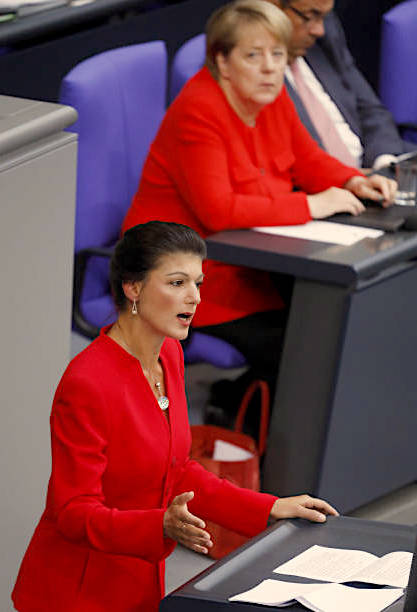
Wagenknecht in the Bundestag (Photo – Michele Tantussi/Getty Images)
Wagenknecht was born in East Germany 48 years ago to an Iranian father and German mother. She is highly educated, with a Ph.D. in economics and is author of books on the young Marx’s interpretation of Hegel, on “The Limits of Choice: Saving Decisions and Basic Needs in Developed Countries” and “Prosperity Without Greed”. The charismatic Sahra has become one of the most popular politicians in Germany. Polls indicate that a quarter of German voters would vote for her as Chancellor.
But there is a catch: her party, Die Linke. Many who would vote for her would not vote for her party, and many in her own party would be reluctant to support her. Why? Immigration.
Sahra’s strongest supporter is Oskar Lafontaine, 74, her partner and now her husband. A scientist by training with years of political experience in the leadership of the SPD, Lafontaine was a strong figure in the 1980s protest movement against nuclear missiles stationed in Germany and remains an outspoken critic of U.S. and NATO militarism – a difficult position in Germany. In 1999 he resigned as finance minister because of his disagreement with the neoliberal policy turn of SPD Chancellor Gerhard Schoeder. He is a consistent critic of financial capitalism and the euro, calling for a change of European monetary policy that would permit selective devaluation and thus relieve the economically weaker member states of their crushing debt burden.
After leaving the SPD in 2005, Lafontaine went on to co-found Die Linke, which absorbed the post-East German Party of Democratic Socialism led by lawyer Gregor Gysi. A few years later he withdrew into the political background, encouraging the rising career of his much younger partner Sahra Wagenknecht.
Lafontaine can be likened to Jeremy Corbyn in Britain and Jean-Luc Mélenchon as a left leader who has retained basic social and antiwar principles from the past and aspires to carry them into the future, against the rising right-wing tide in Europe.
The Wagenknecht-Lafontaine couple advocate social policies favorable to the working class, demilitarization, peaceful relations with Russia and the rest of a multipolar world. Both are critical of the euro and its devastating effects on Member State economies. They favor regulated immigration. Critical of the European Union, they belong to what can be called the national left, which believes that progressive policies can still be carried out on the national level.
The Globalizing Left
Die Linke is split between the national left, whose purpose is to promote social policies within the framework of the nation-state, and the globalization left, which considers that important policy decisions must be made at a higher level than the nation.
As co-leader of the Linke fraction in the Bundestag, Wagenknecht champions the national left, while another woman, the party co-chair Katja Kipping, also an academic of East German origin, speaks for the globalization left.
In a July 2016 article criticizing Brexit, Kipping made it clear that for her the nation is an anachronism unsuitable for policy making. Like others of her persuasion, she equates the nation with “nationalism”. She also immediately identifies any criticism of mass immigration with scapegoating: “Nationalism doesn’t improve our lives, it makes the poor only poorer, it takes nothing from the rich, but instead blames refugees and migrants for all present misery.”
The idea that social reform must henceforth take place only on the European level has paralyzed left parties for decades. The most extreme of the globalizing left shove their expectations even beyond the European Union in hopes of eventual revolution at the global level, as preached by Antonio Negri and Michael Hardt in their joint books Empire and Multitude.
According to Negri, an alarmingly influential Italian theorist who has been dead wrong ever since the 1970s, the final great global revolution will result from the spontaneous self-liberation of the “multitude”. This is a sort of pie in the sky, projecting hopes beyond the here and now to some desirable future made inevitable by the new immaterial means of production (Negri’s boneless imitation of Marxism). Whether or not they have read him, many anarchist anti-globalist notions of The End Times are in harmony with Negri’s optimistically prophetic view of globalization: it may be bad now, but if it goes far enough, it will be perfect.
Since the globalization left considers the nation state inapt to make the revolution, its abolition is seen as a step in the right direction – which happens to coincide with the worldwide takeover of international financial capital. Its core issue, and the one it uses to condemn its adversaries in the national left, is immigration. Katya Kipping advocates “open borders” as a moral obligation. When critics point out that this is not a practical suggestion, the globalization left replies that it doesn’t matter, it is a principle that must be upheld for the future.
To make her policy line even more unrealistic, Kipping calls for both “open borders” and a guaranteed minimum income for everyone.
It is easy to imagine both the enthusiastic response to such a proposal in every poor country in the world and its horrified rejection by German voters.
What can motivate leaders of a political party to make such flagrantly unpopular and unrealizable proposals, guaranteed to alienate the vast majority of the electorate?

Kipling: Globalized immigration in line with international finance. (Getty)
One apparent source of such fantasy can be attributed to a certain post-Christian, post-Auschwitz bad conscience prevalent in sectors of the intelligentsia, to whom politics is more like a visit to the confession booth than an effort to win popular support. Light a candle and your sins will be forgiven! Many local charitable organizations actually put their beliefs in practice by providing material aid to migrants. But the task is too great for volunteers; at present proportions it requires governmental organization.
Another, more virulent strain of the open border advocates is found among certain anarchists, conscious or unconscious disciples of Hardt and Negri, who see open borders as a step toward destroying the hated nation state, drowning despised national identities in a sea of “minorities”, thereby hastening the advent of worldwide revolution.
The decisive point is that both these tendencies advocate policies which are perfectly compatible with the needs of international financial capital. Large scale immigration by diverse ethnic communities unwilling or unable to adapt the customs of the host country (which is often the case in Europe today, where the host country may be despised for past sins), weakens the ability of society to organize and resist the dictates of financial capital. The newcomers may not only destabilize the situation of already accepted immigrant populations, they can introduce unexpected antagonisms and conflicts. In both France and Germany, groups of Eritrean migrants have come to blows with Afghan migrants, and other prejudices and vendettas lurk, not to mention dangerous elements of religious fanaticism.
In foreign policy, the globalization left tends to accept the political and media mainstream criticism of Wagenknecht as a Putin apologist for her position regarding Syria and Russia. The globalist left sometimes seems to be more intent on arranging the rest of the world to suit their standards than finding practical solutions to problems at home. Avoiding war is also a serious problem to be dealt with at the national level.
Despite the acrimonious debates at the June 8 to 10 party congress, Die Linke did not split. But faced with the deadlock on important questions, Wagenknecht and her supporters are planning to launch a new trans-party movement in September, intended to attract disenchanted fugitives from the SPD among others in order to debate and promote specific issues rather than to hurl labels at each other. For the left, the question today is not merely the historic, “What is to be done?” but rather a desperate, Can anything be done?
And if they don’t do it, somebody else will.
Diana Johnstone is the author of Fools’ Crusade: Yugoslavia, NATO, and Western Delusions. Her new book is Queen of Chaos: the Misadventures of Hillary Clinton. The memoirs of Diana Johnstone’s father Paul H. Johnstone, From MAD to Madness, was published by Clarity Press, with her commentary. She can be reached at diana.johnstone@wanadoo.fr .
Trump holds the clock on North Korea while Putin plans his moves
By M.K. Bhadrakumar | Asia Times | June 19, 2018
The argument that China is being “marginalized” by Washington while it works bilaterally with Pyongyang on the profound security issues on the Korean Peninsula has been completely discredited with the surprising news that the North Korean leader Kim Jong-un is back in China on a two-day visit that began today.
The Singapore summit between US President Donald Trump and Kim seems set to produce untold surprises in the future. Kim is indeed acting shrewdly by anchoring his dealings with Trump on his pivotal relationship with Chinese President Xi Jinping. No amount of wishful thinking can obfuscate this geopolitical reality.
Last Friday, Putin telephoned Xi to discuss amongst other issues “the settlement of the situation on the Korean peninsula.” A Xinhua report of their conversation stated that Xi underscored the importance of the two leaderships keeping in close contact and in real time, since the “world situation and hot issues are at the crux of complicated changes” and given the “firm support that our two nations have offered to each other [to] help safeguard the two countries’ sovereignties, securities and development interests, and defend the regional and global peace, stability and justice.”
Meanwhile, the backdrop of that conversation cannot be overlooked – growing tensions between China and Russia on the one hand and the US on the other. On June 15, in a scathing attack on Russia and China, US Defence Secretary James Mattis alleged that “Putin seeks to shatter NATO” and “attempts to undermine America’s moral authority”; and, that the Ming dynasty appears to be Xi Jinping’s model, “albeit in a more muscular manner, demanding other states become tribute states, kowtowing to Beijing.”
While China’s role on the Korean issue is an accepted reality, Russia’s growing profile has been audacious. The point is, Moscow is increasingly pressing for a relaxation and lifting of the UN sanctions against North Korea. The big question is whether and for how long the Russian demand will remain merely verbal before translating into some sort of practical action.
Putin takes a similar approach as the South Korean President Moon Jae-in on the need for constructive engagement of Pyongyang. In some ways, Moscow is even in a position to voice opinions that Seoul may not find it expedient to openly articulate just yet – such as, for example, deployment of the US’ THAAD missile system to South Korea.
All this makes the forthcoming three-day state visit to Russia by Moon on June 21 an engrossing event. While a formal announcement of the visit is yet to be made, Yonhap News Agency “leaked” the news in Seoul on Monday, citing an unnamed South Korean official in the presidential administration. The Yonhap report disclosed that Moon and Putin are expected to pay special attention to North Korea’s nuclear issue during the summit.
It added: “Russia has been making a significant contribution to efforts to denuclearize North Korea while it has also played a significant role in pressuring the North, considering its economic relationship with North Korea.” The news agency went on to quote the South Korean official as summing up: “Also, the visit is expected to help promote strategic cooperation between the two countries [Republic of Korea and Russia] to establish peace in Northeast Asia amid positive developments in security conditions and efforts to denuclearize the Korean Peninsula.” The delicate diplomatic pirouetting is obvious.
Moscow has since acknowledged the veracity of the news regarding Moon’s state visit on Thursday. The Russian Deputy Foreign Minister Igor Morgulov further disclosed that Putin plans to talk with Moon about projects between Russia and the two Koreas. Morgulov said Moscow expects the military confrontation level on the Korean Peninsula to reduce and therefore, cancellation of US-ROK military drills is “a step in the right direction.”
Without doubt, Northeast Asia has begun surging as a top priority in Russian diplomacy. On Friday, a top executive of the Russian gas giant Gazprom disclosed that at Seoul’s initiative Moscow had resumed talks on a Russia-Democratic People’s Republic of Korea-ROK gas pipeline project, saying “a series of talks has been held on this issue, and these talks are continuing.”
The pipeline project holds seamless potential to put rings of engagement around DPRK and stabilize relations between Seoul and Pyongyang, while also remaining a “win-win” project for all three countries in terms of energy security for the two Koreas, plus Russia’s ambitious agenda to develop the Far East with foreign investment, and advancing its “pivot to the East” strategy by expanding its footprint in the Asia-Pacific energy market.
Again, an added dimension that is not quite visible yet is that Tokyo is watching Putin’s moves. The Japanese Prime Minister Shinzo Abe enjoys great personal bonding with Putin. Interestingly, Abe who just visited Russia for the St. Petersburg International Economic Forum (May 24-25) and held talks with Putin, has confirmed his intention to participate in the Eastern Economic Forum (EEF) summit that is scheduled to be held in Vladivostok on September 11-13.
The EEF has become a standing floor for Russia-Japan dialogue, but what lends enchantment to the view is the tantalizing prospect that Putin has also invited Kim Jong-un to the summit in Vladivostok. Is Putin facilitating a meeting between Abe and Kim?
Suddenly, the sky is the limit for Putin’s diplomacy in Northeast Asia. So far, Washington has pretended that Moscow is inconsequential to the Korean endgame. But that is becoming a petulant self-defeating attitude. Trump could possibly make amends when his first summit with Putin takes in early July.
Featured Video

Death Spikes & Rising Cancer In Our Youth Explained
or go to
Aletho News Archives – Video-Images
From the Archives
Politicians lie
By Mazin Qumsiyeh | Popular Resistance | August 18, 2013
There is no way to say this truth nicely: Politicians lie. That includes Japanese, American, Egyptian, Israeli, and Palestinian politicians! Is there something more common sense than that? Yet, so many citizens around the world believe their own politicians or wistfully acknowledge lies but think it is part of the job needed to run things. They believe even when politicians contradict themselves blatantly. This phenomenon is rather remarkable. It is a dissonance and disconnect from reality that many seem oblivious to. It is very dangerous because it can lead to accepting rationales for going to war. These can be deadly wars that lead to millions of lives lost as happened in what was called World War 1 and WW2. Even when incredible and declassified evidence abound, politicians continue to lie and old mythologies refuse to die. Here are just a few of the countless lies told to us over the past few decades… continue
Blog Roll
 Aletho News
- RSF military group defects, joins Sudanese army: State media
- Ireland goalkeeper refuses to play ‘Israel’ as squad weighs boycott
- China pushes back against US on Cuba, Iran
- Ukrainian Soldiers, Potential Mercenaries: Have Gun, Will Travel!
- Burnham’s UN debut… A masterclass in British disinformation
- Iran flights continue despite US aviation sanctions
- Global Tipping Points Lead the World Into a State of Entropy
- The day-after at the White House: USA and Xi Jinping
- The Geopolitical Balance in the Red Sea: The UAE Being Displaced by New Players
- Iraqi resistance group vows to stage airport sit-ins over Iran aerial blockade
- If Americans Knew
- Deconstructing Netanyahu’s pants-on-fire UN rant – Daily Update
- Trump betrayed voters with his campaign lies and prioritized a foreign country once he took office
- Netanyahu calls Israel’s war in Gaza ‘opposite of genocide’ in UN speech to near-empty hall
- Settler Kidnappings: Torture, Sexual Abuse and Terrorisation of Palestinian Abductees as Israel Deepens Annexation of West Bank
- Gaza winter nears as 162,000 tents become unusable, raising fears of humanitarian crisis
- Netanyahu says, “It’s the opposite of genocide”; UN says Gaza economy is world’s ‘most severe crisis on record’ – Daily Update
- Israel’s US-Backed Assault on Gaza Has Created the ‘World’s Most Severe Economic Crisis on Record’: UN
- ‘Protecting U.S. Citizens’… From Israel
- ‘This is where I live now, the back of a truck’: a day in the life of a grandmother in Gaza
- In UN Speech, Iran’s President Displays Pictures of Children Killed by US, Brings Attention to Israel’s Nuclear Arsenal
- No Tricks Zone
- New Study: Earth And Venus Surface Warmth Largely Explained By Convection And Lapse Rate, Not CO2 Or Radiation
- 2025 Nature Paper Claiming Worsening Global Drought Gets RETRACTED …Heavily Flawed
- New Study: ‘Global Drought Shows No Detectable Recent Acceleration Under Climate Warming’
- Economic Masterminds: German Socialists Suggest Taxing Productivity Gains Stemming From Using AI
- The South China Sea Has Not Been Cooperating With The Climate Change Narrative
- Energy Crisis: Germany Enters Heating Season With Historically Low Gas Reserve Fill Levels
- New Study: The Antarctic Ice Sheet Gained Mass From 2020-2024 Due To Staggering Snow And Ice Accumulation
- Study: Ocean Heating Rates From Thousands Of Years Ago ‘Dwarf’ Modern Ocean Heating Rates
- Climate Extremists Target, Attack Large-Scale Power Grid Infrastructure In Germany!
- New Study: Antarctic Ice Melt Has Contributed Less Than 1 Centimeter To Sea Level Rise In The Last 30 Years

