HP Faces $120 Million Potential Loss Due to Complicity in Israel’s Violations of Palestinian Human Rights
IMEMC News & Agencies | June 13, 2018
Hewlett Packard (HP) faces over $120 million in potential losses since India’s largest student federation passed a resolution to support the BDS movement and to boycott Hewlett Packard companies over their well-documented complicity in Israel’s grave violations of Palestinian human rights.
Apoorva Gautam, the India-based South Asia coordinator for the Palestinian BDS National Committee, which leads and supports the global Boycott, Divestment and Sanctions movement for Palestinian rights, explained:
The Students Federation of India (SFI) is more than 4 million members strong, and on June 9, they joined the global campaign to boycott HP. This means that Hewlett Packard companies now risk losing over 4 million potential clients in India because of their complicity in Israel’s gross violations of Palestinian human rights.
Given that the cheapest HP laptop in India costs about $300, this means that HP may be losing a potential student market of over $120 million. This is enormously significant.
What Palestinians and Indian students are showing is that companies seeking to profit from Israel’s military occupation and discriminatory regime face growing popular opposition and risk a serious hit to both their reputations and pocket-books.
HP has provided technology and services that support Israel’s military occupation and racial discrimination policies, including its devastating siege suffocating nearly 2 million Palestinians in Gaza, and illegal settlements built on stolen Palestinian land.
Today, HP-branded companies provide the Israeli government with the servers that house its notorious population registry, a key component in the apparatus of apartheid. Records also indicate that HP-branded companies are still responsible for selling computers to the Israeli military. As such, HP products and services enable racial segregation and denial of basic rights.
In its resolution to boycott HP, the Students Federation of India (SFI) condemned Israel’s recent violence against unarmed Palestinian protesters in Gaza, where Israel killed at least 121 Palestinians and injured more than 13,000 in just the last two months. It also criticized the current right-wing government in India for its “close security and military ties with Israel” and for having become “the largest arms buyer from Israel.”
Vikram Singh, the federation’s General Secretary, promised that the campaign to boycott HP in India would grow:
Our federation will spread the BDS movement and the HP boycott campaign in college and university campuses across India. We will work to convince university administrations to adopt procurement policies that prohibit doing business with HP companies until they prove that they are no longer complicit in Israel’s egregious violations of Palestinian human rights. Until then, this boycott will continue and will grow even stronger.
Abdulrahman Abunahel, a Gaza-based community organizer and coordinator for the Palestinian BDS National Committee (BNC) welcomed the resolution:
Palestinian students and youth movements deeply appreciate the solidarity expressed by our counterparts in the Students Federation of India. As a young Palestinian in Gaza, I know first hand how difficult it is to study, and to simply live, under decades of Israel’s brutal military rule and devastating siege. And I’m heartened by this important gesture of support from India, which reaffirms that where governments fail, people have the the power to act and make a difference.
In the past few years, US church denominations such as the US Presbyterian Church and the United Church of Christ have divested from HP. Friends Fiduciary Corporation, the socially responsible investment firm serving over three hundred Quaker institutions in the United States, divested from HP in 2012. Most recently, the Dublin City Council joined the BDS movement and called for ending ties with HP because of the company’s complicity in Israeli apartheid.
Iran turns to old friends amid European exodus
Press TV – June 12, 2018
The world’s biggest container shipper Maersk Line says it is reviewing Iran operations in the face of US sanctions following President Donald Trump’s withdrawal from an international nuclear deal.
Verbal pledges by European governments to shield trade with the Islamic Republic have not stopped companies from pulling out of Iran projects as they face a “wind-down” period of up to six months before the US reimposes sanctions.
On Monday, German container shipping firm Hapag-Lloyd was reported to have stopped one of its two feeder services to Iran.
The Hamburg-based group, which provides third party services to Iran, will decide on the remaining operation before the Nov. 4 US deadline for companies to halt all trade with Tehran, Reuters reported.
The company was awaiting further clarification as to what operations would be permitted after the wind-down period in order to take final decisions on whether to serve Iran, the news agency reported.
Hapag-Lloyd provides third party feeder ships to Iran from Jebel Ali in the United Arab Emirates because it does not have direct dealing with the Islamic Republic.
Danish shipping companies Maersk Tankers and Torm were reported last month to have stopped taking new orders in Iran.
The EU has said it remained committed to the 2015 Iran nuclear deal and the suspension of its own sanctions but European business entities have questioned the viability of continuing their projects after the sanctions kick in.
And in the absence of clear-cut guarantees from the European governments, Iran has started shoring up ties with the countries which stood their ground in the past when Tehran came under similar sancitons.
On Sunday, Iran President Hassan Rouhani met his Chinese counterpart Xi Jinping in Beijing, with China’s foreign policy mouthpiece Global Times writing that the visit saw Iran’s “comprehensive strategic” relationship with China “upgraded to a new level”.
The meeting with China’s president Xi Jinping took place on the sidelines of the Shanghai Cooperation Organization summit in the eastern coastal city of Qingdao,
China, the largest buyer of Iranian crude, did not reduce crude imports from Iran even at the height of the previous sanctions against Tehran in 2012.
In the first quarter of 2018, China’s imports of Iranian crude rose 17.3% year on year to 658,000 barrels per day, making Iran its sixth biggest supplier.
In their talks, Xi called on the two countries to deepen political relations to enhance strategic mutual trust, increase exchanges at all levels, and continue to support each other on issues of major concern involving their respective core interests, Xinhua news agency reported.
Rouhani also met Indian Prime Minister Narendra Modi who stressed the strategic importance of developing Chabahar Port for expansion of economic and regional cooperation.
India is Iran’s second biggest oil customer and its imports are expected to rise this year, even as Nayara Energy, formerly known as Essar Oil, was reported Tuesday to have decided to slash its Iran imports by almost a half.
Another key meeting on Rouhani’s itinerary was with Russian President Vladimir Putin who criticized the unilateral US move to pull out of the nuclear agreement and reimpose sanctions on Iran.
Rouhani said Iran and Russia should continue multilateral cooperation in the fields of security and regional issues.
Russia is Wary of Borrowing Abroad but Has Increased Foreign Debt by 10% in 2018 Anyway
Sputnik – 12.06.2018
Worried by Russia’s small foreign debt, international creditors are advising it to borrow more, but Russia’s Central Bank believes that investments, not loans, are the way to go.
Russia’s $525-billion foreign debt is dwarfed by $7.5 trillion in Britain, $5 trillion in France, $4.8 trillion in Germany and a whopping $21 trillion in the US.
This tell-tale ratio was not lost on IMF Managing Director Christine Lagarde who, when speaking at the recent St. Petersburg International Economic Forum, described Russia’s foreign debt as “considerably small” and said that it should borrow more.
The Russian Central Bank disagrees, arguing that “investments, not debt capital” should be the main source for financing the country’s economic growth.
Big Debt – Big Problems
Foreign debt may become a major problem if market conditions suddenly change for the worse. The smaller the debt, the lesser the chances of a default. Economists say that with Russia’s foreign debt accounting for just 33 percent of GDP, this is a fairly moderate debt burden.
Russia’s entire foreign debt is commensurate with the country’s gold and currency reserves of $450 billion. This means that Russia’s financial system can simply buy it back from foreign holders at any time.
Risk Minimization
Experts also say that Russia’s small foreign debt and its ability to pay it back fast makes it less dependent on foreign financing.
“The developing markets have found themselves in a bad fix with money going out and high dollar-denominated debt negatively impacting the national economies. In Russia this risk is virtually nonexistent,” TeleTrade currency strategist Alexander Yegorov told Sputnik.
A balanced budget is another reason why Russia does not need to borrow abroad.
This year Russia will have a budget surplus – the first in seven years with the Finance Ministry expecting state revenues to exceed outlays by more than half a trillion rubles ($16 billion).
A small foreign debt is also an indicator that the economy is performing well and the country is paying less interest on borrowed money.
There is one downside here, though, as this leads to a shortage of funds needed for economic growth. Russia is ready to borrow, provided that the money goes into useful and profitable projects that allow the country to easily meet its financial obligations to its foreign partners
In the first quarter of 2018, foreign sources lent Russia an estimated $17 billion in the form of sovereign Eurobonds. Another $2.3 trillion rubles ($36 billion) came from foreign investors buying federal loan bonds.
Russia’s Central Bank governor, Elvira Nabiullina, believes that Russia could borrow more abroad and use part of the money to finance various infrastructure projects inside the country.
George Monbiot: selling the 1% agenda in a Green box

George Monbiot NOT shilling for corporate interests
By Catte | OffGuardian | June 8, 2018
The neoliberals of today specialise in using concepts of concern and inclusiveness as a cover for their frankly fascist agenda. Censorship is being repackaged as “anti-hate”. The destruction of the core idea of “innocent until proven guilty” is being repackaged as protecting (mostly female) victims from their persecutors. Reasonable doubt is being repackaged as “denialism.” Minority opinion is being repackaged as treachery or subversion. Facts that contradict a current state-sponsored agenda are repackaged as “fake news.”
Conformity is being encouraged, presented as a cosy and reassuring “consensus blanket”, under which we can all snuggle together, safe from confusion, doubt or the horrendous experience of having our cherished beliefs called into question. Most journos operating in the mainstream have already opted to crawl in and curl up for the long snooze into intellectual and ethical oblivion, while others, the kapos, are actively herding the remaining doubters inside.
George Monbiot is one of the latter. The last few years have outed this one time supposed anti-establishment figure as nothing more than a fully establishment goon, posturing in the sad tatters of his “dissident Green” cosplay. His performance during the Syria crisis made this too obvious. His sub-intelligent smears on those independent journalists daring to question the narrative made his real allegiances, and limitations, more than clear. His preparedness to brazenly lie and his refusal to debate the people he smeared in an open forum cemented this view.
Monbiot is revealed as the guy the establishment uses to try and lure the Left-Greens out in support of the latest agenda roll-out by the likes of Soros, Gates and the Atlantic Council. He’s booked for the same gigs as Avaaz. His brief, as ever, is to sell fascism – but this time in a Green box.
Today George is busy selling us on veganism.
Now, don’t get me wrong. Veganism is fine. It’s a human choice and it has a place. This is not an attack on veganism, or vegans.
But we need to separate what a thing is from what it’s being used for. Everything, even the best things, can be exploited. And we can’t let loyalty to the thing itself stop us from seeing when its being used for less than good ends.
Veganism is being promoted right now by the usual suspects. There has been a rash of articles in the Guardian and elsewhere about the supposed health and environmental benefits of giving up meat and dairy. Even if we happen to be vegan, we’d be insane not to wonder why. Especially when Monbiot is getting involved.
George is a poster child for the New Wave Vegan. Strange, perhaps, given he’s only a “97% vegan” himself. But let’s just ignore the 3% carnivore, since it’s only road kill. The more important point, anyway, is that George wants us all to think he’s a vegan. Because a salesman has to be seen to use the product he’s promoting. His latest article breaks no new ground on this really. He’s said most of it before, as have others. But still, given the mounting evidence for the political mobilisation of veganism, it’s a good idea to look at what he says.
He starts by offering a binary choice – between the current wasteful and insane industrial farming system and a somewhat poorly defined alternative in which everyone eats a plant-based diet, which he implies without really saying, will put an end to this insanity. He tells us not only will this choice fix the problem of worldwide food shortage (because plant-husbandry produces far more calories per hectare than animal husbandry), but it will also remove the problem of all that unused animal waste currently pouring into rivers and creating massive pollution.
George’s ideal future will also be gratifying for the processed food industry. Because vegans need ready meals!
Unless you can cook well – and many people have neither the skills nor the space – a plant-based diet can be either boring or expensive. We need better and cheaper vegan ready meals and quick and easy meat substitutes
And fake meat grown in a lab!
The big shift will come with the mass production of cultured meat.
George recognises the latter will be a tough sell, but he’s up for giving it a try. An objection to this might be that “artificial meat is disgusting”, says George, but:
If you feel this way, I invite you to look at how your sausages, burgers and chicken nuggets are currently raised, slaughtered and processed. Having worked on an intensive pig farm, I’m more aware than most of what disgusting looks like.
Mmmm… Lab-grown pseudo-meat, pink-dyed and not quite as disgusting as something even worse! Lovely Roundup-saturated veggies [silage] processed into some approximation of the kind of protein humans can digest, and piped into microwavable sachets.
Who knew utopia would end up looking quite so much like – now? Who knew the new way would be just like the old way but with more “progressive” slogans?
George uses twisty self-contradictory arguments to claim one minute that eliminating livestock farming would “be a chance to break our complete dependence on artificial nitrogen”, while in his very next para admitting the exact opposite will in fact be the case.
the transition to plant protein is unlikely to eliminate the global system’s need for artificial fertiliser
Though he throws us a bone in the shape of
the pioneering work of vegan organic growers, using only plant-based composts and importing as little fertility as possible from elsewhere
This is blatant bait and switch. Green or green-sounding proclamations being swapped out for their very opposites with a deftness he hopes will fool us. We may, in some misty future time, not need to rely entirely on synthetic chemicals – but yes, OK, for now we will still be sucking up carcinogens with our lovely all veg diet.
Of course we could just use the animal manure to fertilise our veggies, which would entirely eliminate the need for chemical fertilisers… But let’s not think about that too much. Let’s instead soften that focus and just picture fields full of lovely cruelty-free plants waving in the even lovelier breeze…
In case you haven’t noticed, George’s entire article is hand-waving nonsense predicated on a lie, or a system of lies, and his trademark nifty footwork.
His claim that we need to produce more food is used as a blanket rationale for everything he advocates, but it’s a lie. We don’t need to produce more food. We currently produce more than enough food to feed the world. What we need and don’t have is equitable distribution. And that is because of the stranglehold of the minority interests George is carefully eliding.
His initial binary choice is a lie. We don’t need to choose between intensive animal farming and intensive cereal/veg farming. We have the option of non-intensive farming methods that treat the land, the animals and the crops with respect, and use age-old, sustainable methods to produce chemical-free and healthy food.
His dishonesty is nowhere more apparent than when he tries to elide this simple truth. Look at how he acknowledges the illogicality of unused animal waste
Today, the link between livestock and crops has mostly been broken: crops are grown with industrial chemicals while animal slurry stacks up, unused, in stinking lagoons, wipes out rivers and creates dead zones at sea.
but dodges away from the obvious solution – use the “slurry” to fertilise the land in place of synthetic chemicals – with a weak excuse:
When it is applied to the land, it threatens to accelerate antibiotic resistance.
Notice how he avoids mentioning the fact non-intensively reared animals don’t need to be pumped full of antibiotics in the first place. He even links to the source for sustainable husbandry I cite above, but does so only to dismiss it (without data) as “worse” than anything else on offer, by using, once again, the fake claim about the need to produce more food per hectare:
More damaging still is free-range meat: the environmental impacts of converting grass into flesh, the paper remarks, “are immense under any production method practised today”. This is because so much land is required to produce every grass-fed steak or chop
And adding that it’s also bad for the environment
Those who claim that “regenerative” or “holistic” ranching mimics nature deceive themselves. It relies on fencing, while in nature wild herbivores roam freely, often across vast distances. It excludes or eradicates predators, which are crucial to the healthy functioning of all living systems. It tends to eliminate tree seedlings, ensuring that the complex mosaics of woody vegetation found in many natural systems – essential to support a wide range of wildlife – are absent
You thought Monsanto, GM, monocultures and the ripping up of hedgerows was the problem? Nah. It’s fences. And herbivores eating the grass they’re designed to eat. And implicit in this nonsense of course is the greater nonsense that massive veggie monocultures drowned in pesticides and herbicides, are just teaming with wild life, tree seedlings and predators.
Just as he used frank lies to promote the Soros-backed White Helmets as unsung “heroes”, here, in the fake guise of promoting a healthy, organic, back-to-nature solution to the world’s problems, George is promoting the current power system of Big Ag and Big Food monopoly. Just as Avaaz sells us imperial regime change as grass roots activism, George is selling us industrial farming and denatured food as a return to Eden.
Don’t buy what he’s selling. Don’t surrender your sense of the real to this snake oil salesman. Go vegan if you want – that’s a fine personal choice. But not at the expense of the small producers who are already struggling to survive without the subsidies the big guys get. Don’t vote for some future “meat tax” that will drive them out of business, and penalise the poor, just as Big Ag wants. Don’t buy into this soft focus dreamland where our entire livestock herd disappears bloodlessly and completely from our landscape without being killed or culled, and is somehow better for it. Don’t be whispered into campaigning for a new and self-imposed serfdom, in which 7 billion compliant vegans munch their potage or their shrink-wrapped lab-grown Soylent Green, while the 1% quietly eat grass-fed steak and snigger with duping delight.
Iran to boost production of uranium enrichment material – state atomic agency
RT | June 5, 2018
Iran has begun preliminary work on infrastructure for advanced centrifuges, the country’s Atomic Energy Organization has confirmed. The announcement comes after Tehran said it would revamp its uranium enrichment program.
The infrastructure project is being carried out at a facility in Natanz. Iran also plans to boost production of UF6, a gas needed to produce fuel for nuclear reactors and weapons. But the country’s nuclear activities will remain within the framework of the 2015 nuclear deal, Ali Akbar Salehi, the director of Iran’s Atomic Energy Organization (AEOI), has stated.
A spokesman for the organization said that the International Atomic Energy Agency (IAEA), which oversees Iran’s compliance with the 2015 JCPOA deal, will be notified of Iran’s activities on Tuesday.
“In a letter that will be handed over to the International Atomic Energy Agency … Iran will announce that the process of increasing the capacity to produce … UF6 (uranium hexafluoride) … will start on Tuesday,” he said.
The spokesman said it was being done on the orders of Iranian Supreme Leader Ayatollah Ali Khamenei, who said in a speech on Monday that AEOI must promptly prepare to start uranium enrichment “up to a level of 190,000 SWU for the time being within the framework of the JCPOA (Joint Comprehensive Plan of Action).”
SWU or “separative work unit” is a standard measure of the effort needed to separate isotopes of uranium during an enrichment process. 1 SWU equals 1 kg of such effort.
Previously, Iran’s Atomic Energy Agency estimated that its enrichment capacity will reach 190,000 SWUs by the 15th year after the deal comes into effect. For that purpose, Iran planned to gradually increase its number of centrifuges, while staying within the scope of the deal.
Speaking to ISNA, Kamalvandi stressed that, by boosting its nuclear program, Iran does not seek to develop nuclear weapons. “Our goals are not to achieve a nuclear weapon, and it’s against our religious stance.”
“The message of our actions is that we will maintain our capacity for activation at a high level, and if we agreed to limit it now, it is because the parties must adhere to their commitments,” he said.
After the US exit from the deal on May 8, other parties to the landmark agreement, including France, the UK, and Germany vowed to abide by the deal and keep it intact, despite the US withdrawal. However, European nations followed the lead of Washington in demanding that Iran’s missile program and its regional posture must be a part of any future negotiations for a post-deal security framework. Iran has vehemently refused to tie its ballistic missile program, which has not been a part of the original agreement, to the deal and has called on Europe to compensate it for the impact that the reimposed US sanctions will have on its economy. On Monday, Khamenei said Europe should not expect Teheran to stay in the deal if it does nothing to shield it from the brunt of punitive measures coming its way.
“It seems from what they say that some European governments expect the Iranian nation to both put up with sanctions and give up its nuclear activities and continue to observe limitations [on its nuclear program]. I tell those governments that this bad dream will never come true,” he said.
He again ruled out that Iran might agree to curtail its ballistic missile development, saying that it’s wishful thinking by Europe if it believes otherwise.
“I am telling the Europeans, ‘Limiting our missile work is a dream that will never come true,” Khamenei stressed.
One of the major points of Iran’s ultimatum to Europe is that it must offset the damage inflicted on its energy industry by buying Iranian oil and protecting trade with the Islamic Republic by providing banking guarantees.
Last week, a senior adviser to Khamenei, Ali Akbar Velayati, told Iranian media that the continuation of the talks would depend on Europe’s readiness to meet these demands.
“We will preserve Iran’s regional and missile power to kill US with envy,” he added.
Putin Signs Bill on Countermeasures Against US, Its Allies
Sputnik – 04.06.2018
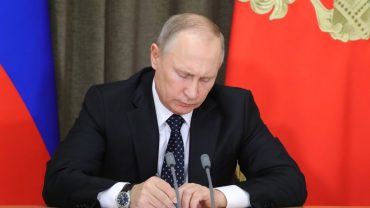 Russian president Vladimir Putin has signed a bill on countermeasures against the United States and its allies.
The law enters into force on the day it is published.
The bill was passed by the Russian Lower House in May. The goal of the legislation is to defend Russia’s sovereignty from “unfriendly actions” by Washington and other foreign states that have imposed political and economic sanctions on Moscow.
On April 6, Washington unveiled new sanctions on Russia over what it described as “global destabilization efforts.” The sanctions list included senior government officials, and lawmakers, as well as major business owners and private and state-owned companies under their control.
In response, Russian Prime Minister Dmitry Medvedev said that Moscow reserves the right to respond to the new US anti-Russia sanctions and may review trade deals.
The Russian Embassy in the United States said that the new package of sanctions is another hit to bilateral relations, adding that the sanctions will hurt thousands of Russian citizens who are part of the businesses that were targeted.
Italy: The Center Cannot Hold
By Diana Johnstone | Consortium News | June 3, 2018
The traditional governing parties, center “left” and center “right” all follow the same neoliberal policies and constitute the self-designated “center.” Mainstream media enforce center right claims to authority on the base of orthodox economic expertise, while the center left derives its authority from its “values,” centered on an identity politics version of human rights. “Center” sounds so reasonable, so safe from dangerous “extremes” and unpredictable populism. Against such threats, the Center presents itself as the champion and safeguard of “democracy.”
How true is this?
World Values Survey results indicate that in Europe and the United States, people who describe themselves as “centrist” on the average have less attachment to democracy (e.g. free and fair elections) that those on the left, and even those on the far right. This is not as surprising as it may seem at first, since “centrists” are by definition attached to the status quo. In European countries, the authoritarian neoliberal “center” is institutionalized in the European Union, which imposes economic policy over the heads of the parliaments of the member countries, dictating measures which conform to the choices of Germany and northern Europe, but are increasingly disastrous for the Southern EU members.
The Centrist fear of democracy was resoundingly confirmed by March 4 legislative elections in Italy. The Center was relegated to the margins and outsiders burst in. The winner, with 32 percent of the votes, was the Five Star Movement (M5S) whose campaign “against corruption” won popular support in the impoverished South. In second place, with 17 percent, was “the League”, formerly the Northern League – that is, a party of rich north Italy chauvinists ready to secede from the “lazy good-for-nothing” south. It took almost three months for this extremely odd couple to agree to a coalition government.
The mystique of the European Union is anti-nationalist, based on the theory that “nations” are bad because they caused the devastating wars of the twentieth century, while European unification is the sole guarantee of “peace.” Convinced of their mission, the Eurocentrists have had no qualms in throwing out the baby of democratic choice along with the nationalist bathwater.
The notion that “peace” depends on “Europe” persists despite the NATO bombing of Serbia and European participation in U.S. wars in Afghanistan, Iraq, Libya and Syria, not to mention EU participation in the current major military buildup in the Baltic States against “the Russian enemy.” Indeed, thanks to NATO, the EU is gearing for a war even worse than the previous ones.
Since the “nation-state” is blamed for evil in the world, the Eurocentrists react with horror at growing demands in Member States for a return to “national sovereignty.” This, however, is a natural reaction to the economic and social disasters resulting from policies dictated by EU institutions in Brussels. The 1992 Maastricht Treaty legally bound member countries to centralized neoliberal monetarist policies; not only “socialism” became illegal – even Keynesianism was ruled out. Promised endless peace and prosperity, citizens of European countries were cajoled into giving up their sovereignty to EU institutions, and many now want it back.
Disillusioned Italy
Italian disillusion is particularly significant. Italy was an exceptionally enthusiastic founding member of the unification begun with the 1957 Treaty of Rome. And yet, Italy’s own history illustrates what can go wrong with such unification, since the 19th century political creation of a unified Italy centered in Turin led to the enrichment of the industrial north at the expense of southern Italy, where the splendor of Naples declined into chronic poverty, crime and corruption. Now Italy itself is “the south” in the periphery of a European Union centered around Germany.
Antagonism between northern and southern Italy has given way to a much stronger antagonism between Italy and Germany – each blaming the other for the crisis.
It is only fair to recall that Germans were very attached to their Deutsche Mark and to their own austere financial policies. Germany could only be lured into the common currency by agreeing to let the euro follow German rules. France eagerly supported this concession based on the notion that the common currency would unify Europe. It is doing quite the opposite.
Germany is a major exporting nation. Its trade with the rest of the EU is secondary. It uses the EU as its hinterland as it competes and trades globally with China, the United States and the rest of the world. The proceeds of Germany’s favorable EU trade balance is less and less invested in those countries but in Germany itself or outside the EU. In the official German view, the main function of the Southern EU members is to pay back their debts to Germany.
Meanwhile, Italy’s once flourishing industrial network has lost its competitive edge due to the euro. It cannot save its exports by devaluation, as it was accustomed to doing. Italy’s debt is now 132 percent of its GNP, whereas the Maastricht Treaty governing the monetary union puts a ceiling of 60 percent on national debt. And to continue paying the debt, public services are cut back, the middle class is impoverished, the domestic market declines and the economy gets even weaker.
This is precisely the situation that has plunged Greece into ever deepening poverty.
But Italy is not Greece. Greece is a small peripheral country, which can be pounded to death by creditors as a warning of what can happen to others. Italy, on the contrary, is too big to fail. Its collapse could bring the whole EU crashing down.
Italy’s Potential Strength Through Weakness
The traditional Italian parties had no solution beyond those that have ruined Greece: cut back social spending, impoverish workers and pensioners, and pay back the foreign banks, with interest.
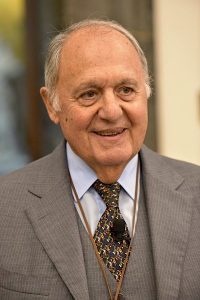
The odd coalition of the League and the M5S was obliged to try something different: basically, to invest in the economy rather than abandon it to its creditors. Their program combines lower taxes with Keynesian stimulation of investment. Since the leader of the League, Matteo Salvini, and Luigi Di Maio of M5S do not like each other, they selected law professor Giuseppe Conte to be Prime Minister in their coalition cabinet. The interesting choice was that of Paolo Savona for the key post of Minister of Economy and Finance. Savona, whose long career has taken him across the summits of Italian and international finance, was certainly the most qualified choice imaginable. Savona knows everything there is to know about the Italian economy and international currency creation.
And yet, it was the appointment of this 81-year-old expert that created outrage in the Eurocenter.
The uproar was spurred by the fact that in one of his books Savona had described the euro as “a German prison.” Savona had also said it was necessary to prepare a Plan B, to leave the euro if there is no other choice. “The alternative is to end up like Greece.”
This hint of disloyalty to the euro was totally unacceptable to the European establishment.
The Center struck back in the person of the largely figurehead President of Italy, Sergio Mattarella, who used, or misused, his unique constitutional power by refusing to approve the government. On May 28, he designated as prime minister Carlo Cottarelli of the International Monetary Fund – a man who represented everything the Italians had just voted against. Known in Italy as “Mr. Scissors” for his advocacy of drastic government spending cuts, Cottarelli was supposed to run an apolitical “technical” government until new elections could be held in the fall.
This coup against the Italian voters caused momentary rejoicing in the Authoritarian Center. The European Budget Commissioner (a German of course), Günther Oettinger, was reported to be gloating over the prospect that “the markets” (meaning the financial markets) would soon teach Italians how to vote. Italy’s economy “could be so drastically impacted,” he said, as to send a signal to voters “not to vote for populists on the right and left.”
This simply intensified Italian indignation against “German arrogance.”
Savona: Plan B just a negotiating tactic
Meanwhile Savona wrote a letter to President Mattarella which introduced a bit of cold reason into an increasingly hysterical situation. He reminded the president that an important meeting of EU heads of state was to be held at the end of June; without a political government, Italy would be absent from negotiations which could seal the fate of the EU. Italy’s plea for economic change could expect French support. Savona denied having called for leaving the euro; in the spirit of game strategy, he had mentioned the need for Plan B in order to strengthen one’s position before negotiations. He made it clear that his strategy was not to leave the euro but to transform it into a genuine rival to the dollar.
“Germany prevents the euro from becoming ‘an essential part of foreign policy’, as the dollar is for the United States”, wrote Savona. But change becomes necessary, as the dollar is less and less suitable for its role as world currency.
Indeed, the Italian crisis merges with a mounting trans-Atlantic crisis, as the U.S. uses sanctions as a weapon in competition with its European “partners.” The paradox is that Italy could use its very weakness to oblige Germany to reconsider its monetary policy in a moment when the German economy is also facing problems due to U.S. sanctions on deals with Russia and Iran, as well as protectionist measures. Savona’s message was that clever diplomacy could work to Italy’s advantage. In its own interest, Germany may need to accept transformation of the euro into a more proactive currency, able to defend European economies from U.S. manipulation.
It was a matter of hours before Cottarella stepped back and a new M5S-League government was formed, with Savona himself back as Minister of Relations with the European Union.
Italy’s Double Jeopardy
The new Italian cabinet sworn in on June 1 is riven with contradictions. Despite all the released anti-EU sentiment, it is definitely not an “anti-EU” government. Conte is back as prime minister. The new foreign minister, Enzo Moavero Milnesi, is a staunch pro-European. As interior minister, the northern Italy chauvinist Salvini – who doesn’t particularly care for southern Italians – will get tough with migrants. As minister of economic development M5S’ Di Maio will try to find ways to improve conditions in the southern regions that elected him. Since Salvini is the more experienced of the two, the League is likely to profit from the experiment more than the M5S.
Some Italians warn that by leaving the “German prison” Italy would simply find itself even more dependent on the United States.
One should never forget that ever since the end of World War II, Italy is an occupied country, with dozens of U.S. military bases on its territory, including air bases with nuclear weapons poised to strike the Middle East, Africa or even Russia. The Italian Constitution outlaws participation in aggressive war, and yet Italian bases are freely used by the United States to bomb whichever country it pleases, regardless of how Italians feel about it.
Worst of all, the U.S. used its Italian “NATO bases” to destroy Libya, a disaster for Italy which thereby lost a valuable trade partner and found itself inundated with African refugees and migrants. While international financial experts exhort Italy to cut government expenses, the country is obliged by NATO to spend around 13 billion euros to buy 90 U.S. F-35 fighters and to increase its military spending to around 100 million euros per day.
Italy’s economic prospects have also been badly hit by U.S.-enforced sanctions against trade with Russia and Iran, important potential energy sources.
U.S. economic aggression, in particular Trump’s rejection of the Iranian nuclear deal, is the issue with the potential to bring European leaders together at a time when they were drifting apart. But at present, the Europeans are unable to defy U.S. sanctions in punishment for trade with those countries because their international dealings are in dollars.
This has already led to the U.S. exacting billions of dollars in fines from the biggest French and German banks, the BNP and Deutsche Bank, for trading that was perfectly legal under their own laws. The French petroleum giant has been obliged to abandon contracts with Iran because 90% of its trade is in dollars, and thus vulnerable to U.S. sanctions. And that is why the idea is growing of building financial instruments around the euro that can protect European companies from U.S. retaliation.
The Disappearance of the Left
The disappearance of left political forces has been almost total in Italy. There are many reasons for this, but a curable part of the problem has been the inability of what remains of the left to face up to the two main current issues: Europe and immigration.
The left has so thoroughly transformed its traditional internationalism into Europism that it has been unable to recognize EU institutions and regulations as a major source of its problems. The stigmatization of “the nation” as aggressively nationalistic has held back the left’s ability to envisage and advocate progressive policies at the national level, instead putting its hopes forever in a future hypothetical “social Europe.” Such a transformation would require unanimity under EU rules – politically impossible with 28 widely differing Member States.
Without such inhibitions, the far right capitalizes on growing discontent.
Another related handicap of the left is its inability to recognize that mass immigration is indeed “a problem” – especially in a country like Italy, with a flagging economy and 20 percent official unemployment (although this figure is probably too high, considering undeclared labor). There is resentment that prosperous Germany issued a general invitation to refugees, which for geographic reasons pile in Mediterranean countries unable to cope. The mass influx of economic migrants from Africa is not even “taking jobs away from” Italians – the jobs are not there to take. These migrants fled war and misery to come to Europe in order to earn money to send back to their families, but how can they possibly meet these expectations?
It is all very well to extol the glorious hospitality of America entreating the world to “Give me your tired, your poor, Your huddled masses yearning to breathe free, The wretched refuse of your teeming shore. Send these, the homeless, tempest-tossed to me…”. Such generosity was suited to a new nation with huge empty spaces and rapidly growing industry in need of a work force. The situation of a “full” nation in a time of economic downturn is quite different. What is to become of the tens of thousands of vigorous young men arriving on Italian shores where there is nothing for them to do except sell African trinkets on the sidewalks of tourist centers? To make matters worse, the great contemporary thrust of technical innovation aims at replacing more and more workers with robots. Leftist denial of the problem leaves its exploitation and resolution to the extreme right.
Some leftist politicians in Italy, such as Stefano Fassina of the Sinistra Italiana are waking up to this need. A left that dogmatically ignores the real concerns of the people is doomed. A bold, honest, imaginative left is needed to champion Italians’ independence from both German-imposed austerity and the expensive military adventurism demanded by the United States. But the interlaced problems created by unregulated globalization do not lend themselves to easy solutions.
Diana Johnstone is a political writer, focusing primarily on European politics and Western foreign policy. She received a Ph.D. at the University of Minnesota and was active in the movement against the Vietnam War. Johnstone was European editor of the U.S. weekly In These Times from 1979 to 1990, and continues to be a correspondent for the publication. She was press officer of the Green group in the European Parliament from 1990 to 1996. Her books include Queen of Chaos: The Misadventures of Hillary Clinton, CounterPunch Books (2016) and Fools’ Crusade: Yugoslavia, NATO and Western Delusions, Pluto Press (2002).
Trade War and the Nationalist Exchange: Trudeau Trails Trump
By Maximilian C. Forte | Zero Anthropology | June 1, 2018
“These tariffs are totally unacceptable. For 150 years, Canada has been America’s most steadfast ally. Canadians have served alongside Americans in two world wars and in Korea. From the beaches of Normandy to the mountains of Afghanistan, we have fought and died together. Canadian personnel are serving alongside Americans at this very moment. We are partners in NORAD, NATO, and around the world. We came to America’s aid after 9/11—as Americans have come to our aid in the past. We are fighting together against Daesh in Northern Iraq…. That Canada could be considered a national security threat to the United States is inconceivable…. these tariffs are an affront to the long-standing security partnership between Canada and the United States, and in particular, to the thousands of Canadians who have fought and died alongside American comrades-in-arms”—Justin Trudeau, Prime Minister of Canada, May 31, 2018
So we now see the launch of a trade war between the US versus Canada, Mexico, and the EU. Focusing on the place of residence of the writer, Canada, one can argue that this trade war is very good news, if one knows how to read this development properly. Justin Trudeau’s visible anger is a testament to the good news: his anger is that he is now required to perform in the role of an economic nationalist, something for which he was not trained. All of his apprenticeship under globalist mentors—such as the Center for American Progress, the Aga Khan and George Soros—only prepared him to play a supporting role as part of a now wounded and cornered neoliberal elite. Trudeau was only meant to be a builder of “team spirit” in service of the technocrats who facilitated neoliberal globalization. He was there to cheer “Canadians” (whatever that word means now) that they were becoming like everyone from everywhere: they were a bit of everything, and nothing in particular. Trudeau thus pranced at the front of gay pride parades, pushed legislation on transgender pronouns, introduced a gender quota for his cabinet, a gender budget, sorted out cabinet ministers according to skin colour and headwear, welcomed everyone to an open Canada, and chided citizens for saying “mankind” instead of “peoplekind,” because the latter is “more inclusive”. And what does he have to show for his efforts? He is now the one to speak of illegal border crossers who should stay away, and imposes counter-tariffs.
Trudeau opened his remarks on the national security front—a big mistake. It was a big mistake for two reasons. One reason, of lesser importance than the next, is that it shows the literalism that is at the heart of moral narcissism and virtue signalling—that you take your opponent’s statements to be literally true, at face value, and no contextualization is necessary. Trudeau thus took great offense at the suggestion that Canada somehow undermined US national security—as if our purpose as a sovereign nation-state was to always serve the Americans better. President Trump, however, is merely using the available tools—he does not think that Canada literally threatens US national security, but he has to invoke that notion because it permits him to use a particular instrument—and that’s all. Back in March, if one was paying attention, one of the arguments Trump used to defend US steel and aluminum industries is that they were vital to US national security and its weapons industries. The Trump administration cited Section 232 of the Trade Expansion Act of 1962. I predicted this would be the justification in 2016, when the media floated arguments dismissing the prospect of Trump’s protectionism, insisting he would need Congressional approval. Others instead advanced the murky argument that the “deep state” would prevent him. Some tried to cover their lack of insight by saying Trump invoked “a rarely used law”. The constant refrain—inexplicably maintained despite its obvious contradiction—was that Trump was a threat and yet Trump would also have no real power. Almost all instantly forgot the meaning of executive power, and how it has increased under the imperial presidency. President Trump proved he could take such action, especially when the action is declared an “emergency” and a “threat to national security”. The only “mystery” here was why Trump suddenly decided to return to a nationalist posture, after a full year of reversals that favoured the continuation of neoliberal globalization. Gary Cohn, Trump’s chief economic adviser and former president of Goldman Sachs, promptly resigned from the administration after Trump announced the tariffs. Some thus saw economic nationalists regaining the upper hand in the Trump administration. It could be that Trump is now reconciled to the realization that his family’s business empire will never become properly transnational, and is even having to pull back from simply experimenting with being international. Trump family fortunes have returned home to roost—that is one possible explanation, and it’s a side issue for now. What we do know, even so soon, is that there is in fact some evidence that jobs are returning to the US steel industry, thanks primarily to Trump’s protective tariffs.
The second reason it was a mistake for Trudeau to use national security as an entry point is that it now opens a valid question for Canadians: what good is our alliance with the US? Why are we in all those wars? Why are we always tagging along with the Yanks? What were we doing in Afghanistan? It’s not like Toronto was attacked on 9/11. Why should we be members of NATO and NORAD? All of it really does not count for anything in the end. Trump has played Trudeau, repeatedly, and is now forcing Trudeau to substantively and effectively call into question Canada’s subservient role as an upholder of American empire. This is an example of the indirectly, quietly subversive outcomes of Trump’s “America First” program, as I argued in “What Happened to the American Empire?”
As for virtue signalling, Trump can do that too. With an absolutely phony earnestness, which neither Trudeau nor anyone else correctly read, Trump would pretend to be enchanted with his Canadian guest, lavishing warmth and praise on him… and look, here’s my daughter, she’s so charmed by you too! All smiles, handshakes, and exuberant lyrics, and it was all deliberately calculated bullsh*t, like you would expect of an expert dealer. Meanwhile, Trump does not forget who his adversaries are, and quietly and indirectly at first—and now loudly and directly—he set about destabilizing Trudeau’s Canada. First there was the mysterious push of illegal border crossers toward Canada, with the US amply admitting Nigerians on visas when their only intention is to enter the US to cross into Canada illegally. Trudeau said Canada would remain open and welcoming, in a direct rebuke aimed at Trump, and now Trump would make him pay for his words—and he has, in spades. More on that in a future article. Then Trump imposed tariffs on Canadian dairy products, softwood lumber, newsprint, massively crushing tariffs on Bombardier passenger planes, and then the renegotiation of NAFTA itself, with the threat of simply tearing up the deal.
Where has Trudeau’s leadership been in all of this? With less people than California, the US market matters a lot more to Canada than vice versa. How has Trudeau prepared Canadians for possible job losses, perhaps in the tens of thousands, as a result of an abrupt trade shock? How will social services suffer in provinces most affected by a diminished export market? Today the Canadian media like to boast that Canada will hit Florida orange juice, so—hint, hint—good luck winning Florida in the next elections. They should be thinking about Canadian elections instead, rather than taking the attitude that only the US will suffer, or that it will suffer more than Canada. But that is what we get: instead of a plan, a program, just amateur cockiness.
How has Trudeau’s government coordinated with local and national industries to realign production to domestic suppliers and domestic consumption in the event of a trade war? Where are the “innovative” and “smart” plans now? Canadian ruling elites have been funding the training of a generation of students to think in globalist terms, and shun nationalism—when what they should have been teaching students is not just to start loving nationalism, but to love their nation. What nation is that, you ask? Writing from Quebec, but as someone raised in Ontario, my very strong impression is that it is Anglo-Canada in particular that has the real identity crisis—that is, not having an identity. We can forget about Aboriginal peoples planting the seeds of a new Canadian creolization, as I argued elsewhere; instead, Aboriginals are being effectively put back in their cultural ghettos, shielded by a paranoia over phony “cultural appropriation,” thus sequestered, contained, and removed from the Canadian conversation. Instead the model we have in Canada sounds like it was imported from Amazon.com: everyone in their appropriate box, and every box on its appropriate shelf.
“We’ll see what happens”. “Maybe this will be big, maybe it won’t. Who knows?” However, it is still worth raising the possibility that if the trade war continues, and lasts, it’s Canada that might not last. The Trump transfer of costs will have achieved its maximum effect. Part of that Trump transfer is that Canadians are being taught—forced—to become nationalist Trumps in their own right, or lose. Let’s see what happens.
A final thought: having lived for a few years in Cape Breton, one of Canada’s long-standing and primary centres in the production of steel, I saw first hand the degree of economic destruction and social devastation wrought on Canadian production by foreign competition, among many other factors. Real leadership would seek to maximize the benefits of protection that (counter)tariffs now offer us, a chance to make sure not all of Canada experiences the kind of econocide witnessed by Cape Breton.
Featured Video

Death Spikes & Rising Cancer In Our Youth Explained
or go to
Aletho News Archives – Video-Images
From the Archives
Politicians lie
By Mazin Qumsiyeh | Popular Resistance | August 18, 2013
There is no way to say this truth nicely: Politicians lie. That includes Japanese, American, Egyptian, Israeli, and Palestinian politicians! Is there something more common sense than that? Yet, so many citizens around the world believe their own politicians or wistfully acknowledge lies but think it is part of the job needed to run things. They believe even when politicians contradict themselves blatantly. This phenomenon is rather remarkable. It is a dissonance and disconnect from reality that many seem oblivious to. It is very dangerous because it can lead to accepting rationales for going to war. These can be deadly wars that lead to millions of lives lost as happened in what was called World War 1 and WW2. Even when incredible and declassified evidence abound, politicians continue to lie and old mythologies refuse to die. Here are just a few of the countless lies told to us over the past few decades… continue
Blog Roll
 Aletho News
- RSF military group defects, joins Sudanese army: State media
- Ireland goalkeeper refuses to play ‘Israel’ as squad weighs boycott
- China pushes back against US on Cuba, Iran
- Ukrainian Soldiers, Potential Mercenaries: Have Gun, Will Travel!
- Burnham’s UN debut… A masterclass in British disinformation
- Iran flights continue despite US aviation sanctions
- Global Tipping Points Lead the World Into a State of Entropy
- The day-after at the White House: USA and Xi Jinping
- The Geopolitical Balance in the Red Sea: The UAE Being Displaced by New Players
- Iraqi resistance group vows to stage airport sit-ins over Iran aerial blockade
- If Americans Knew
- Deconstructing Netanyahu’s pants-on-fire UN rant – Daily Update
- Trump betrayed voters with his campaign lies and prioritized a foreign country once he took office
- Netanyahu calls Israel’s war in Gaza ‘opposite of genocide’ in UN speech to near-empty hall
- Settler Kidnappings: Torture, Sexual Abuse and Terrorisation of Palestinian Abductees as Israel Deepens Annexation of West Bank
- Gaza winter nears as 162,000 tents become unusable, raising fears of humanitarian crisis
- Netanyahu says, “It’s the opposite of genocide”; UN says Gaza economy is world’s ‘most severe crisis on record’ – Daily Update
- Israel’s US-Backed Assault on Gaza Has Created the ‘World’s Most Severe Economic Crisis on Record’: UN
- ‘Protecting U.S. Citizens’… From Israel
- ‘This is where I live now, the back of a truck’: a day in the life of a grandmother in Gaza
- In UN Speech, Iran’s President Displays Pictures of Children Killed by US, Brings Attention to Israel’s Nuclear Arsenal
- No Tricks Zone
- New Study: Earth And Venus Surface Warmth Largely Explained By Convection And Lapse Rate, Not CO2 Or Radiation
- 2025 Nature Paper Claiming Worsening Global Drought Gets RETRACTED …Heavily Flawed
- New Study: ‘Global Drought Shows No Detectable Recent Acceleration Under Climate Warming’
- Economic Masterminds: German Socialists Suggest Taxing Productivity Gains Stemming From Using AI
- The South China Sea Has Not Been Cooperating With The Climate Change Narrative
- Energy Crisis: Germany Enters Heating Season With Historically Low Gas Reserve Fill Levels
- New Study: The Antarctic Ice Sheet Gained Mass From 2020-2024 Due To Staggering Snow And Ice Accumulation
- Study: Ocean Heating Rates From Thousands Of Years Ago ‘Dwarf’ Modern Ocean Heating Rates
- Climate Extremists Target, Attack Large-Scale Power Grid Infrastructure In Germany!
- New Study: Antarctic Ice Melt Has Contributed Less Than 1 Centimeter To Sea Level Rise In The Last 30 Years

