Lebanon proposes anti-US sanctions over embassy move
Press TV – December 9, 2017
 Lebanon’s foreign minister has told an emergency Arab League meeting that imposing economic sanctions should be considered against the US over its embassy relocation move.
“Preemptive measures (must be) taken against the decision… beginning with diplomatic measures, then political, then economic and financial sanctions,” said Gebran Bassil during an Arab Lague meeting held in Cario on Saturday.
US President Donald Trump on Wednesday defied global warnings and said Washington formally recognized Jerusalem al-Quds as the “capital” of Israel and would begin the process of moving its embassy to the occupied city, breaking with decades of American policy.
“Could this calamity bring us together and wake us from our slumber? Let it be known that history will never forgive us and our future will not be proud of what we have done,” added Bassil.
Arab League chief Ahmed Aboul-Gheit also called on world nations to recognize the State of Palestine with East Jerusalem al-Quds as its capital.
He added that Trump’s decision raised a question over Washington’s role as a peace mediator, not just in Palestine but the whole world. “The decision amounts to the legalization of occupation,” he added.
“The decision by the US administration is in its essence legitimizing the occupation and admitting and allowing their stance by force. It is a waste of international legitimacy and the principles of justice, and therefore has placed he who took (the decision) in a state of conflict with the collective will of the international community,” he stressed.
Palestinian Foreign Minister Riyad Al-Maliki called on members of the league to instruct their UN envoys to submit a draft resolution to Security Council to condemn Trump’s decision, which “betrays its hostility and bias against the Palestinian people.”
He also called on world nations to recognize the State of Palestine with East Jerusalem al-Quds as its capital.
“I expect from you to commission the Arab block (in the Security council) to immediately act in presenting a draft resolution to the security council that rejects this American decision. We also call upon all Arabs in light of this American decision that challenged, not only Arabs and Muslims, but the world as a whole, to quickly visit Jerusalem, so as not to leave it as a victim to the American decision and Israeli threat,” he added.
Jordanian foreign minister also stressed that there will be no peace and security in the region unless Jerusalem al-Quds is free.
“We want peace as a strategic option, which we demand for all of the region’s peoples completely and indefinitely. However, there will be no peace without a free and independent Palestine, there will be no peace unless Jerusalem is free, and is the capital of Palestine,” said Ayman Al Safadi.
Meanwhile, Palestinian President Mahmud Abbas’s diplomatic adviser said that Abbas will reject to meet US Vice President Mike Pence during his scheduled visit to the region later in the month.
“There will be no meeting with the vice president of America in Palestine… The United States has crossed all the red lines with the Jerusalem decision,” he added.
Clashes between Israeli security forces and Palestinian protesters in al-Quds continued on Saturday over the Trump administration’s divisive decision.
Palestinian protestors threw objects at Israeli soldiers and set trash cans on fire, while others held guns to the head of an effigy of Trump, before burning it.
Most Europeans Want Better Relations With Russia, Not Sanctions War – Poll
Sputnik | November 23, 2107
As the European Union continues to bear the economic brunt of its sanctions policy towards Russia, a recent poll by Sputnik has revealed that an absolute majority of Britons, Germans, French and Poles want better relations between Brussels and Moscow.
The French Institute of Public Opinion (Ifop) has conducted an opinion poll at Sputnik’s behest, in an attempt to gauge the attitude of Europeans towards the deteriorating relationship between the EU and Russia.
Relations between Brussels and Moscow took a turn for the worse in 2014 amid the crisis in Ukraine, resulting in a perpetuating cycle of sanctions and counter-sanctions which tax the economies of European states.
Ifop interviewed a total of 3,228 respondents of 18 years old or older in the UK, France, Germany and Poland, asking them a single question: “As a result of sanctions and counter-sanctions the political as well as economic relations between Russia and the EU continue to deteriorate. Would you like relations between the EU and Russia to improve in the near future?”
The vast majority of respondents favored improvement in relations between Brussels and Moscow, with 87 percent of Germans, 85 percent of Poles, 79 percent of French and 68 percent of Britons answering “Yes.” It is noteworthy that the economies of the four countries are among those hit hardest by sanctions and Russia’s responsive countermeasures in terms of economic losses.
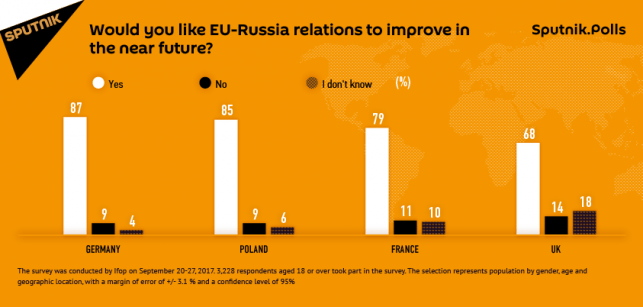
Vast Majority of Germans, Poles, French, Britons Want to Improve Ties With Russia
In Germany, which has lost “tens, if not hundreds of billions euros” and nearly 60,000 jobs due to anti-Russian sanctions, according to a study, 90 percent of male respondents in Germany turned out to be more inclined towards better relations with Russia. In France and the UK, which have reportedly lost €2.1 billion ($2.5 billion) and €3.1 billion ($3.7 billion) in exports respectively, 82 percent and 71 percent of male respondents favored better relations between Brussels and Moscow, the poll has shown.
The relationship between Russia and the European Union soured after Crimean peninsula seceded from Ukraine and reunified with Russia following the March 2014 referendum. The Western countries, including the EU members, have not recognized the legitimacy of the vote, imposing several rounds of sanctions on Russia.
Remembering Brazil’s Leftist President João Goulart on Anniversary of His Death
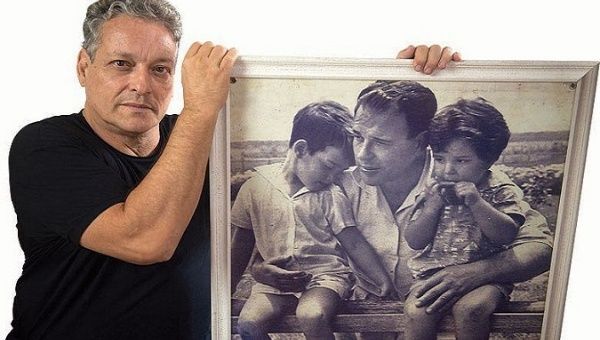
João Vicente Goulart holds a portrait of himself, his father, João Goulart, and his sister, Denize. | Photo: João Vicente Goulart
By Edu Montesanti | teleSUR | December 6, 2017
“Jango was my best friend, a great partner, and the best father to my children. It is still hard to forget,” Jango’s widow, Maria Theresa Goulart told teleSUR.
On Dec. 6, 1976, former Brazilian President João Goulart, popularly known as “Jango,” passed away at 57 years old in his exile with family in Mercedes, Argentina. Officially, he died of a cardiac attack, but evidence points to poisoning.
“There are still some available tissue samples at the Federal Police Criminal Institute of Brazil for a new investigation, as new evidence is expected if we can have more documents declassified and testimonies that would bring new information,” João Vicente Goulart, Jango’s son told teleSUR.
“In the first results analyzed, a substance appeared in tiny amounts which should not be in a human body, called pentaerythritol tetranitrate or erythrin tetranitrate, also known as pentrite,” said Goulart. “It is a chemical with characteristics and end of explosives that, at the time, was only controlled as an exclusive weapon used by the American army,” added Jango’s son, pointing out that secret agents used to infiltrate the family’s house in exile.
“It has been proven that spies removed my father’s documents, they could have easily changed his heart medicine for a poison.”

Jango speaks to a large crowd accompanied by his wife, Maria Theresa Goulart. Photo: João Vicente Goulart
Jango’s body did not undergo an autopsy at the time of his death. His body was buried in São Borja, Brazil, after the assurance that the coffin would not be opened. According to Goulart, “There was severe military repression at my father’s funeral.” There were military officials everywhere, monitoring Jango’s coffin so it could not be opened. In 2006, Mario Neira, a former Uruguayan secret agent, told Goulart that his father had been poisoned.
Overthrown from the Brazilian presidency by a military coup d’état on April 1, 1964, the democratically-elected João Goulart, with more than 70 percent of an approval rating, was exiled three days later with family to Uruguay. In 1973, President Juan Domingo Peron welcomed him. The Goularts were constantly threatened in exile, so the son, João Vicente and Denize, the Goularts’ daughter, left to study in London. Some friends warned former president Jango several times, that he could be killed.
On March 13, 1964, 18 days before the coup, President João Goulart gave a speech to more than 200,000 people in Central do Brasil square in Rio de Janeiro, with his wife Maria Theresa Goulart beside him, for the first time since assuming the presidency. He promised an agrarian reform, reducing remittances of profits overseas, extending democratic rights, along with other very popular reforms.
“Goulart committed the crime of reforming the economy. That was more than (U.S. President) Lyndon Johnson could tolerate and he opted to destabilize the economy and assist a right-wing military takeover,” said the U.S. historian Peter Kuznick to teleSUR.
“The 1964 coup that toppled Goulart’s government was extremely significant,” added Kuznick. “Oliver Stone and I began our documentary about the invasion of Vietnam with a discussion of that coup. We then talk about the Dominican Republic, Greece, Indonesia, and Chile to show that the Vietnam War was part of a pattern.
“A National Intelligence Estimate in the summer of 1963 had warned that Goulart might be establishing ‘an extreme leftist regime, with a strongly anti-U.S. character.’ Johnson’s appointment in December of Thomas Mann as assistant secretary of state to coordinate Latin American affairs was another nail in the Goulart government’s coffin.
“When Goulart responded the next year to U.S. demands to impose austerity on the Brazilian people by instead offering land reform and control of foreign capital and by recognizing Cuba, the U.S. moved quickly to destabilize the economy. Goulart seized U.S. properties.
“Ambassador Lincoln Gordon and U.S. embassy officials urged right-wing Brazilian officers to overthrow Goulart. The U.S. backed Army Chief of Staff General Humberto Castelo Branco. The CIA assisted behind the scenes,” observed Kuznick, who is the director of the Institute of Nuclear Studies at the American University.
The Brazilian historian Victor Schincariol told teleSUR that in order to preserve national peace and people’s security, President Jango didn’t call for a military intervention to protect him. “Goulart was genuinely committed to democracy and social peace. He said that he could not tolerate the death of Brazilians in a virtual civil war.
“At the same time, he knew that the U.S. would support the right-wing forces, which would make the case for the defense of democracy very hard indeed to win,” added the Brazilian researcher at the University of ABC in São Paulo.
On Dec. 18, in the presence of the heads of the military and President Dilma Rousseff, the Brazilian Congress symbolically returned President João Goulart’s mandate, as the OAS exhorted Brazil in 2010 for the crimes against humanity never punished, committed by the military dictatorship that killed 475 people, left 144 “disappeared,” and tortured more than 30,000 people.
There is an Amnesty Act in Brazil, elaborated and passed in 1979 by Brazilian military officials themselves — never addressed in the country by politicians, mainstream media and local elites — that acquits the dictators of the crimes committed between 1964 and 1985.
“Goulart’s and Varga’s legacy was erased, physically and ideologically, by the military dictatorship between 1964-1985. The economy was “globalized;” the case for an industrialization with national capitals, social justice and national independence was substituted by dependence, fascist policies and censorship; the democratic and left-wing forces were imprisoned, killed or left the nation,” said Professor Doctor Schincariol.
“The most important legacy Jango left to Brazil was his tireless fight for workers’ right and social justice,” Jango’s widow, Maria Theresa Goulart told teleSUR. “And for us, his family, his generosity and partnership.”
India to send first cargo to Russia through INSTC

The International North South Transportation Corridor (INSTC) connects India’s Mumbai to Russia’s St Petersburg and beyond
Press TV – December 6, 2017
India says it is preparing to send a consignment to Russia through a much-awaited new intercontinental multi-modal corridor that connects its port city of Mumbai to Russia’s St Petersburg.
The consignment would depart for Iran’s Persian Gulf port of Bandar Abbas in mid-January and would be thereon taken through the Iranian territory to Azerbaijan’s Baku through road and rail. It would be then taken to Russia by train.
India’s media reported that this would formally launch the International North South Transportation Corridor (INSTC) that had been in the making for 17 years. Nevertheless, the INSTC would technically function fully in a few months thereafter, reported the Economic Times.
The report added that hectic preparations were already underway to firm up all elements of the corridor in all key stakeholder states and that a Russian railway operator was expected to play key role in the INSTC.
The ship, road and rail route connects India’s Mumbai to the Iranian port of Bander Abbas and further to Baku in Azerbaijan as well as Astrakhan, Moscow and St. Petersburg in Russia before stretching to northern Europe and Scandinavia.
Currently, a cargo from India to Russia is carried on freight ships via the Red Sea, Suez Canal, Mediterranean Sea, the English Channel and then the Baltic Sea.
The INSTC – which has an estimated cargo capacity of 20-30 million tonnes of goods per year – is expected to provide faster and more efficient trade connectivity between Europe and Southeast Asia.
Dry runs of the route were conducted in 2014, from Mumbai to Baku and Astrakhan via Bandar Abbas. Results showed transport costs will be 30 percent cheaper and transportation period will be 40 percent shorter than the existing routes.
The INSTC will be India’s second corridor after the Chabahar Port to access resource rich Central Asia and its market, the Economic Times wrote.
The launch of Chabahar Port – whose Phase 1 was inaugurated on Sunday – coupled with INSTC will be a game changer for India’s strategic and economic goals in the Eurasian region, added the report.
INSTC could get linked to the Chabahar Port besides Iran’s Bandar Abbas port, the daily quoted an unnamed official as saying.
India also hopes that INSTC would be connected with various other connectivity projects that the five Central Asian and other Eurasian countries have undertaken among themselves, the official said.
Australia to probe Facebook & Google
RT | December 4, 2017
Australia’s competition regulator has begun an inquiry into whether the influence of the US tech giants Facebook and Google has harmed the media sector. The probe is part of the country’s broader media reforms.
“We will examine whether platforms are exercising market power in commercial dealings to the detriment of consumers, media content creators, and advertisers,” said Rod Sims, the Chairman of Australian Competition and Consumer Commission (ACCC).
He added that the inquiry would study how Facebook and Google operated to “fully understand their influence in Australia.”
The government has reportedly ordered the investigation due to concerns about the future of the media sector following years of falling profits, newsroom job cuts and the rise of fake news.
The inquiry will have the power to demand information from Google, Facebook and other firms, as well as hold hearings.
Since 2000, European regulators have investigated tech giants Microsoft, Intel, Apple, Google, Facebook and Amazon over a range of antitrust issues. Google is currently facing more than a €1 billion fine from the EU for abusing search practices. The penalty could become the largest in the history of monopoly abuse cases.
In another case, the EU is investigating whether Google unfairly banned competitors from websites that used its search bar and advertisements. It is also examining how the firm pays and limits mobile phone providers who use its Android software and Play app store.
In September, Spain’s data protection watchdog fined Facebook, saying the social network breached laws designed to protect people’s information and confidentiality. It said the company collected personal data from its users in Spain without obtaining their ‘unequivocal consent’ and without informing them how such information would be used.
The social media giant has also been slapped with a €150,000 fine by the French data protection watchdog for the way the company targeted advertising and tracked users. The penalty was part of a wider probe carried out in Belgium, the Netherlands, Spain, and Germany into some of the corporation’s practices.
Russia & China could set international gold price based on physical gold trading
RT | December 3, 2017
Since Russia, China, India, Brazil & South Africa are all either large producers or consumers of gold, or both, it is highly likely that the BRICS bloc they constitute could focus its cross-border gold trading network on trading physical gold.
Gold pricing benchmarks from such a system would be based on physical gold transactions, which is a departure from the way the international gold price is currently established.
Such a system would also be a threat to “gold” trading markets in London and New York. The London Over-the-Counter (OTC) and the New York COMEX futures exchange currently set the international gold price.
OTC and COMEX are really trading synthetic derivatives on gold, and are completely detached from the physical gold market. In London, the derivative is fractionally-backed unallocated gold positions which are predominantly cash-settled. In New York the derivative is exchange-traded gold future contracts which are predominantly cash-settled and backed by very little real gold.
The major gold producers Russia, China and other BRICS nations could change the way the international gold prices are set currently – in a synthetic trading environment which has very little to do with the physical gold market.
BRICS cooperation in the gold market was first unveiled in April by the First Deputy Chairman of Russia’s Central Bank, Sergey Shevtsov, during a visit to China.
“We (the Central Bank of the Russian Federation and the People’s Bank of China) discussed gold trading,” he said. “The BRICS countries (Brazil, Russia, India, China and South Africa) are major economies with large reserves of gold and an impressive volume of production and consumption of the precious metal. In China, gold is traded in Shanghai, and in Russia in Moscow. Our idea is to create a link between these cities so as to intensify gold trading between our markets.”
Bolivia’s TIPNIS Dispute: How Liberal-Left Alternative Media Becomes a Conveyor Belt for US Regime Change Propaganda
Chicago ALBA Solidarity / November 30, 2017
As has become a standard operating procedure, an array of Western environmental NGOs, advocates of indigenous rights and liberal-left alternative media cover up the US role in attempts to overturn the anti-imperialist and anti-neoliberal governments of Rafael Correa in Ecuador[1] and Evo Morales in Bolivia.
This NACLA article[2] provides an excellent example. Bolivia’s TIPNIS (Territorio Indígena y Parque Nacional Isiboro Secure) dispute arose over the Evo Morales government’s project to complete a road through the park, opposed by some indigenous and environmental groups.
As is NACLA modus operandi, the article says not one word about US and rightwing funding and coordination with the indigenous and environmental groups behind the TIPNIS anti-highway protests. (This does not delegitimize the protests, but it does deliberately mislead people about the issues involved).
In doing so, these kinds of articles cover up US interventionist regime change plans, be that their intention or not.
NACLA is not alone in what is in fact apologetics for US interventionism. Include the Guardian, UpsideDownWorld, [3] Amazon Watch, so-called “Marxist” Jeffery Weber,[4] Jacobin, ROAR, [5] Intercontinentalcry, Avaaz, In These Times, in a short list of examples. We can add to this simply by picking up any articles about oil drilling in Ecuador’s Yasuni during Rafael Correa’s presidency, or the protests in Bolivia’s TIPNIS and see what they say about US funding of protests, if they even mention it.
This is not simply an oversight, it is a cover-up.
What this Liberal Left Media Covers Up
On the issue of the TIPNIS highway, we find on numerous liberal-left alternative media and environmental websites claiming to defend the indigenous concealing that:
- The leading indigenous group of the TIPNIS 2011-2012 protests was being funded by USAID. The Confederation of Indigenous Peoples of the Bolivian East (CIDOB) had no qualms about working with USAID — it boasted on its website that it received training programs from USAID. CIDOB president Adolfo Chavez, thanked the “information and training acquired via different programs financed by external collaborators, in this case USAID”. [6]
- The 2011 TIPNIS march was coordinated with the US Embassy, specifically Eliseo Abelo. His phone conversations with the march leaders – some even made right before the march set out — were intercepted by the Bolivian counter-espionage agency and made public.[7]
- “The TIPNIS marchers were openly supported by right wing Santa Cruz agrobusiness interests and their main political representatives, the Santa Cruz governorship and Santa Cruz Civic Committee.” [8] In June 2011 indigenous deputies and right wing parties in the Santa Cruz departmental council formed an alliance against the MAS (Movement for Socialism, Evo Morales’s party). CIDOB then received a $3.5 million grant by the governorship for development projects in its communities.
- Over a year after the TIPNIS protests, one of the protest leaders announced he was joining a rightwing anti-Evo Morales political party.[9]
- The protest leaders of the TIPNIS march supported REDD (Reduce Emissions from Deforestation and Degradation). The Avaaz petition (below) criticizing Evo Morales for his claimed anti-environmental actions also covered this up. As far back as 2009 “CIDOB leaders were participating there in a USAID-promoted workshop to talk up the imperialist-sponsored REDD project they were pursuing together with USAID-funded NGOs.” [10]
REDD was a Western “environmental” program seeking to privatize forests by converting them into “carbon offsets” that allow Western corporations to continue polluting. That REDD would give Western NGOs and these indigenous groups funds for monitoring forests in their areas.
- These liberal-left alternative media and environmental NGOs falsely presented the TIPNIS conflict as one between indigenous/environmentalist groups against the Evo Morales government. (e.g. the TIPNIS highway was “a project universally[!] condemned by local indigenous tribes and urban populations alike”)[11] Fred Fuentes pointed out that more than 350 Bolivian organizations, including indigenous organizations and communities, even within TIPNIS, supported the proposed highway.
CONISUR (Consejo de Indígenas del Sur), consisting of a number of indigenous and peasant communities within TIPNIS, backed by Bolivia’s three largest national indigenous campesino organizations, organized a march to support of the road. They argued that the highway is essential to integrating Bolivia’s Amazonia with the rest of the country, as well as providing local communities with access to basic services and markets. [12]
The overwhelming majority of people in the West who know about the TIPNIS protests, or the Yasuni protests in Ecuador, where a similar division between indigenous groups took place, never learned either from the liberal-left media or the corporate media, that indigenous groups marched in support of the highway or in support of oil drilling.
- The TIPNIS conflict is falsely presented as Evo Morales wanting to build a highway through the TIPNIS wilderness (“cutting it in half” as they dramatically claim). There are in fact two roads that exist there now, which will be paved and connected to each other. Nor was it wilderness: 20,000 settlers lived there by 2010.[13]
- Anti- highway march leaders actually defended industrial-scale logging within TIPNIS. Two logging companies operated 70,000 hectares within the national park and have signed 20-year contracts with local communities.[14]
- They often fail to note that the TIPNIS marchers, when they reached La Paz, sought to instigate violence, demanding Evo Morales removal. Their plot was blocked by mobilization of local indigenous supporters of Evo’s government.
If we do not read Fred Fuentes in Green Left Weekly, we don’t find most of this information. Now, it is true that some of the media articles did mention that there were also TIPNIS protests and marches demanding the highway be built. Some do mention USAID, but phrase it as “Evo Morales claimed that those protesting his highway received USAID funding.”
Avaaz Petition Attacking Evo Morales over TIPNIS
The TIPNIS campaign, which became a tool in the US regime change strategy, was taken up in a petition by Avaaz. It included 61 signing groups. Only two from Bolivia! US signers included Amazon Watch, Biofuelwatch, Democracy Center, Food and Water Watch, Global Exchange, NACLA, Rainforest Action Network.[15] Whether they knew it, whether they wanted to know it, they signed on to a false account of the TIPNIS conflict, placed the blame on the Bolivian government, target of US regime change, and hid the role of the US.US collaborators in Bolivia and Ecuador are painted as defenders of free expression, defenders of nature, defenders of the indigenous. The US government’s “talking points” against the progressive ALBA bloc countries have worked their way into liberal-left alternative media, which echo the attacks on these governments by organizations there receiving US funds. That does not mean Amazon Watch, Upside Down World or NACLA are themselves funded by the US government – if it somehow exculpates them that they do this work for free. Even worse, much of this propaganda against Evo and Correa appears only in the liberal-left alternative press, what we consider our press.
The USAID budget for Latin America is said to be $750 million, but estimates show that the funding may total twice that. [16] Maria Augusta Calle of Ecuador’s National Assembly, said in 2015 the US Congress allocated $2 billion to destabilize targeted Latin American countries.[17]
This information, how much money it is, what organizations in the different countries receive it, how it is spent, ought to be a central focus of any liberal-left alternative media purporting to stand up for the oppressed peoples of the Americas.
Yet, as Fuentes points out: “Overwhelmingly, solidarity activists uncritically supported the anti-highway march. Many argued that only social movements — not governments — can guarantee the success of [Bolivia’s] process of change…. with most articles written by solidarity activists, [they] downplay the role of United States imperialism…. Others went further, denying any connection between the protesters and US imperialism.”[18]
Why do they let themselves become conveyer belts for US regime change propaganda?
Why did this liberal-left media and NGOs let themselves become conveyer belts for US propaganda for regime change, legitimizing this US campaign to smear the Evo Morales government?
Some of it lies in the liberalish refusal to admit that all international issues can only be understood in the context of the role and the actions of the US Empire. As if conflicts related to countries the US deems hostile to its interests can be understood without taking the US role into account. Some liberal-left writers and groups do understand this, just as they do understand they may risk their positions and funding by looking to closely into it.
It seems easier to not see the role the Empire plays and simply present a liberal-left “critique” of the pluses and minuses of some progressive government targeted by the US. That is how these alternative media sources end up actually advocating for indigenous groups and environmental NGOs which are US and corporate funded. They even criticize countries for defending national sovereignty by shutting down these non-governmental organizations, what Bolivian Vice-President Linera exposes as “foreign government financed organizations” operating in their countries.
Some of it lies in the widely held anti-authoritarian feeling in the US that social movements “from below” are inherently good and that the government/the state is inherently bad. The reporting can be informative on social movements in Honduras, Guatemala, Mexico, Colombia where the people struggle against state repression. But when these social movements in Ecuador or Bolivia were able to win elections and gain hold of some real state power, reporting soon becomes hostile and misleading. “Support social movements when they struggle against governmental power; oppose them once they win government power,” they seem to say. Their reporting slides into disinformation, undermining our solidarity with other struggles, and covering up US regime change efforts. UpsideDownWorld is an excellent example of this.
Some of it lies in what many who call themselves “left” still have not come to terms with: their own arrogant white attitude they share with Western colonizers and present day ruling elites: we know better than you what is good for you, we are the best interpreters and defenders of your socialism, your democracy, your human rights. They repeatedly critique real or imagined failures of progressive Third World governments – targets of the US.
Genuine solidarity with the peoples of the Third World means basing yourself in opposition to the Empire’s interference and exposing how it attempts to undermine movements seeking to break free from the Western domination.
Some of it lies in deep-rooted white racist paternalism in their romanticizing the indigenous as some “noble savage” living at one with nature, in some Garden of Eden. Providing these people with schools, health clinics, modern conveniences we have, is somehow felt not to be in their best interests.
A serious analysis of a Third World country must begin with the role the West has played. To not point out imperialism’s historic and continuing exploitive role is simply dishonest, it is apologetics, it shows a basic lack of human feeling for the peoples of the Third World.
A function of corporate media is to conceal Western pillaging of Third World countries, to cheerlead efforts to restore neocolonial-neoliberal governments to power. However, for liberal-left media and organizations to do likewise, even if halfway, is nothing other than supporting imperialist interference.
[1] https://www.counterpunch.org/2016/02/16/propaganda-as-news-ecuador-sells-out-indigenous-tribes-and-the-environment-to-china/
[2] https://nacla.org/blog/2017/08/22/why-evo-morales-reviving-bolivia%E2%80%99s-controversial-tipnis-road
[3] http://upsidedownworld.org/main/bolivia-archives-31/4864-bolivias-conamaq-indigenous-movement-we-will-not-sell-ourselves-to-any-government-or-political-party
[4] https://mronline.org/2011/08/20/separating-fact-from-fantasy-in-bolivia-a-review-of-jeffery-r-webbers-from-rebellion-to-reform-in-bolivia/
http://www.wrongkindofgreen.org/2012/03/28/the-morales-government-neoliberalism-in-disguise/
[5] https://roarmag.org/essays/bolivia-authoritarianism-mas-elections/
[6] Fred Fuentes, Bolivia: Solidarity activists need to support revolutionary process; Rumble over jungle far from over http://links.org.au/node/2611
[7] http://www.strategic-culture.org/news/2012/09/26/end-to-usaid-spying-looms-in-latin-america.html
[8] http://www.wrongkindofgreen.org/2012/03/28/the-morales-government-neoliberalism-in-disguise/
[9] http://www.la-razon.com/nacional/Pedro-Nuni-lideres-regionales-proyecto_0_1946805357.html
[10] http://www.wrongkindofgreen.org/2012/03/28/the-morales-government-neoliberalism-in-disguise/
[11] http://www.coha.org/corrupted-idealism-bolivias-compromise-between-development-and-the-environment/
[12] http://www.wrongkindofgreen.org/2012/03/28/the-morales-government-neoliberalism-in-disguise/
[13] Linda C. Farthing, Benjamin H. Kohl Evo’s Bolivia: Continuity and Change (2014: 52)
[14] http://links.org.au/node/2611
[15] http://amazonwatch.org/news/2011/0921-appeal-to-bolivian-president-evo-morales-protect-the-rights-of-the-indigenous-peoples-of-tipnis
[16] http://www.globalresearch.ca/usaid-spying-in-latin-america/5306679
[17] http://www.hispantv.com/noticias/ecuador/37659/eeuu-destino-$2000-millones-para-desestabilizar-america-latina
The big slide in renewable energy tells the real story
No, renewables are not taking over the world anytime soon.
By Bjørn Lomborg | Watts Up With That? | November 26, 2017
We have spent the last two centuries getting off renewables because they were mostly weak, costly and unreliable. Half a century ago, in 1966, the world got 15.6% of its energy from renewables. Today (2016) we still get less of our energy at 13.8%.
With our concern for global warming, we are ramping up the use of renewables. The mainstream reporting lets you believe that renewables are just about to power the entire world. But this is flatly wrong.
The new World Energy Outlook report from the International Energy Agency shows how much renewables will increase over the next quarter century, to 2040. In its New Policies Scenario, which rather optimistically expects all nations to live up to their Paris climate promise, it sees the percentage increase less than 6 percentage points from 13.8% to 19.4%. More realistically, the increase will be 2 percentage points to 15.8%.
Most of the renewables are not solar PV and wind. Today, almost 10 percentage points come from the world’s oldest fuel: wood. Hydropower provides another 2.5 percentage points and all other renewables provide just 1.6 percentage points, of which solar PV and wind provide 0.8 percentage points.
Neither will most renewables in 2040 come from solar PV and wind, as breathless reporting tends to make you believe. 10 percentage points will come from wood. Hydropower provides another 3 percentage points and all other renewables provide 6 percentage points, of which solar PV and wind will (very optimistically) provide 3.7 percentage points.
Oh, and to achieve this 3.7 % of energy from solar PV and wind, you and I and the rest of the world will pay – according to the IEA – a total of $3.6 trillion in subsidies from 2017-2040 to support these uncompetitive energy sources. (Of course, if they were competitive, they wouldn’t need subsidies, and then they will be most welcome.)
Most people tend to think about electricity for renewables, but the world uses plenty of energy that is not electricity (heat, transport, manufacture and industrial processes).
Actually, if the world miraculously could make the *entire* global electricity sector 100% green without emitting a single ton of greenhouse gasses, we would have solved just a third of the total global greenhouse gas problem.
As Al Gore’s climate adviser, Jim Hansen, put it bluntly:
“Suggesting that renewables will let us phase rapidly off fossil fuels in the United States, China, India, or the world as a whole is almost the equivalent of believing in the Easter Bunny and [the] Tooth Fairy.”
We need to get real on renewables. Only if green energy becomes much cheaper – and that requires lots of green R&D – will a renewables transition be possible.

References
Data for graph: “A brief history of energy” by Roger Fouquet, International Handbook of the Economics of Energy 2009; IEA data DOI: 10.1787/enestats-data-en, and World Energy Outlook 2017, unfortunately not free, https://www.iea.org/weo2017/
Hansen quote: http://www.columbia.edu/…/mail…/2011/20110729_BabyLauren.pdf
The world emitted 49Gt CO₂e in 2014, and all electricity/heat came to 15Gt or less than a third, http://cait.wri.org/profile/World.
Lebanon FM: Hariri crisis ‘part of attempt to create chaos’
Press TV – November 17, 2017
Lebanese Foreign Minister Gebran Bassil says the crisis over the resignation of Prime Minister Saad al-Hariri is part of an “attempt to create chaos in the region.”
Speaking in Moscow on Friday, Bassil said Lebanon has the “full powers” to respond to the crisis, but hoped this would not be necessary.
“We will respond and we have the full powers to do that, but we hope it doesn’t come to that,” he said.
Lebanese President Michel Aoun has said that Hariri, who resigned as prime minister on Nov. 4, is being detained in Saudi Arabia against his will – despite the premier’s reassurances he would return home soon.
On Friday, a senior Hariri aide was quoted as saying that Hariri will see France’s president on Saturday in Paris and the meeting will help resolve the Lebanese crisis and boost stability.
Bassil has been touring European capitals to lobby for Hariri’s return. On Thursday, he warned that Lebanon should not be treated as a plaything by any country.
“Lebanon is not a toy in others’ hands,” the Lebanese foreign minister said at a joint press conference with his German counterpart Sigmar Gabriel in Berlin.
Gabriel said he shared concerns about the threat of instability and bloodshed in Lebanon and, without mentioning Saudi Arabia directly, warned against the “adventurism” behind the Lebanon crisis and the “human tragedy in Yemen.”
“We expect that Prime Minister Hariri can come back to Beirut,” he added.
Saudi Arabia has been bombing Yemen since 2015 to restore its Riyadh-allied government, killing many thousands in the process.
Bassil, for his part, said, the “Hariri issue is actually a matter of Lebanon’s sovereignty,” and called on Arab countries to “not interfere with Lebanon’s internal matters.”
The Lebanese foreign minister also said further turmoil in his country, which is already hosting thousands of refugees fleeing violence in neighboring Syria, would create a new influx of asylum seekers to Europe.
Bassil also visited Turkey on Thursday and is to travel to Russia on Friday, where he is about to meet with Russia’s top diplomat, Sergei Lavrov.
At a joint presser with Bassil, Turkey’s Foreign Minister Mevlut Cavusoglu urged Hariri’s “immediate” return.
“We support Lebanon’s unity, integrity and stability, and we oppose any development that would risk Lebanon’s stability,” he said.
“Lebanon does not need any other problems. On the contrary, we need to contribute to the solution of the existing problems.”
Bassil also held talks with Turkish President Recep Tayyip Erdogan.
Featured Video

AIDS Inc. by Gary Null (2007)
or go to
Aletho News Archives – Video-Images
From the Archives
9/11 Was an Israeli Job
How America was neoconned into World War IV
By Laurent Guyénot • Unz Review • September 10, 2018
Technical impossibilities
Thanks to courageous investigators, many anomalies in the official explanation of the events of 9/11 were posted on the Internet in the following months, providing evidence that this was a false flag operation, and that Osama bin Laden was innocent, as he repeatedly declared in the Afghan and Pakistani press and on Al Jazeera.[1] The proofs of this appalling fraud have been accumulating ever since, and are now accessible to anyone willing to spend a few hours of research on the Web. (Although, while preparing this article, I noticed that Google is now making access to that research more difficult than it was five years ago, artificially prioritizing anti-conspiracy sites.)
For example, members of Architects and Engineers for 9/11 Truth have demonstrated that it was impossible for plane crashes and jet fuel fires to trigger the collapse of the Twin Towers. Even Donald Trump understood this. In fact, speaking of “collapse” is perhaps misleading: the towers literally exploded, pulverizing concrete and projecting pieces of steel beams weighing several hundred tons hundreds of meters laterally at high speeds. The pyroclastic dust that immediately flooded through the streets, not unlike the dust from a volcano, indicates a high temperature mixture of hot gasses and relatively dense solid particles, an impossible phenomenon in a simple collapse. It is also impossible that WTC7, another skyscraper (47 stories), which had not been hit by a plane, collapsed into its own footprint at near free-fall speed, unless by “controlled demolition.”
Testimonies of firefighters recorded shortly after the events describe sequences of explosions just before the “collapse”, well below the plane impact. The presence of molten metal in the wreckage up to three weeks after the attack is inexplicable except by the presence of incompletely burned explosives. Firefighter Philip Ruvolo testified before Étienne Sauret’s camera for his film Collateral Damages (2011): “You’d get down below and you’d see molten steel—molten steel running down the channelways, like you were in a foundry—like lava.”
Aviation professionals have also reported impossibilities in the behavior of the planes. The charted speeds of the two aircraft hitting the Twin Towers, 443 mph and 542 mph, exclude these aircraft being Boeing 767s, because these speeds are virtually impossible near ground level. In the unlikely event such speeds could be attained without the aircraft falling apart, flying them accurately into the towers was mission impossible, especially by the amateur pilots blamed for the hijacking. Hosni Mubarak, a former pilot, said he could never do it. (He is not the only head of state to have voiced his doubts: Chavez and Ahmadinejad are among them.) Recall that neither of the black boxes of the jetliners was ever found, an incomprehensible situation.
And of course, there are the obvious anomalies of Shanksville and Pentagon crash sites: no plane or credible plane debris can be seen on any of the numerous photos easily available. … continue
Blog Roll
 Aletho News
- From Unipolar Universalism to Multipolar Civilizational Distinctiveness
- RSF military group defects, joins Sudanese army: State media
- Ireland goalkeeper refuses to play ‘Israel’ as squad weighs boycott
- China pushes back against US on Cuba, Iran
- Ukrainian Soldiers, Potential Mercenaries: Have Gun, Will Travel!
- Burnham’s UN debut… A masterclass in British disinformation
- Iran flights continue despite US aviation sanctions
- Global Tipping Points Lead the World Into a State of Entropy
- The day-after at the White House: USA and Xi Jinping
- The Geopolitical Balance in the Red Sea: The UAE Being Displaced by New Players
- If Americans Knew
- Deconstructing Netanyahu’s pants-on-fire UN rant – Daily Update
- Trump betrayed voters with his campaign lies and prioritized a foreign country once he took office
- Netanyahu calls Israel’s war in Gaza ‘opposite of genocide’ in UN speech to near-empty hall
- Settler Kidnappings: Torture, Sexual Abuse and Terrorisation of Palestinian Abductees as Israel Deepens Annexation of West Bank
- Gaza winter nears as 162,000 tents become unusable, raising fears of humanitarian crisis
- Netanyahu says, “It’s the opposite of genocide”; UN says Gaza economy is world’s ‘most severe crisis on record’ – Daily Update
- Israel’s US-Backed Assault on Gaza Has Created the ‘World’s Most Severe Economic Crisis on Record’: UN
- ‘Protecting U.S. Citizens’… From Israel
- ‘This is where I live now, the back of a truck’: a day in the life of a grandmother in Gaza
- In UN Speech, Iran’s President Displays Pictures of Children Killed by US, Brings Attention to Israel’s Nuclear Arsenal
- No Tricks Zone
- New Study: Earth And Venus Surface Warmth Largely Explained By Convection And Lapse Rate, Not CO2 Or Radiation
- 2025 Nature Paper Claiming Worsening Global Drought Gets RETRACTED …Heavily Flawed
- New Study: ‘Global Drought Shows No Detectable Recent Acceleration Under Climate Warming’
- Economic Masterminds: German Socialists Suggest Taxing Productivity Gains Stemming From Using AI
- The South China Sea Has Not Been Cooperating With The Climate Change Narrative
- Energy Crisis: Germany Enters Heating Season With Historically Low Gas Reserve Fill Levels
- New Study: The Antarctic Ice Sheet Gained Mass From 2020-2024 Due To Staggering Snow And Ice Accumulation
- Study: Ocean Heating Rates From Thousands Of Years Ago ‘Dwarf’ Modern Ocean Heating Rates
- Climate Extremists Target, Attack Large-Scale Power Grid Infrastructure In Germany!
- New Study: Antarctic Ice Melt Has Contributed Less Than 1 Centimeter To Sea Level Rise In The Last 30 Years

