China’s nuclear roll-out facing delays
China may scale down plans for nuclear power because of slowing demand for electricity and construction setbacks
By Steve Thomas – ChinaDialogue – 26.10.2016
For China’s nuclear industry, 2016 has been a frustrating year. So far, construction has started on only one new plant, and its target of bringing 58 gigawatts of nuclear capacity in service by 2020 seems impossible to meet.
At present, China has 19.3 gigawatts of nuclear supply under construction and a further 31.4 gigawatts already in service. Given that new plants take five years or more to build, the country faces a shortfall of more than seven gigawatts on its target.
All the plants started between 2008 and 2010 are online except for six imported reactors. These include four AP1000 reactors designed by Westinghouse, based in the USA but owned by Toshiba of Japan; and two European Pressurised Reactors (EPR), developed by Areva, a French multinational group specialising in nuclear power.
The plants are not expected to be completed before 2017 and all will be at least three years late, an unprecedented delay in China’s nuclear history. It would be surprising if China was not disillusioned with its suppliers and their technologies.
Technology problems
The EPR and AP1000 reactors have been problematic to build. The two EPRs are 3-4 years late although there is little available information detailing why. Meanwhile, EPR plants in Finland and France, which should have been completed in 2009 and 2012, respectively, will not be online before 2018.
There are no obvious problems that account for the majority of the delays at any of the sites, just a series of quality and planning issues that suggest the complexity of the design makes it difficult to build.
The four AP1000s are also running 3-4 years late. They are being built by China’s State Nuclear Power Technology Company (SNPTC), which has not built reactors before. There is some publicly available information about the problems suffered in China with the AP1000s, including continual design changes by Westinghouse. The reactor coolant pumps and the squib valves, which are essential to prevent accidents, have been particularly problematic, for example.
Still, China is expected to be the first country to complete construction of AP1000 and EPR designs, a scenario it did not expect or want. The government is required to develop and demonstrate test procedures for bringing the plants into service, which could take up to a year. These test procedures are developed by vendors and generally standardised although national safety regulators must approve them and can add specific requirements.
In 2014, a senior official at China’s nuclear safety regulator, the National Nuclear Safety Administration (NNSA) complained that only a small number of test procedures had been developed for the AP1000, and no acceptance criteria had been submitted for review. He said the same issues affect the EPR.
China will likely be reluctant to commit to further AP1000s (and the CAP1400, a Chinese design modified from the AP1000) until the first of the Westinghouse designs is in service, passes its acceptance tests, and demonstrates safe, reliable operation. There are no plans to build additional EPR reactors.
In fact, state-owned China General Nuclear (CGN) and China National Nuclear Corporation (CNNC) opted instead to develop medium-sized reactors (1000 megawatts), the ACP1000 and the ACPR1000, respectively, based on Areva’s much older M310 design rather than the EPR.
Challenging circumstances
The slowdown in electricity demand growth at home has left China with surplus power-generating capacity. Nuclear is now competing against coal plants supplied with cheap fuel. Furthermore, nuclear has a lower priority for dispatch in winter than combined heat and power plants, which warm homes and factories and typically burn coal and gas.
In 2015, nuclear power accounted for only 3% of China’s electricity and at any plausible rate of building nuclear plants, it is unlikely that nuclear would achieve more than 10% of China’s electricity supply.
This year, one reactor (Hongyanhe 3) in Liaoning, operated for only 987 hours in the first quarter of 2016, just 45% of its availability, while reactors in Fujian (Fuqing) and Hainan (Changjiang) were shut down temporarily.
Another challenge is the strain placed on China’s nuclear regulators in the face of such an ambitious target. The NNSA is under particular pressure to oversee the operation of 36 plants and the construction of 20 plants, as well as being the first regulatory authority to review six new designs. Not even the US Nuclear Regulatory Commission, which monitored standards during the huge build out of the industry in the 1960s and 1970s, has faced such a workload.
Safety authorities are usually reluctant to appear critical of their international peers but in 2014, a senior French safety regulator described NNSA as “overwhelmed”, and claimed that the storage of components was “not at an adequate level”. A senior official from SNPTC said in 2015: “Our fatal weakness is our management standards are not high enough.” To build up the capabilities to support such a large construction programme a pause in ordering new plants and equipment may be necessary.
Uncertain future
The 58GW target of nuclear capacity in service by 2020 is not achievable and, like nuclear capacity targets in the past in China and elsewhere, it will be quietly revised down. The challenge for the Chinese nuclear industry is to do what no other nuclear industry worldwide has been able to do; to bring the cost of nuclear generation down to levels at which it can compete with other forms of generation, particularly renewables.
If it is unable to do this, China cannot afford to carry on ordering nuclear plants and nuclear will retain a small proportion of the electricity mix.
This leaves China’s nuclear export drive in a precarious position. Since 2013, China has turned its attention to nuclear export markets, offering apparently strong advantages over its competitors. The Chinese government can call on all the resources of China to offer a package of equipment, construction expertise, finance and training that none of its rivals, even Russia, can match.
Unlike its competitors, it also has a huge amount of recent construction experience allowing it to supply cheap, good quality equipment. Its attempt to build reactors in the UK is an important element to this strategy; convincing an experienced user of nuclear power that a Chinese plant is worth investing in is a strong endorsement of their technology.
Despite these advantages China has had little export success so far. In part, this is because there are fewer markets open to new nuclear. Such markets are typically found in developing countries where the financial risks are greater, and where governments have tried and failed to launch nuclear power programmes themselves.
It seems clear there is a political element to the Chinese nuclear export strategy, which is to gain influence and leverage in the importing countries. However, if the world nuclear market does not pick up soon, the Chinese government may decide to put its formidable resources behind other technologies that would develop influence with less economic risk. If China’s nuclear home market is not flourishing, this decision will be much easier.
Trumping the climate
By Judith Curry | Climate Etc. | November 13, 2016
So . . . what can we expect from the Trump administration on environment/climate/energy?
There is much angst among the ‘greens’ about what to expect. This is typified by this morning’s headlines from the Huffington Post :
SET TO BOIL: Trump Racing to Scrap Landmark Climate Deal
China Calls Move Ludicrous… ‘GAME OVER’: Scientists Fear Disaster With Donald… ‘Election Of Donald Trump Could Be Devastating For Our Climate And Our Future’… ‘Trump Has A Profound Ignorance Of Science’… Donald Taps Climate-Change Skeptic To Dismantle EPA… Oil Exec Eyed For Sec. Of Interior… New Push For Keystone Pipeline Fires Up…
Lets take a closer look at what President-elect Trump has actually said in recent months, including his policy/issue statements.
Hoax
Whenever the issue of Trump and climate change comes up in the world of the ‘greens’, the first thing they mention is that he said climate change is a ‘hoax.’
Politifact has done a good job of summarizing this (January 2016):
The clearest example comes from a tweet sent by Trump on Nov. 6, 2012. “The concept of global warming was created by and for the Chinese in order to make U.S. manufacturing non-competitive.”
On Jan. 18, after Sanders had attacked Trump’s climate change views in the Democratic debate, Trump told Fox & Friends, “Well, I think the climate change is just a very, very expensive form of tax. A lot of people are making a lot of money. I know much about climate change. I’d be — received environmental awards. And I often joke that this is done for the benefit of China. Obviously, I joke. But this is done for the benefit of China, because China does not do anything to help climate change. They burn everything you could burn; they couldn’t care less. They have very — you know, their standards are nothing. But they — in the meantime, they can undercut us on price. So it’s very hard on our business.”
On Dec. 30, 2015, Trump told the crowd at a rally in Hilton Head, S.C., “Obama’s talking about all of this with the global warming and … a lot of it’s a hoax. It’s a hoax. I mean, it’s a money-making industry, OK? It’s a hoax, a lot of it.”
In August, he stated:
“I’m not a big believer in man-made climate change. Nobody knows for sure.”
Lets first look at the definition of ‘hoax’, here are a few I spotted by googling:
- a humorous or malicious deception.
- to trick into believing or accepting as genuine something false and often preposterous
- a plan to deceive a large group of people
- a deliberately fabricated falsehood made to masquerade as truth.
With these definitions in mind, here are two examples that qualify as hoaxes that I have previously written about:
- The UNFCCC definition of ‘climate change’ arguably qualifies as a hoax: climate change is a change of climate which is attributed directly or indirectly to human activity that alters the composition of the global atmosphere and which is in addition to natural climate variability observed over comparable time periods. [link]. This perversion of the definition of ‘climate change’ was designed to mislead people into thinking that all climate change is caused by humans.
- The propaganda from the UNFCCC that misleads people into thinking that the planned emissions reductions will have any discernible impact (that emerges from natural variability) on the 21st century climate [link], even if you believe the climate models.
So in terms of climate hoaxes, perhaps it is NOT Donald Trump’s whose pants are on fire.
Trump’s answers to ScienceDebate
ScienceDebate.org asked the Presidential candidates questions on a range of science-related issues. The answers to the climate change questions are [here]. Trump’s statement:
There is still much that needs to be investigated in the field of “climate change.” Perhaps the best use of our limited financial resources should be in dealing with making sure that every person in the world has clean water. Perhaps we should focus on eliminating lingering diseases around the world like malaria. Perhaps we should focus on efforts to increase food production to keep pace with an ever-growing world population. Perhaps we should be focused on developing energy sources and power production that alleviates the need for dependence on fossil fuels. We must decide on how best to proceed so that we can make lives better, safer and more prosperous.
Well, I find it difficult to argue with any of this. In fact, I like this statement quite a lot.
Paris
The big news over the weekend is that someone from Trump’s transition team has leaked that Trump plans to pull out of the Paris UNFCCC agreement [link].
Robert Stavins has a concise analysis of Trump’s road ahead re climate change [link]:
Trump, if we take him at his word, will try to pull the United States out of the Paris Agreement on tackling climate change. But it will take four years to do that, now that it has come into force. (It came into force quickly — with countries accounting for 55 percent of global emissions ratifying it — only because countries were afraid of Trump being elected, and wanted to lock the United States in.)
Despite the fact that the Obama administration has already submitted the instrument of ratification through executive agreement, Trump might submit the Paris Agreement to the Senate, where, of course, it would fail in a ratification vote. Or he might just announce that we will not comply with our already submitted nationally determined contributions, a 26 to 28 percent reduction below 2005 emissions by 2025. The big question is what effect all of this will have on the positions of China, India, Brazil, etc. It will surely not encourage greater action.
Domestically, he wants to “bring back the coal industry,” but the problems of the U.S. coal industry are competition from low-price natural gas for electricity generation, not environmental regulation. Also, that’s inconsistent with his pronouncements supporting fracking, because that increases gas supply and lowers gas prices, which hurts coal.
Could he try to amend the Clean Air Act itself? That would be unlikely to succeed, as Democrats in the Senate would filibuster, I assume. Would he eliminate the Environmental Protection Agency, as he also promised at one point? No, again that would require an act of Congress. But he could try to starve the agency through low funding. And he will be appointing people to hundreds of key positions.
A more thorough analysis is provided by Paul Voosen: What Trump can – and can’t – do all by himself on climate.
Energy
Trump’s campaign web site issued a Position Statement on Energy:
DONALD J. TRUMP’S VISION
- Make America energy independent, create millions of new jobs, and protect clean air and clean water. We will conserve our natural habitats, reserves and resources. We will unleash an energy revolution that will bring vast new wealth to our country.
- Declare American energy dominance a strategic economic and foreign policy goal of the United States.
- Unleash America’s $50 trillion in untapped shale, oil, and natural gas reserves, plus hundreds of years in clean coal reserves.
Become, and stay, totally independent of any need to import energy from the OPEC cartel or any nations hostile to our interests. - Open onshore and offshore leasing on federal lands, eliminate moratorium on coal leasing, and open shale energy deposits.
- Encourage the use of natural gas and other American energy resources that will both reduce emissions but also reduce the price of energy and increase our economic output.
- Rescind all job-destroying Obama executive actions. Mr. Trump will reduce and eliminate all barriers to responsible energy production, creating at least a half million jobs a year, $30 billion in higher wages, and cheaper energy.
Read Donald J. Trump’s 100-Day Action Plan, here.
Read Mr. Trump’s Remarks at the Shale Insight Event, and at the Williston Basin Petroleum Conference.
KEY ISSUES
- Energy costs the average American household $5,000 per year. As a percentage of income, the cost is greater for lower-income families. [Fox News, Sept. 3, 2015]
- Shale energy production could add 2 million jobs in 7 years.
- The oil and natural gas industry supports 10 million high-paying Americans jobs and can create another 400,000 new jobs per year. [The New York Times, June 20, 2015]
EPA
Anyone interested in the environment is abuzz with the news that Myron Ebell is leading the transition re the Environmental Protection Agency (EPA). This Wikipedia article summarizes why the ‘greens’ would be alarmed at this appointment.
The Hill has an interesting article: Myron Ebell is Perfectly Suited to Lead the Transition. Excerpts:
Consequently, Ebell has expressed concern about EPA positions, including the Clean Power Plan. The EPA’s controversial power plan is based on an inadequate understanding of global warming and should not drive our middle class into energy poverty against congressional will.
It is critical to understand that while the federal government, through Congress, establishes the overall goals of environmental protection through laws like the Clean Air and Water acts, the implementation of those laws is by state governments.
State governments and their citizens have demonstrated the ability to implement programs that protect our environment without destroying the very thing that makes environmental protection possible: a strong economy.
Over the last eight years the Obama administration has abandoned this successful approach to environmental protection as envisioned by Congress. Instead, they have turned to special interest groups to drive centralized planning. Prime examples include the 2015 EPA Power Plan and the Waters of the United States (WOTUS) rule.
These rules contain illusory flexibility to states when in reality they represent a huge shift of control from states to the federal government. Even the current administration acknowledged that the power plan was symbolic and would do little to improve air quality.
The power plan would be expensive and shut down energy plants that have not yet been paid for, thereby stranding those costs with ratepayers. It would harm the industrial sector by significantly increasing electricity rates, which would throttle manufacturing industries that require low energy prices to compete.
Similarly, under WOTUS land use decisions would be federalized. Our nation’s agricultural industry would be hamstrung by costly and unnecessary land use restrictions, which would stifle growth opportunities. The expansion of manufacturing, commercial and residential development would be left to federal bureaucrats.
Fortunately, dozens of states and state agencies stood their ground against the federal government and won stays against these rules. We hope the Trump EPA will review existing rules and base its policy decisions on sound data and measurable results.
History has demonstrated time and again that just as “all politics is local,” so is environmental protection. State and local governments know best how to apply the many tools available to protect the environment and public health.We still need the EPA, but not the EPA of the past.
Returning control of our environment to the states also limits the dark money from self-serving lobbyists and deep-pocketed special interest groups masquerading as environmentalists.
Environment
I spotted this statement from Trump on the Wikipedia:
Everyone deserves clean air and safe drinking water regardless of race or Water infrastructure will be a big priority. We need to work to protect natural areas, but in a balanced way. End Obama EPA mandates that cost too many jobs, are opposed by most states, and too often have negligible benefit for the environment.
Sep 16, 2016
One of his tweets:
“Give me clean, beautiful and healthy air – not the same old climate change (global warming) bullshit! I am tired of hearing this nonsense.”
Some additional hints from outsideonline :
Don Jr. told reporters: “[W]e’ve broken away from a lot of traditional conservative dogma on the issue, in that we do want federal lands to remain federal.”
Trump himself put it like so to Field & Stream last January: “I mean, are they going to sell if they get into a little bit of trouble? And I don’t think it’s something that should be sold. We have to be great stewards of this land. This is magnificent land.”
The next month, however, Don Jr. gave a more nuanced reply to a reporter’s question about revised leasing requirements coming into place on some federal lands, to enhance protections. “We do have to preserve those lands, and what I’ve seen thus far has been pretty reasonable,” young Don asserted.
JC reflections
In my post Trumping the elites, I stated that Trump’s election provided an opportunity for a more rational energy and climate policy. Many in the blog comments and the twitosphere found this to be an incomprehensible statement.
Here is what I think needs to be done, and I do see opportunities for these in a Trump administration:
- a review of climate science that includes a faithful and transparent representation of uncertainties in 21st century projections of global and regional climate change
- reopening of the ‘endangerment’ issue, as to whether warming is ‘dangerous’
- a do-over on assessing the social cost of carbon, that accounts for full uncertainty in the climate model simulations, the integrated assessment models and their inputs.
- support funding for Earth observing systems (satellite, surface, ocean) and research on natural climate variability.
Even if politics are to ‘trump’ the conclusions of these analyses, it would be clear that the Trump administration has done its due diligence on this issue in terms of gathering and assessing information. If the Trump administration were to accomplish the first 3 items, they might have a scientifically and economically defensible basis for pulling out of the Paris agreement and canceling Obama’s Clean Power Plan.
Environmentalists and ‘greens’ should look for the promising avenues to work with Trump, e.g.:
- Trump is clearly a supporter of clean water and clean air
- Trump seems dedicated to being a good custodian of federal lands (don’t underestimate Don Jr’s influence on this one)
- Trump wants the U.S. to be energy independent; this is easier without an over reliance on fossil fuels
- Trump seems to support win-win energy solutions; e.g. solutions that reduce cost and increase energy security while at the same time reducing emissions.
- Trump is a builder that wants to improve water infrastructure, which will help ameliorate the impacts of droughts and floods.
Working together on these issues would be a good start, if the ‘greens’ can get past the climate hoax thing. Donald Trump does not seem to be particularly beholden to the fossil fuel sector.
In closing, some insights from Andy Revkin:
Is this end times for environmental progress or, more specifically, climate progress? No. The bad news about climate change is, in a way, the good news:
The main forces determining emission levels of heat-trapping carbon dioxide will be just as much out of President Trump’s hands as they were out of President Obama’s. The decline in the United States has mainly been due to market forces shifting electricity generation from coal to abundant and cheaper natural gas, along with environmental regulations built around the traditional basket of pollutants that even conservatives agreed were worth restricting. (Efficiency and gas-mileage standards and other factors have helped, too, of course.)
At the same time, the unrelenting rise in greenhouse-gas emissions in developing countries is propelled by an unbending reality identified way back in 2005 by British Prime Minister Tony Blair, when he said, “The blunt truth about the politics of climate change is that no country will want to sacrifice its economy in order to meet this challenge.”
At the same time, as well, other fundamental forces will continue to drive polluted China and smog-choked India to move away from unfettered coal combustion as a path to progress. An expanding middle class is already demanding cleaner air and sustainable transportation choices — just as similar forces enabled pollution cleanups in the United States in the last century.
That’s why the Paris Agreement on climate change will continue to register progress on emissions and investments in clean energy or climate resilience, but only within the limits of what nations already consider achievable .
So if you’re a working-class family, and dad has to drive 50 miles to get to his job, and he can’t afford to buy a Tesla or a Prius, and the most important thing to him economically to make sure he can pay the bills at the end of the month is the price of gas, and when gas prices are low that means an extra 100 bucks in his pocket, or 200 bucks in his pocket, and that may make the difference about whether or not he can buy enough food for his kids — if you just start lecturing him about climate change and what’s going to happen to the planet 50 years from now, it’s just not going to register.
Trump’s Victory: Arrogance Defeated
By Jean Bricmont | CounterPunch | November 11, 2016
Hillary Clinton called half of Trump voters “a basket of deplorables”. In all the discussions I have had with American “liberals”, they explained to me that Trump supporters were mostly uneducated white men.
However, I am old enough to remember an era when the all the leftwing parties, socialist or communist, and even American Democrats, were based on the workers or the “working class” or the “common man”. Nobody thought to inquire whether they had university degrees or to investigate whether or not their opinions were politically correct on issues such as racism, sexism or homophobia.
What defined the workers as progressive subjects was their economically exploited condition and not some ideological orthodoxy or moral purity.
At the end of the 1970s a great change took place within leftwing parties. They were increasingly dominated by academics and their ideology changed radically from that of the classical left.
Far from aiming to establish some form of socialism, or merely of social justice, the left turned into the champion of the fight for equal opportunity, against discrimination and prejudice, and – with the rise of globalization – the opening of markets.
The more or less mythical hero of the left was no longer the proletarian but the marginal, the migrant, the foreigner, the dissident, or the rebel – even if he happened to be a religious fanatic that no leftist intellectual would have anything to do with. One recalls how Jean-Jacques Rousseau made fun of those who pretend to love the Tartars in order to avoid loving their neighbors.
Little by little a new class alliance formed: the one percent as it is called, or more realistically the richest ten percent who benefit from globalization are allied with the middle class intelligentsia to sell us globalization in the name of “openness to others” and which flaunt the specter of racism or sexism to attract minorities and certain feminists (for although women are not a minority, certain feminist demands are similar to those of minorities).
But that alliance was extremely unnatural in socio-economic terms, because the main victims of globalization are the least qualified workers, often women or members of minorities.
The left’s pro-globalization bias led it astray step by step. First it gave up all effort at regulating the economy, satisfying itself with claiming to share the fruits of growth fairly by ensuring “equal opportunity”. But in the real world, inequalities grew far more than the economy.
They also imagined that international law could be abolished and that a certain “international community” – in practice the United States and its allies – would maintain world order by military means. Again, in the real world that only created chaos, refugees and resistance to that American order. In fact, in the long term, the American population itself came down with a strange disorder, “war fatigue”. Except for a minority of ideologues, hardly anyone in the United States wants to bear the costs of an empire (see the Boston Globe for a lucid analysis of those costs).
The protests of the victims of globalization had to be dealt with. The trick was to use the ideology of tolerance: any objection to globalization was labeled racism, xenophobia. Intellectuals took up the “fight against racism” with enthusiasm, with an eye to preserving their own privileged social position, sheltered from the economic storms of globalization.
In the United States, it was enough to stigmatize bad thoughts; in Europe, they were taken to court.
All that had to explode sooner or later, just as the Berlin Wall came down and the USSR collapsed, and for the same reasons: a self-satisfied but fairly incompetent elite, isolated from social realities, which claims to do what is best for the people without consulting them, and which finally doesn’t even deliver the promised benefits, ends up provoking rebellion against itself.
First the Brexit, then Trump. Whatever one may think of that individual, the worse the things said about him by American “liberals”, the more they expose the enormity of their defeat. After years of political correctness and sermons on feminism and antiracism, what can be more humiliating than the election of someone as demonized by feminists and antiracists as Trump?
For ardent supporters of the European Union, globalization and humanitarian wars, the victory of Trump has an effect comparable to that of the Polish worker strikes on the ruling Communist Party; they exposed the discontent even in the proletariat that theoretically exercised its dictatorship. The election of Trump shows the revolt of the American population in the very citadel of free markets and imperialism.
It remains to be seen whether Trump will carry out the progressive aspects of his program; protectionism and peace with Russia. Those are the aspects that most infuriate the oligarchy, much more than his rude remarks and contradictions. Those are thus the aspects that will require the most intelligence and determination if they are to be realized.
A left which dares take a close look at its past errors should do all it can to push Trump in that direction, rather than to alienate the population still more by once again mounting its high horse of moral superiority and selling its soul to the leaders of the Democratic Party responsible for their own defeat.[1]
A french version of this article was previously published.
[1] Sanders seems to go in that direction : « To the degree that Mr. Trump is serious about pursuing policies that improve the lives of working families in this country, I and other progressives are prepared to work with him » http://www.sanders.senate.gov/newsroom/press-releases/sanders-statement-on-trump
JEAN BRICMONT teaches physics at the University of Louvain in Belgium. He is author of Humanitarian Imperialism. He can be reached at Jean.Bricmont@uclouvain.be
Trump’s Win — A Rebuke to the Elites
By Alastair Crooke | Consortium News | November 12, 2016
So, there it is: Brexit, as I had earlier suggested, was no extraneous “flash in the pan,” but a manifestation of wider and deeper discontents in Western society. Let us be clear: not only did 60 million Americans vote for Donald Trump, but a further 13 million, who voted for Bernie Sanders (in the primaries) similarly voted for strategic change – albeit from within a different political orientation.
I do not intend, here, to attempt any post-mortem on the U.S. election, but rather to try to see what may stand hidden behind the Brexit and Trump events – obscured for now by their overly prominent presence on the forestage of the media and politics.
The first concerns Donald Trump: Unsurprisingly, his personal foibles and his billionaire background have become the focus of a hostile media who question whether he has the ability to bring about strategic change, or not. This is an important question, but still it misses the point. The point here is that there are few – very few – opportunities for elected officials to challenge the status quo – especially when Western centrist parties have patently conspired to offer voters mere nuanced variants of the same “progressive,” liberal, globalized agenda.
In short, there evidently has been a constituency building up, so exasperated at the imperviousness of the elites to the true situation of this constituency, that they want the status quo gone, by whomsoever’s hand is there. Whomsoever: that is the point. It was never some sort of chief executive beauty contest: Would Bernie Sanders have been an ideal President? Would Nigel Farage have been one? Will Trump be able to deliver a new era? — we do not know (but should not foreclose on that possibility). The Whomsoever aspect rather speaks to the depth of alienation that lay latent in American society.
But the message that is in danger of being obscured by the outsize focus on the outsize personality of Mr. Trump is precisely that the “discontents” at democracy, at cultural “identity” politics, at globalization and its sufferings, will not simply disappear now. Mr. Trump will succeed or fail, but the uprising will persist in one form or another – and is likely to spread to other parts of Europe, leaving the latter in turmoil and politically incapacitated.
Profound Alienation
It represents a profound alienation. We should not expect any early return of the liberal world, should Mr. Trump somehow fail.
Nor should Mr. Trump be viewed as some sort of outlandish political freak. In fact, he fits quite closely to one of the mainstream orientations of American conservatism. It is an orientation that is, by instinct, doubtful of grandiose schemes of political or social re-engineering, preferring to take human nature as it is; it is more inclined to focus on domestic needs, rather than uncertain foreign adventures; is financially conservative; is not economically determinist; and tends to see the family as the indispensable building-block of society. It is a Zeitgeist that sees other countries (say Russia or China) as normal countries with whom one should talk, and to pursue common interests.
That Trump should be regarded as some bizarre oddity, rather than as being in the line of Burke and thrice Presidential contender Pat Buchanan (who admits to a certain paternity, as it were) – speaks more to the success of the neoconservative hijack of American conservatism beginning in the 1960s than reflects the historic spectrum of this intellectual current.
One might say that the neoconservatives were never Conservative, in the sense that neoliberals were never Liberal, in the traditional understanding of these terms. What is new is that the President-elect seems to have put together a new Republican constituency of half the American electorate. And this new constituency is not just one of “red-necks” (white, blue-collar workers). It has cut across social classes and ethnic divisions. Even Wall Street traders (supposedly aligned with the Clintons) reportedly were enthusiastically yelling “lock her up” during Mrs. Clinton’s concession speech – and college-educated women only gave Mrs. Clinton a 6 percent edge over those who voted Trump.
It is possible “that this election [originally] was intended to facilitate the triumphant return of the neoconservative-neoliberal paradigm all wrapped up in ‘new packaging.’ For various reasons, the decision was made to assign this role to Hillary Clinton,” according to the Oriental Review.
Perhaps this was because she was viewed as well placed to fuse the liberal-interventionist and the neoconservative trends to the Clintonite “cultural identity politics” base – or possibly, simply because it was “her turn” at the Presidency. If so, it has failed spectacularly.
The Clinton Failure
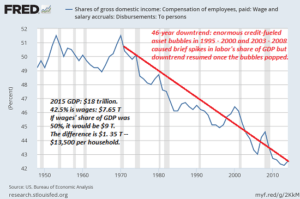
Why did it fail? One aspect of the discontent (as I have outlined before – see here) relates to the slow demise of our financialized, neoliberal, debt-driven growth model. For many in America and Europe, the reality has not been one of economic prosperity, but one of anxiety – and for the first time in the post-World War II era – a sense that the next generations’ prospects will be much tougher, and worse, than ours were.
Here (no friend to Trump) is Naomi Klein’s assessment: “They will blame James Comey and the FBI. They will blame voter suppression and racism. They will blame ‘Bernie or bust’ and misogyny. They will blame third parties and independent candidates. They will blame the corporate media for giving him the platform, social media for being a bullhorn, and WikiLeaks for airing the laundry.
“But this leaves out the force most responsible for creating the nightmare in which we now find ourselves … [financialized] neoliberalism. Here is what we need to understand: a hell of a lot of people are in pain. Under neoliberal policies of deregulation, privatization, austerity and corporate trade, their living standards have declined precipitously. They have lost jobs. They have lost pensions. They have lost much of the safety net that used to make these losses less frightening. They see a future for their kids even worse than their precarious present.
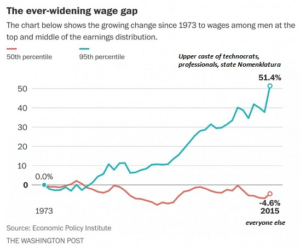
“At the same time, they have witnessed the rise of the Davos class, a hyper-connected network of banking and tech billionaires, elected leaders who are awfully cozy with those interests, and Hollywood celebrities who make the whole thing seem unbearably glamorous. Success is a party to which they were not invited, and they know in their hearts that this rising wealth and power is somehow directly connected to their growing debts and powerlessness.
“For the people who saw security and status as their birthright – and that means white men most of all – these losses are unbearable. Donald Trump speaks directly to that pain. The Brexit campaign spoke to that pain.”
Here it is represented visually:
Of course, this was not the case for the urban élites:
Cultural Resistance
The second aspect to the present discontent has been cultural oppression (or, in the rhetoric of the Democratic Party, “identity politics” – one of the mainstays of the Clintonite electoral base). Its roots are complex, and lie with philosophic currents emerging out of Germany during WWII that somehow fused with American Trotskyist intellectual thinking (which then migrated to the Right). But, in gist, this current of political thought borrowed from the emerging discipline of psychology the concept of clearing the human mind – shocking it, or forcing it into becoming the “clean slate” on which a new mental program could be written by the psychiatric (or political) therapist respectively.
The political aim here was to eliminate totalitarian thinking, and fascist mental “programming,” and to replace it with a liberal-democracy circuit board.
Indeed, the U.S. Immigration and Nationality Act of 1965 was promoted by this intellectual group precisely in furtherance of the notion that concepts such as “national culture” would become meaningless as a result of immigrant cultural dilution. By the 1970s and 1980s, the objective had evolved to implant the idea that there was really no politics to modernity (Fukuyama’s End of History) since all governance somehow had boiled down to technocracy: ensuring effective liberal market functioning — a matter best left to experts.
In political terms, the “clearing” of the mind’s inherited cultural clutter was to be achieved by cultural wars of political correctness. The class war had become discredited, but there were other “victims” on whose behalf war could be waged: the war on gender discrimination, on racism, on denial of gay rights and sexual orientation stereotyping, on verbal micro-aggressions, on sexist language, or any ideas or language which disturbed the individual’s sense of “safe space” were used as tools to clear away old cultural “brush” of inherited national culture, and open the way for an American-led, globalized world.
The ostensible factor linking all these notions of victim “wars” was that their antonym amounted either to fascism or authoritarianism. The problem with this has been that any white American blue-collar worker who attended church, who believed in family life, and was patriotic, became potentially a fascist, a racist, a sexist or a bigot.
Many ordinary Americans (and Europeans) disdain this “cultural” war which places him or her (according to Hillary Clinton), in the “‘basket of deplorables’ Right? Racist, sexist, homophobic, xenophobic, islamophobic, you name it,” and who looked upon his or her community as representing nothing more than a “fly-over” state in the view of the U.S. coastal élites.
The deplorables have now risen up. Donald Trump’s salty language was no liability – it was an electoral asset by thumbing his nose at this correctness, and at so-called ”snowflake” sensibilities. Trump’s ‘incorrectness’ touched on a deep vein of resentment within American traditional society.
Not only does “flyover America” resent being termed “deplorables,” they feel too clearly the disdain in which the American and European elites hold them – and dislike their arrogance in suggesting that there is only one rational, sensible way of doing things, and that they – the elites, being the experts and a part of the Davos set – should tell the rest of us what it is: (despite their decades of failures).
High Emotions
Emotions are high on both sides. To gain a sense of how bitterly the cultural war will be fought, listen to this from the partly-Soros-funded populist mobilization movement Azaaz (linked to America’s Move On organization): “Dear Mr. Trump: This is not what greatness looks like. The world rejects your fear, hate-mongering, and bigotry. We reject your support for torture, your calls for murdering civilians, and your general encouragement of violence. We reject your denigration of women, Muslims, Mexicans, and millions of others who don’t look like you, talk like you, or pray to the same god as you. Facing your fear we choose compassion. Hearing your despair we choose hope. Seeing your ignorance we choose understanding. As citizens of the world, we stand united against your brand of division.”
In short, with Brexit and the Trump victory, we are witnessing an historic point of inflexion. As I noted in mid-October (quoting British political philosopher John Gray): “If the tension between [the globalization project on one hand] and the [sovereign] nation state, [on the other] was one of the contradictions of Thatcherism … From Bill Clinton and Tony Blair onward, the center-left embraced the project of a global free market with an enthusiasm as ardent as any on the right. If globalization was at odds with social cohesion, society had to be re-engineered to become an adjunct of the market. The result was that large sections of the population were left to moulder in stagnation or poverty, some without any prospect of finding a productive place in society.”
“If Gray is correct that when globalized economics strikes trouble, people will demand that the state must pay attention to their own parochial, national economic situation (and not to the utopian concerns of the centralizing elite), it suggests that just as globalization is over – so too is centralization (in all its many manifestations).”
Well, the global trend does not seem to be going in the Avaaz direction. It seems rather to be heading toward prioritizing the recovery of the state, of state sovereignty, and of state engagement in the pursuit of economic policies appropriate to the particular circumstances of the state, and in the state’s ultimate responsibility for the welfare of the community as a whole.
The question is what does this mean geo-strategically? And, secondly, can and will, Trump be able to deliver the new era? The short answer is that this new era seems to presage a period of political volatility, financial volatility and in Europe and the Middle East, the prospect of continued political “shock.”
It is clear that Mr. Trump is not a globalist. It is also clear that he is aware of some of the dangers of the present global monetarist policy. He has spoken of the U.S. Federal Reserve creating “big ugly bubbles” and that the next economic and financial crisis has been “kicked down the road” by Fed Chairwoman Janet Yellen – and clearly awaits whomsoever becomes U.S. President on Jan. 20, 2017.
Painted into a Corner
But three decades of debt-led, financialized “growth policies” leave the President-elect effectively painted into a corner: global debt has spiraled; the bubbles are there still (kept afloat by Central Bank coordinated intervention), and bubbles are infamously difficult to deflate gently; zero or negative interest rates are undermining many a business model, but cannot easily be foregone, without crashing the bond market; and QE (printing money) is systematically eating away at consumer purchasing power through the dilution of its newly created purchasing power, and the latter’s re-direction from “main street” into the financial sector – lifting nominal asset values – but creating no tangible wealth.
America and Europe effectively are in debt-deflation. How then to grow incomes so that producers of goods and services can also afford then subsequently to purchase these goods and services? Trump’s answer is to spend on domestic infrastructure projects. This may help a bit, but is unlikely – in itself – to lift and float the entire U.S. economy.
The reality is that there is no obvious global engine of growth (now that China’s “industrial revolution” has stalled at best). Every nation now is in search of new engines of growth. And it is not easy to imagine that Europe or America will succeed in retrieving all those jobs lost through globalization. Indeed, the attempt so to do – in, and of itself – might just precipitate a further deceleration of world trade, and a consequent decline in output.
In brief, the global economy may see a brief “honeymoon period” thanks to a likely spurt of U.S. fiscal indulgence and a concomitant psychological lift, stemming from – at least – the U.S. construction sector enjoying something of a boom. But ultimately the very economic crisis which Mr. Trump anticipates may prove to be the only way to cut the Gordian knot in which three decades of unprecedented debt and money printing have fettered us.
And if he is to steer through the expected crisis, Mr. Trump will have to eschew the Siren voices of the present elites telling him “TINA” (there is no alternative, but to continue as before).
Where Mr Trump might look for an early (and relatively easy) success however, may be in foreign policy. As “Nixon went to China,” so Trump can go to Russia and China, and begin to treat them as normal nations with whom it is possible to find an intersection of interests (as well as areas of disagreement).
This would be revolutionary. It could change the geo-strategical map. And as President Putin keeps repeating … the door is open (at least for now). Nothing is forever in politics.
Alastair Crooke is a former British diplomat who was a senior figure in British intelligence and in European Union diplomacy. He is the founder and director of the Conflicts Forum, which advocates for engagement between political Islam and the West.
Why Trump’s Presidency Is a Win for Europe
By Finian CUNNINGHAM | Strategic Culture Foundation | 12.11.2016
By vowing to rebuild American society, scale back foreign militarism, de-escalate NATO and seek friendly cooperative relations with Russia, a United States of America under Donald Trump would not only be a boon for America’s best interests. It would also be a win for Europe.
In such a new international outlook, the European bloc would be freed from its atlanticist subservience which has been dominant and deleterious for several decades. European governments would be freer to have more independent foreign policy, instead of toeing the dubious line that up to now has been ordained from Washington. It has been a disaster for the EU to have adhered so slavishly to US foreign policy. Much of the current discontent and disaffection among EU citizens towards the Brussels-based bloc stems from this unnatural and unhealthy subservience to Washington.
Wars in the Middle East, North Africa and Central Asia and the attendant problems of blowback terrorism and influx of refugees are direct results of European governments following Washington’s foreign policy of regime change and so-called «democracy promotion». Even though these wars have been illegal and vile transgressions of international law.
Financial and economic policies adopted by European governments have been straitjacketed by neoliberal capitalist doctrine dictated by Wall Street and successive US governments. This boils down to misery and austerity for the masses, while a tiny oligarchy become ever bloated with wealth. In short, stagnation.
Deteriorating relations with Russia – Europe’s biggest energy supplier – have also stemmed from the EU following Washington’s confrontational agenda towards Moscow. European governments have bought into the spurious US official narrative of Russia being «aggressive» and «expansionist». Admittedly, certain EU members such as the Baltic states are all too willingly Russophobic. But for many others, such hostility between the EU and Russia does not make sense. While economic impacts on the US have been minimal, the tensions between the EU and Russia have badly hit European businesses, exporters, farmers and workers.
The looming threat of war on European territory from the irrational enlargement of the US-led NATO military alliance along Russia’s border is also seen by many citizens as another demonstration of the EU’s reckless subservience to Washington. It is Washington, of course, that has been the main advocate of increasing NATO forces in Europe, augmented by atlanticist EU governments like Britain, Germany and France, as well as the anti-Russian paranoid Baltic states. Some 500 million EU citizens are held ransom to war policies by a coterie of governments who behave like vassals to Washington.
In many ways, the political, economic and cultural problems challenging Europe arise directly from the EU’s lack of independence from the US. Often it seems that Brussels is acting as a rubber-stamp for foreign policies authored in Washington. No wonder then that in the view of many EU citizens the functioning of the bloc is seen to be undemocratic and unrepresentative of their immediate needs. This explains the soaring rise of anti-EU parties right across the bloc. The phenomenon has less to do with an inherent popular affinity for parties labelled «far right» or «xenophobic» and more to do with a popular desire for democratic governance that attends to urgent social interests.
There is much overlap with the political rise of Donald Trump in the US. As in Europe, the mass of ordinary working-class American citizens have been disenfranchised, politically and economically, over several decades. A rarefied political class has become ossified and is seen to be self-enriching and servile to a tiny wealthy elite of financiers, corporations and the military machine that underpins this oligarchy. Integral to the oligarchy are the corporate-controlled media monopolies that pontificate to the masses on how they should vote in elections – elections that have become inconsequential to democratic needs.
All that now appears to be changing. A revolt is underway.
Trump’s election, like the Brexit before in Britain earlier this year, is a popular revolt against the oligarchy. The mass of people have become sickened and wearied by endless wars and endless economic austerity, while the rich elite become ever more obscenely wealthy, and all the while the media propaganda system cynically instructs the people who to vote for and who not to, knowing full well there will really be no «hope and change».
This time around though, the US election, like the Brexit, was infused with righteous, raw popular anger against the oligarchy.
Trump struck a deep popular chord when he called US-led wars in the Middle East a «disservice to our country and a disservice to humanity». People got it when he lamented how much American infrastructure, schools, hospitals, roads, jobs, would have benefited if the trillions of dollars wasted on wars had instead been invested at home. Despite media concealment, a large section of the American people concurred with Trump’s angry denunciation of Obama and past US administrations for criminally stoking terrorism and conflicts. His presidential rival Hillary Clinton was fixed right at the center of this culpability among the Washington oligarchy, which straddles both the Republican and Democrat parties.
Voting Trump into the White House – a property tycoon who has never held an elected office before – is an historic repudiation of the political establishment. It is a political earthquake.
On the eve of election day on November 8, Trump declared that «this will be our independence day… when the American working class will strike back». It may seem incongruous that a billionaire capitalist should exhort the working class to strike. But strike they did.
Trump also said his election would be «Brexit plus, plus, plus». That remark has turned out to be prescient too. The American election earthquake has rocked Europe with greater force than did Britain’s vote to quit the bloc in July. A crevice has been torn open between atlanticist governments and more independently minded ones.
Germany and France in particular have been caught off-side. Chancellor Angela Merkel expressed «shock» at Trump being elected, while French President Francois Hollande – also disapproving the result – called for «united European values» to confront the new American president. Hollande’s bravado for «liberal values» makes him look even more fatuous.
Britain, the other atlanticist voice in Europe, was more congratulatory to President-elect Trump. No doubt, that’s because Britain is seeking to shore up badly needed bilateral trade deals with the US in light of its departure from the EU and therefore it needs to keep Trump sweet.
What really alarms Germany and France is that Trump is no atlanticist or NATO advocate. His nationalist views and tougher stance on immigration controls resonate with EU members like Hungary, Czech Republic, Slovakia, Slovenia, Greece and Austria.
Trump’s views also give a boost to anti-EU parties in Germany and France who are challenging incumbents Merkel and Hollande in elections next year. It was telling that while Merkel and Hollande deprecated Trump’s election, he was heartily congratulated by the anti-EU Alternative for Germany and Marine Le Pen’s National Front in France, as well as Nigel Farage’s UK Independence Party in Britain. These parties also tend to share Trump’s more sanguine view of friendlier relations with Russia.
If Donald Trump can deliver on his avowed program of rebuilding American society and economy from within while abandoning US imperialist hegemony around the world that will potentially transform world relations. For Russia and China it will lead to a much needed normalization of relations, away from the current Cold War-type hostility that threatens to ignite world war. Both Russian and Chinese leaders Vladimir Putin and Xi Jinping were quick to express congratulations and readiness to work with new president Donald Trump.
The political establishment, including the media, in the EU that is dominated by woefully misguided atlanticism has deplored the election of Trump in the US. There is a snobbish handwringing attitude that Trump’s movement is all about racist, white trash numbskulls. There may be some unsavory elements to Trump’s support, as there are in some anti-EU movements. But in the main what it is about is reclaiming democratic power for the mass of people. What the Americans have done in electing Trump is what the Europeans also need to do in order to sack a corrupt and venal establishment that up to now has only served Washington and the atlanticist elite.
If Trump’s victory invigorates similar trends across Europe then that would be a good thing. And especially if it led to Europe having a more independent foreign policy from Washington and in particular gaining a more normal, mutual relationship with Russia.
Energy Price Hike Leaves Whole Sectors of Ukrainian Economy on Brink of Collapse

© Photo: Facebook/Zaporizhstal Europe
Sputnik – 11.11.2016
IMF-mandated hikes in electricity prices for businesses have made whole sectors of the Ukrainian economy uncompetitive, making it more profitable to shut factories down than to keep them operating, says Ukraine’s oldest and largest business association.
Speaking in Kiev on Thursday at the Ukrainian League of Industrialists and Entrepreneurs’ annual conference, president Anatoly Kinakh pointed out with dismay that authorities in Kiev did not bother to carry out the necessary economic calculations when they decided to raise tariffs. “Where are the necessary technical and economic calculations?” the official asked.
“Where were the forecasts about how this will affect the competitiveness of our economy? How does the tariff increase correlate to consumers’ ability to pay? There are no answers to these questions. And this is very serious, because all we are doing is seeing the decline of citizens’ standard of living.”
For example, Kinakh noted, the massive Zaporozhye aluminum plant has recently been forced to stop operations completely due to the high cost of electricity; its energy-intensive production has been made uncompetitive thanks to whopping 40% electricity price hikes and the end of subsidies.
“If before, the plant was able to purchase electricity at a special rate, now this is impossible; the plant is being offered electricity at the same price as other companies, making it uncompetitive,” the official lamented.
The legendary Zaporozhye aluminum plant, established in 1930, was once one of the largest aluminum smelters in the world, and famous for its unique production methods.
Producing over 100,000 metric tons of aluminum a year in its heyday, the plant played a crucial role in contributing to many key industries, including the Soviet and post-independence Ukrainian aerospace industry, which has suffered its own tragic decline in recent years. Antonov, once a legend of global civilian and military aircraft production, isn’t expected to produce even one plane this year.
Ukraine’s International Monetary Fund-mandated austerity measures, combined with the loss of Russian markets for Ukrainian goods, have also hit ordinary Ukrainians hard. The IMF has insisted on further cuts to subsidies on utilities for low-income citizens, leaving millions uncertain where they will get the money to heat their homes this winter.
What Happened In This Election?
By John Chuckman | Aletho News | November 10, 2016
Brushing away the extreme claims and rhetoric of much election analysis, there are some observations which deserve attention. These unfortunately mostly provide hard lessons and not a lot of encouragement for people who hold to principles of democracy, enlightenment, and progressivity.
The election demonstrated perhaps better than ever, and better than has generally been recognized, that American is, indeed, a plutocracy. It took a genuine American Oligarch, a multi-billionaire, a man with a lifetime’s economic empire-building, to defeat a family which could provide the very definition of being politically well-connected, a family which had laboriously constructed and carefully maintained a kind of deep well ever-flowing with money for their ambitions.
It was the ever-flowing well of money, drilled by Bill Clinton with help from some extremely shady friends, such as Jeffrey Epstein, that made the Clintons keystone establishment figures in the Democratic Party. It was not personal charm or exceptional political generalship – although Bill, in his heyday, displayed some of both of those – that earned the Clintons their place, it was the money, the “mother’s milk of politics.” In what is euphemistically called “fund raising,” many hundreds of millions of dollars were provided for the party over the last couple of decades by Bill Clinton’s efforts.
Hillary fully appreciated the fact that money buys power and influence. She lacked Bill’s superficial charm, but she certainly more than shared his ambition. On the charm front, when she was ready to move into running for office, she adopted, perhaps under Bill’s tutelage, a kind of forced clown face with arched eyebrows, bugged-out eyes, and a smile as big as her lips would allow, and these expressions were accompanied by little gestures such as briefly pointing to various on-lookers or waving helter-skelter whenever she campaigned.
Her gestures reminded me of something you might see atop a float in a Christmas Parade or of the late Harpo Marx at his most exuberant. These were not natural for her. They were never in evidence years ago when she spent years as a kind of bizarre executive housewife, both in a governor’s mansion and later in the White House, bizarre because she indulged her husband’s non-stop predatory sexual behavior in exchange for the immense power it conferred on her behind the scenes over her far more out-going and successful politician-husband.
Anyway, Hillary knew that gestures and simulated charm do not get you far in American politics. She determined to build a political war chest long ago, and there are many indications over the years of her working towards this end of making this or that change in expressed view, as when running for the Senate, when sources of big money suggested another view would be more acceptable. She was anything but constant in the views she embraced because when she ran for the Senate she spent record amounts of money, embarrassingly large amounts.
In her years of speaking engagements, she aimed at special interests who could supply potentially far more money than just exorbitant speaking fees. Later, in the influential, appointed post of Secretary of State – coming, as it does, into personal contact with every head of government or moneyed, big-time international schemer – she unquestionably played an aggressive “pay for play” with them all. Covering up that embarrassing and illegal fact is what the private servers and unauthorized smart phones were all about.
A second big fact of the election is that both major American political parties are rather sick and fading. The Republican Party has been broken for a very long time. It hobbled along for some decades with the help of various gimmicks, hoping to expand its constituency with rubbish like “family values,” public prayer and catering to the Christian Right, and anti-flag burning Constitutional amendments, and now it is truly out of gas. That is precisely why a political outsider like Oligarch Trump could manage to hi-jack the party.
He was opposed by tired, boring men like Jeb Bush, seeking to secure an almost inherited presidency, and a dark, intensely unlikable, phony Christian fundamentalist like Ted Cruz, and it proved to be no contest. It was a remarkable political achievement, but I think it was only possible given the sorry state of the party.
The Republican Party had been given a breather, some new life, by Ronald Reagan in the 1980s. He had an extremely mixed record as President, but he was popular, held in some affection, and did have a clear vision, but his effect on the party was not lasting. Trump could be seen as another Reagan, but I think the comparison is superficial. Trump literally hi-jacked the party, and he was not deliriously crowned by its establishment.
The Republican Party itself was formed not long before Abraham Lincoln’s candidacy out of the remains of worn out and collapsed predecessors, including the Whigs and Free-Soil Democrats. Parties do not last forever, and here was Trump creating something of a minor political revolution inside a tired and fairly directionless old party, a phenomenon which I do not think was sufficiently noticed.
The press was too busy attacking him from the start to take notice or do any intelligent analysis, and he was attacked precisely for the potential damage to the establishment he represented. His most promising quality is his potential for creating a new coalition of interests and one excluding the continuation of the Neocon Wars Hillary vigorously embraced and would expand.
But the Democratic Party is in serious trouble, too. It has a great deal of internal rot, as the Wiki-Leaks material from the DNC clearly shows us. Arrogance, lack of direction, ignorance of the people it has always claimed to serve, bad decision-making, and the absolute prostrate worship of money are the major symptoms.
It would have been impossible for the party to have so made up its mind and committed its resources to Hillary Clinton without serious rot. She has always had strong negatives in polling, always been (rightly) suspected concerning her honesty.
The Wiki-Leaks material tells us about many internal conflicts, including harsh high-level judgments of Hillary’s decision-making, resentment over the back-stabbing character of daughter Chelsea who is said to resemble Hillary in her behavior and attitudes, and the belief of some that Hillary just should not have run. And, frankly, she had become for many a rather tiresome, used-up figure from whom absolutely nothing spectacular in politics or policy could possibly be expected. But they not only blindly supported her, they broke all their own party rules by internally and secretly working to defeat a legitimate and viable contender, Bernie Sanders.
Sanders might well have been able to win the election for the Democrats, but their establishment was blind to the possibility and rejected his candidacy out-of-hand. After all, there were Bill and Hillary beckoning to their running well of money. In hindsight, it might be just as well that Sanders was cheated out of the nomination. He proved a weak individual in the end, giving in to just the forces he had claimed to oppose and leaving his enthusiastic followers completely let down. There he was, out on the hustings, supporting everything he ever opposed personified in Hillary Clinton. Men of that nature do not stand up well to Generals and Admirals and the heads of massive corporations, a quality which I do think we have some right to expect Trump to display.
Another important fact about the election is that it was less the triumph of Trump than the avoidance of Hillary that caused the defeat. The numbers are unmistakable. Yes, Trump did well for a political newcomer and a very controversial figure, but Hillary simply did badly, not approaching the support Obama achieved in key states, again something reflecting the documented fact that she is not a well-liked figure and the Party blundered badly in running her. But again, money talks, and the Clintons, particularly Bill, are the biggest fundraisers they have had in our lifetime. No one was ready to say no to the source of all that money.
Now, to many Americans, the election result must seem a bit like having experienced something of a revolution, although a revolution conducted through ballots, any other kind being literally impossible by design in this massive military-security state. In a way, it does represent something of a revolutionary event, owing to the fact that Trump the Oligarch is in his political views a bit of a revolutionary or at least a dissenter from the prevailing establishment views. And, as in any revolution, even a small one, there are going to be some unpleasant outcomes.
The historical truth of politics is that you never know from just what surprising source change may come. Lyndon Johnson, life-long crooked politician and the main author of the horrifying and pointless Vietnam War, did more for the rights of black Americans than any other modern president. Franklin Roosevelt, son of wealthy establishment figures, provided remarkable leadership in the Great Depression, restoring hopes and dreams for millions. Change, important change, never comes from establishments or institutions like political parties. It always comes from unusual people who seem to step out of their accustomed roles in life with some good or inspired ideas and have the drive and toughness to make them a reality.
I have some limited but important hopes for Trump. I am not blind or delirious expecting miracles from this unusual person, and after the experience of Obama, who fairly quickly proved a crushing, bloody disappointment, I can never build up substantial hopes for any politician. And what was the choice anyway? Hillary Clinton was a bought-and-paid one-way ticket to hell.
Trump offers two areas of some hope, and these both represent real change. The first is in reducing America’s close to out-of-control military aggressiveness abroad. This aggressiveness, reflecting momentum from what can only be called the Cheney-Rumsfeld Presidency, continued and grew under the weak and ineffectual leadership of Obama and was boosted and encouraged by Hillary as Secretary of State. Hillary, the feminists who weep for her should be reminded, did a lot of killing during her tenure. She along with Obama are literally responsible for the deaths of tens of thousands of women and their families, many of them literally torn apart by bombs.
The other area of some hope is for the welfare of ordinary American people themselves who have been completely ignored by national leaders for decades. By welfare, I do not mean the kind of state assistance that Bill Clinton himself worked to end.
George Bush’s lame reaction to Hurricane Katrina (before he was internationally shamed into some action) has become the normal pattern for America’s national government when it comes to ordinary Americans. The truth is that the legacy of FDR has withered to nothing and no longer plays any role in the Democratic Party, and of course never did in the Republican Party.
Nothing can impress someone not familiar with America’s dark corners more than a visit to places like Detroit or Gary or Chicago’s South Side, parts of New Orleans, or Newark or dozens of other places where Americans live in conditions in every way comparable to Third World hellholes. No, I mean the people’s general well-being. Trump’s approach will be through jobs and creating incentives for jobs. I don’t know whether he can succeed, but, just as he asked people in some of his speeches, “What do you have to lose?” Just having someone in power who pays any attention to the “deplorables” is a small gain.
People should never think of the Clintons as liberal or progressive, and that was just as much true for Bill as it is for Hillary. His record as President – apart from his embarrassing behavior in the Oval Office with a young female intern and his recruitment of Secret Service guards as procurers for women he found attractive on his morning runs – was actually pretty appalling. He, in his own words, “ended welfare as we know it.” He signed legislation which would send large numbers of young black men to prison. He also signed legislation which contributed to the country’s later financial collapse under George Bush. He often would appoint someone decent and then quickly back off, leaving them dangling, when it looked like approval for the appointment would not be coming. His FBI conducted the assault on Waco, killing about eighty people needlessly. A pharmaceutical plant in Sudan was destroyed by cruise missiles for no good reason. There were a number of scandals, including the suicide of Vince Foster and the so-called Travelgate affair, which were never fully explained to the public. It was his Secretary of State, Madeleine Albright, who answered, unblinkingly, a television interviewer’s question about tens of thousands of Iraqi children who died owing to America’s embargo, “We think it’s worth it.” He committed the war crime of bombing Belgrade. When news of the horrors of the Rwanda genocide were first detected by his government, the order secretly went out to shut up about it. No effort was made to intervene.
No, any real change in America could never come from people like the Clintons, either one of them.
Donald Trump won the election… so what now?
By Kit | OffGuardian | November 10, 2016
In the wake of the shocking result of the US Presidential election, we take a look at some of the key questions left up in the air. How did things go so wrong for Hillary Clinton? How will the world look when the dust has settled? Is this really a sign of any kind of change?
Question 1: What the hell just happened?
Most people, most pundits most media outlets were predicting a Clinton victory. The pundits and reporters, because Hillary was “qualified” and “competent”. Everyone else…because she could follow Obama’s example and mobilise the virtue-signalling vote, and even if she didn’t it would just be rigged. As the primaries evidently were.
The vast majority of the media were behind Clinton. The banks were too. As was Wall Street, big pharma, arms manufacturers, senior figures from both major political parties and (seemingly, anyway) the military and intelligence services. How could that much collective clout possibly fail to pull out the W? How did they let this happen?
You are left with three possibilities.
1, elections aren’t rigged. Simply put, all the weight behind Clinton could only exercise legitimate and transparent power. They could give interviews, write opinion pieces and campaign…and that’s all. They fought hard, and they lost. Fair and square. Given what we know about 2000, 2004 and the democratic primaries this seems unlikely.
2, elections can be controlled, but only in a limited fashion. This was talked about at length following the Brexit vote (which many people have suggested was nothing like as close as the “official figures” made it look). This idea posits that numbers can be manipulated, but not controlled. You can fudge them up and down, but full-on fakery leaves too much evidence, or is simply too difficult. It’s possible that Clinton was just SO mistrusted, SO hated, SO incredibly unpopular, that even with the collective might of 90% of the political and media establishment behind her… they just couldn’t swing the vote. This is plausible, especially if you paid attention to the crowd sizes at their respective rallies.
[Note: These situations both come with the rider that, much like sports, it may only be possible to rig an election if both sides are willing to cooperate. Maybe Trump wouldn’t let it slide the way Al Gore or Bernie Sanders were happy to do.]
3, somebody changed sides. Maybe the election was rigged, but in the other direction. Maybe the sudden, unexpected reopening of the e-mail investigation was a deliberate ploy by the FBI (and others, behind the scenes) to swing public opinion against Hillary. Maybe the rumors of immediate impeachment should Hillary win, and of possible ties to paedophiles and human trafficking, were the straw that broke the camel’s back. It’s possible that an establishment already creaking alarmingly under the weight of Clinton’s baggage, decided Clinton was now simply too much trouble. And that it might be easier to chance their arm on a man who might be willing to play ball, and was less likely to throw up a constitutional crisis and/or suddenly drop dead.
It’s recently become obvious, given the flip-flopping over Ukraine and Syria, that the American political establishment is far from a monolith of drive and purpose. There are internal divisions. There are factions. Trying to distill any kind of rational plan from their resulting actions is like trying to follow the score in a game of Rugby where four teams are playing at once, and they’re all wearing the same uniform.
Question 2: Will Trump Be Allowed to take office?
Just as happened following the Brexit vote (and to a lesser extent Jeremy Corbyn’s election as Labour leader), already this result has sprouted protest movements, petitions and articles either directly challenging its legitimacy, or simply questioning the “democratic value” of the American electoral system.
As the results were coming in last night, I personally witnessed tweets suggesting Obama should refuse to relinquish his office to Trump. Protest marches have already been held in many cities across America. If these protests escalate to riots, or street battles, Obama could declare a state of emergency which “delays” the swearing-in of the new president, Trump supporters would see this (rightly) as a possible coup attempt, leading to further violent unrest and the declaration of martial law. Extreme, but not impossible. Any move to replace Trump before he’s even in office would be totally unprecedented and grossly unconstitutional. But so was Gitmo.
Before the vote was held, the democrats were fervently and hysterically blaming the Russians for “interfering” with the election, baseless rumors which the media eagerly and unquestioningly repeated. You could argue this was done to preemptively defend themselves in the event of a Trump win. Undermining the result before there even was one. The Russian “hacks” are cited as the main cause behind this petition, calling for an overthrow of a Trump government, on the grounds he stole the election. This issue could be picked up more widely in the media in the coming days.
The long, long, long delay before Hillary finally appeared to make her concession speech makes one wonder if, behind the scenes, there may have been wheels turning. Think tanks furiously going over the options and outcomes should Clinton simply refuse to concede the election and publicly call into question the fairness of the vote. In the end, what would have finally sunk that possibility is the pompous way Clinton’s team responded to Trump’s own suggestion there may be vote rigging. To turn around and “disrespect our democracy” after she lost would have laid Clinton open to justified claims of hypocrisy.
There are more old fashioned methods of removing an unwanted president, of course. It’s very telling that “assassination” was shooting up the google search ranks as the results were announced last night. And America has never been short a lone wolf assassin when it really, really needed one.
Question 3: What sort of man is Donald Trump?
It’s tempting, at moments such as this, to blindly and joyfully accept outcome as a win for good guys. I’m not going to deny I was, more than anything, relieved when I saw the result. The possibility of a psychopathic war hawk pushing for a war with Russia, with the full weight of a self-deluded middle-class high on their own moral outrage behind her, was terrifying. But not so long ago Barack Obama was… for want of a better phrase…the great white hope. He was going to change things…but didn’t. In the end he was simply an Orwellian controlled alternative. It’s possible that’s all Trump is, too.
It’s possible Trump is just a pompous windbag who would say or do anything to get into power, simply for the sake of having power. It’s possible he’s an elaborate ploy designed to satiate an angry public thirsty for real change, and buy the oligarch elite more time to milk us dry or blow us all up for some crazy reasons of their own. Both plausible, but let’s put them aside for now.
Let’s say that Trump is sincere in his goals, and let’s say he is allowed to take office and try to introduce his policies – both big ifs, but still. How much institutional and bureaucratic resistance will he encounter? How many threats and extortions will he face? Does he have the strength of character to face down that opposition? Very few people do. Most politicians sell their souls for power, or resign themselves to impotence. It takes an extraordinary person to keep a hold of themselves and their ideals, in a political environment double loaded with both temptation and threat.
All through the election cycle the democrats were far more interested in talking about punch lines, snappy quotes and identity politics than discussing policy. That’s because any real discussion of policies would only push a lot of people into voting for Trump. He want’s to cut-out hostilities with Russia and cooperate in combating terrorism. He wants to slash defense spending and rebuild industry. He wants to pull American bases out of Japan, Germany, South Korea and others, and relinquish America’s self-styled title of “World Policeman”. He wants to stop corporations from employing illegal immigrants to get around paying minimum wage. He has posited leaving NATO.
These are all, on the face of it, reasonable policies that could bring America back from the brink. And they are all, on their own, potentially career ending for any other politician in the Western world.
Will he ever be allowed to enact a single one of them? I guess we’ll see.
Steelworkers urge EU protection against imports
Press TV – November 9, 2016
Steelworkers from across the European Union have held a protest in front of the EU headquarters in Brussels to demand protection, as cheap foreign import mostly from China keeps threatening job security in the industry.
The protesters on Wednesday urged the EU to impose tough restrictions on steel imports from China and adopt better regulations for the market.
Reports said at least 5,000 people from various EU countries attended the demonstration.
Recent studies show that an estimated 330,000 people are working in Europe’s steel factories, the lowest in the history of the industry in the continent. That comes as many think Europe owes its industrial revolution to the boom in steel production.
The European Union has moved to adopt policies that could prevent the import of cheap products to its market. The aim is to cut the flow of steel from China, which has swamped the European markets at dumping prices.
Luc Triangle, the general secretary of Industrial Europe union, said the EU must do more to ensure the rights of the steelworkers were protected.
“You cannot throw workers in the arena of globalization without any protection,” Triangle added.
EU Competitiveness Commissioner Jyrki Katainen said the policies were meant to create a fair competition in the European steel market, noting, “Free trade must be fair, and only fair trade can be free.”
Workers have already staged mass protests in developed EU countries such as Germany, saying the widening trend of cheap imports from China and a global oversupply of the product have already created many uncertainties about the prospects of the industry.
About 50,000 steel workers attended such rallies in three German cities, including the capital Berlin, in April, denouncing the EU’s unfair environmental regulations.

Featured Video

AIDS Inc. by Gary Null (2007)
or go to
Aletho News Archives – Video-Images
From the Archives
Clash of Civilization, Iran Part II
By Jamal Kanj – Intifada-Palestine.com – January 14, 2011
Israel’s survival kit is: perpetuate conflict, insecurity to rationalize collective hate and finally playing victim.
Devoid of conflict, Israel implodes internally; without hate, Zionism loses its justification; and playing eternal victim to continue blackmailing the West. Absence of this holy trinity, Israel ceases to exist.
From its inception, the house of Zion has mastered exploiting adversarial powers to advance Israel’s cause. For instance, their influence over the Democratic Party in the US began with President Truman’s bid for 2nd term election in 1948.
Responding to strong opposition from Secretary of State General George Marshall and Department experts urging against recognition of Israel, President Truman replied: “I’m sorry gentlemen but I have to answer to hundreds of thousands [Jewish voters] who are anxious for the success of Zionism. I do not have hundreds of thousands of [voting] Arabs among my constituents”
Zionists influence over liberal American politics was matched with the doctrinal school of Conservative theoreticians aligning the Republican Party’s platform with Israel’s objectives. The Neoconservative Zionists, coined Zioncons, invented the “Clash of Civilization” concept to fight Israel’s wars. … continue
Blog Roll
 Aletho News
- Merck Virologists Admitted to Falsely Certifying Vaccine Efficacy
- Mandatory Folic Acid for every man, woman & child
- Pro-Palestine protesters arrested outside UK’s ruling Labour Conference in Liverpool
- Mauritius denies landing permit to flight from Israel, forcing cancellation: Tour operator
- Israeli finance minister calls for genocidal war on West Bank, annexation of south Lebanon
- 12 Things Your Psychiatrist Was Trained Not to Tell You
- From Unipolar Universalism to Multipolar Civilizational Distinctiveness
- RSF military group defects, joins Sudanese army: State media
- Ireland goalkeeper refuses to play ‘Israel’ as squad weighs boycott
- China pushes back against US on Cuba, Iran
- If Americans Knew
- Israel forces Gazans to live in constant peril – Daily Update
- Deconstructing Netanyahu’s pants-on-fire UN rant – Daily Update
- Trump betrayed voters with his campaign lies and prioritized a foreign country once he took office
- Netanyahu calls Israel’s war in Gaza ‘opposite of genocide’ in UN speech to near-empty hall
- Settler Kidnappings: Torture, Sexual Abuse and Terrorisation of Palestinian Abductees as Israel Deepens Annexation of West Bank
- Gaza winter nears as 162,000 tents become unusable, raising fears of humanitarian crisis
- Netanyahu says, “It’s the opposite of genocide”; UN says Gaza economy is world’s ‘most severe crisis on record’ – Daily Update
- Israel’s US-Backed Assault on Gaza Has Created the ‘World’s Most Severe Economic Crisis on Record’: UN
- ‘Protecting U.S. Citizens’… From Israel
- ‘This is where I live now, the back of a truck’: a day in the life of a grandmother in Gaza
- No Tricks Zone
- New Study: Earth And Venus Surface Warmth Largely Explained By Convection And Lapse Rate, Not CO2 Or Radiation
- 2025 Nature Paper Claiming Worsening Global Drought Gets RETRACTED …Heavily Flawed
- New Study: ‘Global Drought Shows No Detectable Recent Acceleration Under Climate Warming’
- Economic Masterminds: German Socialists Suggest Taxing Productivity Gains Stemming From Using AI
- The South China Sea Has Not Been Cooperating With The Climate Change Narrative
- Energy Crisis: Germany Enters Heating Season With Historically Low Gas Reserve Fill Levels
- New Study: The Antarctic Ice Sheet Gained Mass From 2020-2024 Due To Staggering Snow And Ice Accumulation
- Study: Ocean Heating Rates From Thousands Of Years Ago ‘Dwarf’ Modern Ocean Heating Rates
- Climate Extremists Target, Attack Large-Scale Power Grid Infrastructure In Germany!
- New Study: Antarctic Ice Melt Has Contributed Less Than 1 Centimeter To Sea Level Rise In The Last 30 Years

