Davos, Mark Carney’s frankness, and the Euro-American rift
By Raphael Machado | Strategic Culture Foundation | January 29, 2026
One of the defining factors of the era beginning from the second half of the 20th century is the partnership between the USA and Europe – initially only Western Europe, eventually most of the old continent. But “partnership” is perhaps an imprecise term. The ideal term would probably be “occupation,” since, as defined by Lord Ismay, NATO was created to “keep the Americans in, the Soviets out, and the Germans down.”
In the meantime, Europeans grew accustomed to an automatic alignment with the USA, quite similar to that of Ibero-American countries during the same period, with the exception of the brief period when Charles de Gaulle distanced his country from NATO. Otherwise, the Atlantic Alliance gradually absorbed European countries.
The confusion is such that when speaking of “Western civilization,” most people think of Europe and the USA together, not only as expressions of the same civilization but as possessing identical fundamental and strategic interests. The Davos Forum or World Economic Forum can be thought of as the “celebration” of this civilizational alliance, an event bringing together political, economic, and societal leaders from around the world to discuss the priorities to be adopted in the coming years.
Historically, the USA and its representatives have always been prominent at the Davos Forum in all discussions, whether on environmental issues, the supposed need to censor the internet, or the social transformations considered necessary to deal with the 2020 pandemic crisis or future health crises. It was a space for consensus and planning among the North Atlantic elites.
However, Trump’s antagonistic stance towards the countries of the European Union inevitably significantly changed the atmosphere of Davos this time.
The pressures and demands for the cession of Greenland, including the threat of using military force, ultimately became the driving force of interactions among the elites. Naturally, at this moment, EU countries would not be capable of mounting significant military resistance to the USA in Greenland. But the increase in European military presence on the Danish-owned island seems to serve simply as the drawing of a red line.
And despite Mark Rutte rushing to try to find some sort of compromise with Trump on the Greenland issue, the reality is that Trump’s mere threat and pressure against his supposed allies was enough to leave scars. In other words, no matter how timid and cowardly current European leadership may be, to the point of yielding time and again, European distrust and ill-will towards the USA is still likely to increase.
Perhaps it is even necessary to look at other sectors besides the political summit. Among intellectuals, think tanks, journalists, and influencers, it seems easier to find tougher and more critical positions regarding the USA, as well as less willingness to reconcile, than among national political leaders.
“Anti-Americanism,” once a central plank for both nationalist and socialist parties in Europe but fallen into disuse after the Cold War, may end up becoming an important discursive topic again in this era of rising diverse populisms.
To a large extent, the speech by Mark Carney, Prime Minister of Canada, can be seen as a reasonable summary of the current geopolitical moment.
Throughout his speech in Davos, Carney emphasized that for decades, Canada and most Western countries remained aligned with the so-called “rules-based international order,” even considering it partly fictional; still, it was a useful and pleasant fiction. The other Western countries knew that these rules were not applied equally to all countries, and that stronger countries were practically exempt from most of their regulations. Everything in that order depended on who was the “accused” and who was the “accuser.” Different countries, engaged in the same actions, such as suppressing civilian protesters, for example, would receive different treatment depending on who their leaders and governments were: some would receive no more than a symbolic slap on the wrist, others would be bombed and have their heads of state executed in sham courts.
And these Western countries were satisfied as long as the bombed countries were African or Arab or, occasionally, some Slavic country like Serbia. This was because, for a few countries, that order allowed them to collect benefits in the form of capitalist extractivism.
Now, however, the international order has ended. It does not even survive as a farce – according to Carney himself. Faced with a series of crises, many countries began to perceive global integration more as an Achilles’ heel than as an advantage. Goods might have been cheaper, but what good is the theoretical availability of cheaper products when, in times of crisis, they become inaccessible, as during the health crisis. Or when sanctions simply make trade relations unviable for targeted countries.
For Carney, therefore, some countries have decided to transform themselves into fortresses, primarily concerned with ensuring their own energy, food, and military autonomy. And one of the basic consequences of this change is the decline of multilateral organizations. International courts, the WHO, the WTO, the World Bank, and various other bodies are increasingly ignored and disdained by regional powers – in the case of countries outside the “Atlantic axis,” because they consider the influence of the USA and its allies in these bodies too great; in the case of the USA, because, on the contrary, they consider that these bodies do not sufficiently serve US national interests.
This parallel and crosswise dissatisfaction is natural, to the extent that international institutions only ever served the USA and its hegemony insofar as that hegemony was the best tool for gradually constituting a “world government,” that “New World Order” proclaimed by George H. W. Bush.
The consequence of this process of collapse of globalist multilateralism is that international relations have come to be dominated by force. Most medium-power countries are not prepared to deal with this new and sudden reality. Moreover, it is naive to simply condemn the current situation and hope for a return to the “good old days” of a “rules-based” international order where the rules do not apply equally to everyone.
Carney also makes a suggestion for these medium-power countries to deal with the current international situation: strengthen bilateral relations with countries of similar mindset and orientation, building small coalitions of reasonably limited scope, aiming both to eliminate possible economic weaknesses and to enhance security mechanisms.
Naturally, Carney is specifically referring to strengthening Canada-EU relations, but, to some extent, we can also apply this kind of reflection to those counter-hegemonic or non-aligned countries that are not continental powers like Russia, China, and India. The case of Venezuela demonstrated that it is, in fact, necessary to be prepared to deal with US aggressiveness.
Countries like Brazil, despite its size and the importance given to it in international relations, lack nuclear weapons and sufficiently modern military forces to effectively protect itself against a focused and determined military action. Naturally, Brazil should seek to solve these deficiencies (and, indeed, the debate on “Brazilian nuclear weapons” has already begun in political, military, and social circles), but no significant change will be seen in the short term – which is why Brazil actually needs to develop other ways to guarantee its own security that do not depend on simple servility to the USA.
It would be fully in Brazil’s interests to lobby, within BRICS, for increasing the “security” dimension of the coalition. Still, we doubt that the current Brazilian administration has any interest in this, or even that it understands the need for such a radical transformation. In the absence of this initiative, at the very least, Brazil should seek to update its military, intelligence, and radar technology with the help of Russian-Chinese partnerships. But on a regional level, Brazil needs to strengthen its ties with other South American countries and begin, subtly, to try to attract them and remove them from the US orbit.
In short, the mere fact that we are discussing these needs, instead of naively betting that international forums created on Western initiative will be enough to defend us, already proves that we are already in a new and dangerous world.
Davos and Abu Dhabi: How the Ukrainian Endgame Exposed Western Decline
By Ricardo Martins – New Eastern Outlook – January 28, 2026
While Russia, the United States, and Ukraine quietly negotiated in Abu Dhabi, Davos revealed Europe’s real position in the emerging world order: excluded from decision-making yet burdened with the costs of war and peace alike.
The 2026 World Economic Forum in Davos will likely be remembered less as a forum for global coordination than as a public autopsy of the Western-led international order.
What emerged in the Alpine setting was not coherence but fragmentation: rhetorical excess, strategic confusion, and an unmistakable sense that the world has already moved beyond the frameworks still defended—often ritualistically—by Euro-Atlantic elites.
Three speeches captured this moment with particular clarity: those of Volodymyr Zelensky, Mark Carney, and, less noticed but arguably most consequential, Chinese Vice-Premier Ding Xuexiang (represented in the Davos debate through He Lifeng’s economic message).
Zelensky and the Public Humiliation of Europe
President Volodymyr Zelensky’s speech was striking not only for its confrontational tone but also for its intended audience. His criticism was not primarily directed at Russia or even the United States, but bluntly at Europe. He accused the European Union of strategic indecision, military weakness, and an inability to guarantee Ukraine’s security, reiterating that Europe “still does not know how to defend itself” and remains structurally dependent on Washington.
Mocking Europe’s symbolic troop deployments to Greenland and its delayed reactions to crises such as Iran reinforced Zelensky’s humiliation of Europe.
This rhetoric can be understood as a final reckoning — an all-or-nothing move in which he burned all bridges and launched a frontal attack without regard for the consequences. By Davos, Kyiv was already aware that negotiations over the territorial concessions of the war were being discussed in Abu Dhabi between the United States, Russia, and Ukraine without European participation.
Zelensky’s speech thus functioned as political coercion aimed at Europe as the remaining actor capable of paying the price of a settlement. By publicly framing Europe as weak and morally indebted, Zelensky attempted to transform guilt into leverage in the final phase of negotiations.
This interpretation is reinforced by reporting in the Financial Times, which revealed that Ukraine’s willingness to consider territorial concessions is conditional upon accelerated EU membership, potentially by 2027. In domestic political terms, this trade-off allows Zelensky to reframe territorial loss as civilisational gain: Ukraine does not lose land; it “joins Europe.”
The bill, however, is addressed to Brussels.
Europe’s Astonishing Response
The European reaction to Zelensky’s speech in Davos bordered on political self-abnegation. Despite being publicly criticised, European Commission President Ursula von der Leyen praised Ukraine’s “heroic struggle” and emphasised Europe’s material commitment rather than responding to the substance of Zelensky’s accusations.
This asymmetry—verbal humiliation met with renewed rhetorical loyalty—reveals a deeper structural problem: Europe’s inability to translate financial power into strategic agency.
Dissent has nevertheless emerged at the national level. Italian politicians, including Rossano Sasso and Matteo Salvini, openly criticised Zelensky’s “ungrateful” tone and questioned continued military and financial support.
Such reactions reflect mounting domestic pressures linked to inflation, energy costs, and war fatigue, documented extensively by Politico and the Kiel Institute.
Yet these voices remain fragmented, and Europe as a collective actor continues to display what can only be described as strategic paralysis.
Mark Carney and the End of the Rules-Based Illusion
If Zelensky exposed Europe’s weakness, Mark Carney articulated its anxiety. His Davos speech openly acknowledged what had long been implicit: the so-called “rules-based international order” is no longer operative—and perhaps never was. Carney framed the current moment as a rupture, arguing that “middle powers” such as Canada and European states must now navigate a world no longer structured by predictable norms but by power, leverage, and economic scale.
Carney’s concept of “value-based realism” deserves close scrutiny. On the surface, it appears as an attempt to reconcile normative language with geopolitical adaptation. In substance, however, it represents an effort to preserve Western managerial influence within a system that has already shifted towards multipolarity. Sovereignty, in Carney’s formulation, is diluted into “managed multipolarity,” administered by the same financial and institutional elites that dominated the previous order.
This is precisely why his discourse fails to resonate in the Global South. For emerging powers—particularly within BRICS—the collapse of the Western order is not a tragedy to be managed but a long-awaited correction. Carney’s speech, far from acknowledging this, sought to repackage decline as stewardship.
That it reportedly irritated Donald Trump is unsurprising: Carney implicitly rejected American unilateralism while simultaneously refusing genuine systemic change.
China and the Silent Centre of Gravity
The most consequential intervention in Davos was arguably not Western at all. Chinese Vice-Premier He Lifeng articulated Beijing’s strategic priority with remarkable clarity: China is positioning itself to become the world’s largest consumer market, making access to Chinese demand the central axis of future global trade.
This message, echoed by analysts such as Pepe Escobar, signals a structural shift in the global economy: dependence is moving eastward.
Unlike Carney’s rhetorical manoeuvres, China’s position was grounded in material capacity: industrial scale, domestic demand, and long-term planning. For much of the Global South, this represents opportunity rather than threat. For Europe, however, it underscores marginalisation.
Abu Dhabi Decides, Europe Pays
The trilateral talks in Abu Dhabi marked a geopolitical turning point. While Europe has committed close to €200 billion in support to Ukraine, it was excluded from negotiations shaping the war’s end.
This exclusion is not accidental. Both Washington and Moscow increasingly view Brussels as incapable of strategic compromise, bound instead by ideological rigidity and proceduralism.
Europe thus faces a brutal dilemma: continue financing a war it does not control, or finance a peace settlement that fundamentally alters the EU through accelerated Ukrainian accession. Neither option strengthens European sovereignty.
Granting Ukraine some lite-sort of membership by 2027—without completed accession chapters—would transform the EU’s budgetary, agricultural, and cohesion policies overnight. Yet postponement risks indefinite financial haemorrhage. As the Financial Times and Reuters have noted, peace may ultimately be cheaper than perpetual war, even if politically uncomfortable.
Conclusion: Europe as the Weakest Link
Davos revealed a system speaking past itself. Zelensky spoke from desperation and tactical clarity. Carney spoke from elite anxiety. China spoke from structural confidence. Europe, by contrast, spoke in platitudes.
The irony is stark. Europe funds Ukraine, absorbs the economic shock, and bears the political consequences—yet is excluded from decision-making. In Abu Dhabi, values were absent, and strategy was outsourced. When the deal is announced, Europe may discover it was not a negotiator, but a guarantor of last resort.
The tragedy is not merely Europe’s weakness, but its refusal to acknowledge it.
Ricardo Martins is a Doctor in Sociology with specialisation in geopolitics and international relations.
Follow new articles on our Telegram channel
AfD co-leader states the obvious: Pouring money into the Ukraine war is killing the German economy
By Tarik Cyril Amar | RT | January 28, 2026
Alice Weidel, co-leader of the AfD (Alternative for Germany) party, has given a speech to which every observer of Germany should pay close attention. And not simply because of Weidel’s inherent political weight.
She is among the country’s most important politicians and with serious prospects for very high office: if her New-Right party breaks through to leading a Berlin government, Weidel is the most likely chancellor. Next to her co-chairman Tino Chrupalla, she is the only real opposition that matters inside the current German parliament.
What makes this particular Weidel speech, delivered in the city of Heilbronn while campaigning in state elections in the classically ‘West German’ Land of Baden-Württemberg, especially noteworthy is its unprecedently outspoken, bracingly combative, and, stirringly logical and honest take on one specific topic, namely Germany’s masochistic relationship to Ukraine.
Not that there were no other topics. Indeed, Weidel started what was a gleefully pugnacious ‘Rundumschlag’ (German for onslaught) where you would expect, the absolutely dismal state of Germany’s once proud and now relentlessly tanking national economy. She reminded her large audience that Germany’s industrial sector is bleeding jobs and companies; national insolvency statistics are a horror and won’t stop breaking abysmal records; and the traditional parties have nothing to offer but same-old-same-old.
And yet, as most right-wing politicians – whether traditional or insurgent – former business consultant Weidel is not at all original with her own suggestions either. She complains that producing things in Germany is so expensive that the country’s economy as a whole has been losing international competitiveness. True enough.
But things get more debatable when Weidel starts explaining the causes of the national malaise. Costs that are too high include, in her view, taxes in general, payroll taxes, and social security payments. This is a classical conservative position: if anything is wrong with capitalism, it’s that those at the bottom of the income and power pyramid still have it too good. Cut the state down and rely on the market’s miraculous powers – pretty much the essence of Weidel’s extremely tired recipe for the future.
In that respect, Weidel’s talk had nothing to offer that isn’t already generously supplied by the grindingly repetitive rhetoric of the current centrist Berlin government under mainstream conservative and sour-schoolmaster-in-chief Friedrich Merz. In essence, ‘shut up, work harder, ask for less. (At least if you aren’t rich like me and my chums).’
With so little of that sounding like a genuine alternative from the ‘Alternative for Germany,’ can the AfD really succeed in breaking the traditional parties’ stranglehold by winning another – at least – ten or so percent of the national electorate? In a country where even the government admits that 17.6 percent of its citizens must get by without “important goods and social activities due to poverty.” In a society where 2.2 million children are officially categorized as at risk of or in poverty? Where income inequality has been growing ever worse, with Germany’s five wealthiest families now boasting combined fortunes of €250 billion, which is more than the poorer half of Germans – over 40 million people –combined? Where, finally, working hard is not even a halfway reliable way to achieve success? More than half of private fortunes are now inherited or gifted (usually to circumvent inheritance taxes, low as they are) and that share rises to between 75-80% among the rich.
Weidel’s criticism of Berlin’s – and the EU’s – current economic suicide non-strategy is often refreshingly on point, but it’s also the very easy part. Yet cosplaying as yet another ‘iron lady,’ promising more blood, sweat, and tears for those who are already getting plenty of all that, may well get the AfD stuck where it is now at less than 30% in Germany as a whole, weaker in the West and doing better only in the East. Weidel and her solidly neoliberal wing in the AfD would do well not to be too sure of themselves yet.
For, if the party does get stuck electorally instead of continuing its surge, then the AfD will not be able to fracture the traditional parties’ undemocratic and, arguably, effectively unconstitutional ‘firewall’ policy of exclusion. Studiously supported by Germany’s propagandistic and conformist mainstream media, in reality the ‘firewall’ is a scandal, since it massively discriminates against more than a fifth of Germany’s voters (and more in the East) who are, in effect, partially disenfranchised. Yet ending that scandal will take electoral success beyond anything the AfD has yet achieved. That’s simply a cold hard fact. Weidel’s rigid capitalist dogmatism could be a dead-end, making the AfD, despite all its current surging, a might-have-been story. We’ll see.
Yet, to her credit, Weidel added a crucial point to her diagnosis of the German economy’s dramatic downfall. A point that almost no other German top politician – at least outside the New-Left BSW, which has been electorally kneecapped, most likely by foul means – has the guts to be honest about in public: The main cause of Germany’s ongoing crash, according to Weidel, are “exploding energy costs,” and that explosion is “homemade,” a result of catastrophically self-harming policies by the traditional parties.
While many of these policies of self-strangulation have been driven by an ideologically motivated exit from nuclear energy and misguided – as well as ineffective – attempts to mitigate global warming, one factor stands out because it is a matter of life and death in a straightforward manner, namely the Ukraine war. That is, in reality, the barely indirect war between Russia and the West (including Germany) via Ukraine.
It is a direct consequence not of the war but of the position toward it taken by at least two successive governments in Berlin (first under the hapless Olaf “the Grinner” Scholz, now under Friedrich “the Scolder” Merz) that Germany’s energy has become ever more backbreakingly expensive.
Even official German agencies and mainstream media have not been able to conceal this basic fact. According to the government statistics office, as of early 2023, the industry price for natural gas was 50.7% higher than before the escalation of February 2022; for electrical power – 27.3%, and for petroleum derivatives – 12.6%. In February 2025, German households were paying a whopping 31% more for energy than in 2021 (according to the mega-mainstream RND). One month later, the respectable Handelsblatt called the “price leap” since the pre-2022, “immense” and reported that gas prices for private households had increased by almost 80% in a little over one year. Let that sink in. And where private citizens’ budgets are squeezed like that, the whole economy badly suffers as well, of course.
And just now, the EU has confirmed it will cut itself off from even the last remnants of Russian gas supplies by 2027. Good luck!
Weidel addressed both the insanity of German policy toward this war and the single most emblematic symbol of that madness, the destruction of most of the Nord Stream pipelines and Berlin’s perfectly perverse response to it.
Weidel rightly noted that the AfD’s long-standing – and plausible – arguments in favor of pursuing peace with Russia in earnest have long been met with the usual witch-hunting smears. That is, the type of neo-McCarthyite suppression which all such displays of dispassionate reason in search of an end to the “nonsensical dying” (Weidel) have been receiving from the “politico-media complex” in war-besotted NATO-EU Europe. Weidel was merciless, too, in skewering the persistent sabotage of any peace prospects by (at least) two German governments and their co-bellicists in the EU and most of Europe. All pretty obvious? Yes. Among the reasonable. But not in the German mainstream media and elite.
And then there was the passage that really rocked the hall: “This government [in Berlin] doesn’t utter a squeak” when Ukrainians, helped by other special services (which Weidel cautiously refrained from naming), blow up German energy infrastructure “in our face.” Genuinely irate, Weidel asked how a German government could keep quiet in such a situation. For “the lost delivery of inexpensive gas,” she continued, “harms not only Germany but all of Europe, [and] Germany the most.” Nice one. So much then for the domestic non-credibility of the Scholz and Merz governments, and for Merz’s aspirations to play a leading role in Europe.
And yes, the Nord Stream scandal marks not merely a political and economic catastrophe. It’s worse than that, because it also stands for a shameful display of submissiveness: “How can a government have so little self-respect,” Weidel asked, that it won’t even genuinely seek to solve such a blatant case of, in effect, massive economic sabotage? That indeed is the question. Even a German very far left of Weidel, such as me, can only agree here. It takes a fundamental lack of elementary patriotism and decency not to share her exasperation.
If the ultra-corruptioneers in Kiev were listening, things got even worse: Weidel was explicit that a country attacking Germany in this manner is not a friend. Obvious? Yes, but not in Germany. Not yet. And she declared her party’s intention to make Ukraine – and Zelensky personally – pay if the AfD gets into power in Berlin. Not only for the enormous damage done by Ukraine’s cowardly Nord Stream terror attack, but also for the dozens of billions preceding German governments have pumped into one of the most corrupt regimes in the world. All power to her arm on that one as well.
Intriguingly, that was a moment when the audience reacted with much applause, as usual, but also loud booing. Clearly, not everyone had caught up to reality when it comes to Germany and its perversely self-damaging relationship to Ukraine. But Weidel is right when she also declared that Germany should have stayed neutral instead of joining the Great Western Proxy Crusade against Russia with gusto. Berlin could have served as an ‘honest broker,’ to the benefit of everyone, not only Germans but also millions of ordinary Ukrainians.
Whatever you think about the specific mix of stale market-dogmatic Thatcherism, undue deference to Donald Trump, and refreshing no-bullshit honesty on foreign policy and national interest with regard to Ukraine and the Ukraine war that Weidel had to offer, there can be no doubt that this was a breakthrough moment. It was the first time a major German party with potentially very good electoral prospects has come out and clearly stated the obvious – Germany was attacked by Ukraine (and quite a few other ‘friends’ as well from Warsaw to London and Washington, even if Weidel skirted that part of the issue), not by Russia.
Therefore, for Germany and Germans, Ukraine is anything but a friendly state, and it is absurd – to put it very mildly – that German governments have ruined the relationship with Russia and the German economy as well, while pumping Kiev full of money and arms. This is an immense national scandal, as clearly as 2 plus 2 is 4. And like that simple fact, it’s always true, no matter who has the courage to say it.
Tarik Cyril Amar is a historian from Germany working at Koç University, Istanbul, on Russia, Ukraine, and Eastern Europe, the history of World War II, the cultural Cold War, and the politics of memory.
Czech coalition rules out higher defense spending, says 2% of GDP is enough
Coalition party leaders would prioritize the needs of Czech citizens over increased armaments spending
By Thomas Brooke | Remix News | January 27, 2026
The new Czech nationalist governing coalition will not increase defense spending in the state budget, according to Tomio Okamura, speaker of the Chamber of Deputies and leader of the minority-governing SPD.
Speaking to reporters after Monday’s coalition council meeting, Okamura said that spending equivalent to around 2 percent of gross domestic product was enough, despite calls from the United States for European member states to spend more to defend themselves.
“The 2 percent of GDP plus or minus is sufficient,” Okamura said, dismissing earlier plans by the previous government to raise defense outlays further. The former center-right cabinet led by Petr Fiala of the Civic Democratic Party had pledged to gradually increase defense spending to 3 percent of GDP by 2030.
The government of Prime Minister Andrej Babiš was set to approve the draft state budget for this year at its Monday cabinet meeting. Czechia has been operating under a provisional budget since the start of the year. Okamura said the budget would be presented by Finance Minister Alena Schillerová of ANO and stressed that the coalition’s priorities lay elsewhere.
“We prioritized money for Czech citizens, money for Czech citizens, not for armaments,” Okamura said. “We really will not increase money for armaments, or if you like, for defense.”
NATO currently expects its members to spend at least 2 percent of GDP on defense. Last year, the Czech Republic spent 171.1 billion crowns (€7.1 billion) on defense, equivalent to 2.02 percent of GDP, meeting both domestic legal requirements and the alliance’s existing target. However, NATO members agreed last June to raise overall defense-related spending, with a goal of 3.5 percent of GDP on core defense by 2035 and an additional 1.5 percent of GDP on related non-military investments.
ANO has repeatedly said it does not question meeting the existing NATO benchmark, but Andrej Babiš has previously described the alliance’s newer spending goals as unrealistic.
President Petr Pavel warned over the weekend that abandoning NATO commitments would carry consequences. Speaking on Nova television, he said that Czechia must meet its defense spending obligations if it expects security guarantees from the alliance. If the country chooses not to do so, politicians must clearly explain to citizens how they would otherwise ensure national security, Pavel said.
G7 Hands Ukraine $40Bln Generated From Frozen Russian Assets
Sputnik – 28.01.2026
The G7 issued $37.9 billion in loans to Ukraine in 2025 using income from Russian assets, which is more than 70% of foreign financing for the Ukrainian budget, Sputnik’s calculations revealed on Wednesday.
Under a 2024 G7 plan, a $50 billion loan for Ukraine was approved, funded by proceeds from frozen Russian assets. As of December 31, 2025, $38.9 billion of this sum had already been allocated.
At the end of 2024, the United States was the first to transfer $1 billion, but since then, no further payments have been reported. The EU was the largest contributor to the scheme, providing Ukraine with $21.1 billion in loans. The remaining funds came from Canada, the UK, and Japan.
Apart from the G7 loan, Ukraine was handed an additional $12.1 billion from the EU, $454 million from Japan, $912 million from the International Monetary Fund, and $733 million from the World Bank in 2025.
In total, the Ukrainian budget raked in $52.1 billion from foreign creditors last year, 73% of which came from the G7 loan.
With the start of Russia’s military operation in Ukraine in 2022, EU and G7 members froze nearly half of Russia’s foreign currency reserves, totaling approximately 300 billion euros ($360 billion). Around 200 billion euros in frozen Russian assets are held in European accounts, primarily at the Belgium-based securities depository Euroclear. The European Commission has been pressing EU members for the green light to use these frozen Russian assets to bankroll Kiev’s war machine.
The Kremlin has cautioned that any attempts to confiscate Russian assets would amount to theft and be in violation of international law.
Following a summit in Brussels on December 19, 2025, the EU opted to abandon its plans temporarily to seize Russian state assets and instead agreed to extend a 90-billion-euro loan to Ukraine from the EU budget. However, Hungary, Slovakia, and the Czech Republic refused to shoulder any responsibility for the loan.
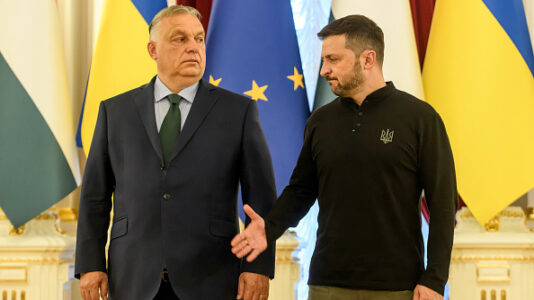
Ukraine expects to join EU next year – Zelensky
RT | January 27, 2026
Ukraine’s Vladimir Zelensky is calling for his country’s accession to the EU by next year. The idea has already raised hackles among some member nations.
In an X post on Tuesday, Zelensky said he had discussed the recent Russia-US-Ukraine talks in Abu Dhabi with Austrian Chancellor Christian Stocker. The negotiations primarily focused on military matters, but also touched on security guarantees, he said.
“Ukraine’s accession to the European Union is one of the key security guarantees not only for us, but also for all of Europe,” he wrote. “That is why we are speaking about a concrete date – 2027 – and we count on partners’ support for our position.”
Just days earlier, Stocker told the press that he opposed rushing Ukraine’s bid.
“I’m not a fan of the fast lane. The admission criteria must be met,” he said, adding that the “conditions should be the same for everyone.”
Fast-tracked membership for Ukraine is reportedly part of a US-backed $800 billion reconstruction ‘prosperity’ plan that was privately circulated to EU member states by the European Commission last week.
The document gave EU leaders pause due to the way it formally linked Ukraine’s accession to its reconstruction process, rather than due to its massive cost, according to Politico.
Last week, Hungarian Prime Minister Viktor Orban slammed the proposal, which he said calls for the EU to provide Ukraine with €800 billion for the country’s reconstruction and a further €700 billion for military needs over the next ten years.
“Hear me now, loud & clear: Hungary will NOT pay for this,” he wrote on X.
He has also nixed the idea of letting Ukraine join the EU, arguing that no Hungarian parliament would vote for accession “in the next hundred years.”
Orban has long stood against Ukraine’s bid, arguing that accession would put the bloc at risk of direct confrontation with Russia.
Moscow has long said that it is not opposed to Ukraine joining the EU. However, Kiev’s ambition to join NATO is a red line and one of the core causes of the current conflict, according to Russia.
France and EU clash over UK missiles for Ukraine – Telegraph
RT | January 27, 2026
France has clashed with several EU nations over a proposal that would allow Ukraine to use an EU-backed loan to buy British Storm Shadow missiles, The Telegraph reported on Monday, citing diplomatic sources. Paris has consistently pushed for preferential treatment for the EU’s military industry on procurements destined for Kiev.
In December, EU leaders approved a €90 billion ($107 billion) loan to cover Kiev’s military needs and budgetary gap, with spending rules that prioritize EU-made weapons before allowing purchases from outside the bloc. According to The Telegraph, a coalition of 11 capitals has now proposed loosening the rule so Ukraine can more easily buy weapons such as Britain’s long-range Storm Shadow cruise missiles, which are in short supply.
France, however, has emerged as an “obvious opponent” to the plan, a diplomatic source told the newspaper. The outlet noted that Paris is the center of the EU’s drive for “strategic autonomy” amid concerns about overreliance on US defense after a rift with Washington over its controversial push to acquire Greenland.
Under the current design of the €90 billion loan, spending on weapons would follow a four-layer procurement cascade that prioritizes Ukrainian producers first, then EU defense firms, followed by partner countries such as the UK, with suppliers outside Europe – including the US – treated as a last resort, according to the article. Ukrainian officials have reportedly estimated that around €24 billion of equipment this year will have to come from suppliers outside the EU.
A diplomatic source told The Telegraph that the aim of Britain and its partners was to keep the system “open enough for the UK” to ensure that reaching the third layer of the cascade “is not so hard.”
NATO Secretary-General Mark Rutte earlier warned that the EU loan should not be constrained by “buy European” rules, while acknowledging the bloc “cannot fully supply everything Ukraine needs to defend itself today and deter tomorrow.”
Moscow has condemned Western arms supplies as prolonging the conflict, while Russian Foreign Ministry spokeswoman Maria Zakharova has suggested that the €30 billion portion of the EU loan earmarked for Ukraine’s budget support would be embezzled by local officials.
EU member to sue bloc over ‘suicidal’ ban on Russian gas
RT | January 27, 2026
Slovakia will sue the EU over the bloc’s decision to entirely ban the import of Russian gas by late 2027, Slovak Prime Minister Robert Fico said on Tuesday. He branded Brussels’ move “energy suicide.”
A day earlier, the member nations voted to give their final approval to the REPowerEU regulation, as part of an effort to gradually phase out imports of natural gas from Russia by November of next year.
“We will file a lawsuit against this regulation at the Court of Justice of the EU,” Fico said at a press conference, calling the looming ban the finalization of the bloc’s “energy suicide.”
“It is a solution that was adopted solely out of hatred towards the Russian Federation. I reject hatred as a trait that should determine international relations,” he added.
The EU vote was approved by a qualified majority to bypass the need for unanimous approval in a way that contravened the core treaties of the bloc. The commission knew that if unanimity was required, such nonsense could not pass.
Slovakia and Hungary will lodge separate lawsuits but coordinate their positions further, Fico said.
According to Budapest, the vote was specifically run in such a way as to bypass Hungary’s and Slovakia’s opposition on a matter that pertains to their national interests.
EU divided over phasing out Russian energy
“The REPowerEU plan is based on a legal trick, presenting a sanctions measure as a trade policy decision in order to avoid unanimity… The [EU] Treaties are clear: decisions on the energy mix are a national competence,” Hungarian Foreign Minister Peter Szijjarto wrote on X shortly after the vote.
EU moves to cut off Russian gas – who will pay the price?READ MORE: EU moves to cut off Russian gas – who will pay the price?
Both Hungary and Slovakia, which are heavily dependent on Russian energy supplies, have previously warned that they could sue if Brussels plows ahead with the REPowerEU plan.
Moscow has warned that the bloc is essentially giving up its freedom by banning all Russian gas imports.
“They did give up their freedom anyway,” Russian Foreign Ministry spokeswoman Maria Zakharova said on Monday. “Time will tell” whether EU member nations will be “happy vassals or miserable slaves,” she said.
Trump and Iran, War or Negotiations?
By Samyar Rostami – New Eastern Outlook – January 26, 2026
Although the likelihood of a US attack on Iran has greatly increased. If Iran shows widespread strength and resistance, the Americans will retreat. Iran’s response to military attacks will certainly be more severe and comprehensive than in previous cases.
In the national security document published in Trump’s second administration, like the previous two documents, the national defense of the United States is characterized, as it includes the defense of the territory, the defense of the people, the defense of the political system, and the defense of the economy.
Iran’s position was also prominent in previous documents. In that document, the name of Iran was repeated six times, and it was one of the greatest threats to US national security. It was proposed, and in addition, in two other cases, it referred to the threat of Iran.
In the latest document, the number of these references has been reduced to three. In the new document, direct reference to Iran’s nuclear program has been almost eliminated. But the issue and role of waterways is still prominent in this document; in fact, this time the name of the Strait of Hormuz is explicitly mentioned and emphasized in the new document.
The new US national security document depicts Iran in the general framework of “weakening” and does not actually mention Iran as a fundamental threat. But this does not mean that the United States no longer considers Iran a threat.
War or negotiations
The behavior of the Trump administration, namely in recent months, has been not only in rhetoric but also in practice anti-Iranian, from pressuring European governments to activate the snapback mechanism to supporting Israeli military actions, seizing ships suspected of carrying weapons to Iran, and even actions such as seizing ships off the coast of Venezuela.
Given the current state of US-Iran relations, the US has two options: moving towards an agreement or adopting a military option, but Washington’s desire is to stop Iran’s nuclear capability without falling into the quagmire of eternal wars.
The issue of negotiations had been stalled since the 12-day war because Tehran refuses to return to negotiations before receiving the necessary guarantees from the US about not starting another attack against Iran by Israel or the US and having the right to enrich uranium.
Not all Trump officials and aides share the same view and approach, and some believe that negotiating with Tehran will increase Iran’s legitimacy. Within the administration, it seems that some are willing not to move towards a military option before diplomatic solutions are exhausted.
Also, the United States, which previously adopted a policy of “maximum pressure campaign,” still claims to protect the rights of the Iranian people. In this regard, Donald Trump has now imposed a 25% customs tariff on any country that has trade relations with Iran, which could have a negative impact on Iran’s economic relations. Trump also called for illegal actions, including the occupation of government institutions, by asking Iranian protesters to continue the protests and even promised that help was on the way.
The United States is also using the protests inside Iran as a tool to gain more concessions from Tehran in any possible agreement.
Iran’s readiness for diplomacy and defense
Previously, Iranian Foreign Minister Abbas Araghchi had emphasized that the United States and the regime would not achieve a different result by repeating the previous failed experience. “Iran is much more prepared than the 12-day war,” he said, adding, “I hope the wise option will be chosen. We will prepare diplomatic and economic options.”
In a situation where an average of $10 billion was allocated annually for the import of basic goods, the government came to the conclusion that economic surgery should be performed in this area; the preferential currency should be eliminated for consumers.
The protests in Iran have been carried out peacefully since early January by a group of people and trades in response to currency fluctuations and the living conditions. The government announced that it recognizes these protests and efforts to address these concerns are ongoing. However, after a week and on January 8-9, the protests by terrorist elements turned into riots in cities, destroying government, public, relief, and mosques.
Iranian authorities have made mass arrests of terrorist elements in team houses and terrorist cells, and they even have documents about the connections between these terrorist elements and the United States and Israel.
In the view of government spokeswoman Fatemeh Mohajerani, the peaceful protests of the people were subjected to a terrorist attack. Also, Brigadier General Ahmad Ali Goodarzi, Commander of the Faraj Border Guard, announced the identification and destruction of 3 terrorist teams before they entered the country at the country’s borders and the discovery of weapons and ammunition from them.
Amir Saeed Iravani, Ambassador and Permanent Representative of Iran in the United Nations, stated in a letter to the Security Council and the Secretary-General of the UN: “The Islamic Republic strongly condemns the continuous, illegal, and irresponsible behavior of the United States of America in coordination with Israel to interfere in Iran’s internal affairs through threats, incitement, and deliberate encouragement of instability and violence.”
Also, internal cohesion among political groups and figures in Iran is established and stable. Apart from the words and positions of the Leader of Iran, the representatives of the Islamic Consultative Assembly (Parliament) considered the government’s decision (end of the consumption chain) a courageous act and an important step.
The parliament speaker, Mohammad Bagher Ghalibaf, said, “At this time, the responsibility of us as Iranian officials is to confront the enemy in the economic war.”
From the perspective of Hassan Rouhani, if a foreign aggressor wants to abuse the protest within the family, the family members will put aside the difference and break the aggressor’s hand.
In fact, from Tehran’s perspective, Iran is ready for both war and negotiation. That means fair, honorable, and equal negotiations with mutual respect and based on mutual interests are still the priority, not giving orders and dictating. Iran also has preconditions.
Although the US has greatly increased its forces in the region. Iran’s military forces are also at the peak of defensive readiness and are ready to confront any aggression and evil of the enemy against Iran. Therefore, any action must face retaliation from Iran.
The amount of oil sales in the past 14 months in the form of export shipments has been record-breaking. The creation of new restrictions on the sale of Iranian oil does not create any serious restrictions on Iran’s oil sales processes.
Outlook
It seems that the US is paying special attention to shaping a soft transformation and a colorful and internal revolution in Iran, along with hard threats as a means of pressure. But internal cohesion among political groups and figures in Iran is established and stable.
Although the likelihood of a US attack on Iran has greatly increased. If Iran shows widespread strength and resistance, the Americans will retreat. Iran’s response to military attacks will certainly be more severe and comprehensive than in previous cases.
In the meantime, Washington’s failure in the direction of the hard programs could make the path of interaction or resolution of issues between Iran and the United States, in the new framework, more complex.
Samyar Rostami is а political observer and senior researcher in international relations.
Follow new articles on our Telegram channel
China Rejects U.S. Claims of Coercion in Central America
teleSUR | January 26, 2026
On Monday, Guo Jiakun, a spokesperson for China’s Foreign Affairs Ministry, rejected U.S. accusations of alleged Chinese “coercion” and “interference” in Central America.
His remarks came after Rep. John Moolenaar, chairman of the U.S. House Select Committee on China, traveled to several Central American countries to counter Chinese influence and question the involvement of Asian companies in strategic sectors such as the operation of ports linked to the Panama Canal.
In response, Guo described the U.S. claims as “complete lies and fallacies,” saying they reflect ideological bias and a Cold War mentality. “China firmly opposes certain U.S. politicians interfering in the normal relations between Central American countries and China,” the Chinese diplomat said.
He also stressed that the Chinese foreign policy toward Latin America and the Caribbean is based on principles of mutual respect, sovereign equality, mutual benefit, openness and inclusiveness, and cooperation aimed at shared development.
According to Guo, relations between China and Central American countries have produced tangible benefits for local populations, particularly in areas such as infrastructure, trade, logistics connectivity, productive investment, and technology transfer.
China maintains that its presence in Central America is not aimed at political domination but rather at a model of South-South cooperation that has been “well received by the countries involved.”
Guo urged U.S. politicians to stop instrumentalizing China-related issues for geopolitical purposes and to focus their efforts on initiatives that contribute to regional development. In multiple international forums, China has reiterated its rejection of bloc-based thinking and confrontation, advocating for a multipolar international order based on multilateralism and respect for state sovereignty.
Earlier, U.S. President Donald Trump released the new U.S. National Security Strategy, which prioritizes strengthening his country’s influence in Latin America and the Caribbean and seeks to reconfigure strategic control over key trade corridors such as the Panama Canal.
Iran: The Eurasian Lock
Iran’s geography makes it a strategic hinge – one that anchors Russia’s southern depth and gives China an escape from US maritime containment
By Abbas al-Zein | The Cradle | January 22, 2026
In the corridors of US strategic decision-making, Iran is no longer treated as a discrete regional file. Dealing with Tehran has become inseparable from great-power competition itself. Coordination between Iran, Russia, and China has moved beyond situational alignment, coalescing into what western analysts increasingly describe as a form of “structural synergy” that undermines Washington’s ability to isolate its rivals.
This assessment overlaps with conclusions reached by the Carnegie Endowment in its report on America’s Future Threats, which identifies Iran as a “central node” in the Eurasian landmass – one that prevents Russia’s geographical isolation while securing China’s energy needs beyond the reach of US naval control.
Any serious destabilization of the Islamic Republic would not remain confined within its borders. It would translate into a dual strategic blockade targeting both China and Russia: reviving security chaos across Eurasia’s interior while striking at the financial and energy platforms that emerging powers increasingly rely on to loosen unipolar dominance.
Geography as strategic depth
For Moscow, Iran’s importance begins with geography. It offers Russia a vital geopolitical opening beyond its immediate borders. According to studies by the Valdai Club, Iran’s significance lies not in formal alliance politics but in its function as the sole land bridge connecting the Eurasian heartland to the Indian Ocean via the International North–South Transport Corridor (INSTC).
This route provides Russia with insulation from NATO’s maritime pressure in the Baltic and Mediterranean, effectively converting Iranian territory into strategic depth protecting Russia’s southern flank.
This geographic interdependence has produced a shared political interest that goes beyond tactical coordination. The stability of the Iranian state acts as a safeguard against the Caucasus and Central Asia drifting toward the kind of fragmentation that preceded the Ukraine war. Research by the Russian Council for International Affairs (RIAC) frames Iranian geography as a cornerstone of the “Greater Eurasia” concept, central to Moscow’s effort to dilute western hegemony across the continent.
For Beijing, Iran plays a comparable role within a different strategic equation. As US naval pressure tightens across the Pacific, China’s westward extension through Iran has become increasingly difficult to replace. Research by the Council on Foreign Relations (CFR) identifies Iran as one of the most critical geographic nodes in the Belt and Road Initiative (BRI), providing Beijing with a land-based corridor into West Asia that bypasses US-controlled maritime choke points – from the Taiwan Strait to the Mediterranean approaches.
Iran’s intermediate position between the Eurasian interior and open seas has therefore imposed a durable entanglement between Tehran, Moscow, and Beijing. In this configuration, political alignment is driven less by ideology than by physiogeographic necessity.
Any attempt to destabilize the Iranian plateau would likely trigger a cascading shock across Eurasia’s interior, escalating a regional confrontation into a systemic blockade aimed at arresting the rise of rival power centers.
Buffer state and security firewall
Beyond logistics, Iran functions as a stabilizing buffer within East Eurasia’s security architecture. One research report by RAND on “Extending Russia” speaks of adversary exhaustion strategies that emphasize the use of peripheral instability to drain rival powers. From this perspective, Iran represents a critical firewall.
Instability inside Iran would mechanically undermine security coordination across Russia’s southern periphery, particularly in the Caucasus and Central Asia. RIAC assessments warn that such a breakdown would open pathways for extremist networks, transcontinental smuggling, and militant spillover – threats Moscow has repeatedly classified as existential.
For China, the concern lies in contagion. Iran’s stability limits the transmission of unrest through Central Asia’s mountain corridors, where Tehran functions as an integral security partner within the Shanghai Cooperation Organization (SCO). This role provides Beijing with a degree of security insulation, allowing it to pursue global ambitions without being drawn into attritional border conflicts.
Energy and financial sovereignty
Economically, Iran’s role extends beyond conventional trade logic. Its partnerships with Russia and China increasingly form part of an alternative financial and energy architecture designed to blunt western leverage.
From Beijing’s perspective, Iranian oil has become a form of strategic insulation. Data indicates that China purchases roughly 1.3 million barrels per day (bpd) of Iranian crude – around 13.4 percent of its seaborne oil imports – with close to 80 percent of Iran’s exports flowing eastward. Increasing settlement through non-dollar mechanisms, including the digital yuan, has further reduced vulnerability to US pressure, particularly at choke points such as the Strait of Malacca.
Reports from the Electricity Hub confirm that China imported more than 57 million tons of Iranian – or suspected Iranian – oil in 2025, often routed via intermediaries such as Malaysia. The figures underscore the diminishing effectiveness of sanctions when confronted with geoeconomic necessity.
Russia’s calculus follows a different path to the same outcome. Cooperation with Iran has emerged as one of Moscow’s most important routes around SWIFT-based isolation. Government of the Russian Federation data shows bilateral trade rising by 35 percent following the Eurasian Economic Union free trade agreement implemented in May 2025.
A central shift has been monetary. In January 2025, the Central Bank of Iran announced full connectivity between Russia’s MIR and Iran’s Shetab payment systems, creating a protected financial corridor. According to Iranian officials, Iran and Russia aim to expand bilateral trade to $10 billion over the next decade, while Iran’s exports to Russia are expected to rise to about $1.4 billion by the end of the current Iranian calendar year (March 20, 2026).
Tehran has increasingly functioned as a re-export hub for Russian technologies and goods, frustrating efforts to economically isolate Moscow.
Washington’s strategy of separation
Against this backdrop, US strategy has evolved. Rather than relying solely on pressure or open confrontation, Washington has gravitated toward what western policy circles describe as a “strategy of separation.” This is an attempt to loosen the interdependence binding Tehran, Moscow, and Beijing by offering alternative pathways rather than confronting the bloc directly.
On the Chinese front, energy has emerged as the primary point of leverage. As the world’s largest oil importer, Beijing remains sensitive to supply stability and pricing. US moves in Latin America – particularly regarding Venezuela – are widely interpreted as efforts to reintegrate large oil reserves into global markets under western regulatory frameworks, potentially diluting Iran’s role in China’s energy security calculus.
In parallel, Washington has expanded its naval and coalition presence across key trade corridors stretching from the Indian Ocean to the western Pacific. This posture is framed not only as deterrence but as a persistent reminder that maritime supply security remains tied to US-led power balances.
On the Russian front, Ukraine occupies a central role. While sustained military and economic pressure aims to drain Moscow’s capacity, intermittent diplomatic signals suggest interest in compartmentalized understandings over European security. The underlying wager is that Russia’s core interests might be partially accommodated in Europe, reducing the long-term value of its partnership with Iran.
US engagement has also intensified across Central Asia and the Caucasus – regions that constitute strategic depth for Russia and critical corridors for China’s BRI. From Moscow and Beijing’s view, expanded security and investment ties in these areas represent an effort to geographically encircle Iran and weaken its role as Eurasia’s connective knot.
Why the bet fails
Despite the breadth of these efforts, the strategy of separation runs up against entrenched distrust in both Moscow and Beijing. For the two powers, the issue is not the scale of incentives on offer but the structure of the international system itself – and the accumulated experience of sanctions, coercion, and volatile western commitments.
From Russia’s vantage point, any trade-off between Iran and Ukraine constitutes a strategic trap. Iran anchors Russia’s southern access to the Indian Ocean; its collapse would expose the Caucasus–Central Asia arc to chronic instability. Gains in Eastern Europe would offer little compensation for a structurally weakened southern flank.
China’s reasoning is similarly grounded. Alternative energy suppliers remain embedded within supply chains that Washington can influence or disrupt. Iranian oil, by contrast, offers a higher degree of geographic and political autonomy. Its value lies less in price than in resilience.
The last barrier
At its core, the contest over Iran pits two logics against one another. One assumes geopolitical networks can be dismantled through incentives and selective realignment. The other recognizes that geography, accumulated experience, and the erosion of trust render such guarantees fragile in a world moving steadily toward multipolarity.
Iran’s collapse or prolonged internal destabilization would not merely reorder energy markets or regional alignments. It would reopen West Asia as a zone of near-exclusive US influence, completing a strategic arc across Western Eurasia. For more than a century, the region has served as a central theater of global power competition – from imperial rivalries to the Cold War and into the present transition toward multipolarity.
Therefore, Iran becomes more than a pivotal state. Much as Venezuela once represented the outer limit of resistance to US power in the Western Hemisphere, Iran now stands as the final geopolitical barrier to the consolidation of American hegemony across the heart of Eurasia.
Its cohesion serves not only its own national interest but also the broader objective shared by Moscow and Beijing: constraining unilateral dominance and preserving strategic autonomy in their immediate neighborhoods.
Russian gas exports to China soar – data
RT | January 22, 2026
China sharply increased its purchases of Russian liquefied natural gas (LNG) in 2025 and reached a record monthly volume in December, according to Chinese customs data cited by RIA Novosti.
In 2025, the Asian nation imported 9.8 million tons of the super-chilled fuel, up 18.3% from the previous year, the outlet reported.
December saw particularly strong growth, with imports rising to 1.9 million tons, a 114.6% increase from the 889,482 tons delivered in the final month of 2024.
Data also showed that in October, Russia became China’s second biggest LNG supplier, overtaking Australia and coming in slightly behind Qatar. Russia’s total gas supplies to China – via pipeline and in liquefied form – reached 5.8 billion cubic meters (bcm) in November 2025, a 33% increase from the same month a year earlier.
Imports of Russian LNG by China, one of the world’s largest gas consumers, have been rising steadily for several years. Alongside pipeline flows, Russia has expanded seaborne shipments from projects in the Arctic and the Far East, including Yamal LNG, Arctic LNG 2, and Sakhalin-2. Cargoes are transported largely via the Northern Sea Route during the summer navigation season and via longer southern routes in winter.
Moscow has sought to expand LNG exports via the Arctic corridor due to Western sanctions targeting key parts of its energy sector.
The surge in gas deliveries reflects a broader shift of Russia’s energy exports toward Asia following the sharp reduction of pipeline supplies to the EU since the escalation of the Ukraine conflict in 2022.
Russia also delivers natural gas to China via the Power of Siberia pipeline, which began operations in 2019 and reached full operational capacity in December 2024.
Moscow and Beijing are also advancing the planned Power of Siberia 2 pipeline through Mongolia. President Vladimir Putin has said that, together with existing and future pipelines, Russian gas deliveries to China could exceed 100 bcm a year.
Featured Video

“Historic Russia”: The Land Putin Will Not Give Back
or go to
Aletho News Archives – Video-Images
Book Review
Why the War on Conspiracy Theories Is Bad Public Policy
By Kevin Barrett • Unz Review • February 1, 2019
 A Review of Conspiracy Theories and Other Dangerous Ideas by Cass Sunstein (based on an earlier paper co-authored with Adrian Vermeule); In Defense of Troublemakers: The Power of Dissent in Life and Business by Charlan Nemeth; and Conspiracy Theories and the People Who Believe Them, edited by Joseph E. Uscinski
On January 25 2018 YouTube unleashed the latest salvo in the war on conspiracy theories, saying “we’ll begin reducing recommendations of borderline content and content that could misinform users in harmful ways—such as videos promoting a phony miracle cure for a serious illness, claiming the earth is flat, or making blatantly false claims about historic events like 9/11.”
At first glance that sounds reasonable. Nobody wants YouTube or anyone else to recommend bad information. And almost everyone agrees that phony miracle cures, flat earthism, and blatantly false claims about 9/11 and other historical events are undesirable.
But if we stop and seriously consider those words, we notice a couple of problems. First, the word “recommend” is not just misleading but mendacious. YouTube obviously doesn’t really recommend anything. When it says it does, it is lying. … continue
Blog Roll
 Aletho News
- BRITAIN’S WARNING: PREPARE FOR WAR
- “Historic Russia”: The Land Putin Will Not Give Back
- How the Cambridge Analytica scandal still haunts Mark Zuckerberg
- The Ongoing Cancellation Campaign Against a Dissenting Academic in Norway
- Yemen and ‘the Houthis’: Challenging Sami Hamdi’s Narrative
- No, Christians did not invent Zionism
- AIPAC-led lobbying network opens branches in Cypriot, Greek parliaments
- Araghchi blasts ‘parasitic’ alliance as US taxpayers pay for Israel’s war on Iran
- Easy fix for Europe’s chaos? Stop fueling war against Russia
- Putin’s key remarks on peace talks and Europe’s ‘schizophrenia’
- If Americans Knew
- An error has occurred; the feed is probably down. Try again later.
- No Tricks Zone
- Two New Studies Find Thwaites Glacier Melt Cannot Be Driven By Human Activity Or A Warming Ocean
- E-Cars Reduce CO2 Emissions By Only 41% Compared To Internal Combustion Engine Vehicles
- Predictions Made By Renowned Climate Professor Over Past Decades Have Been Proven To Be Poor
- New Study Suggests Large Regions Of The Pacific Ocean Have Been Cooling For The Last 80 Years
- Germany’s Green Energy Debacle: High Energy Costs Force Kahla Porzellan to Close After 182 Years!
- New Study: 50 Years Of The Most Aggressive ‘Net Zero’ Policies Can Only Affect The Global Climate By 0.03°C
- US September “Heat” Was No Record…Many Records Set Decades Ago
- Latest European Green Energy Debacle; Portugal’s Largest Flagship Solar Park Insolvent!
- Green Energy Debacle: German Expert Professor Fritz Vahrenholt Warns Of Severe Economic And Social Consequences
- Two More Paleo Reconstructions Affirm Meters-Higher Sea Levels Across Ireland, Brazil 7000-6000 Years Ago

