Belgian police clash with anti-austerity protesters
Press TV | October 7, 2015
Police in Belgium have clashed with protesters in the capital, Brussels, where thousands of people took to the streets to demonstrate against government austerity measures.
On Wednesday, police used tear gas and water cannons to break up crowds of protesters in the city.
Belgium’s three main unions said about 100,000 people gathered in the capital. The demonstration in the capital was part of a nationwide strike against budget cuts, tax policy changes, and a rise in the retirement age.
The Christian union, ACV, the socialist union, ABVV, and the liberal union, ACLVB, say the administration of Prime Minister Charlies Michel is promoting policies which unfairly benefit employers at the expense of workforce. They say the austerity measures are targeting the poor and leaving the rich unaffected.
Workers will have to work until the age of 67, as part of a pension reform package agreed on by the one-year-old government. Reforms also include more control over those who qualify for unemployment benefits, as well as a deal on the indexation of incomes.
The unions are calling on the government to implement alternative policies.
A national rail strike has been also planned for October 9.
Last year, 120,000 people protested against the government’s free-market reforms and austerity measures in Brussels.
TPP: Big Pharma’s Big Deal
By Joyce Nelson | CounterPunch | October 7, 2015
We still don’t know all the details of the Trans-Pacific Partnership (TPP) trade deal tentatively agreed to on Oct. 5 by negotiators from 12 Pacific Rim countries, but already critics are slamming it for many reasons, including its generous concessions to the pharmaceutical industry.
Doctors Without Borders claims the TPP will “go down in history as the worst trade agreement for access to medicines in developing countries.” [1] That’s because the TPP will extend patent protection for brand-name drugs, thereby preventing similar generic drugs (which are far less costly) from entering the market. This will drive up the prices.
Judit Rius Sanjuan, legal policy adviser for Doctors Without Borders, told vox.com that TPP creates patent-related obligations in countries that never had them before. People in “Peru, Vietnam, Malaysia, and Mexico” will be especially affected, she said. “They’ll face higher prices for longer periods of time.” [2]
Ruth Lopert, a professor at George Washington University, told Bloomberg News that provisions in the TPP agreement will affect health-care budgets and drug access in all signatory countries, but especially the poorest. “She said as many as 40,000 people in Vietnam, the poorest country in the agreement, could stop getting drugs to fight HIV because of provisions that will boost the price of [pharmaceutical] therapy.” [3]
Other countries like Canada will also be hit with higher costs. The Council of Canadians says that if the TPP is ratified, “[p]harmaceutical patents will be extended, delaying the release of more affordable generic drugs and adding $2 billion to our annual public health care bill.” [4] In the U.S., many people already cannot afford to pay for the expensive medicines that could save their lives, and they try to access generics available elsewhere.
Extending patent rights for life-saving drugs is an obvious gift to Big Pharma. Conor J. Lynch at opendemocracy.net has called it “a clear corporate handout that would greatly affect international access and most definitely cause preventable deaths. The clear objective here is to increase industry profits, plain and simple. This is not surprising, that’s what private industry does, but there is a serious moral dilemma here.” [5] That moral dilemma is made even more apparent by recent findings.
Tax Cheats
In an ironic coincidence, the TPP agreement was reached on the same day that a damning report on corporate tax-avoidance – Offshore Shell Games 2015 – was released by Citizens for Tax Justice and the US Public-Interest Research Group Education Fund. The report reveals the extent to which top U.S. companies use tax havens like Bermuda, Luxembourg, Cayman Islands, and the Netherlands to set up “tax haven subsidiaries” that are usually little more than a post-office box.
Of the top 30 Fortune 500 companies with the most money held in offshore tax-havens, nine are pharmaceutical companies: Pfizer ($74 billion held offshore), Merck ($60 billion), Johnson & Johnson ($53.4 billion), Proctor & Gamble ($45 billion), Amgen ($29.3 billion), Eli Lilly ($25.7 billion), Bristol Myers Squibb ($24 billion), AbbeVie Inc. ($23 billion), and Abbott Laboratories ($23 billion). [6]
Concerning Pfizer, the world’s largest drug maker (declared profits of $22 billion in 2013), the report states: “The company made more than 41 percent of its sales in the U.S. between 2008 and 2014, but managed to report no federal taxable income for seven years in a row. This is because Pfizer uses accounting techniques to shift the location of its taxable profits offshore. For example, the company can transfer patents for its drugs to a subsidiary in a low- or no-tax country. Then when the U.S. branch of Pfizer sells the drug in the U.S., it ‘pays’ its own offshore subsidiary high licensing fees that turn domestic profits into on-the-books losses and shifts profit overseas.”
Overall, the study found that the 500 largest U.S. companies hold more than US$2.1 trillion in accumulated profits offshore. “For many companies, increasing profits held offshore does not mean building factories abroad, selling more products to foreign customers, or doing any additional real business activity in other countries,” but simply establishing a PO box.
Some companies use the money supposedly “trapped” offshore as “implied collateral” in order to borrow funds at negligible rates for investing in U.S. assets, paying dividends to shareholders, or repurchasing stock.
Of course, as the report makes clear, “Congress, by failing to take action to end this tax avoidance, forces ordinary Americans to make up the difference. Every dollar in taxes that corporations avoid by using tax havens must be balanced by higher taxes on individuals, cuts to public investments and public services, or increased federal debt.”
The report finds that, through a variety of tax-avoidance measures, an estimated US$620 billion in U.S. taxes is collectively owed by the 500 largest companies with headquarters in the U.S.
Corporate Coup
Now the TransPacific Partnership – which is being called “NAFTA on steroids” – would award Big Pharma and other multinationals even more corporate “rights” in more countries, including the controversial investor-state dispute settlement (ISDS) mechanism by which they can sue signatory governments for regulatory changes that affect their profits.
As the Canadian website rabble.ca notes: “The Canadian government is currently being sued through NAFTA by Eli Lilly, an American pharmaceutical company, for invalidating the firm’s patent extensions on two mental health drugs. A Canadian Federal Court decided in 2010 that the patent extensions had not delivered the promised benefits and the drugs should therefore be opened up to generic competition. Generic drugs significantly reduce the cost for end users, but Eli Lilly cried foul and launched an ISDS claim against the government, demanding US$500 million in compensation for lost profits. The case is still in progress, but regardless of the outcome we can expect the TPP to lead to similar ISDS disputes. Powerful multinational pharmaceutical companies will use any available means to cling to over-priced drug monopolies. Greater intellectual property protections in the TPP will give these companies an even stronger quasi-legal basis to sue governments and crowd out generic [drug] competition.” [7]
The final text of the TransPacific Partnership agreement won’t be available for at least a month, likely weeks after the Canadian federal election on October 19. The details will undoubtedly reveal more generous concessions to the multinationals. It will be up to the elected legislators in all twelve countries to approve or reject the TPP. In Canada, NDP leader Tom Mulcair has pledged to scrap the deal if elected as Prime Minister, explaining that the Stephen Harper government had no mandate to sign it during an election campaign when it is merely a “caretaker” government.
The U.S. website zerohedge.com calls the Trans-Pacific Partnership “a Trojan horse” and “a coup by multinational corporations who want global subservience to their agenda.” In no uncertain terms, it adds: “Buyer beware. Citizens beware.” [8]
Footnotes/Links:
[2] Julia Belluz, “How the Trans-Pacific Partnership could drive up the cost of medicine worldwide,” Vox, October 5, 2015.
http://www.vox.com/2015/10/5/9454511/tpp-cost-medicine
[3] “Pacific Deal Rewrites Rules on Trade in Autos, Patented Drugs,” Bloomberg News, October 5, 2015.
http://www.bloomberg.com/news/articles/2015-10-05/pacific-deal-rewrites-rules-on-trade-in-autos-patented
[4] Council of Canadians, “Tell party leaders: Reject the TPP,” October 6, 2015.
[5] Conor J. Lynch, “Trans-Pacific Partnership’s Big Pharma giveaway,” Open Democracy, February 14, 2015.
http://www.opendemocracy.net/conor-j-lynch/transpacific-partnership%E2/80%/99s-big-pharma-giveaway
[6] http://ctj.org/ctjreports/2015/10/orrshore_shell_games_2015.php//executive
[7] Hadrian Mertins-Kirkwood, “Trans-Pacific Partnership a big win for corporate interests,” Rabble.ca, October 6, 2015.
[8] Tyler Durden, “Trans-Pacific Partnership Deal Struck As ‘Corporate Secrecy’ Wins Again,” Zero Hedge, October 5, 2015.
http://www.zerohedge.com
How climate change efforts by developed countries are hurting Africa’s rural poor
Far from the expected development, forestry plantations and other carbon market initiatives in Uganda have severely compromised ecologies and livelihoods of the local people.
By Kristen Lyons and Peter Westoby · The Conversation · September 19, 2015
In recent years there has been significant movement toward land acquisition in developing countries to establish forestry plantations for offsetting carbon pollution elsewhere in the world. This is often referred to as land grabbing.
These carbon trading initiatives work on the basis that forestry plantations absorb carbon dioxide and other polluting greenhouse gases. This helps to undo the environmental damage associated with modern western lifestyles.
Carbon markets are championed as offering solutions to climate change while delivering positive development outcomes to local communities. Heavy polluters, among them the airline and energy sectors, buy carbon credits and thereby pay local communities, companies and governments to protect forests and establish plantations.
But are carbon markets – and the feel good stories that have sprung up around them – all just a bit too good to be true?
There is mounting evidence that forestry plantations and other carbon market initiatives severely compromise livelihoods and ecologies at a local level. The corporate land grabs they rely on also tend to affect the world’s most vulnerable people – those living in rural areas.
But such adverse impacts are often written out of the carbon market ledger. Sometimes they are simply justified as ‘externalities’ that must be accepted as part of ensuring we avoid climate apocalypse.
Green Resources is one of a number of large-scale plantation forestry and carbon offset corporations operating on the continent. Its activities are having a profound impact on the livelihoods of a growing number of people. Norwegian-registered, the company produces saw log timber and charcoal in Mozambique, Tanzania and Uganda. It receives carbon revenue from its plantation forestry operations.
In Uganda, the focus of our research, Green Resources holds two licenses over 11,864 hectares of government-owned, ‘degraded’ Central Forest Reserve. Historically, villagers could access this land to grow food, graze animals and engage in cultural practices.
Under the licensed land agreement between Uganda’s government and Green Resources, more than 8,000 people face profound disruptions to their livelihoods. Many are experiencing forced evictions as a direct result of the company’s take over of the land.
Carbon violence on local villagers
Villagers across Green Resources’ two acquisitions in Uganda report being denied access to land vital for growing food and grazing livestock. These are at Bukaleba and Kachung Central Forest Reserves. They also cannot collect forest resources. Many say they are denied access to sites of cultural significance and to resources vital to their livelihoods.
There are also many stories about land and waterways that have been polluted by agrichemicals the company uses in its forestry plantations. This has caused crop losses and livestock deaths.
Many of those evicted, as well as those seeking to use land licensed to Green Resources, have also experienced physical violence at the hands of police and private security forces tied to the arrival of the company. Some villagers have been imprisoned or criminalised for trespass.
These diverse forms violence are directly tied to the company’s participation in the carbon economy. Thus Green Resources’ plantation forestry and carbon market activities are inflicting ‘carbon violence’ on local villagers.
Green Resources appears to be continuing to tighten the perimeter of its plantation operations as part of ensuring compliance with regulations and certifications required for entry into carbon markets. This further entrenches these diverse forms of violence. In short, subsistence farmers and poor communities are carrying heavy costs associated with the expansion of forestry plantations and global carbon markets.
Inadequate remedies
Green Resources does engage in some community development activities, but these are largely disconnected from local villagers’ needs and aspirations. Interviews with 152 affected villagers across the two sites highlight that access to land to produce food is the most pressing issue. This is an issue that Green Resources has done little to address.
The loss of access to land and sustainable livelihoods for vulnerable populations is unjust and unacceptable, particularly when rural people in Uganda contribute little to carbon pollution.
In 2014 the Oakland Institute, an independent policy think tank based in California, US, published its report on Green Resources. The company has responded, most notably in a strong letter from the CEO. While he sought to discredit the researchers and the report, he failed to engage with substantial issues of concern arising from the research.
At least one company board member has publicly acknowledged problems in company relations with affected communities, especially at the Bukaleba site. These are issues raised by a number of other researchers over a number of years.
The company has not publicly articulated what it is doing to address the social and environmental problems associated with its corporate practices. Green Resources must demonstrate how it is seeking to deal with the substantial adverse impacts associated with its activities.
It’s not just about money
More broadly, there are increasing calls for reform of global plantation forestry and carbon markets to alleviate the burden subsistence farmers carry alongside their expansion. Similarly, there are calls for reform to corporate practices, including community development initiatives and employment practices.
We would suggest that such reforms should be directed towards reducing the gap between the winners and losers in global carbon markets. There must be recognition of common property rights and access and use rights of local people in license areas. This must be done alongside valuing indigenous and local people’s knowledge of forests and ecosystem management.
There are also stronger calls from climate movements for the transformation of global energy futures. Those include the support for renewable energy to reduce global greenhouse gas emissions and the subsequent reliance on offset initiatives.
Movements for climate justice in Africa and elsewhere demonstrate the growing resistance to market based and techno fixes as the means to avert climate change. These calls for justice challenge change agents to move beyond simply tweaking at the edges of carbon markets.
They need to imagine a future where social and environmental justice – not money and markets – are at the centre of thinking and planning.
Toys ‘R’ Us Misuses H-1B Temporary Foreign Worker Visas To Outsource Jobs
By Dan Wright | ShadowProof | October 1, 2015
An investigation by The New York Times suggests Toys ‘R’ Us, and other major corporations, used a foreign worker program in the exact opposite way from how it was intended.
The H-1B visa temporary foreign worker program was setup to allow US companies to hire workers with needed knowledge and skills that those companies could not find domestically. Employers of the foreign workers must sign a declaration that their hiring “will not adversely affect the working conditions” of their business. The purpose of the program is to strengthen the American economy by revitalizing the country’s workforce so that companies employing workers within the US can stay competitive and grow.
According to a Tuesday report from The Times, Toys ‘R’ Us used the temporary foreign worker program to help expedite the process of moving jobs out of the country by having foreign workers from India train on soon-to-be outsourced jobs at one of the company’s US locations.
Toys ‘R’ Us hired a firm called TATA Consulting Services (TCS) which shadowed employers at the Toys ‘R’ Us facility in New Jersey, created manuals, then returned to India to train TCS workers to takeover the jobs. The workers in New Jersey were then laid off.
The TCS employees not only did not augment the company’s US workforce they possessed no qualifying special skills that could not be found in the country — failing both criteria for the H-1B visa program. The jobs TCS helped outsource not only could be done by Americans, they were being done by Americans.
The Times article notes that other companies are similarly violating the spirit if not the letter of the H-1B visa program. Both New York Life Insurance Company and Cengage Learning used the temporary foreign worker program to have foreign workers come to the US and to learn how to train for jobs that would then be outsourced to their country.
While low-skilled, undocumented workers have become a punching bag this presidential election cycle, it is worth keeping in mind that the true culprits in violating US immigration law are businesses looking to suppress wages at home and abroad. They hire the low-skilled, undocumented workers and now are abusing the H-1B visa program.
Iran: most developed country in Muslim world thanks to Western sanctions
Pravda – 30.09.2015
How does the Iranian economy feel after 40 years of the economic blockade? How can Russia and Iran develop cooperation in the future? Pravda conducted an interview on the subject with Rosnano investment director, Vadim Veschezerov.
“A lot has been said recently about the Russian-Iranian cooperation in the field of high technologies. Can Russia and Iran cooperate in the high-tech industry instead of oil and fruit?”
“In my view, this is exactly where we can work together most effectively. Russia and Iran are competitors when it comes to oil. Fruit is growing in many other countries of the world, not just in Iran. Iran is an interesting country, because this is the only highly developed, high-tech country of the Islamic world. In all other countries of the Islamic world, even if they have ultramodern industry, they have achieved it with someone else’s help. Iran has achieved everything alone. In some areas, Iran is a big player. Iran has a very good chemical industry and the world’s only independent pharmaceutical industry.
“I’m not talking about the nuclear program of Iran. Unlike Pakistan and other countries, Iran had no opportunity to borrow – the country was doing everything alone.”
“Has Russia lost the moment for developing cooperation with Iran? We had a unique opportunity, when Iran was living in a blockade, but now there are plenty of Americans and Europeans there.
“We have two or three years. I am personally studying the events that are now happening in the country. Unfortunately, we have very few people in Russia, who realize the peculiarities and structure of Iran, or how to build relationships with the Iranian side.
“Technically, we must explore every area where we can cooperate. In almost 40 years of blockade, the Iranians have learned to do many things and they have reached great progress, but, of course, they can not do everything. For example, their electronics is a very weak point. They are interested in chemistry, mathematics and computer science.
Not that long ago, the secretary of the Supreme Coordination Council of Free and Special Economic Zones of Iran, Akbar Torkan, named five main branches of classical economics that in his view are interesting for foreigners. They are petrochemical, automotive, power generation, steel and cement industries.
“Any industry needs high technologies. In Iran, there is a very strong group of companies working in the field of nanotechnology – this is a priority direction for them. This area is entrusted to the Iranian Council for the development of nanotechnologies.
“We must not forget that the country has been living under the conditions of economic blockade for 40 years. They have learned not only to survive, but to develop independently. As they say: “Thank you, America. You’ve turned us from consumers to entrepreneurs.”
“In what areas does Rosnano intend to cooperate with Iran?”
“We are most attracted to pharmaceuticals. We have something that interests the Iranian side – drugs and medical devices. In Iran, there are very interesting medical devices and medications that can be potential on the international market. In India, the pharmaceutical industry is completely built on copying others, and the Iranians have their own their developments.
“They have a very unique system to encourage scientists and engineers to go into business. For example, if you offer a startup in the high-tech industry, the state can pay a share in the company for you. In three or four years, if you fulfill the agreement with the state, if you create a product, a medication or something else, the state will sell you this share for one real.
“Now that the sanctions are being removed, Russian energy companies have many opportunities in Iran. The USSR had built most of the Iranian energy industry – and they remember that.”
Interview conducted by Said Gafurov
Unilateral restrictive measures must be stopped, Cuban embargo lifted – Lavrov
RT | September 27, 2015
The practice of imposing unilateral coercive measures, taken by one state to force a change in the policy of another, violates the UN Charter and must be stopped, Russia’s Foreign Minister Sergey Lavrov told a UN summit on sustainable development, adding that the Cuba embargo needs to end.
“Such illegitimate restrictive actions, which among other things undermine basic market principles in the areas of trade, finance, technology and investment, must be stopped. This includes the need to lift the embargo against Cuba and other sanctions imposed arbitrarily, bypassing the UN Security Council,” Lavrov said on Sunday.
A US-brokered carrot-and-stick policy in regard to Russia has long been condemned by Moscow. The US has imposed a number of sanctions on Russia since August 2014 over the conflict in eastern Ukraine, accusing Moscow of being a protagonist and participant in the ongoing hostilities. Russia has repeatedly denied the allegations. It responded with counter-measures, banning imports from the EU, US and others. In June, Moscow extended its embargo on food imports from Western countries until August 2016 due to the prolonged anti-Russia sanctions.
“Russia advocates the creation of a fair global economic order, with the global development more manageable. We call for action backed by universally recognized norms of international law, in the spirit of collective decision-making,” Lavrov told the United Nations summit on Sunday.
Russia said earlier this month that it has no illusion about sanctions being lifted and expects them to be stiffened in future, regardless of developments in Eastern Ukraine. Russian Deputy Foreign Minister Sergey Ryabkov said that Moscow can live under continuous Western pressure.
Speaking at the United Nations for the first time on Saturday, Cuba’s President Raul Castro publicly slammed the US trade embargo, lasting for over five decades, describing it as the key obstacle to Havana’s development.
The embargo is “the main obstacle to our country’s economic development while affecting other nations due to its extraterritorial scope, and hurting the interests of American citizens and companies,” Castro told a UN summit on sustainable development.
“Such policy is rejected by 188 United Nations member states that demand its removal,” he added, referring to an annual UN General Assembly resolution that has denounced the US embargo.
Cuba, which estimates the embargo has caused its economy $121 billion in damages, has launched a campaign for the General Assembly to adopt the resolution again, calling for the embargo to be lifted. Adoption of the resolution has already become an annual ritual.
While the General Assembly’s vote is nonbinding and symbolic, it has served to demonstrate Washington’s isolation regarding Havana. UN diplomats, speaking on condition of anonymity, told Reuters that Washington may abstain from the UN vote on the resolution, if the draft text is amended from previous years to soften the criticism of the US.
How the anti-war movement can stop the UK government bombing Syria
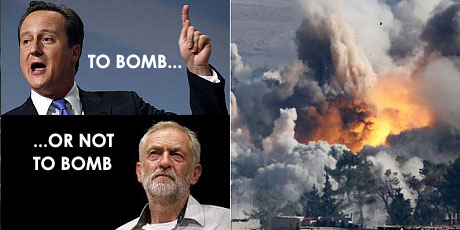
The stakes are high, but with enough pressure from below, David Cameron’s plan to bomb Syria can be defeated.
By Chris Nineham | Stop the War Coalition | September 24, 2015
WE HAVE the biggest opportunity since the start of the Iraq war to make a real change in foreign policy. The aggressive, interventionist policy that has done so much damage is now at the heart of a great contest in British society.
Jeremy Corbyn is facing a massive onslaught from all sections of the establishment. No one can envy him this experience, and the prime question is how we defend him from these attacks and build support for the policies that got him elected as Labour party leader with such a huge majority.
When the right wing is this hysterical, the establishment this panicked, and the media this vitriolic, you know there is just a chance something good might be in reach.
In the next few weeks and months there are going to be a series of stand-offs around foreign policy issues, including almost certainly a vote in parliament on bombing Syria, the outcome of the Iraq war inquiry report, and of course the madness of renewing Trident.
Few mainstream commentators have the wherewithal to understand Corbyn’s victory. They first speculated about left-wing entryism, then they focussed on his ‘style’, now they’ve decided to ignore the scale of his mandate.
Of course Jeremy is different, he wears jumpers and shockingly he tends to say what he thinks. But whatever the media would like to think, his success is not about the way he does what he does, it is about the issues he has brought to the forefront of British politics.
The real nightmare for the establishment is that millions of people agree with him about austerity, about war, and about the shocking state of official politics.
What alarms the mainstream is the energy and enthusiasm generated by his campaign to become leader of the Labour party, much of it due to the protest movements that he has supported so tirelessly over decades, including crucially the anti-war movement.
A return to protest
But if the Corbyn surge was powered partly at least by the movements, we have to make sure that what he has achieved in turn reinvigorates protest.
We know that Corbyn can’t do it alone. And we know too that there are a lot of people around him who — to put it politely — don’t agree with him. Within days of his leadership victory, there were very public briefings against him by a serving UK army general, two of his cabinet ‘colleagues’, including the shadow foreign secretary Hilary Benn, and Sadiq Khan, Labour’s newly selected candidate for London mayor.
Quite simply, Jeremy Corbyn is going to need all the help he can get.
It is clear also, that despite the disasters of the last fourteen years, the British political establishment is desperate to maintain its role as chief cheerleader for US military interventionism. And having scented rebellion against Corbyn among Labour MPs, they have a new confidence about winning a vote to bomb Syria, and at the same time damaging the party’s anti-war leader.
A plan of action: stopping the bombing of Syria
The main task must be to extend the enthusiasm and energy generated by his campaigning over the past months into every local community, workplace and college.
The more people are actively engaged in the campaign to stop the drive to war in Syria, and in the anti-austerity movement, the more we will be defending Jeremy Corbyn under such relentless attack.
How can we do this?
For the anti-war movement, we need to get onto the streets in every area and onto campuses with leaflets, petitions, posters, badges, etc, drawing people into an ever-widening network of activists for peace.
We need to re-invigorate local anti-war groups and start new groups where none exist. While organising locally, the untimate focus will be on parliament and the need to break the consensus that always takes Britain into disastrous wars on the coat tails of the United States.
In 2013, mass pressure on MPs, coupled with the memory of Tony Blair’s catastrophic war on Iraq, delivered an unprecedented defeat for the government, as David Cameron tried to bounce parliament into supporting the bombing of Syria’s Assad regime.
Now Cameron hope that by switching the target to ISIS, he can reverse that defeat and take the UK into yet another pointless war that will serve no purpose, other than to create more death and chaos, and drive more refugees to flee the war zone.
We need to implement immediately a comprehensive lobbying of MPs:
- Use the online lobby tool to contact MPs
- Send letters to MPs’ constituency offices
- Get letters in local newspapers
- Organise group visits to MPs’ regular surgeries to deliver petitions collected locally
There needs to be a particular focus on MPs who have vowed publicly to defy Jeremy Corbyn, so they understand the scale of the opposition to waging war in Syria.
War and the refugee crisis
The links between the refugee crisis and the wars our government so enthusiastically backs need to be underlined continually in our campaigning.
It is scandalous that David Cameron thinks promising to take twenty thousand refugees over five years is an adequate response to the migration or 60 million people fleeing war, conflict and poverty.
It is also outrageous that he wants to respond to people fleeing war-torn countries by intensifying the bombing of Syria — one of the main causes of the crisis.
The most effective thing that the West could do to end this misery is to de-escalate, stop arming regional dictators and aggressors and encourage a negotiated settlement in Syria. We need to develop and promote these arguments everywhere.
Isis is clearly a horrible organisation whose presence makes our arguments harder. We have to tackle the debate head on by having the most high profile possible public meetings and forums we can in each area.
A plan of action: the anti-austerity movement
Stop the War has always contrasted the vast government expenditure on the military and weapons of mass destruction, and the draconian austerity cuts to public and welfare services. Billions are spent on the UK war machine at the same time that brutal cuts in benefits are driving some desperate victims to suicide.
The protests at the Conservative Party conference from 3 October will help shape the political landscape over the next months. Tens of thousands will be protesting there, not just on the opening day – 4 October – but for the whole week. The anti-war message needs to be heard loud and clear by the movement, by the media and by the politicians.
Time is tight — the flashpoints are imminent, and we need to act now.
Within a few days of Jeremy Corbyn becoming Labour leader over 120 new members joined Stop the War Coalition, an indication that the movements that underpinned his victory are recognised as central to defending him.
The stakes are high. With enough pressure from below, David Cameron’s government’s plan to bomb Syria can be defeated for a second time, which would be a long term humiliation for the warmongers.
We also need a big campaign and protest over the scandalous delay in publishing the Iraq war inquiry report, blocked it appears by those — like Tony Blair and Jack Straw — likely to be criticised by Chilcot. With Jeremy Corbyn declaring that Tony Blair should be held to account for alleged war crimes, there is a real prospect that Blair could be driven out of public life once and for all.
Next year parliament will vote on the renewal of Trident nuclear weapons system, at a projected cost of over £100billion. The Campaign for Nuclear disarmament is already mounting a concerted campaign to get MPs to vote against. A huge protest movement before parliament votes will intensify that pressure.
The moment a vote on bombing Syria is announced, Stop the War will call a protest, but the success, the scale, and the impact of that protest depends on what we all do in the next few weeks. Its up to us.
Garifuna Communities of Honduras Resist Corporate Land Grabs

By Samira Jubis | Council on Hemispheric Affairs | September 23, 2015
The fate of the Garifuna people of Honduras hangs in the balance as they face a Honduran state that is all too eager to accommodate the neoliberal agenda of U.S. and Canadian investors. The current economic development strategy of the Honduran government, in the aftermath of the 2009 coup against the democratically-elected President Manuel Zelaya, has not only benefited the political and economic elite in Honduras, but it has also encouraged the usurpation of some of the territories of indigenous peoples of this Central American nation. The often-violent expropriation of indigenous land threatens the Garifuna’s subsistence.
The Garifuna people are descendants of African slaves and two indigenous groups originally from South America—the Arawaks and the Carib Indians. In 1797, the British deported 5,000 Garifuna, also known as Black Caribs, from St. Vincent to Roatán. Since then, the Garifuna people have immigrated throughout North and Central America.[i]
Triunfo de la Cruz and Punta Piedra are home to two of the forty-eight Honduran Garifuna communities along the Honduran Atlantic coast corridor. Due to an ecologically rich geopolitical position, these regions have attracted foreign-backed investments, including tourist and recreational centers, natural resource extraction industries, and self-governing corporate zones. The concept of “self-governing” does not apply to democratic procedures of native citizens, but to the domination of foreign elites who view the Garifuna land as a mere means to the private accumulation of wealth.
Mega development projects have been advertised as a stimulus to economic growth and employment within the country. However, in practice, they have aggravated discrimination and harassment against indigenous and ethnic groups, whom developers generally perceive as obstacles to the expansion of such economic projects. Hence, the Honduran political system, in thrall to ambitious tycoons and foreign interventionism, has infringed on the Garifuna community’s relationship to and management of their ancestral lands. The displacement of these Honduran Afro-descendant communities from their ancestral lands for the development of economic projects accelerated after the coup d’état of June 28, 2009 against the democratically elected President, Manuel Zelaya, and the installment of a U.S. backed golpista regime.
The United States and Canada perceived the center-left policies of former Honduran president Manuel Zelaya as an intolerable restraint on American and Canadian investment objectives in Honduras. The alignment of Honduras with the left-leaning Bolivarian Alliance for the Americas (ALBA) and PetroCaribe along with stricter domestic reforms to rein in the damage caused by neoliberal policies, emboldened the U.S.-Canadian intervention in the Honduran political system. The coup brought the golpista regime of Roberto Micheletti (June 28, 2009 to January 27, 2010) to power and was followed by the subsequent election of two right wing presidents. Tegucigalpa has pursued policies that are more obedient to the economic consensus of Washington and Ottawa, reversing its march towards progressive land and labor reforms and opening the doors wide to foreign investors. As a result, Honduras has been the bloody stage for human rights violations against those who have resisted some of the more intrusive features of the neoliberal economic model.
The Garifuna community of Triunfo de la Cruz, for example, possessed title deeds of full ownership to their ancestral territories. However, the U.S. and World Bank-backed 1992 Agrarian Modernization Law not only led to the expansion of Tela’s city boundaries, but also stimulated future transactions of ancestral lands without consent of the Garifuna community members.[ii] Grahame Russell is the director of Rights Action and has devoted his life to protecting human rights in Guatemala, El Salvador, and Honduras. Russell points out: “All along the north coast, most particularly in the Tela Bay and Trujillo Bay areas, Garifuna villages are being pressured—with false legal documents, with forced sales and with repression—to sell their lands and territories to international tourism operators that are supported by the illegitimate and repressive Honduran regime.”[iii]
The municipality of Tela sold ancestral territories to a corporation called Inversiones y Desarrollos del Triunfo S.A de C.V. The municipality later issued construction permits for the development of tourist projects, such as the Indura Beach and Golf Resort.[iv] Government officials and foreign investors have overlooked the Garifuna people’s opposition to these projects. In turn, there have been frequent territorial disputes between the investors and members of the Garifuna community. In 2014, the Honduran national police and military officials attempted to violently dislodge the Garifuna population from their lands. Despite the United Nations Educational Scientific and Cultural Organization (UNESCO) declaring that the Garifuna culture is one of the nineteen Masterpieces of the Oral and Intangible Heritage of Humanity (2001), violence and physical force have been constantly used to threaten the livelihood of the Honduran Garifuna communities. Oscar Bregal and Jesus Alvarez, two committed Garifuna leaders, were murdered in 1997 while protesting against the violation of the human and civil rights of the Garifuna communities. Oppression and harsh conditions been the principal causes of displacement and emigration of the Honduran Garifuna inhabitants
According to the Indura Beach investors, the first phase of this US $120 million tourist-complex development has created 400 direct jobs and 800 indirect jobs.[v] The Honduran Tourism Institute insists that these jobs have primarily benefited the communities around the complex, especially the Garifuna communities. These benefits, however, have not reached the hands of the Garifuna population. As a matter of fact, unsustainable tourist projects have threatened the Garifuna people’s food sovereignty. As stated by Miriam Miranda, leader of The Honduran Black Fraternal Organization (OFRANEH), the Garifuna people cannot continue to exist without the land required to grow their subsistence crops. Foods like rice, beans, and yucca not only make up the Garifuna daily diet, but also represent critical components of the Garifuna culture. The women of the communities sow and harvest the land for household consumption and income. The Honduran state’s failure to protect the interests of these Honduran citizens has led Garifuna indigenous communities to request the intervention of international organizations.
From August 24 to August 29, the Inter-American Court of Human Rights held its 53rd period of extraordinary sessions in Honduras. During the sessions, the court visited the Garifuna Communities of Triunfo de la Cruz and Punta Piedra to commence proceedings against the Honduran state. OFRANEH— speaking on behalf of the Garifuna inhabitants of Triunfo de la Cruz, Punta Piedra, and Cayos Cochinos—claimed that Honduras has failed to ensure these communities’ right of land ownership as well as their right to free, prior, and informed consent. Although Honduras has ratified the International Labour Organization Convention no. 169, and the Honduran constitution recognizes the rights of indigenous and ethnic peoples, the Honduran Garifuna communities continue to face discrimination and harassment within the Honduran economic and political systems. The petition of the Honduran Garifuna communities was presented to the Inter-American Commission on Human rights on October 29, 2003. [vi] Following the commission’s hearings, the Honduran state agreed to put in place measures to protect the property rights of the Garifuna people. The state, however, has failed to uphold this agreement.
In February 2013, the commission submitted the case Garifuna Community of “Triunfo de la Cruz” and its Members v. Honduras to the Inter-American court after the Honduran government failed to inform the Commission of the measures it had taken to enforce the property rights of the Triunfo de la Cruz inhabitants.[vii] This case not only confirms state collaboration with the violation of Garifuna people’s rights in Honduras, but it also challenges the effectiveness of the international community—in this case the court’s jurisdiction, in protecting those rights.
It has been 12 years since the petition was presented to the commission and the Honduran Garifuna communities are still living in despair and fear. Do we hear their call for justice in the North? Russell remarks that “while OFRANEH and the Garifuna communities are waiting for the Inter-American Court to render its final decision, which—if justice is to prevail—will find in favor of the Garifuna people, against the actions and omissions of the Honduran State, they are not depending on it.” Furthermore, Russell adds that the Honduran Garifuna communities, “resist peacefully, resolutely, on and on, from one community to the next.”
The usurpation of ancestral territories by multinational corporations backed by the political and security structure of the Honduran state has evoked justified skepticism among the Honduran Garifuna communities in regards to neoliberal economic policies that put profits before human needs and respect for participatory democratic procedures. While the Garifuna communities are still waiting for the court’s final decision on their case against the State of Honduras, they have been committed to voicing their grievances. The leadership and determination of the Honduran Garifuna has encouraged other indigenous and ethnic groups in the western hemisphere to fight against hegemonic neoliberal policies that threaten their ability to live and develop in community.
Featured Photo: Chachahuate, a small Honduran island inhabited by Garifuna communities. From: Dennis Garcia
[i] Escure, Geneviève, and Armin Schwegler. “Garifuna in Belize and Honduras.” In Creoles, Contact, and Language Change Linguistics and Social Implications, 37. Amsterdam: John Benjamins, 2004. http://public.eblib.com/choice/publicfullrecord.aspx?p=622399.
[ii] Brondo, Keri V. “La pérdida de la tierra y el activismo de las mujeres garífunas en la costa norte de Honduras.” Journal of International Women’s Studies, 9, no. 3 (May 2008): 374.
[iii] Grahame Russell, e-mail message to author, September 20, 2015
[iv] IACHR, Merits Report No. 76/12. Case No.12.548, Garífuna Community of “Triunfo de la Cruz” and its Members (Honduras), November 7, 2012, paragraph 159, 160.
[v] Diario El Heraldo Honduras. “Lista Primera Etapa De Indura Beach and Golf Resort.” Accessed September 20, 2015. http://www.elheraldo.hn/alfrente/566419-209/lista-primera-etapa-de-indura-beach-and-golf-resort.
[vi] IACHR, Merits Report No. 76/12. Case No.12.548, Garífuna Community of “Triunfo de la Cruz” and its Members (Honduras), November 7, 2012, paragraph 1.
[vii] The Inter-American Commission on Human Rights, (2013). IACHR Takes Case involving Honduras to the Inter-American Court. Available at: http://www.oas.org/en/iachr/media_center/PReleases/2013/076.asp [Accessed 22 Sep. 2015].
UK Labour leader to unveil rail nationalization plan
Press TV – September 20, 2015
UK Labour Party leader Jeremy Corbyn is set to announce his plan for the full renationalization of the railways as his first major policy, reports say.
Corbyn will make the announcement at the Labour conference in Brighton next week, the Guardian says.
He will put forward plans for this to be one of the first acts of any Labour government led by him in 2020, meaning a third of the railways would be in public hands by the end of his first parliament in 2025, the report added.
Corbyn is not likely to have any difficulty getting the proposal through party conference which has voted for rail renationalization many times.
The Labour chief’s policies include spending more on public services like schools and hospitals, scrapping nuclear weapons, renationalizing industries like the railways, according to reports.
Since 1983, he has been member of parliament for the London constituency of Islington North. He is also a member of the Socialist Campaign Group, the Palestinian Solidarity Campaign, Amnesty International, the Campaign for Nuclear Disarmament and the Stop the War Coalition.
During his three decades in parliament, Corbyn has spent much of his time championing causes such as the Stop the War coalition, campaigning against the private finance initiative and supporting peace efforts in the Middle East.
Head of Crimean Tatars public organization criticizes Ukraine’s policy
TASS | September 19, 2015
The Crimean Tatar people got an opportunity to restore their usurped rights only after the March 2014 referendum when Crimea reunified with Russia, chairman of Crimean public organization Milli Firka (People’s Party) Vasvi Abduraimov said Friday in the UN Office in Geneva.
Speaking at an information meeting of nongovernmental organizations on the topic of rights and freedoms violations in Ukraine, which took place on the sidelines of the 30th session of the UN Human Rights Council, Abduraimov recalled that in early 1990s Russia adopted laws on exoneration of repressed peoples and victims of political repressions.
But during the 23-year-stay as part of Ukraine, Crimean Tatars “were unable to use opportunities granted by Russian laws.” “And only after March 2014, we got all opportunities for restoration of all usurped rights as an ethnic community,” he said.
“Ukraine officially declared itself a unitary state and in all possible ways neutralized and universalized ethnic and religious communities for its so-called ‘Ukrainianness’,” Abduraimov said.
“The apotheosis of that policy was the statement by President Viktor Yushchenko that the state doctrine is to build one country, one nation with one language and one faith,” he said. “Now everyone sees what that mindless policy of universalization, when fundamental human rights are infringed upon, has led to.”
“Kiev-style universalization, with total corruption of officials at all levels, when not law and the people rule but 20 oligarchs, could not but lead to a disaster, and it happened,” Abduraimov said.
He added that “the Ukrainian state currently only exists de jure, and not de facto.”
The Milli Firka chairman underscored that in 1954 Crimea was handed from the Russian Soviet Federative Socialist Republic to the Ukrainian Soviet Socialist Republic “absolutely illegally”, as Crimean Tatars in that period “were rightless in exile.” “And no one then asked us or Crimean residents whether they want Crimea to be handed to Ukraine,” he said.
Abduraimov said the rights of all Crimean residents are now violated by Western countries who imposed restrictions for the peninsula which in particular relate to business, foreign trips and tourism.
Due to those restrictions, Crimeans “are unable to conduct economic activity in a normal way.” In a conversation with a TASS correspondent, Abduraimov assessed Western sanctions as “the clearest manifestation of a double standards policy.” “Declaring sanctions against the policy of the Russian Federation, they actually tie the hands and feet of ordinary people, preventing them from moving freely and doing business,” he said.
The Republic of Crimea and Sevastopol, a city with a special status on the Crimean Peninsula, where most residents are Russians, refused to recognize the legitimacy of authorities brought to power amid riots during a coup in Ukraine in February 2014.
Crimea and Sevastopol adopted declarations of independence on March 11, 2014. They held a referendum on March 16, 2014, in which 96.77% of Crimeans and 95.6% of Sevastopol voters chose to secede from Ukraine and join the Russian Federation. Russian President Vladimir Putin signed the reunification deals March 18, 2014.
Despite Moscow’s repeated statements that the Crimean referendum on secession from Ukraine was in line with international law and the UN Charter and in conformity with the precedent set by Kosovo’s secession from Serbia in 2008, the West and Kiev have refused to recognize the legality of Crimea’s reunification with Russia.
Crimea had joined the Russian Empire in 1783, when it was conquered by Russian Empress Catherine the Great.
In the Soviet Union, Crimea used to be part of Russia until 1954, when Nikita Khrushchev, the first secretary of the USSR’s Communist Party, transferred it to Ukraine’s jurisdiction as a gift.
With the collapse of the Soviet Union in 1991, Crimea became part of newly independent Ukraine and remained in that capacity until March 2014, when it reunified with Russia after some 60 years as part of Ukraine.
According to the Crimean and Ukrainian statistics bodies, as of early 2014, Crimea had a population of 1,959,000 people; Sevastopol has a population of 384,000 people.
Work to integrate the Crimean Peninsula into Russia’s economic, financial, credit, legal, state power, military conscription and infrastructure systems has been actively underway since Crimea acceded to the Russian Federation.
Featured Video

New positive ivermectin evidence
or go to
Aletho News Archives – Video-Images
From the Archives
Fanatical Followers of the Covid Regime: A Jim Jones-Style Cult?
By Professor Roger Watson and Dr. Niall McCrae | The Daily Sceptic | November 15, 2021
As scholars at leading British universities over recent decades, we witnessed the replacement of critical thinking and debate by narrative: facts are discrimination and scientific method is imperialism; truth, instead, is derived from ‘progressive’ values. This educational trend may be a major contributory factor to the ease in which society has been inculcated to the Covid ‘new normal’ of masking, testing, and repeated doses of vaccines for a disease of similar risk to severe influenza.
One doesn’t need much critical reasoning to observe the flawed logic of some vaccination enthusiasts, such as people who respond to experiencing any side effects, however debilitating, by saying “at least I know it’s working”, or, after contracting the disease despite their promised inoculation (over 90% effective, according to initial drug company claims), “I’d have been worse off without the jab.” … continue
Blog Roll
 Aletho News
- EU Council Advances Chat Control 2.0 Scanning Proposal
- Ex-Greek MEP files complaint against Israeli spyware firm over alleged Pegasus surveillance
- Troubling ideas throughout the Torah, Talmud, Mishneh Torah and Tanya
- ‘Grave, alarming’: Iran mission on Trump’s UNGA ‘annihilation’ threats
- Najaf airport to reopen to Iranian flights within 24 hours: Ambassador
- From ‘How Will This End For Iran’ to ‘When America Walks Away’: A tale of two Economist covers
- Tehran blasts ‘baseless’ speculation linking Iran to alleged bomb plot at UK air base
- The Rise And… Rise Of ‘Color Revolutions’
- The Coming GOP Bloodbath?
- Arctic Scare Stories Melt Away
- If Americans Knew
- Netanyahu Asked UAE Leader to Deny Report on Oct. 7 Warning in Secret Visit, Sources Say
- CNN Chief Int’l Correspondent Clarissa Ward on Journalists in Gaza
- Democratic Party Consultants Surround Troy Jackson with Pro-Israel Donors
- Christian Leader Responds To Netanyahu’s Claims Regarding Palestinian Christians
- In Gaza, ‘Whoever Survives the Bombing Won’t Survive the Rubble’
- Israel kills more Palestinians, amid push to resettle Gaza – Daily Update
- Israel forces Gazans to live in constant peril – Daily Update
- Deconstructing Netanyahu’s pants-on-fire UN rant – Daily Update
- Trump betrayed voters with his campaign lies and prioritized a foreign country once he took office
- Netanyahu calls Israel’s war in Gaza ‘opposite of genocide’ in UN speech to near-empty hall
- No Tricks Zone
- New Study: Earth And Venus Surface Warmth Largely Explained By Convection And Lapse Rate, Not CO2 Or Radiation
- 2025 Nature Paper Claiming Worsening Global Drought Gets RETRACTED …Heavily Flawed
- New Study: ‘Global Drought Shows No Detectable Recent Acceleration Under Climate Warming’
- Economic Masterminds: German Socialists Suggest Taxing Productivity Gains Stemming From Using AI
- The South China Sea Has Not Been Cooperating With The Climate Change Narrative
- Energy Crisis: Germany Enters Heating Season With Historically Low Gas Reserve Fill Levels
- New Study: The Antarctic Ice Sheet Gained Mass From 2020-2024 Due To Staggering Snow And Ice Accumulation
- Study: Ocean Heating Rates From Thousands Of Years Ago ‘Dwarf’ Modern Ocean Heating Rates
- Climate Extremists Target, Attack Large-Scale Power Grid Infrastructure In Germany!
- New Study: Antarctic Ice Melt Has Contributed Less Than 1 Centimeter To Sea Level Rise In The Last 30 Years


