Ukraine’s Made-in-USA Finance Minister
By Robert Parry | Consortium News | December 5, 2014
Ukraine’s new Finance Minister Natalie Jaresko, a former U.S. State Department officer who was granted Ukrainian citizenship only this week, headed a U.S. government-funded investment project for Ukraine that involved substantial insider dealings, including $1 million-plus fees to a management company that she also controlled.
Jaresco served as president and chief executive officer of Western NIS Enterprise Fund (WNISEF), which was created by the U.S. Agency for International Development (U.S. AID) with $150 million to spur business activity in Ukraine. She also was cofounder and managing partner of Horizon Capital which managed WNISEF’s investments at a rate of 2 to 2.5 percent of committed capital, fees exceeding $1 million in recent years, according to WNISEF’s 2012 annual report.
The growth of that insider dealing at the U.S.-taxpayer-funded WNISEF is further underscored by the number of paragraphs committed to listing the “related party transactions,” i.e., potential conflicts of interest, between an early annual report from 2003 and the one a decade later.
In the 2003 report, the “related party transactions” were summed up in two paragraphs, with the major item a $189,700 payment to a struggling computer management company where WNISEF had an investment.
In the 2012 report, the section on “related party transactions” covered some two pages and included not only the management fees to Jaresko’s Horizon Capital ($1,037,603 in 2011 and $1,023,689 in 2012) but also WNISEF’s co-investments in projects with the Emerging Europe Growth Fund [EEGF], where Jaresko was founding partner and chief executive officer. Jaresko’s Horizon Capital also managed EEGF.
From 2007 to 2011, WNISEF co-invested $4.25 million with EEGF in Kerameya LLC, a Ukrainian brick manufacturer, and WNISEF sold EEGF 15.63 percent of Moldova’s Fincombank for $5 million, the report said. It also listed extensive exchanges of personnel and equipment between WNISEF and Horizon Capital.
Though it’s difficult for an outsider to ascertain the relative merits of these insider deals, they could reflect negatively on Jaresko’s role as Ukraine’s new finance minister given the country’s reputation for corruption and cronyism, a principal argument for the U.S.-backed “regime change” that ousted elected President Viktor Yanukovych last February.
Declining Investments
Based on the data from WNISEF’s 2012 annual report, it also appeared that the U.S. taxpayers had lost about one-third of their investment in WNISEF, with the fund’s balance at $98,074,030, compared to the initial U.S. government grant of $150 million.
Given the collapsing Ukrainian economy since the Feb. 22 coup, the value of the fund is likely to have slipped even further. (Efforts to get more recent data from WNISEF’s and Horizon Capital’s Web sites were impossible Friday because the sites were down.)
Beyond the long list of “related party transactions” in the annual report, there also have been vague allegations of improprieties involving Jaresko from one company insider, her ex-husband, Ihor Figlus. But his whistle-blowing was shut down by a court order issued at Jaresko’s insistence.
John Helmer, a longtime foreign correspondent in Russia, disclosed the outlines of this dispute in an article examining Jaresko’s history as a recipient of U.S. AID’s largesse and how it enabled her to become an investment banker via WNISEF, Horizon Capital and Emerging Europe Growth Fund.
Helmer wrote: “Exactly what happened when Jaresko left the State Department to go into her government-paid business in Ukraine has been spelled out by her ex-husband in papers filed in the Chancery Court of Delaware in 2012 and 2013. …
“Without Figlus and without the US Government, Jaresko would not have had an investment business in Ukraine. The money to finance the business, and their partnership stakes, turns out to have been loaned to Figlus and Jaresko from Washington.”
According to Helmer’s article, Figlus had reviewed company records in 2011 and concluded that some loans were “improper,” but he lacked the money to investigate so he turned to Mark Rachkevych, a reporter for the Kyiv Post, and gave him information to investigate the propriety of the loans.
“When Jaresko realized the beans were spilling, she sent Figlus a reminder that he had signed a non-disclosure agreement” and secured a temporary injunction in Delaware on behalf of Horizon Capital and EEGF to prevent Figlus from further revealing company secrets, Helmer wrote.
“It hasn’t been rare for American spouses to go into the asset management business in the former Soviet Union, and make profits underwritten by the US Government with information supplied from their US Government positions or contacts,” Helmer continued. “It is exceptional for them to fall out over the loot.”
Jaresco, who served in the U.S. Embassy in Kiev after the collapse of the Soviet Union, has said that Western NIS Enterprise Fund was “funded by the U.S. government to invest in small and medium-sized businesses in Ukraine and Moldova – in essence, to ‘kick-start’ the private equity industry in the region.”
While the ultimate success of that U.S.-funded endeavor may still be unknown, it is clear that the U.S. AID money did “kick-start” Jaresco’s career in equity investments and put her on the path that has now taken her to the job of Ukraine’s new finance minister. Ukrainian President Petro Poroshenko cited her experience in these investment fields to explain his unusual decision to bring in an American to run Ukraine’s finances and grant her citizenship.
A Big Investment
The substantial U.S. government sum invested in Jaresco’s WNISEF-based equity fund also sheds new light on how it was possible for Assistant Secretary of State for European Affairs Victoria Nuland to tally up U.S. spending on Ukraine since it became independent in 1991 and reach the astounding figure of “more than $5 billion,” which she announced to a meeting of U.S.-Ukrainian business leaders last December as she was pushing for “regime change” in Kiev.
The figure was so high that it surprised some of Nuland’s State Department colleagues. Several months later – after a U.S.-backed coup had overthrown Yanukovych and pitched Ukraine into a nasty civil war – Under Secretary of State for Public Affairs Richard Stengel cited the $5 billion figure as “ludicrous” Russian disinformation after hearing the number on Russia’s RT network.
Stengel, a former Time magazine editor, didn’t seem to know that the figure had come from a fellow senior State Department official.
Nuland’s “more than $5 billion” figure did seem high, even if one counted the many millions of dollars spent over the past couple of decades by U.S. AID (which puts its contributions to Ukraine at $1.8 billion) and the U.S.-funded National Endowment for Democracy, which has financed hundreds of projects for supporting Ukrainian political activists, media operatives and non-governmental organizations.
But if one looks at the $150 million largesse bestowed on Natalie Jaresco, you can begin to understand the old adage that a hundred million dollars here and a hundred million dollars there soon adds up to real money.
Those payments over more than two decades to various people and entities in Ukraine also constitute a major investment in Ukrainian operatives who are now inclined to do the U.S. government’s bidding.
~
Investigative reporter Robert Parry broke many of the Iran-Contra stories for The Associated Press and Newsweek in the 1980s. You can buy his latest book, America’s Stolen Narrative, either in print here or as an e-book (from Amazon and barnesandnoble.com).
A look at Egypt’s failure to exploit gas in the Mediterranean
By Izzat Shaaban | Al-Akhbar | December 6, 2014
Cairo – The oil and gas resources that Egypt could benefit from are just talk and cannot even be exploited as Israel manipulates these resources and seeks to maintain its control over them by all means possible.
When Israel undertook security measures to protect gas fields in the Mediterranean Sea, including renting a military unit in Cyprus until 2016, it ignited a crisis regarding the right to exploit the oil and gas fields in the Mediterranean. Due to the fact that Israel established the Iron Dome missile defense system to intercept missiles along its coast and off its territorial waters, in addition to its intelligence activities, it was able to monitor the work being done in these economically viable waters.
In addition, Israel has a confidential strategic security understanding with the United States in coordination with Turkey to preempt any international operations aimed at gas exploration and to strike them through the military unit established in Cyprus or the US Sixth Fleet present in the Mediterranean. All these Israeli actions deprive the Egyptian treasury of nearly a billion US dollars yearly for failing to exploit the discovered gas fields in territorial waters in the Mediterranean Sea.
Egypt’s inability to control the gas fields
As a matter of fact, Egypt was never able to control the gas fields located along its territorial maritime borders in the Mediterranean Sea because “Israel seized control of the Leviathan gas field and Cyprus controls the Aphrodite gas field even though they fall within the range of Egypt’s economic water,” according to economic expert Nael Salah al-Din al-Shafi speaking to Al-Akhbar.
According to Shafi, the problem “lies with the location of the fields discovered by some Mediterranean countries and along Egypt’s current maritime border.” He pointed out that “in principle, we cannot estimate the economic returns of the discovered gas fields because there are several of them and we don’t really know their content.”
Maritime delineation
It is known that drawing Egypt’s maritime border was marred with errors. One of these errors, according to Samir al-Najjar, professor of marine science at Alexandria University, is the degree of commitment to the United Nations Convention on the Law of the Sea stipulating that “Coastal States exercise sovereignty over their territorial waters which they have the right to establish its breadth up to a limit not to exceed 12 nautical miles… and have sovereign rights in a 200-nautical mile exclusive economic zone.” That is why, according to Najjar, “If the distance between two states facing each other across the sea is less than 400 nautical miles, they cannot get 200 nautical miles each, therefore they have to agree to demarcate their borders based on the historical and economic rights of each state.”
He added, “If there are no established economic and historical rights for these states, they should resort to maritime delineation based on the meridian or sector line.”
“Egypt overlooked the fact that its established historical rights go back to 200 years BC.” al-Najjar said, pointing out that “after re-measuring, it became evident that the meridian limit in the Aphrodite gas field for example lies three kilometers away.” “This piece of information alone means that two entire fields are located within Egyptian waters,” al-Najjar explained.
Historically, the Mediterranean fields were discovered by geologist Hussam Kheir al-Din. Al-Najjar said that Egypt and Cyprus signed an agreement on February 17, 2003 which was approved by then President Hosni Mubarak and the parliament. In 2006, the two countries signed the so-called Framework Convention to share hydrocarbon reservoirs, meaning gas and oil. However, errors in demarcation postponed the ownership of Aphrodite field, which eventually became Cyprus’ and not Egypt’s. This decision must be reversed but that requires Egypt to redraw its maritime border. Kheir al-Din indicated that Egypt gave up its rights when it agreed to allow internet cables to pass through its water for no charge, pointing out that annual losses vary between $750 million and $2 billion.The reason behind the latest crisis
Security expert, General Ismail al-Gazzar, said the reason behind the latest crises over the Mediterranean waters emerged after Egypt issued the Cairo Declaration at a conference held last month at al-Ittihadiya presidential palace which “foiled an undeclared agreement between Turkey, Cyprus and Israel that aims at pressuring Egypt to impose the status quo after seizing control of all the resources in the Mediterranean.” Gazzar pointed out that “Energy, the US company in charge of gas exploration in the Mediterranean, resorted to military units in anticipation of any international activities to drill for gas.”
Economic losses
Economics professor at the American University of Cairo, Nawal al-Said, said that the two adjacent fields, the Leviathan and Aphrodite, contain reserves worth $200 billion. She pointed out that the US oil and gas company ATB began developing Shimshon, the Egyptian maritime field also seized by Israel, which has about 3.5 trillion cubic feet.
According to economist Amr Helmy, a specialist in financial and stock markets, Egypt has about 123 trillion cubic meters in reserves in the oil fields that are being looted by Israel and about 40 trillion cubic meters of natural gas considered one of the purest in the world. As a result, he added that “Egypt loses about $24 trillion.”
Dis-Accumulation on a World Scale: Pillage, Plunder and Wealth
By James Petras :: 12.03.2014
Introduction
Over the past 30 years, wealth has grown exponentially and has become increasingly concentrated foremost in the upper .01%, then the .1%, followed by the 1% and the upper 10% – 20%.
The large scale, long-term concentration of wealth has continued through booms and busts of the real economy, the financial and IT crises. Wealth grew despite long-term economic recessions and stagnation, because the so-called recovery programs imposed austerity on 80% of the households while transferring public revenues to the rich.
The so-called ‘crises of capitalism’ have neither reversed nor prevented the emergence of an international class of billionaires who acquire, merge and invest in each other’s activities. The growth of wealth has been accompanied by the pillage of accumulated profits from productive sectors which are stored as wealth not investment capital.
The dispossession of capital and its conversion to private wealth subsequently led to the rapid expansion of the financial and real estate sector. Capital accumulation of profits has been the source of private accumulation of wealth at the expense of wages, salaries, public welfare, and state revenues.
The growth of private wealth at the expense of productive investments is a world-wide phenomenon which has been facilitated by an international network of banks, political leaders and ‘regulators’ centered in the United States and England.
The single most important aspect of private wealth accumulation on a world-scale is criminal behavior by the elites in multiple locations and involves the violation of multiple laws and regulations.
The Chain of Illegality: From Exploitation of Labor to the Pillage of the Nation
The original source of private wealth is the exploitation of labor by capital, of which a small percentage of the profits are reinvested in expanding production in the ‘home market’ or overseas. The bulk of the profits are transferred into financial networks which in turn illicitly channel the funds into overseas accounts.
The movements of profits ‘overseas’ takes multiple forms (transfer pricing, phony invoices, etc.) and they are primarily converted to private wealth. These ‘international movements’ of profits are largely composed of mega-thievery or plunder by political and business leaders from ‘developing countries’. According to the Financial Times (17/11/14, p2) “Up to $1 trillion (dollars) is being taken out of developing countries every year through a web of corrupt activities involving anonymous shell companies that typically hide the identity of their true owners”. (my emphasis)
The $1 trillion of stolen profits and revenues from the ‘developing countries’ (Africa, Asia, South America) are part of a “corruption chain” which is organized, managed and facilitated by the major financial institutions in the US and UK. According to a World Bank report in 2011 “70 percent of the biggest corruption cases between 1980 and 2010 involved anonymous shell companies. The US and UK were among the jurisdictions most frequently used to incorporate legal entities that held proceeds of corruption” (Financial Times, 17/11/14, p2.).
This process of “taking out” or pillage of developing countries feeds into rent seeking, conspicuous consumption and other non-productive activity in the ‘developed countries’ or more accurately the imperialist states. The principle beneficiaries of the pillage of ‘developing countries’ by the local elites are their counterparts in the top 1% of the imperial countries, who control, direct and manage the financial, real estate and luxury sectors of their economies.
The very same financial institutions in the imperial countries (and their related accountancy, legal and consultancy arms) facilitate the pillage of trillions from the ‘developed’ countries to offshore sites, via massive tax evasion operations, hoarding wealth instead of investing profits or paying taxes to the public treasury.
Long-term, large scale pillage and tax evasion depends on the central role, at both ends of the world economy, of the financial sector. This results in the ‘imbalance of the economy’ – predominance of finance capital as the final arbiter on how ‘profits’ are disposed.
The extremely narrow membership in the dominant financial sectors means that its growth will result in greater inequalities between classes. A disproportionate share of wealth will accrue to those who pillage the revenues and profits of the productive sector. As a result so-called ‘productive capitalists’ hasten to join and lay claims to membership in the financial sector.
The links between ‘productive’ and ‘fictitious’ capital or financial swindle capital, defy any attempt to find a progressive sector within the dominant classes. But the effort to enter the charmed circle of the dominant financial 1% is fraught with dangers and risks . . . because the financial sector has a very dynamic and super-active capacity for swindles.
The entire process of de-capitalizing the economy is underwritten in the US by the financial elite’s controls over the executive branch of government, especially the ‘regulatory’ and enforcement agencies -Security Exchange Commission, the Treasury and Justice Departments.
Financial institutions facilitate the inflow of trillions of dollars from the kleptocrats in the developing countries as well as the outflow of trillions of dollars by multi-nationals (MNC) to off-shore tax havens. In both instances the banks are key instruments in the process of dis-accumulation of capital by dispossessing nations and treasuries of revenues and productive investments.
The ‘hoarding’ of MNC profits in offshore shell companies does not in any way prevent speculative activity and large scale swindles in the for-ex, equity and real estate markets. On the contrary, the boom in high-end real estate in London, New York and Paris, and the high growth of luxury goods sales, reflects the concentration of wealth in the top .01%, .1% and 1%. They are the beneficiaries of ‘no risk’ pillage of wealth in developing countries, receiving lucrative commissions and fees in laundering the illicit inflows of wealth and outflows by tax dodging multi-nationals.
The Inverted Pyramid of Wealth
A small army of accountants, political fixers, corporate lawyers, publicists, financial scribblers, consultants and real estate promoters make-up the next 15% of the beneficiaries of the pillage economies. Below them are the 30% upper and lower middle classes who experience tenuous affluence subject to the economic shocks, ‘market volatility and risks of downward mobility. Below them, the majority of wage, salaried and small business classes experience declining incomes, downward mobility, rising risks of mortgage foreclosure, job-loss and destitution among the bottom 30%.
Despite wide variations in the class structure between ‘developing’ neo-colonial and developed imperial states, the top 1% across national boundaries has forged economic, personal, educational, and social ties. They attend the same elite schools, own multiple private residences in similar high end neighborhoods, and share private bankers, money launderers and financial advisors. Each elite group has their own national police and military security systems, as well as political influentials who also co-operate and collaborate to ensure impunity and to defend the illegal financial flows for a cut of the wealth.
The investigatory authorities of each developed country tend to specialize in prosecuting rival financial institutions and banks, occasionally levying fines – never imprisonment – for the most egregious swindles that threaten the ‘confidence’ of the defrauded investors.
Yet the basic structure of the pillage economy, continues unaffected – in fact thrives – because the ‘show’ of ‘oversight’ and judicial ‘charges’ neutralizes public indignation and outrage.
The Decisive Role of Dis-Accumulation in the World Economy
While orthodox economists elaborate mathematical models that have no relationship to the operations, agencies and performance of the economy and ignore the real elite actors which operate the economy, Leftist economists similarly operate with theoretical premises about capital and labor, profits and capital accumulation, crises and stagnation, which ignore the centrality of pillage, dis-accumulation, and the dynamic growth of wealth by the international 1%.
The research center, the Capital Financial Integrity Group provides a vast array of data documenting the trillion dollar illicit financial flows which now dominate the world economy.
US MNCs have ‘hoarded’ over $1.5 trillion dollars in overseas shell companies, ‘dead capital’, to avoid taxes and to speculate in stocks, bonds and real estate.
Mexico’s ruling elite organizes massive illicit financial flows, mostly laundered by US banks, ranging from $91 billion in 2007 to $68.5 billion in 2010. The massive increase in illicit financial flows is greatly facilitated by the de-regulation of the economy resulting from the North American Free Trade Agreement (NAFTA). Contrary to most leftist critics the main beneficiaries of NAFTA are not Canadian mine owners or US agro-business or auto manufacturers- it is the US and Canadian financial and real estate money launderers.
From 1960 to 2010 the Brazilian 1% pillaged over $400 billion dollars. These illicit financial flows are laundered in New York, Miami, London, Switzerland and Montevideo. In recent years the rate of pillage has accelerated: between 2000 -2012 illicit financial flows averaged $14.7 billion a year. And, most recently, under the self-styled ‘Worker’s Party” (PT) regime of Dilma Rousseff, $33.7 billion in illicit outflows were laundered annually – 1.5% of the GDP. Much of the pillage is carried out by private and public “entrepreneurs” in the so-called “dynamic” economic sectors of agro-minerals, energy and manufacturing via ‘trade mispricing’, import overpricing and export underpricing invoices.
According to a study published in the Wall Street Journal, (10/15/12), China’s elite’s illicit financial flows top $225 billion a year – 3% of national economic output. China’s 1%, the business-political elite, finance their children’s overseas private education, providing them with half million dollar condos. Illicit flows allow Chinese ‘investors’ to dominate the luxury real estate markets in Toronto, Vancouver, New York and London. They hoard funds in overseas shell companies. The Chinese corporate kleptocrats are the leaders in the drive to deregulate China’s financial markets – to legalize the outflows.
The scale and scope of China’s elite pillage has provoked popular outrage that threatens the entire capitalist structure – provoking a major anti-corruption campaign spearheaded by China’s President Xi Jinping. Thousands of millionaire officials and business people have been jailed, causing a sharp decline in the sales of the world’s luxury manufacturers.
India’s capitalists- as kleptocrats – have long played a major role in de-capitalizing the economy. According to the Financial Times (11/24/14, p3) the Indian elite’s illicit financial flows totaled $343 billion dollars from 2002 to 2011. The Indian Finance Ministry immediately threw up a smoke screen on behalf of the 1%, claiming the Indian elite had only $1.46 billion in Swiss accounts. Most of India’s wealthy have taken to holing their illicit wealth in Dubai, Singapore, the Cayman and Virgin Islands as well as London.
India’s neo-liberal policies eased the illegal outflows. Massive corruption accompanied the privatization of public firms and the allocation of multi-billion dollar assets such as mobile phones, coal fields and energy.
Indonesia, – percentage-wise is the leader in the outflow of illicit flows – fully 23% of annual output. The 1% elite of foreign and domestic capitalists, plunders natural resources, timber, metals, agriculture and dis-accumulates. Profits flow to foreign accounts in Tokyo, Hong Kong, Singapore, Sydney, Los Angeles, London and Amsterdam.
Ethiopia, with per-capita income of $365 dollars, is the site of vast pillage by its ruling elite. From 2000 to 2009, over $11.7 billion dollars in illicit financial flow was laundered mostly by US banks. These outflows enriched the Ethiopian and the US 1% and provoked famine for Ethiopia’s 90%.
Conclusion
The illicit financial flows surpass the capital invested in productive activity. The process of dis-accumulation of capital through relocation is channeled to overseas shell corporations and private bank accounts and beyond into financial holdings and real estate. The accumulation of private wealth exceeds the sums invested in productive activity generating investments and wages. Massive perpetual tax evasion means higher regressive taxes on consumers (VAT) and wage and salaried workers, reductions in social services, and austerity budgets targeting food, family and fuel subsidies.
The past thirty years of deregulated capitalism and financial liberalization, is a product of the financial takeover of state regulatory agencies. The signing of free trade agreements has provided the framework for large scale long-term illicit financial flows.
While illicit financial flows have financed some productive activities, the bulk has vastly expanded the financial sector. The absorption of illicit flows by the financial elite has led to greater inequalities of wealth between the 1% – 10% and the rest of the labor force.
Illicit earnings via mega swindles among the largest and most respected US and EU banks, has curtailed the amount of capital which is available for production, profits, wages and taxes. The circuits of illicit capital flows militate against any form of long-term economic development – outside of the wealth absorbing elites which control both the financial and political centers of decision-making.
The growth and ascendancy of financial elites which pillage public treasuries, resources and productive activity, is the result of an eminently political process. The origins of de-regulation, free trade and the promotion of illicit flows are all made possible by state authorities.
First and foremost, finance capital conquered state power – with the cooperation of “productive capital”. The peaceful transition reflected the interlocking directorates between banks and industry, aided and abetted by public officials rotating between government and investment houses.
The entire African continent was pillaged by billionaire rulers, many former nationalist politicians (South Africa), ex-guerilla and ‘liberation leaders’ (Angola, Mozambique, Guinea Bissau), in collaboration with US, EU, Chinese, Russian and Israeli oligarchs. Trillions of dollars were laundered by bankers in London, New York, Zurich, Tel Aviv and Paris. Growth of the commodity sector bolstered Africa’s decade long expanding GDP – and the mega-outflows of illicit earnings.
World-wide, billionaires multiplied profits ‘received’, but wages, salaries, pensions and health coverage declined! Swindles multiplied as outflows accelerated in both directions. The higher the growth in China, India, Indonesia and South Korea the bigger and more pervasive the corruption and outflows of wealth-led by “Communist” neo-liberals in China, Indian “free marketers” and Russian “economic reformers”.
The World Bank’s and IMF’s proposed “economic reforms” ‘freed’ the incipient political kleptocrats of controls and unleashed two-sided illicit financial flows – laundering funds from abroad and establishing trillion dollar offshore tax dodging citadels.
Illicit swindles dwarfed earnings from ‘capital accumulation’. The relations between capital and labor were framed by the organization and policies dictated by the directors and operators of the trillion-dollar financial networks based on the pillage of treasuries and the wealth of nations.
The center of China’s growth is shifting from manufacturing and the exploitation of labor, to real estate and “financial services”, as worker’s demand and secure double-digit increases in wages. The exploiters of labor turned predators of the national treasury. Under the pretext of “stimulating” the construction sector, real estate speculators in tow with Communist Party officials, absconded with over a trillion dollars from 2009 to 2014. According to Jonathan Anderson of the Emerging Advisors Group “over a trillion dollars” has gone missing in China in the past five years (Financial Times, 28/11/14, p 1.).
Factories still produce, agro-business still exports, the paper value of high tech companies has risen into the high billions, but the ruling 1% of the system stands or falls with the illicit financial flows drawn from the pillage of treasuries. To replenish pillaged treasuries, regimes insist on perpetual ‘austerity’ for the 90%: greater pillage for the 1%, less public revenues for health care which results in more epidemics. Less funds for pensions means later retirement– work til you die.
The plunder of the economy is accompanied by unending wars – because war contracts are a major source of illicit financial flows. Plunder oligarchs share with militarists a deep and abiding belief in pillage of countries and destruction of productive resources. The one reinforces the other in an eternal embrace – defied only by insurgents who embrace a moral economy and who proclaim the need for a total change – a new civilization.
UN: Israeli trade control causes $310m loss for PA
Al-Akhbar | December 3, 2014
The Palestinian Authority lost at least $310 million in customs and sales tax in 2011 as a result of importing from or through Israeli-occupied territories, the UN said Wednesday, urging a radical change to the system.
The lost revenue, worth 250 million euros, was equivalent to 3.6 percent of gross domestic product (GDP) and 18 percent of the tax revenue of the authority, the UN Conference on Trade and Development (UNCTAD) said.
The figures point to “the pressing need to change the modus operandi of the Palestinian import regime to ensure Palestinian rights in all economic, trade, financial and taxation areas,” it said in a new study.
UNCTAD said the 1994 Paris Protocol which governs economic ties between Israeli-occupied and Palestinian territories causes “instability and uncertainty for the Palestinian territory” and should be reformed.
It said barriers should be removed to trade with other countries, and criticized Israel’s “disproportionate influence” on collecting Palestinian revenues.
Israel often freezes the transfer of funds under the pretext of a punitive measure in response to diplomatic or political developments it deems harmful.
About 40 percent of the so-called “fiscal leakage” is related to direct and indirect imports from Israel, and 60 percent from evasion of customs duties, the UN said.
The report cited data from the Israeli Central Bank indicating that 39 percent of Palestinian imports from Israel-occupied territories originate in third countries, but are cleared in Israel and sold on as if produced by Israel.
Customs revenues from these “indirect imports” is collected by the Israeli authorities but not transferred to the Palestinian authority, it said.
Another problem comes from goods smuggled over the border from Israeli-occupied territories, the report said, highlighting the Palestinians’ lack of control over their borders.
Smuggling results in lost sales and purchase taxes for the Palestinian authorities and, where the goods are produced in a third country, lost tariff revenues.
UNCTAD added that its figures are likely to underestimate the problem and urged further research.
The Palestinian economy is bound closely to Israel’s through infrastructure and trade and has few foreign trading partners.
It said that Israel’s system of checkpoints and restrictions in the area inflict long-term damage on Palestinians’ ability to compete in the global market.
The policies are causing a contraction in manufacturing and agricultural sectors, “alarmingly” high unemployment and social problems that would outlive any Israeli-Palestinian peace agreement, the organization said.
Israel occupied East Jerusalem and the West Bank during the 1967 Middle East War. It later annexed the holy city in 1980, claiming it as the capital of the self-proclaimed Zionist state – a move never recognized by the international community.
In November 1988, Palestinian leaders led by Arafat declared the existence of a State of Palestine inside the 1967 borders and the State’s belief “in the settlement of international and regional disputes by peaceful means in accordance with the charter and resolutions of the United Nations.”
Heralded as a “historic compromise,” the move implied that Palestinians would agree to accept only 22 percent, almost 17 percent now after the expansion of Israeli settlements, of historic Palestine in exchange for peace with Israel.
Throughout the 1990s and 2000s, Palestinian leaders sought to create the institutions of statehood despite the lack of an actual state, leading to the development of a security apparatus under US tutelage and a Palestinian bureaucracy.
While major Palestinian cities have boomed in the 26 years since “independence,” Israeli confiscation of land in border regions has continued unabated.
Last year, the World Bank estimated that Israeli control over Area C — the 61 percent of the West Bank under full Israeli military control — costs the Palestinian economy around $3.4 billion annually, or more than one-third of the Palestinian Authority’s GDP.
According to the PLO, between 1989 and 2014, the number of Israeli settlers on Palestinian land soared from 189,900 to nearly 600,000. These settlements, meanwhile, are located between and around Palestinians towns and villages, making a contiguous state next to impossible.
In its Independence Day statement last month, the PLO sought international solidarity to achieve the dream of a Palestinian state free of occupation denied since 1948.
“One effective step that the international community can take is to recognize the State of Palestine over the 1967 border with East Jerusalem as its capital and support Palestine’s diplomatic initiatives such as the UNSC resolution to put an end to the Israeli occupation as well as our access to international treaties and organizations. This will provide additional support to the two-state solution between Israel and Palestine while nullifying any Israeli attempt to change the status quo of the occupied State of Palestine,” the PLO said.
“The international community must ban all Israeli settlement products, divest from all companies involved directly or indirectly in the Israeli occupation and take all possible measures in order to hold Israel, the occupying power, accountable for its daily violations to Palestinian rights and international law.”
The Palestinian Authority this year set November 2016 as the deadline for ending the Israeli withdrawal from the territories occupied by Israel during the Six-Day War in 1967 and establishing a two-state solution.
It is worth noting that numerous pro-Palestine activists argue in favor of a one-state solution, arguing that the creation of a Palestinian state beside Israel would not be sustainable. They add that the two-state solution, which is the only option considered by international actors, won’t solve existing discrimination, nor erase economic and military tensions.
(AFP, Al-Akhbar)
Ankara Buckles Against Western Pressure, Turns to Russia
By Andrew KORYBKO | Oriental Review | December 2, 2014
Russia has abandoned the troubled South Stream project and will now be building its replacement with Turkey. This monumental decision signals that Ankara has made its choice to reject Euro-Atlanticsm and embrace Eurasian integration.
In what may possibly be the biggest move towards multipolarity thus far, the ultimate Eurasian pivot, Turkey, has done away with its former Euro-Atlantic ambitions. A year ago, none of this would have been foreseeable, but the absolute failure of the US’ Mideast policy and the EU’s energy one made this stunning reversal possible in under a year. Turkey is still anticipated to have some privileged relations with the West, but the entire nature of the relationship has forever changed as the country officially engages in pragmatic multipolarity.
Turkey’s leadership made a major move by sealing such a colossal deal with Russia in such a sensitive political environment, and the old friendship can never be restored (nor do the Turks want it to be). The reverberations are truly global.
Missing The Signs
It’s amazing how much the West lost in such a short period of time and due to such major and totally unnecessary political miscalculations, and they owe their roots to the disastrous regime change operations in Syria and Ukraine.
The US In The Mideast:
Nearly four years ago, the US co-opted Turkey to ‘Lead From Behind’ in overthrowing the democratically elected Syrian government. However, things didn’t go as quite as planned and the Syrian people engaged in a fierce Patriotic War to defend the existence of their secular state. Turkey purposely sat out on the anti-ISIL coalition because it wanted solid guarantees of its reward in a regime-changed Syria, but none were forthcoming. Its leadership held firm, so the US started playing the ‘Kurdish Card’ of ethnic nationalism to bully them into submitting – which eventually backfired. The US crossed the line by arming and training the Kurds (some of whom are registered as terrorists by Turkey), and faced with such an existential threat to their state (that would either be unleashed wittingly or unwittingly with time), they knew they had to pivot, and fast.
The EU And Its Energy Policy:
Meanwhile, the EU totally fudged its energy policy with Russia. As a result of the Ukraine Crisis, it began exerting tremendous pressure (which was already building up) on the South Stream project, calling upon EU energy legislation clauses to state that its member states’ cooperation with Russia was illegal. Poorer countries like Bulgaria pleaded for the EU to allow the project, emphasizing how important it was for their national economies (which haven’t received much of Brussels’ largesse since joining), but to no avail, as the EU stonewalled the project. Russia had no choice but to find a replacement route and saw that the only viable stand-in was Turkey, which just so happened to be undergoing its most serious crisis ever with the US.
Ducks In A Row
Let’s look at how this geostrategic masterpiece was set into motion, as the past two months contain the main moves of this political waltz — and they’re all centered on Russian President Putin.
(1) Serbia:
Putin’s October visit to Serbia served to inform his counterpart about the plans to scrap South Stream, while still giving him strong assurances that the Russian-Serbian relationship will remain intact going forward, with or without the gas project.
(2) Syria and Sochi:
Syrian Foreign Minister Walid Muallem visited Sochi last week and personally met with Putin and Foreign Minister Lavrov. The meeting, held behind closed doors, was highlighted for the attention that the Russian leader gave to his guest. Putin could have told him to tell President Assad about his upcoming visit to Turkey in order to reassure his loyal and respected partner of his positive intentions and the bigger picture surrounding his motives.
(3) Turkey:
The final step was for Putin to go to Turkey and make the announcement after his meeting with Erdogan. Turkey understands that it has made a definitive move by joining the project and that there is no going back from this decision. It had been rejected by the EU for decades and it now realizes that its closest military ally, the US, had played it for a fool during the entire Syrian War.
Worse still, the Kurdish Card has gotten out of control, and it seems inevitable that sooner or later the insurrection will be rekindled, and with bloody and destabilizing consequences. On a pragmatic note, global events are shifting from the West to the non-West (read: BRICS and G20), so in the national self-interests of the Turkish state, it’s seen as wise to join the new winner’s circle (after being rejected by Europe and betrayed by the US) and try to turn over a new leaf with new friends.
The Aftershocks
The announcement of the New South Stream has global implications, but here’s just a few of them as arranged by region:
Europe:
The EU will now have to pay for expensive LNG (on average 30% higher) that will likely be sold from the terminal at the Greek-Turkish border as well as remain energy dependent on risky Ukrainian routes. But there’s a catch – the poor Balkan countries are able to get in on the deal by building relatively cheaper overland connecting lines and resurrect the project… but only if they leave the EU and its authoritative energy legislation. All that it takes is for Greece or Bulgaria to abandon Brussels (which doesn’t seem improbable), and the project can either go through Macedonia en route to Serbia or via Bulgaria as initially planned, then up to the Hungarian border. At this point, it’s certainly a tantalizing thought for the countries that have paid the most for their ‘integration’ and received scarcely anything in return. Expect the New South Stream to politically divide the EU like never before.
Mideast:
There is no way that Russia would have sold Syria out after so many years of friendship, especially after Putin’s high-profile meeting with Muallem. Thus, Turkey is not forecast to directly invade Syria (although it could continue training some anti-government fighters). It may, however, allow the US to use its airbases and airspace to carry out airstrikes on ISIL.
Since it’s now behaving in a multipolar fashion, Turkey is playing all sides to its advantage, so it will still retain a defense relationship with NATO and the US, but it will no longer behave as an absolute lackey. Taking things further, Turkey’s shift to the East might allow Iran to one day build pipelines through it to access the Western market, and it could also allow Turkmen gas to transit both countries en route to Europe.
Eurasia:
Most significantly, Turkey has shown that it has the political grit to make historical decisions independent of NATO, showing that it is embracing its pivotal geography and combining it with a multipolar policy. The Shanghai Cooperation Organization (importantly encompassing Russia and China) just outlined the specific procedures for admitting new members a few months ago, although at the time analysts thought this was directed towards India and Pakistan.
Now, however, with Turkey already being a dialogue partner, it might make the rapid step to observer status and full-fledged membership just as quickly as it made its decisive pivot. There’s also been talk of the country entering into a free-trade agreement with the Russian-led Eurasian Customs Union, so it might incidentally find its EU replacement with Brussels’ eastern adversary, Moscow.
As Western decision makers are scratching their heads and wondering how it ever got to this point, they’d do well to remember that none of this would have happened had they just allowed the Syrian and Ukrainian people to live in peace with their democratically elected governments.
Andrew Korybko is the political analyst and journalist for Sputnik who currently lives and studies in Moscow.
Interview with Uruguay’s Carlos Alejandro: Uruguay Elections
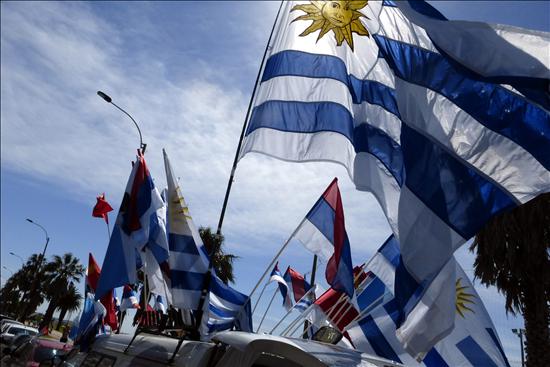
teleSUR | November 28, 2014
UPDATE: Vazquez wins Uruguayan presidential election
teleSUR talks to the Broad Front’s Carlos Alejandro, to understand in more depth the elections and their consequences.
teleSur: Carlos, what have been the standout points of the Broad Front’s campaign?
Carlos Alejandro: There is no political debate in the second round of elections. Really, the right wing has been knocked back, they experienced a serious setback in the first round. They really thought that polls would be right, and that the Broad Front wouldn’t get more than 45 percent of the votes.
The main point of this campaign is to uphold the Broad Front government’s achievements in all areas, especially those related to freedom and equality.
Over the past 10 years, we’ve approved a series of laws, like establishing the 7-hour work day for rural workers; a domestic worker law limiting the number hours they are allowed to work.; the same sex marriage act, a sexual and reproductive health law, which includes legislation on abortion. We want to clarify that it is not an abortion law, because that is one of the themes being debated.
Also being debated is the widening of political engagement among the population; a freedom of information law; the barriers to education; the role of women in politics; all of these are central to the election debate, coming above even economic matters. It’s a rare thing when the economy gets overshadowed in an election … it’s the only political debate they are having in Brazil.
Here in Uruguay what we’re debating is how to better ourselves, how to create better conditions, which is a debate we don’t want to have with the right wing, because they’ve shown us for the past 150 years that they cannot take care of those problems, problems we are resolving, and laying the ground work to have that debate with the people who will truly benefit from these policies.
TS: You have said that if Vazquez is re-elected, he would carry on with the Broad Front’s policies. However, there are many controversial policies that Jose Mujica implemented, like abortion, and the marijuana law, which Vazquez is known to oppose. What will happen if he is elected with regard to these topics?
CA: Tabare was against these projects. He didn’t support them, and furthermore, during his last administration, he vetoed the same law that was later approved under Mujica. But as they are both from the Broad Front, which passed the law, it’s not up for discussion. Nothing will change from the way it was approved during Mujica’s government. There is no political sign that suggests that Tabare will erase what Mujica did.
Regarding the marijuana law in particular, it is very clear within the party, that it is a law still being studied and analyzed, that can and will be corrected if necessary; it is new not only for Uruguay, but in the whole world; we know there are other places who have had similar experiences, like in some of the states in the U.S., but in our case, we want to resolve the drug problem, take the market for marijuana away from organized crime, and create conditions to rehabilitate not only marijuana users, but hard drugs too.
In this sense, our aim is to deepen the changes we have already made, improve what has been done, and improve what has been done badly.
TS: How is Vazquez viewed in Uruguay?
CA: Tabare is a man of the people, what we call “de a pie,” down to earth. He comes from a similar humble background as many other Uruguayans.. The Right cannot forgive him for paving the way —via his education and intellect— for the Left to get into power.
Tabare is a man of the Left, even though the political pragmatism he uses makes him seem more centrist, and not as left-wing as many would like; but he has a great feel for politics, and what both he and Mujica can do effectively is scope out what the people want, but in different ways.
Tabare ended his term with approximately 68 percent of approval, which shows that, beyond the problems that existed during that administration, Tabare ultimately received approval for what he did during his term. And I believe that the result of the October 26 elections shows that the Uruguayan people support his candidacy again.
TS: And how is right wing perceived the Uruguayan people?
CA: I think that the clearest example is that the Right didn’t have a clue how to face the second round of the elections. I’ll reiterate what I said before, they relied too heavily on the polls; they thought they were doing well, so did not work to create the conditions in case the scenario changed.
TS: Do you think that the Brazilian election result might influence the results in Uruguay?
CA: Not for this runoff, but yes, I do believe that the political change in the last days in the Brazil elections, with Marina Silva leading in the polls for so many months, and the possibility that the PT could lose the elections, caused some to be nervous, and a little bit worried. Not only us left-wing activists, but among people who would not necessarily identify themselves as left-wing.
TS: What challenges would a new Broad Front government face?
CA: I have said for many years that the most important thing is to not let down the electorate which voted for us and gave us the opportunity to govern. We have developed all of our policies that aim to improve the quality of people’s lives based on this basis; where we can keep generating societal change and evolution, and most importantly, within a region which is our neighborhood. Latin America is our neighborhood from which we relate to the rest of the world. In this sense, our internal policies have an external objective; to project the country within the region, prioritizing regional integration.
TS: So a Tabare Vazquez government would strengthen regional integration?
CA: Yes, definitely. We’re trying to create the conditions to solidify existing regional integration effortslike MERCOSUR, UNASUR, CELAC, ALBA … those projects are here to stay, and we want to make them robust.
We have shown we are a serious political party, dealing with, for example, the case of the Syrian refugees, and the problem of the Guantanamo prisoners. Doing so doesn’t mean we’re trying to cover-up for, or save Obama’s administration, but instead we are trying to resolve the situation for the prisoners, and help Guantanamo to go back to being part of Cuba.
TS: The case of the Syrian refugees is very interesting…
CA: Let me tell you an anecdote. The union for bank workers has a place for the children of its members to live in Montevideo if they go there to study. When President Mujica announced that Syrian families — who were refugees in Lebanese camps — would come to Uruguay, the young people living in the union’s accommodation talked to the leadership, and offered to share their bedrooms with the Lebanese translators who are there to help the Syrians with their Spanish, and adapting to life in Uruguay. For us, that gesture is not only seen as a humanitarian act, but it means that our youth is getting involved in a political issue that does not directly affect them, far away from our borders. That is very important to us, that they get involved, and understand what is it about.
This also shows the possibility and the capability that we have to resolve these issues. To welcome these Syrian families in Uruguay, so they can work here, have a life here. And it is the same with Guantanamo, a topic that Pepe [Mujica] said was not suspended, but on hold until November 30; and that after the elections, regardless who is the new president, he would continue to advocate for, and engage in, negotiations, so those six prisoners without a sentence can come to Uruguay and be free here. This is a very important political gesture by the Broad Front that needs to be highlighted, and it will reverberate with future governments.
Carlos Alejandro is the Broad Front’s director of international relations, as well as member of the Broad Front Commitment group. A member of the Broad Front since 1983, he has a background of union activism.
Swiss, French call to bring home gold reserves as Dutch move 122 tons out of US
RT | November 28, 2014
The financial crisis in Europe is prompting some nations to repatriate their gold reserves to national vaults. The Netherlands has moved $5 billion worth of gold from New York, and some are calling for similar action from France, Switzerland, and Germany.
An unmatched pace of money printing by major central banks has boosted concerns in European countries over the safety of their gold reserves abroad.
The Dutch central bank – De Nederlandsche Bank – was one of the latest to make the move. The bank announced last Friday that it moved a fifth of its total 612.5-metric-ton gold reserve from New York to Amsterdam earlier in November.
It was done in an effort to redistribute the gold stock in “a more balanced way,” and to boost public confidence, the bank explained.
“With this adjustment the Dutch Central Bank joins other banks that are keeping a larger share of their gold supply in their own country,” the bank said in a statement. “In addition to a more balanced division of the gold reserves…this may also contribute to a positive confidence effect with the public.”
Dutch gold reserves are now divided as follows: 31 percent in Amsterdam, 31 percent in New York, 20 percent in Ottawa, Canada and 18 percent in London.
Meanwhile, Switzerland has organized the ‘Save Our Swiss Gold’ referendum, which is taking place on November 30. If passed, it would force the Swiss National Bank to convert a fifth of its assets into gold and repatriate all of its reserves from vaults in the UK and Canada.
“The Swiss initiative is merely part of an increasing global scramble towards gold and away from the endless printing of money. Huge movements of gold are going on right now,” Koos Jansen, an Amsterdam-based gold analyst for the Singaporean precious metal dealer BullionStar, told the Guardian.
France has also recently joined in on the trend, with the leader of the far-right National Front party Marine Le Pen calling on the central bank to repatriate the country’s gold reserves.
In an open letter to the governor of the Banque de France, Christian Noyer, Le Pen also demanded an audit of 2,435 tons of physical gold inventory.
Germany tried and failed to adopt a similar path in early 2013 by announcing a plan to repatriate some of its gold reserves back from the US and France.
The efforts fizzled out this summer, when it was announced that Germany decided to leave $635 billion worth of gold in US vaults.
Germany only keeps about a third of its gold at home. Forty-five percent is held in New York, 13 percent in London, 11 percent in Paris, and only 31 percent in the Bundesbank in Frankfurt.
Lebanon’s war on ‘hashish’ indistinguishable from war on the poor

A cannabis farmer in the Bekaa Valley prays as Lebanese army men come to destroy his harvest. Al-Akhbar/Rameh Hamieh
By Amer Mohsen | Al-Akhbar | November 27, 2014
The cultivation of cannabis is popular in specific areas that have special characteristics like high altitude and sunlight, similar to the Bekaa region. This differential feature of Lebanon, which can revive the Lebanese countryside, has been overcome by the alternative agricultural policies required from abroad. The health risks associated with the use of cannabis are minimal compared to alcohol and tobacco, and compared with the results of the war on cannabis cultivation which only affects the poor segments of society.
A few years ago, Lebanese organizations, including left-wing movements, launched a media campaign warning against cannabis and the risk of its spread among the youth. The intention behind the campaign was noble, but it had several flaws: The first is related to the medical claims that accompanied the campaign – which are similar to the propaganda that was disseminated in America during the forties to scare people away from marijuana – saying that marijuana drives people crazy, makes them jump out of windows, and causes delinquency and crime. The main problem was in the “central-Beiruti” mentality, which led left-wing movements to claim their devotion to the grievances of the poor and the marginalized, and thus sought to combat and criminalize hashish rather than demand its legalization and lifting the ban on its cultivation.
The issue is very clear. There is a disregard – even contempt – by urban activists for the fates of hundreds of thousands of peasants in their country. They support policies and laws that have impoverished large parts of the Lebanese countryside, either because of their focus on “more important” issues (such as the rejection of the [parliamentary] extension and the “revolt against the sectarian system”), or because of a bourgeois view aimed at preserving morality and normalcy. There is no harm in adopting or defending such a view, but not when it is at the expense of the most vulnerable and disadvantaged segments of society. To date, there are no adequate studies on the social and economic deterioration that affected the villages of Bekaa and Hermel after the prohibition of cannabis cultivation in the nineties, and others on the prosperity witnessed in the region and the local development that resulted from it, while the rest of the country – paradoxically – was experiencing the worst stages of the civil war, and so the government left the farmers alone.
From the history of cannabis
In his book about the history of cannabis, Martin Booth (who also published a well-known book about opium) says that the cannabis is one of the oldest plantations that spread in human societies. He refers to one of the three major species of cannabis today, the “cannabis sativa,” whose name in Latin means “cultivated hemp” because it reached us in its hybrid version, which means that Neanderthals cultivated and hybridized it for thousands of years until the original “wild” seed has been lost and we now have the agriculturally-improved species.
The cultivation of cannabis was widespread not only because of its narcotic effect. Archeological excavations have shown that the consumption of cannabis was also part of religious rituals, and that the plant was an economic asset and resource used in the manufacturing of cloth, linen, ropes, and oils. A conspiracy theory popular among supporters of marijuana in the United States claims that the ban on cannabis cultivation is linked to influential circles in the timber industry, who sought to exclude cannabis as a competitive resource in the paper-manufacturing industry.
We also find many references to hashish and cannabis in Arab and Islamic history, which show its spread and recreational use in our countries through the eras, such as in the writings of chronicler Abdel Rahman al-Jabarti (who talked about his meeting with a mosque orator in Cairo, who claimed to be “under the effect of hashish” to justify his lack of focus during the sermon), as well as in the fatwas of Ibn Taymiyyah, where “Sheikh al-Islam” discussed the topic of hashish and ended up outlawing most of its uses. Based on his jurisprudential arguments, it appears that the people at the time used to consume cannabis either through melting it in tea, eating it directly, or cooking it with food (since the United States had not been discovered yet, and tobacco had not yet reached the ancient world). However, the prolonged explanation provided by Ibn Taymiyyah on the topic and his detailed justification of the prohibition show that the scholars of his day did not have a clear or decisive stance on the matter.
Lebanon and the differential feature
To be able to understand the secret behind the special relationship between Lebanon and hashish, and the differential feature that characterizes the Bekaa Valley and its surrounding hills in this regard, we have to know a few basics about the cultivation of this plant. According to Martin Booth, the “quality” of the hashish – i.e., the concentration of the principal psychoactive constituent Tetrahydrocannabinol (THC) in the female plants – is directly linked to two factors: altitude and sunlight. Cannabis needs large amounts of solar radiation during the maturity period so the plant can grow rapidly, and the growth of its genital parts, which contain the active substance, needs infrared (IR) radiation, whose concentration in the sun increases with altitude.
In other words, high-quality cannabis needs high-altitude mountainous areas, which are, at the same time, hot and exposed to the burning sun during the summer, which is rare in the world. For this reason, the cultivation of cannabis is prominent in specific areas that combine the characteristics of altitude and sunlight, like the Atlas Mountains in Morocco, the hills of Afghanistan … and the Lebanese Bekaa. This is a “geographic gift” that cannot be cloned or bought with money. It is limited to a few regions in the world – Booth says that the best and most expensive types of hashish are grown in India, on the foothills of the Himalayas and over-3,000-meter heights, and due to their rarity are preserved in special leather bags. These qualities have made Lebanon’s Bekaa and Hermel a center for cannabis cultivation since ancient times.
The charming town of Yamuna, which lies in a small internal valley in the highlands of Lebanon’s western mountain range, acquired its “market” reputation in the production of cannabis not because of its special soil, or the magic touch of al-Sharif. It is simply due to its high altitude in the barren areas and abundant water sources, which allows the cultivation of cannabis in perfect conditions. If the Hermel heights – which are rain fed areas today – were covered by irrigation projects – as it was supposed to be decades ago – the whole area would have been like Yamuna.
Lebanon’s gold
In the past two decades, new varieties of marijuana were bred in the West, and plantation techniques were developed in closed spaces under controlled lighting and temperature conditions to produce crops in which the concentration of the psychoactive constituent exceeds any product grown in nature.
However, this pattern of agriculture (which supplies the medical and commercial marijuana market in the West) requires the consumption of large amounts of energy for each plant separately. It is also less competitive – in the commercial sense – compared with lands that are, by nature, ideal for the cultivation of cannabis, and have been inherited by farmers over long years. Millions of meters of these lands can be cultivated at a low cost, and by relying solely on the generosity of the sun and the sky.
From here, we conclude that any kind of agriculture is – naturally – ideal for the marginal areas of Lebanon, and some have real differential features on a global level. A quick look at the labor force working in Lebanon, the price of land, and state policies is enough to understand that Lebanon’s competitive commodity – which will eliminate rural poverty and create development in rural areas – is most likely not potatoes or wheat. In addition, a main characteristic of agricultural property in eastern Lebanon is that [owned lands] are relatively small and fragmented. Also, most farmers own their land, which prevents the emergence of feudal and semi-feudal cartels (as in Afghanistan and South America), or huge agricultural companies that would exploit the peasants as laborers and monopolize profits for the benefit of major landowners. A significant part of proceeds from the cultivation of “contraband” plants in the Bekaa traditionally went to farmers.
This question should be raised, while the country that pressured and forced Lebanon to ban the cultivation of cannabis – the United States – has legalized the use of hashish in several states. The governments of the West no longer have a moral or legal excuse to impose such policies on our country. The general direction in the West is heading toward the legalization of cannabis derivatives, or at least not criminalizing it and prosecuting its users. But Lebanon is required to arrest its farmers who are seeking to avoid hunger and migration.
War on the poor
One of the reasons that triggered the wave of marijuana legalization in the West, even for recreational use, is the absence of a convincing medical argument – i.e. a threat to “public safety” – to justify the prohibition of hashish while allowing the sale of other “drugs” like alcohol and tobacco, which are far more dangerous and harmful than marijuana. As Professor As`ad AbuKhalil once wrote, if whiskey was produced by the countries of the South, while hashish was monopolized by the West, wine would be forbidden and frowned upon in Lebanon while ads by hashish companies would have filled the streets.
Science has become clear in this regard. Serious proven tests have shown that the consumption of cannabis may have side effects and can be dangerous for people who suffer from certain neurological problems. Also, heavy consumption can cause addiction and dependency in one out of 10 cases. However, these risks are insignificant compared with those of alcohol and tobacco, or even stress. Tobacco combustion may be the most dangerous thing in a “marijuana cigarette.” During the writing of this article, I consulted with a professor and researcher of Lebanese origin at Harvard Medical School, who graciously provided me with scientific studies and summaries. He expressed his opposition to the criminalization of cannabis cultivation, adding that its advantages in medical use are “very real,” and that the greatest harm results from the war on cultivation, as evidenced by the American experience, since it mainly affects – in Lebanon, as in America – the poorer classes, which do not have a voice in society.
This is one of the issues that will not be of concern to civil society organizations, and will not receive financing from European governments and institutions. However – unlike a lot of campaigns created by these organizations to justify their existence – it is achievable and can change – in the actual direct sense – many people’s lives.
It is possible to imagine a different future for large areas in Lebanon that are marginalized and disadvantaged today, in which farmers will be able to live in dignity and prosperity in their areas, and land and production will have real value.
The people living on the coast may migrate to internal areas, this time, in search of work and opportunities.
Israeli Authorities Prevent 100 Tons of Vegetables from Exporting out of Gaza
IMEMC News & Agencies | November 24, 2014
At Kerm Abu Salem crossing Israeli occupation authorities have barred ten truckloads of agricultural products from leaving the war-torn and economically besieged Gaza Strip, due to an alleged dispute between the Israeli army and the Ministry of Agriculture.
The dispute is preventing the trucks and their cargo from passing, and being exported to Saudi Arabia and West Bank, according to Al Ray Palestinian Media Agency.
Israeli website Walla reported, on Monday, that allowing the export of the agricultural products comes in the framework of “facilities” granted for Gaza residents in the wake of the last summer’s assault on the region, by Israel. Israeli authorities had agreed on the passage of ten truckloads per day.
Walla added that this shipment of vegetables weighs 100 tons, and has been held back since Sunday morning.
According to the Israeli system, after the truckloads pass to the military checkpoint on the Palestinian side of the crossing, they should be inspected and, then, loaded again onto Israeli trucks to pass to their planned route.
The office of the Coordinator of Government Activities in the occupied territories claims that the trucks are still stuck in the crossing because the Israeli Ministry of Health did not yet inspect them in accordance with regularities, with the Ministry itself citing a lack of staff to do that.
At this time, it is not clear when the shipment will pass.
Big Pharma—Crony Capitalism Out of Control
By Ralph Nader | November 21, 2014
Two recent news items about the voracious drug industry should call for a supine Congress to arouse itself and initiate investigations about the pay-or-die drug prices that are far too common.
The first item—a page one story in the New York Times—was about the Cystic Fibrosis (CF) Foundation, which fifteen years ago invested $150 million in the biotechnology company Vertex Pharmaceuticals to develop a drug for this serious lung disease.
On November 19, the Foundation reported a return of $3.3 billion from that investment. Kalydeco, the drug developed with that investment, is taken daily by CF patients (who can afford it) and is priced at $300,000 a year per patient. Who can pay that price?
The second news release came from the drug industry funded Tufts Center for the Study of Drug Development. The Center’s Joseph DiMasi asserts that the cost of developing a new prescription medicine is about $2.558 billion, significantly higher than the previous estimate of $802 million that the Center claimed in 2003.
The drug industry promoters use this ludicrous figure to justify sky-high drug prices for consumers. Unfortunately, the criticism of this inflated number does not receive adequate media attention.
Half of the DiMasi assertion is opportunity costs foregone if the drug company invested its money elsewhere. That cuts his estimate by almost half to $1.395 billion. This maneuver gives “inflation” a new meaning. According to economist James P. Love, founder of Knowledge Ecology International, DiMasi also conveniently ignores government subsidies such as so-called orphan drug tax credits, research grants from the National Institutes of Health and government support of the cost of clinical trials that qualify (see keionline.org).
Mr. Love adds that the drug companies spend “much more on marketing than they do on research and development.”
Rohit Malpani, Director of Policy and Analysis of Doctors Without Borders (which received the Nobel Prize in 1999), says that if you believe Tufts’ figures, whose alleged data analysis is largely secret, “you probably also believe the Earth is flat.”
Mr. Malpani cites GlaxoSmithKline’s CEO Andrew Witty himself who says that the figure of a billion dollars to develop a drug is a myth.
Malpani adds that “we know from past studies and the experience of non-profit drug developers that a new drug can be developed for just a fraction of the cost the Tufts report suggests. The cost of developing products is variable, but experience shows that new drugs can be developed for as little as $50 million, or up to $186 million if you take failure into account… not only do taxpayers pay for a very large percentage of industry R&D, but are in fact paying twice because they then get hit with high prices for the drugs themselves.”
Mr. Malpani was referring primarily to the U.S., where the drug companies show no gratitude for generous tax credits and taxpayer funded R&D (that they get mostly free.) Add the absence of price controls and you the consumer/patient pay the highest drug prices in the world.
Another largely ignored aspect of the industry’s R&D is how much of it is directed to products that match, rather than improve, health outcomes—so-called “me too” drugs that are profitable, but don’t benefit patients’ health.
Also, the consistently profitable drug industry has been continually unable to restrain its deceptive promotion of drugs and inadequate disclosure of side-effects. About 100,000 Americans die every year from adverse effects of pharmaceuticals. Tens of billions of consumer dollars are wasted on drugs that have side effects instead of drugs for the same ailments with lesser side-effects (see citizen.org/hrg).
During a visit in 2000 with military physicians and scientists at the Walter Reed Army Hospital, I asked how much they spent on R&D to develop their antimalarial drugs and other medicine. The answer: five to ten million dollars per drug, which included clinical testing plus the salaries of the researchers.
This “drug development entity” inside the Department of Defense arose because drug companies refused to invest in vaccine or therapeutic drugs for malaria—then the second leading cause for hospitalizing U.S. soldiers in Vietnam (the first being battlefield injuries). So the military brass decided to fill this void in-house, and with considerable success.
The problem with the stinginess of the coddled private pharmaceutical industry regarding vaccine development continues.Drug resistant tuberculosis and other infectious diseases rampant in developing countries continue to take millions of lives each year. The Ebola epidemic is a current lethal illustration of such neglect.
The survival of many millions of people is too important to be left to the drug companies. For a fraction of what the federal government is wasting on spreading and failing lawless wars abroad, it can expand from the Walter Reed Army Hospital example to become a humanitarian superpower that produces life-saving vaccines and medicines as if the plight of sick people mattered more than windfall profits for Big Pharma.
Ralph Nader’s latest book is: Unstoppable: the Emerging Left-Right Alliance to Dismantle the Corporate State.
Russia loses $140bn with sanctions and falling oil prices – Finance Minister
RT | November 24, 2014
Russia is losing around $40 billion a year due to Western sanctions, but they are not as critical to the economy as lower oil prices, which add $90-100 billion in losses, says Russian Finance Minister Anton Siluanov.
“We lose about $40 billion a year because of the political sanctions and around $90-100 billion a year due to the 30 percent reduction in oil prices,” RIA quotes Siluanov speaking Monday at the International Financial and Economic Forum.
Lower investment and foreign loans along with capital outflow, estimated at $130 billion this year, are the key components of the loss, Siluanov explained.
Siluanov believes the decline in oil prices has a more significant impact on the Russian economy than the international sanctions.
“If we talk about the consequences of geopolitics, of course, they are important for us,” he said. However, he added that “it is not as critical for the course, and even for the budget, as the prices of goods exported by us.”
Talking about the ruble’s depreciation, Siluanov said that fluctuating oil prices should serve as a principal indicator of the ruble’s exchange rate amid a period of high volatility.
“The price of oil has fallen by 30 percent since the beginning of the year. Incidentally, the ruble has weakened by the same 30 percent. When people ask me – listen, you’re the Minister of Finance, what’s the ruble rate going to be? It is impossible to answer because there are a lot of factors. I say, look at oil prices. The behavior of the ruble will depend on them,” said Siluanov.
The price of Brent crude, which is used to calculate the price for Russian Urals blend, has fallen by 30 percent to about $80 a barrel since the end of June; its lowest price for four years.
According to the International Energy Agency, the total supply of oil on the world market in October increased by 35 thousand barrels to 94.2 million (2.7 million barrels more than in October 2013). In the same period, the average daily volume of oil supplies by OPEC countries in the world market amounted to 30.6 million barrels.
OPEC countries are also adding to the oversupply as they’ve been exceeding their quota of 30 million barrels per day for the last six months.
According to IEA experts, the decline in oil demand from China, world’s second largest oil consumer, and rising oil production in the US will lead to a sharper decline in prices in early 2015.
On November 27, OPEC leaders will meet in Vienna to decide whether to shore up oil prices by cutting output.
Featured Video
Dan Dicks with James Corbett on Solutions Watch
or go to
Aletho News Archives – Video-Images
From the Archives
Secret document reveals plans for civil war in Lebanon, Israeli false flags, and invasion
By Randi Nord | Geopolitics Alert | April 5, 2019
Beirut – During his visit with US Secretary of State, Mike Pompeo, Lebanese President Michael Aoun reportedly received a US-Israeli document detailing plans for creating a civil war in Lebanon with covert false flag operations and possible Israeli invasion.
Although the source of the document is Israeli and created in partnership with Washington, no one knows who presented it to Aoun. The Lebanese TV station, Al-Jadeed, initially reported the document on Lebanese TV and a video on its website. Geopolitics Alert translated the report for this article. … continue
Blog Roll
 Aletho News
- Sheikh al-Asadi warns of Iraqi government compliance with US demands
- How to MAKE THE CONSPIRATORS PAY for their crimes! Dan Dicks with James Corbett on Solutions Watch
- There’s a drought in academia: A drought in honest research on the subject of drought and other weather extremes
- Department of War Awards $20.7 Billion Contract to Raytheon for Air-to-Air Missiles
- ‘Distance yourselves from Israel’: IRGC urges US population to question govt policies
- America’s Greenland deal has a radioactive backstory
- The RAF Fairford ‘terror plot’: Unpacking escalation in the UK echo-chamber
- EU Council Advances Chat Control 2.0 Scanning Proposal
- Ex-Greek MEP files complaint against Israeli spyware firm over alleged Pegasus surveillance
- Troubling ideas throughout the Torah, Talmud, Mishneh Torah and Tanya
- If Americans Knew
- New Report: “Scholasticide and Genocide in Gaza: Assessment, Testimonies and Legal Analysis”
- Ex-Biden officials are desperate for a Gaza scapegoat
- Israeli “settlers” Invade Al-Aqsa; Pour Boiling Water on 75-Year-Old
- Israel Has Kidnapped Another American Teenager
- US arms sales to Israel worth $21.6 billion in 20 months
- Three Palestinians Killed in Israeli Attacks on Gaza
- Revealed: German “Anti-Semitism Expert” Driving Crackdown on Palestine Solidarity is Former Israeli Spy
- Egypt’s Warning to Israel Before Oct 7
- Israel’s siege signals another cruel winter for 1.8 million Gazans – Daily Update
- Netanyahu Asked UAE Leader to Deny Report on Oct. 7 Warning in Secret Visit, Sources Say
- No Tricks Zone
- New Study: Earth And Venus Surface Warmth Largely Explained By Convection And Lapse Rate, Not CO2 Or Radiation
- 2025 Nature Paper Claiming Worsening Global Drought Gets RETRACTED …Heavily Flawed
- New Study: ‘Global Drought Shows No Detectable Recent Acceleration Under Climate Warming’
- Economic Masterminds: German Socialists Suggest Taxing Productivity Gains Stemming From Using AI
- The South China Sea Has Not Been Cooperating With The Climate Change Narrative
- Energy Crisis: Germany Enters Heating Season With Historically Low Gas Reserve Fill Levels
- New Study: The Antarctic Ice Sheet Gained Mass From 2020-2024 Due To Staggering Snow And Ice Accumulation
- Study: Ocean Heating Rates From Thousands Of Years Ago ‘Dwarf’ Modern Ocean Heating Rates
- Climate Extremists Target, Attack Large-Scale Power Grid Infrastructure In Germany!
- New Study: Antarctic Ice Melt Has Contributed Less Than 1 Centimeter To Sea Level Rise In The Last 30 Years

