While the financial sector of the core capitalist economies is enjoying escalating asset price inflation, the real sector of these economies, especially those of Europe and Japan, is suffering from deflation, that is, stagnation and high unemployment.
And while the simultaneous occurrence of inflation and deflation sounds paradoxical, it is only superficially so. In reality it is simply the logical outcome of neoliberal monetary policies pursued in these countries: as these policies of austerity economics have since the 2008 financial collapse systematically drained the overwhelming majority of citizens of material resources and funneled those resources to the financial sector, the result has been the understandable contraction of the real sector concurrent with the expansion of the financial sector.
In the face of these apparently contradictory developments, economic pundits and financial “experts” at the helm of monetary policy-making apparatus feign bewilderment at how market developments have become increasingly more “complicated,” and how economic fine-tuning has accordingly become more challenging. Such pompous utterances are, however, hollow pretensions designed to obfuscate issues, to mystify economics and to confuse the people. In reality, there is absolutely nothing “complicated” or mysterious about the simultaneous expansion of the financial sector and contraction of the real sector. It is, indeed, altogether axiomatic that if you systematically rob Peter to pay Paul, you are going to impoverish Peter (the 99%) while enriching Paul (the 1%).
The concurrent enrichment of the financial plutocracy and impoverishment of the masses of the people is akin to the growth of a parasite in the body of a living organism at the expense of life-sustaining blood or nourishment of that organism. What is unknown to the public is that the parasitic transfer of economic blood from the bottom up is not simply the spontaneous outcome of the operations of the invisible hand of market mechanism, or the blind forces of competition. More importantly, the transfer is the logical outcome of deliberate monetary policies that are crafted by the financial elites and their proxies at the helm of economic policy making of most capitalist countries. As political economist Mike Whitney recently put it:
“As most people now realize, stocks haven’t tripled in the last 5 years because the economy is expanding. Heck, no. The economy is still on all-fours and everyone knows it. The reason stocks have been flying-high is because the Fed added a hefty $4 trillion in red ink to its balance sheet. Naturally, when someone buys $4 trillion in financial assets, the price of financial assets go up” (source).
The purported rationale behind the unremitting bestowing of the nearly interest-free money upon the financial institutions is that as these institutions receive cheap money from the printing presses of the government they would, in turn, extend low-cost credit to manufacturers, thereby prompting investment and job creation in the real sector of the economy.
This traditional/New Deal monetary policy worked fairly well as long as regulatory constraints—especially the Glass-Steagall Act that was in force from 1933 to 1998—strictly stipulated the types and quantities of investments that banks and other financial intermediaries could undertake. As those regulatory requirements prohibited banks from engaging in speculative or risky investments, they had very little choice but to behave or do business mainly as banks, or financial intermediaries, that is, funneling depositors’ savings and/or government-generated money to the real sector of the economy.
With the systematic removal of regulatory constraints, however, banks have been increasingly abandoning or marginalizing their traditional role as financial intermediaries. Instead, they now invest mostly in buying and selling of assets and other speculative activities, as such financial/speculative investments are much more lucrative than simply accepting deposits at certain rates of interest and then lending them at slightly higher rates.
Not only has this change in the behavior or function of the banking system drastically curtailed the flow of capital from the financial to the real sector, it has in fact reversed the flow of capital between these two sectors: there is now an alarming capital flight from the real to the financial sector in pursuit of higher, speculative rates of profit. Evidence shows that (in recent years) real sector corporate managers/CEOs are increasingly diverting their profits, as well the cheap money they borrow from governments (usually through the privately-owned central banks), to speculation instead of production. As I noted in an earlier article on this subject, “they seem to have come to think: why bother with the messy business of production when higher returns can be garnered by simply buying and selling titles.”
This steady transfer of money from the real to the financial sector is the exact opposite of what monetary policy-makers—and indeed the entire neoclassical/mainstream economic theory—claim or portray to happen: flow of money from the financial to the real sector.
One would imagine that these drastic changes in real world markets, which show how gravely mainstream economists have gone awry in holding tight to their abstract and largely obsolete theories, would have somewhat shaken the faith of these economists in their economic orthodoxy and prompted them to revise or adjust their traditional theories of money supply, of credit creation, of finance, and of investment.
Alas, the faith in market mechanism and economic orthodoxy seems to be as strong as the faith in any otherworldly religion. Whether as university professors or as advisors to policy makers, mainstream economists continue to teach the same materials and retell the same theories in the face of heavily financialized economies as they did in times long past, that is, in the era of relatively competitive markets and industrial/manufacturing economic structures of yore.
Under the sway of financial capital, monetary policy has increasingly turned into an instrument of asset price inflation, that is, of accumulation of ever more fictitious capital in the deep pockets of the financial oligarchy. While not openly acknowledged, the rationale behind the endless injection of cheap money into the financial sector—in the manner of pumping hot air into a balloon—is a desperate attempt or a vain hope on the part of economic policy makers that the so-called trickle-down effects of asset price bubbles may lead to economic recovery.
Admittedly, the presumed trickle-down effects on aggregate demand may have had some validity in the earlier (industrial or manufacturing) stages of capitalism where the rise in the wealth of nations also meant expanded (real) production and increased employment. However, in the era of heavily financialized economies, where the dominant form of capitalist wealth comes not so much from real production of goods and services as it does from asset price bubbles, trickle-down theory has lost whatever minimal validity it may have had at earlier phases of capitalism.
Sadly, monetary policy makers, who are often proxies of financial elites at the helm of privately-owned central banks (contrary to the widespread perceptions, the U.S. Federal Reserve Bank is also privately owned, its share-holders are commercial banks) are not deterred by real world economic developments that tend to contradict their religious-like theories. Their loyalty is first and foremost to the interests and agendas of their behind-the-scene bosses and benefactors―those who nurture, promote and place them at the seat of monetary/economic decision-making. Having abandoned traditional fiscal and monetary policies of demand management, asset-price inflation has now become the policy of choice of economic recovery—if not recovery, then of preventing an economic collapse.
Hostage to Banksters
This helps explain why the economies of most of the core capitalist countries have become hostage to banksters, to their insatiable appetite for ever more cheap money. This practice of continued injections of cash into the financial sector is obviously tantamount to ransom payments to the “too big to fail” banksters, out of an exaggerated fear that their failure would lead to “cataclysmic economic collapse.” It also helps explain the multiple renewals or endless extensions of the policy of quantitative easing (QE), as termination of this policy is bound to lead to another financial implosion.
As an indication of this destructive addiction of the financial markets to Uncle Sam’s generous cash injections, let us remember how these markets went into a tail spin in mid-October by the prospect that QE may not be extended beyond October; and how they immediately rebounded on the news that the Fed would indeed continue cash injections beyond October―that is, QE3 would be continued as QE4. This is how Mike Whitney described those turbulent days of the financial markets:
“By mid-day [of October 15, 2014], the Dow was down 460 points before clawing its way back to minus 173 points. It looked like the market was set for another triple-digit flogging on Thursday [October 16] when the Fed stepped in and started talking-up an extension to QE3. That’s all it took to ease investors jitters, stop the meltdown and send equities rocketing back into space. By the end of Friday’s session, all the markets were back in the green with the Dow logging an impressive 263 points on the day” (source).
While the policy of indefinite extension of QE (along with near-zero interest rates) may temporarily keep the financial markets from imploding, the policy simply delays the day of reckoning—more or less like keeping a terminally-ill patient alive on artificial life support. And therein lies the futile and, indeed, tragic aspect of this policy: monetary policy-makers’ obligation to constantly inject cash into the financial system in order to keep the system from collapsing is akin to the logic of the proverbial bicyclist who has to keep riding forward or else he would fall over.
Monetary policy-makers at the head of central banks and treasury departments, representing the powerful interests of big finance, would do everything they can to avoid going off the cliff, or to delay the approach to the cliff. In so doing, however, they drain the overwhelming majority of citizens of economic/financial resources—by transferring those resources (through austerity measures) to the financial oligarchy. Andre Damon (of the World Socialist Web Site ) succinctly captures the redistributive effects of this neoliberal monetary policy:
“The richest one percent of the world’s population now controls 48.2 percent of global wealth, up from 46 percent last year, according to the most recent global wealth report issued by Credit Suisse, the Swiss-based financial services company.
“Hypothetically, if the growth of inequality were to proceed at last year’s rate, the richest one percent for all intents and purposes would control all the wealth on the planet within 23 years.
“The report found that the growth of global inequality has accelerated sharply since the 2008 financial crisis, as the values of financial assets have soared while wages have stagnated and declined. . . . Emma Seery, head of Inequality at Oxfam, the British anti-poverty charity, commented, ‘This report shows that those least able to afford it have paid the price of the financial crisis whilst more wealth has flooded into the coffers of the very richest.’
“The study revealed that the richest 8.6 percent of the world’s population—those with a net worth of more than $100,000—control 85 percent of the world’s wealth. Meanwhile, the bottom 70 percent of the world’s population—those with less than $10,000 in net worth—hold a mere 2.9 percent of global wealth.
“The growth in inequality is bound up with a worldwide surge in paper wealth, fueled by the trillions of dollars pumped into the financial system by central banks via zero interest rate and ‘quantitative easing’ policies. . . .
“As the report noted, ‘The overall global economy may remain sluggish, but this has not prevented personal wealth from surging ahead during the past year. Driven by … robust equity prices, total wealth grew by 8.3% worldwide … the first time household wealth has passed the $250 trillion threshold’.” (Source).
What is To be Done?
The solution to the runaway financial sector, according to most liberal–Keynesian critics of financialization, is regulation, or re-regulation. While this would be a welcome improvement over the destabilizing behavior of the unbridled finance capital, it would represent only a tentative short- to medium-term solution, not a definitive long-term one. For, as long as there is no democratic control, regulations would be undermined by the influential financial interests that elect and control both policy-makers and, therefore, policy. The dramatic reversal of the extensive regulations of the 1930s and 1940s, which were put in place in response to the Great Depression, to today’s equally dramatic deregulations serves as a robust validation of this judgment.
Other critics of the out-of-control finance capital call for public banking. These critics argue that, due to their economic and political influence, powerful financial interests easily subvert government regulations, thereby periodically reproducing financial instability and economic turbulence. By contrast, they further argue, public-sector banks can better reassure depositors of the security of their savings, as well as help direct those savings toward productive credit allocation and investment opportunities. Ending the recurring crises of financial markets thus requires placing the destabilizing financial intermediaries under public ownership and democratic control.
While nationalization of commercial banks could mitigate or do away with market turbulences that are due to financial bubbles and bursts, it will not preclude other systemic crises of capitalism. These include profitability crises that result from very high levels of capitalization (or high levels of the “organic composition of capital” a la Marx), from insufficient demand and/or under-consumption, from overcapacity and/or overproduction, or from disproportionality between various sectors of a market economy.
Furthermore, as long as capitalism and, along with it, the lopsided distribution of economic surplus prevails, financial instability cannot be uprooted by bank nationalization. For, while nationalization of traditional/commercial banks may temper financial fragility, other types of financial intermediaries and institutions are bound to arise in order to circumvent regulation and/or nationalization, thereby precipitating financial instability. These include all kinds of shadow banks and speculative enterprises such as private equity firms, derivative markets, hedge funds, and more.
To do away with the systemic crises of capitalism, therefore, requires more than nationalizing and/or regulating the banks; it requires changing the capitalist system itself.
Ismael Hossein-zadeh is Professor Emeritus of Economics (Drake University). He is the author of Beyond Mainstream Explanations of the Financial Crisis (Routledge 2014), The Political Economy of U.S. Militarism (Palgrave–Macmillan 2007), and the Soviet Non-capitalist Development: The Case of Nasser’s Egypt (Praeger Publishers 1989). He is also a contributor to Hopeless: Barack Obama and the Politics of Illusion (AK Press 2012).
November 7, 2014
Posted by aletho |
Deception, Economics | Capitalism, European Union, United States |
Leave a comment
Introduction
There are many fabrications and false assumptions underlying the Colombia peace negotiations between the Santos regime and FARC – EP (Revolutionary Armed Forces of Colombia – Peoples Army). The first and most egregious is that Colombia is a democracy. The second is that the Santos regime pursues policies which enhance non-violent social and political activity conducive to integrating the armed insurgency into the political system.
There is sufficient evidence to call into question both assumptions. Over the past two decades and a half nearly three thousand trade union leaders and activists have been murdered; over 4.5 million peasants have been dispossessed and displaced by the military and paramilitary forces; and over nine thousand political prisoners are being held indefinitely for engaging in non-violent socio-political activity. In addition scores of human rights lawyers, activists and advocates have been assassinated.
The vast majority of the victims are a result of regime directed military and police repression or paramilitary death squads allied with the military and leading pro-government politicians.
The scale and scope of regime violence against social opposition precludes any notion that Colombia is a democracy: elections conducted under widespread terror and whose perpetrators are allied with the state and act with impunity, have no legitimacy.
The re-election of President Santos and the convocation of peace negotiations with the FARC to end Latin America’s longest civil war is certainly a welcome step toward ending the bloodshed and providing the basis for a transition to democracy.
While the Santos regime has put a stop to the massive state terror regime of his predecessor, the US backed Alvaro Uribe regime, political assassinations still occur and the perpetrators continue to act with impunity.
For any peace process to culminate with success, the peace accords, agreed to by both parties, must be effectively implemented. Previous agreements ended in state massacres of demobilized guerrillas turned civil society activists and elected political representatives.
The peace negotiations have proceeded for two years and major accords have been reached on a series of vital areas of mutual concern. In particular both sides have signed off on 3 of 5 points on the peace agenda: rural developments, guerrilla participation in politics, policy on drug trafficking. Current negotiations focus on the contentious “transitional justice” for victims of the conflict. Most human rights groups and experts agree that the vast majority of victims are a result of military and paramilitary repression. However, the Santos regime and its backers in the media claim otherwise – blaming the FARC.
Is There a “Peace Process”?
The Santos regime has thrice rejected cease fire offers by the FARC who have gone ahead and unilaterally implemented them . The regime has chosen to continue the war in Colombia while negotiating in Havana. The two year time span of the peace negotiations provides deep insights into the viability of the peace accords signed in Havana. International and Colombian human rights groups and social movements provide timely reports on the scope and depth of ongoing violations of political and human rights in Colombia during the peace negotiations.
Based on data compiled by human rights attorneys and experts affiliated with the Marcha Patriotica (Patriotic March), an alliance of scores of neighborhood, peasant, trade union and human rights organizations, between April 2012 and January 2014, it is clear that the reign of state and paramilitary terror continues parallel to the peace negotiations.
During this 21 month period, twenty-nine Patriotic March (PM) activists were killed and three others were “disappeared” – and presumed murdered. Scores of others have received death threats.
The class background of the victims points to the vulnerability of the peace agreement. Twenty-three of the murdered members of the PM were peasant leaders and activists promoting agrarian reform, the repossession of land under the regime’s Land Restitution Law or engaged in other peaceful civil society activity. Four of the victims were active in social movements supporting a “peace with social justice” agenda; two were human rights lawyers; two were community and neighborhood organizers and one was a leader of a local youth movement.
None of the assailants were arrested. Military and police officials, who had previous notice of death threats, took no precautions. Nor were any investigations undertaken, even when family and neighbors were privy to relevant evidence.
In the face of the Santos’ government’s unwillingness to curtail military, police and death squad complicity in the murder of peasant activists during the peace negotiations, can the regime be trusted to implement the accord on “rural development”? Can the government guarantee the security of disarmed guerrillas as they enter the political system when over one hundred human rights activists received death threats in September 2014?
According to Amnesty International, during 2013, seventy human rights defenders were killed, including indigenous and Afro-Colombian leaders and twenty-seven members of trade unions. At least forty-eight homicides were committed by military units. Military commanders engaged in “false positives”, meaning murdered civilians were falsely labelled by the military as “armed insurgents”. Extra judicial killings by the military continue under the Santos regime.
Equally ominous, Santos has failed to disband the paramilitary death squads. As a result, the regime fails to protect land claimants. Dispossessed peasants and farmers attempting to resettle their land under Santos’ “Land Restitution Law” have been threatened or murdered by paramilitary gangs. As a result the Law has virtually no impact on resettling peasants because of landlord retaliations.
In fact the number of dispossessed has increased according to the United Nations: 55,157, mostly rural, Colombians fled their homes between January and October 2013, because warfare between and among drug and paramilitary gangs.
Presidential Santos War on Civil Society
The pervasive insecurity that rules the countryside, the murders, disappearances and jailing of social activists, accompanying the peace negotiations, call into question the “accords” thus far reached between the FARC and the Santos regime. Supporters of the regime argue that the number of state murders has declined over the past three years. Critics counter that relatively fewer assassinations have the same effect in generating fear, undermining citizen participation and the transition to a democratic political system.
The entire conception of a successful peace process rests on the assumption that the accords will result in constitutional guarantees of free and democratic citizen participation. Yet throughout the two year period, the regime has not demonstrated a clear and consequential commitment to elementary rights. If that is the case during the negotiations with the popular insurgency, still active and armed, how much worse will conditions become once the military, police and paramilitary are free of any retaliation, when they will have a free hand to intimidate and strike down disarmed political dissidents attempting to compete in local or national elections?
The Santos regime appears to have adopted a two prong strategy: combining violent repression of the social movements in Colombia while adopting the language of peace, justice and reconciliation at the peace table in Havana.
The Santos regime can promise to accept many democratic changes but its practice over the past two years speaks to an authoritarian, lawless regime, content with maintaining the status quo.
The Santos regime has three strategic goals: to disarm the popular insurgency; to regain control over the territory under insurgent control; and to weaken and undermine the popular social movements and human rights groups which are likely to form political alliances with the insurgents when and if they become part of the political system.
It is doubtful that the FARC will surrender their arms in a political climate in which paramilitary killers operate with impunity; military commanders still engage in ‘false positives’; and rural development projects are inoperative because of landowners’ terror tactics.
Unless the peace accords are accompanied by fundamental changes in the military; unless the paramilitary forces are effectively demobilized; unless the government recognizes the legitimacy of the demands of the mass social movements and human rights group for a freely elected constituent assembly is accepted, the peace process will end in failure.
Conclusion: Four Hypothesis on Santos Strategy for War and Peace
There are several hypotheses regarding why the Santos regime negotiates a peace accord while gross violations of human rights continue on a daily basis.
(1) The Santos regime is divided, with one sector in favor of peace and another opposed. This hypothesis lacks any credible basis as there are no visible signs of internal conflict and the regime acts with a unified command. While some state violence may be a result of local military commanders, at no point have national leaders reprimanded the “local” transgressors.
(2) The Santos regime actively pursues violent acts against the social movements to strengthen its bargaining position in the peace negotiations to secure a more favorable settlement – in other words to make the minimum of social concessions in order to placate oligarchs critical of any negotiations. This hypothesis explains the ‘dual strategy’ approach advocated by the regime with regard to the FARC, talking peace in Havana and rejecting a cease fire in Colombia; continuing the war while negotiating peace. But it also undermines the regime’s claim that Santos seeks to incorporate combatant groups into the political system.
(3) The regime is in a tacit pact with former death squad – President Alvaro Uribe. As a result the government’s military apparatus is still tied to paramilitary gangs, working with landowners, drug traffickers and businesspeople. There is no doubt that Santos has long-standing ties to Uribe – he was his Defense Minister. Moreover, after Santos defeated Uribe’s candidate for the Presidency by a narrow margin he has sought a political accommodation with Uribe’s Congressional and business supporters. On the other hand Santos recognizes that his economic strategy, especially his focus on promoting trade with Latin America and especially Venezuela, and his big push to exploit the energy and mining sector depends on reaching a peace agreement with the FARC, which controls substantial mineral rich regions. Hence Santos signs “paper agreements’ with the FARC, while applying a ‘hard fist’ (‘mano duro’) policy to the social movements.
(4) The upsurge of the mass social movements, including the Marcha Patriotica, demanding the effective implementation of the ‘rural development’ reforms and repossession of land to 3.5 million displaced families and the increasing role of the human rights groups in monitoring the ongoing violations of human rights, means that the Santos regime cannot secure ‘peace’ solely through an agreement with the FARC in Havana. If the Santos regime’s goal in the peace negotiations is to disarm the guerrillas and incorporate them into the electoral system, without dealing with the root socio-economic structural reforms, it must weaken the civil society popular movements.
This is the most plausible hypothesis. President Santos is capable of promising the FARC any sort of ‘democratic reforms’ and is willing to sign off on anti-drug agreements and even ‘agrarian development’. But what he is unwilling to accept is the emergence of mass peasant movements actively engaged in changing land tenure, repossessing their farms and reclaiming millions of acres of land granted to big foreign owned mining consortiums.
Santos will not ‘demobilize’ the paramilitary gangs because they are instruments of the big landowners and protect the state grants to the big mining companies. But he will try to limit death squad targets to specific activists and organizations in contentious regions.
Santos has not even curtailed the cross border attacks by Colombian paramilitary groups. Assassinations continue, the latest, the assassination of a Venezuelan Congressional leader. He has expanded military ties with the US by pursuing agreements to collaborate with NATO – offering combat units for the Middle East wars.
What is abundantly clear is that the Santos regime has not complied with the most elementary conditions necessary to implement any of the five point reform agenda set forth in Havana. Military impunity, rampaging death squads, scores of daily death threats to human rights activists, over nine thousand political prisoners and dozens of unsolved killings of peasant leaders is not compatible with a transition to a democratic peace. They are compatible with the continuity of an authoritarian oligarchical regime. A democratic transition and a peace agreement requires a fundamental change in the political culture and institutions of the Colombian state.
November 7, 2014
Posted by aletho |
Civil Liberties, Deception, Economics | Colombia, FARC, Human rights, Latin America, Marcha Patriotica, NATO |
Leave a comment
In perhaps the best mainstream report during the election season, the typically firmly D.C.-based Steve Inskeep went knocking on doors in Colorado and came across a woman, Ili Bennett, who told him she’s felt some excitement from both Elizabeth Warren — and in the past, the Tea Party.
Said Inskeep: “I think you’ve hit on something insightful here. And I want you to help me with this a little bit because the Tea Party, those are some very conservative people — Elizabeth Warren, very liberal person. But they both represent deep unhappiness with the way things are. And it sounds like they both struck a chord with you. Am I right?” He was and it’s not one woman in Colorado of course. Politico headline today states: “Exit polls 2014: Voters hate everyone.” It might seem that way to the insiders at Politico, but actually it’s that voters mostly just hate the establishment of both political parties, which to Politico might seem like “everyone”. And this isn’t new. From 2010: “CNN Poll: Majority angry at both political parties.”
The problem is that people feel they have virtually no where to go and can’t translate that anger to action. There is a de-facto anti-establishment, populist majority. But the entire structure of politics, media and elections is designed to keep them divided and prevent such populists from the left or right or wherever from coalescing politically. Third parties coming from either the left (Green, Socialist) or the right (Constitution, Libertarian) are automatically dismissed by the vast majority as potential spoilers. (I’ve set up VotePact.org to solve exactly this problem.)
Some sectors of the media have lauded the Republican establishment’s stepping into the primary process and preventing Tea Party candidates from getting nominations in so-called “swing states.” Those looking for salvation in presidential elections from the likes of Bernie Sanders or Elizabeth Warren or their Republican mirror images will have to bear in mind the obstacle in the primaries is “electability” (as defined by the establishment) and it’s a virtual certainty that candidates who seem serious about delivering real change will be denied any nomination. Rather, such candidates will likely mostly function as a way of keeping voters on the establishment party reservation, endorsing the ultimate nominee.
As for midterm elections, part of the equation is lower and lower voter turnout — the “leadership” of the parties is in effect firing and further marginalizing the public and their alleged bases.
The establishment will attempt to produce their own version of “bipartisanship” — pro-establishment bipartisanship that is. The mantra of “change” is being used to peddle the never ending use of the Reversible Straitjacket of the Democratic and Republican establishments. This manifests itself as “seesaw politics” and what I’ve called the guillotine pendulum, helping ensure the continuity of what some call the Deep State.
The major corporate media frequently focus on marginal differences between the two major parties, but the areas of agreement between them are sizable in terms of economic, trade, civil liberties, foreign policy and other issues. On these and other critical issues, the establishments of the duopoly are frequently aligned together against their alleged bases, explaining why the public “hates everyone”. Crazy public. Politicians of both parties talk about helping the little guy and then do the bidding of corporate interests.
Now, the political narrative is that Washington is dysfunctional and “can’t agree on anything”. The the general public is clearly being prepared to embrace whatever pro-corporate monstrosity President Obama and presumptive Senate Majority Leader McConnell agree on.
So, predictably, the Wall Street Journal is now reporting: “American businesses are hoping the dust will settle from Tuesday’s GOP takeover of Congress with new attention on corporate taxes, immigration, trade and energy, top priorities that have eluded breakthroughs in recent years. A post-election landscape that includes a more sharply divided government is likely to lead to continued frustration over some items on businesses’ wish list. At the same time, a reshaped political landscape could lead Congress and the White House to seek legislative breakthroughs on some economic issues before the 2016 election season heats up.”
So, the big business agenda on taxes and corporate trade deals like the Trans Pacific Partnership could well be advanced by establishment Republicans in Congress working with the Obama administration. This could well extend to other issues such as civil liberties, more war, etc.
The anti-establishment forces either still in the Democratic Party or that have given up on the electoral process all together should join with those deluding themselves into looking for the Republican Party for some salvation. They should work toward building new institutions that adopt their best beliefs.
And this must go beyond voters. There should be candidates running for Democratic and Republican nominations who — once the establishment ensures their defeat in the primaries — are willing, jointly perhaps, to bolt and not back the party’s establishment nominees.
The day after election day is the most important. Now is the time to reach out across the partisan divide and find populists on the other side to work with. You have nothing to lose but your perpetual chains.
Sam Husseini founded VotePact.org which encourages voters to pair up with their political “mirror image” and vote for their preferred candidates rather than the “lesser evil” offered by the establishment.
November 6, 2014
Posted by aletho |
Civil Liberties, Corruption, Deception, Economics, Timeless or most popular | Obama, United States |
Leave a comment
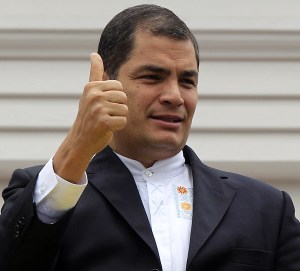 During a meeting Wednesday with the journalists in the coastal, economic hub of Guayaquil, Ecuadoran president Rafael Correa said that over 309,000 children had quit working to attend school.
According to official estimates, the number of working children decreased from 17 to eight percent.
Correa reiterated his commitment to eliminate child work in Ecuador, and sharply criticized the recent initiative of Guayaquil’s mayor, Jaime Nabot, to inaugurate a statue representing a shoeshine boy in the city center.
The head of state called the statue a “shame”, saying “(it) is not part of the folklore, it is part of exploitation.”
During the inauguration, Nebot himself took a picture simulating the act of having his shoes shined by the boy depicted in the statue.
“While the oligarchy builds statues about our exploitation, we build schools so children can keep studying,” added Correa.
November 6, 2014
Posted by aletho |
Economics | Ecuador, Human rights, Latin America |
Leave a comment
The Hungarian parliament has approved a law on Monday which allows building the South Stream gas pipeline without approval of the European Union. The European Commission has already demanded an explanation from Hungarian authorities.
The European Commission’s spokesperson said at a press briefing in Brussels on Tuesday that the EC was in contact with Hungarian authorities to get an explanation for their decision.
The law was passed with 132 votes in favor and 35 votes against, allowing a company to construct a gas pipeline even if it doesn’t have the licenses needed to operate it. According to the new law the only requirement for a company which wants to take part in construction is approval from the Hungarian Energy Office.
“This is meant to give a boost to South Stream and is to show Russia that Hungary is taking the project seriously,” Attila Holoda, an expert on energy regulation, said as cited by Bloomberg.
South Stream is “extraordinarily important” for Hungary because it enhances the security of gas supplies to the country, Janos Lazar, the Minister in Charge of the Prime Minister’s Office, told reporters on October, 22.
The South Stream gas pipeline was projected to deliver gas to south and central Europe via the Black Sea and the Balkans, bypassing Ukraine. The project, with a capacity of 63 billion cubic meters of gas a year, is seen as critical for European energy security. Ukraine has been an unreliable transit country, and building a new pipeline could result in avoiding numerous risks.
The South Stream would run across Bulgaria, Serbia, Hungary, Austria, and Slovenia before entering Italy and Greece. The crisis in Ukraine has made the South Stream project a political issue rather than a legal debate. The EU Commission has been pressuring member states to stop the building of the pipeline. Last year it started an investigation claiming the project contradicted the European Union’s Third Energy Package regulations.
Bulgaria and Austria have temporarily suspended the project but are leaving it on the table.
November 4, 2014
Posted by aletho |
Economics | Europe, European Union, Hungary, South Stream |
Leave a comment
“Listening to farmers and addressing their specific needs. We talk to farmers about the crops they want to grow and eat, as well as the unique challenges they face. We partner with organizations that understand and are equipped to address these challenges, and we invest in research to identify relevant and affordable solutions that farmers want and will use.” – First guiding principle of the Gates Foundation’s work on agriculture.1
At some point in June this year, the total amount given as grants to food and agriculture projects by the Bill and Melinda Gates Foundation surpassed the US$3 billion mark. It marked quite a milestone. From nowhere on the agricultural scene less than a decade ago, the Gates Foundation has emerged as one of the world’s major donors to agricultural research and development.
The Gates Foundation is arguably the biggest philanthropic venture ever. It currently holds a $40 billion endowment, made up mostly of contributions from Gates and his billionaire friend Warren Buffet. The foundation has over 1,200 staff, and has given over $30 billion in grants since its inception in 2000, $3.6 billion in 2013 alone.2 Most of the grants go to global health programmes and educational work in the US, traditionally the foundation’s priority areas. But in 2006-2007, the foundation massively expanded its funding for agriculture, with the launch of the Alliance for a Green Revolution in Africa (AGRA) and a series of large grants to the international agricultural research system (CGIAR). In 2007, it spent over half a billion dollars on agricultural projects and has maintained funding at around this level. The vast majority of the foundation’s agricultural grants focus on Africa.
Spending so much money gives the foundation significant influence over agricultural research and development agendas. As the weight of the foundation’s overall focus on technology and private sector partnerships has begun to be felt in the global agriculture arena, it has raised opposition and controversy, particularly around its work in Africa. Critics say that the Gates Foundation is promoting an imported model of industrial agriculture based on the high-tech seeds and chemicals sold by US corporations. They say the foundation is fixated on the work of scientists in centralised labs and that it chooses to ignore the knowledge and biodiversity that Africa’s small farmers have developed and maintained over generations. Some also charge that the Gates Foundation is using its money to impose a policy agenda on Africa, accusing the foundation of direct intervention on highly controversial issues like seed laws and GMOs.
GRAIN looked through the foundation’s publicly available financial records to see if the actual flows of money support these critiques. We combed through all the grants for agriculture that the Gates Foundation gave between 2003 and September 2014.3 We then organised the grant recipients into major groupings (see table 2) and constructed a database, which can be downloaded here.4
Here are some of the conclusions we were able to draw from the data.
1. The Gates Foundation fights hunger in the South by giving money to the North.
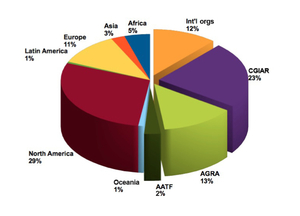
Click to enlarge – Graph 1: the Gates Foundation’s $3 billion pie (agriculture grants, by region).
Graph 1 and Table 1 give the overall picture. Roughly half of the foundation’s grants for agriculture went to four big groupings: the CGIAR’s global agriculture research network, international organisations (World Bank, UN agencies, etc.), AGRA (set up by Gates itself) and the African Agricultural Technology Foundation (AATF). The other half ended up with hundreds of different research, development and policy organisations across the world. Of this last group, over 80% of the grants were given to organisations in the US and Europe, 10% went to groups in Africa, and the remainder elsewhere. Table 2 lists the top 10 countries where Gates grantees are located and the amounts they received, highlighting some of the main grantees. By far the main recipient country is Gates’s own home country, the US, followed by the UK, Germany and the Netherlands.
When it comes to agricultural grants by the foundation to universities and national research centres across the world, 79% went to grantees in the US and Europe, and a meagre 12% to recipients in Africa.
The North-South divide is most shocking, however, when we look at the NGOs that the Gates Foundation supports. One would assume that a significant portion of the frontline work that the foundation funds in Africa would be carried out by organisations based there. But of the $669 million that the Gates Foundation has granted to non-governmental organisations for agricultural work, over three quarters has gone to organisations based in the US. Africa-based NGOs get a meagre 4% of the overall agriculture-related grants to NGOs.
2. The Gates Foundation gives to scientists, not farmers
As can be seen in Graph 2, the single biggest recipient of grants from the Gates Foundation is the CGIAR, a consortium of 15 international agricultural research centres. In the 1960s and 70s, these centres were responsible for the development and spread of a controversial Green Revolution model of agriculture in parts of Asia and Latin America which focused on the mass distribution of a few varieties of seeds that could produce high yields – with the generous application of chemical fertilisers and pesticides. Efforts to implement the same model in Africa failed and, globally, the CGIAR lost relevance as corporations like Syngenta and Monsanto took control over seed markets. Money from the Gates Foundation is providing CGIAR and its Green Revolution model a new lease on life, this time in direct partnership with seed and pesticide companies.5
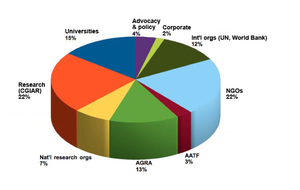
Click to enlarge – Graph 2: the Gates Foundation’s $3 billion pie (agriculture grants, by type of organisation).
The CGIAR centres have received over $720 million from Gates since 2003. During the same period, another $678 million went to universities and national research centres across the world – over three-quarters of them in the US and Europe – for research and development of specific technologies, such as crop varieties and breeding techniques.
The Gates Foundation’s support for AGRA and the AATF is tightly linked to this research agenda. These organisations seek, in different ways, to facilitate research by the CGIAR and other research programmes supported by the Gates Foundation and to ensure that the technologies that come out of the labs get into farmers’ fields. AGRA trains farmers on how to use the technologies, and even organises them into groups to better access the technologies, but it does not support farmers in building up their own seed systems or in doing their own research.6
We could find no evidence of any support from the Gates Foundation for programmes of research or technology development carried out by farmers or based on farmers’ knowledge, despite the multitude of such initiatives that exist across the continent. (African farmers, after all, do continue to supply an estimated 90% of the seed used on the continent!) The foundation has consistently chosen to put its money into top down structures of knowledge generation and flow, where farmers’ are mere recipients of the technologies developed in labs and sold to them by companies.
3. The Gates Foundation buys political influence
Does the Gates Foundation use its money to tell African governments what to do? Not directly. The Gates Foundation set up the Alliance for a Green Revolution in Africa in 2006 and has supported it with $414 million since then. It holds two seats on the Alliance’s board and describes it as the “African face and voice for our work”.7
AGRA, like the Gates Foundation, provides grants to research programmes. It also funds initiatives and agribusiness companies operating in Africa to develop private markets for seeds and fertilisers through support to “agro-dealers” (see box on Malawi). An important component of its work, however, is shaping policy.
AGRA intervenes directly in the formulation and revision of agricultural policies and regulations in Africa on such issues as land and seeds. It does so through national “policy action nodes” of experts, selected by AGRA, that work to advance particular policy changes. For example, in Ghana, AGRA’s Seed Policy Action Node drafted revisions to the country’s national seed policy and submitted it to the government. The Ghana Food Sovereignty Network has been fiercely battling such policies since the government put them forward. In Mozambique, AGRA’s Seed Policy Action Node drafted plant variety protection regulations in 2013, and in Tanzania it reviewed national seed policies and presented a study on the demand for certified seeds. Also in Tanzania, its Land Policy Action Node is involved in revising the Village Land Act as well as “reviewing laws governing land titling at the district level and working closely with district officials to develop guidelines for formulation of by-laws.”8
The African Agricultural Technology Foundation (AATF) is another Gates Foundation supported organisation that straddles the technology and policy arenas. Since 2008, it has received $95 million from the Gates Foundation, which it used to to support the development and distribution of hybrid maize and rice varieties. But it also uses funds from the Gates Foundation to “positively change public perceptions” about GMOs and to lobby for regulatory changes that will increase the adoption of GM products in Africa.9
In a similar vein, the Gates Foundation provides Harvard University University with funds to promote discussion of biotechnology in Africa, Michigan University with a grant to set up a centre to help African policymakers decide on how best to use biotechnology, and Cornell University with funds to create a global “agricultural communications platform” so that people better understand science-based agricultural technologies, with AATF as a main partner.
Gates & AGRA in Malawi: organising the agro-dealers
One of AGRA’s core programmes in Africa is the establishment of “agro-dealer” networks: small, private stockists who sell chemicals and seeds to farmers. In Malawi, AGRA provided a $4.3 million grant for the Malawi Agro-dealer Strengthening Programme (MASP) to supply hybrid maize seeds and chemical pesticides, herbicides and fertilisers.
The main supplier to the agro-dealers in Malawi has been Monsanto, responsible for 67% of all inputs. A Monsanto country manager disclosed that all of Monsanto’s sales of seeds and herbicides in Malawi are made through AGRA’s agro-dealer network.
“Agro-dealers… act as vessels for promoting input suppliers’ products,” says one MASP project document. Another states: “supply companies have expressed their appreciation for field days because MASP trained agro-dealers are helping them promote their products in the very remotest areas of Malawi.” Training the agro-dealers on product knowledge is carried out by the corporate suppliers of the products themselves. In addition, these agro-dealers are increasingly the source of farming advice to small farmers, and an alternative to the government’s agricultural extension service.
A project evaluation report states that 44% of the agro-dealers in the programme were providing extension services. According to the World Bank: “The agro-dealers have… become the most important extension nodes for the rural poor… A new form of private sector driven extension system is emerging in these countries.” The agro-dealer project in Malawi has been implemented by CNFA, a US-based organisation funded by the Gates Foundation, USAID and DFID, and its local affiliate the Rural Market Development Trust (RUMARK), whose trustees include four seed and chemical suppliers: Monsanto, SeedCo, Farmers World and Farmers Association.
Listening to farmers?
“Listening to farmers and addressing their specific needs” is the first guiding principle of the Gates Foundation’s work on agriculture.10 But it is hard to listen to someone when you cannot hear them. Small farmers in Africa do not participate in the spaces where the agendas are set for the agricultural research institutions, NGOs or initiatives, like AGRA, that the Gates Foundation supports. These spaces are dominated by foundation reps, high-level politicians, business executives, and scientists.
Listening to someone, if it has any real significance, should also include the intent to learn. But nowhere in the programmes funded by the Gates Foundation is there any indication that it believes that Africa’s small farmers have anything to teach, that they have anything to contribute to research, development and policy agendas. The continent’s farmers are always cast as the recipients, the consumers of knowledge and technology from others. In practice, the foundation’s first guiding principle appears to be a marketing exercise to sell its technologies to farmers. In that, it looks, not surprisingly, a lot like Microsoft. … Full article with tables and notes
November 3, 2014
Posted by aletho |
Deception, Economics, Environmentalism, Ethnic Cleansing, Racism, Zionism | Africa, United States |
Leave a comment
Argentine authorities this Sunday accused Procter & Gamble of tax fraud and suspended its operations in the country.
The government of the South American country suspended domestic operations for the transnational company Procter & Gamble for fiscal fraud and capital flight in import operations from Brazil for US$138 million that were being billed through a Swiss subsidiary.
The Argentina Tax Bureau (AFIP) stated that the alleged operations allowed for currency to leave the country and to reduce its tax payments.
“Our main goal is for P&G to return the dollars taken out of the country to the central bank and to pay customs penalties and the income tax that was evaded by manipulating transfer prices,” Ricardo Echegaray, the chief tax collector said in the statement.
Procter & Gamble has been conducting business in Argentina since 1991 and currently manages three manufacturing plants and two distribution centers.
Meanwhile, Argentine President Cristina Fernandez has been enhancing efforts to fight against tax evasion and capital flight to boost tax collections.
Last week, Argentina was among 51 countries to sign an agreement to automatically share tax information as part of an OECD and G20 initiative to tackle tax evasion.
Argentina made up the group of 48 nations who pledged to launch their first information exchanges by September 2017, with the three remaining countries on the list expected to follow in 2018.
November 3, 2014
Posted by aletho |
Deception, Economics | Argentina, Latin America |
Leave a comment
Police have attacked thousands of demonstrators protesting against government spending cuts in the Canadian province of Quebec.
The anti-austerity protesters gathered outside the office of Quebec’s Premier Philippe Couillard in Montreal on Friday to condemn the local government’s plan to cut $3 billion from the province’s budget.
The Canadian police used force to disperse the anti-austerity protesters, saying the demonstration, which was dubbed “Austerity: A Horror story”, was unauthorized.
The demonstration, which started at 11 a.m. and ended at around 3 p.m. local time, was organized by a coalition of student unions, including Quebec House of Labour (Centrale des syndicats du Quebec), independent teachers’ federation, as well as Quebec Solidaire, a provincial political party.
“On the one hand, they’re very clear in their intention to cut. On the other hand they’re very clear in their intention not to get any money from people who actually have money,” said Joel Pedneault, a spokesperson for the coalition.
Pedneault further stated, “The orientation behind that is they just want to cut social spending. It’s an orientation against social spending and against our social programs which we fought so hard for in Quebec.”
Several demonstrators were arrested in the crackdown. The demonstration also caused heavy traffic in the area.
November 1, 2014
Posted by aletho |
Civil Liberties, Economics, Solidarity and Activism | Canada, Human rights |
Leave a comment
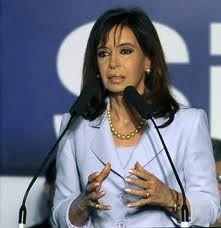 Argentina’s President Cristina Kirchner has warned the United States against the serious consequences of what she called US officials’ slandering Buenos Aires over its debts.
In a harsh five-page letter on Friday, the Argentina president criticized US President Barack Obama’s choice of hire for a high-level advisory position in his administration.
“Could this be a case of namesakes?” Fernandez asks her American counterpart, referring to Nancy Soderberg, a politician who Obama appointed as head of a board at the Public Interest Declassification Board (PIDB), while also holding co-chair position at the American Task Force Argentina (ATFA), the most prominent well-funded lobby group in opposition to Argentina’s debt refinancing efforts.
According to the letter, the ATFA, which has spent millions of dollars lobbying against Argentina, is “an entity specifically created to attack and slander the Argentine Republic and its President.”
The Argentina president said it is a conflict of interest for Soderberg to give sound advice to the president and other US officials because Soderberg’s organization has received payments from one of the vulture funds.
“If confirmed by you, [this] would have grave implications for relations between our two countries,” Kirchner wrote in her letter.
“As you are certainly aware, the functions of the PIDB encompass sensitive issues of national security and include giving advice to the president and to other US executive branch officials,” she added.
Argentina is currently contesting its disputed debts in US courts.
November 1, 2014
Posted by aletho |
Economics | Argentina, Latin America, Obama, United States |
Leave a comment
Karen Spring of the Honduran Solidarity Network writes that in a recent meeting
… Juan Orlando Hernández (President of Honduras), Daniel Ortega (President of Nicaragua), and Salvador Sánchez Cerén (President of El Salvador) defined their nation’s [sic] interests in projects that would develop the [shared area of the Gulf of Fonseca] and came to an agreement on investments in the following sectors: Infrastructure, tourism, agroindustry, and renewable energy.
The meeting declaration mentions, among other projects
… the “implementation of a Employment and Economic Development Zone (ZEDE) [known as a Model City] that includes a logistics park.” The idea is to convert the Gulf into a “Free Trade and Sustainable Development Zone.”
Radio Progreso has noted that the Honduran government is courting investment for the projects from “the European Union [and] the Inter-American Development Bank and is seeking investors in Panama and the United States.”
The ZEDEs, or “model cities,” are areas in which large portions of the Honduran constitution will not apply, including various sections that apply to fundamental and internationally-recognized human rights.
A National Lawyers Guild (NLG) delegation recently traveled to Honduras to investigate the legal implications of the proposed ZEDEs. In a report released in September, the NLG described how few articles of the constitution residents of the ZEDEs would actually enjoy:
Chapter I, Article 1 of the ZEDE law states that Articles 10, 11, 12, 13, 15, and 19 of the Constitution are fully applicable. These provisions define the territorial limits of Honduras, obligate Honduras to international treaties and forbid the ratification of treaties that damage Honduras’ territorial integrity or sovereignty. The remaining sections of the Honduran Constitution, a document of 379 articles, will have only the effect that they are given by an agreement between the Committee for the Adoption of Best Practices (CABP), the independent governing board of the ZEDEs and the corporate promoters seeking to develop the land. [Emphasis added.]
Many fundamental rights of Honduran citizens who live within the borders of ZEDEs are not protected under the new ZEDE law. These rights include: the right to Habeas Corpus or Amparo 20 , Article 183; the inviolability of a right to life, 65; guarantees of human dignity and bodily integrity, 68; the guarantee against the extraction of forced labor, 69; freedom of expression, 72; protections for a free press, 73; freedom of religion, 77; guarantees of assembly and association, 78, 79, and 80; freedom of movement, 81; the right to a defense, to court access, and to counsel for indigents, 82 and 83; and freedom from non-legal detainment, 84 and 85.
Who is this CABP who will govern the ZEDEs and determine which basic human rights will be granted to their residents?
The 21-member CABP, which was announced in February 2014, includes nine US citizens, three Europeans and only four Hondurans. The CABP is dominated by neoliberal and libertarian activists, several with close connections to former President Ronald Reagan [including Grover Norquist and Mark Klugmann].
Ironically, the ZEDEs are being promoted by some libertarian intellectuals and “activists” as perhaps “the freest cities in the world” despite the fact that the zones will shred another fundamental right, and one usually considered sacred to libertarians: property rights. The NLG explains:
A further particularly troubling aspect of the ZEDE law relates to the provisions that allow for the placement of ZEDEs in areas of “low population density,” and in municipalities in the departments adjoining the Gulf of Fonseca and the Caribbean Sea, without prior consultation with the affected communities.
As an example, the report cites the historic Garifuna community of Rio Negro at Trujillo in Colón, which was disrupted by shady land deals ahead of foreign investment. “ZEDEs have created an increased the fear of such incidents in the future,” the NLG states.
Further down, the report elaborates that “ZEDEs do not present Hondurans with authentic choice because they can be imposed on unwilling communities without any referendum,” and that “If the Honduran National Statistics Institute declares the area to have a lower than average population density for a rural area, Congress may impose a ZEDE on any existing communities in that area without even the basic protection of a referendum.”
The NLG notes that “These provisions … violate international law.”
As both the NLG report and Radio Progreso describe, communities in Zacate Grande and Amapala are among those threatened with losing property to ZEDEs that might be “imposed” on them. As attorney Lauren Carasik, one of the authors of the NLG report, wrote in Foreign Affairs in August, “If Zacate Grande is subsumed into the first ZEDE, the island’s 5,000 inhabitants will lose the right to help determine what happens to its land or its resources.”
This is why, as Spring reported,
Last week on October 23, communities and individuals from all over Southern Honduras (El Transito, Nacaome, Amapala, Zacate Grande, Tegucigalpa, etc) crossed the beautiful Gulf of Fonseca – from Coyolito to Amapala – to participate in a march against the ZEDE project proposed for the area. While some participants handed out copies of the ZEDE law, over 500 people marched from the Amapala dock to the municipality office.
Amapala and neighboring communities are being sidelined from the decision-making process that could lead to ZEDEs in their region of Southern Honduras. Radio Progreso reports that while the Korea International Cooperation Agency is funding a feasibility study for the Gulf of Fonseca region, the study has not been presented to the mayors of the relevant municipalities, Alianza, Nacaome and Amapala en Valle. Residents of the areas being considered for ZEDEs are being told very little. NLG investigators explain that
Virtually everyone in the Gulf of Fonseca region who spoke with the delegation voiced concerns about the government’s unwillingness to explain the effects that ZEDEs will have on existing communities within their borders.
…despite the ZEDEs’ potential to nullify existing labor contracts and labor laws in their territory, members of the union of workers at the port that operates in the Gulf of Fonseca have been told nothing. They fear that the arrival of a ZEDE will spell the end of their jobs when a proposed port at Amapala replaces their livelihood.
The Gulf is just one of 14 “potential zones” the Honduran government is considering.
As Radio Progreso notes, the Liberty and Refundation (LIBRE) party is hoping to see the repeal of the constitutional amendment and the organic law facilitating establishment of the ZEDEs. Instead, LIBRE is proposing forms of investment that don’t involve “the surrender of national sovereignty and territory.”
November 1, 2014
Posted by aletho |
Civil Liberties, Economics | European Union, Honduras, Human rights, Latin America, United States |
Leave a comment
The ruling dogma of our political economy is corporatism. Corporatism claims to draw legitimacy from the free market theory that all vendors who do not meet market demands will go under. Corporatism uses this illusion to exert power over all aspects of our political economy.
Free markets, corporatists believe, are the best mechanism to allocate resources for the exchange of goods and services. They believe markets free of regulation, taxation or competition from government enterprises produce the best results. Their favorite metaphor is Adam Smith’s “invisible hand” that produces the greatest good for the greatest number of people by the exertions of many willing sellers and many willing buyers (Adam Smith, they neglected to add, favored public works, public education and social safety nets like decent wages and public welfare as needed.)
Many things intrude on free market theories including military expenditures, wars, taxation, public infrastructure, health and safety regulation and governments’ emergency duties. What financier George Soros has called “market fundamentalism,” is opposed to any interference with free markets. Yet, corporatism makes massive exceptions that rig markets and tilt the seller-buyer balance heavily in favor of the former who become bigger and bigger global corporations.
Market critics call this hypocrisy. Corporations push for larger military budgets, which have concentrated power in ever fewer military contractors. What are less recognized and more part of the culture of acceptance are the other interferences with free markets, which corporate power has entrenched so deeply that they are rarely part of any political or election-time debate.
Let this point be made in the form of questions rarely asked and therefore rarely answered.
Can there be a free market without freedom of contract? Corporatism has stripped consumers of freedom of contract with fine-print standard-form contracts that become more dictatorial every decade. They now often take away consumers rights to go to court for their grievances via compulsory arbitration clauses. They stipulate that the vendors can change the contract anyway they want – called unilateral modification – which takes away the last vestiges of consumer bargaining power. An example is the unilateral changes in what you have to pay in penalties, late fees or any hundreds of fees hidden in the fine print. And you can’t shop around because companies don’t compete over the fine print. (See faircontracts.org.)
Can there be a free market if workers cannot join together to bargain with large employers whose investors have expanding freedom to form companies, holding companies, subsidiaries, joint ventures and partnerships to advance their bargaining power? Moreover, in comparison with the freedom of investors, workers are besieged with union-busting intimidations, lockouts and a system of corporate-driven labor laws that present far more obstacles to go through than is the case with the labor laws of other Western nations.
Can there be a free market without strong and comprehensive anti-monopoly, anti-cartel and other laws against the myriad of anti-competitive practices that Adam Smith alluded to back in 1776 when he warned of the motives when businessmen gather together?
Today, the antitrust laws are weak, dated and little enforced with puny budgets.
For example, thousands of joint ventures between direct competitors are being formed without concern of the moribund antitrust police. There is globalization of businesses without globalization of law enforcement. Big companies can leverage the differences between nations in a race to the bottom to unfairly gain market power against buyers, workers and small businesses.
Can there be a free market without a free market of retaining lawyers to pursue wrongful injuries and fraud by both direct negotiation with the perpetrators or resorting to open, public courts? In our country, such private disputes are not socialized by government. They are given over to a market system of legal and other supplementary services. Yet corporatism strives strongly to block or limit, through captive legislators, access to the courts or tie the hands of judges and juries, the only people who see, hear and evaluate the evidence in each case.
Can there be a free market when corporatists produce crony capitalism or torrents of corporate welfare tax escapes, subsidies, handouts and bailouts that rig markets against other smaller businesses that are playing by the rules of the market?
Can there be a free market when corporate-managed trade agreements, such as NAFTA and the World Trade Organization (WTO), subordinate civic efforts to secure better labor, environmental and consumer treatments to the supremacy of commercial trade? (Seehttp://www.citizen.org/trade/.)
Finally, can there be a free market when the banks fund and control the powerful, secretive Federal Reserve that tightly regulates interest rates and can buy trillions of dollars in bonds (aka quantitative easing – QE) to juice the stock markets and the banks, while tens of millions of savers receive less than half of one percent in interest on their savings? Libertarians, to their credit, have noted this abuse by this corporate government more clearly than have many liberals.
There are other corporate controls against the free market, such as politically extending already lengthy patent monopolies to ward off competition by, for instance, generic drug producers.
Suffice it to say that the American people have enough evidence to abandon the ideological hypocrisy that corporatism uses to control them.
Corporatism, in reality, is the corporate state – a tyranny, greased by big money in elections – never envisioned by the framers of our Constitution when they started its preamble with “We the People.”
Wake up call, anyone? (See citizen.org for more information.)
November 1, 2014
Posted by aletho |
Civil Liberties, Corruption, Economics | Human rights, United States |
Leave a comment