Tide Begins to Turn against FIFA in Rio de Janeiro
By Brian Mier | CEPR Americas Blog | August 15, 2013
After two months of protests that started over price gouging in public transportation and spread to a variety of issues spanning the political spectrum, positive results are beginning to be seen in Rio de Janeiro, where governor Sérgio Cabral, once touted in the New York Times as a possible 2014 presidential candidate is now so unpopular that socialist former mayoral candidate Marcelo Freixo said that he doesn’t think he could even get elected as a condominium residents association secretary.
During the last week a series of measures was announced that seem to show a turning of the tide against the hegemony wielded by the Fédération Internationale de Football Association (FIFA) and the Rio de Janeiro state and municipal governments over local residents.
First, after spending over $500 million rehabbing the structurally sound Maracana stadium – its third multi-million rehab in a dozen years – the plan to privatize and sell it off to a group of cronies for a fraction of that value has been stalled. The landmark status for the neighboring high school and Indigenous museum buildings has been upheld by the court system, so they can no longer be destroyed to create a parking garage. Furthermore, the federal government has blocked destruction of the public swimming pool and athletic track that made up part of the stadium compound. According to the privatization agreement, these are deal killers. The original plan was to surround the stadium with parking garages and luxury shops for the white, middle-class patrons who would now be the only ones able to easily afford ticket prices. The consortium that was poised to take over management of the stadium announced that it was going to back out, then changed its mind but still hasn’t closed a deal. It appears that the new, expensive ticket prices are keeping fans away and this might prove to be a deciding factor in blocking privatization.
Meanwhile, last Friday, the mayor’s office announced that after years of protests and construction of an alternative participatory development plan by local residents together with social movements and the Universidade Federal de Rio de Janeiro planning department, it will no longer raze the neighborhood of Vila Autódromo, which was originally marked for destruction in order to “beautify” the neighborhood for the upcoming “mega-events.” Since 2008, the mayor’s office has evicted tens of thousands of people, but it is hoped that this too will mark a turning point against a government that, until its popularity plummeted last month, felt like it could do whatever it wanted.
The much hailed program for setting up police stations in favelas that were previously controlled by drug trafficking organizations and paramilitary militias, called UPP, is also coming under fire. Drug trafficking gangs continue to operate within the pacified favelas, albeit without carrying machine guns around on the street, and a recent study shows that disappearances of residents has increased by over 50 percent in favelas after the UPP Units have been put in place. The disappearance of a construction worker and father of four, last seen being forced into a UPP Police car in front of his house in Rocinha, has turned into a national issue, as people are holding up signs all over the country during protests asking, “Where is Amarildo?”
Across the nation, people are rising up against the planned “state of exception” that FIFA demands take place for two months before and after the World Cup in 2014, coded into Brazilian law as part of the “General Law of the World Cup” of June 5, 2012. This “state of exception” will enable the government to bypass public bidding laws, provide tax abatement on all official FIFA-sponsored products and hire private foreign security forces to replace the local police protecting players and FIFA officials. In accordance with the Brazilian constitution of 1989, a “state of exception” can only be called in cases of war or natural disasters, making the FIFA law technically illegal. But popular and legal challenges to the Brazilian general “Law of the Cup” are mounting. During the World Cup in South Africa FIFA was able to leave the country with $2.4 billion in profits, while South Africans were left footing the maintenance bill for “white elephant” stadiums in towns with no major sports teams. It will be interesting to see how much FIFA is able to get away with this time around, especially since 2014 is an election year in Brazil.
Brian Mier is a geographer and freelance journalist who lives in Brazil and works as a policy analyst at the Centro de Direitos Econômicos e Sociais. He has a podcast, focused on news reported in the Brazilian alternative media, at http://progressivebrazil.tumblr.com/
Related article
Honduran Union Leader Faces Death Threats
By Eric Gottwald | Labor is Not a Commodity | August 15, 2013
Long-time Honduran union leader José María Martínez of FESTAGRO is facing serious and repeated death threats for speaking out for banana workers’ rights.
For the past 20 years, Martínez has hosted a daily radio show called “Trade Unionist on Air” where he shares labor rights, human rights, and citizenship information with Honduras’ agricultural workers and answers questions for callers concerned about rights violations. Since September of 2012, Martínez has been working closely with workers at the Tres Hermanas banana plantations, suppliers for Chiquita Bananas, who have been struggling to win a collective bargaining agreement in the face of harsh employer repression. Since May, the struggle of the Tres Hermanas workers has been a frequent topic on Martínez’s radio program.
On June 25, 2013, unidentified callers used an untraceable number to call Martínez, demanding he “stop talking sh*t on the radio or [they] will shut his mouth for him,” and to “prepare your burial clothes because we are going to kill you.” They repeated those threats the following day. The perpetrators also made repeated calls to his wife reiterating the death threats and citing the specific clothing Martinez wore each day as proof they were following him.
On July 5th, those threats escalated as an unmarked vehicle staked out Radio Progreso, home to “Trade Unionist on Air.” The vehicle circled Martínez’s place of work four times at the hour Martínez was getting off air. Martínez was forced to escape through a back exit, escorted by Father Ismael Moreno, the Catholic priest who serves as the director for Radio Progreso.
The local police force has warned Martínez to not leave his home without first notifying them for his own protection. Since the 2009 coup, 31 trade unionists, 52 rural workers, and 28 journalists have been murdered in Honduras.
FESTAGRO has asked for supporters to write to the US and Honduran governments to demand protection for José María Martínez and an investigation into these threats:
-
Honduras Attorney General’s Office: denuncias@mp.hn
- US Department of State, Ben Gedan, Honduras Desk: gedanbn@state.gov
You can also write to Chiquita Bananas (who buys from Tres Hermanas) and Jose Lorenzo Obregon, owner of the Tres Hermanas Plantation, to ask that they speak out against these threats and use their influence to end Tres Hermanas’ ongoing refusal to bargain with SITRAINBA, workers’ legally recognized bargaining representative.
-
Jose Lorenzo Obregon, Owner of the Tres Hermanas Plantation: jolobregon@gmail.com
- Chiquita Banana, Manuel Rodriguez, Vice President for Labor Relations: mrodriguez@Chiquita.com
Eric Gottwald is Senior Policy Analyst at the International Labor Rights Forum.
Related articles
- Guatemala urged to investigate trade unionist murders (theguardian.com)
- TUC protests to Colombia over threats (morningstaronline.co.uk)
- What it means to be a union member in Colombia and Chicago (alethonews.wordpress.com)
- Speak without fear in Honduras (unesco.org)
Brazil: Senate Approves Law to Fund Public Services with Oil Revenue
By Kahina Boudarène | The Argentina Independent | August 15, 2013
The law to fund public services with oil revenue, headed by Brazil president Dilma Rousseff, was ratified yesterday by the Senate, two weeks after its approval by the lower house.
“We listened to the streets voices,” declared Renan Calheiros, leader of the Senate, referring to the massive social movements that started several weeks ago all around the country.
The senate has approved the move to use 75% of crude oil revenue to finance education and the other 25% to bankroll the health sector.
The law affects all oil contracts that fall within the “declaration of commerciality”, which was signed on 3rd December 2012.
At first, Rousseff wanted to direct 100% of the revenue to education. The measure was part of a pact announced last June to establish “ways to fight effectively against corruption”.
The pact contains four key points: a national mobility plan privileging public transports; 100% of the oil revenue to education sector; bringing thousands of foreign doctors to the country; and meeting with leaders from peaceful demonstrations, youth organisations, trade unions, workers movements and popular organisations.
Fallouts of Iran Sanctions
By Ali Fathollah-Nejad | World Policy Blog | July 31, 2013
Iran’s President-elect Hassan Rohani has promised to ease the tensions surrounding the international relations of his country. In line with the will of the majority of Iranians, the issue of economic sanctions – weighing heavily on the latter’s day-to-day life – will be a key to that end.
In general, the purpose of sanctions is to force a political opponent to do what she would not do otherwise. In the case of the sanctions imposed on Iran – during the course of what is commonly but simplistically referred to as the “nuclear crisis” – the stated goal has been to force a reversal of Tehran’s nuclear calculus toward slowing down or even halting its nuclear program. This goal has clearly not been met. Instead this period has witnessed ever more crippling sanctions – a form of “structural violence” exerted upon an entire country and its people.
Economic sanctions are one of the most preferred instruments of Western foreign policy. The immediate Western reaction to the Syrian crisis is the most recent evidence of this. In the Iranian case, sanctions have been an integral part of the transatlantic strategy pursued against Tehran, code-named “coercive diplomacy” in Diplomatic Studies. There, sanctions are usually presented as a quasi-peaceful means and as such inherently part of a purely diplomatic approach geared towards avoiding a military confrontation. However, as the Iraqi case demonstrates, sanctions are the last step before military action. In other words, “smart sanctions” are likely to be succeeded by “smart bombs.”
Apart from this worst-case scenario, sanctions have not proven to facilitate the resolution of conflicts; on the contrary, they rather tend to harden the opposing fronts. Frequently, opposing sides view sanctions through fundamentally different prisms. In this case, while the West conceives of sanctions in a cost–benefit framework – the heavier the costs imposed on the targeted country by way of sanctions, the more willing the sanctioned state will be to offer concessions. Iran on its part sees them as a means of illegitimate pressure against which she ought to resist. This explains why in the last couple of years the escalation of sanctions was accompanied by that of the nuclear program. For example, in 2006 – before the Iran sanctions were elevated to an undoubtedly crippling dimension by the United States and the European Union – Iran had a thousand centrifuges; the number today is much more than tenfold. This reality of the nuclear dynamics in the wake of sanctions remains largely ignored in Western capitals.
Moreover, it should be stressed that policymakers in the West have so far devoted much more time and energy to identifying which new set of sanctions to impose rather than to committedly and creatively finding a diplomatic solution of the decade-old stalemate.
The popular rhetoric of sanctions incorrectly characterizes the nature of the socio-economic effects imposed on the target country. Contrary to what is commonly claimed, sanctions actually weaken the lower and middle classes, particularly affecting the most vulnerable in society – workers, women and the youth. As a result, the power gap between the state and society widens. All this, as a matter of fact, actually dampens the prospect of popular uprising. A person struggling for economic survival barely has the luxury of engaging as a citoyen in the struggle for democracy. This explains the firm renunciation of sanctions by Iran’s civil society – voices that the West has largely chosen to ignore.
In political-economic terms, sanctions have largely paralyzed Iran’s civilian economy while state and semi-state economic entities – especially those associated with the Revolutionary Guards – have been able to benefit inter alia by monopolizing imports of various goods via “black channels.” State resources have buoyed those companies that have access to them, leaving others to drown in the tide of rising costs. Sanctions have also prompted enormous growth in the volume of bilateral trade between Iran and China (still about $ 40 billion according to the Iran–China Chamber of Commerce and Industries which is closely related to the regime) – to the detriment of producers and jobs in Iran. The reality of sanctions is that they have cemented the politico-economic power configuration in Iran.
Sanctions produce far-reaching effects at the geopolitical and geo-economic levels. Corresponding with the implicit geopolitical rationale for sanctions – that if you cannot control or influence a country, you will resort to weakening it – these restrictions have indeed stunted Iran’s development trajectory. This inflicted damage has not, however, produced the ultimate goal of reversing Iran’s nuclear and regional policies and has in fact damaged Western interests by boosting the clout of countries like China, Russia, and other regional states.
In the wake of the U.S.-pressured withdrawal of the Europeans from the Iranian market, Iran was virtually handed over to China on a silver plate – something Beijing is indeed quite appreciative of. China’s economic presence in Iran can be witnessed all across the board: from the construction of the Tehran Metro to the exploration of Persian Gulf oil and gas fields.
Iran’s technocrats – a prime victim of the sanctions – observe this development with great concern. Among other things, they have seen that a healthy competition between different foreign competitors is sorely missing, and that the lack of high-tech (formerly delivered by the West) has reduced the quality of domestic production. All of this has a negative impact (mid- and long-term) on Iran’s economic and technological development. If the situation remains unchanged, such damage can hardly be compensated. As another case in point, the sale of Iranian oil to large customers such as China or India has turned into barter – a de facto “junk for oil” program has emerged. In addition, during the past couple of years China has been given preferential rates by Iran for its oil imports.
Finally, some of Iran’s neighboring countries also benefit from the sanctions. Most significantly, due to the energy sanctions against Iran, Russia can safeguard its quasi-monopoly on Europe’s energy supply – a strategic interest held by Moscow which is unlikely to be reversed easily. To a much lesser degree but still noteworthy, Turkey – which has turned into the sole land trade corridor reaching Iran from the West – has seen its profits in its dealings with Iran risen sharply. Not surprisingly, its business press has been cheering the Iran sanctions as providing Ankara with a competitive trade advantage. Also off the radar, Qatar which in the Persian Gulf is sharing the world’s largest gas field with Iran, has been able to exploit South Pars much more rapidly than Iran given the latter’s lack of access to advanced technologies. This has resulted in a tremendous gap of revenues between the two countries of many several billion dollars.
Ultimately, the policy of sanctions is counter-productive on multiple levels, most sensitively on diplomatic and socio-economic grounds. The sanctions – whether called “crippling” or “targeted” – disproportionately affect the civilian population. “Smart sanctions” are very much an oxymoron as “smart bombs” which allegedly function in surgical precision. And like their military counterparts, “targeted sanctions” inflict extensive “collateral damage.”
Despite the political need to seriously reconsider sanctions as a tool for a judicious and solution-oriented foreign policy, there are many political and institutional barriers to overcome before the extremely dense web of Iran sanctions can be dissolved – which remains not only a huge political challenge but also a moral one. The first step in this direction will be the sober realization among policymakers that while sanctions do have effects, these are not the ones officially proclaimed or desired – neither in socio-economic terms nor in the sphere of Realpolitik when it comes to altering Tehran’s nuclear calculation. Leaving the sanctions against Iran in place advances the specter of an Iraqization of Iran – with all its adverse effects internally (destruction of society) as well as externally (war and destabilization of an already too fragile regional balance).
To pave the way for a new chapter in Iran’s relations with the West, Rohani has already proved his wisdom by his choice of foreign minister. Mohammad-Javad Zarif, Iran’s former ambassador to the UN, has already been labeled as “Tehran’s leading connoisseur of the U.S. political elite”. All this undoubtedly presents the most suited prerequisite towards the aim of alleviating the multi-level liability that sanctions constitute. But at the end, it is the responsibility of those who have imposed the sanctions to initiate the process of their removal. The ball is now in the West’s court. It would truly be the “height of irresponsibility” if one missed this opportunity offered by the Iranian people who have already paid dearly for an utterly miscalculated transatlantic “coercive diplomacy.”
*****
Ali Fathollah-Nejad is an Iranian-German political scientist educated at universities in France, Germany, the Netherlands, and the UK. His website is at fathollah-nejad.com.
Brazil says may go to UN over NSA espionage
Press TV – August 15, 2013
Brazil says it may go to the UN over a controversial US spying program on Brazilian citizens, rejecting Washington’s claims that the operation was purely aimed at fighting terrorism.
Addressing a congressional panel on Wednesday, Brazilian Communications Minister Paulo Bernardo said Brasilia was not satisfied with the explanations presented by US Secretary of State John Kerry during his Tuesday visit.
“Consequently, we will bring the case to international organizations, probably the United Nations,” he added.
Kerry’s visit was aimed at easing diplomatic tensions with the Latin American country.
Washington has defended the espionage program as a lawful measure aimed at countering terrorist attacks across the world.
However, Bernardo stressed that the operation also “involved industrial, trade and diplomatic espionage.”
Based on documents leaked by former US intelligence contractor Edward Snowden, Washington has tapped Brazilians’ telephone conversations and emails.
They also indicate that Washington maintains an intelligence base in Brasilia, part of a network of 16 such stations operated by the US National Security Agency (NSA) around the world to intercept foreign satellite transmissions.
Brazil may reject US fighter jet deal over NSA spying scandal
RT | August 13, 2013
Brazilian officials have expressed reluctance to purchasing dozens of military planes from the US after it was revealed that the NSA not only closely monitored Brazilian energy and military affairs, but also mined for commercial secrets.
The US had planned to sell Brazil – a country in the process of revitalizing its Air Force – 36 fighter jets in a deal worth more than US$4 billion. But when US Secretary of State John Kerry meets with Brazilian President Dilma Rousseff on Tuesday, the leaders will not discuss the deal, a source near to the situation told Reuters.
Kerry traveled to Colombia before making his way to Brazil in an attempt to repair relations with Latin American nations after NSA leaker Edward Snowden disclosed documents showing that the US spied on communications related to the military, political and terror issues, and energy policies.
“We cannot talk about the fighters now…You cannot give such a contract to a country that you do not trust,” the source said.
Chicago-based Boeing Co. is competing for the $4 billion contract against France’s Rafale and Sweden’s Gripen, although the longer Brazil goes without choosing, the more likely it is that other competitors will enter the fray.
Rousseff delayed a decision on the fighter jets because of budget woes and widespread demonstrations protesting austerity and government corruption.
“I don’t expect the president to decide on the fighter contract this year, and next year is an election year so it might have to wait until 2015,” a Brazilian government source said.
Brazil’s Foreign Minister, Antonio Patriota, informed United Nations Secretary General Ban Ki-Moon of the nation’s situation as recently as last week.
Tuesday’s visit will be Kerry’s first trip to Brazil as Secretary of State.
But it’s not just Brazil that was reportedly upset over the NSA revelations. Even Colombia – one of Washington’s closest allies in the region – was unhappy about the information revealed. In Bogota, Kerry aimed to play down the rift during a press conference.
“Frankly, we work on a huge number of issues and this was in fact a very small part of the overall conversation and one in which I’m confident I was able to explain precisely that this has received the support of all three branches of our government,” Kerry told reporters. “It has been completely conducted under our Constitution and the law…The president has taken great steps in the last few days…to reassure people of the US intentions here.”
US Vice President Joe Biden has visited Brazil and Colombia, and President Barack Obama recently made a three-day trip to Mexico and Puerto Rico. Both trips have been portrayed as evidence of US politicking below the equator.
During his visit to Brazil, Biden said that stronger trade ties should usher in a new era of relations between Washington and Brasília.
How long that goodwill will last remains to be seen, according Carl Meacham, former Latin America adviser on the Senate Foreign Relations Committee and director of the Americas Program at the Center for Strategic and International Studies.
“I think the tone of the visit will be a bit tense because of these issues raised by the surveillance [program] and I think Secretary Kerry will have to speak to that,” he told AP.
Related article
Greenwald Testifies to Brazilian Senate about NSA Espionage Targeting Brazil and Latin America
By Mabel Duran-Sanchez | CEPR Americas Blog | August 10, 2013
This past Tuesday, investigative journalist Glenn Greenwald testified before the Brazilian Senate’s Committee on Foreign Relations and National Defense (CRE) at a public hearing on the clandestine surveillance activities of the U.S. National Security Agency (NSA) in Brazil.
Greenwald, who has published many top-secret NSA documents leaked to him by whistleblower Edward Snowden, explained how the agency’s surveillance programs go far beyond gathering intelligence related to terrorism and other national security threats, as the U.S. government has suggested. According to Greenwald, NSA spying has focused on foreign business interests as a means for the U.S. government to gain a competitive advantage in negotiations. Greenwald mentioned that he has information regarding instances of NSA surveillance of the Organization of American States (OAS) and secret intelligence documents on economic agreements with Latin American nations. He explained that this type of surveillance has helped the U.S. to make the agreements appear more appealing to Latin American countries. Brazil’s concern about this economic espionage is particularly understandable given that it is the U.S.’s largest trading partner in South America.
During the hearing, Greenwald made reference to a 2009 letter wherein Thomas Shannon, the former Assistant Secretary of State for Western Hemisphere Affairs (from November 2005 – November 2009) and current U.S. Ambassador to Brazil, celebrated the NSA’s surveillance program in Latin America and how it has helped advance U.S. foreign policy goals in the region. Greenwald wrote a detailed account of his findings in an article entitled “Did Obama know what they were thinking?” in the Brazilian print magazine, Época. In this piece, Greenwald explains that Shannon’s letter, addressed to NSA Director Keith Alexander, discusses how the spy agency obtained hundreds of documents belonging to Latin American delegations detailing their “plans and intentions” during the summit. Shannon asserted that these documents were instrumental in helping the Obama administration engage with the delegations and deal with “controversial subjects like Cuba” and “difficult counterparts” like former President of Venezuela, Hugo Chávez, and Bolivian President, Evo Morales. In the same letter Shannon encouraged Alexander to continue providing similar intelligence as “the information from the NSA will continue to give us the advantage that our diplomacy needs,” especially ahead of an upcoming OAS General Assembly meeting in which he knew discussions on Cuba’s suspension from the OAS would ensue.
Greenwald went on to explain the functioning of the NSA’s XKeyscore program to the Brazilian senators, which he referred to as the most frightening of all the programs revealed thus far. He also discussed the first U.S. secret surveillance program revealed to the world, PRISM. In the next 10 days, Greenwald said, he will have further reports on U.S. surveillance and “[t]here will certainly be many more revelations on spying by the U.S. government and how they are invading the communications of Bra[z]il and Latin America.”
When asked by the current CRE President, Senator Ricardo Ferraço, what the international community should do if the U.S. continues its mass surveillance programs, Greenwald said that although many governments around the world have expressed indignation, it has been a “superficial indignation.” He called on foreign governments to put pressure on the U.S. by granting Snowden asylum, which would be most effective if many countries were to do so.
According to Reuters, Greenwald also told reporters that “[t]he Brazilian government is showing much more anger in public than it is showing in private discussions with the U.S. government,” but that “[a]ll governments are doing this, even in Europe.” Although some Brazilian senators have questioned President Rousseff’s upcoming trip to Washington, yesterday, Foreign Minister Antonio Patriota told reporters that “the trip is still on.” Nevertheless, Patriota added that the NSA revelations are “an issue that cannot be left out of the bilateral US-Brazil agenda,” and that he would raise the issue when John Kerry travels to Brasilia early next week.
Related articles
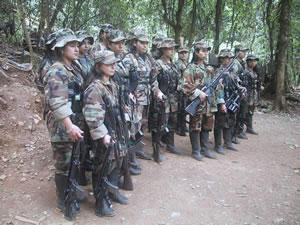
An Interview With the FARC-EP Peace Delegation
The Colombian Negotiations
By HERNANDO CALVO OSPINA | August 7, 2013
 Havana, Cuba.
Even in Havana they get up early. “We get up at 4:30 to wake up the roosters so that they can start singing,” grins Ricardo Tellez, better known as “Rodrigo Granda.”I have an appointment at 7am to interview three members of the Secretariat, the highest authority of the FARC. They are at the forefront of the dialogues between the insurgent organization with the delegation of the Colombian government in Havana. In a great hall of a house in “El Laguito” (1), where they live, “Ivan Marquez” and “Pablo Catatumbo” arrive, too. Granda lights a cigarette and drinks his second cup of coffee. Marquez has a big Cuban cigar in his hand, which he`ll start “after breakfast”. Catatumbo is sipping coffee and says to me: “If the three of us are going to say almost the same, why would you interview me?”
It is the first time a journalist has the opportunity to talk to these three guerrilla leaders together.
Hernando Calvo Ospina: Commanders, you have been talking for seven months, negotiating with the government’s commission in this peace process. Are you still optimistic?
Ivan Marquez: The optimism of the FARC is determined by our willpower to find a political solution to this confrontation, which has lasted for almost fifty years. Because they haven´t been able to defeat us militarily, nor have we, we must seek an alternative. In addition, the circumstances, today’s realities, both in Colombia and on the continent, indicate that it is time to find a pacific solution. Wars are not eternal. And that´s why we make any necessary effort to come to an understanding with the government.
HCO: How does it feel to be so close to your enemy?
IM: In spite of sitting at the same table two groups with very different views, almost antagonistic, we have to tolerate and understand each other. At a negotiating table one should respect the other party, and I think that respect should be mutual. There are moments of algid, strong discussions, but soon things turn back to normal because we know that we must come to an understanding.
HCO: Negotiations in war move between two opponents. It seems to me that you put more emotion on it.
IM: You’re right. The government has always had a tendency to seek the subjugation of the guerrillas as a synonym for peace, not peace through structural changes. The oligarchy wants peace for free. We are making great efforts for them to understand that you need to generate an atmosphere for peace, and that it can be achieved through institutional and political transformations. We are sure that the most important thing for Colombia is to ensure real democracy, where the sovereign people can determine strategic policies, where the opinion of the people is taken into account without being stigmatized and murdered.
HCO: Maybe I’m wrong, but I think that at various times President Juan Manuel Santos has wanted to pull back.
Rodrigo Granda: I don´t think he wants to withdraw, but he does seem afraid. It’s as if he were afraid of former President Alvaro Uribe, of the cattle-breeders, of narco-paramilitary power and the obscure sector within the Armed Forces. Santos recoils despite having the support of a significant sector of industrialists, bankers and churches. For example, according to reports we have, Sarmiento Angulo (2), one of the most powerful men in Colombia, supports the dialogue process. Surveys say that 87% of Colombians also want peace. The correlation of forces in favor of peace is indisputable. Uribe aside, nobody speaks about war anymore. But it seems that Santos does not want to face those sectors led by Uribe, he wants to fight us militarily, and assumes intransigent positions that do not allow a correct development of the dialogues. We know that Uribe has prepared 13,000 paramilitaries, known unofficially as the “anti-land restitution army.” Is it that the Armed Forces and Santos don´t know about that? Of course they do! Is that what Santos is afraid of? Or is he taking it as part of a possible move against us?
HCO: Clearly Uribe tries to torpedo the negotiations. Do you think he wants to return to presidency?
RG: And he wants that to protect himself, because he’s afraid of being sent to Miami for drug trafficking, or to the International Criminal Court in The Hague for crimes against humanity. It would be favorable for him if the negotiations failed, so that he can appear before the country as the solution. Although he wasn´t able to resolve the “problem” of the guerrillas during the eight years he was in office. Pablo Catatumbo: Anyway, Santos and Uribe have the same idea about the negotiations: a peace process by submission. They are blind, deaf and quite wrong, but think they’re smart. And that is where we must continue with wisdom to prove that they are wrong, and that like this, the war will continue.
HCO: In statements you´ve made and documents I’ve read, you are asking for reforms in state institutions and the modernization of the State itself, which may be contradictory for a Marxist-Leninist communist guerrilla.
IM: At the table we are not proposing radical changes to the political or economic structures of the state. Over there, we don´t mention socialism or communism. We try to create conditions to reach an understanding with the government. A place where two different views can meet. We know that some leftist organizations, not only in Colombia, say that we became a reformist guerrilla.
We have made minimum proposals, for example the hundred proposals about the agrarian system, which as you´ve already said, are nothing more than a modernization of the Colombian countryside, but fact is that we are still living in feudalism there. Imagine that even this way, the government puts obstacles.
HCO: What has ever signed between the parties?
RG: We have signed some things, but they are not final signatures because nothing is agreed until everything is agreed. There are points on which we haven´t agreed yet, and we let them out to discuss them later on. Otherwise there won´t be any progress.
HCO: Dialogues in Havana, and strong military confrontations in Colombia …
RG: The government doesn’t want a ceasefire, so both parties have to dialogue under fire. We are having heavy confrontations every day, to an average of three per day. We have done large-scale military actions, which they hide to the nation. Now, both parties have decided that what happens in Colombia is not going to affect the Table.
We have made some gestures of peace, as was the unilateral truce for Christmas, although we had to defend ourselves against the attacks of the army. And what has been hidden is also in that same time span multinationals could increase their profits, they did not have our pressure. That’s why one of the major reasons for ending the guerrillas is that the transnationals can steal whatever they want without any problem.
HCO: So far, what has been the main government’s intransigence in negotiations?
IM: Without any doubt, the determination not to touch the property of the big land-owners, most of which has been obtained through violent dispossession. They`re afraid of that. Their representatives, when they talk to us, have said that that could “unleash the demons of paramilitarism.” They are afraid of cattle-breeders and landowners, to touch one third of the 30 million acres they own, although not even the cows occupy them.
But land reform without touching the big property isn’t reform. There must be set limits for land property. The government has not even thought about putting taxes as a punishment for unproductive land tenure. When we proposed taxing these big properties, the government responded that there is no reliable census; that nobody knows where they are or what their extension is. They suggest that first there should be a census, which can take up to 7 or 10 years. What they don’t say is that during this time the landowners can lease or sell the land to multinationals, which is their strategy.
HCO: If the Colombian government decided to negotiate with the FARC, it was because Washington agreed. You know that that is not an exaggeration of mine. What is the current political attitude?
IM: Recently, 62 U.S. congressmen, including two Republicans, led by Jim McGovern, signed a letter of support for the talks. This letter was sent to Secretary of State John Kerry. We welcomed this altruistic gesture. The White House and the State Department have also expressed their support. Of course, there are always different interests because the Colombian conflict produces money. The powerful arms industry doesn´t want to let loose of that business.
HCO: You are determined to stop the armed struggle. What should the government offer you for this to be achieved? And you, what would you become?
RG: President Santos, during the initial interchanges with us, said he wanted to open the floodgates to a real democracy in the country. That struck us because we have never said that the armed struggle is the only way to change the country. We got up in arms, and we still carry them, because violence has closed the doors to political participation. If the possibility of doing politics legally becomes real, without the constant threat of assassination, in equal conditions and with political reforms that could lead the country towards participatory democracy, we are there. Because there could be created a favorable correlation of forces for the revolutionary movement, which routs the necessary radical changes. We accept that challenge.
PC: You need to build a strong mass movement to impose changes, because the establishment doesn’t give away anything for free. That is a task for us, leftists and Democrats. It is important to create a power block of people who want a new Colombia. That is the challenge, and it´s not a small one.
But you see, as we talk about it at the conversation Table, the repression continues all around the country. The government hasn’t changed anything regarding the treatment of social protest: they are stigmatized, associated with the guerrillas to criminalize them and attack them with bullets. And if there is something we have very clear is that we are not willing to repeat the experience of the Patriotic Union, during which nearly 4000 members and leaders (3) were killed.
History, if it’s not manipulated, doesn´t lie: they have been the violent ones. When we remind the governmental team of these facts, they tell us that they are not here to talk about that. Why? What do they feel ashamed or afraid about? Without knowing the history of political violence in Colombia, how are we to know why we got to the current situation and how to resolve it?
IM: There are three items on the agenda to be discussed: guarantees to exercise political activity, political participation and bilateral and definitive ceasefire. The latter discusses the surrender of weapons and under what conditions. But let it be understood: that´s not handing over weapons. We cannot talk about these points until they are discussed in the table, and they will be the last ones on the agenda.
HCO: What will happen with the paramilitaries?
IM: They must definitively be eliminated; if not, there would be no certainty for an insurgent organization to incorporate into legal politics. That’s an insurmountable condition to reach a peace agreement. And it is the government who has to give the order to his generals to stop the state’s counterinsurgency strategy.
HCO: Are you determined to apologize for the suffering you have caused in this war?
PC: We have made mistakes, some serious, indeed. But whatever official propaganda says, aggression to the population has never been a strategy of the FARC. On the contrary, we have defended them against the army and its paramilitaries, mainly on the countryside.
I have no problem in saying to a woman or a family: “I feel sorry about the pain we have caused with the death of your loved one.” But this is much more complex. Are we going to apologize? Very well. Let´s also invite the economic associations that financed the war and paramilitaries; let´s invite all State institutions, because they guarantee repression and impunity; let´s invite the mass media, too, because they reproduced the stigmatization made by security agencies, which have led to the murders and massacres; the rightist political parties should also sit down and assume their great responsibilities; the former presidents of the republic who gave the orders. Not even the Catholic Church can deny its responsibility! And the governments of the United States, Israel, some European countries and others that have supported various criminal governments of Colombia cannot be left outside of this ceremony. All together, we can decide who the terrorists and murderers of the people are.
HCO: You point out, and rightly so, that the government, its armed forces and the mass media are responsible for psychological warfare and propaganda against the insurgency. But I think an important sector of the so-called intelligentsia have savaged the armed struggle they supported before.
PC: Most intellectuals in Colombia, and probably in the world, are suffering from cowardice, accommodations or both things. Almost all were put by the system in the matrix of lies, and are used to “theorize”, create and repeat falsehoods. Many of them spend time writing discourses against media manipulation, but when the system starts a campaign against someone or somebody, they start talking like parrots.
In Colombia, the system told them that the guerrillas are guilty of everything. Although many of them believed, or believe, they are from the left, they repeated in unison that we are responsible for violence, drug trafficking, kidnapping, poverty, rising gasoline and even the high price of the bananas. I assure you that if tomorrow the birds stop singing, these “intellectuals” repeat what the government and their media say: the guerrillas are to be blamed. They have fallen into such poverty regarding research and argumentation, that their analyses and theories don’t endure any discussion, at least with us. They think that if they discuss with us, we´ll kill them afterwards. They are not even capable of realizing that if that was true, in Colombia there would be very few “intellectuals” left right now. Their brain doesn’t have the capacity to see that those who safeguard their intellectual and political independence are those who are said by the government to be friends or accomplices of the subversion.
HCO: I must admit, and I´m about to end, that I’m not very optimistic about these dialogues. I believe that Colombia and Colombians deserve peace with social justice, but I know the Colombian State, I know the United States, who support that State and who ultimately decides. Hopefully the long night, imposed by State terrorism stops and finally dawns. I wish it with all my heart.
PC: Look, political conditions in Latin America have changed. Who could have imagined what happened in Venezuela and Bolivia with the arrival of Chávez and Evo? Who would have thought that other Latin American governments one day would demand respect for their sovereignty from the U.S.? There are unpredictable things, like the end of the Soviet Union for example.
In Colombia there is an accumulation of hunger, exclusion, injustice and repression. The time will come when people simply won´t take it anymore. There is an accumulation of ongoing processes that can make a leap any time. There is a boiling that could explode tomorrow.
Besides, Colombia is not an island. The neighboring countries are pressing the government because they are tired of the conflict that affects them. Venezuela received about 4 million displaced Colombians, Ecuador almost two million. We believe there are 13 to 15 million Colombians in neighboring countries, that is, the third part of the Colombian population. And these countries must provide housing, food and health. For how long? Apart from the budget they spend to protect their borders. Just because the Colombian government insists on not negotiating a conflict they will never win! We have asked the representatives of those nations to demand for peace, so that all our compatriots can return to their country.
We are optimistic. Revolutionaries must be optimistic, even in the worst situations. And we believe that peace will come to Colombia because we deserve it. The other possibility is total war. That´s why I say the moment has come, but that doesn’t mean it´s easy. This peace process is too complex, but we believe it is possible. We insist on striving for peace, so we will not fold our arms.
I do have hope, although I think the authorities and the Colombian oligarchy lack greatness and humility to start solving this conflict.
Hernando Calvo Ospina is a Colombian journalist. He can be reached through his website.
NOTES:
1. “El Laguito” is a residential complex in Havana. Their houses are separated by trees and gardens. In the center is a small lake. Since November 2012, the delegations of the FARC and the Colombian government are located in this peaceful scenery.
2. According to the magazine Forbes (edition 2012). Luis Carlos Sarmiento Angulo listed as the first billionaire in Colombia, and would rank 64 in the world.
3. The Patriotic Union was born in 1985, as a result of the talks between the government of Belisario Betancur and the FARC. According to the Colombian justice, there was a “political genocide” against the Patriotic Union.
Translation: http://en.firatnews.com/news/news/g…
Banks Threaten to Punish Cities that Use Eminent Domain to Help Underwater Homeowners
By Ken Broder | AllGov | August 4, 2013
Roughly half the homeowners in the Bay Area city of Richmond are underwater on their mortgages, but city officials have come up with a plan to float them to safety, much to the consternation of banks and other moneyed interests.
The city is strongly considering using the power of eminent domain to seize the homes, which are worth less than the amount owed on the mortgage, and sell them back to the owners at fair market prices. Richmond, a poor city by most measurements, has not benefited much by the recent surge in housing prices and many of the homeowners owe three or four times as much as the home is worth, according to The New York Times.
It would be the first city in the nation to use eminent domain in this fashion. But they certainly aren’t the only city that would benefit immensely from the strategy. A lot of cities with low-income minority populations were sold a ton of predatory loans that shouldn’t have been offered, and the Times says at least two dozen are actively considering the move.
Banks—which make money by selling the homes to lenders in the secondary market, who then make money by foreclosing on the homes and reselling them—have promised to block the city with lawsuits. They promise an end to lending in the city if it persists in its plan.
On July 29, the city, according to Carolyn Said of the San Francisco Chronicle, “sent letters to 32 banks and other mortgage holders offering to buy 624 underwater mortgages at discounts to the homes’ current value. If the offers are spurned, the letter said Richmond may use the power of eminent domain to condemn the mortgages and seize them, paying court-determined fair market value.”
The current market value of the 624 homes is about $177 million, but the face value of their mortgages is $242 million. Richmond has given the loan holders until August 14 to sell the homes.
As explained by Shaila Dewan of The New York Times:
“In a hypothetical example, a home mortgaged for $400,000 is now worth $200,000. The city plans to buy the loan for $160,000, or about 80 percent of the value of the home, a discount that factors in the risk of default. Then, the city would write down the debt to $190,000 and allow the homeowner to refinance at the new amount, probably through a government program.”
The city and investors would take $30,000 and use it for expenses and a small profit, while the homeowner ends up with $10,000 in equity.
The banks and secondary lenders would lose a cash cow that relies on the suffering of homeowners. At stake are more than just the primary mortgages. There are $450 billion in second liens and equity loans on bank books that could be affected. The lenders have called the eminent domain tactic illegal and unconstitutional, and an array of heavy hitters, including the Securities Industry and Financial Markets Association, the American Bankers Association and the National Association of Realtors, have lined up in opposition.
Besides threatening court action, they are seeking legislation at the state and federal level to snuff out the nascent movement, and revving up advertising campaigns to argue their case.
However, as David Brodwin of U.S. News and World Report put it, “it’s hard to see why bailing out homeowners with a program of this sort is any less an affront to the principles of capitalism than bailing out banks that made bad investments in mortgage backed derivatives.”
To Learn More:
Richmond’s Pioneering Eminent-Domain Threat (by Carolyn Said, San Francisco Chronicle)
A City Invokes Seizure Laws to Save Homes (by Shaila Dewan, New York Times)
California City Seizes Homes to Save Them (by Ilyce Glink, CBS Money Watch)
One City’s Bold Plan to Prevent Foreclosures (by David Brodwin, U.S. News and World Report)
Will Medical Trade Be Included in the EU Trade Deal and the TPP? If Not, Why Not?
CEPR | August 4, 2013
The NYT has an article today on the enormous savings available to people who had major surgeries performed in Europe rather than the United States. The piece reports that the cost of hip replacement or knee replacement surgery in the United States are more than five times higher than they are in comparable quality facilities in Europe. (The gap would be even larger with facilities in Thailand and India.)
This shows the enormous potential gains from increased medical trade. In effect, our hospitals, doctors, and medical equipment makers benefit from tariffs on the order of 500 percent or more. If the Obama administration really is interesting in promoting growth through trade it would be difficult to imagine a sector with larger potential gains than trade in medical care. The agreements would focus on setting clear liability rules, accreditation systems, and removing obstacles for insurers and government programs that prevent them taking advantage of lower cost medical services in other countries.
If the trade deals do not include major openings on medical trade then it would be a clear example of why these deals are in fact about selective protectionism rather than free trade. Past trade deals have been quite explicitly focused on putting U.S. manufacturing workers in direct competition with the low paid manufacturing workers in developing countries.
Anyone who believes in free trade would want U.S. doctors and other professionals subjected to the same sort of competition. Otherwise, they really only want to use trade to lower the wages of less educated workers to benefit the the wealthy. (Low wages means cheap help.) It is dishonest to call that policy “free trade.”
Featured Video
Can the U.S. Afford to Annihilate Iran?
or go to
Aletho News Archives – Video-Images
From the Archives
Sanctions, War and the Policy of Dual Containment
By SASAN FAYAZMANESH | March 17, 2008
It is now nearly three decades since the Unites States adopted the policy of dual containment of Iran and Iraq. While much has been written about the containment of Iraq, there has been very little in-depth analysis of this policy when it comes to Iran. In a book that is going to be released on March 31, 2008, entitled The United States and Iran: Sanctions, Wars and the Policy of Dual Containment (Routledge), I attempt to address this shortcoming by investigating when and why the US policy of containment of Iran came about, how it evolved, and where it stands today.[1] To the extent that Israel has been involved in US policy making, the study will also include the role that Israel has played in the containment of Iran. Also, since the fate of Iran has been inextricably linked to that of Iraq, occasionally the investigation will overlap with the containment of Iraq.
The policy of dual containment of Iran and Iraq originated during the Carter Administration, but it was not until the Clinton Administration that the expression “dual containment” became popular. … continue
Blog Roll
 Aletho News
- Can the U.S. Afford to Annihilate Iran? /Seyed M. Marandi
- Elmo Sold mRNA Jabs to Your Toddler. Now They Are “Off-Label.”
- British state targets Palestine Action with yet another crooked trial
- Americans are paying the price to preserve Israel’s nuclear hegemony
- Resistance factions are necessary to ensure a permanent US Iraq withdrawal
- How Israel destabilizes the Middle East: Denying sovereignty and the right to exist
- Europe’s Establishment Is Embracing War – and Losing Voters
- NATO chief advocates war of aggression
- No Vote, No Representation, No State: Democracy, Israeli Style
- Zionist Bought Senate Blocks Information About American Citizens Killed By Israel
- If Americans Knew
- Israeli Soldiers Abduct At Least 22 Across Occupied West Bank
- Eight Palestinians Killed in Israeli Attacks on Gaza
- Israeli former leaders and security chiefs threaten legal action over ‘Jewish terrorism’
- Israel map in LA Times ad includes all land from the river to the sea
- Inside Lebanon’s 200-page dossier on Israeli war crimes
- Flydubai, genocide, settler violence, Trump abuse of power to deport – Daily Update
- Counting Antisemitic Incidents: What the ADL Audit Reveals — and Obscures
- Mamdani releases plan to combat antisemitism and hate crimes in New York City
- Iran’s Revolutionary Guards Publish Letter to the American People
- DMFI launches $1 million ad campaign supporting Virginia’s Elaine Luria
- No Tricks Zone
- Green Energy Debacle: German Expert Professor Fritz Vahrenholt Warns Of Severe Economic And Social Consequences
- Two More Paleo Reconstructions Affirm Meters-Higher Sea Levels Across Ireland, Brazil 7000-6000 Years Ago
- New Study: Earth And Venus Surface Warmth Largely Explained By Convection And Lapse Rate, Not CO2 Or Radiation
- 2025 Nature Paper Claiming Worsening Global Drought Gets RETRACTED …Heavily Flawed
- New Study: ‘Global Drought Shows No Detectable Recent Acceleration Under Climate Warming’
- Economic Masterminds: German Socialists Suggest Taxing Productivity Gains Stemming From Using AI
- The South China Sea Has Not Been Cooperating With The Climate Change Narrative
- Energy Crisis: Germany Enters Heating Season With Historically Low Gas Reserve Fill Levels
- New Study: The Antarctic Ice Sheet Gained Mass From 2020-2024 Due To Staggering Snow And Ice Accumulation
- Study: Ocean Heating Rates From Thousands Of Years Ago ‘Dwarf’ Modern Ocean Heating Rates

