Calls in Slovakia for referendum on lifting Russia sanctions
RT | December 17, 2024
Two Slovak political parties have organized a conference to promote calls for a referendum on lifting sanctions against Russia, and have collected more than 160,000 signatures for a petition.
The initiative was organized by the left-wing Party of Slovak Revival and the right-wing Homeland Party, which held an event in Bratislava on Monday, attended by former justice minister Stefan Harabin, as well as representatives of the NGO Free Zone and the Association of Slovak Intellectuals.
Speaking at the event, Harabin described relations with Russia as “an existential question,” adding that, without Moscow’s support, Slovakia “may not preserve our statehood.” He spoke out against what he called “provoking the Russians with sanctions,” adding that these restrictions violate the law.
He also pointed out that the sanctions were harming the national economy. “Almost a million Slovaks live below the poverty line or in poverty. At the same time, sanctions are introduced, and we import the same Russian gas, but at a price four times higher. And people have nothing to eat. What kind of representatives of the state are these?” he asked, referring to the Slovak government.
According to Pavol Slota, the leader of the Homeland Party, more than 160,000 people have signed a petition saying “Russia is not my enemy.” “Let’s stop the anti-Russian sanctions together, Slovaks FORWARD!!” he wrote on Facebook.
The petition calls for a referendum to be held, posing the question: “Do you agree that the Slovak Republic should not apply sanctions against the Russian Federation, which harm Slovak citizens, tradesmen and entrepreneurs?” At least 350,000 signatures are needed for a referendum to be held.
Slota described the petition as “a civic action,” while blasting mainstream media for what he claimed were attempts to downplay the idea. “I believe that there is still a sufficient number of sane people in Slovakia,” he said.
Under far-right Prime Minister Robert Fico, Slovakia has been critical of the Western approach to the Ukraine conflict, cutting off state military aid to Kiev. He has also repeatedly urged the EU to drop restrictions on Russia, insisting that the bloc must resume dialogue with Moscow once the conflict is over.
Scholz loses confidence vote in German parliament, worsening Berlin’s political crisis
By Lucas Leiroz | December 17, 2024
The political crisis in Germany is deepening. Chancellor Olaf Scholz lost a confidence vote in parliament on December 16, effectively dismantling his government. With the collapse of the coalition and the need for early elections, it seems clear that the irresponsible policies of support for Ukraine have been a “death sentence” for the Scholz government.
Scholz lost with a total of 394 votes against him, while only 207 parliamentarians voted in his favor. As a result, early elections will have to be called, and are expected to be scheduled for February 23. For now, Scholz remains in office, but will have to deal with the situation of a minority government. This means that the prime minister does not have the necessary majority of supporters to pass laws of his interest in parliament, in effect being a kind of “symbolic government”.
This situation was expected, considering that his political alliance had already collapsed recently. The pro-government coalition was dismantled after the chancellor fired then Finance Minister Christian Lindner due to disagreements on issues such as the military budget and support for Kiev. Along with Lindner, other ministers and officials who disagreed with Scholz were also dismissed or resigned, which was seen by the coalition as an attempt at a “purge” to eliminate partners who disagreed with the chancellor’s projects.
It is important to remember that Scholz publicly acknowledged the Ukrainian issue as responsible for the crisis in the coalition. Germany is going through a time of great economic and budgetary difficulties. The economic and energy crisis and the large public spending to reverse the “side effects” of the anti-Russian sanctions have harmed various sectors of German society. In parallel to all this, the pro-Scholz wing maintains a policy of support for Ukraine that further expands expenses, creating a worrying budget imbalance.
Having seen the devastating effects of supporting Ukraine on German domestic politics, Scholz desperately tried to reverse this situation by “softening” his Ukrainian policy. He refused to send long-range weapons to the Kiev regime, despite the international pressure to do so and the recent wave of “deep strikes” with direct NATO participation. In addition, he had a direct conversation with Russian President Vladimir Putin in a telephone call, which caused outrage among his Western and Ukrainian partners. More than that, Scholz promised to call Putin more often, arguing that it is vital that European politicians participate more actively in the diplomatic process.
Not even this “change” in stance was enough to improve the public image of the German prime minister, who continued to face strong opposition in parliament, in addition to growing unpopularity. The growth of the German political right, both with the conservative nationalists of the AfD and the “moderate” Christian Democrats of the CDU, shows that Scholz’s political image is already exhausted, with the people and parliament demanding changes that he has proven incapable of achieving.
The problem is that Scholz will remain in office until the next election, which raises concerns for all sides of German politics. Scholz is expected to run again, representing the Social Democratic Party (SPD). His main rival will be the Christian Democrat Friedrich Merz, whose popularity seems to be growing in parallel with Scholz’s decline.
There are two possibilities: either Scholz will adopt an even more moderate stance on Ukraine until the election, in an attempt to gain support from the wing that wants to reduce German war spending; or he will adopt a kind of “suicide stance” and engage in a wave of all-out escalation, similar to what Biden is doing in his final days in the White House, since his chances of re-election are slim.
Scholz’s case is just one more in the great political crisis in the West since 2022. The special military operation had a profound effect on the West, indirectly causing the fall of several political leaders who proved incapable of dealing with the reality of the conflict. The more bellicose and active in the war in favor of Ukraine, the more unpopular Western leaders become and lose the trust of their own voters and supporters, becoming weak and vulnerable politicians.
Indeed, it is currently impossible for a Western leader to pursue a policy of full support for Ukraine. The fact that, unlike the pro-war countries, states like Hungary and Slovakia remain strong and stable, with their leaders enjoying broad popular support, is proof that Kiev is a destabilizing factor for the West. Scholz realized this too late and could not prevent his own collapse.
Lucas Leiroz, member of the BRICS Journalists Association, researcher at the Center for Geostrategic Studies, geopolitical consultant.
You can follow Lucas on X (formerly Twitter) and Telegram.
Global Majority nations are de-dollarizing trade with Panda Bonds and African banks
Inside China Business | December 13, 2024
Top African banks are key in the BRICS push to do more trade outside the US Dollar, and especially outside Western systems. By setting up branches inside China, African banks are able to borrow and lend in renminbi, the Chinese currency. This allows for cross-border trades to be settled in local currencies and RMB, instead of through USD-denominated letters of credit or debt markets. Panda Bonds are another tool, rapidly gaining in popularity and usage. Pandas are RMB bonds, sold to investors in Mainland China who want to diversify their fixed income investments to global borrowers. To borrowers, Panda Bonds offer lower interest costs than USD- or Euro-denominated debt, while also allowing for repatriation and currency swaps that are common in USD loans. Africa’s biggest banks, including those owned by African governments themselves, have set up in Mainland China and are increasingly integrated into China’s financial and industrial sectors. And large Chinese banks are heading the other way, investing heavily in Africa’s raw materials industries, and providing liquidity for Africa’s rising consumer class.
Resources and links:
Substack, for video transcript and direct links https://open.substack.com/pub/kdwalms…
South China Morning Post, African banks set up shop in China as Beijing pushes for yuan to eclipse US dollar https://www.scmp.com/news/china/diplo…
Statista, China’s African Trade Takeover https://www.statista.com/chart/26668/…
Africa’s Top 100 Banks 2024: Going global https://african.business/2024/09/fina…
S&P Global, Three Minutes In Panda Bonds: Why Issuance Is Surging https://www.spglobal.com/ratings/en/r…
Trump is a nightmare for the EU in more ways than one
With its submissiveness to the US and contempt for its president-elect, the bloc’s set itself up for a perfect storm of punishment
By Tarik Cyril Amar | RT | December 14, 2024
For a man his age, incoming US president Donald Trump has a knack for cultivating a bad-boy image. Refreshingly direct to the point of rude honesty, or dishonesty, as the case may be, he has no time for polite circumlocution. His threats are harsh, his demands unvarnished, including toward Washington’s so-called allies in Europe, which really are, at best, clients, and, more realistically, just vassals. In that spirit of candid, no-frills domination, Trump already has a long record of threatening NATO, which he sees – plausibly – as a scam in which European members fleece the US to free-ride on its insane (but that’s a different story…) military spending.
Or, in the genteel English still cultivated at The Economist, “through NATO, America is the guarantor of the continent’s security.” Yeah, right, by firing missiles at Russia… The problem with Trump is that he is uncouth enough to know the real relationship is much more like Don Corleone “protecting” your funeral parlor. And he behaves accordingly: Even during his first term in the White House between 2017 and 2021, he started scaring other NATO members into higher military spending, while never allowing them to feel safe about his commitment. Art of the tough deal: Keep ‘em guessing, keep ‘em on their toes. And it worked, too: the European spongers began to pay more. So, there will be more of that, rest assured. If, that is, there will be a NATO to speak of.
Even less noticed is the fact that the new old US president – and thus capo dei capi of the West – is not much kindlier disposed toward the EU. And yet there it is: Trump’s frank, open, and long-standing dislike for that strange bureaucratic behemoth that is about as democratic as the former Soviet Union, less efficient than the Habsburg Empire, and so full of its global “norm-setting” mission that even American “indispensability” looks oddly old-fashioned by comparison.
As early as the beginning of 2017, when the great American bruiser gate-crashed the White House for the first time, The Economist warned its European readers to “be afraid” of Trump, a man harboring “indifference” and “contempt” for the EU. Really? How unheard of! The raunchy-tycoon-turned-peremptory-president, the British establishment Pravda of neoliberalism and Russophobia explained, would seek to shatter the EU by playing “bilateralism.” That, of course, is Euro-babble for respecting individual countries’ governments by taking their sovereignty more seriously than power-grabbing delusions of grandeur in Brussels. And – oh, horror! – he might even try to talk Russia. (Spoiler: back then he did not – big mistake.)
That, however, was 2017. Now, things have moved on. Even before Trump won his second presidential election by crushing his Democratic opponents, The Economist admitted that “’Trump-proving’ Europe” is a notion doomed to fail, which means EU leaders may well become “geopolitical roadkill.” How so, you may wonder?
Well, first of all there is Russia. Regarding Moscow, Trump seems ready to talk, and in a substantial manner we have not seen since the end of the Cold War: He has publicly signaled that he does not believe in trying to coerce Moscow by further escalation; his freshly appointed advisers Mike Waltz and Keith Kellogg, though known for ambiguous signals in the past, will fall into line, as they should as public servants. And if not, they’ll be fired, Trump-style, fast and without remorse.
To say the least, Trump no longer feels as restrained by Washington’s deep-state, deep-freeze Cold War re-enactors as during his first term. Sure, it’s the US: there is always the possibility someone might try to murder him, again. But if he stays among the living, which is likely, then it’s payback time: Talking to Russia now is one delicious way in which he will dish out well-deserved retribution for both the media-lawfare circus of Russia Rage (aka ‘Russiagate’) in which his opponents weaponized slander and disinformation against him. And, more importantly, Russia has been winning the war in Ukraine, not only against Kiev but also, in effect, against the West. In sum, Trump has less reason to be afraid of his own backstabbers at home, and Washington has more reason to be much more careful about Russia.
Moscow, meanwhile, has made it clear repeatedly that any new agreements would have to be mutually beneficial. The time of Gorbachevian naivete will never return. Yet, at the same time, Russia does seem open to – serious – talks: The Russian leadership does not merely carefully watch Trump, as you would expect. It also sends back calibrated pings that signal cautious appreciation of his overtures, as recently over his criticism of firing Western missiles at Russia.
Hence, nightmare number one for the EU: Trump is serious about ending US support for the failed project of inflicting a geopolitical demotion on Russia via a proxy war in Ukraine. That will leave not only the regime of Ukraine’s past-use-by-date leader Vladimir Zelensky high and dry but remaining fanatics in the EU as well. In the best-case scenario, the US will leave the European vassals with the cost of the postwar, whatever shape that may take. Trump has already said as much. In the worst-case scenario, EU elites could try going it alone. That is, worst-case for them, in every (un)imaginable way: economically, politically, and yes, militarily, too.
And behind Trump’s willingness to make good on his election promise to end the American cluster-fiasco in and over Ukraine, lurks the possibility of a much larger turn toward – wait for it! – diplomacy in the US-Russia relationship. Perhaps it is early days to mention that other long-forgotten D-word – and it would also take two to tango, of course – but a phase of détente cannot be excluded. If it were to take place, America’s European vassals would come to regret burning their bridges with Moscow to please Washington.
Then, nightmare number two, there is the economy. The US-EU relationship is the single largest trade connection in the world, worth about $11 trillion per year. That, you may think, constitutes a lot of common interest and thus reasons for treating each other if not gently then, at least, cautiously. Nope, that’s not how this works, because the relationship is lopsided, and Trump is furious about it. For him, the EU’s trade surplus with the US is yet another way in which shifty Europeans have been milking America. His weapon of choice to retaliate and rectify the situation are, of course, tariffs, the higher the better. Even before his re-election, Goldman Sachs warned that his rule could cost the EU as a whole a full percent of GDP. And yes, that’s a lot, especially for a continent already largely economically depressed, demographically declining, and with badly squeezed public finances.
What can EU leaders, those sadly submissive vassals about to be abused even worse than usual by their hegemon, do now? Frankly, not much. It’s already too late: They have made themselves dependent as never before on whoever happens to win the strange event Americans call “elections” and gets to mess with the world from the White House. And that is not at all Trump’s fault, by the way. (No, and not “the Russians!” either…).
Take, for instance, the EU’s wannabe despot Ursula von der Leyen. Building her own power grab – like Stalin, as it happens – on a mix of executive apparat overreach, crony networking, and ideological bigotry, she has made one serious mistake that may cost her dearly: She has cozied up so shamelessly to the outgoing Biden administration that, serious rumor has it, Trump cannot stand her. So, alternatives are in demand: Maybe he likes Italy’s Giorgia Meloni better? Or originally the Netherlands, now NATO’s Mark Rutte, who is constantly praised for his alleged “Trump-handling” skills?
But here is the problem with that, frankly, silly approach: Trump is not an idiot. Attempts to “handle” him are insultingly obvious and, if he tolerates them temporarily, then it’s only to handle his would-be handlers back. And then the irony is, of course, that the only EU leaders Trump respects, such as Viktor Orban of Hungary, are outcasts among their own: Good luck recruiting them now to make up for how much he disrespects all the others. Maybe they’ll even help, a little, Ursula, Olaf, and Emmanuel. But it’ll cost you, because they will – rightly – set their own conditions and gain great leverage.
What about Danegeld perhaps? Danegeld, you must know, was what the hapless inhabitants of the British Isles paid the seaborne Viking marauders in the Dark Ages. The system was simple: pay up or be plundered and slaughtered. You think that sounds a little primitive for today’s sophisticated Europeans? Never underestimate how low they will stoop. Ursula von der Leyen has already suggested that one way to mollify Trump might be to just buy even more perversely expensive LNG from the US. Christine Lagarde, head of the European Central Bank, has gone even further, pleading for a whole ‘Buy American’ program, including – surprise, surprise! – arms to assuage Trump’s ire.
Desperate? You bet. Humiliating? Obviously. Yet what’s worse, it’s not going to work. Here’s why: Even if Trump condescends to accepting such tributes from his European subjects, he will never lose sight of the one thing that really interests him (apart from his own money, power, and fame): American advantage. Whatever the Europeans will offer and however low they will kowtow, in the end, any deal will be good only for one side, the US. That’s ironic, because Russia, for one, and possibly China as well can expect the minimum of respect that makes mutual benefit at least possible. That’s because they have stood up to American bullying. For the Europeans, though, it’s a Catch 22 now. One way or the other, they will pay even more dearly than before for their historic failure after the Cold War: When they should obviously have emancipated themselves from the US, they sold out worse than ever. And without need. To paraphrase a past master of politics: It’s worse than a crime, it’s self-abuse.
Tarik Cyril Amar is a historian from Germany working at Koç University, Istanbul, on Russia, Ukraine, and Eastern Europe, the history of World War II, the cultural Cold War, and the politics of memory.
Can Europe be saved?
Professor Glenn Diesen interviewed by Dimitri Lascaris
Glenn Diesen | December 11, 2024
I was interviewed by Dimitri Lascaris about the future of Europe. I argue that Europe’s decline derives from its inability to adjust to a multipolar international system. Europe can become one of several centres of power by pursuing collective bargaining power based on common interests, diversifying economic partnerships to avoid excessive dependence on the US, and overcoming the Cold War legacy of zero-sum bloc politics.
The Europeans have done the exact opposite. The European security architecture has been built on the premise that expanding a military alliance ever closer to Russian borders would create peace and stability. Relations with Russia have subsequently collapsed and Europe is losing a costly proxy war against the world’s largest nuclear power. Countries in the shared neighbourhood (Ukraine, Georgia and Moldova) are destabilised and their democracy undermined to ensure pro-West/anti-Russia governments take power. These deeply divided societies have become the battleground for drawing new dividing lines in the new Cold War.
European economies are deindustrialising as they cut themselves off from the Russian market, and are also pressured by the US to decouple from the Chinese market. The US Inflation Reduction Act offers subsidies to what remains of struggling European industries if they relocate to the US. Excessive reliance on the US means that Europe cannot even criticise the US for destroying its energy infrastructure after the attack on Nord Stream. After centuries of a Europe-centric international system, the Europeans have not realised that they have been demoted from a subject to an object of security.
Governments that do not represent national interests will eventually be swept away, yet the political elites become increasingly authoritarian to keep their power. In France and Germany, their political opposition is pushed aside with undemocratic means. Hungary and Slovakia are punished by the EU for failing to fall in line. The election results in Romania were overturned after the electorate did not vote for the right candidate.
The continent desperately needs course correction, yet power structure and ideology prevent necessary changes from being implemented. More aggressive means to control the narrative also result in declining freedom of speech.
EU has failed to cut energy ties with Russia – commissioner
RT | December 12, 2024
The EU has failed to overcome its dependence on Russian energy, and needs a new plan to wean itself off Moscow’s supplies, the bloc’s new energy chief told Politico on Thursday.
In his first interview since taking the post, Dan Jorgensen highlighted the growth in Russian liquefied natural gas (LNG) purchases.
The share of Russian LNG on the EU market reached 20% this year, according to the Agency for the Cooperation of Energy Regulators, despite Brussels’ pledge to stop consuming Russian fuel by 2027.
“It’s obvious to everybody that something new needs to happen because… now it’s beginning to go in the wrong direction,” the EU Energy commissioner said, while pledging to present “a tangible roadmap that will include efficient tools and means for us to solve the remaining part of the problem.”
The new measures will target “gas primarily, but also oil and nuclear” and will be formulated by mid-March, Jorgensen said, noting that five EU countries still rely on Russia for nuclear fuel.
The EU declared its intention to end its dependence on Russian energy supplies following the escalation of the Ukraine conflict in 2022. Supplies of higher-cost US fuel have replaced much of the cheap pipeline gas that was previously delivered by Russia.
However, efforts have stalled in recent months, and the EU continues to buy billions of euros’ worth of Russian gas each month. In 2024, the bloc is expected to import 10% more LNG from Russia than in 2023, according to energy analytics firm Kpler.
Politico noted, however, that any plan to sever energy ties with Russia in the next few years would be strongly opposed by EU members that are still heavily reliant the imports, particularly Hungary and Slovakia, whose leaders Viktor Orban and Robert Fico have resisted energy sanctions on Russia.
Jorgensen’s proposal is also likely to come just weeks after a long-term contract for Russian gas transit via Ukraine is set to expire, on December 31. The EU still receives around 5% of its gas from Russia via Ukraine’s gas transit network, according to the latest data.
Last month, Bloomberg warned of an imminent energy crisis in Western and Central Europe due to the latest US sanctions against Russia’s Gazprombank, the primary bank for energy-related transactions. The outlet said that rapidly depleting gas reserves and potential supply cuts from Russia threaten to exacerbate an already difficult situation.
Merkel Testing Public Opinion With Recent Praise of Russian Gas, German Politician Suggests
Sputnik – 12.12.2024
The head of the German Council for Constitution and Sovereignty, Ralph Niemeyer commented on national politics in the light of governmental crisis.
Former German Chancellor Angela Merkel’s recent remarks about the benefits of past gas supplies from Russia could have been an attempt to test public opinion on the possibility of resuming such supplies under a future government involving the Christian Democratic Union (CDU), the head of the German Council for Constitution and Sovereignty, Ralph Niemeyer, told Sputnik.
Merkel said on Tuesday that she did not consider the years-long gas imports from Russia to Germany a mistake, noting that the arrangement was mutually beneficial.
“It is possible [that the statement was a test of public opinion]. A good quality of Friedrich Merz [CDU leader and chancellor candidate] is pragmatism. If he sees no other way forward, he quickly changes his approach,” Niemeyer said.
Merz could pragmatically disregard earlier promises to Volodymyr Zelensky and work to rebuild relations with Russia, he added.
The German government collapsed in early November after Chancellor Scholz fired Finance Minister Christian Lindner, the Free Democratic Party (FDP) leader, citing his unwillingness to greenlight new proposals for the 2025 budget and more aid for Ukraine.
As a result of the government split, February 23 has been set as the potential date for a snap general election. Scholz will submit a written request for a vote of confidence to parliament on December 11, with a vote to be scheduled for December 16.
If Scholz survives the vote of confidence, he will enter coalition talks with rival parties in a bid to prop up his minority government, which consists of the Social Democrats and the Greens. This scenario is considered unlikely due to a near-universal agreement in parliament on the need to hold an early election.
Seizure of Frozen Russian Assets: Is EU Setting a Legal Trap for Euroclear?
By Ekaterina Blinova – Sputnik – 11.12.2024
Valerie Urbain, CEO of Euroclear which holds $200 billion in frozen Russian Central Bank assets, told Bloomberg that if the European Union (EU) decides to confiscate the money, the financial services company should be exempt from any liabilities.
What are Euroclear’s concerns?
Urbain suggests Russia’s frozen money may be seized if incoming US President Donald Trump cuts off aid to Ukraine.
Confiscating the Russian assets poses severe risks to the euro currency and the broader stability of Europe’s finances, she warns.
Euroclear could also face legal challenges from Moscow to any moves to confiscate its foreign-held funds, a senior EU official told Reuters in March. Moscow could seize the €33 billion ($34.6 billion) of Euroclear money held in Russia and take legal action to sequester Euroclear assets in Hong Kong and Dubai, the official cautioned.
Sputnik pundit and French economist Jacques Sapir warned in October 2023 that the confiscation of Russia’s frozen assets would be theft – leading to legal action.
Urbain’s predecessor Lieve Mostrey warned the EU in February against seizing the frozen Russian money, adding that “the risk is a bit lower” if the EU appropriates the interest owed on the frozen sovereign assets.
But in October the European Commission moved to consider allowing Euroclear to take the frozen Russian assets, despite the risks. Euroclear complains that it faces “a significant number of legal proceedings ongoing, almost exclusively in Russian courts”.
Slovak MP Slams EU Leadership’s ‘Idiotic’ Russian Gas Sanctions
Sputnik – December 11, 2024
Reducing energy dependence on Russia became one of the European Union’s top priorities after the West unleashed its sanctions campaign against Moscow in 2022. The move has backfired on the continent, leaving Europe facing a crippling energy crisis, while Russia retained its position as the world’s largest gas exporter in 2023.
If the EU wants to drive its economy off a cliff, its self-destructive goal of halting Russian gas flows will get that result, Andrej Danko, deputy speaker of the National Council of the Slovak Republic, told Sputnik.
Ending imports of Russian gas will be a huge problem, he warned, adding that “whoever claims that this is not true is a fool.”
“Therefore, we need to talk about this problem, and a solution is needed,” Danko underscored.
The Slovak politician is set to visit Moscow in January to discuss prospects for Russian gas supplies in 2025.
He weighed in on EU Commission President Ursula von der Leyen’s crusade of totally banning both Russian piped gas and LNG, specifically, recent remarks about wanting to discuss with US President-elect Donald Trump an increase in purchases of liquefied natural gas (LNG) from the United States to replace Russian supplies.
The Slovak lawmaker admitted he was puzzled by her proposal.
“How much would US gas imports cost? What was the purpose then of Nord Stream 1, Nord Stream 2? What do they want to achieve? This will be a problem for Germany, where Ursula is from originally… If she wants to live in America later, then I get it. But if Ursula is going to live in the European Union, it’s impossible to understand her… It’s inconceivable for a person of her rank to say something like that,” Danko said.
Gas prices exceeded $500 per thousand cubic meters in Europe in November, with European gas futures reaching around €46 ($48.6) per MWh as Russia suspended fuel deliveries to Austria’s OMV. Furthermore, Ukraine is about to stop the transit of Russia’s gas through its territory by the end of the year, which could affect several European nations, including Austria and Slovakia.
Unless the EU changes its self-harming policy course, it won’t exist in 10 years’ time, Danko speculated. EU sanctions on Russian energy have generated a terrible situation, according to him, and people like Ursula von der Leyen are only driving the bloc’s economy into the ground.
He also voiced hope for dialogue between Moscow and Washington under incoming President Donald Trump. As for Ukraine’s Volodymyr Zelensky, he “does nothing for his people, he only creates problems,” Danko noted, likening the expired Kiev regime leader to a chattering “con artist.”
The EU’s energy problems are also linked to the Green Deal, Danko said, which “some jokers had come up with,” and foolhardy talk about scrapping nuclear energy.
He claimed the biggest problems were created by shutting down nuclear power plants under Germany’s then-Chancellor Angela Merkel.
Codified in a 2002 law, the nuclear phase-out in Germany was finalized after the 2011 Fukushima disaster in Japan. The country’s last trio of operating nuclear power plants, Emsland, Neckarwestheim 2, and Isar 2, were finally shuttered on April 15, 2023.
Berlin’s move to join the West’s energy sanctions against Russia and give up Moscow’s reliable and abundant energy supplies, along with the Nord Stream pipeline sabotage and the “green agenda” aimed at replacing fossil fuels and phasing out nuclear energy, have all contributed to Germany’s dismal economic data and looming deindustrialization.
Assessing the litany of mistakes made by the European Union, Danko speculated that if the continent hopes to achieve progress in energy and the economy, a fresh influx of “parties of the people” is needed to breathe new life into the EU.
US mulls ‘aggressive’ sanctions on Russian oil – Bloomberg
RT | December 11, 2024
US President Joe Biden’s administration is preparing harsher sanctions against Russian oil just weeks before Donald Trump returns to the White House, Bloomberg has reported.
The details of the new restrictions are yet to be finalized, but Washington is looking to target some Russian oil exports, the outlet said on Wednesday, citing people familiar with the matter.
While the US has already banned imports of Russian oil, Biden had long been reluctant to take a more aggressive action against the country’s crude due to fear of energy costs skyrocketing, especially during the run-up to the presidential election, the report said. However, with oil prices falling amid an expected surplus next year and uncertainty about Donald Trump’s commitment to further support for Kiev, the White House could resort to harsher measures, the outlet noted.
The call for new sanctions underscores the departing administration’s willingness to confront Russia before the end of Biden’s term, especially since despite attempts to cripple the Russian economy, Moscow’s GDP is projected to rise by 3.5% this year.
One of the methods that the US could reportedly use to sanction Russian oil exports is to target potential buyers. In this model, purchasers would face punishment by the US. However, such a move would carry significant risks, as major powers such as India and China are Russia’s top customers, the outlet warned, and such limits could also trigger a spike in global oil prices.
The sanctions will also be aimed at Russia’s oil tanker fleet, often described in the West as a ‘Shadow Fleet’, and could be unveiled in the coming weeks, the source told the outlet.
Western governments have introduced a price cap, along with an embargo on Russian seaborne oil, in an attempt to hurt the country’s economy, while at the same time keeping Russian crude flowing to global markets so as not to trigger price hikes.
The Ukraine conflict-related measures were imposed in December 2022, and were followed in February 2023 by similar restrictions on exports of Russian petroleum products. They ban Western companies from providing insurance and other services for shipments of Russian crude, unless the cargo is purchased at or below $60 per barrel.
In response, Moscow banned Russian enterprises from complying with the cap and rerouted most of its energy exports to Asia, particularly India and China.
Wind and Solar Are Fragile
By Steve Goreham | Master Resource | December 2, 2024
Wind and solar have been growing as a share of US electrical power generation over the last two decades. State and federal mandates and subsidies have driven the expansion of renewables because of their inherently dilute and intermittent nature. But it’s clear that renewable electricity sources have a third strike: they are fragile and prone to weather damage and destruction.

Twenty-three states now mandate Net Zero electricity by as early as 2035. Their aim is to replace coal- and gas-fired power plants with wind and solar generators. Wind and solar have grown from near zero in 2000 to 14.1% of US electricity generation in 2023 (10.2% wind and 3.9% solar).
Weather Risk
Wind and solar systems are located on ridge lines, on plains, and offshore, and are exposed to weather forces that usually don’t affect building-housed coal and gas generators. In addition, these systems require about 100 times the land area of traditional generators to deliver the same average electricity output, increasing the chances of storm damage. Damage incidents are rising as more and more systems are deployed.
In May 2019, a massive hailstorm in West Texas destroyed 400,000 solar modules of the Midway Solar Project, about 60% of the facility. The project was only one year old. The system was rebuilt, costing insurers more than $70 million.
On June 23, 2023, the Scottsbluff solar system was destroyed in western Nebraska. Baseball-sized hail falling at up to 150 miles per hour smashed most of the 14,000-panel system. The system had only been operating for four years of its 25-year lifetime and had to be completely rebuilt.
Solar loss insurance claims from hail damage now average about $58 million per claim. Hail damage claims have increased to account for about 54% of solar insurance loss claims. Analysis by Iowa State University shows that severe hail (greater than one inch in diameter) can occur for 20 to 30 days per year in Great Plains states, a wide area of the country stretching from North Dakota to Texas and Colorado to Indiana.
“Fighting Jays Solar” became operational in July of 2023, 40 miles northwest of Houston, Texas. Less than one year later, on March 15 of this year, hail destroyed much of the system, with repair costs estimated to be hundreds of millions of dollars. The system had not yet completed full construction.
Hail is not the only weather hazard facing solar installations. This fall, a tornado associated with Hurricane Milton destroyed much of the Lake Placid Solar Plant in Sylvian Shores, Florida. The facility had only been operating for about five years.
Insurance and Liability Ahead
As a result of hail and other weather damage, insurance premiums for solar facilities are skyrocketing, in some cases up by as much as 400%. In addition, policy coverage is being capped at as little as $10-15 million, requiring system developers to obtain multiple policies to try to cover their projects.
The federal government has been promoting the installation of wind systems off the US East Coast. Maryland, Massachusetts, New Jersey, New York, North Carolina, South Carolina, Rhode Island, and Virginia are constructing or planning offshore wind systems. But offshore wind must operate in one of the world’s harshest environments, buffeted by wind, waves, lightning, and salt spray that is very corrosive to man-made structures.
To date, most offshore wind systems have been deployed in China, Europe, and Vietnam. These systems are prone to weather damage. Turbines deployed in Asia coastal areas suffer typhoon wreckage. Eighty percent of the turbines installed in Europe’s North Sea have required repairs due to weather damage.
The London Array, east of England, the world’s largest offshore wind system, required extensive repairs after only five years of operation. Danish wind operator Ørsted needed to repair undersea cables to offshore wind systems in the North Sea at a cost that exceeded $100 million.
But turbines sited off the US East Coast must survive brutal weather, more severe than offshore turbines in Europe. Tropical storms, hurricanes, and nor’easters periodically traverse the coastal sites planned for new offshore wind systems.
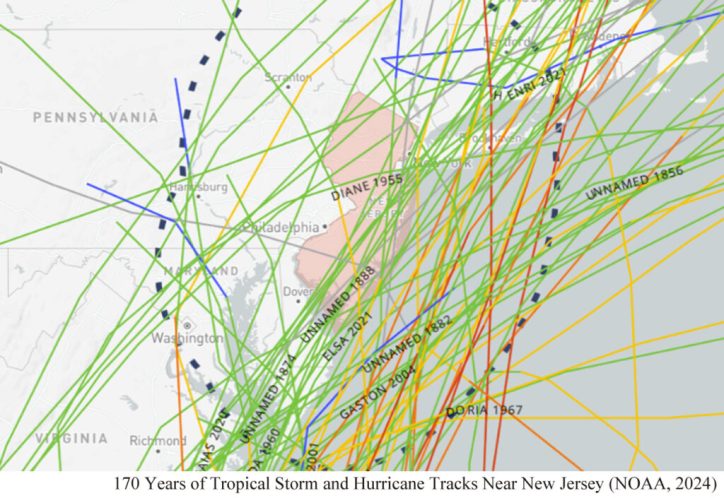
For example, historical data from the National Oceanic and Atmospheric Administration shows that 26 hurricanes and 51 tropical storms passed through New Jersey coastal waters during the last 170 years, or almost five storms each decade. Wind installations will be vulnerable to these weather systems.
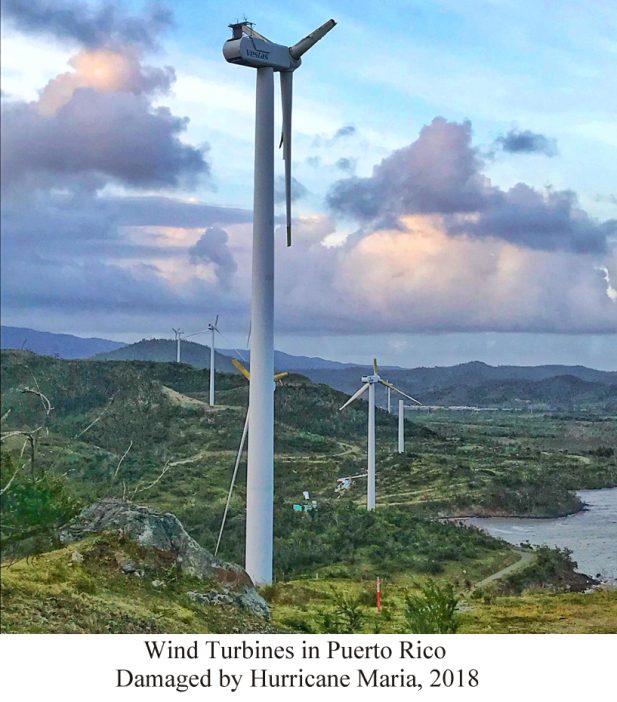
In 2018, Hurricane Maria passed over Puerto Rico, ripping blades from many turbine towers. East Coast wind systems will likely suffer the same fate.
Wind systems are designed to try to protect wind towers and blades in high winds. When winds exceed 55 MPH, a braking system brings the rotor to a standstill to try to avoid turbine damage. Tower blades are also “feathered” or oriented so that they no longer catch the wind.
But near the eye of a hurricane or tropical storm, violent winds can change direction instantaneously and powerfully, too fast for damage-prevention systems to react. The result will be destroyed blades and damaged towers.
Conclusion
In July, a 351-foot-long offshore wind blade splintered and washed up on the beaches in Nantucket, Massachusetts. Beaches were closed and clean-up crews collected six truckloads of fiberglass and plastic debris from the single destroyed blade. Wind operations were temporarily shut down.
Residents, beachgoers, fishermen, and local businesses posted signs, complained to the press, and spoke out at board hearings. But this was just one turbine blade. Image the outcry when a whole offshore system is destroyed by a hurricane, producing mountains of beach debris at Myrtle Beach, Virginia Beach, Atlantic City, or Long Island?
Media headlines claim that weather is becoming more extreme because of human-caused climate change. But to solve the problem, it’s proposed that we install more and more wind and solar systems, which are fragile and vulnerable to violent weather. Incidents of weather destruction of wind and solar installations will continue to rise.
—————-
Steve Goreham is a speaker on energy, the environment, and public policy. His books include the bestselling Green Breakdown: The Coming Renewable Energy Failure.
Russian gas was ‘win-win’ – Merkel
RT | December 10, 2024
Buying natural gas from Russia was a good deal, former German Chancellor Angela Merkel has said, rejecting suggestions that it may have been a strategic mistake.
Merkel, who served as chancellor from 2005 to 2021, was in Paris this week to promote her memoir. She gave an exclusive interview to state TV channel France 2, in which she was asked about Germany’s energy relationship with Russia.
“The gas trade with Russia has a deep-rooted tradition. It began during the Cold War and continued throughout my time in office. I do not think it was a mistake, because we obtained Russian gas at a favorable price,” Merkel said in the interview, which aired on Monday evening.
“It was a win-win situation,” the former chancellor added.
Following the escalation of the Russia-Ukraine conflict, Germany had to source gas elsewhere because “prices exploded,” Merkel said, noting that this would have happened much earlier had Berlin stopped doing business with Moscow during her term.
“I believe it is reasonable to procure the most affordable gas,” she told France 2.
Earlier on her press tour, Merkel also defended the decision to build Nord Stream 2, noting that she had “no support from the business community to stop the gas trade with Russia” at the time. The project was launched in 2015 and the first pipes were laid in 2018.
While the government of Merkel’s successor, Olaf Scholz, has accused Moscow of “shutting off” gas to Germany, his coalition partner Robert Habeck had moved to end the energy trade long before the Ukraine conflict and EU sanctions on Russia provided the pretext. The Green Party leader presented giving up gas for “renewables” as an environmentally responsible policy choice.
Berlin thus refused to certify the newly finished Nord Stream 2 pipeline in January 2022. Nord Stream 1 was destroyed by a series of underwater explosions in September 2022. Investigations by Germany, Sweden, and Denmark have not pointed to a culprit yet, though German media reports have blamed a “rogue” group of Ukrainians.
One of the lines of Nord Stream 2 survived the bombing unharmed and could still deliver gas to Germany should Berlin change its policy and certify the pipeline.
The loss of Russian gas and reliance on the far more expensive US alternative has since pushed energy prices in Germany beyond what a lot of industrial enterprises could afford, triggering a wave of shutdowns and bankruptcies.
In a December 2022 interview, Merkel revealed that Germany and France considered the Minsk Agreements – a framework to peacefully resolve the dispute between Kiev and the two Donbass republics – as a play for time until the West could arm Ukraine for a confrontation with Russia. Former French President Francois Hollande has confirmed her claim.
Featured Video

Houthis Keep Advancing as the Red Sea Crisis Deepens
or go to
Aletho News Archives – Video-Images
From the Archives
15 Saudi ‘hijackers’ were CIA agents working for US: Scholar
Press TV – April 13, 2016
Fifteen of the 9/11 “hijackers” from Saudi Arabia were CIA agents working for the United States government, which was seeking to destroy the Middle East for Israel and to double the American military budget, says Dr. Kevin Barrett, an American academic who has been studying the events of 9/11 since late 2003…. continue
Blog Roll
 Aletho News
- Russia Just Struck the Eyes of NATO’s War Machine in Ukraine
- Russia summons UK charge d’affaires over Kiev drone support
- NATO member warns bloc seeking pretext for war with Russia
- Macgregor: We Haven’t Seen the Worst of the Iran War Yet
- ‘We are not like everyone else’ laws that bind other nations do not apply to Israel, says Likud lawmaker
- Report: Saudi Arabia seeks allies’ assistance as missiles deplete amid war on Yemen
- Fuel Crisis Deepens: Pakistan Warns Tanker Attack in Red Sea Would Be an ‘Act of War’
- ‘Bucha massacre’ a false flag orchestrated by UK – Moscow
- China Rejects Outside Pressure on Trade Ties After New US Russia Sanctions Bill
- Houthis Keep Advancing as the Red Sea Crisis Deepens
- If Americans Knew
- Robert Kraft: The Billionaire Friend of Netanyahu Pulling The Strings Behind the Macklemore/Ed Sheeran Blow Up
- Columbia Administered Fund Gives Big Money to Pro-Israel Groups
- Deportation Case of Palestinian Activist Salah Sarsour Tests First Amendment
- ‘We Will Not Forget’: Palestinians Mark 44 Years since Sabra and Shatila
- Why do we let Zionists decide what we can and can’t say?
- US welcomes Israeli, Iranian delegations to UN, but not Palestinians – Daily Update
- Biden’s Genocide Accomplices Targeted by New Accountability Campaign
- AIPAC’s Network Has Already Spent $67.2 Million to Shape the Midterm Elections
- Jewish Supremacist Manufacturing a Civilizational Threat to License Bigotry
- US bans Palestinian president from speaking at the UN
- No Tricks Zone
- New Study: ‘Global Drought Shows No Detectable Recent Acceleration Under Climate Warming’
- Economic Masterminds: German Socialists Suggest Taxing Productivity Gains Stemming From Using AI
- The South China Sea Has Not Been Cooperating With The Climate Change Narrative
- Energy Crisis: Germany Enters Heating Season With Historically Low Gas Reserve Fill Levels
- New Study: The Antarctic Ice Sheet Gained Mass From 2020-2024 Due To Staggering Snow And Ice Accumulation
- Study: Ocean Heating Rates From Thousands Of Years Ago ‘Dwarf’ Modern Ocean Heating Rates
- Climate Extremists Target, Attack Large-Scale Power Grid Infrastructure In Germany!
- New Study: Antarctic Ice Melt Has Contributed Less Than 1 Centimeter To Sea Level Rise In The Last 30 Years
- Fear Of Debate: Alarmist German Climate Scientist Calls On Mainstream Media To Discredit Skeptic Voices
- End-Of-August Arctic Sea Ice Extent Hasn’t Fallen In 20 Years, Official Data Show!
 Aletho News