Can the WHO and the United Nations impose sanctions on your sovereign country for non-compliance?
The UN is a far bigger threat than the WHO, which, although deserving of attention, cannot consume our entire focus.
BY SHABNAM PALESA MOHAMED | JUNE 18, 2024
This updated analysis was written in 2023 (read in full here at CHD Africa)
Sanctions are a powerful instrument of political control and economic profit. One of the rare but critical topics relevant to the international campaign to #ExitTheWHO is whether the World Health Organisation and the United Nations can impose, influence or recommend specific sanctions. The sanctions could be implemented against countries that choose to not comply or cannot comply with International Health Regulations, the proposed new pandemic treaty, or other legislative attempts that curtail rights, freedom and sovereignty.
The accelerating and profitable globalist march towards unprecedented levels of ‘1984’ style totalitarianism – using censorship, vaccine passports, 15 minute cities, and CBDC’s continues. It is plausible that the WHO and the UN will move to impose, influence or recommend sanctions against countries that do not want to or cannot comply with its centralised health agenda and undemocratic legislative attempts.
What is the basis for me raising the red flag on sanctions in 2023?
Health is no longer just health, as it is defined in the WHO’s constitution. Through Covid-19, and other controversially declared pandemics, health is now a multi-billion dollar health security industry. With it, creeps in the tyranny of secrecy, surveillance, vaccine certificates, forced quarantines, and the undemocratic censorship of free speech. Given the absence of public participation, the WHO is a strategic spear for oligarchs and corporations, and given international resistance to its power grab, it becomes desperate and argues or pushes for sanctions.
Reported in 2021: “In 2021, German Health Minister Jens Spahn called for sanctions against countries that hide information about future outbreaks. Citing the World Trade Organization’s power to sanction countries for non-compliance, Spahn said “there must be something that follows” if countries fail to live up to commitments under a new pandemic treaty that the World Health Assembly will take up in November.”
Further, it is entirely under reported that controversial “World Health Organization Director-General Tedros Adhanom Ghebreyesus also urged countries to consider the idea as they take up the treaty, a legally binding tool. The treaty should “have all the incentives, or the carrots” to encourage transparency, Tedros said, appearing at a press conference with Spahn in Berlin. “But maybe exploring the sanctions may be important,” he added.”
Also reported in 2021: “Speaking at the WHA in June, Mike Ryan, WHO Health Emergencies Programme Executive Director, also spoke out in favour of the treaty, despite the fact that WHO technical staff have historically avoided taking positions on controversial policy choices before member states. “My personal view is that we need a political treaty that makes the highest-level commitment to the principles of global health security — and then we can get on with building the blocks on this foundation.”
I engaged renowned international law expert Professor Francis Boyle about the possibility of sanctions via the WHO. He had no doubt “They will pursue sanctions against countries that do not comply with their orders, coming from Geneva. Both economic and political sanctions. However, they will only have the power to pursue sanctions if we accept their authority. We cannot. We must exit the WHO.”
UN Power Grab. Disaster Capitalism 101.
With far less public scrutiny currently than the controversial WHO, the United Nations is simultaneously seeking exponential new powers and stronger global governance mechanisms, including multilateralism, to deal with what they define as international emergencies.
UN Secretary-General Antonio Guterres’ Common Agenda report arises from a UN declaration on the commemoration of its seventy-fifth anniversary. This report states “All proposed actions are designed to accelerate the achievement of the Sustainable Development Goals. Our Common Agenda is intended to advance the 12 themes of the declaration.”
In March 2023, UN secretary-general Antonio Guterres released a related policy brief: To Think and Act for Future Generations – OUR COMMON AGENDA – Policy Brief 2 – Strengthening the International Response to Complex Global Shocks – An Emergency Platform.
One of this policy brief’s 12 key themes is ‘Being Prepared’, which includes:
1. Emergency Platform to be convened in response to complex global crises
2. Strategic Foresight and Global Risk Report by the United Nations every five years
3. On global public health:
a) Global vaccination plan
b) Empowered WHO
c) Stronger global health security and preparedness
d) Accelerate product development and access to health technologies in low- and middle-income countries
e) Universal health coverage and addressing determinants of health
Under the topic of addressing major risks, Guterres states:
98. An effort is warranted to better define and identify the extreme, catastrophic and existential risks that we face. We cannot, however, wait for an agreement on definitions before we act.
99. Learning lessons from the COVID-19 pandemic, we can seize this opportunity to better anticipate and prepare to respond to large-scale global crises. This requires stronger legal frameworks, better tools for managing risks, better data, the identification and anticipation of future risks, and proper financing of prevention and preparedness. Importantly, however, any new preparedness and response measures should be agnostic as to the type of crisis for which they may be needed. We do not know which extreme risk event will come next. It might be another pandemic, a new war, a high-consequence biological attack, a cyberattack on critical infrastructure, a nuclear event, a rapidly moving environmental disaster, or something completely different such as technological or scientific developments gone awry and unconstrained by effective ethical and regulatory frameworks.
101. Secondly, I propose to work with Member States to establish an Emergency Platform to respond to complex global crises. The platform would not be a new permanent or standing body or institution. It would be triggered automatically in crises of sufficient scale and magnitude, regardless of the type or nature of the crisis involved. Once activated, it would bring together leaders from Member States, the United Nations system, key country groupings, international financial institutions, regional bodies, civil society, the private sector, subject-specific industries or research bodies and other experts. The terms of reference would set out the modalities and criteria for the activation of the platform, including the scale and scope of the crisis; funding and financing; the identification of relevant actors who would form part of it; the support that it would be expected to provide; and the criteria for its deactivation. The platform would allow the convening role of the Secretary-General to be maximized in the face of crises with global reach.
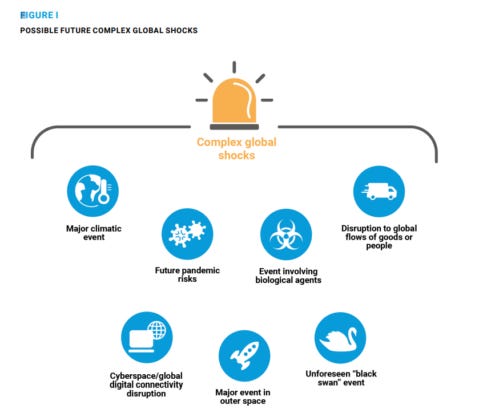
DIAGRAM: Policy Brief 2 – Strengthening the International Response to Complex Global Shocks – An Emergency Platform
UN’s Emergency Platform = One World Government backdoor
The emergency platform would be activated during any event that is deemed to have a global impact, and would provide the UN the authority to actively promote and drive an international response. Antonio Guterres, UN secretary-general, declared: “I propose that the General Assembly provide the Secretary-General and the United Nations system with a standing authority to convene and operationalize automatically an Emergency Platform in the event of a future complex global shock of sufficient scale, severity and reach.”
The policy further argues that such authority would “Ensure that all participating actors make commitments that can contribute meaningfully to the response, and that they are held to account for delivery on those commitments.” While the policy states that the emergency authority would have limited duration, it also states that the UN would be able to extend its own powers if it decides to do so. These powers would effectively render public consensus unnecessary, democracies obsolete, and the role of politicians largely irrelevant.
These all encompassing areas of expanded emergency powers relate to:
- pandemics
- wars and nuclear events
- climate or environmental events, degradation or disaster;
- accidental or deliberate release of biological agents;
- disruptions in the flow of goods, people, or finance;
- disruptions in cyberspace or “global digital connectivity;”
- a cyberattack on critical infrastructure
- a major event in “outer space;”
- “unforeseen risks (‘black swan’ events)
- technological or scientific developments gone awry – and unconstrained by effective ethical and regulatory frameworks.
At least 7 out of 10 of the above areas have already happened or are happening.
What does the UN have planned?
On September 20th 2023, the UN intends to adopt a high level political declaration on pandemics. In my analysis, the UN pathway to the one health and one world government agenda is a back up plan to the WHO’s trajectory which is increasingly exposed and resisted.
The UN is planning to host its related ‘Summit of the Future’ in September 2024. Guterres stated “The Summit of the Future is an opportunity to agree on multilateral solutions for a better tomorrow, strengthening global governance for both present and future generations.” The UN website states “The General Assembly welcomed the submission of Our Common Agenda and passed a resolution to hold the Summit on 22-23 September 2024, preceded by a ministerial meeting in 2023. An action-oriented Pact for the Future is expected to be agreed by Member States through intergovernmental negotiations on issues they decide to take forward.”
Understanding Sanctions or Unilateral Coercive Measures
Sanctions are action that is taken or an order that is given to force a country to obey international laws. There are several types of sanctions imposed through the United Nations:
- Economic sanctions – typically a ban on trade, possibly limited to certain sectors such as armaments, or with certain exceptions (such as food and medicine)
- Diplomatic sanctions – the reduction or removal of diplomatic ties, such as embassies.
- Military sanctions – military intervention
- Sport sanctions – preventing one country’s people and teams from competing in international events.
- Sanctions on the environment – since the declaration of the United Nations Conference on the Human Environment, international environmental protection efforts have been increased gradually.
- Economic sanctions are distinguished from trade sanctions, which are applied for purely economic reasons, and typically take the form of tariffs or similar measures.
It is plausible that the UN’s controllers realise that the world is pushing back against the WHO’s overreach, or find it irrelevant to real health. Given that sovereign nations will choose to exit the WHO, the UN decided to launch plan B and ascribe to itself even greater powers. Technically, there is no legislation to exit the United Nations within the UN Charter. Again, this is a critical issue of national sovereignty.
Can the WHO and the UN collaborate on sanctions?
The WHO is an agency of the United Nations.
- In 2015, on punishing member states who violate the International Health Regulations (IHR), as reported: “United Nations health officials said they want to impose sanctions on countries that do not comply with public health regulations meant to avoid the spread of dangerous epidemics, such as the Ebola outbreak that killed more than 9,000 people and ravaged domestic health care systems in West Africa last year.
- World Health Organization Director Margaret Chan said she is investigating ways to reprimand countries that disobey the IHR — a set of rules adopted in 2005 and mandate that countries set up epidemiological surveillance systems, fund local health care infrastructure and restrict international trade and travel to affected regions deemed unsafe to the public, among other provisions. Chan is on a panel set up by U.N. Secretary General Ban Ki-moon, who instructed the group to think of ways to hold countries accountable for how they manage public health crises and punish those who violate the IHR.”
- In 2022, according to commentators in a policy article: “In order to enforce compliance, some commentators have recommended concluding the treaty at the United Nations level. However, we fear that it has been already decided with the INB (mandated by WHASS) that a treaty will be developed under the roof of WHO. They added: “To move on with the treaty, WHO therefore needs to be empowered — financially, and politically. If international pandemic response is enhanced, compliance is enhanced. In case of a declared health emergency, resources need to flow to countries in which the emergency is occurring, triggering response elements such as financing and technical support.
- These are especially relevant for LMICs, and could be used to encourage and enhance the timely sharing of information by states, reassuring them that they will not be subject to arbitrary trade and travel sanctions for reporting, but instead be provided with the necessary financial and technical resources they require to effectively respond to the outbreak. High-income settings may not be motivated by financial resources in the same way as their low-income counterparts. An adaptable incentive regime is therefore needed, with sanctions such as public reprimands, economic sanctions, or denial of benefits.”
Conclusion
Given the rapidly growing distrust in the WHO, its historical failures and harms, Covid-19 failures and harms, and the fact that it cannot maintain independence because it is a largely privately funded entity; it is plausible that the WHO and/or the UN will move to impose or influence sanctions via the World Trade Organisation, ahead of Agenda 2030. This act of aggression weaponises the WHO and/or the UN against countries that influential funders and unethical stakeholders have an interest in destabilising for power and resource control.
This sinister strategy has disturbing implications for democracy, peace, and prosperity around the world. Freedom faces an existential risk through unelected bureaucratic entities. Nations can and must protect their sovereignty by defunding and exiting WHO, and, by critically assessing the true history, nature, value, and risks of continued membership in the 78 year old United Nations. Not to do so, means to ignore the risks of UN peacekeepers, known to commit crimes with impunity, being deployed in your country to enforce UN and WHO governance.
Outgoing Stoltenberg is still laying mines for the world
Global Times | June 19, 2024
NATO Secretary General Jens Stoltenberg is about to leave his post, and the upcoming NATO summit to be held in the US next month will be his farewell tour, if nothing else. In the past two days, Stoltenberg went to Washington to warm up for the upcoming summit, at the same time showing off some of his own “achievements” to leave some political legacy for the past nine years in his post as NATO Secretary General. He touted that 23 of the 32-member bloc have met the target of spending 2 percent of GDP on defense, while revealing that NATO is discussing the deployment of more nuclear weapons. Stoltenberg’s remarks, which make the world feel great concerns and threats, are said with easiness and even great excitement. The NATO chief also continued to threaten China, saying that China cannot “have it both ways” between the West and Russia and that if it does not change course, “there should be consequences.”
In his nine years in office, the world saw the prolonged Syrian civil war, and the outbreak of the Russia-Ukraine conflict, as well as the Israel-Palestine conflict. The role of NATO, a product of the Cold War and the world’s largest military bloc, in the conflicts of such magnitude, is dishonorable. The Ukraine crisis, in particular, caused by the bloc’s eastward expansion, plunged Ukraine into war, further tore Europe apart, and brought NATO back to life. Even within the US and Europe, there has been harsh criticism and warnings about this.
Yet, Stoltenberg is not satisfied, as he continued to call on the West to supply more weapons to Ukraine on Monday in Washington, claiming it is the “path to peace.” Even he cannot justify it, admitting that this “may seem like a paradox.” This is Stoltenberg’s way of covering up his attempts at war and culpability, as well as the way of NATO as a whole: to create conflicts in the name of preventing crises and to exacerbate catastrophes in the name of managing crises. As one Western scholar summarized, invasion has been hailed as “humanitarian intervention,” coup d’état as “democratic revolution,” regime subversion as “democracy promotion,” gunboat diplomacy as “freedom of navigation,” military bloc expansion as “European integration,” and domination as “negotiation from a position of strength.”
Under Stoltenberg’s leadership, NATO has also been attempting to interfere in the Asia-Pacific region, aligning with the strategic direction of the US, and promoting “NATO’s Asia-Pacificization.” Although such attempts have encountered resistance from the majority of countries in the Asia-Pacific region, and thus remain limited to a small circle of US allies, regional countries must not be negligent. The desire of regional countries to maintain the regional peace and development does not mean that NATO has no intention of creating discord. NATO’s own history has proved that it strengthens its functions through crisis creation. Since it now intends to enhance its presence and functions on a global scale, it inevitably has to create larger crises.
On this point, insightful individuals internationally, including those in Western countries, have long provided incisive summaries. Organizations like NATO have interfered in nearly all wars and conflicts since its foundation, consistently exporting war and only bringing more problems. In the cycle of seeking enemies, creating crises, and extending its existence, NATO aims to make China the latest target. In recent years, NATO summit declarations have increasingly mentioned China, and provocative actions against China have become more frequent. Particularly, Stoltenberg himself has repeatedly issued threats this year, demanding that China must choose sides between the West and Russia. In February alone, he created a notable scene during his US visit by making seven provocative statements about China in six days. His speeches are filled with confrontational language and echoes of the Cold War. Given that some political elites in the US and Europe frequently champion moral causes such as “opposing coercion” and “defending peace,” they should feel embarrassed by Stoltenberg’s remarks.
Stoltenberg’s strenuous efforts to perform and use various occasions to promote the “China threat” narrative indirectly indicate that this task is difficult. China consistently participates in international affairs as a responsible major power, pursuing peace and bringing opportunities. Even within NATO, China is one of the main trading partners for the majority of its 32 member countries. This is one of the reasons why NATO labels China as a “systemic challenge.” For a war-dependent entity like NATO, a China that follows a path of peaceful development naturally becomes a “challenge.”
This year also marks NATO’s 75th anniversary. Stoltenberg’s warmongering rhetoric is the best commentary on the role NATO has played over the past 75 years. If Stoltenberg leaves any legacy during his term, it is conflict and war. People should be particularly wary of Stoltenberg’s promotion of the “threat narrative.” History has repeatedly shown that such rhetoric always runs counter to peace, development, and prosperity. The louder NATO’s voice becomes, the more vigilant peace-loving people should remain.
NATO chief says China should be punished
RT | June 18, 2024
NATO Secretary-General Jens Stoltenberg has called for making China pay a price for allegedly propping up Russia’s military campaign in Ukraine, saying Beijing is “fueling” the conflict by supplying microelectronics and other key components to Moscow.
“The reality is that China is fueling the largest armed conflict in Europe since World War II,” Stoltenberg said on Monday in a speech at the Wilson Center in Washington. “At the same time, it wants to maintain good relations with the West. Well, Beijing cannot have it both ways. At some point, unless China changes course, allies need to impose a cost.”
Stoltenberg has repeatedly attacked China since the Ukraine crisis began in February 2022, arguing that Beijing was enabling Russia to fight against Kiev, a “European friend” of NATO. He has made such comments even as NATO states prolonged the conflict by providing hundreds of billions of dollars’ in economic and military aid to Ukraine.
Monday’s rebuke marked some of his most pointed criticism yet, suggesting that NATO may ramp up sanctions against China. He also called out North Korea and Iran for being supportive of Russia’s defense-industrial complex.
Stoltenberg reiterated an assertion that NATO – a military bloc originally formed against the Soviet Union – needs to get more involved in the Indo-Pacific to counter the “growing alignment between Russia and its authoritarian friends in Asia.” He noted that he invited the leaders of Japan, South Korea, Australia and New Zealand to next month’s NATO summit in Washington to work together on upholding the “international rules-based order.”
China is providing Russia with semiconductors and other key technologies with military applications, including parts needed to make missiles and tanks, Stoltenberg said. He added that Beijing also has supplied Russia with improved satellite and imaging capabilities. “All of this enables Moscow to inflict more death and destruction on Ukraine, bolster Russia’s defense-industrial base, and evade the impact of sanctions and export controls.”
The NATO chief also spoke of his China concerns in an interview with the BBC on Monday. Asked about what the Western military bloc might do about the issue, he said there was an “ongoing conversation” about possible sanctions. “At some stage, we should consider some kind of economic cost if China doesn’t change their behavior,” he said.
Beijing has repeatedly defied demands from the US and other NATO nations to join in sanctioning and isolating Russia. Chinese leaders have pushed a peace plan to end the fighting and have pointed out that Russia’s legitimate security concerns cannot be ignored.
Earlier this year, the Chinese Foreign Ministry denounced NATO as a “walking war machine that causes chaos wherever it goes.” Beijing has accused NATO of meddling in Asian affairs, saying the bloc is a “terrible monster” and has extended a “black hand” toward the region.
US Boosted Nuclear Arms Spending by 18% in 2023, Record Among Nuclear States – Report
Sputnik – 17.06.2024
The United States last year increased spending on nuclear weapons by 18%, which is the highest rate among all nine countries possessing nuclear weapons, the International Campaign to Abolish Nuclear Weapons (ICAN) said on Monday.
US alone spends on nukes more than all other nuclear-armed states, the report read.
“[In 2023] Every country increased the amount it spent on nuclear weapons. The United States had the biggest increase, at nearly 18%. The United States spent more than all the other nuclear-armed states combined, at $51.5 billion. China surpassed Russia as the second-highest spender at $11.9 billion, and Russia came in third, spending $8.3 billion,” the ICAN said in a report, adding that the United Kingdom also significantly increased its nuclear spending for the second year in a row.
In 2023, the US, the UK, China, France, India, Israel, North Korea, Pakistan and Russia spent a total of $91.4 billion developing their nuclear arsenals, which is $10.8 billion or 13.4% more than in 2022, the ICAN also said.
“In 2023, twenty companies working on nuclear weapons development and maintenance earned at least $31 billion for this work. There are at least $335 billion in outstanding nuclear weapons contracts to these companies, some of which have continued for more than a decade. In 2023, at least $7.9 billion in new nuclear weapon contracts were awarded,” the report read.
ICAN, a coalition of civil society organizations in over 100 countries, was founded in Melbourne, Australia in 2007. The coalition promotes adherence to the Treaty on the Prohibition of Nuclear Weapons. In 2017, it received the Nobel Peace Prize for its efforts.
Earlier, experts explained to Sputnik that recent Minuteman III launches are a regular audit of the strategic forces rather than nuclear saber-rattling.
EU now at a crossroads: Reform or self-destruction

By Martin Jay | Strategic Culture Foundation | June 13, 2024
The EU has just experienced a monumental change, following years of failed immigration policies, which has ushered in a massive number of far-right MEPs in the more powerful EU member states. It’s too early to say whether this will make too much of a change to policy decisions at the highest echelons of the European Union but certainly the European Parliament itself is, possibly for the first time ever, going to be an interesting place with now a quarter of all of the 720 MEPs coming from far-right groups.
Traditionally most people who voted in EU elections were stalwart supporters of the project and the ethos of one Europe united by a policy of free movement of goods, services and people and, for many, a single currency. The few who voted against the mainstream parties – the main bloc made up of Christian democrats and socialists – were those who wanted to use their vote as a throw-away gesture to send a signal to their own elites that they want change. That protest vote in the past was always very small as the EU elite in Brussels always benefited from a voting system which was tilted in their favour. But no more.
The European Parliament, which most sceptics considered to be a fake assembly whose only real role is to rubber stamp draft legislation from either the powerful European Commission or member states (via the European Council), could now become suddenly relevant to the whole project. For the last five years, there has only been two Irish MEPs to take the floor and tackle the European Commission head on, on its genocide in Gaza or its phoney war in Ukraine. But now something like 180 MEPs will use their two minutes speaking time to tackle the commission on its failed foreign policy, immigration and trade deals with China, for example. The Ukraine war could be a central theme which will probably be a thorn in the side of the European Commission and its chief – whoever that might be as, despite supporting statements from the Christian Democratic group in the European parliament, it is not a certainty that Ursula von der Leyen will return as Commission chief.
If she succeeds and stays on as EU Commission president, she will have a tough time in parliamentary plenary sessions as Europe’s biggest countries – who pay the most into the EU budget – have picked up the most far-right seats. Marine Le Pen’s Rassemblement National scored the most decisive victory, winning 30 of the country’s 81 seats, and more than double the votes of President Emmanuel Macron’s Renew party. That political slaughter pushed Macron to call a snap election. Italian Prime Minister Giorgia Meloni’s Brothers of Italy won 24 seats and increased her share of the national vote, and the Alternative for Germany (AfD) came second in Germany and snapped up 15 seats. Presently the AfD doesn’t have a pan-European group to align itself to and, under EU rules, benefit from huge amounts of cash from the EU parliament as it was kicked out of one of the two ‘groups’, prompting fears that it will create one itself and invite others to join it. In the European parliament both France’s and Italy’s far-right MEPs are in different groups, but in reality, when it comes to voting, for sure there will be a unified policy on most issues which will give them leverage with the European Commission that we have never seen in the short history of the EU.
It’s important to note that far-right parties topped the polls in Austria and Hungary, too, with important gains in Spain and Cyprus. All of these countries have one thing in common: real immigration problems which neither the mainstream political groups nor the EU has addressed.
But the real issue is the identity and survival of the European Union itself as this shake-up is certainly going to threaten the traditional power structure. Ursula von der Leyen represents the old guard and everything which is wrong with the EU: deluded, outdated views run by elitists who believe the only solution to the EU’s power problem is to take more. Unlike President Macron who wisely stated to the press that the far-right votes were a message which he is listening to, von der Leyen’s statements were more about fighting the new threat.
The G7 loses ground to BRICS
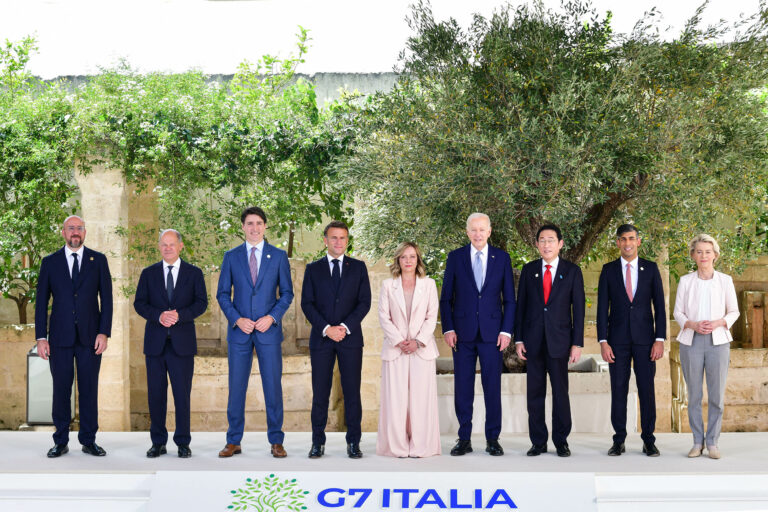
Losers
BY M. K. BHADRAKUMAR | INDIAN PUNCHLINE | JUNE 13, 2024
One hidden transformation of the international system in the most recent years has been the hijacking of the G7 by Washington as its ‘kitchen cabinet’ in the transatlantic system. The G8’s ‘shrinkage’ to G7 in March 2014 following the coup in Ukraine was a defining moment that signalled that there wasn’t going to be any post-cold war peace dividend. The G7 that was conceived as a group of countries charioting the world economy ended up as the vehicle of big-power rivalry to preserve the US’ global hegemony. Isolating Russia — and lately, China, too — became its leitmotif.
With the failure of the western project to isolate Russia, the G7 is meandering and lost its sense of direction. Italy, the G7 summit’s rotating host this year, has made AI a key issue in the summit. And Prime Minister Giorgia Meloni invited by an unlikely guest, the pontiff, to make an unprecedented appearance at the G7 event at the fashionable Italian hotel Borgo Enyatia to advocate for the regulation of artificial intelligence, a technology he’s called potentially harmful. Pope Francis was a chemist prior to entering seminary and will apparently draw on his scientific training to inform his stances. Italy under Meloni’s leadership has increasingly scrutinised AI technology, and temporarily banned ChatGPT in March 2023, becoming the first western country to do so.
Equally, G7 is desperate to go beyond a closed elite club of Western democracies by piloting an ambitious outreach and issued an unusually long list of invited leaders of the non-Western world to the summit. Aside Ukraine, Meloni has invited the leaders of India, Brazil, South Africa, Turkey, Saudi Arabia, Argentina, Algeria, Kenya and Mauritania to attend the meeting. What was the logic applied is impossible to tell.
But this is realpolitik and G7 is hoping to bridge the ‘West vs. the Rest’ hiatus in the line-up over the Ukraine crisis. In fact, the ‘outreach guests’ will witness tomorrow the nail-biting finale of a geopolitical drama, which forms the core of the G7 summit — the months-long attempt by the group’s leaders to make a decision on using dividends from frozen Russian assets for Ukraine’s military needs.
To recap, as part of the West’s ‘sanctions from hell’ against Russia in 2022, the European Union, Canada, the US and Japan froze Moscow’s assets in the western banks to the tune of $ 300 billion. (Some say, the actual figure is closer to $400 billion.) Only about $5-6 billion is located in the US, while $210 billion is stored in Europe, but the decision to use the proceeds from Russian assets was initiated by Washington with a hidden agenda to make Europe pay for the war’s consequences.
Unsurprisingly, the European members and Japan opposed the US pressure to include a provision on the use of income from frozen Russian assets in the joint G7 statement to be adopted. CNN reported on Monday that American officials are still trying to agree on the “most sensitive financial details” of the plan for Russian assets, since the G7 countries are yet to come to a consensus and discussions are continuing as regards “the exact form of providing assistance, as well as guarantees for the return of these funds.”
That said, don’t be surprised if the recalcitrant Europeans ultimately fall in line. There is no question that the G7 move to appropriate Russian money in western banks was bad enough but to use the profits out of them to fund the needs of Ukraine is, to put it mildly, an act of brigandage.
The US gains if the current freeze in Russia-Europe ties reaches a point of no return, as Europe is sure to bear the brunt of Moscow’s retaliation. If the G7 adopts such a move, it will weaken the global financial system. By brazenly violating international law, the G7 will be setting a precedent that undermines confidence in European institutions.
It will be interesting to see how the G7 leaders explain to the ‘outreach’ countries, drawn largely out of BRICS, that Russia is an exception and such a practice will not one day be used against India, Turkey, Saudi Arabia or some other state.
To be sure, the spectre of the 16th summit meeting of BRICS at Kazan (16-18 October) under the chairmanship of Russian President Vladimir Putin haunts the G7. Moscow has let it be known that if the past three years ended with the expansion of the BRICS, the new phase going forward will ensure that the participants in an expanded format create a viable structure in which the member countries work purposively to develop a viable structure.
An important topic at the BRICS summit meeting in Kazan will be the creation of a single currency within the grouping, which will significantly simplify and expand the economic relations of the member countries against the backdrop of mounting pressure from the West.
Speaking at the SPIEF conference in St. Petersburg last week, Putin announced that such an independent payment system would be created. Foreign Minister Sergey Lavrov later confirmed that a platform for payments in national currencies is being developed.
The BRICS countries have realised that the creation of a single currency has become a necessity today due to the ongoing sanctions from the US and the European Union. Lavrov noted that “recent international events have thrown off the masks” of the West, which has tried to impose its own values on other countries under the guise of universal ones and replace equal dialogue with “narrow coalitions” that assign the right to speak on behalf of the whole world.
BRICS, Lavrov underscored, implies a completely opposite type of partnership — that is, anything but a bloc structure, and on the contrary, a fundamentally open format, which involves working only in those areas that are of mutual interest to all participants, big and small. Reports suggest that around 30 countries have sought BRICS membership.
Meanwhile, in ‘systemic’ terms, G7 is entering uncharted waters. Far-right parties are storming the power centres of Europe. With an eye on the G7 summit, Politico wrote:
“Dream on. The G7 summit in the southern Italian coastal resort of Borgo Egnazia features arguably the weakest gathering of leaders the group has mustered for years. Most of the attendees are distracted by elections or domestic crises, disillusioned by years in office, or clinging desperately to power.
“France’s Emmanuel Macron and Britain’s Rishi Sunak are both fighting snap election campaigns they called in last-ditch efforts to reverse their flagging fortunes.
“Germany’s Olaf Scholz was humiliated by far-right nationalists in last weekend’s EU Parliament election and could soon be toppled himself.
“Justin Trudeau, prime minister for nine years in Canada, has spoken openly about quitting his “crazy” job.
“Japan’s Fumio Kishida is enduring his lowest personal ratings ahead of a leadership contest later this year.
“And then there’s Joe Biden.
“The 81-year-old U.S. president’s son, Hunter, was found guilty of gun charges on Tuesday, barely two weeks before his father’s first crucial debate with a resurgent Donald Trump in a presidential campaign the Democrat is in serious danger of losing.”
Above all, the angst in the European mind is palpable that if Trump wins in a democracy-altering climax in the November election, he may not even have time or patience to tolerate an archaic forum like G7. Surveying the bleak landscape, it comes as no surprise that Meloni took matters in her hands and decided to use the summit to her purposes by designing an agenda that cleaved to Italy’s strategic interests — Africa, migration and the Mediterranean.
US using Ukraine conflict as pretext to impose sanctions – China
RT | June 13, 2024
The US is using the Ukraine crisis as an opportunity to impose sanctions while continuing to pump Kiev with weapons, Chinese Foreign Ministry spokesman Lin Jian said on Thursday.
Lin made the remarks after the US State Department and Treasury Department announced a new round of curbs on Wednesday targeting 300 additional individuals and entities in Russia and other countries, including China, Türkiye, and the UAE. In particular, Washington has sanctioned China-based companies which are selling semiconductors to Moscow.
According to the Treasury Department, the latest measures target more than $100 million in trade between Russia and foreign partners suspected of enabling Moscow to evade Western embargoes.
The Chinese diplomat called Washington “extremely hypocritical and overbearing” for supplying Ukraine with weapons while pushing for peace.
“We urge the United States to immediately stop abusing illegal unilateral sanctions, and focus on ceasefires, stop wars, restore peace, and play a constructive role,” he said at a regular news briefing.
Beijing had previously accused the US and its allies, which together supply the bulk of Kiev’s military equipment, of hypocrisy, stating that Western powers should work on bringing Russia and Ukraine to the negotiation table, instead of “shifting the blame” onto China for the continued hostilities.
Earlier this week, China said it remains firmly opposed to the sanctions, noting it would safeguard the rights and interests of its companies and citizens. Beijing has urged Washington to stop smearing China and “lift illegal unilateral sanctions” on its businesses.
Beijing has adhered to a policy of neutrality with regards to the Ukraine conflict, and has firmly rebuffed Western calls to impose sanctions on Russia, opting instead to boost trade with its neighbor. This has led to accusations from the UK and its NATO allies that Beijing is fueling Russia’s military effort by supplying it with dual-use components that can be utilized in weapons production.
Among the latest steps, the US Treasury said it was raising “the risk of secondary sanctions for foreign financial institutions that deal with Russia’s war economy,” effectively threatening them with losing access to the American financial system.
The Chinese foreign ministry has repeatedly stressed that economic and trade cooperation between China and Russia “will not be disrupted by any third party.”
Annual trade between the bordering countries surpassed $240 billion last year, according to official data.
EU “playing a dark game” and serves “sinister” interests of US
By Ahmed Adel | June 13, 2024
The European Union’s reaction to the conflict in Ukraine indicates that the bloc does not pursue the peaceful objectives that were the basis of its creation, writes columnist Javier Melero for the Spanish newspaper La Vanguardia. At the same time, European authorities are in negotiations to maintain the flow of gas through the important Russia-Ukraine pipeline, once again showing that Europe is committing economic suicide with its failed sanctions policy on Moscow.
“War has returned to Europe, and it would be appropriate to ask after the post-election euphoria how the EU reacts to the Russian-Ukrainian conflict,” Melero wrote.
By asking this question, the author emphasises that in public discussions in Europe no other option for resolving the conflict is considered, except “Russia’s unconditional surrender.” Based on this, he concludes that the EU does not act in accordance with declared peaceful objectives but serves the “sinister” interests of NATO and the USA.
“It seems to me that something doesn’t add up here and that Europe is playing a dark game. And these games, what’s even worse, end badly for it. And the conflict in Ukraine seems to be no exception,” concluded Melero.
Yet, even as the EU does not prioritise peace to instead serve Washington’s interests, the bloc is unable to wean itself off Russian energy, a demonstration that the economies and prosperity of the European continent is intrinsically interconnected and that the US-led sanctions have only had a boomerang effect. For this reason, European authorities are desperately in negotiations to maintain the flow of gas through the Russia-Ukraine pipeline even if the bloc tried to end Russian shipments.
The agreement covering this gas transit exchange expires at the end of this year, and with the ongoing Ukrainian conflict, most market watchers expect the flow to finally stop. However, European government and business officials are talking to their counterparts in Ukraine about how to maintain the flow of gas next year, according to people familiar with the matter interviewed on condition of anonymity by Bloomberg.
At the same time, one option that has been discussed is for European companies to buy and inject Azerbaijani gas into Russian gas pipelines bound for Europe, according to some sources. A plan to use Azerbaijani gas could, in theory, benefit Russia if it were set up as an exchange that would allow Moscow to ship its gas elsewhere.
Negotiations are in their early stages, and people familiar with the matter expect decisions only later this year, when the expiry date — and the onset of European winter — add pressure. Russia still sends around 15 billion cubic metres of gas a year to Europe , mainly to Slovakia and Austria, where Moscow is still a dominant supplier.
In Austria, Russian gas covered more than 80% of Austrian consumption for five consecutive months. Europe also imports Russian liquefied natural gas (LNG) by ship and, despite frequent debates about whether it should do so, has never sanctioned Russian gas.
The European Commission, the executive arm of the European Union, believes that the bloc can resist the end of Russian transit through Ukraine without any major security risk, but some member states are less optimistic and fear a repeat of the energy crisis, writes Bloomberg.
Whilst Europe worries about another energy crisis, Russian revenues from oil and gas exports increased by 82.2% in the period between January and April, compared to the same period in 2023, reaching more than 4.2 trillion rubles. The growth comes despite sanctions imposed on Russia since the launch of its military operation in Ukraine in 2022, including an embargo on Russian oil transported by sea and a $60 per barrel price cap on other types of oil.
Moscow has repeatedly expressed its readiness for peace negotiations, but the Kiev authorities have introduced a ban on them at the legislative level. At the same time, the West ignores Kiev’s constant refusals to dialogue and instead encourages the continuation of war, even as Ukraine loses more territory and experiences a demographic collapse as millions have fled the country and hundreds of thousands are being killed in a futile war against Russia.
But as Melero highlighted, US-led NATO only has “sinister” designs. These designs can only be detrimental to European interests, making the complete servitude to Washington all the more bizarre, especially since before February 2022, French-led Europe spoke a brave game of European strategic autonomy from the US. The first opportunity to test Europe’s pursuit for strategic autonomy showed that this was only lip work by French President Emmanuel Macron and that ultimately the EU is the biggest loser in the Ukraine conflict after Kiev itself, and not Russia or even the US.
Ahmed Adel is a Cairo-based geopolitics and political economy researcher.
Intel halts construction of multibillion chip plant in Israel
The Cradle | June 11, 2024
The US-based chip giant Intel Corp is halting a $25 billion chip manufacturing project in Israel, Calcalist reported on 10 June.
The Israeli news agency writes that Inte,sl decision to stop building of the multibillion-dollar factory came after “Intel’s suppliers received in recent days notice of the cancellation of contracts for the supply of equipment and materials required for the establishment of the company’s new factory.”
The plant was announced in December of last year and was expected to be built in Kiryat Gat, just shy of 60 kilometers from Tel Aviv.
The Calcalist report states Intel said in response that Israel continues to be one of the technology company’s “key global manufacturing and [research and development] sites, and we remain committed to the region.
“As mentioned previously, the scope and rate of expansion of Intel’s production at the company’s sites around the world depend on a number of changing factors,” Intel’s response read. “Managing a project of this magnitude, especially in our industry, usually involves schedule adjustments. Our decisions are based on business conditions, market dynamics, and responsible capital management.”
Since the beginning of the war in October of last year, Israel has suffered economic consequences at the hands of the Palestinian resistance.
Venture capitalist investments in Israel peaked in 2021 at $29 billion, but as of 2024, foreign investment has sunk to around $5 billion.
Chief of Israel’s central bank, Amir Yaron, said in May that Israel’s current war costs amount to $70 billion of the Israeli 2025 budget.
“There is no doubt that more expenses will be needed since the economy needs security, and security needs the economy. However, it is important to emphasize – you cannot give an open check on the issue of security spending, you must find the right balance between things,” Yaron said.
Foreign investment by way of defense contracts has been slashed due to Israel’s actions in Gaza.
Earlier this year, Samsung Next decided to close its operations in Israel and focus on other projects abroad. The innovation branch of Samsung has over 70 investments in Israel.
In February, The Japanese Itochu corporation’s aviation unit cut strategic contracts signed with Israel’s Elbit Systems Ltd.
Also in February, Belgium’s Walloon Region suspended two ammunition export licenses to Israel following pressure from rights groups. Later that same month, The Netherlands decided to halt deliveries of F-35 fighter jet parts to Israel, citing the same reasons.
Scholz and Macron belong to ‘ash heap of history’ – Medvedev

German Chancellor Olaf Scholz and French President Emmanuel Macron should abandon politics after their respective parties suffered damaging setbacks in the European Parliament elections, former Russian President Dmitry Medvedev believes.
Scholz’s center-left Social Democratic Party (SPD) is projected to finish third in the key ballot, behind the center-right Christian Democrats and the right-wing Alternative for Germany (AfD).
Macron’s Besoin d’Europe coalition is expected to win less than half of the votes received by the right-wing National Rally party associated with Marine Le Pen, prompting the French president to call a snap parliamentary election after preliminary results emerged on Sunday.
In a social media post on Monday, Medvedev claimed the outcome proves that Scholz and Macron are “respected by no one.” The former Russian leader linked the poor performance at the ballot box with the “idiotic economic and migration policy” pursued by the two leaders and their support for Ukraine “at the cost of [their] own citizens.”
“Time to retire. To the ash heap of history!” said Medvedev, who currently serves as deputy chair of the Russian Security Council.
Vyacheslav Volodin, the speaker of the lower chamber of the Russian parliament, earlier called on Scholz and Macron to resign and to “stop victimizing the citizens of their states.”
Officials in Moscow have accused leaders of EU nations of betraying the interests of their populations in favor of US geopolitical goals. Responding to the Ukraine crisis in 2022, the bloc vowed to support Kiev militarily for “as long as it takes,” and imposed an array of economic sanctions against Russia. Most notably, Brussels has pushed EU countries to stop buying Russian natural gas.
Large consumers such as Germany have struggled to substitute cheap Russian pipeline fuel with other sources, including renewables and expensive liquified natural gas. American LNG producers have since taken over a large share of the European market. A hike in energy prices has forced many energy-intensive businesses to either move out of the EU or shut down entirely.
Guardian withdraws cheap renewables claim
Net Zero Watch | June 4, 2024
The Guardian has been forced to withdraw an advertorial, paid for by National Grid, that purported to debunk ‘myths’ about clean energy.
Energy writer David Turver, who had formulated a detailed rebuttal,[1] submitted complaints to both the Guardian and the Advertising Standards Authority (ASA).
The Guardian’s response said that they did not think that there was any need to correct the article. However, the ASA appear to have taken more jaundiced view, and the article has now been removed from the Guardian website. As they told Mr Turver:
We have decided to resolve your complaint through the provision of advice to the advertiser. Therefore, we have explained the concerns raised to the advertiser and provided them with guidance on how to ensure that their advertising complies with the Codes both now and in future.
Mr Turver, who has written extensively on the relative costs of renewables and other forms of electricity generation,[2] said:
The Guardian piece was a mess of untruths and half-truths and attempted to paint the picture that renewables are cheap. Although the ASA seems to have avoided giving a ruling, the disappearance of the article suggests that they think any such claims are misleading.
Notes
[1] https://davidturver.substack.com/p/national-grid-propaganda
[2] https://davidturver.substack.com/p/debunking-cheap-renewables-myth
Featured Video

Macgregor: We Haven’t Seen the Worst of the Iran War Yet
or go to
Aletho News Archives – Video-Images
From the Archives
15 Saudi ‘hijackers’ were CIA agents working for US: Scholar
Press TV – April 13, 2016
Fifteen of the 9/11 “hijackers” from Saudi Arabia were CIA agents working for the United States government, which was seeking to destroy the Middle East for Israel and to double the American military budget, says Dr. Kevin Barrett, an American academic who has been studying the events of 9/11 since late 2003…. continue
Blog Roll
 Aletho News
- Iran’s Plan to Shut Down AI in the Persian Gulf
- Israel seeks ‘compensation’ from Washington over Saudi F-35 sale
- Saudi crown prince seeks dialogue with Ansarullah after Yemeni blows: Report
- Damascus rejects Saudi request for Syrian fighters to counter Yemen: Report
- South Korea says will not send troops to join terrorist US war on Iran
- Russia Just Struck the Eyes of NATO’s War Machine in Ukraine
- Russia summons UK charge d’affaires over Kiev drone support
- NATO member warns bloc seeking pretext for war with Russia
- Macgregor: We Haven’t Seen the Worst of the Iran War Yet
- ‘We are not like everyone else’ laws that bind other nations do not apply to Israel, says Likud lawmaker
- If Americans Knew
- Debunking The Claim That Macklemore Has A “History Of Antisemitism”
- CPJ demands release of arrested Palestinian-US journalist near Bethlehem
- Robert Kraft: The Billionaire Friend of Netanyahu Pulling The Strings Behind the Macklemore/Ed Sheeran Blow Up
- Columbia Administered Fund Gives Big Money to Pro-Israel Groups
- Deportation Case of Palestinian Activist Salah Sarsour Tests First Amendment
- ‘We Will Not Forget’: Palestinians Mark 44 Years since Sabra and Shatila
- Why do we let Zionists decide what we can and can’t say?
- US welcomes Israeli, Iranian delegations to UN, but not Palestinians – Daily Update
- Biden’s Genocide Accomplices Targeted by New Accountability Campaign
- AIPAC’s Network Has Already Spent $67.2 Million to Shape the Midterm Elections
- No Tricks Zone
- New Study: ‘Global Drought Shows No Detectable Recent Acceleration Under Climate Warming’
- Economic Masterminds: German Socialists Suggest Taxing Productivity Gains Stemming From Using AI
- The South China Sea Has Not Been Cooperating With The Climate Change Narrative
- Energy Crisis: Germany Enters Heating Season With Historically Low Gas Reserve Fill Levels
- New Study: The Antarctic Ice Sheet Gained Mass From 2020-2024 Due To Staggering Snow And Ice Accumulation
- Study: Ocean Heating Rates From Thousands Of Years Ago ‘Dwarf’ Modern Ocean Heating Rates
- Climate Extremists Target, Attack Large-Scale Power Grid Infrastructure In Germany!
- New Study: Antarctic Ice Melt Has Contributed Less Than 1 Centimeter To Sea Level Rise In The Last 30 Years
- Fear Of Debate: Alarmist German Climate Scientist Calls On Mainstream Media To Discredit Skeptic Voices
- End-Of-August Arctic Sea Ice Extent Hasn’t Fallen In 20 Years, Official Data Show!
 Aletho News