The level of congenital malformation and ill health in Iraqi children is not improving, which means whatever happened during the US-led war is still there and the damage has been done to DNA, says Chris Busby a health inspector in Fallujah.
November 7 marks 12 years since Washington began what became the bloodiest battle in its invasion of Iraq. It took two months for the Pentagon to push insurgents out of the city of Fallujah with hundreds of civilian victims as collateral damage.
Following studies on the ground, the World Health Organization claimed that rates of stillbirths and congenital defects across Iraq are consistent with or even lower than international estimates.
Nevertheless, other studies have linked serious health issues to the use of depleted uranium weapons in both the 1991 and 2003 wars. Those weapons were designed to be “armor-busters”. However the US has reportedly used them on soft targets as well.
Depleted uranium is toxic and mildly radioactive and there are growing calls to ban the use of such arms altogether.
RT talked to Dr. Chris Busby who has studied what’s been described as an epidemic of cancer and birth defects in Iraq and particularly Fallujah. He’s behind a major report on the issue and says the situation on the ground remains drastic, years after the war ended.
‘Health situation not improving’
“The most interesting thing is that nothing has got any better. The level of congenital malformation, the level of ill health in the children as they are born is not improving, which means that whatever it was that happened long ago is still there in the genetic make-up of the people who live there.”
‘WHO report – disgraceful’
“The problem with that study is that it wasn’t a study that was carried out at a hospital like ours. The study that was carried out by the WHO – which is incidentally a disgraceful study – just looked at children whose parents said that they had congenital malformations. On that basis in fact they found that they had a lower level of congenital malformations than the expected number throughout the world should have led them to the idea that maybe the study wasn’t working.”
‘Cause of health problems’
“We know it was exposed to uranium because we measured the uranium in one study. We spent a lot of money looking at the uranium levels in the hair of the parents of the children with congenital malformations. So, there is no doubt about it being uranium.”
‘Need for depleted uranium ban’
“It is becoming clear now that uranium has very serious genetic qualities that weren’t understood. And they are still not conceded by the authorities. The last people to concede it will be the Americans, the American military, the people who are most dependent upon it. They don’t want to get rid of this magical weapon. And they are fighting tooth and nail, including scientifically, to try and show that there isn’t a serious problem that quite obviously is.”
‘Damage done to DNA can’t be cleaned up’
“The problem is not that there are these contamination sites. It is very difficult to decontaminate an area that has been affected by depleted uranium because it spreads so uniformly across the area in the form of these very fine particles. So, it is not a case of going somewhere and finding something that is radioactive and removing it. Though, you can do that. Lots of the tanks and armored vehicles that were attacked in the First Gulf War, they can be taken away and dumped somewhere. But that is not the problem. The thing that is causing the problem is the inhalation of this dust. And once the dust is created, it goes all over the place. After 10-20 years the dust will get washed down by the rain into the soil and won’t be so hazardous. The problem is that the damage that has been done to the DNA – you can’t clean that up. The continuing level of congenital malformations and cancer presumably is an indicator of the fact that the genome of these people has been affected and that is like a sort of trans-generational curse that will go on for a very long time, for generations,” Busby told RT.
Christopher Busby is an expert on the health effects of ionizing radiation. He qualified in Chemical Physics at the Universities of London and Kent, and worked on the molecular physical chemistry of living cells for the Wellcome Foundation. Professor Busby is the Scientific Secretary of the European Committee on Radiation Risk based in Brussels and has edited many of its publications since its founding in 1998. He has held a number of honorary University positions, including Visiting Professor in the Faculty of Health of the University of Ulster. Busby currently lives in Riga, Latvia. See also: http://www.chrisbusbyexposed.org, http://www.greenaudit.org and http://www.llrc.org.
Anti-fluoridation activists in Georgia received a major boost of support when former U.S. Ambassador to the United Nations under Jimmy Carter, Andrew Young, sent a letter to Georgia Governor Nathan Deal and House Speaker David Ralston demanding hearings to investigate why water fluoridation is being continued in the state despite all the reasons to end it.
Ambassador Young is asking for a written response. His letter was also sent to the CEO of the American Water Works Association, David LaFrance.
“What’s clear to me is that we need a repeal of Georgia’s water fluoridation law, and hearings to look into how fluoridation has continued all these years, long after there were plenty of reasons to end it,” Ambassador Young wrote.
“This is a civil rights issue, and the people have the right to have the full story given to them, rather than highly edited, misleading talking points.”
Young also addressed the sketchy nature of the pro-fluoridation argument when he wrote,
When someone’s story keeps changing, there are quite often motivations behind their changed stance that may not be aligned with the best interests of the public. The story offered by water fluoridation promoters keeps changing… and changing… and changing. There are key groups such as seniors, kidney patients, diabetics, communities of color, thyroid patients and people who drink a lot of water due to their occupation that are especially effected by Fluoridegate.
“I am calling for Fluoridegate hearings, here, in Georgia and I am calling for a repeal of Georgia’s fluoridation law, immediately,” Young added.
You can read the full text of Young’s letter here. We congratulate Ambassador Young on having the courage to speak out on this issue and we eagerly await the written response to it. Even more important, we are looking for an end to water fluoridation in Georgia.
Next week the Fraser Institute’s newly established Peter Munk Centre for Free Enterprise will offer a day long “Introduction to Economic Reasoning” seminar for Grade 10-12 students in Scarborough. Launched in June with $5 million from the founder of Barrick Gold, the Centre for Free Enterprise cements Munk’s position as leading contributor to right-wing ideas. But, the ideologue’s biggest contribution has been to a venerable public institution.
The Munk School of Global Affairs reveals much about the state of foreign-policy debate in this country. Among 35 million Canadians, the University of Toronto would be hard pressed to find a less credible source of support for the study of international affairs.
Peter Munk is a right wing ideologue and mining magnate with an important personal stake in a particular foreign policy. The Munk founded Barrick Gold has benefited from Canadian diplomatic support, export financing and development aid.
With its projects spurring ecological devastation, communal conflict and dozens of deaths on six continents, the Toronto company has led the charge against moves to withhold diplomatic and financial support to Canadian companies found responsible for significant abuses abroad. After An Act Respecting Corporate Accountability for the Activities of Mining, Oil or Gas Corporations in Developing Countries was narrowly defeated in 2010 Munk wrote a letter in the Toronto Star “celebrating those MPs who had the courage” to side with Canada’s massive mining industry lobby and vote against bill C 300.
Munk espouses far-right political views. In 1997 he praised dictator Augusto Pinochet for “transforming Chile from a wealth-destroying socialist state to a capital-friendly model that is being copied around the world” while two years later the Canadian Jewish News reported on a donation Munk made to an Israeli university and a speech in which he “suggested that Israel’s survival is dependent on maintaining its technological superiority over the Arabs.” In 2007 he compared Venezuelan president Hugo Chavez to Hitler and later dismissed criticism of Barrick’s security force in Papua New Guinea by claiming “gang rape is a cultural habit” in that country. He responded to a 2014 Economist question about whether “Indigenous groups appear to have a lot more say and power in resource development these days” by saying “globally it’s a real problem. It’s a major, major problem.”
An initial $6.4 million contract to rename the International Studies Department the Munk Centre for International Studies stipulated the Centre would receive advice from Barrick’s international advisory board, which included US President George Bush and former Prime Minister Brian Mulroney. (When asked why he appointed Mulroney to Barrick’s board, Munk told Peter C. Newman: “He has great contacts. He knows every dictator in the world on a first name basis.”) The 1997 agreement empowered Munk to stop payments if dissatisfied with the Centre. Happy with its direction, Munk contributed $5 million more in 2006 and $35 million to launch the Munk School of Global Affairs in 2010. That deal committed the U of T to pony up $39 million from its endowment while the Ontario and federal governments chipped in $50 million (as well as a $16 million tax credit to Peter Munk for his $35 million donation).
Flush with resources, the School is highly influential. It co-sponsors an award for the world’s best non-fiction book on foreign affairs, Canadian Forces College workshops, annual lecture with Washington’s National Endowment for Democracy and Toronto International Film Festival speakers series. The School also co-sponsors the Munk Debates, which held the first-ever Canadian foreign policy leaders debate during the 2015 federal election.
The School’s Munk Fellowship in Global Journalism awards twenty fellowships for a year-long program run in partnership with the Globe and Mail, CBC News, Toronto Star, Postmedia and Thomson Reuters. The School has significant ties to the Globe and Mail with former editors-in-chief John Stackhouse and William Thorsell both senior fellows at the School.
While executive director at the Munk Centre in 2007, Marketa Evans helped spawn the Devonshire Initiative, a project for NGOs and mining companies to discuss corporate social responsibility and development issues. Named after the street where the School is located, the Devonshire Initiative undermined a government–civil society Roundtable that called for withholding government financial and political support to resource companies found responsible for major abuses abroad. Evans would later be appointed Canada’s inaugural Corporate Social Responsibility counselor, a post the Harper Conservatives set up to alleviate pressure to restrict government support for companies found responsible for international abuses.
The School supported the Harper Conservatives’ low-level war against Iran. After severing diplomatic ties and designating Iran a state sponsor of terrorism in 2012, Foreign Affairs ploughed $250,000 into the Munk School’s Global Dialogue on the Future of Iran. The aim of the initiative was to foment opposition to the regime and help connect dissidents inside and outside Iran. Expanding the Global Dialogue on the Future of Iran, Foreign Affairs gave the Munk School $9 million in 2015 to establish the Digital Public Square project to undermine online censorship within enemy states.
Canada’s most influential global studies program is the brainchild of a mining magnate with a significant personal stake in a particular foreign policy. And the school has been shaped in his hard right image.
This month, the Pentagon admitted it has used uranium weapons in attacks inside Syria — violating its public promise last year that it would not use DU there, and contradicting the claim that US bombing is done in defense of the Syrian people, according to the Int’l Campaign to Ban Uranium Weapons.
Like the Pentagon’s past denials of the dangers of the chemical weapon Agent Orange, US military officials still claim publicly that its uranium weapons are not known to cause health problems. Made from waste uranium-238 — left from H-bomb and reactor fuel production — it is called “depleted” uranium (DU) but is only “depleted” of U-235. Ironically, the best evidence that it is dangerously toxic and radioactive — contrary to press pronouncements — comes from the Pentagon itself. A June 1995 report to Congress by the Army’s Environmental Policy Institute (AEPI) concluded: “Depleted uranium is a radioactive waste and, as such, should be deposited in a licensed repository.”
Military studies done in 1979, ‘90, ‘93, ‘95 and ‘97, make clear that uranium weapons are chemically toxic, alpha-radiation-emitting poisons that are a danger to target populations and to invading/occupying US forces alike. In spite of this cautionary written record, the military has been shooting its radioactive waste all over the world: into population centers in Iraq in 1991 (380 tons), in Afghanistan in 2001 (amounts unknown); in Bosnia in 1994-‘95 (five tons); in Kosovo in 1999 (10 tons), in Iraq again in 2003 (170 tons); and now in Syria.
The AEPI report above also says that DU has the potential to generate “significant medical consequences” if it enters the body. The Army’s Office of the Surgeon General, in its Aug. 16, 1993 “Depleted Uranium Safety Training Manual,” says that the expected effects of DU exposure include a possible increase of cancer, and kidney damage. The manual also warns, “When soldiers inhale or ingest DU dust, they incur a potential increase in cancer risk … (lung or bone) and kidney damage.”
The Army’s Mobility Equipment, Research & Development Command reported way back in 1979 that, “Not only the people in the immediate vicinity but also people at distances downwind from the fire are faced with potential over exposure to air-borne uranium dust.” This uranium “dust” is generated when DU shells hit and burn through hard targets like tanks or armored vehicles. The uranium is spread for miles by the wind, contaminating everything is its path including food, water, soil, schools, hospitals, etc., and DU is radioactive forever, or ten times 4.5 billion years, whichever comes first.
In 1990, the Army’s Armaments, Munitions and Chemical Command radiological task group said that DU is a “low level alpha radiation emitter … linked to cancer when exposures are internal, [and] chemical toxicity causing kidney damage.” It added that “there is no dose so low that the probability of effect is zero.”
With evidence of its radio-toxicity so clear and redundant, any use of uranium weapons today appears to flaunt the military’s own Field Manual prohibition — absolute and universal — against the use of poison or poisoned weapons.
Historical Disregard Revisited
The military has a long history of deliberately exposing US citizens and others to deadly risks without their knowledge or consent, beginning with the open-air nuclear bomb tests it knew would contaminate vast areas. The Atomic Energy Commission (AEC) chose not to evacuate or even warn downwind populations it knew would be hard-hit by radioactive fallout. (“Fallout risk near atom tests was known, documents show,” New York Times, March 15, 1995) These bomb tests exposed Nevada Test Site workers to levels of radiation that the AEC knew could cause harm, but the agency chose not to reduce workers’ exposures or to even inform them of the risks because doing so would have scandalized and halted the bombing tests. (“Records say workers faced high radiation: Suit contends US used no safeguards,” St. Paul Pioneer Press, Dec. 14, 1989)
Likewise, the government refused to inform some 600,000 H-bomb factory workers that workplace radiation exposures posed serious health risks, although enough was known about radiation to warn them in 1948. (“N-plant workers not told of risks: Report says US arms program exposed many to radiation,” Associated Press, Dec. 19, 1989) Between 1944 and 1974, “medicalized” human radiation experiments were even conducted on unwitting US citizens, 16,000 of them (The Plutonium Files, by Eileen Welsome).
Today, the Pentagon extends this ghastly history into Syria where it is deliberately exposing human beings to weaponized radiation that it knows can cause cancer and other diseases. As if the undeclared, unconstitutional war in Syria weren’t unlawful enough, now add the crime of using poison in violation of military law and the Hague Regulations of War on Land.
It is so easy to prove that DU is poison, that a group of four non-lawyers, myself included, convinced a Minneapolis jury in 2004 that AlliantTechsystems’ manufacture of the shells is unlawful enough to excuse an otherwise illegal trespass; our minor offense was justified in order to prevent the greater harm of DU weapons production. Like torture, the use of such poison in war is always criminal, akin to gas war. This latest US government war crime must be condemned in the harshest terms.
For more information on DU weapons and the global effort to have them banned, see ICBUW.org.
Senegalese agro-pastoralists are striking wins against Senhuile SA, a foreign-owned agribusiness company established in Ndiaël, Saint-Louis Region of Senegal. In 2012, Senhuile obtained a 50 year lease on 20,000 hectares for a sweet potato plantation in a forest and wetland reserve, which was partially declassified to establish agribusiness activities.1 The deal threatened 9,000 pastoralists, who depend on these lands for their livelihoods. In addition to grazing their 100,000 animals (cows, sheep, goats, and horses), these lands also provide them with firewood, fruits, medicinal plants, and saps and resins.
For over four years, 37 villages impacted by Senhuile’s activities have shown fierce resistance. In the latest action, over 350 local opponents to the project gathered on July 29, 2016, to claim their right to farm the reserve lands. Previously, communities had been denied the authorization to cultivate small plots on the grounds that Ndiaël was classified among the Ramsar Wetlands of International Importance. Now that large tracts of the reserve have been declassified and cleared by Senhuile, residents of Ndiaël are determined to start their own agricultural activities in the area.
Prior to 2012, Senhuile had planned to settle in Fanaye, some 30 kilometers away, but was forced to relocate after violent local opposition led to the deaths of two protestors and injuries to many others in 2011. Upon arriving in Ndiaël, Senhuile did not seek the consent of the local communities or provide compensation for the loss of grazing lands. Instead, it carried out aggressive land clearing—religious spaces, cemeteries, schools were destroyed in the process—while protecting its concession with barbed wires and security guards.
Senhuile: Lack of Transparency & Scandals
Senhuile’s project has been opaque since its inception. Although located in a semi-arid area with plans for large-scale irrigation using water from the adjacent Lake Guiers—a crucial reservoir already affected by low water levels, algae proliferation, and pollution—Senhuile conducted its first environmental impact assessment only months after starting to clear the land. The company initially announced its intention to grow sweet potatoes for bioethanol production, but its strategy shifted several times, from sunflower plantations to finally opting in 2016 for rice, maize, and peanut production.
In addition, Senhuile has been involved in scandals repetitively. Held by a murky international conglomerate composed of Italy’s Tampieri Financial Group, Senegalese investors, and a shell company registered in New York, Senhuile has changed directors three times since 2012. Benjamin Dummai, its first CEO, was arrested in 2014 on charges of misappropriating CFA 200 million (over $300,000). Dummai’s successor, Massimo Castelluci, fired a large number of employees. Dismissal-related disputes are now opposing Senhuile in the regional Saint-Louis Court. In July 2016, Senhuile’s latest director, Massimo Vittorio Campadese, barely avoided prison after the company was accused of committing customs fraud and negotiated a CFA 1.1 billion ($1.85 million) fine to settle the matter.
Senhuile’s disastrous track record belies the company’s intentions and initial claims around its contribution to the local economy – Senhuile promised to create 2,500 jobs by 2013 but today employs less than 100 people. Unsurprisingly, initial resistance from the 37 villages impacted by the project has garnered strength as former Senhuile workers and neighboring rice growers, who were recently expropriated from lands previously granted to them by the company, have joined the opposition.
Senegalese authorities, consequently, have been forced to recognize the legitimacy of the local resistance. A few months ago, they announced—and recently confirmed—their intention to reduce Senhuile’s concession by half from 20,000 to 10,000 hectares. The recent mobilization was organized by local communities to build on this successful development. They are claiming their right to over 14,000 hectares of lands in the reserve, including all of Senhuile’s former lands and some other declassified areas. This action has served as a successful catalyst to kick-start a negotiation process in August 2016 between the Senegalese administration, the company, and protestors to demarcate and divide the declassified lands for redistribution.
The residents of Ndiaël hope to soon start using the land for cultivating cash crops including watermelons, sweet potatoes, and cassava. Cattle herding, the area’s traditional occupation, will accompany agricultural activities. Small-scale agricultural plots, contrary to large-scale farms, leave space for cattle routes and preserve animals’ access to water points. In addition, after harvesting, farmers will let the cattle graze leftover fodder from the fields and use the manure to fertilize the soil. These methods of small-scale agriculture will respect the zone’s ecology, feed entire families, and invigorate the local economy.2
While the expectations are high, the struggle isn’t over for the community members. They are still waiting for proper land demarcation and fear unexpected developments, including allocations of concessions to firms participating in the World Bank-funded Inclusive and Sustainable Agribusiness Development Project (PDIDAS). However, their tenacious resistance has voiced an honest appeal to the government to prioritize the future and food security of Senegalese families over the interests of foreign investors. If villagers win, the Ndiaël case may set a precedent for other populations affected by land grabbing in the country. If not, they are ready to scale up the resistance. As local opponent Ardo Sow explains, “this is a fight for survival. We cannot remain bystanders and watch the state run roughshod over the population. […] We will not cede for anything in the world.”
Footnotes
[1] The declassification of 20,000 hectares of reserve land for a large-scale agriculture project was surprising considering that, in March 2012, the same month former President Wade issued the decree granting land to Senhuile, the Senegalese government submitted an official financing request to the World Bank for a project to restore the Lac de Guiers area and adjacent wetland ecosystems, particularly the Ndiaël reserve, considered an endangered Ramsar site.
[2] Surveys conducted in the area have found that small farms obtain excellent profits from their commercial activities (notably potato and rice cultures) and employ a great number of workers.
Pharmaceutical companies are fuelling the rise of superbugs by manufacturing drugs in factories that leak industrial waste, says a new report which calls on them to radically improve their supply chains.
Factories in China and India – where the majority of the world’s antibiotics are produced – are releasing untreated waste fluid containing active ingredients into surrounding areas, highlights the report by a coalition of environmental and public health organisations.
Ingredients used in antibiotics get into the local soil and water systems, leading to bacteria in the environment becoming resistant to the drugs. They are able to exchange genetic material with other nearby germs, spreading antibiotic resistance around the world, the report claims.
Ahead of a United Nations summit on antimicrobial resistance in New York next week, the report – by the European Public Health Alliance (EPHA) and pressure group Changing Markets – calls on major drug companies to tackle the pollution which is one of its root causes.
They say the industry is ignoring the pollution in its supply chain while it drives the proliferation of drug resistant bacteria – a phenomenon which kills an estimated 25,000 people across Europe and globally poses “as big a threat as terrorism,” according to NHS England’s Chief Medical Officer Dame Sally Davies.
If no action is taken antimicrobial resistance (AMR) will kill 10 million people worldwide every year – more than cancer – according to an independent review into AMR last year led by economist Professor Jim O’Neill.
Changing Markets compiled previous detailed reports and conducted its own on-the-ground research looking at a range of Chinese and Indian drug manufacturing plants making products for some of the world’s biggest pharmaceutical companies. One of the world’s biggest antibiotic production plants, in Inner Mongolia, was found in 2014 to be “pumping tonnes of toxic and antibiotic-rich effluent waste into the fields and waterways surrounding the factory,” according to Chinese state television.
In India, where much of the raw material produced by Chinese factories is turned into finished drugs, various studies have found “high levels of hazardous waste” and “large volumes of effluent waste” being dumped into the environment. About a quarter of UK medicines are made in India.
The factory pollution mixes with waste from farms and sewage plants, providing an ideal breeding ground for the drug-resistant bacteria. Once established in the environment, the germs can spread around the world through air and water, and by travellers visiting countries where the bacteria are prevalent.
A drug-resistant bacteria first found in India in 2014 has since been found in more than 70 countries around the world, the report highlights.
Most major drug companies display a “shocking lack of concern” about pollution in their supply chains, Changing Markets claims. It is calling for companies that fail to demand environmentally sound manufacturing and waste treatment techniques from their suppliers to be blacklisted.
Large purchasers of medicines, including health services, hospitals and pharmacies should push for cleaner production processes, it adds.
Natasha Hurley, a spokeswoman for Changing Markets, said: “Big Pharma’s role in fuelling drug resistance is all too often overlooked when policies to curb the spread of AMR are being discussed.
“Our research has shown that the industry is failing to take the necessary action to address the threat of a looming environmental and public health crisis in which it is playing a key part.”
Modern medical systems rely on antibiotics to prevent people becoming ill with bacterial infections.
The drugs also prevent infection during surgery and treatments like chemotherapy, which can wipe out the body’s immune system.
As the bugs become resistant to the drugs used to treat them, experts fear more people will die of infections – and common medical procedures will become high risk.
Next week global leaders will meet for a United Nations conference in New York to discuss the growing problem of AMR.
Resistance is fuelled by the overuse of antibiotics in farming as well as in human medicine, a topic the Bureau of Investigative Journalism has been researching for more than six months.
Earlier this year, the Bureau analysed figures released by the Veterinary Medicines Directorate, which regulates what drugs vets prescribe for use in British farming and agriculture, and revealed a significant increase in sales of some critically important antibiotics.
A “critically important” antibiotic is one which is either the sole treatment option or one of few alternatives for a serious infectious disease in humans.
They also treat diseases humans can catch from non-human sources such as animals, water, food or the environment, including some drug-resistant diseases.
The rise in sales of critically important antibiotics is happening despite the fact it is now known that resistant forms of certain food poisoning illnesses, including campylobacter, and some variations of the superbug MRSA, are directly linked to antibiotic use on farms.
In April, the Bureau revealed growing levels of resistance among campylobacter bacteria, which is commonly found in supermarket chickens. The bug infects up to 300,000 people in the UK each year, hospitalising about 1,000 and killing about 100.
Previously unpublished data collated by Public Health England showed almost one in two of all human campylobacter cases tested in England was resistant to the antibiotic ciprofloxacin.
Ciprofloxacin is one of several drugs doctors can turn to when victims of food poisoning develop complications, and is also used to treat other conditions such as urinary tract infections.
Responding the EPHA and Changing Markets’ report, Emma Rose from the campaign group the Alliance to Save our Antibiotics said: “Today’s briefing casts light on how big polluting factories are fueling the emergence of drug resistant bacteria.
“With prescribers of both human and veterinary medicine increasingly urged to take action on antibiotics, the pharmaceutical industry must now play its part in tackling this crisis.”
European companies are accused of taking advantage of weak fuel standards in African countries to export highly-polluted fuel to West Africa, a new report says.
The report, from the Swiss watchdog group of Public Eye, said major European oil companies and commodity traders take crude oil from African countries, blend it with highly-polluted additives, and then sell it back to them.
“Many West African countries that export high grade crude oil to Europe receive toxic low quality fuel in return,” it wrote.
Toxic products that the companies add to make the so-called “African Quality” fuels are far higher than those allowed in Europe, according to Public Eye.
“Their business model relies on an illegitimate strategy of deliberately lowering the quality of fuels in order to increase their profits,” the report read.
It said companies, among them the Swiss commodity traders Trafigura and Vito, increased their profits at the expense of Africans’ health.
While the European Union (EU) has allowed ten parts per millions (ppm) of sulfur in diesel in the continent, the legal limit on sulfur petrol in some African countries like Nigeria is 3,000 ppm.
After burning, the sulfur is released into the atmosphere as sulfur dioxide and other particulates that provide a major contributor to respiratory symptoms such as bronchitis and asthma.
According to the report, 20 million people in the Nigerian state of Lagos breathe 13 times more particulate matter than people in London, with dirty fuel being the main reason.
This is while Nigeria and some other West African countries produce petroleum with the world’s lowest sulfur levels. They do not have refining capabilities, however, and have to import fuel from Europe.
“Africa could prevent 25,000 premature deaths in 2030 and almost 100,000 premature deaths in 2050” if the export of low-quality fuel is stopped, Public Eye said.
It called on African governments “to protect the health of their urban population, reduce car maintenance costs, and spend their health budgets on other pressing health issues.”
“If left unchanged, their practices will kill more and more people across the continent,” the report warned.
In response to the allegations, the report said, three of the companies denied any wrongdoing, arguing that they meet the regulatory requirements of the market.
Public Eye, however, said that the companies adjusted their blends with no increased costs when Ghana lowered its sulfur content level in 2014.
… Baxter says there are likely still 800 cases of dynamite stored in a wooden shed on the abandoned base, along with buried ammunition all over the site.
“The army sent a demolitions expert up to dispose of [the dynamite], but he said it was too risky to fool with, so he left.” … Read full article
The International Union for the Conservation of Nature (IUCN) has come in for criticism due to its lack of attention to the detrimental effects of wars and military operations on nature. Considering the degree of harm to the environment coming from these human activities, one would think that the organization might have set aside some time at its World Conservation Congress this past week in Hawaii to specifically address these concerns.
Yet, of the more than 1,300 workshops crammed into the six-day marathon environmental meeting in Honolulu, followed by four days of discussion about internal resolutions, nothing specifically addressed the destruction of the environment by military operations and wars.
The heavy funding the IUCN gets from governments is undoubtedly the rationale for not addressing this “elephant in the room” at a conference for the protection of the endangered planet – a tragic commentary on a powerful organization that should acknowledge all anti-environmental pressures.
At a presentation at the USA Pavilion during the conference, senior representatives of the U.S. Army, U.S. Air Force and U.S. Navy regaled the IUCN audience of conservationists with tales about caring for the environment, including protecting endangered species, on hundreds of U.S. military bases in the United States.
The presenters did not mention what is done on the over 800 U.S. military bases outside of the United States. In the one-hour military style briefing, the speakers failed to mention the incredible amounts of fossil fuels used by military aircraft, ships and land vehicles that leave mammoth carbon footprints around the world. Also not mentioned were wars that kill humans, animals and plants; military exercise bombing of entire islands and large swaths of land; and the harmful effects of the burn pits which have incinerated the debris of war in Afghanistan and Iraq.
Each military service representative focused on the need for training areas to prepare the U.S. military to “keep peace in the world.” Of course, no mention was made of “keeping the peace” through wars of choice that have killed hundreds of thousands of persons, animals and plants, and the bombing of the cultural heritage in many areas around the world including Afghanistan, Iraq, Syria, Pakistan, Libya, Yemen and Somalia.
Miranda Ballentine, Air Force Assistant Secretary for Installations, the Environment and Energy, said the U.S. Air Force has over 5,000 aircraft, more than all the airlines in the United States — yet she never mentioned how many gallons of jet fuel are used by these aircraft, nor how many people, animals and cultural sites the aircraft have bombed.
To give one some idea of the scale of the footprint of U.S. military bases, Ballentine said Air Force has over 160 installations, including 70 major installation covering over 9 million square miles of land, larger than the country of Switzerland, plus 200 miles of coastland.
Incredibly, Ballentine said that due to commercial development around military bases, military bases have become “islands of conservation” — conservation takes place inside the protected base while there are larger conservation issues outside the fence lines of the bases.
Adding to the mammoth size of the military base footprint, Dr. Christine Altendorf, the regional director of the U.S. Army’s Installation Management Command of the Pacific, said U.S. Army bases have 12.4 million acres of land, including 1.3 million acres of wetlands, 82,605 archeological sites, 58,887 National Historical Landmarks and 223 endangered species on 118 installations.
The U.S. Navy’s briefer, a Navy Commander, added to the inventory of military equipment, saying the Navy has 3,700 aircraft; 276 ships, including 10 aircraft carriers; 72 submarines. Seventy naval installations in the United States have 4 million acres of land and 500 miles of coastline. The Navy presenter said the Navy has never heard of a marine mammal that has been harmed by U.S. Naval vessels or acoustic experiments in the past ten years.
Only One Question
At the end of the three presentations, there was time for only one question — and luckily, my intense hand waving paid off and I got to ask: “How can you conserve nature when you are bombing nature in wars of choice around the world, practicing military operations in areas that have endangered species like on the islands of Oahu, Big Island of Hawaii, Pagan, Tinian, Okinawa and bombing islands into wastelands like the Hawaiian island of Koho’olawe and the Puerto Rican island of Vieques and now you want to use the North Marianas ‘Pagan’ Island as a bombing target. And how does the construction of the new South Korean naval base in pristine marine areas of Jeju Island that will be used by the U.S. Navy and the proposed construction at Henoko of the runways into the pristine Oura Bay in Okinawa fit into conservation of nature?”
Interestingly, in the large audience of approximately 100 people, not one of them applauded the question indicating that either audience was composed primarily of Department of Defense employees, or that the conservationists are uneasy about confronting the U.S. government and particularly the U.S. military about its responsibility for its large role in the destruction of much of the planet’s environment.
The Navy representative was the only person to respond to my question. He reiterated the national security necessity for military exercises to practice to “defend peace around the world.” To his credit, he acknowledged the role the public has in commenting on the possible impact of military exercises. He said that over 32,000 comments from the public have been made on the Environmental Impact Assessment (EIA) of the possibility of artillery firing and aircraft bombing of the Northern Marianas island of Tinian — that has only 2,300 inhabitants.
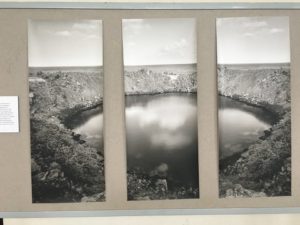
Despite all odds, someone in Hawaii was able to get an exhibit of photographs of the cleanup of Koho’olawe placed on the third floor of the Hawaii Convention Center. There was no sign announcing the exhibition, just a series of photos with some explanation. In five days of attending the conference, I observed that 95 percent of the conference attendees who walked past the exhibition did not stop to look at it – until I stopped them and explained what it was about. Then, they were very interested.
A crater that was created on the Hawaiian island of Koho’olawe from massive explosions of TNT in 1965. (Photo from Hawaii Archive)
From 1941 to 1990, the island of Koho’olawe was used as a bombing range for U.S. military aircraft and naval vessels. One photograph in the exhibition showed the crater called “Sailor’s Hat” which was made by several massive explosions of TNT in 1965 to recreate and study the effects of large explosions on nearby ships and personnel to simulate in some manner the effects of a nuclear explosion. The crater affected the island’s fresh water aquifer and now no artesian water remains on the island.
After Hawaiians stopped the bombing through their protests and by staying on the island during bombings from the 1970s, the U.S. Navy returned Koho’olawe to the State of Hawaii in 2004 after a 10-year clean-up process. But only 66 percent of the surface has been cleared of unexploded ordnance (UXO), and only 10 percent cleared to a depth of 4 feet. Twenty-three percent of the surface remains uncleared and 100 percent of the waters surrounding the island have not been cleared of UXO, putting divers and ships at risk.
Okinawan Environmental Activists
Environmental activists from Okinawa had a booth at the IUCN at which they told about the attempt of the U.S. military and the national Japanese government to construct a runway complex into Oura Bay, a pristine marine area that that is the home of the protected species of marine mammal, the dugong.
The Deputy Governor of Okinawa and the Mayor of Nago city, Okinawa, both of whom have been key figures in the grassroots campaign to stop the construction of the runways and the lawsuits filed by the provincial government of Okinawa against the federal Japanese government, gave presentations about the citizens’ struggle against the construction of the runways.
However, there was no mention of the environmental effects on the marine environment from the construction of a huge new naval base on Jeju Island, South Korea, the site of the previous IUCN conference four years ago. At that conference, IUCN, no doubt at the request of the South Korean government, refused to allow citizen activists to have a booth inside the convention or make presentations like the Okinawans did this year. As a result, the Jeju Island campaigners were forced to stay outside the conference site.
Four years later in the 2016 WCC conference in Hawaii, the Government of Japan and the Province of Jeju Island sponsored a large multi-media pavilion about Jeju island which did not mention the construction of the new naval base and the destruction of the cultural heritage of the site nor the displacement of women divers who had dived at the location for generations.
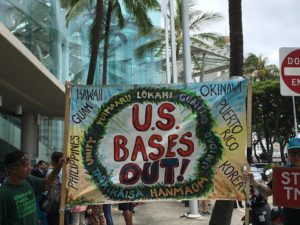
On Sept. 3, local groups in Honolulu came to the Hawaii Convention Center with signs to remind the IUCN of the U.S. militarization of Asia and the Pacific. Signs and posters from local environmentalists cited the environmental impact from the huge 108,863-acre Pohakuloa bombing range on the Big Island of Hawaii, the largest U.S. military installation in the Pacific; the Aegis missile test center on the island of Kauai; and the four large U.S. Army, Navy, Air Force and Marine bases on the island of Oahu.
Other signs referenced the extensive number of U.S. military bases in Japan, Okinawa, South Korea, Guam and new U.S. military installations in the Philippines and Australia.
Ann Wright served 29 years in the US Army/Army Reserves and retired as a Colonel. She also served 16 years as a US diplomat in US Embassies in Nicaragua, Grenada, Somalia, Uzbekistan, Kyrgyzstan, Sierra Leone, Micronesia and Mongolia. She was on the small team that reopened the US Embassy in Kabul, Afghanistan in December 2001. She resigned from the US Department of State in March 2003 in opposition to the war on Iraq.
President Barack Obama has opted to ratchet up military tensions in Asia as one of his last foreign policy acts as president of the United States. Using climate change and free trade backdrops at the G20 Summit in Hangzhou, China and the U.S.-ASEAN and East Asia Summits in Vientiane, Laos as mirages intended to mask his aggressive military posture in the Asia-Pacific region, Obama seeks to cement his «pivot to Asia». It is Obama’s sincere hope that his anticipated successor, his former Secretary of State, Hillary Clinton, will expand on the expansionistic and aggressive regional showdown with China and Russia that his administration launched with his Asia «pivot».
The ultra-protocol conscious Chinese threw diplomacy and decorum to the wind when Obama touched down at Hangzhou International Airport and his national security adviser Susan Rice and deputy national security adviser became embroiled in an argument with Chinese security personnel. When White House officials traveling with Obama began issuing orders to the Chinese personnel, one Chinese official yelled at them, «This is our country. This is our airport». It was as if the Chinese, realizing that this would be their last encounter with Obama as president, were letting him and his war hawk national security team know who was the boss as long as they were on Chinese soil. At least on the tarmac at Hangzhou International Airport, the Chinese swung Obama’s Asia «pivot» back to China.
It was an ignominious final «haj» for Obama’s anti-Chinese jihad. Obama began his presidency in 2009 with being awarded, incredibly prematurely as it turned out, the Nobel Peace Prize. For the Asia-Pacific region, Obama’s presidency would end with angry words between his aides and Chinese officials at a Chinese airport.
Obama began his journey as the host for Pacific Island leaders at the Central Intelligence Agency front, the East-West Center, which is located at his mother’s alma mater, the University of Hawai’i. Obama was the official host at the 2016 Pacific Islands Conference (PIC) of Leaders at the CIA-linked center. Obama’s speech before the leaders, many from small Pacific island states, focused primarily on global climate change. Obama also addressed the World Conservation Congress at their meeting in Hawai’i.
Obama was schooled in anti-Chinese bigotry and Cold War fear tactics by his CIA mother and right-wing fascist Indonesian army stepfather while a child in post-1965 coup Indonesia. Obama, who is fully aware that the blood of 800,000 to one million Indonesians, Communists and ethnic Chinese Indonesian nationals, flowed in the streets, canals, and rivers of Indonesia from 1965 to 1967, the year he and his mother arrived in the country, believes it his birthright and duty to continue his familial “jihads” against «Communist» China that were instilled in him as a child, teen, and college student by his CIA-connected parents.
Papua New Guinea’s Prime Minister, Peter O’Neill, tipped off the press about the real purpose of the PIC before he departed Port Moresby for Hawai’i. O’Neill, who is in charge of one of Papua New Guinea’s most corrupt governments since independence in 1975, said that “regional security” shared the bill with climate change at the Hawai’i conference. In addition to independent Pacific Island states, the PIC includes the U.S. territories of American Samoa, Guam, Northern Marianas, and the state of Hawai’i.
U.S. Army Assistant Chief of Staff Colonel Tom Hanson, a relatively low-level official to be issuing policy statements, gave an ultimatum to Australia just prior to Obama’s departure for Hawai’i and Asia. Hanson told the Australian Broadcasting Corporation, “I think the Australians need to make a choice … it’s very difficult to walk this fine line between balancing the alliance with the United States and the economic engagement with China.” The statement chilled U.S.-Australian relations prior to Obama’s meeting with Australian Prime Minister Malcom Turnbull at the G20 summit.
Also on Obama’s agenda was pressuring certain PIC leaders who have shown signs of resisting the political status quo imposed by Washington. Northern Marianas Governor Ralph Torres, a Republican, recently signed into law the Second Marianas Political Status Commission that seeks to re-evaluate the islands’ current neo-colonial status imposed by the agreement that transformed the Northern Marianas into a colony where Asian sweat shops predominate and where those of Northern Marianas descent have little say over their domestic affairs. The Pentagon wants to turn the island of Tinian into a live-fire range, a decision that imperils the 3,000 residents of the island.
Another U.S. colony, Guam, has seen the growth of a Commission on Decolonization and an Independence for Guahan Task Force. Guahan is the proper Chuukese name for Guam.
Obama, a product of U.S. imperialist control over Hawai’i, the importance of which for Washington is solely military, has done everything possible to subvert and suppress the anti-colonial aspirations of the Pacific islands under U.S. domination and political influence.
The Obama administration has also been exercising subtle pressure on the Federation of Micronesia, a quasi-independent former U.S. Trust Territory, to deter movements for independence from the island groups of Chuuk and Yap. Under the Compact of Free Association, the U.S. effectively controls Micronesia and reserves the right o build military bases, through the federal government of Micronesia located in Pohnpei. Chuuk and Yap accuse Pohnpei of ignoring their own interests. Similar neo-colonialist “compacts” are in effect with the other former U.S. trust territories of the Marshall Islands, where the U.S. maintains a missile test range, and Palau, where the U.S. would like to build a naval base.
After departing Hawai’i for Asia, Obama stopped at the U.S.-controlled Midway Island, where he expanded the Papahānaumokuākea National Monument, a major marine wildlife sanctuary. However, the national monument, in addition to being the world’s largest marine sanctuary, also extends the protected wildlife area to the limits of America’s exclusive economic zone (EEZ). Ironically, it was China’s extension of its EEZ around disputed islands in the South China Sea, that resulted in Obama ratcheting up regional military confrontation with China.
Obama’s visit to another monument on Midway Island, the one honoring America’s decisive defeat of Japan in the Battle of Midway of 1942, had little to do with protecting sea turtles, albatrosses, and tiger sharks and everything to do with proclaiming America’s resolve to maintain the Pacific Ocean as an «American lake». The message to China and Russia could not have been more stark regardless of the masking of Obama’s military message with climate change and environmental optics.
Obama’s marine conservation visit to Midway is also suspicious. Under Obama’s neo-Cold War tactics, the United States is reopening abandoned or expanding previously scaled-down military bases in Iceland, Greenland, the Aleutian Islands of Shemya and Attu, Guam, American Samoa, and the Philippines. Midway, a former U.S. base, may also be see a renewed active military presence as part of Obama’s jihads against China and Russia. Midway Atoll is literally owned by the U.S. Interior Department. However, Midway’s Henderson Field is maintained as an active airport — which was capable of landing Obama’s Air Force One Boeing 747 — by a private company, American Airports Corporation. The company operates a number of airports in the western United States that were used to film some of the most jingoistic U.S. television shows, including the CIA propaganda series «24» and the U.S. Navy puffery series «JAG».
Obama, whose presidency has been buoyed by money and sycophancy from Hollywood, perhaps sees himself as not only waging a personal jihad against China and Russia but as a future action film star. It is a preferable option since as a movie star, Obama will only be able to wage fictional wars on movie sets.
An elitist, nationalist, bias dominates all areas of Canada’s paper of record.
On the front of last weekend’s Style section the Globe and Mail profiled Sonja Bata on turning 90. Business partner and wife of the deceased Thomas Bata, the Globe lauded Sonja for the “many contributions she has made to Canada”, including the Bata Shoe Museum and various other establishment “cultural, environmental and social causes.” The article touched on the shoemaker’s early history and described how she “traveled the world building a shoe empire – between 1946 and 1960, 25 new factories were built and 1700 Bata stores opened.”
While the three-page spread included an undated photo of Sonja and her husband on the “African continent”, it ignored how the Toronto-based shoe company took advantage of European rule to set up across the continent. By the end of the colonial era Bata had production or retail facilities in Nigeria, Kenya, Morocco, South Africa, Egypt, Sierra Leone, Libya, Sudan, Algeria, Senegal, Congo, Tanzania, Rhodesia and elsewhere. In the 1940s and 50s, notes Shoemaker with a Mission, “the organization’s expansion was especially great in francophone Africa. As Mr. Bata himself noted, there was no country in that part of the world where his company was not established as the number-one supplier of footwear.” While “Mr. Bata” may not be the most objective source on the shoemaker, a government study just after independence found the company controlled 70% of the footwear market in British East Africa (Kenya, Uganda and Tanzania).
In a 1974 Saturday Night article titled “Canadians Too, Can Act like Economic Imperialists”, Steve Langdon describes the company’s operations in Kenya: “Bata seems to be undercutting decentralized rural development in Kenya, to be blocking African advance in other areas, and to be throwing its weight around politically — all at a handsome profit.” In a bid to subvert the establishment of a domestic competitor, the Toronto-based multinational wrote its overseas suppliers to discourage sales to its challenger and asked Kenyan government officials to intervene on its behalf.
Bata’s mechanized production methods squeezed out indigenous footwear producers all the while increasing imports of plastics and machinery, which came at the expense of local materials (leather) and employment. In the 1975 article Canada’s Relations with Africa Robert Matthews notes that Bata drained “money and opportunity from poor rural areas” to the benefit of a small group of locals and the Toronto head office.
When the post-independence Tanzanian government announced that it would acquire a 60 percent share of a multitude of major foreign firms Bata was the only hold out. The Toronto firm attempted to sabotage Tanzania’s push to acquire a controlling interest in the local company’s operations. In Underdevelopment and Nationalization: Banking in Tanzania James H. Mittelman explains: “Bata Shoes (a Canadian-based concern), for example, ran down stocks, removed machinery, supplied imperfect items, and later withdrew all staff, supposedly closing down for annual repairs! The Company refused to relinquish more than 49 per cent of its controlling interests, tried to set up a new wholesaling operation dependent on its firm in Kenya, and urged other foreign investors to fight.”
Bata’s aggressive reaction to Tanzania’s efforts aimed to dissuade other newly independent African countries from following a similar path. The shoemaker no doubt feared for its significant operations across the continent.
Bata received Canadian government support as well. In mid-1973 the Canadian High Commissioner in Nairobi visited Uganda to ask Idi Amin if he would attend the annual Commonwealth Heads of Government Meeting taking place in Ottawa. But, the primary objective of the high commissioner’s meeting was to convince Amin to reverse his nationalization of Bata. A cable published by WikiLeaks read: “CANADIAN HIGH COMMISSIONER OLIVIER MET WITH PRESIDENT AMIN JUNE 29 TO DISCUSS GOU TAKE-OVER OF BATA SHOE FIRM. AMIN REVERSED EARLIER DECISION AND ORDERED THAT A NEW PARTNERSHIP ARRANGEMENT (51 PERCENT BATA, 49 PERCENT GOU) BE WORKED OUT.”
Through the 1970s Bata worked under the white regime in Rhodesia (Zimbabwe). It broke sanctions against Rhodesia by exporting goods manufactured there to South Africa. Even more controversial, it operated in apartheid South Africa until the late 1980s. The company broke unions and blocked black workers from semiskilled, skilled and executive positions. Listed among the “hardline defenders of investment in South Africa” in Ambiguous Champion: Canada and South Africa in the Trudeau and Mulroney years, Bata faced an international boycott campaign. During this period Sonja Bata was quoted in the Canadian media justifying the company’s South African policy and Thomas Bata proclaimed “we expanded into Africa in order to sell shoes, not to spread sweetness and light.”
The Globe and Mail is exposing its elitist, nationalist, bias in ignoring Bata’s unsavory history.
Yves Engler’s latest book is Canada in Africa: 300 years of Aid and Exploitation.
It’s a little strange to write a fact sheet about a term that actually has no meaning.
That’s right – there’s no real definition of a “run-of-river” hydro project. As our former director, Patrick McCully, once said of run-of-river hydro, “It’s a sort of Alice in Wonderland, ‘it means exactly what I want it to mean’ term.”
Simply put, run-of-river (ROR) hydro projects have limited storage capacity as compared to conventional storage dams. But there, the clarity ends. The term has been applied to everything from micro-hydro projects providing electricity in remote villages to the Belo Monte mega-dam in Brazil, which will devastate an extensive area of the Brazilian rainforest, displace over 20,000 people, and threaten the survival of indigenous tribes that depend on the river.
One World Bank insider told me that Bank officials often misuse the term as short-hand for “low-impact.” That kind of imprecision lulls officials and the public into thinking ROR projects are the silver (or green) bullet: hydro projects that produce power but without the negative impacts. Because the term sounds so innocuous, ROR projects usually don’t get the level of scrutiny they require. And the truth is, run-of-river dams are anything but low-impact.
Preparing our new fact sheet, “Swindling Rivers,” I’ve learned a lot about run-of-river hydro, the different forms it takes, and the significant impact ROR projects can have:
The Himalayas are perforated by run-of-river tunnels where river flows are diverted to powerhouses, bypassing river channels for often dozens of kilometers. India’s Teesta River is undergoing a ROR boom that, once complete, will see more of the river flow though tunnels than the river channel itself. These ROR schemes divert some, or even all, of a river’s flow, often causing changes to a river’s temperature, velocity and depth that can completely kill off the natural life in a river.
At the same time, so-called “peaking” ROR projects are wreaking havoc on communities and aquatic life. Unlike the diversion tunnels, these projects often store a river’s flows behind a dam during the day, only to be released all at once in the evening to generate power during peak energy demand. These daily fluctuations between drought and flood are incredibly disruptive to river ecology. More tragically, these unexpected releases have made drownings a common occurrence for downstream communities in India.
And just like traditional dams, all run-of-river projects stymie the life cycle of migratory fish.
A new feature in The Economist highlights the perils of dam construction on one of the world’s greatest waterways, the Mekong River, where Laos is currently building the Xayaburi and Don Sahong Dams. These would be the first two of eleven dams planned on the lower mainstream of the river, all of which are classified as “run-of-river” projects, despite sizeable reservoirs. Laos’ downstream neighbors fear the dams’ impacts on fish populations and agriculture that sustain the livelihoods and food security of millions and have voiced strong concerns over the projects. The Government of Laos, in return, has pointed to the fact these projects are run-of-river in an attempt to downplay concern over their impacts. If the full suite of dams is constructed, they would transform more than half of the vibrant river into a series of stagnant reservoirs.
But the concerns are not going away. In fact, they were recently echoed in an article in the prestigious magazine Science, which raised the alarm about the threat of major biodiversity losses by run-of-river projects on the world’s great rivers – the Mekong, the Amazon and the Congo.
In short, there’s nothing innately better about run-of-river projects. If anything, the term is a greenwash for some deeply destructive projects. The upshot? Don’t be fooled by the name: All ROR projects deserve the same exacting scrutiny as any other dam.
By Donald Neff | Washington Report On Middle East Affairs | January 1996
On January 4, 1948, Jewish terrorists drove a truck loaded with explosives into the center of the all Arab city of Jaffa and detonated it, killing 26 and wounding around 100 Palestinian men, women and children.[1] The attack was the work of the Irgun Zvai Leumi – the “National Military Organization,” also known by the Hebrew letters Etzel – the largest Jewish terrorist group in Palestine. The Irgun was headed by Revisionist Zionist Menachem Begin and had been killing and maiming Arabs, Britons and even Jews for the previous ten years in its efforts to establish a Jewish state.
This terror campaign meant that at the core of Revisionist Zionism there existed a philosophical embrace of violence. … continue
This site is provided as a research and reference tool. Although we make every reasonable effort to ensure that the information and data provided at this site are useful, accurate, and current, we cannot guarantee that the information and data provided here will be error-free. By using this site, you assume all responsibility for and risk arising from your use of and reliance upon the contents of this site.
This site and the information available through it do not, and are not intended to constitute legal advice. Should you require legal advice, you should consult your own attorney.
Nothing within this site or linked to by this site constitutes investment advice or medical advice.
Materials accessible from or added to this site by third parties, such as comments posted, are strictly the responsibility of the third party who added such materials or made them accessible and we neither endorse nor undertake to control, monitor, edit or assume responsibility for any such third-party material.
The posting of stories, commentaries, reports, documents and links (embedded or otherwise) on this site does not in any way, shape or form, implied or otherwise, necessarily express or suggest endorsement or support of any of such posted material or parts therein.
The word “alleged” is deemed to occur before the word “fraud.” Since the rule of law still applies. To peasants, at least.
Fair Use
This site contains copyrighted material the use of which has not always been specifically authorized by the copyright owner. We are making such material available in our efforts to advance understanding of environmental, political, human rights, economic, democracy, scientific, and social justice issues, etc. We believe this constitutes a ‘fair use’ of any such copyrighted material as provided for in section 107 of the US Copyright Law. In accordance with Title 17 U.S.C. Section 107, the material on this site is distributed without profit to those who have expressed a prior interest in receiving the included information for research and educational purposes. For more info go to: http://www.law.cornell.edu/uscode/17/107.shtml. If you wish to use copyrighted material from this site for purposes of your own that go beyond ‘fair use’, you must obtain permission from the copyright owner.
DMCA Contact
This is information for anyone that wishes to challenge our “fair use” of copyrighted material.
If you are a legal copyright holder or a designated agent for such and you believe that content residing on or accessible through our website infringes a copyright and falls outside the boundaries of “Fair Use”, please send a notice of infringement by contacting atheonews@gmail.com.
We will respond and take necessary action immediately.
If notice is given of an alleged copyright violation we will act expeditiously to remove or disable access to the material(s) in question.
All 3rd party material posted on this website is copyright the respective owners / authors. Aletho News makes no claim of copyright on such material.
 Aletho News
