There’s Nothing Parochial About the Issue of GMO Food Labeling
By Jonathan Latham, PhD | Independent Science News | January 24, 2017
The GMO labeling issue has quieted down some but there is still plenty to discuss. Just this week the USDA proposed its definition of a GMO for labeling purposes and it includes loopholes for gene editing. However, it is also possible for reasonable people to imagine that GMO labeling is a sideshow to the real business of the food movement. After all, most GMO foods and GMO crops are visually indistinguishable from non-GMOs, and tiny non-GMO labels can look pretty irrelevant on the side of a soda bottle containing whole cupfuls of sugar. Last week, Michael Pollan, Olivier de Schutter, Mark Bittman and Ricardo Salvador made that error, calling GMO labeling “parochial.” Granted, they wrote “important but parochial”, but qualifying the significance of GMO labeling in any way was a mistake.
The first issue is that GMOs are legally distinct from non-GMO crop varieties. They possess an enhanced legal status that has enabled GMOs to become a gushing profit centre for agribusiness. These rights not only allow their owners to steer farmers’ herbicide use, which also increases profits, they can also legally prevent independent research which would otherwise show up their advertising claims. The share price of Monsanto reached $142 in 2008, reflecting the enormous profitability of massively increasing seed prices on the back of GMO introductions.
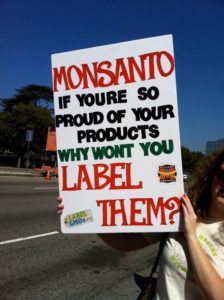
California Proposition 37
Those profits have in turn fuelled a set of key agribusiness activities. One was the acquisition of almost the entire independent global seed business, which now resides in very few hands. The second was a cluster of enhanced PR and lobbying activities that were necessary to defend GMOs. Rather than hide in the shadows agribusiness corporations needed to come out swinging in defence of the indefensible, which necessitated, among other things, a much higher degree of control than previously over teaching content and research at public universities.
Thus their special legal status enabled an unprecedented ability to control both the present and the future of agriculture.
GMOs are also conflated with science and thus progress. They have the intellectual role of presenting agribusiness as the innovative and dynamic frontier of agriculture, in contrast to those people who base their efforts on ecological diversity, local expertise, or deep knowledge. This cutting edge image is key to the agribusiness business model of reaping tax breaks and subsidies (Lima, 2015).
All around the world, taxpayer money supports and subsidises agribusiness without which benefits it would not exist (Capellesso et al., 2016). In the final analysis, however, the GMOs-as-progress argument is circular. Agribusiness is innovative because it uses GMOs and GMOs show how innovative they are. Smoke and mirrors, but politicians fall for it every day, delivering massive transfers of wealth every year from the public to the private sector (Lima, 2015).
The biological truth of GMOs is equally disturbing. At one end of the food chain are the crops in the field. Many people have noticed the virtual disappearance of Monarch butterflies. There are three leading explanations of this disappearance. The loss from farmland of their larval host plants, milkweeds, is one possibility; poisoning of their caterpillar larvae after consuming insecticide-filled pollen from Bt insect-resistant GMOs is a second; and toxicity from the neonicotinoid pesticides used to treat GMO seeds is the third. The first two both stem directly or indirectly from GMO use in agricultural fields since before GMOs, milkweeds could not be eradicated and now they can. Most likely is that all three causes are true and that along with milkweeds GMO agriculture also decimated, or eradicated entirely, many other species too.
Monarchs are lovely, but they are not otherwise special. Their significance is as sentinels. Planting milkweeds and pollinator way stations to specially preserve a sentinel species does not rescue an agricultural ecosystem, but it will mask the symptoms. Agribusiness is right now hoping that no one will notice the difference, and that by bringing back monarchs it can obscure the facts of their killing fields.
Internationally too, GMOs threaten to transform agriculture in places like India where millions of people who make a living by labouring in fields could be displaced by herbicide-tolerant crops such as mustard.
At the human consumption end of the food chain, if you live in the US, no one is protecting you from potential health hazards due to GMOs. Makers of GMO crop varieties don’t even have to notify the FDA of a new product. And if the maker deems the product is not a pesticide they don’t have to notify the EPA either. Trump won’t make it worse because it can’t be worse. It is non-partisan contempt for public health.
What are those potential health hazards? One important example is the famous (or infamous) rat study of NK603 corn by the French research group of professor Gilles-Eric Séralini . It is the only longterm study of the effects of GMOs on a mammal. If you ignore the tumours that most people focused on, the study found major kidney and liver dysfunction in the treated animals (Séralini et al., 2014). This dysfunction was evident from biochemical measurements and was also visually apparent under the microscope. These results are of no interest to US regulators, even in principle, since they fall between jurisdictions.
From this we can conclude that GMOs are often harmful, directly and indirectly, and further, that they are the leading edge of the business model of agribusiness.
The question, however, was labeling. Imagine that organic food was not allowed to be labeled. Would there be such an organised and powerful challenge to industrial food? What labeling does for the agriculture and food system is to allow the public to express its dismay and disagreement with the direction of corporate agriculture and assert their democratic rights to protect themselves. Labeling allows the public to engage with specific policies and products within the vast complexity of the food system and push back in a focused way against corruption and dishonesty, in real time. There aren’t too many chances to do that in America today.
References
Capellesso AJ, Ademir Antonio Cazella, Abdon Luiz Schmitt Filho, Joshua Farley, and Diego Albino Martins (2016) Economic and environmental impacts of production intensification in agriculture: comparing transgenic, conventional, and agroecological maize crops. AGROECOLOGY AND SUSTAINABLE FOOD SYSTEMS 40: 215–236. Lima T. (2015) Agricultural Subsidies for Non-farm Interests: An Analysis of the US Agro-industrial Complex. Agrarian South: Journal of Political Economy 4(1) 54–84o-industrial Complex
Séralini G-E, Emilie Clair, Robin Mesnage, Steeve Gress, Nicolas Defarge, Manuela Malatesta, Didier Hennequin and Joël Spiroux de Vendômois (2014) Republished study: long-term toxicity of a Roundup herbicide and a Roundup-tolerantgenetically modified maize. Environmental Sciences Europe 26:14 DOI: 10.1186/s12302-014-0014-5
Federal Regulator Halts Move to Toughen Radiation Exposure Limits
By John Laforge | CounterPunch | January 13, 2017
Work has been halted on two rulemaking projects that would have reduced the amount of radiation the government permits workers and the public to be exposed to without their consent. The improved limits would have been in line with internationally accepted standards, Bloomberg BNA reports. A Nuclear Regulatory Commission announcement says stopping the process of setting stricter radiation exposure limits was “due to the high costs of implementing such changes.” The purpose of the NRC is to protect public and nuclear worker health and safety, but this time it’s just saving money for the nuclear industry.
The cancellation of two unfinished and long-overdue precautionary improvements, noted in the Dec. 27 Federal Register, came as a shock to nuclear industry watchdogs who have campaigned for increased radiation protection since 1990. That year, the International Commission on Radiological Protection (ICRP) recommended that radiation industry worker exposures be reduced by three-fifths, from 50 milliSieverts per year to 20 milliSieverts per year. (A milliSieverts is a measure of the body’s absorption of radiation.) The recommendation has never adopted by the United States. Based in Ottawa, Ontario, ICRP sets standards used worldwide as the basis for radiological protection, working to reduce cancer and other diseases caused by radiation exposure.
Ed Lyman, with the Union of Concerned Scientists, told Bloomberg BNA the termination of these projects “makes the US look out of step with the rest of the world. It makes it look like we’re basing our regulations on obsolete information.” Jerry Hiatt, with the industry lobbying group Nuclear Energy Institute, was relieved by the NRC move telling Bloomberg that existing rules were adequate, and that it’s unnecessary to reduce currently permitted exposures.
The rulemaking project was begun by the NRC staff in 2008 and was intended to update the country’s radiation protection standards in accordance with ICRP’s international standards, primarily with respect to radiation dose. The NRC staff had previously recommended that the commission reduce the total radiation worker exposure from 50 milliSieverts-per-year to 20 milliSieverts-per-year — in line with the ICRP’s 1990 global recommendation. However, the NRC rejected the recommendation.
The NRC’s decision not to align permitted radiation exposures with those of the ICRP is the equivalent of “throwing out one of the most significant changes to get the US in step with the rest of the world,” Lyman said. The commission formally approved the stop-work orders in April, but it only notified the public on Dec. 27.
The NRC also decided to stop work on a second rulemaking which would have brought the US in line with international rules regarding daily releases of radioactive waste water from nuclear reactors. By way of explanation, the NRC said, its current standard “continues to provide adequate protection of the health and safety of workers, the public and the environment.”
Over the last 70 years, permitted radiation exposure limits for workers and the public have dramatically decreased as science has come to better understand the toxic and cancer-causing properties of low doses.
In its 2012 pamphlet “Radiation Exposure and Cancer” the NRC acknowledges that, “[A]ny increase in dose, no matter how small, results in an incremental increase in risk.” Likewise, the National Academy of Sciences, in its latest book-length report on the biological effects of ionizing radiation BEIR-VII, says: “[L]ow-dose radiation acts predominantly as a tumor-initiating agent,” and that “[T]he smallest dose has the potential to cause a small increase in risk to humans.” And the US Environmental Protection Agency agrees, “[A]ny exposure to radiation can be harmful or can increase the risk of cancer … In other words, it is assumed that no radiation exposure is completely risk free.”
But today, when the international standard dose limit is less than half what our own government allows, it’s the radiation industry shareholders that are being protected by the NRC, not public health and safety.
Join the debate on Facebook
John LaForge is a Co-director of Nukewatch, a peace and environmental justice group in Wisconsin, and edits its newsletter.
Thatcher Wanted to Infest Peru With Coca-Eating Moths: New Docs
teleSUR | December 30, 2016
Margaret Thatcher wanted to eradicate cocaine in Peru with moths, according to newly-released documents, which also reveal the then-British government’s top-secret strategy in combating acid house parties and soccer hooligans.
Her peer in the Labour Party, Lord Victor Rothschild, suggested in 1989 that to tackle drug production in Peru, “One might think of aerial sprays, with or without the connivance of the government concerned; and various other methods of introduction, covert as well as overt.”
The moth, Eloria noyesi, is known for its exclusive diet of the coca plant. “While virtually everyone agrees that those who take cocaine or crack, in the various ways available, should be punished, everyone, I think, agrees that it is the ‘drug baron’ who must be mercilessly ‘put down,’” Rothschild also added.
Thatcher found the “most intriguing idea” to be “characteristically brilliant” and an “ingenious solution,” she responded in a letter released Friday by the National Archives in Kew.
However, the plan was never executed because it lacked cooperation from the Peruvian government.
Other declassified documents describe plans to allow law enforcement to attack anti-nuclear “demonstrators or terrorists” and “as a last resort, open fire to prevent a perceived threat of sabotage not only to nuclear warheads but also to the submarine.”
Multiple documents also detail moves against soccer hooligans with the aim of “excluding troublemakers from football grounds,” who represent “a serious blemish on our society” that are “destroying the game as family entertainment.”
Another signature fight from Thatcher revealed in the documents is her war on Acid House parties, the 1980s’ underground equivalent of raves. Private correspondence claims her uncle was “very disturbed” by the parties and that police had a “feeling of collective anger and helplessness” when they were unable to shutdown the raves.
Ecuador to Investigate NGO for Supporting Amazon Anti-Mining Violence
teleSUR | December 22, 2016
Ecuador has warned that an environmental group, accused of supporting violent acts that left one police officer dead and another with life-threatening injuries amid Indigenous protests against a Chinese mining company in the Amazon, is being investigated and could have its legal status removed.
Accion Ecologica was notified Tuesday by the Ministry of Environment that administrative proceedings would be starting against the group which is accused of supporting “mobilizations that promote discord and confrontations with the police,” Ecuador’s Ministry of Interior said.
Accion Ecologica has been accused of supporting recent violent protests reportedly carried out by the section of the Shuar Indigenous group which attempted to occupy territory in the area where Chinese mining company Explorcobres, in charge of a copper mining project in Ecuador’s Amazon rainforest, is operating.
On Dec. 14, a group of people in the town of San Carlos de Tanantza, in the province of Morona Santiago, killed a police officer, injured five others, as well as two military members, during a protest against the mining project.
Security officials said that a group of 80 people, believed to be part of a Shuar community fired at police guarding the Explorcobres camp, after the group had already attempted on a number of occasions to enter the area. The government is holding six people in detention over the incidents, which also left another officer seriously injured.
Ecuador has rules governing NGOs that say that they should fulfill the mandate of the mission in their legal documents, and government officials say that Accion Ecologica has moved away from its original peaceful goals of environmental advocacy and that its support of recent violent protests could undermine the country’s security and peace.
Ecuador began registering and regulating NGO’s, given the history of interference from foreign governments using NGO’s to meddle in the country’s affairs.
The Ministry of Interior said that all environmental groups are free to “express their ideas,” but are not permitted to “make an apology for criminal actions or engage in political action apart from the function they registered in the defense of nature.”
In a statement, Accion Ecologica responded to the accusations by the Ministry of the Environment maintaining that “We have been scrupulous in our compliance with the law,” and that their lobbying complies with the country’s environmental management guidelines. In response, the group has taken to social media with the hashtag #SOSAccionEcologica, echoing the “SOS” taglines used by opposition groups to the region’s left-wing governments.
UN Demands ‘Israel’ to Pay Lebanon More than $850 Million for 2006 “Oil Slick”
Al-Manar | December 23, 2016
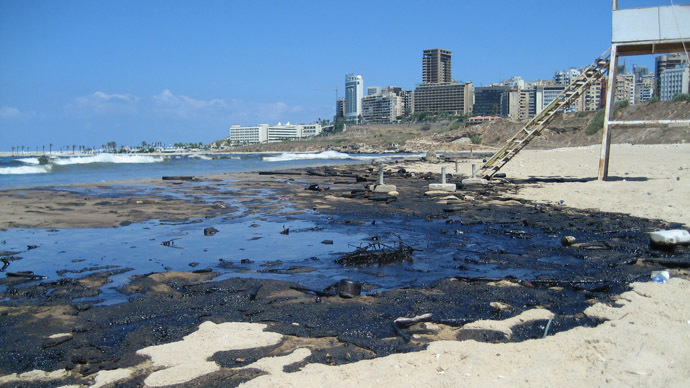
The United Nations General Assembly adopted a resolution titled “Oil slick on Lebanese shores” urging the Zionist entity to pay Lebanon some $850 mn compensation to cover the clean-up cost of an oil spill caused by the Zionist July 2006 war on the country.
The UNGA voted 166 in favor of the non-binding resolution to 8 against (Australia, Canada, the Zionist entity, Marshall Islands, Federated States of Micronesia, Nauru, Palau, United States), with 7 abstentions (Cameroon, Democratic Republic of Congo, Honduras, Papua New Guinea, South Sudan, Tonga, Vanuatu).
Taking into account the 1992 Rio Declaration on Environment and Development, which in principle requires the polluter to pay environmental damage costs, the assembly found the Zionist entity guilty of the July 15, 2006 environmental disaster.
The disaster was caused by a Zionist strike on the oil storage tanks in the direct vicinity of the Jiyeh electric power plant in Lebanon. As a result an oil slick covered the Lebanese coastline entirely, stretching all the way to the Syrian coastline.
By that text, the Assembly considered that the oil slick had heavily polluted the shores of Lebanon with 15,000 tons of oil and partially polluted Syrian shores and consequently had serious implications for the Lebanese economy.
The Assembly decision followed the assessment report by Secretary-General Ban Ki-moon which stipulated the value of damage to be $856.4 million. Now the Assembly is asking the Zionist entity to provide “prompt and adequate compensation.”
The oil slick made by the spill “has had serious implications for livelihoods and the economy of Lebanon,” the resolution read, accounting for inflation of a October 2007 estimate by the United Nations Secretary General that reported the spill caused $729 million in damage.
Lebanon bore the brunt of the spill, but the Syrian coast and other Mediterranean countries suffered as well, the UN said, asking Lebanon to continue clean-up efforts and the international community to increase funding for its environmental restoration.
The resolution noted that the UN chief expressed “grave concern at the lack of any acknowledgment on the part of the government of Israel of its responsibilities vis-a-vis reparations and compensation” to Lebanon and Syria for the oil spill.
Lebanon’s permanent representative to the UN Nawaf Salam hailed the resolution and called it a “major progress.”
“We affirm that Lebanon will continue to mobilize all resources and resort to all legal means to see that this resolution is fully implemented, and that the specified compensation is paid promptly,” he said.
“This resolution also paves the way for further compensation into other areas of damage (health, ecosystem services as habitat, potential groundwater contamination, and marine diversity), that were not considered in the current calculated amount,” Salam added.
For its part, the Zionist mission to the UN rejected the resolution, expressing wonder that it does not cover the environmental damage which occurred in the northern occupied territories following the attack on Lebanon, claiming that the entity launched the July 2006 war on the country as “a consequence.”
The Zionist entity waged a brutal 33-day war on Lebanon in July 2006, killing hundreds of Lebanese people and leaving serious damage to vital infrastructure. The war ended by a UN 1701 resolution which urged the Zionist entity to halt hostilities and withdraw behind the blue line drawn by UN forces after the liberation of most occupied Lebanese southern territories in May 2006.
Washington state sues Monsanto over ‘omnipresent and terrifically toxic material’
RT | December 9, 2016
PCB pollution is in “every waterway in the state,” Washington Attorney General Bob Ferguson said as he announced a lawsuit against Monsanto. It is the first time the agricultural biotech giant has ever been sued by a state.
Polychlorinated biphenyls, or PCBs, have been at the heart of multiple lawsuits brought against the multinational agrochemical corporation Monsanto by Seattle and Spokane, Washington, as well as cities in California and Oregon. However, this Thursday marked the first time a state government has sued the company over the potentially carcinogenic chemicals.
The lawsuit, which seeks monetary restitution for damages and cleanup caused by the use of PCBs, was filed in King County Superior Court. Washington Governor Jay Inslee (D) and the state’s Attorney General Bob Ferguson jointly announced the lawsuit in a press conference, claiming that Monsanto knew for years that it was polluting bays, lakes and rivers when it used the chemicals in coolants, hydraulic fluids, paints and sealants, Associated Press reported.
A win for the state could potentially reap hundreds of millions of dollars from Monsanto as well as two subsidiaries, Solutia Inc. and Pharmacia LLC.
Monsanto quit using PCBs when Congress banned them in 1979, but many say the damage had already been done and the chemicals’ impact are still felt today. From 1935 to 1979, Monsanto was the only company to produce PCBs, described by Ferguson as “one of the most pervasive pollutants in history,” the Seattle Post-Intelligencer reported.
Inslee called the chemicals “omnipresent and terrifically toxic,” adding that “one of the highest recorded [PCB concentrations] for any place on Earth” was in Washington’s southern resident orca population, according to the Post-Intelligencer.
The US Environmental Protection Agency classifies PCBs as a likely human carcinogen that also pose a risk of severe damage to the endocrine, immune, nervous and reproductive systems. Washington state’s Department of Health posted 13 different advisories against fish consumption due to risks of PCB pollution. Seattle’s Duwamish River is an EPA Superfund cleanup site, and one of its hazardous contaminants is PCB.
“Monsanto is responsible for producing a chemical that is so widespread in our environment that it appears virtually everywhere we look – in our waterways, in people and in fish – at levels that can impact our health,” Inslee said at the Thursday press conference, the Post-Intelligencer reported.
During the presser, Ferguson reportedly quoted from an internal Monsanto memo from 1937, which acknowledged lengthy exposure to PCB vapors having “systemic toxic effects.” Ferguson cited other records as well, charging that the corporation hid this sort of information from the public even though it knew of global PCB pollution in the 1960s.
Read more:
Monsanto’s ‘less-volatile’ dicamba herbicide receives quiet EPA approval
The Burning Bush
By Gilad Atzmon – December 2, 2010
Israel’s rural landscape is saturated with pine trees. These trees are new to the region. The pine trees were introduced to the Palestinian’s landscape in the early 1930s by the Jewish National Fund (JNF) in an attempt to ‘reclaim the land’. By 1935, JNF had planted 1.7 million trees over a total area of 1,750 acres. Over fifty years, the JNF planted over 260 million trees largely on confiscated Palestinian land. It did it all in a desperate attempt to hide the ruins of the ethnically cleansed Palestinian villages and their history.
Along the years the JNF performed a crude attempt to eliminate Palestinian civilisation and past but it also tried to make Palestine look like Europe. The Palestinian natural forest was eradicated. Similarly the olive trees were uprooted. The pine trees took their place. On the southern part of mount Carmel the Israelis named an area as ‘Little Switzerland’. By now, there is no much left of “Little Switzerland.”
However, the facts on the ground were pretty devastating for the JNF. The pine tree didn’t adapt to the Israeli climate as much as the Israelis failed to adapt to the Middle East. According to JNF statistics, six out of every 10 saplings planted did not survive. Those few trees that did survive formed nothing but a firetrap. By the end of each Israeli summer each of the Israeli pine forests become a potential deadly zone.
In spite of its nuclear ability, its criminal army, the occupation, the Mossad and its lobbies all over the world, Israel seems to be vulnerable. It is devastatingly alienated from the land it claims to own and care for. Like the pine tree, Zionism, Israel and the Israeli are foreign to the region.
China’s nuclear roll-out facing delays
China may scale down plans for nuclear power because of slowing demand for electricity and construction setbacks
By Steve Thomas – ChinaDialogue – 26.10.2016
For China’s nuclear industry, 2016 has been a frustrating year. So far, construction has started on only one new plant, and its target of bringing 58 gigawatts of nuclear capacity in service by 2020 seems impossible to meet.
At present, China has 19.3 gigawatts of nuclear supply under construction and a further 31.4 gigawatts already in service. Given that new plants take five years or more to build, the country faces a shortfall of more than seven gigawatts on its target.
All the plants started between 2008 and 2010 are online except for six imported reactors. These include four AP1000 reactors designed by Westinghouse, based in the USA but owned by Toshiba of Japan; and two European Pressurised Reactors (EPR), developed by Areva, a French multinational group specialising in nuclear power.
The plants are not expected to be completed before 2017 and all will be at least three years late, an unprecedented delay in China’s nuclear history. It would be surprising if China was not disillusioned with its suppliers and their technologies.
Technology problems
The EPR and AP1000 reactors have been problematic to build. The two EPRs are 3-4 years late although there is little available information detailing why. Meanwhile, EPR plants in Finland and France, which should have been completed in 2009 and 2012, respectively, will not be online before 2018.
There are no obvious problems that account for the majority of the delays at any of the sites, just a series of quality and planning issues that suggest the complexity of the design makes it difficult to build.
The four AP1000s are also running 3-4 years late. They are being built by China’s State Nuclear Power Technology Company (SNPTC), which has not built reactors before. There is some publicly available information about the problems suffered in China with the AP1000s, including continual design changes by Westinghouse. The reactor coolant pumps and the squib valves, which are essential to prevent accidents, have been particularly problematic, for example.
Still, China is expected to be the first country to complete construction of AP1000 and EPR designs, a scenario it did not expect or want. The government is required to develop and demonstrate test procedures for bringing the plants into service, which could take up to a year. These test procedures are developed by vendors and generally standardised although national safety regulators must approve them and can add specific requirements.
In 2014, a senior official at China’s nuclear safety regulator, the National Nuclear Safety Administration (NNSA) complained that only a small number of test procedures had been developed for the AP1000, and no acceptance criteria had been submitted for review. He said the same issues affect the EPR.
China will likely be reluctant to commit to further AP1000s (and the CAP1400, a Chinese design modified from the AP1000) until the first of the Westinghouse designs is in service, passes its acceptance tests, and demonstrates safe, reliable operation. There are no plans to build additional EPR reactors.
In fact, state-owned China General Nuclear (CGN) and China National Nuclear Corporation (CNNC) opted instead to develop medium-sized reactors (1000 megawatts), the ACP1000 and the ACPR1000, respectively, based on Areva’s much older M310 design rather than the EPR.
Challenging circumstances
The slowdown in electricity demand growth at home has left China with surplus power-generating capacity. Nuclear is now competing against coal plants supplied with cheap fuel. Furthermore, nuclear has a lower priority for dispatch in winter than combined heat and power plants, which warm homes and factories and typically burn coal and gas.
In 2015, nuclear power accounted for only 3% of China’s electricity and at any plausible rate of building nuclear plants, it is unlikely that nuclear would achieve more than 10% of China’s electricity supply.
This year, one reactor (Hongyanhe 3) in Liaoning, operated for only 987 hours in the first quarter of 2016, just 45% of its availability, while reactors in Fujian (Fuqing) and Hainan (Changjiang) were shut down temporarily.
Another challenge is the strain placed on China’s nuclear regulators in the face of such an ambitious target. The NNSA is under particular pressure to oversee the operation of 36 plants and the construction of 20 plants, as well as being the first regulatory authority to review six new designs. Not even the US Nuclear Regulatory Commission, which monitored standards during the huge build out of the industry in the 1960s and 1970s, has faced such a workload.
Safety authorities are usually reluctant to appear critical of their international peers but in 2014, a senior French safety regulator described NNSA as “overwhelmed”, and claimed that the storage of components was “not at an adequate level”. A senior official from SNPTC said in 2015: “Our fatal weakness is our management standards are not high enough.” To build up the capabilities to support such a large construction programme a pause in ordering new plants and equipment may be necessary.
Uncertain future
The 58GW target of nuclear capacity in service by 2020 is not achievable and, like nuclear capacity targets in the past in China and elsewhere, it will be quietly revised down. The challenge for the Chinese nuclear industry is to do what no other nuclear industry worldwide has been able to do; to bring the cost of nuclear generation down to levels at which it can compete with other forms of generation, particularly renewables.
If it is unable to do this, China cannot afford to carry on ordering nuclear plants and nuclear will retain a small proportion of the electricity mix.
This leaves China’s nuclear export drive in a precarious position. Since 2013, China has turned its attention to nuclear export markets, offering apparently strong advantages over its competitors. The Chinese government can call on all the resources of China to offer a package of equipment, construction expertise, finance and training that none of its rivals, even Russia, can match.
Unlike its competitors, it also has a huge amount of recent construction experience allowing it to supply cheap, good quality equipment. Its attempt to build reactors in the UK is an important element to this strategy; convincing an experienced user of nuclear power that a Chinese plant is worth investing in is a strong endorsement of their technology.
Despite these advantages China has had little export success so far. In part, this is because there are fewer markets open to new nuclear. Such markets are typically found in developing countries where the financial risks are greater, and where governments have tried and failed to launch nuclear power programmes themselves.
It seems clear there is a political element to the Chinese nuclear export strategy, which is to gain influence and leverage in the importing countries. However, if the world nuclear market does not pick up soon, the Chinese government may decide to put its formidable resources behind other technologies that would develop influence with less economic risk. If China’s nuclear home market is not flourishing, this decision will be much easier.
Zika: JunkScience right again; Public health ‘experts’ wrong again
By Steve Milloy | JunkScience | October 26, 2016
“Scientists are bewildered by Zika’s path across Latin America” — except the “scientists” didn’t do the right science before jumping to conclusions.
From today’s WaPo :

Below are the cases:

Back in March, I wrote that we need to wait until the data from Colombia are in. Well they are. Clearly there is some other cause of the reported fetal deformities. I don’t expect the “experts” to figure it out. Meanwhile, how many babies were needlessly aborted?
Trumping the climate
By Judith Curry | Climate Etc. | November 13, 2016
So . . . what can we expect from the Trump administration on environment/climate/energy?
There is much angst among the ‘greens’ about what to expect. This is typified by this morning’s headlines from the Huffington Post :
SET TO BOIL: Trump Racing to Scrap Landmark Climate Deal
China Calls Move Ludicrous… ‘GAME OVER’: Scientists Fear Disaster With Donald… ‘Election Of Donald Trump Could Be Devastating For Our Climate And Our Future’… ‘Trump Has A Profound Ignorance Of Science’… Donald Taps Climate-Change Skeptic To Dismantle EPA… Oil Exec Eyed For Sec. Of Interior… New Push For Keystone Pipeline Fires Up…
Lets take a closer look at what President-elect Trump has actually said in recent months, including his policy/issue statements.
Hoax
Whenever the issue of Trump and climate change comes up in the world of the ‘greens’, the first thing they mention is that he said climate change is a ‘hoax.’
Politifact has done a good job of summarizing this (January 2016):
The clearest example comes from a tweet sent by Trump on Nov. 6, 2012. “The concept of global warming was created by and for the Chinese in order to make U.S. manufacturing non-competitive.”
On Jan. 18, after Sanders had attacked Trump’s climate change views in the Democratic debate, Trump told Fox & Friends, “Well, I think the climate change is just a very, very expensive form of tax. A lot of people are making a lot of money. I know much about climate change. I’d be — received environmental awards. And I often joke that this is done for the benefit of China. Obviously, I joke. But this is done for the benefit of China, because China does not do anything to help climate change. They burn everything you could burn; they couldn’t care less. They have very — you know, their standards are nothing. But they — in the meantime, they can undercut us on price. So it’s very hard on our business.”
On Dec. 30, 2015, Trump told the crowd at a rally in Hilton Head, S.C., “Obama’s talking about all of this with the global warming and … a lot of it’s a hoax. It’s a hoax. I mean, it’s a money-making industry, OK? It’s a hoax, a lot of it.”
In August, he stated:
“I’m not a big believer in man-made climate change. Nobody knows for sure.”
Lets first look at the definition of ‘hoax’, here are a few I spotted by googling:
- a humorous or malicious deception.
- to trick into believing or accepting as genuine something false and often preposterous
- a plan to deceive a large group of people
- a deliberately fabricated falsehood made to masquerade as truth.
With these definitions in mind, here are two examples that qualify as hoaxes that I have previously written about:
- The UNFCCC definition of ‘climate change’ arguably qualifies as a hoax: climate change is a change of climate which is attributed directly or indirectly to human activity that alters the composition of the global atmosphere and which is in addition to natural climate variability observed over comparable time periods. [link]. This perversion of the definition of ‘climate change’ was designed to mislead people into thinking that all climate change is caused by humans.
- The propaganda from the UNFCCC that misleads people into thinking that the planned emissions reductions will have any discernible impact (that emerges from natural variability) on the 21st century climate [link], even if you believe the climate models.
So in terms of climate hoaxes, perhaps it is NOT Donald Trump’s whose pants are on fire.
Trump’s answers to ScienceDebate
ScienceDebate.org asked the Presidential candidates questions on a range of science-related issues. The answers to the climate change questions are [here]. Trump’s statement:
There is still much that needs to be investigated in the field of “climate change.” Perhaps the best use of our limited financial resources should be in dealing with making sure that every person in the world has clean water. Perhaps we should focus on eliminating lingering diseases around the world like malaria. Perhaps we should focus on efforts to increase food production to keep pace with an ever-growing world population. Perhaps we should be focused on developing energy sources and power production that alleviates the need for dependence on fossil fuels. We must decide on how best to proceed so that we can make lives better, safer and more prosperous.
Well, I find it difficult to argue with any of this. In fact, I like this statement quite a lot.
Paris
The big news over the weekend is that someone from Trump’s transition team has leaked that Trump plans to pull out of the Paris UNFCCC agreement [link].
Robert Stavins has a concise analysis of Trump’s road ahead re climate change [link]:
Trump, if we take him at his word, will try to pull the United States out of the Paris Agreement on tackling climate change. But it will take four years to do that, now that it has come into force. (It came into force quickly — with countries accounting for 55 percent of global emissions ratifying it — only because countries were afraid of Trump being elected, and wanted to lock the United States in.)
Despite the fact that the Obama administration has already submitted the instrument of ratification through executive agreement, Trump might submit the Paris Agreement to the Senate, where, of course, it would fail in a ratification vote. Or he might just announce that we will not comply with our already submitted nationally determined contributions, a 26 to 28 percent reduction below 2005 emissions by 2025. The big question is what effect all of this will have on the positions of China, India, Brazil, etc. It will surely not encourage greater action.
Domestically, he wants to “bring back the coal industry,” but the problems of the U.S. coal industry are competition from low-price natural gas for electricity generation, not environmental regulation. Also, that’s inconsistent with his pronouncements supporting fracking, because that increases gas supply and lowers gas prices, which hurts coal.
Could he try to amend the Clean Air Act itself? That would be unlikely to succeed, as Democrats in the Senate would filibuster, I assume. Would he eliminate the Environmental Protection Agency, as he also promised at one point? No, again that would require an act of Congress. But he could try to starve the agency through low funding. And he will be appointing people to hundreds of key positions.
A more thorough analysis is provided by Paul Voosen: What Trump can – and can’t – do all by himself on climate.
Energy
Trump’s campaign web site issued a Position Statement on Energy:
DONALD J. TRUMP’S VISION
- Make America energy independent, create millions of new jobs, and protect clean air and clean water. We will conserve our natural habitats, reserves and resources. We will unleash an energy revolution that will bring vast new wealth to our country.
- Declare American energy dominance a strategic economic and foreign policy goal of the United States.
- Unleash America’s $50 trillion in untapped shale, oil, and natural gas reserves, plus hundreds of years in clean coal reserves.
Become, and stay, totally independent of any need to import energy from the OPEC cartel or any nations hostile to our interests. - Open onshore and offshore leasing on federal lands, eliminate moratorium on coal leasing, and open shale energy deposits.
- Encourage the use of natural gas and other American energy resources that will both reduce emissions but also reduce the price of energy and increase our economic output.
- Rescind all job-destroying Obama executive actions. Mr. Trump will reduce and eliminate all barriers to responsible energy production, creating at least a half million jobs a year, $30 billion in higher wages, and cheaper energy.
Read Donald J. Trump’s 100-Day Action Plan, here.
Read Mr. Trump’s Remarks at the Shale Insight Event, and at the Williston Basin Petroleum Conference.
KEY ISSUES
- Energy costs the average American household $5,000 per year. As a percentage of income, the cost is greater for lower-income families. [Fox News, Sept. 3, 2015]
- Shale energy production could add 2 million jobs in 7 years.
- The oil and natural gas industry supports 10 million high-paying Americans jobs and can create another 400,000 new jobs per year. [The New York Times, June 20, 2015]
EPA
Anyone interested in the environment is abuzz with the news that Myron Ebell is leading the transition re the Environmental Protection Agency (EPA). This Wikipedia article summarizes why the ‘greens’ would be alarmed at this appointment.
The Hill has an interesting article: Myron Ebell is Perfectly Suited to Lead the Transition. Excerpts:
Consequently, Ebell has expressed concern about EPA positions, including the Clean Power Plan. The EPA’s controversial power plan is based on an inadequate understanding of global warming and should not drive our middle class into energy poverty against congressional will.
It is critical to understand that while the federal government, through Congress, establishes the overall goals of environmental protection through laws like the Clean Air and Water acts, the implementation of those laws is by state governments.
State governments and their citizens have demonstrated the ability to implement programs that protect our environment without destroying the very thing that makes environmental protection possible: a strong economy.
Over the last eight years the Obama administration has abandoned this successful approach to environmental protection as envisioned by Congress. Instead, they have turned to special interest groups to drive centralized planning. Prime examples include the 2015 EPA Power Plan and the Waters of the United States (WOTUS) rule.
These rules contain illusory flexibility to states when in reality they represent a huge shift of control from states to the federal government. Even the current administration acknowledged that the power plan was symbolic and would do little to improve air quality.
The power plan would be expensive and shut down energy plants that have not yet been paid for, thereby stranding those costs with ratepayers. It would harm the industrial sector by significantly increasing electricity rates, which would throttle manufacturing industries that require low energy prices to compete.
Similarly, under WOTUS land use decisions would be federalized. Our nation’s agricultural industry would be hamstrung by costly and unnecessary land use restrictions, which would stifle growth opportunities. The expansion of manufacturing, commercial and residential development would be left to federal bureaucrats.
Fortunately, dozens of states and state agencies stood their ground against the federal government and won stays against these rules. We hope the Trump EPA will review existing rules and base its policy decisions on sound data and measurable results.
History has demonstrated time and again that just as “all politics is local,” so is environmental protection. State and local governments know best how to apply the many tools available to protect the environment and public health.We still need the EPA, but not the EPA of the past.
Returning control of our environment to the states also limits the dark money from self-serving lobbyists and deep-pocketed special interest groups masquerading as environmentalists.
Environment
I spotted this statement from Trump on the Wikipedia:
Everyone deserves clean air and safe drinking water regardless of race or Water infrastructure will be a big priority. We need to work to protect natural areas, but in a balanced way. End Obama EPA mandates that cost too many jobs, are opposed by most states, and too often have negligible benefit for the environment.
Sep 16, 2016
One of his tweets:
“Give me clean, beautiful and healthy air – not the same old climate change (global warming) bullshit! I am tired of hearing this nonsense.”
Some additional hints from outsideonline :
Don Jr. told reporters: “[W]e’ve broken away from a lot of traditional conservative dogma on the issue, in that we do want federal lands to remain federal.”
Trump himself put it like so to Field & Stream last January: “I mean, are they going to sell if they get into a little bit of trouble? And I don’t think it’s something that should be sold. We have to be great stewards of this land. This is magnificent land.”
The next month, however, Don Jr. gave a more nuanced reply to a reporter’s question about revised leasing requirements coming into place on some federal lands, to enhance protections. “We do have to preserve those lands, and what I’ve seen thus far has been pretty reasonable,” young Don asserted.
JC reflections
In my post Trumping the elites, I stated that Trump’s election provided an opportunity for a more rational energy and climate policy. Many in the blog comments and the twitosphere found this to be an incomprehensible statement.
Here is what I think needs to be done, and I do see opportunities for these in a Trump administration:
- a review of climate science that includes a faithful and transparent representation of uncertainties in 21st century projections of global and regional climate change
- reopening of the ‘endangerment’ issue, as to whether warming is ‘dangerous’
- a do-over on assessing the social cost of carbon, that accounts for full uncertainty in the climate model simulations, the integrated assessment models and their inputs.
- support funding for Earth observing systems (satellite, surface, ocean) and research on natural climate variability.
Even if politics are to ‘trump’ the conclusions of these analyses, it would be clear that the Trump administration has done its due diligence on this issue in terms of gathering and assessing information. If the Trump administration were to accomplish the first 3 items, they might have a scientifically and economically defensible basis for pulling out of the Paris agreement and canceling Obama’s Clean Power Plan.
Environmentalists and ‘greens’ should look for the promising avenues to work with Trump, e.g.:
- Trump is clearly a supporter of clean water and clean air
- Trump seems dedicated to being a good custodian of federal lands (don’t underestimate Don Jr’s influence on this one)
- Trump wants the U.S. to be energy independent; this is easier without an over reliance on fossil fuels
- Trump seems to support win-win energy solutions; e.g. solutions that reduce cost and increase energy security while at the same time reducing emissions.
- Trump is a builder that wants to improve water infrastructure, which will help ameliorate the impacts of droughts and floods.
Working together on these issues would be a good start, if the ‘greens’ can get past the climate hoax thing. Donald Trump does not seem to be particularly beholden to the fossil fuel sector.
In closing, some insights from Andy Revkin:
Is this end times for environmental progress or, more specifically, climate progress? No. The bad news about climate change is, in a way, the good news:
The main forces determining emission levels of heat-trapping carbon dioxide will be just as much out of President Trump’s hands as they were out of President Obama’s. The decline in the United States has mainly been due to market forces shifting electricity generation from coal to abundant and cheaper natural gas, along with environmental regulations built around the traditional basket of pollutants that even conservatives agreed were worth restricting. (Efficiency and gas-mileage standards and other factors have helped, too, of course.)
At the same time, the unrelenting rise in greenhouse-gas emissions in developing countries is propelled by an unbending reality identified way back in 2005 by British Prime Minister Tony Blair, when he said, “The blunt truth about the politics of climate change is that no country will want to sacrifice its economy in order to meet this challenge.”
At the same time, as well, other fundamental forces will continue to drive polluted China and smog-choked India to move away from unfettered coal combustion as a path to progress. An expanding middle class is already demanding cleaner air and sustainable transportation choices — just as similar forces enabled pollution cleanups in the United States in the last century.
That’s why the Paris Agreement on climate change will continue to register progress on emissions and investments in clean energy or climate resilience, but only within the limits of what nations already consider achievable .
So if you’re a working-class family, and dad has to drive 50 miles to get to his job, and he can’t afford to buy a Tesla or a Prius, and the most important thing to him economically to make sure he can pay the bills at the end of the month is the price of gas, and when gas prices are low that means an extra 100 bucks in his pocket, or 200 bucks in his pocket, and that may make the difference about whether or not he can buy enough food for his kids — if you just start lecturing him about climate change and what’s going to happen to the planet 50 years from now, it’s just not going to register.
Featured Video

Trita Parsi: Israel Set a Trap for Total War in the Region
or go to
Aletho News Archives – Video-Images
From the Archive
Zionism’s Violent Legacy
By Donald Neff | Washington Report On Middle East Affairs | January 1996
On January 4, 1948, Jewish terrorists drove a truck loaded with explosives into the center of the all Arab city of Jaffa and detonated it, killing 26 and wounding around 100 Palestinian men, women and children.[1] The attack was the work of the Irgun Zvai Leumi – the “National Military Organization,” also known by the Hebrew letters Etzel – the largest Jewish terrorist group in Palestine. The Irgun was headed by Revisionist Zionist Menachem Begin and had been killing and maiming Arabs, Britons and even Jews for the previous ten years in its efforts to establish a Jewish state.
This terror campaign meant that at the core of Revisionist Zionism there existed a philosophical embrace of violence. … continue
Blog Roll
 Aletho News
- Trita Parsi: Israel Set a Trap for Total War in the Region
- Trump’s Iran war is on an Israeli leash
- Saudi oil boss issues global supply warning
- Riyadh Says Its Oil System Is Intact. The Numbers Say Otherwise.
- Trump and Netanyahu Want to “Finish the Job” on Iran
- US ‘one-sided dictation’ not Iran’s beliefs makes rational talks impossible: Baghaei
- Iran’s Next Strike May Not Explode. It Could Shut You Down /Col Doug Macgregor
- Iran: US political targets legitimate if assassinations return
- Iraq shuts key border crossing with Iran under US pressure: Report
- Undersea Internet cables could be targeted in retaliation for attacks on Iran: IRGC deputy chief
- If Americans Knew
- The Israel Lobby’s Changing Fortunes
- AIPAC has become such a political liability that it’s shifting to a more “nimble” approach to buying politicians
- At least 160 Israeli settler attacks in 2 weeks
- Will Gaza’s Ancient Christian Community Disappear Forever?
- Israel’s vision of regional security rests on keeping Arab states weak
- Heidi Levine recounts how Palestinian youths helped save her in settler attack
- DAILY UPDATE: Latest essential news on Palestine, Israel, & region
- Trump’s Intensifying Sabotage of the ICC, for Israel’s Sake
- Israeli military detain US and UK volunteers in West Bank including Democratic NY politician Brad Lander
- Americans at National Conservatism Conference held in Israel this year criticize Israel
- No Tricks Zone
- E-Cars Reduce CO2 Emissions By Only 41% Compared To Internal Combustion Engine Vehicles
- Predictions Made By Renowned Climate Professor Over Past Decades Have Been Proven To Be Poor
- New Study Suggests Large Regions Of The Pacific Ocean Have Been Cooling For The Last 80 Years
- Germany’s Green Energy Debacle: High Energy Costs Force Kahla Porzellan to Close After 182 Years!
- New Study: 50 Years Of The Most Aggressive ‘Net Zero’ Policies Can Only Affect The Global Climate By 0.03°C
- US September “Heat” Was No Record…Many Records Set Decades Ago
- Latest European Green Energy Debacle; Portugal’s Largest Flagship Solar Park Insolvent!
- Green Energy Debacle: German Expert Professor Fritz Vahrenholt Warns Of Severe Economic And Social Consequences
- Two More Paleo Reconstructions Affirm Meters-Higher Sea Levels Across Ireland, Brazil 7000-6000 Years Ago
- New Study: Earth And Venus Surface Warmth Largely Explained By Convection And Lapse Rate, Not CO2 Or Radiation

