US, Iran inching closer toward one-page MoU to end war: Axios
Al Mayadeen | May 6, 2026
The White House believes it is approaching an agreement with Iran on a one-page memorandum of understanding aimed at ending the war and establishing a framework for more detailed nuclear talks, Axios reported, citing two US officials and two additional sources briefed on the matter.
The United States is expecting Iranian responses on several key points within the next 48 hours, the sources added. While no agreement has been finalized, they indicated that this represents the closest the parties have come to a deal since the US and “Israel” launched their war on Iran in February 2026.
The proposed memorandum includes provisions under which Iran would commit to a moratorium on nuclear enrichment, while the United States would agree to lift sanctions and release billions of dollars in frozen Iranian funds. Both sides would also remove restrictions affecting transit through the Strait of Hormuz.
However, many of the outlined terms remain contingent on reaching a final agreement, leaving open the possibility of a renewed war or a prolonged interim phase in which active fighting ceases without a comprehensive resolution.
In a similar vein to the Axios report, a Pakistani source involved in the Islamabad talks confirmed to Reuters that Washington and Tehran are closing in on a one-page memo to end the US-Israeli war on Iran.
“We will close this very soon. We are getting close,” the source told Reuters.
Shehbaz Sharif hails ‘momentum’
Commenting on the situation, Pakistani PM Shehbaz Sharif asserted that “Pakistan remains firmly committed to supporting all efforts that promote restraint and a peaceful resolution of conflicts through dialogue and diplomacy.
In a post on X, he wrote: “We are very hopeful that the current momentum will lead to a lasting agreement that secures durable peace and stability for the region and beyond.
The prime minister of Pakistan also thanked US President Donald Trump for halting the so-called “Project Freedom”, which aimed to provide “safe” maritime routes through the Strait of Hormuz in an attempt to counter Iran’s closure.
“I am grateful to President Donald Trump for his courageous leadership and timely announcement regarding the pause in Project Freedom in the Strait of Hormuz,” he stated.
He emphasized that Trump’s agreement to halt the project, on the request of Pakistan, Saudi Arabia, and other “brotherly countries”, will serve “advancing regional peace, stability, and reconciliation during this sensitive period.”
Inside the high-stakes draft deal talks
Behind the scenes, the proposed one-page, 14-point memorandum of understanding (MOU) is being negotiated by envoys of Donald Trump, Steve Witkoff and Jared Kushner, alongside several Iranian officials, both through direct contacts and intermediaries, according to Axios.
In its current form, the draft MOU would formally declare an end to the war in the region and initiate 30 days of negotiations aimed at reaching a detailed agreement on reopening the Strait of Hormuz, limiting Iran’s nuclear program, and lifting US sanctions.
Those follow-up negotiations are expected to take place in either Islamabad or Geneva, according to two sources familiar with the discussions.
During the 30-day window, Iran’s restrictions on shipping through the strait, along with the US naval blockade, would be gradually eased, a US official said. However, the same official noted that if talks collapse, US forces would retain the option to reinstate the blockade or resume military operations.
Details of nuclear file included in MoU
The duration of a proposed moratorium on uranium enrichment remains a central sticking point in negotiations, with terms still being actively debated, according to Axios. Three sources indicated the pause would last at least 12 years, while another suggested 15 years as a likely compromise. Iran has proposed a five-year moratorium, while the United States has pushed for a 20-year halt.
Washington is also seeking to include a provision that would extend the moratorium in the event of any Iranian violation, a source said. Under the current framework, Iran would be permitted to resume enrichment at low levels of 3.67% once the moratorium expires. Additionally, Iran would commit to never pursuing a nuclear weapon or engaging in weaponization-related activities, according to a US official. Discussions are also underway regarding a clause that would prohibit Iran from operating underground nuclear facilities.
The draft MoU further includes provisions requiring Iran to accept an enhanced inspections regime, including snap inspections by the United Nations, according to a US official. In parallel, the United States would commit to gradually lifting sanctions and releasing billions of dollars in Iranian funds currently frozen abroad.
Despite this, Iran has repeatedly affirmed that the current talks are solely focused on ending the war, rejecting claims by US officials that the nuclear file is being discussed in the ongoing talks.
Additionally, two informed sources claimed to Axios that Iran would agree to remove its enriched uranium from the country, to be stored in another country, with the United States being one option. Iran has repeatedly rejected such a term, emphasizing that it has no plans to transfer its uranium to any other country, even allies.
Iran denies nuclear talks are ongoing in talks with US
Provisions related to halting uranium enrichment for 15 years, determining the fate of 60% enriched uranium, and the gradual opening of the Strait of Hormuz were included in an earlier US proposal submitted around 20 days ago, but were firmly rejected by Iran, according to Fars News Agency.
On May 2, the agency reported that Washington has since revised its proposal three times, noting that Tehran did not accept any of the earlier drafts in principle. It added that the latest US proposal, consisting of nine articles, omits several of the previously circulated conditions, as US officials recognized Iran would not agree to them.
According to the report, Iran’s counterproposal does not include acceptance of a long-term suspension of uranium enrichment or the opening of the Strait of Hormuz prior to a final agreement, underscoring Tehran’s position that such measures cannot precede a comprehensive deal.
Meanwhile, Iranian Foreign Ministry spokesperson Esmaeil Baghaei said Tehran’s plan to end the war is solely focused on halting hostilities, rejecting media reports suggesting nuclear commitments or maritime security arrangements. Speaking to state television, he stated that “some of the issues being raised relate to the record of previous negotiations with the United States,” emphasizing that Iran’s 14-point proposal centers on ending the war.
Baghaei further stressed that “at this stage, we have no nuclear negotiations,” underscoring that the current proposal does not include any nuclear-related topics, in contrast to claims circulating in international media.
Sorry, the comment form is closed at this time.
Featured Video
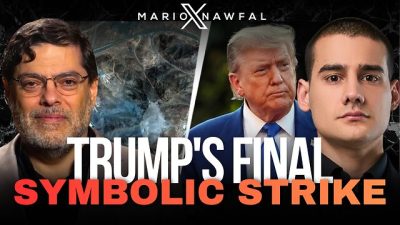
Trump asks Iran not to retaliate after he strikes Pickaxe Mountain
or go to
Aletho News Archives – Video-Images
Book Review & Summary
Calling of an Angel: The True Story of Rene Caisse and an Indian Herbal Medicine Called Essiac (1988)
Dr. Gary L. Glum – 30 Q&As – Book Review & Summary
Lies are Unbekoming | October 17, 2026
On June 10, 1975, Dr. Chester Stock, a vice president at Memorial Sloan-Kettering Institute for Cancer Research, wrote to a Canadian nurse named Rene Caisse: “Enclosed are test data in two experiments indicating some regressions in sarcoma 180 of mice treated with Essiac.” The sentence sat in a letter from one of the world’s largest private cancer research centers, concerning an herbal tea an elderly English woman had learned from an Ojibwa medicine man at a northern Ontario mining camp in the 1890s. The tests were terminated the following year after Sloan-Kettering admitted, in sworn affidavit three years later, that they had prepared the injectable solution improperly from the dried material supplied — freezing and thawing the herb rather than boiling it as Rene had instructed. By the time Calling of an Angel was published in 1988, Rene Caisse had been dead for a decade, having treated thousands of cancer patients across fifty-six years in her Bracebridge, Ontario kitchen, never charging a fee, and refusing every offer — from Memorial Sloan-Kettering, the National Cancer Institute, Merck, Parke Davis, and private corporations dangling contracts up to $1 million — to release her formula before the medical establishment admitted her remedy had merit. … continue
Blog Roll
 Aletho News
- Trump asks Iran not to retaliate after he strikes Pickaxe Mountain – w/ Prof. Marandi
- Vice President J.D. Vance’s Deceptive ‘Antiwar’ Campaign Speech
- Iran: Palestinians’ rights must not be compromised in Gaza’s future; US, Israel to blame for Hormuz situation
- Ongoing tales of Syrian chemical weapons
- Moscow blasts UN for ignoring torture of Russian POWs
- Millions of Books Could Have Been Destroyed in Lebanon During Israeli Bombings
- Moscow warns of ‘hunt for Russians’
- Calling of an Angel: The True Story of Rene Caisse and an Indian Herbal Medicine Called Essiac (1988)
- South Korean Assistance to the U.S. in the War with Iran: Between Allied Duty and National Interests
- Pharma- and Gates-Funded GAVI Seeks to Assure Parents
- If Americans Knew
- Israeli soldiers debunk Israel’s talking points
- In West Bank, Israeli settlers are totally out of control – Daily Update
- NPR investigation finds evidence of widespread fraud at mall kiosks tied to Israeli skincare brand
- Tucker Carlson exposes Israeli Lies about the Oct 7th attack, Charlie Kirk, and the U.S.
- Israel has detained thousands of Palestinian children since Oct 7th – over half spent time in solitary, many uncharged
- Israeli Analysis: Is Netanyahu Planning an ‘October Surprise’ Attack Before Israel’s Election?
- Israeli settlers brutally attack Palestinians and Washington Post female photographer, 65
- Words Have Changed, Occupation Continues: The Reality of the Gaza Ceasefire
- Gaza’s child amputees are growing faster than their prosthetics allow
- Israel keeps Palestinians struggling just to survive–Daily Update
- No Tricks Zone
- New Study Suggests Large Regions Of The Pacific Ocean Have Been Cooling For The Last 80 Years
- Germany’s Green Energy Debacle: High Energy Costs Force Kahla Porzellan to Close After 182 Years!
- New Study: 50 Years Of The Most Aggressive ‘Net Zero’ Policies Can Only Affect The Global Climate By 0.03°C
- US September “Heat” Was No Record…Many Records Set Decades Ago
- Latest European Green Energy Debacle; Portugal’s Largest Flagship Solar Park Insolvent!
- Green Energy Debacle: German Expert Professor Fritz Vahrenholt Warns Of Severe Economic And Social Consequences
- Two More Paleo Reconstructions Affirm Meters-Higher Sea Levels Across Ireland, Brazil 7000-6000 Years Ago
- New Study: Earth And Venus Surface Warmth Largely Explained By Convection And Lapse Rate, Not CO2 Or Radiation
- 2025 Nature Paper Claiming Worsening Global Drought Gets RETRACTED …Heavily Flawed
- New Study: ‘Global Drought Shows No Detectable Recent Acceleration Under Climate Warming’

