No more time to wait for a nuclear weapons ban
International Campaign to Abolish Nuclear Weapons | Statement to the UN First Committee | October 28, 2014
Nuclear disarmament has for too long been about waiting. Waiting for nuclear-armed states to fulfill their obligations. Waiting for the so-called “conditions” to be right for disarmament.
While we wait, we do not get closer to the elimination of nuclear weapons or to a more secure world. While we wait, the risks of the use of nuclear weapons remain or even increase. While we wait, the catastrophic and overwhelming consequences of such use do not diminish.
We do not have time to wait.
The conferences on the humanitarian consequences of nuclear weapons hosted by Norway and Mexico have clearly explained and documented these consequences.
Physicians, physicists, climate scientists, humanitarian agencies, and survivors have all presented alarming evidence about the effects of nuclear weapons.
This evidence has shown that a single nuclear weapon can destroy an entire city, inflicting massive numbers of instantaneous casualties.
This evidence has shown that acute radiation injuries kill people in a matter of minutes, days, or weeks; and that radiation-caused cancers and other illnesses continue to kill for years among those directly exposed and across generations.
This evidence has shown that the use of even a small fraction of existing nuclear arsenals would cause environmental devastation, including disruption of the global climate and agricultural production.
This evidence cannot be ignored.
We know that the only way to ensure these consequences will never occur is to prevent the use of nuclear weapons. And the only way to do that is to eliminate them entirely. The General Assembly, NPT states parties, the International Court of Justice, the overwhelming majority of states that belong to nuclear-weapon-free zones, and civil society have all said this repeatedly. That part of the debate is over.
We don’t have time to wait. States are in fact legally bound not to wait. Every state party to the nuclear Non-Proliferation Treaty is committed to pursuing effective measures for nuclear disarmament.
Most importantly, we do not have to wait.
While the nuclear-armed states modernise their arsenals and refuse to engage in multilateral negotiations for nuclear disarmament as they are obliged to do, there is at least one effective measure that the rest of the world can take.
That is to prohibit nuclear weapons through a legally-binding instrument.
This is not a radical proposal. Indiscriminate weapons get banned. It is what we do as human society in the interests of protecting ourselves. We have done it before with other weapon systems, including biological and chemical weapons. A treaty banning nuclear weapons would complete the set of
prohibitions against WMD.
This should not be a controversial proposal. An international prohibition is merely the logical outcome of an examination of the risks and consequences of nuclear weapons detonation. It is complementary to existing international law governing nuclear weapons.
This is a meaningful proposal. It could have a variety of effects on the policy and practice of states. It could establish a comprehensive set of prohibitions and provide a framework under which the elimination of nuclear weapons can be pursued.
This is a feasible, achievable proposal. It can be negotiated in the near-term, and have normative and practical impacts for the long-term.
Naturally, as we get closer to beginning a diplomatic process, thoughts will turn to how and where such a treaty should be negotiated.
ICAN has no fixed view on this except that effective processes that have meaningful results tend to be based on some important principles of multilateralism. Negotiations must be inclusive, democratic, and involve civil society and international organizations.
A crucial foundation for our confidence in this idea is the conviction that such a treaty can and should be negotiated by those states ready to do so, even if the states with nuclear weapons oppose it and decide not to participate. A few recalcitrant states should not be able to block a successful outcome. It would be better for all states to participate and to move towards prohibition and elimination without delay. But this seems unlikely at the present time.
While we must keep working towards that goal with absolute determination, we believe states should put a prohibition in place now.
To the nuclear-armed states that see this as a hostile idea: it is not. You have applauded groups of states for adopting nuclear-weapon-free zones in their regions. Globalising this prohibition on nuclear weapons will give increased political and legal space for you to pursue elimination. All of you have registered your commitment to a nuclear-free world. A prohibition of nuclear weapons is an important part of the process to achieve that universal goal.
To the states in alliances with nuclear-armed states that are concerned such a treaty would be inconsistent with existing commitments: it would not be. All states have agreed that nuclear weapons should be eliminated. No security alliances have ever crumbled because a weapon system was outlawed and eliminated. Any states that consider humanitarian action a priority should understand that a ban treaty would be consistent with their existing obligations and principles.
To the states that have already foresworn nuclear weapons through the NPT and nuclear-weapon-free zones, and that might baulk at the idea of taking on more of the burden for nuclear disarmament: this ban treaty will not be a burden. It will reinforce the stigma against nuclear weapons. It will undermine their purported value. It will further erode any misplaced perceptions that these weapons of mass destruction confer symbolic power and prestige. It will make global the commitments you have already made regionally. It will give you an opportunity to take charge, for nuclear disarmament is the responsibility and right of everyone. Finally, it will have normative and practical impacts that will facilitate elimination. We welcome the opportunity to consider this approach with you. As Kenya said earlier this month, discussions about this should not cause anxiety.
A window of opportunity is now open to take an important next step towards the elimination of nuclear weapons. We should seize this opportunity before it closes. The conferences in Oslo and Nayarit have helped us see nuclear weapons as the devastating and inhumane weapons they are. We’re confident that the Vienna conference in December will reinforce that humanitarian perspective.
It is clear to us that the logical conclusion of these evidence-based gatherings is to begin a diplomatic process to prohibit nuclear weapons through a legally binding instrument.
This will take courage. We have confidence that the overwhelming majority of states will join this process. And we look forward to accompanying you along the road to a treaty banning nuclear weapons.
International Campaign to Abolish Nuclear Weapons (ICAN) represents more than 360 partner organizations in 93 countries.
How does the Gates Foundation spend its money to feed the world?
GRAIN | November 4, 2014
“Listening to farmers and addressing their specific needs. We talk to farmers about the crops they want to grow and eat, as well as the unique challenges they face. We partner with organizations that understand and are equipped to address these challenges, and we invest in research to identify relevant and affordable solutions that farmers want and will use.” – First guiding principle of the Gates Foundation’s work on agriculture.1
At some point in June this year, the total amount given as grants to food and agriculture projects by the Bill and Melinda Gates Foundation surpassed the US$3 billion mark. It marked quite a milestone. From nowhere on the agricultural scene less than a decade ago, the Gates Foundation has emerged as one of the world’s major donors to agricultural research and development.
The Gates Foundation is arguably the biggest philanthropic venture ever. It currently holds a $40 billion endowment, made up mostly of contributions from Gates and his billionaire friend Warren Buffet. The foundation has over 1,200 staff, and has given over $30 billion in grants since its inception in 2000, $3.6 billion in 2013 alone.2 Most of the grants go to global health programmes and educational work in the US, traditionally the foundation’s priority areas. But in 2006-2007, the foundation massively expanded its funding for agriculture, with the launch of the Alliance for a Green Revolution in Africa (AGRA) and a series of large grants to the international agricultural research system (CGIAR). In 2007, it spent over half a billion dollars on agricultural projects and has maintained funding at around this level. The vast majority of the foundation’s agricultural grants focus on Africa.
Spending so much money gives the foundation significant influence over agricultural research and development agendas. As the weight of the foundation’s overall focus on technology and private sector partnerships has begun to be felt in the global agriculture arena, it has raised opposition and controversy, particularly around its work in Africa. Critics say that the Gates Foundation is promoting an imported model of industrial agriculture based on the high-tech seeds and chemicals sold by US corporations. They say the foundation is fixated on the work of scientists in centralised labs and that it chooses to ignore the knowledge and biodiversity that Africa’s small farmers have developed and maintained over generations. Some also charge that the Gates Foundation is using its money to impose a policy agenda on Africa, accusing the foundation of direct intervention on highly controversial issues like seed laws and GMOs.
GRAIN looked through the foundation’s publicly available financial records to see if the actual flows of money support these critiques. We combed through all the grants for agriculture that the Gates Foundation gave between 2003 and September 2014.3 We then organised the grant recipients into major groupings (see table 2) and constructed a database, which can be downloaded here.4
Here are some of the conclusions we were able to draw from the data.
1. The Gates Foundation fights hunger in the South by giving money to the North.
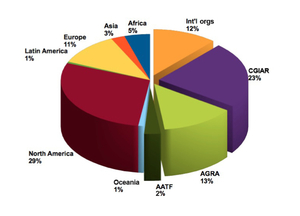
Click to enlarge – Graph 1: the Gates Foundation’s $3 billion pie (agriculture grants, by region).
Graph 1 and Table 1 give the overall picture. Roughly half of the foundation’s grants for agriculture went to four big groupings: the CGIAR’s global agriculture research network, international organisations (World Bank, UN agencies, etc.), AGRA (set up by Gates itself) and the African Agricultural Technology Foundation (AATF). The other half ended up with hundreds of different research, development and policy organisations across the world. Of this last group, over 80% of the grants were given to organisations in the US and Europe, 10% went to groups in Africa, and the remainder elsewhere. Table 2 lists the top 10 countries where Gates grantees are located and the amounts they received, highlighting some of the main grantees. By far the main recipient country is Gates’s own home country, the US, followed by the UK, Germany and the Netherlands.
When it comes to agricultural grants by the foundation to universities and national research centres across the world, 79% went to grantees in the US and Europe, and a meagre 12% to recipients in Africa.
The North-South divide is most shocking, however, when we look at the NGOs that the Gates Foundation supports. One would assume that a significant portion of the frontline work that the foundation funds in Africa would be carried out by organisations based there. But of the $669 million that the Gates Foundation has granted to non-governmental organisations for agricultural work, over three quarters has gone to organisations based in the US. Africa-based NGOs get a meagre 4% of the overall agriculture-related grants to NGOs.
2. The Gates Foundation gives to scientists, not farmers
As can be seen in Graph 2, the single biggest recipient of grants from the Gates Foundation is the CGIAR, a consortium of 15 international agricultural research centres. In the 1960s and 70s, these centres were responsible for the development and spread of a controversial Green Revolution model of agriculture in parts of Asia and Latin America which focused on the mass distribution of a few varieties of seeds that could produce high yields – with the generous application of chemical fertilisers and pesticides. Efforts to implement the same model in Africa failed and, globally, the CGIAR lost relevance as corporations like Syngenta and Monsanto took control over seed markets. Money from the Gates Foundation is providing CGIAR and its Green Revolution model a new lease on life, this time in direct partnership with seed and pesticide companies.5
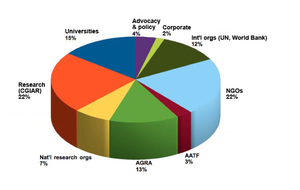
Click to enlarge – Graph 2: the Gates Foundation’s $3 billion pie (agriculture grants, by type of organisation).
The CGIAR centres have received over $720 million from Gates since 2003. During the same period, another $678 million went to universities and national research centres across the world – over three-quarters of them in the US and Europe – for research and development of specific technologies, such as crop varieties and breeding techniques.
The Gates Foundation’s support for AGRA and the AATF is tightly linked to this research agenda. These organisations seek, in different ways, to facilitate research by the CGIAR and other research programmes supported by the Gates Foundation and to ensure that the technologies that come out of the labs get into farmers’ fields. AGRA trains farmers on how to use the technologies, and even organises them into groups to better access the technologies, but it does not support farmers in building up their own seed systems or in doing their own research.6
We could find no evidence of any support from the Gates Foundation for programmes of research or technology development carried out by farmers or based on farmers’ knowledge, despite the multitude of such initiatives that exist across the continent. (African farmers, after all, do continue to supply an estimated 90% of the seed used on the continent!) The foundation has consistently chosen to put its money into top down structures of knowledge generation and flow, where farmers’ are mere recipients of the technologies developed in labs and sold to them by companies.
3. The Gates Foundation buys political influence
Does the Gates Foundation use its money to tell African governments what to do? Not directly. The Gates Foundation set up the Alliance for a Green Revolution in Africa in 2006 and has supported it with $414 million since then. It holds two seats on the Alliance’s board and describes it as the “African face and voice for our work”.7
AGRA, like the Gates Foundation, provides grants to research programmes. It also funds initiatives and agribusiness companies operating in Africa to develop private markets for seeds and fertilisers through support to “agro-dealers” (see box on Malawi). An important component of its work, however, is shaping policy.
AGRA intervenes directly in the formulation and revision of agricultural policies and regulations in Africa on such issues as land and seeds. It does so through national “policy action nodes” of experts, selected by AGRA, that work to advance particular policy changes. For example, in Ghana, AGRA’s Seed Policy Action Node drafted revisions to the country’s national seed policy and submitted it to the government. The Ghana Food Sovereignty Network has been fiercely battling such policies since the government put them forward. In Mozambique, AGRA’s Seed Policy Action Node drafted plant variety protection regulations in 2013, and in Tanzania it reviewed national seed policies and presented a study on the demand for certified seeds. Also in Tanzania, its Land Policy Action Node is involved in revising the Village Land Act as well as “reviewing laws governing land titling at the district level and working closely with district officials to develop guidelines for formulation of by-laws.”8
The African Agricultural Technology Foundation (AATF) is another Gates Foundation supported organisation that straddles the technology and policy arenas. Since 2008, it has received $95 million from the Gates Foundation, which it used to to support the development and distribution of hybrid maize and rice varieties. But it also uses funds from the Gates Foundation to “positively change public perceptions” about GMOs and to lobby for regulatory changes that will increase the adoption of GM products in Africa.9
In a similar vein, the Gates Foundation provides Harvard University University with funds to promote discussion of biotechnology in Africa, Michigan University with a grant to set up a centre to help African policymakers decide on how best to use biotechnology, and Cornell University with funds to create a global “agricultural communications platform” so that people better understand science-based agricultural technologies, with AATF as a main partner.
Gates & AGRA in Malawi: organising the agro-dealers
One of AGRA’s core programmes in Africa is the establishment of “agro-dealer” networks: small, private stockists who sell chemicals and seeds to farmers. In Malawi, AGRA provided a $4.3 million grant for the Malawi Agro-dealer Strengthening Programme (MASP) to supply hybrid maize seeds and chemical pesticides, herbicides and fertilisers.
The main supplier to the agro-dealers in Malawi has been Monsanto, responsible for 67% of all inputs. A Monsanto country manager disclosed that all of Monsanto’s sales of seeds and herbicides in Malawi are made through AGRA’s agro-dealer network.
“Agro-dealers… act as vessels for promoting input suppliers’ products,” says one MASP project document. Another states: “supply companies have expressed their appreciation for field days because MASP trained agro-dealers are helping them promote their products in the very remotest areas of Malawi.” Training the agro-dealers on product knowledge is carried out by the corporate suppliers of the products themselves. In addition, these agro-dealers are increasingly the source of farming advice to small farmers, and an alternative to the government’s agricultural extension service.
A project evaluation report states that 44% of the agro-dealers in the programme were providing extension services. According to the World Bank: “The agro-dealers have… become the most important extension nodes for the rural poor… A new form of private sector driven extension system is emerging in these countries.” The agro-dealer project in Malawi has been implemented by CNFA, a US-based organisation funded by the Gates Foundation, USAID and DFID, and its local affiliate the Rural Market Development Trust (RUMARK), whose trustees include four seed and chemical suppliers: Monsanto, SeedCo, Farmers World and Farmers Association.
Listening to farmers?
“Listening to farmers and addressing their specific needs” is the first guiding principle of the Gates Foundation’s work on agriculture.10 But it is hard to listen to someone when you cannot hear them. Small farmers in Africa do not participate in the spaces where the agendas are set for the agricultural research institutions, NGOs or initiatives, like AGRA, that the Gates Foundation supports. These spaces are dominated by foundation reps, high-level politicians, business executives, and scientists.
Listening to someone, if it has any real significance, should also include the intent to learn. But nowhere in the programmes funded by the Gates Foundation is there any indication that it believes that Africa’s small farmers have anything to teach, that they have anything to contribute to research, development and policy agendas. The continent’s farmers are always cast as the recipients, the consumers of knowledge and technology from others. In practice, the foundation’s first guiding principle appears to be a marketing exercise to sell its technologies to farmers. In that, it looks, not surprisingly, a lot like Microsoft. … Full article with tables and notes
Bowling for Meltdowns
By JOHN LaFORGE | CounterPunch | October 31, 2014
Weakening radiation standards; a cap on accident liability; reactor propaganda vs improvements; old units running past expiration dates; revving the engines beyond design specs …. You’d think we were itching for a meltdown.
The Environmental Protection Agency has recommended increased radiation exposure limits following major releases. It would save the industry a bundle to permit large human exposures then, rather than shut down rickety reactors now.
The EPA proposal is a knock-off prompted by Fukushima, because after the triple meltdown started three years ago, Japan increased — by 20 times — the allowable radiation exposures deemed tolerable for humans. Prior to the meltdowns of March 2011, Japan allowed only 1 milliSievert of radiation per year in an individual’s personal space. Now, the limit is 20 milliSieverts per year. This is not safe, it’s just allowable, or, rather, affordable, since the cost of decontaminating 1,000 square miles of Japan to the stricter standard could bust the bank.
The Price Anderson Act provides US reactor owners with a liability cap and a tax-payer bailout in the event of serious accidents or attacks. The law relieves utilities of hundreds of billions in financial risk posed by our ongoing meltdown roulette game. The owners won’t be bankrupted by the next loss-of-coolant disaster, but the US might.
Fukushima has spewed more long-lived radioactive chemicals to the air, the soil and the ocean than any catastrophe in history. But the chant heard round the world is: “The dose is low, there’s no immediate danger.” Promoters of nuclear power repeat this mantra at every opportunity, hoping to dodge Germany’s answer to Fukushima — a permanent reactor phase-out — and it has nearly drowned out all warnings of radiation’s health and environmental effects.
Have you heard of PSR’s March 2011 “Health risks of the releases of radioactivity from the Fukushima reactors: Are they a concern for residents of the US?”; or IPPNW’s June 2014 “Critical Analysis of the UNSCEAR Report”; or the Nov. 2012 “Report of the UN Special Rapporteur on the right to health within the context of the nuclear accident at Fukushima”; or Greenpeace’s two major reports, “Lessons from Fukushima,” and “Fukushima Fallout”? No, the feds would rather you read the UN Scientific Committee’s exec. summary which claims Fukushima’s effects are “unlikely to be observable.” This conclusion was made before any research was done.
The chances of radiation disasters will increase further if the Nuclear Regulatory Commission allows US reactors to run for 80 years. This is what Duke Power, Dominion Power and Exelon suggest for seven of their 40-year-old rattle traps now operating in Pennsylvania, Virginia and South Carolina.
These seven reactors were designed and licensed to be shut down in the current decade. However, since 1991 the nuclear industry has been granted 70 “license extensions” that have generally added 20 years. Now the owners want to push their units an extra 40 years.
Former NRC Commissioner George Apostolakis wasn’t apoplectic when the commission considered the idea, but, according to the New York Times, he said, “I don’t know how we would explain to the public that these designs, 90-year-old designs, 100-year-old designs, are still safe to operate.” The NRC has yet to rule on the 80-year option, but it’s never denied a single license extension request.
Gunning old Fukushima-type engines
Captured by the industry it’s supposed to govern, the NRC has approved 149 reactor “power uprate” applications and has denied exactly one. Power uprates boost the output of old reactors beyond what their original licenses permit. It’s done by packing reactor cores with extra fuel rods and, feeling lucky, running them harder.
Chillingly, 23 operating US reactors are duplicates of the Fukushima-type General Electric Mark 1. Fifteen of these clunkers have been granted power uprates, and seven of these 15 have been granted a second power uprate. (See chart) Susquehanna’s two 31-year-old Fukushima clones in Pennsylvania were granted a hair-raising three power uprates.

With the radiation industry and the NRC working to deny or delay post-Fukushima safety improvements, how do you feel about reactor operators stomping the accelerator while they run their geriatric uranium jalopies toward the cliff?
Japan to reopen 1st nuclear plant after Fukushima disaster – despite volcano risks
RT | October 28, 2014
A local council has voted to re-open the Sendai Nuclear Power Plant on the outermost western coast of Japan, despite local opposition and meteorologists’ warnings, following tremors in a nearby volcano.
Nineteen out of 26 members of the city council of Satsumasendai approved the reopening that is scheduled to take place from early 2015. Like all of Japan’s 48 functional reactors, Sendai’s 890 MW generators were mothballed in the months following the 2011 earthquake and tsunami.
Satsumasendai, a town of 100,000 people, relies heavily on state subsidies and jobs, which are dependent on the continuing operation of the plant.
But other towns, located within sight of the plant, do not reap the same benefits, yet say they are being exposed to the same risks. A survey conducted by the local Minami-Nippon Shimbun newspaper earlier this year said that overall, 60 percent of those in the region were in favor of Sendai staying shut. In Ichikikushikino, a 30,000-strong community just 5 kilometers away, more than half of the population signed a petition opposing the restart. Fewer than half of the major businesses in the region reported that they backed a reopening, despite potential economic benefits.
Regional governor Yuichiro Ito has waved away the objections, insisting that only the city in which the plant is located is entitled to make the decision.
While most fears have centered around a lack of transparency and inadequate evacuation plans, Sendai is also located near the volcanically active Kirishima mountain range. Mount Ioyama, located just 65 kilometers away from the plant, has been experiencing tremors in recent weeks, prompting the Meteorological Agency to issue a warning. The government’s nuclear agency has dismissed volcanic risks over Sendai’s lifetime as “negligible,” however.
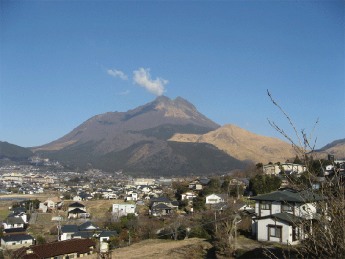
Mount Ioyama (image from blogs.yahoo.co.jp)
Satsumasendai’s Mayor Hideo Iwakiri welcomed the reopening, but said at the ensuing press conference that it would fall upon the government to ensure a repeat of the accident that damaged Fukushima, an outdated facility subject to loose oversight, is impossible.
September’s decision to initiate the return Japan’s nuclear capacity back online was taken by Prime Minister Shinzo Abe, who endorses nuclear production in the country, but has delegated the controversial call on reopening to local councils. Sendai was chosen after becoming the first plant to officially fulfill the government’s new stricter safety rules. It may also have been picked due to its geographical remoteness, and distance from the 2011 disaster area.
The primary reason for Abe’s nuclear drive been the expense in replacing the lost energy that constituted 30 percent of the country’s consumption, which the government says cost Japan an extra $35 billion last year. Japanese consumers have seen their energy bills climb by 20 percent since the disaster as a result.
But another concern remains the state of the country’s aging nuclear plants, which will cost $12 billion to upgrade. Meanwhile plans to build modern nuclear reactors – which were supposed to be responsible for half of the country’s nuclear power by 2030, according to previous government energy plans – have predictably been shelved in the wake of the disaster.
Fukushima dome removal suspended
The painfully slow and calamitous decommissioning of the Fukushima Daiichi plant, in the northeast of the country, had to be halted yet again Tuesday, after the removal of the temporary dome over the damaged Reactor 1 was interrupted by severe winds.
The canopy needs to be taken off so that the radioactive reactor rods, which have been contaminating the soil and water around the plant, can be placed in storage.
But as workers attempted to lift a section of the plastic dome to decontaminate the air inside, a segment of the cover up to six feet was blown off by a severe gust of wind.
Tokyo Electric Power Company, TEPCO, the operator of the shuttered plant, says that the incident has not impacted radiation levels, and hopes to resume operations as soon as possible.
Yucca Mountain Radioactive Waste Dump Not Dead Yet
By JOHN LAFORGE | CounterPunch | October 22, 2014
Just in time for Halloween, a real zombie.
Although the Obama Administration cancelled the Yucca Mountain project for disposing high-level radioactive waste (uranium fuel rods) in 2009, the scheme stays amazingly undead.
Last Thursday, the Nuclear Regulatory Commission issued the third in a series of reports in which it declared that the deep, engineered cavern inside the mountain — 90 miles from Las Vegas, Nevada — meet the commission’s ever-changing (Eric Pianin, “Rules changed for Nevada nuclear waste site plan,” Wash. Post, Dec. 12, 2001) requirements.
Still pending are two more reports and a final NRC ruling on the site’s suitability. Actual operation of the dump also requires approval from the Environmental Protection Agency and the departments of Transportation and Energy (DOE). Of course, lawsuits by the State of Nevada and dozens of environmental groups would follow a decision to start burying waste.
In spite of 70 years of head scratching, science and industry have not found a cheap way to “dispose” of high-level radioactive waste. In 2008, the plan was estimated to cost at least $90 billion.
The DOE’s 1999 draft environmental impact statement for Yucca, says that leaving the wastes at 72 US reactor sites in 39 states is just as safe as moving it thousands of miles toward Yucca Mt. — as long as it is repackaged every 100 years. There is no need to rush the opening a dumpsite, except that reactor operators want to free-up storage space for freshly produced waste so they can keep running old reactors.
Yucca Mt. Project Cancelled for Hundreds of Reasons
While Republicans from nuclear-heavy states are pushing to revive the Yucca project and hoping for a November take-over of the Senate, Majority Leader Harry Reid, D-Nev., broadcasts the science-based disqualifiers that prove Yucca unsuitable. Among them are fast flowing water inside the mountain, earthquake faults, lava flows, and the risk of exploding waste canisters — like the one that burst and wrecked the Energy Department’s Waste Isolation Pilot Project in New Mexico last February. Joonhong Ahn, an engineering professor at the U. of Calif., Berkeley, said in an e-mail to ScienceInsider.com, “… there are still numerous hurdles ahead.”
Indeed, the Government Accounting Office concluded in 2001 that 293 unresolved scientific and engineering problems hinder the plan. (“GAO Challenges Plans for Storage of Nuclear Waste,” Wash. Post, Nov. 30, 2001) Responding to the new report, Nevada state officials made the same point. “The NRC licensing board has admitted more than 200 Nevada contentions challenging the safety and environmental impacts of the proposed repository, and Nevada is prepared to aggressively prosecute these challenges. It is not apparent that the [NRC report] specifically addressed these and other safety contentions,” said Bob Halstead, Executive Director of Nevada’s Agency for Nuclear Projects, in a prepared statement.
“For the NRC staff to publically release just this one volume of the 5-volume Safety Evaluation Report outside the proper context of an ongoing licensing proceeding, and in the absence of a complete SER, is unprecedented,” Halsted said. “It creates a false impression that the safety review has been completed. It is difficult to see what reason there could be for such a release except to provide political support and encouragement for Yucca Mountain supporters in Congress and elsewhere.”
This false impression was spectacularly exaggerated by Rep. John Shimkus, R-Mich., who told the New York Times Oct. 17, “[N]uclear waste stored under that mountain … will be safe and secure for at least a million years.”
Nuclear Waste Production is Kept Alive by Yucca Supporters
Yucca Mt. wouldn’t begin to address the country’s vast nuclear waste problem. There already are about 70,000 tons of it stored at reactor sites. This stockpile would fill Yucca to capacity and force the start of a search for Dump No. 2. Waste that must be containerized for a million years is the “animated corpse” that will forever haunt our clean, cheap too-safe-to-meter nuclear power complex.
The Yucca Mt. “mobile Chernobyl” idea — and alternate plans for regional “interim” dumps — also explodes the risks of radiation accidents contaminating waste handlers and the people along transport routes. The DOE’s planning maps show the waste passing through 40 states, 40 Indian Reservations and 100 major cities. In January 2008, former state transportation analyst Fred Dilger caused alarm when he told a Hillary Clinton campaign rally that if waste trains go through Las Vegas, “All of the casinos on the west side of Las Vegas Boulevard would be bathed in gamma radiation.”
The shipments, using as-yet-untested waste casks, would expose between 138 and 161 million Americans to the risks of dangerous levels of radiation and to the consequences of inevitable truck, train and barge accidents. Even the project’s Final Environmental Impact Statement predicts between 150 and 250 rail or truck crashes over the plan’s 25-year span — about 10 crashes every year for 25 years.
That’s an undying prospect scary enough for a million Halloweens.
New Seeds, Old Pesticides: A Farmer on 2,4-D and Next Gen GMOs
By Jim Goodman | Civil Eats | October 15, 2014
I doubt very many people have ever heard or seen a “tank mix.” Simply put, it is a mix of several crop chemicals used together to control a variety of weeds. I have not looked into a swirling mix of chemicals in a crop spray rig for probably 20 years–that’s about how long it has been since we have used any herbicides on our farm.
It may look different now, new chemicals, perhaps new colors and new toxic smells. I remember it as a sulfurous yellow mix of rising spreading plumes of chemicals, circulating and mixing together in the tank. The smell was literally breathtaking and the toxicity likewise. (That’s why it’s recommended that the applicator wear breathing protection and a Hazmat suit.)
When people ask me why we switched to organic farming, that swirling yellow tank mix always reappears in my mind. How did I ever rationalize putting that stuff on my fields?
When genetically modified (GM) crops were introduced commercially in 1996, farmers were told that Monsanto’s “Roundup Ready”(RR) technology would make crop production easier, safer, and “one spray was all they’d ever need.”
Roundup would be a safer, more effective replacement for all those chemicals farmers were currently using their tank mixes, they told us. With Roundup as the cornerstone of GM crop technology, the promise was safety. We’d have no more worries about weeds, and it would be eternally effective, so there would be no more need for tank mixes.
While I really don’t consider any pesticide safe (after all–they are poisons), Roundup was probably less toxic, perhaps less carcinogenic, and perhaps less of an endocrine disruptor than some of the chemicals it replaced. Perhaps.
I specifically remember 2,4-D (one of the components of the Vietnam-era defoliant Agent Orange) being singled out as a “more dangerous” herbicide that would no longer be needed. Who wouldn’t like that–a dangerous herbicide replaced by an easier to use, safer, permanently more effective one? There was sliced bread and then there was RR.
Of course, it didn’t work out that way. In 1996, Monsanto was fined by the State of New York for false advertising in its promotion of Roundup as “safe.” According to a 2013 Associated Press article, Monsanto acknowledged that U.S. Environmental Protection Agency (EPA) approval “is not an assurance or finding of safety” because U.S. regulations are based on a cost-benefit analysis, which balances the potential of “any unreasonable risk to man or the environment” against the “the economic, social, and environmental costs and benefits of the use of any pesticide.”
Isn’t that something? EPA approval is not an assurance of safety.
Consider the fact that EPA-approval was based on specific recommended quantities, and then, as these products became less effective, the tendency would be to “add a just little more.” But, even with “just a little more,” nature found a way to survive, and weeds developed resistance to Roundup to the point that even a thorough sousing would no longer kill them. Once again the tank mix became the only hope in killing these new, pesticide-resistant “superweeds.”
To help fight resistant weeds, farmers have also been encouraged to develop integrated weed management strategies. Mark Jeschke, Agronomy Research Manager at DuPont Pioneer, notes that “mechanical weed control and crop rotation are examples of two such tactics available to growers.” (These are tactics organic farmers have always used). But for heaven’s sake, the industry says, don’t stop spraying.
The “new generation” of GM crops are on the way and the first out of the pipeline are corn and soybeans that Dow AgroSciences developed to be used in conjunction with 2,4-D. In September, The U.S. Department of Agriculture approved the new seeds, as part of a branded “Enlist Weed Control System” that could be going into the ground as early as spring 2015.
Now remember that in 1996 Roundup was touted as the safe alternative to 2,4-D, a dangerous pesticide. Has 2,4-D become safer than it used to be? No.
My guess is that Dow decided it would be cheaper and easier to engineer seeds to resist the old herbicides rather than develop new herbicides that might be less toxic. And, as Tom Philpott at Mother Jones notes, Dow and Monsanto know that planting seeds that withstand both 2,4-D and Roundup would lead to an increase in herbicide use.
In fact, Dow and Monsanto stand to cash in on 2,4-D and Roundup cross-licensing. We are talking big profit potential. Never mind the fact that an Ohio study pointed out that 2,4-D is potentially potent enough to cause a “17 to 77 percent reduction of the marketable fruit and vegetables” on farms close to those where it is sprayed.
The University of Maryland recommends leaving a 350-foot buffer zone (PDF) between fields sprayed with 2,4-D and grapevines, which–along with tomatoes, potatoes, eggplants, peppers, melons, sweet potatoes, beans, and other vegetables–are highly susceptible to 2,4-D drift.
It would be one thing if the farmer doing the spraying was responsible for leaving a buffer strip between their crops and the neighbors’ vegetables. But the guy with the chemicals can spray right up to the property line. Over the last 20 years I have had to leave many acres of my land in buffer strips. Most farmers try to be good neighbors, but they can’t control the wind.
Weeds resistant to 2,4-D were documented as early as 1957, and still, farmers are hoping that 2,4-D resistant corn and soybeans, especially a 2,4-D/Roundup resistant combination, will be “the one” solution to their problems. And if weed resistance shows up they can “just add a little more”–at least until this system fails and the next GM crop is introduced.
Civil Eats editor’s note: The U.S. Environmental Protection Agency (EPA) today approved Dow Chemical’s Enlist Duo herbicide, a new blend of 2,4-D and Roundup (glyphosate) developed for use on new varieties of genetically engineered (GE) corn, soybeans, and cotton.
Maduro Hands Over Land Titles to Indigenous Communities, Creates Institute to Protect Native Languages
By Z.C. Dutka | Venezuelanalysis | October 15, 2014
On Monday, in celebration of the nationally acclaimed Day of Indigenous Resistance, Venezuelan president Nicolas Maduro established a presidential council for indigenous peoples, handed over collective land titles to 14 original communities, lowered the threshold age for indigenous pensioners, and announced the creation of an institute to protect the country’s 44 native languages.
The South American leader also pledged 5000 new homes for indigenous communities for 2015 through the national housing mission Mision Vivienda, and announced the investment of 575 million bolivars (about $7 million) to address extreme poverty in 396 of those communities.
Aloha Nuñez, the Indigenous Peoples’ Minister, noted that the presidential council was formed as a result of elections held in 2,194 indigenous communities after the idea was discussed in 1,589 countrywide assemblies.
Delia Gonzalez, a spokesperson for the Wayúu community of Zulia state, said that the debates leading up to the creation of the council were conducted with respect, tolerance and spirituality, in the interest of enabling diverse indigenous peoples to make significant contributions to the transition towards socialism.
Nuñez also explained how the language institute is the product of many years’ collective efforts. Of the 44 different original peoples that exist in Venezuela, Nuñez said, 34 speak their language and 10 have lost theirs through lack of use.
“We should immediately found and motivate a team systematically [that can] permanently, scientifically, register, rescue and revive all indigenous languages that exist in Venezuelan territory,” said Maduro from Miraflores presidential palace where Monday’s ceremony was held.
Shortly after, the Venezuelan president announced the incorporation of all indigenous above the age of 50 into the Amor Mayor mission for special elderly pensions. Nationwide, the mission applies to women over 55 and men over 60 who live in family homes maintained by minimum wage workers.
Land titles that encompass six ethnic groups and 14 communities of Anzoategui state were presented to community representatives; 1,891 hectares to the Guatacarito people, 438 to the Cumanagoto, 983 to the Capachal, 3,294 to the Pedregal, 657 to the Guayabal and 1,119 hectares to the Kariñas of Mapiricurito.
From 2011 to 2013 the Committee for the Demarcation of Land and Habitat, of the indigenous ministry, has signed 40 property titles for collective lands, including over 1.8 million hectares of land.
In a similar ceremony in July, Nuñez declared, “Today, the Bolivarian government recognizes the lands that ancestrally belonged to us and have been our home for many years.”
New frontiers for oil palm
Communities lose out to oil palm plantations
GRAIN | September 22, 2014
Palm oil is not something you would associate with a Mexican kitchen. But go to any supermarket in the country, and you will find countless products containing it. The country’s food system has changed immensely since the North American Free Trade Agreement (NAFTA) came into effect in 1994 and multinational companies moved in to take control of the country’s food supply. The alarming rate of obesity, now higher than that of the US, is one manifestation of Mexico’s changing food landscape, and tied to this is the escalating consumption of palm oil.
Palm oil consumption has increased by over four times since NAFTA was signed, and it now accounts for one quarter of the vegetable oil consumed by the average Mexican, up from 10% in 1996. Other countries in Latin America undergoing similar changes to their food systems have also increased their consumption of palm oil. Venezuelans have doubled their intake, and Brazilians are consuming 5 times what they did in 1996.
This growing consumption is matched by growing production, not in Mexico, but in those countries where oil palm can be most cheaply produced. A third of Latin America’s palm oil exports now go to Mexico.
Colombia, with about 450,000 ha under production, is the biggest palm oil producer in the Americas. Since the late 1990s, Colombia’s palm oil production has taken off for several overlapping reasons, including government incentives and a national biodiesel mandate. Oil palm has also been promoted as a substitute crop for coca as part of the US-backed “Plan Colombia” – a programme aimed at ending the country’s long-standing armed conflict and curbing cocaine production. Paradoxically, palm oil is also proving a useful way for drug cartels, paramilitaries and landlords to launder money and maintain control of the countryside.
The most notorious land grabs for palm oil in Colombia have occurred in the north west Chocó province, where businessmen and paramilitaries have colluded to force Afro-Colombian communities to cede their territories for palm oil plantations and contract farming. After dozens of Afro-Colombian leaders were killed resisting such land grabs, Colombia’s Prosecutor General’s Office brought forward charges against 19 palm oil businessmen for crimes of conspiracy, forced displacement, and the invasion of ecologically important land. Three of these businessmen have so far been convicted.
Disease outbreaks have limited palm oil’s expansion in Chocó Province and most of the expansion has instead happened on the pasture lands of the central and eastern parts of the country, where the oil palm industry claims there is little deforestation and displacement of peasants. But studies show that these pasture lands are in fact typically common areas vital to peasants for the production of their food crops and the grazing of their livestock. The “pasture lands” are often the only lands that peasants have access to, and palm oil companies routinely use force and coercion, including paramilitaries, to take control of these lands from them or to force them into oppressive contract production arrangements. Across Colombia, the expansion of palm oil and the presence of paramilitaries are tightly correlated.
Ecuador, Latin America’s second largest palm oil producer, has also seen a recent expansion in oil palm production. While much of its palm oil is produced on farms of less than 50 ha, new expansion is driven by private companies who have been moving into the territories of Afro-Ecuadorians and other indigenous peoples in the Northern part of the country, leading to severe deforestation and displacement and meeting with stiff local resistance.
Land conflicts over palm oil are also erupting in Central America. In Honduras, peasants in the Aguan Valley have been killed, jailed and terrorized for trying to defend their lands and small palm oil farms from powerful national businessmen who have been grabbing their lands to expand their palm oil plantations with the backing of foreign capital. Ironically, these peasant families first moved into the forests of the Aguan in the 1970s as part of a government land reform programme, and were encouraged to grow palm oil and establish their own cooperatives. The neoliberal policies of the 1990s and a coup d’état in 2009, opened the door for powerful local businessmen like Miguel Facussé, to destroy the peasant cooperatives, violently grab lands for plantations, and reorient the supply chain towards exports for biofuels and multinational food companies. Likewise in Guatemala, where production of palm oil has quadrupled over the past decade, the palm oil sector is now entirely controlled by just eight wealthy families who have been aggressively seizing lands from indigenous communities, such as the Q’eqchi,
Some industry insiders predict that an expansion of oil palm production in Brazil will soon dwarf all other production in the region. Brazil is a net importer, and production has so far been confined to a small area of Pará, in the North. But, unlike in other regional palm oil producing countries where production is dominated by national companies and wealthy landowning families, transnational corporations have recently made significant investments in Brazilian palm oil production, such as the mining company Vale, energy companies Petrobras and Galp, and ADM, one of the world’s largest grain traders and a major shareholder in the world’s largest palm oil processor Wilmar.
Going further
Tanya M. Kerssen, “Grabbing Power: The New Struggles for Land, Food and Democracy in Northern Honduras,” FoodFirst, 1 February 2013
Human Rights Everywhere, “The flow of palm oil Colombia- Belgium/Europe: A study from a human rights perspective,” 2006
DOE to offer $12.6 billion for nuke projects
By Timothy Cama | The Hill | September 30, 2014
The Department of Energy (DOE) is drafting a solicitation to provide as much as $12.6 billion in loan guarantees for nuclear energy projects.
The goal of the loan guarantees is to commercialize advanced nuclear technologies that could not otherwise get financing for research and development.
Any nuclear project that would reduce or avoid greenhouse gas emissions is eligible, but DOE said it is particularly interested in advanced nuclear reactors, small modular reactors, upgrades at existing facilities and front-end nuclear projects.
“For the first time in more than 30 years, new nuclear power plants are under construction in the United States,” Energy Secretary Ernest Moniz said in a Tuesday statement.
“This solicitation would build on that investment and help support the construction of the next generation of safe and secure nuclear energy projects.”
DOE said the loans align with the Obama administration’s “all-of-the-above” approach to energy as well as the goal of reducing greenhouse gas emissions.
Officials released a draft solicitation for the projects Tuesday. It will take comments on the draft for 30 days before writing a final version.
Featured Video

US IRAN TALKS: Who Are the Crazy Ones Here? /Lt Col Daniel Davis
or go to
Aletho News Archives – Video-Images
From the Archives
Woolsey Fire started at Santa Susana Field Lab — where “radioactive materials released were never accurately measured”
By John Laforge | CounterPunch | November 30, 2018
In my Nov. 16 column, I reported on potential radiation risks posed by California’s Woolsey wildfire having burned over parts or all of the Santa Susana Field Laboratory—south of Simi Valley, Calif., 30 miles outside Los Angeles—site of at least four partial or total nuclear reactor meltdowns.
The field laboratory operated 10 experimental reactors and conducted rocket engine tests. In his 2014 book Atomic Accidents, researcher James Mahaffey writes, “The cores in four experimental reactors on site … melted.” Reactor core melts always result in the release of large amounts of radioactive gases and particles. Clean up of the deeply contaminated site has not been conducted in spite of a 2010 agreement.
Los Angeles’s KABC-7 TV reported Nov. 13 that the Santa Susana lab site “appears to be the origin of the Woolsey Fire” which has torched over 96,000 acres. Southern Calif. Public Radio said, “According to Cal Fire, the Woolsey Fire started on the afternoon of Thursday, Nov. 8 … on the Santa Susana site.” … continue
Blog Roll
 Aletho News
- US IRAN TALKS: Who Are the Crazy Ones Here? /Lt Col Daniel Davis
- Talks with the US end without a deal over excessive US demands: Iran
- Feeling Better, Getting Worse: How Psychiatric Drugs Create the Illusion They Cure
- ‘Nobody Told Me’: Former Mental Health Patient Calls Out Dangerous Side Effects of Psychiatric Drugs
- Dr. Abu-Sitta: Beirut ‘felt like a day in Shifa Hospital’
- Iran Has Won the War, It Will Be Up to the US to Secure the Peace: Mohammad Marandi
- Iran condemns assassination threats against Iranian negotiators amid US talks
- Brussels cannot say where its own pipeline inspectors are as Hungary’s oil lifeline remains shut
- Israel’s Iran War: Myth and Reality
- Between war and industrial breakdown: The US-Israeli attrition crisis
- If Americans Knew
- Pro-Israel ‘Thinktanks’ and Individuals who Influence U.S. Foreign Policy
- Mearsheimer reveals how Israel dictates US policies on Iran, Gaza – video
- After killing 350+, Israel still has a “score to settle” with Lebanon before ceasefire – Daily Update
- Military aid to Israel emerges as the latest political litmus test for Democrats
- The only Palestinian children’s rights organization closes following years-long Israeli campaign against it
- ‘I Can’t Forget the Smell’: Lebanese Reel After Israel Kills Over 300 in Single Day
- DNC Shoots Down Resolutions Calling Out AIPAC and Limiting Arms to Israel
- TCN: Is Israel Blackmailing President Trump?
- Israel killed at least 303 Lebanese yesterday – who were they? Daily Update
- Amnesty: Urgent – Protect Lebanese civilians from brutal escalation in Israeli attacks
- No Tricks Zone
- German Expert: Heat Dome Led To Record Temps In Western USA…Warmer In 1934, 1936
- New Study: No Linear Warming Or Glacier Retreat Along Northern Antarctic Peninsula Since 1980s
- An Inconvenient Tree: Uncovered In Alps… Europe Much Warmer Than Today 6000 Years Ago
- New Study Reports A 60% Slowdown In Greenland’s Ice Loss Rate In The Last Decade
- Low Intensity Tornado Wrecks Major Solar Farm, Creating A Potential Toxic Dump
- New Study Finds Warming Saves Lives…Cold Temperatures 12 Times More Deadly Than Excess Heat
- German Science Blog Accuses PIK Climate Institute Of Hallucinating Climate Tipping Points
- Devastating Assessment Of Comirnaty Vaccine By Former Senior Pfizer Europe Toxicologist
- New Study: CO2 Is ‘Effectively Negligible’ As An Explanatory Climate Change Factor Since 2000
- Former Pfizer Toxicologist Dr. Helmut Sterz Tells Bundestag Hearing Pfizer Vaccine Should Have Never Been Approved
 Aletho News